Hermès Geta Bag: The Honest Guide to the Japanese Sandal Bag, Sizes, Prices, and Buying Pre-Owned
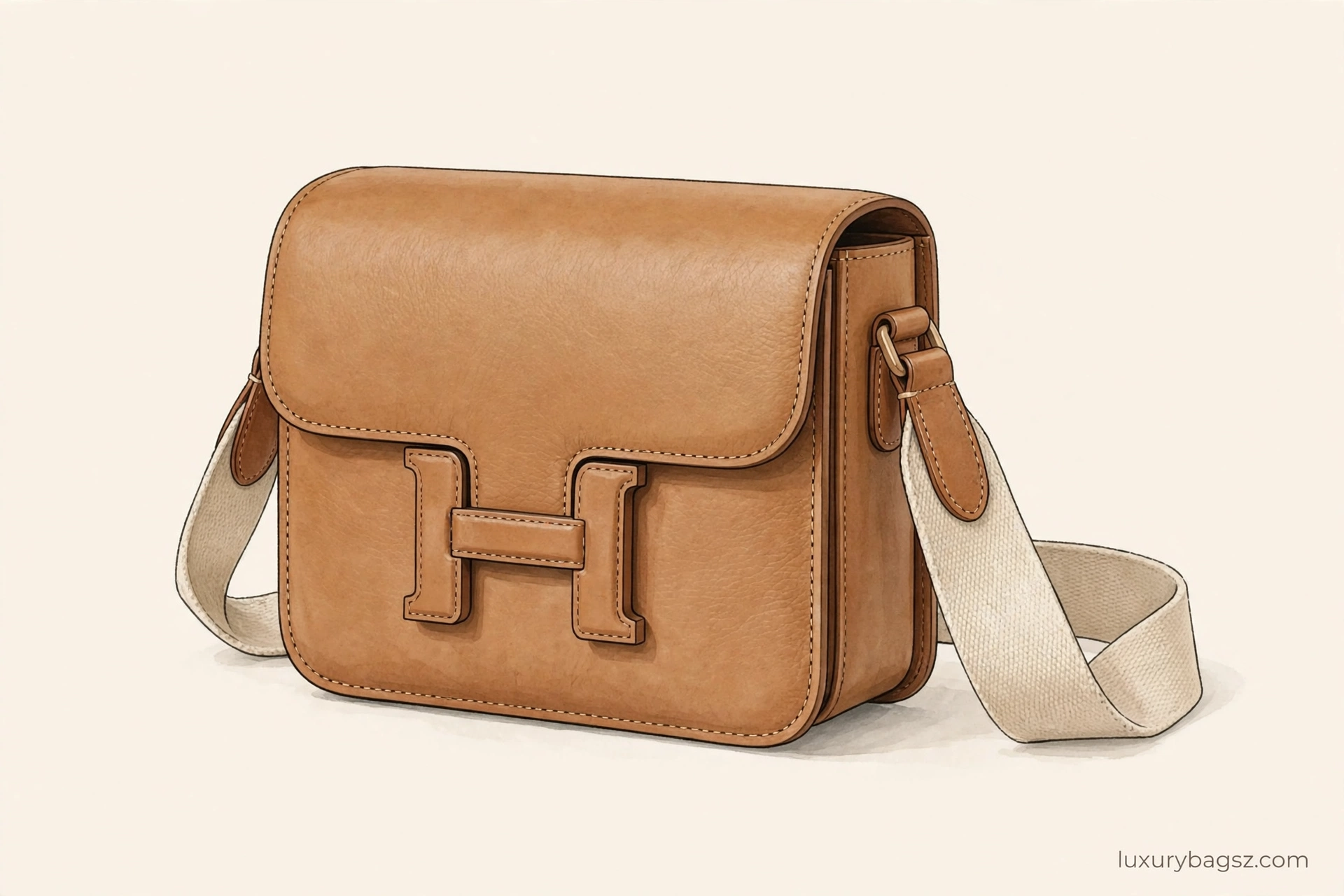
The Hermès Geta is a small, structured, supple messenger bag whose whole design starts with a sound: clickety-clack. That is the sound Japanese wooden geta sandals make on the ground, and, according to Hermès, it is also the sound of this bag’s clasp. The Geta is named after those wooden platform sandals, and its signature detail is a leather-sheathed “H”, extended along its horizontal bar, which does three jobs at once: it is the clasp, it is the strap adjustment system, and it is the feet the bag stands on.
That triple job is what makes the Geta different from every other Hermès flap bag, and it is also what makes it divisive. Owners love the cleverness, the casualness, and the fact that it is not a quota bag. Some owners, just as honestly, struggle with the thick canvas strap, which can take time to adjust and to lay flat, and with a magnetic closure that stays shut in normal use but is not a lock.
This guide gives the sizes, leathers, prices, what fits, real vs fake checks, condition, care, and a pre-owned buying checklist, with the dimension and price conflicts stated plainly, because Hermès lists the bag in centimetres and inches across markets, listings measure it differently, and resale prices for rare colours are premiums, not market averages.
Key Takeaways
- The Geta is named after Japanese wooden platform sandals (geta), and its expanded, leather-sheathed “H” closure is a magnetic clasp, a strap slider, and the bag’s feet in one — the bag rests on the bottom of the H plaques, not on its base.
- Hermès’ current official dimensions for the standard Geta are L 20 x H 15 x D 7 cm, with an adjustable fibre canvas shoulder strap of 61–120 cm, worn over the shoulder or across the body. Other listings give 20 x 14 x 6.5 cm, 20.5 x 14 x 7 cm, or 8 x 5.5 x 2.5 inches — handmade variation and different measuring points, not different bags.
- A separate Geta slim version exists in Epsom calfskin at L 23 x H 14 x D 5 cm, with a shorter strap of 49–97 cm. Do not price or size a standard Geta from a slim listing.
- Main leathers are Mysore goatskin (Chèvre Mysore), Evercolor calfskin, and Epsom calfskin (slim). Mysore becomes more supple and satiny with age; Evercolor softens and becomes shinier; Epsom keeps a fine, regular, slightly glossy grain.
- Retail reported for the standard Geta in Chèvre is $5,800 US, according to PurseBlog’s guide (first published 2022, updated 2026), and £5,190 on Hermès’ UK product page (shown out of stock). Resale listings for rare colours run far higher — $8,500 and $13,500 in two listings seen — and those are asking premiums, not a market average.
- The Geta is not a quota bag, according to PurseForum owners, so asking at a boutique is a real route, unlike for a Birkin or Kelly — though stock still varies by colour and leather.
- It fits a phone, compact wallet, keys, cardholder, lipstick and AirPods, with room to spare over a Mini Constance but less than a Mini Lindy, according to owner comparisons. It does not fit a water bottle, a full-size wallet flat, or a tablet.
- The magnetic closure is convenient but not secure: owners report it stays shut in normal use, but it will open if the bag is shaken hard. Treat it as a flap bag for calm days, not a locked bag for a crowded commute.
Everyone photographs the Geta’s H; I thread its strap. The canvas strap adjusts through that leather-sheathed H, so I slide it back and forth and feel how the mechanism grips and releases — smooth travel with a firm hold is the genuine behaviour, and it is very hard to fake cheaply. While the strap is moving I watch the sheathing for lifting edges. I examined the Geta’s clasp closely in our fake-spotting guide as well, and the strap test is its natural partner: a bag whose whole design is one mechanism should be judged by working that mechanism, not by admiring it.
Quick Second Answer
What is the Hermès Geta bag? A small, structured messenger bag in Mysore goatskin or Evercolor calfskin, named after Japanese geta sandals, closed by an expanded leather-sheathed “H” that is also its strap adjustment and its feet.
How much is it? $5,800 US reported for Chèvre, £5,190 on Hermès UK (out of stock at check). Pre-owned prices vary wildly by colour — compare same-leather, same-colour listings, not rare-colour premiums.
What fits? Phone, compact wallet, keys, cards, lipstick, AirPods. More than a Mini Constance, less than a Mini Lindy. Not a bottle, not a tablet, not a full wallet flat.
Is it a quota bag? No, according to owners — but that does not mean your colour is in stock.
Is it worth buying pre-owned? Yes, if you love the casual H design, you accept a thick canvas strap that takes getting used to, and you have checked the H marquetry, the magnetic mechanism, the strap, and the blind stamp. No, if you need a handheld bag, a lock that truly locks, or a strap you can swap — the Geta has none of those.
What should you check first? The H closure (tone-on-tone marquetry, magnet, sliding action), the leather grain for the claimed leather, the canvas strap (thickness, wear, pilling), the interior pockets, the blind stamp, and whether the price matches the size and leather — not a rare-colour premium.
What the Geta Actually Is
The Geta is a compact, symmetrical messenger bag, built like a small box, closing with a click. Its front and back look almost identical, except that the H plaque on the back is for appearance only — the back does not open. There are no conventional feet on the base: instead, the extended H plaques on the front (and the matching plaque on the back) act as a pedestal, lifting the bottom of the bag off the surface you set it down on.
Hermès describes it this way: the leather-sheathed “H”, extended along its horizontal bar, serves both as a clasp, a strap adjustment system and as studs on the base of the bag, like a pedestal. The innovative magnetic clasp also folds down securely to keep belongings protected, and it slides to adjust the shoulder strap. Because the bag is handmade, Hermès warns that its stated dimensions may vary.
The bag was unpacked as a new Hermès design in May 2022 coverage, and it was presented as one of the centrepieces of a collection inspired by resilience and strength. That makes it a genuinely recent Hermès design, not a vintage or archive revival — which matters for buying, because there is no decades-long pre-owned price history to lean on, and because fakes arrived quickly, with replica listings already offering “handmade” Geta copies.
Geta vs Constance vs Mini Lindy
- Geta: Small box messenger, leather-sheathed expanded H, magnetic closure, canvas strap, no handle, casual, non-quota, about $5,800. See our guide to the Constance bag for the formal H-clasp comparison.
- Constance: Structured flap shoulder bag with a large, visible H clasp, leather strap, more formal, quota-disputed, Mini 18 about $9,700 retail. Owners call the Geta a “casual cousin” to the Constance — same H idea, much quieter execution.
- Mini Lindy: Softer, slouchier, larger capacity than the Geta, according to owner comparisons that place the Geta between a Mini Constance and a Mini Lindy for what it holds.
- Colorado (discontinued): One guide argues the Geta looks like a cross between the Constance and the discontinued Colorado, not a straight Constance copy.
The Versions: Standard, Slim, and Verso
Standard Geta
- What it is: The main Geta, in Mysore goatskin or Evercolor calfskin, with tone-on-tone leather marquetry on the H closure, one main compartment, two interior flapped pockets (one divided into two parts), and an adjustable fibre canvas shoulder strap.
- Dimensions: L 20 x H 15 x D 7 cm on Hermès’ current product pages, strap 61–120 cm without the snap hook. In inches, Hermès US gives 7.9 x 5.9 x 2.8 inches, strap 24–47.2 inches. Other listings give 20 x 14 x 6.5 cm or 20.5 x 14 x 7 cm, and one owner-measured interior is 19 cm wide, 11 cm high, 6 cm deep. Treat the official 20 x 15 x 7 cm as the headline, and the rest as handmade and measuring variation.
- Hardware: Yellow gold plated or palladium plated, depending on colourway, with the metal inset in leather matching the bag.
- Wear: Over the shoulder or across the body, by the canvas strap only — there is no top handle and no place to add a different strap.
Geta slim
- What it is: A separate, slimmer Geta in Epsom calfskin, with the same H closure and tone-on-tone marquetry.
- Dimensions: L 23 x H 14 x D 5 cm, strap 49–97 cm — longer and flatter than the standard, with a shorter strap range.
- Warning: A slim listing must not be used to price, size, or judge a standard Geta. If a listing says 23 cm long and 5 cm deep, it is almost certainly the slim, not the standard.
Verso and colour versions
- What they are: Two-tone Verso versions, for example Blue Brume with a Craie interior, seen in owner reports, plus single colours including Caramel, Etoupe, Mauve Sylvestre, and Vert Fizz in listings and owner posts.
- Warning: A Verso interior colour is not a defect and not a lining change — it is the version. Check the listing’s exterior and interior colours separately, and do not assume a Verso bag’s interior should match its exterior.
What is not a Geta
- Constance: A different bag with a large, exposed H clasp and a leather strap — see the comparison in Section 2.
- Evelyne: A different bag with a perforated H and a canvas strap. The Geta’s strap feels similar to an Evelyne strap, owners say, but the bag is not an Evelyne.
- A “Geta tote”: Replica and low-price listings use “Geta tote” for bags that are not the Hermès Geta at all. A tote shape, a $109 price, or a “tote handbag” title is a warning, not a version.


Materials: Mysore, Evercolor, and Epsom
For general Hermès leather-origin principles, including which countries make leather for Hermès bags, see our guide to Hermès leather — the same “no single country” principle applies to the Geta’s leathers.
Mysore goatskin (Chèvre Mysore)
Hermès says Mysore goatskin’s name comes from a southern Indian town, its grain is obtained by boarding (rolling the leather against itself, grain against grain), it first appeared in the collections in the 1990s, it has an irregular but harmonious grain with a slight shine that shows the natural features of goatskin, and it becomes more supple and satiny over time. For the Geta, that means a soft, slightly shiny goatskin that breaks in nicely, but that will show its natural grain variation — a perfectly uniform, plastic-like grain on a “Mysore” listing is a warning.
Evercolor calfskin
Hermès says Evercolor is complementary to Evergrain calfskin, with a similar suppleness and a wide palette of “forever” colours, first appeared in 2012, satiny, with a small, regular grain obtained by printing, more visible grain than Evergrain, supple and soft in hand, and it softens and becomes shinier over time. For the Geta, Evercolor reads slightly more regular and satiny than Mysore, and it will shine up with wear — check for shine and softening on pre-owned Evercolor, and do not mistake normal softening for damage.
Epsom calfskin (slim)
Hermès’ Epsom description, on the slim Geta page, notes a fine, regular, slightly glossy grain obtained by machine-printing, uniform, deep colours, named for a town in south-east England famous for horse races, first appeared in 2004. For the slim, Epsom gives a more structured, printed-grain feel than Mysore or Evercolor. Do not expect a slim in Epsom to feel like a standard in Mysore.
Canvas strap, hardware, and interior
- Strap: Adjustable fibre canvas, like an Evelyne strap but thick, according to owners. Light-coloured straps can pick up dirt, and one owner reports very mild pilling where the strap rubbed a jacket seam. Check strap thickness, edge wear, and pilling, not just length.
- Hardware: The H closure is leather-sheathed with tone-on-tone marquetry, in yellow gold plated or palladium plated metal. The metal should be inset cleanly, not proud, rough, or peeling to a different metal.
- Interior: Lined in matching leather (or the Verso contrast colour), with one main compartment and two interior flapped pockets, one divided into two parts. Other listings describe a back slip pocket and two front card slots — the pocket count varies slightly by description, so photograph the pockets rather than relying on a count alone.

Sizing, Fit, and What Fits
What fits in a standard Geta
Owner photos and comparisons agree on the essentials: phone, compact wallet or cardholder, keys, lipstick, AirPods, and a few small extras. The interior, owner-measured at about 19 x 11 x 6 cm, is roomy for a small bag, and owners say it holds definitely more than a Mini Constance, but not quite as much as a Mini Lindy.
What does not fit
- A water bottle (too tall, and the magnetic flap is not a bottle-proof closure).
- A full-size wallet flat (it will fight the box shape and push the flap out).
- A tablet, a Kindle in a thick case, or a large sunglasses case plus a wallet together.
- Anything you need to grab one-handed while running — the flap needs a deliberate click shut, and the bag has no handle to grab.
Why listings give different dimensions
- Launch coverage: PurseBlog’s 2022 coverage gave 8.5 x 5.1 x 2 inches — roughly 21.6 x 13 x 5.1 cm — which matches the official 20 x 15 x 7 cm in no dimension. Treat the official figure as the reference and the 2022 figure as early coverage, not as a second size.
- A 21.5 x 13 x 5 cm listing: one listing for a Mauve Sylvestre Geta used these figures, which sit closer to the slim’s profile, yet listed the bag simply as a Geta. Do not use a single listing as a size reference — ask the seller which version it is.
- Strap drop vs strap length: some listings give strap drop (how far the bag hangs) and some give total strap length. The standard’s 61–120 cm is a length range; a “20-inch drop” in an older guide is a different measurement. Do not compare a drop to a length.
- The rule: if a listing’s dimensions match neither official version, ask the seller to confirm the version and to measure length, height and depth in that order, with the bag empty and standing. If they cannot or will not, do not use that listing as a price reference.
How it carries
- Crossbody: The strap adjusts long enough for crossbody wear, and most owners wear it that way.
- Shoulder: Shorten the strap to shoulder length; the canvas strap is comfortable but thick, and on a petite frame the width can feel like a lot of strap for a small bag, according to one owner who passed on the bag for that reason.
- Handheld: Not a handheld bag. There is no handle, and owners are explicit: “It’s definitely not a handheld bag,” and there is no place to add a different strap or make it handheld.
- Adjusting the strap: This is the Geta’s most reported quirk. One owner took about 20 minutes to get the strap to a setting, then found it did not lay flat at the bottom and bulged at the back. Others say it gets speedy once you find your method, and some ask their sales associate to set the strap in store and then never change it. Try the adjustment in store, or set it once at home and leave it.
Price: What the Geta Actually Sells For
Prices below are from guides and listings seen during research. They are not a live price check, and they are not a valuation for a specific bag. A bag’s price depends on its version (standard vs slim), leather, colour, hardware, condition, and date stamp. Always check the individual listing.
Retail
- Standard Geta, Chèvre, United States: $5,800, according to PurseBlog’s guide.
- Standard Geta, United Kingdom: £5,190, on Hermès’ UK product page, shown out of stock at check.
- Geta slim, Epsom: No retail price verified in the sources above — do not use the standard price for a slim.
Retail price history: $5,800 was the 2022 launch price
The $5,800 figure above is the launch price, not today’s price. The history found in guides and price lists runs like this:
- 2022, launch coverage: $5,800 US in Chèvre (PurseBlog). This is the figure most older articles still quote.
- 2023 guide: $5,950 US and €4,550 — already $150 above the launch figure a year later.
- January 2026 increase: one 2026 price-increase tracker records the Geta moving from $7,250 to $7,650 in the US, a rise of $400 (5.5%), as part of Hermès’ January 2026 annual increase.
- 2026 non-quota price list: $7,650 US and €5,300 in Europe for the standard Geta in Evercolor and Chèvre Mysore, and the same $7,650 and €5,300 for the Geta slim in Epsom. In that list, neither the version nor the leather changes the retail price, and no separate retail figure for gold versus palladium hardware was found.
Quoting $5,800 as today’s retail understates it by $1,850 against the 2026 figure, and makes a normal pre-owned price look like a premium. The UK figure of £5,190 above came from a page that was out of stock when checked and may predate the January 2026 increase — check the UK price on the day, and do not convert the US price and call the result the UK price, because Hermès does not price by straight conversion.
Secondary and listing prices (not averages)
- Caramel Chèvre, gold hardware, pristine: One variant listed at $8,500 in a reseller’s variant table.
- Mauve Sylvestre Mysore, palladium hardware: $13,500, out of stock, on a curated reseller page — a rare-colour premium, not a market price.
- Caramel, Singapore listing: S$6,800, brand new, in one Carousell listing.
- Etoupe Mysore, yellow gold plated buckle, brand new full set: S$15,288 in another Carousell listing — again, a single listing, not an average.
- Replica and “tote” listings: $709 for a “handmade” replica Geta, and $109.99 for a “Geta tote” — these are not Hermès prices, and a genuine Geta at those prices does not exist.
What the price range tells you
The range — $5,800 retail, £5,190 in the UK, and $8,500–$13,500 for rare-colour resale listings — is the point. There is no single pre-owned price for a Geta, because a standard Chèvre in a common colour, a Verso version, and a Mauve Sylvestre premium are three different markets. A bag at a price far below retail with no condition reason, or at a replica-site price, is a warning, not a find. A bag at a price in the retail-to-modest-premium range from a reputable reseller, with clear photos and returns, is a much safer buy.
Pre-owned prices by condition (listings found, not averages)
Pre-owned Geta prices are clusters by condition, not one range. The bands below come from listings found in research; they are not averages, not a price index, and several listings were already out of stock when checked.
- Used standard Getas: roughly $3,825–$5,600. The lowest used figure found was a used Nata Chèvre Mysore at $3,825. A used Etoupe 2023 at $4,250 had fallen through $4,500, $4,750 and $5,000 in its own price history — a single listing’s price can fall over months, and the same colour can appear at $4,250 and $5,690 in different listings without either being wrong.
- Excellent standard Getas: roughly $4,250–$7,905. Examples include a 2025 Evercolor in brown at $6,750 with no inclusions stated, a pristine Blue Jean with palladium hardware at $7,500, and an excellent Nata at $7,905. A lower price with no box or dust bag is not the same value as the same price with a full set.
- Pristine or new standard Getas: roughly $7,500–$10,750. These sit at or above the $7,650 retail figure. That happens when a colour is scarce, or when the seller is a high-end reseller with authentication and returns — a price above retail needs a reason, and is not on its own proof of value.
- Rare-colour premiums: $12,500–$15,950 in single listings. A Mushroom Mysore in good condition at $12,500, the Mauve Sylvestre at $13,500 above, and a Béton Mysore in good condition at $15,950. These are single listings for specific colours, not a market price for any Geta — a common-colour bag does not become worth $13,500 because a Mauve Sylvestre listing was.
- Geta slim pre-owned: roughly $7,500–$9,315 in listings found. Black Epsom examples: $7,500 new, $8,100 at Sotheby’s in 2026, and $9,315 in a marketplace listing. Judge the $9,315 against other slim listings, not against the struck-through “original” price shown beside it — struck-through marketplace prices are not reliable references.
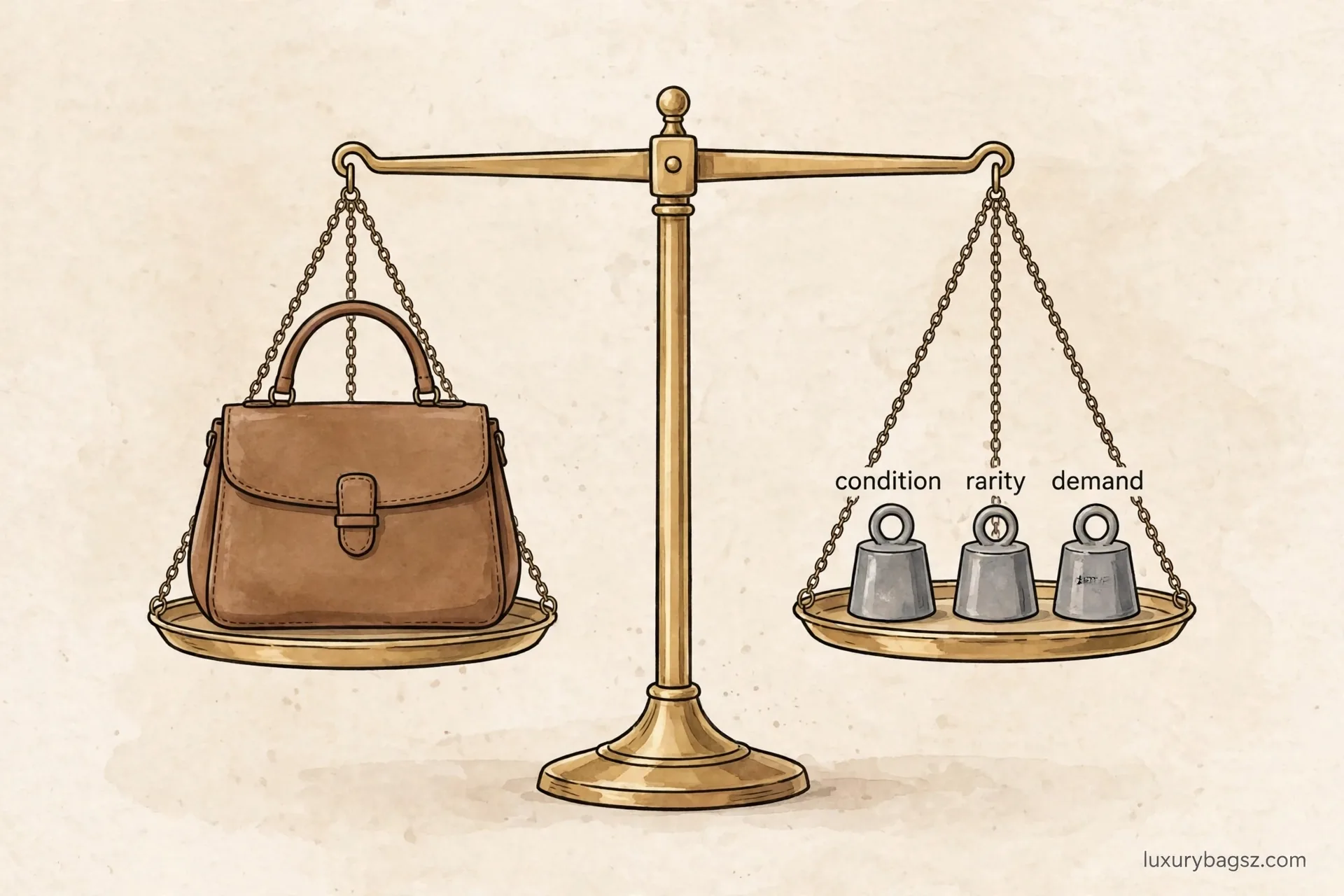
What moves a pre-owned Geta price, in order
- Version: standard vs slim. Never mix them.
- Colour: neutrals (black, Etoupe, Nata, gold) sell steadily; rare colours can command large premiums, but only for that colour.
- Condition: pristine and new command the most, excellent is the middle, and good or used falls — sometimes sharply, especially with corner wear, flap-edge wear or strap soiling.
- Inclusions: box, dust bag, care booklet and felt matter. A bag with no inclusions at $6,750 is not the same deal as a full-set bag at $6,750.
- Seller: a reputable reseller with authentication, clear photos and returns can charge more than a private seller with one photo and no returns — and that premium can be worth paying.
- Hardware and stitching: palladium versus gold, and white contrast stitching on colours like Blue Jean, affect desirability, but no consistent hardware premium was quantified in the listings found. Do not let a seller invent one.
Real vs Fake: Geta-Specific Checks
Hermès bags are widely counterfeited, and the Geta, as a recent, recognisable, non-quota bag, is a prime target — replica sites already list it by name. Use the checks below together, never one alone. For general Hermès authentication principles, including blind stamps, stitching, and hardware, see our guide to fake Hermes Kelly — the same blind-stamp, stitching, and hardware principles apply, with extra Geta checks below. For general authentication discipline, see our guide to fake Rolex — the principle is the same: no single check proves a piece.
The H closure must be right
The H should be leather-sheathed, tone-on-tone, with marquetry that matches the bag’s leather, and it should extend along its horizontal bar. The magnet should click shut firmly, and the H should slide to adjust the strap. A plastic-looking H, a metal H with no leather sheathing, a magnet that barely holds, or an H that does not slide is a warning. The back plaque should look like the front but do nothing — if the back “opens”, it is not a Geta.
The feet must be H plaques, not studs
A genuine Geta has no conventional feet. It rests on the bottom of the H plaques. A bag with four round metal studs on its base, or with a flat base that sits directly on a table, is a warning.
The leather must match the claim
Mysore should be irregular-grained goatskin that softens and turns satiny; Evercolor should be satiny calfskin with a small, regular printed grain; Epsom (slim only) should be fine, regular, slightly glossy printed grain. A “Mysore” bag with a uniform plastic grain, or an “Evercolor” bag that is stiff and matte like cardboard, is a warning.
The stitching must be right
Hermès stitching is saddle stitching, done by hand with two needles working in opposite directions through pre-punched holes, by a single artisan, according to a reseller’s description of Hermès craftsmanship. Machine stitching, uneven stitches, loose threads, or a thread colour that does not match the leather are warnings, especially at the flap, the H attachments, and the strap ends.
The blind stamp and Made in France mark must be right
Hermès bags carry a blind stamp for the year and a “Hermès Paris Made in France” stamp, in a specific font and placement. Check the blind stamp in photos and compare it with reputable listings for the same year. A misspelled stamp, a blurry stamp, or a stamp in the wrong place is a warning. Note: Hermès issues no authenticity cards — a card is a red flag, not a proof, as noted in our Kelly guide. One replica listing’s promise of a “certificate card” is itself a warning.
The canvas strap must be right
The strap should be thick fibre canvas, adjustable through the H mechanism, with clean edges and no fraying beyond normal wear. A thin nylon strap, a leather strap presented as original, or a strap that cannot be adjusted through the H at all is a warning.
The interior must be right
The interior should be lined in matching leather (or the Verso contrast), with one main compartment and two flapped pockets, one divided. A fabric lining, a vinyl lining, glued pocket edges, or pockets that gape are warnings.
Price and seller as a check, not a verdict
A bag at $709, $109, or far below retail from a seller with no history and no returns is a warning, not a bargain. A price in the retail-to-modest-premium range from a reputable reseller, with clear photos and returns, is a much safer buy.
What not to rely on
- A seller’s claim of “rare” without a version (standard vs slim), leather, colour, and date stamp to support it.
- A single front photo, with no close-ups of the H, the strap mechanism, the base, the interior, or the blind stamp.
- A celebrity or editorial photo of a Geta, which proves the bag exists, not that the listing’s bag is genuine.
- A “Geta tote” listing, which is not the Hermès Geta at all.
Condition Checklist for the Geta
Use this checklist on the listing photos, and ask the seller for any photo that is missing.
- Leather: Grain for the claimed leather, scratches, corner wear, softening and shine (normal for Mysore and Evercolor, but check for uneven shine or damage).
- H closure: Marquetry condition, magnet strength, sliding action, metal inset, and any peeling or rough edges.
- Base: The H plaques as feet — scratches, wear, and whether the bag still sits level on them.
- Strap: Canvas thickness, edge wear, dirt (especially light colours), pilling, and whether it still adjusts and lays flat.
- Stitching: Evenness, slant, thread colour, and loose threads, especially at the flap and strap attachments.
- Blind stamp: Legibility, correctness for the year, and placement.
- Interior: Leather lining condition, pocket condition, dirt, stains, and odour.
- Corners and edges: Wear, scuffs, and colour loss, especially at the box corners.
- Box and dust bag: Present and photographed, not just mentioned, including the strap dust bag where included.
If a listing does not show a condition point above, that is not proof the bag is bad, but it is a reason to ask before you pay.
Care and Storage by Material
Mysore goatskin
- Clean gently with a soft, dry cloth. Do not use harsh cleaners, water, or conditioners not made for goatskin, which can darken or stain it.
- Keep out of prolonged direct sunlight and heat, which can fade colour and dry leather.
- Store in a dust bag, in a cool, dry place, with light tissue support so the box shape is not crushed, but not stuffed so tightly that the flap is forced open.
Evercolor calfskin
- Clean gently with a soft, dry cloth, and keep out of prolonged sunlight and heat, as with Mysore.
- Expect softening and increased shine with wear — that is the leather’s normal change, not damage. Store with tissue support, in a dust bag, so the shape is kept.
Epsom calfskin (slim)
- Clean gently with a soft, dry cloth, and keep out of prolonged sunlight and heat.
- Store upright with support, in a dust bag, so Epsom keeps its structured, printed-grain shape.
Canvas strap
- Brush off surface dirt gently with a soft, dry brush or cloth. Do not soak the strap, and do not use harsh cleaners that could transfer colour to the leather.
- For light-coloured straps, check for dirt and colour transfer after wear, and store the strap so it does not rub against a rough jacket seam, which one owner linked to mild pilling.
Hardware and H feet
- Clean hardware gently with a soft, dry cloth. Do not use metal polishes, which can damage plating.
- Store with tissue between the H plaques and other items, so the plaques do not scratch leather or other bags. For general bag storage principles, see our guide to store Hermes Kelly — the same cool, dry, no-stacking principles apply, with extra care for the box shape.

Buying Pre-Owned Safely: The Photo Checklist
Ask for, or check for, these photos before you pay. A seller who cannot provide them is a seller to be cautious about.
- Front, back, both sides, and top of the bag, not just one angle.
- Close-up of the H closure, showing marquetry, magnet, and sliding mechanism.
- Close-up of the leather grain, showing texture for the claimed leather.
- Close-up of the base, showing the H plaques as feet.
- Close-up of the canvas strap, showing thickness, edges, and adjustment.
- Close-up of stitching at the flap and strap attachments.
- Close-up of the blind stamp and Made in France mark.
- Interior photos, showing lining colour and both flapped pockets.
- Box, dust bag, and paperwork, if included, photographed with the bag.
- A photo of the bag with items inside for scale, so you can judge the standard vs slim size.
Buying rules
- Buy from a reputable reseller with a clear returns policy, or from a seller with a strong, checkable history.
- Compare at least two or three listings for the same version and leather before you pay, so you know the range and do not mistake a rare-colour premium for a market price.
- Do not pay by unprotected transfer, especially for a bag in excellent condition or a popular colour.
- If a listing price is far below retail, ask why. A condition reason can explain a low price. No reason given is a warning.
- For a high-value bag, consider an independent authentication service before the return window closes, not after it.
For pre-owned buying generally, the same discipline applies to other Hermès bags — our guides to In the Loop 18, Silkycity 33, and Picotin Lock 18 work through the same photo, condition, and returns checks for other modern Hermès bags, and our guides to clean Chanel bags, suede brush, Saphir Renovateur, and dress shoes cover the same care-first buying discipline for other materials.

Frequently Asked Questions
What is the Hermès Geta bag?
A small, structured messenger bag named after Japanese geta sandals, closed by an expanded leather-sheathed “H” that is also its strap adjustment and its feet.
How much is a Hermès Geta bag?
$5,800 US reported for Chèvre, £5,190 on Hermès UK (out of stock at check). Pre-owned prices vary by version, leather, and colour — rare colours list far higher.
What size is the Geta?
Standard: L 20 x H 15 x D 7 cm, strap 61–120 cm. Slim (Epsom): L 23 x H 14 x D 5 cm, strap 49–97 cm. Other listings vary by a centimetre or so from handmade variation.
Is the Geta a quota bag?
No, according to owners — but stock still varies by colour and leather.
Does the Geta have a handle?
No. It is carried by its adjustable canvas strap only, over the shoulder or across the body.
Does the Geta lock?
No, not truly. Its magnetic H closure clicks shut and stays shut in normal use, but owners report it opens if shaken hard.
What is the Geta made of?
Mysore goatskin or Evercolor calfskin for the standard, Epsom calfskin for the slim, with a fibre canvas strap and yellow gold plated or palladium plated H hardware.
Is the Geta better than the Constance?
It depends. The Geta is more casual, quieter, and non-quota, with a canvas strap and a magnetic closure. The Constance is more formal, with a large H clasp and a leather strap. Choose by formality and carry, not by name alone.
What should I ask a seller before buying?
Ask for the ten photos in Section 10, the exact version (standard vs slim), leather, colour and interior colour, blind stamp, strap condition, and returns policy. If any of those are refused, reconsider the purchase.
The Geta, Judged the Way It Was Designed
The Hermès Geta is worth buying pre-owned if you buy it for what it actually is: a small, clever, casual box bag, named for a sandal, closed by an H that does three jobs, in a size that holds the essentials and nothing more, at a price that is accessible by Hermès standards, without quota-bag scarcity, and without a lock that truly locks.
Buy it if you love the quiet H design, you have verified the marquetry, the magnet, the strap mechanism, and the blind stamp, you have seen close-up photos of the H feet and the interior pockets, and you accept a thick canvas strap that takes getting used to, no handle, and a flap that needs a deliberate click. Start with a common colour in Mysore or Evercolor, from a reputable seller with returns, before you chase a Verso or rare-colour premium.
Skip it, or wait for a better listing, if the H does not slide or click firmly, the leather grain does not match its claim, the strap is frayed or cannot lay flat, the base plaques are worn unevenly, the blind stamp is wrong or missing, or the price is far below retail with no condition reason. A clever bag bought badly is not a bargain. It is a bag you will either return, repair at cost, or regret.
Bought well, the Geta is one of the most quietly Hermès things you can own: a bag without a handle, a flap without a lock, and feet that are also its clasp. That is the value, and it is worth paying for — once, for the right bag, in the right condition.
For pre-owned buying generally, the same discipline applies to other pieces — our guides to the Cambon bag, VIP gift bags, Richard Prince, Milk Carton bag, Prada chandelier shoes, snail jewellery, Amy ballet shoes, Arty ring, Dior Gambler bag, Gisou hair oil, Glossier perfume, and Huda foundation stick work through the same version, price, condition, and returns checks, and our guides to serial number check and Rolex on finance and Rolex 1908 show how the same authentication and price discipline applies beyond bags.
My own last test is the one the design asks for: I slide the strap through the H and feel the magnet catch, because a Geta lives in that mechanism. After ten-plus years of examining bags, I trust a Geta whose H works beautifully far sooner than one that merely photographs beautifully.