Prada Chandelier Shoes: Spring 2010 Perspex Crystal Mules — Prices and Pre-Owned
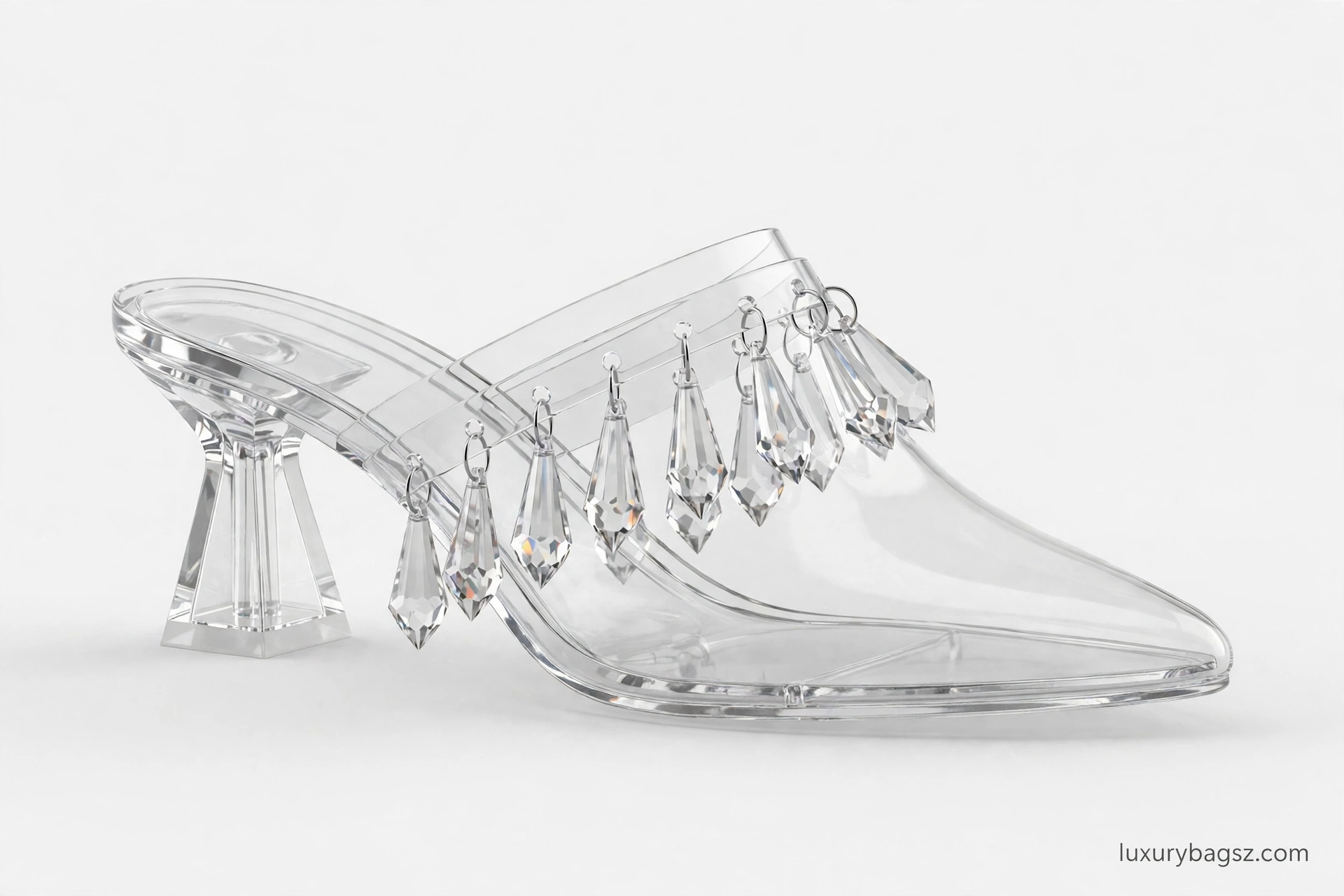
“Prada chandelier shoes” is not a shoe line with a catalogue and a size run. It is a nickname for a moment: Prada’s Spring/Summer 2010 collection, in which Miuccia Prada turned chandeliers into clothes and shoes. The collection’s glitter dress was called, in Italian, “abito lampadario,” the chandelier dress, made from Plexiglass drops connected by a net of small metal rings. The shoes that went with it were just as literal: Perspex (clear acrylic, also called Plexiglass or Lucite) mules and sandals with faceted crystal drops hanging from them, so that every step made the crystals move and catch light, like a chandelier swaying.
That movement is why people still talk about them, and also why they are hard to buy well. Clear Perspex ages. It yellows, it clouds, it spots with humidity and wear. Crystals loosen and fall out. A pair that looked like glass on the runway in 2010 can look cloudy and tired in 2026, and a listing photo taken in bright light can hide that completely.
This guide separates the versions, because “chandelier shoes” covers at least three different shoe types from the same collection, plus later chandelier-inspired dresses that are not shoes at all. It gives the versions, materials, sizing and comfort reality, prices seen in listings, what to wear them with, Prada-specific fake checks, a condition checklist focused on Perspex and crystals, care and storage, and a safe pre-owned buying checklist. Where sources disagree or where a price is for a general category rather than a specific chandelier mule, it says so plainly.
The 60-Second Answer
What are they?
Prada’s Spring/Summer 2010 chandelier shoes: Perspex mules and crystal drop sandals from the chandelier collection, with faceted crystal embellishments that move like a chandelier.
When were they made?
Spring/Summer 2010, under Miuccia Prada. They are not a current line, and they have not been re-released as a new collection.
How much are they?
General Prada crystal shoes on 1stDibs are $144 to $800, and Prada Lucite pieces are $235 to $8,750, but a specific chandelier mule’s price depends on version, size, colour, and Perspex and crystal condition. A collector who found a pair at auction reported a relatively low starting price, but also condition issues, which is the usual trade-off.
Are they comfortable?
No, not for long wear. They are high, clear, and crystal-covered, with a Perspex heel and vamp that do not flex or breathe like leather. They are for a few hours, a photo, or a collection, not for a full day on your feet.
Are they worth buying pre-owned?
Yes, if you love the 2010 chandelier moment, you want a collector’s evening shoe, and you buy a pair whose Perspex is still clear and whose crystals are complete. No, if you want a comfortable, everyday, hard-wearing shoe, or a shoe whose value you expect to rise predictably.
What should you check first?
Perspex clarity (yellowing, clouding, spots), crystal completeness, heel condition, and whether the listing is for a mule, a sandal, or a thong flat, because those are different shoes with different prices and different wear.
What the Spring 2010 Chandelier Collection Actually Was
Prada’s Spring/Summer 2010 show was staged with a wall split along two sides, seven doors opening into it, and a Plexiglass checkerboard floor on one side, according to Prada’s own show description. The clothes played with transparency, shine, and hardware: clear materials, metal rings, and crystals, against more straightforward silhouettes. The chandelier pieces were the extreme end of that idea: taking a household object, a chandelier, and turning it into a wearable, moving, light-catching surface.
Miuccia Prada has a long history of taking unfashionable or everyday things and making them into Prada, from nylon backpacks in 1984 to “ugly chic” in the 1990s. The chandelier collection fits that history: it is glamorous and absurd at the same time, a dress made of lamp drops and shoes made of clear plastic and crystals, worn as if they were normal evening wear. That tension is why the collection is still written about, photographed, and collected, long after it sold out in stores.
The chandelier idea did not stop in 2010. It stayed in people’s minds, and it reappeared in later work: the chandelier dress concept was replicated for The Great Gatsby, for Daisy Buchanan, and in 2014 Prada designed an updated chandelier dress for Lupita Nyong’o to wear to the Met Costume Institute Gala, an emerald green net dress with glass beads, crystals, and chandelier drops, enhanced with cascading feathers. Those later dresses are not the 2010 shoes, but they show why the 2010 collection is still a reference point: it created a visual language that other designers and stylists kept returning to.
The name: chandelier shoes vs chandelier dress vs chandelier outfit
- Chandelier shoes: The Perspex mules, crystal drop sandals, and rhinestone thong flats from Spring/Summer 2010.
- Chandelier dress / abito lampadario: The Plexiglass-drop dress from the same collection, made from drops connected by a net of small metal rings.
- Chandelier outfit (Charitybuzz): A complete outfit description, including the Plexiglass-drop dress worn over a white stretch poplin top, with sandals embroidered with crystals and transparent Plexiglass high heels, listed at $3,000 and sold out. That price is for the outfit as listed, not for shoes alone, and it should not be used as a shoe price.
Keeping those three apart matters for price. A $3,000 outfit, a $391 average crystal shoe, and a specific chandelier mule at auction are three different things.
The Versions: Mules, Sandals, and Thong Flats
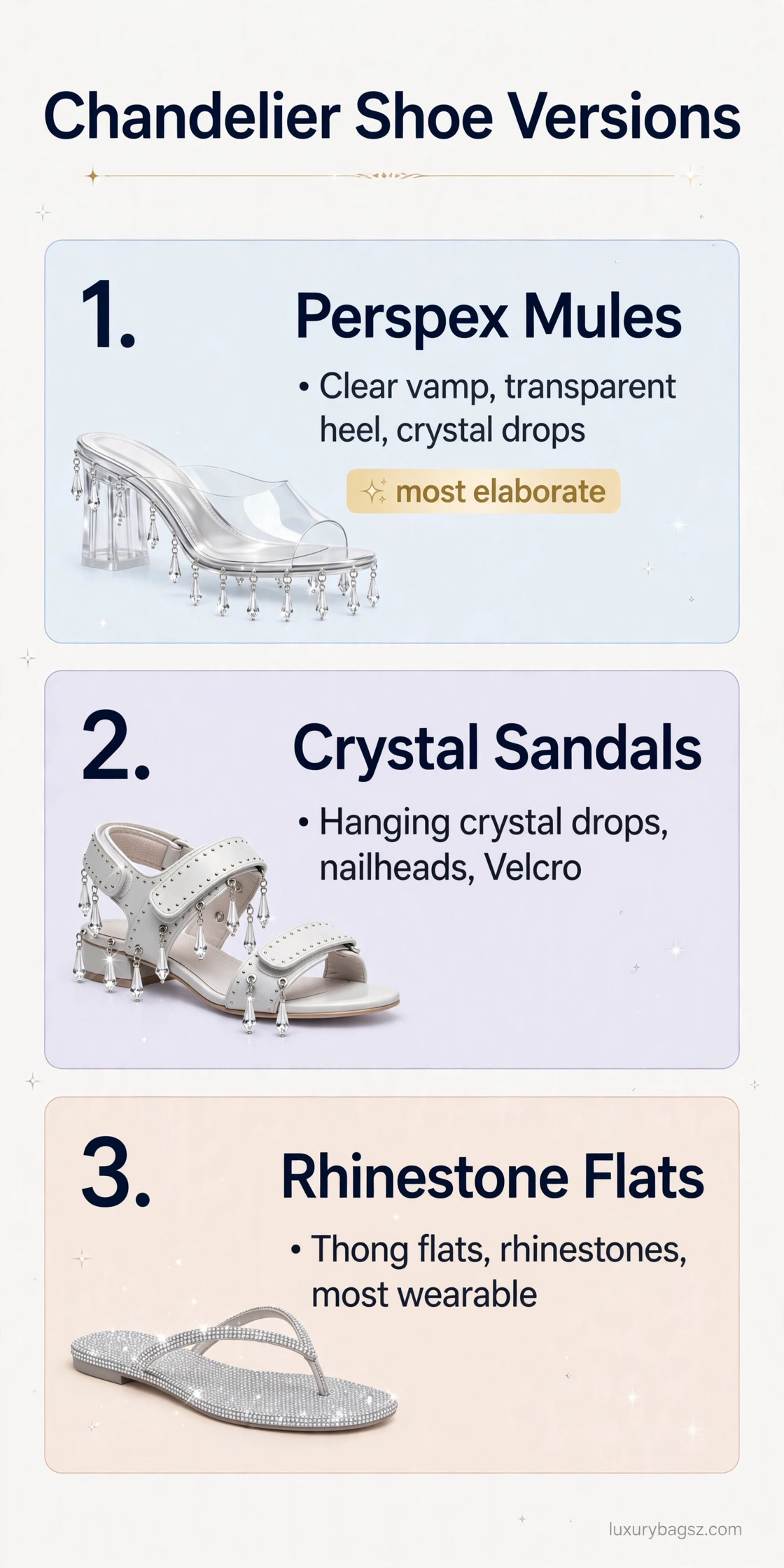
“Chandelier shoes” covers at least three shoe types from the same collection, and they should not be priced or judged as if they were the same shoe.
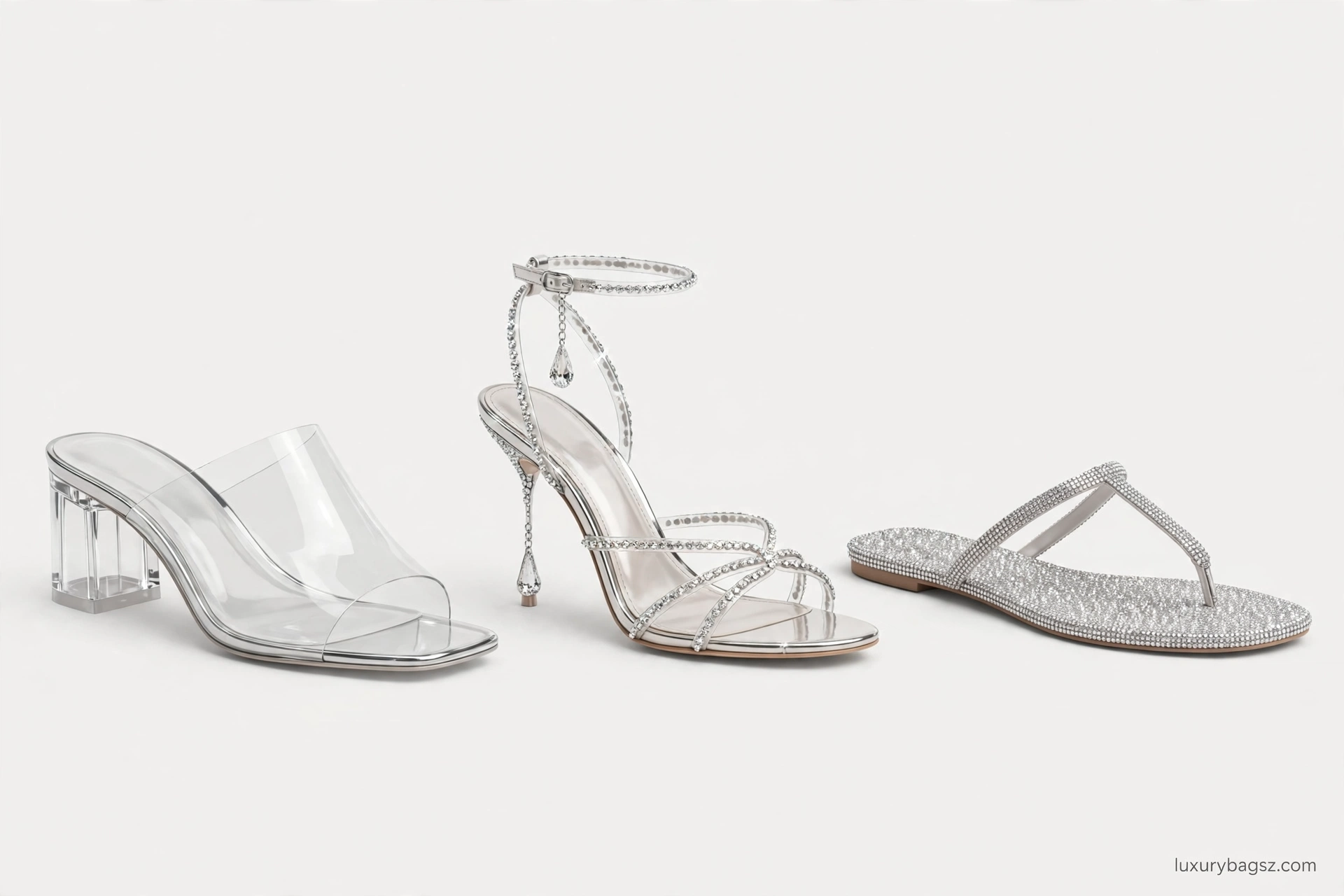
Perspex chandelier mules (the main shoe)
- What they are: Backless mules with a clear Perspex vamp, a transparent Plexiglass high heel, and faceted crystal embellishments that hang and move.
- Look: The most elaborate version, and the one most often photographed on the runway and in editorials. The crystals are the point: they are faceted, they catch light, and they move with every step.
- Colours: The runway and campaign versions come in different heel colours, including green, yellow, and pink, according to collector coverage. A green heel version appears in campaign imagery. Do not assume every chandelier mule is clear or silver; check the heel colour in the listing photos.
- Wear: The hardest to wear for long, because a mule has no back strap, a Perspex vamp does not flex, and crystals add weight and catch on fabric.
Crystal chandelier drop sandals
- What they are: Sandals with crystal chandelier drops, described in a 2010 blog as “crystal chandelier drop sandals from Prada,” with nailheads and Velcro.
- Look: Less elaborate than the mules in some versions, more sandal-like, with a focus on the hanging crystal drops rather than a full Perspex vamp.
- Criticism at the time: The same 2010 blog loved the crystal drop concept but criticised the rest of the shoe, saying the nailheads reminded the writer of 1990s clogs and the Velcro was “painfully present” and detracted from the pendants. That criticism is useful for buyers: a chandelier sandal’s value is in its drops, but its wearability is in its straps, buckles, and sole, which should be checked as carefully as the crystals.
- Availability note: The 2010 blog also noted the shoes did not seem to be available in the US at the time, which is a reminder that chandelier shoes were a limited, seasonal, runway-led item, not a widely stocked line.
Rhinestone thong flats
- What they are: Thong flats with rhinestones, from the same unmistakable collection, according to a collector who bought a pair after buying the mules.
- Look: Flatter, more wearable, and less elaborate than the mules, with rhinestones rather than full chandelier drops.
- Price note: The same collector reported the thong flats were only half the price of the mules they had paid for. That is one collector’s experience, not a market rule, but it shows the expected hierarchy: mules most elaborate and most expensive, flats simpler and cheaper.
- Wear: The most wearable chandelier shoe, because flats do not have a high Perspex heel, but they still have rhinestones that can loosen and a thong strap that fits differently from a mule or sandal.
What is not a chandelier shoe
- Prada Spring/Summer 2008 fairy and orchid shoes: A different collection, with silk velvet, suede, leather, and plastic, orchids on the heels, and a fairy-tale theme, documented by the ASU FIDM Museum. They are Prada, they are 2008, and they are not chandelier shoes.
- Generic Prada crystal pumps: Crystal pumps on 1stDibs, priced $178 to $690, are a general category, not the 2010 chandelier mules. A crystal pump is not automatically a chandelier shoe.
- Prada Flame sandals: A different iconic Prada shoe, from Spring 2012 and revived in Fall 2018, with flame motifs and sculptural wedges. They are collectible, but they are not chandelier shoes.
- Later chandelier dresses: The Great Gatsby chandelier dress and the 2014 Lupita Nyong’o Met Gala chandelier dress are dresses, not shoes, and they should not be used to price or authenticate a 2010 shoe.
Video note: this is a DIY recreation inspired by Prada SS10, not an authentic Prada pair.

Materials: Perspex, Plexiglass, Crystals, and Metal
Perspex / Plexiglass / Lucite
Perspex, Plexiglass, and Lucite are all names for clear acrylic plastic. In the chandelier shoes, it is used for the vamp (the front part of the shoe over the toes) and for the high heel, which is transparent. That transparency is the look: the shoe seems to disappear, leaving only crystals and the foot visible.
Clear acrylic has specific weaknesses that leather does not:
- Yellowing: Clear vamps yellow over time, especially with age, heat, and sunlight. A collector reported that a pair bought at auction had clear vamps that had “yellowed a bit,” which is described as “a given considering its age.”
- Clouding and spotting: Humidity and wear make clear vamps “spotty and cloudy,” according to the same collector. Perspiration, humidity, and storage conditions all contribute.
- Scratching: Clear acrylic scratches more visibly than leather, and scratches catch light, which makes them more noticeable on a transparent shoe.
- Rigidity: Perspex does not flex or breathe like leather. It holds its shape, but it does not mould to the foot, which affects comfort and fit.
Crystals and rhinestones
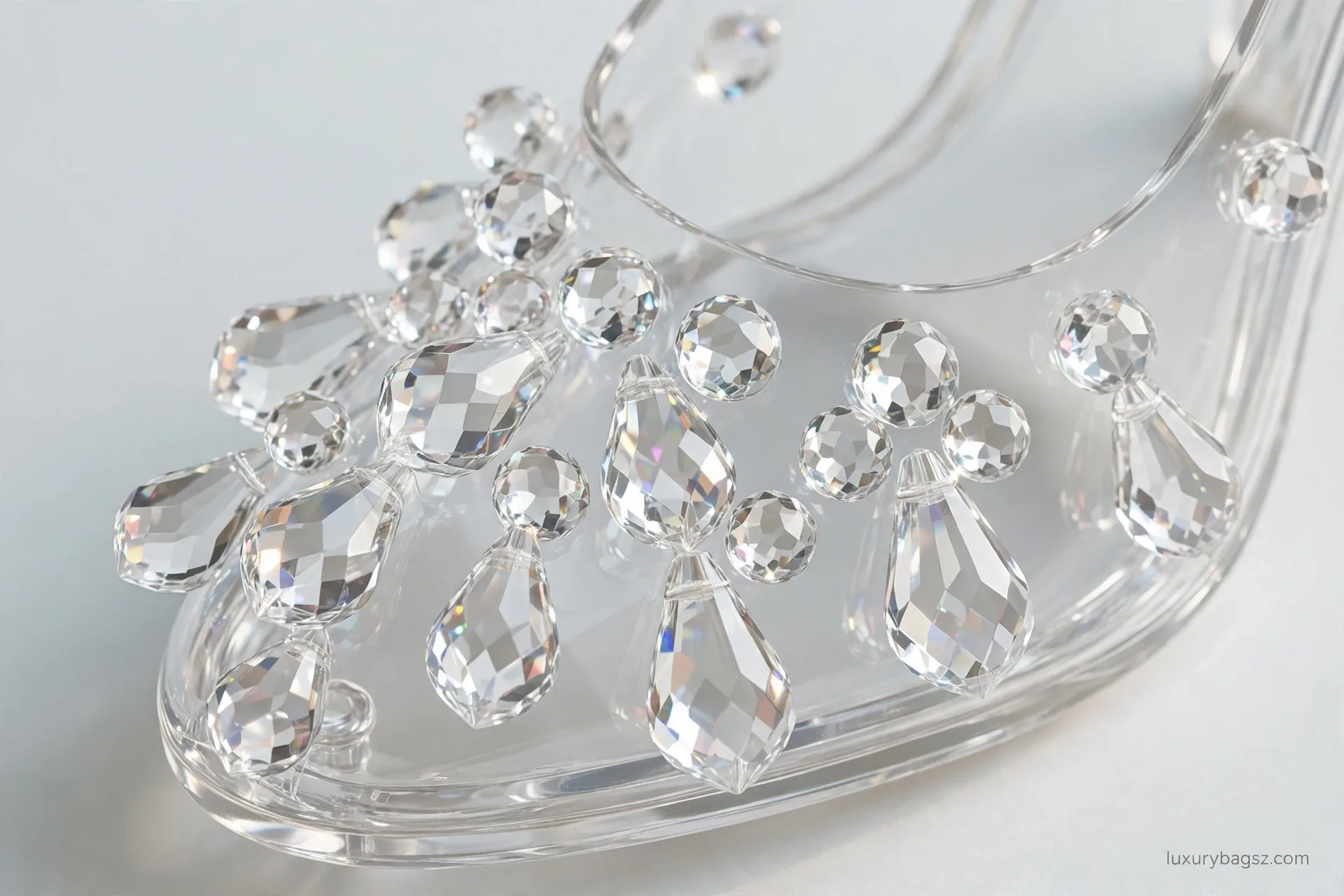
The chandelier shoes use faceted crystal embellishments, and the flats use rhinestones. Crystals are glass or crystal, not plastic, in the more elaborate versions, and they are attached to the shoe in drops, so they hang and move. That movement is beautiful and fragile: crystals can loosen, fall out, chip, or catch on fabric, tights, and other shoes in storage.
Metal rings, nailheads, and hardware
The chandelier dress uses a net of small metal rings to connect Plexiglass drops. The sandals use nailheads and Velcro in some versions. Metal hardware on shoes should be checked for tarnishing, rust (if stored damp), and loose fittings. Velcro, where present, should be checked for wear: Velcro that no longer grips is a functional failure, not just a cosmetic one.
Leather, suede, and lining
Even a Perspex shoe has leather or suede parts: insole, lining, and sometimes a heel cap or strap. Check the insole for wear, the lining for staining, and any leather parts for drying or cracking, as you would for any pre-owned shoe.
Sizing, Fit, and Comfort: The Honest Reality
Prada shoes are sized in EU sizes, and pre-owned listings often give both EU and US sizes. A pair listed as EU 40 is often described as US 10 in one eBay listing for a different 2008 Prada heel, but EU-to-US conversion varies by brand and by shoe type, so always check the listing’s own size, the insole measurement if given, and the seller’s fit notes, rather than converting from memory.
For general shoe fitting principles, including how to measure feet and how fit differs from size, see our guide to dress shoes — the same measure-first, try-in-the-evening, and break-in principles apply, with extra caution for Perspex, which does not stretch.
Fit issues specific to chandelier shoes
- Perspex does not stretch: A leather shoe can break in and mould to the foot. A Perspex vamp cannot. If a chandelier mule is tight across the toes when you first try it, it will stay tight.
- Mules slip: A backless mule relies on the vamp and the foot’s shape to stay on. If the vamp is too loose, the shoe slips; if it is too tight, it pinches. There is no ankle strap to adjust.
- Heel height and transparency: A transparent Plexiglass high heel looks weightless, but it is still a high heel. It does not cushion like a leather or rubber heel, and it can be slippery on smooth floors.
- Crystals add weight and bulk: Hanging crystals add weight to the front of the shoe, which changes how it balances, and they can catch on tights, trousers, and long dresses.
- Heat and sweat: Perspex does not breathe. In warm weather or after a few hours, feet sweat more in a Perspex shoe than in a leather shoe, which contributes to the clouding and spotting noted by collectors.
- Width: Prada shoes tend to run narrow in many styles, according to general fit guidance, but a specific chandelier shoe’s width should be checked in the listing, not assumed from the brand.
Who they suit
They suit a short evening, a photo shoot, a fashion event, or a collection, where the look matters more than comfort. They do not suit a full day on your feet, walking on uneven ground, dancing for hours, or anyone who needs a comfortable, supportive shoe. If you buy them to wear, plan for a few hours, bring a second pair for walking, and check the fit in the evening, when feet are slightly larger, as with any high heel.
Price: What Chandelier Shoes Actually Sell For
Prices below are from listings and category ranges seen during research. They are not a live price check, and they are not a valuation for a specific chandelier mule. A shoe’s price on the day you buy depends on version, size, heel colour, Perspex clarity, crystal completeness, and seller. Always check the individual listing.
Category ranges (not specific chandelier mule prices)
- Prada crystal shoes, 1stDibs: $144 to $800, averaging about $391. This is a general category including many crystal shoe types, not only chandelier mules.
- Prada crystal pumps, 1stDibs: $178 to $690, averaging about $690 in the listing summary, which is itself inconsistent (average equal to the high end), so treat it as a rough range, not a precise average.
- Prada Lucite, 1stDibs: $235 to $8,750, averaging about $595. This is a very wide category, from small Lucite accessories to rare pieces, and its high end should not be used to value a chandelier mule.
Specific prices seen
- Chandelier outfit, Charitybuzz: $3,000, sold out, for the complete outfit including dress and sandals, not for shoes alone.
- Collector auction experience: A collector reported spotting chandelier mules at auction “starting from a relatively low price,” buying them for “a little bit more than what I had budgeted for,” with condition issues (yellowing, spotting, clouding). No exact auction price was given in that account, so it cannot be used as a price point, only as a warning that a low starting price often means condition issues.
- Thong flats vs mules: The same collector reported thong flats at half the price of the mules they had paid for. Again, that is one experience, not a market rule, but it confirms the expected hierarchy.
What the price range tells you
The range is the point, and also the problem. There is no single, reliable, published price for a Prada chandelier mule in a given size and condition, because they are rare, seasonal, and condition-sensitive. A pair with clear Perspex and complete crystals, in a common size, from a reputable reseller, is a different market from a pair with yellowed, cloudy Perspex and missing crystals at auction. A price far below the category range, with no condition reason given, is a warning, not a find. A price far above the range needs a reason: rare heel colour, excellent condition, full box and dust bags, or a provenance story that can be checked.
Real vs Fake: Prada-Specific Checks for Chandelier Shoes
Generic Prada authentication guides help, but chandelier shoes have their own checks, because Perspex and hanging crystals are not found on a normal Prada pump. Use the checks below together, never one alone. For general authentication principles, see our guide to fake Rolex — the principle is the same: no single check proves a shoe, and a shoe that fails several checks should not be bought on a seller’s word alone.
- The shoe must be a 2010 chandelier shoe, not a generic crystal shoe. A real chandelier shoe has a Perspex vamp and heel, faceted crystal drops that hang and move, and a 2010 collection look. A generic crystal pump, a crystal-covered sneaker, or a shoe with crystals glued flat to leather is not a chandelier shoe, whatever the listing calls it. Check the shoe type (mule, sandal, or thong flat) against the versions in Section 3.
- Perspex quality and clarity. Genuine Prada Perspex should be clear (allowing for age yellowing), smooth, and well-finished, with no mould lines, bubbles, or rough edges that suggest cheap acrylic. Perspex that looks like thin, cloudy plastic from new, or that has a yellow tint inconsistent with the shoe’s age and storage, is a warning. Age yellowing is normal; poor-quality acrylic from new is not.
- Crystal quality and attachment. Crystals should be faceted, clear, and securely attached in drops, not flat, dull, plastic-looking, or glued on randomly. Missing crystals are a condition issue; wrong crystals (plastic, wrong size, wrong cut) are an authenticity issue. Check crystals in close-ups, not just in a full-shoe shot.
- Insole, logo, and Made in Italy. Prada shoes should have a clear, well-printed insole logo, correct spelling, and a Made in Italy mark where appropriate for the version. Check the insole in photos, and compare it with reputable listings for the same shoe type. A misspelled logo, a blurry insole print, or a Made in Italy mark in the wrong place is a warning. Do not rely on the insole alone, because counterfeiters copy logos, but a wrong insole is a strong reason to stop.
- Heel, sole, and construction. The Plexiglass heel should be transparent, solid, and well-attached, with no cracks, chips, or wobble. The sole should be leather or the correct material for the version, with even stitching or construction, and no glue overflow. A heel that wobbles, a sole that peels, or construction that looks rushed is a warning, especially on a shoe described as excellent condition.
- Box, dust bags, and paperwork. Original Prada box, dust bags, and paperwork, where included, should be photographed, not just mentioned, and should match the shoe type and size. A box alone does not prove a shoe, because boxes can be bought separately, but a missing box on a high-value pair is a reason to ask and to price accordingly.
- Price and seller as a check, not a verdict. A chandelier mule at a price far below the category range, from a seller with no history and no returns, is a warning, not a bargain. A price in the normal range from a reputable reseller, with clear photos and a returns policy, is a much safer buy, even if it is not the cheapest listing.
What not to rely on
- A seller’s claim of “rare” or “runway” without photos to support it.
- A single photo of the whole shoe, with no close-ups of Perspex, crystals, heel, sole, or insole.
- A celebrity or editorial photo of a chandelier shoe, which proves the shoe exists, not that the listing’s shoe is genuine.
- A general “Prada crystal shoe” listing that does not show a Perspex vamp or hanging crystals.
Condition Checklist for a 2010 Perspex Shoe
A chandelier shoe bought in 2026 is 16 years old. That age is part of its collector value, and also its risk. Use this checklist on the listing photos, and ask the seller for any photo that is missing.
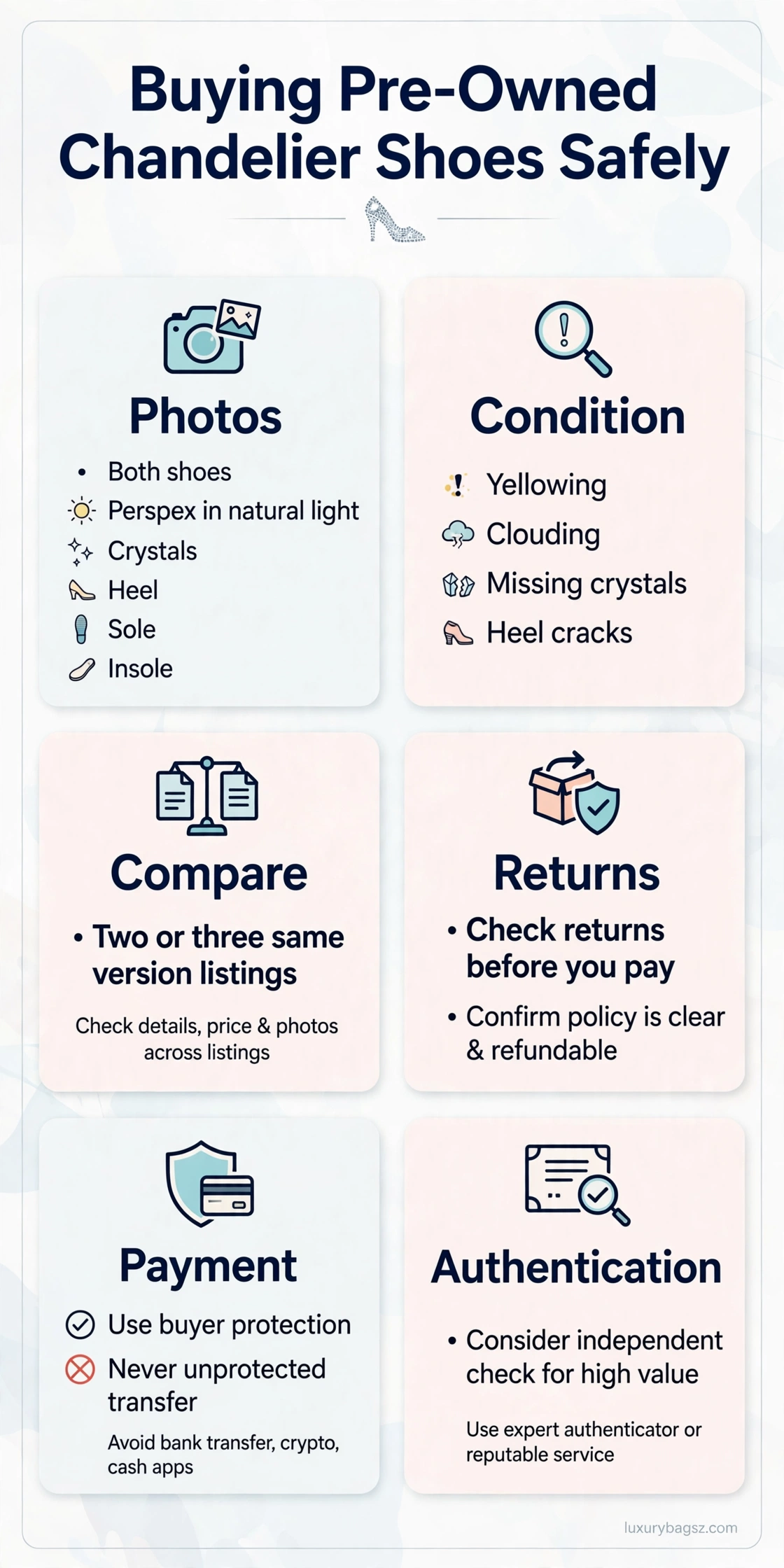
- Perspex clarity: Yellowing, clouding, spotting, and scratches, especially on the vamp. Ask for photos in natural light, not just studio light, so you can judge true clarity.
- Crystals: Missing, loose, chipped, or replaced crystals. Count them in close-ups if you can, and check both shoes, not just one.
- Heel: Cracks, chips, yellowing, wobble, and wear at the heel tip. A transparent heel shows damage more than a covered heel.
- Sole: Wear, peeling, and damage at the toe and heel. A heavily worn sole on a shoe described as unworn is a warning.
- Insole and lining: Wear, staining, odour, and peeling. A clean insole on a 2010 shoe is a plus, not a given.
- Straps and Velcro (sandals): Wear, fraying, and Velcro grip. Velcro that no longer grips is a functional failure.
- Nailheads (sandals): Missing, loose, or tarnished nailheads.
- Thong strap (flats): Wear, stretching, and damage at the toe post.
- Box and dust bags: Are they present and photographed, not just mentioned?
- Odour and storage: A shoe stored in a damp or humid environment can carry odour and clouding that is hard to reverse. Ask how it was stored if the listing does not say.
If a listing does not show a condition point above, that is not proof the shoe is bad, but it is a reason to ask before you pay. A reputable seller will provide the photo.
Care and Storage by Material
Chandelier shoes need different care by material, because their vulnerable parts are different.
Perspex / Plexiglass
- Clean with a soft, dry microfibre cloth, or with a cleaner made for acrylic, following the product’s instructions. Do not use harsh cleaners, acetone, or abrasive cloths, which can cloud or scratch acrylic.
- Keep out of prolonged direct sunlight and heat, which accelerate yellowing and can warp acrylic.
- Keep out of high humidity where you can, because humidity contributes to spotting and clouding, according to collector experience.
- Store in a cool, dry place, in dust bags, with tissue between the shoes so Perspex does not scratch Perspex, and with crystals protected from snagging.
- Do not stack heavy items on Perspex shoes, and do not store them in a sealed plastic bag in a humid room, which can trap moisture.
Crystals and rhinestones
- Handle by the shoe, not by the crystal drops, and do not pull on drops to test them.
- Clean crystals gently with a soft, dry cloth. Do not use water or harsh cleaners on crystals unless a specialist advises it, because water can loosen settings and dull finishes.
- Store with tissue between crystal areas and other surfaces, so crystals do not snag, chip, or scratch other shoes.
- If a crystal loosens or falls out, keep it, do not glue it back with generic glue, and take the shoe to a specialist if you want it repaired. Generic glue can damage Perspex and surrounding crystals.
Leather, suede, and lining
- Condition leather parts only with a product made for that leather, and test on a hidden spot first.
- Keep leather and suede out of prolonged sunlight and heat, which dry them out.
- Store with shoe trees or tissue to hold shape, where appropriate for the shoe type, but do not force a shoe tree into a Perspex mule in a way that stresses the vamp.
General storage
For general storage principles, including keeping shoes in a cool, dry place and avoiding stacking, see our guide to store Hermes Kelly for bag storage principles that also apply to keeping a collector’s item in shape, and our shoe fitting guide in dress shoes for how to keep a shoe’s shape between wears.

Buying Pre-Owned Safely: The Photo Checklist
Ask for, or check for, these photos before you pay. A seller who cannot provide them is a seller to be cautious about.
- Front, back, both sides, and top of both shoes, not just one shoe.
- Close-up of the Perspex vamp, in natural light, showing clarity, yellowing, clouding, and scratches.
- Close-up of crystals, showing completeness, attachment, and any missing or chipped pieces.
- Close-up of the heel, showing transparency, cracks, chips, and heel tip wear.
- Close-up of the sole, showing wear and construction.
- Close-up of the insole, showing logo, size, and Made in Italy mark.
- Close-up of straps, Velcro, nailheads, or thong strap, depending on the version.
- Box, dust bags, and paperwork, if included, photographed with the shoes.
- A photo of both shoes together, so you can compare Perspex clarity and crystal completeness between left and right.
- A photo in natural light, if the listing photos are all studio-lit, so you can judge true Perspex colour and crystal sparkle.
Buying rules
- Buy from a reputable reseller with a clear returns policy, or from a seller with a strong, checkable history.
- Compare at least two or three listings for the same version before you pay, so you know the range.
- Do not pay by unprotected transfer, especially for a chandelier mule in excellent condition.
- If a listing price is far below the range, ask why. A condition reason (yellowed Perspex, missing crystals, worn sole) can explain a low price. No reason given is a warning.
- For a high-value pair, consider an independent authentication service before the return window closes, not after it.
For pre-owned buying generally, the same discipline applies to other limited pieces — our guide to the Arty ring works through the same photo, condition, and returns checks for a different kind of limited piece.
Frequently Asked Questions
When were Prada chandelier shoes made?
Spring/Summer 2010, as part of Prada’s chandelier collection, under Miuccia Prada.
What are they made of?
Perspex (clear acrylic, also called Plexiglass or Lucite) for the vamp and heel, with faceted crystal drops, plus leather, suede, and metal parts depending on the version.
Are they the same as Prada crystal pumps?
No. Crystal pumps are a general category. Chandelier shoes specifically have a Perspex vamp and heel and hanging crystal drops from the 2010 collection.
How much are Prada chandelier shoes?
General Prada crystal shoes on 1stDibs are $144 to $800, and Prada Lucite pieces are $235 to $8,750, but a specific chandelier mule’s price depends on version, size, heel colour, Perspex clarity, and crystal completeness. Check the individual listing on the day.
What sizes do they come in?
Prada EU sizes, with listings often giving a US conversion as well. Always check the listing’s own size and, if given, the insole measurement, rather than converting from memory.
Are they comfortable?
Not for long wear. They are high, clear, and crystal-covered, with a Perspex heel and vamp that do not flex or breathe like leather. They are for a few hours, a photo, or a collection.
Why do Perspex shoes yellow and cloud?
Clear acrylic ages with time, heat, sunlight, humidity, and wear. Collectors report yellowing as a given with age, and spotting and clouding with humidity and wear. That is the main condition risk to check.
How do I authenticate Prada chandelier shoes?
Use the checks in Section 7 together: 2010 chandelier shoe type, Perspex quality, crystal quality and attachment, insole and Made in Italy, heel and sole construction, box and paperwork, and seller and price. For a high-value pair, use a reputable authenticator.
Can I wear them every day?
No, not practically. They are evening, collector, and occasion shoes. Daily wear will scratch Perspex, loosen crystals, and wear the heel faster than occasional wear.
Are chandelier shoes still made?
No. They were a Spring/Summer 2010 seasonal collection. Any “new” chandelier shoe in 2026 is pre-owned, unless it is a different, later crystal shoe, which should be checked carefully.
What should I ask a seller before buying?
Ask for the ten photos in Section 10, the exact version, size, heel colour, Perspex clarity in natural light, crystal completeness for both shoes, and the returns policy. If any of those are refused, reconsider the purchase.
Final Verdict
Prada chandelier shoes are worth buying pre-owned if you buy them for what they actually are: a Spring/Summer 2010 runway idea made wearable, a Perspex mule or sandal with crystals that move like a chandelier, a collector’s evening shoe, and a piece of Miuccia Prada’s most theatrical collection.
Buy them if you love the 2010 chandelier moment, you have researched the exact version, you have seen close-up photos of the Perspex in natural light, the crystals on both shoes, the heel, and the insole, and you accept that a 16-year-old Perspex shoe will show age. Start with a pair in good condition, from a reputable seller with returns, before you consider a rare heel colour or a pair with condition issues.
Skip them, or wait for a better listing, if the Perspex is heavily yellowed or cloudy, many crystals are missing, the heel is cracked or wobbles, the shoe type does not match the 2010 versions, or the price is far below the range with no condition reason. A chandelier shoe bought badly is not a bargain. It is a shoe you will either return, repair at cost, or regret.
Bought well, they are one of the most joyful shoes Prada has ever made: a shoe that disappears except for light, a chandelier you can walk in for an evening, and a runway story that still holds up. That is the value, and it is worth paying for — once, for the right version, in the right condition.
For pre-owned buying generally, the same discipline applies to other limited pieces — our guide to the Cambon bag works through the same version-by-version price and condition checks for a different discontinued piece, and our guide to Richard Prince shows how another limited-edition collaboration should be judged model by model, not by its name alone.