

YSL Arty Ring: The Honest Guide to Colours, Sizing, Tarnish, and Buying Pre-Owned
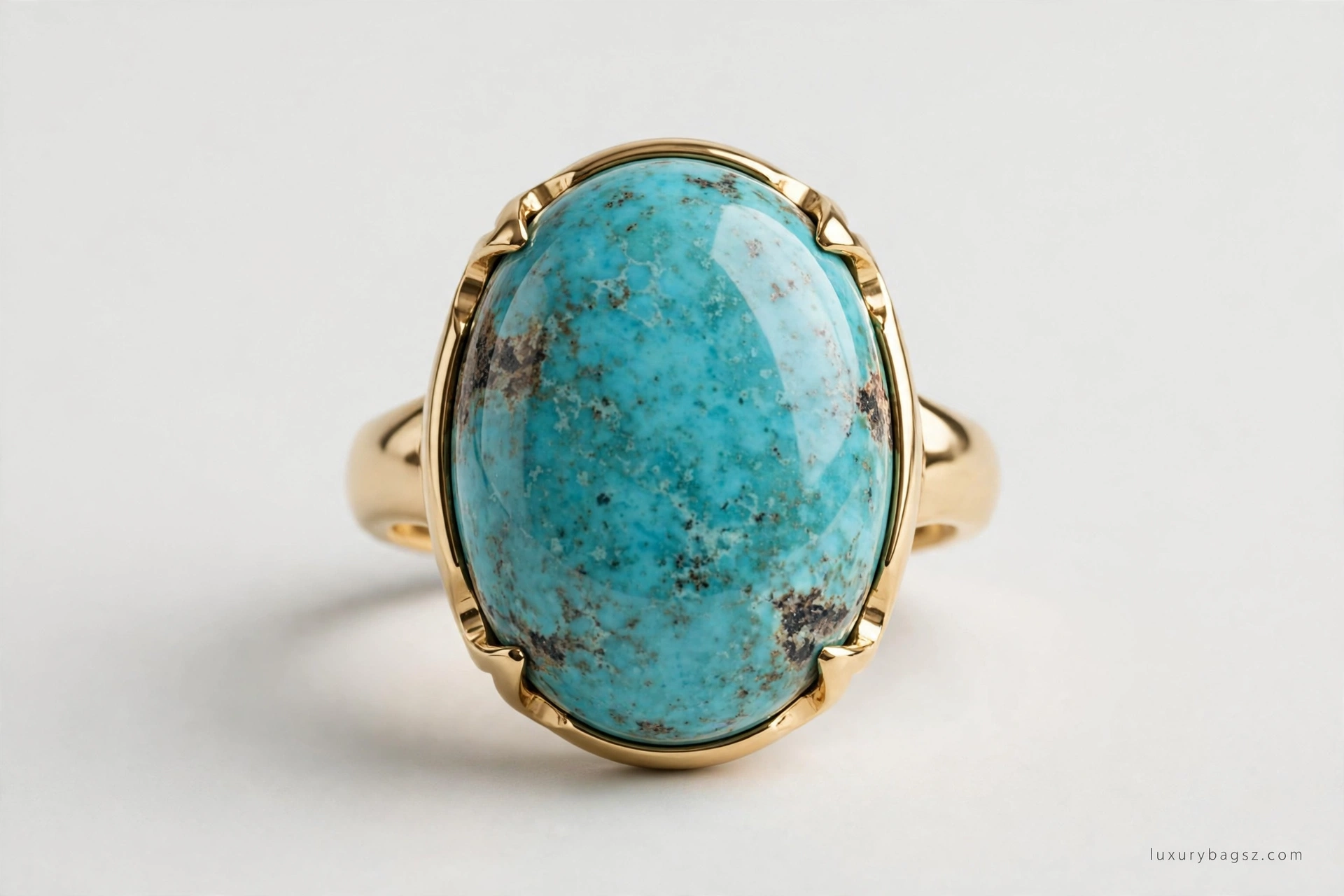
The YSL Arty ring is one of those pieces everyone recognises instantly and almost no one can buy easily anymore. It is a big, oval, cabochon cocktail ring — gold- or silver-tone, with a bright, glossy stone — that was everywhere in the early 2010s, then quietly disappeared from most showrooms. Today, most people looking for one are looking second-hand, and that changes everything about how you should shop for it.
Search for it and you will find the opposite problem to most luxury guides: too much information, scattered across hundreds of forum pages, resale listings, and generic “how to spot a fake” articles that never actually talk about the Arty itself.
Prices range from under $200 to nearly $2,000. Sizes are described as 5, 6, 7, and 8, but owners say a 7 and an 8 can fit the same. And the “stone” is called turquoise, lapis, glass, resin, and enamel in different listings — sometimes for the same colour.
This guide pulls that scattered information together, states plainly where sources disagree, and fills the gaps competitors leave: old vs new, sizing, materials, tarnish, real vs fake, and buying pre-owned safely.
Key Takeaways
- The Arty is a large oval cabochon cocktail ring, usually in gold- or silver-tone metal, in colours including turquoise, lapis, coral, cream, red, pink/mint, black, and the rare Cipria.
- It is costume jewellery, not fine jewellery: plated metal with a cabochon that is described across listings as natural-look stone, glass, resin, or enamel depending on the version. Do not buy it expecting solid gold or a precious gemstone.
- Sizing runs large and inconsistent. Many owners size up, and size 7 and 8 can feel the same. Try before you buy, or buy from a seller with returns.
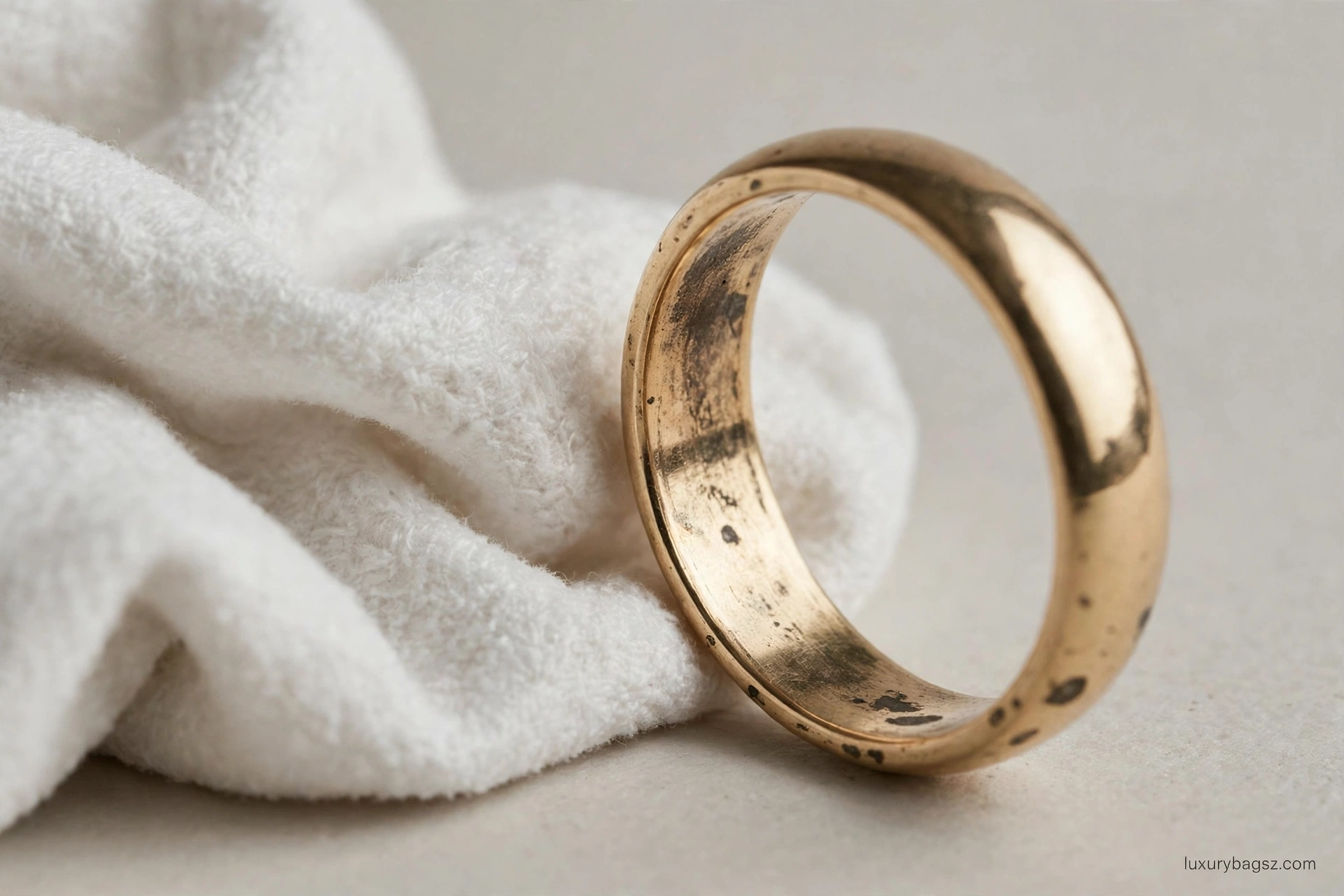
- Tarnish on the back and inside is common with regular wear, even with careful use. The front usually stays good much longer.
- Most Arty rings today are bought pre-owned, because boutiques pulled the older style from showrooms and stock is limited. That makes the seller checklist in Section 9 more important than any single “authenticity” detail.
- Prices have climbed: from around $190 early on, to $290, then $360 in the US, with resale averaging around $501 on 1stDibs and ranging much higher for rare colours and sizes.
The Short Quick Answer
What is it? A Saint Laurent (formerly Yves Saint Laurent, YSL) statement cocktail ring with a large oval cabochon set in a wide metal frame. It was designed to be noticed — this is not a delicate everyday band.
Who will love it? People who want one bold ring that does the work of a whole jewellery look, collectors of early-2010s Saint Laurent, and anyone who likes vintage costume jewellery with real presence.
Who should skip it? People who want a ring they can wear every day without thinking about it, people with metal allergies who react to plated costume jewellery, and people who want a ring that will hold its finish perfectly for years. The Arty needs care, and its plating will show wear on the back with regular use.
How much should you pay? Check locally on the day, but as a guide: original US retail climbed from about $190 to $290 and then $360. Resale today is often $200–$500 for common colours in common sizes, and higher — sometimes $1,000-plus on high-end resale sites — for rare colours like Cipria or hard-to-find sizes. A price far below the going rate for a “new” ring in a popular colour is a warning, not a bargain.
What size should you buy? If you can, try it on. If you cannot, assume you may need a size up from your usual ring size, and check the seller’s return policy first. Section 4 explains why.
Old Arty vs New Arty: The Change Competitors Rarely Mention
Forum owners who own several Arty rings report a real change over time: newer rings are thinner, with a narrower back band, than older ones. One owner who bought a later ring worried it was fake because it was physically smaller and the back band was not as wide as her other three — and was told by other owners that yes, newer ones changed.
Why does this matter?
- Fit: A thinner band can feel different even in the same numbered size. That is part of why size 7 and 8 are reported as fitting the same on some people.
- Weight and feel: An older, chunkier Arty feels more substantial. A newer one feels lighter and sits a little lower.
- Authentication: A thinner band alone does not prove a ring is fake. It may simply be a later production run. Do not use band width as a single test — use the full checklist in Section 8.
- Availability: Owners also report that Saint Laurent boutiques stopped carrying the older Arty style in many stores, pulled remaining stock from showrooms, and kept only limited quantities in the back. The newer style some stores carry instead is not the same ring, and many long-time collectors say they do not like it as much.
Practical rule: when a listing says “vintage” or “2011” or “early Arty,” ask the seller for a photo of the back of the band and its width, and compare it to the measurements in Section 3. Do not assume every Arty is identical.
Colours, Metal Tones, and Measurements
Colours
The Arty came in a wide colour range, and colour is often what drives price and desirability more than anything else. Common and well-known colours include:
- Turquoise — bright blue-green, one of the most iconic and sought-after colours
- Lapis — deep blue, often with gold flecks, described as lapis lazuli in listings
- Coral — warm orange-pink, popular and frequently restocked in its day
- Cream / white — pale, elegant, and harder to keep looking clean
- Red — bold, and sometimes found at sale prices when other colours were full price
- Pink / mint — lighter, softer versions, including a silver-tone version with a mint/pink stone
- Black — with gold or silver tone, including a black stone with dots version
- Green / emerald — gold-tone with a deep green stone, a collector favourite
- Cipria — a pale pink-beige, repeatedly described as elusive and hard to find, especially in sizes 7 and 8
- Khaki, amber, wood, purple — other, less common versions reported by owners and resale sellers
Colour names are not standardised across resale sites. One seller’s “turquoise” may be another’s “teal,” and “lapis” may be used for several shades of blue. Always judge by photos in natural light, not by the colour name alone.
Colour unevenness — normal, not necessarily a flaw
Owners report that colour can look uneven at the edges of the glass, especially on the Love/pink versions, where a couple of areas at the edge are very slightly paler than the rest. Judging from many online photos, this seems common for that version. It does not automatically mean a ring is fake or damaged — but if the unevenness is dramatic, chipped, or cloudy in the centre, ask for more photos before buying.
Metal tones
- Gold-tone: The classic Arty look. Gold-plated metal, sometimes described as 24kt gold plating in resale listings. Warm, bold, and the most common version.
- Silver-tone: Less common, and owners say silver versions can be harder to find in larger sizes. Some owners also say silver versions do not look as good in person as in photos — try to see one in person or in unedited photos before buying silver.
- Mixed: Some versions pair a coloured stone with the opposite tone — for example, a green stone with a silver band, or a pink stone with a silver band. These are real, but rarer, so verify them carefully.
Measurements — one hard example
Resale and valuation sources do not agree on a single spec sheet, because the Arty changed over time and came in different versions. One RealReal valuation for a size 6 Arty cocktail ring gives a useful reference point:
- Material: Brass and resin
- Weight: 23.6 grams
- Band width: 11.3 mm
- Ornament length: 36.4 mm
- Ornament width: 28.1 mm
- Estimated retail: $290
- Includes: Designer box and jewellery pouch
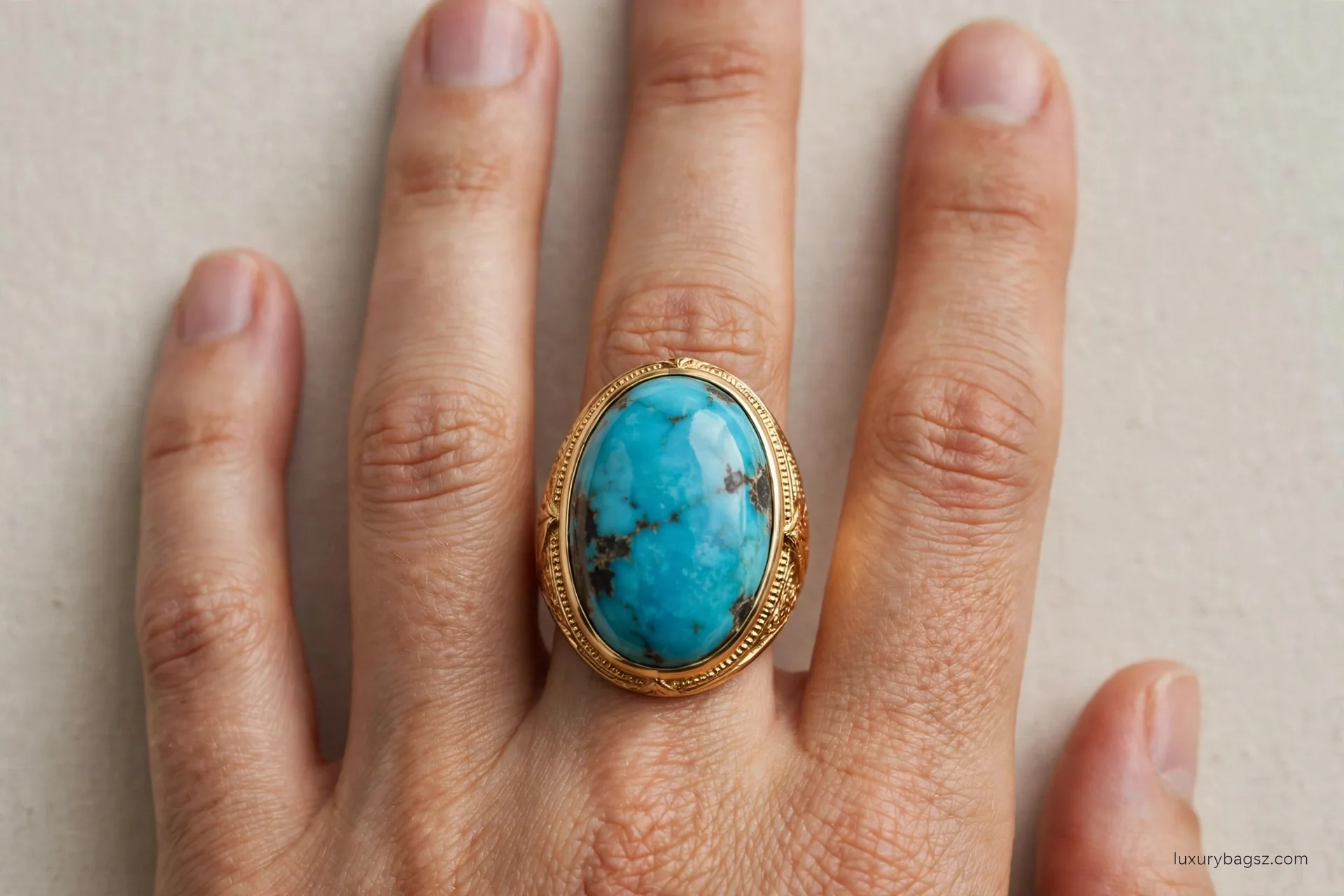
That ornament — over 36 mm long — is why the Arty is a statement piece, not a subtle ring. It will cover a large part of your finger and will be noticed. If a listing shows a small, delicate ring and calls it an Arty, be suspicious.
Use weight as a rough guide, not a rule: a genuine Arty should feel substantial, around the low-20s of grams for a size 6 example, but weight varies by size, version, and stone. A very light ring, or one that feels hollow, deserves a closer look.
Sizing: Why It Runs Large and Inconsistent
This is the section most guides skip, and it is the one that saves buyers the most returns.
What owners actually experience
- “Most of my rings are a size 5 and some of them fit smaller” — the Arty does not fit like a normal ring.
- “Size 7 and 8 fits exactly the same on me” — reported by more than one owner in store.
- “Normally in my middle I use a size 7 and I feel it a bit loose” — a size 7 Arty feeling loose on a size 7 finger.
- “My middle finger is a size 6 but needed a size 7 for the YSL ring. Luckily the size 6 fits my ring finger” — the same person needing two different Arty sizes for two fingers.
- “I think the sizing is not uniform” — a summary many owners would agree with.
Why it happens
Three reasons combine:
- Wide band: The Arty has a wide band (around 11 mm in the example above). Wide bands always fit tighter than thin bands in the same numbered size, because they cover more of the finger and cannot flex as easily. But the Arty’s wide, flat shape also means it can sit differently depending on knuckle shape.
- Large, top-heavy ornament: A 36 mm ornament makes the ring top-heavy. It can rotate, sit off-centre, and feel loose even when the band itself is snug.
- Production changes: Older chunkier bands and newer thinner bands do not feel identical, even at the same size number.
How to choose a size
- Try it on if you possibly can. This is the single best advice for the Arty. A boutique, a resale shop, or a friend’s ring will tell you more than any size chart.
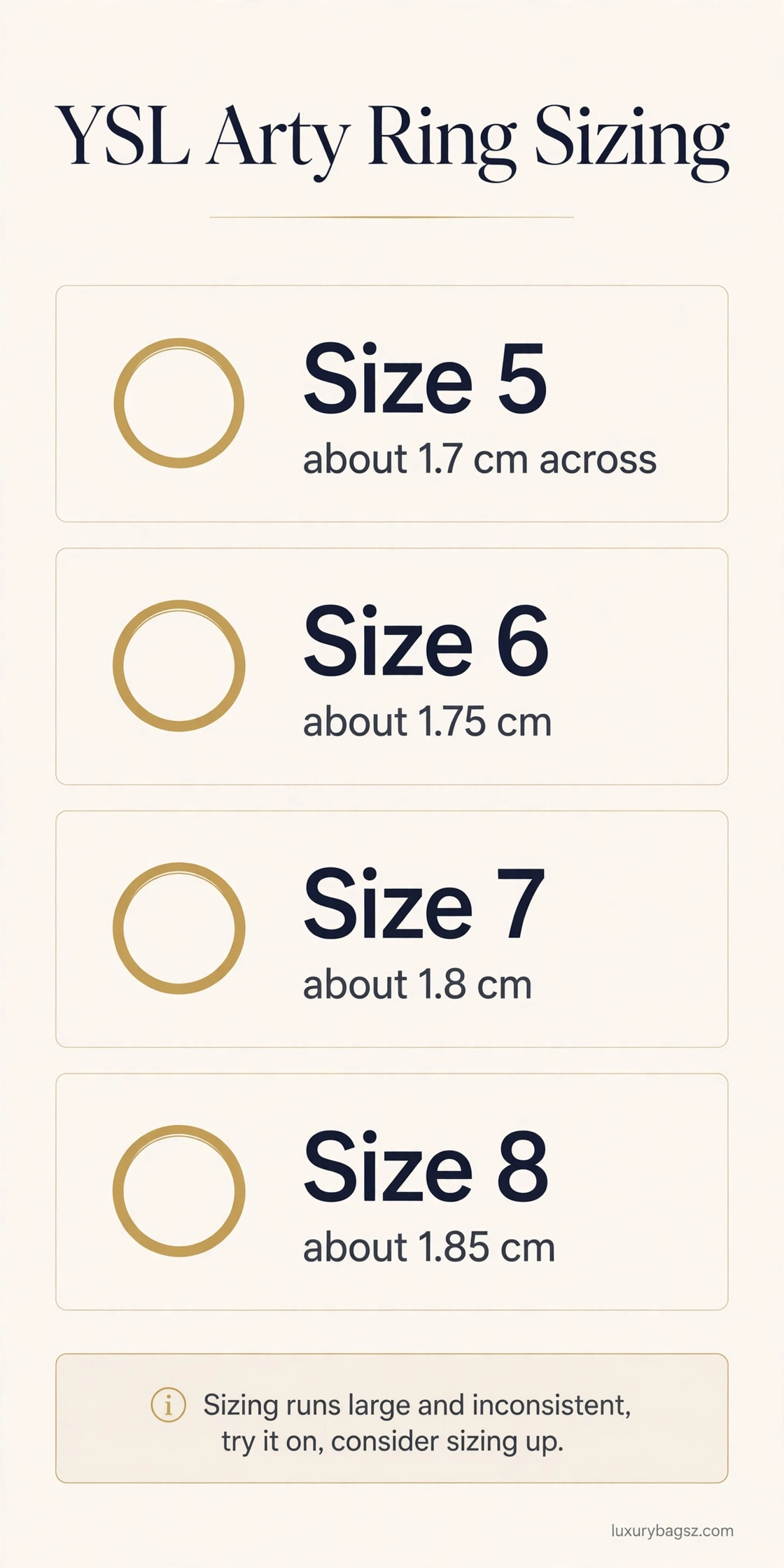
- If you cannot try it on, consider sizing up from your usual thin-band size, especially for a middle or index finger. Many owners end up a full size up.
- Measure by diameter, not just by number. One retailer gave these approximate diameters, measured across the outline of the ring: size 5 ≈ 1.7 cm, size 6 ≈ 1.75 cm, size 7 ≈ 1.8 cm, size 8 ≈ 1.85 cm. Compare that to a ring you already own by tracing its outline and measuring across — that is more reliable than guessing from a number alone.
- Think about which finger. The Arty is most often worn on the middle or index finger, or as a cocktail ring on the ring finger for events. The same size will feel different on each finger, and the large ornament looks different on each finger too. Decide the finger first, then the size.
- Check returns before you pay. Because sizing is inconsistent, a no-returns pre-owned purchase is a gamble. A seller who accepts returns, or who provides exact measurements and many photos, is worth paying a little more for.
Sizes available
Most listings show sizes 5, 6, 7, and 8. Size 8 is often the hardest to find in popular colours, and may have needed pre-ordering even when the ring was in stores. Size 4 appears occasionally for rarer versions. If you need a size outside 5–8, expect a longer search and a higher price.
Materials and the “Stone” Explained
Competitors call the Arty’s centre a “stone” and leave it there. That is misleading, because different versions and different listings describe it differently.
What we know
- Metal: Brass with gold or silver plating is the most consistent description. Some listings say “gold-plated metal,” some say “24kt gold plating.” It is plated costume jewellery, not solid gold or silver.
- Centre: Described across sources as cabochon, resin, glass, enamel, turquoise, and lapis lazuli — sometimes in the same listing. The honest summary is: a large, domed, glossy cabochon in a bright colour, made to look like a natural stone, in materials that vary by version and production run.
- Natural vs imitation: Some resale listings call a turquoise version “natural turquoise cabochon” and a lapis version “natural lapis lazuli cabochon.” Others describe the same colours as resin or glass. Do not pay a precious-stone price for an Arty. Its value is in the design, brand, colour, and rarity — not in the material value of the centre.
- Signature: Authentic examples are stamped “Yves Saint Laurent” — for example, a Poshmark listing for a black stone version notes “100% Authentic Stamped YVES SAINT LAURENT.” Check for a clean, even stamp inside the band, but remember that stamps alone do not prove authenticity, because they can be copied.
What this means for buyers
- Do not buy an Arty as an investment in gold or gemstones. It has no intrinsic precious-metal or precious-stone value in the way a solid gold ring does.
- Do buy it for design, colour, and collectability — which is where its resale value actually comes from.
- If a seller claims a specific natural stone and charges a premium for it, ask for proof: a valuation, a purchase receipt, or a professional assessment. A colour name is not proof of a natural stone.
Price: Retail History, Resale, and What to Pay Now
Retail history (reported, not official)
Owners’ reports over time show a clear climb:
- Early: around $190
- Mid-period: $290
- Later: $360 in the US
- Singapore: SGD 280, then SGD 390–400
- Hong Kong: HK$2,300
- Europe (sale examples): turquoise €145, lapis €195, cream €195, coral €78, red €58 — sale prices, not full retail, and they show how much colour and timing affected price even then
These are owner-reported figures from different years and countries, not a single official price list. Treat them as a history, not a current price guide.
Resale today
- 1stDibs: Prices start at $408 and top out at $1,900, averaging around $501. That average is pulled up by rare colours and high-end sellers — it is not the price of a common Arty in average condition.
- eBay and similar: Owners report new Arty rings at $200–$400, with higher prices reflecting demand for specific colours and sizes. Condition, box/pouch inclusion, and size move the price a lot.
- Outlets: Owners mention California and New Jersey outlets having Arty rings in specific colours and sizes, sometimes weeks after a colour sold out elsewhere. Outlets are worth checking, but stock is unpredictable.
What to pay — a practical guide
- Common colour, common size, good condition, with pouch: Expect the middle of the resale range. Do not overpay for a common turquoise or coral in size 6 or 7 just because a high-end site lists it higher.
- Rare colour (Cipria, certain greens, certain pinks) or rare size (especially 8): Expect to pay more, and expect to wait. Rarity is real for the Arty, and collectors do pay premiums.
- No box, no pouch, visible tarnish: Pay less, and factor in that you may not be able to resell it for as much later.
- “New” at a very low price: If a “new” Arty in a popular colour is far below the going resale range, treat it as a warning. It may be a fake, a damaged return, or a different version than pictured.
Always check the price on the day, from at least two or three sellers, for the same colour and size. A single listing is not a market price.
Tarnish and Care: Honestly
If there is one thing every Arty buyer should know before paying, it is this: tarnish is common, and it is not necessarily a sign of a fake.
What owners report
- “I have one gold tone and another silver finish that I wear regularly and both have tarnished in the back. I normally take them off when I wash my hands and only put them on when my hands are completely dry. I have had them both for almost 2 years.”
- “The gold has tarnished a lot, everywhere but the front.”
- “The silver has also tarnished but doesn’t give me an allergic reaction.”
- “Minor tarnish from use visible” — a standard note on resale listings for turquoise and lapis versions.
- “The gold is in pristine condition and not tarnished at all on the front. At the back there is slight bronze coloured tarnish” — even a hardly-worn, well-kept ring can show back tarnish.
- “After having washed my hands, I noticed that the golden metal does get some kind of tarnish, which could be wiped off” — and a store associate cautioned about possible tarnish, not plating loss, and advised removing the ring before washing hands.
- “I don’t wear mine everyday… if you avoid the ring having contact with perfume/water etc. you should be fine.”
The pattern is consistent: front stays good, back and inside tarnish first. That is because the back touches skin, sweat, soap, and water, while the front is protected by the stone and frame.
Allergy note
Most owners report no reaction, even those who are sensitive to most metals. One owner who is “allergic to most metals (except 18K gold and silver)” reported no problems with the Arty. But another owner reported being “really allergic” to the gold version, while the silver version did not cause a reaction. If you have a metal allergy, test carefully: wear the ring for a short period first, check for redness or itching, and do not assume gold-tone and silver-tone will react the same way for you.
Care that actually helps
- Remove before washing hands, showering, swimming, and applying perfume, lotion, or sunscreen. Water and perfume are the fastest routes to tarnish.
- Put it on last, take it off first. Perfume and hand cream should be dry before the ring goes on.
- Wipe after wear with a soft, dry cloth. Do not use abrasive cleaners, silver dip, or ultrasonic cleaners on a plated resin/glass ring — they can damage plating and stone.
- Store it separately in its pouch or a soft cloth bag, away from other jewellery that can scratch it. Do not toss it loose in a bag or drawer.
- Clear nail polish trick: Several long-term owners coat the inside and back of the band with clear nail polish to slow tarnish, reapplying every week or so with daily wear, or less often with occasional wear. One owner says coated rings look “like new.” This is a user trick, not an official care instruction — test it on a small area first, let it dry fully before wearing, and reapply when it wears off. Do not paint the front or the stone.
- Do not wear it every day if you want it to stay pristine. Occasional wear, with proper storage, preserves the finish far longer than daily wear. If you love it enough to wear it daily, accept that the back will tarnish and the front will eventually show wear too.
When tarnish means something else
Tarnish on the back alone, with a good front, is normal wear. Tarnish plus flaking plating, a loose stone, a cracked cabochon, or a bent band is damage, not just tarnish — and it should affect the price you pay for a pre-owned ring.
Real vs Fake: An Arty-Specific Checklist
Generic guides say “check the logo, check the weight, check the packaging.” For the Arty, you need more specific checks — and you need to know that no single check proves authenticity.
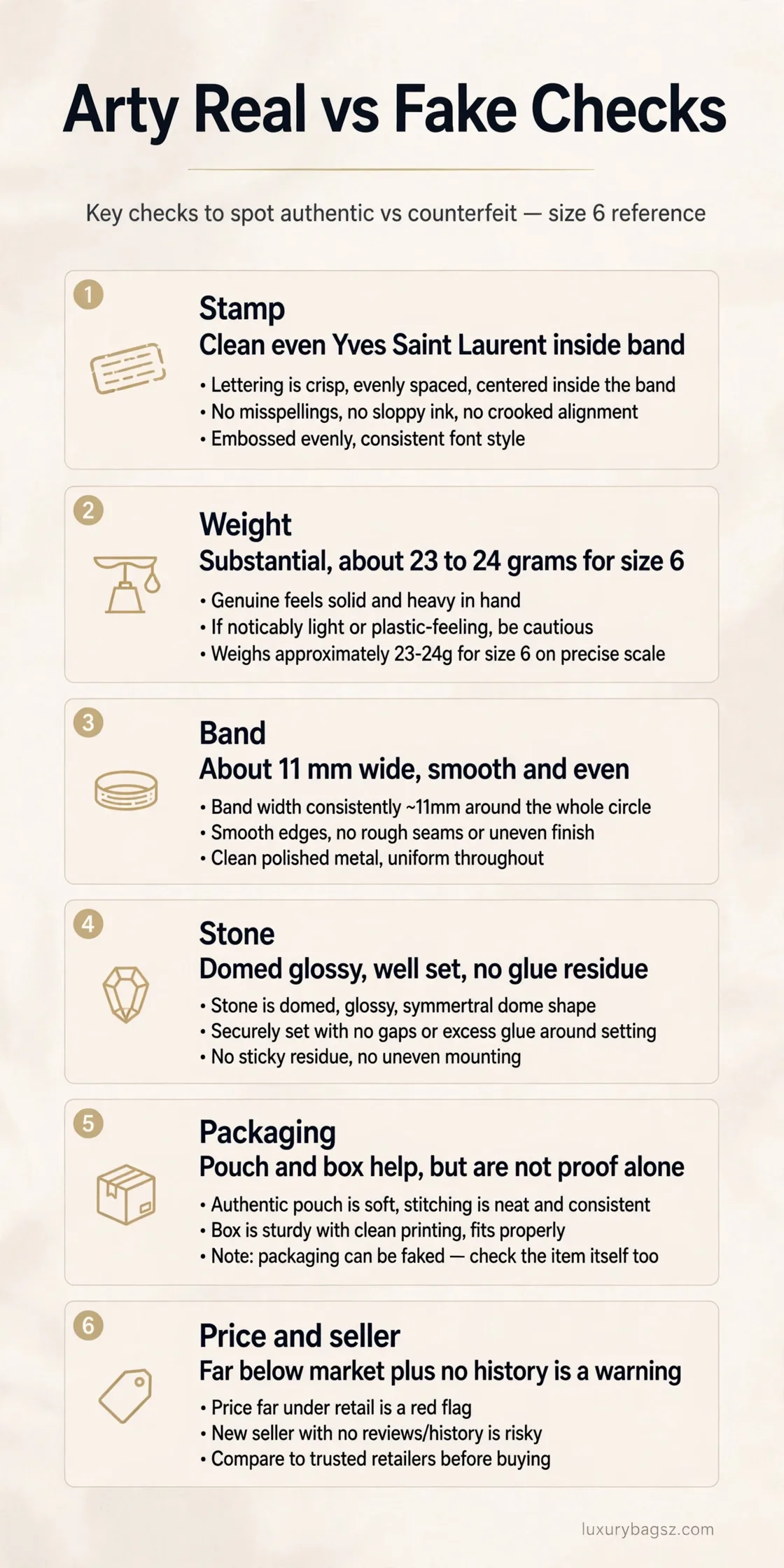
The stamp
Look inside the band for “Yves Saint Laurent” in clean, even lettering. Fakes often have blurry, shallow, uneven, or misspelled stamps. Use a loupe or a phone macro photo if you can. But remember: a good stamp can be copied, and a worn stamp on a genuine older ring can look faint. Stamp alone is not proof.
Weight and feel
A genuine Arty should feel substantial — around 23–24 grams for a size 6 example, varying by size and version. A very light, hollow-feeling ring deserves suspicion. But weight alone is not proof either, because fakes can be weighted.
Band width and shape
Check the band width against the reference in Section 3 (around 11 mm for a size 6 example) and look at the back of the band. Remember the old-vs-new change: a thinner band does not automatically mean fake. What should worry you is a band that is much narrower, uneven, sharp-edged, or poorly finished compared to known examples.
The stone / cabochon
Look at the cabochon in natural light. It should be domed, glossy, and well-set, with no glue residue around the edges, no bubbles or cloudiness in the centre (edge paleness on some pink versions aside), and no wobble when you press it gently. A loose, cloudy, or badly glued stone is a red flag.
Finish and symmetry
The metal frame should be smooth, evenly plated, and symmetrical. Look for tool marks, rough edges, uneven plating, or a frame that does not sit evenly around the stone. Genuine costume jewellery from a luxury house is still finished to a high standard, even if it is not fine jewellery.
Pouch, box, and paperwork
A genuine Arty often comes with a designer pouch and box. Missing packaging does not prove a fake — many pre-owned rings lose their box — but complete packaging in good condition, with consistent branding, is a positive sign. Conversely, perfect packaging with a poor-quality ring is a classic fake pattern: counterfeiters often copy packaging better than they copy the ring.
Price and seller
A “new” Arty in a popular colour at a price far below the going resale range, from a seller with no history, no returns, and stock photos only, is a warning. A seller with a history, real photos, exact measurements, and a return policy is worth more than a cheaper listing with none of those.
Photos to ask for
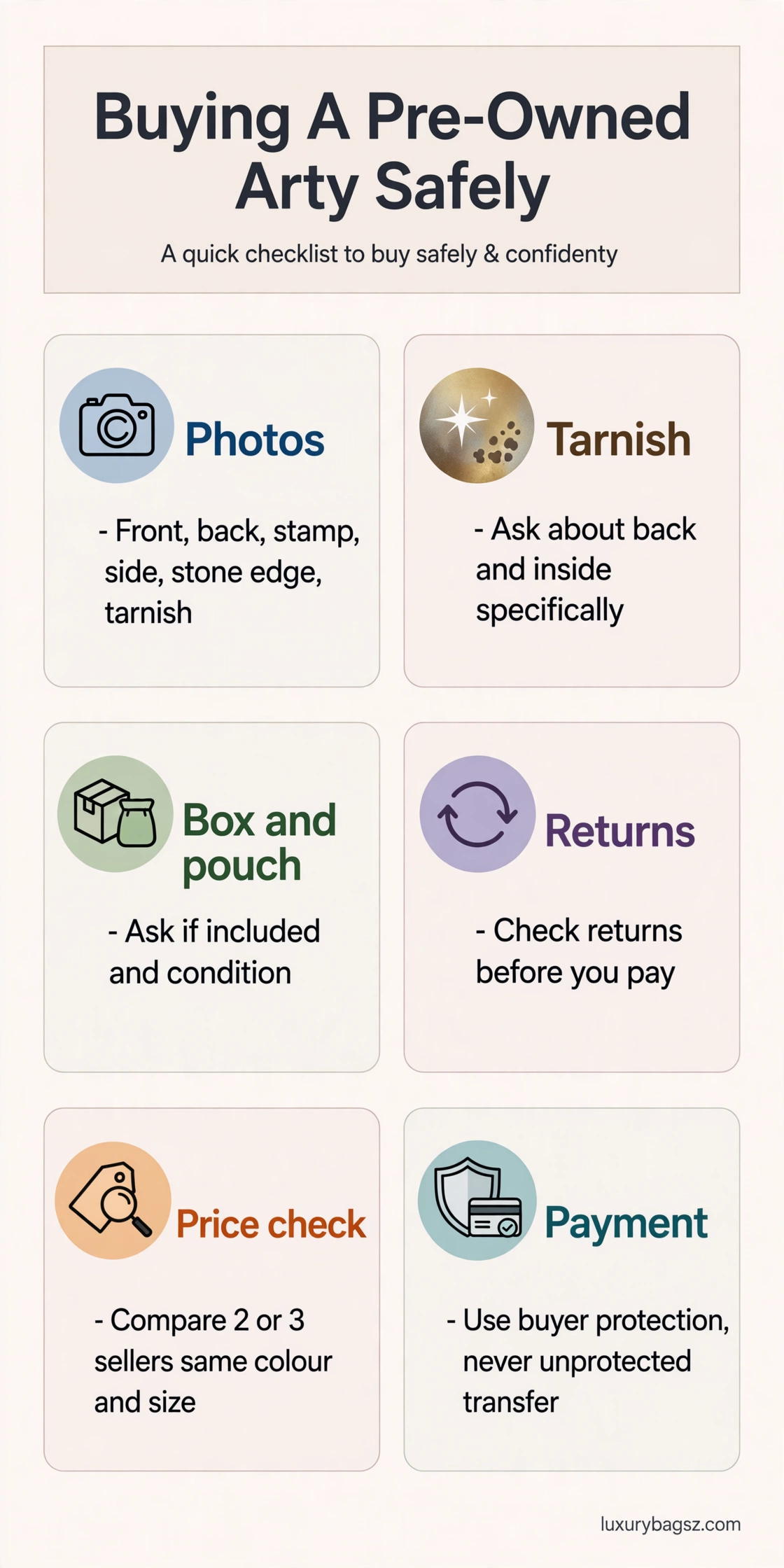
Ask the seller for, at minimum: front in natural light, back of the band, inside stamp (macro if possible), side profile showing band thickness, stone edge close-up, and any tarnish or damage clearly shown. A seller who refuses or only sends stock photos is not a seller to trust for a pre-owned Arty.
If you are still unsure
Use a professional authenticator, a reputable resale platform with authentication, or a jeweller who handles designer costume jewellery. Do not rely on a forum opinion from photos alone for a high-value purchase — photos can hide as much as they show.
Buying Pre-Owned Safely
Most Arty buyers today are pre-owned buyers, so this section matters more than the retail section.
Where to look
- Reputable resale platforms with buyer protection and, ideally, authentication: The RealReal, 1stDibs, Vestiaire Collective, and similar platforms.
- Established vintage sellers with a history of Saint Laurent sales and clear photos.
- Outlets — unpredictable, but occasionally worth checking for specific colours and sizes.
- Forums and collector groups — useful for learning, but buy only with payment protection, never by unprotected transfer.
Checklist before you pay
- Confirm colour, metal tone, and size — in the seller’s own photos, not just the title.
- Ask for the 6 photos listed in Section 8.
- Ask about tarnish, specifically on the back and inside, and ask for photos of it.
- Ask whether box and pouch are included, and what condition they are in.
- Ask about returns. If there are no returns, the price should reflect that risk.
- Compare the price to at least two other listings for the same colour and size.
- Pay with a method that gives you buyer protection. Do not pay by unprotected transfer for a pre-owned luxury item.
- When it arrives, check it against the photos before wearing it, and keep the packaging until you are sure you are keeping it.
Red flags
- Stock photos only, or photos that do not match the description.
- “New” in a rare colour and size at a low price, with no history.
- Refusal to provide stamp, back, or tarnish photos.
- Vague material claims (“real turquoise, solid gold”) that contradict the known plated/resin construction.
- Pressure to pay quickly, off-platform, or by transfer.
Styling: Solo, Stacking, and Which Finger
The Arty is a statement ring, and styling it well is mostly about restraint everywhere else.
- Solo is safest: One Arty, no other large rings on the same hand, minimal bracelets. Let the ring be the focus.
- Middle or index finger: The most common choices. The large ornament sits well on a longer finger and is visible without getting in the way as much as on a ring finger.
- Ring finger for events: Works as a cocktail ring for evenings, but the size and weight make it less practical for all-day wear on the ring finger, especially if you type a lot.
- Stacking: If you stack, stack with thin, minimal bands on other fingers, not with other large cocktail rings. Two large stones on one hand compete and look cluttered.
- Metal mixing: Gold-tone Arty pairs well with other warm gold accents. Silver-tone Arty pairs better with cool silver or white gold. Mixing gold Arty with silver jewellery can work, but keep the rest minimal.
- In person vs photos: Owners note that some versions, especially silver, do not look as good in person as in photos. Colours also look different under shop lighting vs daylight. Judge colour in daylight photos, and expect the ring to look bolder in person than in a small online thumbnail.
Frequently Asked Questions
Is the YSL Arty ring still made?
The older Arty style was pulled from many showrooms and is no longer widely available new. Some stores carry a newer style, but collectors generally mean the older oval cabochon version when they say “Arty ring.” Most buying today is pre-owned.
Is it real gold or a real gemstone?
No. It is plated costume jewellery — brass with gold or silver plating, with a cabochon described as resin, glass, enamel, or natural-look stone depending on the version. Its value is in design and collectability, not material value.
Why does my Arty ring tarnish?
Because plated metal tarnishes with skin contact, sweat, water, and perfume, especially on the back and inside where it touches skin. This is common even with careful wear. See Section 7 for care and the clear nail polish trick.
Does it cause allergies?
Most owners report no reaction, but some report reactions to gold-tone versions while silver-tone is fine for them. Test for a short period first if you have metal sensitivity.
What size should I buy?
Try it on if you can. If you cannot, consider sizing up from your usual thin-band size, and check the diameter measurements in Section 4. Size 7 and 8 can feel the same, and newer thinner bands feel different from older chunkier ones.
How can I tell if mine is real?
Use the full checklist in Section 8 — stamp, weight, band, stone, finish, packaging, price, and seller — not any single detail. For a high-value purchase, use a professional authenticator.
Is it worth the price?
If you love the design and colour, and you buy at a fair resale price in good condition, many collectors say yes. If you want a ring that will stay perfect with daily wear, or an investment in gold or gemstones, no — this is not that ring.
Can I wear it every day?
You can, but expect faster tarnish on the back and more wear overall. Occasional wear preserves it much longer. If you wear it daily, remove it for washing hands, perfume, and lotions, and wipe it after wear.
What comes with it originally?
Typically a designer box and jewellery pouch. Many pre-owned rings have lost one or both — that affects price, but does not by itself prove a fake.
Why is Cipria so expensive?
Because it is rare, especially in larger sizes, and collectors actively seek it. Rarity, not material, drives that premium.
Final Verdict
The YSL Arty ring is a bold, beautiful, and slightly impractical piece of costume jewellery — and that is exactly why people love it. Buy it for its colour, its presence, and its place in Saint Laurent history, not for durability or material value. Buy it with your eyes open about sizing, tarnish, and the pre-owned market, and you are much less likely to be disappointed.
If you buy pre-owned, buy slowly: check the stamp, the band, the stone, the tarnish, and the seller, and do not let a low price rush you past those checks. And if you can try it on first, do — for the Arty, fit in person tells you more than any size chart ever will.
For readers who like the idea of a statement piece but want to understand how fakes are spotted in other luxury categories too, our guides to VIP gift bags and a fake Rolex use the same check-the-details approach — one detail alone never proves authenticity. And if you are buying pre-owned generally, the seller photo-and-questions approach in our Cambon bag guide works just as well for rings.






