

Dior Gambler Bag: The Honest Guide to the 2004 Dice Bowler, Sizes, Prices, and Buying Pre-Owned
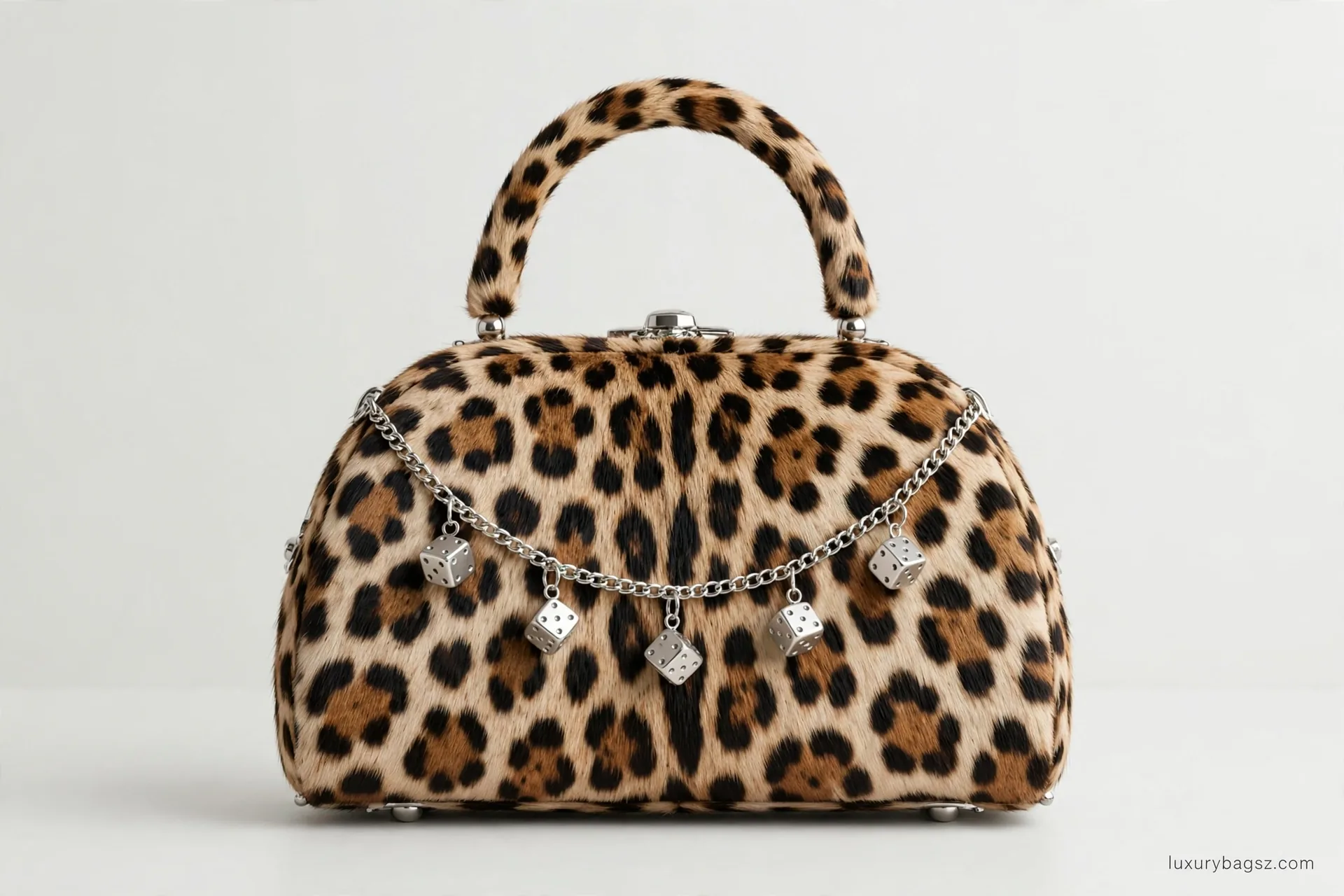
The Dior Gambler is not a bag you buy quietly. It is a small, curved bowler bag with silver dice dangling from a chain across the front, made for John Galliano’s Fall 2004 Dior collection, and it has spent the last twenty years being either loved loudly or left in a closet. That is exactly why it is hard to shop for today: almost everything written about it is either a single resale listing for one bag, or a forum thread where owners argue about sizes.
Search for it and you will find the same problems again and again. One seller calls a bag “medium” and another calls a bag the same shape “large.” One listing says leopard, another says pony hair, and a third says canvas, all for bags that look related but are not the same. Prices run from under $500 to nearly $4,000. And the generic “how to spot a fake Dior” guides talk mostly about Lady Dior cannage stitching, which tells you almost nothing about a Gambler, because the Gambler is not a cannage bag.
This guide pulls the scattered information together, states plainly where sources disagree, and fills the gaps: what the Gambler actually is, why the sizes confuse everyone, what each material means for wear and care, what to pay, how to check a Gambler specifically, and how to buy a twenty-year-old statement bag without regretting it.
One clarification first. “Gambler” was a whole Dior line in that era, not just this bag. There are Gambler wallets, a matching large wallet, dice jewellery, and even Gambler heels and mules with dice detailing. This article is about the Gambler handbag — the bowler — and it will say “Gambler bag” where the wider line could cause confusion.
Key Takeaways
- The Gambler bag is John Galliano’s Fall 2004 Dior bowler, recognised by its curved bowling-bag shape, top handles, chain, and dangling silver dice charms with crystal details.
- Size names — mini, small, medium, large — are not standardised across sellers. Always buy by the individual bag’s measurements, measured the same way, not by the size word in the title.
- Materials vary widely: leopard pony hair, red velvet, suede, python trim, Trotter canvas, satin, patent leather, and calfskin. Material, more than anything else, decides how the bag wears, how it must be cared for, and what it is worth.
- The code stamped inside, in the form seen on Gamblers such as 05-MA-0094, 07-MA-0094, and 11-MA-00XX, is a production code, not a unique serial number. A plausible code alone proves nothing.
- Most Gamblers today are bought pre-owned, and condition is the price. Pony hair loss, velvet crushing and dice imprints, suede stains, python drying, and zip and chain wear matter more than the colour name.
- Prices today are wide: roughly $480 for a canvas version in one listing, up to $3,950 for suede and Trotter versions, with leopard pony versions around $1,450 to $2,503. Original retail for the small version was reported by owners at around $1,200, with outlet prices near $600 at the time. Check the day, the material, and the condition — a single listing is not a market price.
The 60-Second Answer
What is it? A Christian Dior bowler-style top-handle bag from Fall 2004, designed by John Galliano, with a curved body, a wrap-around zip, top handles, a chain detail, and silver-tone dice charms that dangle across the front. The dice are the signature — if the dice are missing, damaged, or wrong, the bag is not the bag people mean when they say “Gambler.”
Who will love it? Collectors of Galliano-era Dior, Y2K fashion lovers, and anyone who wants one unmistakable statement bag. Owners describe it as fun, outrageous, and loud — in a good way, if that is your style.
Who should skip it? People who want a quiet everyday bag, people who need to carry a lot, and people who want a bag they never have to think about. The Gambler is small to medium, it draws attention, and its pony hair, velvet, and python versions are delicate.
How much should you pay? Check locally on the day, for the same material and size. As a guide from current and recent listings: canvas versions from around $480, leopard pony versions roughly $1,450 to $2,503, and suede and Trotter canvas versions up to $3,950. Condition, dice completeness, and included dust bag move the price a lot within those ranges.
What size should you buy? Buy by measurements, not by the word “medium” or “large.” Section 3 gives the actual measurements seen on real bags, and explains why two bags with the same size name can differ.
What the Gambler Bag Actually Is
The Gambler bag comes from a very specific moment: Dior under John Galliano in the early 2000s, when bags were meant to be noticed. The Fall 2004 Gambler is a bowler — a curved, rounded bag with a flat base, a top zip that wraps around the curve, and short top handles — rather than a tote, a flap bag, or a shoulder bag, although some versions also have a chain that allows shoulder or crossbody carrying.
The details that make it a Gambler, and not just any Dior bowler, are consistent across listings:
- The dice. Large silver-tone metal dice charms, embellished with crystals or rhinestones and the Dior name, suspended from a chain along the front, plus a smaller set on the zipper pull. On the red velvet and leopard pony version, the chains and dice are gold-tone with crystals spelling “DIOR.” The dice are not a charm you can add later and call it complete — a Gambler without its dice is an incomplete Gambler, and should be priced that way.
- The shape. A mini bowler shape: rounded, structured, standing on four metal feet at the base. The white monogram version is described as a mini bowler that is still big enough for a large phone, a bifold wallet, and daily essentials.
- The closure. A double zip closure on the red velvet and leopard pony version, and a wrap-around zip on other versions. The zip is a wear point on a twenty-year-old bag — check it before you pay (see Section 8).
- The handles and trim. Handles, trim, and details in leather, patent leather, or python, depending on the version. The velvet version has velvet handle plaques with gold stud hardware embossed “CD.”
- The lining. Not one lining for all Gamblers. The red velvet and leopard pony version is lined in black Dior-print textile, with an inside zipper pocket with a patent leather pull, a keychain snap clip, and a cellphone pocket with a snap strap. The white monogram version is lined in striking red satin, with a zipper pocket inside. Do not reject a Gambler because its lining differs from a photo of a different version — compare it to the same version.
- The stamps. A leather plaque stamped “CHRISTIAN DIOR PARIS,” and a rear stamp reading “MADE IN ITALY” followed by a code, for example “11-MA-00XX” on the red velvet and leopard pony version. Section 7 explains what that code does and does not prove.
The Gambler also came with matching pieces, including a large wallet with the same dice idea, and owners report a smaller Gambler purse without the chain-link handle. If a seller offers a “Gambler set,” check each piece separately — a genuine wallet does not make a bag genuine, and vice versa.

Sizes: Why the Names Confuse Everyone
This is the section that saves buyers the most returns, because the Gambler has no single, reliable size chart.
The size names sellers use
Listings and owners use mini, small, medium, and large, and sometimes just “Gambler” with no size at all. The problem is that these words were never applied consistently, and twenty years of resale have made it worse. One owner who thought her bag was the large realised, after comparing measurements with another owner’s bag, that hers was the medium. Another owner reports that larger Gamblers are easier to find than smaller ones, which affects price as well as availability.
Actual measurements seen on real bags
Because there is no official chart in the sources, the honest approach is to show what real bags actually measure, and to warn that the same size word can cover different numbers:
- A medium, as measured by its owner: 7 inches high, 11⅛ inches long, 6⅜ inches deep, with the same handle drop as the larger bag she compared it to.
- A larger bag, as measured by the same comparison: 8.5 inches high, 11.5 inches long, 8 inches deep.
- A Fall 2004 bowler, as listed by a vintage seller: base length 11 inches, width 6 inches, height 8.5 inches, drop 5.25 inches.
- A white monogram mini bowler: 8.5 inches wide, 7 inches high excluding handles (10.5 inches with handles standing), 6.5 inches deep, 3-inch handle drop.
- A red velvet and leopard pony version: 7 inches wide, 9 inches high, 6 inches deep in one part of the listing, and 7 inches long, 9 inches high, 6.5 inches deep in another — the same bag, with width and length swapped and depth differing by half an inch. That is a perfect example of why you must ask how a seller measured.
- A leopard pony version from a preloved seller: 20 cm wide, 17 cm high, 10 cm deep, with a 7 cm handle drop.
- A purple canvas and python version: 27 cm long, 21 cm high, 21 cm deep, with a 14 cm handle drop. Note how much deeper that is than the other versions — depth is where Gamblers differ most.
- A black suede and python bowling bag: listed without a single clean measurement in the snippet, which is itself a warning: if a seller gives no measurements, ask for them.
How to compare two Gamblers fairly
Ask the seller for all four numbers, measured the same way, before you compare:
- Length across the base, end to end, not across the curve.
- Height from the base to the top of the zip, excluding handles — and, separately, height with handles standing, if you care about how it looks carried.
- Depth at the widest point of the base, not at the top where the bag curves in.
- Handle drop from the top of the handle to the top of the bag.
Then ask what the bag fits. The white monogram mini bowler fits a large phone, a bifold wallet, and daily essentials. A larger bowler fits more, but no Gambler is a work tote: if you need a laptop, a water bottle, and a book, this is the wrong bag, whatever size name the listing uses.
One unconfirmed claim to handle carefully
One forum owner reports that the smaller Gambler was not released in the US, only in Europe, and that her mother bought the small version at a Dior outlet in Cabazon, California. That is owner-reported, not verified by Dior or by a retailer, so this guide does not present it as fact. If a seller claims a small Gambler is “rare because it was never sold in the US,” treat that as a selling claim to verify, not as proof of rarity or value.


Materials: One Name, Many Very Different Bags
“Gambler” describes a design, not a material. Buying a Gambler without knowing which material you are buying is like buying a coat without knowing whether it is wool or plastic — the care, the wear, and the price are all different.
Leopard pony hair
The most famous Gambler material, and the most delicate. Leopard-print pony hair (also called ponyhair or hair-on-hide) over a velvet or canvas body, often with patent leather trim and handles. It is the version most people picture when they say “Gambler,” and the version owners warn about most: pony hair is beautiful and fragile. It sheds, it rubs bare on handles and corners, and it does not forgive being squashed in a closet or carried against rough fabric. Owners report keeping python and pony Gamblers in the closet because they are “so delicate” and they are afraid of ruining the scales or hair.
Red velvet
Ruby red velvet with leopard-print pony hair, black patent leather trim on the handles and side panels, and gold-tone chains and dice. Velvet crushes, it shows pressure marks, and — a Gambler-specific problem reported by owners — the dice themselves can leave imprints on the velour part of the bag where they rest. A velvet Gambler with dice imprints is not necessarily damaged beyond use, but it is not mint, and the price should reflect it.
Suede
Black suede with python details, tonal patent trim, and silver-tone dice with crystals. Suede stains, it shows water marks, and it flattens where it is rubbed. The black suede and python bowling bag in one listing is described as pre-owned in good condition, 7 out of 10, with scratches on the hardware, stains on the suede, and normal signs of use — a realistic description for a twenty-year-old suede bag, and a useful benchmark for what “good condition” actually means at this age.
Python trim and python versions
Python appears as trim on handles and panels, and as the main feature on some versions, including a green leopard-print canvas bag with yellow python leather and a silver chain handle. Python is the material owners are most nervous about: it dries, it cracks, and its scales lift if it is stored badly, got wet, or dried with heat. A python Gambler that has been kept dry, dust-bagged, and out of sunlight will look very different from one that has not, even at the same age.
Trotter canvas and oblique canvas
The house’s Trotter canvas, and white oblique canvas with leather trim, are the hardiest Gambler materials. The white Trotter bowler is described as a petite pre-owned bag with tonal patent trim and silver-tone dice with crystal details, and the white oblique version carries the same dice idea on canvas. Canvas Gamblers are still twenty years old — canvas frays at corners, the print wears, and the trim ages — but they are far more forgiving than pony hair or velvet, and that is part of why some canvas versions still command high prices: they are the wearable Gamblers.
Satin, patent, and calfskin
Other versions reported by owners and sellers include satin with embroidery, plain-colour suede, and soft grained calfskin in a single colour. These subtler versions — a white logo jacquard version, a black, maroon, or single-colour suede version, a single-colour calfskin version — are the ones owners say “will go with classy looks,” as opposed to the loud leopard and red velvet versions. They are also the versions most likely to be confused with other Dior bowlers, so the dice, the stamps, and the code matter even more for them.
How material should change what you pay
Do not pay a leopard pony price for a canvas bag, and do not expect a canvas bag’s durability from a pony hair bag. As a rough guide from listings: canvas versions appear from around $480, leopard pony versions around $1,450 to $2,503, and suede and Trotter versions up to $3,950. Within each material, condition — especially dice completeness, hair loss, velvet crushing, suede staining, and python condition — moves the price more than the colour name does.

Price: Retail History, Resale, and What to Pay Now
Retail history (reported, not official)
Owners’ reports give a useful anchor, not a current price guide. The small Gambler was reported at retail around $1,200, with outlet prices just under $600 at the time, and a small version seen on eBay at around $900 in the same period. Those are owner-reported figures from different years and places, not a single official price list, and they are twenty years old. Treat them as history, not as what you should pay today.
Resale today
Recent and current listings show how wide the range is, and why material and condition must be stated alongside any price:
- Purple canvas and python: $480, sold out, from The Luxury Closet.
- White oblique canvas and leather: $591 in one listing, with a code of 05-MA-0094.
- Black suede and python bowling bag: 1,323 AED (about $360 at a rough conversion, but check the rate on the day — do not rely on a converted figure from this guide), out of stock, condition 7 out of 10.
- Red velvet and leopard pony hair: $1,450, out of stock, from Mrs Couture.
- Leopard pony hair, red: $2,503 (reduced from $3,575) from Hive Preloved, 20 × 17 × 10 cm, no accessories included.
- Black suede Gambler: $3,950 from Editorialist.
- White Trotter Gambler bowler: $3,950 from Editorialist.
- White monogram mini bowler: $2,495, sold, from Amarcord Vintage.
Two lessons follow. First, a high price does not mean a better bag — the $3,950 suede and Trotter listings are asking prices from a particular retailer, not a market average. Second, “sold” and “out of stock” listings are history, not availability: do not chase a sold bag’s price as if it were today’s price.
What to pay — a practical guide
- Common material, common size, good condition, dice complete, dust bag included: Expect the middle of the range for that material. Do not overpay just because a high-end retailer lists the same material higher.
- Rare material or colour, or a hard-to-find size: Expect to pay more, and expect to wait. Leopard pony in good condition, and the larger sizes, are the ones owners say are harder to find.
- Missing dice, damaged dice, heavy pony hair loss, crushed velvet, stained suede, or dry python: Pay less, and factor in that you may not be able to resell it for as much later. Missing dice are not a small flaw on a Gambler — they are the signature.
- “New” or “mint” at a very low price: If a supposedly mint Gambler in a popular material is far below the going range, treat it as a warning. It may be a fake, a damaged return, or a different version than pictured.
- Always compare like with like. At least two or three listings for the same material, the same size range, and similar condition, on the day you buy. A single listing is not a market price.
What Fits, How It Carries, and Who It Suits
The Gambler is a statement bowler, not a workhorse, and its practicality depends on which size you actually get.
What fits
- Mini bowler: A large phone, a bifold wallet, and daily essentials — keys, cards, lipstick, and a small pouch. That is the white monogram version’s own description, and it is a good rule for the mini size generally.
- Medium and larger bowlers: More room for a small cosmetic pouch, sunglasses in a soft case, and a paperback, but still not a laptop bag, and still curved — rigid items that fit a rectangular tote may not fit a bowler’s curved top.
- Pockets: An inside zipper pocket, and on the red velvet and leopard pony version a cellphone pocket with a snap strap and a keychain snap clip. Do not expect many pockets: the Gambler’s interior is simple, and the shape, not the organisation, is the point.
How it carries
Top handles are the main carry, with a chain on some versions allowing shoulder or crossbody wear. The chain is both a feature and a wear point: check that the chain links are complete, that the dice hang evenly, and that the chain attachments are not pulling at the bag. A Gambler carried by its chain will swing and knock its dice against the body — which is part of why dice imprints appear on velvet versions, and why owners who love their Gamblers sometimes carry them by hand instead.
Styling honestly
Owners are refreshingly honest about this bag. It is “loud,” “funky,” “outrageous,” and “so LOUD people always stare.” It works with jeans and a t-shirt, with an all-black outfit, and as a single statement piece with everything else kept minimal. It does not work as a quiet bag, and it does not work with another loud bag or a lot of competing jewellery — the dice are already doing that job. The subtler versions — single-colour suede, calfskin, or white jacquard — are the exception, and they are the ones to choose if you want the Gambler shape without the full Y2K shout.
If you are buying a Gambler to wear every day, be honest with yourself about the material: a canvas or calfskin Gambler can be an everyday bag; a pony hair or velvet Gambler, worn daily, will show it fast. If you are buying it as a collector’s piece or an occasion bag, condition and completeness matter more than everyday practicality, and storage (Section 9) matters more than carrying comfort.
Real vs Fake: Gambler-Specific Checks
Generic Dior guides will tell you to check cannage stitching, D.I.O.R. letter charms, and CD hardware clarity. Those are real Dior checks, but they are mostly Lady Dior checks, and they will not catch a fake Gambler on their own. For the Gambler, you need checks that are specific to this bag — and you need to know that no single check proves authenticity.
The dice
This is the first and most Gambler-specific check. The dice should be silver-tone (or gold-tone on the red velvet and leopard pony version), substantial, cleanly made, and embellished with crystals or rhinestones spelling or showing “DIOR.” Look for: even crystal setting with no missing stones, no glue residue, no lightweight hollow feel, and a chain attachment that matches the bag’s other hardware. Dice that are plastic-light, blurry, misspelled, or attached with the wrong chain are a red flag. Missing dice are not a small flaw — ask why they are missing, and whether the price reflects a complete bag or an incomplete one.
The stamps
Look for a leather plaque stamped “CHRISTIAN DIOR PARIS” in clean, even lettering, and a rear stamp reading “MADE IN ITALY” followed by a code. Fakes often have blurry, shallow, uneven, or misspelled stamps. Use a phone macro photo if you can. But remember: a good stamp can be copied, and a worn stamp on a genuine twenty-year-old bag can look faint. Stamp alone is not proof.
The production code — and the trap
Gamblers seen in listings carry codes such as 05-MA-0094 (white oblique canvas), 07-MA-0094 (black suede and python), and 11-MA-00XX (red velvet and leopard pony, with the last digits obscured in the listing). Treat these as production codes, not unique serial numbers: they give a production clue, they do not certify a bag, and counterfeiters can copy a plausible code. Two warnings from the sources make this concrete. First, a forum thread shows two different-sized Gamblers apparently sharing the code 05-MA-0074, until the owners realised the seller had posted the wrong photo of the label — a reminder to match the code photo to the actual bag, not just to the listing description. Second, a seller who lists a code in the description that differs from the code in the photo (as happened with 05-MA-0094 listed against a photo showing 05-MA-0074) is a seller to question, not to trust blindly. Always ask for a clear photo of the code on the bag you will receive, and check that it fits the bag’s era and version — a code that does not fit the Fall 2004 Gambler story needs an explanation.
The shape and construction
The Gambler should be a structured, curved bowler that stands on four metal feet, with a wrap-around or double zip that runs smoothly and sits evenly along the curve. Look for: a shape that holds its curve rather than slumping, feet that match the other hardware, a zip that does not catch or gap, and handles that are attached cleanly with no loose stitching or pulling. A bag that is the wrong shape — too flat, too tall, or with the wrong handle attachment — is wrong whatever its stamps say.
The materials, in hand and in photos
Leopard pony hair should look and feel like hair-on-hide, not printed fabric. Velvet should look like velvet, not cheap plush. Python trim should show real scale texture, not a printed pattern. Canvas should show the Trotter or oblique print clearly, not a blurry copy. One forum authentication thread makes the point well: a seller describing leopard material as “canvase” (their spelling) for a bag that should be pony hair was enough for experienced owners to doubt it. Material claims that contradict the known Gambler materials for that version are a red flag, even if the bag looks convincing in a small photo.
The lining and interior
Compare the lining to the same version, not to Gamblers generally. Black Dior-print textile on the red velvet and leopard pony version, red satin on the white monogram version, and a simple interior with a zipper pocket, a phone pocket, and a keychain snap on the versions that have them. A lining that is the wrong colour, the wrong print, or the wrong material for the version, or an interior with pockets that version never had, needs an explanation. Packaging proves little on its own: dust bags, boxes, and cards circulate separately, and a perfect dust bag with a poor-quality bag is a classic fake pattern.
Price and seller
A “mint” Gambler in a popular material at a price far below the going range, from a seller with no history, no returns, and stock photos only, is a warning. A seller with a history, real photos, exact measurements, and a return policy is worth more than a cheaper listing with none of those. Dior itself does not offer an authentication service for handbags, according to the authentication guides — so a seller claiming “authenticated by Dior” should be asked what they actually mean, and a professional independent authenticator is the route if you need certainty for a high-value purchase.
If you are still unsure
Use a professional authenticator, a reputable resale platform with authentication, or a specialist who handles Galliano-era Dior. Do not rely on a forum opinion from photos alone for a high-value purchase — photos can hide as much as they show, and the Gambler’s materials are exactly the kind that photographs flatter.

Condition Checklist for a Twenty-Year-Old Gambler
A Gambler is twenty years old. “Good condition” at that age does not mean “like new,” and the checklist below is what separates a fair price from an overpayment.
Dice and chain
Are all dice present? Are any crystals missing, loose, or replaced? Is the chain complete, untangled, and attached firmly at both ends? Does the zipper-pull dice set match the front set? Missing or replaced dice should reduce the price, and should be stated in the listing, not discovered on arrival.
Pony hair
Is the hair full, or thin and patchy on handles, corners, and the base? Is there bald rubbing where the bag has been carried against clothing? Is the hair matted or crushed from storage? Pony hair does not grow back — hair loss is permanent, and it is the first thing to check on a leopard Gambler.
Velvet
Is the velvet crushed, flattened, or marked where the dice rest? Are there dice imprints on the velour, as owners report? Are there stains, fading, or worn patches on the pile? Velvet imprints from the dice are a known Gambler issue — they do not automatically mean the bag is ruined, but they do mean it is not mint.
Suede
Are there stains, water marks, or flattened nap? Are the corners and base worn through the nap? Suede that has been cleaned badly can look worse than suede that has been left alone — ask what, if anything, the seller has used on it.
Python
Are the scales flat, intact, and flexible, or dry, lifting, cracked, or peeling? Is there discolouration where the skin has dried out? Python condition is the difference between a wearable bag and a display piece, and it is hard to repair well.
Patent, canvas, and calfskin
Is the patent cloudy, cracked, or showing dye transfer? Is the canvas fraying at corners or wearing thin on the print? Is the calfskin scratched, stained, or dried out? These materials age more forgivingly than pony hair or python, but twenty years still shows.
Hardware, zip, handles, and feet
Is the hardware scratched, tarnished, or replaced? Does the zip run smoothly along the whole curve, or catch, gap, or stick? Are the handles firm, with no cracking, pulling, or loose stitching? Are all four feet present and matching? A Gambler with a failing zip or a loose handle is a repair bill, not just a cosmetic flaw — price it that way.
Interior and smell
Is the lining clean, or stained, musty, or torn? Does the bag smell of smoke, perfume, or damp storage? Smell is hard to photograph and hard to remove from velvet, suede, and pony hair — ask about it before you pay, not after it arrives.
Care and Storage by Material
There is no single Gambler care routine, because there is no single Gambler material. The table below is general care guidance for these materials, not Dior’s official instructions for a specific bag — if you have a maker’s care note for your bag, that takes priority, and for a valuable or badly stained bag, a leather specialist is safer than any home method.
Pony hair
Brush gently with a soft-bristle brush, in the direction of the hair, to remove dust. Avoid constant rubbing, pressure, and contact with rough fabric, which rubs the hair bare. Do not use water, cleaners, or conditioners made for smooth leather on pony hair. Store it where nothing presses on the hair, and do not squash it under other bags.
Velvet
Brush lightly, keep it dry, and store it so nothing presses on the pile — including its own dice, which can imprint the velour. Do not use water or household cleaners on velvet, and do not iron or steam it. If velvet is stained or crushed, a specialist is safer than a home attempt.
Suede
Brush with a suede brush in one direction to lift dust and restore the nap, and use a suede eraser for light marks. For Gambler suede, our guide to how to use a suede brush covers the same brush-and-direction approach in detail. Do not soak suede, do not use smooth-leather conditioner on it, and let it dry naturally away from heat if it gets wet — then brush it again once dry.
Python
Dust gently, in the direction of the scales, with a soft brush, and blot light marks with an almost-dry cloth. Do not soak python, do not dry it with heat, and do not take it out in rain if you can avoid it — water and heat are what crack it. A reptile-skin cream made for python, used sparingly and tested first, is the usual specialist route; household oils and smooth-leather creams are not.
Canvas, patent, and calfskin
Wipe canvas with a soft, damp cloth, and keep it out of prolonged sunlight, which fades the print. Wipe patent with a dry soft cloth, and store it away from coloured materials, which can transfer dye onto patent. Wipe calfskin with a soft cloth, and condition smooth calfskin sparingly with a product made for it, tested first in a hidden spot — never on suede, pony hair, or velvet parts of the same bag.
Storage for any Gambler
Store it stuffed lightly, so the bowler holds its curve, in its dust bag, away from sunlight, damp, and heat. Do not hang it by its chain, which pulls at the attachments and lets the dice knock against the body. Do not stack other bags on top of a pony hair or velvet Gambler. Check it every few months: look at the pony hair, the velvet pile, the python scales, and the zip, and air it briefly in a dry room. For a fuller storage routine, the same stuffed, dust-bagged, check-regularly approach in our guide to how to store Hermes Kelly bags applies well to a Gambler too, even though the materials differ.
What not to do
Do not use abrasive cleaners, silver dip, ultrasonic cleaners, or household oils on a Gambler. Do not use a hairdryer to dry python or velvet. Do not try to “restore” pony hair or velvet at home with water, steam, or a brush that is too stiff. If a bag is valuable, badly stained, or has lifting python scales, stop and take it to a specialist — a wrong home treatment can do more damage than the stain it was meant to fix.
Buying Pre-Owned Safely
Most Gambler buyers today are pre-owned buyers, so this section matters more than the retail section.
Where to look
- Reputable resale platforms with buyer protection and, ideally, authentication: 1stDibs, Vestiaire Collective, The RealReal, and similar platforms, plus established vintage sellers with a history of Galliano-era Dior.
- Established vintage shops with clear photos and measurements, and a stated returns policy.
- Forums and collector groups — useful for learning, and for finding sellers with a history, but buy only with payment protection, never by unprotected transfer.
Checklist before you pay
- Confirm the version: material, colour, size measurements (all four numbers from Section 3), and whether the dice and chain are complete.
- Ask for the photos listed below — not stock photos, but photos of the actual bag.
- Ask about every condition point in Section 8, specifically: pony hair loss, velvet crushing and dice imprints, suede stains, python dryness, zip function, and handle and foot condition.
- Ask for a clear photo of the production code, and check it against the listing description — if they differ, ask why.
- Ask whether the dust bag is included, and what condition it is in. A dust bag is a plus, not proof of authenticity.
- Ask about returns. If there are no returns, the price should reflect that risk, especially for a twenty-year-old bag you cannot inspect in person.
- Compare the price to at least two other listings for the same material and size range.
- Pay with a method that gives you buyer protection. Do not pay by unprotected transfer for a pre-owned luxury bag.
- When it arrives, check it against the photos before carrying it, and keep the packaging until you are sure you are keeping it.
Photos to ask for
Front in natural light, back, both sides, base and feet, dice close-up (front and zipper pull), chain attachments, handles and trim, leather plaque stamp, rear “MADE IN ITALY” stamp and code, lining and interior pockets, zip along the curve, and every wear point: pony hair on handles and corners, velvet pile, suede nap, python scales, and any stains or damage, clearly shown. A seller who refuses, or who only sends stock photos, is not a seller to trust for a pre-owned Gambler. The same photo-and-questions approach works for other pre-owned luxury buys too — our Arty ring guide uses the same checklist idea for a very different kind of statement piece.
Red flags
- Stock photos only, or photos that do not match the description.
- Material claims that contradict the known Gambler materials for that version — for example, calling pony hair “canvas.”
- A production code in the description that differs from the code in the photo, with no explanation.
- “Mint” or “new” at a very low price, with no history, in a popular material.
- Refusal to provide dice, stamp, code, lining, or wear photos.
- Pressure to pay quickly, off-platform, or by transfer.
- A claim of “authenticated by Dior” with no detail — Dior does not offer a handbag authentication service, so ask what authentication actually means in that listing.

Frequently Asked Questions
Is the Dior Gambler still made?
No, not in its Fall 2004 form. The Gambler bag is a Galliano-era design from 2004, and buying today is almost entirely pre-owned. Some Gambler-named accessories exist from the same era, but they are not the bag.
Is it a bowling bag or a bowler bag?
Both words are used for the same shape: a curved, rounded top-handle bag with a flat base. Sellers say “bowler” and “bowling bag” interchangeably for the Gambler — check the measurements, not the word.
What are the dice made of?
Silver-tone (or gold-tone on the red velvet and leopard pony version) metal, embellished with crystals or rhinestones showing the Dior name. They are the signature detail, and they should feel substantial, not plastic-light.
What does the code inside mean?
It is a production code, in the form seen on Gamblers such as 05-MA-0094, 07-MA-0094, and 11-MA-00XX. It gives a production clue, it is not a unique serial number, and it does not authenticate a bag on its own. Match it to the bag’s era, version, and other details, and get a professional opinion if you are unsure.
Why are prices so different for the same bag?
Because “the same bag” is rarely the same bag: material, size, dice completeness, and condition differ, and so does the seller. A canvas Gambler, a leopard pony Gambler, and a suede Gambler are different purchases, even though they share a name and a shape.
Can I wear a pony hair or velvet Gambler every day?
You can, but expect it to show wear fast — pony hair rubs bare, velvet crushes, and the dice imprint velvet. Canvas and calfskin versions are far more forgiving for daily wear. For a delicate Gambler, occasional wear and careful storage preserve it much longer.
How do I clean a Gambler?
By material, not by a single routine: brush pony hair in the hair’s direction, brush suede gently in one direction, blot python with an almost-dry cloth and never soak or heat-dry it, keep velvet dry and unpressed, and wipe canvas and patent with a soft cloth. See Section 9, and use a specialist for valuable or badly stained bags.
What comes with it originally?
Typically a dust bag, and on some versions a box. Many pre-owned Gamblers have lost one or both — that affects price, but does not by itself prove a fake, and a dust bag alone never proves a bag is genuine.
Is the small Gambler really Europe-only?
That is an owner-reported claim from a forum, not a verified fact, so this guide does not present it as true. If a seller uses it to justify a premium, ask for evidence beyond a forum post.
Is it worth the price?
If you love Galliano-era Dior, you want a statement bag, and you buy the right material and condition at a fair price for that material, many collectors say yes. If you want a quiet, hard-wearing everyday bag, or a bag you never have to think about, no — this is not that bag.
The Gambler: Joy First, Practicality Second
The Dior Gambler is a loud, joyful, slightly impractical piece of fashion history — and that is exactly why people still hunt for it twenty years later. Buy it for its shape, its dice, and its place in Galliano’s Dior, not for everyday practicality or for durability you will not get from pony hair, velvet, or python. Buy it with your eyes open about sizes, materials, and condition, and you are much less likely to be disappointed.
If you buy pre-owned, buy slowly: check the dice, the stamps, the code, the lining, and every wear point in Section 8, and do not let a low price rush you past those checks. Buy by measurements, not by size names, and buy by the individual bag in front of you, not by a photo of a different Gambler in the same colour.
For readers who like the idea of a statement piece but want to understand how fakes are spotted in other luxury categories too, our guides to VIP gift bags and a fake Rolex use the same check-the-details approach — one detail alone never proves authenticity. And if you are buying pre-owned generally, the seller photo-and-questions approach in our Cambon bag guide works just as well for a Gambler as it does for a Chanel bag.
Galliano-era Dior is where my checking slows down most: pony hair, velvet and python forgive nothing, and twenty years of storage shows on all three. I read the dice, the code inside and the corners before I read the price. Buy the Gambler for joy, by all means — but let the condition, not the nostalgia, set what you pay.






