Vivienne Westwood Snail Jewellery: Prices and Buying Pre-Owned
Key Takeaways
- There is no verified, current Vivienne Westwood retail line called “Snail Jewellery” in the brand’s main catalogue. The snail appears as a nature motif and in archive pieces made with delicate snail shells.
- Westwood’s signature, and the main authentication anchor, is the Orb: a Sovereign’s Orb (the hollow golden sphere topped with a jewelled cross, from the coronation of King Charles II in 1661) with a Saturn-like ring around it, first imagined in the mid-1980s and debuted on clothing in Fall/Winter 1987.
- Materials for Westwood jewellery generally are brass with rhodium, gold, or rose gold plating, sterling silver, crystals, and pearls. Shell pieces are the exception: fragile, natural, and not to be treated like metal.
- General price ranges for Westwood jewellery are earrings $100 to $300, necklaces $150 to $600 and more, and rings $120 to $400, according to buying guides. On 1stDibs, used Westwood necklaces start at $212 and top out at $1,300, averaging about $680, and earrings start at $148 and top out at $6,950, averaging about $373. Those are category ranges, not a price for a specific snail piece.
- A snail piece’s price depends on whether it is a metal spiral piece, a real-shell piece, a vintage archive piece, or a modern nature-motif piece, and on its condition, completeness, and provenance.
- Shell is fragile: keep it dry, out of direct sunlight and heat, and away from harsh cleaners. A shell piece that has been soaked, dropped, or stored damp is a condition risk, not a bargain.
- Buy from a reputable reseller with clear photos of the tag, hallmarks, shell or spiral detail, clasp, and box, and a returns policy.
The 60-Second Answer
What is Vivienne Westwood snail jewellery? Snail-shaped or snail-shell jewellery in Vivienne Westwood’s nature-motif language, and archive pieces made with delicate snail shells, rather than a single current retail line. Is there a specific “Snail” product to buy? Not as a verified current catalogue item. What you will find pre-owned are snail-shaped metal pieces, shell pieces, and pieces described as snail jewellery by sellers. Check which one a listing actually is before you pay. How much is it? General Westwood jewellery ranges are earrings $100 to $300 and necklaces $150 to $600 and more. A specific snail piece’s price depends on material (metal vs real shell), age, condition, and provenance. Do not use a general Orb price as a snail price. Is it worth buying pre-owned? Yes, if you love the nature motif, you have verified the piece’s material and markings, and you accept that a real-shell piece is fragile and needs careful storage. No, if you want a hard-wearing everyday piece, or if the listing cannot show you the tag, the shell detail, or the clasp. What should you check first? The tag and markings, the material (real shell vs metal spiral vs plated brass), the shell’s condition (chips, cracks, fading), and whether the piece is presented as archive, vintage, or modern, with evidence to support that claim.What the Snail Means in Vivienne Westwood’s Work
Vivienne Westwood (1941–2022) is one of the most influential fashion designers of the past half-century, and jewellery played an integral role in defining her look from the beginning of her career. She incorporated jewellery not as an add-on, but as a powerful part of her designs — to add meaning and give expression to the body. That meaning came from history, nature, and rebellion, mixed together. Her early punk work used safety pins, bondage chains, dog collars, and DIY materials. Her later work used historical references: 18th-century parure, Elizabethan portraits, corsetry, and the Sovereign’s Orb. And throughout, she used nature: pearls, crystals, and natural materials, as a reminder of the world she campaigned to protect. The snail fits that third strand. A snail’s shell is a spiral, and a spiral is a shape Westwood returned to again and again — in the Orb’s Saturn ring, in the Armour ring’s overlapping plates (described as like an armadillo’s shell, a protective spirit), and in shell and spiral forms generally. A snail piece is therefore not a random animal charm. It is a small, protective, spiral, natural form, made in a house that used jewellery to say something about history, nature, and rebellion. The exhibition Vivienne Westwood & Jewellery makes that clear. It presents more than 600 archive and runway pieces, curated across eight rooms by decade and theme: early punk roots, Wonderland fantasies, eco-friendly DIY ideas, 18th-century parure, and an ode to the Orb Tree. Its materials range from paper to brass to delicate snail shells and straw, from pieces set with thousands of crystals to pieces made from broken bottles and cans, crocheted, or fashioned from corrugated cardboard. The snail-shell pieces in that exhibition are shown as objets d’art, in self-lit cabinets, alongside garments, catwalk looks, collages, imagery, and film. They are not presented as a retail line, and they should not be bought as if they were.Snail jewellery vs Orb jewellery
- Orb jewellery: The house’s signature. The Orb merges the British Sovereign’s Orb with Saturn’s rings, symbolising tradition launched into the future. It is the main authentication anchor, the most recognisable Westwood motif, and the piece most likely to hold value.
- Snail jewellery: A nature motif, not the house signature. A snail piece may or may not carry an Orb, and it may or may not carry a Westwood tag. Its value is in its motif, its material, and its provenance, not in being a signature Orb piece.
- Shell jewellery: A material category, not a motif. A shell piece could be a snail shell, a pearl, or another natural shell. Its care and condition checks are different from metal, whatever its motif.
The Versions: Metal Spirals, Real Shell, and Vintage Nature Pieces
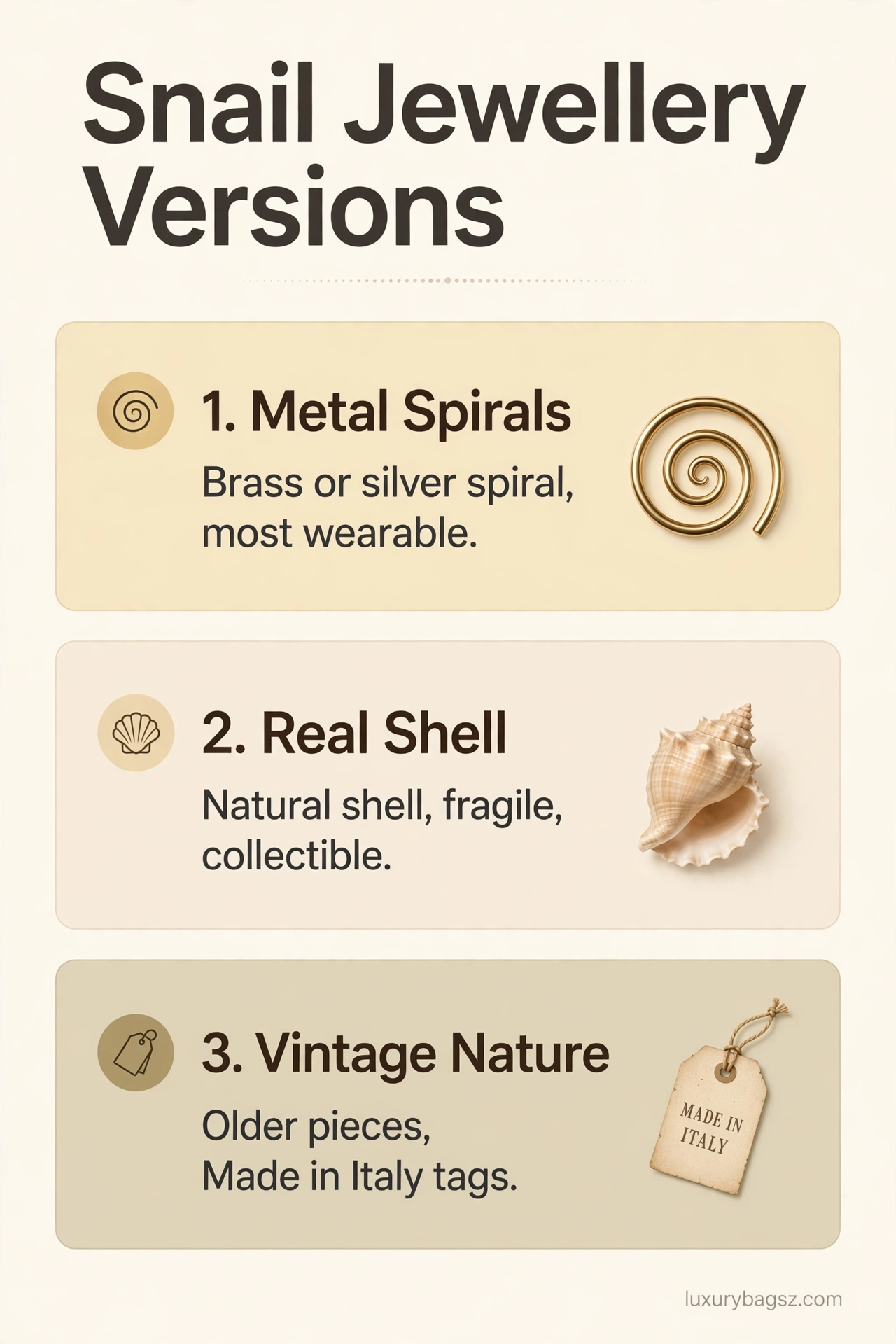
“Snail jewellery” covers at least three different kinds of piece, and they should not be priced or judged as if they were the same.Metal snail-spiral pieces
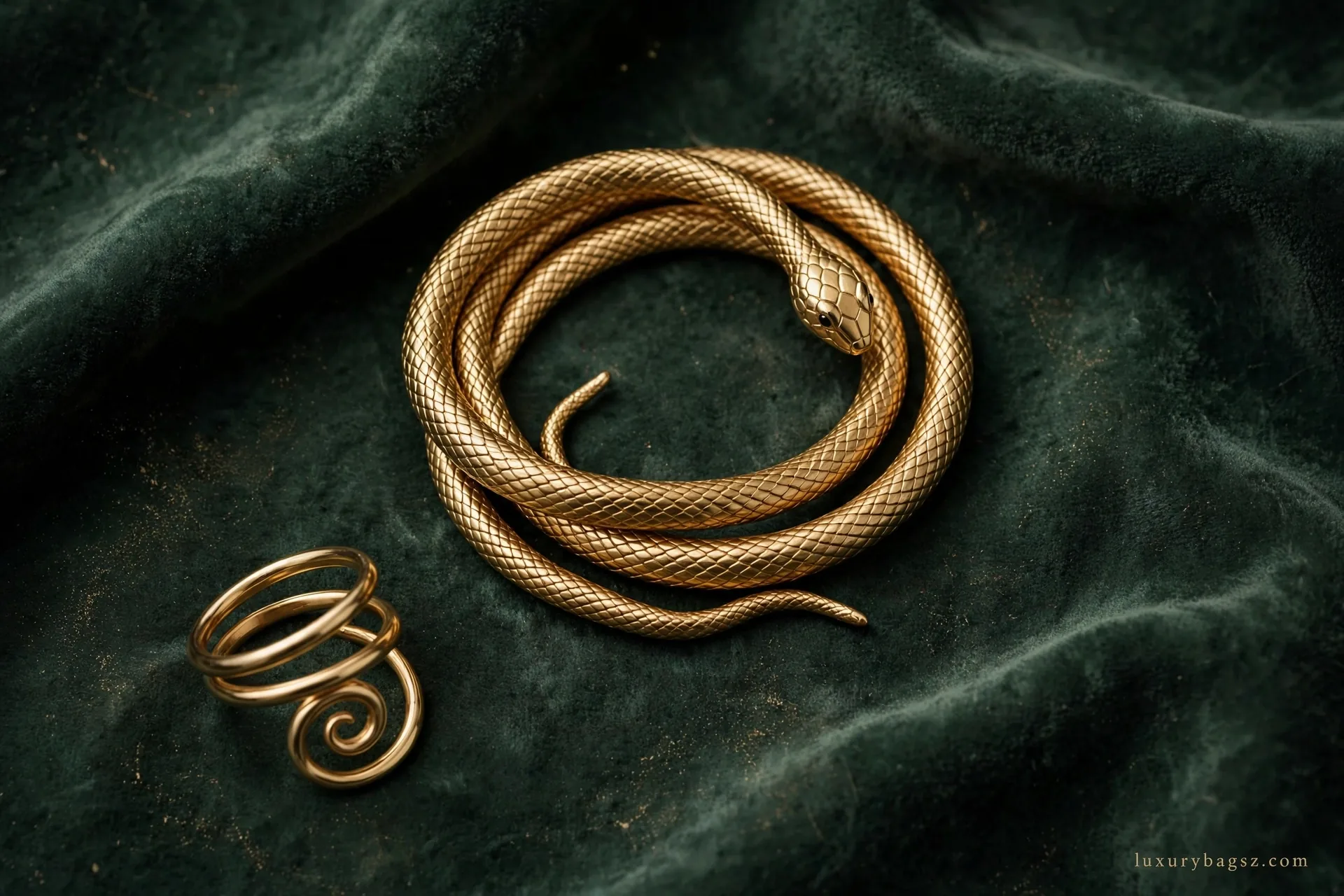
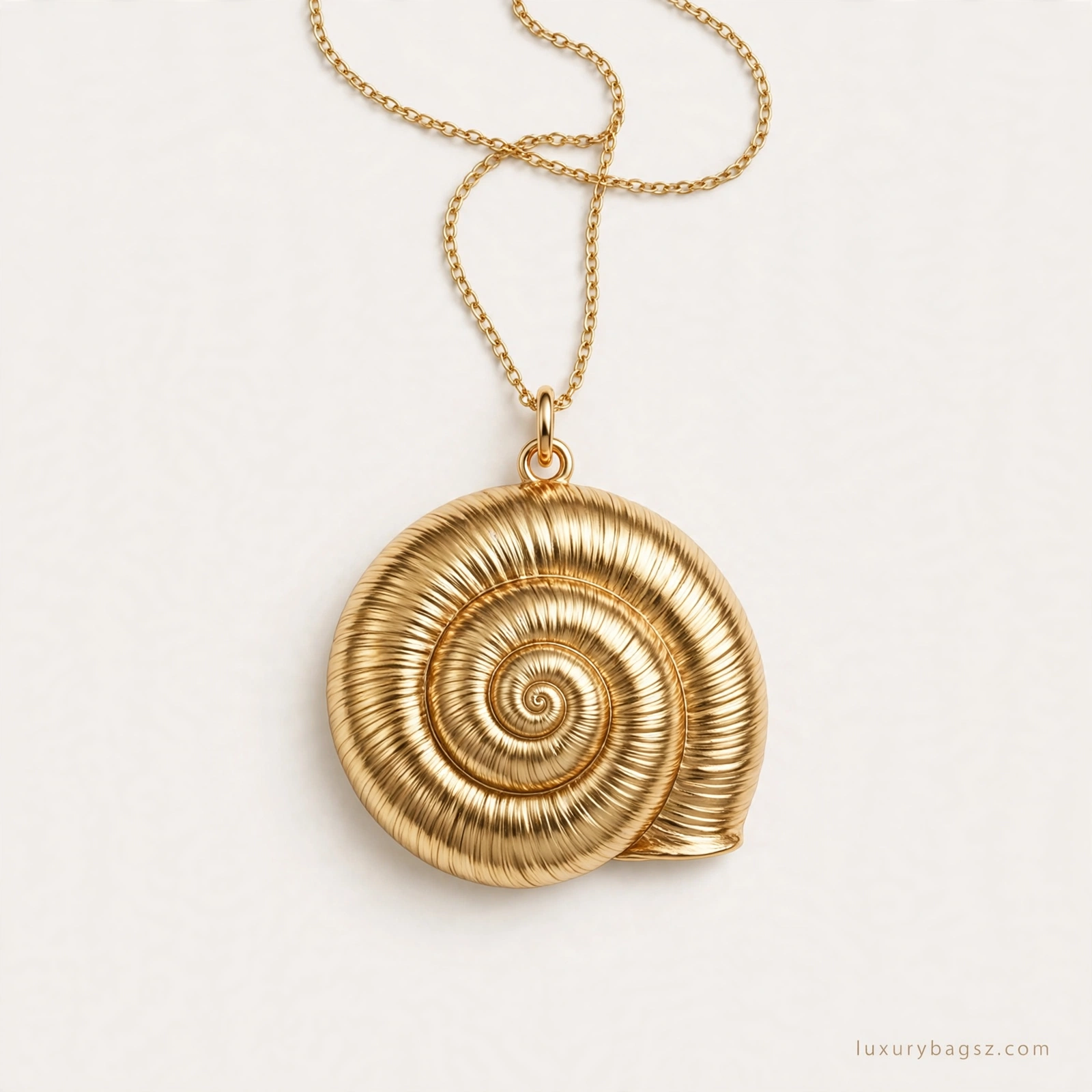
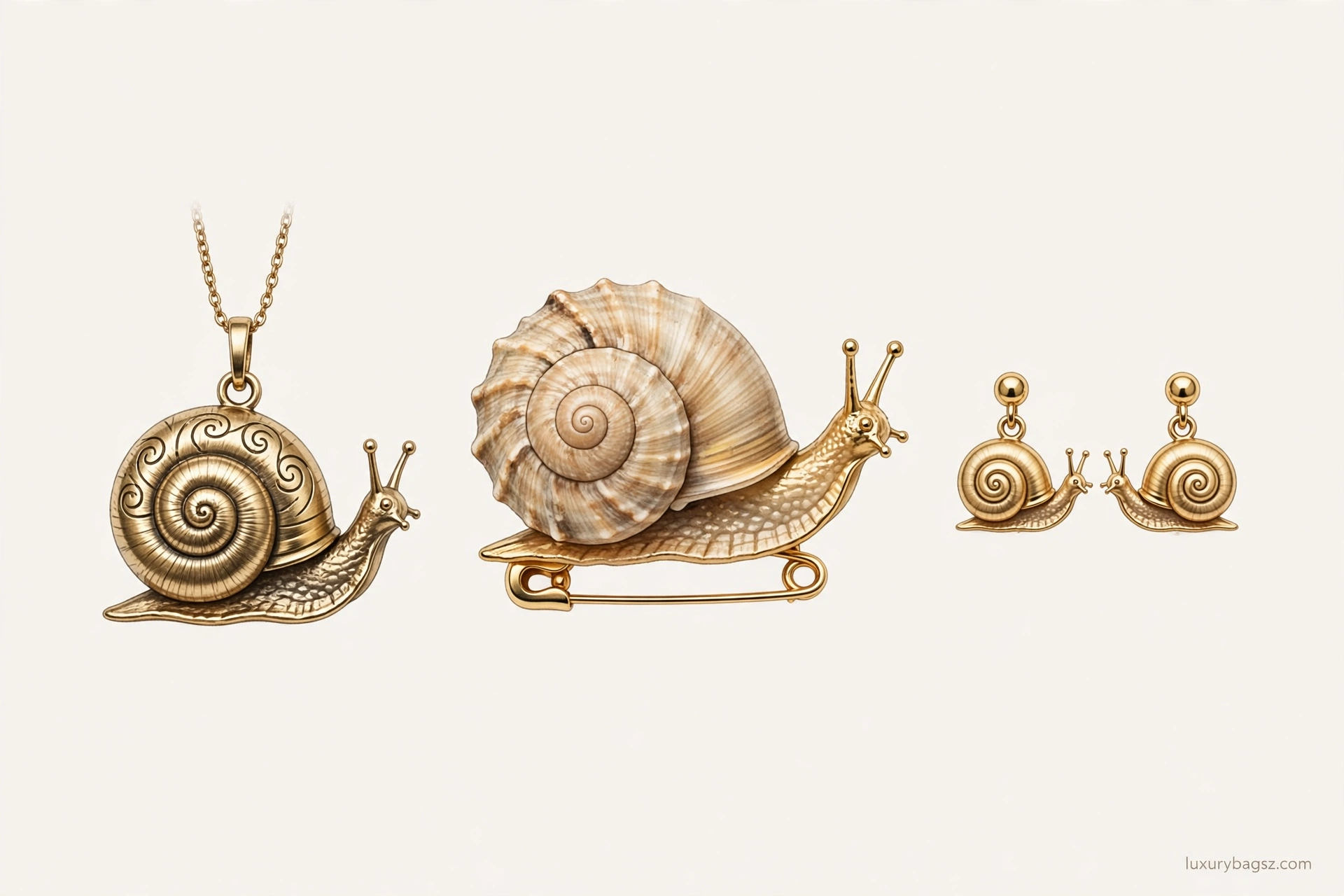
- What they are: Pieces shaped as a snail or a spiral, in brass with gold, rose gold, or rhodium plating, or in sterling silver, with crystals or pearls where the design calls for them.
- Look: The snail is suggested by the spiral, not by a literal shell. The piece is metal, hard-wearing (for costume jewellery), and repairable by a jeweller in a way a shell piece is not.
- Wear: The most wearable snail jewellery, because metal does not chip like shell and does not fade like a natural shell in sunlight.
- Price: In the general Westwood range for its type: earrings $100 to $300, necklaces $150 to $600 and more, rings $120 to $400, according to buying guides. A specific metal snail piece’s price depends on its type, size, plating, and condition.
Real snail-shell pieces
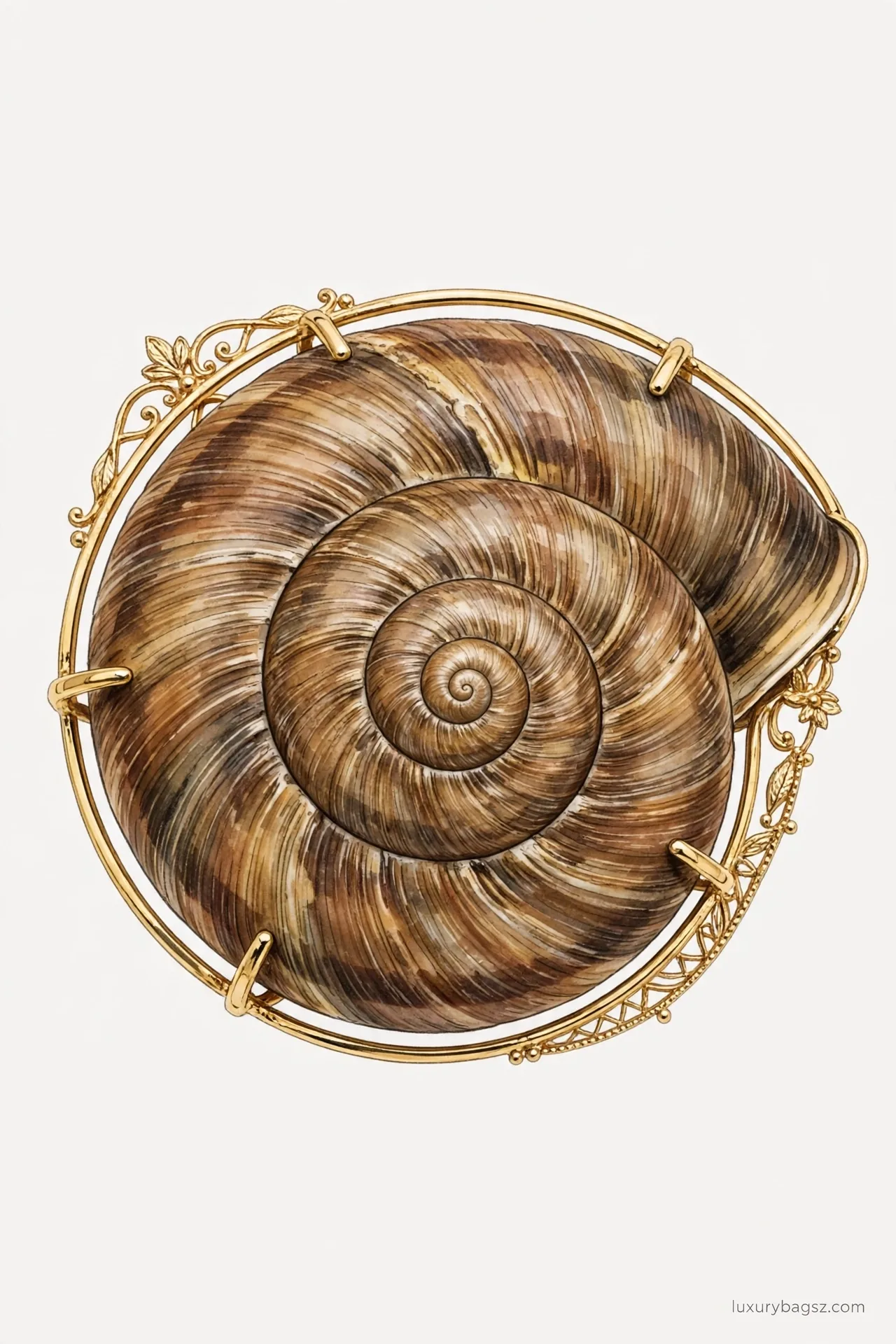
- What they are: Pieces made with, or incorporating, a real snail shell, in the heritage-craft and archive tradition shown in the Vivienne Westwood & Jewellery exhibition.
- Look: Natural, irregular, and fragile. A real shell’s colour, pattern, and spiral are unique to that shell, not standardised like a metal casting.
- Wear: The least wearable, and the most collectible. A real-shell piece is for occasional wear, display, or collection, not for everyday wear, swimming, or rough handling.
- Price: Harder to pin down, because real-shell pieces are rarer and more condition-sensitive. A shell piece in excellent condition, with provenance, is a different market from a shell piece with chips, cracks, or fading. Do not use a metal piece’s price as a shell piece’s price.
Vintage and archive nature pieces
- What they are: Older Westwood pieces that use nature motifs, natural materials, or shell, from the house’s earlier collections, including the late 1980s pieces that first used the Orb and natural materials together.
- Look: Older plating, older clasps, and older tags. Late 1980s Westwood costume jewellery, for example, is described in auction listings as made in Italy, with branded oval tags stamped “Vivienne Westwood – Made in Italy.”
- Wear: Vintage costume jewellery needs more careful handling than modern pieces, because plating wears, clasps weaken, and crystals loosen with age.
- Price: Vintage Westwood pieces on 1stDibs and in auction listings range widely, from a few hundred dollars for a small piece to several thousand for a rare or complete set. A group of late 1980s Orb pieces in one auction lot, for example, was estimated at £200 to £300 plus fees, for seven pieces together, not per piece. Always check whether a price is per piece or per lot.
What is not snail jewellery
- Orb jewellery without a snail or shell: The most common Westwood jewellery, and the most valuable as a signature, but not snail jewellery.
- Pearl jewellery without a snail motif: Pearls are a Westwood signature, from the three-row pearl choker to pearl drop earrings, but a pearl necklace is not a snail piece unless it is shaped as, or incorporates, a snail or shell.
- Armour ring: A four-piece overlapping silver ring, described as like an armadillo’s shell, with a protective spirit. It is shell-like, but it is not a snail piece, and it should not be sold as one.
- Generic snail jewellery by other brands: A snail-shaped piece by another brand, or an unbranded snail charm, is not Vivienne Westwood snail jewellery, whatever a seller’s title says.
Materials: Brass, Silver, Plating, Crystals, Pearls, and Shell
Brass with plating
Most Westwood costume jewellery is brass-based, with premium rhodium, gold, or rose gold plating, according to retailer guides. Brass is a good base for costume jewellery: it holds detail, it can be plated in different colours, and it is lighter than solid silver or gold. Its weakness is plating wear: plating wears at edges, clasps, and points of contact, revealing brass underneath. That wear is normal with age and wear, and it should be priced accordingly, not hidden in photos.Sterling silver and solid gold
Some Westwood pieces are sterling silver, and a smaller number are solid gold (for example, 9k gold earrings and rings in the current catalogue). Silver pieces are generally hypoallergenic, according to retailer guides, while most earrings feature plated brass posts, which may cause reactions in sensitive individuals. Silver tarnishes, but it can be cleaned and polished by a jeweller. Gold pieces are rarer, more expensive, and should be checked for hallmarks.Crystals and pearls
Westwood pieces use crystals (including Swarovski crystals in many Orb pieces) and pearls (including hand-knotted vegan and glass pearls, and faux pearls in chokers). Crystals should be clear, well-set, and complete. Pearls should be even, well-knotted (where knotted), and free from peeling or discolouration. A missing crystal or a peeling pearl is a condition issue, and it should be shown in photos, not described away.Real snail shell
Real shell is the material that makes snail jewellery different. Shell is calcium carbonate, not metal. It is:- Fragile: It chips, cracks, and breaks if dropped or knocked, in a way metal does not.
- Porous: It absorbs moisture, oils, and chemicals, which can stain or weaken it.
- Light-sensitive: Prolonged direct sunlight can fade a shell’s natural colour and pattern.
- Unique: No two shells are identical, so a shell piece cannot be replaced by an identical shell piece if it breaks.
What to check by material
- Metal spiral: Plating wear, tarnish, loose crystals, clasp strength, and tag legibility.
- Real shell: Chips, cracks, fading, staining, and whether the shell is securely set or loose in its mount.
- Pearl or crystal accents: Missing stones, loose settings, peeling pearls, and evenness of colour.
Sizing, Fit, and Wear: What Snail Jewellery Suits
Westwood jewellery sizing follows standard conventions, with some house-specific notes:- Necklaces: Most Westwood necklaces feature 3 to 5 cm extender chains for flexibility, according to retailer guides. The iconic Bas Relief Choker sits at 36 to 40 cm for a close neck fit. A snail pendant on a longer chain will sit differently from a snail choker, and a pendant’s drop length should be checked in the listing.
- Earrings: Westwood earrings are generally for pierced ears, with secure butterfly backs or hooks depending on the design. A snail earring’s weight matters: a heavy shell or metal snail earring will pull on the ear more than a small stud, and it should not be worn for a full day if it is heavy.
- Rings: Westwood rings follow standard UK sizing, typically in the H to Q range, according to retailer guides. A snail ring’s spiral shape may fit differently from a plain band, because a spiral or shell shape does not sit flat on the finger in the same way. Check the listing’s size, and ask for the internal diameter if it is not given.
- Bracelets and bangles: Westwood bracelets and bangles should be checked for internal diameter and clasp type, because a bangle that is too tight will chip a shell piece if it knocks against a table, and a bracelet that is too loose will catch on fabric.
Who snail jewellery suits
Snail jewellery suits a collector, a nature-motif lover, or someone who wants a conversation piece rather than a signature Orb piece. A metal snail piece suits everyday or occasional wear, with the usual costume-jewellery care. A real-shell snail piece suits occasional wear, display, or collection, with careful storage, as described in Section 9. It does not suit rough everyday wear, swimming, or anyone who needs a hard-wearing, hypoallergenic, solid-metal piece — for that, a sterling silver or solid gold Westwood piece, or a small Orb stud, is a better choice. For general jewellery buying discipline, the same photo, condition, and returns checks apply to other limited pieces — our guide to the Arty ring works through those checks for a different kind of limited piece.Price: What Snail Jewellery Actually Sells For
Prices below are from buying guides, retailer listings, and auction listings seen during research. They are not a live price check, and they are not a valuation for a specific snail piece. A piece’s price on the day you buy depends on whether it is metal or shell, its type, its age, its condition, and its provenance. Always check the individual listing.General Westwood jewellery ranges (buying guides)
- Earrings: $100 to $300 (studs at the lower end, pearl Orb drops at the upper end).
- Necklaces: $150 to $600 and more (basic Orb pendants around $200; deluxe versions with pearls or gemstones over $500).
- Rings: $120 to $400, depending on complexity.
- Bracelets: $180 to $450.
1stDibs category ranges
- Used Westwood necklaces: Start at $212, top out at $1,300, averaging about $680. This is a general category, including Orb, pearl, and other necklace types, not only snail necklaces.
- Westwood earrings: Start at $148, top out at $6,950, averaging about $373. The high end is for rare or high-value earrings, not for a typical snail earring, and it should not be used to value a specific piece.
- Westwood “Worlds End” pieces: On 1stDibs, average $5,500, ranging from $1,239 to $39,498. This is a different, high-value category (Worlds End is a Westwood label and boutique name), and it should not be used to value snail jewellery.
Specific prices seen
- Ismene earrings (retailer listing): $220, sold out, in brass, for pierced ears. This is a modern Westwood earring, not a snail piece, but it shows the current retail range for a brass Westwood earring.
- Late 1980s Orb jewellery lot (auction): A group of seven Westwood pieces, including an articulated skeleton pendant choker, a rhinestone brooch, and other pieces, estimated at £200 to £300 plus fees, for the lot together. This shows how vintage Westwood costume jewellery can be priced as a lot, not per piece, and why a per-piece price should be checked.
- Late 1980s Orb trio (auction): Three pieces — a crystal-set Orb pendant necklace (50 cm chain), a bracelet (19 cm), and an Orb bracelet (16 cm) with red enamel heart detail, each with branded oval tags stamped “Vivienne Westwood – Made in Italy” — estimated at £80 to £100 plus fees, for the trio together, with some tarnish and one tiny stone missing. Again, a lot price, not a per-piece price, and a condition note that explains the low estimate.
- RealReal valuation examples (not snail pieces, but Westwood price anchors): A silver-tone and enamel Orb pendant necklace, estimated retail $185, condition Good; a faux pearl and crystal three-row Bas Relief choker, estimated retail $690, condition Excellent, with designer box and pouch; a faux pearl and crystal “broken” bead strand necklace, estimated retail $590, condition Very Good. These show how condition and completeness (box, pouch) affect a Westwood piece’s retail estimate.
What the price range tells you
The range is wide because Westwood jewellery is wide: from a $100 stud to a $690 choker to a $6,950 rare earring, from a modern brass piece to a vintage archive piece, from a metal spiral to a real shell. A snail piece at a price far below its type’s range, with no condition reason given, is a warning, not a find. A snail piece at a price far above its type’s range needs a reason: real shell in excellent condition, vintage provenance, a complete set with box and pouch, or a rare motif that can be checked.Real vs Fake: Westwood-Specific Checks for Snail Jewellery
Westwood jewellery is widely counterfeited, especially Orb pieces, and snail pieces are not exempt, because a seller can put a Westwood tag on an unbranded snail charm. Use the checks below together, never one alone. For general authentication principles, see our guide to fake Rolex — the principle is the same: no single check proves a piece, and a piece that fails several checks should not be bought on a seller’s word alone.The tag and markings must be right
Authentic Westwood pieces carry a branded tag or stamp. Late 1980s pieces, for example, carry branded oval tags stamped “Vivienne Westwood – Made in Italy.” Modern pieces carry a tag with the Westwood name and, often, an Orb. Check the tag in photos, and compare it with reputable listings for the same period. A misspelled tag, a blurry stamp, a tag in the wrong place, or a tag that looks newly attached to an old piece is a warning.The Orb, where present, must be right
If a snail piece also carries an Orb, the Orb must be the Westwood Orb: a sphere with a cross on top and a Saturn-like ring around it, not a generic planet charm, not a plain ball, and not a ring without a cross. A wrong Orb is a strong reason to stop, even if the snail shape looks right.The material must match the claim
A piece described as sterling silver should be silver, not plated brass with silver-coloured plating that wears to brass. A piece described as real shell should be shell, not plastic or resin shaped as a shell. Check the material in close-ups: shell has a natural, irregular pattern and a matte or slightly glossy natural finish; plastic has a uniform pattern and a shiny, moulded finish. A material claim that does not match the photos is a warning.The plating, crystals, and pearls must be right
Plating should be even, with wear only where age and wear explain it, not peeling in large patches on a piece described as new. Crystals should be clear, well-set, and complete. Pearls should be even and well-knotted where knotted. A piece with missing crystals, peeling pearls, or plating that peels to a different metal underneath, on a piece described as excellent condition, is a warning.The clasp, chain, and construction must be right
Necklaces should have a lobster clasp or the correct clasp for the design, with a 3 to 5 cm extender where the design calls for it. Earrings should have secure butterfly backs or hooks. Chains should be even, with no kinks or weak links. A clasp that does not close, a chain that kinks, or construction that looks rushed is a warning.The box, pouch, and paperwork must match
Original Westwood box, pouch, and paperwork, where included, should be photographed, not just mentioned, and should match the piece’s period and type. A box alone does not prove a piece, because boxes can be bought separately, but a missing box on a high-value piece is a reason to ask and to price accordingly. A complete set (box, pouch, piece) in excellent condition, as in the RealReal choker example above, is a plus, not a given.Price and seller as a check, not a verdict
Westwood guides note that there is no official discounting through the brand, so deeply discounted items on third-party sites should raise suspicion. A snail piece at a price far below its type’s range, from a seller with no history and no returns, is a warning, not a bargain. A price in the normal range from a reputable reseller, with clear photos and a returns policy, is a much safer buy, even if it is not the cheapest listing.What not to rely on
- A seller’s claim of “rare,” “archive,” or “runway” without photos or provenance to support it.
- A single photo of the whole piece, with no close-ups of tag, shell or spiral detail, clasp, or box.
- A celebrity or editorial photo of Westwood jewellery, which proves the house exists, not that the listing’s piece is genuine.
- A general “Westwood jewellery” listing that does not show a snail or shell, whatever the title says.

Condition Checklist for Snail Jewellery
Use this checklist on the listing photos, and ask the seller for any photo that is missing.- Tag and markings: Legible, correctly spelled, in the right place for the period.
- Metal: Plating wear, tarnish, scratches, and dents, especially at edges and clasps.
- Shell (if real shell): Chips, cracks, fading, staining, and whether the shell is loose in its mount.
- Crystals and pearls: Missing, loose, chipped, or replaced stones; peeling or discoloured pearls.
- Clasp and chain: Clasp strength, chain evenness, extender presence, and any kinks or weak links.
- Earring backs and hooks: Secure, not bent, not missing.
- Ring size and fit: Size given, internal diameter if asked, and any resizing marks.
- Box and pouch: Present and photographed, not just mentioned.
- Odour and storage: A piece stored damp or in sunlight can carry odour, tarnish, or fading that is hard to reverse. Ask how it was stored if the listing does not say.
Care and Storage by Material
Real shell
- Keep dry. Do not swim, shower, or exercise in a shell piece, and do not soak it in water or cleaner.
- Clean gently with a soft, dry cloth only. Do not use harsh cleaners, acetone, or abrasive cloths, which can stain, weaken, or scratch shell.
- Keep out of prolonged direct sunlight and heat, which fade shell colour and can crack shell.
- Store in a cool, dry place, in a soft pouch, with tissue between the shell piece and other jewellery, so shell does not chip against metal.
- Do not stack heavy items on a shell piece, and do not store it in a sealed plastic bag in a humid room, which can trap moisture.
Brass with plating
- Clean with a soft, dry cloth. Do not use harsh cleaners or polishes made for solid silver or gold, which can strip plating.
- Keep out of prolonged sunlight and heat, which accelerate tarnish and plating wear.
- Store in a pouch, away from other jewellery, so plating does not scratch.
- If plating wears, a jeweller can sometimes re-plate a brass piece, but re-plating a shell piece is not the same as re-plating metal, and it should be discussed with a specialist before it is attempted.
Sterling silver and solid gold
- Silver tarnishes, but it can be cleaned with a silver cloth or by a jeweller. Gold pieces should be cleaned gently with a soft cloth.
- Store silver in a pouch, away from air and moisture where you can, to slow tarnish.
- Keep silver and gold pieces away from harsh chemicals, including perfume and hairspray, which should be applied before jewellery is put on, not after.
Crystals and pearls
- Handle by the metal, not by the crystal or pearl, and do not pull on settings to test them.
- Clean crystals and pearls gently with a soft, dry cloth. Do not use water or harsh cleaners on pearls unless a specialist advises it.
- Store with tissue between crystal and pearl areas and other surfaces, so stones do not scratch each other.
General storage
For general storage principles, including keeping a collector’s item in a cool, dry place and avoiding stacking, see our guide to store Hermes Kelly for bag storage principles that also apply to keeping a delicate piece in shape.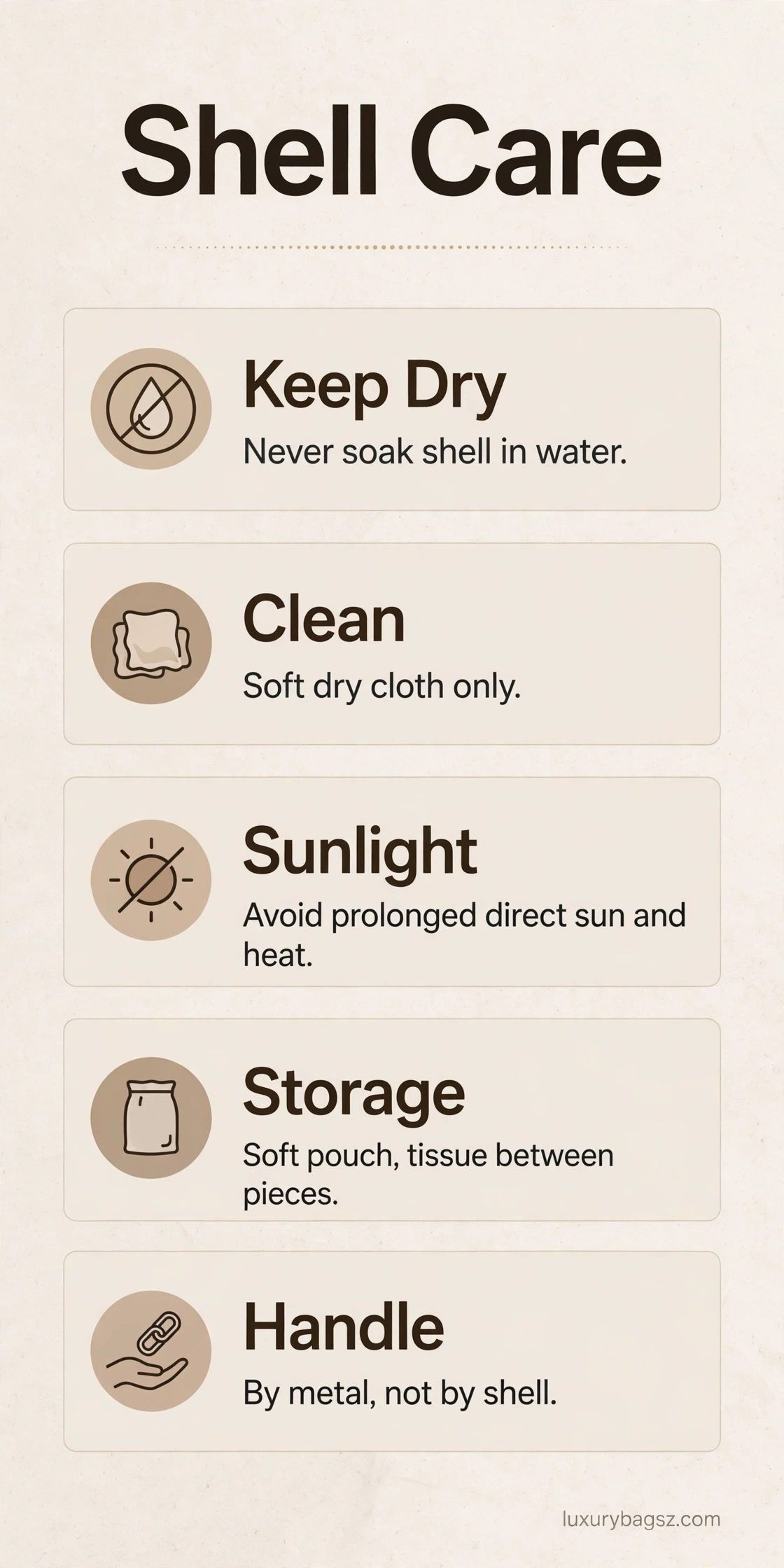
Buying Pre-Owned Safely: The Photo Checklist
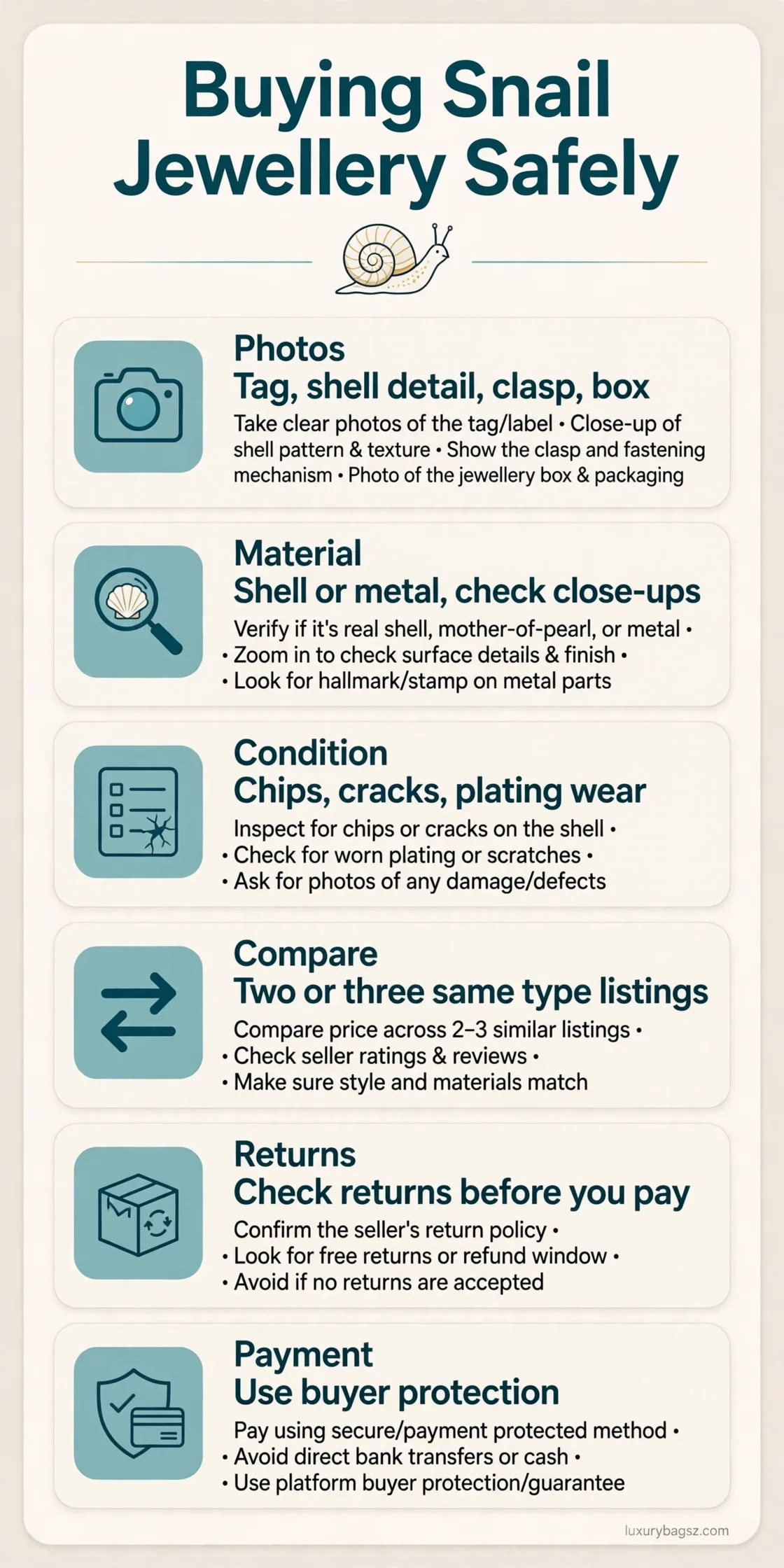
Ask for, or check for, these photos before you pay. A seller who cannot provide them is a seller to be cautious about.- Front, back, and both sides of the piece, not just one angle.
- Close-up of the tag or stamp, showing the Westwood name and Made in Italy mark where present.
- Close-up of the snail or shell detail, showing the spiral, the shell pattern, and any chips or cracks.
- Close-up of the Orb, if present, showing the sphere, cross, and Saturn ring.
- Close-up of the clasp, chain, earring back, or ring band, depending on the type.
- Close-up of crystals and pearls, showing completeness and setting.
- Close-up of plating wear or tarnish, especially at edges and clasps.
- Box, pouch, and paperwork, if included, photographed with the piece.
- A photo of the piece worn or held for scale, so you can judge its size, if the listing does not give dimensions.
- A photo in natural light, if the listing photos are all studio-lit, so you can judge true shell colour and plating colour.
Buying rules
- Buy from a reputable reseller with a clear returns policy, or from a seller with a strong, checkable history.
- Compare at least two or three listings for the same type before you pay, so you know the range.
- Do not pay by unprotected transfer, especially for a snail piece in excellent condition or with provenance.
- If a listing price is far below the range, ask why. A condition reason (chipped shell, worn plating, missing crystal) can explain a low price. No reason given is a warning.
- For a high-value piece, consider an independent authentication service before the return window closes, not after it.
Frequently Asked Questions
Is there a specific Vivienne Westwood “Snail” product?
Not as a verified current catalogue item. The snail appears as a nature motif and in archive pieces made with delicate snail shells, rather than as a single retail line.
What is snail jewellery made of, and can you wear a real-shell piece every day?
It depends on the piece: brass with gold, rose gold, or rhodium plating, sterling silver, crystals, pearls, or real snail shell. Check the listing’s material claim against close-up photos.
No, not practically. Real shell is fragile, porous, and light-sensitive. It suits occasional wear, display, or collection, with careful storage, as described in Section 9.
How much is Vivienne Westwood snail jewellery?
General Westwood ranges are earrings $100 to $300, necklaces $150 to $600 and more, and rings $120 to $400. A specific snail piece’s price depends on material, type, age, condition, and provenance. Check the individual listing on the day.
How do I authenticate snail jewellery, and what should you ask a seller before buying?
Use the checks in Section 7 together: tag and markings, Orb where present, material matching the claim, plating and stones, clasp and construction, box and paperwork, and seller and price. For a high-value piece, use a reputable authenticator.
Ask for the ten photos in Section 10, the exact material, type, size, shell condition if real shell, tag photos, and the returns policy. If any of those are refused, reconsider the purchase.
How do I care for a snail-shell piece, and are Westwood pieces hypoallergenic?
Keep it dry, clean it only with a soft dry cloth, keep it out of prolonged sunlight and heat, and store it in a soft pouch with tissue between it and other jewellery. Do not soak it or use harsh cleaners.
Sterling silver pieces are generally hypoallergenic, according to retailer guides. Most earrings feature plated brass posts, which may cause reactions in sensitive individuals. Check the listing’s material and, if you are sensitive, ask the seller about the post material.
What sizes do Westwood necklaces and rings come in?
Most necklaces feature 3 to 5 cm extender chains, with the Bas Relief Choker at 36 to 40 cm. Rings follow standard UK sizing, typically H to Q. Always check the listing’s own size and, if given, the internal diameter.
Are Westwood pieces a good investment?
Core Orb pieces and complete sets with box and pouch tend to hold value better than a generic piece, according to buying guides, but no jewellery purchase should be made as a guaranteed investment. Buy a snail piece because you love its motif and material, not because you expect it to rise in value.
Final Verdict
Vivienne Westwood snail jewellery is worth buying pre-owned if you buy it for what it actually is: a nature motif in a house that used jewellery to say something about history, nature, and rebellion, made in metal, in shell, or in both, and sold pre-owned in a market where the seller’s description is not always the piece’s story.
Buy it if you love the snail spiral, you have verified the piece’s material and markings, you have seen close-up photos of the tag, the shell or spiral detail, the clasp, and the box, and you accept that a real-shell piece is fragile and needs careful storage. Start with a metal snail piece in good condition, from a reputable seller with returns, before you consider a real-shell archive piece.
Skip it, or wait for a better listing, if the shell is chipped or cracked, the plating peels in large patches, the tag is wrong or missing, the Orb where present is wrong, or the price is far below its type’s range with no condition reason. A snail piece bought badly is not a bargain. It is a piece you will either return, repair at cost, or regret.
Bought well, snail jewellery is one of the most quietly Westwood things you can own: a small, spiral, protective, natural form, made by a house that turned safety pins, pearls, and Orbs into statements, and a reminder that the most interesting jewellery is not always the most famous piece. That is the value, and it is worth paying for — once, for the right piece, in the right condition.
For pre-owned buying generally, the same discipline applies to other discontinued and limited pieces — our guide to the Cambon bag works through the same version-by-version price and condition checks for a different discontinued piece, and our guide to Richard Prince shows how another limited-edition collaboration should be judged piece by piece, not by its name alone, and our guide to Prada chandelier shoes shows how another fragile, seasonal, collector’s piece should be judged by condition first.