Rolex on Finance | Monthly Payments, Total Cost & Risks Explained
Judging Rolex Finance by Total Payable
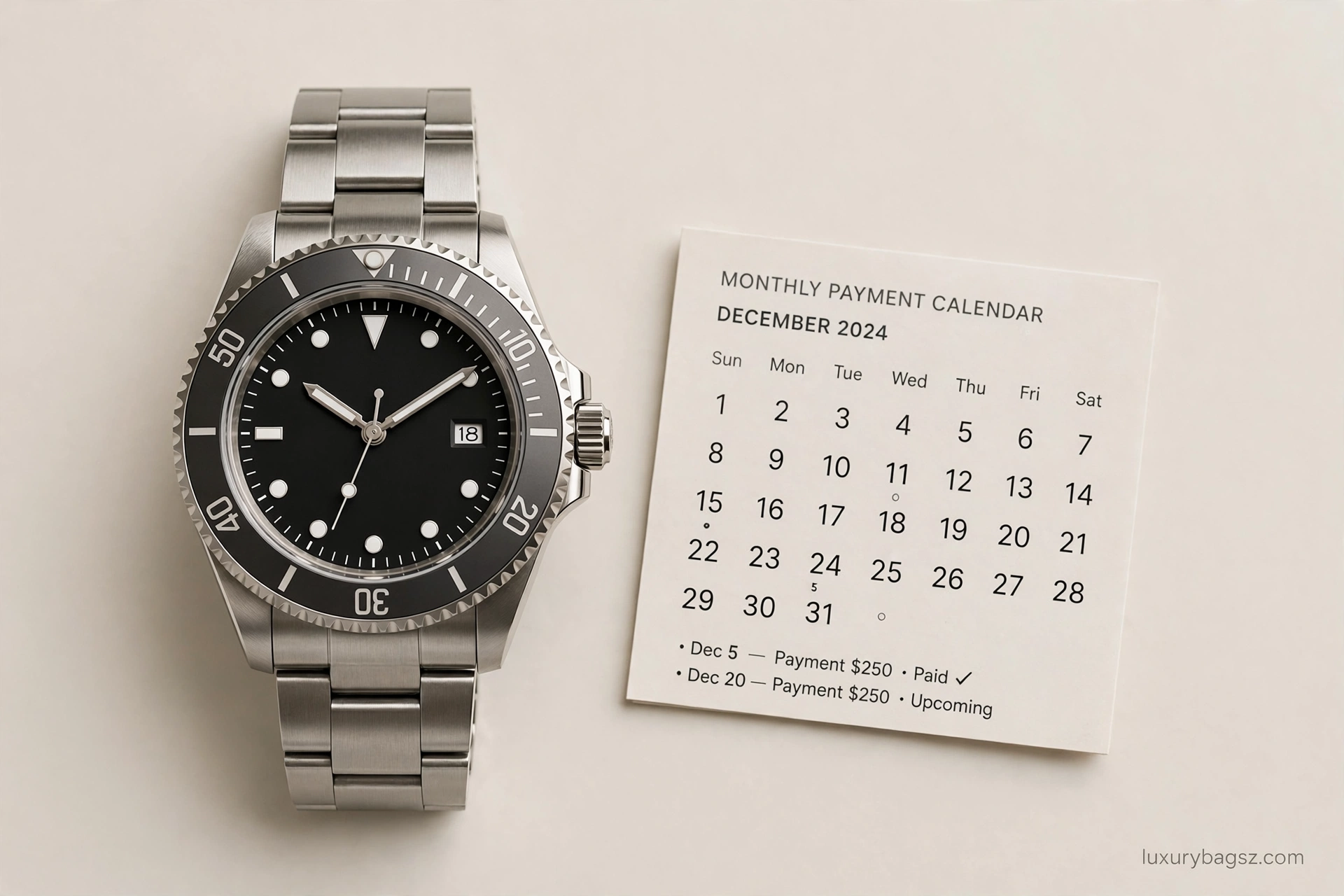
Judge any Rolex finance offer by what you will pay overall — deposit, interest and any fees added together — rather than by the monthly figure alone. The lowest-cost route is usually a short 0% dealer deal cleared fully inside its promotional window, which typically lasts around 12 months and needs a deposit plus strong credit.
Costs climb sharply on longer interest-bearing loans, where some point-of-sale examples reach 36% APR. Using a watch you already own as security is a different arrangement altogether. One London pawn example charges 5% monthly interest, shown as 60% representative APR, and the lender keeps the watch until repayment.
A Rolex on finance sounds simple: instead of paying £10,000 or $12,000 at once, you pay a monthly amount and wear the watch now. In practice, “on finance” can mean five or six very different deals, with different owners, different interest, and very different risks.
The first thing to get right is which kind of finance you are looking at. Buying a Rolex on finance is not the same as borrowing against a Rolex you already own. The first spreads the price of a new purchase. The second is a pawn or asset-backed loan, where the lender usually keeps the watch until you repay. Confusing the two is how people compare a 0% dealer offer with a loan at 60% representative APR and think they are shopping in the same market. They are not.
This guide separates the two, compares the main routes on the same watch, and works out the total cost — not just the monthly payment. It also covers the traps competitors gloss over: deferred interest, representative APR, who owns the watch while you are paying, and what happens if the watch is stolen, damaged, or sold before the loan is finished.
This guide is general information only. It is not financial advice, and it is not affiliated with, endorsed by, or sponsored by Rolex. Interest rates, deposits, terms, and eligibility change by lender, country, and credit profile, so always check the exact agreement offered to you before you sign.
Key Takeaways
- “Rolex on finance” means two different things: buying on finance, and borrowing against a watch you already own. Keep them separate.
- The monthly payment is not the price. Always compare the total amount payable, including deposit, interest, and fees.
- 0% finance is real, but usually short, usually needs a deposit, and usually needs strong credit — and some 0% promos charge backdated interest if you miss the deadline.
- Representative APR is not a promise. It is the rate roughly half of accepted applicants get or beat. Your rate may be higher.
- If a financed watch is stolen or damaged, you still owe the loan. Finance does not insure the watch.
- You may not be free to sell or trade a financed watch until the agreement is settled. Check the ownership terms first.
- A Rolex is not a guaranteed investment. Financing a resale premium can leave you owing more than the watch is worth if the market cools.
The 60-Second Answer
What is the cheapest way to buy a Rolex on finance?
Usually, a short 0% dealer or retailer offer that you repay in full inside the promotional period, with no interest and no fees. The catch is that it is usually 12 months, usually needs a deposit, and usually needs good credit.
What is the most expensive way?
Usually, a long, high-APR point-of-sale loan, a credit card carried past its 0% period, or a pawn loan against a watch you already own. At the top end of point-of-sale APRs — 36% in some US examples — the interest can add thousands to a watch that was never going to appreciate by that much.
What should you check before anything else?
- The total amount payable, not just the monthly payment.
- Whether the rate is representative or guaranteed for you.
- Who owns the watch during the agreement, and what happens on default.
- Whether the watch is insured from day one.
- Whether you could still afford the payments if your income dropped for three months.
If any of those five answers is unclear, do not sign yet.
The 5 Ways to Pay Over Time, Compared
2.1 Dealer and retailer finance
This is finance offered at the point of sale, usually through a partner lender rather than by the dealer itself. In the UK, for example, Chronofinder acts as a credit broker introducing customers to Novuna Personal Finance, and Luxe Watches uses V12 Finance. In the US, authorised dealers often partner with banks or jewellery credit providers.
Typical shape: a deposit, then fixed monthly payments over 12 to 60 months. Short terms may be 0% APR. Longer terms are interest-bearing.
Watch out for: the deposit rules. Chronofinder requires a minimum 10% deposit and caps the loan at £20,000, so on a watch above £20,000 you must pay the difference as deposit. Luxe Watches, on one listing, required a minimum 30% deposit and a maximum of 50%. Deposit rules vary a lot by seller and lender, so never assume 10% is standard.
2.2 Buy now, pay later (BNPL)
BNPL providers such as Affirm, Klarna, and Bread appear at the checkout of many pre-owned dealers. The 1916 Company, for example, offers Affirm for certified pre-owned Rolex watches in the US: pay in 4 interest-free payments every 2 weeks, or a 3, 6, 12, 18, or 24-month plan at 0–36% APR depending on credit.
Typical shape: quick eligibility check, then fixed instalments. Some plans are genuinely interest-free. Others are ordinary loans with a BNPL label.
Watch out for: that 0–36% range. The low end and the high end are not the same product in any meaningful sense. A plan at 36% APR is not “paying monthly for convenience” — it is expensive borrowing, and it needs to be judged against a personal loan or saving up, not against a 0% offer.
2.3 Personal loan from a bank, credit union, or online lender
You borrow a lump sum, pay the dealer in full, and repay the lender in fixed monthly payments. The watch is yours from day one, because the loan is usually unsecured — it is not secured on the watch itself.
Typical shape: 12 to 60 months, rates driven by credit score, income, and debt-to-income ratio. Competitor guides put prime borrowers around 6–9% APR and subprime borrowers above 15% APR, with credit unions sometimes cheaper for members.
Watch out for: a secured loan against savings or another asset can look cheaper, but it puts that asset at risk. Do not trade an unsecured watch loan for a secured loan without understanding what you are putting up as collateral.
2.4 Credit card, including 0% purchase cards
A credit card can be the cheapest route if you clear the balance inside a 0% introductory period, and one of the most expensive if you do not. Once the 0% period ends, the standard APR applies to the remaining balance, and interest can compound monthly.
Typical shape: no fixed term, minimum payments that stretch the debt out, and a promotional window that rewards discipline and punishes drift.
Watch out for: minimum payments. Paying only the minimum on a £10,000 balance at a standard card APR can take years and cost thousands in interest. If you use a card, set a fixed monthly payment that clears the balance before the 0% period ends, and put that date in your calendar.
2.5 Lease-to-own and subscription
Lease-to-own and subscription services let you wear a watch for a monthly fee, with an option to buy, return, or upgrade later. Some competitor guides quote subscription fees of roughly $150 to $450 a month depending on the model and service, with minimum terms of around 6 months.
Typical shape: low upfront cost, no ownership until you exercise a purchase option, and a total cost that can exceed the retail price if you rent for a long time and then buy.
Watch out for: the purchase maths. One competitor example describes a customer who rented for 18 months at $400 a month — $7,200 in rent — and then paid a further $6,000 to buy outright. That is $13,200 in total, and it may be more than the watch cost at the start. Always ask: what is the purchase price after the rental period, how much rental credit counts toward it, and what happens if the watch is damaged while rented?
Comparison table
| Route | Who owns the watch? | Typical term | Typical APR range | Best for |
|---|---|---|---|---|
| Dealer / retailer finance | Usually you, with a loan to repay | 12–60 months | 0% promo, or around 11.9% representative in one UK example | A watch from that seller, repaid inside the term |
| BNPL | You, with a loan to repay | Pay in 4, or 3–24 months | 0–36% depending on credit | Short, interest-free plans only |
| Personal loan | You, from day one | 12–60 months | Roughly 6–9% prime, 15%+ subprime | Comparing lenders freely, any seller |
| Credit card | You, from day one | No fixed term | 0% intro, then standard card APR | Disciplined borrowers who clear it inside 0% |
| Lease-to-own / subscription | The provider, until you buy | 6 months and up | No APR, but fees and a purchase price | Trying a model, or variety over ownership |

Same Watch, Total Cost: The Table Competitors Don’t Give You
Most finance pages show you one example, from one lender, on one term. That makes comparison impossible. Here is the same watch, at the same price, across the main interest-bearing routes, so the difference is the finance, not the watch.

Assumptions, stated plainly: £10,000 cash price, £1,000 (10%) deposit, £9,000 borrowed. Monthly payments below are approximate, calculated on a standard amortising basis with no fees, and rounded to the nearest pound. Your lender’s exact figures will differ with fees, rounding, and whether interest is calculated differently. Use this table to compare routes, not as a quote.
| Route | Term | APR | Monthly payment (approx.) | Interest (approx.) | Total payable incl. deposit (approx.) |
|---|---|---|---|---|---|
| Dealer 0% promo | 12 months | 0% | £750 | £0 | £10,000 |
| Dealer extended finance | 60 months | 11.9% representative | £197–£200 | £2,820–£2,985 | £12,820–£12,985 |
| Dealer extended finance | 36 months | 11.9% representative | £299 | £1,746 | £11,746 |
| Personal loan, good credit | 36 months | 8% | £282 | £1,153 | £11,153 |
| Personal loan, weaker credit | 36 months | 15% | £312 | £2,232 | £12,232 |
| BNPL, top-end rate | 24 months | 36% | £531 | £3,754 | £13,754 |
Three things jump out.
First, term matters as much as rate. The same 11.9% APR costs about £1,746 over 36 months and about £2,820–£2,985 over 60 months on the same £9,000. A lower monthly payment is not a cheaper deal — it is often a longer, more expensive one.
Second, the 0% deal is only cheap if you finish it. £750 a month for 12 months is a big commitment. If you cannot sustain it, a longer loan at a modest APR may be safer than a 0% plan you default on.
Third, the top-end BNPL rate changes the whole purchase. At 36% over 24 months, you pay roughly £3,754 in interest on a £9,000 loan. No ordinary Rolex is guaranteed to appreciate by that amount, and most will not.

Real examples from competitors, for scale
- Chronofinder (UK, representative example): £10,000 cash price, £1,000 deposit, £9,000 credit, 60 monthly payments of £197, total charge for credit £2,820, total payable £12,820, 11.9% APR representative.
- The 1916 Company / Affirm (US): a $7,950 purchase at 10% APR over 24 months costs approximately $367.12 a month.
- CareClone (US example): a $12,000 two-tone Datejust at 10% APR over 24 months costs approximately $553 a month, about $1,280 in interest, true cost about $13,280.
- LivingSpaceGuide (US examples): an $11,000 Submariner at 6% APR over 24 months costs about $486 a month, about $656 in interest; a $10,000 personal loan at 8% over 36 months costs about $313 a month, about $1,248 in interest.
Treat every one of those as a starting point, not a quote. Rates are representative, credit-dependent, and change over time.
0% Finance, Honestly
0% finance is the headline every seller wants you to see, and it is worth understanding properly, because it is both real and conditional.
Who gets 0%? Usually, buyers with strong credit, a clean affordability check, and a deposit that meets the lender’s minimum. Chronofinder’s 0% offer, for example, is 12 months with a minimum 10% deposit. Other sellers require 20% or 30%. If you do not meet the deposit or credit bar, you may be offered an interest-bearing plan instead — and the monthly payment will look similar while the total cost is not.
What is deferred interest? Some 0% promotions are not “no interest if you pay on time” in the simple sense. They are “no interest charged if you clear the whole balance by the end of the promotional period, but if you do not, interest is charged backdated to the purchase date.” That is the deferred-interest trap, and it is the single most expensive misunderstanding in BNPL and store finance. Before you sign, ask in writing: if I still owe £1 on the last day of the promo, do I pay interest on the original balance, or only on the remaining £1?
What else can break a 0% deal? Late or missed payments can end the promotional rate, add fees, and damage your credit record. A 0% plan is a discipline test as much as a finance product. If your income is variable, or the monthly payment leaves no buffer, a longer interest-bearing loan with a payment you can actually sustain may be the safer choice, even though the total cost is higher on paper.
A simple 0% checklist:
- Deposit required, and maximum loan amount.
- Promotional period in months, and the exact end date.
- Whether interest is deferred or only charged on the remaining balance after the promo.
- What happens on a late or missed payment.
- Whether you can overpay or settle early without a fee.
Eligibility, Credit Checks, and Representative APR
Soft check vs hard check
Most point-of-sale finance starts with a soft credit check to see if you pre-qualify. A soft check does not affect your credit score. If you proceed, the lender usually performs a hard inquiry to finalise your terms. A hard inquiry can affect your score, and multiple hard inquiries in a short period can look worse than one.
Affirm’s eligibility check at The 1916 Company is described as a soft check that will not affect your credit. That is the pre-qualification stage, not the whole story. Always ask which stage you are at, and whether the next step is a hard check.
What “representative APR” actually means
Representative APR is not the rate you will get. In the UK, it is the rate that at least 51% of accepted applicants must receive or beat. That means up to 49% of accepted applicants can be offered a higher rate. Chronofinder’s 11.9% APR representative is a good example: it tells you what a typical accepted borrower might get, not what you will get.
In the US, the equivalent warning is the APR range. Affirm’s 0–36% range tells you almost nothing about your rate until you apply. Do not compare a representative rate from one lender with a headline 0% rate from another as if they were the same kind of figure.
Affordability, not just approval
Approval is not affordability. A lender may approve you for a payment you can only sustain by cutting essentials, dipping into savings every month, or relying on overtime that is not guaranteed.
Before you apply, run this test honestly:
- Can you pay the monthly amount, plus insurance, for 12 months, if your income drops by 20%?
- Do you still have 3 to 6 months of essential expenses saved, after the deposit?
- Is the total amount payable still sensible if the watch loses 20% of its value?
If the answer to any of those is no, the finance is stretching you, even if the lender says yes.
Missed payments
Late or missed repayments can have serious consequences, and competitors state this plainly for a reason: your credit rating may be affected, which can make it more difficult to obtain credit in the future. Missed payments can also end a promotional rate, add late fees, and, on a secured or lease-to-own agreement, put the watch itself at risk. If you think you may miss a payment, contact the lender before the due date, not after. Lenders have more options before a payment is missed than after it.

Buying New vs Pre-Owned on Finance
New from an authorised dealer
Authorised dealers rarely handle finance in-house. They partner with banks or finance providers, and finance may be limited to in-store sales of new watches. On sought-after models, there is another constraint competitors mention but do not develop: waiting lists and allocation. An authorised dealer may not offer finance on a watch you cannot actually buy yet, and may limit financed transactions on highly sought-after pieces.
The advantage of buying new on finance is the full manufacturer warranty and a clean service history. The disadvantage is availability — and, on some models, a retail price that is below the secondary market price, which makes the watch hard to get at all.
Pre-owned from a reputable dealer
Pre-owned dealers are where most point-of-sale finance actually lives: Affirm, Klarna, and Bread at checkout, dealer finance through a partner lender, and V12-style finance in the UK. The advantage is choice and availability. The disadvantage is that you must do the authentication work yourself, because finance does not authenticate a watch.
Before you finance a pre-owned Rolex, do the same checks you would do paying cash. For the physical checks, see fake Rolex. For the serial check — location, format, dating, and what a serial cannot prove — see serial number check. A financed fake is worse than a cash fake: you still owe the loan, and you have a dispute with both the seller and the lender.
Grey market and private sellers
Grey market sellers may sell below authorised retail and may accept finance through third-party platforms, but warranty and service history may be weaker. A private seller will rarely offer finance at all — you would be using your own personal loan or credit card, which means the seller gets paid in full and the lender’s claim is on you, not on the watch.
In both cases, the finance does not fix a weak provenance. If the papers are incomplete, the service history is missing, or the serial does not line up, the watch is a worse buy on finance than it is for cash, because you are paying interest on a compromised asset.
Borrowing Against a Rolex You Already Own
This is the second intent, and it needs its own section, because the maths and the risks are completely different.
How it works
A pawnbroker or asset-backed lender values your watch, lends you a percentage of that value, and usually stores the watch securely for the duration of the loan. You repay the loan plus interest, and the watch is returned. If you do not repay, the lender may sell the watch to recover the loan.
New Bond Street Pawnbrokers in London, for example, offers loans against Rolex watches at 5% fixed monthly interest, with a Representative APR of 60%, contracts of 2 to 7 months, no credit checks, and no early payment penalties.

Edinburgh Asset Finance describes a similar asset-backed model for business owners, with the watch stored securely, interest typically under 10% (on an annual basis, as described), and no claimed impact on credit rating or company accounts.
Why the APR looks shocking — and why it is not a typo
5% a month compounds to a very high annual rate. That is why the representative APR is 60%, even though the monthly rate sounds modest.
Short-term pawn loans are priced for short terms. Over 2 to 7 months, the total interest on a small loan may be manageable. Over a year, it would not be.
Do not compare a pawn loan’s monthly rate with a purchase loan’s annual rate without converting them to the same basis.
When it can make sense — and when it cannot
It can make sense as a short, planned bridge: a known cash-flow gap, a fixed repayment date, and a watch you are certain you can redeem.
It does not make sense as a way to fund a lifestyle, cover a long-term shortfall, or borrow against a watch you cannot bear to lose. If you cannot repay, you lose the watch. That is the whole security arrangement.
Also note the valuation gap. A lender lends a percentage of value, not the full market price, and a dealer buying your watch outright will also pay below market value, because they must resell at a profit.

Borrowing against a Rolex is not the same as selling it, but neither is it free money. You are paying to keep the watch, and the interest is the price of keeping it.
What Happens If You Sell, Trade, Damage, or Lose a Financed Rolex
This is the section most competitors skip, and it is where financed buyers get caught.
Selling or trading while financed
On a personal loan or credit card, the watch is usually yours, so you can sell it — but you still owe the loan in full, even if the sale price is lower. On dealer finance, BNPL, or lease-to-own, the agreement may restrict sale, transfer, or trade until the balance is settled, and on lease-to-own you may not own the watch at all until you exercise the purchase option.
Before you buy, ask: can I sell or trade this watch before the agreement ends, and if so, what must I pay to release it? If you plan to upgrade in a year, a 60-month agreement with an early-settlement fee and a resale loss is a bad fit.
Negative equity
Negative equity means you owe more than the watch is worth. It happens easily on finance, for three reasons: you paid interest on top of the price, you bought at a resale premium, and the market cooled. A competitor guide makes this point well: if you finance an already marked-up resale watch, interest is charged not only on the watch itself, but also on the market premium. If the market later cools, you still owe the contracted amount.
This is why “buy it because it will appreciate” is a dangerous reason to finance. Some steel sports models — Submariner, GMT-Master II, Daytona — have held value well in strong markets, and some rose sharply between 2010 and 2020.
But not every Rolex appreciates, dress models often depreciate, premiums compress, and selling costs (dealer margin, platform fees, authentication) eat into any gain. Buy because you want the watch. Treat appreciation as upside, not as the repayment plan.

Theft, damage, and loss
Finance does not cover theft or loss, and a loan does not pause because the watch is gone. If a financed watch is stolen or badly damaged, you still owe the lender, and you may also face an insurance excess, a claim dispute, or a gap between the insured value and the outstanding balance.
Insure the watch from day one, for its replacement value, not just its purchase price. Competitor guides put standalone or scheduled watch insurance at roughly $100–$500 a year depending on value and cover, and authorised servicing at $600–$1,200 or more every 5 to 10 years. Add both to your monthly cost when you judge affordability. A £200 monthly payment plus £25 a month insurance plus a future £900 service is not a £200 commitment.
Default and repossession
On an unsecured personal loan or credit card, default damages your credit and can lead to collection action, but the lender does not automatically take the watch. On a secured loan, a pawn loan, or a lease-to-own agreement, the watch itself is the security, and the provider may have the right to retain or sell it. Read that clause before you sign, not after you miss a payment.
When Finance Makes Sense, and When It Doesn’t
Finance can make sense when:
- The plan is short, 0% or low-APR, and you can clear it comfortably inside the term.
- You have an emergency fund intact after the deposit, and the monthly payment survives a 20% income drop.
- The watch is insured from day one, and you have budgeted for servicing.
- You are buying a watch you want to keep, not a watch you need to flip to repay the loan.
- You have compared at least two routes on total amount payable, not just monthly payment.
Finance probably doesn’t make sense when:
- The monthly payment only works if nothing goes wrong.
- You are relying on appreciation to repay the loan.
- The APR is at the top of a BNPL range, or the term is 60 months on a watch you may sell in 2 years.
- You have not read the deferred-interest, early-settlement, and ownership clauses.
- You are borrowing against a watch you already own to fund a purchase you cannot otherwise afford.
- You are financing a resale premium on a watch whose market price is already falling.
A plain affordability test
Add up, per month: the finance payment, insurance (annual premium divided by 12), and a servicing reserve (say, £900 every 7 years is about £11 a month). If that total is more than you can pay from regular income, without touching savings or overtime, for 12 months straight, the deal is too big — whatever the monthly payment headline says.
Alternatives worth comparing
Before you sign, compare finance with: saving for 6 to 12 months and buying outright; buying a certified pre-owned model one tier down; trading in an existing watch to cut the financed amount; and, if you only want variety, a subscription service where you return the watch instead of owning it. A subscription at $200–$400 a month buys variety with no equity. That is a bad deal if you want ownership, and a good deal if you want to try models without a five-year commitment. Judge it on what you actually want, not on the monthly figure alone.
Frequently Asked Questions
Can you buy a Rolex on finance with no deposit?
Sometimes, but not always. Some listings allow 0% deposit, others require 10%, 20%, or 30% to 50%. Chronofinder requires a minimum 10% deposit. Luxe Watches, on one listing, required 30% to 50%. A larger deposit lowers the amount borrowed, the monthly payment, and the total interest, so it is usually worth paying if you can.
How long can you finance a Rolex for?
Typical terms are 12 to 60 months. Short terms (6 to 12 months) are common for 0% offers and pawn loans are shorter still (2 to 7 months in one UK example). Longer terms lower the monthly payment but raise the total interest, as the table in Section 3 shows.
Does financing a Rolex affect your credit score?
A soft eligibility check does not. A full application usually involves a hard inquiry, which can affect your score. On-time payments, if reported to credit bureaus, can help build credit. Late or missed payments can damage it and make future credit harder to obtain.
Do you own the watch while you are paying for it?
On a personal loan or credit card, usually yes, from day one. On dealer finance or BNPL, usually yes, but with a loan to repay and possible restrictions on sale. On lease-to-own or subscription, usually no, until you exercise the purchase option. On a pawn or asset-backed loan, the lender usually holds the watch until you repay. Check your agreement — do not assume.
Can you pay off Rolex finance early?
Often yes, but not always without a fee. Some pawn loans charge no early payment penalty. Some point-of-sale loans allow overpayment or early settlement, sometimes with an early-settlement charge. Ask before you sign, and get the answer in writing.
Can you sell a Rolex that is still on finance?
On an unsecured loan, you can usually sell it, but you still owe the loan in full. On dealer finance, BNPL, or lease-to-own, you may need to settle the agreement first, or you may not own the watch to sell. Selling a financed watch for less than the outstanding balance leaves you with a remaining debt and no watch.
Is financing a Rolex a good investment?
No, not as a strategy. Some models have appreciated, but a watch is not a guaranteed investment, markets change, premiums compress, and selling costs exist. Interest adds a hurdle that appreciation must clear before you break even. Buy a Rolex because you want to wear it. If it holds value, that is a bonus.
Is it better to finance a new Rolex or a pre-owned one?
New gives you a full warranty and clean history, but availability and waitlists can limit you. Pre-owned gives you choice and often a lower price, but you must authenticate carefully, because finance does not prove a watch genuine. In both cases, compare the total amount payable, not just the monthly payment.
Financing a Rolex: The Short, Honest Route
Rolex on finance is not one product. It is a set of very different deals wearing the same monthly-payment headline.
The cheapest honest route is usually a short 0% plan you can repay in full, on a watch you want to keep, insured from day one, with an emergency fund intact after the deposit. The most expensive route is usually a long, high-APR loan — or a pawn loan stretched beyond its short term — on a watch bought at a premium, in the hope that appreciation will bail you out. It usually will not.
So judge any offer on five numbers, in this order: total amount payable, monthly payment, deposit, term, and APR — and on three clauses: deferred interest, ownership and sale restrictions, and early settlement. If a seller will not give you those five numbers and those three clauses in writing, walk away and compare another lender.
A Rolex should be a watch you enjoy wearing, not a monthly payment you dread. If the finance makes the watch stressful, the watch is too expensive at that price, on those terms, right now — whatever the monthly figure says.
I see the end of these decisions: some of the pre-owned pieces I check were bought in a hurry, on a long plan, at the top of the market. The purchases that hold up — in watches as in bags — are the boring ones: short terms, honest totals, and an owner who still wanted the piece after the payments ended. Finance the watch only if the arithmetic stays dull.