How to Spot a Fake Hermès Kelly Bag | 12 Checks & Buying Guide
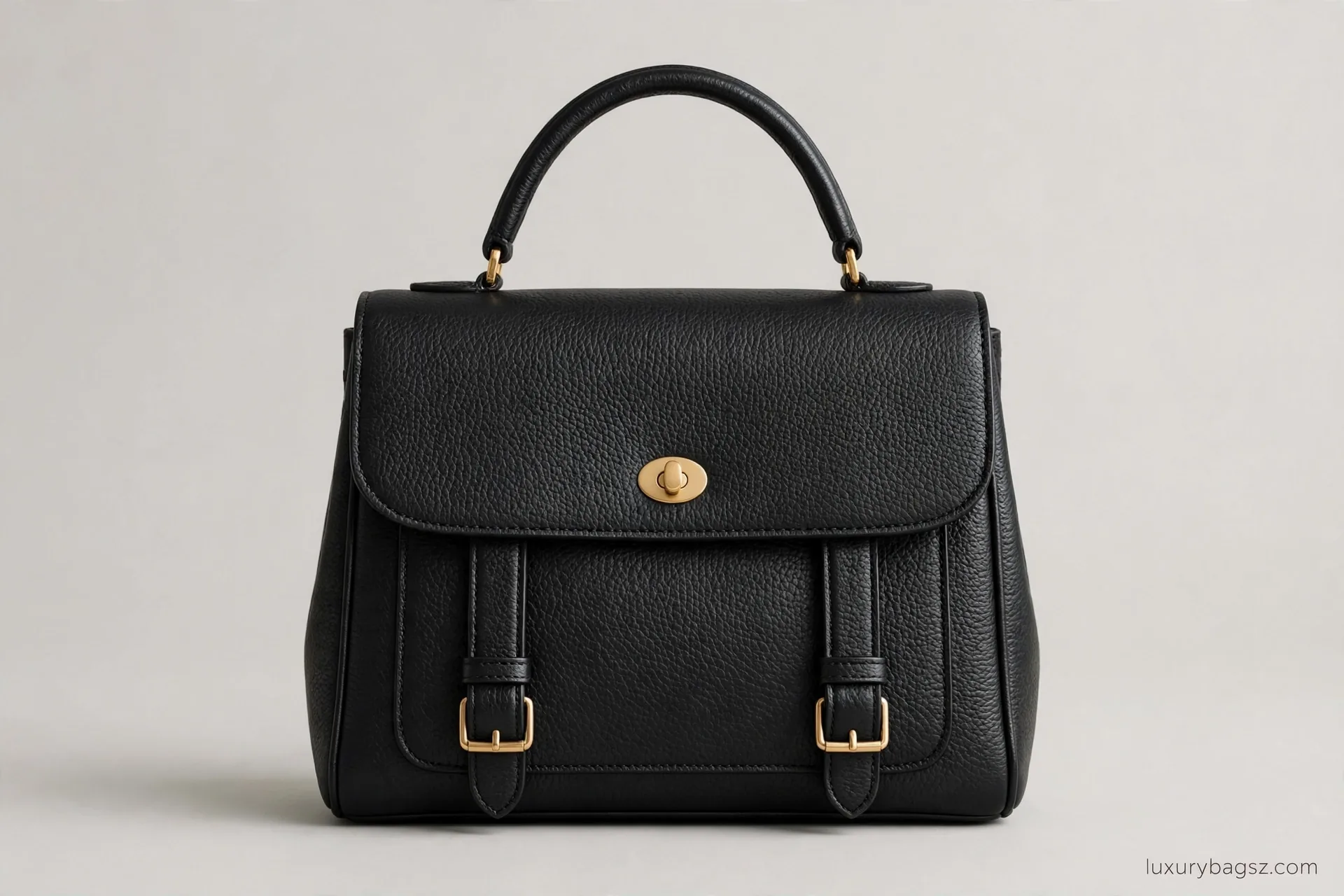
How to spot a fake Hermès Kelly bag is a harder question than it used to be. A cheap fake is still easy: the stitching wanders, the stamp is blurred, the hardware feels light, and the shape sags. A good fake, sometimes called a superfake, is a different problem. It can copy the stitching count, copy the engraving, and even copy a blind stamp well enough to fool a quick look.
That is why this guide does not start with one magic detail. It starts with the construction of the bag itself, then works through 12 checks in order, from the shape you can see in a listing photo to the details you can only judge in person. It also tells you plainly where guides disagree, what no single check can prove, and what to ask a seller for before you send money.
A Kelly is not one bag. It comes in two constructions, several sizes, and many leathers, and a check that is right for one version can be wrong for another. Keep that in mind throughout: a Sellier Kelly and a Retourne Kelly are supposed to look different, and judging one by the rules of the other is how genuine bags get wrongly called fake, and fakes get wrongly passed.
Table of Contents
Key Takeaways
- Start with Sellier vs Retourne. A rigid Sellier that slouches, or a soft Retourne with sharp external stitching, is wrong before you check anything else.
- The heat stamp under the front flap should read HERMÈS PARIS MADE IN FRANCE, with sharp, even letters, a correct accent on È, and no letter touching its neighbour.
- The blind stamp is a date and artisan code, not a serial number, and not proof of authenticity on its own. Its format and location must fit the era of the bag.
- Genuine Kelly stitching is hand saddle stitching: slanted, even, and in a thread colour that matches the bag. Machine-straight, crooked, or loose stitching is a red flag.
- The handle is a hard part to copy well. It should be rigid, symmetrical, with a curved top and a flat underside, and it should not lean, twist, or change thickness along its curve.
- Lock and key numbers must match each other. A matching number does not prove the bag genuine, but a mismatch is a serious problem.
- Hermès does not issue an authenticity card with its bags. A branded card claiming to certify a Kelly is itself a red flag.
- If several checks fail, walk away. If one check is unclear, get a professional opinion before you pay, not after.
On a Kelly, my first move is to name the construction — Sellier or Retourne — because half the checks that follow change with it. Then I go straight to the heat stamp on the flap. Ten years of handling these bags has taught me how the letters should sit in the leather: pressed cleanly, never printed on the surface, and spaced the way the house’s own stamps are spaced. A stamp that floats or blurs under my thumb ends the examination early; one that passes earns the bag the full run of stitching, sangle and hardware checks.
Short Verdict
If you only have a minute, check these five things first.
- Construction: Is it Sellier or Retourne, and does it behave like that construction? Sellier is rigid, sharp-edged, and stands upright. Retourne is softer, rounder, and may slouch a little.
- Shape: A Kelly is boat-shaped: wider at the bottom, narrower at the top. A bottom that is far too wide, or Sellier corners that are rounded instead of sharp, is a warning.
- Heat stamp: Under the front flap, HERMÈS PARIS MADE IN FRANCE should be crisp, evenly spaced, and lightly pressed, not printed, faint, or pressed so hard the edges blur.
- Stitching: Look for slanted, even hand stitching. Crooked, uneven, or perfectly machine-straight stitching is a warning.
- Hardware feel: Gold or palladium hardware should feel heavy and smooth, with clean engraving. Light, plasticky, or loosely engraved hardware is a warning.
Passing all five does not prove a Kelly genuine. Failing two or more is a strong reason to stop and get help, or to walk away.

Sellier vs Retourne First
This is the check most short guides skip, and it is the one that prevents the most false calls.
Sellier, from the French word for saddler, was the first Kelly construction. The stitching is on the outside of the bag, the edges are sharp, and the bag is rigid. It holds its shape and stands upright. Sellier Kellys are usually made in sturdier leathers such as Epsom or Box.
Retourne, sometimes called souple, is made and then turned inside out. The stitching ends up inside, so you see piping instead of external stitching, and the bag is softer and rounder. It is usually made in softer leathers such as Togo, Clemence, or Chevre, and it may slouch when set down.
So:
- A Sellier that slouches, sags, or has rounded corners is a red flag.
- A Retourne judged as fake because it is soft, or because you cannot see external stitching, is a mistake. Softness is normal for a Retourne.
- A bag that claims to be Sellier but shows Retourne piping, or vice versa, does not match its own description. Ask the seller to confirm the construction in writing, with photos of the edges.
Mini Kelly bags add one more wrinkle: the Mini Kelly 20 is usually Sellier, so it should have that sharp, boat-like Sellier shape, narrow at the top and wide at the bottom, not a soft, rounded body.

The 12 Checks in Order
Work through these in order. Do not jump to the blind stamp and stop there. A copied blind stamp on a badly made bag is still a badly made bag.
Check 1: Shape and Proportions
A genuine Kelly has clean lines and a balanced silhouette. The flap should be flat and sharp, not bulky or over-embossed. The corners on a Sellier should be sharp. On a Retourne, the corners are naturally softer, but the bag should still be symmetrical left to right.
Common fake tells: a bottom far wider than the top, so the boat shape is exaggerated; a flap that looks thick and puffy; one side higher than the other; a bag that leans when set down, when the construction says it should stand.
Sizes matter here too. Kelly sizes are named by their width in centimetres: Mini Kelly 20, Kelly 25, 28, 32, and 35 are the usual range. A Kelly 28 that measures nothing like 28 cm wide, or a Mini Kelly that is clearly much larger, has a proportion problem. Measure, do not guess, and compare the measurement to the size the seller claims.
Check 2: Flap, Closure, and Metal Plates
The Kelly closes with a single top handle, a front flap, and a turn-clasp, often called the Kelly lock, held by two sangle straps. The closure should be symmetrical, with straight edges. On a genuine bag, the top and bottom parts of the closure match each other in width. On many fakes, the bottom part is wider than the top, or the whole closure sits off-centre.
The metal plates on the straps should be thin, sharp, and finely detailed, not thick, embossed, and blurry. Screws on a genuine Kelly are hollowed out on top. Screws that are covered, domed, or crudely finished are a warning. The lettering on the plates should be clean and correctly sized: on genuine hardware it is often paler and more precise than the bolder, thicker lettering seen on fakes, though this varies by era and finish, so use it as one signal among many, not as a sole test.

Check 3: Heat Stamp
Under the front flap, a genuine modern Kelly is heat-stamped HERMÈS PARIS MADE IN FRANCE. Check it slowly:
- Letters should share the same baseline and weight.
- Spacing should be even, with no letter touching its neighbour.
- The accent on È should be thin and centred.
- The stamp should be lightly pressed into the leather, crisp but not gouged, and not printed on the surface.
- On many fakes, the S in HERMÈS or in PARIS sits higher than the other letters, or looks thicker. MADE IN FRANCE on a fake often looks thin, washed-out, or poorly shaped.
The foil tone of the stamp should match the finish of the bag’s hardware, gold with gold and silver-toned with palladium. A stamp whose foil colour fights the hardware is another small inconsistency to question.
Vintage exception: very old Kellys, before about 1954, can have silver, gold, or colourless debossed stamps instead of the modern form. Do not apply the modern stamp rules to a genuinely vintage bag without checking its era first.
A stamp on the interior lining, rather than under the flap, is not the usual Kelly placement and should be treated as a warning.
Check 4: Blind Stamp
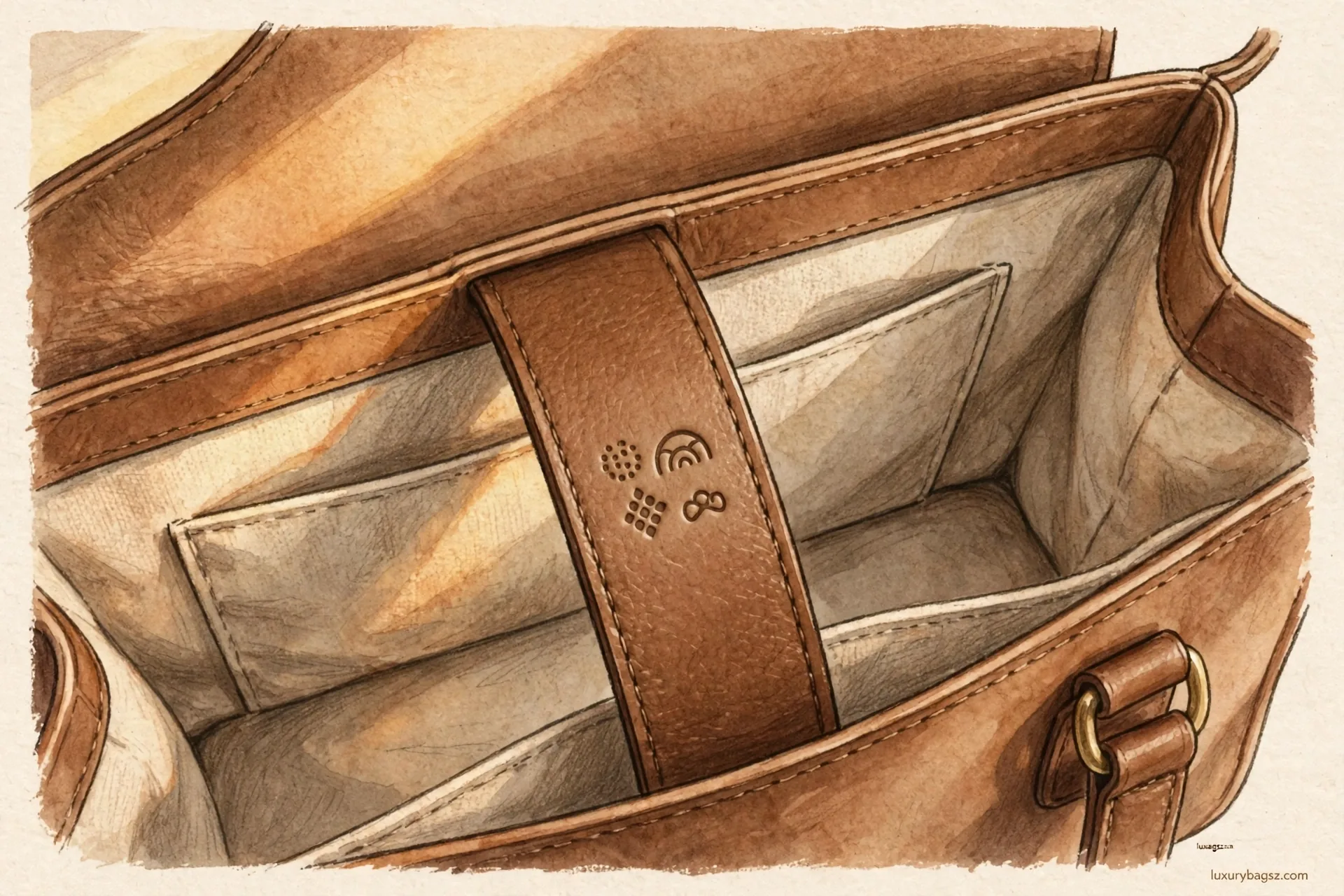
The blind stamp is a small, hard-to-find stamp that records the year of manufacture and the artisan who made the bag. It is not a serial number, and it does not by itself prove authenticity, because counterfeiters copy blind stamps too.
What to check:
- Location: On a Kelly, the blind stamp is usually under the main flap, often behind the sangle strap or inside a pocket fold. A seller who will not photograph it, or who photographs a stamp in a place that does not fit the model, is hiding something.
- Format fits the era: Early blind stamps were a single letter, sometimes inside a shape. From 1997 to 2014, letters appeared inside a square. From 2015 onward, Hermès moved to a single letter with no shape and no obvious alphabetical order, and later to a discreet alphanumeric code. A stamp format that does not fit the claimed age of the bag is a serious problem.
- Craftsman code: Beside the date letter there is usually an artisan code. It should be present and cleanly stamped, not missing, blurred, or in a font that does not match the rest of the bag.
Do not date a Kelly from a blind stamp chart alone if the bag’s leather, hardware, and construction point to a different era. Charts disagree on some years, and a copied stamp can carry a plausible-looking letter. Use the blind stamp as a cross-check, not as a verdict. For the full year-letter tables and the shapes used in each era, see the Hermès date codes and blind stamps guide.

Check 5: Saddle Stitching
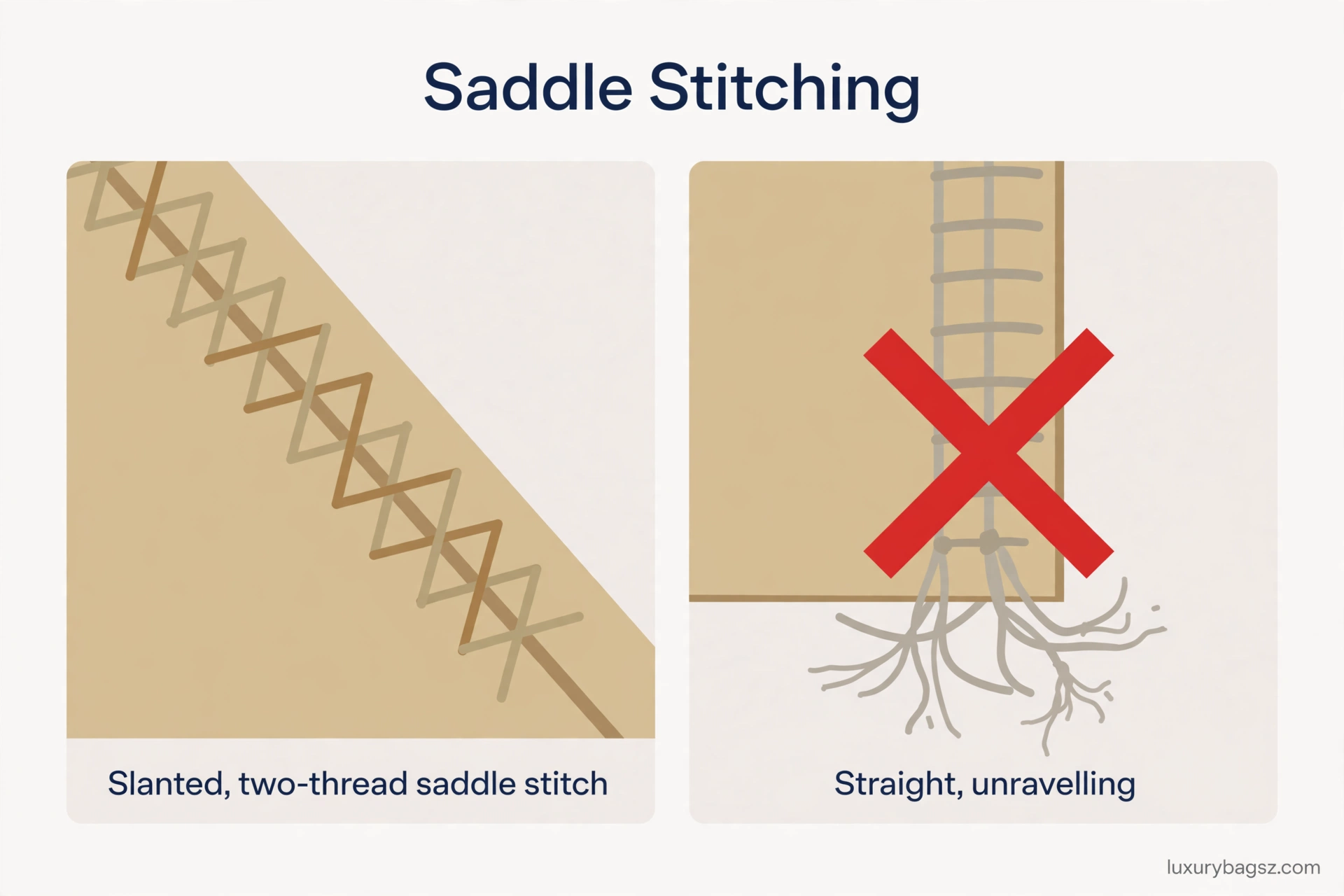
Every Hermès bag is hand-stitched, and the Kelly uses saddle stitching: two needles crossing through each hole, which gives the stitch a natural slant. Check for:
- Slanted, even stitches, in a thread colour that matches the bag.
- Stitching that is straight overall, with no crooked seams, loose threads, or stitches obviously out of line.
- Double stitching where the handle joins the bag.
- On a Sellier, visible external stitching that is meticulous, because it is on show. On a Retourne, stitching inside, with piping outside.
Hand stitching is meticulous, but it is not machine-perfect. A tiny human variation is normal. What is not normal is machine-straight stitching, thread that is too thick or too thin for the bag, or stitching that pulls, gaps, or comes loose. If the stitching looks mass-produced and uniform in a way no hand could repeat, that is a warning, not a guarantee, because superfakes are now much better at this than they used to be.
Stitch count is part of the same check. The spacing and character of the stitches should stay consistent all the way around the bag, including the handle bases and flap edges. A seam that changes character halfway along its run was not finished by one careful hand.
Machine stitching on copies also tends to sit flatter, with looser tension at the corners. Thread ends on a copy may look melted rather than finished invisibly, and loose tails do not belong on a genuine bag.
Check 6: Handle
The Kelly handle is one of the hardest parts to make, and one of the best places to look. It is made from several pieces of leather, takes hours to build, and should be rigid and well-constructed, with a curved topside and a flat underside.
Check:
- The handle sits straight and symmetrical, with the same curve and thickness all the way around. It should return to centre when you set the bag down, not lean or twist to one side.
- Where the handle meets its tabs, stitching lines up left and right.
- Thickness does not change as the handle curves, and it does not get chunky at the apex.
- The shadow the handle casts is even from base to base. On a fake, the shadow often fattens where the core is not built correctly.
Handle hardware changed over time. Kellys made before 2001 generally have simple D-rings. From 2001 onward, Hermès used split double D-rings, one side for the handle and one side for the shoulder strap. A post-2001 bag with pre-2001 hardware, or vice versa, needs an explanation that fits its date.
Check 7: Sangle and Croix Strap
The Kelly’s front straps, the sangles, and the cross strap that holds the flap closed, sometimes called the croix strap, should be symmetrical and well finished.
Check:
- The strap is symmetrical, with a symmetrical cut-out rectangle, and the leather is smooth, not wrinkled.
- The inner side of the strap is neatly finished, with rivets evenly placed along the inner edge of the stitching.
- The Hermès logo on the strap, where present, uses the correct font. Rough, mechanical engraving, unevenly spaced rivets, or plus-or-minus screws where rivets should be, are warnings.
- The shoulder strap, where included, carries the same heat stamp in the same foil colour as the bag. A strap stamp that does not match the bag’s stamp is a problem.
Check 8: Hardware, Lock, and Keys
Kelly hardware is gold-plated or palladium-plated metal, never plastic, and it should feel heavy and smooth. Gold hardware on a genuine bag carries a hallmark after PARIS in its engraving. Engraving should be clean, sharp, and correctly placed, not shallow, flat, or printed-looking.
The Kelly comes with a padlock, called a cadenas, keys, and a key cover, called a clochette. Check:
- HERMÈS on the lock is thin, clean, and symmetrical, not smudged, uneven, or overly bold.
- The four-digit number engraved below the lock logo matches the number engraved on the keys. The numbers should be cleanly etched, not sloppy or shallow.
- The finish on the lock, keys, and clochette matches the finish on the rest of the bag’s hardware.
- The lock action is smooth but resistant. A lock that feels loose, gritty, or weightless is a warning.
Finish defects are their own tell. Genuine plating is smooth and even, so bubbling, flaking, or peeling on the turn lock, strap plates, or padlock points away from the house.
The turn lock should sit centred and move firmly, with clean casting at its edges. A lock that wobbles in its mount, or shows rough and unfinished casting, was not finished to this standard. The clochette deserves the same look: on a genuine set it is neatly sewn from a single folded piece of leather, not glued or roughly stitched.
A matching lock and key number is a good sign, but it is not proof. Locks and keys can be swapped, and numbers can be copied. A mismatch, on the other hand, is a strong reason to stop.

Check 9: Zipper
The Kelly’s interior zippered pocket is a useful, specific check. On a genuine Kelly:
- The zipper pull lies parallel to the teeth when closed. It does not dangle vertically into the pocket.
- The folded leather tab on the pull is in the same material and colour as the bag, cut into a diamond shape.
- The zipper is marked Hermès.
- Since 2001, Hermès has used an H-shaped zipper pull instead of the older square shape. Older bags may have the square block instead of the H, so check the zipper against the bag’s era.
- The zipper runs smoothly, and the zipper itself is matte, not shiny.
A shiny zipper, a pull that hangs at the wrong angle, a tab in the wrong leather, or a zipper that catches and drags, are all warnings.
Check 10: Feet
The Kelly’s bottom studs, or feet, are hammered into the bag. They should be firm, evenly placed, and impossible to unscrew by hand. Feet that are flimsy, wobbly, or that unscrew are a strong fake signal. Also check that the feet match the bag’s hardware finish, and that the base of the bag is flat and balanced, not warped or lopsided.
Check 11: Leather, Grain, and Smell
Hermès uses full-grain leather and exotic skins with distinct grain, weight, and feel. The main Kelly leathers to know are:
- Togo: matte finish, finely pebbled grain, soft but structured.
- Epsom: light, stiff, with a pressed cross-hatch grain. Often used for Sellier.
- Clemence: soft, heavier, with a larger, slouchier grain.
- Chevre: goatskin, light, with a fine grain.
- Box: smooth, glossy calfskin, used for many Sellier Kellys.
- Swift: soft, smooth, fine-grained calfskin.
Check:
- Grain is deep and defined, not shallow, printed-looking, or rubbery.
- The leather feels soft and supple, not stiff, plasticky, or chemically coated.
- The smell is natural leather, not a harsh chemical or plastic smell. Genuine leather scent lingers; a chemical smell that hits you on opening is a warning.
- Grain varies naturally across the bag. Perfectly uniform grain, with no variation under direct light, can be a sign of a lower-grade or synthetic material, though some pressed leathers such as Epsom are naturally more uniform, so judge the grain against the leather type claimed.
For more on where Hermès leather comes from, and why a single country label does not tell the whole story, see the supply-chain discussion in the companion guides linked at the end of this article.
Check 12: Lining and Interior
The inside of a Kelly is made with as much care as the outside. Check:
- Lining colour and material fit the bag’s era and leather. A lining colour that does not appear on Hermès colour charts for that period is a question to ask, not an automatic verdict.
- Interior stitching is neat, with no loose threads, and pockets are correctly placed and finished.
- The interior pocket layout matches the Kelly model claimed. A pocket in the wrong place, or a lining that feels cheap or loose, is a warning.
- No glue should be visible. Hermès construction does not rely on visible glue at the seams.

Kelly Sizes and Proportions
A size claim is a check, not just a description. Measure the bag yourself, or ask the seller for a photo of a tape measure across the bag, before you pay.
- Mini Kelly 20: about 20 cm wide. Usually Sellier. Sharp, structured, and small enough that proportion errors show quickly.
- Kelly 25: about 25 cm wide. A popular everyday size, still structured in Sellier, softer in Retourne.
- Kelly 28: about 28 cm wide. Often called the classic Kelly size.
- Kelly 32: about 32 cm wide. Larger, more formal, and more likely to show a sag or lean if the construction is wrong.
- Kelly 35: about 35 cm wide. The largest usual Kelly, and the one where a too-wide bottom or a weak handle shows most.
If a seller calls a bag a Kelly 28 but it measures 32 cm, or calls a soft, slouchy bag a Sellier 25, the listing does not match the bag. Ask for a correction or walk away.
Photos to Ask a Seller For
Do not buy a pre-owned Kelly from one front photo. Ask for these 10 photos, in good light, with no filters:
- Front, flap closed, bag standing on its own.
- Front, flap open, showing the heat stamp under the flap.
- Back of the sangle strap, showing any stamp there.
- Blind stamp, close and in focus, with the surrounding leather visible.
- Handle from the front and from the side, showing its curve and both ends.
- Closure and metal plates, front and back, showing screws and engraving.
- Lock front and back, keys, and clochette, showing the matching numbers.
- Zipper pull and interior pocket, showing the pull lying parallel to the teeth.
- Feet and base, showing all studs and the flatness of the base.
- Stitching close-ups: flap edge, handle join, and one long seam.
Also ask, in writing: Is it Sellier or Retourne? What leather is it? What year, from the blind stamp, does the seller claim? Does the lock number match the keys? Has the bag been repaired, re-dyed, or re-stitched? A seller who refuses the blind stamp photo, or who answers vaguely on construction and leather, is a seller to avoid.

What NOT to Rely On
These are the traps that catch buyers who have done some homework but not enough.
- An authenticity card. Hermès does not include an authenticity card with its bags. A card claiming to certify a Kelly is a red flag, not reassurance.
- A matching blind stamp alone. Blind stamps are copied. A plausible letter does not prove a bag genuine if the shape, stitching, and hardware fail.
- A matching lock and key number alone. Numbers can be copied, and locks and keys can be swapped between bags.
- Weight alone. A fake can be made heavy. Weight is a useful signal, not a test.
- A receipt. A receipt proves that a purchase happened, not that the bag in front of you is the bag that was bought. Receipts only help when the size, leather, colour, and date on them match the bag exactly, and even then they support the other checks rather than replacing them.
- A boutique visit. Hermès boutiques do not generally authenticate resale bags in writing. A polite comment in a shop is not a certificate.
- A seller’s old authentication screenshot. Get a fresh, independent authentication for the exact bag you are buying, with its own photos, not a screenshot from another sale.
- Price alone. A very low price is a warning, but a full price does not prove a bag genuine. Superfakes are sold at near-genuine prices too.
- One perfect detail. A perfect stamp on a bag with bad stitching, or perfect stitching on a bag with wrong hardware, is still a bag with a failed check.
For the same reason, a single check in a watch or bag guide does not prove authenticity either. The principle is the same in the fake Rolex guide: no one mark, on its own, is enough. You can see how each check is carried out in our authentication process.

Safe Buying Rules
- Buy from an official Hermès boutique if you can. That is the only route with no authentication question at all.
- If buying pre-owned, use a reputable reseller that authenticates in-house and offers returns, and keep the listing, photos, and messages.
- Get an independent professional authentication before you pay, if the price justifies it. For a Kelly, it almost always does.
- Pay by a method that gives you buyer protection. Avoid wire transfers, gift cards, and friends-and-family payments for a bag you have not inspected.
- Do not let a seller rush you. Scarcity pressure, a disappearing listing, or a second buyer waiting are classic pressure tactics.
- Check the seller’s other listings. A seller with many Kellys at below-market prices, or with identical photos across listings, is a warning.
- Keep the bag as received until authentication is complete. Do not wear it, clean it, or alter it first, because that can weaken a return or a claim.
Listing red flags in general, not just for Kelly bags, follow the same pattern as in the VIP gift bags guide: stock photos instead of photos of the actual bag, refusal to photograph a stamp, vague answers on construction, and a price that does not fit the claimed condition.
If You Already Bought a Fake
If you suspect a Kelly you already bought is fake, do not panic, and do not alter the bag.
- Stop wearing it and keep it exactly as received, with its dust bag, box, lock, keys, and clochette.
- Keep every record: the listing, photos, messages, payment receipt, and delivery tracking.
- Get an independent professional authentication, with a written report on the exact bag, not a general opinion.
- Contact the seller first, in writing, with the report, and ask for a return and refund under the platform’s rules.
- If the seller refuses, open a claim through the platform or payment provider promptly, within its deadline, and attach the report and your records.
- If you bought from a private seller with no protection, take advice on your local consumer and fraud options. Do not resell the bag as genuine, and do not pass it on without disclosing the authentication result.
- Do not try to fix a suspected fake yourself. Re-stitching, re-dyeing, or replacing hardware can destroy evidence and can make a return impossible.
A bag that turns out to be fake is a loss, but selling it on as genuine would turn a loss into a fraud. Keep the paper trail clean.
FAQ
Can I authenticate a Kelly from photos alone, and should I trust a seller who says Hermès authenticated it?
Photos can raise or lower suspicion, and a good photo set can catch many fakes. They cannot prove a bag genuine with certainty, especially with superfakes. For a high-value Kelly, an in-person professional authentication is the safer route. Ask for the written report, for the exact bag, with photos. A verbal claim, a boutique comment, or an old screenshot is not the same as a current, independent authentication.
Does a Kelly come with an authenticity card, and does a receipt prove it is genuine?
No. Hermès does not issue authenticity cards with its bags. A card is a red flag, not proof. No. A receipt shows that someone bought a bag, not that the bag being sold is that bag. Check that the size, leather, colour, and date on the receipt match the bag, and treat the receipt as supporting evidence only, never as a substitute for the checks above.
Where is the blind stamp on a Kelly?
Usually under the main flap, often behind the sangle strap or inside a pocket fold. Its exact spot varies by model and era, which is why a seller should photograph it in context, not as a cropped close-up with no surrounding leather.
Is a Sellier Kelly supposed to be stiff?
Yes. Sellier is rigid, sharp-edged, and stands upright. A Sellier that slouches is a warning. A Retourne, by contrast, is supposed to be softer.
Can a Kelly be real if the stitching is not perfect?
Hand stitching can have tiny human variation. It should still be slanted, even, and well-aligned overall. Crooked seams, loose threads, or machine-straight stitching are different from tiny variation, and they are warnings.
What is the difference between a Kelly and a Birkin for authentication?
The Kelly has a single top handle, a front flap, and a turn-clasp. The Birkin has two top handles, a flap held by two exterior straps, a padlock, and a clochette, and it opens wide at the top. Many checks overlap, such as stamp, stitching, and hardware, but the shape, handle, and closure checks are Kelly-specific, so do not apply Birkin rules to a Kelly.
What if only one check fails?
One unclear check is a reason to pause and get a professional opinion, not necessarily a reason to call the bag fake. Several failed checks, or a failed check on construction, stamp, or blind stamp format, are much stronger reasons to walk away.
Final Verdict
A genuine Kelly is consistent. Its construction matches its name, its shape matches its size, its stamp matches its era, its stitching matches its construction, and its hardware, lock, and keys match each other. A fake usually fails that consistency somewhere, even if one detail looks perfect.
Work through the checks in order, ask for the 10 photos, and do not let a single stamp, a matching lock number, or a low price decide for you. If you are unsure, pause. A Kelly that is genuine will still be genuine after a professional check. A Kelly that is not will not become genuine because you paid quickly.
For conflicting claims in resale guides, the same caution applies as in the Cambon bag guide: where sources disagree on a number, a date, or a construction detail, say so, check the exact bag in front of you, and let the bag itself, not the guide, decide.