Which Country Makes Leather for Hermès Bags? | Supply Chain Explained
Ask “which country makes leather for Hermès bags?” and you will get a confident one-word answer: France. That answer is half right, and half misleading, because it mixes up three different stages of making a bag.
Hermès bags are handmade in France. That part is not in doubt. Hermès says so itself, and every genuine leather bag carries a “Made in France” stamp. But the leather inside that bag did not necessarily start its life in France. The animal may have been raised in one country, the hide may have been tanned in another, and only then did it travel to a French workshop to be cut, stitched, and finished by a single artisan.
This guide separates those three stages, country by country, leather by leather, so you can answer the question properly — and so you can spot the two traps that catch buyers: thinking Italian tanning means an Italian-made bag, and thinking a “Made in France” stamp tells you where the calf was raised. It tells you neither.
This guide is general information only. It is not affiliated with, endorsed by, or sponsored by Hermès. Hermès does not publish a per-bag leather-origin label, so where a specific source is not confirmed by Hermès itself, this guide says so plainly rather than guessing.
Table of Contents
This is the part of Hermès I have seen with my own eyes. I have visited leather factories in Spain and France — the tanning world that supplies houses like Hermès, Chanel, Louis Vuitton, Saint Laurent, Prada and Dior — and a hide’s journey through raising, tanning and finishing crosses more borders than most buyers imagine. That is why I read a ‘Made in France’ stamp the way this guide does: it certifies where the bag was made, not where its leather began. After ten-plus years in the bag industry, that distinction is the first thing I explain to anyone who asks me where a Hermès really comes from.
The Short and quick answer
So, which country makes leather for Hermès bags?
France makes the bag. France, Italy, Germany, and Spain make most of the leather. France raises most of the calves. Other countries raise the exotic animals.
In one sentence: a typical Hermès calfskin bag starts as a French calf, is tanned in a French, Italian, German, or Spanish tannery, and is cut and sewn by hand in France. An exotic Hermès bag starts on a farm in the United States, Africa, or Australia, is tanned in Europe, and is also finished in France.
If someone tells you “Hermès leather is French leather”, they are simplifying. If someone tells you “Hermès bags are made in Italy” or “Hermès bags are made in China”, they are wrong about the finished bag, even if part of the supply chain passed through Italy. Keep those two ideas separate and most of the confusion disappears.
The Finished Bag: France, Always, and Why
This is the part Hermès states most clearly, and it is the part competitors get right most often.
Hermès says on its own FAQ page that the vast majority of its products are crafted in France, and that all of its leather goods are handmade in France by 2,500 saddler-fine leather craftsmen in its manufactures. That is not a marketing slogan about one flagship workshop. Hermès has opened thirteen leather-goods workshops in France since 2010, including a Normandy hub with workshops at Val-de-Reuil (opened 2017), Louviers (opened 2023), and Les Andelys, which was announced with 260 artisan jobs.
Named French workshop towns that appear in competitor guides include Pantin, just outside Paris, Fitilieu, Seloncourt, Montaigu, Saint-Vincent-de-Paul, and Allenjoie. The exact list changes as new workshops open, so do not treat any one list as complete. The point that does not change is the location: France.
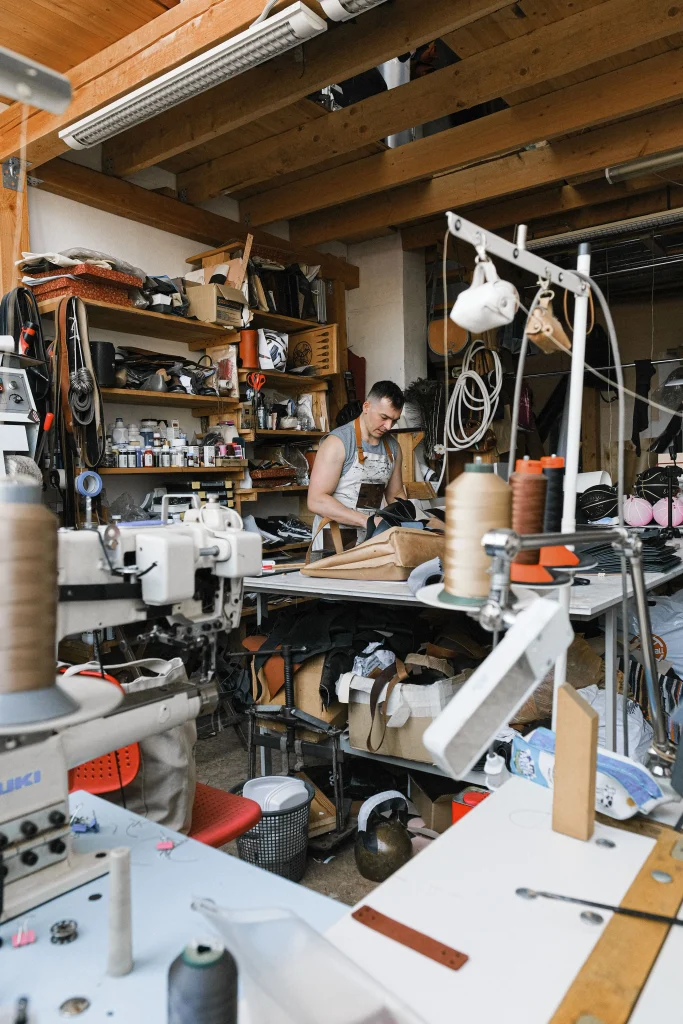
Each bag is made by a single artisan from start to finish, not passed along an assembly line. That artisan cuts the leather, saddle-stitches it by hand with linen thread coated in beeswax, attaches the hardware, and finishes the edges.
That is why a Birkin takes many hours to make, why production is limited, and why the price is what it is. It is also why Hermès can credibly stamp every leather bag “Made in France” — because the cutting, stitching, hardware assembly, and finishing all happen there.
What about other Hermès products? Hermès itself notes that it draws on specific expertise elsewhere: watchmaking in Switzerland, Mongolian cashmere, Vietnamese lacquer, Scottish wool. Shoes, in particular, are a different story from bags, and competitor guides note that Hermès shoes are made in Italy. That does not change the bag rule. A bag is not a shoe, and a shoe factory in Italy does not make a Birkin Italian.
For a full dress-shoe guide — what counts as a dress shoe, how Italian and French shoe traditions differ, and how care fits into ownership — see dress shoes.

Where the Calfskin Comes From
Most Hermès leather is calfskin, and most of that calfskin starts in France.
Hermès documents state that it uses more than 35 different types of leather, most of which come from calves raised in France, including its flagship Box leather, which is made using an English tanning technique. Its 2017 registration document adds a precise detail that is worth quoting in spirit: calfskin comes from abattoirs within the European Union, which in practice means almost exclusively abattoirs in France.
Why does that matter? Because hide quality depends on the animal’s life. Hermès says so itself in its CSR reporting: leather reflects the animal’s life, and only an animal that is well treated and cared for, growing in a controlled environment, will provide a beautiful hide. Scars, blemishes, insect bites, and irregularities in texture are reasons a hide is rejected. Hermès’ standards are strict, and only a small percentage of hides meet them. That rejection rate is part of the cost, and part of why the leather feels the way it does.
Hermès also says its raw skins come exclusively from animals that were raised for their meat. That is a statement about the supply chain, not a claim that every hide is perfect. A hide can come from a meat animal and still be rejected for a scar. The selection happens after the animal, not instead of it.
One caution: “most calfskin comes from France” does not mean “all calfskin comes from France”. Hermès works with tanneries in Italy, Germany, and Spain as well, and those tanneries source hides through their own European networks. For a specific bag, Hermès does not publish the farm or abattoir, so you cannot trace one Birkin’s calf back to one farm from the bag alone. Anyone who claims to do so from a stamp or a serial number is guessing.


Where the Tanning Happens: France, Italy, Germany, and Spain
Tanning is the step that turns a raw hide into leather: cleaning it, preserving it, softening it, dyeing it, and finishing its surface. It is also the step where country claims get most confused, because tanning is a specialised trade with its own geography.
Hermès says it buys all of its leather-goods leather directly from tanneries, with no intermediaries, and that the vast majority of its needs are covered by French, Italian, German, and Spanish tanneries, all of which must adhere to European standards, which Hermès describes as some of the highest in the world for the industry.
In plain words, that means:
- France is the centre of Hermès tanning, for both in-house and partner tanneries.
- Italy is a major tanning country for Hermès, especially for exotics, and for embossed and specialist finishes.
- Germany and Spain are also in the tannery network, though Hermès names fewer specific German and Spanish tanneries publicly than French and Italian ones.
- No tanning for Hermès bags happens in China, in the sources checked. China appears in this story only as a market, and as a source of counterfeit bags, not as a tannery for genuine Hermès leather.
Why Europe, and why those four countries? Because European tanning has centuries of craft behind it, because European environmental and labour standards are high, and because Hermès can audit its tanneries directly. Since February 2020, Hermès has been a member of the Leather Working Group (LWG), which audits tanneries on environmental performance. By the end of 2023, Hermès reported that 100% of the tanneries in its Cuirs Précieux (precious leathers) division had been audited to LWG standards.
France and Italy also have different tanning traditions, and it helps to know the difference in plain terms. French tanneries are prized for precision and a smooth, consistent finish, often using chrome tanning, which is faster and gives a soft, flexible result. Italian tanneries are renowned for vegetable tanning, using natural tannins from bark and leaves, which gives a rich colour and supple feel and ages with a patina. Hermès uses both traditions, depending on the leather and the finish it wants. Neither is “better” in general. The right tanning method is the one that gives the leather the character Hermès wants for that bag.
Hermès-Owned vs Partner Tanneries
Hermès does not rely entirely on outside tanneries, and it does not do everything in-house either. It does both, and the split matters for consistency.
Hermès-owned tanneries, named in competitor and Hermès sources:
- Tanneries d’Annonay, France — acquired in 2013. Specialises in exotic and calf leathers. In 2023 it was certified LWG Bronze Level in its first audit.
- Tanneries du Puy, France — acquired in 2015. Specialises in Box and calf leathers.
- Tanneries de Cuneo, Italy — the Italian tannery competitors mention most often, specialising in exotic leathers. It obtained LWG Silver Level certification on re-certification in 2022, after a first audit in 2020.
- Tanneries de Vivoin and Montereau, France — Vivoin was certified LWG Bronze Level, Montereau LWG Silver Level, in audits reported in 2023.
Long-term partner tanneries, named in guides:
- Tanneries Haas, France — one of the most well-known tanneries Hermès has partnered with over the years, associated in guides with Togo and other natural-grain leathers.
- Tanneries Roux, France — associated in guides with Barenia and other smooth leathers.
Owning a tannery gives Hermès direct control over quality, capacity, and environmental standards. Partnering gives it access to specialist skills it does not need to own outright. Either way, Hermès buys directly from the tannery, with no intermediaries, which is unusual in luxury and is part of how it keeps its leather consistent from year to year.

One figure from a lower-authority source needs a flag here. A Gionar article claims Hermès has a Louisiana Spa tannery in Italy where crocodile leather undergoes a six-month tanning process before going to France. That six-month figure is not confirmed by Hermès itself in the sources checked, so treat it as an unconfirmed guide claim, not a Hermès fact. The underlying point — Italian tanning, French assembly — is confirmed. The exact duration is not.

Exotic Leathers: Farm Countries, Then Europe, Then France
Exotic leathers are where the “one country” answer breaks down most completely, because the animal, the tannery, and the workshop are almost never in the same country.
Crocodile and alligator: Hermès documents say the vast majority of crocodilian skins come from farms in the United States, Africa, and Australia. PurseBlog’s guide breaks it down further: crocodile farms in Africa and Australia, alligator farms in the United States. Those skins are then tanned in Europe — Cuneo in Italy is the named exotic tannery — and then made into bags in France. A Niloticus crocodile Birkin, for example, is named for the Nile crocodile, but the bag itself is still made in France.
Ostrich: PurseBlog lists Africa as the farm source. Ostrich first appeared in Hermès collections in 1920, and its distinctive follicle pattern is flattened and the skin is tripled in Hermès’ process, according to Hermès’ own product descriptions quoted in competitor guides.
Lizard: PurseBlog lists Africa and Southeast Asia as farm sources. Lizard is a smaller, more delicate skin, used for smaller bags and accessories as well as full bags.
Chevre (goat): PurseBlog says Hermès’ chevre leathers all come from India. Chevre is distinguishable by its grain, obtained by rolling the leather against itself in a technique called boarding, and by the visibility of a spine in the centre of the bag. That spine is not a flaw. It is where the goat’s spine was, and it is a marker of the leather type.

All exotic skins used by Hermès are CITES-certified, meaning they are traded under the Convention on International Trade in Endangered Species, with permits and quotas. That certification is about legal and regulated trade, not about the bag’s quality. A CITES certificate does not make a bag genuine on its own, and a missing certificate on a second-hand listing is a reason to ask questions, not a proof of fakery by itself.
For the authentication side of exotic and non-exotic bags — what to check, what a single mark cannot prove, and what to ask a seller for — the same logic that applies to other luxury authentication applies here, even though the product is different. For a guide to spotting a fake luxury item, with checks in order and a photo checklist, see fake Rolex. That guide is about watches, not bags, so use it for the authentication principles only, not as a Hermès checklist.
Per-Leather Origin Table
This is the table competitors do not give you in one place. Where a cell says “not confirmed”, that means Hermès does not publish that detail for that leather, and this guide will not invent it.
| Leather | Animal origin | Tannery country | Bag made in | Notes |
|---|---|---|---|---|
| Togo | Calf, mostly France | France (Haas, in guides) | France | Durable, pebbled grain, from France and Switzerland in some guides — Switzerland is unconfirmed for Togo specifically |
| Clemence | Calf, mostly France | France, in guides | France | Softer, larger grain than Togo, slouchier with use |
| Epsom | Calf, fine-pored | France and Italy, specialist embossing | France | Embossed, structured, lightweight. A replica-site claim that hides come from Switzerland, Germany, and Austria is unconfirmed — do not copy it as fact |
| Box | Calf, mostly France | France (du Puy, in guides) | France | Glossy, smooth, flagship leather, English tanning technique |
| Swift | Calf, mostly France | France, in guides | France | Smooth, fine-grained, soft sheen, used for flaps and pockets |
| Chevre | Goat, India (PurseBlog) | Europe, not confirmed per tannery | France | Boarded grain, visible spine, lightweight and durable |
| Barenia | Calf, mostly France | France (Roux, in guides) | France | Natural, untreated look, develops patina and marks with use |
| Niloticus crocodile | Nile crocodile farms, Africa | Italy (Cuneo, exotic tannery) and France | France | Large scales, very selective allocation |
| Alligator | Farms, United States | Europe, not confirmed per tannery | France | Smaller, more regular scales than crocodile |
| Ostrich | Farms, Africa | Europe, not confirmed per tannery | France | Follicle pattern, flattened and tripled by Hermès |
| Lizard | Farms, Africa and Southeast Asia | Europe, not confirmed per tannery | France | Small, delicate scales, often for smaller items |
If a guide gives you a precise farm for Togo or a precise tannery for ostrich without citing Hermès or a named tannery, treat it as a guess. Hermès’ own documents give countries and tannery groups, not a farm-to-bag trace for every leather.

The Italy and China Myths, Cleared Up
“Hermès bags are made in Italy”
No. Hermès bags are not made in Italy. What is true is that Hermès tans leather in Italy, owns a tannery in Cuneo, and sources other materials and fabrics from Italy, such as cashmere for clothing. Tanning is one step. Cutting, stitching, and finishing a bag is a different step, and that step happens in France.
That is why the two statements that sound contradictory are both true: “Hermès leather comes from Italy” (for some leathers, at the tanning stage) and “Hermès bags are not made in Italy” (at the assembly stage). If you see a genuine Hermès bag, it will be stamped “Made in France”. If you see a bag stamped “Made in Italy” and sold as Hermès, that stamp is itself a warning sign, not a sign of Italian craftsmanship.
For a guide to telling a real luxury gift bag from a fake one, with listing red flags and photos to ask a seller for, see VIP gift bags. That guide is about Chanel VIP gifts, not Hermès, but its red-flag logic — too-good prices, wrong stamps, missing photos — applies to any luxury listing.
“Hermès bags are made in China”
No. Hermès has had a presence in China as a market since 1996, and it is a successful luxury brand there, but no genuine Hermès bags are made in China, according to Hermès and every competitor guide checked. The confusion comes from two real facts: counterfeit Hermès bags are made in China, and viral videos have alleged — without evidence that holds up — that genuine bags are made there. A counterfeit made in China does not make a genuine bag Chinese, any more than a counterfeit made anywhere else changes where the genuine article is made.
Could a ribbon, a box, or packaging be made outside France? Possibly. Competitor guides note that possibility. But the bag itself — the leather, the stitching, the hardware assembly — is French-made. Packaging is not the bag.

What the “Made in France” Stamp Does and Does Not Prove
This is the section to read before you buy, especially second-hand.
What it proves:
- The bag was assembled in France, by Hermès, in a French workshop.
- The cutting, saddle stitching, hardware fitting, and finishing happened in France.
What it does not prove:
- That the calf was raised in France. Most calfskin is French-raised, but the stamp does not say that for your specific bag.
- That the hide was tanned in France. It may have been tanned in Italy, Germany, or Spain.
- That the leather is a specific type. Togo, Clemence, Epsom, and Box all carry the same “Made in France” stamp. The leather type is identified by grain, feel, and, on second-hand listings, by seller photos and expert inspection, not by the stamp alone.
- That the bag is genuine, on its own. A stamp can be faked. A genuine stamp on a fake bag is still a fake bag.
The same logic applies to serial numbers and stamps on other luxury goods: a single mark, on its own, never proves authenticity. For the watch version of that principle — what a serial number can date, what it cannot prove, and why copied serials exist — see serial number check. Again, that guide is about Rolex, not Hermès, so use it for the principle only.
For a Chanel-specific version of the same lesson — how conflicting material and origin claims, outdated serial lists, and boutique-authentication myths can mislead buyers — see Cambon bag. Cambon guides disagree on calfskin vs lambskin and Made in Italy vs Made in France, which is exactly the kind of conflict that happens when origin is treated as a single label instead of a supply chain.

Caring for the Leather, Whatever Country It Came From
Origin does not change care. Once a Hermès bag is in your hands, what matters is the leather type, not the tannery’s postcode.
- Full-grain leather is the rule. Hermès uses only full-grain leather, the top part of the skin in an unadulterated condition, according to its documents. That means wrinkles, veins, and pores are natural characteristics, not flaws. Do not try to “fix” them with harsh cleaners.
- Dry-first, spot-test, no harsh chemicals. The same principles that apply to any smooth leather bag apply here: brush or wipe dry first, test any product on a hidden area, and never use alcohol, harsh solvents, or heat to clean leather. For the full bag-care version of those principles, with material tables, stain guidance, and storage, see clean Chanel bags.
- Conditioning is for smooth leather only. If you condition a Hermès bag, use a conditioner made for smooth leather, in a thin coat, after a spot test. Do not use a smooth-leather cream on suede, nubuck, or patent, and do not use a suede product on smooth leather. For how suede care differs — brush types, nap direction, and why cream ruins suede — see suede brush.
- Keep perfume and chemicals off leather. Perfume, hairspray, and similar products contain solvents that can mark leather. Apply scent to skin or clothes first, let it dry, and keep it off the bag. For choosing a scent to wear separately from your leather care, see Glossier perfume.
- For repairs, Hermès recommends its own artisans. Competitor guides quote Hermès as recommending that maintenance and repairs be entrusted to its own artisans rather than treated at home with unsuitable products. That is sensible advice for a bag at this price, especially for stitching, hardware, and edge finishing. Home care is for cleaning and conditioning. Structural repair is not.

Frequently Asked Questions
Which country makes leather for Hermès bags?
No single country. Most calfskin comes from France, most tanning happens in France, Italy, Germany, and Spain, exotic skins are farmed in the US, Africa, Australia, and Southeast Asia, and every finished bag is handmade in France.
Is Hermès leather French?
Mostly, at the calfskin and assembly stages, but not exclusively. Some Hermès leather is tanned in Italy, Germany, or Spain, and exotic skins are farmed outside Europe. “French leather” is a simplification, not a precise description of the whole supply chain.
Are Hermès bags made in Italy?
No. Hermès tans leather in Italy and owns a tannery in Cuneo, but its bags are not made in Italy. They are made in France.
Are Hermès bags made in China?
No. Genuine Hermès bags are not made in China. Counterfeit Hermès bags are made in China, which is where the confusion comes from.
Can I tell where my Hermès bag’s leather came from by looking at it?
No, not precisely. The “Made in France” stamp tells you where the bag was assembled. It does not tell you where the calf was raised or where the hide was tanned, and Hermès does not publish a per-bag origin label.
Does Hermès own its tanneries?
Some of them, yes. Tanneries d’Annonay and Tanneries du Puy in France, and the Cuneo tannery in Italy, are Hermès-owned or Hermès-group tanneries named in guides and Hermès documents. It also works with long-term partner tanneries such as Haas and Roux in France.
Is Hermès leather ethically sourced?
Hermès says its raw skins come only from animals raised for meat, its exotic skins are CITES-certified, and its tanneries are audited to Leather Working Group standards. Those are real certifications, but they certify legal and regulated trade and audited tannery practice, not that every hide is flawless or that every farm is perfect. Treat certification as evidence, not as a guarantee.
Why is Hermès leather so expensive if the raw material comes from several countries?
Because the cost is not mainly the raw hide. It is the selection rate (only a small percentage of hides pass), the tanning, the single-artisan hand making in France, the hardware, and the limited production. The supply chain’s geography is a small part of the price. The labour and the rejection rate are the large parts.
Final Verdict
The honest answer to “which country makes leather for Hermès bags?” is a supply chain, not a flag.
France raises most of the calves and makes every bag. France, Italy, Germany, and Spain tan most of the leather. The United States, Africa, Australia, and Southeast Asia farm the exotic skins. Europe tans them. France finishes them.
Once you see it that way, the myths fall away: Italian tanning does not make a bag Italian, Chinese counterfeits do not make a genuine bag Chinese, and a “Made in France” stamp does not tell you where a calf was raised. It tells you where a single French artisan cut, stitched, and finished the bag you are holding. That, in the end, is what Hermès is selling — not a country’s leather, but a French workshop’s work, on leather that has travelled further than the stamp suggests.