How to Spot a Fake Hermès Geta Bag: The Honest Guide to the H Clasp, Feet, Strap, and Blind Stamp
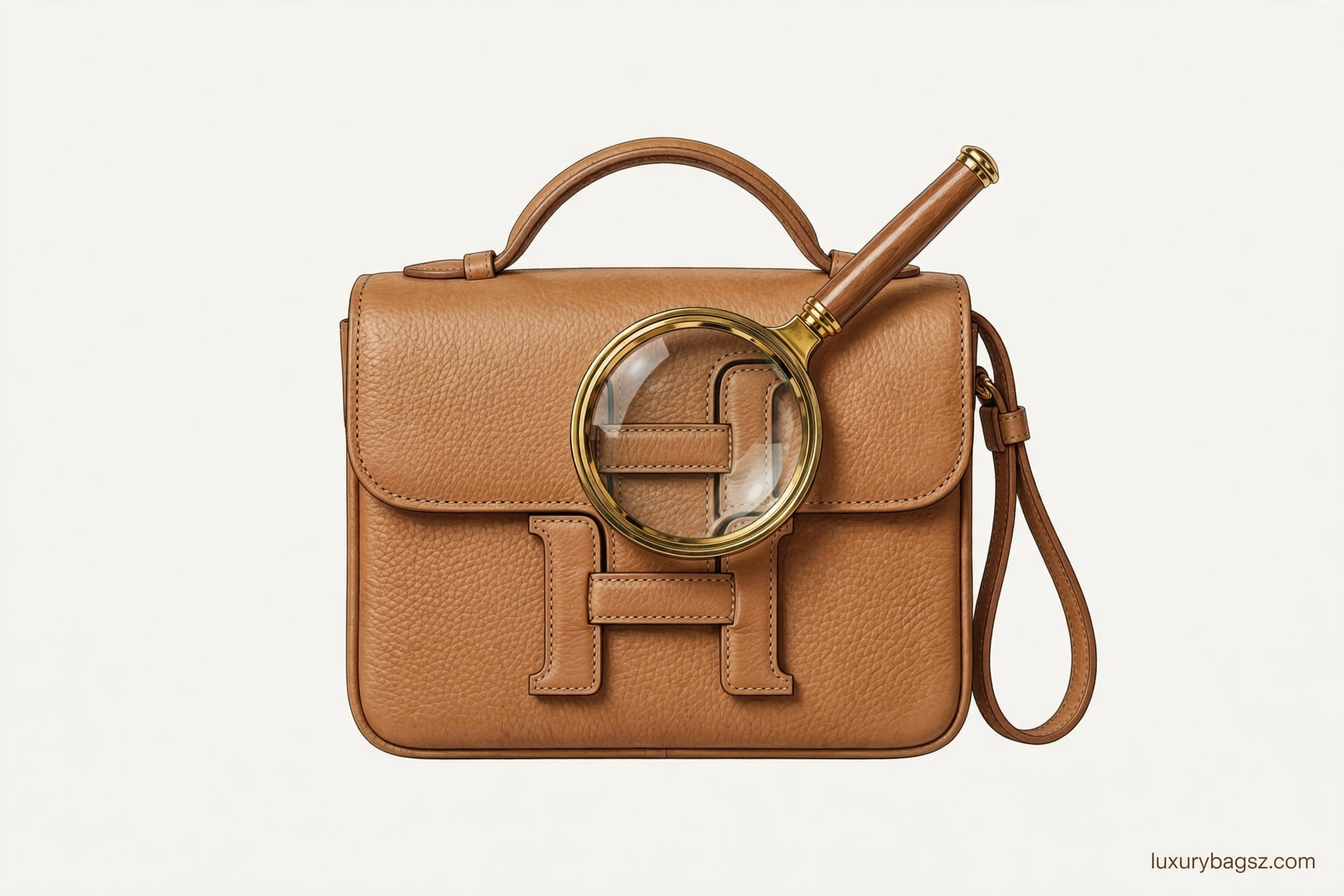
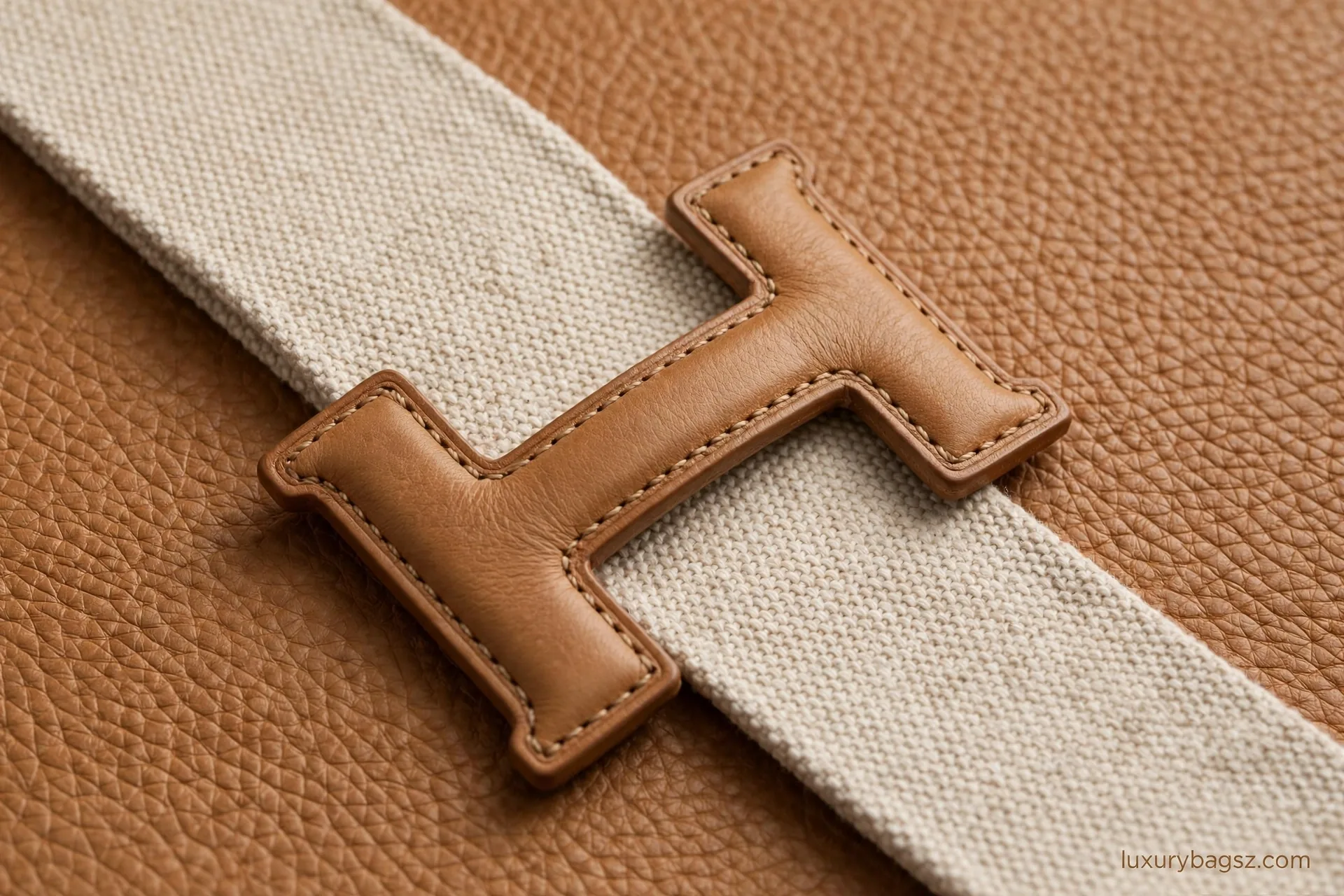
The Hermès Geta is an easy bag to fake badly and a hard bag to fake well, because its whole identity is one mechanism: an expanded, leather-sheathed “H” that is a magnetic clasp, a strap adjustment system, and the bag’s feet, all at once. A replica can copy the shape of that H from a photo. It is much harder to copy how the H feels, slides, clicks, and carries the bag’s weight — and that is where most fakes give themselves away.
That is also why generic “how to spot a fake Hermès” guides are not enough for the Geta. They check stitching, stamps, and hardware in general, but they do not check whether the back plaque opens (it must not), whether the bag rests on H plaques instead of studs, whether the strap adjusts through the H, or whether the listing is a standard Geta or a slim Geta. A buyer who only runs the generic checks can pass a well-made replica and fail a genuine bag with normal handmade variation.
This guide gives 12 Geta-specific checks in order, the traps that catch buyers, a photo checklist for pre-owned buying, and what to do if you already bought a bag you now doubt.
Key Takeaways
- Check the H first, not last: leather-sheathed, tone-on-tone marquetry, magnetic click, sliding strap adjustment, and H plaques as feet. A plastic H, a metal H with no sheathing, a magnet that barely holds, or round stud feet are warnings.
- The back plaque does nothing. If the back of a “Geta” opens, or the back plaque works as a clasp, it is not a Geta.
- Hermès issues no authenticity cards. A “certificate card” in a Geta listing is a red flag, not proof — replica listings promise one.
- Do NOT use the shake test as a fake test: owners report a genuine Geta’s magnetic flap opens if the bag is shaken hard. A bag that opens when shaken is not proven fake, and a bag that stays shut when shaken is not proven genuine.
- Standard vs slim matters: standard is 20 x 15 x 7 cm, strap 61–120 cm; slim (Epsom) is 23 x 14 x 5 cm, strap 49–97 cm. A listing that mixes the two sets of measurements is a warning.
- Leather must match its claim: Mysore goatskin is irregular-grained and turns supple and satiny; Evercolor calfskin is satiny with a small, regular printed grain; Epsom is fine, regular, slightly glossy printed grain.
- Price is a check, not a verdict: $5,800 US retail for Chèvre, £5,190 UK. A $709 “handmade” Geta or a $109 “Geta tote” is not a genuine Hermès price.
The Geta is the Hermès bag I judge by touch before sight. I work the leather-sheathed H clasp first — sliding it, feeling the magnet catch, checking that the sheathing sits tight with no lifting edges — because that one mechanism is the bag’s clasp, strap adjustment and feet in a single piece, and it is brutally hard to fake convincingly. After that I turn the bag over to confirm it rests on H plaques rather than studs. Having examined over 500 bags by hand, I trust that sequence: mechanism first, then stamps, stitching and leather grain.
60-Second Answer
What is the fastest Geta fake check? Look at the H: leather-sheathed, tone-on-tone, magnetic, sliding, and doubling as feet. Then look at the base: no round studs, the bag rests on H plaques. Then look for a blind stamp and a “Hermès Paris Made in France” stamp, crisp and correctly spelled, with the accent on the “è”.
What is the single biggest red flag? An authenticity or certificate card. Hermès does not issue one. Next biggest: a price far below retail with no condition reason, especially from a seller with no history and no returns.
Can I test the magnet by shaking the bag? No — not as a fake test. Genuine Getas open when shaken hard, according to owners. Use the magnet’s click, slide, and hold in normal use, not a shake.
What should I photograph before buying? Front, back, both sides, top, H close-up, base, strap, stitching, blind stamp, interior pockets, box and dust bag — the 10-photo checklist in Section 6.
What if several checks fail? Do not buy on the seller’s word. Walk away, or get an independent authentication before the return window closes, not after it.
What a Genuine Geta Must Look Like (The Reference)
Before checking a listing, fix the reference in your mind, from Hermès’ own description and from owner reports:
- A small, structured, symmetrical box messenger bag, closing with a click.
- Front and back look almost identical, except the back H plaque is for appearance only and the back does not open.
- An expanded, leather-sheathed “H”, extended along its horizontal bar, with tone-on-tone leather marquetry.
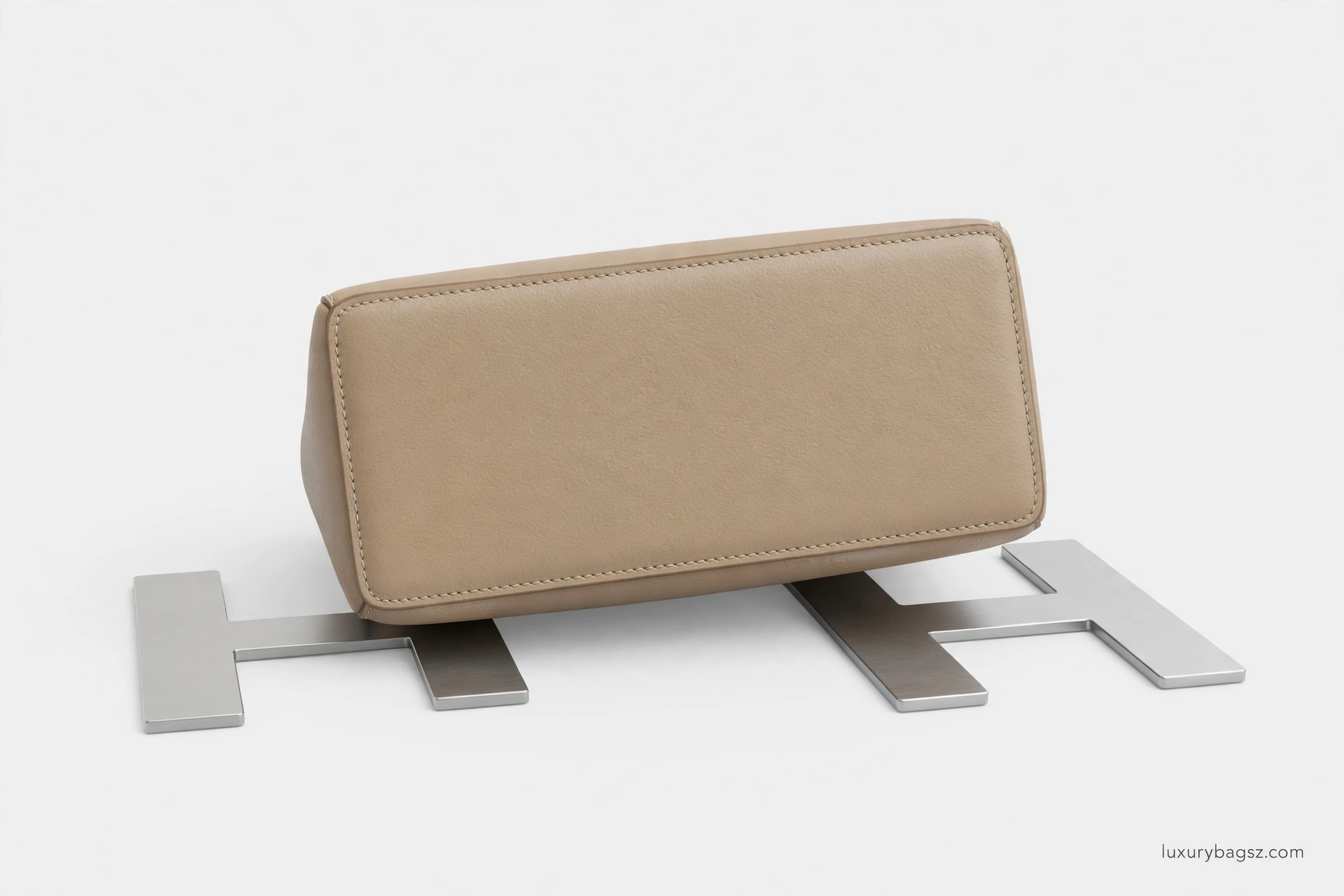
- A magnetic clasp that folds down securely, slides to adjust the strap, and acts as studs on the base, like a pedestal — the bag rests on the bottom of the H plaques, not on its base.
- One main compartment, two interior flapped pockets (one divided into two parts), lined in matching leather (or a Verso contrast colour).
- An adjustable fibre canvas shoulder strap, worn over the shoulder or across the body. No top handle, no place to add a different strap.
- Mysore goatskin or Evercolor calfskin for the standard; Epsom calfskin for the slim.
- A blind stamp for the year and a “Hermès Paris Made in France” stamp, crisp and correctly placed.
- No authenticity card. A care booklet may be present; a card is not Hermès practice.
Any listing that contradicts this reference on a structural point — back opens, round feet, leather strap as original, fabric lining, card as proof — needs an explanation, and “the seller says so” is not one.
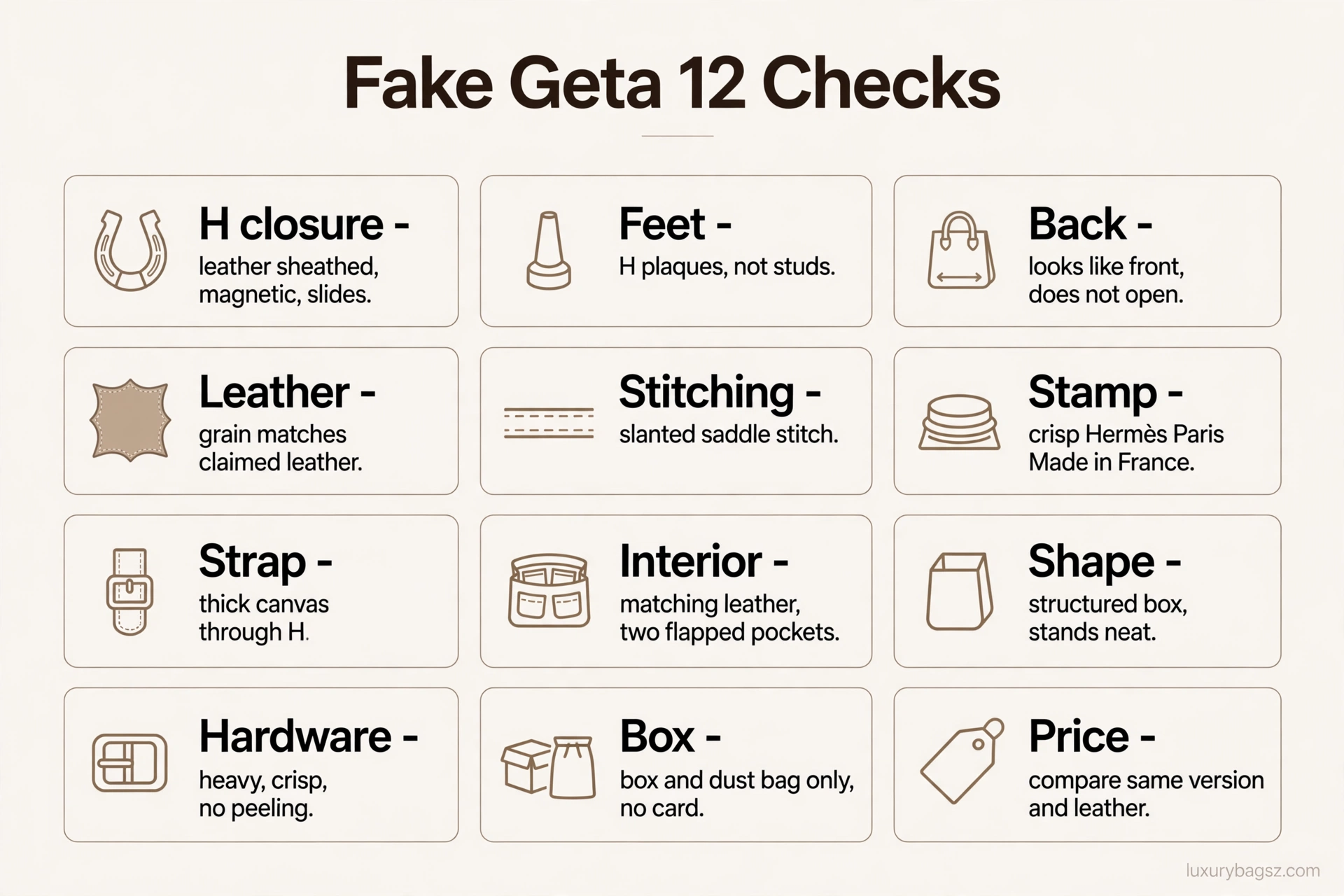
The 12 Checks, In Order
Check 1: The H closure — sheathing, marquetry, magnet, slide
- Genuine: Leather-sheathed H, tone-on-tone marquetry matching the bag’s leather, metal inset cleanly in leather, magnet clicks shut firmly, H slides to adjust the strap.
- Warning: Plastic-looking H, bare metal H with no leather sheathing, marquetry in a different colour or material, magnet that barely holds or does not click, H that is fixed and does not slide, rough or peeling metal, hollow-feeling hardware.
- How to check in photos: Ask for a straight-on H close-up, a side view showing the sheathing depth, and a photo of the strap passing through the H. A single distant front photo is not enough.
Check 2: The feet — H plaques, not studs
- Genuine: No conventional feet. The bag rests on the bottom of the H plaques, which act as a pedestal.
- Warning: Four round metal studs, screw-in feet, feet that twist or unscrew easily, or a flat base that sits directly on a table.
- How to check in photos: Ask for a base photo with the bag standing, showing the plaques touching the surface and the base lifted clear of it.
Check 3: The back — looks like the front, does nothing
- Genuine: Back plaque looks like the front H but is for appearance only; the back does not open.
- Warning: A back that opens, a working back clasp, or a back with no plaque at all.
- How to check in photos: Ask for a back photo and, if in doubt, a photo of the back plaque from the side. This one check alone kills many replicas that only copy the front.
Check 4: The leather — grain must match the claim
- Mysore (Chèvre Mysore): Irregular but harmonious grain, slight shine showing natural goatskin features, becomes more supple and satiny with age.
- Evercolor: Satiny, small regular grain obtained by printing, more visible grain than Evergrain, supple and soft, softens and becomes shinier with wear.
- Epsom (slim only): Fine, regular, slightly glossy printed grain, uniform, deep colours.
- Warning: A “Mysore” bag with a uniform plastic grain, an “Evercolor” bag that is stiff and matte like cardboard, colour that looks painted on rather than evenly saturated, or a colour that does not appear in Hermès’ colour range. Christie’s specialists note counterfeit colour can look painted on, and Hermès produces a limited number of shades, so a shade outside that range is a warning.
- How to check in photos: Ask for a close-up of the grain in natural light, not a filtered studio shot, plus a corner photo showing wear and grain together.
Check 5: The stitching — saddle stitch, slanted, even
- Genuine: Hand saddle stitching, two needles working in opposite directions through pre-punched holes, even, slightly slanted stitches, in a thread colour matching the leather, with no loose ends. One guide puts authentic stitching at about 5 stitches per centimetre, slanted, never machine-perfect.
- Warning: Machine stitching (too perfect, overly straight, tightly uniform, shallow), uneven stitches, some straight and some slanted, loose threads, crooked seams, or a thread colour that does not match the leather. Check the flap, the H attachments, and the strap ends, where counterfeiters cut corners.
- How to check in photos: Ask for macro photos of stitching at the flap edge and at a strap attachment. Blurry stitching photos are a reason to ask again, not to assume.
Check 6: The blind stamp and Made in France mark
- Genuine: A blind stamp (letter for the year, with a craftsman mark, and a shape in some eras) and a “Hermès Paris Made in France” stamp, centred, evenly spaced, crisp, correctly spelled — including the accent on the “è” — in a font that is consistent across letters. For a Geta, made from around 2022, the year letter must fit a 2022-or-later bag; a letter that dates the bag before the Geta existed is a warning.
- Warning: Misspelling, missing accent, uneven lettering, poor alignment, blurry or shallow stamp, stamp in the wrong place, a stamp that looks newly added to an old bag, or a date letter that does not fit the Geta’s era.
- How to check in photos: Ask for a clear, straight-on blind stamp photo and a Made in France photo. Compare the letter against reputable listings for the same year, and do not accept a seller’s reading of the stamp without seeing it.
Check 7: The canvas strap — thick, adjustable through the H, clean edges
- Genuine: Thick fibre canvas, like an Evelyne strap but thick, adjustable through the H mechanism, with clean edges, no fraying beyond normal wear. Light colours may show dirt or very mild pilling where the strap rubbed a jacket seam — that is normal wear, not a fake sign on its own.
- Warning: Thin nylon strap, a leather strap presented as original, a strap that cannot be adjusted through the H, frayed or glued edges, or a strap that is clearly from another bag.
- How to check in photos: Ask for a strap photo showing thickness, edge, and the strap passing through the H, plus a photo of the strap at its longest and shortest settings if the seller claims full adjustability.
Check 8: The interior — matching leather, two flapped pockets, no fabric
- Genuine: Lined in matching leather (or the Verso contrast colour), one main compartment, two interior flapped pockets, one divided into two parts, with neat pocket edges and no glue.
- Warning: Fabric, vinyl, or synthetic lining, glued pocket edges, pockets that gape, a lining colour that does not match the exterior (outside a Verso version), or a single pocket where two flapped pockets should be.
- How to check in photos: Ask for interior photos showing the full lining, both pockets open, and the pocket edges. A dark, blurry interior photo is not a check.
Check 9: The shape and box structure
- Genuine: A structured, symmetrical box shape that stands neatly, with balanced proportions. Handmade variation means minor softening is normal, especially in Mysore and Evercolor, which soften with age.
- Warning: A bag that collapses completely, bulges on one side, leans, or has a flap that does not sit flush when clicked shut — beyond normal softening. A “Geta tote” shape, with no box structure at all, is not a Geta.
- How to check in photos: Ask for a straight front photo on a flat surface, a side photo showing depth, and a photo of the bag standing empty. If it only ever appears stuffed or held up, ask why.
Check 10: The hardware finish and weight
- Genuine: Brass plated with palladium or gold, substantial in hand, crisp finish, no peeling or flaking. Engravings, where present, should be crisp and precise, never shallow or blurred.
- Warning: Lightweight, hollow-feeling hardware, peeling or flaking plating, discolouration around the H, or engraving that is thick, blurred, or misspelled.
- How to check in photos: Ask for a hardware close-up in natural light. Peeling on a genuine bag can happen with heavy wear, so judge peeling together with price, condition, and the other checks — not alone.
Check 11: The box, dust bag, and paperwork — supporting evidence only
- Genuine (where included): Hermès box, dust bag (including a strap dust bag where included), ribbon, and care booklet, photographed with the bag, matching its period and type. A box alone does not prove a bag, because boxes can be bought separately.
- Warning: An authenticity or certificate card presented as proof, a dust bag with a thin, wide, or misprinted H, a box that does not match the bag’s period, or paperwork that is only mentioned, never photographed.
- How to check in photos: Ask for the box, dust bag, and booklet photographed beside the bag, not stock photos of packaging.
Check 12: Price and seller — the range test
- Genuine range: $5,800 US retail for Chèvre, £5,190 UK, with pre-owned prices varying by version, leather, colour, and condition, and rare colours listing at premiums ($8,500–$13,500 in listings seen).
- Warning: $709, $109, or far below retail with no condition reason, a seller with no history, no returns, unprotected payment only, or pressure to pay off-platform. A price in the normal range from a reputable reseller, with clear photos and returns, is a much safer buy, even if it is not the cheapest listing.
- How to check: Compare at least two or three listings for the same version and leather before you pay. If only one listing in the world is at that price, ask why.

This is a genuine Geta ownership review, not a Geta-specific authentication video — no Geta-specific fake-spotting video was found on YouTube. Use it to see a genuine bag’s H closure and wear, not as proof of authentication. Every check in this guide follows the Luxury Bagsz authentication process.
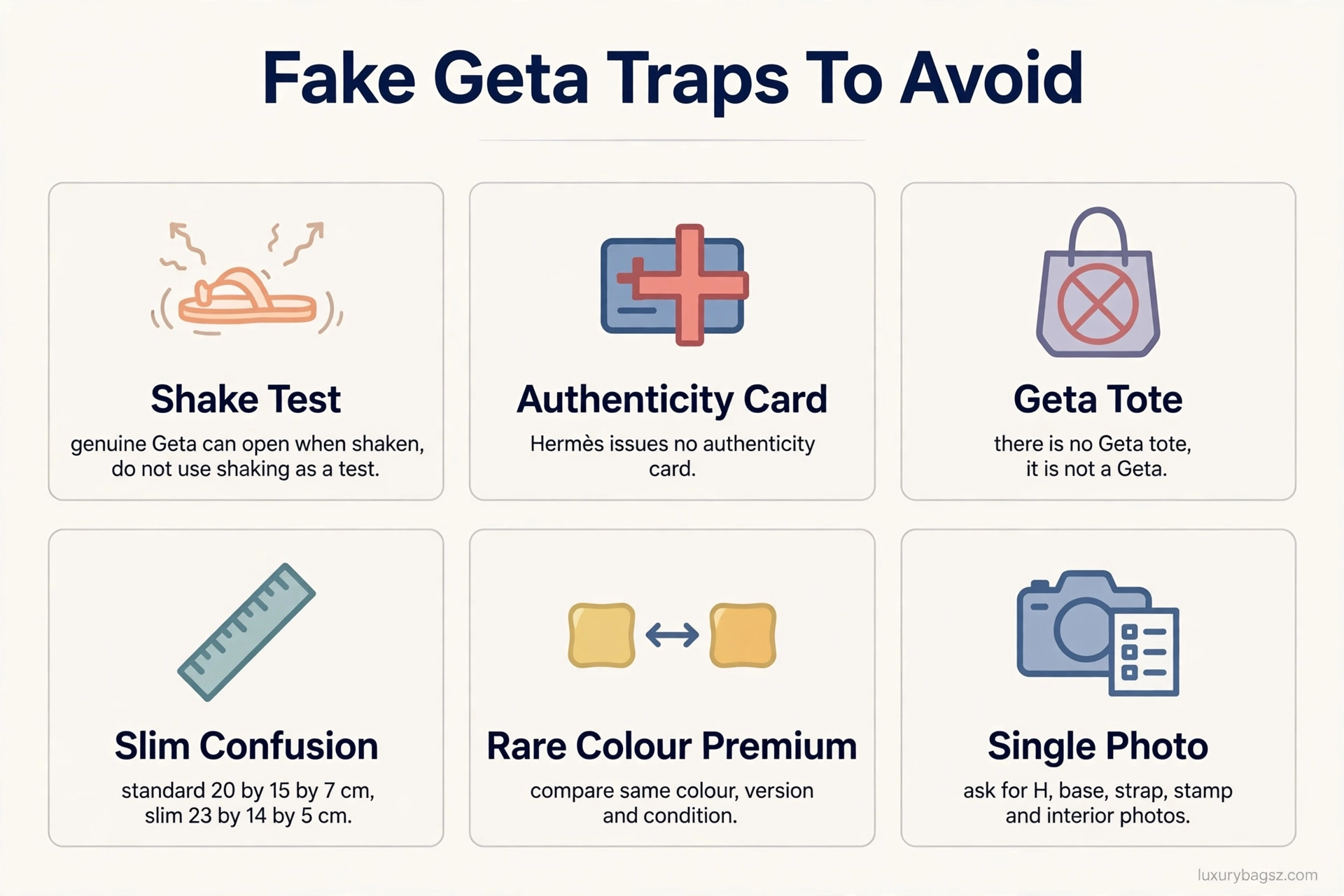
The Traps That Catch Geta Buyers
Trap 1: The shake test
Owners report a genuine Geta opens if shaken hard. That means a seller who “proves” a bag by shaking it shut, or a buyer who rejects a bag because it opened when shaken, is using a test that proves nothing. Judge the magnet by its click and hold in normal use, plus the other 11 checks.
Trap 2: The authenticity card
Hermès does not issue authenticity cards. Any Geta listing that leans on a card, or a replica site that promises a “certificate card” with the bag, is waving a red flag. A care booklet is not a card, and a card is not a booklet.
Trap 3: The “Geta tote” and the replica Short
Listings titled “Geta tote”, Shorts selling “H ERMES GETA Crossbody” bags, videos tagged “#inspired”, and reseller ads with a WhatsApp order number are not independent reviews and not genuine Hermès listings. They are replica or seller listings. Do not use them as price references, and do not use their photos as authentication references.
Trap 4: Standard vs slim confusion
A 23 cm long, 5 cm deep bag is a slim, not a standard, and a 20 x 15 x 7 cm bag is not a slim. A listing that gives standard dimensions with a slim price, or slim dimensions with a standard price, or that never says which version it is, is a warning. Ask for the version, then check the measurements against it.
Trap 5: The rare-colour premium as a “market price”
A Mauve Sylvestre listing at $13,500 does not make every Geta worth $13,500, and a Caramel listing at $8,500 does not make a common-colour Geta worth $8,500. Compare like with like: same version, same leather, same colour family, same condition.
Trap 6: The single-photo listing
A genuine Geta needs close-ups: H, base, strap, stitching, blind stamp, interior. A listing with one front photo, or with stock photos, or with photos that never show the H mechanism, is not a checked listing. It is an unchecked one.
Trap 7: “Verso” as an excuse for any mismatch
Verso means a deliberate two-tone version, for example Blue Brume with a Craie interior. It does not excuse a lining colour that matches nothing, a pocket count that is wrong, or a leather that does not match its claim. Ask for the Verso colours by name, then check them.
Already Bought? What To Do Now
- Do not wear it as genuine until checked. Keep the bag, box, dust bag, receipt, listing screenshots, and messages exactly as they arrived. Do not alter, repair, or re-sell it as genuine in the meantime.
- Photograph everything using the 10-photo checklist in Section 6, plus the listing photos as they appeared when you bought it.
- Get an independent authentication from a reputable authenticator or reseller service, before the return window closes. Tell them it is a Geta, and ask them to check the H mechanism, feet, strap, and blind stamp specifically, not just generic Hermès points.
- Contact the seller in writing with the specific checks that failed, with photos, and ask for a return under their returns policy. Keep the conversation in writing.
- If the seller refuses and the payment was protected, use the platform’s dispute process with the authentication report and the listing evidence. If the payment was unprotected, that is a lesson for the next purchase — see Section 6 — and it does not make the bag genuine.
- If authentication confirms it is genuine, keep the report with the bag. It helps the next buyer, and it protects you if the same questions come up again.
Buying Safely: The 10-Photo Checklist and Rules
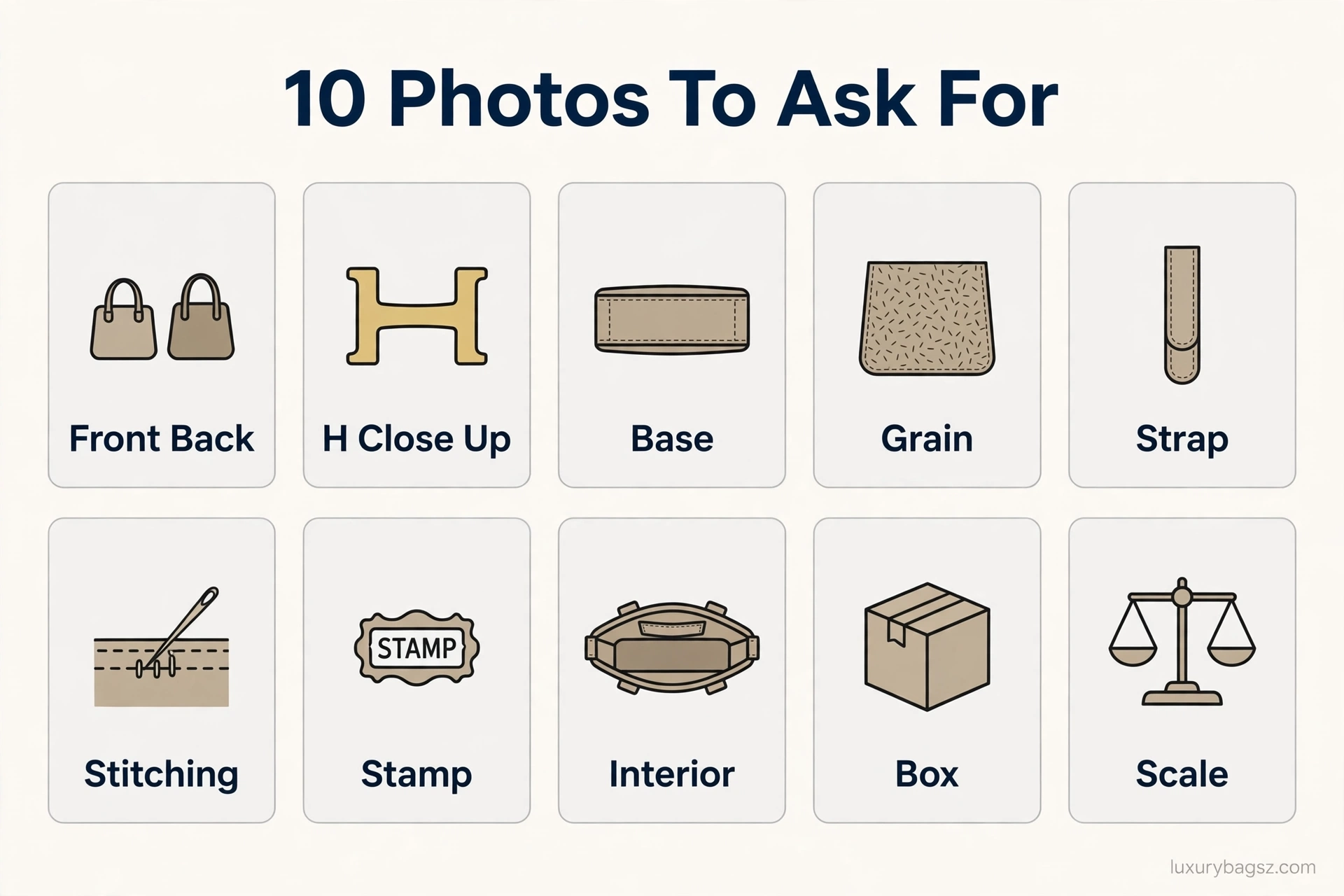
Ask for, or check for, these photos before you pay:
- Front, back, both sides, and top of the bag, not just one angle.
- Close-up of the H closure, showing marquetry, magnet, and sliding mechanism.
- Close-up of the base, showing the H plaques as feet.
- Close-up of the leather grain, showing texture for the claimed leather.
- Close-up of the canvas strap, showing thickness, edges, and adjustment through the H.
- Close-up of stitching at the flap and strap attachments.
- Close-up of the blind stamp and Made in France mark.
- Interior photos, showing lining colour and both flapped pockets.
- Box, dust bag, and booklet, if included, photographed with the bag.
- A photo of the bag with items inside for scale, so you can judge standard vs slim.
Buying rules
- Buy from a reputable reseller with a clear returns policy, or from a seller with a strong, checkable history.
- Compare at least two or three listings for the same version and leather before you pay.
- Do not pay by unprotected transfer, especially for a bag in excellent condition or a popular colour.
- If a listing price is far below retail, ask why. A condition reason can explain a low price. No reason given is a warning.
- For a high-value bag, consider an independent authentication service before the return window closes, not after it.
For general Geta facts — sizes, leathers, prices, and what fits — see our guide to what is the Geta bag. For other Hermès authentication, see our guides to fake Hermes Kelly and fake Rolex for the same cluster-of-checks discipline, and our guide to store Hermes Kelly for storage principles that also protect a Geta’s box shape.
Frequently Asked Questions
How can you tell a fake Hermès Geta bag, and does a real one come with an authenticity card?
Check the H first (leather-sheathed, tone-on-tone, magnetic, sliding, doubling as feet), then the base (H plaques, not studs), the back (does not open), the leather grain for the claimed leather, saddle stitching, the blind stamp and Made in France mark, the canvas strap, the interior pockets, and the price against the same version and leather. No single check proves it — use the cluster.
No. Hermès does not issue authenticity cards. A card in a listing is a red flag, not proof.
Does a real Geta open if you shake it?
Yes, according to owners — the magnetic flap can open if shaken hard. Do not use shaking as a fake test.
What is the difference between a standard Geta and a slim Geta?
Standard: 20 x 15 x 7 cm, strap 61–120 cm, Mysore or Evercolor. Slim: 23 x 14 x 5 cm, strap 49–97 cm, Epsom. Do not mix their prices or measurements.
How much should a genuine Geta cost?
$5,800 US retail for Chèvre, £5,190 UK. Pre-owned varies by version, leather, colour, and condition; rare colours list at premiums. A $709 or $109 “Geta” is not a genuine Hermès price.
Can a fake Geta have a correct blind stamp?
Counterfeiters copy genuine stamps, so a correct-looking stamp alone does not prove a bag. Check it together with the H, leather, stitching, strap, and interior — and get an independent authentication for a high-value purchase.
Should I buy a Geta without seeing the H mechanism?
No. The H mechanism is the bag’s identity. If a seller will not show it close up, do not buy.
What should I do if I already bought a fake Geta?
Keep everything as it arrived, photograph it, get an independent authentication, contact the seller in writing for a return, and use the platform’s dispute process if payment was protected. Do not re-sell it as genuine.
Final Verdict
A fake Geta is easiest to spot when you check what makes a Geta a Geta, not just what makes a Hermès bag a Hermès bag. The H must be leather-sheathed and tone-on-tone, it must click and slide, it must carry the bag as feet, the back must do nothing, the strap must be thick canvas adjusting through the H, and the blind stamp must fit a bag made from around 2022. A bag that fails several of those checks, at a price far below retail, with a certificate card and a single front photo, is not a bargain. It is a replica with a good listing.
Buy a Geta only when the cluster lines up: H, feet, back, leather, stitching, stamp, strap, interior, box, and price, all for the same version and leather, from a seller with returns, with the 10 photos in hand. If any part of that cluster is missing, ask for it. If it is refused, walk away. A Geta bought badly is not a bargain. It is a bag you will either return, authenticate at cost, or regret.
Bought well, the Geta’s cleverness is also its protection: a mechanism that does three jobs is hard to copy well, and a buyer who knows how it should feel, slide, and stand has a real advantage. Use that advantage, check by check, before you pay.
For other Hermès bags, the same cluster discipline applies — for example, when checking a Constance bag or an In the Loop 18, and when storing a bag safely, as in our guide to store Hermes Kelly.