

What Are Dress Shoes? Types, Formality, and How to Choose the Right Pair
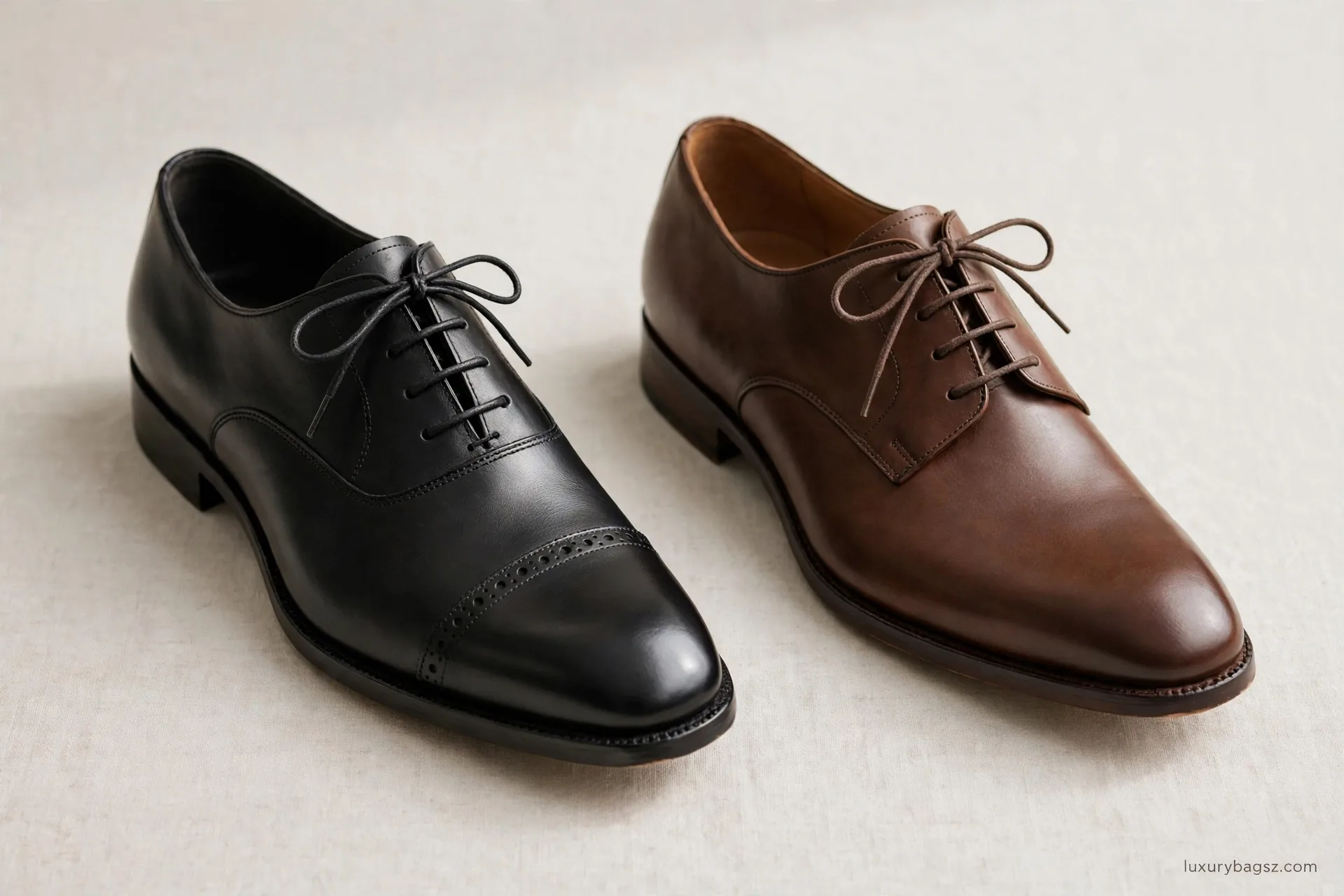
What are dress shoes? Dress shoes are formal, structured shoes made to be worn with tailored clothes, suits, and smart outfits for formal, business, and special occasions. They are the opposite of trainers and casual sneakers: slim, polished, low-heeled, and designed to look intentional, not sporty.
If you have ever stood in front of a wardrobe wondering whether loafers count, whether brown shoes work with a navy suit, or whether you need a black Oxford at all, this guide answers those questions. It explains the main types, how formal each one is, what they are made of, how they should fit, and how to choose your first pair without buying shoes you will rarely wear.
Table of Contents
Key Takeaways
- Dress shoes are structured leather shoes for formal and smart-casual outfits, not trainers, boots, or flip-flops.
- Oxfords are the most formal lace-up, with closed lacing. Derbies are slightly less formal, with open lacing and a roomier fit.
- Brogueing is decoration, not a shoe type on its own. A brogue can be an Oxford or a Derby, and more perforations mean more casual.
- Black is the most formal colour, brown is the most versatile, and burgundy adds character without being as casual as tan.
- Fit matters more than brand. A well-made shoe that pinches is the wrong shoe, no matter how good it looks.
What Are Dress Shoes?
A dress shoe is a shoe designed for smart casual or more formal events, usually made of leather, with a slim sole, a low heel, and a clean, tailored shape. Most dress shoes have a smooth or lightly textured upper, a stitched sole rather than a sole that is only glued on, and a shape that sits neatly under tailored trousers.
Dress shoes are worn for work, weddings, interviews, dinners, parties, and formal events. Many people also wear them as daily work shoes, especially in offices with a formal or business dress code. The key point is not the price or the brand. It is the purpose: the shoe is meant to complete a tailored outfit, not to provide sports performance or outdoor protection.
Good dress shoes are usually made of calf leather or suede. Calf leather is smooth, tight-grained, and formal. Suede is softer, more textured, and slightly more casual. Patent leather, which is highly polished and shiny, is reserved for the most formal occasions, such as black tie.
Dress Shoes in the US and the UK Do Not Mean Exactly the Same Thing
This is the confusion most guides skip, and it matters if you are shopping or reading advice online.
In the United States, “dress shoe” is a broad term. It often means any smart shoe that is not a sneaker, boot, or open shoe. That includes Oxfords, Derbies, brogues, monk straps, and loafers.
In the United Kingdom, “dress shoe” can mean something much narrower. Many British readers use “smart shoes” for everyday smart footwear, and reserve “dress shoe” for a shoe worn to a black-tie event, such as a highly polished black plain-toe or cap-toe Oxford, or a patent Oxford.
For this article, “dress shoes” is used in the broader sense: the full range of formal and smart shoes, from black-tie Oxfords to smart-casual loafers. When a shoe is only for black tie, that is stated clearly, so you do not wear the wrong pair to a formal event.
What Are NOT Dress Shoes?
A clear no-list helps more than a long definition, especially for beginners.
These are generally not dress shoes:
- Trainers, running shoes, and sports sneakers, even in black leather
- Flip-flops, slides, and beach sandals
- Work boots, hiking boots, and chunky outdoor boots
- Boat shoes and deck shoes, which are smart-casual at best
- Open-toe sandals, unless they are heeled, strappy, and clearly formal for women
Some shoes sit on the border. Chelsea boots and dress boots can be dress shoes when they are slim, polished, and worn with a suit, but a chunky boot is not. A suede loafer can be a dress shoe for smart-casual wear, but it is not a black-tie shoe. The rule is simple: if the shoe would look out of place with a suit at a formal event, do not call it a dress shoe for that event, even if it looks smart on its own.
Dress Shoe Anatomy in Plain Words
You do not need shoemaking terms to buy well, but knowing five parts makes every guide easier to understand.
- Vamp: the front part of the shoe, over the toes and instep.
- Quarters: the side panels that carry the eyelets for laces, or the strap for a monk shoe.
- Toe cap: an extra piece of leather sewn over the toe. A cap-toe Oxford has a seam across the toe. A plain-toe Oxford does not.
- Welt: a strip of leather stitched between the upper and the sole. A welted shoe can usually be resoled by a cobbler.
- Outsole and insole: the outsole touches the ground, and the insole sits inside the shoe under your foot.
- Last: the foot-shaped form the shoe is built on. The last decides the toe shape, width, and overall fit, which is why two shoes in the same size can fit very differently.
When a guide says “closed lacing,” it means the quarters are stitched under the vamp, so the lacing closes neatly. When it says “open lacing,” the quarters sit on top of the vamp, so the shoe opens wider and fits a higher instep more easily.
Types of Dress Shoes Compared
Use this table first, then read the short description for the types you are considering.
| Type | How it closes | Formality | Best for |
|---|---|---|---|
| Oxford | Closed lacing | Highest | Black tie, business formal, interviews |
| Wholecut | No laces, one piece of leather | Highest | Formal events, business formal, evening wear |
| Derby | Open lacing | High to medium | Business, smart-casual, wider feet |
| Monk strap | One or two buckles, no laces | High to medium | Business, smart-casual, social events |
| Brogue | Perforated decoration, Oxford or Derby lacing | Medium to high | Business casual, smart-casual, weekends |
| Loafer | Slip-on, no laces | Medium | Business casual, summer suits, smart-casual |
| Dress boot | Laces or zip, ankle height | High to medium | Cold weather, suits, smart-casual |
| Patent Oxford | Closed lacing, patent leather | Highest, black tie only | Black tie, white tie, very formal events |
Oxford shoes
Oxfords are the standard dress shoe for most suits. They have closed lacing, a sleek shape, and a clean silhouette. A plain-toe Oxford in polished black calf is the correct shoe for black tie.
A cap-toe Oxford in black or dark brown covers almost every formal occasion below black tie. Oxfords are slightly less adjustable than Derbies, so fit is especially important.
Wholecut shoes
A wholecut is cut from a single piece of leather, with a seam usually only at the back of the heel. The plain surface shows the leather and the shape of the shoe, which makes it look very sleek and formal.
Wholecuts are best for formal and business-formal wear, not for everyday rough use, because there is no toe cap to hide scuffs.
Derby shoes
Derbies have open lacing, which makes them easier to fit over a high instep and slightly more relaxed than Oxfords. In the United States, a Derby is often called a Blucher, although strictly a Blucher has small eyelet tabs sewn onto a single-panel vamp.
In everyday use, the two names are used for the same open-laced shoe. A plain black Derby can be worn with a suit, and a brown Derby works well for business casual and smart-casual outfits. For many buyers, the Derby is the most versatile first dress shoe.

Monk strap shoes
Monk straps close with one or two buckled straps instead of laces. A single monk with a plain toe is close to an Oxford in formality. A double monk, or a lighter colour, looks more relaxed and noticeable.
Monk straps work well with slim trousers because there are no laces to break the line of the shoe, but they are not black-tie shoes.
Brogue shoes
Brogues are not a separate shoe shape. Brogueing is decorative perforation along the seams and often on the toe. A quarter brogue has perforations only along the toe cap. A semi-brogue adds a pattern on the toe.
A full brogue, or wingtip, has a toe cap shaped like a W that runs along the sides. More brogueing means more casual. A semi-brogue can carry a suit, but a full brogue should not be worn to black tie.
Loafers
Loafers are slip-on shoes with no laces. Penny loafers have a strap across the vamp, tassel loafers have tassels, and horsebit loafers have a metal bit. A plain calf leather loafer can be worn with a suit in a modern office, while suede loafers are more clearly smart-casual.
Loafers are the easiest dress shoe to wear in warm weather and for summer suits, but they are not the right choice for black tie.
Dress boots and Chelsea boots
Dress boots combine the elegance of a dress shoe with ankle coverage. A slim Chelsea boot, with elastic side panels and a clean silhouette, can work with a suit in cold weather and in transitional seasons. A chunky boot, a work boot, or a boot with a thick lug sole is not a dress boot, even if it is made of leather.

Women’s Dress Shoes
Most dress shoe guides focus only on men, but the keyword itself is not men-only, so the main women’s styles deserve a short section.
- Pumps: closed-toe shoes with a heel, usually at least 5 cm, in leather or suede, with a rounded or pointed toe. The classic work and formal shoe for women.
- Slingbacks: similar to pumps, but with a narrow strap over the heel instead of a closed back.
- Loafers: flat, slip-on shoes, often in darker colours, more comfortable and more masculine in style than a heel, but still smart.
- Mules: slide-on shoes that do not cover the back of the foot. A mule counts as a dress shoe only when it has a heel and a formal finish.
- Ballet flats: flat, rounded-toe shoes, originally from ballet, now made in many colours and materials. They are smart-casual rather than formal.
- Heeled sandals: sandals with a heel, many straps, or a shiny finish can be acceptable for formal occasions, while flat flip-flops are not.
For women, the same formality rules apply: closed, polished, and simple is more formal, while open, textured, and heavily decorated is more casual.
Formality Spectrum: What to Wear When
The most common mistake is not wearing the wrong shoe, but wearing a shoe that is two steps too formal or too casual for the occasion. One step out is usually fine. Two steps looks careless.
| Occasion | Correct shoe | Why |
|---|---|---|
| Black tie | Plain-toe Oxford, polished black calf or patent | Closed lacing, no brogueing, maximum formality |
| White tie | Patent Oxford | The most formal dress code |
| Business formal | Cap-toe Oxford, black or dark brown | Sleek, understated, professional |
| Business suit, everyday office | Oxford, Derby, or monk strap, black or brown | Smart, not ceremonial |
| Job interview | Plain Derby or cap-toe Oxford, black or dark brown | Signals care without drawing attention to your feet |
| Smart-casual, client meeting | Derby, brogue, loafer | Character without crossing into casual |
| Summer wedding, guest, daytime | Tan Oxford, loafer, or semi-brogue | Lighter leather and suede read as seasonal |
| Summer wedding, black tie | Black Oxford, not a loafer or brogue | The invitation dress code comes first |
Always check the invitation first. A summer wedding that says black tie still calls for Oxfords, even in warm weather.

Materials and Construction
Leather quality
Full-grain leather keeps the top surface of the hide, which is the tightest and most durable layer. It develops a patina with age, responds to polish and conditioning, and can be resoled and worn for many years.
Corrected-grain leather has been sanded and embossed with an artificial grain. It looks uniform when new, but it does not patina in the same way and cannot be maintained as well.
Calfskin is smooth, tight-grained, and the standard for formal dress shoes. Grain leathers, such as pebbled or tumbled leather, are more resistant to scuffing and better for everyday Derbies and loafers, but they read as slightly more casual. Suede is split leather with a soft, velvety finish.
It is less water-resistant than smooth calf and suits smart-casual occasions. Patent leather is coated for a mirror shine and is for formal evening wear, not daily office wear. Velvet slippers are for relaxed black-tie evenings, not for business.
Sole construction
A Goodyear-welted shoe has a welt stitched to the upper and insole, and the outsole stitched to the welt, with cork filling underneath. Because the welt sits between the upper and sole, a cobbler can replace a worn sole without damaging the upper, so a welted shoe can be resoled many times.
Blake-stitched shoes, common in Italy, have the sole stitched directly to the upper. They are lighter and more flexible, and they can also be resoled by a specialist. Glued shoes are usually cheaper and lighter, but they are harder to repair and often cannot be resoled in the same way.
For soles, leather soles are traditional, thinner, and more formal, but they wear faster on rough streets and are less water-resistant. Rubber soles, such as studded Dainite rubber, keep a sleek profile while adding grip and water resistance, which makes them a practical choice for daily wear in wet weather.
Colours and What to Pair Them With
Colour in dress shoes is not only personal taste. It is also dress-code grammar.
- Black: the most formal colour. It pairs with black, navy, charcoal, and grey suits, and with black tie. It does not pair naturally with brown or tan suits.
- Dark brown: the most versatile colour for everyday business. It works with navy, grey, green, and earth tones, but not with a black suit.
- Tan and cognac: lighter and more seasonal. They work with navy, stone, light grey, and cream, but not with dark formal suits.
- Burgundy and oxblood: more interesting than black and more formal than tan. They work with navy, charcoal, and mid-grey, and signal a considered wardrobe choice, but they are not for black tie.
The simplest rule for belts and shoes is to match the colour family, not necessarily the exact shade. A dark brown belt with dark brown shoes, or a black belt with black shoes, is enough to make an outfit look consistent.

Fit Guide: How Dress Shoes Should Fit
Fit matters more than brand, and most fit problems are not fixed by breaking shoes in.
- Length: there should be roughly 10 to 12 mm of space beyond your longest toe, and no more than 15 mm.
- Width: the widest part of your foot should sit at the widest part of the shoe. Leather stretches very little in width, so do not buy a narrow shoe hoping it will give.
- Heel: 2 to 3 mm of heel slip is normal in new leather shoes, and the heel cup usually tightens as the leather beds in. Consistent slip of 10 mm or more is a sizing problem.
- Instep: if you have a high instep, a Derby with open lacing will usually fit more comfortably than an Oxford with closed lacing.
- Break-in: full-grain calfskin usually needs 3 to 5 wears to mould to your foot. Wear new shoes for a short period first, not a full long day, and use cedar shoe trees after each wear.
- Socks: try shoes with the thin dress socks you will actually wear, not thick athletic socks. Thick socks make a slim shoe feel tight and look bulky.
If a shoe hurts on first wear, it is usually the wrong size or the wrong last, not a shoe that simply needs breaking in. Do not accept shoes that pinch in the shop.

How to Choose Your First Pair
Buy for the occasions you actually dress for, not for occasions you imagine.
If you wear suits or attend formal events, start with black Oxfords. A plain or cap-toe design with little decoration works for interviews, weddings, funerals, and black tie.
If your wardrobe is mostly business casual or smart-casual, start with dark brown Derbies, which cover suits, chinos, and smart-casual outfits.
A practical starter collection, in order, is:
- Black Oxford — formal, business formal, interviews
- Dark brown Derby — business, smart-casual, everyday smart wear
- Tan or mid-brown brogue — smart-casual, weekends, spring and summer
- Burgundy or dark brown loafer — warm weather, casual offices, summer events
- Brown monk strap — a laceless alternative for business casual and social events
Later additions can include patent Oxfords for black tie, suede loafers for summer, wholecuts for formal business settings, and two-tone spectator shoes for a vintage-inspired summer look.
You do not need all five at once. Two well-chosen pairs cover most needs, and a third pair adds real variety.

Care Basics So Dress Shoes Last
Dress shoes that are looked after and resoled can last for many years, while the same shoes worn every day without rest will wear out quickly.
- Brush off surface dirt with a soft brush after each wear.
- Insert cedar shoe trees immediately after wearing. They absorb moisture and help the shoe keep its shape.
- Rest leather shoes for at least 24 hours before wearing them again. Do not wear the same leather pair every day.
- Polish smooth leather weekly if worn regularly, with a small amount of wax polish on a cloth, left to dry, then buffed with a clean brush or cloth. Do not over-polish, as wax build-up can clog leather pores.
- For suede, use a suede brush and a protective spray made for suede, not ordinary leather polish.
- The same spot-test-first rule applies to other leather goods. For a detailed leather-care example, see how to clean Chanel bags safely without damaging leather.
- Do not dry wet shoes near a radiator or with direct heat. Let them air-dry away from heat and sunlight, with shoe trees inside.
- Check laces, heels, and soles regularly, and take worn soles to a cobbler before the upper is damaged.


Common Mistakes to Avoid
- Wearing brown shoes with a black suit, or black shoes with a brown or tan suit, without understanding the contrast.
- Wearing a full brogue to black tie, or patent evening shoes with casual clothes.
- Wearing thick athletic socks with slim dress shoes.
- Leaving shoes scuffed or unpolished for a formal occasion.
- Wearing the same leather pair every day without shoe trees or rest.
- Ignoring the dress code on the invitation.
- Buying for price alone, instead of fit and construction.
- Accepting shoes that pinch in the shop, hoping they will stretch.
- Wearing formal Oxfords with shorts or sportswear.
- Choosing a shoe for personal preference when the occasion has a clear formality floor, such as black tie.

FAQ
What are dress shoes, in simple words?
Dress shoes are formal, structured leather shoes made to be worn with suits and smart outfits for formal, business, and special occasions. They have a slim sole, a low heel, and a clean shape, unlike trainers or casual shoes.
Do I need dress shoes?
If you attend interviews, weddings, formal dinners, or work in a formal office, yes. One pair of black Oxfords or dark brown Derbies covers most of those occasions. If you rarely dress formally, one versatile dark brown Derby is a better first buy than a patent black-tie shoe.
Are loafers dress shoes?
Yes, for business casual and smart-casual wear, especially in plain calf leather. Suede loafers are more casual. Loafers are not black-tie shoes, and they are not the right choice for a very formal event.
Can I wear dress shoes with jeans?
A dark brown Derby, loafer, or brogue can work with dark, slim jeans for smart-casual wear, but a black formal Oxford with jeans usually looks mismatched. The shoe should match the overall formality of the outfit, not just the colour.
Are Chelsea boots dress shoes?
A slim, polished Chelsea boot can be a dress shoe with a suit in cold weather. A chunky, work-style boot is not a dress shoe, even if it is made of leather.
Are dress shoes comfortable?
A well-fitted dress shoe can be comfortable for a long day, but a shoe that is too narrow, too short, or built on the wrong last will not become comfortable with breaking in. Fit, width, and instep matter more than softness in the shop.
How long do dress shoes last?
Full-grain calfskin dress shoes, properly maintained with shoe trees, rotation, and regular resoling, can last 10 to 20 years. Glued, corrected-grain shoes usually last much less, because they cannot be resoled and maintained in the same way.

Conclusion
Dress shoes are not just formal shoes. They are a small set of choices that signal how formal an occasion is, how well an outfit is put together, and whether the wearer understands the dress code. Start with the definition, then the type, then the formality, then the fit. A black Oxford for formal events, a dark brown Derby for everyday smart wear, and a loafer or brogue for smart-casual occasions will cover almost every situation most readers face.
Buy for fit and construction first, look after the shoes with trees, rotation, and polish, and resole them instead of replacing them. That is how a first pair becomes a long-term wardrobe staple, not a one-event purchase.






