Hermès Clic Clac H Bracelet Sizes: PM vs GM, Width and Wrist Fit
What PM and GM Actually Measure
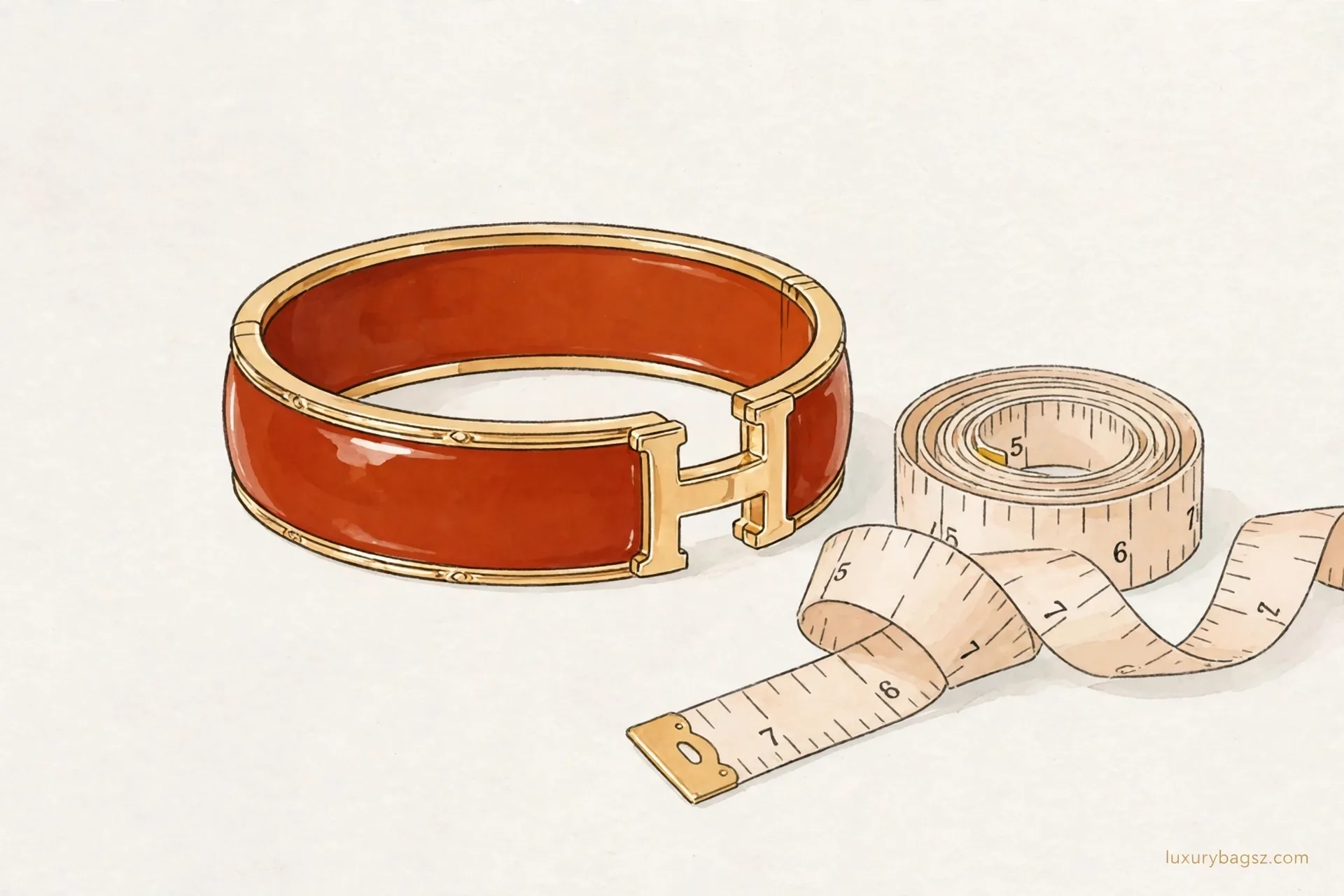
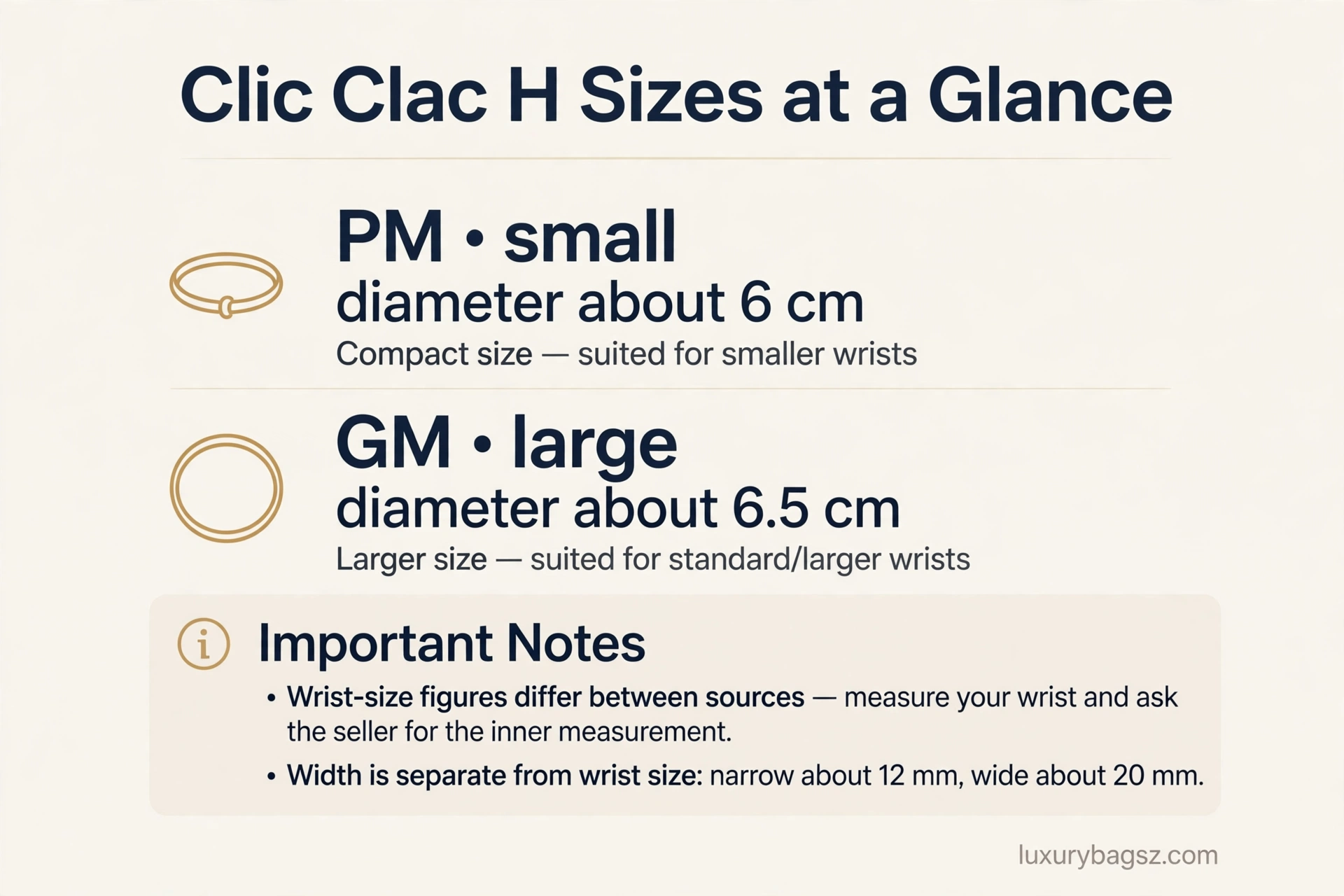
PM and GM are the Clic Clac H’s two wrist sizes, and as a rough guide a wrist around 15 to 16 cm usually suits PM, while 17 to 18 cm usually points to GM.
The piece itself is a hinged enamel band in a metal frame, closed by the H-shaped clasp that clicks shut. Treat the wrist figures as a starting point only — they circulate among blogs and resale listings rather than coming from Hermès — and use the measuring routine below, with a tape measure or a strip of paper, before you buy.
The Hermès Clic Clac H bracelet is one of the easiest Hermès pieces to fall in love with and one of the easiest to buy in the wrong size. It looks simple: a hinged enamel band, a metal frame, and an H-shaped clasp that clicks shut. It comes in two sizes, PM and GM. How hard can it be?
This guide untangles those two measurements, lays out the figures that sources disagree on without quietly picking a winner, and gives you a measuring routine you can do at home with a tape measure or a strip of paper. It covers how Hermès itself describes the sizes, how resale sellers and blogs describe them differently, how to measure your wrist so the number means something, how a wide band changes the feel of the same wrist size, how stacking with a watch changes the choice, what prices actually look like by size, and what to ask a seller before you pay for a bracelet you cannot try on.
A note on the pictures first. Every picture in this guide is a generic illustration, not a photograph of a real Hermès bracelet. Illustrations simplify metalwork and flatten enamel, and they are not drawn to an exact scale, so never measure a width or a diameter off a picture. Use the pictures to follow the ideas, and use the words — and your own tape measure — for the numbers. Where a picture simplifies a detail, the words in this guide prevail.
A note on scope, too. This guide is about sizes and fit. It is not an authentication guide, and a size label on its own never proves a bracelet genuine. A seller can print PM on a listing for a bracelet that is not PM, and a bracelet can be the right size and still be a copy. Size checks and genuineness checks are different jobs. If you are buying pre-owned and the size story does not add up, that is a reason to pause whether or not anything else about the bracelet worries you, and the same pause applies when a listing leans on a label instead of measurements, just as it does in a fake Evelyne listing where a claim is offered in place of evidence.
Table of Contents
Key Takeaways
- PM and GM are wrist sizes, not widths. PM (Petit Modèle) is the small wrist size and GM (Grand Modèle) is the large wrist size. Width — narrow or wide — is a separate choice that applies to either wrist size.
- Hermès describes the two sizes by diameter: PM is about 6 cm and GM is about 6.5 cm. Blogs and resale listings often describe them instead by wrist circumference, and those wrist figures disagree with each other, so never trust a single blog figure on its own.
- A hinged bracelet is sized by your wrist, not by your hand. That is the great advantage of the Clic Clac H over a solid bangle: it opens and closes on your wrist, so you do not have to fit it over your knuckles. Your hand size is irrelevant to this bracelet, and any guide that tells you to measure your hand for a Clic Clac H is describing a different kind of bracelet.
- Measure your wrist snugly, just above the wrist bone, at the place you will actually wear the bracelet, and record the number in both centimetres and inches. Then ask the seller for the bracelet’s inner measurement, not just its PM or GM label.
- A wide band feels tighter than a narrow band at the same wrist size, because more of the band touches your skin and the band bends less around the curve of your wrist. If you are between sizes in a wide band, the larger size is usually the safer choice.
- Price is driven more by width, colour, condition, and whether the bracelet is new or pre-owned than by PM versus GM alone. A single resale listing is never a market average, and a price quoted from one guide at one date is not a current market price.
- The Clic Clac H is the wider hinged enamel bracelet in the family, distinct from the narrower Clic H. If a listing calls a narrow bracelet a Clic Clac H, or a wide bracelet a Clic H, the naming is muddled and the measurements in that listing need checking twice.
- The metal on a standard Clic Clac H is plated, not solid gold. Gold-plated and palladium-plated finishes are the normal finishes, and that matters for care, for wear over time, and for price expectations: do not pay a solid-gold price for a plated bracelet.
Clic Clac H Sizes in Brief
How many sizes are there? Two wrist sizes: PM (Petit Modèle, small) and GM (Grand Modèle, large). Hermès gives those two sizes as diameters of about 6 cm for PM and about 6.5 cm for GM. On top of that, the bracelet comes in a narrow width and a wide width, and that width choice is independent of the wrist size.
Which size should most people start with? Start with your wrist measurement, not with a guess from a guide. A wrist of about 15 to 16 cm usually points toward PM, and a wrist of about 17 to 18 cm usually points toward GM, but those are rough guides, not rules, because sources disagree on the exact wrist figures and because width, fit preference, and whether you stack the bracelet all shift the answer. Measure first, then match the measurement to the bracelet’s inner measurement, and only then decide.
What is the single most common mistake? Treating PM as narrow and GM as wide. That mistake is everywhere in competitor guides, and it is the mistake this guide exists to correct. PM and GM answer the question “how big is the loop?” Width answers the question “how broad is the band?” A buyer who orders “a PM because I want a narrow bracelet” may receive a wide PM and wonder why it looks so bold, or may be sold a narrow GM by a seller who thinks GM means wide, and wonder why it slides down her arm.
Can you size a Clic Clac H without trying it on? Yes, if you have two numbers: your wrist circumference, measured properly, and the bracelet’s inner circumference or inner diameter, measured by the seller. With those two numbers you can make a good decision most of the time. Without the seller’s number, you are guessing, however careful your own measurement is.
What if you are between sizes? In a narrow band, choose by fit preference: snug if you like the bracelet to stay put, larger if you like a little movement. In a wide band, lean toward the larger size, because a wide band that is slightly tight feels tighter than a narrow band that is slightly tight, and a wide band has less give around the wrist. If you plan to stack the bracelet with a watch, lean larger again, and read the fit rules before you decide.
Is there a TGM size? Not as a standard Clic Clac H size. TGM (Très Grand Modèle) appears in listings for other Hermès bracelet lines and in some Clic H family listings, but the standard Clic Clac H range described by Hermès is PM and GM. A listing that offers a Clic Clac H in TGM needs its measurements stated plainly, because the label alone does not tell you what you are buying.
Clic Clac H vs Clic H: the Width Confusion Behind Wrong Orders
To understand Clic Clac H sizes, you first have to understand which bracelet you are sizing. The Hermès enamel bracelet family has two famous members, and guides confuse them constantly.
The Clic H is the narrower bracelet. It is the slim enamel band with the rotating H clasp that most people picture when they hear “Hermès H bracelet”. Its narrow width is widely described as about 12 mm, or about half an inch. It is a lighter, slimmer presence on the wrist, and it stacks easily with other bracelets and with a watch.
The Clic Clac H is the wider bracelet. It is a broader band of enamel in the same hinged construction, with the same H clasp idea, but with much more colour on show. Its wide width is widely described as about 20 mm, or about three-quarters of an inch to a full inch depending on the source and the version. It is a bolder, more standalone piece, and it behaves differently on the wrist from the narrow bracelet even at the same wrist size, for reasons the narrow-versus-wide comparison explains.
Here is where guides go wrong. Some guides use “Clic Clac” and “Clic H” as if they were two names for the same bracelet, and then use PM and GM as if they were width names. One widely read guide, for example, describes PM as “the narrower, more delicate option” at about half an inch wide and GM as “the wider, bolder statement piece” at about an inch wide, and then says both are available in “the same wrist size”. That description mixes up the two axes completely. It takes a width difference and labels it with wrist-size names, and then has to claim the wrist size is the same for both, which contradicts the whole point of having two wrist sizes. A buyer who follows that guide and asks a seller for “a PM” expecting a narrow bracelet may receive a wide PM, or may be told by a knowledgeable seller that PM has nothing to do with width and feel misled by the guide rather than by the seller.
Other guides make the opposite error. They describe the Clic Clac as a different clasp — a plain rectangular plate rather than an H — which confuses the Clic Clac H with other hinged bracelets in the wider Hermès range. The bracelet this guide is about, the Clic Clac H, has the H clasp. If a listing shows a plain rectangular clasp and calls the bracelet a Clic Clac H, the naming is wrong, and the size figures in that listing should not be trusted until they are checked against the actual bracelet.
The practical rule is simple. When you read any guide or listing, ask two questions, separately: what wrist size is this, PM or GM? And what width is this, narrow or wide? If a guide or listing answers only one of those questions, or answers both with a single word, it has not described the bracelet. Ask for the missing number before you buy.
What PM and GM Actually Mean
PM stands for Petit Modèle, French for small model. GM stands for Grand Modèle, French for large model. Those names are used across many Hermès product families, from bags to bracelets, and they never mean the same measurements from one family to another. A PM in one family is not a PM in another family. That is worth stating plainly, because buyers who know Hermès bags sometimes assume a size name carries across, and it does not. The same measure-first discipline that applies to a Lindy sizes question applies here: the name is a label, and the measurement is the fact.
Hermès itself describes Clic Clac H and Clic H sizes in a short statement on its size-guide pages: the bracelets are available in small (PM, 6 cm) and large (GM, 6.5 cm). That is a diameter figure — the distance straight across the inside of the bracelet loop, not the distance around it. It is the cleanest official statement available, and it is the anchor for this guide. A PM loop is about 6 cm across inside. A GM loop is about 6.5 cm across inside. The difference between the two sizes, at the level of diameter, is half a centimetre.
Half a centimetre of diameter sounds tiny, and it matters more than it sounds. A loop is a closed shape, so a small change in diameter means a larger change in the distance around the loop, and an even more noticeable change in how the loop sits on a wrist that is oval rather than round. The measurements section works through that maths in plain terms. For now, the point is that PM and GM are close together — there is no huge jump between them — which is why buyers between sizes exist in large numbers, and why a good measuring routine matters more here than for a product with widely spaced sizes.
Hermès also gives wrist guidance for its hinged bracelets in a different form: because the bracelet opens and closes directly on the wrist like a cuff, you only need to measure your wrist circumference, and a properly fitted watch strap can serve as a guide. That advice is sound as far as it goes, but it stops short of the number buyers actually need, which is the wrist circumference that each size fits. Hermès’ own published material, as found in this research, gives the diameter figures above and does not give a single, settled wrist-circumference table for PM and GM in the same place. That gap is exactly where blogs and resale guides step in, and where they disagree, as the size-conflicts section sets out in full.
One more naming point. Some listings add a third size label, TGM, or describe a bracelet as “PM/GM” without saying which. TGM appears in genuine Hermès listings for other bracelet designs, and it is sometimes attached to Clic H family listings by sellers, but it is not a standard Clic Clac H size in Hermès’ own description. Treat any TGM-labelled Clic Clac H as a listing that must prove its measurements, not as a size you can order with confidence from the label alone. And treat any listing that says “PM/GM” as a listing that has not told you the size at all: it is the seller’s way of saying the bracelet comes in two sizes, not a description of the bracelet on offer.

How Sizes Are Measured: Diameter, Circumference, Wrist Fit
Three different numbers get used for this bracelet, and guides switch between them without warning. Understanding which number you are looking at is half the battle.
Diameter is the distance straight across the inside of the loop, from one inner edge to the opposite inner edge. Hermès’ PM figure of 6 cm and GM figure of 6.5 cm are diameters. Diameter is easy to measure on a bracelet that is lying flat, and it is the number Hermès publishes, but it is not the number your wrist feels, because your wrist is not a circle and the bracelet loop, once closed on your wrist, is not a perfect circle either.
Inner circumference is the distance around the inside of the loop. For a perfect circle, inner circumference is diameter multiplied by pi, about 3.14. That gives roughly 18.8 cm for a 6 cm diameter and roughly 20.4 cm for a 6.5 cm diameter. Those are useful ballpark conversions, and resale listings often quote inner circumferences in this range — one well-documented wide example, for instance, pairs a 65 mm inner diameter with a 20.42 cm circumference, which matches the maths exactly. But a genuine Clic Clac H is oval, not a perfect circle, because a wrist is oval, so the true inner circumference of a real bracelet will not match the circle maths exactly. Treat converted figures as approximations, and prefer a seller’s directly measured inner circumference over a figure converted from a diameter by a guide.
Wrist circumference is the distance around your wrist, measured with a tape. This is the number you control, and it is the number that decides whether a bracelet will close comfortably, close tightly, or not close at all. The relationship between wrist circumference and inner circumference is the whole sizing question: the bracelet’s inner circumference must be larger than your wrist circumference, by enough to let the bracelet sit without pinching, but not so much larger that it slides off over your hand or spins freely. How much larger is “enough” is a matter of fit preference, and the fit rules cover it, but the direction is fixed: inner circumference bigger than wrist circumference, always, or the bracelet will not close.
That direction explains the most common sizing error after the PM-means-narrow error. Buyers sometimes compare their wrist circumference directly with the diameter figure — a wrist of 16 cm against a PM diameter of 6 cm — and conclude that no size could possibly fit. Those two numbers are in different units of the same problem: one is a distance around, the other is a distance across. A 6 cm diameter loop has an inner distance around of roughly 18.8 cm, which is comfortably larger than a 16 cm wrist. Always compare like with like: wrist circumference against inner circumference, or wrist diameter against inner diameter. Never compare a circumference with a diameter.
It also explains why a hinged bracelet is sized differently from a solid bangle. A solid printed-enamel bangle does not open, so it must fit over your hand, and guides for those bangles tell you to measure your hand with your thumb tucked in — a measurement that can reach 7.2 inches for a 62 mm bangle, 7.5 inches for a 65 mm bangle, and 8.6 inches for a 70 mm bangle, according to Hermès’ own bangle guidance. None of that applies to the Clic Clac H. Because the Clic Clac H hinges open, it closes directly on your wrist, and your hand size is irrelevant. If a guide tells you to measure your hand for a Clic Clac H, it has copied a bangle guide onto a hinged bracelet, and its size advice should not be trusted. The same lesson about labels applies to other Hermès families: telling scarf sizes apart also comes down to measuring the thing itself rather than trusting a name, and the bracelet is no different.
How to Measure Your Wrist, Step by Step
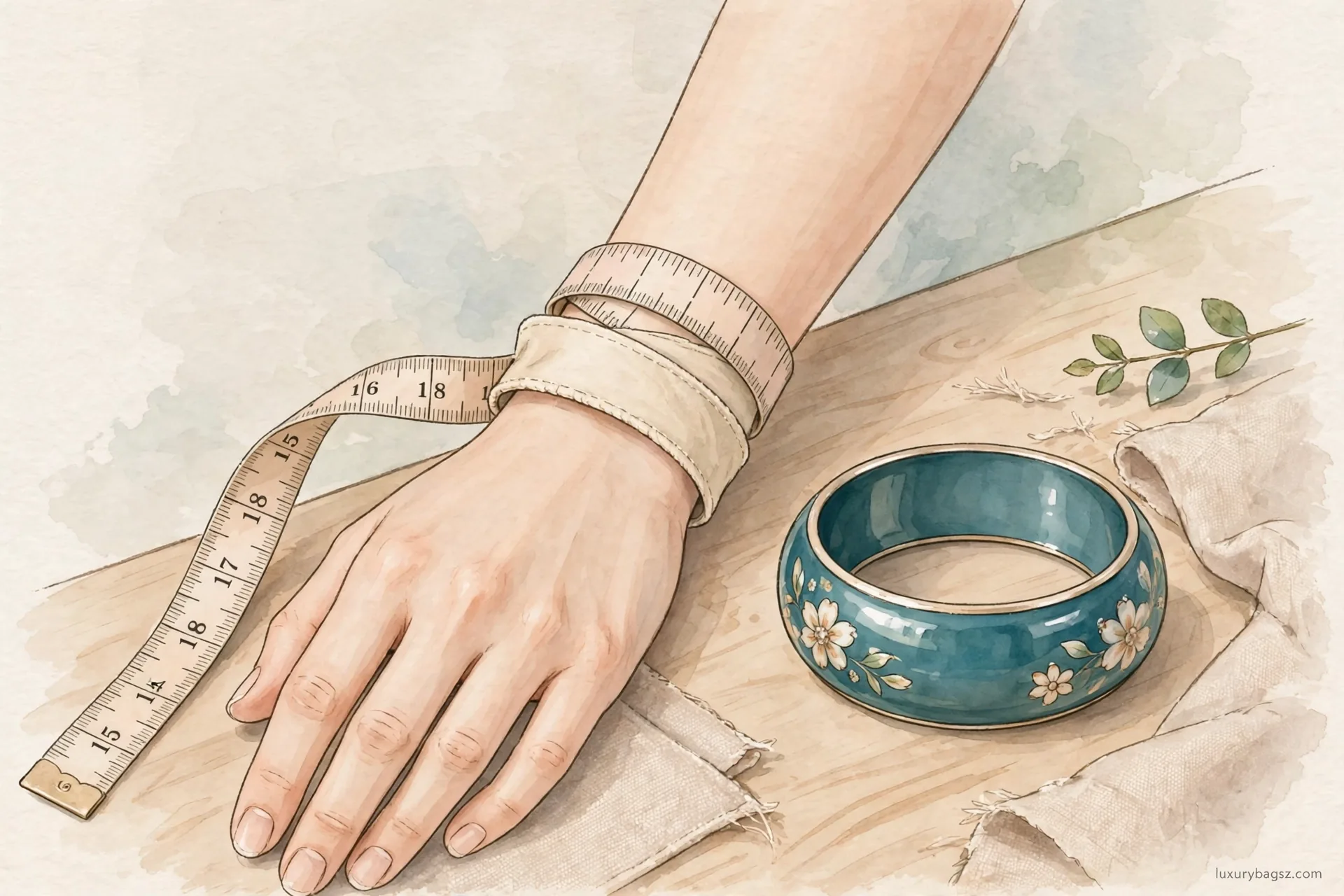
You need a soft measuring tape, or a strip of paper and a ruler, and two minutes. Do it in the afternoon if you can, when your wrist is at its normal size rather than first thing in the morning, and do it on the wrist you will wear the bracelet on, because most people’s wrists differ by a few millimetres from one side to the other.
First, find the place. The bracelet will sit just above the wrist bone, on the forearm side of the bony bump, not on the bone itself and not halfway up the forearm. Put your arm on a table, palm down, relaxed, and mark that place lightly in your mind. That is where the tape goes.
Second, wrap the tape around that place, snugly but not tightly. The tape should touch your skin all the way around, with no gap and no sag, but it should not dig in, dent the skin, or compress the flesh. You should be able to slip one fingertip under the tape only with effort. If the tape leaves a mark when you remove it, it was too tight, and your number will be too small.
Third, read the number where the tape meets its own start, and write it down in both centimetres and inches. One inch is 2.54 cm, so 15 cm is about 5.9 inches, 16 cm is about 6.3 inches, 17 cm is about 6.7 inches, and 18 cm is about 7.1 inches. Recording both units matters, because Hermès’ own figures are in centimetres, many blogs are in inches, and resale listings use both, sometimes in the same listing. A number recorded in only one unit is a number you will have to convert under pressure later, and conversion is where errors creep in.
Fourth, repeat the measurement twice more, and take the middle value if the three readings differ. Wrist measurements vary with temperature, with how recently you exercised, and with how tight you pull the tape, and a single reading can easily be off by half a centimetre. Half a centimetre is the whole difference between PM and GM at the diameter level, so a sloppy single reading can put you in the wrong size entirely.
Fifth, if you will wear the bracelet over a sleeve, over a watch, or stacked against another bracelet, measure again in that configuration. Put the sleeve on, or the watch on, and measure around the whole stack at the place the bracelet will sit. A measurement taken on a bare wrist does not describe a wrist wearing a chunky watch, and the fit rules explain how much difference that makes.
Sixth, if you do not have a soft tape, use a strip of paper. Wrap it snugly as above, mark where it overlaps, lay it flat against a ruler, and read the length. Paper stretches less than string and kinks less than ribbon, so it is the best substitute. Do not use string pulled tight around the wrist and then measured loosely on a ruler, because that method adds error at both ends and is the most common cause of a measurement that is a full size out.
Finally, compare your number with the bracelet’s inner measurement, not with a blog’s wrist table alone. Ask the seller for the inner circumference, or the inner diameter in both directions if the bracelet is oval, and check that the inner figure is larger than your wrist figure by an amount that matches your fit preference from the fit rules. If the seller cannot give you an inner measurement, you do not have enough to buy safely, however good the photographs look.
The Fit Rules: Snug, Sliding, Stacking, and Sleeves
Fit preference is personal, but the vocabulary around it is not, and most sizing disappointment comes from buyers and sellers using the same words to mean different things.
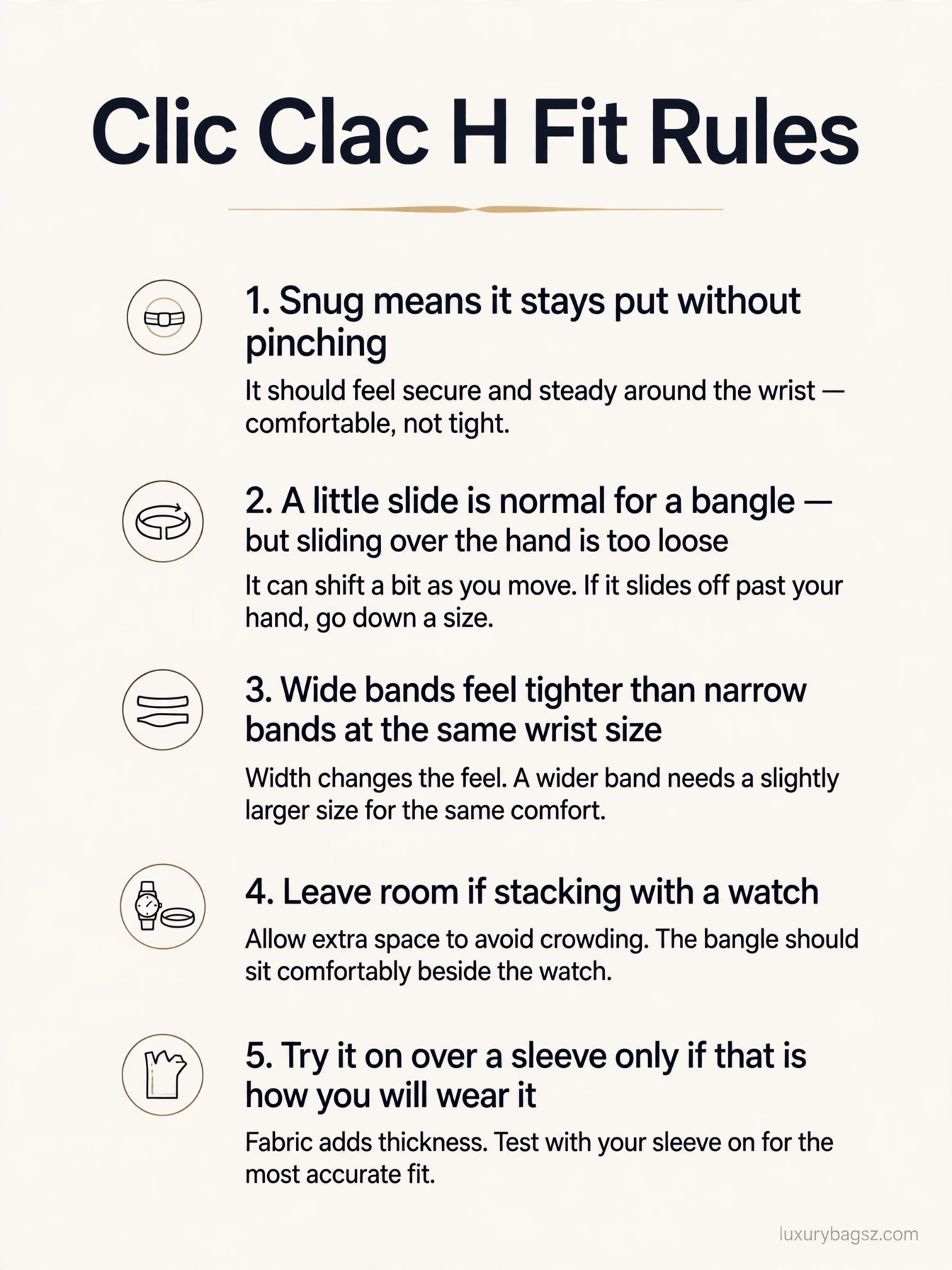
Snug means the bracelet stays where you put it, does not spin freely, and does not slide down over your hand when you lower your arm, but it does not pinch, dent the skin, or hurt when you bend your wrist. A snug bracelet still moves a little — a bangle is a rigid loop, not a strap, so some movement is built into the design — but it returns to place and the H stays on the outside of your wrist. Many buyers prefer snug for a narrow bracelet, because a slim band that slides looks lost on the wrist, and because a narrow band that is loose can slip over the hand more easily than a wide band can.
A little slide is normal, and it is not a sign that the bracelet is too big. A rigid bangle cannot grip the wrist the way a strap can, so it will shift a centimetre or two as you move, especially when your arm is raised or lowered. What matters is how far it slides and whether it stays on the wrist. A bracelet that slides up and down the lower forearm but stays on the wrist is a normal bangle fit. A bracelet that slides over the hand, or that spins so the H ends up on the inside of the wrist every time you move, is too loose, whatever the label says.
Too tight is easier to recognise and harder to live with. A bracelet that pinches when you bend your wrist, that leaves a lasting dent, that hurts after an hour, or that you have to force closed is too tight, even if it technically closes. Buyer reports on forums make this vivid: one buyer with a wrist of about 17 cm found a PM bracelet that could “just” be done up but hurt when she moved her wrist, and had to return it. A bracelet that only just closes is not a snug fit; it is a too-tight fit that will get worse in heat, when wrists swell slightly, and after a long day. If a bracelet only just closes in a cool shop or a cool room, it will be tighter still on a warm day.
Stacking with a watch changes the choice more than most buyers expect. A watch adds bulk on one side of the wrist, and a bracelet worn next to it has less room to move and more to knock against. Two rules follow. First, if you always wear the bracelet on the same wrist as a watch, measure with the watch on, as the wrist-measuring steps direct, and lean toward the larger size if you are between sizes. Second, think about damage as well as comfort: a hard enamel bracelet knocking against a watch case all day will mark both pieces over time, so many owners wear the bracelet on the opposite wrist from the watch, or leave a gap between them. A bracelet that fits perfectly on a bare wrist can feel crowded next to a watch, and a size chosen for a bare wrist can feel wrong the first day it is worn with one.
Sleeves change the choice in the same direction. A bracelet worn over a cuff needs a larger loop than the same bracelet worn on bare skin, because the cuff adds thickness all the way around. The rule is the one in the fit-rules picture: try it on over a sleeve only if that is how you will wear it, and if you wear it both ways, size for the bare wrist and accept that it will sit higher or tighter over a sleeve, or size for the sleeve and accept a looser fit on bare skin. There is no size that is perfect for both, because the wrist itself is a different size in the two cases.
Season and swelling deserve a brief mention, because they surprise first-time bangle buyers. Wrists swell slightly in heat, after exercise, and over the course of a long day, and a bracelet that fits perfectly in the morning can feel tight by the evening. That is normal, and it is another reason to avoid a bracelet that only just closes: it has no margin for a normal day. If you live in a hot climate, or you know your wrists swell, lean toward the larger size, and test a bracelet in the afternoon rather than first thing in the morning when you try it on in a shop.
Narrow vs Wide: How Enamel Width Changes Everything
Width is the measurement most guides treat as decoration, and it is the measurement that changes the wearing experience most after wrist size itself.
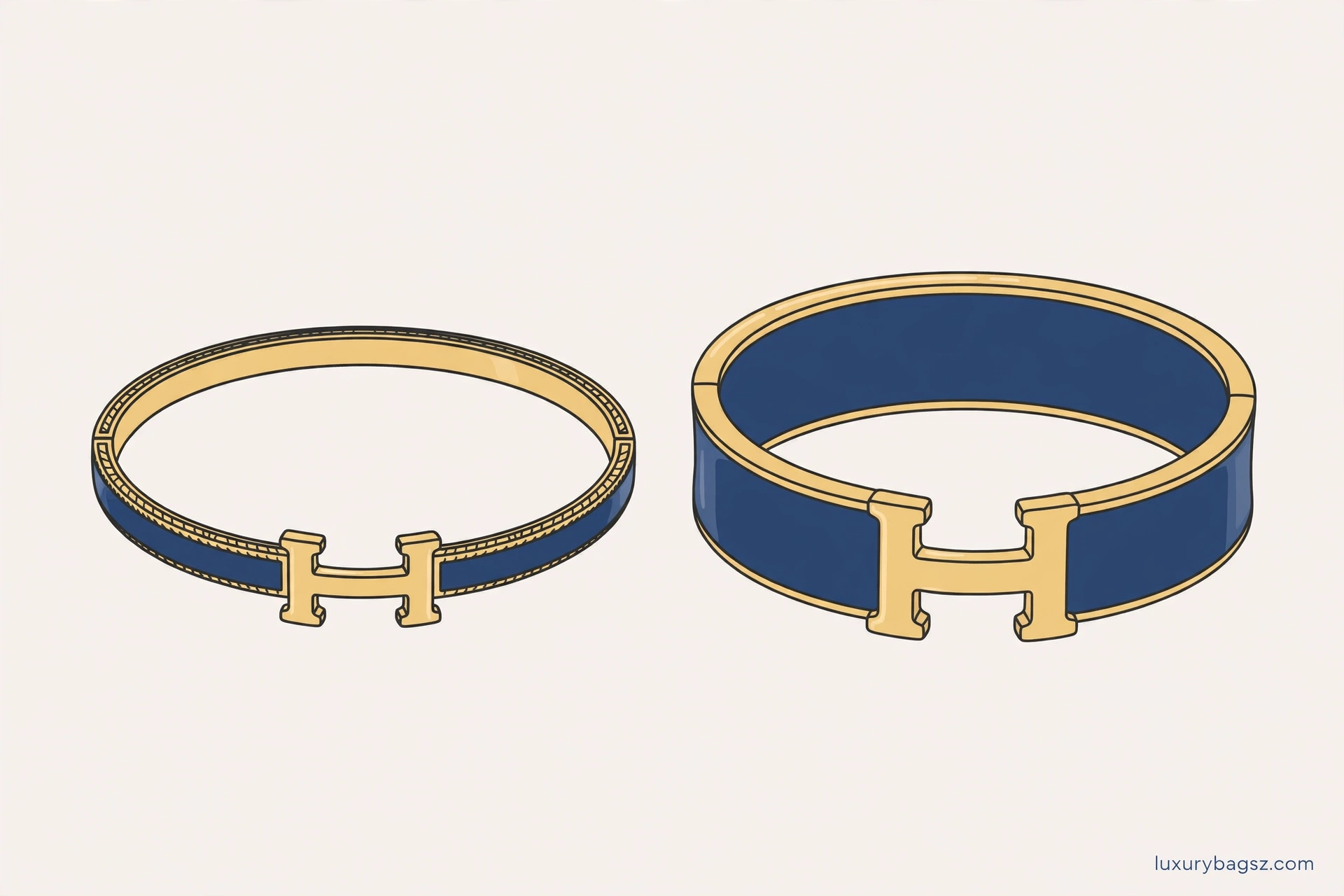
The narrow bracelet, the Clic H, is widely described as about 12 mm wide, or about half an inch. The wide bracelet, the Clic Clac H, is widely described as about 20 mm wide in current listings — one recent resale listing for a wide model gives wrist size 16 cm and width 20 mm in the same breath — while resale valuation reports most commonly give 0.75 inches, about 19 mm, for wide examples, and 0.5 inches, about 12 to 13 mm, for narrow examples. A printed wide example measured in detail pairs a 65 mm inner diameter with a 17 mm width, which sits between those figures and shows that width varies by version as well as by the narrow-wide split. Sources therefore disagree on exact widths, and this guide does not pretend otherwise: narrow is roughly 12 to 13 mm, wide is roughly 17 to 20 mm, and the exact figure for a given bracelet is the figure measured on that bracelet, not the figure in a guide.
Why width changes fit feel is a matter of geometry. A narrow band touches a smaller area of skin, and it can tilt and flex slightly as your wrist moves, so it forgives a slightly tight fit. A wide band touches a larger area, it cannot tilt as freely, and it bridges the curve of your wrist more rigidly, so the same inner circumference feels tighter in a wide band than in a narrow band. That is why the opening brief advises leaning larger in a wide band when you are between sizes, and why a buyer who wears a narrow PM comfortably may find a wide PM uncomfortable, even though both are labelled PM. The label is the same. The wearing experience is not.
Width also changes stacking. A narrow bracelet stacks easily: it sits beside a watch or another bracelet without crowding, and two narrow bracelets can share a wrist without looking piled up. A wide bracelet is a standalone piece by design. It takes up the whole wrist visually, it leaves little room beside a watch, and stacking two wide bracelets, or a wide bracelet with a chunky watch, quickly becomes crowded and uncomfortable, and increases the knocking that damages enamel and watch cases alike. If you plan to stack, that is an argument for narrow, or for sizing a wide bracelet larger so it has room to sit beside its neighbours.
Width changes appearance, too, and that is a sizing decision in its own right. On a small wrist, a wide band can look overwhelming and can make the wrist look smaller by contrast, while a narrow band looks proportionate. On a larger wrist, a narrow band can look lost, while a wide band looks balanced. There is no rule here, only proportion: hold both widths against your wrist, in a mirror, at arm’s length, not pressed against your face, and judge the whole arm, not the bracelet in isolation. Photographs of other people’s wrists are a poor guide to proportion on your own wrist, because wrist size, arm shape, and camera distance all change the look.
Finally, width changes weight and care. A wide band has more enamel and more metal, so it weighs more — resale valuation reports put wide examples at roughly 62 to 70 grams and a narrow example at about 34 grams, though those are single examples, not averages, and weight varies by era and finish. A heavier bracelet slides more when you lower your arm, knocks harder against tables and door frames, and is more tiring over a long day. None of that makes wide wrong; it makes wide a choice to make with open eyes, especially if you will wear the bracelet all day, every day, rather than for occasions.
The Size Conflicts, Laid Out Plainly
This part does something most guides avoid: it puts the disagreeing figures side by side and says plainly that they disagree, instead of quietly choosing one and presenting it as settled.
Hermès’ own size-guide statement gives diameters: PM about 6 cm, GM about 6.5 cm. That is the official anchor, and it is stated in centimetres of diameter.
A long-running resale and blog guide, quoting Hermès’ website guidance for hinged bracelets, gives wrist circumferences: PM 6.2 inches and GM 7.1 inches. In centimetres, those are about 15.7 cm and 18.0 cm. Those figures are presented as the wrist sizes the two bracelet sizes fit.
Another widely read comparison guide gives different wrist figures: PM fitting wrists up to 6.2 inches and GM fitting wrists up to 6.7 inches, about 15.7 cm and 17.0 cm. Its PM figure matches the first guide, but its GM figure is a full inch smaller than the first guide’s GM figure. A buyer with a wrist of 7.0 inches would be a GM buyer by the first guide and too large for GM by the second guide.
A third guide gives yet another pair: PM and GM fitting wrists up to 6.7 inches and 7.5 inches respectively, about 17.0 cm and 19.1 cm. By that guide, a buyer with a wrist of 6.5 inches would be a PM buyer, while by the first two guides the same buyer would be a GM buyer or between sizes. Three guides, three different answers, for the same wrist.
A fourth guide collapses the whole question by saying most Clic Clac bracelets fit wrists up to about 6.7 inches, without distinguishing PM from GM at all. That is not a size guide; it is a shrug, and it is included here only to show how vague the published advice can get.
These disagreements have several causes, and naming them helps a buyer weigh the figures. First, guides mix diameter and circumference without saying which they mean, so a figure quoted as a wrist size may in fact be a converted diameter. Second, guides differ on whether the wrist figure is a maximum, a typical fit, or a comfortable range, and a maximum is always larger than a typical fit for the same bracelet. Third, guides differ by era and by width: a wide band and a narrow band with the same label fit differently, as the narrow-versus-wide comparison explains, so a guide written about narrow bracelets will give different wrist figures from a guide written about wide bracelets, even when both guides are honest. Fourth, some guides are simply copying each other with errors added at each copy, which is why the same wrong figure can appear in several places and look like agreement when it is really repetition.
The honest conclusion is that no published wrist table, on its own, settles your size. Hermès’ diameter figures are the most reliable anchor, because they describe the bracelet rather than a guess about your wrist. Your own wrist measurement is the second anchor, because it describes you rather than a guess about a bracelet. The bridge between them is the bracelet’s inner circumference, measured by the seller. Any guide that asks you to trust its wrist table instead of that bridge is asking you to trust its guess over a measurement, and you should not.
Era Variations and What Changed Over Time
The Clic Clac H has been made for decades, and a bracelet made twenty years ago is not identical to a bracelet made this year, even when both carry the same size label. Era variation is the reason two bracelets with the same PM label can feel different, and the reason a size table from one decade can mislead a buyer in another.
The most visible era difference is width variation within the wide and narrow families. Early examples and later examples of the wide bracelet do not all measure the same width, and printed enamel versions in particular vary, with one documented example at 17 mm where other wide examples measure 19 or 20 mm. That variation is not a fault; it reflects different versions, different enamel designs, and changes in production over time. But it means a buyer cannot assume that a wide bracelet from one era will feel like a wide bracelet from another era, and a seller who gives only the width name without a millimetre figure has not given enough.
Weight varies by era for the same reason. Resale valuation reports for wide examples range from about 62 grams to about 70 grams, and a narrow example is reported at about 34 grams. Those are single examples, not a trend line, and they are quoted here to show the spread, not to set a standard. A heavier bracelet is not more genuine than a lighter one, and a lighter bracelet is not a fake, because width, era, plating, and enamel design all move the weight. Weight is a comparison between two bracelets of the same width and era, or it is not useful at all.
Markings vary by era as well. Hermès has changed its marking system over the years, with newer pieces using a single letter with no shape around it and earlier systems using shapes around the letter, and the letter-to-year sequence is not alphabetical in every period. A size guide cannot settle genuineness from a marking, and this guide does not try, but era matters for sizing in one practical way: a bracelet whose markings point to one era and whose listing claims another era has a story that does not add up, and the measurements in that listing should be checked rather than assumed. Size labels have been applied consistently enough that PM and GM mean roughly the same diameters across eras, but the exact inner measurement still varies by example, which is why the pre-owned buying checks insist on a measured figure for pre-owned bracelets in particular.
One more era point concerns the wider bracelet family. Hermès has produced printed enamel bangles within the Clic Clac family, and those printed versions are sometimes listed alongside solid-colour versions without any distinction. A printed band can be slightly different in width and weight from a solid band of the same nominal size, because the printing and the enamel layers differ. If you are buying a printed version, ask for its width and inner measurement specifically, and do not assume that a solid-colour size table applies to it exactly.
The practical lesson of era variation is modest but important: treat every pre-owned bracelet as an individual, not as an instance of a table. Tables describe typical examples. Your bracelet is a specific example, made in a specific year, in a specific version, with its own measurements. Measure that bracelet, or have the seller measure it, and the era problem largely disappears.
Price Differences by Size
Price is the part of this guide where the warning matters most: a single listing is never a market average, and a price range quoted from one guide at one date is not a current market price. Everything that follows is therefore presented as examples with dates and sources, not as a price table to shop from.
At retail, current Hermès United States listings found in this research put the narrow Clic H bracelet at $810, the Clic Clac H bracelet at $890 to $960 depending on the version, and a larger XL Clic H version at $1,575. Those are retail list prices for current versions, not resale prices, and they already show the pattern that matters for sizing: the wide Clic Clac H costs more than the narrow Clic H, and special versions cost more again. Within the Clic Clac H itself, the price difference between PM and GM at retail is small compared with the difference between narrow and wide, and between a standard colour and a special or printed version. In other words, width and version move the price more than wrist size does, which matches the rest of this guide: wrist size is a fit choice, while width and version are product choices, and product choices are what retailers charge for.
In resale, single listings illustrate the spread rather than setting an average. One FASHIONPHILE listing for a wide GM printed Clic Clac H bracelet is priced at $795. One 1stDibs listing for a Clic Clac H bracelet is priced at $625. One Scandinavian resale listing for a wide model, with a stated new price of 9,200 Swedish kronor, is offered at 4,999 kronor. A broad 1stDibs range for Clic Clac H bracelets runs from $371 to $34,500, with a stated average of $695 — but that range mixes standard bracelets with rare, diamond, and antique pieces, so its average describes a catalogue, not a typical bracelet, and it should not be used as a price guide for a standard PM or GM. The honest resale picture is that standard pre-owned Clic Clac H bracelets commonly trade in the broad hundreds of dollars, that condition, colour, width, and version move the price more than PM versus GM, and that any single listing that looks far outside the range of comparable listings for the same width and condition deserves a question, not a celebration.
Size also affects resale in a quieter way: availability. PM is the more common size in resale listings, because it fits the larger number of buyers, and GM listings, while plentiful, can be harder to find in a specific colour. That availability difference can move the price of a specific colour in GM above the same colour in PM, even though the retail difference is small. It also means a buyer who needs GM in a rare colour may wait longer or pay more, not because GM is intrinsically more valuable, but because that combination is scarcer. Scarcity of a combination is not the same as value of a size, and a seller who charges a large premium “because it is GM” without a colour or condition reason should be asked to explain the premium.
Finally, a price warning that connects size and genuineness without confusing the two. A bracelet priced far below comparable listings for its width and condition is not automatically fake, and a bracelet priced at full retail is not automatically genuine. Price is context, not evidence. But a bracelet whose size label does not match its measured size, and whose price is far below comparable listings, has two separate warnings pointing the same way, and that combination is worth more attention than either warning alone. The same discipline that applies to a Geta price and sizes question applies here: compare like with like — same width, same condition, same version — and distrust any comparison that mixes them.
Buying Pre-Owned: Reading a Listing for Size
Pre-owned listings are where sizing goes wrong most often, because the buyer cannot try the bracelet on, the seller may not know the size, and the listing may use size words loosely. Read a listing for size in a fixed order, and do not skip steps because the photographs look good.
First, find the wrist size label, PM or GM, and check that the listing states one, not both. A listing that says “PM/GM” has not stated a size. A listing that says “one size” for a Clic Clac H has not stated a size either, because this bracelet does not come in one size. Ask the seller which size the bracelet on offer actually is.
Second, find the width, in millimetres, not just the word narrow or wide. A listing that says “wide” without a number is better than a listing that says nothing, but it is still not enough, because wide varies by version and era, as the era-variations section explains. Ask for the width measured across the enamel band with a ruler or caliper.
Third, find the inner measurement, inner circumference or inner diameter, measured by the seller on the actual bracelet. This is the number that matters most, and it is the number most listings omit. A listing that gives only a PM or GM label, without an inner measurement, is asking you to trust the label, and labels are the easiest thing in a listing to get wrong. Ask for the inner circumference, and if the seller gives a diameter, ask for both directions of the oval, because a single diameter figure for an oval bracelet is an average that hides the shape.
Fourth, check the shape. A genuine Clic Clac H is oval, because a wrist is oval. A bracelet photographed flat, from straight on, that looks like a perfect circle deserves a question, and a worn photograph that shows the bracelet spinning or the H sliding out of place deserves a closer look. Shape is not only a genuineness point; it is a fit point, because a round bracelet fits a wrist differently from an oval one, and a round bracelet that is sold as a Clic Clac H may have been made to a different pattern entirely.
Fifth, check the listing against itself. A bracelet described as narrow that measures 20 mm wide has a contradiction. A bracelet described as PM whose inner circumference matches a GM has a contradiction. A bracelet described as new whose photographs show heavy wear has a contradiction. Any one contradiction is a reason to ask a question. Two contradictions are a reason to walk away, because a seller who has the size wrong and the condition wrong may have more wrong than that, and you cannot try the bracelet on to find out what else.
Sixth, ask about returns before you pay, not after the bracelet arrives. A seller who allows returns for fit gives you a safety net that no measurement can replace. A seller who does not allow returns, or who allows returns only for genuineness and not for fit, is asking you to take the whole sizing risk yourself, and the price should reflect that risk. Read the return terms for fit specifically: some sellers accept returns for any reason within a window, others accept returns only if the bracelet is unworn with tags, and a bracelet you have tried on to test fit may count as worn under a strict policy. Clarify that point in writing before you buy.
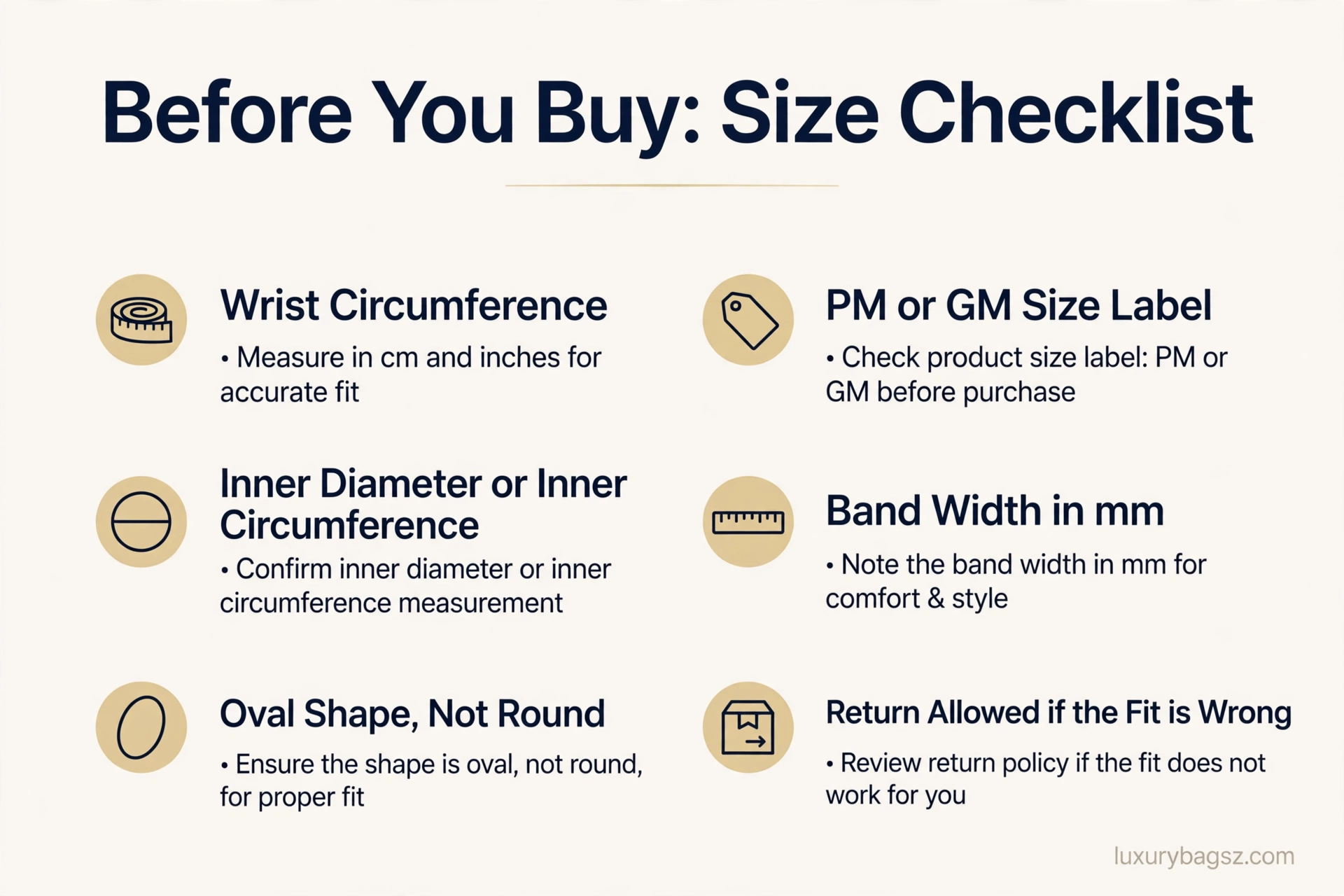
Trying On in Store vs Buying Online
Trying on in a boutique is the best way to choose a size, and it is worth doing even if you plan to buy elsewhere, because five minutes with both sizes on your wrist teaches you more than any table. Use those five minutes deliberately.
Try both sizes, not just the size you expect. Put PM on one wrist and GM on the other, if the shop allows it, and compare them directly. Walk around the shop, bend your wrist, lower your arm, and raise it. Notice which size stays put, which size slides, and which size pinches when you bend. Then try both widths, if both are available, because a PM wide and a PM narrow feel different, as the narrow-versus-wide comparison explains, and the comparison that matters is the combination you will actually buy, not the size label in isolation.
Try the bracelet the way you will wear it. If you wear a watch on that wrist, wear the watch. If you wear the bracelet over a cuff, wear the cuff. If you stack it with another bracelet, bring that bracelet. A fit tested on a bare wrist in a cool shop is a fit tested in conditions you may never wear it in, and the fit rules explain why that matters.
Pay attention to the H, not just the loop. When the bracelet is on, the H should sit on the outside of your wrist, level and centred, and it should stay there as you move. An H that constantly slides to the inside of the wrist is a sign the bracelet is too loose or the wrong shape for your wrist, even if the loop itself feels comfortable. A bracelet that fits the loop but cannot keep its clasp in place is not a good fit.
Buying online cannot replicate that test, but it can come close if you are disciplined. Measure your wrist as the wrist-measuring steps direct, ask the seller for the inner measurement as the pre-owned buying checks direct, compare the two numbers, check the return terms for fit, and, if the seller offers it, ask for a worn photograph on a wrist of a similar size to yours. A worn photograph on a wrist much smaller or larger than yours tells you little, but a worn photograph on a similar wrist, showing how the bracelet sits and where the H lands, is genuinely useful. And if the online price is much lower than the boutique price for the same bracelet, remember that the difference is not only a saving: it is also the loss of the try-on, the return counter, and the staff advice, and that loss has a value you should weigh, not ignore.
Between Sizes, Small Wrists, Large Wrists, and Men’s Sizing
Between sizes is the most common sizing position, and it is not a problem to solve so much as a preference to discover. If your wrist measurement falls between the PM and GM inner measurements, or if different guides put you in different sizes, as the size-conflicts section shows they often will, decide by the fit rules: narrow band, choose by whether you like snug or a little movement; wide band, lean larger; stacking with a watch, lean larger; hot climate or swelling wrists, lean larger; only-just-closes, always go larger. A between-sizes buyer who chooses the smaller size because it feels more secure in the shop often regrets it on the first warm day, while a between-sizes buyer who chooses the larger size rarely regrets the extra movement, because a bangle is supposed to move a little.
Small wrists need a frank word. Buyer reports include wrists as small as 14.5 cm and 12 to 12.5 cm, and the experiences differ: one buyer with very small wrists reported that a PM bracelet dangled and moved up and down a bit but was not too big, while another buyer with a 14.5 cm wrist wondered whether the bracelet was out of the question entirely. Those are individual reports, not rules, and they show the range of preference as much as the range of fit. A small wrist does not rule out a Clic Clac H, but it does mean the bracelet will move more, the H may slide more, and the wide version may look and feel more dominant on the arm. Small-wristed buyers should try PM first, should lean toward narrow if they want the bracelet to stay put, and should be wary of any seller who says a GM will fit a small wrist “because bangles are supposed to be loose”. Loose is a fit preference. Sliding over the hand is a wrong size.
Large wrists have the mirror problem. GM is the larger size, but it is only half a centimetre larger in diameter than PM, so a wrist at the top of the GM range, or beyond it, may find even GM tight. Buyer experience here is consistent: a bracelet that only just closes is too tight, and there is no larger standard Clic Clac H size to step up to. Large-wristed buyers should measure carefully, should ask for the actual inner measurement rather than trusting the GM label, and should consider whether a different Hermès bracelet line with larger sizes fits better, rather than forcing a GM that pinches. Forcing a tight bracelet also risks the hinge and the enamel over time, because a bracelet that is stressed every time it closes is a bracelet being asked to do something it was not sized to do.
Men’s sizing follows the same logic, without a separate men’s range. Guides commonly advise men to take GM, and that advice is reasonable as a starting point, because men’s wrists are on average larger, but it is not a rule. A man with a wrist of 16 cm is a PM buyer by measurement, and a man with a wrist of 19 cm may find even GM tight. Measure the wrist, match the inner measurement, and ignore any guide that sizes by gender instead of by centimetres. The tape measure does not know or care who is wearing the bracelet, and that is its virtue.
Care and Wear That Affect Fit Over Time
A bracelet’s fit on the day you buy it is not necessarily its fit a year later, because wear, care, and your own wrist all change. None of these changes resize the bracelet dramatically, but they change how it feels, and a buyer who understands them will not mistake a care problem for a size problem.
Enamel is hard but brittle. A knock against a table, a door frame, or another bracelet can chip the edge of the enamel, and a chipped edge can feel sharp against the skin and can catch on clothing, which makes a well-fitting bracelet feel uncomfortable. That discomfort is not a size problem, and sizing up will not fix it. Inspect the enamel edges when a bracelet starts to feel uncomfortable, and have chips assessed before they grow, rather than assuming the bracelet has become too tight.
Plating wears, and plating wear changes feel. The metal on a standard Clic Clac H is plated, not solid gold, and plating wears first on the parts that touch skin, clothing, and hard surfaces: the edges of the H, the high points of the frame, and the hinge. Worn plating can feel rougher than new plating, and it can look duller, which some owners mistake for a bracelet that no longer fits them, when the real change is in the surface. Gentle care — a soft dry cloth for dust, a slightly damp soft cloth for light marks, dried immediately, no harsh chemicals, no abrasive cloths, no soaking, and no ultrasonic cleaners — protects plating and enamel alike. Keep the bracelet away from perfume, hairspray, and chlorinated water, and store it separately so it does not knock against other jewellery. Those habits do not change the size, but they preserve the fit and feel you chose.
Your wrist changes, too. Weight change, heat, exercise, and the time of day all move wrist circumference by a few millimetres, and a few millimetres is a noticeable amount on a rigid bangle. A bracelet that feels perfect in winter may feel tight in summer, and a bracelet that feels loose in the morning may feel right by the evening. That is normal, and it is why this guide keeps returning to margin: a bracelet with a little room for a normal day is a better purchase than a bracelet that fits only on a cool morning in a shop. If your wrist size changes permanently, because of a lasting weight change or for another reason, revisit the size rather than forcing a bracelet that no longer fits, because a forced fit damages the bracelet as well as your comfort.
Final Verdict
Buy the size your measurements point to, not the size a guide guesses for you. Measure your wrist properly, in both units, three times, at the place you will wear the bracelet. Ask the seller for the bracelet’s inner measurement and its width in millimetres, and compare like with like: wrist circumference against inner circumference, never against a diameter. Remember that PM and GM are wrist sizes and that width is a separate choice, and refuse any listing or guide that uses one word to answer both questions.
If you are between sizes, let width decide: lean larger in a wide band, and lean larger again if you stack with a watch, wear the bracelet over a sleeve, or know your wrists swell in heat. If a bracelet only just closes, it is too tight, whatever the label says, and there is no virtue in forcing it. If a bracelet slides over your hand, it is too loose, whatever the seller says about bangles being meant to move. And if a listing cannot give you an inner measurement, a width in millimetres, and a clear return policy for fit, it has not given you enough to buy, however attractive the price or the photographs.
The Clic Clac H rewards a careful buyer. It is a bracelet that opens on the wrist, so you are spared the hand measurement that makes solid bangles so hard to size, and its two sizes are close enough together that a careful measurement usually settles the question. Take the two minutes to measure, take the extra minute to ask the seller for the inner figure, and you will almost certainly choose well. The most expensive Clic Clac H is not the one with the highest price; it is the one in the wrong size, sitting in a drawer because it pinches, slides, or spins, and a tape measure is a much cheaper purchase than that mistake.
FAQ
What is the difference between PM and GM on a Clic Clac H, does PM mean narrow, and how does it differ from a Clic H?
PM (Petit Modèle) is the small wrist size and GM (Grand Modèle) is the large wrist size. Hermès describes them by diameter at about 6 cm for PM and about 6.5 cm for GM. They are wrist sizes, not widths. No. That is the most common error in competitor guides. Width — narrow or wide — is separate from wrist size. A bracelet can be PM and wide, or GM and narrow. Always ask for both the wrist size and the width in millimetres. The Clic Clac H is the wider hinged enamel bracelet, while the Clic H is the narrower bracelet in the same family. The narrow version is widely described as about 12 mm wide, and the wide version as about 17 to 20 mm wide, though sources disagree on exact widths by version and era.
How do I measure my wrist for a Clic Clac H, and do I need to measure my hand?
Wrap a soft tape snugly just above the wrist bone, at the place you will wear the bracelet, on the wrist you will wear it on. Read the number in both centimetres and inches, repeat twice more, and take the middle value. Measure again with a watch or sleeve on if you will wear the bracelet that way. No. Hand measurement is for solid bangles that do not open. The Clic Clac H hinges open and closes directly on your wrist, so only your wrist circumference matters. Any guide that tells you to measure your hand for this bracelet is describing a different kind of bracelet.
Why do different guides give different wrist sizes for PM and GM?
Because guides mix diameter and circumference, differ on whether a figure is a maximum or a typical fit, differ by width and era, and copy each other with errors added at each copy. Published wrist figures for GM range from about 6.7 inches to about 7.5 inches across guides, so no single blog table settles your size. Trust Hermès’ diameter figures, your own wrist measurement, and the seller’s inner measurement instead.
Is there a TGM Clic Clac H size, and what if I am between sizes?
Not as a standard size in Hermès’ own description, which gives PM and GM. TGM appears in listings for other bracelet lines and sometimes in Clic H family listings, but a TGM-labelled Clic Clac H needs its measurements stated plainly before you can buy it with confidence. In a narrow band, choose by fit preference: snug if you like it to stay put, larger if you like a little movement. In a wide band, lean larger. If you stack with a watch, wear it over a sleeve, or know your wrists swell in heat, lean larger again. A bracelet that only just closes is too tight, not snug.
Should a Clic Clac H be snug or loose, and does a wide bracelet fit like a narrow one?
Snug enough to stay put and keep the H on the outside of your wrist, without pinching or hurting when you bend your wrist. A little slide is normal for a rigid bangle, but sliding over the hand or spinning so the H ends up inside the wrist means the bracelet is too loose. No. A wide band feels tighter than a narrow band at the same wrist size, because more of the band touches your skin and the band bends less around your wrist. If you are between sizes in a wide band, the larger size is usually the safer choice.
Can I stack a Clic Clac H with a watch?
Yes, but measure with the watch on and lean toward the larger size if you are between sizes. A bracelet worn next to a watch has less room to move and will knock against the watch case, so many owners wear the bracelet on the opposite wrist from the watch, or leave a gap between them.
How much does size affect the price, and what should you ask a seller before buying pre-owned?
Less than width, colour, condition, and version do. At retail, current listings found in this research put the narrow Clic H at $810 and the Clic Clac H at $890 to $960, with larger or special versions higher. In resale, single listings are never market averages, so compare several recent comparable listings for the same width and condition before judging a price. Ask for the wrist size label, the width in millimetres, the inner circumference or inner diameter measured on the actual bracelet, a worn photograph, and the return terms for fit specifically. If the seller cannot give you the inner measurement, you do not have enough to buy safely.