What Is the Hermès Chaîne d’Ancre Bracelet? Link Sizes, Metals and Prices
The Hermès Chaîne d’Ancre bracelet is one of the few pieces of jewellery that most people recognise before they know its name. The same anchor-chain motif is also made as a Chaîne d’Ancre ring, in silver and gold. A row of bold, interlocking oval links, each one crossed by a central bar, closed by a simple T-shaped bar that slides through a ring: that is the whole design, and it has barely changed since 1938.
There is no coloured stone doing the work, no logo plate, no enamel panel. The chain itself is the design, and that is exactly why it has lasted for nearly ninety years while louder jewellery has come and gone.
That simplicity is also why this bracelet is easy to misunderstand. Buyers ask the wrong first questions. They ask what it costs, or whether it is a good investment, before they ask which link size they are looking at, how many links the bracelet has, or whether the clasp they are seeing is the classic toggle at all.
Sellers, meanwhile, describe almost any chunky anchor-style chain as a Chaîne d’Ancre, and resale listings mix together different decades, different link sizes, and different metals under one name, as if they were one product with one price. They are not. A small-link silver bracelet and a large-link 18-karat gold bracelet share a motif and a name, but they are different objects to wear, to clean, and to pay for.
This guide sorts that out. It starts with what the bracelet is and where it came from, separates what is documented about its origin from what is retold as lore, and then works through the details that actually decide whether a given bracelet suits you: how the links are built and how they move, how sizing really works when there is no buckle with holes to adjust.
What the metals and finishes mean in practice, how the Chaîne d’Ancre family differs from the Clic family and from other Hermès bracelets, how it wears alone and stacked, what it costs new against what single resale listings show, what to check before buying pre-owned, and how to clean and store a chain made of many moving links.
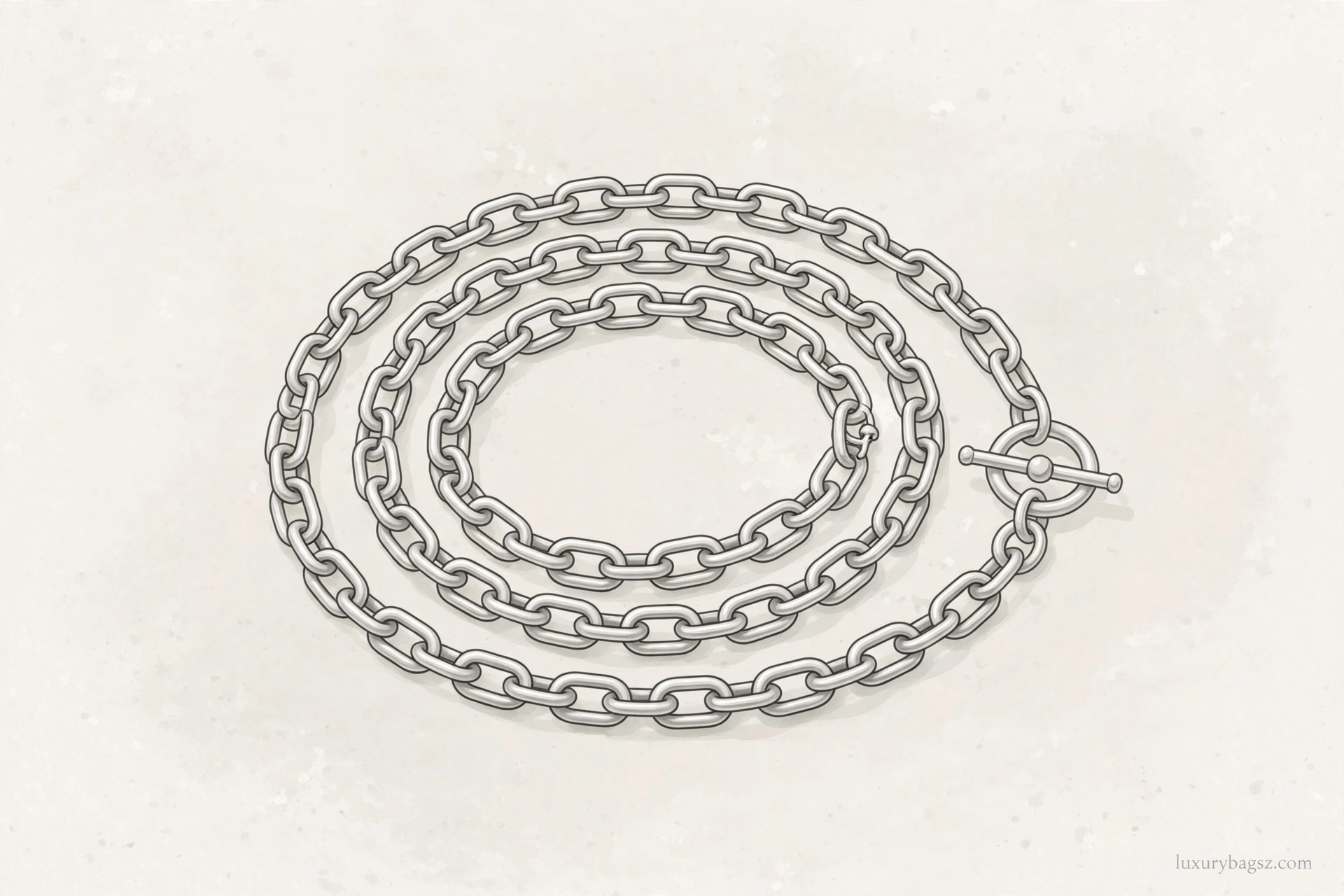
A note on the pictures in this guide, because it matters more here than in most jewellery writing. Every picture here is a generic illustration, not a photograph of a real Hermès bracelet, and none of them should be used as a reference for genuine detail.
Illustrations simplify link shapes: the featured image and the stacking image, for example, show plain oval links without the central bar that defines the classic link, while the labelled diagram in the link-construction section shows the bar correctly. The words of this draft prevail over anything simplified in an image or infographic. Use the pictures to understand what to look at, never as a side-by-side standard for judging a real bracelet.
Key Takeaways
- The Chaîne d’Ancre bracelet dates to 1938, designed by Robert Dumas after anchor chains he saw in a Normandy port. The year and the designer are well documented; the colourful details of the walk, the sketchbook, and the seaside sitting are retold lore, and this guide says plainly which is which.
- The classic link is an oval crossed by a central bar, and the classic closure is a T-bar toggle: a bar that passes through a ring. If a bracelet has plain oval links with no bar, or a lobster clasp, it is a different chain design, not the classic Chaîne d’Ancre.
- Sizing has two dimensions, not one: the size of each link and the total length of the bracelet, usually set by the number of links. A bracelet can be the right length and still look wrong if the link size does not suit your wrist, and a bracelet cannot be adjusted at home by adding or removing a link without a jeweller.
- The core metals are sterling silver, marked 925, and 18-karat gold, marked 750, in yellow, rose, and white gold. Plated finishes are not solid gold, and a gold-coloured bracelet at a silver price is a warning, not a bargain.
- Hermès issues no authenticity card as a general rule. A card supplied with a Chaîne d’Ancre bracelet is a red flag, not reassurance, and the same rule runs through our guides to a fake Evelyne and a fake Kelly.
- The Chaîne d’Ancre is not the Clic family. Clic bracelets are rigid enamel bangles with an H clasp; Chaîne d’Ancre bracelets are flexible metal chains with a toggle. They wear differently, stack differently, and fail differently, and confusing them is the most common beginner mistake after confusing link sizes.
- Prices vary so widely by metal, link size, age, and condition that no single number is a fair guide. One resale listing is one bracelet at one moment, never a market average, and this guide never treats it as one.
- Silver tarnishes, gold does not tarnish the same way, and a chain needs different care from a bangle or a leather strap, because dirt and moisture collect where links meet and rub.
The Anchor Chain in Brief
What is it, in one sentence? The Hermès Chaîne d’Ancre bracelet is a flexible bracelet made from a single row of interlocking oval links, each crossed by a central bar, closed with a T-bar toggle, first made in silver in 1938 and still made today in silver and gold.
What does “Chaîne d’Ancre” mean? It is French for “anchor chain”, and the name is literal: the motif copies the look of the chain that holds a ship’s anchor. That nautical origin is the whole identity of the piece. It is not an equestrian motif, like so much else at Hermès, and it is not a monogram. It is a working object, a ship’s chain, refined into jewellery.
Who is it for? Everyone, in practice. The original 1938 bracelet was made for women, according to Hermès’ own telling, and the motif was later embraced just as strongly by men, which is why you will find the same design described in some guides as a men’s bracelet and in others as a women’s bracelet. Both are right, and neither label should decide your purchase. Link size decides it: smaller links read delicate, larger links read bold, and the same bracelet can look entirely different on two wrists.
What is the fastest way to tell it apart from other chain bracelets? Look for the central bar in each link and the T-bar toggle. A plain curb chain has flat, twisted links. A Figaro chain alternates long and short links. A rope chain twists. The Chaîne d’Ancre link is an oval with a bar across its middle, like the stud-link chain used on ships, where the bar stops the link from collapsing and keeps the chain from kinking. If the bar is missing, you are looking at a different chain, however anchor-like the listing title sounds.
How much should you expect to pay? There is no honest single answer, and any guide that gives you one without naming a metal, a link size, and a condition is guessing. Sterling silver is the entry point, gold costs several times more, and large-link gold bracelets sit in a different price world from small-link silver ones. The prices section gives real listing examples with their limits stated, rather than a made-up average.
Is it a good investment? Buy it because you want to wear a chain bracelet for decades, not because a seller promises appreciation. Vintage large-link gold examples have sold strongly, and silver examples hold up reasonably for jewellery, but no bracelet is a guaranteed investment, and condition, completeness, and the exact model matter far more than the name on the listing. Anyone who quotes you a return figure for “a Chaîne d’Ancre” without naming the model is selling, not advising.
What is the one mistake to avoid first? Buying by length alone. Two bracelets can both measure 19 centimetres and feel completely different, because one has many small links that drape and one has few large links that stand away from the wrist. Always ask for the link size or model name and the link count alongside the length, and read the sizes section before you pay.
What the Bracelet Is, and What It Is Not
Strip away the marketing and the Chaîne d’Ancre bracelet is a chain, a clasp, and nothing else. There is no leather, no enamel, no stone in the classic model, though later variations add diamonds, mix metals, and multiply rows.
The classic bracelet is a single strand of metal links that wraps the wrist once and closes with a toggle. That is the whole object, and its quality lives entirely in the execution: the uniformity of the links, the smoothness of their finish, the weight of the metal, and the way the finished chain moves.
The movement is the part that photographs cannot show and that first-time buyers most often miss. A good Chaîne d’Ancre chain articulates freely: each link swings against its neighbours, the chain drapes over the wrist bone instead of holding a stiff curve, and it settles with a soft metallic sound when you move your wrist.
Sellers sometimes describe this as the chain “singing”, and buyers who love the bracelet often mention the sound and the weight before they mention the look. A stiff chain, a chain that kinks instead of draping, or a chain whose links catch and grind against each other is either damaged, poorly made, or a different construction wearing the name.
Weight is the other quality that photographs hide. Genuine Chaîne d’Ancre bracelets are noticeably heavy for their size, because the links are solid metal rather than hollow tubes. One resale valuation for a medium-model silver bracelet recorded a total weight of 62.2 grams, which is the weight of a substantial piece of jewellery, not a light fashion chain.
That figure is a single listing, not a standard, and weight varies with link size and length, but the direction is reliable: if a bracelet that looks like a medium or large Chaîne d’Ancre feels light in the hand, something is wrong, and you should check the metal and the construction before you check anything else.
What the bracelet is not matters just as much. It is not a bangle: it has no fixed shape, and it will not hold a circle when you take it off. It is not a watch strap, though the same link has been used on Hermès watch bracelets, including vintage Chaîne d’Ancre bracelet watches from the 1960s. It is not a Clic bracelet, though both are Hermès bracelets and both are often sold side by side.
And it is not a generic anchor chain: many jewellers make anchor-style chains, and the motif itself has been so widely copied that Hermès went to court in France to defend it, with the Court of Appeal confirming in 2022 that the design is protected by copyright. A chain can look like an anchor chain without being a Hermès Chaîne d’Ancre, and the difference lives in the details covered in the pre-owned checks section.
The house behind the bracelet is the same house whose leather goods dominate its reputation, and the same insistence on handwork runs through both. Our guide to Hermès leather sets out where the house’s leather comes from and why its sourcing is so closely guarded; the jewellery workshops apply the same logic to metal, with pieces finished by hand and marked accordingly.
You do not need to care about bags to care about this bracelet, but understanding that Hermès treats a chain link with the same seriousness it treats a bag handle explains why the bracelet costs what it costs and why cheap copies feel different in the hand.
The Origin Story: What Is Documented, and What Is Lore
The origin story of the Chaîne d’Ancre is one of the best-known tales in jewellery, and it is also a good lesson in how a true story gathers decoration every time it is retold. The core facts are stable across reliable sources, including Hermès’ own telling, auction-house catalogue notes, and press coverage of the copyright case. The decorations vary, and some of them contradict each other. This part separates the two.
What is documented is this. In 1938, Robert Dumas designed a bracelet inspired by a ship’s anchor chain he had seen in a Normandy port, and Hermès launched it in silver, where it met with immediate success. Dumas was the first person from outside the Hermès family to join the house’s design ranks — he had married into the family — and he was already the designer behind the Sac à dépêches, the bag later known as the Kelly, and behind the horse-and-carriage emblem. The bracelet was the house’s move into a new territory: jewellery built from an everyday working object, made modern by simplifying it rather than decorating it. Sotheby’s catalogue notes, Hermès’ own history pages, and the French court reporting all agree on the year, the designer, and the anchor-chain inspiration.
What is lore, or at least what no single source can confirm, is everything around that core. Some retellings place Dumas on a yacht cruise off the Normandy coast, others on a walk along the harbour walkways. Some give him a sketchbook in hand on the docks, drawing the chain then and there. Some name a metalworker, Dr Perçin, who helped him realise the design in silver after jewellers who preferred gold and platinum resisted it.
Some say the bracelet was designed for a woman’s wrist from the start, others describe it as a men’s design that women later adopted. One auction listing even dates the first sketch to 1937, a year before the bracelet’s launch, which may simply reflect the difference between a sketch and a launch, or may be a seller’s rounding.
None of these details change what the bracelet is, but they should change how you read guides that present them as certain fact. When a guide tells you the name of the boat, the weather, or the exact dock, it is storytelling, not history, and a guide that cannot tell the difference will not be reliable on the details that cost you money either.
Two further points in the story deserve plain statement because competitors often blur them. First, the 1938 bracelet was a bracelet, not a whole collection. Rings, necklaces, earrings, cufflinks, and later the watch bracelets came afterwards, through the 1950s and 1960s and onward, as the motif spread across the house’s jewellery and then into scarves, tableware, and bag hardware.
A seller who dates a Chaîne d’Ancre ring to 1938 is dating the motif, not the object. Second, the motif’s long life is not the same as unchanging production. Link proportions, clasp details, hallmarks, and the workshops used have all changed across nine decades, which is why vintage pieces need the era-aware checking in the pre-owned checks section rather than a single checklist applied blindly to every decade.
There is one more piece of documented history that buyers rarely hear and should. In 2017 Hermès sued a French business selling copies of its anchor-chain jewellery, and in January 2022 the Court of Appeal confirmed the design’s originality and copyright protection, with rights running until 2049 on the court’s reckoning. The practical meaning for a buyer is simple: the copies flooding the market are not a grey area or a tribute. They are copies of a protected design, and the better they look in photographs, the more carefully you need to check the metal, the weight, and the marks in the pre-owned checks section.
How the Links Are Built, and How the Chain Moves
The Chaîne d’Ancre link is best understood by comparing it with the ship’s chain it copies. A ship’s anchor chain uses stud links: oval links with a bar, the stud, fixed across the middle. The stud stops the link from deforming under load, keeps neighbouring links from collapsing into each other, and helps the chain run cleanly. Dumas took that working shape, slimmed it, smoothed it, and turned it into jewellery. The result is a link that is recognisably nautical without looking industrial: an oval frame, a central bar, and a polished surface that catches light along the curve.
Each link in the bracelet is interlocked with its neighbours at right angles, so that one link lies flat while the next stands upright, alternating all the way along the chain. That alternation is what gives the bracelet its articulation. Because each link can pivot where it passes through the next, the chain bends in every direction instead of only one, which is why it drapes around a wrist bone rather than bridging over it like a stiff bangle. It is also why the bracelet feels alive on the wrist: the links shift as you move, and the chain resettles each time you move your arm. When you try one on, flex it in your hand first. A genuine chain folds softly in any direction and springs back without kinking. A chain that resists bending in one direction, or that holds a bend after you release it, has a damaged or deformed link, or is not built this way at all.
The toggle closure deserves the same attention as the links, because it is both the most distinctive part of the bracelet and the part most often got wrong by copies. The classic closure is a T-bar: a straight bar attached to one end of the chain, which you pass through a ring on the other end, where it turns sideways and holds. There is no spring, no snap, and no small moving part to wear out, which is one reason the design has lasted. The bar itself is often engraved, and on genuine pieces the engraving, the proportions of the bar, and the size of the ring are consistent with the link size: a large-link bracelet has a substantial bar, a small-link bracelet a finer one. A toggle that feels loose in its ring, a bar that slides back out too easily, or a ring that has been bent out of round are all reasons to have the bracelet checked before you buy, because a toggle failure means a lost bracelet, not just an annoyance.
The finish of the links is the last construction detail to learn before you shop. Classic Chaîne d’Ancre links are polished smooth, with no visible seam where the link was closed, and edges that feel rounded rather than sharp. Run a fingertip slowly along the inside of the chain, where it touches your skin: a genuine bracelet feels smooth throughout, with no rough spot, burr, or sharp edge catching your skin. Copies most often fail here, because polishing the inside of every link by hand is slow and expensive, and a maker cutting corners will polish the outside that photographs well and leave the inside rough. The same test applies to the toggle bar and ring. If any part of the bracelet scratches your skin when you run it gently across the inside of your forearm, do not buy it until a jeweller has explained why.
One caution about the pictures again: the labelled diagram in this guide shows the link and toggle shapes correctly, but it is a diagram, not a measurement drawing. Link proportions vary by model and by era, and a real bracelet’s bar may sit slightly differently from the diagram’s. Judge a real bracelet by the principles in this part — oval link, central bar, alternating interlock, smooth finish, firm toggle — not by matching it line for line to an illustration.


Sizes and Lengths: Two Numbers, Not One
If there is one part of this guide that will save you a return, it is this one. Chaîne d’Ancre sizing confuses buyers because it has two dimensions that sellers often collapse into one number, and because different sellers use different naming for the same idea.
The first dimension is link size: how big each individual link is. Sources broadly agree that the classic chain comes in small, medium, and large link sizes, sometimes labelled with the French model names Petit Modèle (PM), Grand Modèle (GM), and Très Grand Modèle (TGM), and sometimes simply small, medium, and large. Some guides describe five link sizes across the wider family, because the Enchaînée and Farandole variations add finer options, but for the classic single-row bracelet, small, medium, and large are the working categories. The confusion starts when a listing says only “GM” or only “medium” without saying whether it means the link size or the bracelet length, and when a seller uses PM and GM the way other Hermès lines use them for overall size. Always ask which dimension a label refers to.
The second dimension is bracelet length, which on a chain bracelet is set by the number of links. Unlike a leather strap with holes, or a bangle made in three wrist sizes, a Chaîne d’Ancre bracelet cannot be shortened by a notch. Its length is fixed when it is made, and changing it means a jeweller opening and reclosing links, which is work you should not need on a new purchase and should think twice about on a pre-owned one. Sellers therefore describe length in different ways: total length in centimetres or inches, inside circumference, wrist size the bracelet is said to fit, or link count. A single resale valuation for a medium-model silver bracelet gave an inside circumference of 7.5 inches and a width of 1.25 inches, while a medium Enchaînée model in another listing measured 6.25 inches inside with a width of 0.25 inches. Those two bracelets are both called medium, and they are plainly not the same size in any dimension that matters to your wrist. Treat every such figure as a description of one bracelet, not a definition of “medium”.
The sizes infographic in this guide shows small, medium, and large links with approximate widths to help you picture the difference. Those widths are illustrative only, not official Hermès measurements, and the draft prevails over them: what matters is the relative difference and the fit method, not the millimetres printed on a graphic. Do not buy or reject a bracelet because its measured width differs by a millimetre or two from an illustration.
How to choose, then, in practice. First, measure your wrist snugly with a tape measure at the wrist bone, where the bracelet will sit. Second, add ease: most wearers want roughly a finger’s width of movement, enough for the chain to drape and slide slightly without spinning freely around the hand. A bracelet that fits exactly at your wrist measurement will feel tight once the links settle, because a chain needs room to articulate. Third, decide link size by the look you want and the weight you will tolerate: small links are lighter, quieter, and easier to stack; large links are heavier, louder, and dominate the wrist. Fourth, when buying pre-owned, ask for the total length, the link count, and the link size or model name, all three, and compare the total length against your wrist measurement plus ease. If a seller can give you only one of the three, you do not yet have enough to buy with confidence.
A final sizing trap: the toggle itself adds length and changes how a bracelet fits. A bracelet measured end to end including the toggle will sit differently from one measured as chain only, and a toggle that sits on top of the wrist, which some wearers prefer as a feature, effectively shortens the draping length. When a seller gives you a measurement, ask whether the toggle is included. It is a small question that prevents a common disappointment.

Materials and Finishes: Silver, Gold and the In-Between
The classic Chaîne d’Ancre bracelet is made in two core metals, and almost every pricing and care question follows from which one you are holding.
Sterling silver is the original metal and still the entry point. Sterling silver is 92.5 percent silver and 7.5 percent other metal, usually copper, which is why it is stamped 925. It has a cool, bright shine, it is substantially cheaper than gold, and it is the metal most first-time buyers choose. Its drawback is tarnish: silver reacts with sulphur compounds in the air and in sweat, forming a dark layer that dulls the shine over time. Tarnish is normal, it is not damage, and it is reversible with the care in the care and cleaning section, but a silver bracelet that is never polished will gradually look grey rather than bright, and the change happens fastest in the crevices where links meet.
Gold in the Chaîne d’Ancre line means 18-karat gold, stamped 750, meaning 75 percent pure gold with the remainder made up of other metals that set the colour. Yellow gold is the classic gold colour, rose gold gets its pink warmth from a higher copper share in the alloy, and white gold is alloyed and usually coated to give a cool, silvery colour. Gold does not tarnish the way silver does, it is heavier and more expensive, and it holds its colour with less maintenance, though it still scratches and still needs cleaning. Diamond-set versions exist, including contour models that curve the chain, and they sit in a higher price band again, because you are paying for stones and setting work as well as metal.
The materials infographic in this guide summarises silver 925 and gold 750 side by side, with the warning that plated is not solid gold. Its alloy breakdowns are simplified: the draft prevails on the exact point, which is that 750 guarantees 75 percent gold and 925 guarantees 92.5 percent silver, while the remaining share varies by colour and by maker. Do not use the infographic’s alloy percentages to judge a real bracelet.
Now the warning that matters most in this part. Plated finishes are not solid gold, and gold-coloured is not a metal at all. A plated bracelet is a base metal, often brass or a silver-coloured alloy, coated with a thin layer of gold. It can look convincing in photographs, it can even be stamped with confusing marks, and it will wear through with time, especially on a chain where links rub against each other constantly. A gold-coloured Chaîne d’Ancre bracelet offered near a silver price, or a “gold” bracelet with no 750 mark and no credible provenance, should be treated as plated or imitation until proven otherwise. The same applies to gold-tone fashion copies, which are costume jewellery wearing a luxury name in the listing title. If a seller cannot state the metal plainly, in the form “sterling silver 925” or “18-karat gold 750”, and show the corresponding mark, do not pay a solid-metal price.
Two further finishes appear in the wider family and are worth knowing so they do not confuse you. Two-tone models mix silver and gold links or combine a silver chain with a gold toggle, and blackened or darkened silver models deliberately darken the metal for contrast. Neither is a defect, but both should be described as such in the listing, and a darkened silver bracelet should not be sold to you as tarnished silver that “just needs a polish”, because polishing a deliberately darkened finish can ruin it. When in doubt about a finish, ask the seller to state it in writing before you pay.

The Wider Family, and How It Differs from the Clic Family
The Chaîne d’Ancre name covers a family, not a single bracelet, and competitors’ guides usually list the family without explaining how the members differ in wear. That is a gap worth closing, because buying the wrong family member is a more expensive mistake than buying the wrong colour.
The classic single-row bracelet is the starting point: one row of oval links with central bars, toggle closure, in silver or gold, in small, medium, or large links. Everything else is a variation on that row.
The Chaîne d’Ancre Enchaînée, whose name suggests links chained together, uses finer, more closely linked rows that read as a more delicate, almost textile chain. One resale valuation for a medium Enchaînée silver bracelet gave an inside circumference of 6.25 inches and a width of only 0.25 inches, against the 1.25-inch width of a medium classic model in another listing. Those figures are single listings, not standards, but they show the direction: Enchaînée is the finer, narrower interpretation, and it suits wearers who want the motif without the boldness of the classic large link.
The Farandole is a related but distinct line that reinterprets the anchor motif with a lighter, more rhythmic arrangement of links, often in silver, and often described as the more feminine and more accessible branch of the family. It also uses a toggle closure, a bar through a ring, which is why it is so often confused with the classic bracelet. The practical difference is feel: Farandole chains tend to be lighter and more fluid, and their pricing generally sits below the classic line in the same metal, though that is a tendency across listings, not a rule for any single bracelet.
Later reinterpretations multiply the motif further: multi-row chains that layer several strands into one bracelet, contour models that curve the chain, mixed-metal models that alternate silver and gold, and diamond-set models that add stones along the links. In recent years the house’s jewellery direction has also stretched the link itself, multiplying it into dense rows and elongated forms, under the same anchor-chain idea. These are legitimate parts of the family, but they are not the 1938 bracelet, and a listing that calls a multi-row diamond piece simply “a Chaîne d’Ancre” without naming the variation has not told you what you are buying.
The motif also escapes jewellery entirely, which is part of its fame. It appears as a pattern on silk scarves, as hardware on bags, and as a design on tableware, and the same anchor-chain idea turns up on a scarf ring and in the printed pattern of a silk square. If you pair the bracelet with silk, the way a twilly on a bag handle repeats a motif across an outfit shows how Hermès expects its patterns to echo rather than match exactly. That echo is a styling opportunity, not a reason to buy matching pieces: a chain bracelet and a chain-printed scarf worn together can easily become too much of one idea.
Against all of that, the Clic family is a different world. Clic bracelets are rigid enamel bangles: a stiff oval band, faced with coloured enamel, closed with an H-shaped clasp. They do not drape, they do not articulate link by link, they slide over the hand rather than fastening around the wrist, and they are sized by hand size rather than by link count. They are also far more colour-driven: the same Clic shape comes in dozens of enamel colours, while a Chaîne d’Ancre bracelet’s colour is its metal. A buyer who wants a flexible, weighty metal chain and buys a Clic by mistake, or the reverse, has not made a small error. They have bought a different kind of object. Keep the two families apart in your mind from the start, and be wary of any listing or guide that treats “Hermès bracelet” as one category with one set of advice.
Other Hermès bracelets sit nearby and are worth a sentence each so they do not blur into the picture. The Collier de Chien bracelet, adapted from a dog collar in 1949, is a leather or metal band with pyramid studs and a central ring, closed with a turn-lock: bold, but rigid and studded, nothing like a chain. The Kelly bracelet is a leather strap with a padlock-style closure, closer to a watch strap than to a chain. The Nantucket watch takes its case shape from a Chaîne d’Ancre link, a rectangle within a rectangle, which shows how far the motif travels without being a bracelet at all. Knowing these neighbours helps you recognise when a listing has borrowed the Chaîne d’Ancre name for a bracelet that belongs to another family.
How It Wears, and How to Stack It
A Chaîne d’Ancre bracelet wears differently from almost any other bracelet you own, and the difference is worth trying before you buy, because it decides whether you will actually reach for it daily.
On its own, the bracelet sits as a single strong line across the wrist. Small links read as a refined chain, the kind of piece that works with a shirt cuff and does not fight a watch. Medium links are the versatile middle: visible without dominating, heavy enough to feel present, light enough for all-day wear. Large links are a statement: they catch light with every movement, they make a sound you can hear in a quiet room, and they will dominate a slim wrist and balance a larger one. There is no universally right link size, only a right one for your wrist, your wardrobe, and your tolerance for weight and sound. If you work at a keyboard all day, try the bracelet at a desk before you commit: a large-link chain can clatter against a desk and a laptop edge in a way that a small-link chain does not, and some wearers love that presence while others find it distracting within a week.
The toggle placement is a styling choice most guides never mention. Most wearers let the toggle fall to the underside of the wrist, where it sits flat and unobtrusive. Some wearers deliberately turn the toggle to the top of the wrist, where the bar becomes a feature, a small piece of hardware displayed rather than hidden. Both are fine, and the same bracelet can be worn either way on different days, but the choice changes the fit slightly, because a toggle sitting on top of the wrist bone takes up room that the chain would otherwise use to drape. If you try a bracelet on and it feels tight with the toggle on top, try it with the toggle underneath before you decide it is the wrong length.
Stacking is where the Chaîne d’Ancre earns its reputation as a collection piece, and where most styling mistakes happen. The chain stacks well with one slim, plain piece: a thin bangle, a fine chain, or a simple leather wrap that does not compete with the links. It stacks badly with another bold chain, with a wide cuff, or with a watch that has a heavy bracelet of its own, because two strong metal pieces on one wrist rub, scratch, and tangle. The rule is one hero per wrist. If the Chaîne d’Ancre is the hero, everything else on that wrist should be quiet. If you wear a watch on the same wrist, wear the chain on the other wrist, or accept that the chain will mark the watch case over time.
Mixed metals in a stack deserve a plain word. Silver and gold can be mixed successfully, and many wearers do it deliberately, but a silver Chaîne d’Ancre stacked tightly against a gold bracelet will transfer marks over time, because the harder metal wears the softer one where they rub. Keep a little space between different metals, or accept the wear as part of the bracelet’s life. The same applies to stacking two Chaîne d’Ancre bracelets in different link sizes, which some collectors love: it looks wonderful, and it will wear both bracelets faster than wearing either alone. That is a fair trade if you know you are making it, and a nasty surprise if you do not.
For formal wear, the small-link silver or gold bracelet is the safest choice: it reads as jewellery without shouting, it sits under a cuff without bulk, and it does not compete with cufflinks or a dress watch. For casual wear, the medium link in silver is the workhorse: it goes with denim, linen, and knitwear, it improves with a little patina, and it does not demand a formal outfit to justify itself. For evening wear, the large link, or a diamond-set variation, does the work of a statement piece on its own, and needs nothing else on the wrist. Whatever you choose, wear the bracelet for a full day before you decide it is comfortable: a chain that feels fine for ten minutes in a shop can feel heavy after eight hours, and weight is the one quality you cannot judge from a photograph.

Prices: Retail Against Resale, and Why Single Listings Mislead
No part of this topic is more misreported than price, so this part states its limits before its numbers. Hermès does not publish a single stable price list that this guide can quote as current, prices vary by market, metal, link size, and year, and resale listings vary by condition, completeness, and seller. Everything below is therefore examples with their context, not a price guide, and any guide that gives you a single “average price” for a Chaîne d’Ancre bracelet without naming metal, link size, and condition is inventing a number.
Start with the shape of the market rather than a figure. Silver is the entry point and gold costs several times more, because the metal itself costs more and the bracelet contains a substantial weight of it. Large links cost more than small links in the same metal, because they contain more metal. Diamond-set and multi-row models cost more again. Vintage large-link gold models from the 1960s and 1970s are often described by resellers as among the most sought-after pieces in Hermès jewellery, and they command strong prices when they are in excellent condition with their original presentation. None of that translates into a single figure, and a buyer who anchors on one number will overpay for one bracelet and miss another.
Now the examples, each with its limits. A resale valuation for a medium-model sterling silver Chaîne d’Ancre bracelet recorded an estimated retail figure of 1,875 dollars, for a bracelet weighing 62.2 grams with an inside circumference of 7.5 inches. That is one bracelet, valued at one moment, and the estimated retail figure is the valuer’s estimate, not a boutique price. A second example: a rose gold and diamond contour bracelet in size SH was listed by a reseller at 2,995 dollars against a stated retail price of 4,675 dollars, described as like new. That is also one bracelet, and the saving is that bracelet’s story, not a discount you can expect on any other. A third kind of example: marketplace aggregates that mix every Chaîne d’Ancre bracelet ever listed, from small silver chains to large gold and diamond pieces, show ranges from a few hundred dollars to tens of thousands, with averages in the low thousands. Those aggregates are nearly useless for pricing a specific bracelet, because they average objects that have almost nothing in common except a name, and this guide does not quote them as a price for anything.
What, then, should you actually do with prices? First, fix the exact bracelet: metal, link size, variation name, and condition. Second, find several recent listings for that exact combination, not for the name in general, and look at the spread, not the average. Third, treat a price far below the spread for that combination as a warning, not a bargain, and ask why: is the metal plated, is the bracelet damaged, is the seller new, is the listing using stock photographs? Fourth, remember that completeness matters: an original box and pouch add value and confidence, but they do not prove authenticity on their own, and their absence does not prove a bracelet fake. Fifth, budget for the costs after purchase: a jeweller’s check, a professional clean, and, for a toggle repair, workshop time. A bracelet that is cheap because its toggle is worn is not cheap once it has been repaired properly.
One more pricing trap deserves a plain sentence. Some sellers quote a “retail price” that is not a current boutique price but a figure carried over from an old listing, a different market, or a different model. If a listing’s retail figure cannot be tied to the same metal, link size, and variation as the bracelet being sold, ignore it and price the bracelet on comparable sold listings for the same combination instead.
What to Check When Buying Pre-Owned
Buying a Chaîne d’Ancre bracelet pre-owned is the sensible way to find discontinued variations and vintage gold, and it is also where most costly mistakes happen. The checks below are ordered by what you can do before you pay, and they are written for a buyer, not a professional authenticator. No checklist in any guide can give you certainty on a high-grade counterfeit. What a checklist can do is filter out the large majority of bad bracelets and tell you when to pay for a professional opinion.
First, ask for the facts in writing: metal stated as sterling silver 925 or 18-karat gold 750, link size or model name, total length, link count, weight in grams, and photographs of the toggle, the links from both sides, and any marks. A seller who cannot give you those basics has not given you enough to buy, however good the first photograph looks. Compare the weight against the link size: a medium or large bracelet that weighs very little for its size is a warning, because genuine links are solid and heavy, while copies are often hollow or made from lighter alloys.
Second, examine the marks, and know what they can and cannot prove. Genuine pieces carry the Hermès name, with the accent on the second e, alongside the metal fineness mark, 925 for silver or 750 for gold, and often French assay marks and a maker’s mark on older pieces, with the maker’s mark of Georges L’Enfant appearing on some vintage gold examples. The placement, depth, and lettering of these marks matter, and copies routinely get the accent, the spacing, or the mark format wrong. But marks alone prove nothing, because marks are copied too. A correct-looking mark raises confidence; it never closes the case, and a missing or worn mark on a genuinely old bracelet does not automatically condemn it, because decades of wear soften engraving.
Third, run the hand and eye tests from the link-construction section: links uniform in size and shape, edges smooth with no burr or sharp spot, chain articulating freely in every direction without kinking, toggle closing firmly with the bar sitting securely in its ring. Look at the links where they meet: genuine links show even wear from decades of movement, while copies often show uneven casting, visible seams, or a rough interior. Listen, if you can hold the bracelet: a genuine chain has a soft, even metallic sound, not a dull thud or a harsh rattle.
Fourth, apply the card rule without exception. Hermès issues no authenticity card as a general rule, so a card, a certificate, or a code to check online, supplied with a Chaîne d’Ancre bracelet, is a red flag, not reassurance. The same rule is central to our guides to a fake silk scarf and to a fake Evelyne, and it applies here with the same force. A box and pouch are nice to have and add value, but they are also bought separately and borrowed from other purchases, so judge the bracelet, not the packaging. A receipt photograph proves that someone once bought something, not that this bracelet is the thing they bought.
Fifth, check the story against the object. A bracelet described as a 1960s large-link gold model should show the weight, the link proportions, and the marks consistent with that era, not the finer proportions of a modern small-link model. A bracelet described as unworn should show no wear where links meet. A bracelet described as a rare variation should be named as that variation, with the features that make it rare stated plainly. Vague stories — “from an estate”, “bought in Paris”, “guaranteed genuine” — are not evidence, and a seller who leans on a story instead of photographs and measurements is telling you where their confidence actually comes from.
Sixth, protect the payment. Buy through a platform or seller that offers returns and buyer protection, pay by a method that preserves that protection, and keep the right to return the bracelet if a reputable authenticator disagrees with the seller’s description. If the price is high, the seller is unknown to you, or anything still feels slightly off after the checks above, pay for professional authentication before the return window closes, not after. A seller who discourages independent authentication, or who will not accept a return on an authenticator’s disagreement, has given you an answer about the bracelet, whether they meant to or not.
Finally, know when to walk away without further argument. Walk away when several checks fail at once, when the seller refuses the photographs and measurements above, when the metal cannot be stated plainly, when a card is offered as proof, when the price is far below the spread for that exact combination with no credible explanation, or when you are pressed to pay quickly, off-platform, or by a method with no protection. Any one of those is a reason to pause. Two together are a reason to stop.

Care and Cleaning: Keeping a Chain of Many Links Alive
A chain bracelet needs different care from a bangle or a leather strap, because it has dozens of moving joints where dirt, moisture, and skin products collect, and because every link rubs against its neighbours every time you move. The good news is that the care is simple, and most of it is about what you avoid rather than what you do.
Start with daily habits. Put the bracelet on last, after perfume, lotion, and hair products have dried, and take it off first when you come home. Perfume and lotion do not ruin metal in a day, but they build up in the joints of a chain faster than on a smooth bangle, and they accelerate tarnish on silver. Remove the bracelet before swimming, bathing, exercising, and cleaning: chlorine attacks gold alloys and speeds silver tarnish, salt water dulls metal and drives tarnish into the joints, and household cleaners are harsher than most wearers expect. Remove it before sleeping too, not because it will break overnight, but because a chain caught in bedding can kink a link, and a kinked link is the beginning of a weak point.
Cleaning silver is straightforward. Wipe the bracelet after wear with a soft, dry cloth to remove sweat and products. For tarnish, polish gently with a silver polishing cloth, working along the links rather than scrubbing across them, and use a soft brush, such as a soft toothbrush, with mild soap and lukewarm water for dirt caught where links meet, drying the bracelet thoroughly afterwards. Dry it properly: moisture left in the joints is what tarnishes a chain from the inside out. Avoid abrasive polishes, avoid harsh chemical dips unless a professional advises them for your specific bracelet, and never use a silver dip on a bracelet with stones or a deliberately darkened finish without checking first, because dips and darkened finishes do not mix. Some guides recommend toothpaste or baking-soda pastes for silver; this guide does not, because abrasive pastes wear the surface of the links a little every time, and on a chain whose value lives in its polished finish, that wear adds up.
Cleaning gold is simpler. Wipe with a soft cloth, wash occasionally in mild soap and lukewarm water with a soft brush for the joints, rinse, and dry thoroughly. Gold does not tarnish like silver, so you are removing dirt and product build-up rather than fighting oxidation, but the joints still need the brush, because a gold chain that looks clean from above can hold a surprising amount of dirt where links meet. For diamond-set models, add a professional inspection every six to twelve months, because a chain flexes constantly and a loosened stone on a moving chain is lost faster than a loosened stone on a ring.
Storage matters more for a chain than for most jewellery. Store the bracelet flat or loosely coiled in its own pouch, on its own, not tangled with other jewellery. Chains tangle, and untangling a chain by pulling on it is how links get bent. Keep it away from other metal pieces, because harder metals scratch softer ones where they rub in a drawer. For silver, an airtight pouch or an anti-tarnish strip in the box slows tarnish noticeably, and wearing the bracelet regularly also slows tarnish, because skin contact polishes the surface lightly. The same keep-it-separate rule applies across a collection: when you clean a canvas bag, you keep brushes and products away from the fabric for the same reason you keep a chain away from other jewellery, because one careless contact marks a surface that is hard to restore.
Repairs deserve a plain word. A stretched link, a bent toggle ring, a worn toggle bar, or a link that has gone stiff are all jobs for a jeweller experienced with fine chains, not for pliers at home. Opening a link badly weakens it, and a chain repaired badly is weaker than a chain left alone until it can be repaired properly. Hermès workshops can service their own pieces, and a reputable independent jeweller can handle straightforward link and toggle work, but ask what the repair will do to the marks and the finish before you authorise it, and keep the repair record with the bracelet, because a well-documented repair is part of the bracelet’s history, not a flaw to hide.
The Mistakes That Cost Money
Competitors’ guides to the Chaîne d’Ancre tend to share the same shape: a short history paragraph, a list of materials, a price range, and a styling note, with the same gaps in every one. This guide has tried to close the gaps that actually cost buyers money, and it is worth naming them plainly so you can spot them in the next guide you read.
The first gap is the origin story told as fact. Most guides repeat the Normandy walk, the sketchbook, and the seaside sitting as if they were documented, without saying that the documented core is the year, the designer, and the anchor-chain inspiration, and that the rest is retelling. A guide that cannot separate history from lore will not separate a genuine mark from a copied one either.
The second gap is sizing treated as one number. Most guides give you a length, or a model name, and stop there, without explaining that link size and total length are separate decisions, that the toggle changes the fit, and that two bracelets both called medium can measure very differently. That gap is why so many buyers receive a bracelet that is technically their wrist size and still looks and feels wrong.
The third gap is articulation. Almost no competitor guide tells you to flex the chain in your hand, to check that it bends in every direction without kinking, or to run a fingertip along the inside of the links for burrs. Yet those are the tests that separate a well-made chain from a copy, and they cost nothing and need no equipment.
The fourth gap is the card rule stated without its reason. Guides that say “check for the authenticity card” have it backwards: Hermès issues no authenticity card as a general rule, so the presence of a card is the warning. A guide that tells you to look for a card is actively making you easier to fool.
The fifth gap is price presented as an average. Guides that quote a single average across silver and gold, small and large links, new and vintage, are averaging objects that should never be averaged. A price is only meaningful for an exact combination, and a single listing is only evidence about one bracelet.
The sixth gap is care written for a bangle, not a chain. Guides that tell you to polish a bracelet without mentioning the joints, the toggle, the storage problem of tangling, or the difference between silver tarnish and a deliberately darkened finish are giving you advice that will, at best, leave your bracelet dirty where it matters, and at worst damage a finish that should never have been polished.
Avoid those six gaps, and you will buy better than most guides teach you to. Buy the link size that suits your wrist, not the model name that sounds impressive. Buy the metal you can maintain, not the metal that photographs best. Ask for weight, link count, and toggle photographs before you pay. And buy from a seller who welcomes those questions, because a seller who welcomes hard questions about a chain is usually selling a chain that survives them.
Final Verdict
The Hermès Chaîne d’Ancre bracelet has lasted since 1938 for a reason that has nothing to do with fashion cycles: it is a working shape, a ship’s chain, made beautiful by simplification rather than decoration, and it still does its job — a flexible, weighty, honest piece of metal jewellery — as well as it did on the day it launched. That is a rare claim, and it is why the bracelet survives both trends and copies.
Buy it if you want a chain bracelet you will wear for decades, if you like weight and movement on the wrist, and if you are willing to choose carefully between link sizes and metals rather than buying the first listing with the right name. Start with silver in a medium link if you are unsure, because it is the most forgiving combination of price, weight, and versatility, and move to gold or to a larger link once you know how a chain feels after a full day on your wrist. Buy pre-owned with the checks in the pre-owned checks section, buy new when you want a known history and a known fit, and in either case buy from a seller who answers hard questions with measurements and photographs, not stories.
Do not buy it as a guaranteed investment, do not buy it by length alone, do not buy it because a card came in the box, and do not buy a gold-coloured bracelet at a silver price and hope the metal sorts itself out. The bracelet rewards a careful buyer and punishes a hurried one, and the difference between those two buyers is rarely money. It is usually ten minutes of checking, a tape measure, and the willingness to walk away from a listing that will not answer a straight question. Give it those ten minutes, and the anchor chain that caught Robert Dumas’s eye in a Normandy port in 1938 can sit on your wrist for the next ninety years, still articulating, still catching light, still unmistakably itself.
Frequently Asked Questions
What is a Hermès Chaîne d’Ancre bracelet?
It is a flexible bracelet made from a single row of interlocking oval links, each crossed by a central bar, closed with a T-bar toggle, first launched in silver in 1938 after Robert Dumas was inspired by a ship’s anchor chain in a Normandy port.
What does Chaîne d’Ancre mean?
It is French for “anchor chain”. The name describes the motif directly: the bracelet copies the stud-link chain used on ships’ anchors, slimmed and polished into jewellery.
Who designed it, and when?
Robert Dumas designed it in 1938. The year, the designer, and the anchor-chain inspiration are well documented. The colourful details of the Normandy walk, the sketchbook, and the seaside sitting are retold lore, and this guide marks them as such in the origin section.
What is the clasp called, and how does it work?
The classic closure is a T-bar toggle. A straight bar on one end of the chain passes through a ring on the other end and turns sideways to hold. There is no spring or snap, which is part of why the design has lasted, and a toggle that feels loose or slides out too easily needs checking before you buy.
What sizes does it come in?
The classic chain comes in small, medium, and large link sizes, sometimes labelled PM, GM, and TGM, and the bracelet’s total length is set by its number of links. Always ask for link size, total length, and link count together, because any one of those alone does not describe the fit.
What metals is it made from?
The core metals are sterling silver, stamped 925, and 18-karat gold, stamped 750, in yellow, rose, and white gold. Diamond-set, multi-row, mixed-metal, and contour variations exist in the wider family. Plated finishes are not solid gold.
How is it different from a Clic bracelet?
A Clic bracelet is a rigid enamel bangle with an H clasp, sized by hand size and chosen by enamel colour. A Chaîne d’Ancre bracelet is a flexible metal chain with a toggle, sized by link size and length and chosen by metal. They are different kinds of object, not different colours of the same bracelet.
Can men and women both wear it?
Yes. The original 1938 bracelet was made for women on Hermès’ telling, and the motif was later embraced just as strongly by men. Link size, not a gender label, should decide your purchase.
How do I clean a silver Chaîne d’Ancre bracelet?
Wipe it after wear with a soft, dry cloth, polish tarnish gently with a silver polishing cloth, and clean dirt from the joints with a soft brush, mild soap, and lukewarm water, drying thoroughly afterwards. Avoid abrasive pastes and harsh dips, and never polish a deliberately darkened finish as if it were tarnish.
Does it come with an authenticity card?
No, as a general rule Hermès issues no authenticity card, so a card supplied with a bracelet is a red flag, not reassurance. Judge the bracelet by its metal, weight, link uniformity, finish, toggle, and marks, and get a professional opinion for any high-value purchase that still feels uncertain.
Is it a good investment?
It can hold value well, especially vintage large-link gold examples in excellent condition, but no bracelet is a guaranteed investment, and condition, exact model, and completeness matter far more than the name. Buy it to wear for decades first, and treat any resale strength as a bonus.
What should I check before buying one pre-owned?
Ask for the metal stated as 925 or 750, the link size or model name, total length, link count, and weight, with photographs of the toggle, both sides of the links, and any marks. Check link uniformity, smooth edges, free articulation, and a firm toggle, apply the card rule, and buy through a seller who offers returns and accepts independent authentication.