

Hermès Lindy Bag Sizes Explained: Mini, 26, 30, 34, and the Discontinued 45
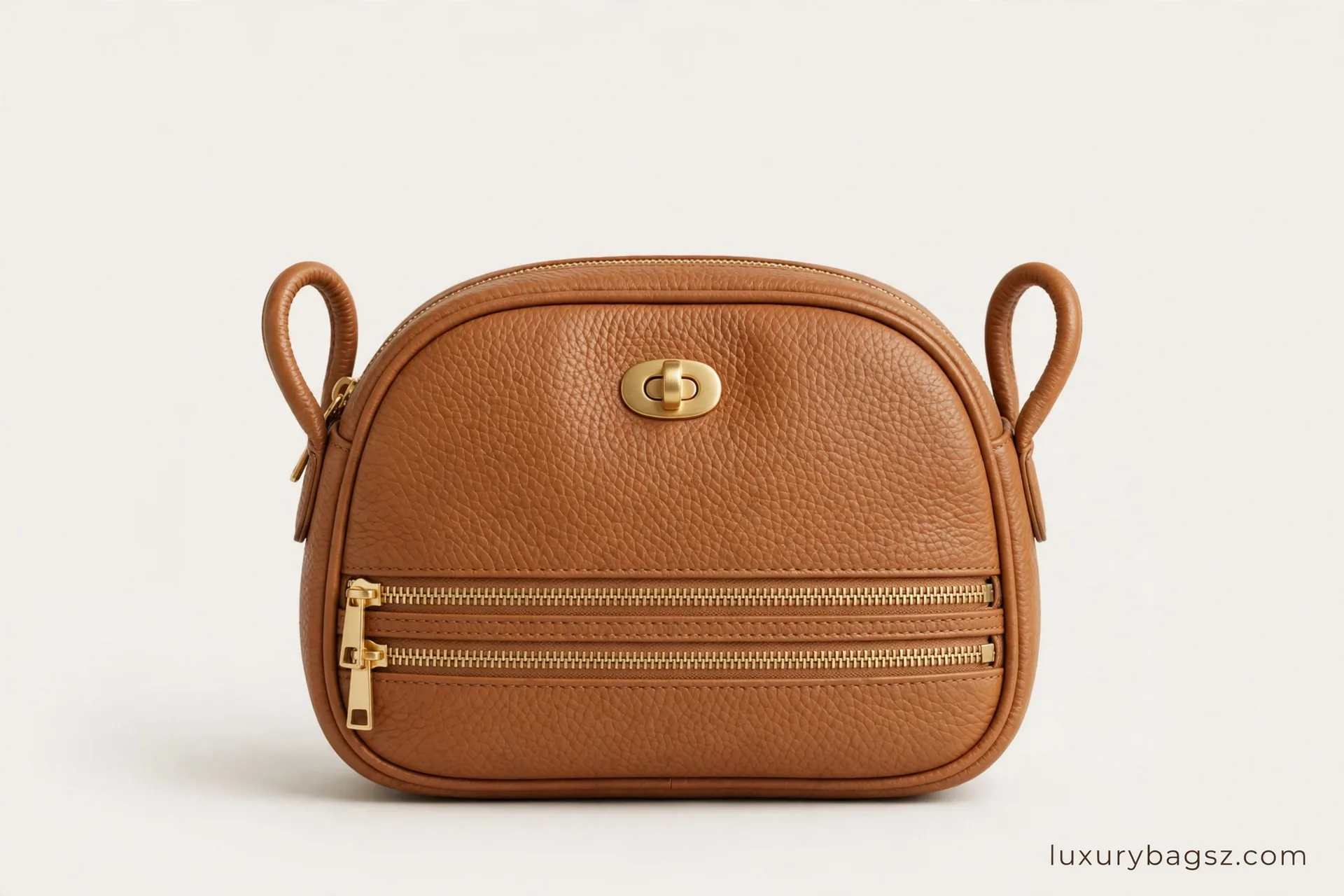
Choosing a Lindy by Load, Not Number
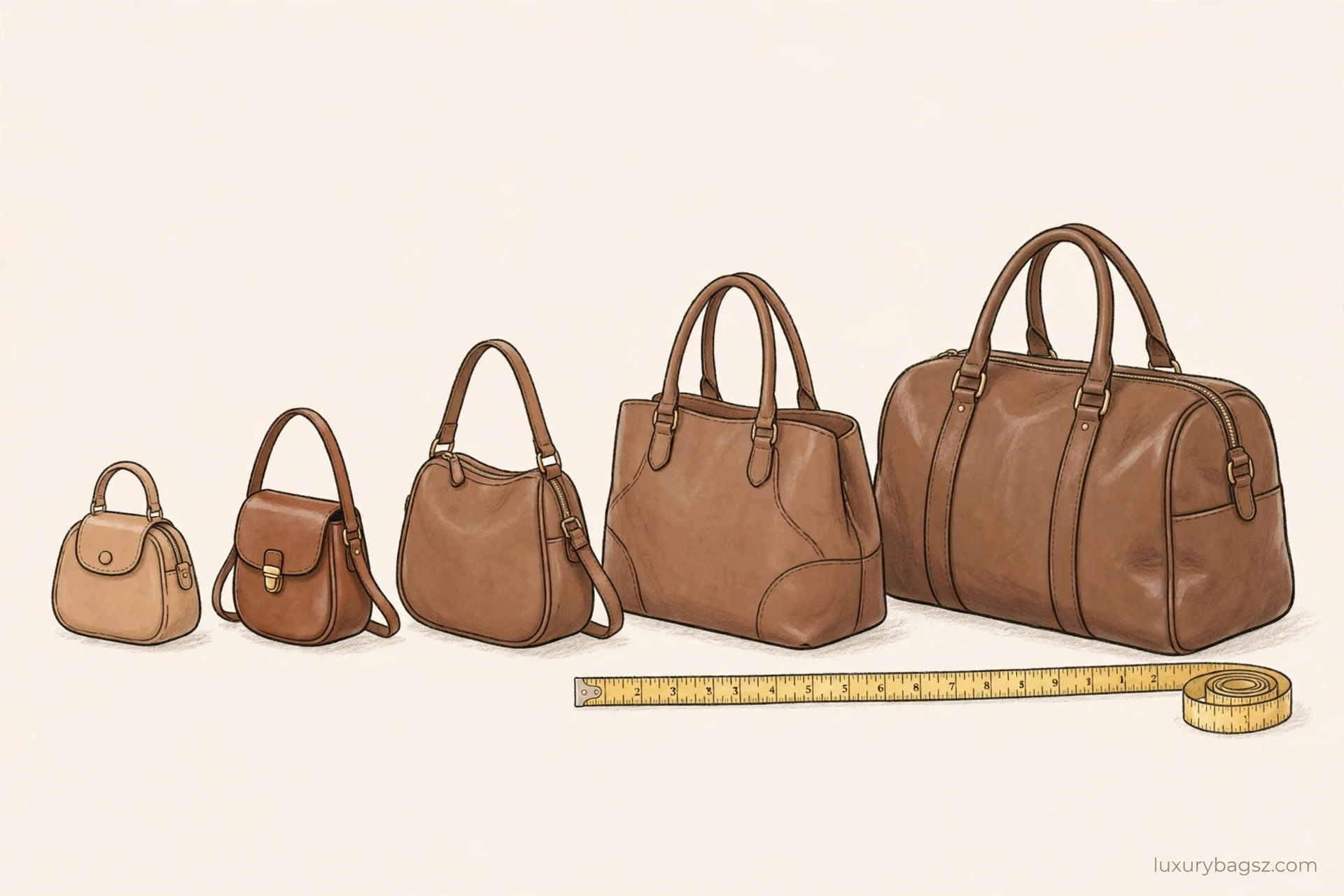
The Lindy comes in Mini, 26, 30 and 34 sizes still in production, plus a discontinued 45 made for travel. For most daily use the choice narrows to the 26 or the 30: the 26 stays neater and lighter, while the 30 copes better when you add a small bottle, a pouch and a case for sunglasses.
Only the Mini works comfortably across the body for most adults; the larger sizes sit as hand or shoulder carry. Its number signals a nominal base width in centimetres, not the opening or usable space, and the current Mini Lindy II measures roughly 18 to 19 cm with a shorter drop than the original 2019 Mini.
The Lindy is the Hermès bag most size guides get wrong in the same quiet way: they print one neat table, as if a Lindy were a rigid box, and then leave you to discover — with a bag you cannot return — that a soft, folding bag does not behave like a table.
A Lindy is not a Kelly. It does not stand to attention. It folds in the middle when it is empty, it slouches when it is full, its opening is narrower than its base, and the same nominal size can measure slightly differently from one example to the next because it is handmade. That is not a flaw in the bag. It is the design. Once you understand it, the sizes make sense. Until you understand it, even the right size on paper can feel like the wrong size on your shoulder.
This guide explains every Lindy size that sources support — Mini 20, 26, 30, 34, and the discontinued 45 — plus the important split inside the Mini family between the original Mini Lindy and the current Mini Lindy II. It gives dimensions with their conflicts shown, not smoothed away. It explains how each size actually wears, what realistically fits in each one, how leather changes the usable size and weight, what prices sources actually report (and where they contradict each other), and how to choose by your height, your body, and the load you really carry.
If you only need the short answer, the next part gives it. If you are about to spend several thousand pounds or dollars on a soft bag, read the measurement part before you buy. It is the part most competitor guides skip, and it is the one that prevents the most expensive mistakes.
I choose a Lindy by load, and I suggest sellers’ photographs be read the same way. The number is a nominal base width, nothing more — so when I examine one, I check what the opening actually admits, because a Lindy 26 and a Lindy 30 with the same base story carry very differently. The Mini needs its own care: the current Mini Lindy II is a little narrower than the 2019 original, with a shorter drop. After years of handling these bags, my advice is unglamorous — measure the bag, load the bag, and only then believe the size in the listing title.
Lindy Sizes in Brief
What sizes does the Lindy come in? Mini 20, 26, 30, and 34 in current and recent production, plus the discontinued 45 travel size. The Mini arrived much later than the rest: the original Lindy sizes were 26, 30, and 34, the 45 was added as a travel version, and the Mini did not appear until Fall/Winter 2019.
Which size is the everyday sweet spot? For most daily loads, the 26 or the 30. The 26 is the lighter, neater everyday bag. The 30 is the roomier everyday bag, the one that absorbs a sunglasses case, a pouch, and a small bottle without turning into a different shape. Choose the 26 if you carry light and dislike bulk; choose the 30 if your day is unpredictable.
Which size is crossbody? The Mini, and realistically only the Mini. Its longer strap is made to sit across the body. The larger Lindys have a shoulder strap, but for most adults that strap is a shoulder strap, not a comfortable crossbody strap — and on the 34 it can feel short for crossbody wear even for taller wearers.
What about the Mini II? The current Mini sold by Hermès is the Lindy II mini bag, not the original 2019 Mini 20. Guides disagree slightly on its exact measurements — roughly 18 to 19 cm wide, with a shorter strap drop than the original — and owners report that both generations fit about the same small load. The strap height is the difference you will actually feel.
What should I not assume from a size number? That a 34 will fit a laptop, that a 30 will fit a tablet flat, or that a Mini will fit a full wallet. All three depend on the actual item, the actual opening, and how the soft body folds. Measure your items, not just the bag.
What the Lindy Actually Is
The Lindy was designed in 2006 and released in Hermès’ Spring/Summer 2007 collection, under Jean-Paul Gaultier’s creative direction at the time, from an observation by designer Frédéric Vidal.
The observation was simple and practical: a traditional top-handle bag forces you to hold your arm out so the bag stays parallel to your body, which strains the shoulder and forearm. The Lindy’s answer was to move the handles to the gussets — the narrow sides of the bag — so the bag sits more naturally against the body, and to add a strap that connects handle to handle.
That one decision explains almost everything about how Lindy sizes wear. The handles are not on the broad front and back faces, as on a Kelly or a Birkin. They are on the sides. You slip your hand through from the side, the bag hangs perpendicular to your arm rather than flat against it, and the body can fold slightly to follow your hip.
When the bag is relatively empty, it bends in the centre and can be carried by its top handles. When it is fuller, it holds a boxier shape and shoulder carry becomes easier. Owners sometimes call it the “toaster bag” for that boxy-when-full, slouched-when-empty look.
The nickname is affectionate, but it is also a warning: do not judge a Lindy from a stuffed boutique photo alone, and do not judge it from an empty one either.
The closure is equally distinctive, and it matters for size. The Lindy closes with two zippers, one from each end, meeting in the centre under a turn-lock (often called a clous de selle or twist lock). There are two exterior slip pockets, one under each handle, and interior patch pockets.
That means the opening is not a wide, open tote mouth. It is a zippered centre opening, and the pockets are useful for a phone or cards but do not add to the main compartment’s width. A guide that only lists exterior dimensions and then promises that a tablet “fits” has skipped the only measurement that decides whether the tablet goes in flat: the opening, and the way the soft sides fold around it.
The Lindy is also not a quota bag in the Birkin and Kelly sense, which is part of why size guides for it are so widely read: it is a bag a buyer can realistically be offered, compare across sizes, and buy without the same appointment-and-history gate.
That does not mean every size, colour, and leather is in stock on a given day — the Mini in particular is often described as hard to find in boutiques — but it does mean size, not access alone, is the decision most buyers actually have to make.
The Sizes, One by One
Mini Lindy 20 — and Mini Lindy II
The Mini is the smallest Lindy, the most discussed, and the easiest to buy wrong. It was introduced in Fall/Winter 2019, and it is the only Lindy designed to be worn comfortably across the body. It keeps the full Lindy design in miniature: side handles, double zippers, centre turn-lock, exterior pockets, and a long strap.
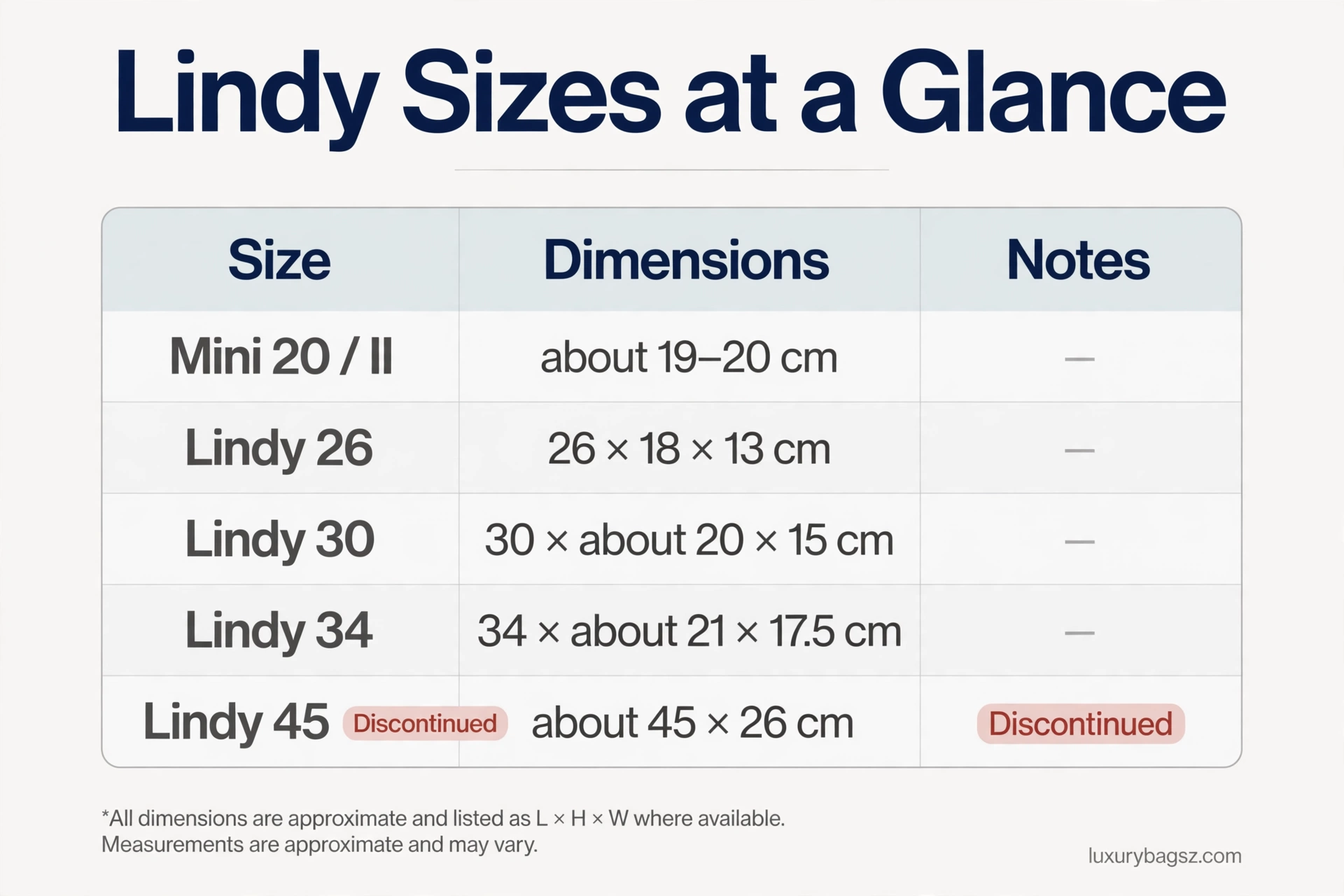
Here is where sources diverge, and you need to see the divergence. The original Mini Lindy 20 is commonly listed at about 19 to 20 cm wide, about 12 to 12.5 cm high, and about 9 to 10 cm deep. One guide gives 19.5 x 12.5 x 9.5 cm. Another gives 20 x 12 x 10 cm. A measured example in a size guide gives 19 x 12 x 9 cm. Those are not three different bags. They are the same nominal size measured differently, on handmade, soft bags, by different people.
The Mini Lindy II is a further complication. Hermès now sells the bag as the “Lindy II mini bag.” When a model is re-released with changes to size, shape, or strap length, Hermès designates it with the next Roman numeral, and the II measures about 2 cm less across the bottom than the original — roughly 18 to 19 cm wide against 19 to 20 cm — with a shorter shoulder strap (a drop of about 48 cm against about 53 cm).
Guides put the II at roughly 18 to 19 cm wide, about 11.5 to 13 cm high, and about 9 to 9.5 cm deep, with a strap drop of about 48 cm against about 53 cm for the original. One product listing for a Mini Lindy II in Swift gives 19 x 13 x 9.5 cm with a 108 cm strap length — note that strap length and strap drop are different numbers, a point the dimensions section returns to.
Owners who have both generations report something useful and reassuring: both fit about the same small load. The strap height is the difference that matters. The original, with its longer drop, sits near the hip on most adults. The II, with its shorter drop, sits higher, towards the waist or upper hip, which reads better on shorter frames and can feel high on anyone over about 175 cm.
The strap is not adjustable in the way a long crossbody strap on another bag might be, so if crossbody height matters to you, try both generations before committing — or, pre-owned, ask the seller to photograph the bag worn, or at least to measure the drop on the actual bag.
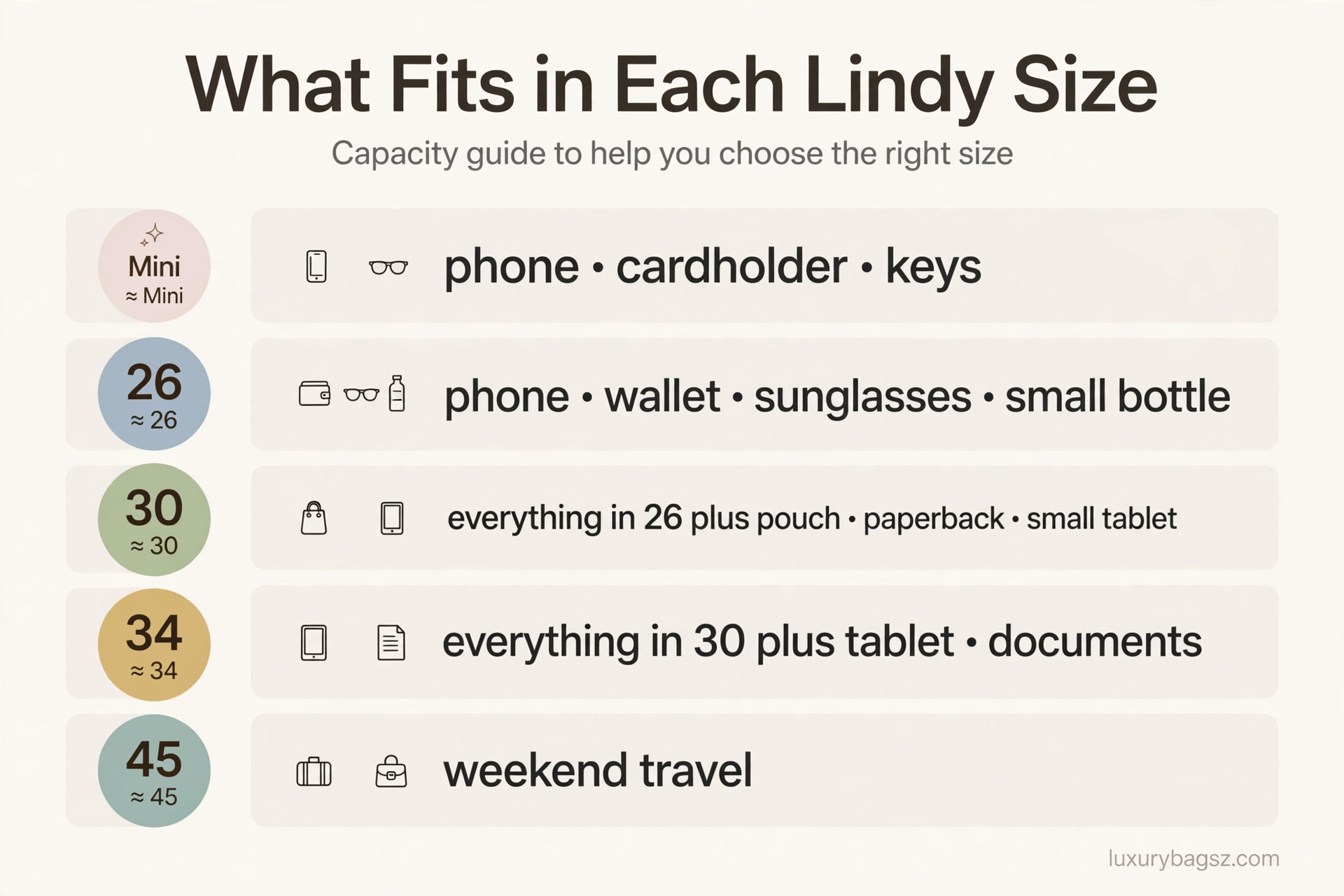
What fits in a Mini, in plain terms: a phone (including a large phone), a slim cardholder or compact wallet, keys, lipstick, and a few small extras. What does not fit: a full wallet flat, a sunglasses case plus a pouch plus a bottle, a book or Kindle, or any tablet. If your everyday carry is already minimal, the Mini works. If you are planning to shrink your carry to fit the Mini, be honest about whether you will actually do that every day.
Lindy 26
The 26 is the neat everyday Lindy. At a nominal 26 cm wide, it is the smallest of the original sizes, and for many buyers it is the best balance of presence and lightness. It is large enough to feel like a real bag, not a novelty, and small enough not to dominate a smaller frame or a crowded commute.
Dimensions are more consistent for the 26 than for the Mini, but they are still not identical across sources. The common listing is 26 x 18 x 13 cm (about 10.2 x 7.1 x 5.1 inches). One guide gives the height as 19 cm and the depth as 14 cm, which is a reminder that even a “standard” size is measured differently by different sellers. Treat 26 x 18 x 13 cm as the working figure, and check the actual bag if a centimetre matters to your fit.
What fits in a 26, according to the better what-fits guides: a large phone, a full wallet, a mini makeup bag, a cased pair of sunglasses, a passport, a small water bottle, a compact power bank, and keys.
That list is realistic precisely because it is not heroic: it does not promise a tablet, a laptop, or a full-size bottle. The 26’s two compartments help here — the bag is more organised than an open tote of the same width — but the zippered centre opening still sets the limit. A small bottle fits because it can stand in the soft body; a rigid tablet that must lie flat is a different test.
How it wears: by hand, on the forearm, or on the shoulder. It is not a crossbody bag for most adults, despite having a strap. The strap connects handle to handle and is made for shoulder wear on this size. If you need hands-free carry every day, the Mini is the honest Lindy answer, not a forced crossbody 26.
Lindy 30
The 30 is the classic Lindy size, the one most guides call the standard, and the one most owners describe as “perfect for everyday” once they have lived with it. At a nominal 30 cm wide, it is the size that absorbs the extras a 26 makes you choose between: the sunglasses case and the pouch, the reusable shopping bag, the to-go cup (empty, as one owner dryly notes), the diary or small tablet that a 26 would make you angle in.
Dimensions again vary by source. The common listings are 30 x 21 x 15 cm, 30 x 20 x 15 cm, and 30 x 19 x 16 cm. The width is consistent at 30 cm. The height and depth move by a centimetre or two, which is exactly what you would expect from a soft, handmade bag measured at different points — at the base, at the top, stuffed, or empty.
Do not treat any one of those triples as exact to the millimetre. Treat the width as nominal, the height as about 19 to 21 cm, and the depth as about 15 to 16 cm, and then check the actual bag.
What fits in a 30: everything in the 26 list, plus room to spare — a larger pouch, a paperback, a small tablet in many cases (measure yours against the opening, not just the base), and a small bottle without a fight.
What does not reliably fit: a full-size laptop, a large water bottle alongside a full daily load, or a rigid A4 folder flat. One listing that claims a 34 “fits a laptop” and another that claims a 30 does the same should both be read as seller shorthand, not as a measured guarantee. A laptop that fits diagonally into a soft bag is not the same as a laptop that fits safely, flat, and zipped shut.
How it wears: by hand, on the forearm, and on the shoulder. On a smaller frame the 30 can look generous, especially in a slouchy Clemence, and on a taller frame it can look like the neat everyday bag it is. That frame effect is real, and it is why the choosing-a-size section does not give a single “best size” by height alone — it gives a test to run with your own body and your own load.
Lindy 34
The 34 is the large everyday and short-trip Lindy. At a nominal 34 cm wide, it is the biggest size most buyers will realistically consider for daily use, and the one where the Lindy’s softness becomes both its strength and its risk: filled, it is generous; under-filled, it can look empty and oversized, and its weight — especially in Clemence — becomes something you feel by the end of the day.
Dimensions are commonly listed as 34 x 22 x 17.5 cm (about 13.4 x 8.7 x 6.9 inches). Other listings give the height as 20 cm and the depth as 18 cm, and one older forum listing gives a depth of only 7.5 cm, which is almost certainly a different measurement point or an error — a 34 cm bag that is only 7.5 cm deep would not match any other Lindy 34 description, and this guide does not rely on it. The working figure is 34 x about 20 to 22 cm high x about 17.5 to 18 cm deep.
What fits in a 34: everything in the 30 list, plus a tablet more comfortably, documents, a small laptop in some owners’ experience (again, measure the opening and the item, and do not force a zip shut over a rigid corner), and a change of clothes for a short trip if you pack soft items.
It is the size for a buyer who carries more, travels light, or wants one bag that can do work and weekend. It is not the size for a buyer who wants a neat, compact daily bag — that buyer will find the 34 wears them, rather than the other way round.
How it wears: on the shoulder and by hand. Crossbody wear on a 34 is not the design intention for most adults, and the bag’s width means it will sit low and wide across the body if forced. On a petite frame, the 34 can fall on the hip when worn on the shoulder and can look bulky; on a taller or broader frame, it can look proportionate. Height alone does not decide it — torso length, shoulder width, and how much you fill the bag matter as much.
Lindy 45 — the discontinued travel size
The 45 was the Lindy’s travel size: a much larger, weekend-bag version of the same design. Sources list it at about 45 x 26 x 23 to 26 cm, though even here the depth is given as both 23 cm and 26 cm in different guides. It was produced for a period after the original sizes, mainly for short trips, and guides agree it has been discontinued.
That matters for two reasons. First, do not shop for a “new” 45 as if it were a current boutique size; any 45 you find will be pre-owned or vintage, and its condition, leather, and measurements need the extra care the buying checklist describes. Second, do not size a 26, 30, or 34 from a 45 listing, or vice versa — the 45’s proportions, weight, and wear are a different category, closer to a duffle than to a daily handbag.

Dimensions and How They Are Measured
This is the part that separates a useful size guide from a copied table. Most competitor guides print dimensions without saying what was measured, where, or on what kind of bag. For a rigid bag, that omission matters less. For a Lindy, it matters a great deal.
First, the number in the name is a nominal width. It is the width the model is sold under, roughly the width of the base, not a guarantee that every point on the bag measures that width. A Lindy that is 30 cm at its base will be narrower at its zippered top when it is empty and folding inwards, and wider when it is stuffed and pushing outwards. A guide that gives a single width without saying “at the base” has given you a label, not a measurement.
Second, height and depth move with fill and leather. A Clemence Lindy that is 21 cm high when stuffed can measure less when it slouches. A Swift Lindy drapes differently again.
That is why sources disagree by a centimetre or two on height and depth for the same nominal size: they are measuring different examples, in different states, with different methods. Hermès itself notes that handmade dimensions can vary, and that note should be taken seriously for the Lindy above all.
Third, strap length and strap drop are not the same number, and guides mix them up. Strap length is the full length of the strap, often measured without its hardware or with it, depending on the seller.
Strap drop is the distance from the top of the strap to the top of the bag when the strap is worn — the number that decides where the bag sits on your body. A Mini Lindy II listing that gives a 108 cm strap length and a guide that gives a 48 cm strap drop are not contradicting each other; they are measuring different things. When you buy, ask for the drop, and if possible for a worn photo, because drop is what you will feel.
Fourth, handle drop matters separately. The Lindy’s top handles have a drop of roughly 7 cm on the Mini — enough to pinch-carry or hook over a wrist, not enough to wear on the shoulder. On larger sizes the handles are for hand and forearm carry. A guide that lists only a strap and never mentions handle drop has left out the carry you will use most often when you pick the bag up off a table.
Fifth, the opening decides what fits, not the base. The Lindy’s centre zip opening is narrower than its base, and the two side pockets do not widen it. Before you buy for a specific item — a tablet, a book, a camera, a bottle — measure that item’s longest rigid dimension and its thickness, and ask the seller to measure the opening on the actual bag.
A tablet that is 30 cm wide will not lie flat in a 30 cm Lindy if the opening is narrower or if the bag’s soft sides fold inwards around it. This single check prevents more returns than any dimension table.
A practical way to use all of this: when you see a dimension triple, ask yourself three questions. Was it measured at the base or at the top? Was the bag empty, stuffed, or in between? And is the number a strap length or a strap drop? If the listing cannot answer, treat its dimensions as a starting point, not as a specification, and measure the actual bag before you pay.
How Each Size Wears
Size guides often describe wear in one line — “hand, shoulder, crossbody” — as if every size wore every way equally well. For the Lindy, that is misleading. The strap, the handle position, and the body width change the honest wear for each size.
Mini (20 and II): hand, wrist, shoulder, and crossbody. This is the only Lindy where crossbody is the design intention, not a stretch. The long strap sits across the body, the bag sits at the hip (original) or waist to upper hip (II), and the small body does not swing wildly when you walk. It can also be carried by its handles or hooked over a wrist, and on a smaller frame it can sit on the shoulder. The limitation is not wear but capacity: crossbody freedom is bought with a small interior.
26: hand, forearm, and shoulder. The 26 hangs neatly on the shoulder, sits comfortably in the crook of the arm, and can be carried by hand without dragging. It is light enough, especially in a lighter leather, to be an all-day bag. Crossbody wear is possible for some very petite wearers with a short torso, but for most adults the strap is too short to sit comfortably across the body without riding up, and the bag will pull towards the hip in a way that defeats the Lindy’s ergonomic design.
30: hand, forearm, and shoulder. The 30 is the most versatile shoulder bag in the family. It sits well on the shoulder, it does not overwhelm the forearm, and it can be carried by hand when you want it to look more formal.
Crossbody wear is even less realistic than on the 26 for most adults: the wider body means the bag sits further out from the body, and the strap length does not compensate. If a seller photographs a 30 worn crossbody, look at where the bag actually sits — high, tight, and pulling — before you assume you will wear it that way daily.
34: hand and shoulder. The 34 is a shoulder bag first, a hand bag second. On the shoulder it distributes its weight well when filled evenly, but it can feel heavy by the end of a long day, especially in Clemence. By hand it is a substantial carry, and on a smaller frame it can look and feel like luggage rather than a handbag. Crossbody wear should be treated as an exception, not a selling point, for this size.
45: hand and shoulder, as a travel bag. The 45 wears like a soft duffle: by hand for short carries, on the shoulder for longer ones, and best when it is filled enough to hold its shape. Under-filled, it collapses and looks larger than it is useful. It is not a daily commuter bag for most buyers, and it should not be chosen on the strength of a daily-size guide.
One more wear point that guides rarely mention: the Lindy changes shape as you wear it. Empty, it folds in the middle and hugs the hip. Full, it boxes out and sits further from the body.
That means the same size can look neat in the morning and boxy by the evening, depending on what you have added during the day. If you love the folded, slouchy look, do not overfill the bag to chase capacity. If you love the boxy look, accept that the bag will look larger and feel heavier when it holds that shape.
What Fits in Each Size
The table below is a realistic starting point, not a promise. It is built from what-fits guides, owner reports, and the dimension reasoning in the dimensions section. Your own items are the final test — measure them, and test them through the opening, not just against the base.
| Size | Realistically fits | Does not reliably fit |
|---|---|---|
| Mini 20 / II | Phone, slim cardholder or compact wallet, keys, lipstick, small extras | Full wallet flat, sunglasses case + pouch + bottle, book, tablet |
| 26 | Phone, full wallet, mini makeup bag, cased sunglasses, passport, small bottle, compact power bank, keys | Tablet flat in most cases, laptop, large bottle with a full load |
| 30 | Everything in the 26 list, plus a larger pouch, paperback, small tablet in many cases, small bottle without a fight | Full-size laptop, large bottle with a full load, rigid A4 folder flat |
| 34 | Everything in the 30 list, plus a tablet more comfortably, documents, a small laptop in some owners’ experience, soft clothes for a short trip | Large laptop safely zipped flat, rigid A4 folder with a full load, a week’s clothes |
| 45 (discontinued) | Weekend clothes, toiletries, documents, a tablet and more, as a travel bag | Daily neat carry — it is too large and too soft when under-filled for most daily use |
Three cautions belong with that table. First, “fits” in a soft bag can mean “can be squeezed in” or “fits flat and zips shut without strain.” Only the second meaning should guide a purchase. A zip forced shut over a rigid corner will strain the zip, distort the bag, and wear faster. Second, pockets help organisation but do not create space.
The two exterior pockets are for a phone or cards, and the interior pockets are for small items; they do not make a Mini into a 26. Third, weight matters as much as volume. A 34 that fits everything you own is not a good daily bag if, filled, it is too heavy to carry comfortably. Pack your real load, weigh it if you can, and carry it for an hour in a comparable bag before you commit to the largest size.
A useful test before buying, especially pre-owned: lay out your daily items on a table, measure the longest rigid item, and compare it to the bag’s opening, not its base. Then ask the seller for a photo of those items, or items of the same size, inside the actual bag, with the zip closed. A seller who can do that has given you more useful size information than any table.
Materials and How They Change Size, Weight, and Sag
A Lindy in Clemence and a Lindy in Swift at the same nominal size are not the same bag to carry. The leather changes the weight, the drape, the sag, and therefore the size the bag appears to be and the size it behaves like.
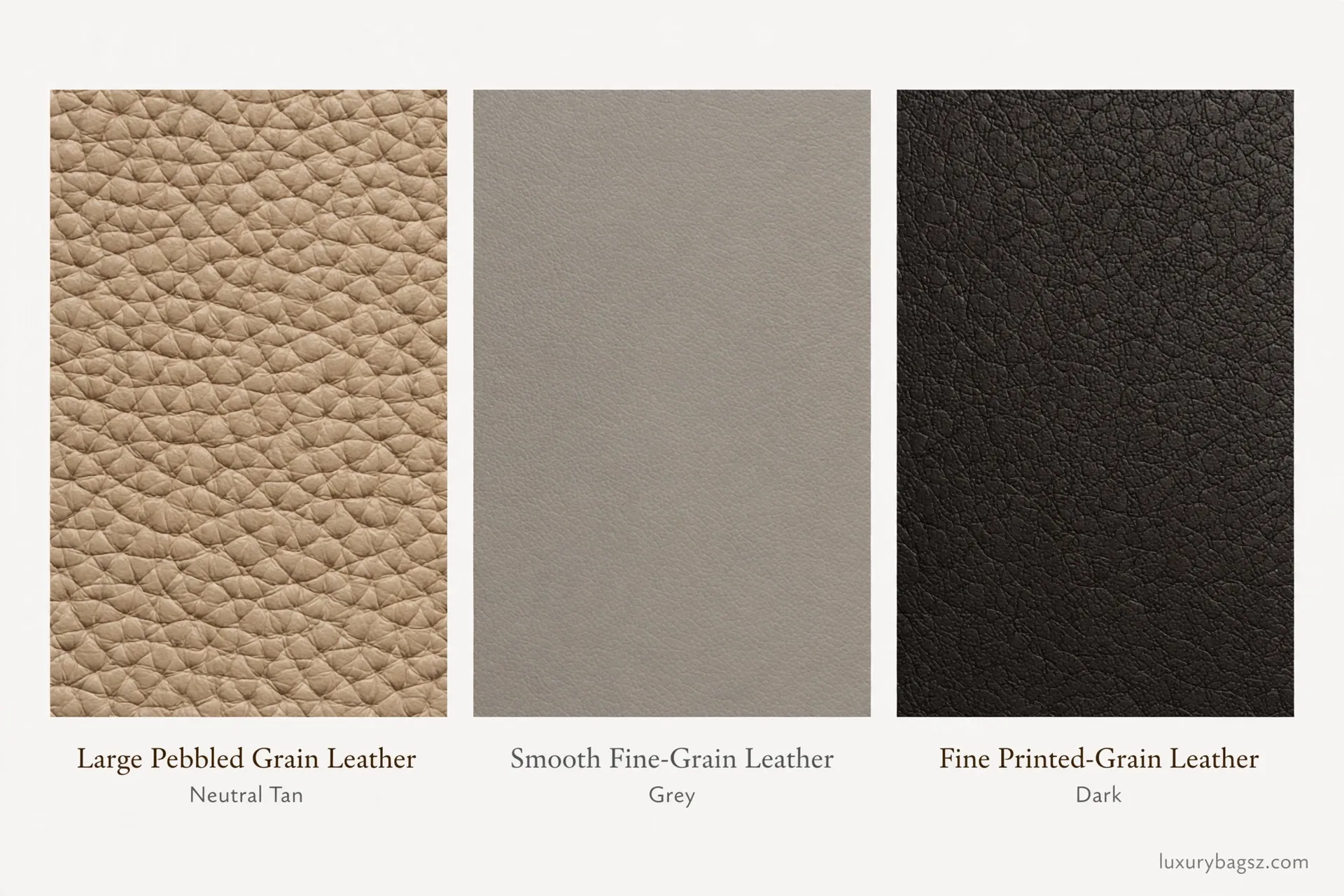
Taurillon Clemence is the classic Lindy leather, and the one most size guides associate with the model. It is a bull-calf leather with a prominent pebbled grain and a semi-matte finish, introduced for luggage in 1992. It is durable and scratch-resistant, which is why it survives daily use well, but it is also heavier and softer than many other Hermès leathers, and it slouches.
On a Lindy, that slouch is part of the look — the bag folds, drapes, and softens with wear — but it also means a Clemence 30 can look larger and less structured than a Swift 30, and a Clemence 34 can feel heavier by the end of the day. Clemence can also show water marks, so a larger Clemence bag that gets caught in rain is a heavier, wetter bag to carry home. For a detailed look at where Hermès leathers come from and how they are made, see our guide to Hermès leather.
Swift is a smooth calfskin with a fine natural grain and a matte finish, originally called Gulliver, discontinued in 1999, and reintroduced as Swift in the mid-2000s. It shows colour more vividly than Clemence, which is why bright Mini Lindys in Swift photograph so well, but it is smoother, softer in structure, and more easily scratched and marked.
Owners report that a Swift Mini holds its “dumpling” shape less well than a Clemence Mini, and that Swift can ripple and sag with wear. On a larger Lindy, Swift’s drape can make the bag look softer and less boxy than the same size in Clemence, which some buyers love and others find too unstructured for work.
Evercolor sits between the grained and smooth families: a fine printed grain with a satin finish and a slight sheen. It is more structured than Swift and less slouchy than Clemence, and it is often described as a versatile middle ground.
On a Lindy, Evercolor can give a 26 or 30 a slightly more formal, held-together look without making it rigid. It will still soften with wear, and prolonged sunlight can fade it, but it is a useful choice if you want the Lindy’s softness without the full Clemence slouch.
Togo, Epsom, and other leathers appear in Lindy listings less often, and each changes the size story in the same way: Togo is pebbled, matte, and lighter and thinner than Clemence, with a more held shape; Epsom is embossed, firm, and shape-retaining, so a Lindy in Epsom will look more structured and less slouchy than the same size in Clemence.
Exotic leathers — crocodile, ostrich, and others — are produced in small numbers, command much higher prices, and should be judged on their own listings, not on Clemence dimensions. A crocodile Mini is not a Clemence Mini with a different skin; its weight, structure, and care are different, and its price is in a different category altogether.
The practical rule is simple: if you dislike slouch, do not buy a large Lindy in Clemence and hope an insert will fix it. An insert can support a base, but it cannot turn a soft, heavy leather into a structured one.
Choose the leather for the shape you want, and the size for the load you carry, and let those two choices work together. For keeping a soft bag’s shape in storage, the same principles apply as for other soft Hermès bags — upright with support, or flat where the construction calls for it, never hung by its handles — as set out in our guide to store Hermes Kelly.
Prices by Size
This part needs a warning before any number: Hermès does not publish a price list. Every Lindy price in a guide is therefore a report — from a boutique receipt, a price tracker, a reseller listing, or a guide’s own compilation — and reports differ by date, market, leather, and hardware. A guide that prints one price per size without a date, a market, or a leather has printed a number, not a price.
With that warning, here is what sources actually report, with their conflicts shown.
Older guide prices, now out of date but still widely copied: One older price guide lists, in US dollars for Taurillon Clemence, Mini Lindy 20 at $6,650, Lindy 26 at $7,000, Lindy 30 at $7,800, and Lindy 34 at $8,700. Those figures are useful only as history: they show the old pattern, where price rose with size, and they show how much prices have moved since. Do not use them as today’s boutique prices.
2026 guide prices, with a conflict to flag: A 2026 price tracker compiled from receipts and cross-checked sources lists Lindy 26 in Clemence at $10,800 in the US and Lindy II Mini in Clemence at $9,050. A separate 2026 Sotheby’s guide puts the Mini Lindy at approximately $9,050 in US boutiques after the annual increase, and the Lindy 34 in Clemence at approximately $8,700. Read together, those two 2026 sources do not agree in the way a buyer would expect: one implies the Mini is cheaper than the 26, which makes sense, while the other puts the 34 below the Mini, which does not follow the old size-price pattern.
This guide does not resolve that conflict by picking one figure, because the sources may be reporting different dates, different leathers, or different markets, or one may simply be out of date. The honest conclusion is that 2026 US retail for a leather Lindy is in the high four figures to low five figures, that the Mini is around $9,050 in the most recent US reports, and that any figure for a 26, 30, or 34 should be checked for the exact size, leather, and date before it is relied on.
Other markets, as single reports, not averages: One Canadian guide reports Lindy 26 at $10,300 CAD and Lindy 30 at $11,300 CAD. A Paris comparison puts the Mini Lindy in Clemence at €6,250 on a Paris tag, against $9,050 in the US, before any tax refund — a reminder that market, currency, and tax change the price more than size alone does. Those are single-market reports, not a global price list.
Secondary market, as ranges, not averages: Sotheby’s secondary-market guidance puts leather Lindy bags at roughly $4,000 to $15,000 depending on condition and size, with pristine small sizes at $10,000 to $15,000 and older or larger models at $4,000 to $7,000, and crocodile Lindys at $15,000 to $27,000. Individual secondary listings in the same search run much higher for desirable Minis — for example, a 2026 Etoupe Clemence Mini at $13,000, a 2025 Gold Swift Mini at $10,900, and a 2026 Black Clemence Mini II at $11,660 — and much lower for older larger bags. Those single listings are not a market average, and they should never be quoted as one. The pattern they do support is consistent with other guides: the Mini, especially in desirable colours, commands a premium on the secondary market that larger sizes often do not, because it is harder to find new and because its crossbody wear makes it more versatile for many buyers.
What this means for choosing a size: Do not choose a Lindy size because a guide says it is “better value” or “holds value better.” Value depends on colour, leather, condition, generation (Mini I versus II), and market on the day, not on size alone. Choose the size that fits your load and your body, check the price for that exact size and leather on the day, and treat any price that is not dated, sourced, and tied to a specific leather as a starting point for a question, not as an answer.
Choosing a Size by Height, Body, and Daily Load
Most size guides give a single rule — “petite buyers should choose the Mini, taller buyers the 30” — and then stop. That rule is too simple, because height alone does not decide how a Lindy sits. Torso length, shoulder width, how you carry, and what you fill the bag with matter as much as height, and sometimes more.
Start with your load, not your height. Lay out everything you carry on a normal day, and everything you carry on a busy day, and be honest about which list is the real one. If the normal list is phone, cardholder, keys, and lipstick, the Mini is a real option.
If the normal list is phone, full wallet, sunglasses, pouch, keys, and a bottle, the Mini is not a real option, however much you like its look. If the busy list adds a tablet, a book, and a reusable bag, the 30 is the honest choice, not the 26 stretched to its limit. A bag that fits your busy day will feel generous on a light day; a bag that fits only your light day will feel like a constraint on a busy one.
Then test the strap, not just the width. For a Mini, the test is crossbody height: does the bag sit at your hip, your waist, or too high? The original Mini sits lower than the II, so a taller wearer may prefer the original and a shorter wearer may prefer the II — but torso length, not height alone, decides where the bag lands, because a long torso with short legs and a short torso with long legs will wear the same drop differently. For a 26, 30, or 34, the test is shoulder comfort: does the bag sit at your hip without swinging, does it stay put when you walk, and does it pull on your shoulder when filled? A bag that passes that test empty but fails it filled is not the right size for your load.
Then check the frame effect. On a petite frame, a 26 can look neat and a 30 can look generous, especially in slouchy Clemence. On a taller or broader frame, a 26 can look small and a 30 can look proportionate, while a Mini can look like an accessory rather than a bag.
On a smaller frame, a 34 can fall on the hip when worn on the shoulder and can look bulky; on a taller frame, the same 34 can look balanced. These are tendencies, not rules, and they are best tested with the actual bag, or with a bag of the same width and weight, worn with the clothes you actually wear — a coat changes the fit, a summer dress changes it again.
A short decision guide, with its limits stated:
- Choose the Mini if your load is minimal, you want hands-free crossbody wear, and you are comfortable choosing what to leave behind. Do not choose it if you need a full wallet, a bottle, or a pouch every day.
- Choose the 26 if your load is light to moderate, you want a neat everyday bag, and you like a lighter carry. Do not choose it if your busy day regularly needs a tablet or a book.
- Choose the 30 if your load is moderate to full, your days are unpredictable, and you want one bag that can absorb extras without changing shape. Do not choose it if you dislike bulk or if a 26 already fits your real load.
- Choose the 34 if your load is full, you travel light, or you want a work-and-weekend bag in one. Do not choose it if you want a compact daily bag, if you are petite and dislike a bag that falls on the hip, or if filled weight is already a concern.
- Consider the 45 only if you specifically want a pre-owned travel bag and you understand its size, weight, and discontinued status. Do not choose it as a daily bag on the strength of a size table.
If you are between two sizes, the tie-breaker is usually the busy-day load, not the light-day look. A bag that is slightly generous on a light day is a pleasure; a bag that is slightly too small on a busy day is a daily frustration. And if you are between Mini generations, the tie-breaker is strap drop, not a centimetre of width.
For comparison, it helps to think of the Lindy against other soft Hermès bags, not just against itself. A smaller soft bucket, such as the Picotin Lock 18, is a hand-carry bag with a different, more open shape, while a structured flap bag, such as the Constance bag, holds its shape in a way a Lindy never will.
If you want structure, the Lindy — at any size — is the wrong family, however much you like its look. If you want softness, the Lindy is the right family, and size is then a question of load and wear, not of structure.
Buying Checklist: Size Questions to Ask Before You Pay
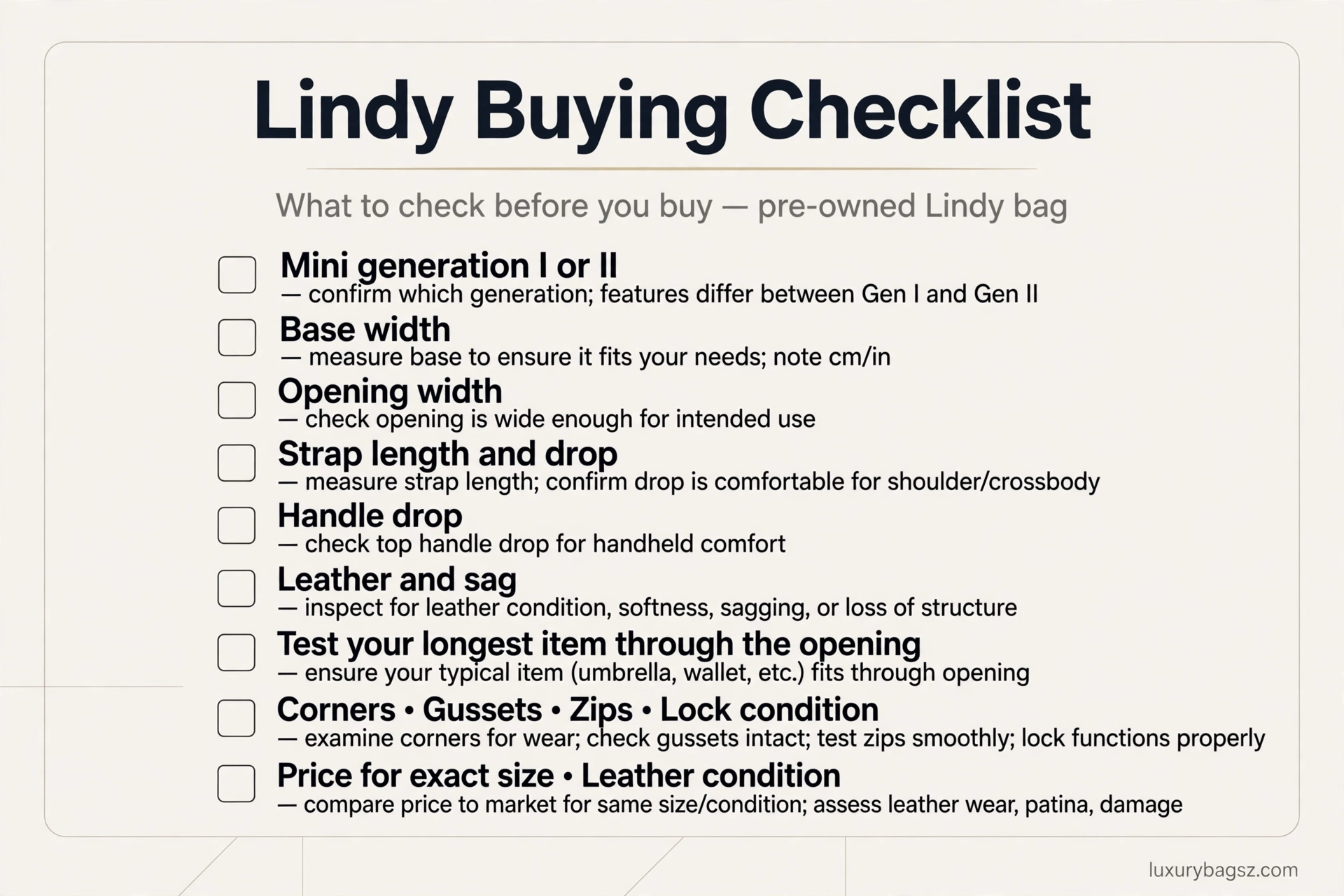
Use this checklist for any Lindy purchase, but especially for a pre-owned one, where the listing may give only a nominal size and a single photo. Ask for what is missing, and do not pay until you have it.
- Which generation is it, if it is a Mini? Original Mini Lindy 20 or Mini Lindy II? Ask for the product name as listed, the strap drop, and a worn photo if possible. A listing that just says “Mini Lindy” has not answered the size question.
- What are the four measurements on this bag? Base width, opening width, strap length and strap drop, and handle drop. A listing that gives only “30 cm” has given you a model name, not a measurement.
- What is the leather, and how does it affect this example? Clemence, Swift, Evercolor, Togo, or exotic? Ask how the bag holds its shape when empty and when filled, and whether it slouches, ripples, or holds a boxy shape. A photo of the bag empty and a photo of it filled are more useful than a single stuffed photo.
- What fits, tested, not claimed? Ask the seller to test your longest rigid item — or an item of the same size — through the opening, with the zip closed. Do not accept “fits a laptop” or “fits a tablet” without that test.
- What is the condition by size? Check the base corners, the gussets where the handles attach, the zippers, and the turn-lock. On a larger Lindy, check for sag and for wear where the strap meets the handles. On a Mini, check the strap itself, because a shorter II strap that has been stretched or altered changes the wear completely.
- Is the 45 really a 45, and is it priced as pre-owned? If you are buying a 45, confirm its measurements, its condition as a travel bag, and that you are not paying a current-boutique price for a discontinued size.
- What is included, and does it affect size? A dust bag, box, and papers do not change the bag’s size, but a bulky insert or a non-original strap does. Ask whether the strap is original, and whether any insert is included or has been used to force the bag into shape.
- What is the price for this exact size, leather, and condition? Ask for the date and market behind any retail price quoted, and compare secondary prices only for the same size, generation, leather, and condition. A Mini price does not set a 30 price, and a Clemence price does not set a Swift price.
For general Hermès buying principles — checking a seller, asking for clear photos, and not treating a single photo or a promise of a card as proof — the same careful approach applies as for other Hermès bags, as set out in our guide to fake Hermes Kelly. That guide is about the Kelly, not the Lindy, and its checks should not be copied across as Lindy checks, but its buying discipline — measure the actual bag, ask for the actual photos, and do not pay for a claim — is the right discipline for a Lindy size purchase too.
FAQ
What is the smallest Lindy size?
The Mini, nominally 20 cm in its original generation, and slightly smaller as the current Mini Lindy II, at roughly 18 to 19 cm wide depending on the source and measurement. It is the only Lindy made for comfortable crossbody wear.
What is the largest Lindy size?
The 45, a discontinued travel size at about 45 x 26 x 23 to 26 cm. Among sizes you can realistically shop for today, the largest is the 34, at about 34 x 20 to 22 x 17.5 to 18 cm.
Is the Lindy 26 or 30 better for everyday use?
Both are everyday sizes, and the better one depends on your load. The 26 is lighter and neater for a light to moderate load. The 30 is roomier and more forgiving for a full or unpredictable day. If you regularly carry a tablet, a book, or a pouch plus a sunglasses case, the 30 is the safer choice. If you do not, the 26 will feel less bulky.
Can you wear a Lindy 26 crossbody?
For most adults, no, not comfortably as a daily carry. The 26’s strap is a shoulder strap, not a crossbody strap, and forcing it across the body usually makes the bag ride up and pull. The Mini is the Lindy crossbody size. A very petite wearer may find a 26 crossbody workable, but it should be tested worn, not assumed.
Does a Lindy 30 fit a laptop?
Not reliably, and not as a guarantee. Some owners report fitting a small laptop, but a laptop’s fit depends on its exact dimensions, the bag’s opening, and whether the zip can close without strain over a rigid corner. Measure your laptop and the actual bag’s opening before you buy for that purpose. A tablet is a more realistic test for a 30, and even then it should be measured, not assumed.
What is the difference between Mini Lindy and Mini Lindy II?
The II is the current, slightly smaller generation, with a shorter strap drop. The original Mini 20 is about 19 to 20 cm wide with a strap drop of about 53 cm; the II is about 18 to 19 cm wide with a strap drop of about 48 cm, depending on the source. Owners report both fit about the same small load. The strap height — hip for the original, waist to upper hip for the II on most adults — is the difference you will feel most.
Is the Lindy a quota bag?
No, not in the Birkin and Kelly sense. The Lindy is a bag a buyer can realistically be offered and compare across sizes, though availability still varies by size, colour, and leather, and the Mini in particular can be hard to find new. That does not mean every Lindy is in stock on a given day.
Why do Lindy dimensions differ between guides?
Because the Lindy is soft and handmade, because guides measure at different points (base versus top, empty versus stuffed), and because they sometimes mix strap length with strap drop, or a Mini I measurement with a Mini II measurement. A centimetre or two of difference is normal for this bag. A guide that hides that difference is less useful than one that shows it and tells you to measure the actual bag.
Final Verdict
The Lindy does not reward buying by number alone. It rewards buying by load, by strap, and by leather — in that order. Start with what you actually carry on a busy day, not what you wish you carried. Then check how the size you are considering wears on your body, with that load in it, not empty in a boutique mirror.
Then choose the leather for the shape you want to live with, knowing that Clemence will slouch and add weight, Swift will drape and mark more easily, and a more structured leather will hold its shape at the cost of some of the Lindy’s softness.
For most buyers, that process lands on the 26 or the 30. The 26 is the neat everyday bag, the 30 is the forgiving everyday bag, and the difference between them is less about a few centimetres on paper than about whether your busy day needs the extra room.
The Mini is the right choice only if your load is truly minimal and you want hands-free crossbody wear — and then only if you have checked which Mini generation you are buying and where its strap actually sits on you. The 34 is the right choice if you carry more, travel light, or want one bag for work and weekend, and the wrong choice if you want a compact daily bag. The 45 is a travel bag from another era, worth considering only as a pre-owned purchase judged on its own measurements.
If you want a smaller soft Hermès bag with a different, more open shape, the Picotin Lock 18 is worth comparing, and if you want structure rather than softness, the Constance bag will tell you quickly that the Lindy family is not the right one.
And whatever size you choose, keep it the way a soft bag needs to be kept — supported, not hung, and not squashed — as in our guide to store Hermes Kelly. A Lindy bought in the right size and kept well will look better in a year than a Lindy bought in the wrong size and forced to behave like a different bag.






