What Is the Hermès Clic H Bracelet?
The Clic H in Brief
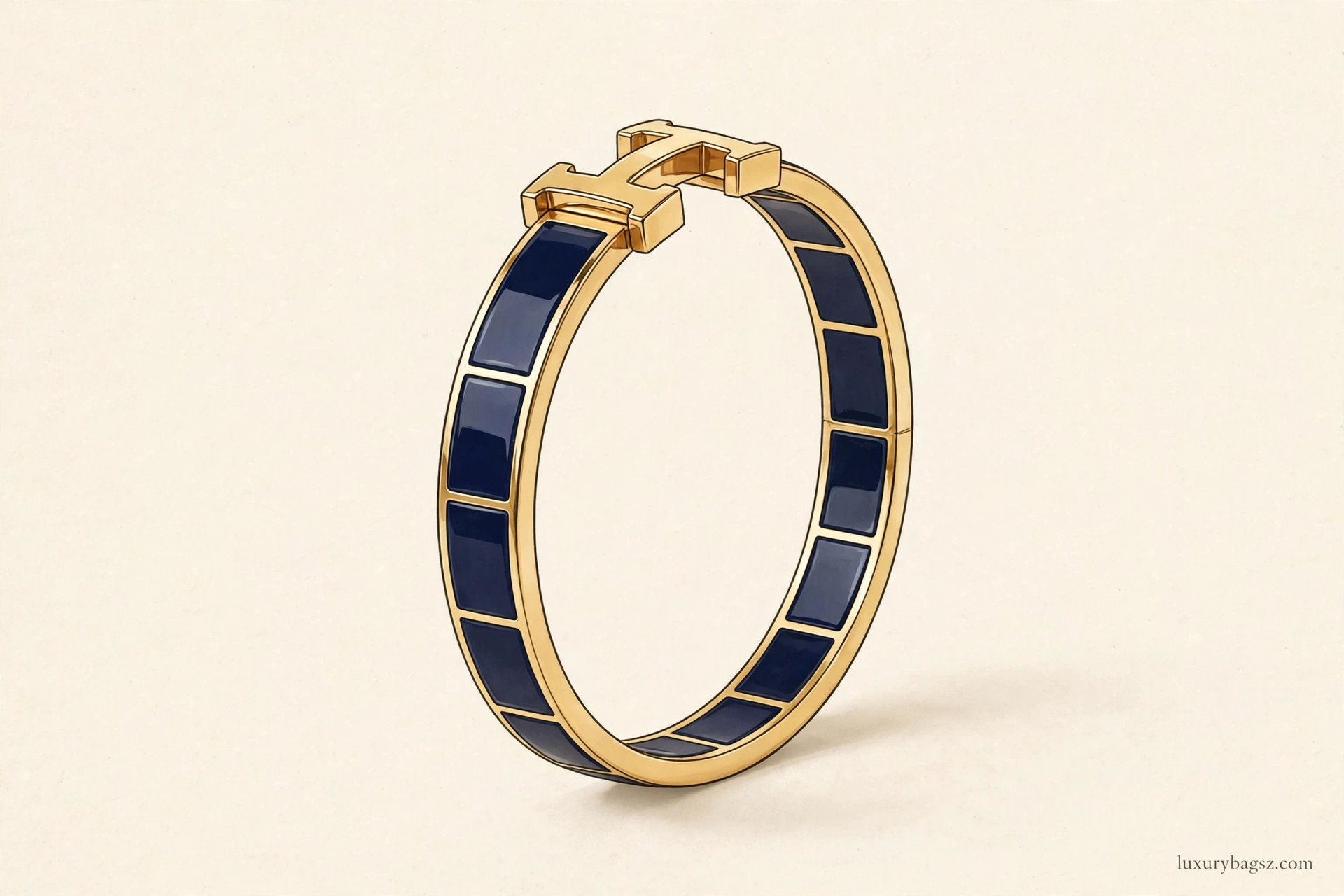
The Hermès Clic H bracelet is a hinged enamel bangle with a large letter H at the front. That H is not decoration added on top of a separate fastening. It is the fastening. You squeeze or pivot it, the bracelet swings open at a hinge on the opposite side, you put it around your wrist, and you press it shut until it clicks. That click is where the “Clic” part of the name comes from.
The band itself is metal, usually described as brass with a plated finish, with coloured enamel set into the metal frame. The enamel is the colour you see. The metal frame is the outline, the edges, and the H. Change the enamel colour, change the metal finish, and you have a different-looking bracelet, even though the shape stays the same.
It is one of Hermès’ most recognisable pieces of jewellery, and also one of the most confusing to shop for. That confusion is not your fault. Sellers, resale listings, and even guides use the names Clic H, Clic Clac H, and H bracelet as if they always mean the same thing. They do not, or at least they do not do so consistently. Sizes are described in at least three different ways. Prices quoted online range from a few hundred dollars to well over two thousand, and both ends of that range can be genuine figures for different pieces, different years, and different markets. This guide sorts out what is settled, states plainly where sources disagree, and adds the practical detail most short guides skip: how the clasp actually works, how to measure for it, how enamel differs from paint, how to stack it without wrecking it, and what to check before buying one pre-owned.
If you remember only one thing, remember this: the Clic H is a plated enamel bangle with a pivoting H clasp, not a solid-gold bracelet, not a lock, and not a one-size piece. Everything else in this guide follows from that.
What the Bracelet Is Made Of, Part by Part
Picture the bracelet as a loop that opens in one place. Working around that loop, you meet four elements.
First, the band. This is the curved metal frame that wraps around the wrist. On most standard versions it is a brass base with plating on top. Plating is a thin layer of another metal applied over the base. It gives the colour and shine, but it is not the same as a bracelet made entirely from that metal. This matters for price, for care, and for repairs, and it is the single most common misunderstanding about the piece.
Second, the enamel. Enamel panels sit inside the metal frame on the outer face of the band. On a plain Clic H, the enamel is a single flat colour. On printed versions, the enamel carries a pattern. The enamel is smooth, glossy, and hard, and it is what gives the bracelet its deep, saturated colour. It is not a coat of paint brushed on at the end. True enamel is a glass-like material fired at high heat, and that firing is part of why the colour looks so even and so deep.
Third, the hinge. Opposite the H, the band is joined by a hinge. This is the pivot that lets the bracelet swing open like a small gate. A healthy hinge feels firm and smooth. It should not flop loosely, and it should not need force. If a hinge feels gritty, slack, or stiff in a way that makes you force it, that is a warning sign, whether the piece is new or pre-owned.
Fourth, the H clasp. At the front, the two ends of the band meet at the H. One side of the H is fixed to one end of the band, and the other side engages with the other end. When you close the bracelet, the H sits straight across the front, bridging the gap, and the mechanism clicks into place. When you open it, the H releases and the band swings open at the hinge. The H is therefore doing two jobs at once: it is the visual centre of the bracelet, and it is the closure that holds the whole loop shut.
The bracelet is oval rather than round, because a wrist is oval rather than round. That oval shape is deliberate. It stops the bracelet from spinning freely around the wrist, and it keeps the H sitting at the front where it belongs. A perfectly round bangle in this style should make you pause, because it does not match how a genuine Clic H is shaped. Shape alone never proves anything on its own, but it is one of the first things to notice.
Inside the band, genuine pieces carry engraving. The usual form is “HERMÈS” in capitals, often with “MADE IN FRANCE” and a letter code that relates to the year of manufacture. The exact format has changed over the years, and sources describe the marking system differently depending on era, so do not treat one photo of one marking as the rule for every year. What matters is that the engraving on a genuine piece is crisp, clean, and evenly stamped, not scratched, blurry, or unevenly deep.
The Naming Mess: Clic H, Clic Clac H, and H Bracelet
This is where most buyers first get lost, so let us untangle it carefully.
The original name, according to several histories of the piece, was simply the Hermès H bracelet. Wearers started calling it “Clic Clac” because of the clicking sound it makes when it opens and closes. Over time, the nickname stuck so firmly that it became part of how the piece is sold and searched for. That is why you will see the same bracelet listed under three names in different places.
Then a second distinction grew up on top of that. Some guides and sellers now use “Clic H” for the version with the bold, pivoting H clasp, and “Clic Clac” or “Clic Clac H” for a version with a flatter, more discreet rectangular clasp that carries a small Hermès engraving instead of a big H. Other guides and sellers use “Clic Clac H” for every version, including the H-clasp version. Both usages are out there, and neither has fully won. Hermès’ own current listings add to the mix, because they sell pieces labelled Clic H, Clic Clac H, Clic HH, and Mini Clic Kelly side by side, each with its own clasp and proportions.
What should you do with this? First, do not buy on the name alone. Look at the clasp in the photo. If the front is a large H that pivots, you are looking at the H-clasp bracelet this guide is about. If the front is a plain rectangular plate, you are looking at a different clasp style, even if the listing calls it a Clic Clac. Second, when you compare prices, compare like with like. A price for a narrow plain Clic H tells you nothing about the price of a wide printed Clic Clac, and mixing the two up is how people end up thinking they have found a bargain or been overcharged when neither is true.
The same letter does a different job on a Constance bag, where the H is a bag buckle rather than a bracelet clasp, which is a useful reminder that the H is a house motif used across many kinds of pieces, not a feature unique to this bracelet.
How the Clasp Opens and Closes
Many guides say “it clicks open and shut” and stop there. That is not enough when you are holding one for the first time, because the motion is not obvious, and forcing it is exactly how hinges and clasps get damaged.
Start with the bracelet closed and the H facing you. The H has two upright legs joined by a crossbar. To open it, press or squeeze the sides of the H together in the way the mechanism allows, while holding the band steady with your other hand. You are releasing the catch, not bending the metal. Use a gentle, even pressure. If you find yourself pushing hard, stop and reposition your fingers. Force is a sign that you are pressing in the wrong place or at the wrong angle, not a sign that the bracelet is stuck.
Once the catch releases, the bracelet swings open at the hinge on the opposite side. It opens like a gate, not like a cuff you bend apart. Do not try to pull the two ends apart sideways or twist them. Let the hinge do the work. Place the open bracelet around your wrist, with the hinge at the back of the wrist and the H at the front, then bring the two ends together and press until you hear and feel the click. That click is your confirmation. If it closes silently, or if the H sits crooked after closing, open it again gently and close it again. A bracelet that will not click shut cleanly, or a clasp that sits at an angle when closed, needs attention before you wear it out of the house.
A few practical points that rarely make it into short guides. First, practise opening and closing it at home, over a soft surface, before you wear it anywhere busy. Dropping a hard enamel bracelet onto a hard floor is one of the easiest ways to chip it. Second, do not open it with wet or slippery hands if you can avoid it. Third, never use a tool, a fingernail levered hard under the H, or another piece of jewellery to force the catch. The mechanism is designed to be operated by fingers. If fingers cannot operate it smoothly, that is information, not a challenge.


One more detail: some older and wider versions are described in authentication guides as using different screw types at the pivot, with flathead screws on narrow and wide versionsand a star-shaped screw on particularly wide versions. You do not need to unscrew anything to wear the bracelet, and you should not. The point of knowing this is only that a screw that looks wrong, stripped, or replaced with something crude is worth noticing on a pre-owned piece.
What the H Clasp Is Not
This part corrects three ideas that cause real mistakes.
The H clasp is not a lock. It has no key, no combination, and no locking mechanism in the sense of a padlock or a bag lock. It is a spring catch that holds the bracelet closed with a click. That is enough to keep it on your wrist during normal wear, but it is not a security device. Do not rely on it to protect the bracelet from being slipped off, and do not describe it to a seller or a buyer as a lock, because that word creates a false expectation about how secure it is.
The H clasp is not a hinge. The hinge is on the opposite side of the bracelet. The H is the closure. Mixing the two up matters when you describe a fault. “The hinge is loose” and “the clasp will not click shut” are different problems with different repairs, and a repairer will need to know which one you mean.
The H clasp is not adjustable. You cannot tighten it, loosen it, or resize the bracelet by fiddling with the H. Fit comes from choosing the right bracelet size and width in the first place, which is why the sizing parts of this guide matter more than any trick for making a wrong size work.
Materials in Plain Terms
The standard Clic H is enamel set in plated metal. The metal finishes most often listed are gold-plated, palladium-plated, and rose gold-plated. Palladium plating gives a silvery-white finish. Rose gold plating gives a warm pinkish finish. Gold plating gives a yellow finish. Some resale valuation reports describe a specific piece as 18k yellow gold-plated brass, which is a useful example of how the construction is described when it is documented properly: a brass base, a gold plating, and enamel on top.
What the bracelet is not, in its standard form, is solid gold, solid palladium, or solid rose gold. If a listing describes a standard enamel Clic H as solid gold, treat that as a red flag, or at best as sloppy wording. There are precious-metal Hermès pieces at very different prices, but the everyday enamel Clic H is not one of them. The same caution applies in the other direction. If a listing says “gold” with no mention of plating, ask what that word means in that listing before you pay.
Plating has practical consequences. It can wear over time, especially on edges and on the H itself, where fingers touch it every time the bracelet is opened and closed. It can be scratched by harder metals. It does not respond well to abrasive polishes, which can strip it. None of this makes plating a flaw. It is simply the construction, and it should be priced and cared for as plating, not as solid metal.
Enamel, by contrast, is not a metal at all. It is a hard, glass-like coating. That hardness is why the colour stays vivid and why the surface feels cold and smooth. It is also why enamel is brittle in a particular way: it resists scratching from soft contact better than paint does, but it can chip or crack from a sharp knock. Think of it as closer to glass than to plastic. That single comparison explains most of the care advice in this guide.
Unlike leather, where the material itself varies by animal, tannery, and finish, enamel colour here is a manufactured finish applied to a metal frame. If you want to understand how different that world is from leather, the guide to where Hermès leather comes from shows how much of leather quality depends on origin and tanning, while a Clic H depends far more on the firing of the enamel and the quality of the plating.
Enamel, Lacquer, and Paint Are Not the Same Thing
Sellers and guides often use the words enamel, lacquer, and paint as if they were interchangeable. They are not, and the difference is worth knowing, because it affects how the bracelet ages and how you should clean it.
True enamel, in the jewellery sense, is a powdered glass-like material fused to metal by firing at high heat. It is applied in layers, fired, cooled, and finished to a smooth, hard surface. The result is dense, glossy, and colourfast in a way that paint rarely is. When you run a finger over genuine enamel, it feels cool, hard, and perfectly smooth, with the colour sitting flush inside its metal frame rather than sitting on top of it like a sticker.
Lacquer is a coating that dries or cures on a surface without that high-heat glass fusion. It can look glossy and colourful, and it is used on many fashion jewellery pieces, but it is generally softer and more vulnerable to solvents, scratches, and chipping than fired enamel. Paint is broader still, and in cheap copies it is often simply coloured coating over a base metal or plastic.
Why does this matter for a buyer? Because a copy made with resin, plastic, or paint can look convincing in a single photo and feel wrong in the hand. Resin and plastic feel warmer and lighter than enamel. They scratch more easily with a fingernail. They may show bubbles, uneven colour, or colour bleeding into the metal border. Genuine enamel, by contrast, should look uniform, sit flush with its metal edges, and feel cool and weighty. None of these signs proves authenticity on its own, and a good copy can mimic some of them, but together they are a useful first filter.
For care, the distinction points in the same direction: treat the surface as hard but brittle, and keep solvents and abrasives away from it. A cleaner that is safe for painted fashion jewellery is not automatically safe for enamel, and a cleaner that is safe for solid metal is not automatically safe for plating. When in doubt, the gentlest method in this guide is the right one.
Widths: Narrow, Wide, and Wider Still
Width is the first choice most buyers actually notice, and it is also the choice most often confused with size. Width is how broad the band is across your wrist. Size, in the PM and GM sense, is how large the loop is around your wrist. A bracelet can be narrow and large, or wide and small. Keep those two ideas apart and most sizing confusion disappears.
The narrow version is the one most people start with. Guides commonly describe it as about 12 millimetres wide, or about half an inch. It gives a slim line of colour, it sits comfortably under a sleeve, and it is the easiest width to stack. If you want a bracelet that reads as jewellery rather than as a statement cuff, narrow is the natural starting point.
The wide version is bolder. Guides commonly describe it as about 20 millimetres, or around three quarters of an inch to a full inch, depending on the version and the source. That range itself is a warning: “wide” is not one fixed measurement across every year and every variant. A wide band gives a much larger block of colour, it is more visible from a distance, and it feels more substantial on the wrist. It is also less forgiving if the fit is wrong, because a wide band cannot slide and settle the way a narrow one can.
Beyond wide, there are extra-wide and XL versions, including the Clic H XL Midnight listed at a much higher price than the standard versions. These are statement pieces, not everyday starter pieces, and they should be judged on their own terms. Do not assume that an XL price tells you anything about a standard narrow price, or that a narrow fit tells you anything about how an XL will feel.
Width also affects wear. A narrow bracelet next to a watch or another bracelet moves a little and causes a little friction. A wide bracelet next to the same neighbours causes more friction over a larger area, which means more chance of scuffing, both to the enamel and to whatever sits beside it. That is not a reason to avoid wide versions. It is a reason to think about stacking before you buy, rather than after.
Sizes: PM, GM, and the Numbers That Do Not Agree
Here is the honest position: sources disagree about Clic H sizing, and any guide that gives you one clean table without mentioning that disagreement is hiding something.
Hermès’ own size guidance says that Clic Clac and Clic H bracelets are available in small (PM, given as 6 centimetres) and large (GM, given as 6.5 centimetres). Those figures describe diameter, not wrist circumference, which is part of why they look so different from the inch figures in resale and blog guides. A diameter and a circumference are different measurements, and converting between them for an oval bracelet is not as simple as multiplying by a fixed number.
Resale and blog guides, meanwhile, give wrist-circumference figures that do not match each other. Some say PM fits wrists up to about 6.2 inches and GM fits up to about 6.7 inches. Others say PM fits up to about 6.7 inches. Others give GM as about 7.1 inches, and one guide gives PM and GM as fitting up to 6.7 and 7.5 inches respectively. Still other guides describe a T1, T2, and T3 system, at about 6.1, 6.7, and 7.1 inches, which appears to belong to a different bracelet family and gets mixed into Clic H discussions by mistake.
What can you safely take from this mess? First, PM means Petit Modèle, the smaller model, and GM means Grand Modèle, the larger model. That relative fact is stable even when the exact inches are not. Second, the difference between PM and GM is modest, roughly half a centimetre in diameter on Hermès’ own figures, which is why trying both on matters more than memorising a chart. Third, some guides also mention a TGM size, a still larger model, for some versions, but it is not part of every range, so do not assume it exists for the colour and width you want.
Era matters too. Widths, sizes, and even the exact shape of the H have varied over the years, and a bracelet from an older collection may not match the current size chart exactly. If you are buying pre-owned, the size printed or engraved on the piece, the seller’s measured circumference, and your own wrist measurement are all more useful than a generic chart.
The practical rule that follows from all of this is simple: use the chart as a starting point, then try the bracelet on if you possibly can. If you cannot try it on, buy from a seller who gives a measured inside circumference and a clear return policy, and measure your own wrist exactly as described in the next part.
How to Measure Your Wrist for a Clic H
Because the Clic H is hinged, you do not need to fit it over your hand. That is a real advantage over a solid bangle, where hand size matters as much as wrist size. For a Clic H, wrist size is what matters, but you still need to measure it properly, because a hinged bracelet that is too tight will pinch and a hinged bracelet that is too loose will slide down onto your hand all day.
You need a soft measuring tape, the kind used for sewing. If you do not have one, use a strip of paper or a piece of string, mark where it meets, and measure that length flat against a ruler. Do not use a metal tape measure, and do not guess from a watch strap, although a well-fitting watch strap can be a rough cross-check.
Wrap the tape snugly around your wrist at the point where the bracelet will sit, usually just below the wrist bone, on the side towards your hand. Keep the tape flat against the skin, not twisted, and snug but not tight. You should be able to slip a fingertip under the tape without forcing it. Read the measurement where the tape overlaps. Write it down. Then measure again, because a tape that slips by half an inch will put you in the wrong size.
Now add fit preference. A Clic H is a structured bracelet, not a soft chain. It is meant to sit fairly close to the wrist, with a little movement, not to hang loose like a bangle that slides up and down the forearm. If you are between sizes, the usual advice is to choose the larger size for comfort, especially for a wide version, which feels tighter than a narrow version at the same loop size. If you like a snug, neat look and you are buying narrow, the smaller size may suit you, but only if you have tried that snugness and liked it. Do not choose a smaller size hoping it will stretch. It will not. Metal and enamel do not stretch.
Also measure with your usual context in mind. If you always wear a watch on the same wrist, the bracelet will sit next to it, and that changes how much room it has. If your wrist swells in heat, or if you plan to wear the bracelet over a sleeve, factor that in. A bracelet that fits perfectly on a cool morning in a shop can feel tight on a hot afternoon, and that is normal for a rigid piece.
Finally, remember the shape point from earlier. Because the bracelet is oval, its fit depends on the shape of your wrist as well as its circumference. Two wrists with the same circumference can feel different in the same bracelet if one is rounder and one is flatter. This is another reason why trying it on beats any chart.

Colours and Hardware: How Combinations Work
One of the reasons the Clic H has lasted is the sheer range of combinations. The enamel colour and the metal finish are chosen together, and the same enamel colour can look completely different in gold plating, palladium plating, or rose gold plating.
Classic colours include black, white, navy, and gold-toned neutrals, alongside the famous Hermès orange. Brighter colours include pinks, reds, greens, and blues, and Hermès gives its colours specific names that change by collection. Two pinks that look identical in a resale photo can be different colours with different names in person, which is why you should never buy a colour based on a single unlabelled photo. Ask the seller for the colour name if they know it, and compare it against the bracelet in daylight, not only under shop lighting.
Hardware changes the character of the piece more than many buyers expect. Gold plating warms a colour and makes it read as classic and dressy. Palladium plating cools it and makes it read as crisp and modern. Rose gold plating softens it and pairs naturally with pinks and warm neutrals. There is no universally best finish. There is only the finish that suits the colours you already wear and the other jewellery you already own.
A word on white and gold in particular, because it is the combination most often searched for. A white enamel Clic H with gold plating is a real, classic combination, but “white and gold” is also a phrase sellers use loosely for anything pale with yellow metal. Check the enamel colour in the photo, check the hardware colour, and do not assume that a listing titled “white and gold” matches the exact shade you have in mind.

Printed and Patterned Versions
Beyond plain enamel, Hermès makes printed Clic H versions where the enamel carries a pattern rather than a single colour. These patterns draw on the house’s scarf and textile designs, and they include animal motifs, geometric patterns, and pictorial scenes. Printed versions are usually priced higher than plain versions when new, and they are also harder to judge pre-owned, because a pattern gives a copy more detail to get wrong and gives a buyer more detail to check.
For a printed version, look at how the pattern meets the clasp. On a well-made piece, the pattern should flow sensibly up to the metal edges and the H, without smudging, bleeding, or breaking in a way that looks accidental. Look at whether the pattern repeats evenly around the band, and whether the colours stay clean at the edges. A pattern that looks blurry, patchy, or misaligned is worth questioning, even if the plain-colour parts of the bracelet look fine.
Printed versions also raise a care point. The pattern is part of the enamel, not a sticker on top of it, on a genuine piece, but it is still enamel, and it still chips if knocked. Do not treat a printed bracelet as tougher than a plain one just because it looks busier. If anything, chips show more clearly on a pattern, because they break the design.
How It Should Feel on the Wrist
A well-fitting Clic H feels structured and present. You notice it, especially at first, in a way you would not notice a thin chain. That is normal. It should not pinch, dig, or leave a deep mark after a short wear. It should not slide freely down over the back of your hand when you lower your arm. It should stay roughly in place, with the H at the front, and it should move a little when you move your wrist, without rotating all the way around.
Give yourself a few days to judge comfort, if you can. A rigid bracelet feels different on day one from how it feels once you are used to it. But do not confuse getting used to it with accepting a wrong fit. Pinching at the hinge or at the clasp, a bracelet that constantly twists so the H ends up on the inside of your wrist, or a bracelet that you have to keep pushing back up your arm are all fit problems, not breaking-in problems. Enamel and metal do not break in the way leather does.
Weight is part of the feel. A genuine Clic H has a satisfying heft from its metal and enamel. It is not heavy in the sense of a solid metal cuff, but it is not light and tinny either. A bracelet that feels like a toy, or that feels hollow, should prompt a closer look, especially pre-owned. Weight alone never proves anything, because width and version change the weight, but a dramatic mismatch between the look and the feel is worth noticing.
Styling It: On Its Own, Stacked, and With a Watch
On its own, the Clic H needs very little help. A narrow version with a plain outfit, a wide version with a simple dress or a shirt with the sleeves pushed up, and the bracelet does the work. That simplicity is part of its appeal. If you are buying your first one, start by imagining it with the clothes you already wear most often, not with an outfit you would have to buy to match it.
Stacking is where the Clic H becomes a collection rather than a single piece. The classic stack is two or three narrow Clic H bracelets in colours that either match, contrast, or graduate from one to another. A black, a white, and a bright colour is a common starting trio. Two narrow bracelets in the same hardware finish look more deliberate than two in clashing finishes, although mixing finishes can work if it is done on purpose and the colours tie the stack together.
Stacking with other kinds of bracelets needs more care. Thin metal bangles, beaded bracelets, and leather wraps can all sit next to a Clic H, but every neighbour is a potential source of scratches. The enamel is hard, but it is not scratch-proof, and plating is softer than many people realise. A bracelet with a rough edge, a charm with a sharp corner, or a watch case with a hard bezel can all mark the enamel or the plating over time. If you stack, put the Clic H where it moves least, keep the neighbours smooth, and check the contact points after the first few wears.
Wearing it with a watch is common and usually works well, but it needs the same thinking. A watch on the same wrist will sit next to the bracelet, and the two will touch when you move. A smooth watch case is kinder than a chunky, angular one. A leather watch strap is kinder than a metal bracelet watch, which can grind against the enamel. Some people prefer the watch on one wrist and the Clic H on the other, which removes the problem entirely and lets each piece be seen on its own. There is no rule here, only a trade-off between the look you want and the wear you are willing to accept.
A silk scarf tied at the neck pairs naturally with a Clic H, and a scarf ring keeps that scarf in place without anything touching the bracelet itself, which is a neat way to add a second Hermès accessory without adding friction at the wrist.
Stacking Without Damage: The Rules That Matter
Short guides often say “stack it” and leave it there. The damage-aware version is more specific, and it is worth spelling out, because enamel chips are not repairable in the way a scratched metal surface is.
First, keep hard against hard to a minimum. Two enamel bracelets knocking together are less risky than an enamel bracelet knocking against a steel watch case or a bracelet with metal studs, but they can still chip each other at the edges. Space matters. A stack that is packed so tightly that nothing can move will grind more than a stack with a little breathing room.
Second, put the most vulnerable piece where it is protected. If you have one Clic H you care about most, wear it in the middle of a stack rather than at the end, where it takes knocks from tables, door frames, and bags.
Third, take the stack off for tasks that involve impact. Typing is fine. Gardening, gym work, carrying heavy bags by their handles, and anything where your wrist will hit a hard surface repeatedly is not the time for enamel. Hermès itself advises removing jewellery before activities that may damage it, including sport and swimming, and that advice applies here with full force.
Fourth, check the neighbours. Run a finger along any bracelet you plan to stack with a Clic H. If you feel a sharp edge, a rough join, or a protruding charm, that neighbour is a scratch risk, however pretty it looks.
Fifth, accept that stacking causes wear. Even careful stacking will, over years, leave faint marks on plating and enamel. If you want a bracelet to stay pristine, wear it alone and store it alone. If you want the stacked look, accept the trade-off and choose colours and finishes that will age gracefully with a little wear.

Cleaning It: The Gentle Method
Enamel care is not leather care. The routine for clean Chanel bags is built around leather, which is porous, flexible, and sensitive to water in its own way. A Clic H is rigid metal and glass-like enamel, and it needs a different, simpler routine. Do not transfer a leather routine onto an enamel bracelet, and do not transfer an enamel routine onto a leather bag.
For everyday cleaning, a soft, dry, lint-free cloth is enough. Wipe the enamel and the metal gently after wearing, to remove skin oils, dust, and traces of perfume or lotion. A microfibre cloth made for glasses or a soft cotton cloth both work. Do not use a paper towel, which can be surprisingly abrasive, and do not use a polishing cloth impregnated with chemical polish unless you are sure it is safe for plating.
For a deeper clean, a slightly damp soft cloth, wrung out well, can be used, followed at once by drying with a second dry cloth. Do not soak the bracelet. Do not run it under a tap for a long time. Do not use hot water. If you need to remove grime from around the H or the hinge, a very soft brush, used gently and dry or barely damp, is better than a chemical. Dry the bracelet fully before you put it away, because moisture trapped around the hinge or under the H is not helpful for plated metal.
What to avoid matters more than what to use. Avoid harsh chemicals, including bleach, acetone, nail polish remover, and strong solvents. Avoid abrasive pastes, including toothpaste and baking soda pastes, which are sometimes suggested online for jewellery and which can scratch plating and dull enamel. Avoid ultrasonic cleaners unless a professional who knows the piece tells you otherwise, because vibration and heat are not kind to enamel and to a hinged mechanism. Avoid silver dip and gold dip solutions, which are made for solid metals and can strip plating. Avoid spraying perfume, hairspray, or sunscreen directly onto the bracelet. Put those products on first, let them dry, and then put the bracelet on.
If the bracelet has been exposed to salt water, chlorinated water, or a chemical spill, rinse it gently with clean, lukewarm water at once, dry it at once, and inspect it. Do not wait until later. Chlorine in particular is an enemy of plating, and sweat, which is mildly acidic, will dull plating over time if it is left on the surface repeatedly. This is not a reason to panic about normal wear. It is a reason to wipe the bracelet after wearing it on a hot day.
What Damages Enamel: Impact, Chemicals, Heat, and Time
Enamel’s weakness is not softness. It is brittleness. A sharp knock, a drop onto a hard floor, or a repeated bang against a table edge can chip it, even if the bracelet looks fine after a soft bump. Chips usually happen at edges, where the enamel meets the metal frame, because that is where force concentrates. Once enamel is chipped, the damage is visible, it exposes the material underneath, and it cannot be polished away the way a scratch on metal can. Prevention is therefore worth far more than repair.
Chemicals damage enamel and plating in a slower, less dramatic way. Perfume, hairspray, cleaning sprays, and lotions can dull the surface over time. Strong solvents can do worse, faster. The rule is simple: the bracelet goes on last, after products, and comes off first, before cleaning, cooking with strong chemicals, or any task involving solvents.
Heat and sudden temperature change are also unkind to enamel. Do not leave the bracelet on a radiator, in a hot car, or next to a heater. Do not take it from a very cold place into a very hot shower and expect the enamel to be indifferent. Enamel and metal expand at different rates, and repeated extreme changes can stress the bond between them.
Time and normal wear cause plating to thin, especially on the H, where fingers grip it, and on the outer edges, where it meets the world. This is normal wear, not a fault, and it happens faster if the bracelet is worn daily, stacked with harder pieces, or cleaned with anything abrasive. A bracelet worn occasionally and stored properly will keep its plating far longer than one worn every day against a steel watch.
Storage and Travel
Storage for a Clic H is simple, but it is worth doing properly, because most scratches happen off the wrist, not on it.
Store the bracelet in its own soft pouch or its own compartment, closed, so that the H does not catch on anything and the enamel does not rub against other jewellery. Do not toss it into a bag with keys, coins, or other bracelets. Do not store it loose in a drawer where it can slide against hard objects. Keep it away from direct sunlight, heat, and humidity when it is not being worn. Sunlight will not fade enamel the way it fades fabric, but heat and humidity are still unhelpful for plating and for the hinge over time.
The same separate-pouch habit that helps when you store a Hermes Kelly bag applies here in miniature: give the piece its own space, keep it clean and dry before you put it away, and do not let it share that space with anything harder than itself. The Kelly guide is about a bag, not a bracelet, but the principle of one piece, one protected space, transfers directly.
For travel, carry the bracelet in its pouch inside a hard case or a padded compartment, not loose in a suitcase pocket. Take it off for flights if you are likely to bang your wrist in a cramped seat, and put it on after you arrive. If you are travelling with several bracelets, pouch each one separately. A stack that travels as a loose pile will arrive scratched.
Repairs: What Can Be Fixed and What Cannot
A loose hinge, a clasp that will not click shut, a chipped edge, and worn plating are four different problems, and they have very different prospects.
A hinge that feels loose or a clasp that no longer clicks cleanly should be looked at by Hermès or by a jeweller experienced with enamel bracelets. Do not try to tighten the hinge yourself with pliers, and do not bend the H to make it catch. Bending plated metal weakens it, and a bent H that catches today may snap or sit crooked tomorrow. A professional can judge whether the mechanism needs adjustment, cleaning, or a part, and whether the work is worth the cost for that piece.
A chipped enamel edge is the hardest problem. Enamel cannot be polished back the way metal can, and a repair that fills a chip will rarely match the original colour and gloss perfectly. Some specialists can do enamel repair, but it is skilled work, it is not cheap, and the result may still be visible on close inspection. This is why the prevention advice in this guide is so insistent. If you are buying pre-owned, a chip should reduce the price, and you should decide before you buy whether you can live with it as it is.
Worn plating can sometimes be re-plated, but re-plating an enamel bracelet is not the same as re-plating a plain metal ring. The enamel must be protected during the work, the colour match must be right, and the cost may approach the value of a standard pre-owned piece. Get a quote before you commit, and be wary of any repairer who promises a perfect, invisible result without seeing the piece.
For any repair, keep the original box and any receipt or proof of purchase you have, even though Hermès issues no authenticity card as a general rule. Proof of purchase helps a repairer and a future buyer, even when it is not a card, and it costs nothing to keep.
Price: Why One Number Never Tells the Story
If you search for a Clic H price, you will find numbers that seem to contradict each other. They mostly do not contradict each other, once you know what each number is describing. They describe different pieces, different years, and different markets.
On Hermès’ own current United States listings, as found during research for this guide, a plain Clic H bracelet is listed at $810, patterned versions at $870, a Clic Clac H at $890, and a Clic H XL Midnight at $1,575. Those are current retail figures for those specific listings, in that market, at that time. They will change with price rises, with currency, and with market, and a price in euros or in another region will not match them.
Older guides and older reviews give lower figures, including $600 for a Clic H at the time of one 2018 review, and $600 to $700 for a narrow version and $800 to $900 for a wide version in a more recent resale guide. Those figures may have been accurate when they were written. They are not current retail prices, and they should not be quoted as if they were.
Other guides give much higher figures, including a range of $1,200 to $2,500 for a Clic H depending on finish and size. That range does not match Hermès’ own current listings for standard pieces, and it may reflect resale asking prices for rare colours, printed versions, wider versions, or a different market. Treat it as a sign that prices vary widely, not as a retail price.
Resale prices vary more again. During research, single resale listings and marketplace ranges included figures around $575, $625, $649, $650, and $765 for various narrow and wide pieces. Those are single listings, not market averages, and they should never be quoted as “the resale value” of a Clic H. A single listing reflects one seller, one condition, one colour, one size, and one moment. Averages need many sales of comparable pieces, and a guide that quotes one listing as an average is misleading you.
What should you pay? For a new piece, check Hermès’ current price for the exact version you want, in your market, before you budget. For a pre-owned piece, compare several recent sales of the same width, colour family, hardware, size, and condition, and adjust for chips, hinge condition, and missing packaging. A pre-owned piece in excellent condition with its box will reasonably cost more than the same piece with a chip and no box. A rare colour or a discontinued pattern may also cost more, but rarity alone does not make a damaged piece valuable.
Where to Buy, and What to Expect
Buying new from Hermès, either in a boutique or through its website where available, gives you the current version, the current price, and the full packaging. It also gives you the chance to try sizes on, which, as this guide has argued, matters more than any chart. Availability varies by colour and size, and popular combinations sell out. That is normal for Hermès, and it is not a sign that a colour is discontinued.
Buying pre-owned, from a reputable resale platform, an auction house, or a trusted dealer, gives you access to discontinued colours, older versions, and lower prices. It also gives you risk. Condition, authenticity, and size all need checking, and the return policy matters as much as the price. Buy from a seller who provides clear, close photos of the enamel, the H from the front and the side, the hinge, and the inside engraving, and who states the size, the width, and the condition honestly. If a seller cannot or will not provide those photos, that is information.
Be cautious with marketplace listings that show only one stock-style photo, that describe the piece only as “gold” with no mention of plating, or that promise an authenticity card as proof. Hermès issues no authenticity cards as a general rule, so a card included with a Clic H is not the proof it is presented as, and in some cases it is a sign of a copy. Packaging, receipts, and a seller’s reputation are more useful than a card.
Pre-Owned Condition Checks
Use this checklist when you are looking at a pre-owned Clic H, whether in person or from photos. No single check proves authenticity, and no single flaw proves a copy. The pattern across the checks is what matters.
First, look at the shape. It should be oval, not perfectly round. Second, look at the enamel. It should be smooth, even in colour, and flush with its metal frame, with no bubbles, rippling, or colour bleeding into the metal border. Third, look at the edges. Chips at the enamel edges, especially near the H and the hinge, should be visible in good photos, and their absence in a listing that claims mint condition is worth questioning.
Fourth, look at the H. It should sit straight when closed, with a consistent gap between the H and the enamel on each side. A crooked H, a wobbly H, or a gap that is wide on one side and tight on the other is a warning sign. Fifth, operate the clasp, or ask the seller to demonstrate it. It should open and close with a clean click, with firm but smooth hinge tension, not loose and floppy, not stiff and gritty.
Sixth, look at the hinge. It should be neat, with screws that look correct for the version, not stripped, replaced, or crude. Seventh, read the inside engraving. It should be crisp, clean, and evenly stamped, in the format appropriate to the era. Blurry, scratched, or unevenly deep engraving is a warning sign. Eighth, feel the weight and the temperature. Enamel and metal feel cool and weighty. Plastic and resin feel warm and light.
Ninth, check the plating. Look for even colour, and for wear on the H and the edges that matches the claimed condition. A bracelet claimed as unworn should not show heavy plating wear. Tenth, check the colour name and the hardware finish against the photos, in daylight if possible. Eleventh, check the size and width as measured, not just as labelled. Ask for the inside circumference if it is not given. Twelfth, check what is included, and do not treat a missing box as a fault on its own, since packaging is often lost, but do treat a promised authenticity card with scepticism, for the reason given above.
If several checks raise doubts, walk away or get a professional authentication before you pay. A Clic H is a popular piece, and another one in your colour and size will come along. Paying for a copy because you were in a hurry is the most expensive way to buy one.

Authenticity Signals, and Their Limits
This guide gives authenticity signals, not a full authentication service, and that distinction matters. The signals above, shape, enamel quality, engraving, H alignment, hinge tension, weight, and plating, are the ones most often cited by authentication guides. They are useful, and they catch many poor copies. They do not catch every copy, because copies have improved, and because genuine pieces vary by era, wear, and repair.
Two limits deserve emphasis. First, a genuine piece that has been repaired, re-plated, or heavily worn may fail a visual check that a mint genuine piece would pass. A replaced hinge screw, for example, does not automatically mean a copy. It may mean a repair. Second, a good copy may pass several visual checks, especially in photos, and only fail on close handling, weight, or engraving detail. That is why professional authentication exists, and why a seller’s return policy and reputation matter as much as your own eye.
If you are spending a significant amount on a pre-owned piece, consider an independent authentication service, especially if the colour is rare, the price is unusually low, or the seller cannot provide the photos listed above. The cost of authentication is small compared with the cost of buying a copy.
Common Mistakes and Myths
The first mistake is buying on width alone, or on size alone, and confusing the two. Remember: width is across the band, size is around the loop. You need both right.
The second mistake is buying a colour from a single photo. Enamel colours shift with lighting, with screen settings, and with the age of the piece. Ask for daylight photos, ask for the colour name, and accept that a colour you love in a photo may look different in person.
The third mistake is treating the H as a lock. It is a clasp. It will hold the bracelet on your wrist, but it will not secure it against being removed, and it should not be described as a lock to a buyer or an insurer.
The fourth mistake is expecting an authenticity card. Hermès issues no authenticity cards as a general rule. A seller who presents a card as the main proof of authenticity is either mistaken or misleading you.
The fifth mistake is cleaning enamel like metal, or like leather. Harsh chemicals, abrasive pastes, and ultrasonic cleaners are all risks, not shortcuts. The gentle cloth method in this guide is slower, but it is the method that preserves plating and enamel.
The sixth mistake is stacking without thinking about friction. A beautiful stack that chips your favourite bracelet in a week is not a good stack. Check neighbours, give pieces room, and take enamel off for rough tasks.
The seventh mistake is quoting a single resale listing as a market price. One listing is one seller. Compare several comparable sales before you decide what a piece is worth.
Who the Clic H Suits, and Who Should Think Twice
The Clic H suits someone who wants a single, recognisable piece of jewellery that works with many outfits, who likes colour, and who is happy with a structured bracelet that sits close to the wrist. It suits a first Hermès jewellery purchase, because it is less expensive than many Hermès bags and leather pieces, and because it is easy to wear daily if you choose a narrow width and a colour you will not tire of.
It suits a collector, too, because the range of colours and patterns rewards collecting, and because narrow versions stack so well. A collector who buys slowly, one colour at a time, and who stores each piece separately, will get more pleasure from the range than someone who buys five at once and wears them all together every day.
Think twice if you do hard manual work with your hands, if you play sport with your wrist exposed, or if you dislike the feeling of a rigid bracelet. The Clic H is not a sports bracelet, and it will not survive repeated impact the way a silicone or steel sports band will. Think twice if you want a bracelet you never have to think about. Enamel needs a little care, and a wearer who wants zero maintenance will be happier with a plain metal bangle.
Think twice, as well, if you are buying purely as an investment. A standard Clic H is a jewellery purchase, not a financial asset. Some rare colours and discontinued patterns hold their value well pre-owned, and some do not, and condition dominates everything. Buy it because you want to wear it, and treat any resale value as a bonus, not as a promise.
An Evelyne bag is a useful comparison here, because it is also a low-key, everyday Hermès piece that rewards choosing the right size and the right colour for your own life rather than the most talked-about version. The bracelet works the same way: the right narrow version in a colour you wear constantly beats a dramatic wide version you only wear twice.
Questions Buyers Ask Most
What is the Hermès Clic H bracelet?
It is a hinged enamel bangle with a large H at the front that acts as the clasp. The band is plated metal with enamel panels set into it, the bracelet opens at a hinge opposite the H, and it closes with a click.
Is the Clic H the same as the Clic Clac H?
Not always, and that is the problem. Some sellers use the two names for the same H-clasp bracelet, because “Clic Clac” began as a nickname for the clicking sound. Other sellers use “Clic Clac” for a version with a flat rectangular clasp instead of a big H. Always check the clasp in the photo, not just the name in the title.
Is the Clic H solid gold?
No, in its standard form. It is plated metal, usually brass with gold, palladium, or rose gold plating, with enamel panels. If a listing calls a standard enamel Clic H solid gold, ask for clarification before you pay.
How do I open a Clic H bracelet?
Press or squeeze the sides of the H to release the catch, let the bracelet swing open at the hinge, place it around your wrist, and press it shut until it clicks. Use gentle, even finger pressure, and never force it with a tool.
Is the H a lock?
No. It is a clasp with a spring catch. It holds the bracelet closed during normal wear, but it has no key and no locking mechanism, and it should not be relied on as a security device.
What size should I buy, PM or GM?
PM is the smaller model and GM is the larger model. Sources disagree on the exact wrist measurements for each, with PM described as fitting up to about 6.2 inches in some guides and up to about 6.7 inches in others, and GM described from about 6.7 inches up to about 7.5 inches in different guides. Measure your wrist snugly, consider whether you prefer a snug or a relaxed fit, and try both sizes on if you can.
What is the difference between narrow and wide?
Narrow is about 12 millimetres, or about half an inch, across the band. Wide is about 20 millimetres to about an inch, depending on the version and the source. Narrow is subtler and easier to stack. Wide is bolder and more visible, and it feels tighter at the same loop size.
Can I wear a Clic H every day?
Yes, if you choose a width and fit you are comfortable with, and if you accept that daily wear will gradually wear the plating and increase the chance of chips. Take it off for sport, swimming, gardening, and any task where your wrist will hit hard surfaces repeatedly.
How do I clean a Clic H bracelet?
Wipe it with a soft, dry, lint-free cloth after wearing. For grime, use a slightly damp soft cloth and dry it at once. Avoid harsh chemicals, abrasive pastes, ultrasonic cleaners, and metal dip solutions, all of which can damage plating or enamel.
Can I clean it the same way as a canvas bag?
No. Canvas and enamel need different routines, and a method that suits canvas may be too harsh, or simply wrong, for a bracelet. If you also own canvas pieces, follow the guide to clean a canvas bag for those, and keep the gentle cloth method in this guide for the bracelet.
Does it come with an authenticity card?
Hermès issues no authenticity cards as a general rule. Do not treat a card as proof of authenticity, and do not reject a genuine piece only because it has no card, since packaging is often lost over time.
Can I shower or swim with it on?
You should not. Water, especially chlorinated or salt water, is unkind to plating, and soap, shampoo, and sunscreen can dull enamel and metal over time. Hermès advises removing jewellery before activities that may damage it, including swimming.
Can enamel chips be repaired?
Sometimes, by a specialist, but rarely invisibly, and often at a cost that approaches the value of a standard pre-owned piece. Prevention, through careful wearing and storage, is far more reliable than repair.
Is a Clic H a good investment?
Buy it to wear it. Some rare colours and discontinued patterns hold value well, and condition dominates resale price, but a standard Clic H should not be bought as a financial investment. Compare several recent sales of comparable pieces before you judge any resale price.
What should I check before buying pre-owned?
Check the oval shape, the evenness of the enamel, the straightness of the H when closed, the firmness of the hinge, the crispness of the inside engraving, the weight and feel, the condition of the plating, and the measured size and width. If several checks raise doubts, get professional authentication or walk away.
Final Verdict
The Hermès Clic H bracelet earns its reputation, but it earns it as a specific kind of piece, not as a generic luxury bracelet. It is a hinged enamel bangle with a pivoting H clasp, made from plated metal and fired enamel, in a range of widths, sizes, colours, and patterns that reward careful choosing and punish careless buying.
Buy the narrow version if you want an everyday piece that stacks easily and sits quietly with most outfits. Buy the wide version if you want colour and presence, and you are happy with a bolder, less forgiving fit. Measure your wrist properly, try both PM and GM on if you can, and do not let a single chart, a single price, or a single photo decide for you. Sources disagree on sizes and prices for good reasons, because the range has changed over time and across markets, and the only figures that matter are the ones for the exact piece in front of you.
Care for it gently, store it separately, take it off for rough work and water, and keep harsh chemicals away from it. Check it carefully pre-owned, and remember that no authenticity card is expected. Do those things, and a Clic H is a piece you can wear for years, in one colour or in a small, well-chosen stack, without the surprises that catch out buyers who shop by name alone.
Illustration note: all images in this article are generic AI illustrations with a small luxurybagsz.com mark. They are not real product photos, and where any illustration simplifies a detail, the text of this guide prevails.