How to Tell Hermès Scarf Sizes Apart: 55, 65, 70, 80, 90, 100 and 140 cm Explained
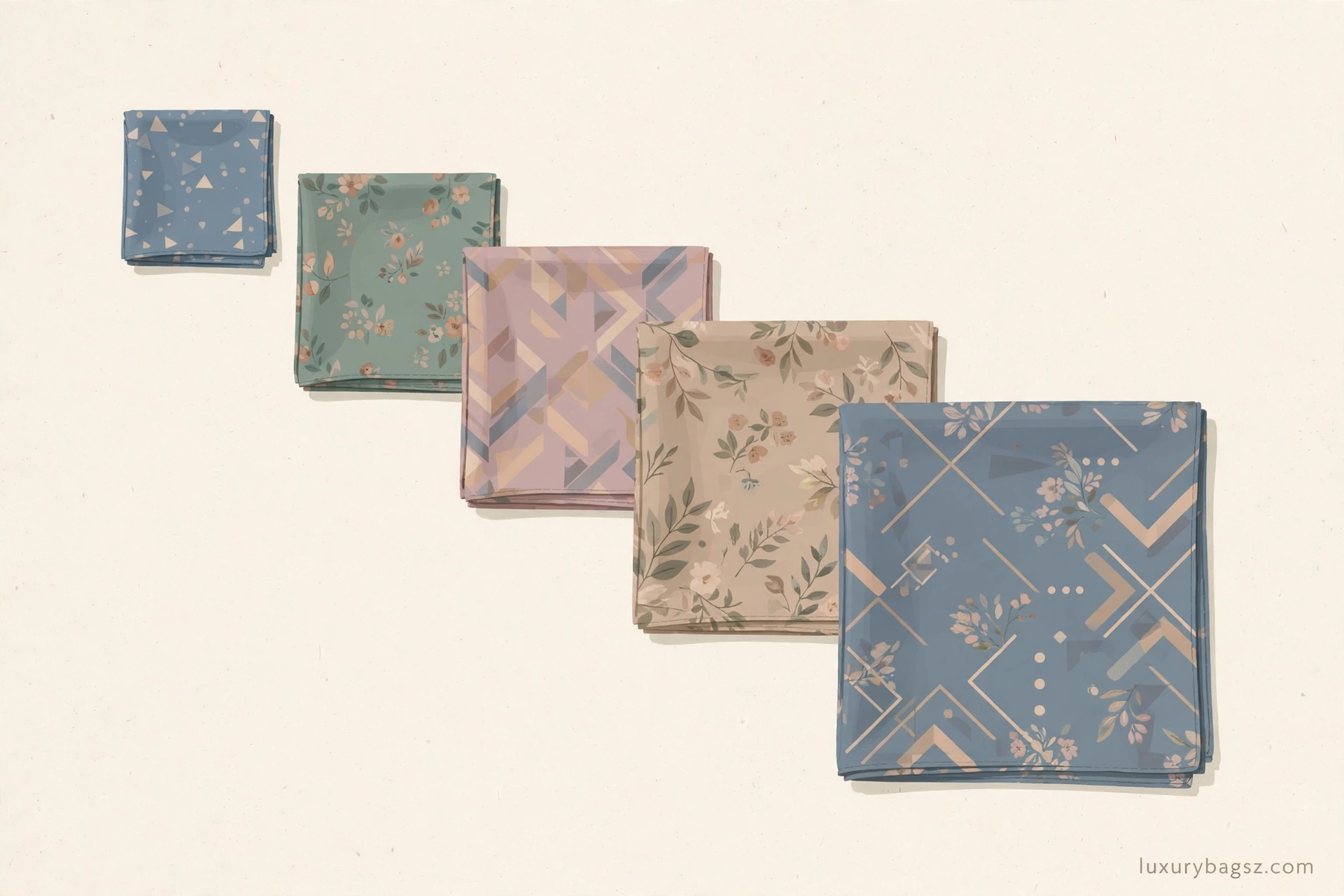
A Hermès scarf size is not a vague small, medium or large. It is a number, and that number is usually the length of one side of a square, measured in centimetres. A 90 is about 90 cm by 90 cm. A 140 is about 140 cm by 140 cm. Once you know that one rule, most of the confusion disappears — but not all of it, because Hermès does not use one tidy ladder of sizes, and different guides do not always agree on what each number is called.
Some guides list only four or five sizes: the 45 pocket square, the 55 bandana, the 70 compact square, the 90 classic carré and the 140 shawl. Others add the 65, the 80 and the 100. Guides that skip the 80 and the 100 leave a buyer staring at a listing marked “80” or “100” with no frame of reference at all, and guides that treat “bandana” as one single size hide the fact that the word is used for more than one format. Almost every short guide also stops at the measurements, without explaining what changes when you wear the scarf: how much fabric is left for a knot, and whether the print still reads as a picture or breaks up into a band of colour.
This guide works through the seven sizes in the title in order, smallest to largest: 55, 65, 70, 80, 90, 100 and 140 cm. For each one it gives the shape, the names sellers and guides actually use, the materials you are most likely to meet, and the wear options that size genuinely supports — plus the wear options it does not.
It also covers how to measure a scarf yourself, why two scarves with the same number can measure a centimetre or two differently, how one design can appear in several sizes without being a simple photocopy enlargement, and what to check before buying second-hand. Where sources disagree, this guide says so plainly rather than quietly picking one version.
One warning up front, because it saves the most money: the number alone never proves a scarf is genuine, and a single measurement never proves it is fake. Hand-rolled hems vary, washed silk can shift slightly in size, and a seller may be quoting the printed area rather than the full edge-to-edge size. Use the number as a starting point, then check the design, the fabric, the hem and the listing details together. The second-hand checks section sets out that checklist.
Scarf Sizes at a Glance
What does the number mean? For the square scarves in this guide, the number is the approximate side length in centimetres. A 55 measures about 55 cm on each side; a 90 measures about 90 cm on each side. All seven sizes here are squares, not rectangles. Long, narrow formats such as the twilly are a different family and are covered only as a boundary marker in the number-reading section, so you do not mistake one for a small square.
Which size is the classic? The 90, universally called the carré. If someone says “a Hermès scarf” without a number, the 90 is the size most people picture: the large square with a hand-rolled hem, worn at the neck, on the head or folded into a top.
Which size is the shawl? The 140. At roughly 140 cm a side — about 55 inches — it is big enough to sit over both shoulders as a wrap, and it is the size most often made in cashmere and silk rather than silk alone.
Which sizes are the bandanas? Guides disagree here, and the disagreement is worth stating. The 55 is the most consistently called a bandana. The 65 is also sold as a “bandana scarf” in current Hermès listings, in cashmere and silk. The 70 is sometimes described as a bandana too, and one widely copied guide calls the 70 a “bandana coeur”. So “bandana” is a style family — a smaller, easy, often more casual square — not a single measurement. Always ask for the number, not just the word.
What is the least documented size here? The 80 and the 100. Both appear in listings and fuller size lists, yet most short guides omit them entirely. The 80 turns up most often in wash silk, a softer, matte-finished silk. The 100 sits between the classic 90 and the shawl-sized 140: more drape than a 90, but not a full shoulder wrap. Neither has a single settled nickname that every source uses, and this guide does not invent one for them.
How much bigger is each step, really? Area grows much faster than side length: a 90 has about two and two-thirds times the area of a 55, and a 140 has more than six times the area of a 55. That is why a jump of “only” 20 or 25 cm can completely change how a scarf wears.
Quick comparison
| Size | Usual name | Shape | Most common material | Best for |
|---|---|---|---|---|
| 55 cm | Bandana | Square | Silk, sometimes cotton in older pieces | Small neck knot, hair tie, pocket accent |
| 65 cm | Bandana scarf | Square | Cashmere and silk | Neck knot, hair, light layer |
| 70 cm | Carré 70, compact square | Square | Silk, often lighter or wash silk | Neat neck tie, everyday wear |
| 80 cm | Wash square | Square | Wash silk | Soft neck drape, relaxed knot |
| 90 cm | Carré, classic carré | Square | Silk twill | Neck, head, top, fullest styling range |
| 100 cm | Large square | Square | Silk | Fuller drape than a 90, neck and shoulders |
| 140 cm | Grand carré, shawl | Square | Cashmere and silk, also silk | Shoulder wrap, generous neck drape |

First, Read the Number Correctly
Before the seven sizes, three reading rules prevent most mistakes.
First, a square scarf is named by one number because both sides are meant to be the same. A listing that gives two different numbers, such as 90 by 180 cm, is not a 90 square at all: it is a stole or a doubled format, sometimes made by joining two squares. A listing that gives one small number and one long number, such as about 5 by 86 cm, is a twilly, the narrow ribbon scarf tied at the neck, wrist, hair or bag handle. Twillies are not small squares, and a 55 square should never be described as a twilly. The same applies to the losange, a lengthened diamond shape, and to triangle scarves: different shapes, different measuring rules, and outside the seven sizes in this guide.
Second, “carré” simply means square in French, and Hermès uses it as the family name for its square scarves. “Grand carré” means large square and is most often attached to the 140, but it is descriptive, not a guarantee: a seller may call a 100 a grand carré because it feels large next to a 90. Trust the number and the measured dimensions, not the flourish in the title.
Third, centimetres and inches do not convert neatly, and rounding hides real differences. A 55 is about 21.7 inches, a 65 about 25.6, a 70 about 27.6, an 80 about 31.5, a 90 about 35.4, a 100 about 39.4 and a 140 about 55.1. Two listings for the “same” size may show 35 and 36 inches for a 90; both are rounding the same approximate 90 cm. The danger is the other way round: a 65 listed as 26 inches and a 70 as 27 look close in inches, but they are different formats with different prints, fabrics and prices. Work in centimetres whenever a listing gives them.
A related trap is the pocket square family below this guide: the 45, often called a gavroche or pocket square, and smaller formats such as a 20 nano square. If a seller offers you a “55” that measures 45 cm, you are looking at a different format, or a wrong label.
The 55 cm Bandana: Small, Bold, and Easy to Misread
The 55 is the smallest size in this guide, about 55 cm by 55 cm, or roughly 21.7 inches a side. Guides agree more about this size than about almost any other: it is the bandana size. Several guides describe 55 bandanas as printed in a limited palette, sometimes three colours, in a traditional bandana style, with a bold, graphic layout that reads well even folded small. That matters, because a fine, detailed picture that looks beautiful spread out at 90 cm can turn to visual noise when folded down to a neck knot at 55 cm.
In wear, the 55 is a neck scarf first. Folded into a triangle or a band, it ties in a small knot at the front or side of the neck, sits neatly under a collar, and works as a hair tie or headband. What it cannot do is the work of a larger square: it will not drape over the shoulders, make a convincing head covering for most wearers, or fold into a top. Anyone selling a 55 as a “shawl” is either mistaken or hoping you will not measure it.
Materials at 55 are most often silk, and older bandana editions also appear in cotton. Do not assume cotton means fake or silk means genuine: both fibres have been used, and the fibre must match the particular design and edition.
The hand-rolled hem, the print quality and the listing details matter far more than a single fibre claim. The common buyer mistake with the 55 is buying it for a 90 job: if you want a wrap for a cool evening, a 55 will disappoint you, but as a sharp accent you wear weekly, it is often the better buy.
The 65 cm Bandana Scarf: The Cashmere-and-Silk Middle Step
The 65 is where short guides start to go quiet, and that silence causes real confusion, because the 65 is a current, named format, not a rounding error. Current Hermès listings sell a “bandana scarf 65”: a square of 65 by 65 cm, in cashmere and silk with hand-rolled edges, described as a small model scarf that is easy to wear. The composition given in those listings is 70 percent cashmere and 30 percent silk. Older 65 pieces also appear in listings in other materials, including cotton in a vintage edition, so again the material follows the edition, not the number alone.
At about 25.6 inches a side, the 65 gives roughly 40 percent more area than the 55, while still sitting firmly in the small-square family. That extra fabric is the difference between a knot that feels tight and one that sits comfortably. It works at the neck, in the hair, and as a light layer for a small-framed wearer, though it is not a full shawl.
The naming conflict to watch is the double use of “bandana”: both the 55 and the 65 are called bandanas, and the 70 sometimes gets the same label. A listing titled only “Hermès bandana” therefore tells you almost nothing about size. Ask for the centimetre number and, if possible, a flat measurement photo — no photograph of a folded scarf will reliably show a 10 cm difference.
Another point competitors usually miss: the 65 bandana print is not simply the 90 print shrunk down. At 65 cm, a design is typically redrawn or reframed for the smaller square, with a layout that suits a bandana: a centred motif, a strong border, or a simplified arrangement. The same-design section explains why that matters when you are comparing two sizes of what looks like the same design.
The 70 cm Carré: The Compact Classic
The 70, about 70 cm by 70 cm or 27.6 inches a side, is the compact classic. Guides that mention it tend to agree on its character even when they disagree on its nickname: it is a smaller, lighter, more everyday square than the 90, suited to neat, precise knots and to wearers who find a 90 voluminous.
One guide calls it a good option for petites; another describes it as made in a lighter-weight silk than other formats. Both observations point the same way: the 70 is the size you buy when you love the carré idea but want less fabric around your neck.
In wear, the 70 covers the core neck styles well: a small knot, a band tie, a triangle fold at the front, and a tidy loop. It can work in the hair and as a bag accent, and it layers under a jacket without the bulk a 90 can create. It falls short where the 90 excels: a full head wrap, a draped top, and a generous shoulder drape all need the extra length the 70 does not have. If your test for a scarf is “can I tie it five ways and still have fabric left over”, the 70 will pass fewer of those tests than the 90, and that is a feature, not a flaw, if neatness is what you want.
Materials at 70 are most often silk, including lighter silk and wash silk editions. In Hermès usage, a wash treatment gives silk a softer, more matte, slightly faded, velvety feel, and Hermès notes that the process can slightly alter dimensions. So a wash 70 measuring 68 or 69 cm flat is not automatically mislabelled; the listing should say it is washed. A wash finish is a treatment of the silk, not a different size family, and it does not by itself prove anything about authenticity.
The 70 also appears in a heart-shaped “coeur” bandana variant in some fuller size lists. Most 70s are squares, but if a 70 in a listing is not square, check whether the edition is a named special shape before assuming the listing is wrong.
The 80 cm Wash Square: The Size Most Guides Skip
The 80 is the first size in this guide that most short guides simply leave out, and that omission is itself useful information: if you only read short guides, an 80 listing looks like an error. It is not. The 80 appears in current and recent listings as a square of about 80 cm by 80 cm, or 31.5 inches a side, and the clearest examples are in wash silk: 100 percent wash silk, with the softer, matte, relaxed hand that the wash treatment gives.
In wear, the 80 sits exactly where its number suggests: between the compact 70 and the classic 90, with a softer, more relaxed neck drape than a 70 and a looser knot than a 70 allows, without the full volume of a 90. For a wearer who finds a 70 a little skimpy and a 90 a little much, the 80 is often the comfortable middle — provided the wash silk hand is what you want, since wash silk drapes more softly and holds less structure than standard silk twill.
Because the 80 is less documented, it is also the size where you should be most careful about the listing details. Check the material claim against the edition: an 80 described as standard silk twill may be a different edition from an 80 wash silk, and a price copied from a 90 listing is not a guide to an 80 price. Check the measurement the same way you would for any size, flat and edge to edge, as set out in the measuring section. And do not let a guide that omits the 80 persuade you that a real 80 must be a mislabelled 70 or 90. The fuller size lists include the 80 alongside the 65 and the 100, and wash silk listings confirm it as a format in its own right.
The 90 cm Carré: The Classic, and the Benchmark for Everything Else
The 90 is the benchmark. About 90 cm by 90 cm, roughly 35.4 inches a side, in silk twill with a hand-rolled hem, it is the size Hermès is most associated with, the size of the first silk scarf introduced in 1937 in its classic form, and the size in which the widest range of designs appears. If you are comparing any other size, you are usually comparing it, consciously or not, with the 90.
Why does the 90 wear so differently? Area, plus the way a square folds. Fold a 90 diagonally and you have a triangle with a long edge of about 127 cm, enough to wrap, cross and knot with fabric to spare.
Spread it out and the full design reads as a picture, with border, corners and centre all visible. That is why the 90 supports the widest styling range here: neck knots, head wraps, a folded top, a shoulder drape and a bag wrap. No smaller square does all of that comfortably, and no larger square does the neat neck knot quite as crisply.
Materials at 90 are dominated by silk twill, the diagonal-weave silk with a slight sheen and a firm, structured drape that holds a fold. Wash silk 90s also exist, with the softer, matte hand described in the 70 cm section, and double-face editions exist too: scarves printed on both sides, a specific treatment that should never be assumed for every 90.
A standard 90 is printed on one face, and the reverse shows the print through the silk more faintly. If a listing claims double-face for an edition that was not made that way, that claim needs checking, not celebrating.
The 90 is also where the “same design, different size” question matters most, because the largest number of designs exist first or most famously at 90. A design you love at 90 may also exist at 140, and sometimes at 70 or in a bandana format — but the other version is a reframing, not a photocopy. The same-design section covers what changes. On price, the 90 is generally more expensive than the smaller squares, because it uses more silk and is the flagship size, but the gap is not fixed: edition, material, wash treatment, colourway and vintage status all move the price, sometimes by more than the size step itself.
The 100 cm Large Square: More Drape Than a 90, Not Yet a Shawl
The 100, about 100 cm by 100 cm or 39.4 inches a side, is the second size that short guides routinely omit, and it is the size most likely to be misdescribed in a listing. Fuller size lists include a 100 by 100 square alongside the 90 and the 140, and that placement tells you its character: it is a large square, clearly bigger than the classic, but still a square scarf rather than a shawl format.
In wear, the 100 gives you everything the 90 gives you, with more fabric: fuller knots, deeper drapes, more shoulder coverage and more head-wrap length. The trade-off is neatness — a small, crisp neck knot that looks sharp in a 70 or a 90 can look bulky in a 100 unless you fold it more narrowly, and under a fitted jacket a 100 can add visible volume.
Think of it as the size for wearers who like the 90 but always wish it were a little more generous, or for colder weather, when a little extra coverage is welcome without committing to the full wrap of a 140.
What the 100 is not, despite some loose listing language, is automatically a “grand carré”: that phrase is most consistently tied to the 140, and applying it to a 100 muddies the very distinction a buyer needs. Nor is the 100 a rectangle, a stole or a doubled square: it is a single square, and a listing giving two different dimensions for a supposed 100 square should be questioned like any mismatched listing. Materials at 100 are most often silk, in line with the 90 family; check the edition and finish, and do not carry a 90 or 140 price across to a 100, since sellers sometimes price the less common 100 by analogy to the nearest size they know.
If you are choosing between a 90 and a 100 and you cannot try either on, the practical test is simple: do you usually fold a 90 down because there is too much fabric, or do you usually wish a 90 gave you one more wrap? If you fold down, stay at 90 or below. If you wish for more, the 100 is the next step before the much larger jump to 140.
The 140 cm Grand Carré: The Shawl Square
The 140, about 140 cm by 140 cm or 55.1 inches a side, is the largest square in this guide and the one most often called a grand carré or a shawl. At nearly five feet a side, that scale changes the scarf from an accessory into a garment-like wrap: draped over both shoulders it covers the upper arms and back, and folded it makes a deep, warm neck wrap.
Materials are the key difference at 140, and the source conflict here must be stated plainly. Some listings give the classic cashmere-and-silk shawl blend as 65 percent cashmere and 35 percent silk, while current Hermès bandana listings in cashmere and silk give 70 percent cashmere and 30 percent silk. Both figures appear in reputable places, for different editions and seasons, and neither is the single standard for every 140. Silk-only 140s also exist, lighter and cooler than the blends. Read the composition on the listing for the actual piece, and do not reject a 140 because its ratio differs from one you read for a different edition.
In wear, the 140 is the most versatile size in one sense and the least neat in another. It does the shoulder wrap, the generous neck drape and the head wrap better than any smaller square, and layers over a coat in a way a 90 cannot.
But a small neck knot in a 140 is a project, with a great deal of fabric to fold away, and it can look bulky unless the fold is narrow and careful. Many experienced wearers therefore keep a smaller square for neat neck wear and use the 140 for draping.
Care also changes at 140, simply because of bulk: it takes up far more drawer space than a 90, creases more visibly if crushed, and benefits most from being folded flat and kept out of direct sunlight, much like the flat, out-of-sunlight approach used when storing a Kelly. Cashmere blends need moth-aware, clean, dry storage, and they pill with friction over time — a wear characteristic of the fibre, not by itself proof of a fake.
How to Measure a Scarf, and Why Two “Identical” Scarves Can Differ
Measuring a square scarf sounds trivial until you try to settle a dispute between two listings. Follow these steps, in this order, and you will remove most of the argument.
Lay the scarf completely flat on a clean, flat surface, with no folds, no bunching and no hanging edge. Smooth it gently without stretching it: silk, and especially a washed or cashmere-blend fabric, will give a little under tension, and a stretched measurement is a false measurement.
Measure from the outer edge of the hem on one side to the outer edge of the hem on the opposite side, along the middle of the scarf rather than along a corner, where a rolled hem can sit unevenly. Then measure the other direction the same way. A true square should give the same figure, within a small tolerance, in both directions. Record both figures, not just the larger one.
Allow a small tolerance, and understand where it comes from. Hermès itself notes, on its bandana listings, that because a scarf is hand-rolled, the indicated dimensions may vary. The wash process, as noted in the 70 cm section, can also slightly alter dimensions. Vintage measuring adds another layer: one reseller measuring a nominal 70 flat recorded about 67 by 65 cm, a gap of several centimetres from the nominal size. That single example should not be treated as the standard tolerance for every scarf, but it shows why a flat measurement a centimetre or two short of the nominal size is not, on its own, a reason to call a piece fake — and why a measurement several centimetres short, or a square that measures as a rectangle, is a reason to ask questions.
Photographs can mislead even honest sellers: a scarf photographed folded or on a model gives no reliable scale. The useful listing photos are a flat, full view with a tape measure visible along one edge, plus any surviving care or size tag.
Tags are absent on many vintage pieces, and that absence proves nothing, but a tag claiming 90 on a scarf that measures 70 flat is a red flag worth resolving before you pay. Finally, measure before concluding anything about authenticity: a wrong size claim may be a listing error, a different format, or a fake, and those need different responses.


The Same Design in Several Sizes: What Actually Changes
One of the most satisfying discoveries for a collector is finding a favourite design in more than one size — and one of the most common disappointments is assuming the bigger version is just the smaller version enlarged. It is not, or not only.
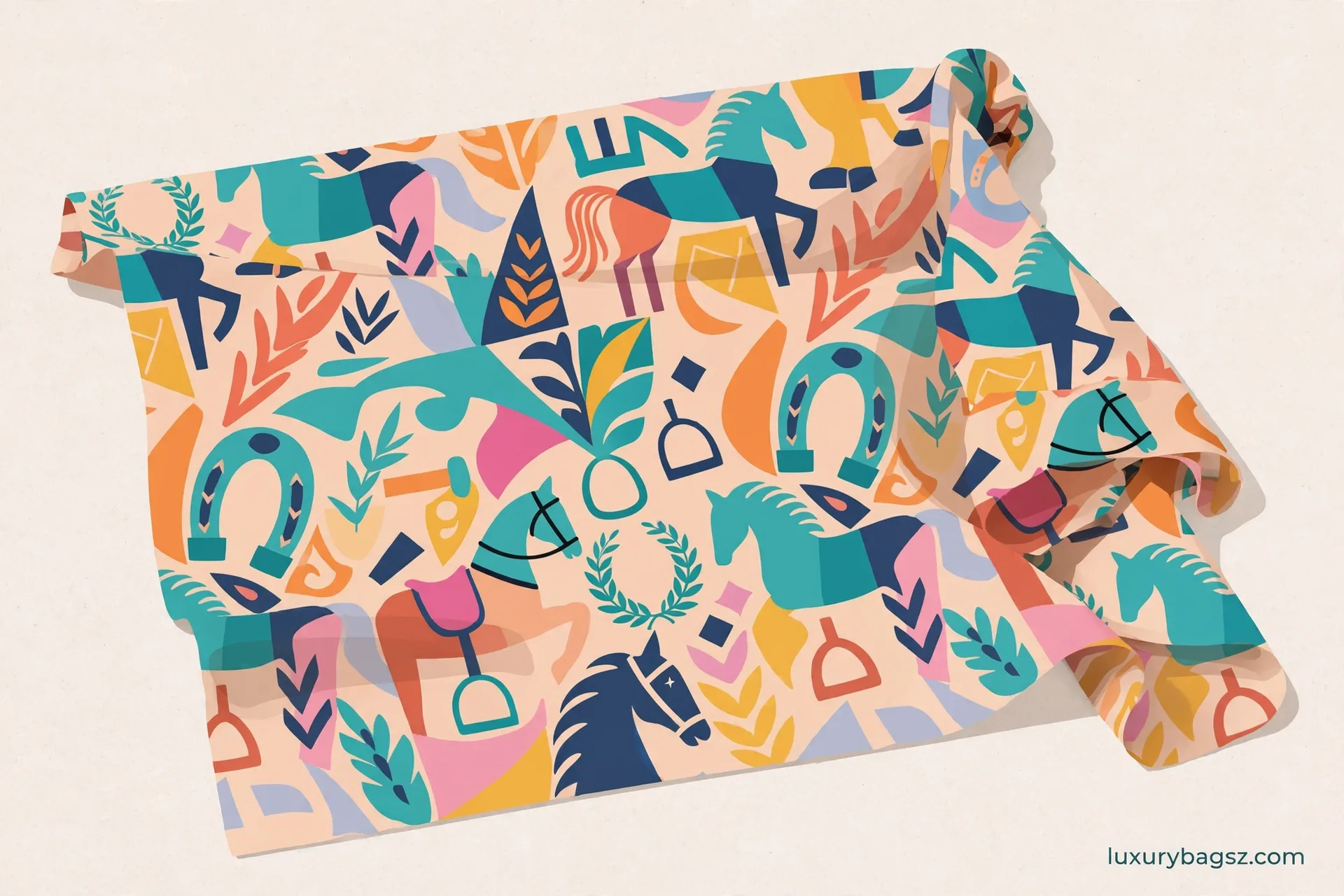
A design drawn for a 90 square has a border, corners and a centre that work at that scale. Redrawn for a 140, the artist and the studio have room to expand the picture, add detail, and let the border breathe. Redrawn for a 55 or 65 bandana, the same design must be simplified, cropped or reframed so that it still reads when folded small. The motif may be centred differently, the border may be bolder, and fine detail that carried the 90 version may be dropped because it would turn to clutter at bandana scale. Two scarves can therefore share a design name and a colour story while looking quite different in the hand, and both can be genuine.
Colourways add a second layer: not every colour combination is issued in every size, so finding one at 90 does not guarantee it exists at 140 or at 65. Always pin down design, colourway and size together, with material as a fourth check. That is why “which size is better” is the wrong question for a design you love — ask instead which reframing you want to live with: the full picture at 90 or 140, the bold bandana version at 55 or 65, or the compact version at 70 or 80.
How Size Changes the Way a Scarf Wears
Size does not just change how much fabric you have. It changes which folds work, how the print appears, and how the scarf behaves through a day.
At 55 and 65, the print is mostly hidden when worn: a folded band shows a stripe of the design, a knot a small patch. Buy these sizes for colour and for the knot itself, not for the full picture. At 70 and 80, a triangle fold shows a generous wedge, but the full square is still rarely on display. At 90, a triangle fold finally shows a large part of the picture, and a draped wear shows most of it. At 140, the picture is the outfit: draped over the shoulders, the whole design is visible to anyone facing you.
Weight follows area. A silk 90 is light and crisp; a cashmere-blend 140 is heavier, warmer and softer, and will settle and shift as you move in a way a crisp twill does not. A wash silk 80 sits between the two: soft and relaxed, less likely to hold a sharp fold. If you hate adjusting a knot, a crisp twill in a smaller size will suit you better than a large, soft blend.
Body size and height change the same scarf, too: a 70 that looks neat on a petite wearer can look small on a taller wearer, and a 140 that wraps generously on one person can overwhelm another. There is no universal “right” size for a height or frame. The practical test is always the same: fold it the way you will actually wear it, and judge how much fabric is left after the knot. When buying online, compare the side length with a scarf you already own, rather than with a model photograph.


Materials by Size: Silk Twill, Wash Silk, Cashmere Blends and More
Material and size travel together, but they are not the same thing, and confusing them leads to false rules such as “all 140s are cashmere” or “all 90s are twill”. The fuller picture is this.
Silk twill is the classic carré material: a diagonal-weave silk with a slight sheen, a firm hand and a hand-rolled hem. It appears across the size range, but it defines the 90 above all, and it is what most wearers mean when they say a scarf “holds a fold”. Mousseline, a sheer, lightweight silk, appears in shawl and stole formats and some larger, airier pieces; it drapes softly and should not be judged by twill standards of crispness. Wash silk is silk given a washing treatment that softens it, mattifies the surface and gives a slightly faded, velvety feel. It appears notably at 80 and at 90, and in 70 editions too, and the treatment can slightly alter dimensions, as Hermès itself notes. Wash silk is a finish, not a lower grade and not a separate size.
Cashmere-and-silk blends dominate the 140 shawl family and the 65 bandana family, though with different ratios in different editions, as the 140 shawl section notes: 65 percent cashmere with 35 percent silk in some shawl listings, 70 percent cashmere with 30 percent silk in current bandana listings.
The blend gives warmth, softness and drape, and it also brings pilling and a need for gentler storage. Cotton appears in older bandana editions, including at 65, and reminds us that the size ladder has a history: not every size and material combination available today was available in every decade, and not every vintage combination is still made.
When a listing gives a material that does not fit the size family you expect, do not reject it outright and do not accept it blindly. Check the edition. A silk 140 exists alongside cashmere-blend 140s. A cotton 65 exists alongside cashmere-blend 65s. The edition, the season and the design decide the material; the size only narrows the likely range.
Choosing Your Size: A Practical Decision Guide
Start from how you will actually wear the scarf, not from which size sounds most impressive.
If you want a small, sharp accent for the neck or hair, start with the 55 or the 65: the 55 is sharper and smaller, the 65 easier to knot with a little more presence. If you want one everyday neck scarf that ties neatly and layers under a coat, the 70 is the natural choice, with the 80 as the softer wash-silk alternative. If you want the fullest range — neck, head, top, drape, display — and you are buying one scarf to do the most jobs, buy the 90, the size with the widest choice of designs and colourways second-hand. If you love the 90 but always want a little more fabric, step to the 100 before jumping to the 140. And if you want a wrap for a cool evening, buy the 140, in cashmere and silk for warmth or in silk for a lighter wrap.
Consider your wardrobe too: a 140 in a bold print can carry a plain coat, a 55 in a strong colour can lift a plain shirt, and a 90 in a detailed design rewards a quiet outfit that lets the picture show.
A large, soft 140 under a fitted coat, or a tiny 55 expected to warm your shoulders, will both disappoint for reasons that have nothing to do with quality.
Finally, consider the bag question. A small square tied to a bag handle is a classic accent, and it works best with a smaller format that does not overwhelm the handle — the same kind of handle accent you might try on a Constance bag, where a neat, small tie reads as an accent rather than a second bag. A 140, by contrast, is a garment in its own right and rarely belongs on a handle.

Note: this video’s prices are from January 2024; the draft’s prices prevail where they differ.
Buying Second-Hand: Size Checks That Protect You
Second-hand buying is where size knowledge pays for itself, because a wrong size claim is one of the easiest misdescriptions to catch — and one of the easiest to miss if you never ask for a measurement.
Ask for three things before you pay: the nominal size in centimetres, a flat measurement in both directions, and a photograph of the scarf laid flat with a tape measure visible. Compare the flat measurement with the nominal size, allowing the small hand-rolled and wash tolerance described in the measuring section, and no more. Ask for the material and the composition where a tag survives, and check that the material fits the edition: a cashmere-blend claim on an edition made in silk twill, or a wash silk claim on an edition made in standard twill, needs an explanation.
Then widen the check beyond size, because size alone never authenticates a scarf. Look at the hand-rolled hem: even, neatly rolled and hand-stitched, not machine-flat or unevenly gathered. Look at the print: sharp, with clean colour edges and no blurring that suggests a copied print. Treat a care tag and any surviving box or ribbon only as supporting evidence, never as proof on its own, because packaging is easier to copy than a hand-rolled hem. Apply the same layered caution that guides spotting a fake Hermes Kelly: no single check decides, and a price far below the market for that size, material and edition is a warning, not a bargain.
Be especially careful with the sizes short guides omit. An 80 or a 100 offered at a 90 price, or a 65 offered at a 55 price, may simply be priced by analogy, but it may also be a mislabelled format. Compare at least two or three listings for the same design, size and material before deciding the market price. And be careful with “one size” listings that give no number at all: a seller who knows the format can almost always give the centimetre number.
Caring for Different Sizes Without Ruining the Drape
Size changes care only in practical ways, but those practical ways matter. A 55 can be folded small and stored in a drawer without much thought. A 140 cannot: folded carelessly, it creases deeply, and those creases show most on a cashmere blend and on a large, flat print. Fold larger squares loosely, store them flat where possible, and keep every size out of prolonged direct sunlight, which fades silk and cashmere alike.
Do not wash a silk twill carré as if it were a wash silk edition, and do not assume a wash silk edition can be treated like cotton. Standard silk twill scarves are normally dry-cleaned or handled by a specialist, while wash silk editions are presented as more washable — but “more washable” in a seller’s description is not a care instruction for your piece.
Follow the care tag on the actual scarf, and when there is no tag, default to specialist care. The same caution applies to pressing: a hand-rolled hem and a printed silk surface do not forgive a hot, direct iron.
For storage, small squares can live folded in a drawer, separated so dark prints do not transfer colour to light ones. Medium squares benefit from being rolled rather than sharply folded. Large squares and shawls benefit most from flat storage, or a loose roll in a breathable cover, away from moths, moisture and sunlight. Whatever the size, do not store a scarf sealed in plastic in a damp place: silk and cashmere both need air.
Frequently Asked Questions
Is a 90 the only “real” Hermès scarf size? No. The 90 is the classic and the most widely available, but the 55, 65, 70, 80, 100 and 140 are all real square formats, documented in fuller size lists and in listings. A guide that lists only the 90 is simplifying, not defining the range.
What is the difference between a 65 and a 70? Five centimetres on each side, which sounds small but gives the 70 about 16 percent more area than the 65. More importantly, they are different formats with different typical materials: the 65 is most often a cashmere-and-silk bandana, while the 70 is most often a silk compact square. Do not treat them as interchangeable.
Why do some sources give 65 percent cashmere and others 70 percent? Different editions use different blends: 65/35 for some shawl editions, 70/30 for current bandana editions. Check the composition for the actual piece, not a general rule.
Can I wear a 140 as a neck scarf? Yes, folded narrowly, but expect bulk and expect to manage the fabric. Most wearers who love a 140 use it as a shoulder wrap or a generous drape, and keep a smaller square for neat neck knots.
Does a measurement a centimetre short mean a scarf is fake? Not on its own. Hand-rolled hems vary, and Hermès notes that indicated dimensions may vary for hand-rolled pieces. A small gap is a tolerance question. A large gap, a rectangle where a square is claimed, or a measurement that matches a different format entirely is a reason to ask for more evidence.
Which size should I buy first? If you want one scarf that does the most, buy a 90 in silk twill, in a design and colourway you love enough to wear weekly. If you want a wrap, buy a 140. If you want a small everyday accent, buy a 65 or a 70. The best first size is the one whose job matches your daily wear, not the one with the most impressive number.
Final Verdict
Tell Hermès scarf sizes apart by the number, then by the shape, then by the material — in that order, and never by a nickname alone. The 55 is the small bandana, sharp and graphic. The 65 is the cashmere-and-silk bandana, a little easier to knot. The 70 is the compact, everyday square.
The 80 is the softer wash-silk middle step that short guides skip and buyers should not. The 90 is the classic carré, the benchmark and the widest-ranging size of all. The 100 is the fuller large square, more drape than a 90 without becoming a wrap. And the 140 is the grand shawl square, a garment in its own right.
Buy the size whose job you can name before you buy it: a knot, a neat tie, a drape, or a wrap. Measure it flat when it arrives, allow the small hand-rolled tolerance, and check the design, hem and material alongside the number.