How to Spot a Fake Hermès Clic H Bracelet: 12 Checks, Hinge Feel, Era Stamps, and the Traps That Prove Nothing
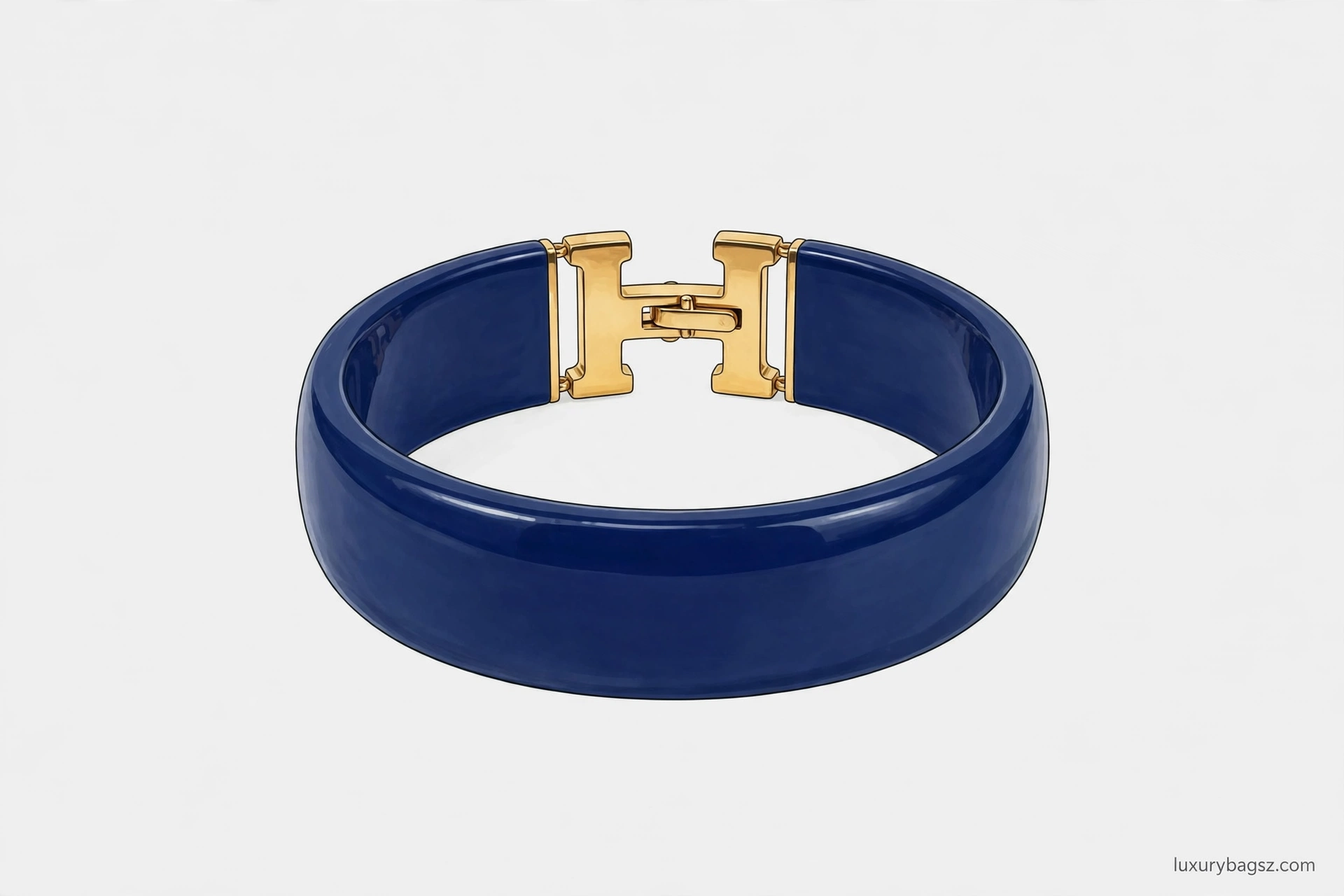
The Hinge and Enamel That Expose a Fake Clic H
Feel the hinge first. On a genuine bracelet the H turns with firm, controlled resistance, without flopping, rattling or grinding, and it sits straight and level once closed. Many copies look convincing while shut and betray themselves as soon as they move.
Look closely at the enamel next: it should appear smooth, evenly coloured and level with its metal surround, with tidy edges and no bubbling, rippling or colour spilling over. Shape matters too — a genuine piece is oval rather than perfectly round. Check any stamp against the claimed era, but treat stamps, boxes and cards as supporting detail only, never as proof alone.
A fake Hermès Clic H bracelet is rarely caught by one dramatic giveaway. It is usually caught — or missed — by a pile of small details, checked in the right order, on the actual bracelet in front of you. That is why so many buyers get it wrong, and why so many guides get it wrong too: they give you five quick tells, you tick them off, and you feel safe, while the bracelet that fooled you passed all five easily.
The Clic H makes this harder than most Hermès pieces, and easier in one way. Harder, because it is small, simple, and widely copied. There is no leather grain to study, no stitching to count, and no complex shape to memorise. A counterfeiter only has to get an enamel band, a metal frame, and an H-shaped clasp roughly right, and at arm’s length, in a single resale photograph, most copies look roughly right. Easier, because the bracelet is a mechanism as much as it is a piece of jewellery. It opens, it hinges, it clicks, and it sits on a wrist. How it moves, how it weighs in the hand, and how its enamel meets its metal tell you things a photograph of a bag never could — if you know what to feel for and what to ask a seller to show you.
This guide is written for a buyer, not for a professional authenticator, and it is honest about its limits. No guide, and no set of photographs, can give you a certain verdict on a high-grade counterfeit. What this guide can do is teach you to spot the large majority of fakes, to ask for the photographs and measurements that make a fake much harder to hide, to recognise the traps that prove nothing at all, and to know when to stop and pay for professional authentication before you pay for the bracelet.
A note on the pictures in this guide, because it matters for an authentication article more than for any other kind. Every picture here is a generic illustration, not a photograph of a real Hermès bracelet, and none of them should be used as a reference for what a genuine Clic H looks like in detail. Illustrations simplify metalwork, flatten enamel, and tidy up hinges. Use them to follow the checks, not to compare a bracelet against them line for line. Where an illustration simplifies a detail, the words in this guide prevail.
Key Takeaways
- Judge a Clic H as a whole. No single check — stamp, price, photograph, card, or receipt — proves a bracelet genuine, and no single flaw, on its own, always proves it fake. It is the pattern across all twelve checks that matters.
- Hermès issues no authenticity cards as a general rule. A card, a certificate, a number to “check online”, or a plastic card supplied with a Clic H is a red flag, not reassurance. A copied stamp proves nothing either, because counterfeiters copy stamps.
- The hinge is the most underrated check in the whole subject. A genuine Clic H hinge has a firm, controlled feel: it opens with deliberate resistance, it does not flop, rattle, or grind, and the H sits straight and level when closed. A loose, gritty, or wobbly hinge deserves a much closer look, even if the enamel looks perfect.
- Enamel is the second most underrated check. Genuine enamel is smooth, even in colour, and flush with its metal frame, with clean edges and no bubbles, rippling, bleeding into the metal, or orange-peel texture. Paint and resin copies are often too flat, too soft, or too uneven at the edge.
- Weight is a comparison, never a pass or fail number on its own. A genuine Clic H feels solid for its size, but width, era, and plating all change the weight, and no single published gram figure can settle a bracelet. Compare like with like — same width, same era, same finish — or do not use weight at all.
- A box, a ribbon, and a dust bag prove nothing on their own. All three are widely copied, and all three can be borrowed from a genuine purchase. Judge the bracelet, not its packaging.
- Ask for ten photographs before you pay, including the H closed, the hinge open, the stamp, an enamel edge close-up, and the bracelet worn. A seller who cannot or will not supply them has not given you enough to buy safely, however good the first photograph looks.
- Cleaning damage and fake signs overlap, and confusing them costs buyers money in both directions. Harsh cleaners, perfume, sweat, and knocks can dull plating and chip enamel on a genuine bracelet, so wear alone never proves a fake — and a perfect-looking bracelet is not proof of genuineness either.
- If you have already bought a bracelet and now doubt it, stop wearing it as a proven genuine piece, keep everything that came with it, do not alter, polish, or repair it, and get a professional opinion before you try to resell it or confront the seller. The already-bought section sets out the order to follow.
Spotting a Fake Clic H in Brief
Can you tell a fake Clic H from one photograph? Almost never, and you should distrust any seller or guide that says you can. One photograph can rule a bracelet out — a plainly wrong shape, a misspelled stamp, or enamel that is visibly bubbled can be enough to walk away — but it cannot rule a bracelet in. Good counterfeits are photographed to pass the one angle you are shown.
What is the fastest honest check? Look at the bracelet as a mechanism, not as a picture. Ask for a short video, or at least photographs, of the H being opened and closed, the hinge moving, and the H sitting closed from straight on. A genuine hinge moves with controlled tension and the H lands straight. Many fakes look fine closed and give themselves away the moment they move.
What about the stamp? Check it, but do not stop there. A genuine stamp is a small, cleanly pressed mark in a place that matches the model and the era, and the letter or format must fit the claimed age of the bracelet. A stamp that breaks that pattern, or a claimed year that contradicts the stamp, is a serious warning — but a correct-looking stamp is not proof, because stamps are among the easiest details to copy.
What is the one trap to avoid above all? Treating anything that came in the box as proof. Hermès does not issue authenticity cards as a general rule, and it does not give a Clic H a serial number that a buyer can check in a database. A card, a certificate, a “serial number check”, or a receipt photograph can all be faked, borrowed from another purchase, or printed at home.
When should you walk away without further argument? When several checks fail at once, when the seller refuses the ten photographs listed in the seller-photo checklist section, when the claimed year contradicts the stamp, when the price is far below any plausible range for that width and condition with no credible explanation, or when the seller pressures you to pay quickly, off-platform, or by a method with no buyer protection. Any one of those is a reason to pause. Two or more together are a reason to stop.
When should you pay for professional authentication? Whenever the bracelet passes your own checks but the price is high, the seller is unknown to you, the colour is a desirable or rare colourway, or anything in the listing still feels slightly off after you have run all twelve checks. Professional authentication is not an admission that you cannot tell; it is the normal, sensible step for a purchase at this price, and reputable resellers expect it. A seller who discourages it, or who will not allow a return if a reputable authenticator disagrees, is telling you something important. That pattern-first discipline is the same discipline behind a fake Kelly check: no one detail carries the verdict, and the whole pattern has to agree.
What a Real Clic H Is Supposed to Look Like
The Clic H is an enamel bangle bracelet with a metal H-shaped clasp. That sentence sounds simple, and it is the reason the bracelet is so often misdescribed. Guides that call it solid gold are wrong. Guides that call it leather are wrong. Guides that show a photograph of a different bracelet — a Clic Clac, a Kelly bracelet, or a printed enamel bangle — and label it a Clic H are wrong in a way that poisons every check that follows.
Start with the construction. A standard Clic H is a rigid enamel band set in a metal frame, finished in palladium plating or gold plating. Sources disagree on the exact plating description: some describe gold plating in general terms, others specify a gold-plated finish over a base metal, and the precise base metal is not consistently stated across reliable sources. This guide does not resolve that disagreement silently. What matters for authentication is not the name of the base metal, which you cannot see without damaging the bracelet, but the finish you can see: even plating, a consistent tone across the H, the frame, and the hinge, and wear that looks like wear, not like a thin coating flaking off in sheets.
Next, the shape. A genuine Clic H is oval, not a perfect circle, because a wrist is oval. Hold it flat and look at it from the side as well as from the front. A perfectly round bracelet spins on the wrist, sits wrong, and keeps the H sliding out of place. Cheap copies are often round because a circle is easier to manufacture. That does not mean every round-looking bracelet in a photograph is fake — camera angle and lens distortion can flatten an oval — but a bracelet that is plainly circular when photographed flat, from straight on, deserves a much closer look, and a worn photograph should show it sitting as an oval on the wrist.
Then the widths and sizes, which is where most listings go vague. The Clic H family includes a narrow version and a wider version, and guides use different names for them: Clic H for the narrow bracelet, Clic Clac H for the wider bracelet, with the narrow version often described as about 12 mm wide. Sources disagree on exact widths for every variant, and width also varies by era and by the specific version, so this guide does not publish a single width table as if it were exact. What you should do instead is pin the listing down: ask the seller for the width in millimetres, measured across the enamel band, and for the internal circumference, and then compare those figures with the current Hermès listing for that named version, not with a random blog table. A seller who will only say “standard size” has not told you anything.
Sizing names add a second layer of vagueness. Hermès uses PM (Petit Modèle) and GM (Grand Modèle) for small and large, and some guides translate those into wrist circumferences of roughly 6.7 inches for PM and roughly 7.5 inches for GM. Those figures are approximate, they vary by source, and they are not a substitute for measuring your own wrist and asking for the bracelet’s internal measurements. A bracelet that is sold as PM but measures like a GM, or the other way round, is either mislisted or misrepresented, and either way you should not buy it until the measurements are explained.
Finally, the finish should be quiet in the way Hermès finish usually is. The enamel should be deep and glossy, the metal should be polished without rough edges or casting bubbles, and there should be no large external branding shouted across the bracelet. The brand mark, where it appears, is pressed into the interior metal, not printed in large letters on the outside. A bracelet that looks loud, rough, or plasticky at close range has already failed the first impression, even before you run a single formal check.
Why the Standard Five Points Are Not Enough
Most competitor guides for the Clic H cover the same five or six points, and they cover them in the same order: enamel, the H shape, the stamp, the shape, the clasp, and the box. Those points are real, and this guide covers them too, but on their own they are not enough, for three reasons.
First, they are the points counterfeiters already know. A guide that has been public for years teaches a counterfeiter exactly what to fix next. The enamel on a good copy is now often smooth. The H is often straight. The stamp is often copied letter for letter. A guide that stops at those points is testing a fake against last year’s standard, not this year’s copy.
Second, most guides treat each point as a pass or fail test on its own. “If the H gap is wrong, it is fake” or “if the weight is light, it is fake” sounds decisive, and it is misleading. Genuine bracelets vary by era, by width, and by wear. A worn genuine bracelet can have chipped enamel. A genuine bracelet from one era can have a different screw type from a genuine bracelet from another era. A single failed point is a reason to look harder, not always a reason to declare a fake — and a single passed point is never a reason to declare a bracelet genuine.
Third, and most importantly, most guides miss the checks that actually separate a good copy from a genuine bracelet in practice. They rarely describe hinge feel in any usable detail. They rarely explain plating wear patterns — where plating wears first on a genuine bracelet, and what wear looks like when it is faked or hidden. They rarely explain stamp placement by era with the honest caveat that placement varies by example, so buyers either over-trust a stamp or dismiss a genuine bracelet because its stamp sits where a blog said it should not. They rarely give a seller-photo checklist that a buyer can actually send to a seller. They rarely explain cleaning damage, so buyers mistake a genuine bracelet that has been cleaned harshly for a fake, or mistake a fake that has been polished to hide poor plating for a genuine bracelet in good condition. And they almost never explain what to do after you have bought a bracelet you now doubt, which is when most buyers actually need help.
This guide is built to fill those gaps. The twelve checks below are ordered the way a buyer should run them: start with what you can see in a photograph, move to what you can feel and test in person, and finish with the traps that should never decide a purchase. Where sources disagree — on widths, on plating descriptions, on screw types, on prices — this guide says so plainly, instead of picking one version and presenting it as settled.


Check 1: The Enamel
Enamel is the first check for a reason: it is the largest visible surface on the bracelet, it is the hardest surface to fake well at close range, and it is the surface most buyers look at least carefully, because they are looking at the colour instead of the material.
On a genuine Clic H, the enamel is smooth, even in colour across the whole band, and flush with its metal frame. Run your eye — and, in person, a fingertip — along the edge where enamel meets metal. The join should be clean and level, with no step up or down, no gap, and no ridge of excess material. The colour should be the same at the centre of the band as it is at the edges, and the same on both sides of the H. The surface should be glossy and hard, with a depth that comes from layered enamel, not a flat painted look.
On a fake, enamel goes wrong in several distinct ways, and each one tells you something different. Bubbles and pinholes in the surface suggest resin or low-grade enamel that was not fired or finished properly. Rippling or an orange-peel texture suggests a coating that was sprayed or poured rather than properly enamelled. Colour bleeding into the metal frame, or a fuzzy, uneven edge where enamel meets metal, suggests poor masking and finishing. A colour that changes across the band — darker at the edges, lighter in the middle, or patchy under bright light — suggests uneven coating thickness. A surface that feels warm, soft, or easily scratched with a fingernail suggests plastic or resin rather than glass-based enamel, which stays cold and hard to the touch. None of these on its own is a certain verdict, but two or more together, on a bracelet sold as genuine and unworn, are a strong warning.
Photographs hide enamel faults better than any other fault, because a seller can photograph a bracelet in soft light, at a distance, and at an angle that flattens texture. That is why the enamel edge close-up is one of the ten photographs in the seller-photo checklist section, and why you should ask for it in bright, natural light, straight on, with no filter. A seller who will only send soft, distant photographs of the enamel has not shown you the enamel at all.
Edge chips need separate handling, because they are where buyers most often go wrong. Genuine enamel chips. It chips when a bracelet knocks against a table, a door frame, or another bracelet, and the edge of the band is the most exposed place on the whole bracelet. A single small chip on an otherwise well-made bracelet that is sold as used is not proof of a fake. What matters is the pattern: chips that are concentrated at the edge and consistent with knocks are plausible wear; chips across the middle of the band, flaking in sheets, or a surface that is peeling rather than chipping suggest a coating that was never enamel in the first place. Ask the seller to photograph every chip, and to describe how the bracelet was worn, before you decide what a chip means.

Check 2: The H Clasp and Hinge Feel
If enamel is the first check, the hinge is the check most guides rush past, and it is the check this guide spends the most time on, because it is the hardest thing for a counterfeiter to fake and the easiest thing for a buyer to test.
A Clic H opens by rotating the H. On a genuine bracelet, that rotation has a firm, controlled feel. It is not loose, it is not stiff to the point of sticking, and it does not grind, click in the wrong place, or wobble from side to side. There is a slight, deliberate tension in the hinge — enough that the bracelet stays where you put it, not so much that you have to force it. When the H closes, it lands straight and level, with an even gap on both sides between the H and the enamel band, and it stays straight when you turn the bracelet over and look at it from the back.
On a fake, the hinge gives itself away in ways that are hard to photograph but easy to feel. A hinge that flops open under its own weight, or that swings freely with no resistance, suggests a pivot that was not made to a tight tolerance. A hinge that grinds, catches, or sticks halfway suggests rough internal finishing. A hinge that rattles when you shake the bracelet gently suggests play in the pivot or a screw that is not seated properly. An H that lands crooked, tilted, or with a visibly uneven gap on one side suggests a clasp that was not fitted to its band. An H whose horizontal bar is curved rather than straight, or whose legs are rounded and soft at the edges rather than crisp, suggests casting rather than careful finishing.
The H gap deserves a careful note, because one competitor claim about it is often repeated without qualification. Some guides say that if you can fit another H leg into the gap beside the H, the bracelet is fake. Treat that as a rough rule of thumb, not as a measurement. The gap varies by width and by era, and a photograph taken at an angle can make a correct gap look wide and a wide gap look correct. What matters is consistency: the gap should be even on both sides, and it should match the gap on a comparable genuine bracelet of the same width, photographed straight on. An uneven gap is a much stronger warning than a gap that merely looks large in one photograph.
Ask a seller for a short video of the hinge, not just photographs. A video of the H being opened, rotated, and closed, filmed in natural light with no music and no cuts, is worth more than ten still photographs of a closed bracelet. A seller who refuses a video, or who sends only a video of a closed bracelet being waved at the camera, has not shown you the mechanism. If you are buying in person, open and close the bracelet several times, slowly, and feel for the same resistance each time. A hinge that feels different on the third close from the first close is telling you something about its internal wear or its build quality, and you should listen to it.

Check 3: Shape, Width, and Fit
Shape is a check that sounds too simple to matter, and it matters precisely because it is simple. A genuine Clic H is oval. A cheap fake is often a perfect circle. The reason is manufacturing: a circle is easier to form, easier to enamel evenly, and easier to photograph as if it were correct, until it is worn.
Test shape in three ways. First, photograph the bracelet flat, from straight on, and compare its height with its width. An oval bracelet is visibly longer in one direction than the other. Second, photograph it from the side, so you can see whether the band curves smoothly or whether it has flat spots, kinks, or a lopsided bulge. Third, and most usefully, ask for a worn photograph. On a wrist, a genuine oval bracelet sits with the H centred on the outside of the wrist, and the band follows the shape of the wrist without spinning. A round bracelet spins, slides, and keeps turning the H out of place, and a seller who will not show the bracelet worn may be hiding exactly that behaviour.
Width and fit are linked, and both are routinely misdescribed in listings. A listing that says “Clic H” without saying narrow or wide, and without giving a width in millimetres, has not described the bracelet. A listing that says “PM” without giving an internal circumference has not described the fit. Ask for both figures, measured by the seller with a tape or caliper, and measure your own wrist at the point where you will wear the bracelet, not at the narrowest point of your wrist if you wear bracelets higher up. A bracelet that is sold as fitting a wrist it plainly cannot fit, or that is photographed on a wrist it plainly does not fit, is either mislisted or misrepresented.
Be careful with width claims from competitor guides. One guide describes the narrow Clic H as about 12 mm wide, and that figure is widely repeated, but sources disagree on exact widths across the family, and the wider Clic Clac H is described in different guides with different figures. Do not reject a bracelet because its width differs by a millimetre or two from a blog table. Reject a listing, or at least pause it, when the seller’s own measurements contradict the seller’s own description — when a bracelet described as narrow measures wide, or a bracelet described as PM measures like a GM — because that contradiction is about the listing, not about a table.
Check 4: Engraving and Stamps by Era
The stamp is the check buyers trust most, and it is the check they should trust least on its own. Counterfeiters copy stamps. They copy them well. A correct-looking stamp is necessary for a genuine bracelet, but it is never sufficient proof, and an unusual stamp is not always proof of a fake, because stamp placement and format vary by era and by example.
On a Clic H, the brand mark and related markings are found on the interior metal, in and around the hinge area. Competitor guides describe this in slightly different words — one says the mark sits on one side of the interior of the hinge, another says it sits inside the bracelet — and those descriptions are not contradictory so much as imprecise, because the exact placement shifts by era and by version. What you should look for is a mark that is cleanly and crisply pressed or engraved, with even letterforms, consistent depth, and no sign of being scratched, printed, or stuck on. The letters should be sharp at their edges, not soft, doubled, or blobby. Misspellings, uneven letter spacing, letters that fade in the middle of a word, or a mark that looks painted rather than pressed are all serious warnings.
The year letter is the part of the stamp that most buyers get wrong, because they treat it as a code they can look up and settle. Hermès has used letter codes for years, and guides describe a change in the marking system around 2015, with newer pieces using a single letter with no shape around it, while earlier systems used shapes around the letter. The exact letter-to-year sequence is deliberately not alphabetical in some periods, and different guides publish different tables, so this guide does not publish a letter-to-year table as if it were settled. What you should do instead is check for internal consistency: the claimed age of the bracelet, the format of its stamp, and the style of its hardware should all point to the same era. A bracelet claimed as brand new with an old-format stamp, or a bracelet claimed as vintage with a new-format stamp, has a story that does not add up, and the seller should be able to explain it before you buy.
Screw type is often bundled with stamps in competitor guides, and it needs the same caution. One widely repeated guide says Hermès uses flathead screws for narrow and wide bracelets and a star-shaped screw for particularly wide bracelets. Other sources do not confirm that rule in the same terms, and screw type can also change with repair. Treat screw type as a supporting detail, not as a verdict: a screw that is burred, mismatched, replaced with a generic screw, or sitting proud of its housing is a warning about build quality or repair, but a screw type that differs from a blog rule, on its own, does not prove a bracelet fake. The screws and joints section returns to screws in detail.
Finally, remember what a stamp cannot do. A stamp cannot prove a bracelet genuine if the enamel, hinge, plating, and weight all point the other way. A copied stamp on a fake bracelet is still a copied stamp. Judge the stamp last among the physical checks, not first, and judge it as one voice in a chorus, not as a solo verdict.
Check 5: Plating and Wear Patterns
Plating is where a genuine bracelet that has been worn well and a fake bracelet that has been made badly look most alike at a glance, and most different when you look closely. Learning to read plating wear is therefore one of the most useful skills in this whole guide.
On a genuine Clic H, plating is even in tone across the H, the frame, and the hinge, and it wears in a predictable pattern. The places that touch skin, clothing, and hard surfaces wear first: the outer edges of the H, the high points of the frame, and the parts of the band that knock against a table. That wear is gradual. It shows as a soft dulling or thinning, not as a sudden change of colour, and it is usually worse on the parts that are handled most, and lighter on the parts that are protected. A bracelet that has been worn for years should show some wear somewhere, and a bracelet sold as used with absolutely no wear at all deserves a question, not automatic trust — it may have been replated, polished aggressively, or never worn, and each of those stories needs checking.
On a fake, plating goes wrong in different ways. A thin or uneven coating can flake in sheets, peel at the edges, or show a different-coloured base metal underneath in patches. A coating that is too yellow, too orange, or too grey compared with the rest of the bracelet suggests a plating bath that was not controlled, or a repair that replated only one part. A bracelet whose H is one tone of gold and whose frame is another tone of gold has a plating story that does not add up, unless the seller can explain a repair. A bracelet whose plating is perfect on the outside and rough, bubbled, or discoloured on the inside of the hinge has been finished for photographs, not for wear.
Perfume, sweat, and water are the three everyday causes of plating wear that buyers most often mistake for fake signs. Perfume sprayed directly onto a bracelet can dull plating and enamel over time. Sweat is mildly acidic and, with repeated wear in heat or during exercise, can wear plating faster than a buyer expects. Chlorine from swimming pools and harsh cleaning products can damage plating quickly and visibly. That is why the cleaning-damage section separates cleaning damage from fake signs in detail: wear that matches a plausible story — a bracelet worn daily, sprayed with perfume, or worn swimming — is not the same as wear that matches no story at all, such as flaking on a bracelet sold as unworn, or wear concentrated in a place that never touches anything.
Ask the seller for a plating wear close-up, in natural light, of the H edges and the hinge, and ask how the bracelet was worn and stored. A seller who describes wear honestly, and whose photographs match that description, is giving you usable evidence. A seller who describes a heavily worn bracelet as “like new”, or a like-new bracelet with heavy wear in its photographs, is giving you a contradiction, and contradictions are what this guide is built to catch.
Check 6: Weight — Comparison, Never a Number Alone
Weight is the check most guides state most confidently and least usefully. “A genuine Clic H feels heavy” is true, and it is almost useless on its own, because “heavy” is relative, because width changes weight, and because a counterfeiter can add weight by using a denser base metal or by making a band thicker.
Use weight as a comparison, never as a pass or fail number. If you already own a genuine Clic H of the same width, compare the two in your hands, one after the other, with your eyes closed if you can. If you do not own one, compare the bracelet you are considering with a known genuine example in a boutique, if you have access to one, or ask a trusted reseller to weigh a comparable example for you. A difference that is obvious in the hand — a bracelet that feels like a toy, or a bracelet that feels noticeably heavier than a comparable genuine example — is useful evidence. A difference of a few grams on a kitchen scale, measured by a seller you do not know, on a bracelet whose width you have not confirmed, is not.
Be especially careful with weight claims in competitor guides. One guide says fake bracelets are lighter because they are made from plastic, and that is true of cheap plastic copies, but it is not true of metal copies, which can be made to weigh almost exactly what a genuine bracelet weighs. Another guide says fake bracelets are often smaller than real ones, and that size difference can feel like a weight difference, when it is really a size difference. Separate the two: measure the bracelet, then weigh it, and do not let a small size explain away a large weight difference, or a large weight explain away a small size.
In photographs, weight cannot be judged at all, which is why weight should never be the reason you buy a bracelet from photographs alone. If a listing leans heavily on weight — “heavy, therefore genuine” — without showing the hinge, the stamp, and the enamel edge, it is leaning on the weakest form of evidence in the weakest form of presentation. Ask for the photographs in the seller-photo checklist section, and treat weight as a check you run in person, or not at all.
Check 7: Screws, Joints, and Inner Metal Finish
Small metal details are where cost-cutting shows, because they are the details a buyer is least likely to photograph and a counterfeiter is least likely to finish well. Look at them deliberately.
Start with the screws. On a genuine bracelet, screws are neat, seated flush, and consistent with each other and with the era of the bracelet. They should not be burred, chewed, mismatched, or sitting proud of their housings. A screw that has been forced, replaced with a generic hardware-store screw, or tightened so hard that it has damaged the surrounding metal suggests repair, poor manufacture, or both. As noted in the engraving and stamps section, one competitor guide links screw head shape to width, with flathead screws for narrow and wide bracelets and a star-shaped screw for particularly wide bracelets, but other sources do not confirm that rule in the same terms, so do not use screw head shape alone as a verdict. Use screw condition and consistency as evidence, and screw head shape as a supporting detail to check against a comparable genuine example.
Next, look at the joints where the band meets the hinge and where the H meets its pivot. On a genuine bracelet, those joints are clean, tight, and free of excess metal, glue, or rough casting marks. On a fake, joints are often where you find rough edges, visible seams from casting, glue residue, or a gap that opens and closes as the hinge moves. Run a fingertip — gently, in person — along the joint and feel for a sharp edge or a step that should not be there. In photographs, ask for a close-up of each joint, straight on, in natural light.
Finally, look at the inner metal finish, the surface inside the band that sits against your wrist. On a genuine bracelet, that surface is finished cleanly, even if it is not polished to the same shine as the outside. It should not be rough, pitted, discoloured in patches, or coated in a way that flakes onto skin. A rough or flaking inner finish suggests a bracelet that was finished for its outside photographs, not for wear, and it is also a comfort warning: a bracelet that flakes against skin is not a bracelet you should wear, genuine or not, until it has been assessed.
Check 8: Colour Names, Finishes, and Printed Enamel
Colour is where buyers are most easily fooled, because colour is subjective, because photographs distort colour, and because Hermès colour names are specific in a way that everyday colour words are not.
Hermès does not just do “pink” or “blue”. It does named colourways — Rose Sakura, Rose Dragee, and many others in the pink family alone, to take one example from competitor guides — and those names describe specific shades that look different in person from how they look in a grainy resale photograph. A listing that says only “pink” has not told you which colourway it is selling. A listing that gives a specific Hermès colour name should be checked: does that colourway exist for the Clic H, in that width, in that era, with that plating? A colourway that was never made in that combination is a serious warning, and a colourway name that is misspelled, or that mixes two different colour names together, is a warning about the seller’s knowledge or honesty, even if it is not proof about the bracelet.
Finishes add a second layer. Beyond standard solid-colour enamel, Hermès has produced printed enamel bangles within the wider Clic Clac family, and other finishes and patterns appear across the range. A printed or patterned bracelet should not be judged by the same standard as a solid-colour bracelet: the pattern should be crisp, aligned, and consistent across the band, with no smudging, doubling, or fading in one area. A solid-colour bracelet, by contrast, should be exactly that — solid, with no pattern, no mottling, and no variation that looks like a printing fault. Confusing the two is a common buyer error, and it is an error sellers exploit, by describing a faulty solid-colour bracelet as “printed” or a faulty printed bracelet as “solid with character”.
Photographs distort colour in predictable ways. Warm indoor light makes blue look green and pink look orange. A phone filter can make a dull enamel look deep and a deep enamel look flat. Ask the seller for photographs in natural daylight, with no filter, next to a neutral white object if possible, and compare the colour across several photographs, not just one. If the colour looks different in every photograph, the photographs are not showing you the colour — they are showing you the lighting — and you should not buy on colour until you have seen the bracelet in person or through a trusted authenticator.
Traps That Prove Nothing: Box, Ribbon, Dust Bag, Card, and Receipt
This part could be the shortest in the guide, and it is one of the most important, because it is about evidence that feels convincing and proves nothing.
A genuine-looking orange box proves nothing. Boxes are copied, and genuine boxes are sold empty, borrowed, and reused. A box that is the wrong size for the bracelet, a box whose colour or print does not match the era of the bracelet, or a box that is in perfect condition while the bracelet is heavily worn, are all warnings about the listing, but a perfect box with a fake bracelet is common, and a missing box with a genuine bracelet is also common, because boxes get lost, damaged, and thrown away.
A ribbon and a dust bag prove nothing on their own, for the same reasons. Both are simple to copy and easy to borrow. A ribbon tied in the wrong way, a dust bag in the wrong material or with the wrong print, or a dust bag that is brand new while the bracelet is old, are warnings, but a correct ribbon and dust bag with a fake bracelet prove nothing at all. Judge the bracelet, not its wrapping.
An authenticity card proves less than nothing, because it is a red flag in itself. Hermès issues no authenticity cards as a general rule, so a card supplied with a Clic H, however official it looks, however many holograms or numbers it carries, is evidence against the listing, not for it. The same applies to certificates, plastic cards, and any document that claims to “certify” a Clic H. A genuine bracelet does not need a card to be genuine, and a fake bracelet does not become genuine because someone printed a card for it.
A receipt proves very little, and a photograph of a receipt proves even less. Receipts can be borrowed from a genuine purchase, faked, or reused for a different bracelet. A receipt that names a different width, colour, or date from the bracelet in the listing is a contradiction, and a receipt photograph that is blurred, cropped, or taken from the internet is not evidence at all. A receipt can support a bracelet that already passes the physical checks, by showing a plausible purchase history, but it cannot rescue a bracelet that fails them.
The rule for all five traps is the same: packaging and paperwork are supporting details, never deciding evidence. If a seller leans on the box, the card, or the receipt instead of showing you the hinge, the stamp, and the enamel edge, that seller is leaning on the weakest evidence available, and you should ask why.

Price, Listings, and Seller Behaviour
Price is not an authenticity check, and it is not a trap either. It is a context check: a price that makes sense for a width, colour, and condition, from a seller with a plausible history, is unremarkable, while a price that makes no sense is a reason to look harder, not a reason to celebrate a bargain.
Resale prices for Clic H bracelets vary by width, colourway, plating, condition, and era, and competitor guides that quote a single price range — one widely repeated guide puts the retail price at roughly $700 to $900 — should be treated as a snapshot, not as a market average. A single resale listing is never a market average, and a single guide’s price range, written at one date, is not a current market price. Check several recent, comparable, sold listings for the same width and condition, from reputable resellers, before you decide what a plausible price looks like, and remember that retail prices change, colourways go in and out of demand, and a rare colour in good condition can command a price that looks high until you compare it with other rare colours.
Watch for listing language that should make you pause. A seller who refuses to give measurements, who will only describe a bracelet as “authentic guaranteed” without showing the stamp or hinge, who uses stock photographs instead of photographs of the actual bracelet, who pressures you to pay off-platform, or who offers a price far below comparable listings with a story that does not explain it — a sudden sale, a gift that was never wanted, a price that is “only for today” — is giving you behavioural evidence, and behavioural evidence matters. A genuine seller with a genuine bracelet has no reason to hide measurements, refuse photographs, or rush you. A price that looks too good is a warning in a fake Geta listing just as it is here, and the same pause applies in both cases.
Also watch for listings that copy language from authentication guides. A listing that recites the twelve checks, or that says “passes all authentication checks”, without showing you the photographs that would let you run those checks yourself, is using guide language as a substitute for evidence. Ask for the evidence, not for the claim. A seller who can show you the hinge, the stamp, and the enamel edge does not need to tell you the bracelet passes; you can see it for yourself.
The 10-Photo Seller Checklist
If you buy a Clic H from photographs, you are buying on the basis of what the photographs show, not on the basis of what the seller says about them. Before you pay, ask for these ten photographs of the actual bracelet, not stock photographs, and not photographs of a different bracelet.
- Front, flat, straight on, with the H centred.
- Back, flat, straight on, so you can compare shape and finish with the front.
- H clasp closed, close-up.
- Hinge open, close-up, showing the inner mechanism.
- Interior stamp, close-up, sharp enough to read.
- Enamel edge, close-up, where enamel meets metal trim.
- Worn on the wrist, to show fit and true scale.
- Hinge screw, close-up.
- Plating wear, close-up, of the H edges and the hinge.
- Full bracelet on a plain background, in natural daylight.
If the seller can make a short video of the hinge opening and closing, ask for that as well — a hinge video shows the feel of the mechanism in a way no photograph can, and a seller who refuses a thirty-second video is telling you something about either the bracelet or themselves.
Send the request as one message, so the seller knows you are serious and organised, and judge the response as well as the photographs. A seller who sends all ten promptly is behaving like a genuine seller. A seller who sends three, argues about the rest, or says the bracelet is “already authenticated” and needs no photographs, is behaving like a seller with something to hide. The checklist also works in reverse: if you are selling a genuine bracelet, sending these ten photographs before the buyer asks is the fastest way to earn a premium price.
The same discipline applies to other Hermès pieces: a fake Lindy listing falls apart the same way when you ask for the right photographs and get excuses instead.

Cleaning Damage vs Fake Signs
Cleaning damage and fake signs overlap, and confusing them costs buyers money in both directions. Genuine bracelets that have been cleaned harshly can look fake, and fake bracelets that have been photographed cleverly can look merely dirty. This part separates the two.
Harsh cleaning causes predictable damage. Bleach and abrasive cleaners dull enamel, leaving a matte patch that looks like a fake’s uneven finish but is really a chemical burn. Ultrasonic cleaners can loosen settings and crack enamel at stress points. Metal polish applied to plated metal strips the plating, leaving a bright patch that looks like a fake’s thin coating wearing through, when it is really a genuine plating polished off. If a bracelet shows damage that matches a known cleaning mistake — a matte patch where a cleaner was scrubbed, a bright patch where polish was overused — consider that the bracelet may be genuine and mistreated, rather than fake.
Fake signs that mimic cleaning damage are different in pattern. A fake’s plating flakes in sheets from unworn areas, not just from high-contact points. A fake’s enamel is uneven from manufacture, not dulled in patches by a chemical. A fake’s metal is rough or pitted underneath the damage, while a genuine bracelet’s metal under cleaning damage is still well finished. Look at the damage pattern: cleaning damage follows the cleaner’s path, while manufacturing faults follow the manufacturing process.
Cleaning rules for a Clic H are simple, and they are the opposite of the routine for a leather bag. Do not apply a leather routine to enamel: no leather cleaner, no conditioner, no saddle soap, and no oils. Wipe enamel with a soft dry cloth, or a cloth barely dampened with water, and dry it immediately. Keep perfume, hairspray, and household cleaners away from the bracelet, because they attack both enamel and plating. The contrast with leather care is worth stating plainly, because buyers who own both make this mistake: a clean Chanel bags routine that feeds leather will ruin enamel, so keep the two routines separate.
Already Bought? What to Do Next
If you have already bought a Clic H and now doubt it, the worst thing you can do is nothing, and the second worst thing is to panic. Work through this sequence.
First, stop wearing it as a proven genuine piece. Put it aside, keep it safe, and do not sell it on as genuine while you have doubts — passing on a fake, even unknowingly, is how fakes spread, and it can come back on you. Second, gather everything that came with it: box, ribbon, dust bag, receipt, card, the listing photographs, and your messages with the seller. Photograph the bracelet yourself, running through the ten photographs in the seller-photo checklist section, so you have your own evidence, not just the seller’s. Third, run the twelve checks in this guide against your own photographs, honestly, and write down which checks pass, which fail, and which you cannot judge. Fourth, if the bracelet fails checks or you cannot judge enough of them, get a professional authentication — the professional-authentication section explains when and how. Fifth, if the bracelet is judged fake, act on the purchase: contact the seller, use the platform’s buyer protection if you bought through one, and keep records of everything. Time limits apply to most buyer protection schemes, so do not wait for certainty before you start the process — you can pursue protection and authentication in parallel.
The pattern is the same for other Hermès purchases. If the piece you doubt is a bag, our fake Evelyne guide walks through the same sequence of evidence, checks, and next steps, because the process of proving a fake is the same whatever the piece.
When to Pay for Professional Authentication
Professional authentication is not an admission of failure, and it is not a luxury. It is a cost of buying pre-owned luxury, and for a Clic H it is cheaper than the bracelet in almost every case that matters.
Pay for authentication whenever the bracelet passes your own checks but the price is high, the seller is unknown to you, the listing photographs are incomplete, or you are buying as a gift and cannot afford a mistake. Pay for it before you buy, not after, whenever the seller and the platform allow it — a pre-purchase authentication is a small fee that can save you the full price. If you have already bought and now doubt the bracelet, pay for it as soon as possible, because buyer protection time limits run from the purchase date, not from the date you became certain.
Choose an authenticator that handles Hermès jewellery and small leather goods, not just bags, and that gives you a written verdict with reasons, not just a yes or no. Ask what photographs they need — it will be close to the ten in the seller-photo checklist section — and send them before you pay the fee, so you know the authenticator can work from what you have. Keep the written verdict with your purchase records: it protects you if you resell, it supports a buyer protection claim, and it is the only form of words that carries weight if a dispute goes further.
Do not pay for authentication from the seller’s chosen authenticator, from a service that also sells the bracelet, or from anyone who gives a verdict from a single photograph. An authenticator with a financial interest in the sale is not an authenticator, and a verdict from one photograph is a guess with a fee attached.
Final Verdict
A fake Clic H is not caught by a single tell, and a genuine Clic H is not proved by a single stamp, a single photograph, or a single box. It is caught, or proved as far as a buyer can prove it, by a pattern: enamel that is smooth and flush, a hinge that moves with firm, controlled tension and lands straight, an oval shape that sits right on the wrist, a stamp that fits its era, plating wear that matches a plausible story, a weight that feels right for its width, screws and joints that are neat and consistent, a colour name that exists for that bracelet, and a seller who shows you all of it, in natural light, without rushing you.
If a bracelet passes that pattern, and a reputable authenticator agrees, buy it with confidence and wear it well, gently, and separately from other jewellery. If a bracelet fails several parts of that pattern at once, or if the seller will not show you the details that would let you run the pattern at all, walk away. There will be another Clic H, in the colour you want, from a seller who shows their work. The bracelet you do not buy can never be a fake you own.
Frequently Asked Questions
Is a Clic H solid gold? No. A standard Clic H is an enamel bracelet with palladium-plated or gold-plated metal, not solid gold. Sources disagree on the exact plating description and base metal, but no reliable source describes the standard Clic H as solid gold. A listing that calls it solid gold is misdescribing it, whatever else it gets right.
What is the difference between a Clic H and a Clic Clac H? In general terms, the Clic H is the narrower bracelet and the Clic Clac H is the wider bracelet, with the narrow version often described as about 12 mm wide. Exact widths vary by source and by era, so confirm the width in millimetres from the seller and compare it with the current Hermès listing for that named version, rather than relying on a single blog table.
Does a genuine Clic H come with an authenticity card? As a general rule, no. Hermès issues no authenticity cards, so a card supplied with a Clic H is a red flag, not reassurance. Judge the bracelet, not the card.
Can I tell a fake Clic H from one photograph? Almost never. One photograph can rule a bracelet out, but it cannot rule a bracelet in. Ask for the ten photographs in the seller-photo checklist section, plus a short video of the hinge, before you pay.
Does a chip in the enamel mean a bracelet is fake? Not on its own. Genuine enamel chips when it knocks against hard surfaces, especially at the edge of the band. What matters is the pattern: edge chips consistent with knocks are plausible wear, while flaking, peeling, or chips across the middle of the band suggest a coating that was never enamel in the first place.
What should the H gap look like? The gap between the H and the enamel band should be even on both sides, and the H should sit straight and level when closed. A rough rule in some guides — that a gap wide enough to fit another H leg is a fake — should be treated as a rule of thumb, not as a measurement, because the gap varies by width and era and photographs distort it.
What does PM and GM mean for a Clic H? PM stands for Petit Modèle (small model) and GM stands for Grand Modèle (large model). Some guides translate those into wrist circumferences of roughly 6.7 inches for PM and roughly 7.5 inches for GM, but those figures are approximate and vary by source. Measure your own wrist and ask for the bracelet’s internal circumference.
Does weight prove a Clic H genuine? No. Weight is a comparison, never a pass or fail number on its own. Width, era, and plating all change weight, and metal copies can be made to weigh almost exactly what a genuine bracelet weighs. Compare like with like, or do not use weight at all.
Can I clean a Clic H with leather cleaner? No. Enamel is not leather, and leather cleaners, conditioners, and oils should not be used on enamel or plating. Use a soft, dry cloth for everyday dust, a slightly damp soft cloth for light marks, dried immediately, and no abrasive cloths, harsh chemicals, soaking, or ultrasonic cleaners.
What should I do if I have already bought a fake Clic H? Stop wearing it as a proven genuine piece, keep everything that came with it, do not alter or repair it, photograph it using the ten photographs in the seller-photo checklist section, get a written professional opinion, and contact the seller in writing for a return and refund, using the platform’s dispute process if the seller refuses. The already-bought section sets out the order in full.
The stamps in brief: brand mark inside the hinge area; Made in France marking on the interior metal; a year letter code that varies by era and example, with placement and format varying by era and example; a copied stamp proves nothing.