How to Clean Hermès Fashion Jewellery: Silver, Gold, Enamel and Plated Pieces, Without Ruining Them
Start With the Finish, Then the Gentlest Clean
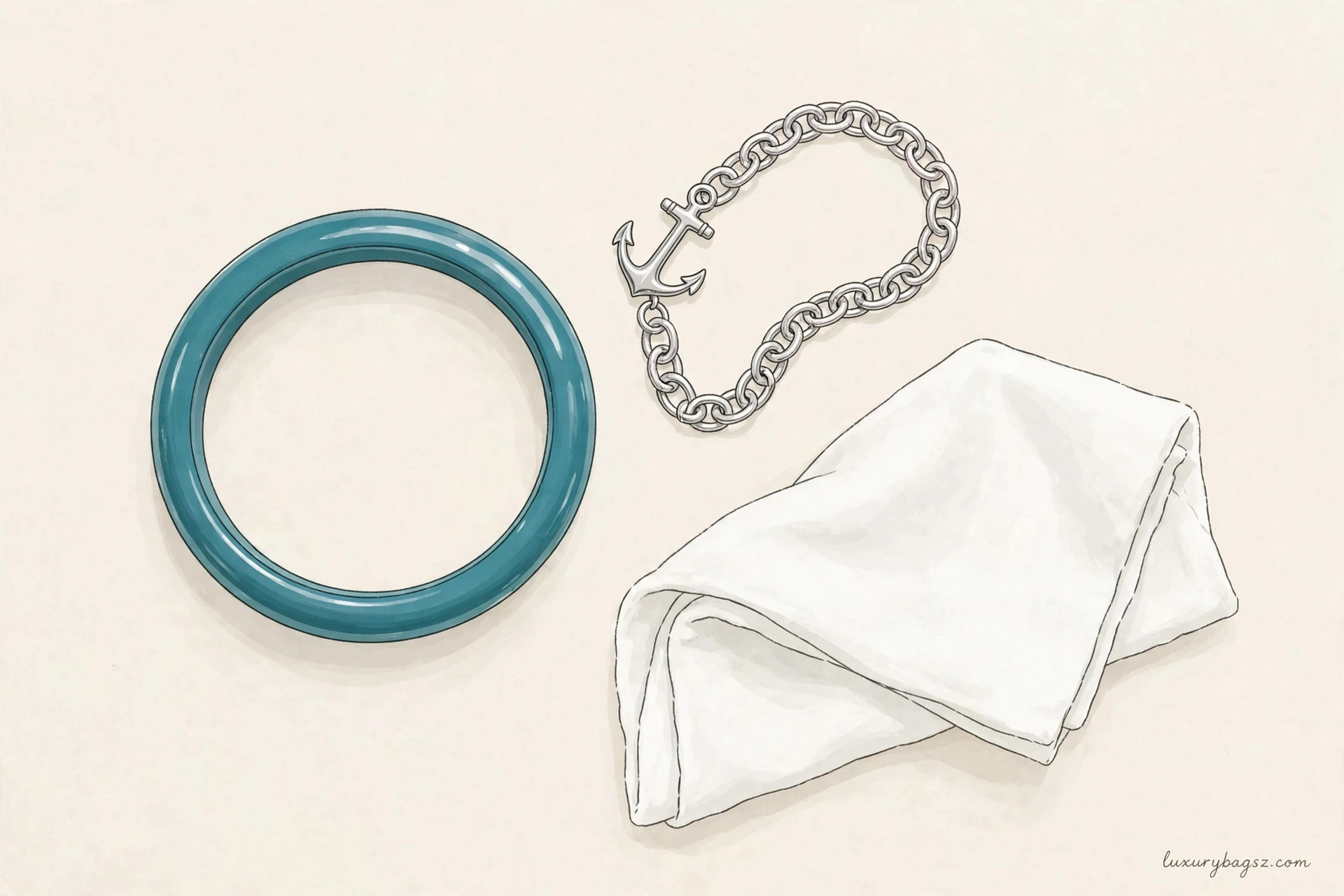
Work out what surface you hold before cleaning anything, then use the mildest method that suits it. For most pieces that means a soft dry cloth first; if grime remains, a barely damp cloth with one drop of mild soap, followed straight away by thorough drying.
Solid silver, solid gold, plating, enamel and deliberately darkened finishes all react differently, and a treatment that helps one can harm another. Enamel is glass-like and brittle, while plating is only a thin coating. Never use ultrasonic or steam cleaning, silver dip, abrasive pastes, toothpaste, lemon or vinegar on these pieces.
Introduction
Hermès fashion jewellery is unusually easy to damage by cleaning it the wrong way, and unusually hard to repair once that damage is done. That sounds like a contradiction, because the pieces themselves look tough: a Clic H bangle with a glossy enamel face, a Chaîne d’Ancre chain in solid-feeling silver, a Kelly bracelet with a padlock that clicks shut like a bag clasp. They look like objects you could scrub, dip, or polish back to new. In most cases, you cannot, and the cleaning advice that works perfectly well on a plain silver ring can strip, chip, or cloud a Hermès piece in a single afternoon.
The reason is that “Hermès fashion jewellery” is not one material. It is at least four different kinds of surface, often on the same piece: solid sterling silver or solid gold on the fine pieces; gold or palladium plating over a base metal on many fashion pieces, including the well-known enamel bangles; vitreous-style enamel, which is essentially a thin layer of coloured glass fused to metal; and deliberately darkened or brushed finishes that are meant to look less than mirror-bright. Each of those surfaces wants a different clean, and several of them are ruined by exactly the method that saves another. A silver dip that lifts tarnish off plain sterling can eat through plating and dull enamel. A polishing cloth that restores plain silver can rub the darkening out of a deliberately darkened chain and thin a plated layer until the base metal shows through. An ultrasonic bath that is harmless for a plain gold band can crack enamel and loosen a glued or set stone.
This guide is built around one rule: identify the finish first, then choose the mildest clean that works for that finish, and stop the moment the piece looks damaged rather than dirty. It covers the pieces buyers actually ask about — enamel bangles such as the Clic H and Clic Clac H, Chaîne d’Ancre chains, Kelly bracelets and belts with metal hardware, Rivage pendants and similar enamel and metal pieces — and it is honest where sources disagree. Rival guides disagree with each other, sometimes sharply, on water, on silver dips, on the foil-and-baking-soda bath, and on polishing cloths, and this guide states those disagreements plainly instead of quietly picking one version and presenting it as settled. Where a method is safe for one finish and dangerous for another, the guide says so, finish by finish.
Two standing facts belong at the start, because they change how you read every cleaning claim. First, a plated finish is not solid gold and it is not sterling silver, however heavy or convincing the piece feels. Plating is a thin coating over a different base metal, and once it wears through, no polish restores it; only replating does, and that is professional work. Second, Hermès issues no authenticity cards as a general rule, so a card supplied with a piece is a red flag, never proof that the piece is genuine, and never a reason to trust a cleaning claim printed on that card. If a seller’s “care card” tells you to dip or ultrasonically clean an enamel bangle, treat the card, not the bangle, as suspect.
A note on the pictures in this guide, because it matters for a cleaning article more than for most. Every picture here is a generic illustration, not a photograph of a real Hermès piece, and none of them should be used as a colour or finish reference for a genuine piece. Illustrations simplify metalwork and flatten enamel. Use them to follow the steps, not to judge whether your own piece matches a shade or a shine. Where an illustration simplifies a detail, the words in this guide prevail.
Key Takeaways
- Identify the finish before you clean anything. Solid silver, solid gold, plating, enamel, and a deliberately darkened finish each need a different clean, and the method that saves one can ruin another.
- The safe default for almost every Hermès fashion piece is the mildest one: a soft, dry cloth first, then, only if needed, a barely damp soft cloth with a drop of mild soap, followed by immediate, thorough drying. Anything stronger needs a reason, not a habit.
- Tarnish on sterling silver is normal and reversible. Darkening that was put there deliberately, on the other hand, is part of the finish, and polishing it away is damage, not cleaning.
- Enamel is glass-like and brittle. It chips on impact, cracks under sudden temperature change, and is damaged by harsh chemicals, abrasive pastes, ultrasonic baths, and steam. Never soak a chipped or cracked enamel piece.
- Plated pieces must never meet silver polish, silver dip, abrasive paste, or a treated polishing cloth meant for solid silver. Those products remove plating, and plating does not grow back with further polishing.
- Never use an ultrasonic cleaner, a steam cleaner, a harsh chemical dip, an abrasive paste, toothpaste, lemon, or vinegar on Hermès fashion jewellery. Never use a leather cleaner on metal, and never use a metal polish on leather, enamel, or a bag.
- Clean joints, hinges, clasps, and toggles by hand, with a soft brush and a barely damp cloth, and dry them fully. Trapped moisture in a hinge is where corrosion starts.
- Store each piece separately, in its own soft pouch, away from humidity, perfume, and other jewellery that can scratch or tangle it. Anti-tarnish strips and airtight pouches help silver; they do not rescue a piece that is stored damp.
- Perfume, hairspray, lotion, sweat, swimming pools, and household cleaners do more damage over time than ordinary dirt. Put jewellery on last, take it off first, and keep it off for swimming, cleaning, and workouts.
- If a piece is chipped, cracked, loose, flaking, discoloured in patches, or has a clasp that no longer seats properly, stop cleaning it and get a professional opinion. Home cleaning cannot fix damage, and enthusiastic home cleaning often makes damage worse.
- When in doubt, ask Hermès after-sales service or a jeweller who works with enamel and plating. A professional clean costs far less than a ruined bangle.
Cleaning Hermès Fashion Jewellery in Brief
What is the one safe clean for most pieces? A soft, dry, lint-free cloth, used gently after every wear. If the piece still looks dirty, a soft cloth barely dampened with lukewarm water and a single drop of mild, fragrance-free soap, wiped gently and then dried at once with a second dry cloth. That two-step clean suits the largest number of Hermès fashion pieces, and it is the clean to return to whenever you are unsure about a finish.
Can I soak my Hermès jewellery in soapy water? Only if you are sure the piece is plain solid metal with no enamel, no plating, no glued stones, and no deliberately darkened finish — and even then, only briefly, in lukewarm water, never hot. For enamel bangles, plated pieces, and anything with a set or glued stone, do not soak. A brief damp wipe is the stronger clean for those pieces, not a bath.
Why does my silver chain look dark, and is that tarnish? Usually, yes, if the chain is sterling silver: silver reacts with sulphur compounds in air, on skin, and in everyday products, forming a dark layer. But not every dark finish is tarnish. Some Hermès pieces are deliberately darkened, brushed, or given a matte finish, and that darkening is the design. The difference matters because tarnish can be polished away and a deliberate finish cannot be polished back once it is removed. The silver section explains how to tell them apart before you touch either one with a cloth.
Can I use a silver dip or a polishing cloth? On plain sterling silver with no enamel, no plating, and no deliberate darkening, a silver dip or a purpose-made silver polishing cloth is a recognised method, used by many jewellers — but this guide does not recommend it as a first step, and it must never be used on enamel, plated, or darkened pieces. Sources disagree on dips and cloths more than on any other cleaning question, and the silver section and the gold and plating section set out that disagreement in full, so you can see why a method one guide calls essential another guide calls destructive.
What about an ultrasonic cleaner? No. Not for enamel, not for plated pieces, not for pieces with stones, and not as a shortcut for a chain with a hinge or toggle. Ultrasonic vibration can crack enamel, loosen settings and glue, and shake dirt deeper into a hinge rather than out of it. Steam cleaners carry the same warning for enamel, because heat and pressure stress a glass-like layer. If a home guide tells you an ultrasonic bath is safe for “all jewellery”, that guide is not talking about enamel fashion jewellery.
How often should I clean a piece? Lightly, after every wear, with a dry cloth: thirty seconds, no products. Deeply, only when the piece actually needs it: when it looks dull, feels sticky, or has visible dirt in its joints. Cleaning a plated or enamel piece on a fixed weekly schedule, with products, wears the finish faster than wearing the piece does. The best cleaning routine for most fashion jewellery is mostly wiping and mostly leaving alone.
When should I stop and use a professional? When the piece is chipped, cracked, flaking, loose at a joint, or discoloured in a patchy way that does not match ordinary tarnish; when a clasp, hinge, or toggle no longer works smoothly; when you do not know what finish you have; or when the piece is valuable enough that a mistake would cost more than a professional clean. The professional section gives the order to follow and what to ask for.
Three Traps in Most Cleaning Advice
Most rival guides for cleaning Hermès jewellery fall into one of three traps, and recognising them will save you from following bad advice that sounds confident.
The first trap is treating all Hermès jewellery as if it were one material. A guide will open with “Hermès jewellery” and then give a single cleaning recipe, usually warm soapy water and a soft brush, as if a solid silver Chaîne d’Ancre chain, an enamel Clic H bangle, and a gold-plated Kelly bracelet were interchangeable. They are not. The soapy-water recipe is reasonable for plain solid metal and risky for enamel that is already chipped, wrong for plating if it is followed by a silver polish, and incomplete for a chain, because it says nothing about drying the inside of a hinge. A guide that does not split its advice by finish is not a guide to Hermès jewellery; it is a guide to one imaginary piece.
The second trap is copying generic jewellery advice without checking it against enamel and plating. The generic web is full of home remedies — toothpaste, lemon juice, vinegar, baking soda paste, the foil-and-baking-soda bath, silver dip, ultrasonic baths — and many of them work, after a fashion, on plain silver. Almost none of them are safe across enamel and plating, and several are actively destructive on those finishes. Yet rival guides repeat them, sometimes with a Hermès name added to the title and nothing else changed. If a guide recommends toothpaste for an enamel bangle, or an ultrasonic bath for a plated bracelet, it has not considered the finish at all, and its other advice should be treated with the same suspicion.
The third trap is silence on the details that actually decide whether a piece survives cleaning: joints, hinges, clasps, and storage. Rival guides rarely explain how to clean inside a toggle ring, around a hinge pin, or under a Kelly padlock, where dirt and moisture collect and where corrosion starts. They rarely explain that a bracelet stored touching another bracelet will scratch it, that a chain stored tangled will kink, or that a piece stored damp in a closed pouch will tarnish faster than a piece stored dry in open air. They rarely explain the difference between tarnish and a deliberate darkened finish, so readers polish darkening away and then wonder why the piece looks wrong. And they almost never explain when to stop — the point at which a piece is damaged, not dirty, and home cleaning becomes the problem rather than the cure.
This guide is built to fill those gaps. Every method below is tied to a finish, every “never” is tied to a reason, and every disagreement between sources is stated rather than smoothed over. Where sources conflict, the guide follows the stricter advice for the more delicate finish, because a clean that is slightly too gentle leaves dirt that a professional can remove, while a clean that is slightly too harsh leaves damage that nobody can undo.
Fashion Jewellery, Fine Jewellery, and Knowing Which You Hold
Hermès sells jewellery at two very different levels, and the cleaning rules change between them. Fine jewellery — the high jewellery pieces in solid gold, platinum, and precious stones — is made to be serviced by a jeweller and is usually cleaned professionally, with home care limited to a soft cloth. Fashion jewellery — the broader range that most buyers mean when they say “Hermès jewellery” — includes the enamel bangles, the palladium- and gold-plated bracelets, the silver-toned chains, and the metal-and-enamel pendants. Fashion jewellery is where the damage happens, because its finishes are thinner, more varied, and less forgiving than solid fine metal.
Within fashion jewellery, the pieces this guide covers most often are the following. Enamel bangles: the Clic H and the Clic Clac H, a wide or narrow bangle with a coloured enamel face and a metal edge and clasp, usually in gold or palladium plating over a base metal. Chains: the Chaîne d’Ancre, a row of anchor links with a central bar and a T-bar toggle, made in sterling silver and in gold versions. Bracelets with bag hardware: Kelly bracelets and belts, which borrow the padlock, strap, and clasp language of the Kelly bag in metal and sometimes leather. Pendants and smaller pieces: Rivage pendants, enamel and metal charms, and similar pieces that mix enamel, plating, and sometimes a stone or a leather cord. A single collection can therefore contain solid metal, plating, enamel, and leather in different pieces, and sometimes on the same piece.
Before you clean anything, identify what you hold, using four checks that need no tools. First, read any marks: sterling silver is usually marked 925, solid gold is usually marked 750 for 18-karat gold, and plated pieces may be marked with the plating metal or with no fineness mark at all. A fineness mark alone is not proof of anything — marks are copied — but a piece with no fineness mark that is sold as solid gold should make you pause, and a piece described as gold-plated should be treated as plated whatever it feels like. Second, look at the edges and the clasp: plating wears first at edges, hinges, and clasp contact points, where a different colour showing through is a sign of a plated layer wearing thin, not of dirt. Third, look at the face: a glossy, coloured, glass-smooth face on a bangle is enamel, and enamel rules apply to that face even if the edges are metal. Fourth, ask what you paid and where you bought it: a standard enamel bangle at a fashion-jewellery price is a plated and enamel piece, not a solid gold piece, and cleaning it as if it were solid gold is the single most common expensive mistake in this whole subject.
If you cannot identify the finish after those four checks, do not guess. Clean only with a dry soft cloth, and ask Hermès after-sales service or a jeweller before using any liquid, dip, or polish. Guessing the finish and then choosing the strongest clean for the guessed finish is how plating gets stripped and enamel gets clouded.
The Safe Default Clean, Step by Step
This is the clean to use for almost every Hermès fashion piece, and the clean to return to whenever a stronger method is in doubt. It has five steps, and the order matters.
Step one, inspect before you clean. Work in bright, natural light, over a soft towel or a lined tray, so a dropped piece does not hit a hard surface and so a loose stone or link is noticed rather than lost. Look for chips in enamel, cracks, flaking, loose stones, a clasp that sticks, and discolouration that looks patchy rather than even. If you find any of those, stop here and go to the damage stop-rules section. Cleaning a damaged piece is not the next step; assessing the damage is.
Step two, wipe dry. Use a soft, lint-free, untreated cloth — a microfibre cloth or a plain cotton cloth — and wipe the whole piece gently, following the shape of the metal rather than scrubbing back and forth across enamel. This alone removes skin oils, dust, and light fingerprints, which are most of what makes a piece look dull after a day’s wear. For a chain, let it drape over your fingers and wipe link by link rather than bunching it and rubbing, which tangles and kinks it.
Step three, only if the piece still looks dirty, wipe damp. Dampen a second soft cloth with lukewarm water and a single drop of mild, fragrance-free soap — plain dish soap with no bleach, no degreaser, and no added fragrance is the usual choice — and wring the cloth until it is barely damp, not wet. Wipe the dirty areas gently. For joints and clasps, use a soft-bristled brush, such as a baby toothbrush, barely dampened with the same solution, and brush lightly, letting the bristles reach into crevices without forcing them. Do not soak the piece, do not run it under a tap, and do not leave the damp cloth sitting on enamel.
Step four, rinse the cloth, not the piece. Wring a clean cloth in plain lukewarm water, wipe the piece again to lift soap residue, and repeat with a freshly wrung cloth if the piece still feels slippery. Soap left on metal attracts dirt and can dull enamel, and soap trapped in a hinge dries into a film that holds moisture against the metal. The point of this step is to leave no soap behind, not to get the piece wetter.
Step five, dry fully, at once. Pat the piece dry with a soft, dry cloth, then leave it in open air on a soft towel for at least an hour before storing it, turning a chain or a bangle once so that no damp patch sits against the towel. Pay particular attention to hinges, toggle rings, clasp interiors, and the underside of a bangle, where water hides. Never store a piece damp, never dry it with heat — no hairdryer, no radiator, no direct sunlight — and never put a chain away tangled, because a damp tangle dries into a kink.
That is the whole default clean. It is deliberately boring, and boring is the point: a clean that cannot strip plating, crack enamel, or remove a deliberate finish is a clean you can repeat after every wear without slowly destroying the piece you are trying to keep beautiful.


Silver: Tarnish, Deliberate Darkening, and the Dip Disagreement
Sterling silver tarnishes. That is not a fault, and it is not a sign that a piece is fake or of poor quality. Silver reacts with sulphur compounds in the air, in sweat, and in everyday products — perfume, hairspray, rubber, wool, eggs, onions, and chlorinated water are all commonly named — forming a dark layer of silver sulphide on the surface. A silver chain stored unworn in a drawer can tarnish, a silver chain worn daily can tarnish where it touches skin, and a silver chain worn in a humid climate tarnishes faster than the same chain worn in a dry one. Tarnish is normal, it is even, it follows the shape of the piece, and on plain sterling silver it is reversible.
Deliberate darkening is different, and confusing the two is one of the most expensive mistakes in silver care. Some Hermès pieces, and many silver pieces generally, are given a darkened, oxidised, brushed, or matte finish on purpose: recesses are darkened to make raised detail stand out, or a whole surface is brushed to a soft matte rather than polished to a mirror. That darkening is part of the design, it is usually most visible in recesses and on surfaces that would otherwise be plain, and it does not look like patchy tarnish. If you polish a deliberately darkened piece with a silver polishing cloth, a silver dip, or an abrasive paste, you will remove the darkening along with any tarnish, and the piece will come out looking brighter, flatter, and wrong — and the darkening cannot be restored by polishing it again. Before you polish any silver piece, compare it with photographs of the same model when new, and ask whether the dark areas sit in recesses and follow the design, or whether they sit on high points and look like ordinary dullness. If you are unsure, use only a dry soft cloth and ask a professional.
This is also where sources disagree most sharply, and the disagreement must be stated, not hidden. On silver dips, one group of jewellers and care guides recommends a brief dip in a commercial silver dip as a fast, effective way to remove tarnish from plain sterling silver, followed by thorough rinsing and drying. Another group warns that dips are aggressive, that they strip deliberately darkened finishes, that they attack plating and can leave a dull, lifeless surface, and that residue trapped in crevices continues to act after rinsing. Both groups are describing real outcomes on different pieces: a dip on plain, unadorned sterling can work well, and the same dip on a darkened, plated, or enamel-adjacent piece can damage it. This guide follows the stricter position for Hermès fashion jewellery: do not use a silver dip on any piece with enamel, plating, a darkened finish, a stone, or a hinge you cannot rinse fully, and do not use a dip as a routine clean even on plain sterling, when a cloth and soapy water will do the job more slowly and more safely.
The same disagreement applies to the foil-and-baking-soda bath, in which silver is placed on aluminium foil in hot water with salt and baking soda so that sulphide transfers from the silver to the foil. Some general guides present it as a gentle, chemical-free miracle for tarnished silver. Other guides warn that it is an electrochemical reaction that can also strip deliberate darkening, dull plating, and damage pieces with stones or glued elements, and that hot water alone is a risk for enamel. Again, both descriptions contain truth for different pieces. For plain sterling with no other finish, the bath can remove tarnish. For Hermès fashion jewellery, which so often mixes finishes, this guide does not recommend it: the risk to a darkened or plated area outweighs the speed, and the default clean described earlier achieves the same result on light tarnish without the risk.
On polishing cloths, the disagreement is narrower but still real. A purpose-made silver polishing cloth contains mild abrasives and anti-tarnish agents, and one group of guides recommends it as the safest routine method for silver. Another group points out that any abrasive cloth, used repeatedly, thins plating and removes darkening, and that a treated cloth must never be used on a plated or darkened piece. The reconciliation is simple and is this guide’s rule: an untreated soft cloth for plated, enamel-adjacent, and darkened pieces, always; a silver polishing cloth only on plain sterling with no other finish, used gently, in straight strokes, and never as a scrubbing tool.
A final silver warning belongs here. Never use toothpaste, baking soda paste, lemon juice, or vinegar on silver fashion jewellery. All four are abrasive or acidic, all four are recommended by some general home guides, and all four scratch or etch a finish that a soft cloth would have preserved. A scratched plating layer cannot be polished smooth again, because polishing removes more plating.

Enamel Bangles: Clic H, Clic Clac H, and Every Coloured Face
Enamel is the finish that most cleaning guides get wrong, because it looks like the toughest surface on a bangle and is in fact the most brittle. Enamel is a glass-like layer fused to metal by heat. It is hard, glossy, and resistant to ordinary wear, which is why a Clic H bangle keeps its colour for years. It is also brittle, which is why a single knock against a table edge, a door handle, or another bracelet can chip it, and why sudden temperature change, harsh chemicals, and vibration can crack it. A chip is not dirt, and no cleaning method fills a chip. The goal of enamel care is to avoid creating the chip in the first place, and to avoid making an existing chip worse.
The everyday clean for an enamel bangle is the mildest in this guide. Wipe the enamel face with a soft, dry cloth after every wear. If the bangle needs more, wipe it with a barely damp soft cloth, with at most a drop of mild soap, and dry it at once. Do not soak an enamel bangle, do not leave it sitting in water while you clean something else, and do not run it under a hot tap: several enamel guides warn specifically against hot water and sudden temperature change, because thermal shock stresses the glass-like layer. The Clic H guide describes the bangle’s enamel face and H clasp in full, and the same face that gives the bangle its colour is the face this gentle clean protects. For sizing, the Clic Clac H sizes guide explains the narrow and wide versions, and a bangle that fits loosely knocks against things more often, which is itself an enamel risk worth fixing by fit rather than by cleaning.
Sources disagree on water for enamel, and the disagreement is worth stating plainly, because it decides what you do with a dirty bangle. One group of guides, including several enamel specialists, says a brief wipe with lukewarm soapy water is safe for intact enamel, provided the piece is dried at once and never soaked. Another group, including several bracelet-care guides, says to keep enamel bangles dry, to use a dry cloth only, and to allow at most a slightly damp cloth for stubborn dirt. A third group splits the difference by finish: intact enamel tolerates a damp wipe, while aged, cracked, or lifting enamel tolerates no water at all. This guide follows the strictest version that still cleans: dry cloth first, barely damp cloth only on intact enamel, no soaking, no hot water, and no water at all on a bangle whose enamel is chipped, cracked, or lifting at an edge, because water entering under a lifted edge can loosen it further and trap corrosion against the metal beneath.
What never to use on enamel follows from what enamel is. No ultrasonic cleaner and no steam cleaner: vibration and heat crack a glass-like layer and loosen anything glued to it. No abrasive paste, no scouring pad, no toothpaste, and no treated silver polishing cloth on the enamel face: abrasion clouds gloss, and clouded enamel cannot be polished back to its original depth. No harsh chemical dip, no silver dip, no bleach, no acetone, and no nail-polish remover: chemicals can dull, stain, or lift enamel, and a dip that is safe for plain metal is not safe for a coloured glass face. No leather cleaner, no metal polish, and no furniture polish on enamel: each is made for a different surface and each leaves a film or a chemical on the one surface it was not made for. If a product’s label does not say it is safe for enamel, assume it is not.
Impact matters as much as chemistry. Take an enamel bangle off before cooking, cleaning, gardening, sport, and any task where your wrist meets a hard surface. Store it where it cannot knock against other jewellery: its own pouch, its own compartment, never loose in a bag with keys, a phone, or another bangle. A bangle that is chipped at the edge will chip further at the same edge, because the protective glass layer is already broken there, so a chipped bangle needs a professional assessment, not a more vigorous clean. And never try to fill a chip at home with nail polish, glue, or coloured resin: a home fill traps moisture, looks wrong under close inspection, and makes a professional repair harder, because the repairer must first remove your fill.

Gold, Gold-Plated, and Palladium-Plated Pieces
Gold care splits cleanly in two, and the split is the whole subject: solid gold can be cleaned more firmly than plated gold, and confusing the two is how plating is lost.
Solid gold — 18-karat gold, marked 750, and used on fine Hermès pieces — does not tarnish the way silver does, because gold does not react with sulphur in the same way. It dulls from skin oils, lotion, and dirt, and that dullness lifts with the default clean described earlier: a soft cloth, then a barely damp cloth with mild soap, then full drying. A brief lukewarm soapy soak is accepted by most guides for plain solid gold with no stones, no enamel, and no glued elements, and a soft brush reaches into crevices that a cloth cannot. Even for solid gold, however, abrasive pastes, toothpaste, and harsh dips are unnecessary and unwise: they scratch a soft metal, and scratches on gold are removed only by removing more gold.
Plated gold and plated palladium are a different story, and they cover most Hermès fashion bangles and bracelets. Plating is a thin layer — gold plating or palladium plating over a base metal, often brass — and Hermès hardware is traditionally coated in gold, palladium, or permabrass, an exceptionally thick plating that is a house signature. Thick or not, plating is still a coating, and every clean removes a microscopic amount of it. That is why the rules for plated pieces are stricter than the rules for solid metal: wipe with an untreated soft cloth, damp-wipe only when needed, dry at once, and never use silver polish, silver dip, a treated polishing cloth, an abrasive paste, or an ultrasonic bath on a plated piece. A silver polishing cloth is made to remove a layer from silver; on a plated piece, the layer it removes is the plating itself. Once plating wears through at an edge or a clasp, the base metal shows as a different colour, and no amount of polishing restores it. Only replating, by a professional, restores it, and replating changes the piece’s surface in ways a buyer should discuss with the professional first.
Palladium plating deserves a note of its own, because it looks like silver and is sometimes cleaned as if it were silver. Palladium is resistant to corrosion and tarnishing, which is why it is used, and it does not need a silver dip or a silver cloth. Treat palladium-plated pieces exactly like gold-plated pieces: soft cloth, barely damp wipe when needed, dry at once, no dips, no treated cloths, no abrasives. A palladium-plated piece that looks dull usually needs only a dry wipe; a palladium-plated piece that looks patchy, with a different colour showing through at edges, is wearing through, not dirty, and polishing it will make the patch larger.
Wear habits matter more for plating than any cleaning product. Plating wears at contact points: where a bangle meets a watch, where a bracelet rubs a desk, where a clasp opens and closes. Wearing a plated bangle against a watch or another bracelet every day wears it faster than any single clean. Perfume and hairspray sprayed directly onto a plated piece, sweat left on it after a workout, and chlorine from a pool all attack plating over time. Put plated jewellery on last, after perfume and lotion have dried, and take it off before swimming, showering, workouts, and cleaning. Those two habits preserve plating longer than any product sold as a plating protector.
Chains, Toggles, Hinges, and Clasps: Where Dirt and Damage Hide
A chain, a toggle, a hinge, and a clasp are the parts of a piece that a cloth alone cannot clean, and the parts where a careless clean does the most harm. This part covers them together, because they share one problem: they are moving metal parts with interiors that a wipe cannot reach and that moisture cannot easily leave.
For a Chaîne d’Ancre chain, start by letting the chain drape, never by bunching it. Wipe it link by link with a soft cloth, following the curve of each link, and use a soft brush, barely dampened, only where dirt is visible between links. The Chaîne d’Ancre guide describes the anchor links and the T-bar toggle in full, and the toggle deserves its own check: wipe the bar and the ring, brush lightly inside the ring, and dry both fully, because a toggle that is put away damp corrodes where the bar meets the ring, which is exactly where it must seat smoothly. Never force a stiff toggle, never oil it with a household oil, and never clean it with a dip: a toggle that sticks usually has dirt or corrosion in the ring, and forcing it bends the bar. If a chain kinks, do not pull it straight with force; lay it flat, work the kink gently with your fingers, and if it will not lie flat, ask a jeweller, because a kinked link is a weakened link. The fake Chaîne d’Ancre checks also explain why a chain that moves unevenly deserves attention, and that same uneven movement after cleaning is a reason to stop and seek advice, not to clean harder.
For a Clic H or Clic Clac H clasp, the risk is different: the clasp is a hinge with a spring or a snap, and its interior collects lotion, sweat, and soap. Open the clasp, wipe both faces with a dry cloth, and use a barely damp soft brush only on the metal parts, keeping moisture off the enamel face. Dry the clasp open, in air, before closing it: closing a damp clasp traps moisture inside the hinge, and that trapped moisture is where a hinge stiffens and corrodes. Never use a pin, a needle, or a sharp tool to dig dirt out of a hinge; you will scratch the metal and push dirt deeper. If a clasp no longer snaps shut cleanly, or if it opens on its own, do not keep wearing the piece and do not try to bend the clasp back at home. A clasp that fails on a wrist loses the bracelet.
For Kelly bracelets and belts, the same hinge and padlock logic applies, with one extra warning: many Kelly pieces mix metal with leather, and leather and metal must never be cleaned with each other’s products. Wipe the metal with a soft cloth, keep metal polish, dips, and soapy water off the leather, and keep leather conditioner off the metal, where it leaves a film that attracts dirt and dulls plating. A fake Clic H guide makes the related point that plating and enamel on a fashion bangle are not solid metal, and the same caution applies here: a Kelly bracelet’s metal parts are often plated, and a metal polish that would suit solid hardware will strip them.
For pendants, rings, and smaller pieces, including pieces with a moving part such as a scarf ring, the rule is the same in miniature: clean the moving part by hand, dry it open and in air, and never assume that because a piece is small it can go in an ultrasonic bath or a dip. The scarf ring guide describes a metal ring that is handled, turned, and stored against silk, and the same care — hand-cleaned, fully dried, stored separately so it cannot scratch what it touches — applies to any small metal fashion piece.
For leather cords, fabric elements, and any piece that mixes materials, clean each material separately and keep each product on its own material. If a piece has a leather cord, wipe the cord with a dry cloth only, and keep soapy water, dips, and metal polish off it. If a piece has a stone, check whether the stone is set or glued before using any liquid at all: a glued stone loosens in water and heat, and a loose stone is lost, not cleaned. When a piece mixes materials and you cannot clean one material without wetting another, use a dry cloth only and ask a professional.
What Never to Use, and Why Each One Harms
This part is a single list, because a list is harder to misread than a paragraph, and because each item here has been recommended somewhere on the web for some kind of jewellery. None of them belongs on Hermès fashion jewellery.
Ultrasonic cleaners: vibration cracks enamel, loosens set and glued stones, shakes hinges, and can drive dirt deeper into a clasp. Steam cleaners: heat and pressure stress enamel and loosen glue. Silver dips and harsh chemical dips: they strip plating, remove deliberate darkening, dull enamel, and leave residue in crevices that keeps acting after rinsing. Abrasive pastes, scouring pads, and toothpaste: they scratch plating, cloud enamel, and scratch soft gold. Baking soda paste: abrasive on plating and enamel, whatever it does for plain silver. Lemon juice and vinegar: acids that etch plating and enamel and dull metal. Bleach, chlorine cleaners, and acetone: they attack plating, enamel, and glue, and chlorine is a particular enemy of plated and silver pieces. Treated silver polishing cloths on plated, enamel, or darkened pieces: they remove the very layer they are meant to polish. Leather cleaners on metal: a leather cleaner is made for leather, and on metal it leaves a film, can discolour plating, and does nothing useful. Metal polishes on leather, enamel, or fabric: they stain, film, and abrade surfaces they were not made for. Household oils, WD-40, and similar lubricants on hinges and clasps: they attract dirt, go rancid or gummy, and stain anything the piece touches. Hairdryers, radiators, and direct sunlight for drying: heat stresses enamel, dries leather, and can discolour plating. A leather cleaner made for bags is the clearest example of a product in the wrong place: a cleaner that suits Chanel bags is made for leather, not for a metal bangle, and the same applies to Saphir Renovateur, which is a leather care product, not a metal cleaner, and must never be used on jewellery metal, enamel, or plating.
If a product is not labelled safe for your piece’s exact finish, do not use it on the strength of a blog post, a video, or a shop assistant’s assurance. The cost of being wrong is a finish, and finishes do not come back with a second product.

Everyday Wear: Perfume, Water, Sweat and the Habits That Matter
Most damage to Hermès fashion jewellery does not happen during cleaning. It happens during wearing, in small daily exposures that add up, and no cleaning routine compensates for them. This part is therefore longer than a simple “take it off” list, because the habits are the care.
Perfume, hairspray, lotion, sunscreen, and makeup are the most common daily chemicals a piece meets. All of them contain solvents, alcohols, or oils that dull enamel, attack plating, and accelerate tarnish. The rule is simple and is worth following exactly: put jewellery on last, after perfume, hairspray, and lotion have been applied and have dried, and take jewellery off first, before removing makeup or applying night products. Spraying perfume directly onto a bangle or a chain, even once, leaves a film that a dry cloth may not fully remove, and repeated spraying builds a layer that dulls enamel and plating together. The same keep-products-off-fabric rule applies in reverse to silk worn beside jewellery: if you wear a twilly on a bag handle, keep metal cleaners, dips, and polishes away from the silk, which needs none of them.
Water is the second daily exposure, and sources disagree on how strict to be, so the disagreement is stated here. Some guides say brief contact with clean water is harmless for most jewellery, provided the piece is dried at once. Others say to keep fashion jewellery dry at all times, because water, and especially chlorinated or salt water, attacks plating and tarnishes silver. Both are partly right: a brief splash of clean water on intact metal, dried at once, is unlikely to ruin a piece, while swimming, showering, and hot tubs are a different exposure altogether, combining water, chlorine or salt, heat, and soap. This guide’s rule is practical: keep fashion jewellery off for swimming, showering, baths, and hot tubs, without exception; if a piece is splashed, dry it at once with a soft cloth and leave it in air before storing; and never swim in a plated or enamel piece on the reasoning that you will clean it afterwards, because chlorine and salt act while you are still in the water.
Sweat and workouts are the third exposure. Sweat is mildly acidic and salty, and it collects under a bangle, inside a clasp, and between chain links, where it tarnishes silver and wears plating. Take fashion jewellery off for workouts, for gardening, for cooking over steam, and for any task where your hands are in water or chemicals. Household cleaning is the same: bleach, dish soap at full strength, oven cleaner, and even prolonged contact with washing-up water damage plating and enamel, and rubber gloves, which contain sulphur, can themselves tarnish silver if a piece is stored against them.
Finally, impact and friction during wear deserve the same attention as chemicals. A bangle worn against a watch, a bracelet worn against a desk edge all day, a chain worn under a heavy bag strap, and an enamel bangle worn while carrying shopping all wear and chip faster than the same piece worn alone. Rotate pieces, rather than wearing one plated bangle every day against the same watch, and take a bangle off for tasks where your wrist meets hard surfaces. A piece that is worn hard and cleaned gently lasts longer than a piece that is worn gently and cleaned harshly, but a piece that is worn hard and cleaned harshly does not last at all.
Storage: Separate, Dry, Dark, and Untangled
Storage is where tarnish, scratches, and tangles are decided, and it is where rival guides are thinnest. A piece that is cleaned perfectly and then stored badly will look worse in a month than a piece that is cleaned lightly and stored well.
Store each piece separately, in its own soft pouch or its own compartment. Enamel bangles must not touch each other, or keys, or a phone, or another bracelet: enamel chips on contact with hard objects, and plating scratches on contact with other metal. Chains must not be stored tangled in a pile with other chains: a tangled chain kinks, and a kinked chain is weakened at the kink. Fasten a chain’s clasp before storing it, so the chain cannot tangle with itself, and lay it flat or hang it, rather than bunching it into a pouch. Pendants and rings need their own compartments for the same reason: a ring stored loose in a pouch with a bangle will scratch the bangle and be scratched by it.
Keep stored jewellery dry, cool, and out of direct sunlight. Humidity accelerates tarnish on silver and corrosion on plated base metal, and direct sunlight fades some enamel colours and heats a closed box. An airtight pouch or a sealed bag with an anti-tarnish strip helps sterling silver, because it limits the air and sulphur compounds that cause tarnish, and several silver guides recommend it. But an airtight pouch only helps if the piece inside is dry: sealing a damp piece in an airtight pouch traps moisture against the metal, which is worse than storing it in open air. Dry fully, in air, before sealing anything. Anti-tarnish strips and silica gel packets are useful in a jewellery box, but they are not a substitute for drying, and a strip that is exhausted — usually after some months — does nothing, so replace strips on a schedule rather than assuming an old strip still works.
Two storage disagreements are worth stating. First, on wearing versus storing silver: some guides say wearing silver often prevents tarnish, because skin oils and friction keep the surface bright, while others say sweat accelerates tarnish and storage in an airtight pouch is better. Both are true for different pieces: a plain silver chain worn daily and wiped after wear often stays brighter than the same chain stored unworn, while a silver piece worn only for workouts or in humidity tarnishes faster than a stored one. The reconciliation is to wipe after wear and store dry, rather than choosing wearing or storing as a cure on its own. Second, on boxes versus pouches: some guides prefer the original box, others prefer individual soft pouches, because a box with several pieces loose inside scratches them. The box is fine if each piece has its own pouch or compartment inside it; the pouch is fine if it is soft, dry, and not airtight around a damp piece. What matters is separation and dryness, not the container’s brand.
Travel storage deserves a sentence of its own. Never travel with fashion jewellery loose in a bag, a coat pocket, or a wash bag with toiletries. Use a jewellery roll or individual pouches, keep pieces separate, keep them away from perfume bottles and lotions, and keep them in hand luggage, not checked luggage, where temperature, humidity, and handling are worse. A canvas bag is a useful travel bag, but jewellery inside it still needs its own pouches: a bag protects against weather, not against pieces scratching each other.

When a Piece Looks Damaged, Not Dirty: Stop Rules
Knowing when to stop cleaning is more valuable than knowing ten more cleaning methods, because a damaged piece cleaned enthusiastically becomes a more damaged piece. Stop, and seek a professional opinion, if you see any of the following.
Enamel chipped, cracked, or lifting at an edge, or a coloured face that has gone cloudy, patchy, or dull in one area while the rest stays glossy. Plating flaking, or a patch of different-coloured metal showing through at an edge, a hinge, or a clasp. A stone that moves, rattles, or looks loose in its setting, or a glued element that has shifted. A chain link that is bent, kinked, or stiff in one place while the rest of the chain moves freely. A hinge that sticks, grinds, or will not close fully, or a toggle bar that is bent or no longer seats across its ring. A clasp that opens on its own, or that needs force to close. Discolouration that is patchy, greenish, or black in a way that does not match even tarnish, which can suggest corrosion of a base metal under worn plating. A smell of chemicals after a previous clean, or a sticky film that returns after wiping, which can suggest residue trapped in a hinge or under enamel.
In each of those cases, the right next step is the same: stop cleaning, stop wearing the piece if a clasp or link is failing, keep everything that came with it, and get an opinion before you polish, repair, or alter anything. Do not try to fill a chip, bend a link back, tighten a hinge with pliers, or glue a stone at home. Home repairs on fashion jewellery almost always make a professional repair harder and more expensive, and a home repair that changes the piece can affect its value and its authenticity assessment.
One authenticity note belongs here, because cleaning and authenticity meet at this point. A piece that is heavily polished, replated, or repaired may look cleaner than a genuine untouched piece, and heavy polishing is itself a warning sign in authentication: it removes hallmarks, softens detail, and hides wear patterns. If you bought a piece second-hand and its cleaning history is unknown, do not polish it before an authenticity check, and do not let a seller’s promise that a piece “just needs a clean” substitute for checking the piece itself. A fake Clic H check and a fake Chaîne d’Ancre check both depend on surface detail that aggressive cleaning removes, so cleaning before checking can destroy the very evidence you need. Hermès issues no authenticity cards as a general rule, so a card, a certificate, or a “cleaning certificate” supplied with a piece proves nothing, and a card that instructs an aggressive clean should be treated as a warning, not as care advice.
When to Use a Professional, and What to Ask For
A professional clean is not an admission of failure. It is the normal care step for a valuable piece, and Hermès itself recommends entrusting objects regularly to its artisans rather than tampering with them using unsuitable products. Use a professional when a piece is damaged in any way listed in the damage stop-rules section, when you do not know its finish, when a clasp, hinge, or toggle is failing, when plating has worn through, when enamel is chipped, when a stone is loose, or when the piece is valuable enough that a home mistake would cost more than the professional’s fee. That last test is the practical one: if you would be upset to lose the finish, do not risk the finish at home.
Ask the professional three questions before handing a piece over. First, what finish do you identify on this piece, and what clean do you propose for that finish? A professional who cannot name the finish, or who proposes the same clean for every piece, is not the right professional for enamel and plating. Second, will you clean it by hand, and will you avoid ultrasonic baths, steam, dips, and abrasive polishes on enamel and plating? If the answer is that an ultrasonic bath is standard for everything, take the piece elsewhere. Third, what will you not do — will you avoid removing deliberate darkening, avoid polishing plating thin, and avoid filling enamel chips with glue as a substitute for a proper repair? The answers to those questions tell you whether the professional understands fashion jewellery or only plain metal.
For Hermès pieces, Hermès after-sales service is the first place to ask, because it knows the house finishes and can advise whether a piece needs a clean, a repair, a replating, or an enamel restoration, and what each would involve. A local jeweller who works with enamel and plating is a good second choice, provided the jeweller answers the three questions above satisfactorily. A high-street cleaning service that dips everything, ultrasonically cleans everything, and polishes everything to a mirror shine is the wrong choice for a fashion piece, however convenient it is, because a mirror shine on a deliberately matte or darkened piece is damage, not improvement.
Keep a simple record of professional work: the date, the professional, what was done, and what was advised against. That record helps the next professional, helps you track how a finish is wearing, and helps a future buyer understand the piece’s history. A piece with a clear care history is easier to sell, easier to authenticate, and easier to keep beautiful than a piece whose history is a mystery.
A Cleaning Routine You Can Actually Keep
A routine that is too complicated will not be kept, and a routine that is not kept does not protect anything. This part reduces the whole guide to a routine that takes less than a minute a day and a few minutes when a piece actually needs more.
After every wear: wipe the piece with a soft, dry cloth, check the clasp or toggle, and put the piece in its own pouch, dry. That is the daily routine, and for most pieces, on most days, it is the whole routine.
Once a month, or when a piece looks dull: inspect the piece in bright light for chips, flaking, loose stones, and clasp problems. If it is intact, give it the damp wipe in the default clean section, dry it fully in air, and store it separately. If it is not intact, stop and go to the damage stop-rules section.
Once or twice a year: check storage — replace anti-tarnish strips, check pouches for damp or damage, check that chains are still fastened and untangled, and check that no piece has migrated into a shared compartment where it can scratch another. If a piece is worn daily, consider a professional inspection at the same time, especially for clasps and hinges, which wear invisibly until they fail.
Never, at any point in that routine: use an ultrasonic bath, a steam cleaner, a dip, an abrasive paste, toothpaste, lemon, vinegar, bleach, a leather cleaner on metal, or a metal polish on enamel, leather, or plating. The routine works because the “never” list is short and absolute, and because the daily step is so mild that it can be repeated indefinitely without wearing a finish.
If you remember one sentence from this guide, make it this: the mildest clean that works, done often, with the piece stored separately and dry, preserves Hermès fashion jewellery longer than any strong clean done rarely. Fashion jewellery rewards restraint. The pieces that look best after ten years are rarely the pieces that were cleaned hardest; they are the pieces that were worn carefully, wiped gently, stored separately, and handed to a professional the moment something went wrong.
Final Verdict
Hermès fashion jewellery does not need aggressive cleaning, and aggressive cleaning is the fastest way to ruin it. The pieces that survive beautifully are the pieces whose owners learned the finish first, cleaned with a soft cloth and, when needed, a barely damp wipe, kept perfume, water, sweat, and household chemicals away from metal and enamel, stored each piece separately and dry, and handed a damaged piece to a professional instead of trying to fix it at home.
That restraint is not a compromise. It is the correct care for surfaces that are thin, brittle, or deliberately finished: plating that cannot be polished back, enamel that cannot be unchipped, and darkening that cannot be unpolished. A guide that promises a fast, strong clean for every Hermès piece is promising the wrong thing, because the strongest clean is the one most likely to remove the finish you were trying to save.
Start with the default clean, keep the never list absolute, and let a professional handle anything that looks damaged rather than dirty. Your jewellery will not look newly bought every day, and it should not: a piece that is worn, wiped, and stored well develops a soft, even life of its own, which is a better look than a mirror shine bought at the cost of its finish. Clean gently, store separately, and stop when the piece tells you to stop. That is the whole method, and it is enough.
FAQ
Can I clean a Hermès enamel bangle with water?
Briefly, and only if the enamel is intact: a barely damp soft cloth, with at most a drop of mild soap, wiped gently and dried at once. Do not soak an enamel bangle, do not use hot water, and do not use any water at all on a bangle whose enamel is chipped, cracked, or lifting. When in doubt, use a dry cloth only.
Can I put Hermès fashion jewellery in an ultrasonic cleaner?
No. Ultrasonic vibration can crack enamel, loosen set and glued stones, and disturb hinges and clasps. Steam cleaners carry the same warning for enamel. Hand cleaning with a soft cloth is the safe method for fashion jewellery, whatever a general jewellery guide says about ultrasonic baths for plain metal.
How do I remove tarnish from a sterling silver Hermès chain?
First, check whether the darkening is tarnish or a deliberate darkened finish, as explained in the silver section. If it is ordinary tarnish on plain sterling with no enamel, plating, or darkening, wipe with a soft cloth, then a barely damp cloth with mild soap, and dry fully. A silver polishing cloth or a dip is a recognised method for plain sterling, but this guide does not recommend it as a first step, and it must never be used on enamel, plated, or deliberately darkened pieces.
Can I use silver polish on a gold-plated Clic H bangle?
No. Silver polish, silver dip, and treated silver polishing cloths remove plating, and plating does not grow back. A plated bangle needs only an untreated soft cloth, and a barely damp wipe when needed. If plating has worn through at an edge, polishing will make the worn patch larger, not smaller.
What should I do if my enamel bangle chips?
Stop cleaning it, stop wearing it if the chip has a sharp edge, and get a professional opinion. Do not fill the chip at home with nail polish, glue, or resin, and do not soak or scrub the chipped area. A professional can assess whether the enamel can be stabilised or restored, and a home fill makes that assessment harder.
Can I wear Hermès fashion jewellery in the shower or swimming pool?
No. Showering, swimming, and hot tubs combine water, soap or chlorine or salt, and heat, all of which attack plating, tarnish silver, and stress enamel. Take fashion jewellery off before swimming, showering, and bathing, and dry a splashed piece at once if it does get wet.
How should I store Hermès bracelets so they do not scratch each other?
Each piece in its own soft pouch or its own compartment, chains fastened and laid flat or hung so they cannot tangle, enamel bangles kept away from hard objects and other jewellery, and everything stored dry, cool, and out of direct sunlight. Never store a piece damp, and never store several pieces loose together in one pouch or box compartment.
Can I use a leather cleaner on the metal parts of a Kelly bracelet?
No. Leather cleaners are made for leather, and on metal they leave a film and can discolour plating. Clean metal parts with a soft cloth, keep leather products off metal, and keep metal products off leather. On a mixed-material piece, clean each material separately.
My silver chain looks dark in its crevices but bright on its high points. Is that a problem?
Usually not. Tarnish collects in crevices and recesses first, while high points stay brighter from contact and friction, and that pattern is normal for worn silver. What matters is whether the pattern is even and fits the piece’s age and wear, and whether the dark areas are tarnish rather than a deliberate darkened finish. If the darkening is patchy, greenish, or black in a way that does not match ordinary tarnish, stop and ask a professional.
When is a professional clean worth the cost?
Whenever a piece is damaged, whenever you do not know its finish, whenever a clasp, hinge, or toggle is failing, whenever plating has worn through or enamel has chipped, and whenever the piece is valuable enough that a home mistake would cost more than the professional’s fee. For Hermès pieces, Hermès after-sales service is the first place to ask, and a jeweller experienced with enamel and plating is a good second choice.