How to Spot a Fake Hermès Evelyne Bag: The Honest Guide to the Perforated H, Strap, Stamps, and Leather
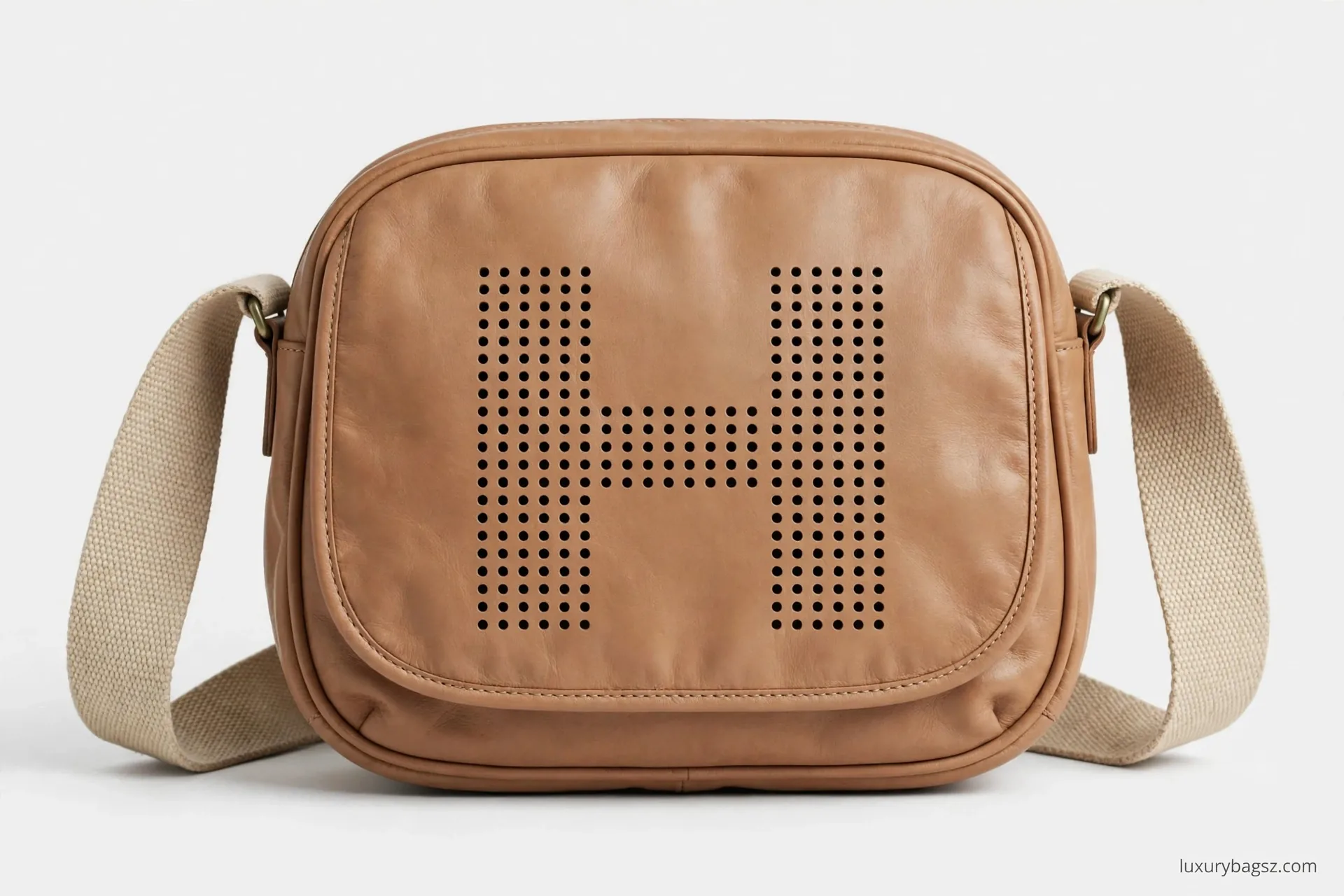
The Evelyne is the easiest Hermès bag to recognise and one of the easiest to get wrong when you are buying second-hand. Its most famous feature — a large perforated “H” on the front — looks simple. That simplicity is the trap.
A perforated H can be punched into almost any leather, and a thick canvas strap can be copied in an afternoon. What is much harder to copy, all at once and consistently, is the whole bag: the right shape for its generation, the right leather grain for the material claimed, the right strap construction, clean saddle stitching, crisp stamps in the right format for its era, and hardware that feels and wears like plated brass.
This guide is built for that whole-bag test. It starts with what a genuine Evelyne should look like, then works through twelve checks in the order that catches the most fakes earliest, then covers the traps that competitor guides routinely miss. It does not promise a magic single tell. In fact, several of the most repeated “tells” online are unreliable, and this guide says so plainly where that is the case.
The Evelyne began life in 1978, designed by Evelyne Bertrand in Hermès’ riding department, as a carry-all for horse grooming tools. That origin explains almost everything about the design: the perforated H was originally ventilation, so air could circulate around brushes and tools, and it was originally meant to face the wearer’s body.
Today many people wear the H facing outwards, as the visible design feature. Wearing it outwards is not a sign of a fake. It is simply how the bag is now commonly worn. Do not let a seller, or a guide, turn a wearing preference into an authentication rule.
Key Takeaways
- Start with the perforated H, but do not stop there. Clean, even, round holes matter — and so does everything else.
- The Evelyne has no traditional serial number and Hermès issues no authenticity cards. A card, or a “serial number” that is supposed to prove the bag alone, is itself a warning sign.
- Generations matter. Evelyne I, II, and III differ in pockets and straps, and the Sellier version does not have a perforated H at all. Judging a Sellier by perforations, or an Evelyne I by an Evelyne III strap, will mislead you.
- The interior should be the unlined, sueded back of the leather. A fabric-lined interior on a standard leather Evelyne is a major red flag.
- Leather grain must match the material claimed. Clemence, Togo, and Epsom do not look or behave the same, and a mismatch is more useful than a vague feeling that the leather “looks cheap”.
- Blind stamp format must fit the bag’s era, but the letter alone does not date a bag, because the alphabet has run more than once. A stamp that is too deep, too shallow, misspelled, or in the wrong place is a question, not an automatic verdict — and a missing stamp is also a question, not proof on its own.
- Photographs, price, box, and dust bag are supporting evidence only. All of them can be faked, borrowed, or bought separately. Judge the bag first.
The Evelyne fools buyers because its famous perforated H looks easy, so I deliberately ignore the H at first and read the leather instead. Having walked leather factories in Spain and France, I judge a claimed Clemence grain by how it slumps and catches the light — and by what it is not, because PU and PVC imitate the print of a grain without its depth or smell. When the material convinces me, I come back to the H and check that each hole is cut cleanly, with no fraying or stretched edges.
Spotting a Fake Evelyne in Brief
What is the fastest honest check? Look at the whole bag in good light before you zoom in on any one detail. A genuine Evelyne has a soft, saddle-like, rounded shape, an open top closed by a pull-through leather tab, a wide woven canvas strap with matching leather accents, and — on the classic versions — a large perforated H on the front panel. If the shape is stiff and boxy, the top is zipped, the strap is thin leather or shiny nylon webbing, or the bag has a flap, you are not looking at a standard Evelyne at all, whatever the label says.
What catches most fakes? The perforated H, the strap, and the stitching, taken together. On a genuine classic Evelyne the H holes are clean, round, evenly sized, and evenly spaced, with sharp edges and no tearing, fraying, or loose fibres. The strap is thick, tightly woven canvas, not flimsy webbing, with leather pieces that match the bag. The stitching is saddle stitching: hand-done, slightly slanted, even, and in a colour that matches the bag. A bag that fails two of those three deserves a very hard second look, even if its stamps look convincing.
What does not prove a bag? A card, a receipt, a box, a dust bag, a single clear photo, a plausible price, or a blind stamp letter that matches a year chart. Counterfeiters copy all of those. They are useful only when they agree with the bag itself.
When should you walk away? Walk away when the seller will not provide clear, close, well-lit photos of the H, the strap and its leather ends, the closure tab and its underside, the stitching, the interior, and the stamps; when the generation, material, and era do not line up; or when the price, story, and bag disagree with each other. A genuine seller with a genuine bag can usually provide those photos. A seller who cannot, or will not, has already told you something important.
The Genuine Evelyne Reference
Before you check a bag, you need to know which Evelyne you are supposed to be checking. Competitor guides often describe “the Evelyne” as if it were one unchanging bag. It is not.
The classic Evelyne is a soft crossbody messenger bag with a rounded, saddle-like body, an open top, and a leather pull-through tab closure. There is no zip and no flap on the standard version.
The front panel carries the large perforated H on the classic versions. The bag is unlined: the inside is the raw, sueded back of the leather, in the same colour family as the outside. That unlined interior is one of the most useful reference points in this whole guide, because it is easy to check and hard to fake convincingly in combination with everything else.
Generations differ in ways that matter for authentication, and sources do not always agree on the exact dates. The broad pattern that guides repeat is this: Evelyne I, from 1978, had an interior pocket and no exterior pocket, with a fixed-length removable strap. Evelyne II added an exterior back pocket and removed the interior pocket.
Evelyne III kept the exterior pocket and made the strap adjustable. Some guides date the Evelyne II reissue to 2000; others are less specific about dates. This guide therefore treats generation features — pocket position and strap adjustability — as more reliable than a claimed generation year on its own. If a listing calls a bag an Evelyne III but it has an interior pocket and a fixed strap, ask which feature is wrong, rather than accepting the label.
Sizes are another place where listings get sloppy. Guides and resellers commonly use names such as TPM, PM, and GM for small, medium, and large Evelyne sizes, and the Evelyne also appears in larger formats.
Do not authenticate by a size name alone. Measure, or ask for measurements, and compare the proportions in the photos: a TPM should read as a small crossbody, a GM as a generously sized one. A bag whose size name, measurements, and proportions disagree is a listing to question, even before you reach the stamps.
The Sellier version is the exception that breaks most shortcut guides. The Evelyne Sellier, a newer, more structured version, features an embossed, diamond-shaped H rather than a perforated H. That means the famous perforation count and hole-shape checks in this guide do not apply to a Sellier at all. If you are checking a Sellier, skip the perforation checks and lean harder on shape, structure, leather, stitching, strap, stamps, and hardware. A seller who describes a Sellier as having a perforated H, or who shows you perforations on a bag claimed to be a Sellier, has mixed up two different versions.
Materials also need a plain statement. The Evelyne is most commonly found in Clemence, Togo, and Epsom leathers, and in two-material versions using Toile H canvas. Clemence is soft, supple, and heavily grained, with a larger, flatter grain, and it tends to slouch with wear. Togo has a smaller, tighter grain and holds its shape a little more firmly.
Epsom is a fine, regular, slightly glossy, machine-printed grain on calfskin; it is stiffer and more structured, and its grain can flatten or rub with long wear. Swift, where it appears, is smooth. A bag claimed to be Clemence but showing a fine, uniform printed grain is not showing Clemence grain, whatever the listing says. Grain alone never proves a bag — good leather is widely available — but grain that contradicts the claimed material is a real problem for that listing.
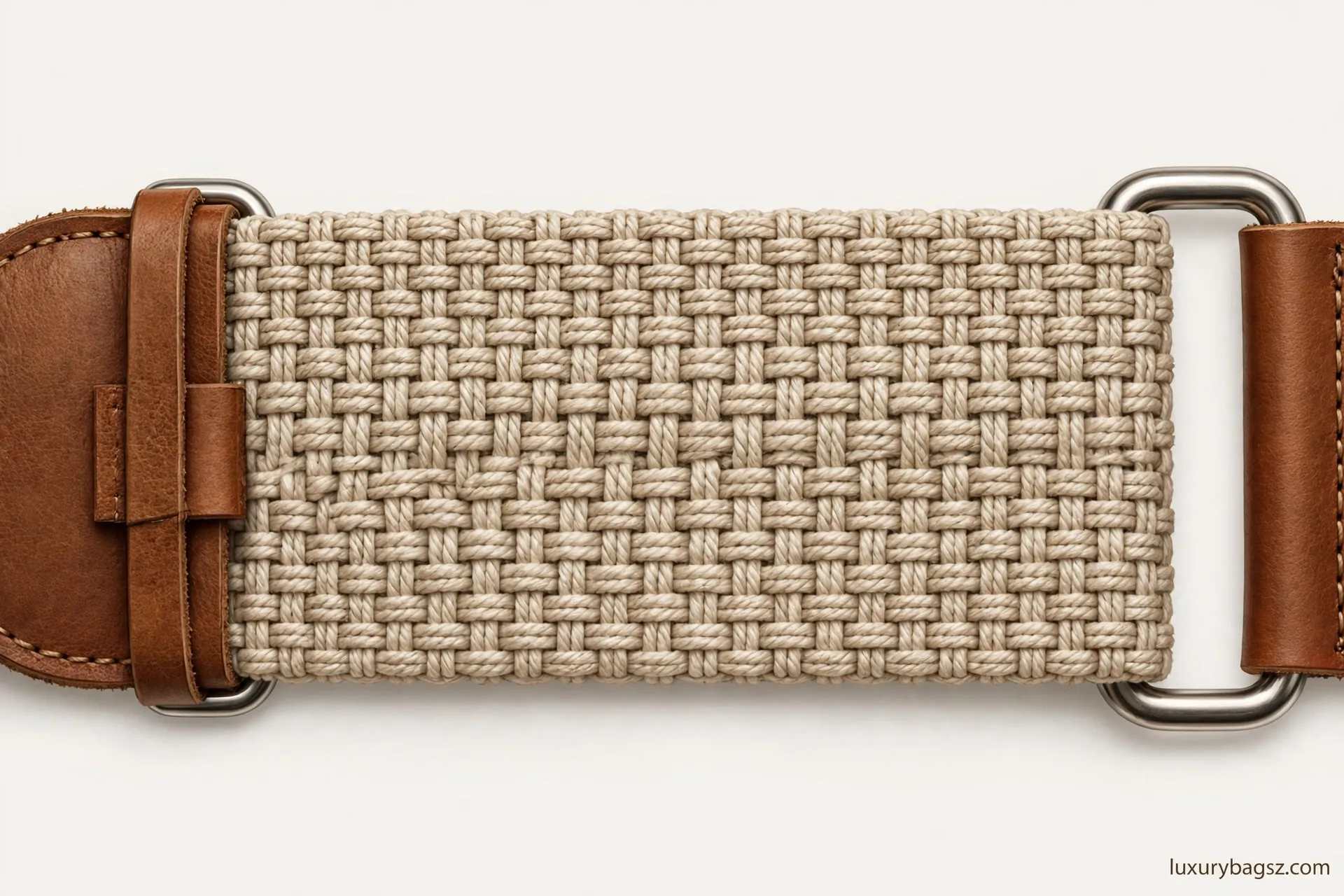
The strap deserves its own paragraph, because it is both distinctive and frequently copied badly. On a genuine Evelyne III the strap is a wide, thick, tightly woven canvas strap, adjustable, with leather accents that match the bag’s exterior material and colour. The canvas should feel substantial, not thin, shiny, or loosely woven, and the leather ends should be finished cleanly.
Earlier generations used a removable strap that was not adjustable in the same way, so again, generation matters: an adjustable strap does not automatically make a bag a III, and a fixed strap does not automatically make it fake, but the strap type must fit the generation claimed. Extra straps, including braided or replacement straps sold separately, do not authenticate the bag. Judge the bag and its original-style strap together, and treat any non-standard strap as a question about what has been replaced, not as proof either way.
Hardware on a genuine Evelyne is restrained: D-rings and strap fittings, a snap-style pull-through tab closure, and plated brass hardware in gold or palladium finishes. It should feel substantial and be finished cleanly, with crisp engraving where engraving is present.
Hardware that feels light, hollow, or tinny, that shows uneven plating, bubbling, or a dull plastic-like finish, or whose engraving is blurry, oversized, or misspelled, is a warning sign. As with every other check, hardware alone is not a verdict — hardware can be replaced, and finishes vary by era — but hardware that disagrees with the rest of the bag strengthens a case for walking away.
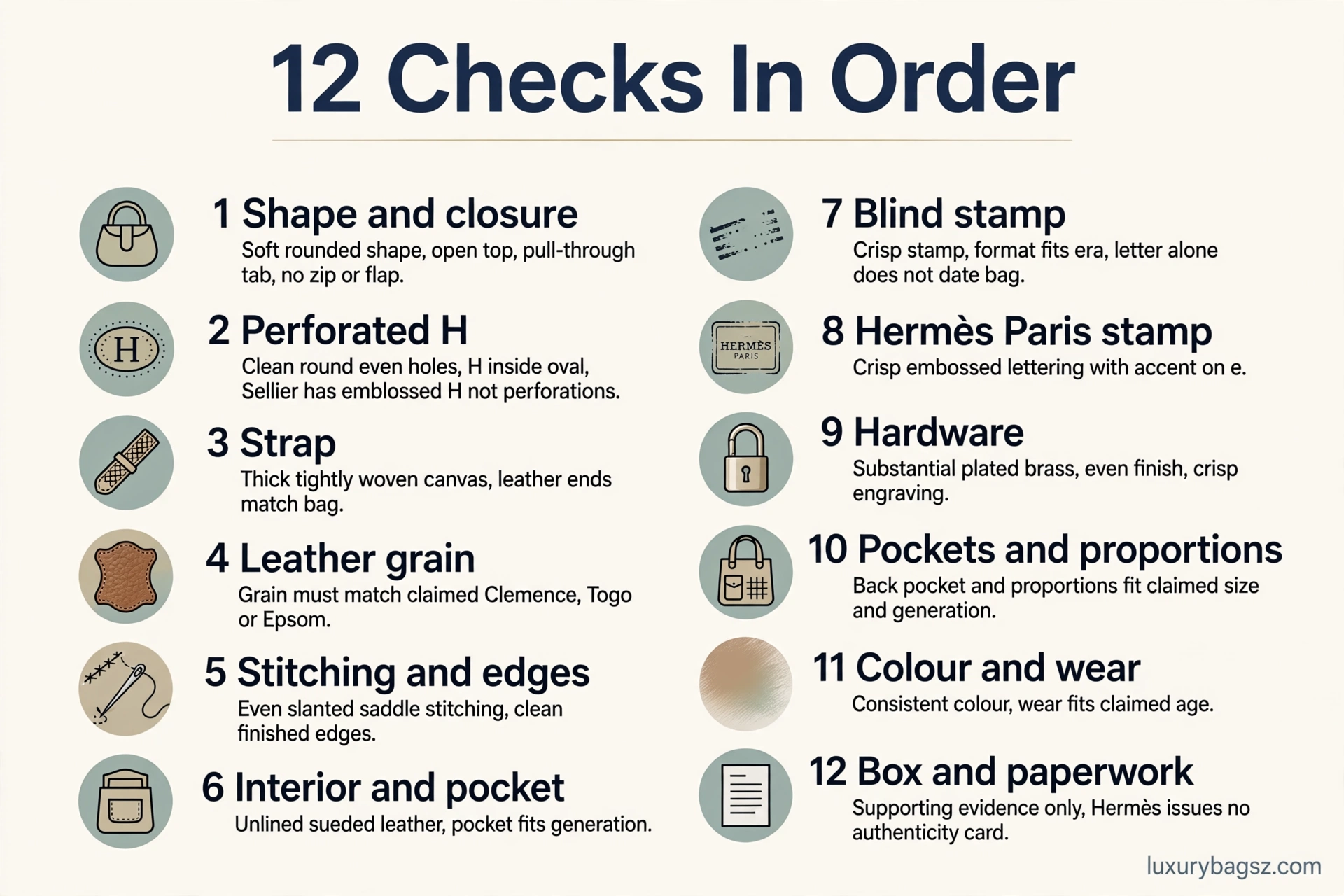
The Checks in Order
Work through these checks in order. The early checks are the ones you can do from good photos, and they filter out the most obvious fakes before you spend time on stamps and paperwork.
Do not skip ahead to the blind stamp and then work backwards. A convincing stamp on a bag with the wrong shape, wrong interior, and wrong strap is still a bag with the wrong shape, wrong interior, and wrong strap.
Check 1: Shape, top, and closure
A standard Evelyne is soft and rounded, not rigid, boxy, or sharply structured — unless it is a Sellier, which is deliberately more structured. The top is open, closed by a leather pull-through tab.
There is no zip, no flap, and no magnetic flap closure on a standard Evelyne. The tab should pull through cleanly and sit naturally, with finished edges. A bag with a zip top, a flap, a drawstring, or a tab that looks glued rather than stitched and finished is not a standard Evelyne, and no stamp can rescue it.
Also check the overall silhouette from the side and the back, not just the front. A genuine Evelyne slouches gently and evenly. A bag that is unnaturally stiff in Clemence, or that collapses in a lopsided way in Epsom, is worth questioning — not because softness alone proves anything, but because the behaviour should fit the leather claimed.
Check 2: The perforated H
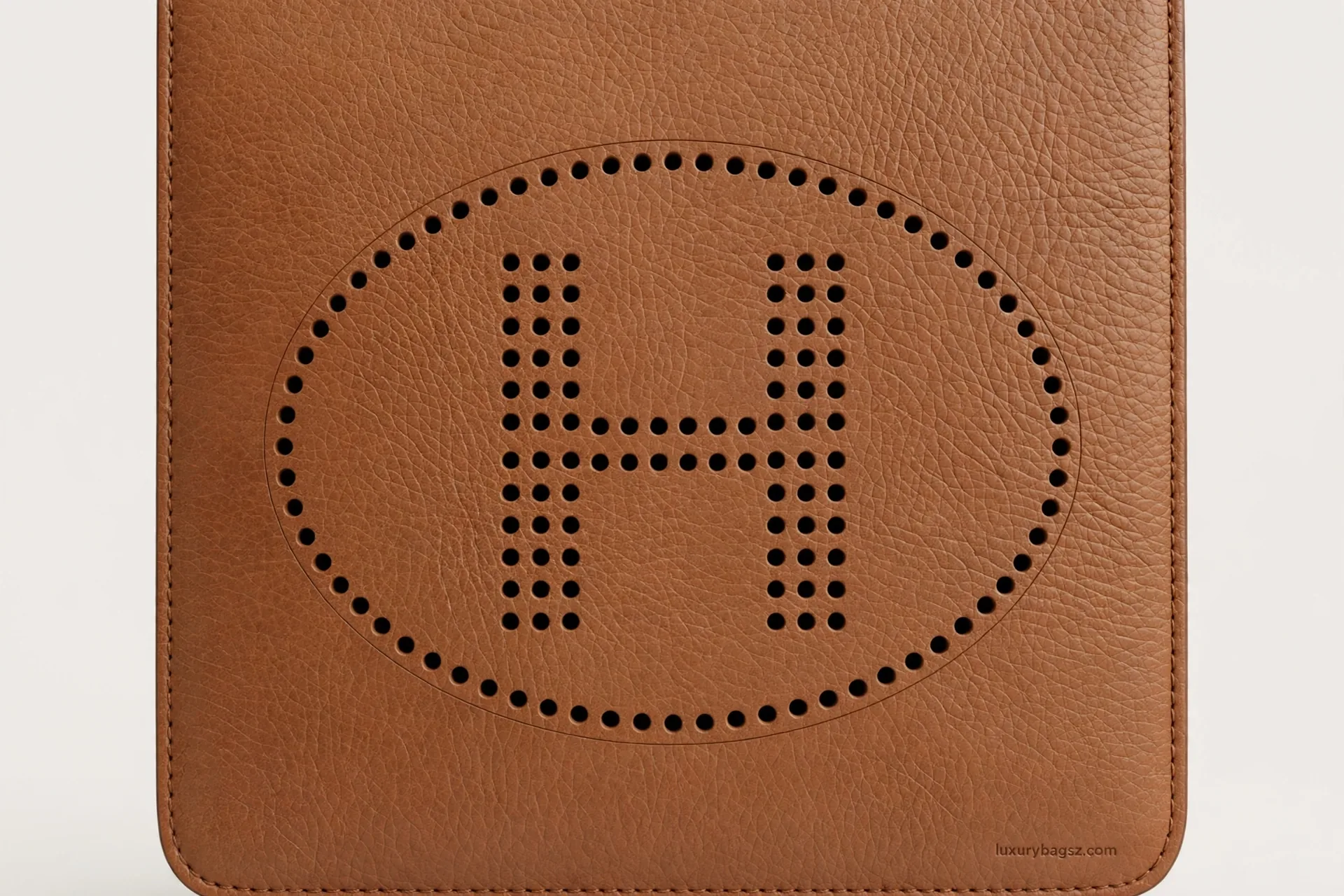
This is the signature check, and it needs care. On a classic Evelyne the H is formed by holes punched cleanly through the leather, not printed, embossed, or stitched on. The holes should be round, evenly sized, and evenly spaced, with sharp, clean edges and no tearing, fraying, or stray fibres.
The H should sit symmetrically on the front panel, inside its oval outline, and the outline itself should be a smooth oval, not pointed at the sides or squashed into a circle.
Many guides repeat a specific hole count: 63 holes in total, made up of 40 for the oval, 9 for each vertical arm of the H, and 5 across the middle bar. That count is repeated widely enough to be worth knowing, and a wildly different count on a classic Evelyne is a reason to look harder. But this guide does not treat 63 as a rule that proves a bag by itself, for three reasons.
First, guides also say hole size varies with the size of the bag, which makes counting from a photograph unreliable, especially at an angle or in poor light. Second, a counterfeiter who can punch holes can also count to 63. Third, the count does not apply to the Sellier version at all. Use the count as a prompt to look closely, not as a pass-or-fail test. What matters more is the quality of the punching: even, round, clean holes, consistently executed across the whole H and oval. Uneven sizes, oval or torn holes, holes that drift out of alignment, or an H that looks lopsided are all stronger warning signs than a disputed count.
Also check the back of the H, where you can. Because the holes go through the leather, the reverse side should show the same clean punching, not a printed pattern, a glued-on patch, or holes that disappear into a lining. A bag with a printed H, or with perforations that do not go through, is not a classic Evelyne.
Check 3: The strap
The strap is where many fakes give themselves away, because a good canvas strap is expensive to make well and easy to make badly. On an Evelyne III, check that the strap is wide, thick, tightly woven canvas, adjustable, and in a colour that matches or complements the bag as the original design intends.
The weave should be tight and even, with no loose threads, fraying, or shiny synthetic sheen. The leather accents at the ends and attachments should match the bag’s leather type and colour, and should be finished cleanly, not raw, glued, or unevenly cut.
Check the strap fittings as well: D-rings and adjusters should feel substantial, sit straight, and show clean plating and, where present, crisp engraving. A strap that is thin, floppy, loosely woven, or made from leather throughout on a bag claimed to be a standard Evelyne III is a mismatch to question. So is a strap whose leather ends do not match the bag at all. Remember the generation rule: if the listing claims an Evelyne I with a fully adjustable modern strap, or an Evelyne III with a fixed, non-adjustable strap, ask for an explanation. Replacement straps exist, but a replaced strap should be disclosed, and it still does not authenticate the bag.
One guide claim about strap stamps needs a caution. Some guides say the genuine stamp on the strap leather is centred, while fakes place it higher up, or omit it. That may be true for the examples those guides photographed, but strap stamp placement is not a universal rule in this guide’s view, because placement can vary and because a single photographed example is not a standard.
Treat strap stamp position as a minor supporting detail, and put your weight on the stamp’s quality — crisp, correctly spelled, correctly accented lettering — rather than on a millimetre of position.
Check 4: Leather grain for the material claimed
This check only works if you first ask what material the listing claims. Do not judge leather in the abstract. Ask: is this claimed to be Clemence, Togo, Epsom, Swift, or Toile H canvas? Then compare.
Clemence should show a large, soft, irregular grain and feel supple; it slouches with use. Togo should show a smaller, tighter, more regular grain and hold shape a little better. Epsom should show a fine, regular, slightly glossy printed grain and feel stiffer.
Toile H canvas versions should show a woven canvas body with leather trim, not a leather body with a canvas print. A “Clemence” bag with a fine printed grain, a “Togo” bag with a huge flat grain, or an “Epsom” bag that is soft and slouchy like Clemence are all mismatches to question.
Also check the leather’s surface and smell, with restraint. Genuine Hermès leather has a natural leather smell and a surface that shows the grain consistently, not a plastic coating, an unnaturally uniform shine, or a chemical or plastic smell. Smell alone is weak evidence — storage, cleaning products, and photography can all affect it — but a strong plastic or chemical smell combined with other problems strengthens the case against a bag.
For the wider picture of where Hermès leather comes from and why no single country answers that question, see our guide to Hermès leather, which separates animal origin, tannery country, and assembly in France. That distinction matters here too: a leather’s origin story is not an authentication check, and a seller who leans on an origin story instead of showing the grain, stitching, and stamps is leaning on the wrong thing.
Check 5: Stitching and edges
Hermès stitching is saddle stitching, done by hand with linen thread. It has a natural slight slant, it is even and consistent, and the thread colour matches the bag. Look along the edges, the strap attachments, the pocket edges, and the closure tab. You should see neat, evenly spaced, slightly slanted stitches with no loose threads, no skipped stitches, no puckering, and no glue showing at the edges.
Machine-straight stitching in a perfectly vertical line, uneven spacing, loose ends, or thread that does not match the bag are all warning signs. But do not over-read a single stitch. Handmade bags vary, and a single slightly uneven stitch on an otherwise consistent bag is not a verdict.
What you are looking for is a pattern: consistent hand-done slant and spacing across the whole bag, versus consistent machine regularity or consistent sloppiness. Edges should also be finished: bound and even along the sides, not raw, frayed, or thickly glued. The Evelyne’s edges are a good place to look because counterfeiters often finish them quickly, and quick edge work shows.
Check 6: Interior, pocket, and lining — or rather, the lack of lining
Open the bag, or ask for a clear interior photo. A standard leather Evelyne is unlined. The inside is the sueded back of the leather, soft to the touch, in the same colour family as the outside.
There should be no fabric lining, no suede-like fabric glued in, and no interior pocket on an Evelyne II or III. Evelyne I had an interior pocket, so an interior pocket on a bag claimed to be a I is not automatically wrong — but an interior pocket on a bag claimed to be a II or III is a generation mismatch, and a fabric lining on any standard leather Evelyne is a major red flag.
Also check the exterior back pocket on II and III versions. It should be cleanly cut and stitched, in matching leather, sitting flat and naturally on the back panel. A back pocket that is misaligned, made from mismatched leather, or stitched with different thread is a problem.
And check the interior for the things that should not be there: a maker’s label sewn in, a serial-number plate, a care card tucked into a pocket, or a fabric tag claiming to certify the bag. Hermès does not authenticate its bags that way, and extra labels inside an Evelyne are more likely to be a counterfeiter’s invention than a genuine feature.
Check 7: Blind stamp and craftsman stamp
The blind stamp is the small embossed code pressed into the leather that, together with a craftsman stamp, indicates when and by whom a bag was made. On Evelyne bags, guides place the blind stamp in different spots: under the closure strap or pull-through tab, on the strap itself, or on an interior area depending on generation and era.
That disagreement is itself useful information. It means you should not reject a bag solely because its stamp is not exactly where one guide said it would be. Instead, check whether a stamp is present, whether it is crisp and cleanly pressed (not too deep, not too shallow, not blurry), and whether its format fits the era claimed.
The broad format pattern that guides agree on is: letters inside a circle from 1971 to 1996, letters inside a square from 1997 to 2014, and a plain letter with no shape from 2015 onwards. Earlier formats also exist for older bags. But the letter alone does not date a bag, because the alphabet has run through more than once, and the shape matters as much as the letter.
A square-framed letter on a bag claimed to be from 2020, or a plain letter on a bag whose other features point to the 1990s, is a mismatch to question. A stamp that is misspelled, unevenly spaced, or pressed so hard that it distorts the leather is also a warning sign.
Two cautions belong here, because competitor guides often omit them. First, Hermès does not use traditional serial numbers. A “serial number” offered as the main proof of an Evelyne is not how Hermès works; authentication rests on the combination of blind stamp, craftsman stamp, materials, and craftsmanship. Second, not every authentic Hermès bag carries a blind stamp in the way a guide expects, and stamps can wear. A missing or faint stamp is therefore a reason to seek expert help, not a one-word verdict. The same discipline applies across Hermès models: our guide to fake Hermes Kelly makes the same point about stamps, that format, placement, and quality must be read together, not as a single letter.
Check 8: The Hermès Paris stamp
Where a “HERMÈS PARIS MADE IN FRANCE” stamp is present, it should be crisp, cleanly embossed into the leather, centred and evenly spaced, with the accent on the “è” in “HERMÈS” and lettering that is correctly spelled and correctly sized. Guides describe the stamp as typically spread across three lines, with the font growing progressively smaller line by line. A stamp that is printed or painted on, rather than embossed, that is blurry, faded, oversized, or in a thin, wrong font, or that drops the accent, is a warning sign.
Be careful about where you expect to find this stamp on an Evelyne. Guides differ: some describe a stamp on the front or on the strap leather, others place the main markings under the closure strap. This guide does not insist on one spot. What it insists on is quality and consistency: wherever the stamp appears, it should look like a genuine Hermès stamp — clean, correctly spelled, correctly accented, and in keeping with the bag’s era — and it should agree with the blind stamp and the rest of the bag. A beautiful front stamp on a bag whose blind stamp, stitching, and strap all fail is still a failing bag.
Check 9: Hardware weight, finish, and engraving
Pick the bag up, or ask the seller about weight and feel, and look closely at every piece of hardware: D-rings, strap adjusters, snap fittings, and any engraved plates. Genuine Hermès hardware is plated brass in gold or palladium finishes, and it should feel substantial, not light or hollow. The plating should be even and clean, with no bubbling, flaking, dull patches, or plastic-like coating. Where hardware is engraved, the engraving should be crisp, correctly spelled, and correctly spaced.
A note on one specific claim: some guides say to look for an engraved code under the front clasp or snap on an Evelyne, and treat a particular code as proof of genuineness. This guide does not repeat that claim as a rule, because it appears in only some guides, it is not explained consistently, and a code that is easy to copy is not a strong test in any case. Use hardware as a whole-bag check — weight, finish, consistency across all fittings, and clean engraving — rather than hunting for one magic code. Hardware that is mixed in finish, for example gold D-rings with palladium adjusters on a bag that should be uniform, is a mismatch to question, as is hardware that has been replaced without disclosure.
Check 10: Pockets, proportions, and model consistency
Step back and check the bag against its own claimed model. Does it have the exterior back pocket that a II or III should have, and no interior pocket that a II or III should not have? Does the perforated H sit on the front panel in the right size for the bag’s size, not too large, too small, or off-centre? Does the strap length and width look right for the size, and does the bag hang and sit the way an Evelyne of that size should?
Also check the Sellier question again at this stage. If the bag is structured, boxy, and has an embossed diamond H, it may be a Sellier, and it should be judged as a Sellier. If the bag is soft and slouchy but has an embossed H, or structured and boxy but has perforations, something is mixed up. Model consistency is a quiet but powerful check, because counterfeiters often combine features from different versions — a III strap on a I body, a Sellier H on a classic body, a GM strap on a TPM bag — and those combinations are easier to spot than a single fake stamp.
Check 11: Colour, dye, and wear
Colour should be consistent across the bag, the strap leather accents, and the stitching, allowing for the natural variation of handmade leather and for honest wear. A bag whose front panel, back pocket, strap leather, and closure tab are all slightly different shades, or whose dye looks painted on, uneven, or unnaturally bright, is worth questioning. So is a bag claimed to be in a rare or discontinued colour with no supporting story, no wear consistent with its claimed age, and no other evidence to back the claim.
Wear itself is evidence, not just damage. A genuine bag claimed to be ten years old should show some honest wear in the places where Evelynes wear: corners, strap edges, and the closure tab. A bag claimed to be old but looking factory-fresh in every detail, or a bag claimed to be new but showing heavy corner wear and a flattened grain, both deserve questions. Wear does not prove or disprove a bag on its own, but wear that contradicts the claimed age and story is a useful prompt to look harder at everything else.
Check 12: Box, dust bag, receipt, and paperwork — supporting evidence only
A genuine purchase from Hermès typically comes with an orange box, a dust bag, and, where applicable, a receipt. The box should be the right colour and quality, the dust bag should be good-quality cotton with a clean, correctly printed or stamped logo, and any receipt should be consistent with the bag, the boutique, and the date claimed. But all of these can be bought, borrowed, or faked, and none of them authenticates the bag. The full checklist sits in our authentication process.
The one paperwork rule that is absolute is about cards. Hermès issues no authenticity cards. A plastic or paper card claiming to certify an Evelyne, or any Hermès bag, is itself a red flag, not supporting evidence. The same applies to a “certificate” printed by the seller, a “serial number card”, or a booklet that is pixelated, misspelled, or in the wrong font. Judge the bag, use paperwork only as a cross-check, and walk away from any listing that leans on a card instead of showing the bag clearly. Hermès boutiques also do not offer authentication of pre-owned bags, so a seller who claims “Hermès authenticated this for me” should be asked exactly what they mean, and by whom, in writing.

Traps Competitors Miss
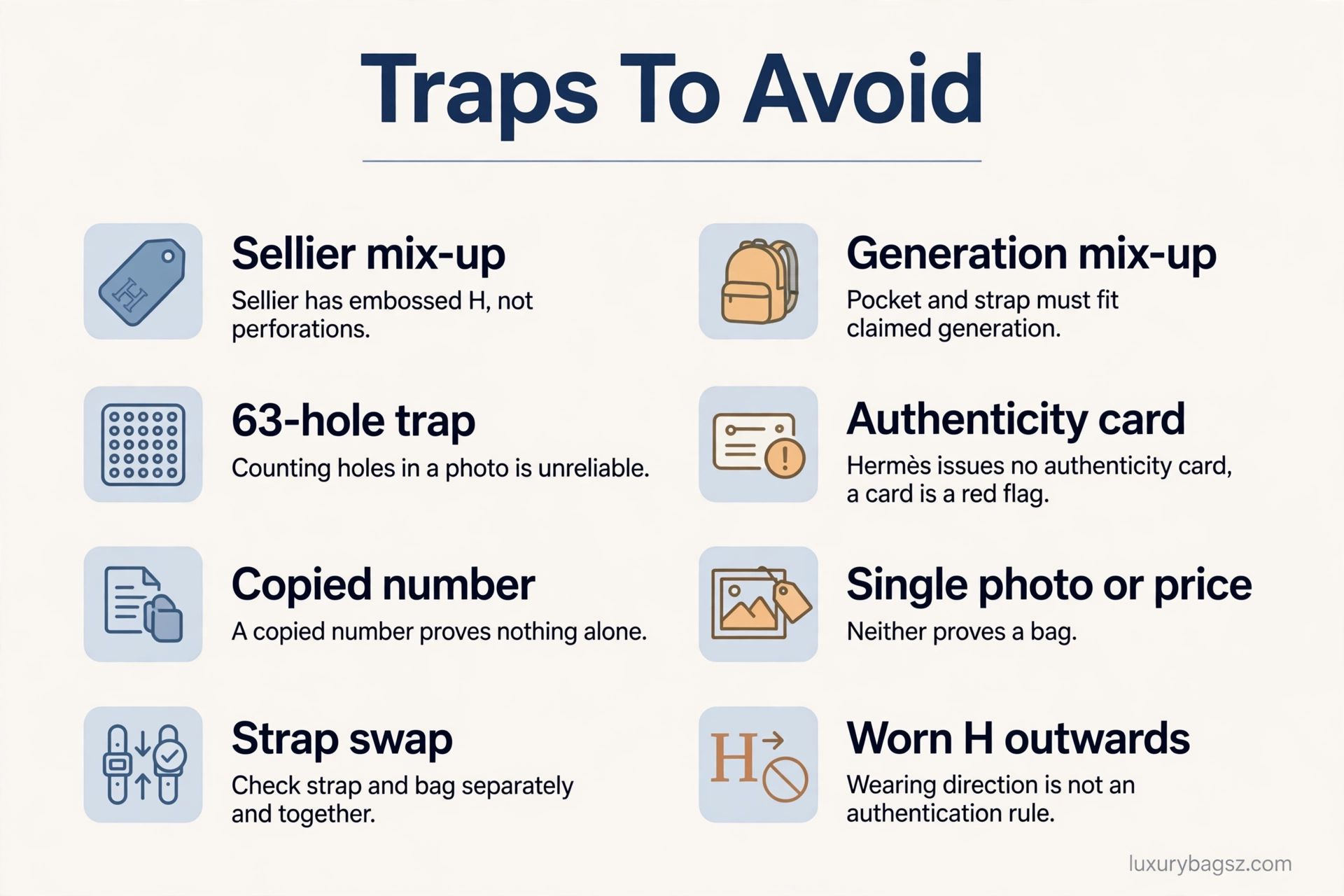
Most Evelyne guides stop at the perforated H and the blind stamp. The traps below are where buyers actually lose money, because they are the places where a plausible-looking listing falls apart.
Trap 1: The Sellier mix-up. As noted above, the Sellier does not have a perforated H. Guides that present perforation counting as the Evelyne test, without mentioning the Sellier, will mislead anyone checking a Sellier, and will also mislead anyone who is shown a classic Evelyne with perforations and told it is a Sellier. Always establish which version you are checking first.
Trap 2: The generation mix-up. A bag that mixes generations — for example, an interior pocket with an adjustable strap and an exterior pocket, or a fixed strap on a bag sold as a III — is not automatically fake, because parts can be replaced and listings can be mislabelled. But a mixed-generation bag should never be bought on the listing label alone. Ask the seller to explain the combination, and check whether the explanation fits the photos.
Trap 3: The 63-hole trap. Counting holes in a photograph is unreliable, hole size varies with bag size, and a counterfeiter can count. A bag that passes a hole count but fails on strap, stitching, interior, and stamps has not passed anything that matters. Conversely, a bag that fails a rough hole count in a blurry photo, but passes everything else cleanly, has not necessarily failed. Count holes only in sharp, straight-on photos, and never let a count override the whole-bag test.
Trap 4: The authenticity card. This is the simplest trap and the most common. Hermès does not issue authenticity cards. Any card, however official it looks, is a reason to question the listing, not a reason to trust it. The same warning applies to “certificates” issued by the seller themselves. A third-party authentication report is a different thing from a seller-printed card, but even a third-party report should be checked: who issued it, for this specific bag, with photos that match the bag you are being sold?
Trap 5: The copied number. Because Hermès does not use traditional serial numbers, a number that is copied from a genuine bag proves nothing on its own. This is the same principle that applies to a copied number on any luxury item: a genuine number on a fake bag is still a fake bag. As with fake Rolex checks, where counterfeiters also copy genuine numbers, the number must agree with the whole item — its era, its materials, its construction — or it is just a number. Never buy an Evelyne because a seller showed you a number that “checks out” on a chart.
Trap 6: The single photo and the single price. No single photo proves a bag, and no single price proves it either. A genuine Evelyne can be cheap because it is worn, damaged, or sold quickly, and a fake can be expensive because the seller knows that a low price looks suspicious. Judge the bag across many photos, and treat price as a prompt, not a verdict. If the price is far below comparable listings for the same size, material, and condition, ask why — and do not accept “a bargain” as an answer on its own.
Trap 7: The strap swap. Because Evelyne straps are removable and replaceable, a genuine strap on a fake bag, or a fake strap on a genuine bag, are both possible. Check the strap and the bag separately and together. A perfect strap does not rescue a failing bag, and a replaced strap does not condemn an otherwise consistent bag — but an undisclosed replacement should always be disclosed and priced accordingly.
Trap 8: The “worn H outwards” rule. Some guides imply that the H must face the body, because that was its original ventilation purpose. That is history, not an authentication rule. Today the H is commonly worn facing outwards. Do not reject a bag, or accept one, because of which way the H was facing in a photograph.
Trap 9: The perfect bag. A bag that is perfect in every photographed detail, with no wear, no variation, and no flaw, is not automatically genuine. Handmade bags have variation, and pre-owned bags have wear. A bag that looks too perfect, especially at a low price and from a seller with no history, deserves the same careful check as a bag that looks obviously wrong. Perfection in photos can also mean heavily edited photos. Ask for unedited, natural-light photos if the listing photos look overly processed.
Trap 10: The seller’s story. Stories — “bought in Paris”, “from my grandmother”, “only worn twice”, “with full set” — are not checks. They are claims to be tested against the bag, the stamps, the wear, and the paperwork. A good story with a failing bag is still a failing bag. A thin story with a consistent bag is still a consistent bag. Listen to the bag first.
If You Have Already Bought One
If you have already bought an Evelyne and now have doubts, do not panic, and do not try to “fix” the bag. Do not clean it aggressively, do not re-stamp it, do not replace parts, and do not sell it on to someone else as genuine while you are unsure. Those steps can damage a genuine bag, destroy evidence, and create a worse problem.
First, gather everything you have: the listing, all photos, messages with the seller, the receipt, the box and dust bag, and any paperwork. Photograph the bag yourself in natural light, including the H, the strap and its ends, the closure tab and its underside, the stitching, the interior, the back pocket, and the stamps. Keep those photos dated and unedited.
Second, work through the twelve checks above again, calmly, and write down which checks pass, which fail, and which you cannot judge from photos. That list is what an expert will want to see, and it will also stop you from fixating on one detail.
Third, get an independent expert opinion. Use a reputable third-party authentication service with specific Hermès experience, not the seller, not a general marketplace opinion, and not a social media poll. Ask whether they need the bag in hand or can work from photos, what their report covers, and what happens if their opinion differs from the seller’s. Keep the report with the bag’s records.
Fourth, act on the report. If the bag is genuine, you have peace of mind and a record for resale. If it is not, contact the seller promptly, in writing, with the report and your original listing evidence, and ask for a return and refund under the platform’s or seller’s terms. If the seller refuses, or the sale was outside a platform, use the payment provider’s dispute process and keep every message. Time limits apply on many platforms and payment methods, so do not delay this step while you hope the problem goes away.
Finally, whatever the outcome, do not present a bag you now know to be fake as genuine to anyone else. That is not just unfair to the next buyer; it is how fakes keep circulating. If you keep the bag, keep it clearly as a non-genuine item, not as a Hermès bag.
Buying Safely: The 10-Photo Checklist
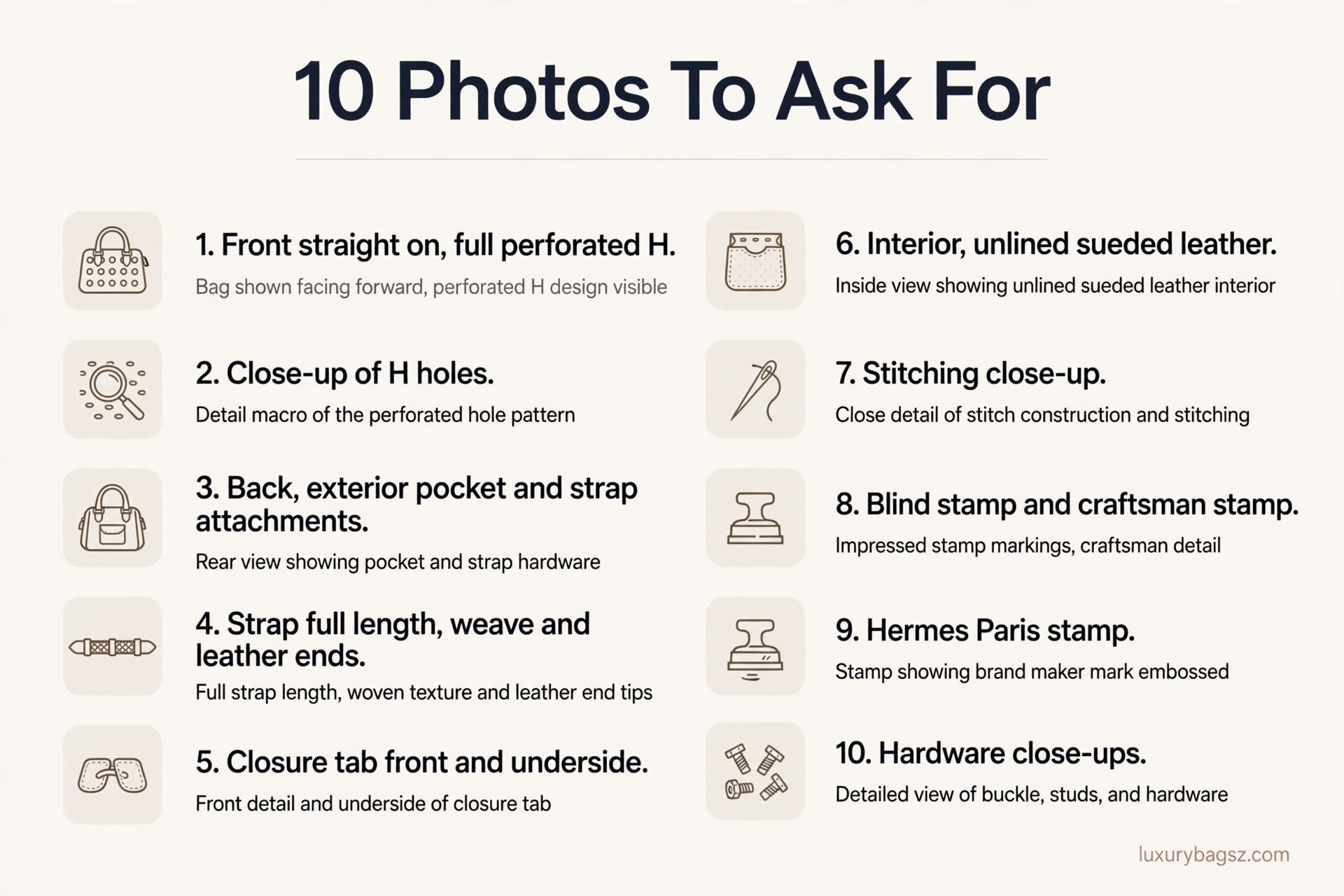
Before you pay, ask for these ten photos. A seller who provides them willingly is not guaranteeing genuineness, but a seller who refuses or delays on several of them is giving you information too.
- Front, straight on, in natural light, showing the full perforated H and oval, with no filter.
- Close-up of the H holes, straight on, showing hole shape, spacing, and edges.
- Back of the bag, straight on, showing the exterior back pocket (for II and III) and the strap attachments.
- Strap, full length, showing the weave, the adjuster, and both leather ends.
- Closure tab, front and underside, showing the pull-through tab, its stitching, and any stamps underneath.
- Interior, wide shot, showing the unlined sueded leather and the absence or presence of an interior pocket.
- Stitching close-up, along an edge and at a strap attachment, showing slant, spacing, and thread colour.
- Blind stamp and craftsman stamp, close and sharp, with the surrounding leather visible for scale and context.
- Hermès Paris stamp, close and sharp, showing spelling, accent, spacing, and embossing quality.
- Hardware close-ups, including D-rings and adjusters, showing finish, weight cues, and any engraving.
Alongside the photos, ask for: the claimed generation, size, material, colour, and approximate year; measurements; a description of any repairs, replacements, or wear; and the return policy in writing. Check that the answers agree with the photos. If a photo shows a different material, a different pocket arrangement, or a different stamp format from the description, stop and ask for an explanation before you pay.
Once the bag is yours, storage matters too. An Evelyne is best stored flat on its back, lightly stuffed, in its dust bag, away from damp and direct light, rather than hung by its strap or squashed under other bags. The same careful storage habit that helps a Kelly helps here: our guide to store Hermes Kelly sets out that upright-versus-flat reasoning by construction, and for a soft, unlined Evelyne, flat on its back is the safer default. Do not store it damp, do not hang it by the strap for months, and do not stack heavy items on top of it.
Frequently Asked Questions
Does a genuine Evelyne always have 63 holes in the H?
Guides widely repeat 63 — 40 for the oval, 9 for each arm, and 5 across the middle — for a classic Evelyne. Treat that as a widely repeated guide claim, not as a rule that proves a bag. Hole size varies with bag size, counting from a photo is unreliable, and the count does not apply to the Sellier version. Judge hole quality — round, even, clean, well spaced — together with the rest of the bag.
Does Hermès issue an authenticity card for the Evelyne?
No. Hermès issues no authenticity cards for any of its bags. A card claiming to certify an Evelyne is a red flag, not proof. A genuine purchase comes with a box, dust bag, and where applicable a receipt, and none of those authenticate the bag on their own.
Does an Evelyne have a serial number?
Not in the traditional sense used by other luxury brands. Hermès uses a blind stamp and a craftsman stamp, not a unique serial number that can be looked up to prove a single bag. Anyone who offers a “serial number” as the main proof of an Evelyne is not describing how Hermès works.
Where is the blind stamp on an Evelyne?
Guides place it in different spots — under the closure strap or pull-through tab, on the strap, or in an interior area — depending on generation and era. Do not reject a bag solely for stamp position. Check that a stamp is present, crisp, and in a format that fits the era claimed, and read it together with the craftsman stamp and the rest of the bag.
Can I tell a fake from the strap alone?
No, but the strap is one of the strongest early checks. A thin, loosely woven, shiny, or mismatched strap on a bag claimed to be a standard Evelyne III is a serious warning sign. A good strap, however, does not rescue a bag that fails on shape, interior, stitching, and stamps.
Is it fake if the H faces outwards?
No. The H was originally designed to face the body for ventilation, when the Evelyne carried grooming tools. Today it is commonly worn facing outwards. Wearing direction is not an authentication check.
What if the bag has no interior pocket?
That depends on the generation claimed. Evelyne I had an interior pocket; Evelyne II and III do not, and instead have an exterior back pocket. A missing interior pocket is expected on a II or III, and a present interior pocket is expected on a I. Judge the pocket against the generation, not in isolation.
Should I buy an Evelyne without seeing the stamps?
No, not at a genuine-bag price. Ask for sharp, close photos of the blind stamp, craftsman stamp, and Hermès Paris stamp before you pay. If the seller cannot provide them, or provides only blurry photos, treat that as a reason to pause, not as a detail to sort out after payment.
Can Hermès authenticate my Evelyne for me?
Hermès boutiques do not offer authentication of pre-owned bags. Use the checks in this guide, and for a high-value purchase, use a reputable third-party authentication service with specific Hermès experience.
Is a cheap Evelyne always fake?
No, and an expensive Evelyne is not always genuine. Price reflects condition, size, material, colour, seller, and urgency as well as genuineness. Use price as a prompt to check harder, not as a verdict in either direction.
My Evelyne Rule: Shape First, Stamps Last
The Evelyne rewards a slow, whole-bag check and punishes a quick, single-detail check. Start with shape and closure, then the perforated H, then the strap, leather, stitching, and interior, and only then the stamps and paperwork. That order matters, because it stops a convincing stamp or a plausible card from distracting you from a wrong shape, a fabric lining, or a strap that does not belong on the bag claimed.
The same habit helps across Hermès models: when you are checking another bag, for example when spotting a fake Geta, the discipline is identical — establish the genuine reference for that model first, then work through its checks in order, and never let one detail, one photo, or one piece of paperwork carry the whole decision. For an Evelyne, that means remembering its equestrian origin, its generations, and its Sellier exception, and refusing to be rushed by a story, a price, or a card.
If the bag passes the whole-bag test — right shape for its generation, clean perforations or the correct Sellier embossing, a thick woven strap that fits its generation, grain that matches the material claimed, even saddle stitching, an unlined sueded interior, crisp stamps in the right era format, and hardware that feels and looks right — then you have a strong, honest basis for buying, ideally still backed by a clear return policy. If it fails on several of those points, or if the seller will not show you the photos that would let you check them, walk away. There will be another Evelyne. There is no bargain that is worth buying a fake by mistake.
That order is the one I use myself. After more than ten years of checking bags — over 500 of them by hand — I still start with shape and leather and let the stamps speak last, because a stamp is the easiest thing in this guide to copy and the hardest thing to trust on its own.