How to Choose a Hermès Crossbody Bag Size: Evelyne, Constance and Lindy
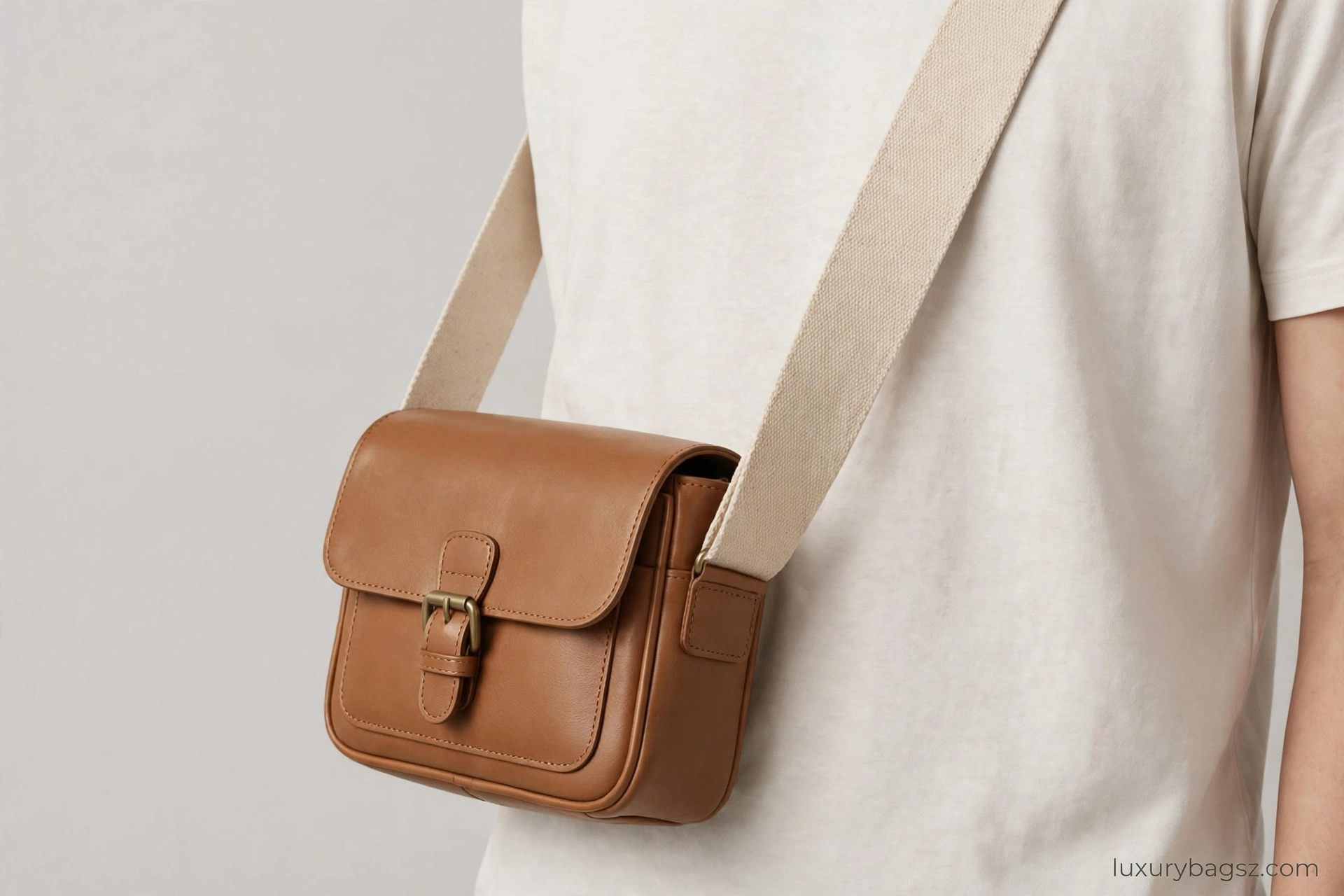
Choosing Crossbody by Drop, Not Width
Judge a Hermès crossbody by strap drop and by what passes through its opening, not by the number in its name. That figure usually marks base width alone, so bags of similar width can sit at very different heights and hold quite different loads.
For everyday carry with a phone, wallet, keys, sunglasses and a small pouch, most wearers should begin with the Evelyne 23 or 29. The 23 hugs the body more closely, while the 29 allows extra room. The Evelyne 16 suits only the lightest kit and its strap does not adjust.
A Hermès crossbody bag is not one bag in five sizes. It is several very different bags that happen to be worn the same way, and the size number on one of them tells you almost nothing about how another one will sit on your body.
That is the mistake most size guides make. They list widths in centimetres, as if a 23 cm Evelyne and a 24 cm Constance were almost the same bag. They are not. The Evelyne is a soft, open, slouchy messenger with a wide canvas strap. The Constance is a slim, structured flap bag with a narrow, adjustable leather strap.
The Lindy is a soft, double-zipped bag whose shape changes when you lift it. Put the same person in all three, at roughly the same width, and the bags will sit at different heights, bounce differently when walking, and hold different things — because width is only one of the measurements that matter.
This guide starts where the choice actually gets made: what you carry, where you want the bag to sit, and how long the strap really is when it is on you. It then works through the main crossbody-capable families — above all the Evelyne, because it is the family built for crossbody wear — and explains the traps that catch buyers again and again:
Confusing strap length with strap drop, assuming every Evelyne strap adjusts, assuming a hand-carried bag becomes a crossbody bag just because a strap can be bought for it, and trusting a size number without checking the opening, the depth, and the loaded weight.
Table of Contents
Key Takeaways
- At Hermès, a size number usually means the width of the bag’s base in centimetres, not counting handles or straps. It does not tell you the usable opening, the depth, or the strap fit.
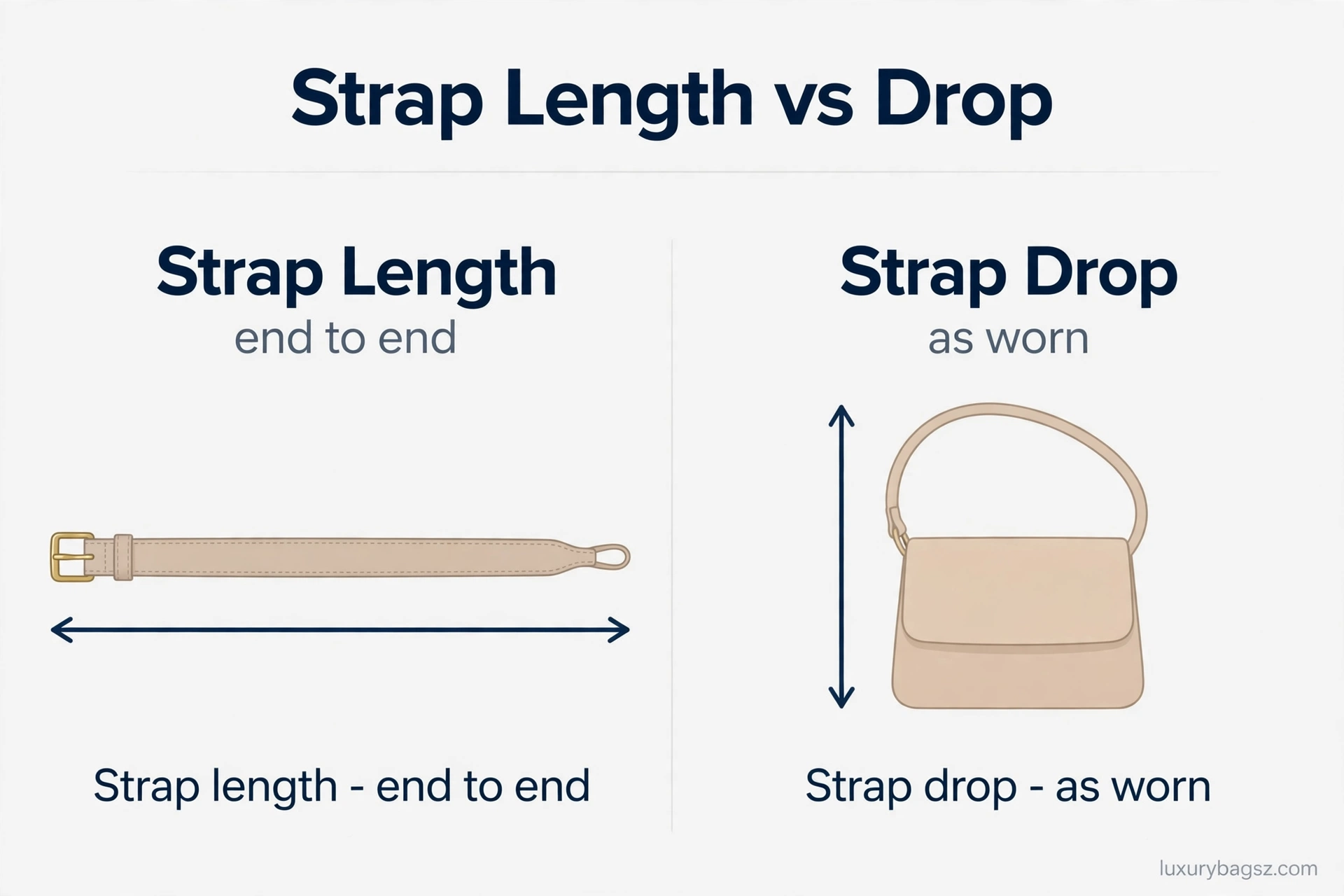
- Strap length and strap drop are different figures. Drop is the distance from the top of the bag to the top of the strap as worn. A listing that gives only total strap length has not yet told you where the bag will sit.
- The Evelyne is the clearest crossbody family: 16 (TPM), 23, 29 (PM), 33 (GM), and 40 (TGM). The 16 has a fixed strap; the 23 and 29 have adjustable straps in current form. That one difference matters more than 7 cm of width.
- The Constance 18 is the most comfortable structured crossbody of its family; the 24 is roomier but bulkier across the body, and sources disagree about whether its strap is shorter than the 18’s — so measure the actual bag.
- A Mini Lindy can work crossbody; larger Lindys, the Picotin Lock, and the In the Loop 18 are primarily hand, forearm, or shoulder bags, not crossbody bags as sold.
- Prices rise with size in the Evelyne family, but not in a neat, predictable ladder, and they change by year, region, and material. Check the price on the day, for the exact size and material, and never treat a single reseller listing as a market average.
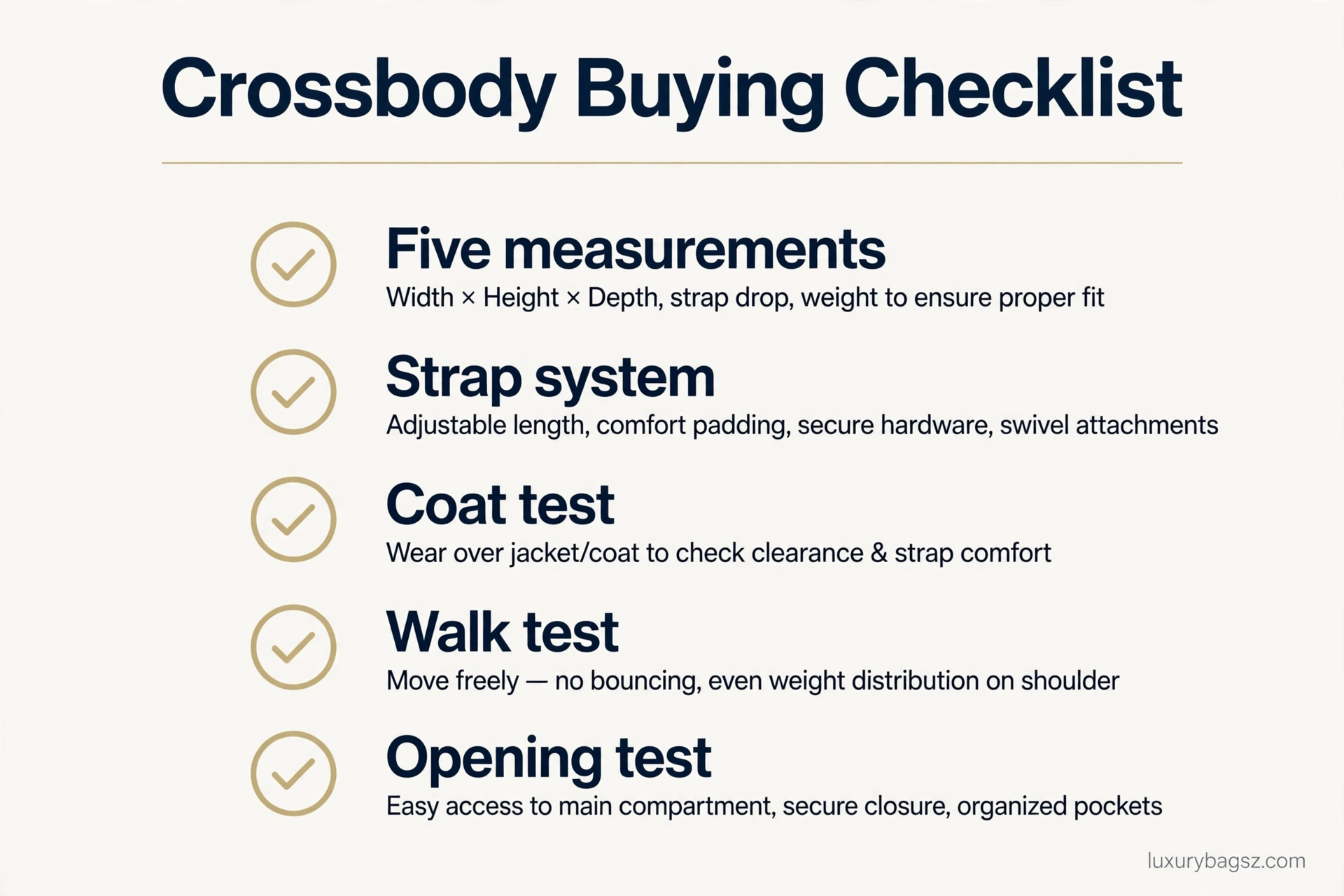
- Before you buy, do the coat test, the walk test, and the opening test with your own phone, wallet, and keys. A bag that fits on a table can still fail on a body.
Buyers measure a crossbody by its width; I measure it by its drop. When a Hermès crossbody comes to me, I put it on — strap drop against the body tells you more in five seconds than any dimension table, because the number in a bag’s name is only its base width. Then I pass the owner’s actual kit through the opening: phone, wallet, keys, sunglasses. The Evelyne 23 and 29 part company exactly there. Having examined more than 500 bags, I have stopped trusting size names entirely. A bag fits your life or it does not, and only wearing it settles which.
Crossbody Sizes in Brief
What is a Hermès crossbody bag? A bag designed — or at least genuinely able — to be worn diagonally across the body, with the bag resting on the opposite hip, leaving both hands free. The Evelyne was built for this. The Constance and the Mini Lindy can do it well. Several famous Hermès bags cannot, as sold, and that distinction is part of choosing well.
Which size should most people start with? If you want a true everyday crossbody and you carry a phone, a slim or full wallet, keys, sunglasses, and a small pouch, start with the Evelyne 23 or the Evelyne 29. The 23 is the neater, closer-to-the-body choice; the 29 is the roomier, more forgiving choice. If you carry only a phone, a card case, and keys, the Evelyne 16 is enough — provided you accept its fixed strap. If you regularly carry a tablet, a bottle, and a book, you are not looking for a small crossbody at all; you are looking at the Evelyne 33 or a larger shoulder bag, and you should test the loaded weight before you commit.
What matters more than width? Strap drop, in that order: first, whether the strap adjusts at all; second, the drop at the setting you will actually use; third, the opening and the depth; fourth, the width. A bag with the right width and the wrong drop will sit on your waist, bang against your hip, or ride up under your arm — and you will stop wearing it.
How much should you pay? For the Evelyne, guide prices quoted for August 2026 in the United States were $2,525 for the 16, $4,275 for the 23, $4,425 for the 29, and $4,850 for the 33. Those are guide figures, before sales tax, for the sizes and materials those guides were tracking — not a promise for every colour, leather, or boutique on any given day. The Constance is in a different price world: about $9,700 for the 18 and about $14,000 for the 24 as of 2026 in the earlier guide on this site, again as starting points to check, not as fixed prices.
When is crossbody the wrong choice? When the bag is too heavy loaded, when it has no secure closure and you will be in a crowd, when the strap does not adjust and the drop puts the bag at your waist instead of your hip, or when the bag you love is a hand bag and you are planning to force it into crossbody wear with a third-party strap. Each of those cases is covered in Section 7.
What Counts as Crossbody at Hermès
Crossbody is a way of wearing a bag, not a category Hermès prints on a label. So this guide uses a simple test: a bag counts as crossbody-capable if, as sold, it has a strap long enough and positioned well enough to be worn diagonally across the body, with the bag resting on the opposite hip, without the strap slipping off, the bag flipping open, or the wearer having to hold it in place.
By that test, the families fall into three groups.
Built for crossbody. The Evelyne, in all its sizes, is the obvious member. It has a wide canvas strap, a body that sits flat against the hip, and — in current larger sizes — an adjustable strap. The Jypsière, a messenger-style bag introduced in 2008, is also built this way, with a flap and a shoulder strap. The Constance, with its adjustable leather strap, belongs here too, though it is a structured flap bag rather than a casual messenger.
Can work crossbody, with a check. The Mini Lindy is the main example. Guides describe the Mini Lindy as the size with the longer strap option for crossbody wear, while larger Lindys are more naturally shoulder or hand bags. A Mini Bolide, with a removable strap of about 105 cm in one guide, is another borderline case: the strap length can work crossbody for some bodies and not for others, so it must be measured, not assumed. The Geta is a useful comparison here: it is a small messenger-style bag with an adjustable fibre-canvas strap, 61 to 120 cm on the standard size, and our guide to the Geta bag explains why its H closure and strap system make it a genuine crossbody shape, even though it is much smaller and more structured than an Evelyne.
Not crossbody as sold. The Picotin Lock is a hand and forearm bucket with a short woven handle and no strap; the In the Loop 18 is a hand-carry bucket with Swift handles and no strap as sold. Our guide to the Picotin Lock 18 is explicit that it is hand or forearm carry only, and the In the Loop 18 guide says the same about that bag without a third-party strap. A third-party strap can be added to some hand bags, but that changes the balance, the wear on the attachment points, and the look, and it does not turn the bag into a bag Hermès designed for crossbody wear. If crossbody wear is a must-have, buy a bag designed for it rather than adapting a bag that is not.
There is also a group that confuses buyers because the strap exists but the carry is not really crossbody: small handbags with a short detachable strap that only just reaches the shoulder, and totes with a long strap that are meant for the shoulder, not the diagonal. The Silkycity 33, for example, is a foldable silk tote with an adjustable Swift strap of about 28 to 41.7 inches in its guide — long enough for shoulder wear and, for some bodies, for crossbody wear, but it is a soft, square tote, not a crossbody messenger, and it will not sit against the hip the way an Evelyne does. Judge the carry by trying it on, not by the presence of a strap.
Sizes by Bag Family
3.1 How Hermès sizes work — and what the number hides
Hermès generally names a bag by the width of its base in centimetres. A Constance 18 is about 18 cm wide at the base; an Evelyne 29 is about 29 cm wide. Handles, straps, side gussets, and wings are not counted in that number. That is why two bags with similar numbers can feel so different: a 24 cm Constance is slim, at about 4 to 5 cm deep, while a 23 cm Evelyne is about 6 to 7 cm deep and much taller in proportion. The number is a starting point for comparison within one family, not across families.
Handmade variation matters too. Hermès itself notes that dimensions can vary slightly because the bags are handmade. A centimetre here or there is normal. What is not normal is a listing that gives only the size number and no full measurements — width, height, depth, strap length, and strap drop — and expects you to buy on the number alone. Ask for all five, for the actual bag, every time.
3.2 Evelyne: 16, 23, 29, 33, 40
The Evelyne is the family to learn first, because it is the only one where the full size ladder is a crossbody ladder. The sizes, in current guides, are:
| Size | Common dimensions (cm) | What it is for |
|---|---|---|
| 16 (TPM) | 16 × 18 × 5 | Essentials only |
| 23 | 23 × 24 × 6 to 7 | Neat everyday crossbody |
| 29 (PM) | 29 × 30 × 8 | Roomy everyday crossbody |
| 33 (GM) | 33 × 31 × 8 | Work and extra carry |
| 40 (TGM) | 40 × 44 × 10 | Travel and oversized carry |
Those dimensions are not as settled as the table makes them look, and the disagreements are worth stating plainly. The TPM is given as 16 × 18 × 5 cm in most current guides, but one older guide gives 16 × 20 × 5.5 cm, and a reseller listing gives 16.5 × 18 × 5.5 cm with a 112 cm strap. The 23 is given as 23 × 24 × 6 cm in one guide and 23 × 24 × 7 cm in another. The 29 is given as 29 × 30 × 8 cm in most guides, but also as 29 × 30 × 7 cm and, for the Sellier version, 29 × 30 × 10 cm. The 40 is given as 40 × 44 × 10 cm in most guides and 40 × 42 × 10 cm in one. None of these differences means a guide is lying; they reflect different versions, different measurement points, and handmade variation. They do mean you should not choose between a 23 and a 29 on the basis of a single centimetre in a table. Choose on what fits and how it sits.
The generations matter as much as the sizes. The Evelyne I had no exterior pocket and a fixed strap. The Evelyne II added the exterior rear pocket but kept a fixed strap. The Evelyne III, the current standard, has the exterior pocket and an adjustable strap. But the TPM is the exception that catches buyers: even in recent form, the TPM’s strap is described in guides as fixed and long — one guide calls it the smallest bag with the longest strap, and another gives a fixed drop of about 22 inches. The 23, by contrast, was introduced in 2025 precisely to fill the gap between the 16 and the 29, and it has the adjustable strap and rear pocket that the TPM lacks. If you are buying a TPM because you want a small adjustable crossbody, stop: that is the 23, not the 16.
In practical terms: the 16 holds a phone, a card case, and keys, and little else. The 23 adds a slim wallet, sunglasses, and a small pouch, and in one guide it is said to hold an iPad Mini — treat that as a tight fit to test, not a guarantee, because cases and pouches change the answer. The 29 holds a wallet, sunglasses, a small tablet, and a bottle in most guides, and it is the size most often called the best all-round everyday Evelyne. The 33 holds a book, documents, or a laptop carried vertically in one guide — again, test the actual device, in its case, through the actual opening. The 40 is a travel and oversized bag; worn crossbody, it covers a large part of the hip and thigh, and for many wearers it stops feeling like a crossbody bag at all and starts feeling like a messenger bag. That is not a flaw; it is a reason to be honest about whether you want a crossbody or a travel bag.
3.3 Constance: 14, 18, 24, and the elongated Élan
The Constance is the structured alternative to the Evelyne. Its current core sizes are the 18 and the 24, with a Micro 14 for essentials and an elongated Élan 25 that is a different shape, not simply a bigger 24. Our guide to the Constance bag covers the full family, including the discontinued 23, 25, and 29 sizes that still appear in resale listings.
For crossbody purposes, the 18 is the sweet spot. It measures about 18 × 15 × 5 cm in most guides, though one guide gives 18 × 15 × 4 cm — another small depth disagreement to check on the actual bag. It holds a phone, a card holder or slim wallet, keys, and lipstick, and it sits neatly across the body without dominating the hip. The 24, at about 24 × 18 × 4 to 5 cm, holds more — sunglasses, a small notebook, a fuller wallet — but it is wider, heavier when loaded, and more noticeable across the body. One comparison guide says the 18 is much easier crossbody, especially for a range of body types, and that the 24 is better on the shoulder or as a high crossbody. Another guide says the strap length is the same on both sizes, so either can be worn shoulder or crossbody. A third guide says the 18 has a longer strap and the 24 a shorter one. Those three claims cannot all be true for every bag, because straps vary by version and by how the seller measured them. The practical answer is to ask for the strap length and drop of the actual bag, and to try it at both the shoulder and crossbody settings if you can.
The Constance strap can also be doubled for a shorter drop, which is useful if you want one bag to do both shoulder and crossbody duty. But doubling a leather strap changes how it hangs and can make the bag sit higher and tighter than a dedicated crossbody strap would. Test the doubled setting too, not just the full-length setting.
3.4 Lindy: Mini first, larger sizes with caution
The Lindy is a soft, slouchy bag with two zips and two handles that sit on the gussets, so the body folds and changes shape when lifted. The Mini Lindy, introduced in 2019 in guides, is the crossbody size. One documented Mini Lindy measures 19 × 13 × 9.5 cm with a 108 cm strap; another measured example gives 19 × 12 × 9 cm. The difference is small, but the strap figure is the one to note: 108 cm of total strap is not a drop figure, and whether that strap gives a comfortable crossbody drop depends on the wearer’s height, torso, and coat.
Larger Lindys — 26, 30, and 34 in guides — are primarily hand and shoulder bags. They can be worn on the shoulder, and some owners wear them crossbody, but the body is wider, softer, and heavier when loaded, and the shape will sag and shift more across the body than a Mini will. If you want a Lindy for crossbody wear, start with the Mini and be suspicious of any listing that calls a 30 or 34 a crossbody bag without giving the strap drop.
3.5 Geta, Mini Bolide, and the other small messengers
The Geta deserves a short section because it is often mistaken for a mini Evelyne or a mini Constance, and it is neither. The standard Geta measures 20 × 15 × 7 cm with an adjustable fibre-canvas strap of 61 to 120 cm; the Slim measures 23 × 14 × 5 cm with a strap of 49 to 97 cm. That adjustable range is the point: the Geta can be set for shoulder or crossbody wear, but the bag itself is small, structured, and held by a magnetic H closure, so it carries less than an Evelyne 23 and it must not be shaken open as a test — a genuine Geta can open if shaken hard, as our guide to spotting a fake Geta explains. For crossbody purposes, the Geta is an evening and light-day bag, not a daily workhorse.
The Mini Bolide is another borderline crossbody: about 18.5 × 14.5 × 8 cm in one guide, with a removable leather strap of about 105 cm and a drop of about 50 cm. That drop works crossbody for many wearers and not for taller wearers or over a coat, so again, the number alone does not decide it.
The lesson from both is general: a small bag with a strap is not automatically a good crossbody bag. The strap must be long enough at a comfortable drop, the body must sit flat enough not to swing, and the closure must stay shut while you walk. Test all three.
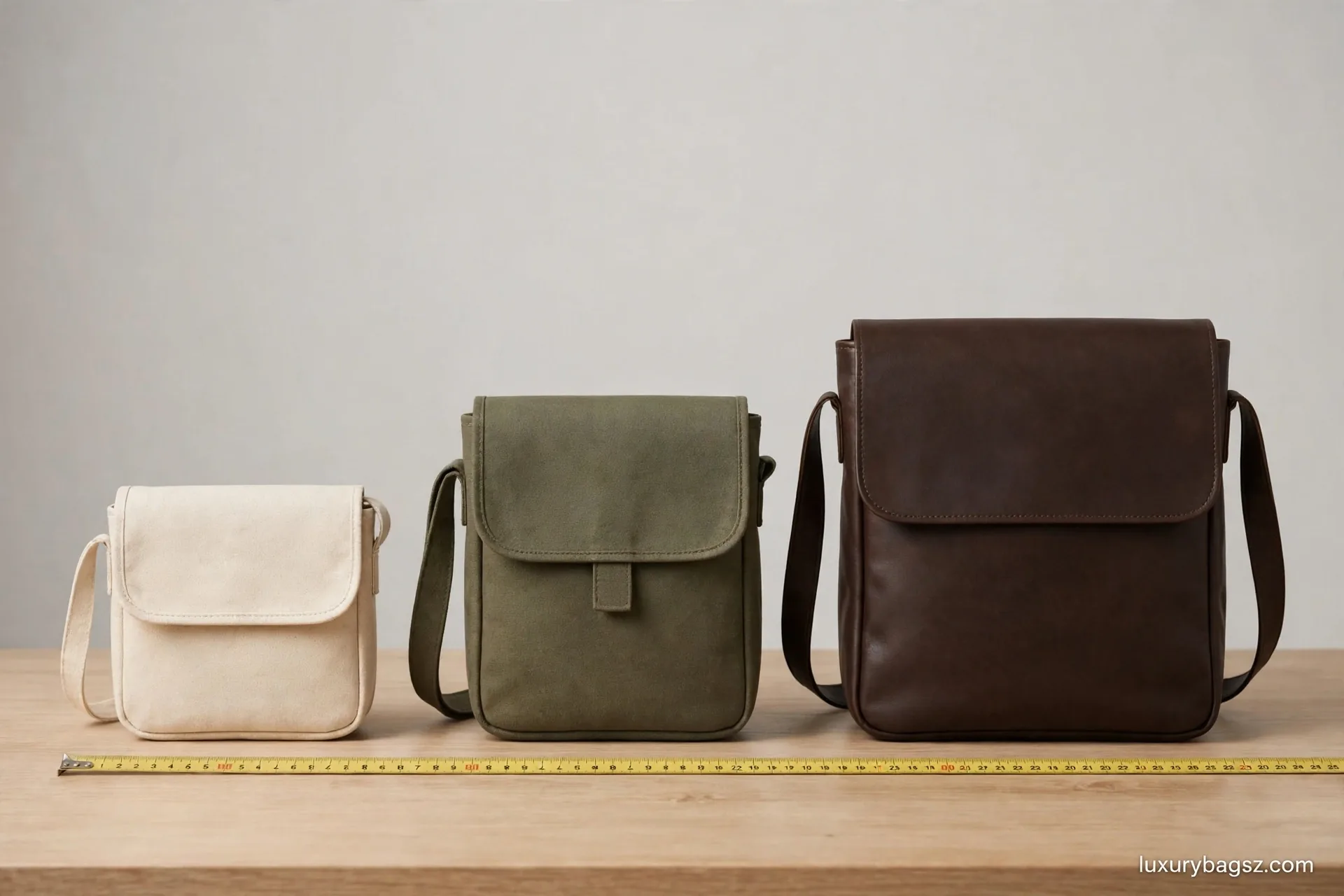
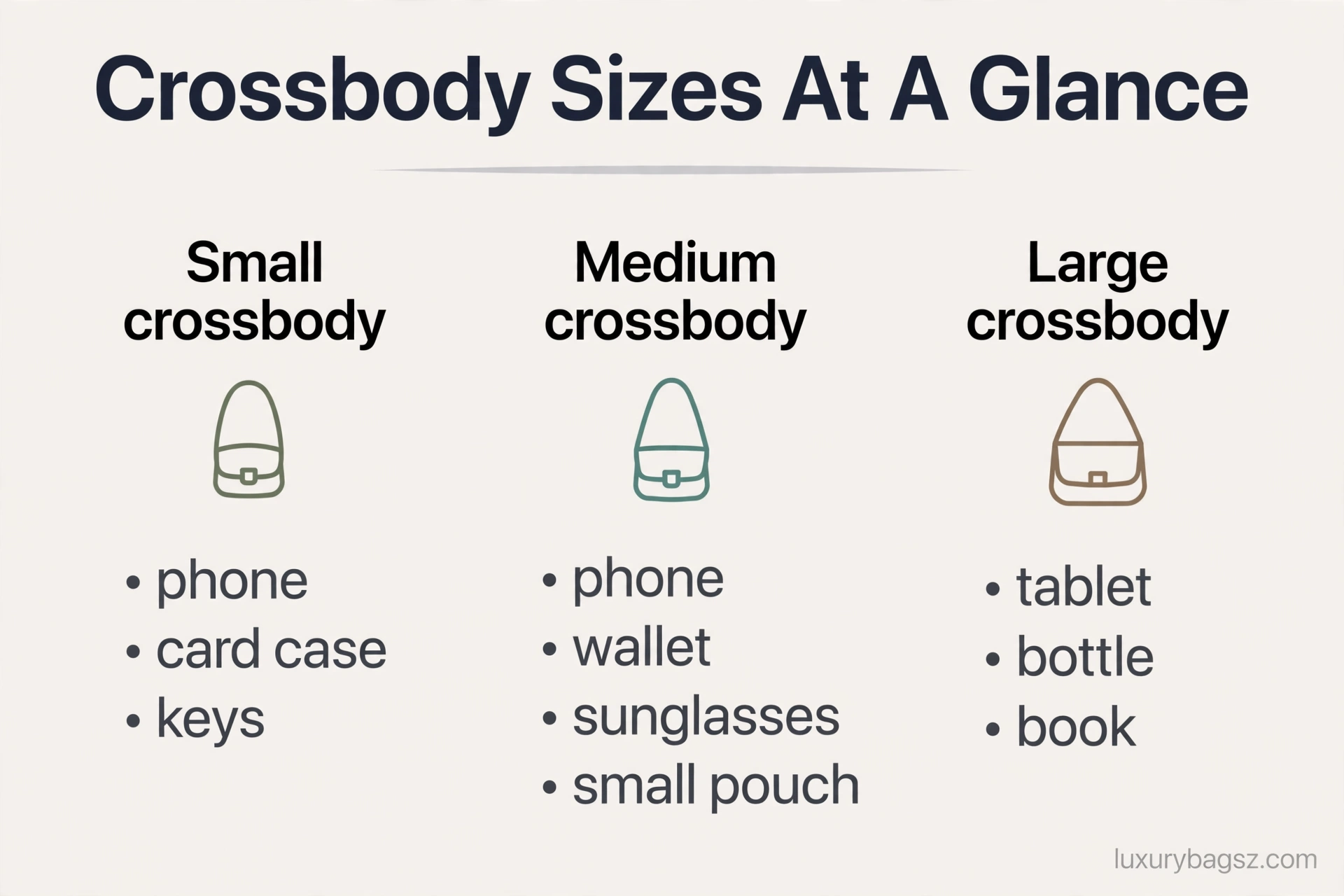

this is an Evelyne-only size guide, not a guide to all Hermès crossbody families, and it does not explain strap length vs strap drop — the article’s Section 5 definitions prevail.
Body and Height Fit: Proportion, Not Just Height
Most size guides give height bands — petite, average, tall — and stop there. Height is a useful starting point, but torso length, shoulder width, and what you wear matter more, and they are the reason two people of the same height can need different drops.
As a starting range only, general crossbody guides suggest a drop of roughly 46 to 52 cm for wearers under about 160 cm, 52 to 58 cm for 160 to 170 cm, and 55 to 63 cm above about 171 cm. Another general guide gives a crossbody drop of 51 to 64 cm overall, with 46 cm workable for petite wearers. Those ranges overlap and disagree at the edges, which is exactly the point: they are starting points for a fitting, not Hermès rules. A long torso needs more drop than a short torso at the same height. Broad shoulders need more strap to clear a coat. A bag worn over a winter coat needs a longer setting than the same bag worn over a summer dress — sometimes by a whole strap hole or slider position.
Proportion matters in the other direction too. A large, wide bag on a small frame does not just look large; it covers more of the hip, swings more when you walk, and is harder to open without lifting it off the body. A tiny bag on a tall frame does not just look small; it can ride high on the waist, pull the strap into the neck, and force you to hunch to reach inside. The Evelyne 23 is often recommended for petite wearers precisely because its squarer proportions sit closer to the body than the taller 29, while taller wearers often find the 29 proportionally right. Those are tendencies, not rules — but they are better tendencies than “buy the most popular size.”
The most reliable fit test costs nothing: stand in front of a mirror in the clothes you will actually wear, put the bag on crossbody, and check four things. First, where does the bottom of the bag sit — waist, upper hip, mid-hip, or thigh? Most wearers prefer upper to mid-hip for walking. Second, does the strap sit comfortably on the shoulder without digging or slipping? Third, can you open the bag and take your phone out without taking the bag off or lifting it awkwardly? Fourth, walk — does the bag bounce, swing forward when you lean, or hit your hip with every step? A bag that passes on a table and fails on a walk is the wrong size, whatever the label says.
Strap Length and Drop: The Measurement Most Guides Get Wrong
This is the section competitors skip, and it is the section that saves buyers the most money.
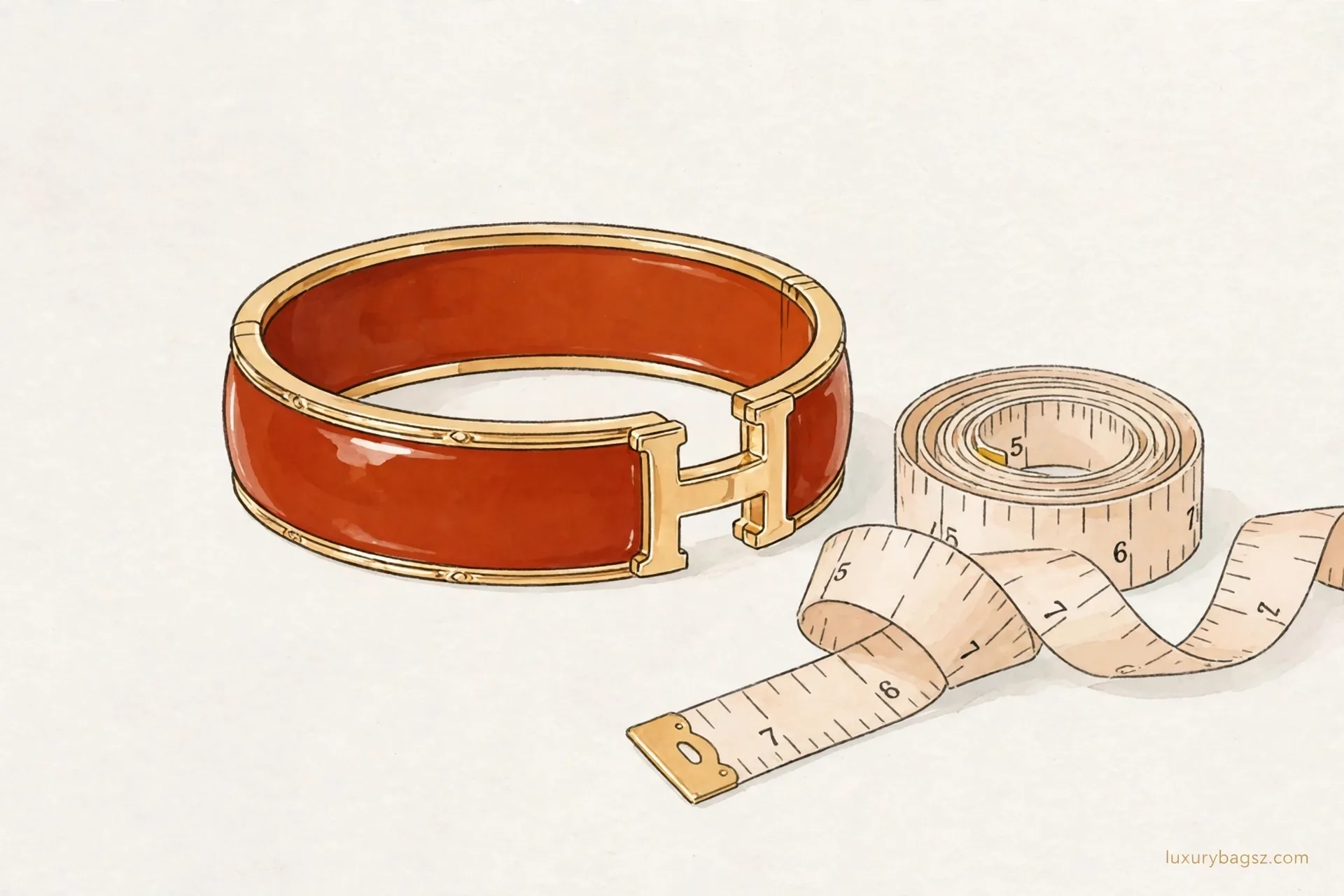
Strap length is the total length of the strap, end to end, including the parts that attach to the bag. Strap drop is the vertical distance from the top of the bag to the top of the strap as worn. They are not interchangeable, and a listing that gives one without the other has given you half a measurement. A general guide gives a rough conversion for crossbody wear — total length is about 2.3 times the drop — but that is a rough conversion for a typical crossbody, not a formula for a specific Hermès strap, because attachment points, bag height, and how the strap folds over the shoulder all change the result. Use it only to translate a listing figure into a question to ask the seller, not as a substitute for the seller measuring the drop.
To measure drop yourself, use a soft tape. Put the bag on as you will wear it, or hang it from a hook at shoulder height if you are measuring a listing bag in person, and measure from the top edge of the bag to the highest point of the strap loop. Do it at the setting you will use, not the longest setting. If the strap adjusts, measure the shortest and longest settings and note both. If the strap is fixed, as on the TPM, that single drop is the fit — there is no adjustment to save you if it is wrong.
Three strap traps recur in listings. The first is the TPM trap: a small bag with a long, fixed strap. Guides describe the TPM strap as long and non-adjustable, and one owner guide calls it the smallest bag with the longest strap. If you are petite, that strap can put a tiny bag at your thigh; if you are tall, it can be the only size that works. Either way, you must know the drop before you buy, because you cannot change it without a replacement strap, and a replacement strap is a different purchase with its own fit and authenticity questions.
The second trap is the adjustable-strap assumption. Not every adjustable strap adjusts enough. An Evelyne 23 strap that adjusts by a few centimetres is not the same as a Constance strap that can be doubled. Ask for the range, not just the word “adjustable,” and check whether the adjustment is a slider, holes, or a buckle, because each one slips or holds differently under a loaded bag.
The third trap is the coat trap. A strap that fits over a T-shirt can be too short over a coat, and a bag that sits at mid-hip in summer can ride at the waist in winter. If you will wear the bag year-round, test it over the thickest coat you own, and leave one adjustment position in reserve. A bag that only fits at its very longest setting has no room for a coat, a scarf, or a heavier load.
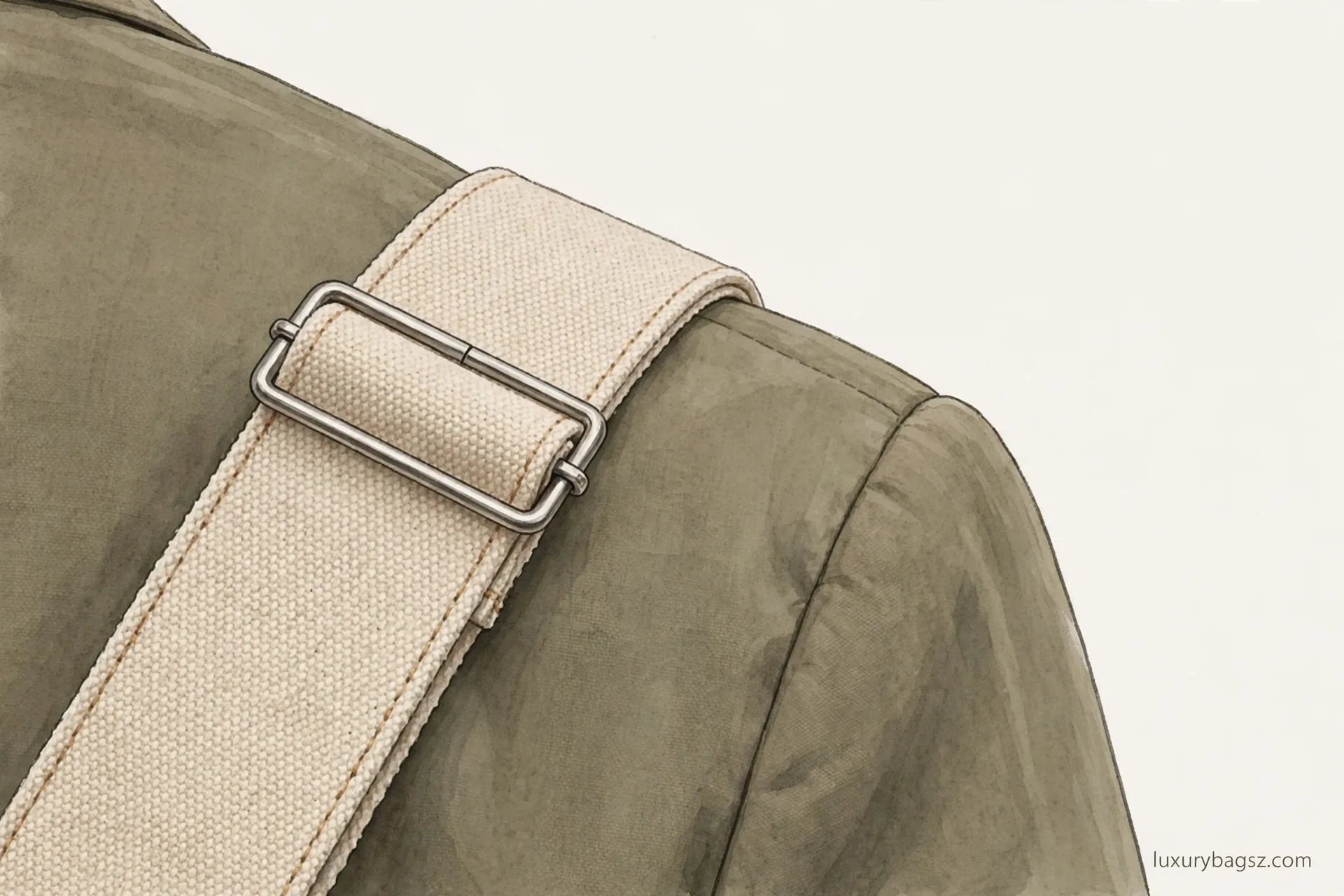
Finally, strap material matters for comfort. The Evelyne’s wide canvas strap spreads weight and grips the shoulder, which is why a 29 can feel lighter than a narrower-strapped bag of the same weight. A narrow leather strap concentrates weight and slips more easily, especially over smooth coats. When you compare a canvas-strapped Evelyne with a leather-strapped Constance, you are comparing strap comfort as well as bag size — and for all-day crossbody wear, that comfort difference can matter more than a centimetre of width.
What Fits: Test With Your Things, Not a List
“What fits” lists are useful only if they are tested against real objects, and most guides fail here by listing items without sizes. A “phone” in 2026 can be 14 cm tall or 17 cm tall, in a case or out of one. A “wallet” can be a card case, a slim bifold, or a long wallet that is 19 cm long. A “tablet” can be a 20 cm mini or a 28 cm full-size device. So this section gives fits as tests, not as promises, and tells you how to run them.
Start with your own kit. Lay out the things you carry every day — phone in its case, wallet, keys, sunglasses in their case, lipstick or small pouch, and anything else you will not leave behind — and measure the longest and thickest items. Then check three things against the bag: first, does the longest item fit flat, without bending the bag or forcing the closure? Second, does the thickest combination fit at the bag’s depth, not just its width? Third, can you get the phone out quickly, one-handed, without emptying the bag? A bag that holds everything but requires you to unpack it to answer a call is not a good crossbody bag.
By family, as a starting guide only:
- Evelyne 16: phone, card case, keys. A slim wallet is a tight fit in most guides, and a full wallet generally is not. No sunglasses case, no bottle, no tablet.
- Evelyne 23: phone, slim or full wallet, sunglasses, keys, small pouch. A small book or e-reader fits in some guides; an iPad Mini is described as fitting in one guide and should be tested in its case.
- Evelyne 29: everything in the 23, plus a small tablet and a bottle in most guides, and a compact umbrella in some. This is the first size where “daily carry” stops feeling like a compromise for most wearers.
- Evelyne 33: everything in the 29, plus a book, documents, or a laptop carried vertically in one guide. Test the laptop in its sleeve, through the opening, not just against the width.
- Evelyne 40: travel and oversized carry. It will hold what the 33 holds and more, but worn crossbody it is a large, heavy bag, and the loaded weight test in Section 7 matters most here.
- Constance 18: phone, card holder or slim wallet, keys, lipstick. A full wallet is tight; sunglasses are a maybe, depending on the case.
- Constance 24: everything in the 18, plus sunglasses and a small notebook in most guides, and a fuller wallet. The extra width helps, but the slim depth still limits bulky items.
- Mini Lindy: phone, wallet, keys, small pouch. Its depth — about 9 to 9.5 cm — helps with bulky small items, but its soft shape means the usable space changes as the bag slouches.
- Geta standard: phone, compact wallet, keys, lipstick, earphones, in the earlier guide on this site. Not a bottle, a tablet, or a full wallet laid flat.
Weight is the hidden fit test. A bag that holds a bottle, a tablet, and a book on paper can still be the wrong crossbody if, loaded, it pulls the strap into your neck, bounces when you walk, or makes your shoulder ache after an hour. Load the bag with your actual things, wear it for a walk around the block, and notice where it hurts. Leather choice changes this too: Clemence is soft and heavy for its size, Epsom is structured and lighter in feel, Togo sits between them, and canvas is the lightest option in the Evelyne family. Our guide to Hermès leather explains where those leathers come from and how they are made, which helps explain why two bags of the same size can feel so different when loaded.
Security is the other hidden fit test. The Evelyne has an open top with a snap tab, which leaves gaps on either side — easy access for you, and easier access for anyone else in a crowd. The Constance has a flap and an H clasp, which is slower to open and more secure. The Lindy has two zips, which are secure but slower. If you will wear the bag crossbody in crowded places, a flap or zip matters more than an extra centimetre of width, and the open-top Evelyne should be worn with the opening against your body, not facing out.
When Crossbody Does NOT Work
Crossbody wear is not always the answer, and a good size guide should say when to stop forcing it.
When the bag is too heavy. If the loaded bag pulls, bounces, or aches after an hour, the size is wrong for crossbody wear, even if the strap fits. Go smaller, carry less, or switch to a shoulder or hand bag for that load. A 40 cm Evelyne loaded for travel is a messenger bag, not a comfortable all-day crossbody, for most wearers.
When the closure cannot keep up. An open-top bag in a crowded market, on public transport, or at a festival is a risk. If you need security, choose a flap or zip bag, or wear the open bag with the opening against your body and the strap shortened so the bag cannot be lifted easily.
When the strap cannot be set right. A fixed strap with the wrong drop, an adjustable strap that only adjusts a little, or a strap that slips under load are all reasons to pass on that specific bag, even if you love the colour. Colour does not fix fit.
When the bag is a hand bag. The Picotin Lock and the In the Loop 18 are the clearest examples on this site. Adding a third-party strap to a hand bag can work for light, occasional wear, but it changes the balance, it can wear the attachment points, and it does not make the bag a crossbody bag in the way an Evelyne is. If you need crossbody wear every day, buy a crossbody bag.
When the body shape fights the strap. A very soft, slouchy bag can fold, twist, and ride up across the body, especially when it is under-filled. A very structured bag can dig at the hip if the drop puts a hard corner against your body. Both problems are fit problems, not quality problems, and both are reasons to try the bag on with your usual load, not just to look at it.
When you need to get in and out constantly. A flap bag with a clasp, or a double-zipped bag, is slower than an open-top messenger. If your day involves constant phone, card, and key access, the Evelyne’s open top is a feature, not a flaw — provided you accept the security trade-off above.
Prices by Size: What the Numbers Actually Mean
Prices are where size guides most often mislead, by giving one number as if it were the price. Hermès prices change by year, region, material, and colour, and reseller prices are asking prices for single bags, not market averages. This section therefore gives prices only with their source, date, and limits attached.
For the Evelyne, a guide tracking United States retail in August 2026 gave $2,525 for the 16, $4,275 for the 23, $4,425 for the 29, and $4,850 for the 33. Notice two things. First, the jump from the 16 to the 23 is much larger than the jump from the 23 to the 29 — size alone does not explain price, because material, generation, and positioning matter too. Second, no TGM 40 price is given in that guide excerpt, so this guide does not invent one. A Sellier TPM 16 in Epsom was given as $3,975 in the same guide family — higher than the standard 16, because the material and construction are different. That is a useful warning: two bags called “16” can have very different prices if one is Amazone canvas and leather and the other is Sellier Epsom.
For the Constance, the earlier guide on this site gave about $9,700 for the 18 and about $14,000 for the 24 as of 2026. Single reseller listings in a general guide gave $11,850 for a Gris Meyer Constance 18 and £15,170 for a Biscuit Constance 18 in Swift — those are single asking prices, in different currencies, for different colours and leathers, and they are not averages and not retail prices. Do not average them, and do not compare a reseller asking price in pounds with a retail price in dollars without converting currency, tax, and condition.
For the Geta, the price guide on this site gives a fuller retail history, and it is worth reading before you compare a Geta with an Evelyne: the standard Geta was $5,800 in 2022 and $5,950 in 2023 in guides, rising to $7,650 in the United States in 2026 lists, with pre-owned single listings ranging far wider. Our guide to Geta bag price and sizes sets those figures out with their dates attached, and the same discipline applies here: a price without a date, a size, a material, and a currency is not a price you can use.
Three price rules follow. First, check on the day, for the exact size and material, in your currency, including tax. Second, treat any single listing — especially a very low one — as a question, not a bargain: a $709 “handmade” Geta-style listing and a $409 “Neo Garden” style listing in earlier guides on this site were replica-style red flags, not market prices, and the same caution applies to any crossbody listing far below retail. Third, do not pay a premium for size alone. A larger bag is not automatically a better value; it is a larger bag, with more material, more weight, and a different fit, and if it does not fit your body and your load, the premium is wasted.
Buying Checklist: Before You Pay
Use this checklist for any crossbody purchase, new or pre-owned, and do not skip the fit steps because the bag is new. A new bag with the wrong drop is still the wrong bag.
- Get all five measurements for the actual bag: width, height, depth, total strap length, and strap drop at the setting you will use. If the seller gives only the size number, ask again.
- Check the strap system: fixed or adjustable, slider or holes or buckle, and the full adjustment range. For an Evelyne, check the generation: I (no exterior pocket, fixed strap), II (exterior pocket, fixed strap), III (exterior pocket, adjustable strap) — and remember the TPM is fixed even in recent form.
- Test your own kit through the opening: phone in its case, wallet, keys, sunglasses case, pouch. Check the longest item flat and the thickest combination at the depth.
- Do the coat test: try the bag over the thickest coat you will wear with it, and leave one adjustment position in reserve.
- Do the walk test: load the bag, wear it crossbody, and walk. Check bounce, hip impact, neck pull, and whether you can open it one-handed without taking it off.
- Check the closure for your use: open top (Evelyne) versus flap and clasp (Constance) versus zips (Lindy). Match the closure to crowds, commuting, and how often you need access.
- Check the leather and weight: Clemence is soft and heavy, Epsom is structured, Togo is in between, canvas is lightest. A heavier leather in a larger size is a different carrying experience from the same size in canvas.
- Check the condition points that affect fit: strap wear and stretching, slider and buckle function, attachment-point wear, and any third-party strap or repair. A stretched strap changes the drop, even if the listing still quotes the original length.
- Verify authenticity on principles, not on a single item: Hermès issues no authenticity cards, so a card in a listing is a red flag, not proof. For the principles that apply across Hermès bags — stitching, stamps, hardware, and seller checks — our guide to spotting a fake Hermes Kelly sets out the approach, even though it is about a different bag, and the Geta-specific checks in our fake Geta guide show how those principles apply to a small messenger.
- Check the price with its limits: date, size, material, colour, currency, tax, and condition. Compare like with like, and be suspicious of any price far below retail without a clear, checkable reason.
- Plan storage so the strap keeps its fit: store the bag upright or flat as its construction suits, with the strap laid flat or loosely coiled, not hung by the strap and not crushed under other bags. Our guide on how to store Hermes Kelly covers the storage principles that keep shape and straps in good condition, even though it is written for a Kelly.
If any step fails — the drop is wrong, the phone does not fit through the opening, the bag bounces, the strap does not adjust — walk away from that specific bag, not from crossbody wear altogether. The right size in the right family is usually one step up or down the ladder, not a different kind of bag.
FAQ
What is the best Hermès crossbody size for everyday use?
For most wearers, the Evelyne 23 or 29. The 23 is neater and closer to the body; the 29 is roomier and more forgiving. Choose by your daily kit and your drop, not by popularity alone.
Is the Evelyne 16 too small, and is the 23 worth it over the 16 or 29?
For phone, card case, and keys, no. For a wallet, sunglasses, and a pouch as well, yes, in most guides. And its fixed strap is the bigger question: if the drop does not suit you, the 16 cannot be adjusted to suit you.
What is the difference between strap length and strap drop?
Length is the total strap, end to end. Drop is the distance from the top of the bag to the top of the strap as worn. Listings often give length only. Ask for drop at the setting you will use.
Can a tall person wear a Constance 18 crossbody, and can a Picotin or In the Loop 18 be worn crossbody?
Often yes, but it depends on the actual strap and drop, not just height. Sources disagree about whether the 24’s strap is shorter than the 18’s, so measure the actual bag and try it over your usual clothes.
Not as sold. Both are hand and forearm bags without a strap. A third-party strap can be added, but it changes balance and wear, and it does not make the bag a designed crossbody bag.
Does a bigger crossbody hold proportionally more?
Not necessarily. Depth, opening width, and shape matter as much as width. A slim 24 cm Constance holds less bulky kit than a deeper 23 cm Evelyne, even though the numbers look similar.
If the 16 is too small and the 29 feels bulky on your hip, the 23 is the intended middle step, with the adjustable strap and rear pocket the 16 lacks. If you need a tablet and a bottle daily, the 29 is still the better choice.
Should I buy crossbody size based on height alone, and how do I know if it will work over a coat?
Try it over your thickest coat, with the bag loaded, and leave one adjustment position spare. If it only fits at the longest setting, it will not work year-round.
Why do guides disagree on Evelyne dimensions?
Because they measure different versions, different points, and handmade bags vary. The TPM, 23, 29, and 40 all have small dimension disagreements across guides, stated in Section 3. Use the range as a warning to measure the actual bag, not as a reason to distrust every guide.
No. Torso length, shoulder width, coat, and load matter as much as height. Height bands are starting points; the mirror, coat, and walk tests in Sections 4 and 5 are the decision.
Final Verdict
Choose a Hermès crossbody by fit first, family second, and size number last. Start with your daily kit, measure the drop you need, and then try the families in order: the Evelyne if you want a casual, hands-free messenger, the Constance bag if you want a structured flap bag that still works across the body, and the Mini Lindy if you want a soft, slouchy shape with a zip. If a small, structured messenger appeals to you, the Geta bag is worth trying on for comparison — it is smaller and more formal than an Evelyne, and its adjustable strap range is part of why it works crossbody at all.
If you take one habit from this guide, make it the five-measurement habit: width, height, depth, strap length, and strap drop, for the actual bag, before you pay. A bag that passes all five, with your things inside, over your coat, on a walk, is the right crossbody size — whatever number is in its name.