How to Spot a Fake Hermès Silk Scarf: 12 Checks, the Hand-Rolled Hem, and the Traps That Prove Nothing
Starting With the Hem, Then the Print
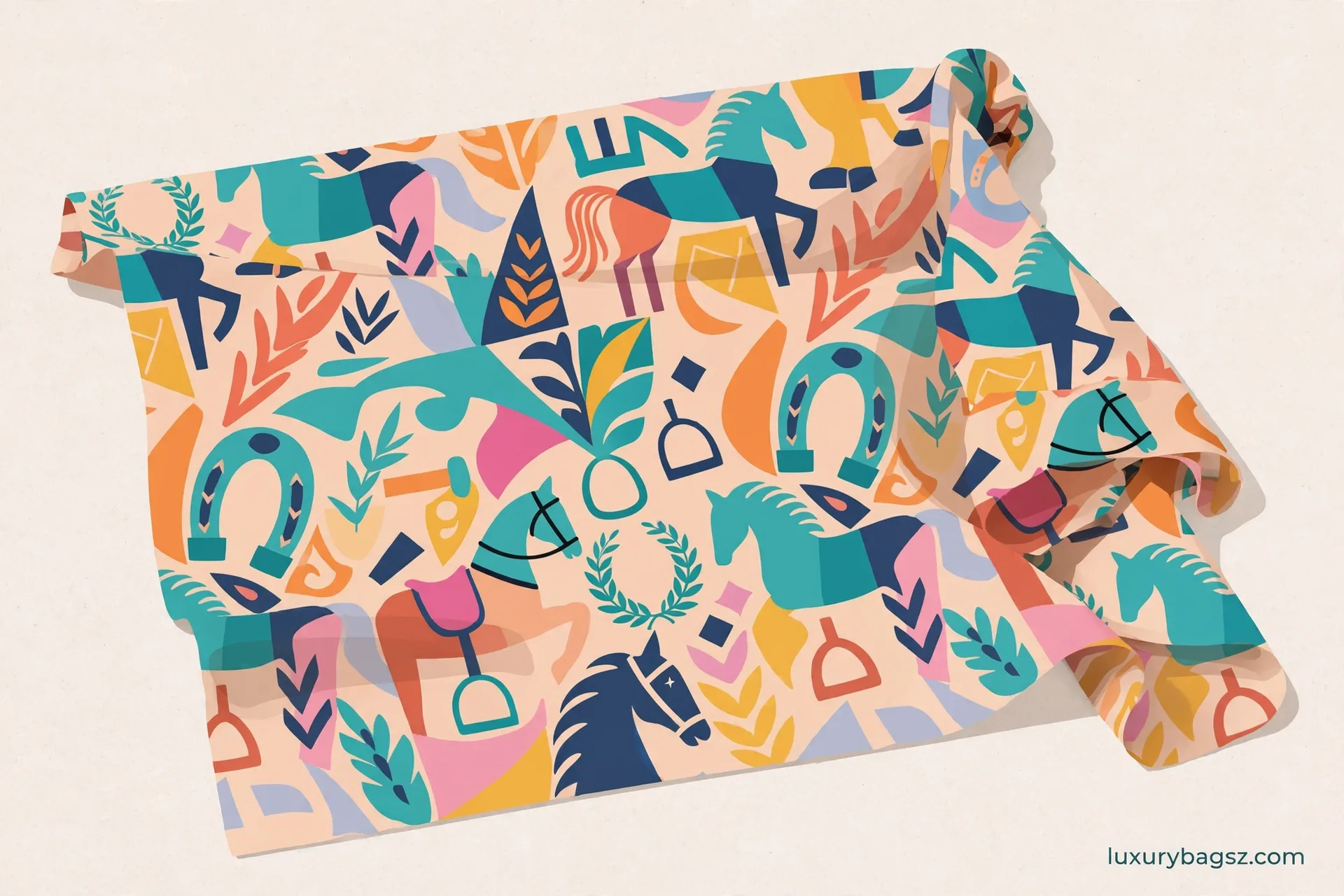
Begin with the hem and the print together, judging the scarf as a whole across all checks rather than trusting any single test. On a genuine carré the hem is rolled by hand towards the printed side, feels soft and springy, and is held by tiny stitches that vary slightly in spacing.
A stiff, glued or perfectly uniform machine edge is a serious warning. The print should show composed artwork with fine lines and clean colour separation, the signature reading Hermès with its accent, alongside the title and artist credit where the design carries them.
Treat the care label as supporting evidence judged by era — older pieces may lack one entirely. Cards, certificates or online code checks prove nothing; Hermès issues none of them for scarves. Hermès does not offer a public authentication service for scarves either.
A fake Hermès silk scarf is rarely caught by one dramatic giveaway. It is caught — or missed — by a pile of small details, checked in the right order, on the actual scarf in front of you. That is why so many buyers get it wrong, and why so many guides make it worse: they hand you a single magic test, a stitch count, a stamp code, or a box colour, and imply that one test settles the matter. It does not.
This guide is written for a buyer, not for a professional authenticator, and it is honest about its limits from the start. No guide, and no set of photographs, can give you a certain verdict on a high-grade counterfeit. What this guide can do is teach you to spot the large majority of fakes, to ask for the photographs and measurements that make a fake much harder to hide, to recognise the traps that prove nothing at all, and to know when to stop and pay for professional authentication before you pay for the scarf.
A note on the pictures in this guide matters more here than in any other kind of article. Every picture here is a generic illustration, not a photograph of a real Hermès scarf, and none of them should be used as a reference for what a genuine scarf looks like in detail. Illustrations simplify stitching, flatten weave, and tidy up print. Use them to understand what to look at, never as a side-by-side comparison standard. The words of this draft prevail over anything simplified or mistyped in an image or infographic.
Key Takeaways
- Judge a scarf as a whole. No single check — hem, print, stamp, label, box, receipt, or price — proves a scarf genuine, and no single flaw, on its own, always proves it fake. It is the pattern across all twelve checks that matters.
- Hermès issues no authenticity card for scarves. A card, a certificate, or a number to check in an online database is a red flag, not reassurance. A copied stamp proves nothing either, because counterfeiters copy stamps.
- The hand-rolled hem is the most useful single check, but it is not a magic test. Genuine hems are hand-rolled and hand-stitched, which means slight irregularity, not machine perfection. A stiff, glued, or perfectly uniform machine hem is a serious warning. A decent hand-rolled hem on a fake is possible, so a good hem never closes the case on its own.
- Sources disagree on the numbers that many guides quote as gospel — stitches per centimetre, silk weight, and hem time. This guide tells you where they disagree and why you should never fail or pass a scarf on one quoted number.
- Vintage scarves play by different rules. Older pieces may lack a care label, carry different stamp colours, or miss markings that later pieces always carry. A missing label alone never condemns a vintage scarf, and a modern-looking label on a supposedly 1970s scarf is itself suspicious.
- A size name proves nothing on its own. Carré, twilly, gavroche, stole, and cashmere formats have different finishes, and a seller who only says “Hermès scarf” has not told you which format you are buying, or which checks apply.
- Ask for ten photographs before you pay, including all four corners, a hem close-up, the signature corner, and the care label. A seller who cannot or will not supply them has not given you enough to buy safely, however good the first photograph looks.
- If you have already bought a scarf and now doubt it, stop presenting it as proven genuine, keep everything that came with it, do not alter it, wash it, or cut anything off it, and get a professional opinion before you try to resell it or confront the seller. The ‘If You Have Already Bought One’ section sets out the order to follow.
Hand me a Hermès carré and I go straight to the hem. I roll it gently between my fingers: on a genuine scarf the hem is rolled by hand towards the printed side, soft and springy, held by tiny stitches whose spacing varies just slightly — the signature of a human hand, not a machine line. A stiff, glued or perfectly uniform edge is a serious warning. Only after the hem passes do I study the print’s line work and the accented Hermès signature. Silk is not a bag, but after ten years around Hermès, I judge its finishing by the same standard.
A Fake Silk Scarf in Brief
Can you tell a fake silk scarf from one photograph? Almost never, and you should distrust any seller or guide that says you can. One photograph can rule a scarf out — a plainly misspelled signature, a machine-flat hem, or a print that does not match any known design can be enough to walk away — but it cannot rule a scarf in. Good counterfeits are photographed to pass the one angle you are shown.
What is the fastest honest check? Hold the scarf, if you can, and look at the hem first, then the print. A genuine carré has a soft, hand-rolled edge that flexes and springs back, with tiny hand stitches that vary slightly in spacing. A fake very often gives itself away here first: a stiff edge, visible machine stitching in a straight marching line, glue, or a heat-sealed feel. If you cannot hold it, ask for a hem close-up before anything else.
What about the signature and the stamp? Check them, but do not stop there. A genuine scarf carries the Hermès Paris signature printed as part of the design, usually with the design title and the artist’s name or initials, and on many pieces from the 1980s and 1990s onward a copyright line. Spelling, accent, and lettering matter — the name is Hermès, with an acute accent on the second e — but counterfeiters copy signatures well now, so a correct-looking signature never closes the case.
What is the one trap to avoid above all? Treating anything that came in the box as proof. Hermès does not issue authenticity cards for scarves, and there is no public database where a buyer can check a scarf code. A card, a certificate, a receipt photograph, or a beautiful orange box can all be faked, borrowed from another purchase, or bought separately. Judge the silk, not the extras.
When should you walk away without further argument? When several checks fail at once, when the seller refuses the ten photographs listed in the seller-photos section, when the claimed design was never made in the claimed colourway, when the price is far below any plausible range for that design and condition with no credible explanation, or when the seller pressures you to pay quickly, off-platform, or by a method with no buyer protection. Any one of those is a reason to pause. Two or more together are a reason to stop.
When should you pay for professional authentication? Whenever the scarf passes your own checks but the price is high, the seller is unknown to you, the design is rare or highly faked, or anything in the listing still feels slightly off after you have run all twelve checks. Professional authentication is not an admission that you cannot tell. It is the normal, sensible step for a purchase at this price, and reputable resellers expect it. A seller who discourages it, or who will not allow a return if a reputable authenticator disagrees, is telling you something important.
What a Real Hermès Silk Scarf Is Supposed to Be
Hermès began making scarves in 1937, with a woodblock-print-based design under Robert Dumas, and the silk square has been a core part of the house ever since.
The classic format is the carré: a square of silk twill, most famously 90 cm by 90 cm, printed by screen printing with each colour applied separately, finished with hand-rolled edges, and designed by a named artist whose work often includes a hidden motif or a personal signature touch.
That description is the baseline. Everything else in this guide is about how far a given scarf departs from it, and whether that departure has an innocent explanation.
The first thing to establish about any scarf is its format, because the checks that apply to a carré do not all apply to other formats. The best-known family is the square: the 90 cm carré, the smaller 70 cm and 45 cm squares, and the tiny pocket squares. Then come the narrow formats: the twilly, a long thin strip made to wrap a bag handle or wrist, and the gavroche, a smaller square often worn at the neck.
Then come the long formats: stoles and shawls around 140 cm, and the larger cashmere-and-silk blends that drape like a wrap rather than a crisp square. Our guide to 90 cm carré sets out the classic square in full, and our guide to scarf sizes explains how the formats differ in size and use. If a listing just says “Hermès scarf” without a format or a measurement, you do not yet know which checks to run.
Silk twill is the heart of the classic carré. Twill is a diagonal weave, and on a genuine scarf you can feel and often see that slight diagonal relief when you look closely. The fabric is dense and substantial for silk, with a fluid but stable drape: it falls in soft folds, holds a knot without collapsing, and releases without deep, sharp creases. It is not flimsy, not papery, and not slippery like polyester.
Counterfeits most often fail here in one of two directions: too light and shiny, with a plastic or waxy sheen, or too stiff, holding creases like paper. Neither feel is proof on its own — a scarf that has been starched, stored badly, or washed wrongly can feel different from a pristine one — but feel is where experienced buyers start, because it is the hardest quality for a cheap fake to imitate at a glance.
Print is the second half of the baseline. A genuine Hermès design begins as artwork, traditionally a gouache painting, and is transferred to silk by screen printing, with each colour laid down separately. That is why genuine prints show crisp lines, clean colour separation, and fine detail even in small motifs, and why the reverse of the print shows colour without the muddy bleed of a cheap digital print.
Fakes printed digitally often show dot-matrix or pixelated edges under magnification, colours that bleed into each other, and a flat, poster-like surface. But be careful: a heavily photographed or compressed listing image can make a genuine print look pixelated, and a good fake can look crisp at listing resolution. Print quality is a check you run on a high-resolution photograph or in hand, never on a thumbnail.
The hem is the third part of the baseline, and it gets its own full treatment in the hand-rolled hem section because it deserves it. For now, know this: the classic carré edge is rolled by hand toward the printed side and stitched by hand with fine silk thread in a colour matched to the border.
That handwork leaves traces — slight variation in stitch spacing, a soft and flexible roll, a corner that is folded and finished rather than cut and sealed. Machine hems, glued hems, and heat-sealed hems are the single most common giveaway across all price levels of fakes.
Finally, the signature and labelling baseline. A genuine scarf carries “Hermès Paris” as part of its printed design, with the accent on the second e, and usually the design title and the artist’s credit somewhere in the print. A woven or printed care label sewn into a corner or edge typically reads “100% silk” or “100% soie” and “Made in France” or “Fabriqué en France” on modern pieces.
Older pieces vary, and the vintage section explains how. Any scarf that spells the name without the accent, in all capitals as a substitute for the proper lettering, or with added words like “Original” or “Luxury” deserves immediate suspicion. One circulating guide even misnames the accent itself, calling it a grave accent when the mark in Hermès is acute. If a guide cannot get that detail right, treat its other claims with the same caution you would apply to a seller’s story.
Where the Published Numbers Disagree: Stitch Counts and Weight
Most guides that rank for this topic cover the same five points — print, hem, signature, label, box — and stop. That is not enough, and in several places it is actively misleading. This part names the gaps and the disagreements plainly, so you can see where a confident-sounding guide may be steering you wrong.
First, the numbers war. Guides quote stitch counts for a genuine hand-rolled hem as 3 to 4 per centimetre, as 6 to 8 per centimetre, and as 7 to 8 per centimetre, all with equal confidence. They cannot all be a pass-or-fail standard, and none of them should be used as one.
Stitch density varies by artisan, by era, and by format, and counting stitches from a photograph is unreliable. What matters is the character of the stitching — hand-stitched, slightly irregular, nearly invisible, in matching silk thread — not whether you count six or eight in a centimetre. Any guide or seller that fails or passes a scarf on a single stitch count is using a number the sources themselves cannot agree on.
Second, the weight war. Some guides claim genuine silk weighs 14 or 16 momme, others claim 13 to 14 grams per square metre, and others simply say “twice as thick as average silk” without a number at all.
Momme and grams per square metre are different units, the figures come from different formats and eras, and no buyer can weigh a scarf’s fabric density from a listing photograph. Treat any weight claim as background colour, not as a check. If a seller invites you to weigh the scarf as proof, that is theatre, not authentication.
Third, the time war. One guide says hand-rolling takes about 30 minutes per scarf. Another says several hours. Others say the whole scarf takes up to 18 months from design to completion.
These figures describe different things — one artisan’s hemming time, a whole production pipeline, a marketing claim — and none of them helps you judge the scarf in your hands. A fake does not become genuine because someone claims it took a long time to make.
Fourth, the care-label myth. Several guides state flatly that genuine Hermès scarves carry no care symbols and no washing instructions on their labels, and that the presence of care instructions proves a fake.
That is wrong for modern pieces, which do carry care labels, and it is the wrong test for vintage pieces, which may carry none. The correct rule is era-dependent, and the care label section sets it out. A guide that gives you one label rule for all eras will mislead you on both old and new scarves.
Fifth, the blind-stamp decoder trap. Circulating guides offer decodings for scarf stamps, such as a format said to show workshop, year, and batch number, and claim that a code can be read like a serial number. Hermès publishes no such decoding guide for scarves, and no public database exists for buyers to check a scarf code against.
A stamp format that looks plausible may still be copied, and a stamp that does not match an online decoder may still belong to an era or format the decoder never covered. Treat stamp decoders as unverified folklore, useful only as a prompt to ask an expert, never as a verdict.
Sixth, the signature-corner rule. Some guides say the signature appears in one or two corners, and that a signature in all four corners proves a fake.
Design layouts vary: some designs carry the signature once, some repeat elements around the border, and some place the title and artist credit in positions a rigid corner-counting rule never anticipated. Judge the signature on spelling, lettering, and integration into the print, not on a corner count.
Seventh, the packaging contradiction. Guides disagree even about the box: one describes a white box with a navy ribbon, another the familiar orange box, another a rigid matte box with embossing.
Packaging has changed over time, varies by market, and is the easiest part of the whole package to fake or buy separately. A box proves nothing in either direction. A beautiful box with a fake scarf inside is still a fake scarf, and a genuine scarf sold without its box is still genuine.
Eighth, the format gap. Almost every competitor guide describes only the 90 cm carré and then applies its rules to everything. Twillies are narrow and finished differently, gavroches are small, stoles are long, and cashmere blends drape and feel differently from pure silk twill.
A buyer who applies carré hem rules to a cashmere stole, or carré weight expectations to a sheer mousseline, will condemn genuine pieces and pass fakes that happen to match the wrong standard. The formats section closes this gap.
Ninth, the missing practical parts: almost no guide gives you a seller-photograph checklist, a message script for what to ask, a price-reading method that does not rely on a single listing, or a plan for what to do after you have already bought. Those are the parts that actually save buyers money, so this guide includes all of them, in parts 11, 12, and 13.
Tenth, the super-fake gap. Most guides describe cheap fakes: plastic sheen, misspelled names, machine hems. They rarely warn you that high-grade counterfeits now imitate hand-rolled hems, copy signatures well, and arrive in convincing packaging.
The honest conclusion is uncomfortable but necessary: the better the fake, the less any home checklist can guarantee, and the more professional authentication matters. A guide that never says that is selling confidence, not accuracy.
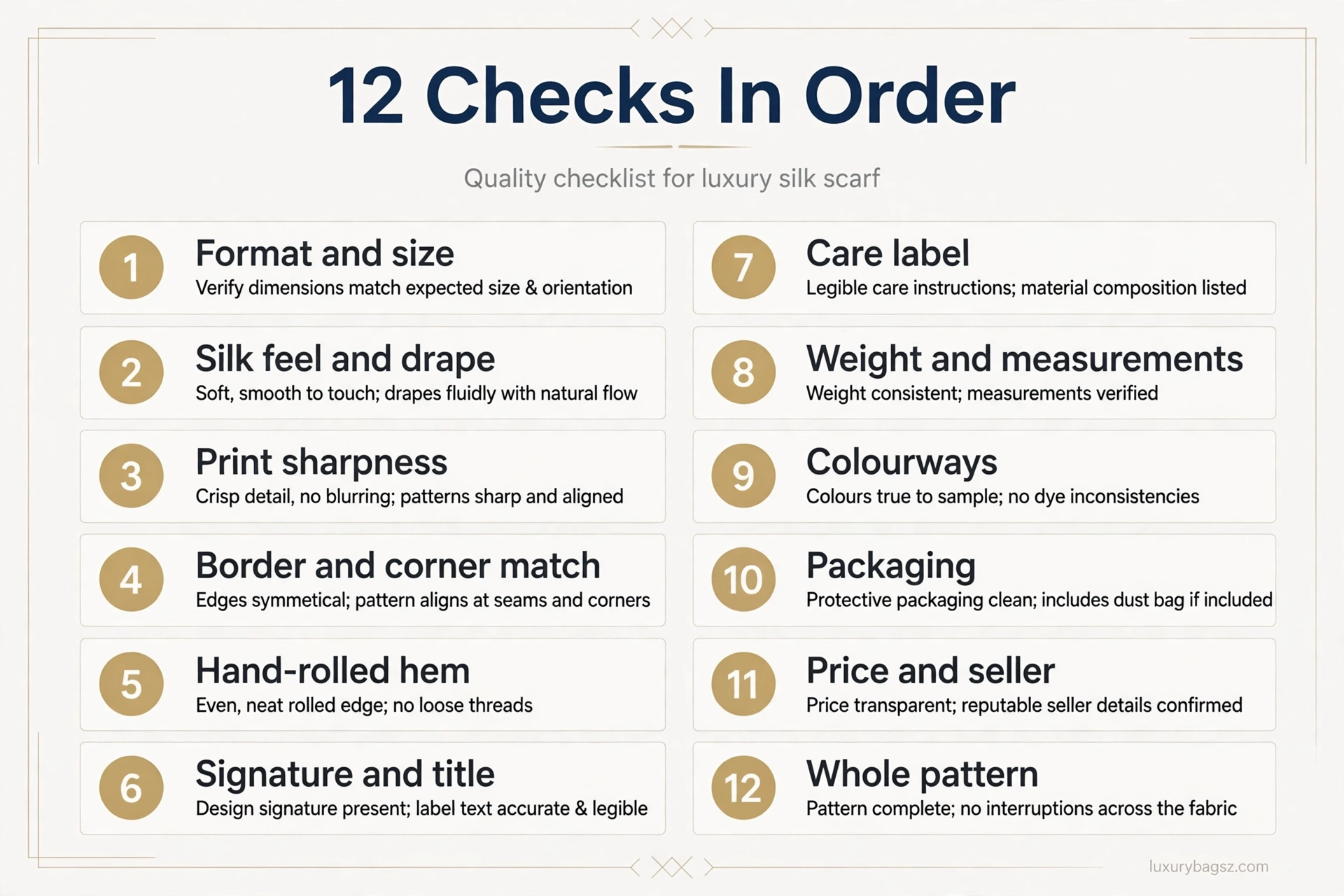
The 12 Checks in Order
Run the checks in this order, because the order is part of the method. Early checks are cheap and decisive: a scarf that fails several of them is not worth a long argument about its stamp.
Later checks only matter once the early ones have passed. Score the scarf as a pattern, not as a single pass or fail, and write down what you see for each check before you move on. Memory flatters a scarf you already want.
Check 1 — Format and size. Measure the scarf flat, edge to edge, without stretching it, and compare the result with the claimed format. A carré claimed at 90 cm should measure close to 90 cm square; a small shortfall from hemming is normal, a 10 cm shortfall is not. Rectangular formats should be measured on both sides.
A scarf that is square when it should be rectangular, or a “90” that measures 85 cm, has a problem that no good hem can fix. Also confirm the format matches the design: some designs were only ever made in certain formats, and a design you know as a carré appearing as a twilly deserves research before purchase, not after.
Check 2 — Silk feel and drape. In hand, feel for dense, smooth silk twill with a slight diagonal texture and a soft, substantial drape. It should feel cool and smooth, fall in soft folds, and release without sharp creases.
Warning signs are a slippery polyester feel, a waxy or greasy coating, a papery stiffness, or a flimsy lightness that drapes like tissue. From photographs, drape is harder: look for how the scarf falls when held or worn, not how it looks laid flat and pressed. A scarf photographed only flat and stiff may be hiding its drape deliberately.
Check 3 — Print sharpness. Under magnification or in a high-resolution photograph, lines should be crisp, colours cleanly separated, and fine detail preserved in small motifs. Look for dot-matrix or pixelated edges, colours bleeding across boundaries, and blurred small lettering. Genuine screen printing keeps detail at small scale; cheap digital printing loses it. Remember the compression caveat: judge print from the best photograph you can get, and ask for a macro photograph of a detailed motif if the listing images are small.
Check 4 — Border and corner match. The border should run evenly around the scarf, and the pattern should meet the corners in a way that looks designed, not cut off mid-motif. Fold opposite corners together in your mind, or ask for a photograph of the scarf folded diagonally: on a genuine carré the design should mirror sensibly along the fold.
Misalignment, motifs chopped at the edge, and borders that change width along one side are all warnings. This check catches many fakes that look fine in a single flat photograph, because a fake maker who prints a design slightly off-size cannot fix the corners afterwards.
Check 5 — Hand-rolled hem. See the hand-rolled hem section for the full method. In brief: soft, flexible, hand-stitched roll in matching thread, slightly irregular stitch spacing, no glue, no stiffness, no machine-straight line. A machine hem is one of the strongest single warnings available. A good hand-rolled hem is encouraging but never decisive alone, because skilled counterfeiters now imitate it.
Check 6 — Signature, title, and copyright. See the print and signature section for the full method. In brief: “Hermès Paris” spelled with the acute accent, lettering crisp and integrated into the print, design title and artist credit present where the design is known to carry them, and a copyright line in the expected format on pieces from the eras that carry one.
Misspellings, missing accents, wrong lettering, and invented additions are warnings. A perfect-looking signature is encouraging but never decisive alone.
Check 7 — Care label. See the care label section for the full method. In brief: modern pieces carry a label reading “100% silk” or “100% soie” with a Made in France mark; vintage pieces vary; a missing label alone proves nothing, because owners cut labels off; a label that contradicts the claimed era is a warning. Check the label’s stitching, material, and wording, not just its presence.
Check 8 — Weight and measurements together. Do not weigh a scarf as a verdict, for the reasons in the numbers section. Instead, use weight and measurements together as a consistency check: a carré that is the right size but feels far too light, or a stole that is far heavier than its format suggests, deserves a closer look at its fabric. Weight only speaks when it contradicts the format, and even then it speaks as a warning, not as proof.
Check 9 — Colourways. Check that the design was actually made in the colourway being sold. Hermès designs are reissued in many colourways over the years, so an unfamiliar colour is not automatically fake — but a colourway that no reference, collector record, or reputable reseller listing shows for that design is a serious question to resolve before paying.
Ask the seller which year and collection the colourway comes from, and check that answer against references yourself. Fakes very often invent colourways that look plausible and were never produced.
Check 10 — Packaging. Treat packaging as background, never as evidence. A genuine scarf is usually sold folded in tissue in a box with a ribbon, but boxes, ribbons, tissue, and care booklets are all easy to fake or buy separately, and packaging has changed over time. Judge the scarf first. If the packaging is the best thing about the listing, that is itself a warning: good sellers photograph the silk, not the box.
Check 11 — Price and seller. See the price section for the full method. In brief: compare the price with a range across several reputable resellers for the same design, format, and condition, never with a single listing. A price far below that range with a story attached — an estate sale, a gift, a mistake, a bulk lot — is a warning, not a bargain. A price at or above the range proves nothing either; expensive fakes exist.
Check 12 — The whole pattern. Step back and judge all eleven checks together. A scarf that passes ten checks and raises a small question on one may be genuine with an innocent explanation, such as a cut label or a replaced box. A scarf that raises small questions on five checks is a different matter, even if no single check is damning.
Fakes are usually caught by accumulation: a slightly stiff hem, a slightly off colour, a slightly vague seller, a slightly too-good price. Trust accumulation over any single dramatic detail, in both directions.

The Hand-Rolled Hem, Examined Properly
The hem deserves its own part because it is the check buyers most often get half right. They know to look for a hand-rolled hem, but they do not know what a hand-rolled hem actually looks like, so they pass machine hems that are neatly done and fail genuine hems that show honest handwork.
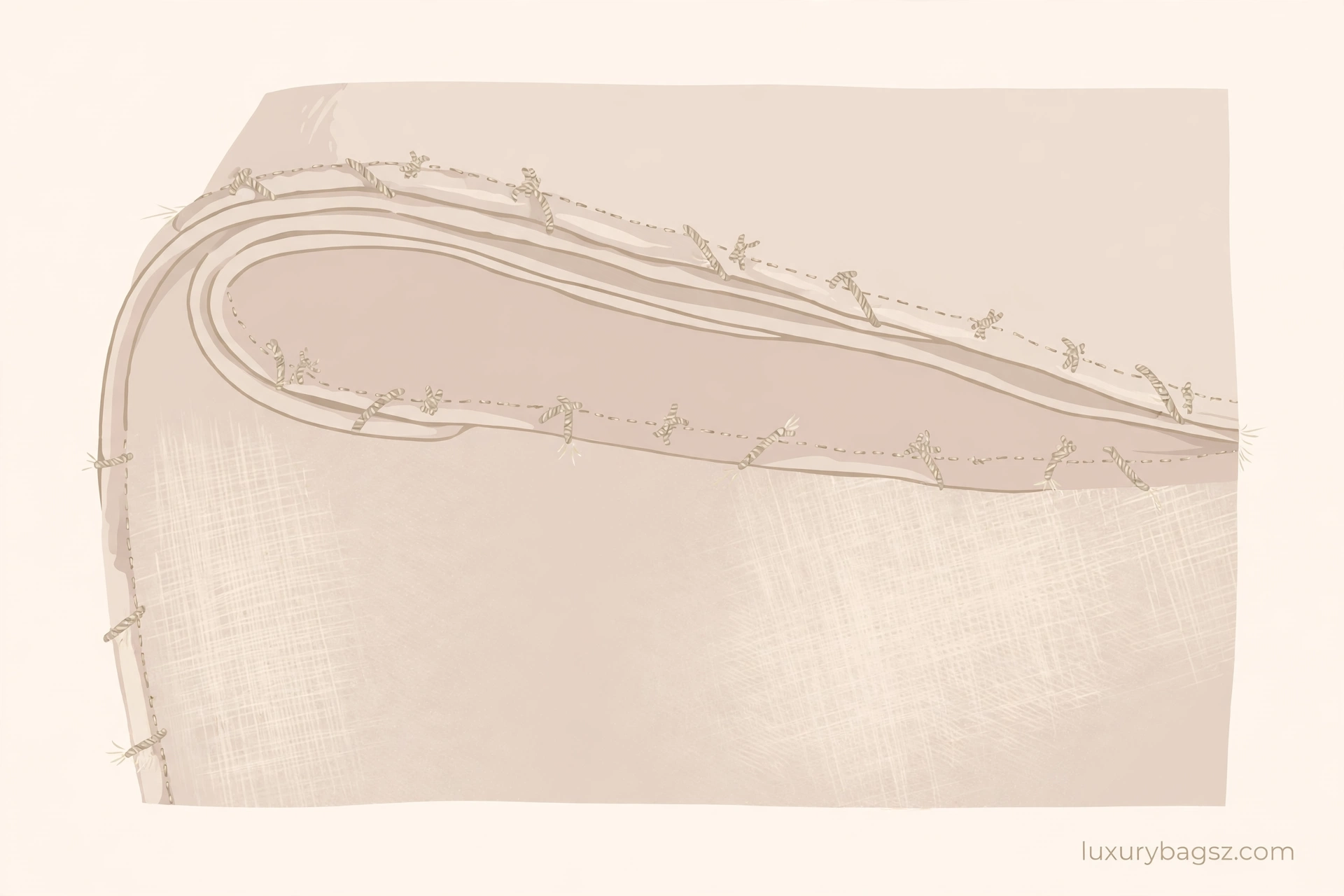
A genuine carré hem is rolled by hand toward the printed side, then stitched by hand with fine silk thread. The roll is soft and flexible: you can bend it, twist a corner gently, and it springs back without cracking or holding a sharp crease. The stitches are tiny and nearly invisible from the printed side, and when you look closely at the underside you see slight variation in their spacing and angle — the trace of a human hand working quickly and well, not a machine marching in a straight line. The thread colour matches the border it sits on. The corners are folded and finished by hand, so they look tidy but not sealed, and the roll runs evenly in diameter along each edge without sudden thickening or thinning.
A fake hem fails in recognisable ways. A machine hem shows perfectly uniform stitches in a straight line, often more visible than a hand hem, and feels stiffer. A glued hem feels rigid and may show a faint translucent film or residue inside the roll, and it cracks or resists bending rather than flexing. A heat-sealed hem feels plastic and snaps back sharply instead of springing softly. A bulky hem, much thicker than the silk itself, usually means the edge was folded by machine and pressed, not rolled by hand. Visible knots, loose threads in quantity, or thread that does not match the border colour are all warnings, though a single loose thread on a worn vintage scarf is wear, not forgery.
Do not count stitches as a verdict. As the numbers section explains, published guides disagree wildly on stitches per centimetre, and counting from a photograph is unreliable. Instead, ask yourself three questions: does the roll flex softly, does the stitching vary slightly like handwork, and is the thread matched and nearly invisible? If the answer to all three is yes, the hem supports genuineness. If the answer to two or more is no, the hem warns against it.
And remember the super-fake caveat: a well-made fake can have a hand-rolled-looking hem. A good hem lets a scarf continue to the next checks. It never ends the examination.
One more practical point: check all four edges, not one. Fake makers sometimes finish one edge well — the edge they expect you to photograph — and rush the other three. Ask for close-ups of at least two edges and one corner, and compare them. Genuine handwork varies slightly from edge to edge, but it does not change character: a soft hand roll on one edge and a stiff machine edge on the next is not variation. It is a contradiction.
Print, Signature, Title, and Copyright
The print is where a scarf’s identity lives, and it is where careful buyers can catch fakes that pass a casual look. Work through it in layers: the artwork itself, the signature, the title and artist credit, and the copyright line.
Start with the artwork. A genuine Hermès design is a composed picture, not a repeated pattern stamped across the silk. Motifs have depth, fine line work, and subtle colour gradation, and the same design appears in reference photographs, collector records, and reputable reseller listings with the same composition. Compare the scarf in front of you with a verified reference of the same design, motif by motif. A fake often simplifies: fine lines thicken, small background detail disappears, colour gradations flatten into solid blocks, and the composition shifts slightly because the design was copied from a photograph rather than from the original artwork. If you cannot find any reference for the design at all, that is not proof of rarity. It is a reason to pause and research harder, because most genuine designs are documented somewhere.
Next, the signature. “Hermès Paris” should appear as part of the print, in lettering that is crisp, evenly weighted, and integrated into the fabric rather than sitting on top of it like a sticker or a stamp. The accent on the second e is acute, and the spelling is exact. Common fake errors are a missing accent, a sans-serif or generic letterform where the design uses a specific serif or script, smudged or pixelated lettering under magnification, and lettering that is too large, too bold, or placed where the genuine design does not place it. But do not apply a rigid corner-counting rule: designs vary in where they place the signature, and a signature in an unexpected corner is a question, not an automatic fail, until you have compared it with a reference.
Next, the title and artist credit. Many designs carry the design title and the artist’s name or initials within the print, and some carry a small painted signature or hidden motif associated with the artist.
Check that the title matches the design, that the artist credit matches the designer recorded for that design, and that the lettering style matches the rest of the print. A title that belongs to a different design, an artist credit that does not match any recorded designer for that pattern, or a signature that looks added afterwards in a different ink or weight are all serious warnings.
This is also where invented colourways often betray themselves: the title may be right, but the colour combination was never issued under it.
Next, the copyright line. On many pieces from the 1980s and 1990s onward, you will find a line such as a copyright symbol followed by the artist’s initials and a year. Its format matters: the initials should match the artist, the year should be plausible for the design’s first issue or reissue, and the line should be printed in the same quality as the rest of the design.
Fakes often omit it, garble the initials, or use a year that contradicts the design’s history. But older pieces may carry no copyright line at all, and its absence on a genuinely vintage scarf is not a fail. Era is everything here, which is why the vintage section exists.
Finally, look at the reverse of the print. Genuine screen printing shows colour through to the reverse without the muddiness of a cheap transfer, and the design remains legible rather than ghostly or blotchy.
A reverse that is blank, or that shows the design only as a faint stain, suggests a printing method that Hermès does not use for a carré. A reverse that shows heavy bleed, where colours have soaked into each other, suggests the same. As with every check, treat the reverse as one voice in a chorus, not as a solo verdict.
The Care Label: What It Can and Cannot Tell You
The care label is the most over-read and most misread part of a scarf. Buyers treat it as an identity card. It is not. It is a small sewn tag whose presence, wording, and stitching can support or warn against genuineness, but which can never settle the matter alone.
On a modern scarf, expect a label sewn into a corner or edge, usually reading “100% silk” or “100% soie”, with a Made in France mark, and care instructions. The label material is fabric, not paper, and it is stitched in with thread that matches its surroundings, sitting flat and straight. The lettering is sharp and correctly spelled, in the expected languages. A paper-like label, a label glued rather than stitched, crooked stitching, misspellings, or a label that reads like a machine translation are all warnings.
On an older scarf, expect variation. Some vintage pieces carry no care label at all, or carry a simpler label with less information. Labels also get cut off by owners who find them irritating against the skin, which is why a missing label alone never condemns a scarf: it is one of the most common innocent explanations in all of scarf buying. What matters is whether the absence fits the claimed era and whether everything else about the scarf supports it. A supposedly 1970s scarf with a crisp modern care label is more suspicious than a supposedly 1970s scarf with no label at all.
Origin wording needs care. Guides agree that Hermès scarves are made in France, and a label reading Made in Italy or Made in China on a scarf claimed as Hermès is a serious warning. But do not turn that into a single-label verdict either: labels can be replaced, faked, or misread, and a scarf with a correct label can still be fake. Judge the label together with the hem, the print, and the fabric, and treat any label that contradicts the claimed era as a question to resolve, not as an instant answer.
Two more label traps deserve naming. First, the “no care instructions” trap: some guides claim genuine labels never carry care instructions, and buyers then condemn modern scarves that do. Modern scarves do carry care information, and the absence of it is an era question, not a universal rule. Second, the barcode trap: a small tag with a barcode and product code sometimes accompanies a new scarf, and sellers present it as an authentication document. It is a retail tag, not a proof of genuineness, and it can be copied or borrowed like any other piece of paper. A barcode proves that a tag was printed. It proves nothing about the silk it is attached to.
Vintage Scarves: When the Rules Change
Vintage scarves are where rigid guides do the most damage, because they apply modern rules to old pieces and modern expectations to old manufacturing. If you buy vintage, learn the era differences before you buy, not after.
The broad shape of the change is this: the older the scarf, the more variation you should expect in markings, and the more you should rely on craftsmanship — hem, fabric, print quality — rather than on labels and codes. Early scarves may lack a care label, may carry a simpler signature, and may use stamp colours and label formats that later pieces abandoned. From the 1980s and 1990s onward, markings become more standardised: copyright lines, fuller labels, and more consistent signature placement. A scarf claimed as 1960s that carries a full modern label set is therefore more suspicious than a scarf claimed as 1960s that carries almost no markings at all, provided its craftsmanship is right.
Condition is part of vintage authentication, not separate from it. A genuinely old scarf shows honest wear: softening of the silk, gentle fading in strong colours, slight wear at fold lines, and a hem that has relaxed with use. A supposedly vintage scarf in flawless, crisp, unworn condition with a story about decades in a drawer is possible — scarves do sit unworn — but it deserves the same scrutiny as any too-good story, especially if its markings look modern. Conversely, wear alone never proves age: fakes are artificially aged, washed, and distressed to simulate it. Judge wear for consistency — does the fading match the fold lines, does the hem wear match the handling a scarf would get — rather than for its mere presence.
Provenance matters more for vintage, and it is also easier to fake. A vintage box, a story about an estate sale, or a photograph of a grandmother wearing a scarf are all easy to invent and impossible to verify from the listing. Treat provenance as a pleasant bonus when it is documented, never as evidence. What you can verify is the design itself: was this design issued in this era, in this format, in this colourway? Collector references, design archives, and reputable reseller records are your tools here, and a design that cannot be placed in any era is a scarf you should not buy on a story.
Finally, be extra careful with rare and early designs. The first Hermès scarves, the most famous artist collaborations, and the designs that command the highest prices are also the most faked, and the fakes aimed at collectors are often the best made. For any vintage scarf at a serious price, professional authentication is not optional extra caution. It is the purchase method.
Formats That Break the Carré Rules
This is the part most guides skip, and it is the part that saves genuine scarves from false condemnation. Not every Hermès silk piece is a 90 cm carré, and the other formats have their own finishes. Apply carré rules to them and you will get wrong answers in both directions.
The twilly is the clearest example. It is a long, narrow strip, made to wind around a bag handle, a wrist, or a neck, and our guide to wearing a twilly on a bag handle shows how it is used. A twilly is not a small carré: its proportions, its print layout, and its edge finish follow its own format, and its narrow width means its hem behaves differently from a big square’s. Judge a twilly against twilly references, not against carré checklists, and be suspicious of a “twilly” whose print looks like a carré design crudely cut into a strip.
The gavroche and the smaller squares sit between the twilly and the carré. They are squares, but smaller, and their print is composed for their size rather than shrunk from a 90 cm design. A design that looks stretched, cropped, or awkwardly scaled on a small square may be a fake made by resizing a carré print, or it may be a genuine small-format composition you have not seen before. The difference is resolved by reference, not by feeling: find a verified example of the same design in the same format before you decide.
The long formats — stoles, shawls, and wraps around 140 cm — bring their own complications. Some are pure silk, some are cashmere and silk blends, and the blends drape, feel, and weigh differently from silk twill. A cashmere blend will feel softer and woollier, will not show the same crisp twill diagonal, and will not hold a knot the same way. That is not a flaw. It is the material. What should still hold is print quality, signature accuracy, and edge finishing appropriate to the format. A stole with a machine-pressed edge and a blurry print is suspicious in any material.
Sheer formats deserve a special warning. Mousseline and other lightweight silks are deliberately thin and translucent, and they will fail every test based on carré density and weight. Do not buy a sheer scarf by carré standards. Buy it by its own references: does the print stay crisp at that lightness, does the edge finish suit a sheer fabric, and does the design exist in that sheer format?
The practical rule is simple: name the format before you run the checks, and run only the checks that belong to that format. A seller who cannot name the format, or who calls everything a carré, has not given you enough information to authenticate anything. Ask for the measurement, the material as stated on the label, and the format name, and check all three against references before you pay.
Traps That Prove Nothing
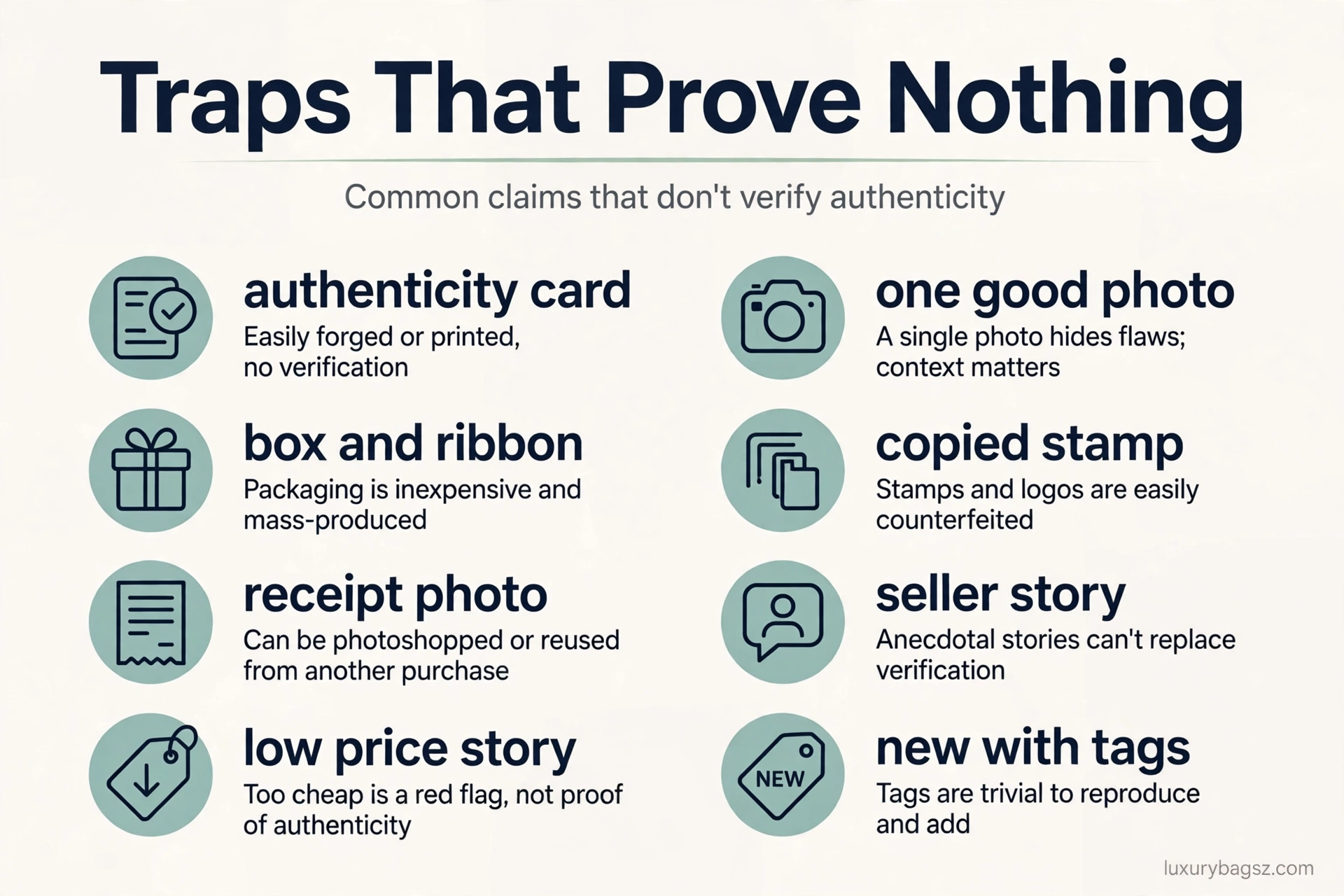
Some things feel like proof and are not. Memorise this list, because sellers of fakes rely on every item on it.
An authenticity card. Hermès does not issue a standalone authenticity card for scarves. A card in the box is not reassurance. It is a red flag, because someone made it, and Hermès did not.
A box, ribbon, and tissue. Packaging is cheap to produce and easy to buy separately. A beautiful box proves that someone owns a box. It proves nothing about the silk inside it.
A receipt photograph. Receipts can be photographed from another purchase, edited, or printed. A receipt also proves, at most, that someone once bought something. It does not prove that the scarf in front of you is the scarf on the receipt.
A barcode tag. A retail tag with a barcode and product code is a stock tag, not an authentication document. It can be copied, swapped, or attached to anything.
A copied stamp or signature. Counterfeiters copy stamps and signatures as a matter of routine. A correct-looking stamp or signature is a necessary condition for genuineness, not a sufficient one. It lets a scarf continue. It never closes the case.
A single good photograph. One flattering photograph hides hem, reverse, corners, and label. Fakes are photographed to pass the angle you are shown. Insist on the ten photographs in the seller-photos section, or do not buy.
A seller’s story. Estate sales, gifts from a grandmother, boutique mistakes, bulk lots, and “my friend works at Hermès” are stories, not evidence. A true story and a false story sound exactly alike in a listing. Judge the silk.
A low price with an explanation. A bargain price is a warning, not a proof of anything, and an explanation attached to it is usually part of the sales pitch. See the price section for how to read price properly.
“New with tags” or “unworn”. Tags are trivial to reproduce and attach, and “unworn” is a claim, not a condition you can verify from a listing. Judge the scarf, not its adjectives.
A professional-looking listing. Good photography, confident wording, and a polished shopfront are marketing, not authentication. Some of the best-made fakes are sold through the best-looking listings, because presentation is cheap and silk is expensive.
A second opinion from a stranger online. A commenter who says “looks real” from one photograph has performed no authentication at all. Treat online opinions as prompts to look closer, never as verdicts. The only opinions that carry weight are professional authentications of the actual scarf, with its photographs and measurements attached.
10 Photos to Ask a Seller For
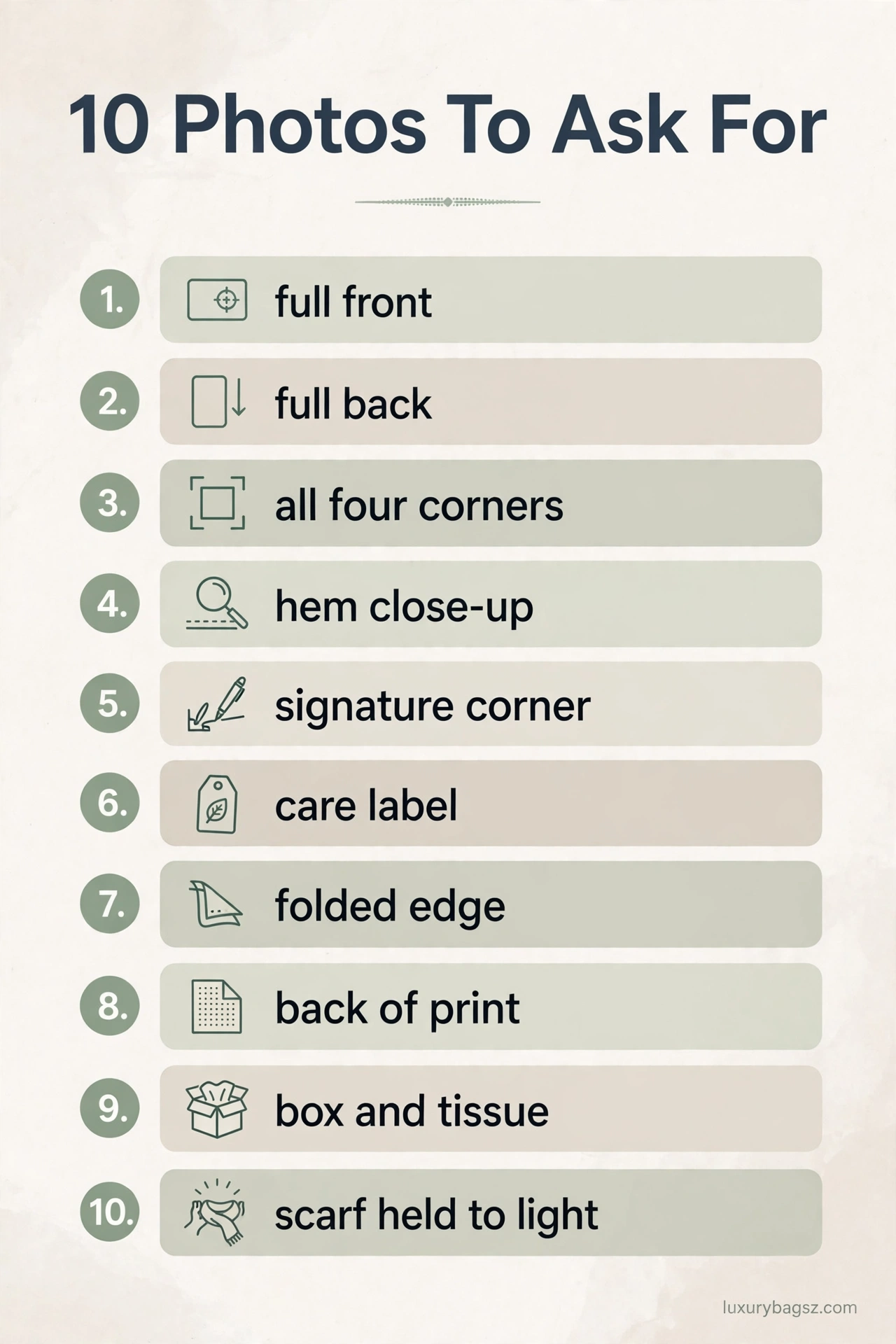
Before you pay, ask for these ten photographs, taken of the actual scarf for sale, not stock images and not photographs of a different example of the same design. A genuine seller with the scarf in hand can supply them. A seller who refuses, delays, or substitutes stock images has told you something important, whatever their explanation.
- The full front, laid flat, showing the whole design and all four borders.
- The full back, laid flat, showing the reverse of the print.
- All four corners, one photograph each or one clear photograph showing each corner’s finish and border meeting.
- A close-up of the hem along one edge, showing the roll and the stitching.
- A close-up of a second edge and one corner, so you can compare the finish.
- A close-up of the signature corner, showing the signature, title, and any copyright line legibly.
- A close-up of the care label, showing its wording, stitching, and material.
- A photograph of the scarf folded diagonally, so you can judge how the design meets at the fold.
- A photograph of the scarf held up to light, showing the weave, the drape, and the print’s behaviour in light.
- A photograph of the scarf with a ruler or tape measure along one edge, showing its true measurement, plus a photograph of the box and tissue if packaging is claimed — judged as packaging only, per the traps section.
Along with the photographs, ask four questions in writing: What is the exact format and measurement? What is the design name, and in which colourway and approximate year was it issued? Where and when did the seller acquire it, and can they show the purchase record with personal details covered?
Will they accept a return if a reputable professional authenticator finds the scarf not genuine? Keep the answers in writing. A seller who answers clearly, supplies the photographs, and accepts a return condition is not proven genuine — but they have removed most of the easy ways a fake is sold. A seller who answers vaguely, refuses photographs, or refuses any return on authenticity grounds has removed your safety net, and you should not buy without it.
Red-flag seller behaviours, in addition to refusal, include pressure to pay quickly, insistence on payment methods with no buyer protection, refusal to photograph a specific detail you named, photographs that are always slightly blurry at exactly the hem or the label, and listings that use only stock or catalogue photographs. Any one of these is a reason to pause. Two together are a reason to stop, even if the scarf itself looks good.
Price: How to Read It Without Being Fooled
Price is a check, not a verdict, and it is the check buyers most often read backwards. A low price does not prove a fake, because genuine scarves do sell cheaply when they are worn, unfashionable in colour, or sold by someone who needs a quick sale. A high price does not prove genuineness, because expensive fakes exist and because a high price is itself a sales tactic. What price can do is tell you whether a listing deserves extra scrutiny, and whether the seller’s story fits the market.
Read price as a range, never as a single number. Gather prices for the same design, format, and condition from several reputable resellers, and look at the spread, not the cheapest or the dearest example. A single resale listing is never a market average: one seller’s optimistic price, one distressed sale, and one misidentified design can each distort the picture on their own. Condition moves price more than most buyers expect: a pristine rare colourway and a worn common colourway of the same design can sit far apart, and both prices can be entirely genuine. Format moves it too: a 90 cm carré, a twilly, and a cashmere stole in the same design are different products at different prices.
Treat a price far below the range as a warning that demands an explanation, and then judge the explanation. “Estate sale” and “gift” are the two most common explanations attached to fakes, precisely because they cannot be checked. A credible explanation is specific, documented, and consistent with the scarf’s condition: a worn scarf at a worn-scarf price from a seller with a history of selling worn scarves is a different proposition from a pristine rare scarf at half price from a brand-new account. When the price and the story do not fit together, believe the mismatch, not the story.
Also watch for the opposite trap: a price set just below the reputable range, close enough to look plausible and far enough below to feel like a bargain. This is where many good fakes are priced, because a price that is obviously absurd scares buyers off, while a price that is merely attractive disarms them. If a listing feels like a bargain you would be foolish to miss, that feeling is the sales pitch working. Slow down, run the twelve checks, and ask for the ten photographs before you let urgency decide.
If You Have Already Bought One
Doubting a scarf you already own is an unpleasant moment, and the worst responses are the hurried ones: washing it, cutting off a suspicious label, confronting the seller with accusations, or reselling it quickly to recover your money. Each of those makes the situation worse. Follow this order instead.
First, stop presenting the scarf as proven genuine. Do not wear it as a verified piece, do not lend it as one, and above all do not resell it as genuine while you doubt it. Selling a scarf you believe may be fake, without saying so, passes the problem to someone else and creates a dispute that will follow you.
Second, preserve everything exactly as it arrived: the scarf, the box, the tissue, the ribbon, any tags, any card, and all messages with the seller, including the listing itself. Take screenshots of the listing before it can be edited or removed. Do not wash the scarf, do not attempt to repair the hem, and do not cut anything off it. Alteration destroys evidence and can destroy a return claim.
Third, get a professional opinion. Send a reputable authentication service the ten photographs from the seller-photos section, plus the seller’s description and any provenance offered, and ask for a written opinion on the actual scarf.
If the service needs the scarf in hand, send it by a tracked, insured method and keep the tracking record. A professional opinion is the only verdict that carries weight with a marketplace, a payment provider, or a seller.
Fourth, act on the opinion. If the scarf is found not genuine, contact the seller in writing, calmly and with the opinion attached, and ask for a return and refund within the platform’s or payment provider’s process.
If the seller refuses, escalate through the marketplace or payment provider with the same evidence, within their deadlines — deadlines matter, and delay weakens claims. Keep every message polite and factual: accusations and threats slow disputes down, while a clear paper trail speeds them up.
Fifth, if the scarf is found genuine, keep the opinion with it. A written authentication from a reputable service is the best thing you can pass to a future buyer, and it protects the scarf’s value far better than any card or box ever could. File it with the purchase record, and note the design, format, colourway, and measurement alongside it, so the next owner does not have to start from scratch.
Caring for a Scarf You Believe Is Genuine
Authentication and care are linked, because the wrong care can destroy the very details you authenticated. Silk is a protein fibre: it dislikes water, heat, and harsh chemicals, and a scarf that has been washed wrongly can lose print crispness, hem shape, and drape permanently.
The safe rule for a scarf you believe is genuine is professional dry cleaning by a cleaner experienced with silk, never home washing, never a hot iron directly on the print, and never a harsh stain treatment applied at home. The comparison is useful here: just as clean Chanel bags need material-specific care rather than a single universal method, a silk scarf needs silk-specific care rather than whatever worked on another fabric.
For day-to-day wear, the styling choices also affect longevity. A scarf worn as a neck piece, tied in the many ways our guide to tying a silk scarf describes, will crease differently from one worn flat, and a scarf threaded through a scarf ring will wear at the ring points over time. None of that is damage in the ordinary sense — scarves are made to be worn — but it is wear, and wear changes how a scarf looks under future authentication. Keep a record of how a scarf has been worn and cleaned, and store it folded loosely in tissue, away from direct sunlight and damp, rather than hung or knotted for months.
A scarf stored knotted will hold creases that a later buyer may misread as a fabric flaw, and a scarf stored in sunlight will fade in ways that no later explanation fully repairs.
One last care warning: never attempt to “improve” a scarf’s hem, label, or print. Re-rolling a hem, re-stitching a label, or touching up print does not restore a scarf. It creates a new set of questions for any future authenticator, and it can turn a genuine scarf with honest wear into a scarf whose history cannot be trusted. Honest wear is explainable. Alteration is not.
Final Verdict
A fake Hermès silk scarf is not usually exposed by one clever trick. It is exposed by patience: by naming the format, by checking the hem and the print properly, by treating the label and the packaging as supporting voices rather than verdicts, by asking for ten photographs, by reading price as a range rather than a bargain, and by knowing when to pay for a professional opinion instead of guessing.
The most important habit this guide can leave you with is also the simplest. Judge the scarf, not the story.
Stories are cheap, boxes are cheap, cards are cheap, and confident listings are cheap. Dense silk twill, crisp screen printing, a soft hand-rolled hem, accurate signature and title, and a label that fits the claimed era are not cheap, and they are hard to fake all at once.
When a scarf shows all of them together, and the seller answers clearly and accepts an authenticity return, you have a sound basis for buying. When it shows several small warnings at once, or the seller will not give you the photographs to check, you have a sound basis for walking away — and walking away from a doubtful scarf costs nothing, while buying a fake costs the full price plus the trouble of undoing the purchase.
No single check in this guide proves authenticity, and no guide replaces a professional opinion on a high-value piece. Use the twelve checks to avoid the large majority of fakes, to ask better questions, and to know when to stop and get expert help. That is what a good authentication guide is for: not certainty, but fewer expensive mistakes.
Frequently Asked Questions
Can a fake scarf have a hand-rolled hem, and is a missing care label proof of a fake?
Yes. Skilled counterfeiters now imitate hand-rolled hems, so a good-looking hem supports genuineness but never proves it. Judge the hem together with the print, the fabric, the signature, and the label, and get a professional opinion on any high-value piece.
No. Owners cut labels off, and many vintage pieces never carried the modern label set. A missing label is a question to weigh with the rest of the evidence, not a verdict. A modern-looking label on a supposedly old scarf is more suspicious than no label at all.
Does Hermès issue an authenticity card for scarves, and can a stamp or code be checked in an official database?
No. Hermès offers no public authentication service or buyer database for scarf stamps and codes. Online decoders are unverified, and a code that matches a decoder proves nothing, because counterfeiters copy codes too.
No. Hermès does not issue a standalone authenticity card for scarves. A card offered with a scarf is a red flag, not reassurance, because it was made by someone other than Hermès.
Are all Hermès scarves 90 cm squares?
No. The 90 cm carré is the most famous format, but Hermès also makes 70 cm and 45 cm squares, twillies, gavroches, stoles, shawls, and cashmere blends. Always confirm the format and measurement before running the checks, because different formats have different finishes.
Does a low price always mean a scarf is fake?
No. Genuine scarves sell cheaply when worn or in less popular colourways. But a price far below the range for the same design, format, and condition, especially with an unverifiable story attached, is a serious warning that deserves the full twelve checks before you pay.
Can I authenticate a scarf from a single listing photograph, or is professional authentication worth it?
Almost never. One photograph can rule a scarf out, but it cannot rule one in. Ask for the ten photographs in the seller-photos section, including hem close-ups, the signature corner, and the care label, before you buy.
For a high-value, rare, or doubtful scarf, yes. It is the normal step for a purchase at this price, it carries weight in disputes and future resale, and it is the only verdict that goes beyond a home checklist. A seller who discourages it is giving you information about the seller, not about the scarf.
What should I do if I already bought a scarf I now doubt?
Stop presenting it as proven genuine, preserve everything that came with it, do not wash or alter it, get a written professional opinion on the actual scarf, and then pursue a return through the seller, marketplace, or payment provider within their deadlines.
Do vintage scarves follow the same rules as modern ones?
Not entirely. Older pieces may lack care labels, carry different stamp colours, or miss markings that later pieces always carry. Judge vintage scarves mainly on craftsmanship — hem, fabric, and print quality — and verify the design, format, and colourway against references for its era.