

How to Wear a Hermès Twilly on a Bag Handle
A Twilly on a Handle in Brief
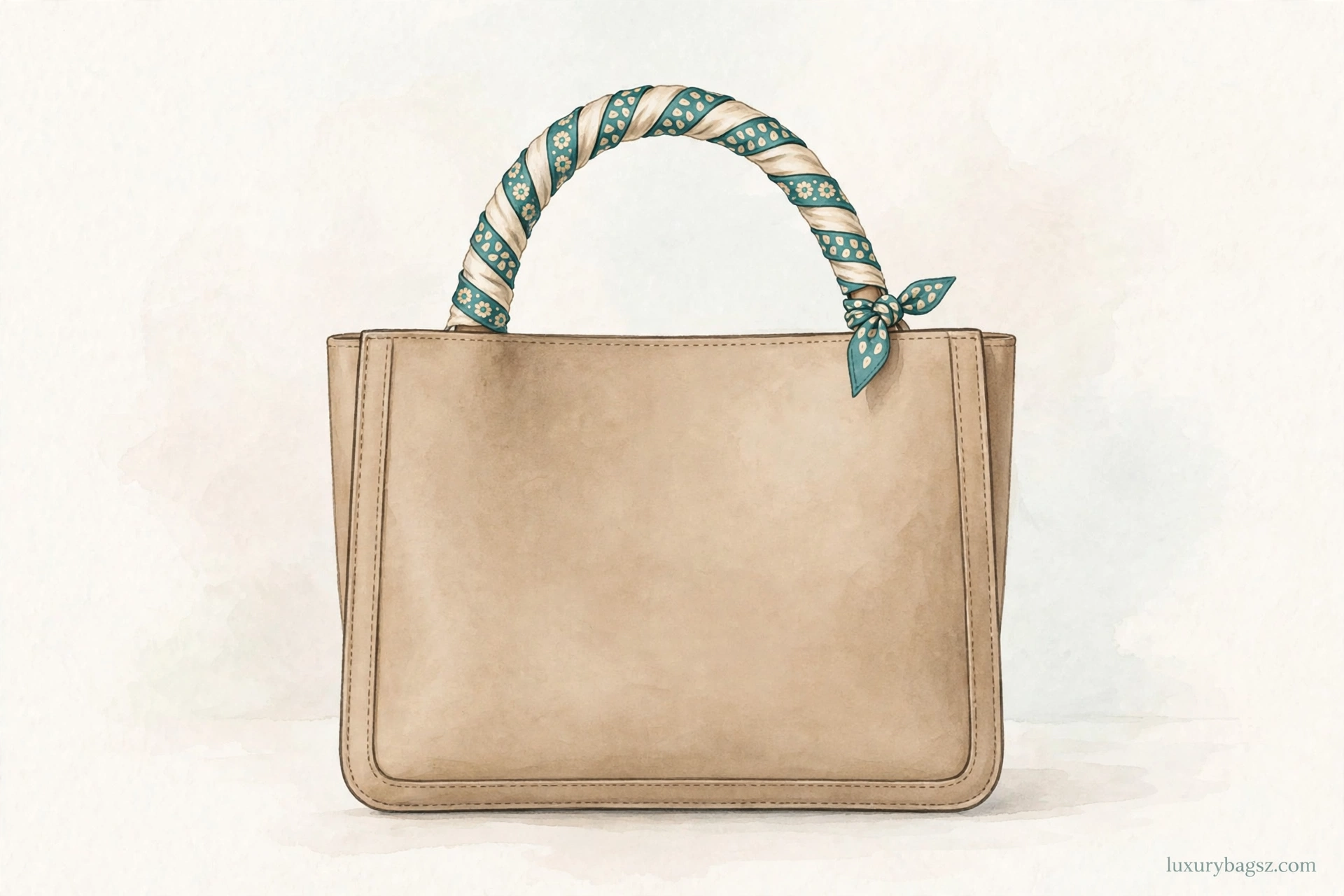
A twilly is a narrow strip of silk, roughly 5 cm wide and 86 cm long, and wearing one on a bag handle comes down to a single decision: cover the handle, or decorate it. A full spiral wrap covers the whole handle and puts silk between your hand and the leather. A bow or a knot at the handle base leaves the handle bare and adds colour only. Start with the full spiral on a single rolled handle, keep every turn snug rather than stretched tight, overlap each turn slightly so no bare leather shows, and finish with a small knot tucked underneath.
If the twilly runs short before you reach the far base, stop at a half-handle wrap rather than pulling the silk thin. Check dark silk against light leather before a long day out, untie the twilly before long storage, and never machine wash silk. One twilly suits one handle; a bag with two handles needs a matching pair for a balanced look, or a single twilly worn deliberately on one handle only.
Introduction
A twilly on a bag handle looks effortless in photographs, and that is exactly why it frustrates so many people the first time they try it. The photographs hide the fiddly parts: the first knot slipping loose, the spiral going uneven halfway along, one tail ending up longer than the other, and the whole wrap loosening during the day.
None of those problems means you have the wrong twilly or the wrong bag; the technique needs a small adjustment, and this guide gives you those adjustments, one style at a time.
Most existing guides cover only the classic spiral wrap, and they cover it in three or four lines. They rarely explain how a wrap differs from a bow, which handles suit which style, what to do when a twilly is too short for a long handle, how dye can move in both directions between silk and leather, or how to take a twilly off and store it without setting creases into the silk. Those are the gaps this guide fills.
Every style below comes with numbered steps you can follow at a table, with the starting knot, the direction of the wrap, and the finishing knot spelled out, so you are not left guessing from a photograph.
This guide is about the wearing, not the buying: it does not authenticate a twilly, and it does not claim that a wrap guarantees protection or a higher resale price. Where sources disagree — on exact length, on when the twilly first appeared, and on how much protection a wrap really gives — the disagreements section says so plainly, rather than picking one version and hiding the rest.
Key Takeaways
- A full spiral wrap covers and cushions a handle; a bow or knot decorates it and leaves the handle bare.
- Standard twillies measure about 5 cm by 86 cm, but special editions vary, so measure your own strip before you plan a wrap.
- Start at the handle base, wrap diagonally with a slight overlap, keep the silk snug but never stretched, and finish with a knot tucked underneath.
- One twilly per handle is the rule for a full wrap; a two-handle bag needs a pair for symmetry.
- Dark silk can mark light leather, and dark clothing can mark light silk, so test a new pairing before a long outing.
- Untie, do not yank, when you remove a twilly, and store the silk rolled loosely, not knotted, for long periods.
I wrap handles for the same reason I check silk so closely: a Twilly is protection before it is decoration. Silk between your palm and a leather handle keeps oils, sunscreen and friction off the part of the bag that ages fastest, and on the pre-owned bags I examine, wrapped handles are consistently the cleanest. My own wraps follow the spiral in this guide — snug, never stretched, each turn overlapping slightly, knot tucked underneath. A strip that runs short gets a half wrap, not a thinner one. Silk pulled thin protects nothing and looks it.
Table of Contents
What a Twilly Is, and What It Is Not
A twilly is a long, narrow scarf woven from silk twill, the diagonal weave that gives the strip its name and its slight crispness. Unlike a square scarf, it is already a band when you pick it up, so there is no folding into a triangle or a bias strip before you start. You knot it, wrap it, or bow it, and the narrow width is what makes all three possible without bulk. The silk is printed on both sides, so either face can show during a wrap, and the hand-rolled edges are part of the finish, not a flaw to tuck away.
What a twilly is not matters just as much. It is not a handle cover in the hardware sense: it does not buckle on, it does not grip by itself, and it will not stay put if only draped over a handle. It is held by friction, overlap, and the knots at each end, which is why tension and finishing matter. It is not a repair, either: wrapping a cracked, peeling, or badly darkened handle may hide the damage while trapping moisture against weak leather. If a handle is damaged, have it looked at before you wrap it.
A twilly is also not only a bag accessory — the same strip ties at the neck, wraps a wrist, or ties a ponytail — but on a handle its job is specific: cover the grip area, or decorate the base. Deciding which job you want before you start is what keeps the result looking intentional, and the full-wrap-or-accent section walks through that choice.
Twilly, Maxi-Twilly, or a Folded Square: Picking the Right Strip
The standard twilly is the starting point for almost every handle style in this guide. Sources agree closely on its proportions, commonly about 5 cm wide and 86 cm long, which converts to roughly 2 inches by 34 inches. That length is enough for a full spiral around a standard rolled top handle, with a little left over for the finishing knot. It is not, however, a fixed law.
Fringed editions, special editions, and twillies from other makers can run a little shorter or a little longer, and a few centimetres either way changes how far a wrap reaches. Measure your own strip, laid flat and unstretched, before you promise yourself a full wrap on a long handle.
The maxi-twilly, commonly listed at about 20 cm by 160 cm, is a different tool, not simply a longer twilly. Folded lengthwise into a band, it can wrap a long or thick handle that a standard twilly cannot reach, but its extra width makes a broader, softer wrap with fewer turns and a bulkier finishing knot. Use it when a standard twilly genuinely runs short, not as a default, because the neat candy-twist look comes from the narrow strip.
A full square scarf is the third option, and it is worth understanding even though this guide is about twillies. A 90 cm square, folded into a bias band, can wrap a handle in the same spiral way, and guides to scarf sizes show how the formats relate. The difference is bulk: a folded square makes a wider, softer band that shows more pattern but grips less neatly, and the folded edges can work loose during the day.
A square also gives you a much larger piece of silk to manage at the finishing knot. The classic carré 90 is a beautiful scarf, but for a crisp handle wrap, the narrow twilly is the easier and tidier choice. Keep the square for the neck, and let the twilly do the handle work.
Full Wrap or Simple Accent: The Choice That Shapes Everything
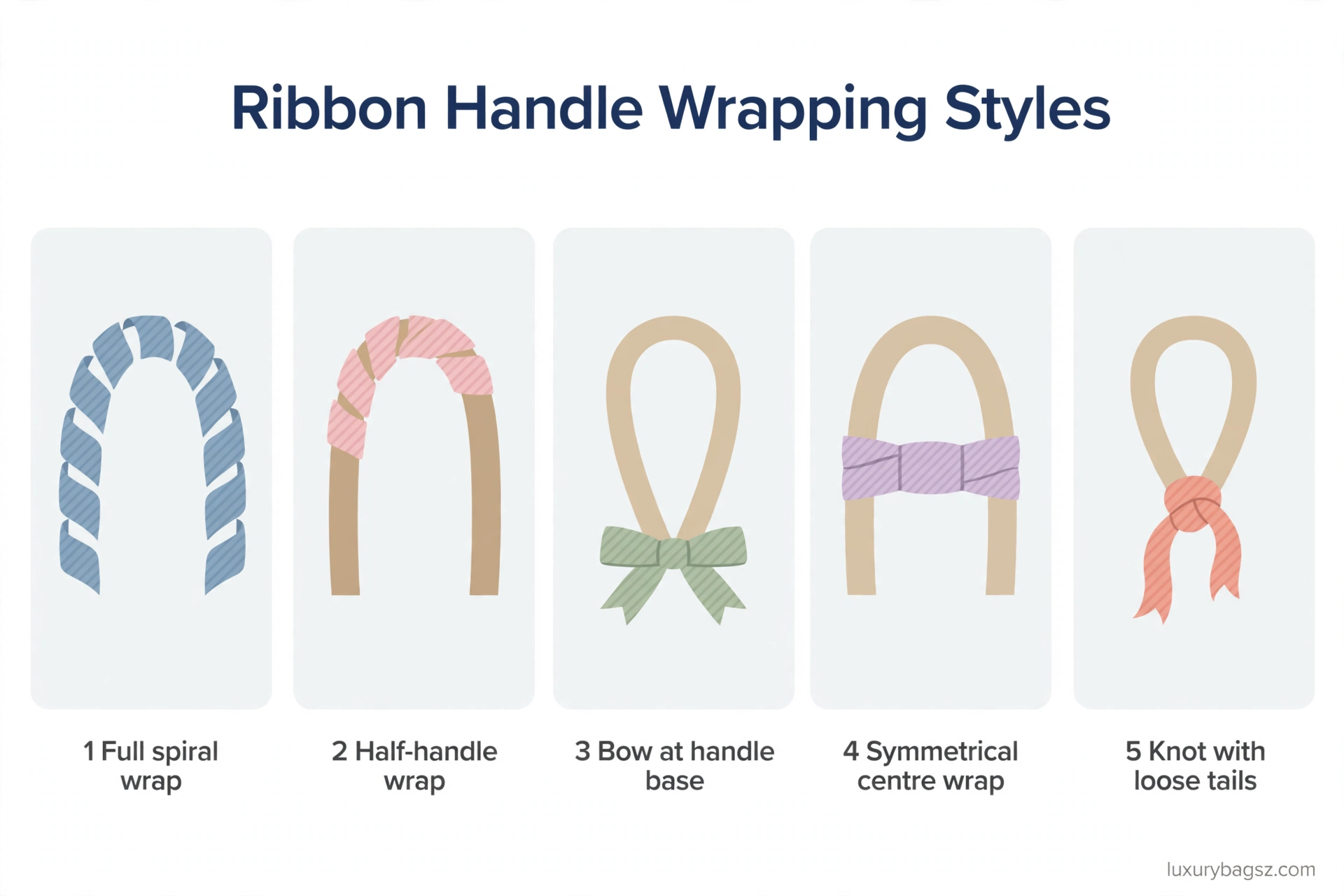
Every twilly handle style falls into one of two families, and choosing between them first saves most of the frustration later. In the full-wrap family, the silk covers the handle from base to base, or at least across the grip area, and the twilly pattern becomes the look of the handle.
In the accent family, the silk is tied once at the handle base, or at the top of a strap, and the handle stays visible, with the twilly acting as a bow, a knot, or a pair of loose tails. Neither family is better in the abstract; they solve different problems.
Choose a full wrap when your main aim is to put a layer between your hand and the leather, when you want to change the handle colour completely, or when the handle is light and you use hand cream often. A neat spiral also suits a formal look, because it reads as deliberate and finished.
Choose an accent when you want the bag itself to stay the star, when the handle is a feature you like, or when you are in a hurry. An accent takes under a minute, uses less silk, and comes off in seconds when you change your mind.
The middle ground is the half-handle and grip-only wrap described in the half-handle section, which covers exactly the area your hand touches and leaves the rest bare.
That compromise suits long tote handles, where a full wrap would eat a whole twilly and still run short, and a bag carried on the shoulder, where only the middle of the handle meets your hand or clothing. The styles infographic after this part maps all five styles at a glance, so you can point to the one you want before you pick up the silk.
The Full Spiral Wrap, Step by Step
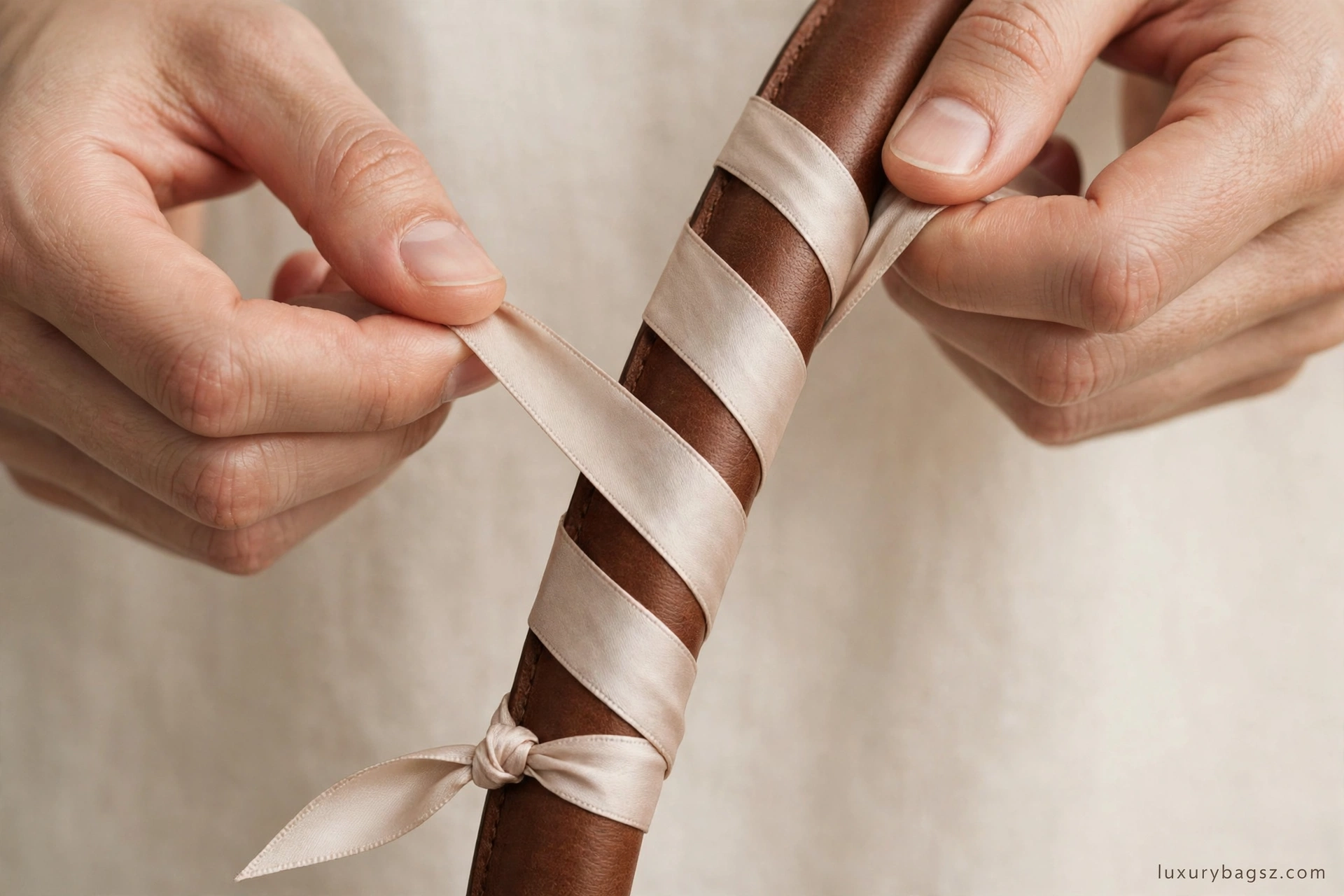
The full spiral is the signature twilly handle style, and it rewards patience more than dexterity. Work at a table with the bag lying on its side, so the handle stays still and both of your hands are free. Do not try to wrap a handle while the bag is hanging from your arm; the handle swings, the tension goes uneven, and the spiral bunches at the curve.
- Lay the twilly flat and smooth it gently, working from the middle outwards, so no fold from storage sits in the middle of your wrap.
- Hold one end against the base of the handle, on the underside, where the handle meets the bag body. This least visible spot is where the starting knot belongs.
- Tie a small, flat knot around the handle base with that end, pulling it snug but not tight, so it grips without denting the leather or crushing the silk.
- Wrap diagonally towards the far base, angling each turn to overlap the previous turn by about a third of the twilly width. That overlap keeps the spiral from gaping open when you pick the bag up.
- Keep the tension even and moderate: firm enough that the silk does not slide, loose enough that it still lies flat. If the silk looks shiny or narrow, you are pulling too hard; unwind two turns and redo them more gently.
- At the top curve, slow down. The curve is where wraps bunch, because its inside needs less silk than its outside. Take slightly smaller, closer turns over the curve, smoothing each with a finger before moving on.
- At the far base, tie a second small knot on the underside, mirroring the first. Tuck both tails underneath the last two turns, so no loose end sticks out.
- Stand the bag up and look at the handle from the front, the back, and the top. Ease any slipped or gapped turn back into place with a fingertip, rather than pulling the whole wrap tight.
Check at the end by running a finger lightly along the wrapped handle: it should feel like a smooth, even twist, with no ridge standing proud and no bare leather peeking through. If leather shows between turns, the overlap was too small; if the handle feels stiff or the silk looks strained, the tension was too high. The wider guide to tying a silk scarf covers the same spiral, and the same rule applies there: snug beats tight, every time.

The Symmetrical Centre Wrap
The symmetrical centre wrap solves the most common complaint about the full spiral: uneven ends. When you start at one base and wrap towards the other, the finishing knot often lands with too much silk left over, or too little, and the two knots look different.
The centre method avoids that by starting in the middle and working outwards in both directions, so each side uses half the twilly and the ends match.
- Fold the twilly in half lengthwise, matching the two ends, and mark the fold with a light finger press. That fold is the middle of your strip.
- Hold the middle against the top centre of the handle, on the underside, so the fold sits where your hand rests most.
- Wrap one half diagonally down one side, with the same slight overlap as the full spiral wrap, and tie a small knot at that base, tucked underneath.
- Return to the middle and wrap the other half down the other side, mirroring the angle and overlap of the first side as closely as you can.
- Tie the second base knot, tuck both tails underneath, and compare the two sides. Because each side used half the strip, the knots should sit at matching heights and the tails should be similar lengths.
- If one side still looks tighter or looser, adjust only that side: unwind it to the middle, redo it, and leave the good side alone.
This method also helps when you are in a hurry, because a mistake on one side costs only half the wrap, and it suits a bag you rewrap often. The trade-off is a small fold where the two halves meet at the top centre of the handle. On most handles that spot sits under your hand anyway, but if you want a perfectly smooth top, the one-direction spiral in the full spiral wrap section is the better choice.
The Half-Handle and Grip-Only Wrap
Not every handle needs, or can take, a full wrap. A long tote handle may be longer than one twilly can cover, a shoulder handle may only meet your hand across its middle, and a handle with decorative hardware near the bases may look better with the hardware left visible. The half-handle and grip-only wraps cover the part that matters and leave the rest alone.
For a half-handle wrap, start at one base exactly as in the full spiral wrap, wrap diagonally to the middle, and finish with a knot at the middle, on the underside. That middle knot needs to be more secure than a base knot, because it has no bag body behind it, so tie it twice and tuck the tail underneath the last turn.
The result covers the side you grip when carrying by hand, and leaves the other half bare, which looks deliberate when the bare half is clean and in good condition.
For a grip-only wrap on a tote, find the middle third of the handle, the area your fingers actually close around, and centre the twilly there using the method in the centre wrap section, wrapping outwards a short way in each direction. Tie off both ends with small knots tucked underneath.
This uses less silk, leaves the bases and hardware visible, and cushions the grip area where it counts. It is also the easiest wrap to redo, and the wrap to choose on a first attempt with a new bag, before you commit a whole twilly to a full spiral.
One caution applies to both versions: a half wrap creates an edge where silk meets bare leather, and that edge collects hand cream and dirt faster than either surface alone.
Check the edge when you retie, wipe the bare leather next to it with a dry soft cloth, and do not let the edge sit in exactly the same place for months. Moving the wrap a turn or two at each retie spreads the wear and keeps the line from becoming a permanent mark.
The Bow at the Handle Base
The bow is the fastest twilly handle style, the most decorative, and the one that most often goes wrong, because a twilly is short. A bow needs enough free silk for two loops and two tails, and a standard twilly only just provides it, so the technique is about saving length, not spending it.
- Fold the twilly in half to find the middle, then hold the middle against the handle base, on the front face, where the bow will sit.
- Pass both ends around the back of the handle and bring them forward again, crossing them once in front. This single crossing anchors the bow without using up length in extra wraps.
- Form a loop with one end, holding it where you want the bow to sit, roughly the size of your thumb.
- Wrap the other end around the centre of that loop, then pull a second loop through behind the wrap, the way you tie a shoelace bow.
- Pull both loops gently until they are roughly the same size, and pull the centre wrap snug, not tight. A tight centre crushes the silk and makes the bow look pinched.
- Fan the loops open with your fingertips, adjust the two tails so one hangs slightly longer than the other, and turn the whole bow a little to the side so it faces forward rather than sitting flat against the bag.
If the bow keeps collapsing, the loops are almost always too long and heavy for the silk to hold upright. Shorten the loops, keep the tails shorter too, and try again. If the bow will not form at all because the ends run out, you have spent too much length on the anchor: use a single crossing, not a full wrap, at the handle base, and start with the twilly centred, not with one end much longer than the other.
A bow suits a single handle base, a tote handle base, or the point where a strap meets the bag body, and it suits a bag you carry often, because there is no long wrap to redo each time you pick the bag up.
The Knot With Loose Tails
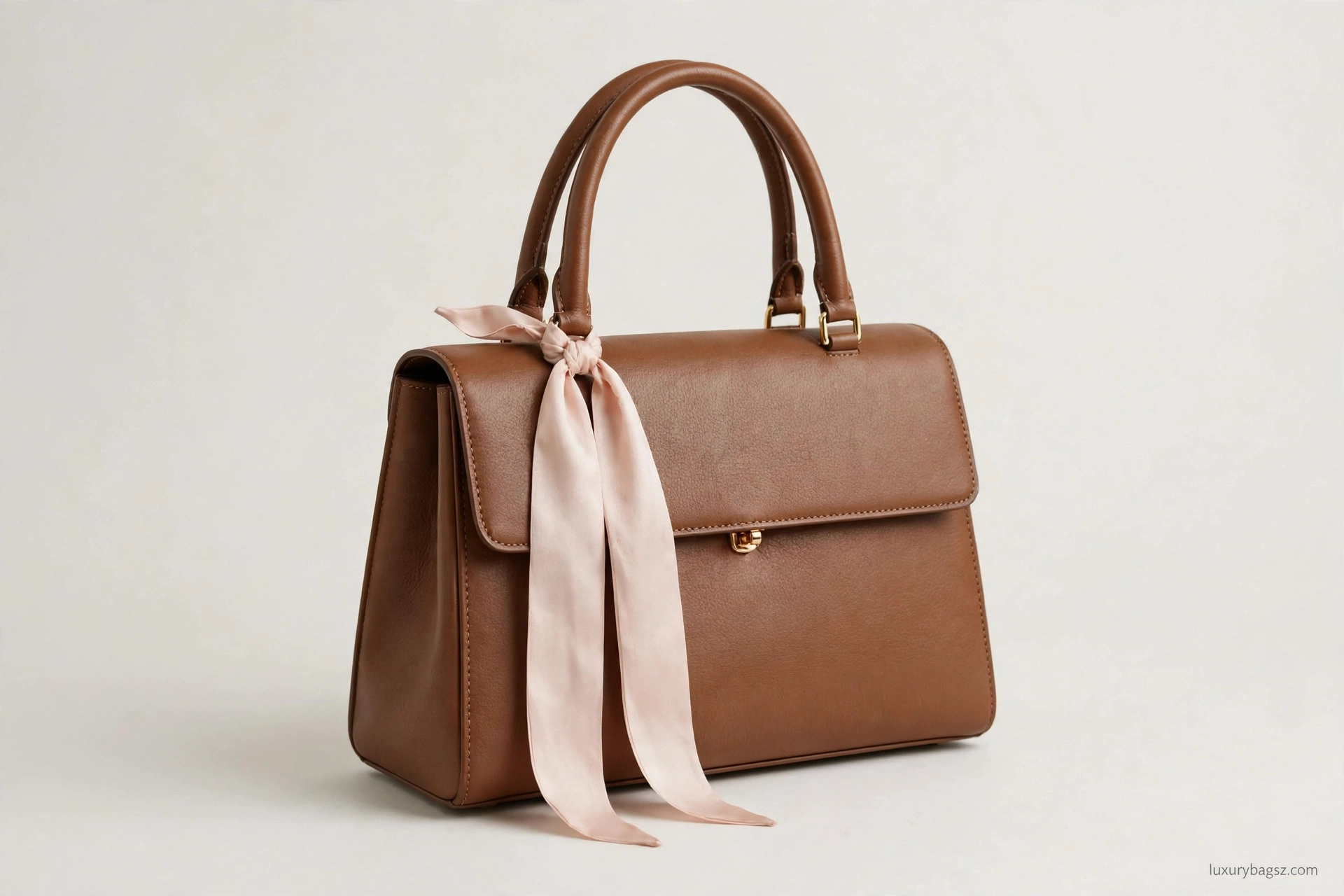
The knot with loose tails is the simplest accent of all, and the most forgiving, because it does not need symmetry or even tension. Knot the twilly once around the handle base, or around the top of a strap, and let the two ends hang free. The tails move as you walk, catch the light, and show the pattern in a way a tight wrap cannot, which is why this style photographs so well despite taking seconds.
The details still matter. Tie the knot on the front face of the handle base if you want it seen, or on the underside if you want only the tails to show. Keep the tails long enough to move — at least a handspan each — and adjust the look by moving the knot, not by cutting the silk.
Never cut a twilly: the cut edge frays, the hand-rolled finish is lost, and the piece cannot be restored. If the tails are too long, tie the knot a little higher, or loop the twilly twice around the handle before knotting, which shortens both tails evenly.
Watch where the tails fall. Tails that hang over a clasp, a zip, or a lock can catch when you open the bag, and tails that hang near a car seatbelt buckle or a door handle can snag. Before you leave the house, open and close the bag once with the twilly in place, and move the knot a finger-width in either direction if a tail catches anything. That thirty-second check prevents the two most common accidents with this style: a tail yanked mid-stride, and a tail trapped in a zip that pulls the knot hard against the handle.
Matching the Style to the Handle and the Bag
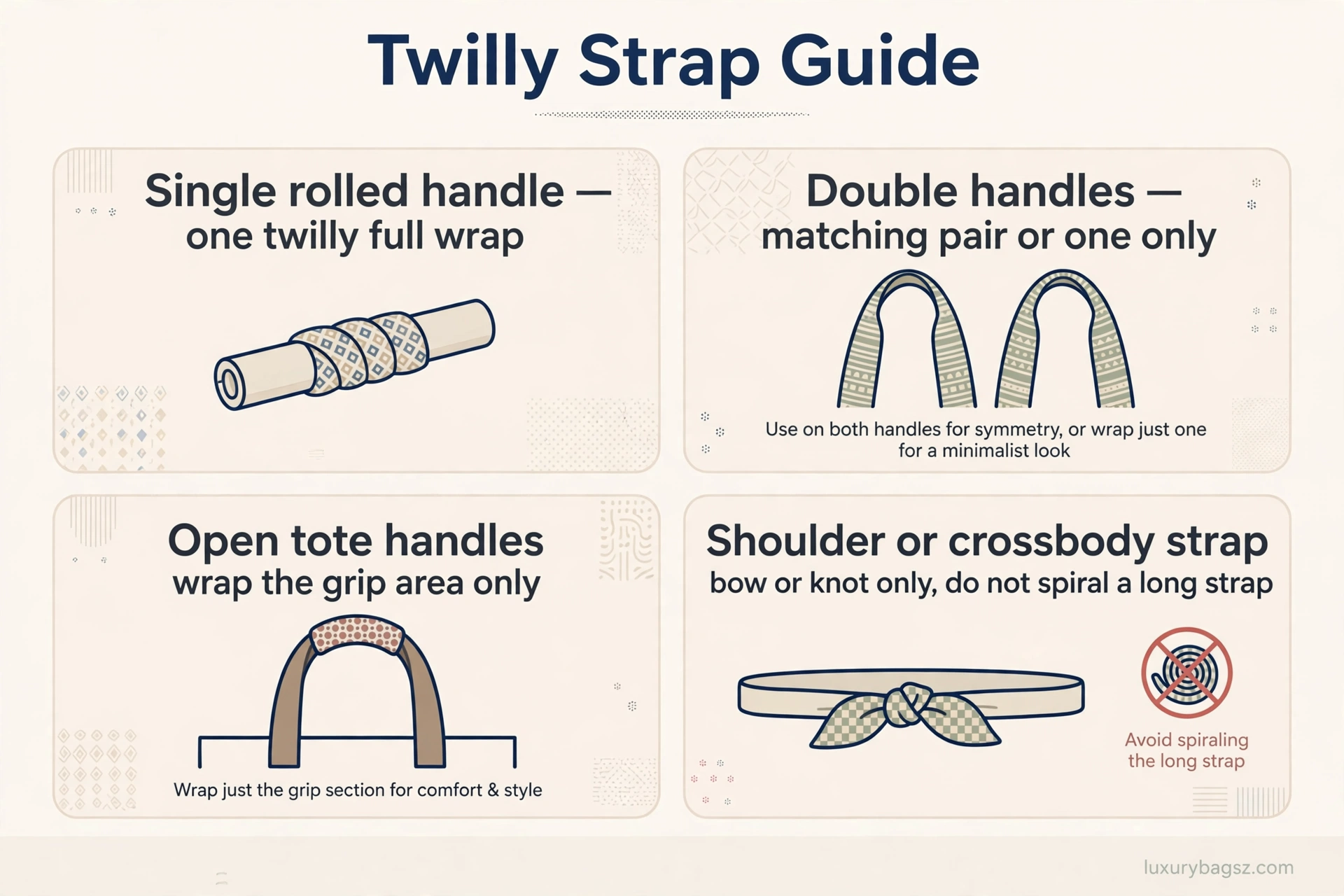
Handle shape decides the style more than fashion does. A single rolled top handle, the classic structured shape, takes any style in this guide, and the full spiral is its natural partner, because the round profile gives the silk an even surface to grip. A flat handle, common on totes and everyday bags, also takes a spiral well, but the silk can slide on the flat faces if the tension is too loose, so keep the overlap generous and check the wrap after the first hour of carrying.
A bag with two handles needs a decision before you start. A matching pair of twillies, one on each handle, gives symmetry and is the safest choice for a formal look. A single twilly on one handle only gives a deliberately asymmetric look that suits a casual tote, but it only works when the single wrap is neat and clearly intentional; a half-finished single wrap on a two-handle bag reads as forgotten, not fashionable.
If you own only one twilly and a two-handle bag, the bow or knot accent on one handle is a better use of it than a single full wrap, because an accent is understood as decoration, while a lone wrap invites the eye to look for its missing partner.
Tote handles deserve their own note. An open tote, such as a canvas Herbag, often has long, flat handles carried on the shoulder as well as in the hand, and a full spiral would use more than one twilly and add bulk at the shoulder. The grip-only wrap from the half-handle section is the practical answer, and the same care that goes into carrying a tote without sagging applies here: keep the added bulk low, keep the handles even, and do not let a wrap change how the tote hangs. A structured top-handle bag such as a Constance bag suits a full spiral or a bow at the base, because the short handle shows the whole style at once.
Shoulder and crossbody straps are a different case. Do not spiral a long strap: you would need several twillies, the wrap would bunch at the shoulder, and the added thickness changes how the strap sits. Use a bow or a knot where the strap meets the bag body, and leave the strap itself bare.
The same applies to an Evelyne bag strap or any adjustable crossbody strap, where choosing the right crossbody bag size matters more to comfort than any wrap. Chain straps are the exception to avoid: silk snags on chain links and will catch, pull, and fray. On a bare chain, leave the twilly off; a small knot on a smooth leather shoulder pad is possible.
The bags that suit a twilly least are worth naming, because guides rarely do. A very small mini bag can be overwhelmed by even a narrow strip. A handle crowded with hardware, studs, or a lock at the base leaves no clean spot for a knot.
A very soft, unstructured handle that twists as you carry it will twist the wrap with it. And a bag carried daily in rain, or against a rough coat, will wear a silk wrap fast. In each case, wear the twilly at the neck or wrist instead, and let the bag go bare.
Colour and Pattern: Making a Narrow Strip Work Hard
A twilly is only 5 cm wide, so colour and pattern behave differently on a handle than on a square scarf. A large, bold print becomes a series of small fragments when wrapped, because each turn shows only a short length of strip.
Small, repeated motifs, fine stripes, and small-scale patterns read best in a wrap. A large motif works best as a bow or a knot with tails, where longer lengths hang free and the motif can show whole.
Colour choice follows a simple rule: match one colour, not every colour. Pick one colour from the twilly and match it to one thing you are wearing, such as shoes or a belt, and let the rest of the outfit stay neutral.
Two approaches both work: tone-on-tone, where the twilly sits close to the bag colour and adds texture, and deliberate contrast, where a bright twilly on a neutral bag becomes the focal point. What rarely works is a muddy middle, a twilly only slightly different from the bag, which reads as a mismatch rather than a choice.
Light and dark bags need opposite thinking. On a dark bag, a light or bright twilly lifts the whole bag and shows from a distance. On a light bag, a dark twilly gives definition and hides hand marks better than a pale one, but it carries the dye-transfer risk covered in the dye transfer section, so test it first. A pale twilly on a pale bag can look exquisite in person and nearly invisible in photographs.
How Many Twillies, and Should a Pair Match
The count question has a short answer and a longer one. The short answer: one twilly per handle for a full wrap, one twilly for a bow or knot accent, and a pair for a two-handle bag worn symmetrically. The longer answer is about what a pair should be.
A matching pair — two twillies in the same design and colourway — gives the most formal, balanced result, and it is the choice for a structured bag worn to an occasion where symmetry reads as polish.
A contrasting pair — two twillies in related colours, or the same design in different colourways — gives a more playful result, and it suits a casual tote or a bag you carry every day, where a little asymmetry feels personal rather than sloppy.
There is also the question of whether a pair must be identical in length. In practice, two twillies in the same design can still differ by a centimetre or two, because silk is cut and finished by hand, and that small difference shows up as one wrap finishing a turn higher than the other.
The centre-wrap method described earlier helps here, because it lets you compare the two sides as you go, and a half-turn difference at the base knot is invisible to anyone but you. Do not chase perfect identical wraps; chase wraps that look even at a normal viewing distance, and accept that hand-wrapped silk will never be machine-perfect.
For a single-handle bag, a second twilly is not wasted: it covers cleaning days, and two twillies knotted together, join hidden at the base underside, can reach a longer handle. Treat a join as a practical fix, not a display finish, and prefer a maxi-twilly or a half wrap when you have the choice.
Dye Transfer, in Both Directions
Dye transfer is the most misunderstood part of wearing a twilly on a bag handle, because it moves in both directions, and most guides only mention one. The first direction is from the twilly to the bag: a dark or strongly dyed silk, especially when damp from rain or hand moisture, can leave colour on light leather.
The second direction is from the bag, or from your clothing, to the twilly: dark leather, new dark denim, and untreated or heavily dyed handles can mark light silk, and hand cream and lotion can carry dye and dirt onto the silk at the grip area. A wrap reduces direct hand contact, which helps with oils and lotion, but it does not seal the leather, and it does not make either surface dye-proof.
Testing a new pairing is simple and worth the minute it takes. Before a long day out, wrap the twilly, carry the bag indoors for an hour, then unwrap and check both surfaces in good light: the underside of the leather where the silk sat, and the underside of the silk where it touched the leather.
Look for any tint, darkened patch, or sticky feeling that suggests moisture. If either surface shows a mark, change the pairing and retest. Pay special attention after rain, after applying hand cream, and with new dark jeans, because moisture and fresh dye move colour fastest. For canvas totes, the gentle routine for cleaning a canvas bag is the right starting point if a canvas handle picks up a mark.
Two claims in this area need plain handling. First, no wrap guarantees protection: a wrap that is loose, damp, or left in place for months without checking can trap moisture and hide a developing mark, which is worse than no wrap at all.
Second, claims that protected handles sell for a fixed percentage more — figures such as 15 to 25 percent appear on seller blogs — are marketing claims, not verified market data. A single listing, or a single seller blog, is never a market average, and this guide does not repeat those figures as fact. What a wrap genuinely does is keep a handle looking cleaner for longer when it is checked, retied, and removed for storage.
Removing, Retying, and When to Leave the Handle Bare
Removing a twilly well matters as much as wrapping it well, because most silk damage happens at removal. Untie each knot gently, working the silk free with your fingers rather than pulling the ends apart, which tightens the knot further and sets a crease where it gripped.
If a knot has tightened during the day, ease it open from the inside with a fingertip, rather than yanking the tail. Then unwind turn by turn and smooth the silk flat before you put it away.
How often to retie depends on how often you carry the bag. Check a daily bag each evening, retie weekly with a full unwind, and inspect the bare handle monthly for darkening, dye marks, stitching wear, and any change where the wrap edge sat. That check is the real protection a twilly offers, because it forces you to look at the handle regularly, rather than hiding it under silk for a season.
For long storage, take the twilly off. A bag stored for weeks or months with a tight wrap can develop a permanent crease line in the silk where it bent around the handle, and a matching pressure line on the leather underneath.
Store the bag with its handles in their natural position, following the same gentle habit described for storing a Kelly bag, and store the twilly rolled loosely on its own, away from the bag, so the silk does not snag on hardware in a dust bag. Once the silk is off, wipe the bare handle with a clean, dry, soft cloth — the same gentle habit described for cleaning Chanel bags — and let the bag air briefly before it goes back into storage.
There are also days to leave the handle bare on purpose: heavy rain, because wet silk and wet leather together move dye faster than either alone; a handle already damp, sticky, or freshly conditioned, because wrapping over it traps moisture; and hours against a rough coat or a new dark garment, because friction plus fresh dye is the worst combination for both surfaces.
A twilly is at its best as a rotating accessory, worn for days and rested for days, not as a permanent fixture that never comes off.
Silk Care: Washing, Drying, and Storage
Silk twill is strong for its weight, but it dislikes exactly the treatments that feel most efficient: hot water, harsh detergent, wringing, and tumble drying. The safest rule is to follow the care label on your own twilly, and when the label is missing or unclear, to choose professional cleaning over home washing. Many silk scarves are labelled for professional cleaning only, and a valuable or intricately finished twilly is worth that expense rather than a home experiment.
If the label allows hand washing, the method is gentle throughout. Fill a clean basin with cool or lukewarm water, never hot, add a small amount of mild detergent made for delicates or silk, and dissolve it fully before the silk goes in. Submerge the twilly, swirl lightly for two to three minutes, and do not rub, scrub, or twist it.
Rinse in fresh cool water until no suds remain, supporting the silk so it does not stretch under its own wet weight. Lay it flat on a clean towel, roll the towel to blot out moisture, then lay the twilly flat away from direct sunlight and heat. Do not hang wet silk by one corner, which stretches the weave unevenly, and do not iron it while damp at high heat; low steam from a distance, or a cool press through a thin cotton cloth, is safer for relaxing creases.
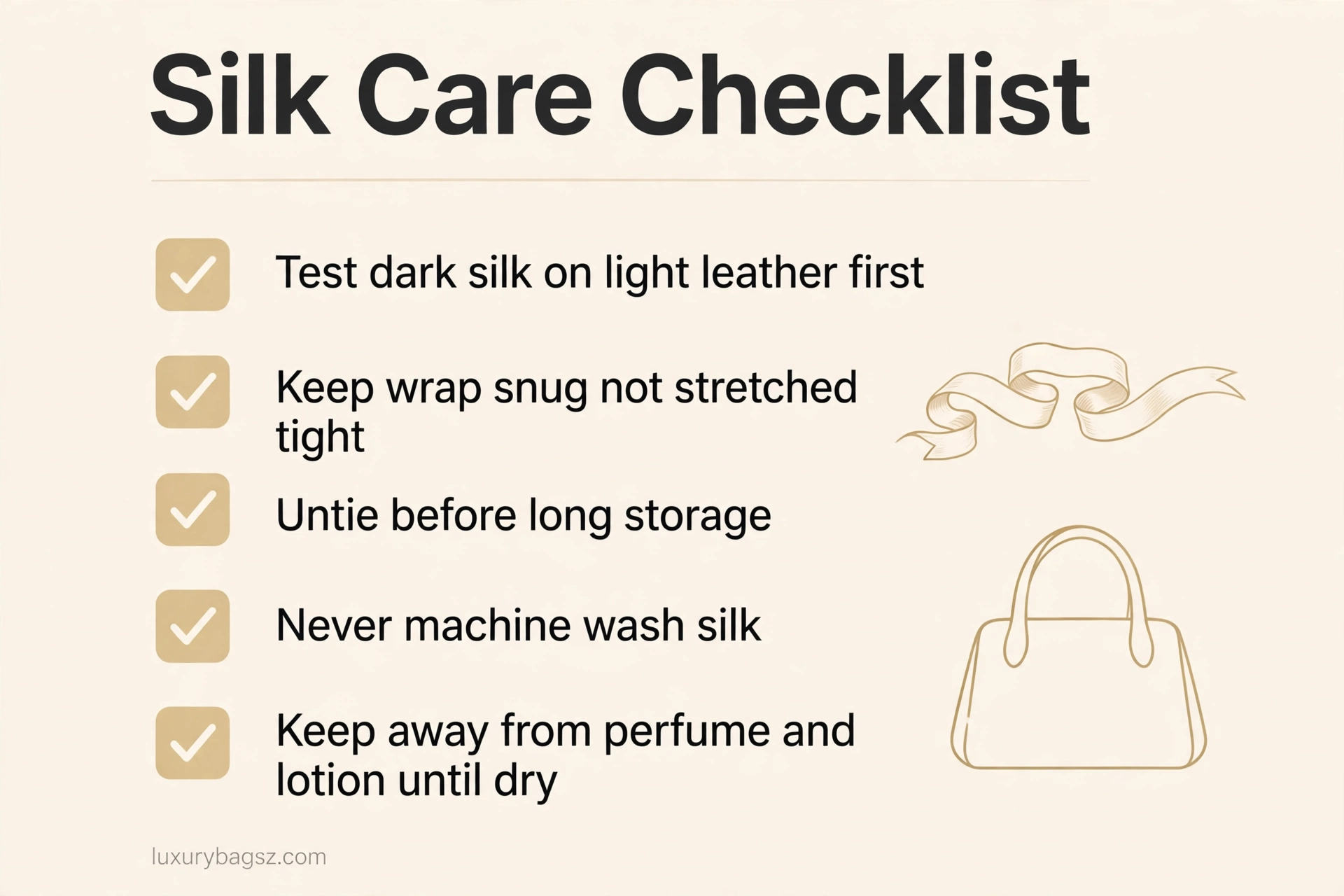
Between washes, silk needs little. Air the twilly flat for an hour after a long day of wear, keep perfume, lotion, and makeup away from it until dry on your skin, and store it rolled loosely, not folded tight and not left knotted, in a drawer or soft pouch away from direct sunlight, which fades dyes, and away from sharp objects such as buckles and keys. Varying the roll stops any single crease from becoming permanent.
Troubleshooting: Slipping, Uneven Ends, and Bunching
Most twilly problems have a small, specific fix, and trying the fix beats rewrapping from scratch in frustration. Work through the problem, not against it.
The wrap slips during the day. The usual causes are tension that was too loose, a smooth handle that gives the silk little grip, or a twilly that stretched slightly as it warmed in your hand. Fix it by rewrapping with a slightly wider overlap and a firmer — not tighter — hand, and by double-knotting the finishing knot. A light pre-stretch helps some people: pull the twilly gently along its length before wrapping, with even pressure, to take out slack that would otherwise appear during wear. Pull gently, because hard pulling thins and distorts silk. If the wrap still slips on a very smooth handle, a bow or knot accent may suit that bag better than a spiral.
The ends come out uneven. The centre method described earlier is the fix. If you prefer the one-direction spiral, measure halfway along the twilly before you start, and aim to reach the top curve at that halfway point. If you reach the curve early, your turns are too wide apart; if you reach it late, they are too close. Adjusting at the curve leaves room to correct.
The wrap bunches at the curve. The top curve of a handle needs less silk on the inside than the outside, so wide turns bunch there. Take smaller, closer turns over the curve, smooth each turn before the next, and let the silk lie flat rather than twisting it into a cord. If bunching persists, the twilly may be too wide for that handle curve, and a narrower strip, or a half wrap that stops before the curve, will look neater.
The bow flops. Shorten the loops. A bow with long, heavy loops cannot stand upright in silk twill, and the fix is almost always smaller loops and shorter tails, not a tighter centre knot. A tighter centre crushes the silk and makes the flop worse.
The knot at the base looks bulky. The finishing knot is bulky because too much silk arrived at the base at once. Fold the last length of twilly into a narrower strip before knotting, tie the knot flat against the handle, and tuck the tail underneath the last two turns. If the bulk is at the starting knot, the same fold-and-tuck works there too.
The twilly is too short for the handle. Do not stretch it. Choose a half-handle or grip-only wrap, join two twillies with the join hidden at the base, or use a maxi-twilly folded into a band. Stretching a short twilly thin damages the silk itself, and a stretched wrap looks shiny and strained even when it technically reaches.
What Guides Disagree On
Guides to twillies disagree more than their confident tone suggests, and knowing where they disagree stops you from thinking you have done something wrong when you have simply met a different version of the story.
When the twilly first appeared. One widely cited guide dates the twilly to the early 2000s, with customers, not the maker, first putting it on bag handles. Another dates it to the late 1930s, a claim that seems to conflate the twilly with the longer history of silk scarves in general.
This guide does not resolve that disagreement with a single year, because the wearing technique does not depend on it. What is consistent is that the bag-handle use began with customers improvising.
The exact length. Most sources list about 5 cm by 86 cm, but others give 85 cm, 31 inches, or 32 inches, and fringed or special editions differ further. Those differences are small, but they matter when a wrap runs a turn short, which is why this guide tells you to measure your own strip rather than trusting a single published figure.
How tight to wrap. Some guides say to wrap tightly for maximum protection, while others warn that tight wrapping strains silk and dents soft leather. This guide sides with the second view: snug, with a slight overlap, holds a wrap without stretching the silk or marking the handle, and a slipping wrap is fixed with overlap and a double knot, not more force.
Whether a wrap protects or only decorates. Seller blogs tend to present protection as guaranteed and attach resale figures to it. Collector forums are more sceptical, with some owners arguing that a bag needs no decoration, and others reporting that their twillies picked up exactly the hand-cream marks that would otherwise have reached the handle.
Both can be true: a wrap puts silk between hand and handle, and it does not make a handle invulnerable. Treat protection as a benefit that depends on checking, retying, and removing the wrap, not as a property of the silk alone.
What to call each style. The symmetrical centre wrap, the half-handle wrap, and the grip-only wrap go by several names across guides, and some guides use “classic wrap” for both a full spiral and a bow. This guide names each style by what it does and describes the steps each time, so a difference in naming does not become a difference in technique.
A First-Week Practice Plan
Do not try to learn five styles in one evening. Learn one, wear it, and add the next when the first feels automatic.
Day one: the full spiral on a single handle, at a table, following the full spiral wrap section. Check the overlap at the curve, carry the bag around the house for an hour to see if anything slips, and rewrap once, using what the first attempt taught you about tension.
Day two: the symmetrical centre wrap from the centre wrap section on the same bag. Compare the two sides, and notice how much easier even ends become when you start from the middle.
Day three: the bow at the handle base from the bow section. Practise saving length at the anchor, and keep the loops small until the bow stands up on its own.
Later in the week: the half-handle wrap on a tote, and the knot with loose tails on a second bag. By the end of the week you will know which style suits which bag in your collection, and you will be rewrapping in minutes.
Practise with the twilly and bag you actually plan to carry, and practise removing the twilly as part of each session, because gentle removal keeps the silk in good condition.
Frequently Asked Questions
Can one twilly wrap a whole handle, and should I wrap one handle or both?
Usually yes, for a standard rolled top handle: about 5 cm by 86 cm covers most single handles with a little left for the finishing knot. Long tote handles, very thick handles, and double handles are the exceptions, covered in parts 8 and 13.
Either, but deliberately. A matching pair gives symmetry, while a single accent on one handle reads as decoration. What looks unfinished is a single full wrap with no partner and no clear reason, so if you own only one twilly, choose a bow or knot accent on one handle rather than a lone full wrap.
Will a twilly stop my light handle from darkening, and can a dark twilly stain a light bag?
It helps, by putting silk between your hand and the leather, but it does not guarantee it: hand cream, moisture, and dye can still reach the handle, especially if the wrap is loose or left in place for months. Check the handle when you retie, and treat the wrap as one part of handle care, not a substitute for it.
Yes, it can, especially when damp. Test a new dark-on-light pairing indoors for an hour, check both surfaces in good light, and avoid the pairing in rain or with damp hands. If a mark appears, change the pairing and have the silk professionally cleaned if needed.
How do I stop a wrap from slipping?
Use a slightly wider overlap, even moderate tension, and a double-knotted finishing knot. On a very smooth handle, the centre-wrap method and a short gentle pre-stretch can help. Do not solve slipping by pulling the silk tighter, which strains silk and can mark soft leather.
Can I wrap a crossbody or shoulder strap?
Do not spiral a long strap. Tie a bow or a knot where the strap meets the bag body, and leave the strap itself bare. Chain straps should be left alone entirely, because silk snags on chain links.
How often should I retie a twilly, and can I machine wash one?
Check a daily bag each evening, retie weekly with a full unwind, and inspect the bare handle monthly. For long storage, remove the twilly entirely and store it rolled loosely on its own.
No. Follow the care label, and choose professional cleaning when the label says so or when you are unsure. If hand washing is allowed, use cool water, a mild silk detergent, no rubbing or wringing, and dry flat away from sunlight and heat.
Is a twilly only for one brand of bag?
No. These techniques work on any bag with a handle or strap that gives the silk a clean place to knot, and a generic narrow silk ribbon wraps the same way.
What if my twilly is too short for my handle?
Use a half-handle or grip-only wrap, join two twillies with the join hidden at the base, or fold a maxi-twilly into a band. Never stretch a short twilly thin to make it reach.
Final Verdict
A twilly on a bag handle is a small skill with a disproportionate return. One narrow strip of silk, learned properly, can protect a light handle from daily hand contact, change the colour of a familiar bag in a minute, and give a plain tote a finished look without any new purchase.
The skill itself is not complicated: start at the base, wrap diagonally with a slight overlap, keep the silk snug but never stretched, finish with a knot tucked underneath, and untie gently when you are done.
The rest — the symmetrical centre start, the half-handle compromise, the bow that saves length, the dye test before a long day out — is refinement, and it comes with a week of practice.
Start with the full spiral on the bag you carry most, practise removing it as carefully as you wrap it, and let the handle, not a photograph, choose the style. A wrap that slips, bunches, or overwhelms a small bag is telling you something useful about that pairing, and the honest fix is often a different style, a different bag, or a bare handle for the day.
Worn that way — checked, retied, and rested — a twilly earns its place as the easiest way to make a bag you already own feel new again.






