

How to Use a Hermès Scarf Ring

A Scarf Ring in Brief
A scarf ring is a small loop of metal, horn, wood or resin that holds a silk scarf in place without a knot. You fold the scarf, thread its ends through the ring, slide the ring to where you want it, and let friction do the rest. That is the whole idea, and it is why a ring suits people who love silk but dislike bulky knots, crease lines across a knot, or a knot that works loose by lunchtime.
A plain round ring with one interior opening is the easiest place to start: thread both ends of a bias-folded 90 cm carré through it, slide it up towards the neck or down towards the chest, and adjust the ends until they hang evenly. A slide, which is a frame divided by a straight centre bar into two openings, works differently: one end goes one way and the other end goes the other way, so the fabric crosses inside the frame and grips more firmly. A smaller twilly ring does the same job for a narrow strip. Once it is on, the styling options — hair, wrist, neck and bag — are covered in how to wear a Hermès Twilly.
A ring will not fix every problem. It will not make a thick folded shawl fit through a small opening, it will not hold if the opening is far larger than the fold, and a rough or damaged edge can snag silk faster than a knot ever would. Check the ring with your fingertips before it touches silk, match the opening to the fold rather than to a size label, and practise the basic thread-through in front of a mirror before you wear it out.
If a current retail price for a genuine house ring is what you are looking for, this guide does not give you one: no source checked for this guide states a verified current retail price, and the single resale listings quoted in the buying genuine vs generic section are individual listings, not market averages.
Introduction
Most guides to scarf rings make the same mistake. They show a finished look, they say “thread it through the ring”, and they stop there, as if threading were one obvious movement.
It is not. There are at least three different ring shapes in common use, each threaded differently; a 90 cm carré, a 70 cm square, a twilly and a 140 cm shawl each behave differently in a ring; and the difference between a ring that holds all day and a ring that slides open in ten minutes is usually a small choice made before threading begins —
How wide the fold is, which way the ends pass through, and whether the fabric is pulled into a loop or left flat. This guide works through all of that, step by step, in front-of-a-mirror language.
The focus is the classic Hermès silk formats, because that is where the ring tradition is strongest and where readers ask the most questions: the 90 cm carré in silk twill, the 70 cm square, the narrow twilly, and the large 140 cm shawl. The methods work on any good silk square, though, so if your scarf is from another maker or a vintage find, everything here still applies.
Where guides disagree — about what counts as a ring and what counts as a slide, about the names of the house designs, about sizes, and about whether a ring truly protects silk — this guide says so plainly, in the disagreements section, rather than picking one version and hiding the others. A ring is a tool, not a magic fix, and knowing its limits is what makes it useful.
What a Scarf Ring Is — and What It Is Not
A scarf ring is a small, rigid loop made to be threaded with fabric. It is sometimes called an anneau, from the French word for ring, and sometimes called a scarf slide, though as the three shapes section explains, those two words do not always mean the same thing.
The ring itself does no tying: it gathers, holds and displays fabric, and it replaces a knot or sits over one. Think of it as a buckle without prongs, or a curtain ring for silk. It is worn at the neck, at the chest, at the shoulder or at the waist, wherever the gathered fabric needs to stop moving.
It is not a finger ring, and that confusion causes more failed purchases than any other. House jewellery rings made for the finger — including anchor-chain designs — are sized for a finger, shaped for a finger, and entirely different objects from scarf rings, even when they share a motif name.
A finger ring will not thread a scarf, and a scarf ring will not fit a finger comfortably. When you search or shop, add the word scarf to every query, and check that the listing shows fabric passing through the object. If it shows only a hand, it is probably not a scarf ring at all.
It is also not a pin, a brooch or a clip. A pin pierces silk, and a pierced hole in silk twill does not close. A clip grips from the outside and can leave pressure marks. A ring holds by friction inside its opening, with no piercing and no teeth, which is the whole point: it is the gentlest of the holding options, provided its inner edge is perfectly smooth. It is not a substitute for a knot in every case, either.
A knot can be tied anywhere on a scarf, in any fabric, with no extra object. A ring needs the right opening for the fold you are using, and if you do not have it, a knot is the better choice that day. Finally, a ring is not a guarantee against slipping. Silk is smooth by nature, and a ring that is too large for the fold will let silk slide just as a loose knot does. The ring changes how friction works; it does not remove the need for it.
The Three Shapes That Matter
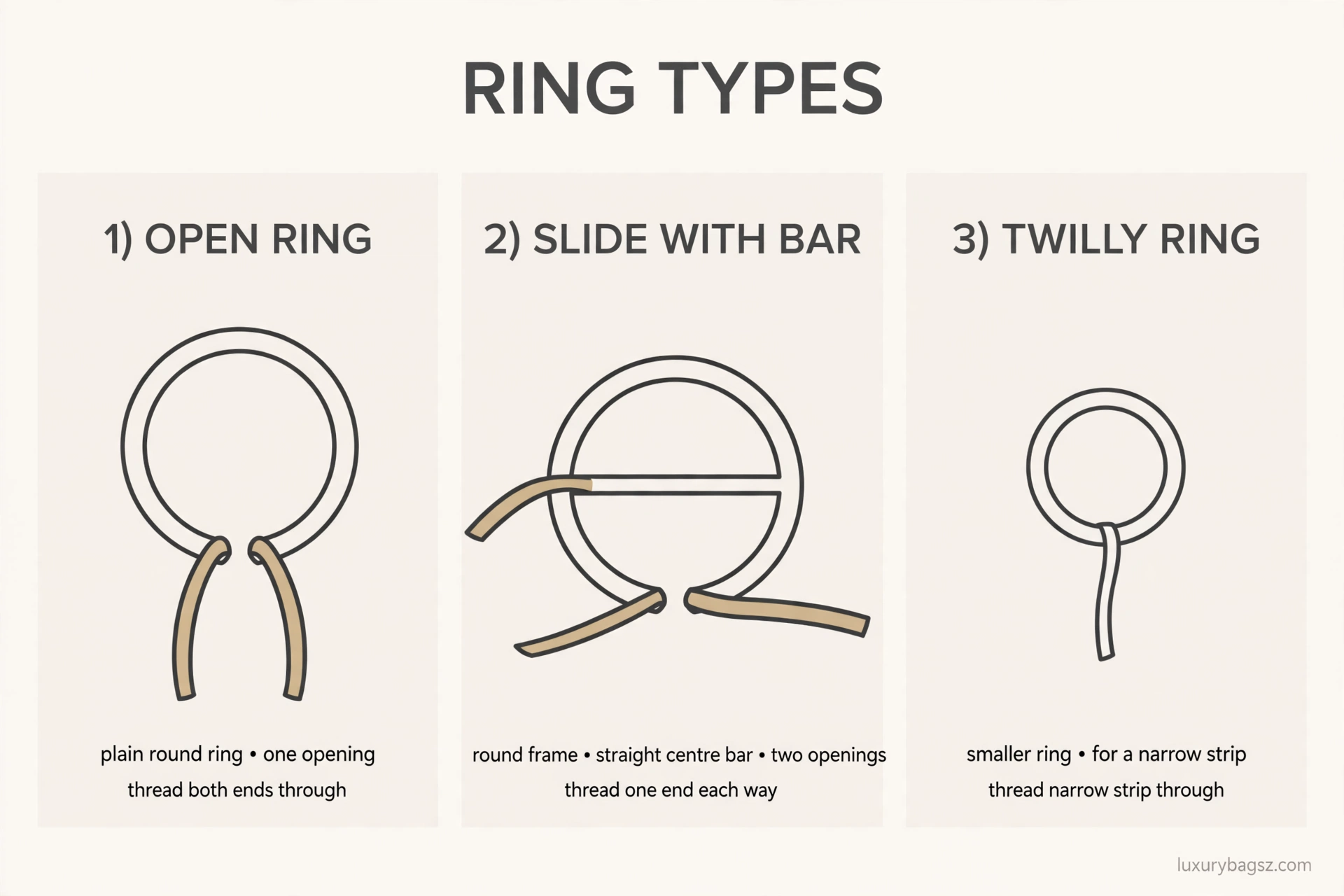
Forget the dozens of decorative variations for a moment. Almost every scarf ring you will meet is one of three shapes, and each one threads differently. Learn the three shapes and you can work out any new ring in under a minute.
The open ring. This is the classic: a plain closed loop, round or sometimes square, with a single interior opening. The word open here describes the opening in the middle, not a gap in the metal — the loop itself is closed. You thread one or both ends of the scarf through that one opening, and the fabric bunches gently inside it.
House examples often cited by wearers include the round Régate design, a simple circular ring reported in gold-plated and palladium-plated finishes. The open ring is the most versatile shape, the easiest to learn, and the best choice for a first ring, because its threading is the most forgiving: if you thread it the wrong way round, you can simply pull the fabric back out and try again, with no second opening to confuse matters.
The slide with a centre bar. This shape looks like a buckle or a small picture frame: an outer frame divided by one straight bar into two openings. One end of the scarf passes through one opening and the other end passes through the other, so the two ends cross at the bar and grip each other.
The hold is firmer than a plain ring, which is why slides suit slippery fabrics and drapes that need to stay put. The trade-off is bulk: each opening is smaller than the single opening of an open ring, so a thick fold that sails through an open ring may not fit through a slide at all.
House examples often cited include anchor-chain-shaped slides, where the frame echoes a chain link. The threading direction matters more here than with an open ring, and the slide method section gives the steps in full.
The twilly ring. This is not a different mechanism, it is a smaller open ring, scaled down for a narrow strip. Hermès formerly sold small rings for this purpose, according to long-running wearer guides, and similar small rings are widely sold today by other makers.
A twilly ring is decorative as much as functional on a narrow strip: it gathers the strip, marks a point along it, and stops a wrapped handle or a neck accent from unwinding, but it cannot do the heavy holding work of a full-size ring, because there is simply less fabric inside it to create friction.
Using a full-size ring on a twilly is the common beginner error — the strip slides straight through, and the ring drops to the end of the strip or off it entirely.
Beyond these three, you will meet horn rings, wooden rings, resin rings, enamelled rings and magnetic holders. A magnetic holder is not threaded at all: two magnets grip the fabric between them.
It suits people who find threading fiddly, but it holds by magnet strength rather than friction, and it should be kept away from bank cards and away from fine silk that could be pinched or creased between hard faces. Treat every decorative variation as one of the three shapes above, plus decoration, and its threading will be clear.
Before You Thread: Fold First
Every ring method starts with a fold, and the fold decides whether the ring will hold. Threading an unfolded square through a ring is possible, but the fabric bunches unevenly, the ring sits crooked, and the pattern disappears into a wad. Fold first, thread second. That order never changes.
The bias band. This is the workhorse fold for rings, and the one most methods in this guide assume. Lay the square flat, face down, with one corner pointing towards you. Fold the top corner down to the centre and the bottom corner up to the centre, so the two folded edges meet.
Fold each edge to the centre line again, then fold the whole band in half lengthwise. You should have a smooth, flat strip about 5 to 8 cm wide for a 90 cm carré. For a 70 cm square, aim slightly narrower, about 4 to 6 cm, so the shorter scarf still leaves workable ends. The width is a choice, not a rule: a wider band shows more pattern and feels softer at the neck, while a narrower band threads more easily and grips more firmly inside a small ring.
If a ring keeps slipping, narrowing the band by one fold is often a better fix than buying a new ring, because a narrower band can be doubled back through the ring, as the ring knot section explains.
The rolled triangle. Fold the square corner to corner into a triangle, then roll the long folded edge towards the point in two or three even turns. This gives a soft, round tube rather than a flat band, and it suits draped neck styles and the waterfall drape, where a flat band would look stiff.
A rolled tube is thicker than a flat band of the same scarf, so check it against the ring opening before you commit: a tube that fits an open ring may not fit a slide.
The flat drape. For a shawl, do not fold at all at first. Drape the shawl open over your shoulders, gather the fabric where you want the ring to sit, and thread only the gathered bunch through the ring.
Folding a 140 cm shawl into a band first turns it into a thick rope that defeats the drape, which is the shawl’s whole point. The 140 shawl section covers this in full.
A note on learning the folds. If the bias band is new to you, the companion guide to tying a silk scarf walks through the bias fold and the triangle fold with numbered steps and the same sizes used here. The folds are identical whether the scarf ends in a knot or a ring, so learning them once serves both.
The Basic Thread-Through
This is the first ring method to learn, and the one you will use most often. It suits a 90 cm carré in silk twill, a plain open ring, and a wearer who wants a neat neck style in under a minute. Practise it flat on a table first, then at the neck in front of a mirror.
- Make a bias band from the carré, as in the fold-first section, about 5 to 8 cm wide.
- Hold the ring in one hand and the band in the other. Push both ends of the band through the ring from the same side, so the ring sits somewhere along the middle of the band, with two ends hanging free on the other side of the ring.
- Drape the band around the back of your neck, with the ring in front of your chest and the two ends hanging down from it.
- Slide the ring up towards your neck or down towards your chest until it sits where you want it. Higher reads more formal; lower reads more relaxed and shows more pattern.
- Pull the two ends gently downwards and outwards until they hang evenly, or pull one slightly longer for a casual look. Fan each end a little so a strip of pattern shows rather than a folded edge alone.
- Check the back in a mirror. The band should lie flat against your neck, not twisted into a rope, and the ring should sit level, not tipped to one side.
If the ring slides down the band on its own, the opening is too large for the fold, or the band is too narrow. Widen the band by one fold, or double one end back through the ring as in the ring knot section. If the ring will not slide at all, the fold is too thick: narrow the band, or switch to a larger open ring.
Never force silk through a ring. Forcing compresses the weave, creates a hard crease exactly where the ring grips, and can drag a thread loose at the edge of the ring. If it does not pass with gentle pressure, the pairing is wrong, not your hands.
This basic method is also the right test for any new ring. Before you wear a ring out, thread it at home, walk around the house for ten minutes, sit down, stand up, and turn your head.
A ring that survives that test will survive a day out. A ring that slips at home will slip faster outdoors, and it is better to learn that in your bedroom than on the street.
The Ring Knot
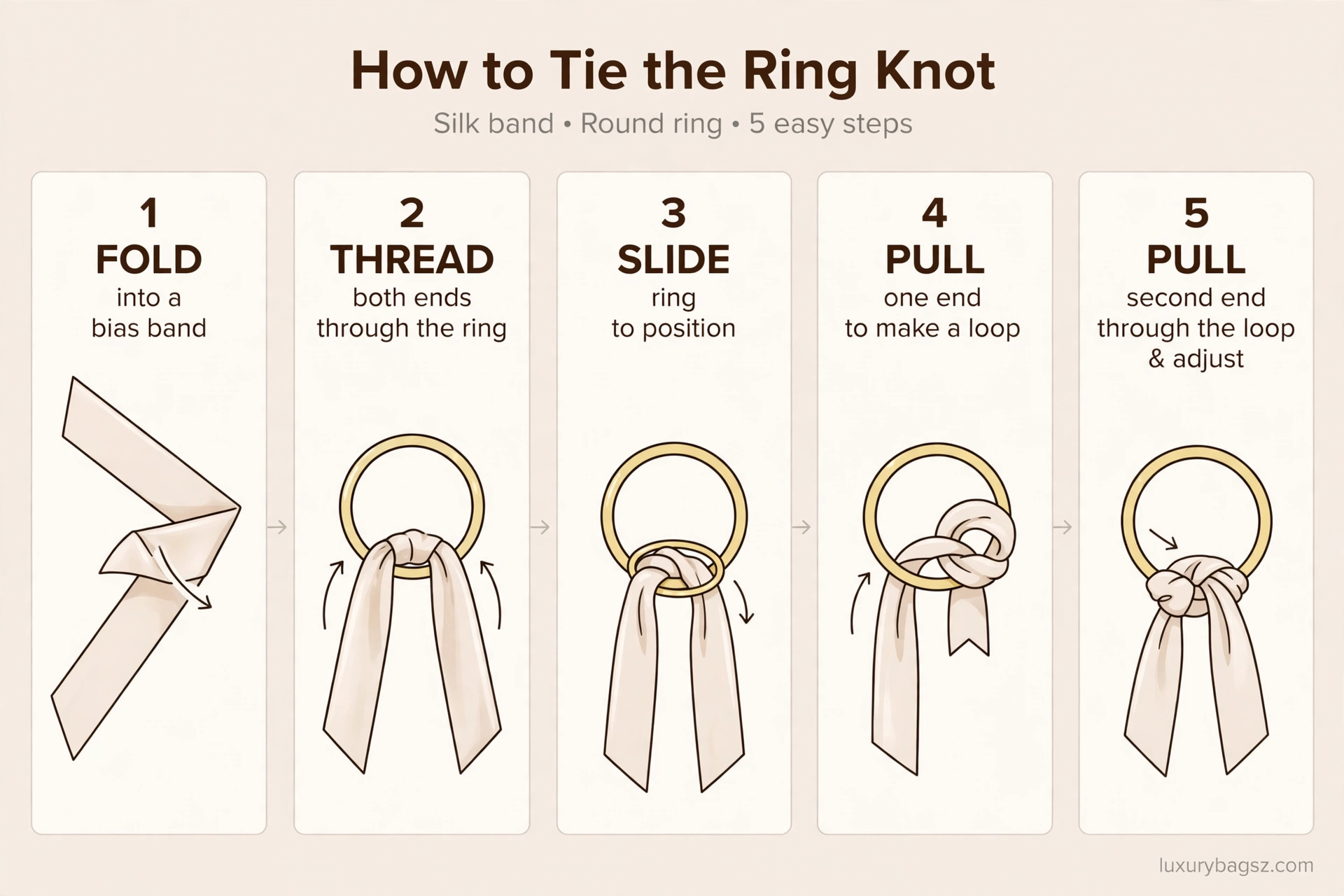
The ring knot is the most secure neck method in this guide, and the one to learn when the basic thread-through slips. It combines a ring with a loop, so the fabric grips itself as well as the ring. It suits a 90 cm carré and a 70 cm square, and it works in silk twill and in softer, slippier fabrics where the basic method fails.
The name is a source of confusion: some guides call this a loop-through with a ring, others call it a ring knot, and a few use the same words for a knot tied beside a ring. This guide uses ring knot for the method below, and says so each time, so there is no doubt which movement is meant.
- Make a bias band and drape it around the back of your neck, with the two ends hanging in front of your chest, one end slightly longer than the other.
- Thread the longer end through the ring from front to back, and let the ring rest against your chest where you want the finished knot to sit.
- Pull the fabric that has just passed through the ring outwards a little, so it forms a small, loose loop on the far side of the ring. Do not pull a large loop: a loop of about 3 to 4 cm is enough.
- Pass the shorter end through that small loop, from the same direction the longer end came through the ring.
- Pull the shorter end through slowly until the loop closes snugly around it. The ring should now sit flat, with the loop hidden behind it or just below it, and the two ends hanging from the ring.
- Adjust the ends to the lengths you want, and slide the whole ring a fraction to one side if a centred placement looks too formal. Check that you can slip two fingers between the band and your neck: a ring knot that pulls is no better than a tight knot, and it creases silk in exactly the same place.
The reason this holds is friction in two places at once: the fabric grips the ring, and the loop grips the second end. That double grip is why the ring knot is the recommended fix for fine silk muslin and for washed silk, both of which slip through a plain thread-through.
It is also why the ring knot is the wrong choice when you want a quick change of look during the day: it takes longer to undo than a thread-through, and undoing it requires working the loop open gently rather than pulling the ends apart. Never yank a ring knot open. Pulling tightens the loop further and drags threads across each other, which is how pulls start.

The Waterfall Drape
The waterfall is the most flattering ring style for showing a large area of pattern, and the best choice when the scarf itself is the point of the outfit. It suits a 90 cm carré worn with a plain top or dress, where the falling fabric can be seen in full. It is also the style most often shown in photographs with no steps at all, which is why it looks harder than it is.
- Fold the carré into a triangle, then roll the long folded edge towards the point in two even turns, as in the fold-first section, so you have a soft tube with a triangular point still free at one end.
- Drape the tube around the back of your neck, with both ends hanging in front of your chest and the triangular point falling between them, or fold the point away if you prefer a cleaner neckline.
- Thread both ends through an open ring from the same side, and slide the ring up until it sits just below the collarbone.
- Let the ends fall. Do not pull them tight or even them up precisely: the waterfall works because the ends fall at slightly different lengths and the fabric opens out below the ring like falling water.
- Fan the lower part of each end gently with your fingers, so the pattern opens out rather than staying folded in a narrow strip. Step back and check the overall shape: it should widen gradually from the ring downwards, not flare suddenly or hang as two stiff cords.
The common failure here is a ring placed too high. A ring at the throat squeezes the waterfall into a bib and makes the neck look crowded. A ring at or just below the collarbone gives the fabric room to open. The other common failure is a band that is too narrow: a narrow band makes a thin waterfall that looks like two ribbons rather than a drape. If your waterfall looks thin, refold with a wider band or use the rolled triangle rather than a flat band. A slide can also be used for a waterfall, but an open ring suits it better, because the fabric needs room to open below the ring, and a slide’s divided openings keep the ends more separate and more parallel.
The Slide Method
A slide threads differently from an open ring, and threading a slide as if it were an open ring is the single most common slide mistake. With a slide, the two ends do not travel together through one opening. They travel separately, in opposite directions, and they cross at the centre bar. That crossing is what creates the grip.
- Make a bias band from the scarf, narrower than you would use for an open ring, because each opening of the slide is smaller than a single open ring. Test the band against one opening before you drape the scarf.
- Drape the band around the back of your neck, with the two ends hanging in front of your chest.
- Hold the slide flat in front of your chest, with the centre bar horizontal.
- Pass the left end through the upper opening, from front to back, and the right end through the lower opening, from back to front — or the reverse, provided the two ends travel in opposite directions. The key point is opposition: if both ends travel the same way, the slide will not grip, and the scarf will slide straight through.
- Pull both ends gently until the slide sits where you want it, then let the ends hang. The crossed fabric inside the slide should lie flat, not bunched into a wad at the bar.
- To adjust during the day, hold the slide still with one hand and pull one end with the other. Never pull both ends at once while the slide is against your neck, which drags the whole band tighter around the throat.
Slides suit three situations better than open rings: slippery fabrics that need extra grip, drapes that must stay exactly in place for hours, and waist or shoulder gathers where the fabric is under more movement than at the neck.
They suit three situations worse: thick folds that do not fit the divided openings, quick changes of look, and anyone who dislikes fiddly threading in front of a mirror. If you find yourself forcing fabric through a slide, stop. The slide is the wrong size for that fold, and forcing it will crease the silk and may damage the slide’s bar fixings. Switch to a wider open ring, narrow the band, or use a knot that day instead.
The 90 cm Carré in Full
The 90 cm carré is the format most ring methods were designed around, and it rewards a little attention to placement. The same thread-through can look formal, casual or decorative depending only on where the ring sits and how long the ends are, so placement is worth practising deliberately rather than leaving to chance.
Centred and high. Ring just below the throat, ends even, band fairly narrow. This is the office version: neat, symmetrical, and close to a necklace in effect. It suits a collared shirt and a jacket, and it keeps the scarf clear of a bag strap. Keep the band narrow here, or the high ring will crowd the jaw.
Off to one side. Ring slid to the left or right of centre, one end longer than the other. This is the relaxed version, and the most forgiving: asymmetry hides uneven ends and a ring that sits slightly crooked. It suits an open-neck top and a casual jacket, and it photographs well because the eye follows the longer end.
Low and open. Ring at the chest or lower, ends long and fanned, band wide. This is the waterfall family, covered in the waterfall section, and it suits a plain dress or a simple top where the scarf provides the colour. It does not suit a high collar or a statement necklace, both of which will fight the ring for the same space.
Behind the neck. Thread the band through the ring at the front, then slide the ring round to the nape and let the ends fall down the back, or tie the ends behind the neck with the ring as a decorative front gathering.
This is an older styling, less common now, but useful when the front of an outfit is already busy and the scarf is wanted as a back accent. Check the back in a mirror, or ask someone, before relying on it: a back placement you cannot see is easy to get wrong.
A note on the carré itself: the 90 cm square is the classic format, with hand-rolled edges and silk twill that holds a band upright and shows a large area of pattern. Readers who want the full background on that format — its history, its sizes and its place in the range — will find it in the guide to the 90 cm carré.
The ring methods here assume that twill character: a crisp fabric that holds its shape. On a softer washed silk carré, the same methods work, but the ends will fall more softly and the ring knot is a better default than the basic thread-through.
The 70 cm Square
The 70 cm square is a smaller, neater scarf, and it needs a smaller approach to rings. Its shorter length means less fabric to work with, and its smaller presence means a large ring can overwhelm it. The rule is simple: smaller scarf, smaller ring, narrower band, simpler method.
Make a bias band about 4 to 6 cm wide, and choose an open ring whose interior opening is only just larger than the doubled band. Thread both ends through as in the basic thread-through section, and wear the ring fairly high, near the neck, where the shorter ends still have room to hang. The ring knot also works well on a 70 cm square, and it is often the better choice, because the shorter scarf has less weight pulling downwards to keep a plain thread-through in place.
Avoid the waterfall on a 70 cm square: there is not enough length for the fabric to open out below the ring, and the result looks cramped rather than flowing. Avoid a large slide: the divided openings will be too small for even a narrow band doubled back, and the slide itself will look out of proportion to the scarf.
The 70 cm square has one advantage over the carré that ring wearers should use: it makes a tidier headband and a neater neck accent, because there is less bulk at the ring. Slide a small ring to the middle of a bias band, tie the band at the back of the neck or at the side of the head, and the ring becomes a decorative centre point rather than a holding device.
In that decorative use, the ring does not need to grip firmly, because the tie behind the neck does the holding. This distinction — a ring that holds versus a ring that decorates — matters for buying, as the size and material section explains: a decorative ring can be lighter and smaller than a holding ring, and a holding ring that is too decorative may not grip at all.
For a fuller comparison of the formats, including how the 70 cm square sits against the 90 cm carré and the larger shawl, the guide to scarf sizes lays out each format side by side. The ring advice here follows that same sizing: match the ring to the scarf you actually own, not to a photograph of a different size.
The Twilly and the Pochette
Narrow and small formats need a different conversation about rings, because the usual holding logic breaks down. A twilly is a strip roughly 5 cm wide and 85 cm long, though special editions vary.
A pochette is a small square, about 45 cm on each side. Neither has enough fabric for the methods used on a carré, and both are better served by small rings used decoratively or as light gathers.
The twilly through a twilly ring. Thread one end of the twilly through a small ring, slide the ring to somewhere between the end and the middle, and thread the other end through the same ring in the same direction, so two loops come out of the top of the ring. Turn the ring to the side and arrange the loops into a top loop and a bottom loop, with a longer end and a shorter end.
Place the ring against the side of the neck, with the short end hanging in front, and wrap the long end around the neck so it comes round and sits beside the short end. This is a fiddly method the first time, and it is worth practising flat on a table before attempting it at the neck. The result is a slim neck accent with a jewellery-like point at the side, which is the twilly’s strength: it adds colour without the bulk of a square.
The twilly as a bag accent. Knot one end of the twilly around a bag handle, wrap it in a spiral, and use a small ring at one base of the handle to anchor the wrap and stop it unwinding. The ring here is a stop, not a knot: it sits over the wrapped fabric and holds the last turn in place.
The same trick works on a wrist, where a small ring stops a wrapped twilly from loosening during the day. A twilly also dresses a bag handle in the same way on an Evelyne bag as on any other leather bag, and the ring comes off in seconds when the plain handle is wanted again.
The pochette. With a 45 cm square, a regular ring is usually too large to be anything but decorative: slide it to the middle of a bias band and tie the band behind the neck, or thread each end through the ring in opposite directions if the ring is small enough.
If the ring is too large, the pochette will slide through it entirely, and the ring will drop off the end. Do not buy a full-size ring for a pochette. Buy a twilly ring, or wear the pochette without a ring at all. A pochette tied in a small knot at the neck, or folded into a pocket square, is a complete style on its own, and a ring that does not grip adds nothing but a risk of loss.
The 140 cm Shawl
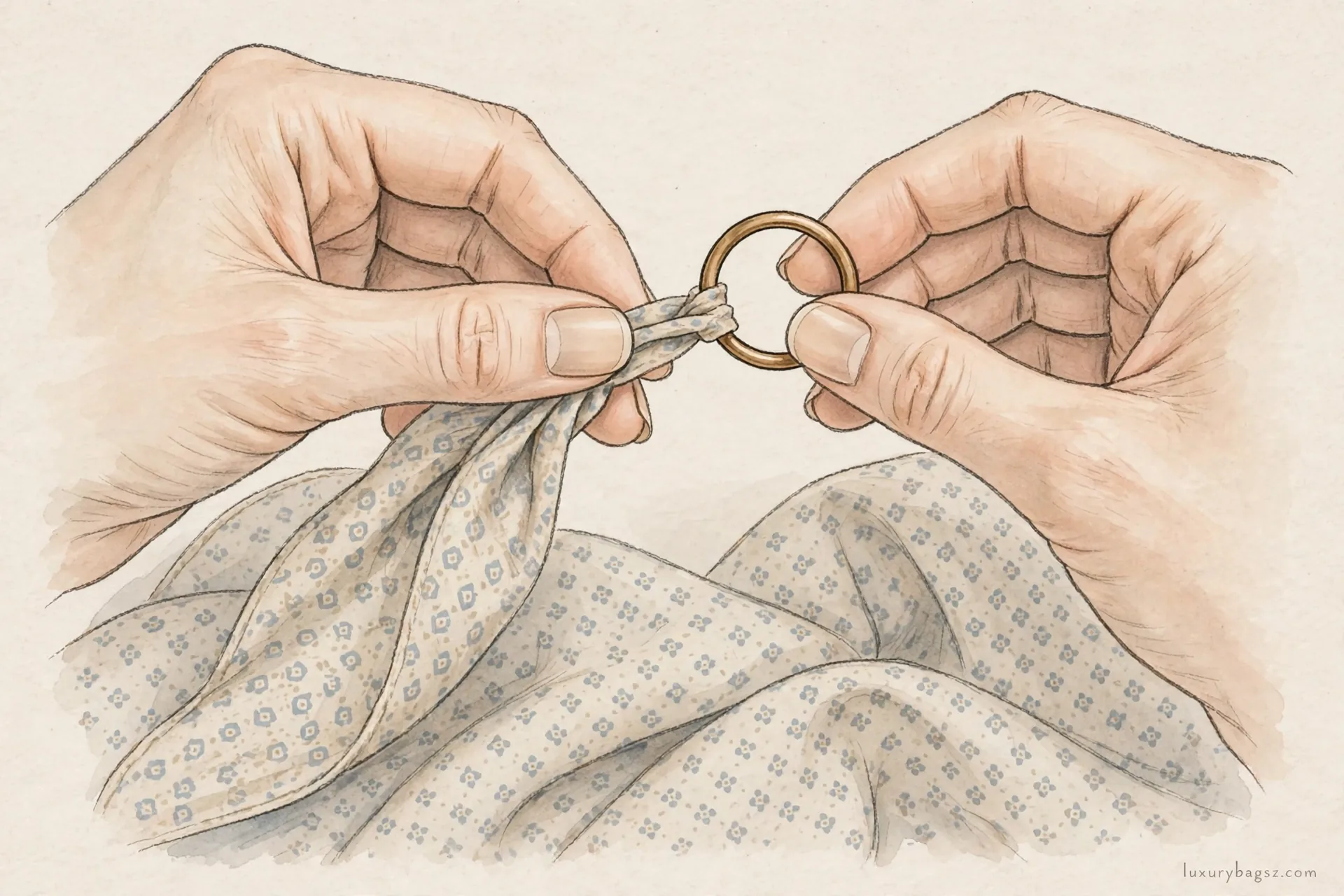
The 140 cm shawl is a different animal from a square scarf, and ring methods for it are about gathering and draping, not about neat neck knots. The shawl is often a silk and cashmere blend rather than pure silk twill, so it is softer, heavier and bulkier, and it drapes rather than holds a shape. Forcing it into a band and threading it through a small ring produces a thick, lumpy bundle that defeats the drape. Work with the drape instead.
The shoulder gather. Drape the shawl open over both shoulders, with equal lengths hanging in front. Gather the fabric at one shoulder into a soft bunch — not a tight twist, just a gathered handful — and thread only that bunch through a large open ring. Slide the ring to the shoulder point, and let the rest of the shawl fall naturally on both sides.
The ring holds the gather in place and stops the shawl sliding off the shoulder, while the open fabric keeps its drape. This is the single most useful shawl-and-ring method, and it works because the ring is holding a gather, not a folded band.
The front drape. Drape the shawl over the shoulders, bring one front corner across the body to the opposite shoulder, and gather both front corners together through a large ring at the chest.
This closes the shawl like a wrap top and keeps it in place without a belt. Keep the ring large: a shawl gather is thick, and a ring that fits a carré band will not fit a shawl gather. If the gather will not pass through the ring with gentle pressure, the ring is too small, full stop.
The belted wrap. Drape the shawl, belt it loosely at the waist over a dress, and use a ring at one shoulder as a secondary anchor rather than the main hold. The belt does the structural work; the ring stops the shoulder fabric from sliding. This combination suits cold weather and long wear, where a single ring alone would be asked to hold too much weight for too long.
What not to do. Do not fold a shawl into a bias band and thread it through a ring at the neck as if it were a carré. The bulk at the neck will be uncomfortable, the ring will be hidden inside the fold, and the shawl’s drape — its whole reason for existing — will be lost.
Do not use a slide on a shawl gather: the divided openings are too small for the bulk, and the centre bar will crease the gathered fabric in a hard line. And do not hang a heavy ring on a fine silk shawl: the weight will pull the drape downwards on one side and distort the fall of the fabric all day.

Plissé and Fine Fabrics
Two fabrics deserve special mention, because ring advice written for silk twill does not transfer to them unchanged. The first is plissé, the finely pleated silk in which the whole scarf is pleated from end to end, giving a structured, textured surface. The second is fine silk muslin, sometimes called mousseline, which is feather-light and very slippery.
Plissé holds its pleats, which is both a help and a problem in a ring. The pleats give the fabric body, so a plissé band sits upright in a ring and shows texture well. But the pleats also add bulk, and they can be crushed if the ring is too small or the fabric is forced.
Long-running wearer guides report that a round open ring suits plissé well, including for a gathered flower-style knot in which the pleated fabric is pulled into a rounded shape through the ring. That report is wearer experience, not a maker specification, and it should be treated as such: try it at home first, with a ring whose opening is generous for the pleated fold, and check the pleats after removing the ring.
If the pleats are flattened in a hard line where the ring sat, the ring was too small or the fabric was left in it too long. Plissé should never be left gathered in a ring in storage, as the ring care section explains.
Fine muslin is the opposite problem: almost no bulk and almost no friction. A plain thread-through will usually slip, because there is too little fabric inside the ring to grip. The fixes, in order of simplicity, are: narrow the band and double it back through the ring; use the ring knot, which adds a second friction point; or use a slide, whose crossing fabric grips more firmly than a single opening. A muslin scarf in a large, smooth, heavy ring is the worst pairing in this guide: too little friction, too much weight, and a ring that will travel down the scarf during the day. If you love muslin, buy the smallest, lightest ring that will take the doubled band, and test it at home for an hour before wearing it out.
Washed silk sits between twill and muslin: softer and more relaxed than twill, with a little more grip than muslin. The basic thread-through usually works on washed silk, but the ring knot is a safer default for a full day.
Cotton scarves, including 70 cm cotton squares, behave differently again: cotton has more surface grip than silk, so a ring holds more easily, but cotton creases more readily where a ring grips it, and a ring left on a cotton scarf in storage will mark it. The principle across all fabrics is the same: match the ring’s opening and weight to the fabric’s bulk and slipperiness, and test the pairing at home before trusting it outdoors.
When a Ring Helps and When It Hurts
A ring is not always an improvement on a knot. Knowing when to reach for it, and when to leave it in the drawer, is what separates a ring wearer from a ring collector.
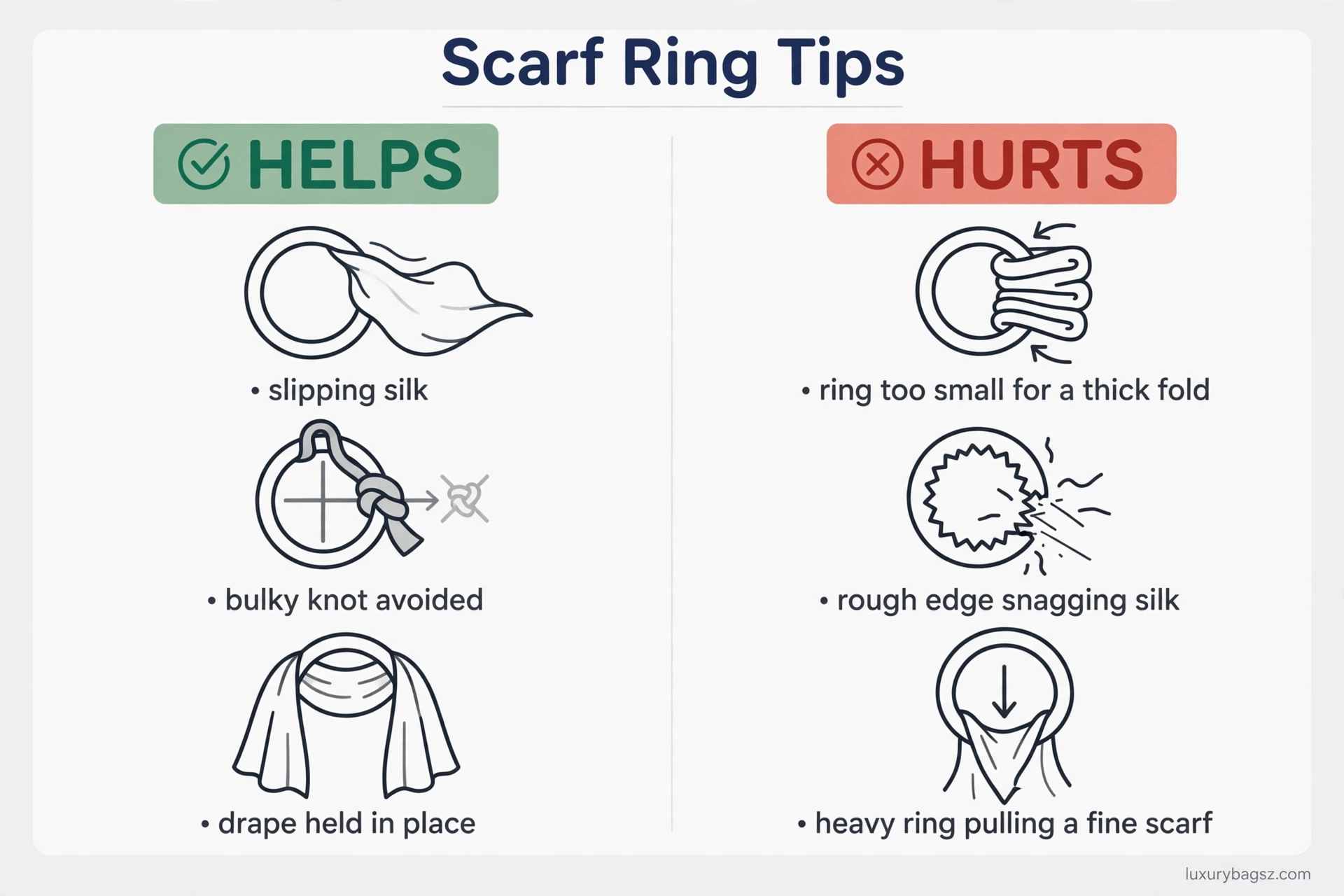
A ring helps when:
- The scarf is slippery. Fine silk, washed silk and muslin slip out of knots, and a ring adds friction without tightening a knot.
- A knot would be bulky. A thick twill band tied in a knot at the neck can look like a lump under a jacket collar; a ring gathers the same fabric into a flat, neat point.
- A knot would crease the silk. Repeated tight knots in the same place wear fibres and set crease lines; a ring spreads the pressure over a wider area and leaves a softer mark.
- A drape needs holding. A shawl over the shoulders, a waterfall at the chest, or a wrap that must stay in place for hours all benefit from a ring anchor.
- Hands are stiff or a quick change is needed. Threading a ring is often easier than tying and untying a neat knot repeatedly, and a thread-through can be undone in seconds.
- The ring itself is wanted as jewellery. A gold-tone or horn ring at the neck or chest is a visible accent, and it can tie an outfit together in the way a necklace does.
A ring hurts when:
- The opening is too small for the fold. Forcing silk through crushes the weave and creases it in a hard line.
- The opening is too large for the fold. The scarf slides through, the ring drops, and the style falls apart — sometimes taking the ring with it, lost on the street.
- The inner edge is rough. A nick, a sharp join, a rough plating edge or a cracked resin edge will snag silk, and a snag on a silk square is often permanent.
- The ring is too heavy for the fabric. A heavy metal ring on fine muslin pulls the drape downwards and distorts the fall of the scarf.
- The ring is worn against a rough surface. A ring that rubs against a coarse jacket, a bag strap or a seatbelt will mark both the ring and the silk over time.
- The scarf is left in the ring. A scarf stored gathered in a ring will take on the shape of the gather, and the crease where the ring sat can become hard to relax out.
The test for any new pairing is simple and takes a minute: thread it, wear it round the house for ten minutes, take it off, and look at the silk where the ring sat. If the silk looks unchanged and the ring stayed put, the pairing works. If either fails, change the fold, change the ring, or use a knot that day. There is no pairing so good that it is worth damaging silk for.
Stopping Slipping Silk
Slipping is the complaint that drives most people to a ring in the first place, so it deserves a full treatment rather than a passing tip. Silk slips because it is smooth: its fibres are continuous and fine, with little surface texture to grip each other or the skin.
Body heat, movement and dry air all reduce what little grip there is. A ring helps by adding friction, but friction alone is not the whole answer, and the fixes below work in combination.
Narrow the band, then double it. A narrower band doubled back through the ring puts twice as much fabric inside the opening, which roughly doubles the friction. This is the first fix to try, and it costs nothing.
Use the ring knot, not the thread-through. The ring knot adds a second friction point where the loop grips the second end. On muslin and washed silk, this is often the difference between holding and slipping.
Use a slide for a stubborn drape. The crossing fabric inside a slide grips more firmly than a single opening. If a drape must stay put for a whole evening, a slide is a better tool than an open ring.
Add a hidden knot behind the ring. Tie a small, loose knot in the band behind the ring, then slide the ring over the knot so the knot is hidden inside or behind the ring. The knot acts as a stop that the ring cannot slide past.
This is a well-reported wearer trick for very slippery fabrics, and it works because the ring is no longer relying on friction alone. Keep the knot loose, so it can be undone without pulling, and never use this trick with a pin: a pin through silk is a different matter entirely, and it damages the fabric.
Change what is underneath. A scarf worn over a smooth satin top slips more than the same scarf worn over a cotton shirt or a knitted top, because there is less grip between scarf and clothing. If a style keeps slipping, try it over a different neckline before blaming the ring.
Check the ring, not just the scarf. A ring with a polished, slightly matte inner surface grips better than a ring with a mirror-polished inner surface, because the tiny texture adds friction. A ring that has been polished to a high shine inside may look better and hold worse. This is a small effect, but on muslin it can be the deciding one.
What not to do. Do not use hairspray on silk to stop slipping: it contains alcohol and polymers that can stain silk and degrade its fibres over time. Do not use adhesive tape on silk, even tape sold for clothing: it can leave residue and tear fibres when removed. Do not pin through silk to hold a ring in place.
Do not tighten a ring knot until it feels firm: a knot pulled hard enough to feel firm will crease the silk exactly where it grips, and those creases are the hardest to relax out later. If a style slips after all the fixes above, the honest answer is that the pairing of that scarf, that ring and that outfit does not work, and a different knot or a different scarf is the better choice that day.
Choosing Size and Material
Buying a scarf ring is where most mistakes happen, because size labels do not mean what buyers assume they mean, and material names do not guarantee the qualities buyers hope for. This part separates what is known from what is merely labelled.
Size means the opening, not the outside. The measurement that matters is the clear interior opening — the space the fabric actually passes through — and, for a slide, the clear space inside each of its two openings. The outside diameter of the ring is almost irrelevant, except for how it looks.
Two rings with the same outside size can have very different openings, because a thick-walled ring has a smaller interior than a thin-walled ring of the same outside size. Always ask for, or measure, the interior opening.
Nominal labels are not verified inner diameters. Some generic sellers list sizes as 35, 42 and 50 mm, but the measurement point behind those labels is often not stated, and supporting diagrams do not always agree with the selectable options. Treat those numbers as nominal option labels, not as verified inner diameters, and do not choose a thick fold merely because one option has the largest number.
The reliable test is physical: fold the scarf as you will wear it, and pass the fold through the ring before buying, or buy from a seller with a returns policy that allows that test at home.
A practical size guide, with its limits. As a rough starting point only, a small twilly ring suits a single narrow strip; a medium open ring suits a bias band from a 70 cm square or a narrow band from a 90 cm carré; and a large open ring suits a wide band from a 90 cm carré or a gathered shawl bunch.
These are starting points, not rules, because band width, fabric thickness and pleating all change the fit. A plissé band is thicker than a flat twill band of the same width, and a cashmere-blend shawl gather is thicker again. The fold test in the paragraph above beats any chart, including this one.
Materials. Gold-plated and palladium-plated metal rings are the classic house finishes reported for round rings, and they suit most outfits because they read as jewellery. Plating wears over time, especially where the ring rubs against fabric, so a plated ring will eventually show its base metal at wear points; that is normal wear, not a fault, but it is a reason to buy plating of good quality and to store the ring separately, as the ring care section explains.
Horn rings are light, warm to the touch, and kind to silk, because horn can be polished very smooth; they suit a more natural, understated look. Wooden rings are also light and smooth when well finished, but a poorly finished wooden ring can have a rough grain that snags silk, so check the inner edge with a fingertip and with a scrap of fine fabric before it touches a good scarf.
Resin and enamel rings offer colour and pattern, but enamel can chip at the inner edge, and a chip is a snag waiting to happen. Sterling silver and solid gold rings are heavier, and that weight matters: a heavy ring suits a heavy shawl and overwhelms a fine muslin scarf. Choose the material for the scarf it will hold, not only for the outfit it will match.
Weight is a feature, not a footnote. A light ring stays where it is put on a light scarf, and a heavy ring drags a light scarf downwards. Hold the ring in your hand and imagine it hanging from a silk band for eight hours. If it feels heavy in the hand, it will feel heavier on silk. This is the most overlooked buying check, and it is the one most likely to explain a ring that looks perfect in a photograph and disappoints in wear.
Buying Genuine vs Generic
This is the part where plain speaking matters most, because prices and authenticity claims for scarf rings are easy to overstate and hard to verify. This guide states what was found, what was not found, and what should not be claimed.
Price uncertainty, stated plainly. No source checked for this guide states a verified current retail price for a genuine house scarf ring. House prices vary by design, material and market, and they change over time, so any guide that quotes a single current price without a dated source should be treated with caution. This guide does not quote one.
What was found instead are individual listings, and they are reported here as individual listings only, never as market averages:
- One resale listing for a square scarf ring, in stock at the time it was seen, priced at £195.
- One vintage listing for a gold and brown scarf ring, in very good condition with slight signs of wear, priced at €190.
- One antique listing for a gold-plated metal scarf ring, 2.8 cm in diameter and 1.5 cm high, priced at €180.
Those three prices describe three different objects, in different conditions, from different sellers, at different times. They do not establish what a genuine ring costs, what a fair price is, or what any other ring should sell for.
A single listing is never a market average, and a reader who treats it as one will overpay or undervalue with equal ease. For a current price, check a house boutique or an authorised seller directly, and note the date of the price you are given, because an undated price is already out of date.
Genuine house rings. Genuine house scarf rings are sold through house boutiques and authorised sellers, and through reputable resale sellers with authentication. They are not sold through every online marketplace that uses the house name in a listing title. A listing that uses the house name but shows no clear photographs of the ring, its finish and any markings, and that cannot say where the ring came from, should not be trusted on the strength of its title alone. Markings and stamps vary by design and era, so a single stamp rule does not authenticate every ring; reputable sellers authenticate by the whole object — weight, finish, construction and provenance together — not by one mark. If a price looks far below every other listing for a similar object, that is a reason for caution, not a bargain to celebrate.
Generic rings. A generic ring is not a lesser object by definition. Many generic rings are well made, perfectly smooth, and better suited to a particular scarf than a house ring would be, because they come in a wider range of openings and weights. The honest difference is provenance and resale value, not necessarily function: a generic ring will not carry the house name, and it will not hold the resale value of a house piece, but it may hold a scarf just as well or better.
For a first ring, a generic ring is often the wiser purchase, because it allows the wearer to learn which opening and weight suit their scarves before spending more. Buy generic rings from sellers who state the interior opening, the material and the weight, and who allow returns, so the fold test in the size and material section can be done at home.
What to check before paying. Run a fingertip slowly round the entire inner edge, feeling for nicks, rough plating or sharp joins. Hold the ring up to the light and look for cracks in enamel or resin. Weigh it in the hand and compare it with the scarf it will hold.
Thread a similar fold through it, if the seller allows, or confirm a returns policy that allows that test at home. Check that the listing photographs show the actual ring for sale, not a stock photograph of a different ring. And keep the receipt and any authentication paperwork with the ring, stored separately from the ring itself, so a future resale or insurance question can be answered without hunting through old messages.
Ring Care and Scarf Care Together
A ring and a scarf live together during the day and should live apart the rest of the time. That separation is the core of caring for both.
After wearing. Remove the scarf from the ring as soon as you take it off. Undo any ring knot gently, working the loop open rather than pulling the ends apart, and slide the ring off the fabric. Let the scarf air for an hour before storing it, especially after a full day of wear, so body heat and moisture do not get trapped in a fold. Smooth the area where the ring sat gently with your hands, working from the centre outwards, and check for any pulled thread or crease line.
A faint mark from a ring usually relaxes if the scarf is left flat overnight; a hard crease from a forced fit or a tight knot is harder to relax, and it is a sign that the pairing needs changing, not that the scarf needs pressing.
Cleaning the ring. Wipe a metal ring with a soft, dry cloth after wearing, to remove skin oils and any silk fibres caught at the edge. For plated rings, use only a dry cloth: polishes and chemical cleaners can wear plating, and they should never be used on a ring that will touch silk, because residue transfers to the fabric. Horn and wood rings should be kept dry and away from heat; a damp cloth, well wrung out, is enough for cleaning, followed by drying.
Enamel and resin rings should be wiped dry and checked for chips after any knock. If a ring is damaged — a nick, a crack, a loose bar on a slide — take it out of use until it is repaired or replaced. A damaged ring is not a minor flaw when it touches silk; it is a snag waiting for a scarf.
Storing the ring. Store the ring separately from scarves, in a soft pouch or a lined box, away from other jewellery that could scratch it or be scratched by it. Do not store a scarf gathered in a ring, and do not hang a scarf from a ring on a hook: both practices set a crease where the ring grips and stretch the weave unevenly over time. Store the scarf rolled loosely or folded loosely along different lines each time, in a drawer or a soft pouch away from sunlight and sharp objects.
Keep scented sachets away from direct contact with silk, and keep the ring away from perfume: spray perfume and let it dry before putting the scarf and ring on, because perfume can mark both silk and plating.
A shared habit. The same gentle handling that protects a leather bag protects a silk scarf: clean hands, a dry scarf, no yanking, no forcing. If a ring will not slide, a scarf will not thread, or a knot will not open, stop and work out why, rather than applying more force.
Force is the one handling habit that damages silk, rings and bags alike, and it is always the wrong answer to a fitting problem.
Mistakes to Avoid
These are the mistakes that turn up again and again, in guides and in real life, and each one has a simple fix.
Forcing silk through a ring that is too small. The fold creases, the weave compresses, and a thread may drag loose. Fix: narrow the band, or use a larger ring.
Using a ring that is too large for the fold. The scarf slides through and the ring drops. Fix: widen the band, double it back through the ring, or use the ring knot.
Buying a finger ring by mistake. A finger ring will not thread a scarf, however similar its motif. Fix: check that the listing shows fabric passing through the object, and add the word scarf to every search.
Threading a slide like an open ring. Both ends through one opening, in the same direction, will not grip. Fix: thread the ends in opposite directions through the two openings, as in the slide method section.
Pinning through silk to hold a ring. Pins leave holes in silk twill that do not close. Fix: use a hidden loose knot behind the ring, or choose a method that holds on its own.
Leaving the scarf in the ring in storage. The gather sets a crease where the ring sat. Fix: remove the ring, untie fully, and store the scarf rolled loosely.
Using a damaged ring. A nick or a chipped edge snags silk faster than any knot. Fix: check the inner edge with a fingertip before every wear, and retire a damaged ring until it is repaired.
Using a heavy ring on a fine scarf. The drape pulls downwards on one side and distorts all day. Fix: match weight to fabric — light rings for muslin, heavier rings only for heavier shawls.
Wearing the ring dead centre every time. A centred ring can look formal and stiff, and it competes with a necklace. Fix: slide the ring to one side for most outfits, and try centred and off-centre placements to see which suits the outfit.
Forgetting the back. A ring placement that looks perfect from the front can be twisted or bunched at the back. Fix: check the back in a mirror before leaving the house, especially for back placements and shoulder gathers.
What Guides Disagree On
Scarf rings have no single official vocabulary, and guides disagree more than they admit. Knowing where the disagreements are will stop you from thinking you have done a method wrong when you have simply met a different name for it.
Ring, anneau, slide. Some guides use ring and anneau for any loop that holds a scarf, and slide for a frame with a centre bar. Others use slide for any ring, and anneau only for house pieces.
Still others use ring for a closed loop and slide for a buckle-like frame, which is the distinction used in this guide. The object matters more than the word: count the openings, and thread accordingly.
Régate and other house names. The round house ring is widely written as Régate, but spellings vary across wearer guides and resale listings, and the same design is sometimes described simply as a circular scarf ring.
House designs also change over time, and a design sold in one era may not be sold in another. Do not let a spelling difference put you off a ring, and do not assume that a name in a listing guarantees a particular design: check the shape and the openings, not only the name.
Whether a ring protects silk. Some guides present a ring as always gentler than a knot, because it avoids a tight knot. Others point out that a ring concentrates pressure in one place and can crease silk where it grips, especially if the fit is tight or the scarf is left in the ring.
Both claims have truth in them: a well-fitted ring, removed after wearing, is gentler than a tight knot left in place; a tight-fitting ring left on a scarf in storage is worse than a loose knot undone at the end of the day. The difference is fit and habit, not the object alone.
Whether a twilly ring helps or merely decorates. Some wearers report that a small ring genuinely stops a twilly wrap from unwinding, while others find it purely decorative, with the tie or wrap doing all the holding. Both experiences are consistent with the physics: a small ring on a narrow strip has little fabric inside it to create friction, so its holding power is limited, and whether it helps depends on the strip, the ring size and the wrap. Treat a twilly ring as a light gather and a decorative point first, and a holding device second.
Sizes. Some guides give ring sizes as if they were universal, with a single size for a carré and a single size for a twilly. Others give no sizes at all, only the advice to test the fold. The second approach is closer to the truth, for the reasons in the size and material section: nominal labels are not verified inner diameters, band widths vary, and fabrics vary in thickness. A size chart is a starting point for shopping, not a substitute for the fold test.
Plissé and the round ring. The report that a round open ring suits plissé, including for a gathered flower-style knot, comes from long-running wearer guides, not from a maker specification, and other guides do not mention plissé and rings together at all.
Try the method at home, check the pleats afterwards, and judge by the scarf in front of you rather than by any guide’s enthusiasm.
None of these disagreements changes how a ring is threaded. They only change what it is called, what size it is said to be, or how much it is praised, so do not let a name or a claim put you off a method that works on your own scarf.
A First-Week Practice Plan
Do not try to learn every method in one evening. Learn one, wear it, and add more when the first feels automatic.
Day one: the basic thread-through, practised flat on a table first, then at the neck in front of a mirror. Concentrate on the fold width and on sliding the ring to the position you want, rather than on speed.
Day two: wear the basic thread-through out, for a few hours only, and check it during the day. Note whether the ring stays put, whether the silk looks marked when you take it off, and whether the placement suits your outfit. That one day of observation teaches more than any guide.
Day three: the ring knot. Practise the loop movement slowly, with the scarf flat on a table, until the loop step feels natural. Then wear it at the neck and compare its hold with the basic thread-through on the same scarf.
Day four: the waterfall, or the slide method, whichever suits the rings you own. A waterfall teaches drape and placement; a slide teaches opposite-direction threading and grip.
Day five: a different format. If you have learned on a carré, try a 70 cm square, a twilly or a shawl, and notice how the ring size and the fold width need to change. If you only own one format, try a different placement instead: off-centre rather than centred, or low rather than high.
After that: the shoulder gather for a shawl, the twilly ring method, and the slipping fixes, in whichever order your wardrobe calls for. By this point you will be choosing rings by opening and weight without checking the size and material section, and you will know which methods suit your scarves without re-reading the steps.
A useful habit at every stage: practise with the scarf and the ring you actually plan to wear, not with spares. Different sizes, fabrics and ring weights behave differently, and a method learned on a twill carré will feel unfamiliar on a muslin square until you have tried it there too.
Wearing a Ring With the Rest of Your Outfit
A ring does not live alone. A few pairing notes make the difference between a ring that looks added on and one that looks like part of the outfit.
Match the ring’s metal to the other metals you are wearing — earrings, a watch, a bag’s hardware — rather than mixing gold-tone, palladium-tone and silver at random.
A horn or wooden ring is the exception: it reads as a natural material rather than a metal, so it pairs with any metal, provided the outfit is not already busy. Keep the ring clear of a statement necklace: both want the same space at the chest, and one of them should move — the ring to one side, the necklace higher or lower, or one of them left off.
With a collared shirt, a high ring sits above the collar points and reads neatly; with an open neck, a lower ring shows more pattern and reads more casually. When you carry a bag on a shoulder strap, a low ring at the chest can be knocked by the strap, so a higher or off-centre placement is safer, and choosing the right crossbody bag size keeps the strap from cutting across the ring.
In warm weather, a 70 cm square with a small ring gives colour without the warmth of a full carré; in cold weather, a shawl gathered at the shoulder with a large ring does the work of a wrap and a scarf at once.
If a colour does not flatter your complexion, wear the ring and scarf away from your face: as a waist gather over a dress, as a shoulder gather on a shawl, or as a bag accent. You keep the pattern and the ring, and neither has to sit against your skin.
And if an outfit already has a strong pattern, choose a plain ring rather than a decorative one, so the ring frames the scarf rather than competing with it. The ring should be the quietest jewellery in the outfit, not the loudest.
Final Verdict
A scarf ring earns its place in a wardrobe not by being decorative, though it often is, but by solving a real problem: it holds silk without a knot, without a pin, and without the crease lines a tight knot leaves behind. That is a modest claim, and it is the right one. A plain open ring, a bias band, and the basic thread-through will take a single 90 cm carré through most outfits, from a neat neck style at work to a waterfall over a plain dress.
The ring knot will hold the fabrics that slip, a slide will hold the drapes that must stay put, and a large ring will gather a shawl at the shoulder without destroying its drape. None of that requires a house piece, a large collection, or a current price list. It requires one ring whose opening fits your fold, whose edge is smooth, and whose weight suits your scarf — tested at home, worn with care, and removed before storage.
Start with the basic thread-through, keep every movement gentle, and let the fold choose the ring, not the other way round. The guides that show ten finished looks in ten photographs are useful for inspiration, but the ones that teach you to fold, to test a fit, and to fix a slipping scarf are the ones that actually get worn.
Frequently Asked Questions
What is a Hermès scarf ring?
It is a small loop — sometimes called an anneau — made to be threaded with a silk scarf, so the scarf is held in place without a knot. House designs include round rings and anchor-chain-shaped slides, and generic rings in the same shapes work by the same threading.
How do you use a scarf ring for the first time?
Fold the scarf into a bias band, push both ends through an open ring from the same side, drape the band around the back of your neck with the ring in front, slide the ring to the position you want, and adjust the ends. Practise flat on a table first, then in front of a mirror.
What is the difference between a scarf ring and a scarf slide?
A ring, in the sense used in this guide, is a closed loop with one interior opening, through which one or both ends pass together. A slide is a frame divided by a centre bar into two openings, through which the ends pass in opposite directions. Count the openings on the object in front of you, and thread accordingly.
Which ring size do I need?
The interior opening matters, not a size label. Fold the scarf as you will wear it, and check that the fold passes through the ring with gentle pressure, neither forced nor loose. Nominal labels such as 35, 42 and 50 mm are not verified inner diameters, so the fold test beats any chart.
Why does my scarf keep slipping through the ring?
Usually because the opening is too large for the fold, or the fabric is very smooth. Narrow the band and double it back through the ring, use the ring knot, or switch to a slide. Do not solve slipping by pulling the fabric tighter.
Can a scarf ring damage silk?
It can, if the inner edge is rough, if the fit is so tight that silk must be forced through, or if the scarf is left gathered in the ring in storage. A smooth, well-fitted ring, removed after wearing, is gentler than a tight knot. Check the inner edge with a fingertip before every wear.
Can I use a scarf ring on a twilly?
Yes, with a small twilly ring. Thread the twilly through the small ring and arrange the loops as in the twilly section. A full-size ring will not hold a twilly: the strip will slide straight through it.
Can I use a scarf ring on a 140 cm shawl?
Yes, with a large open ring, used to gather the shawl at one shoulder or at the chest, as in the 140 shawl section. Do not fold a shawl into a neck band and thread it through a small ring: the bulk defeats the drape.
How much does a genuine Hermès scarf ring cost?
This guide does not state a verified current retail price, because no source checked for it states one. Individual resale listings seen during research included £195 for one square ring, €190 for one vintage gold and brown ring, and €180 for one antique gold-plated ring, but those are single listings, not market averages. Check a house boutique or an authorised seller directly for a current, dated price.
How do I store a scarf ring?
Separately from scarves, in a soft pouch or a lined box, away from other jewellery. Never store a scarf gathered in a ring, and never hang a scarf from a ring on a hook. Remove the ring after wearing, let the scarf air, and store the scarf rolled loosely.






