History of Salvatore Ferragamo: From Bonito to Shoemaker to the Stars
Ferragamo in Brief: The Shoemaker Who Taught Hollywood to Walk
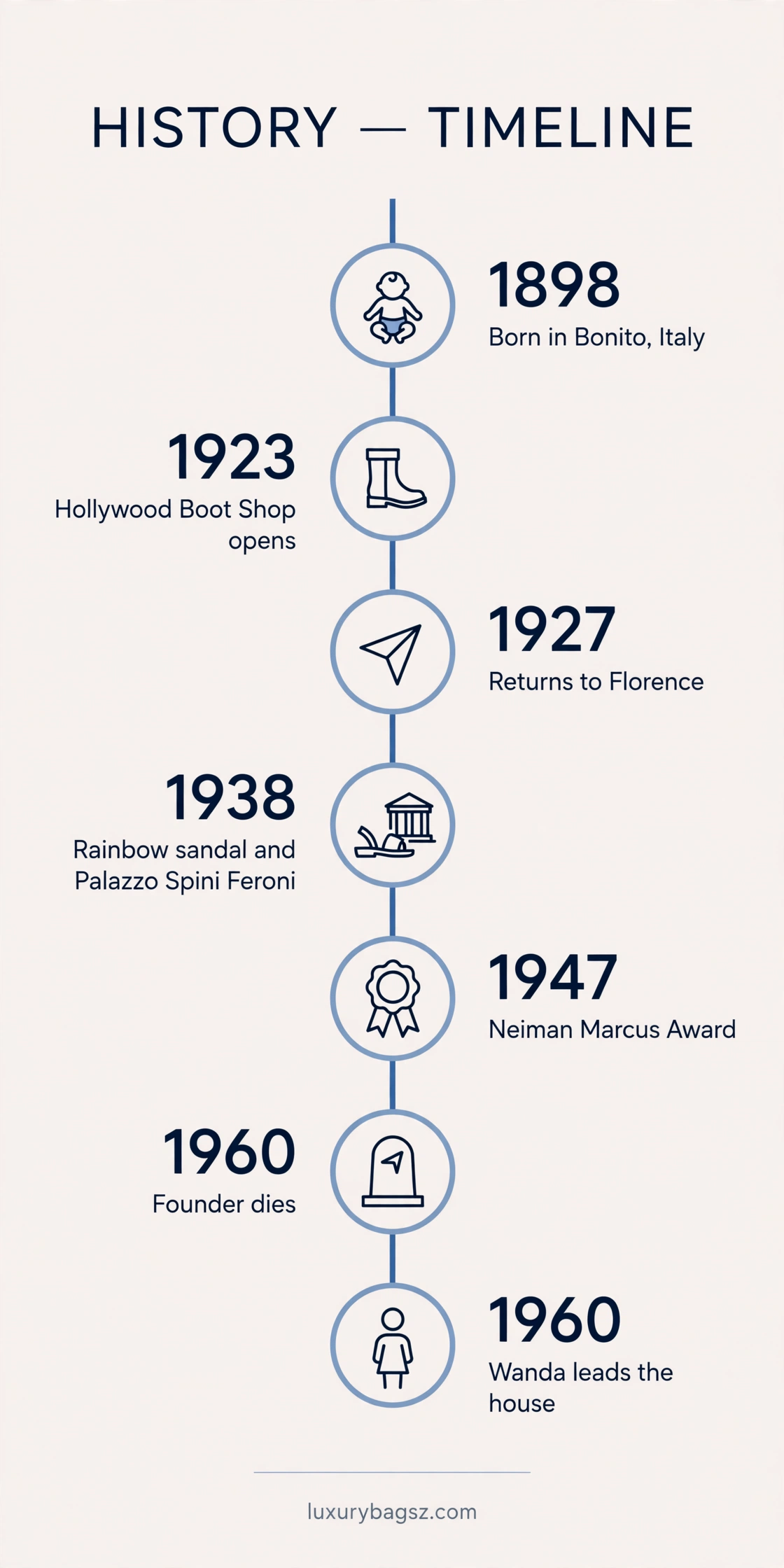
Salvatore Ferragamo is the rare fashion founder whose nickname tells the whole story: the shoemaker to the stars. Born poor in Bonito, southern Italy, in 1898, he made his first pair of shoes at nine, emigrated to America as a teenager, dressed the silent-film stars of Hollywood, and returned to Florence in 1927 to found the house that still bears his name.
What set him apart was not glamour alone but science. He studied anatomy to understand how weight falls on the foot, and he turned that knowledge into inventions: the wedge heel, the cage heel, the invisible heel and the Kimo sandal. If you remember one thing, remember this: Ferragamo made beautiful shoes that were engineered to be worn, and that combination is why the house still matters nearly a century on.
Key Takeaways
- Salvatore Ferragamo was born in Bonito, Italy, in 1898, the eleventh of fourteen children.
- He opened the Hollywood Boot Shop in 1923 and dressed stars such as Gloria Swanson and Joan Crawford.
- He returned to Florence in 1927 and founded his eponymous house there.
- His inventions include the wedge heel, the cage heel and the invisible lucite heel.
- The Rainbow sandal of 1938 and the Kimo sandal of 1951 became design landmarks.
- After his death in 1960, his wife Wanda built the house into a full luxury brand.
- Buyers should check fit on both feet, stitching, soles and heel tips before paying.
A Boy Shoemaker in Bonito
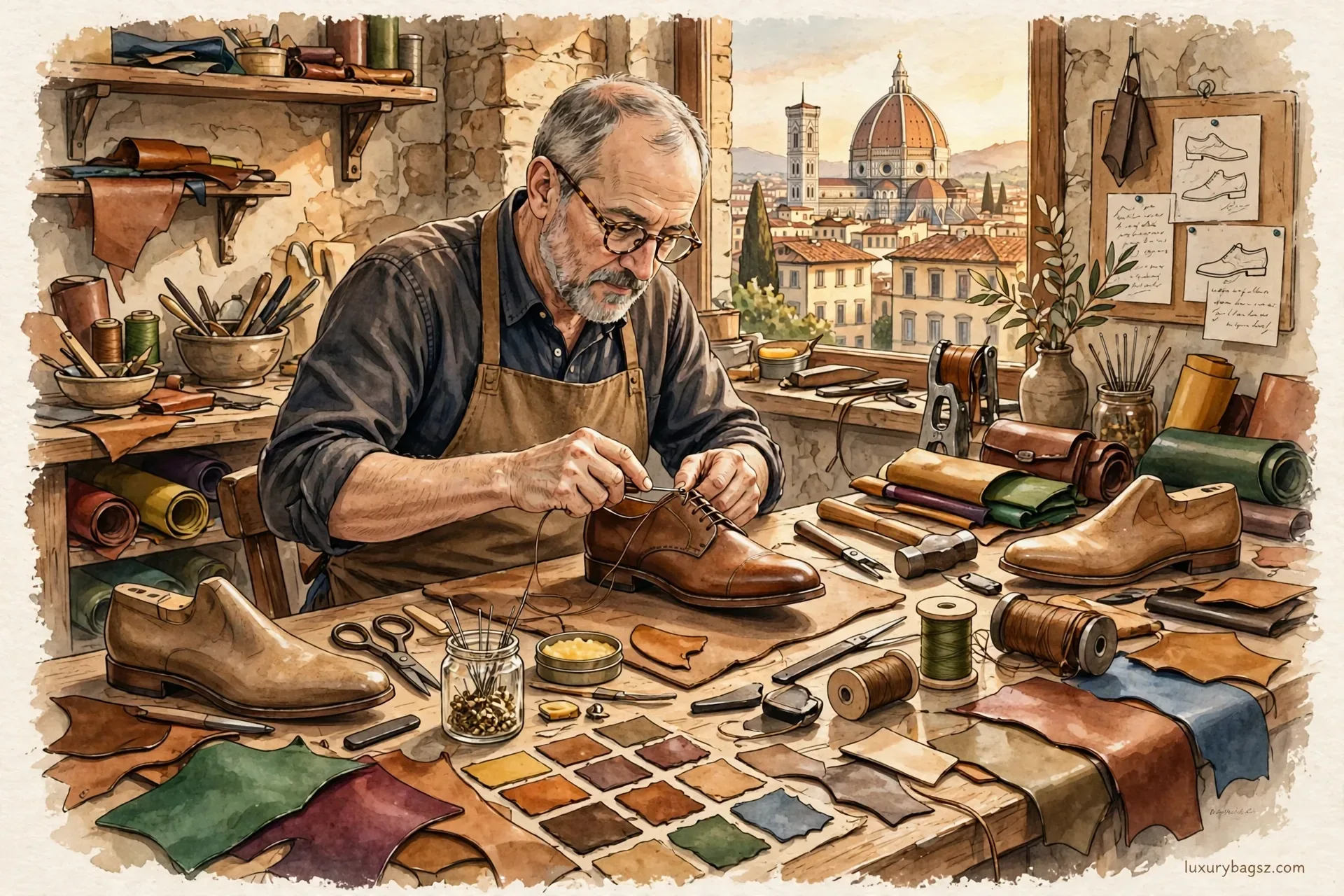
Salvatore Ferragamo was born in 1898 in Bonito, a small town near Naples, the eleventh of fourteen children in a poor family. The story goes that, aged nine, he made his first pair of shoes in secret because his family could not afford white shoes for his sister's first communion, borrowing canvas, nails and tools from the local shoemaker.
By his early teens he had opened a small shop at home, and he later apprenticed with a shoemaker in Naples. The apprenticeship gave him technique, but the drive was his own: a fascination with feet, fit and the way a shoe could change how a person moved. That curiosity would later take him into anatomy lectures, an unusual detour for a shoemaker and the key to his career.
Bonito also taught him craft discipline. In a poor household, materials were precious and mistakes were costly. The habit of careful handwork, learned young, stayed with him through Hollywood glamour and Florentine success alike.
Hollywood: Shoemaker to the Stars
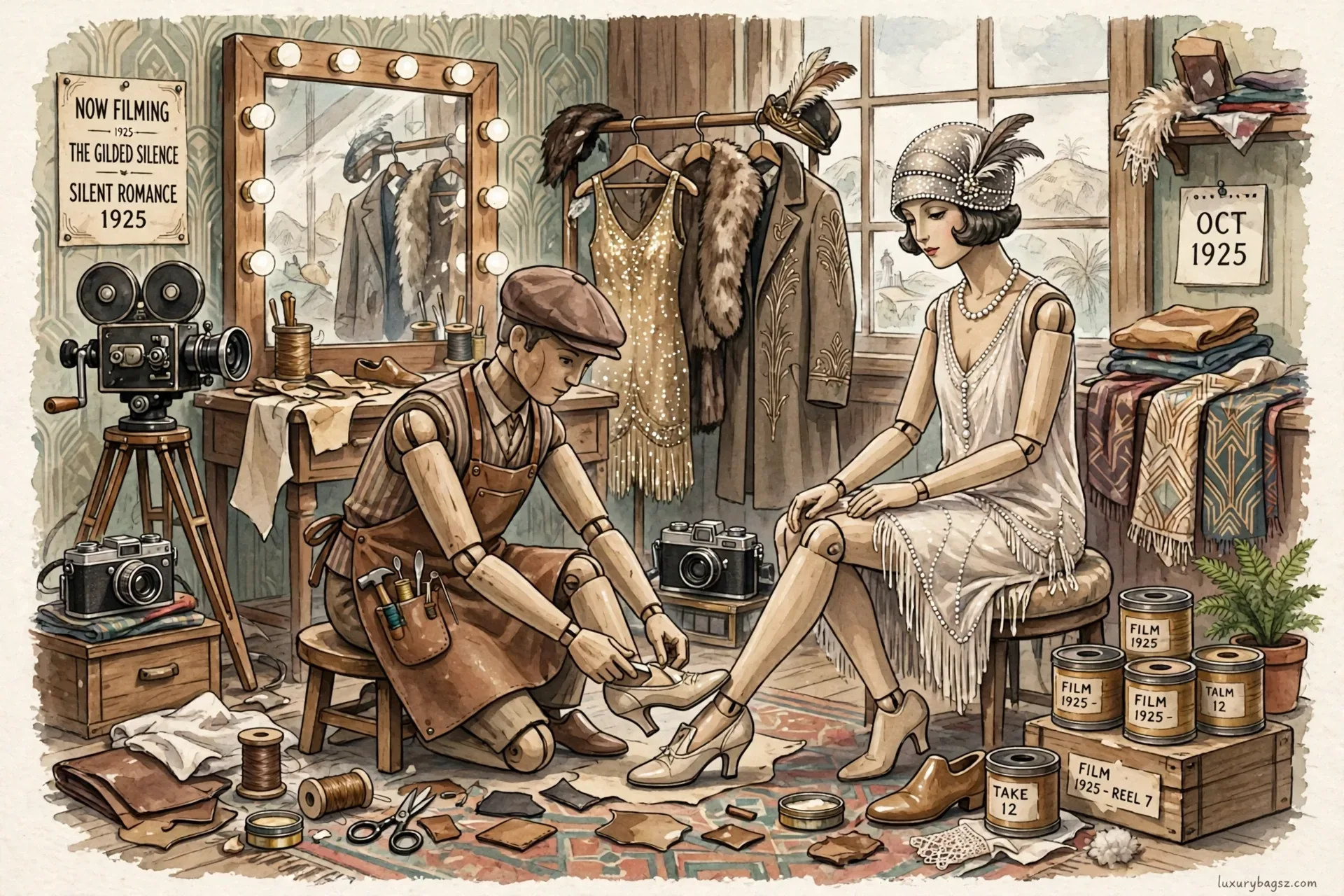
Ferragamo emigrated to the United States as a teenager, first working in a Boston shoe factory, then joining his brothers in Santa Barbara, California. There he made shoes for the American Film Company, and when the film business moved to Hollywood, he moved with it. In 1923 he opened the Hollywood Boot Shop, across from Grauman's Egyptian Theatre, and the press began calling him the shoemaker to the stars.
His clients read like a roll call of the silent era: Gloria Swanson, Mary Pickford, Joan Crawford, Greta Garbo and Rudolph Valentino, among others. He also made shoes for films, including Cecil B. DeMille's The Ten Commandments. The work was custom, theatrical and demanding, and it taught him how a shoe must perform under lights, on camera and through long days on set.
Hollywood also exposed a problem that changed his life's work. His shoes looked beautiful but often hurt. Rather than accept that trade-off, he enrolled in evening anatomy classes at the University of Southern California, travelling long distances to study how body weight falls on the arch of the foot. Comfort, he decided, was an engineering problem, and he intended to solve it.

Return to Florence: The House Is Founded
In 1927, Ferragamo returned to Italy and settled in Florence, founding his eponymous company and opening a factory that combined Florentine artisanal skill with the production methods he had learned in America. The idea was to keep hand craft while organising it efficiently, training apprentices in a system rather than relying on a single pair of hands.
A plain note on dates: most histories give 1927 as the founding year, but some company sources regard 1928 as the foundation date, which is why the house celebrated its eightieth anniversary in 2008. Similarly, sources differ on whether he emigrated in 1914 or 1915. Neither discrepancy changes the story, but buyers and writers should not treat either year as beyond dispute.
The Depression hit the young business hard, and it went bankrupt before rebuilding with a focus on the Italian market. By 1938, Ferragamo was in a position to buy the Palazzo Spini Feroni, the great Florentine palace that still houses the flagship store and the Museo Ferragamo. Recovery, for Ferragamo, meant returning to craft and to Florence.
Inventions That Changed Shoes
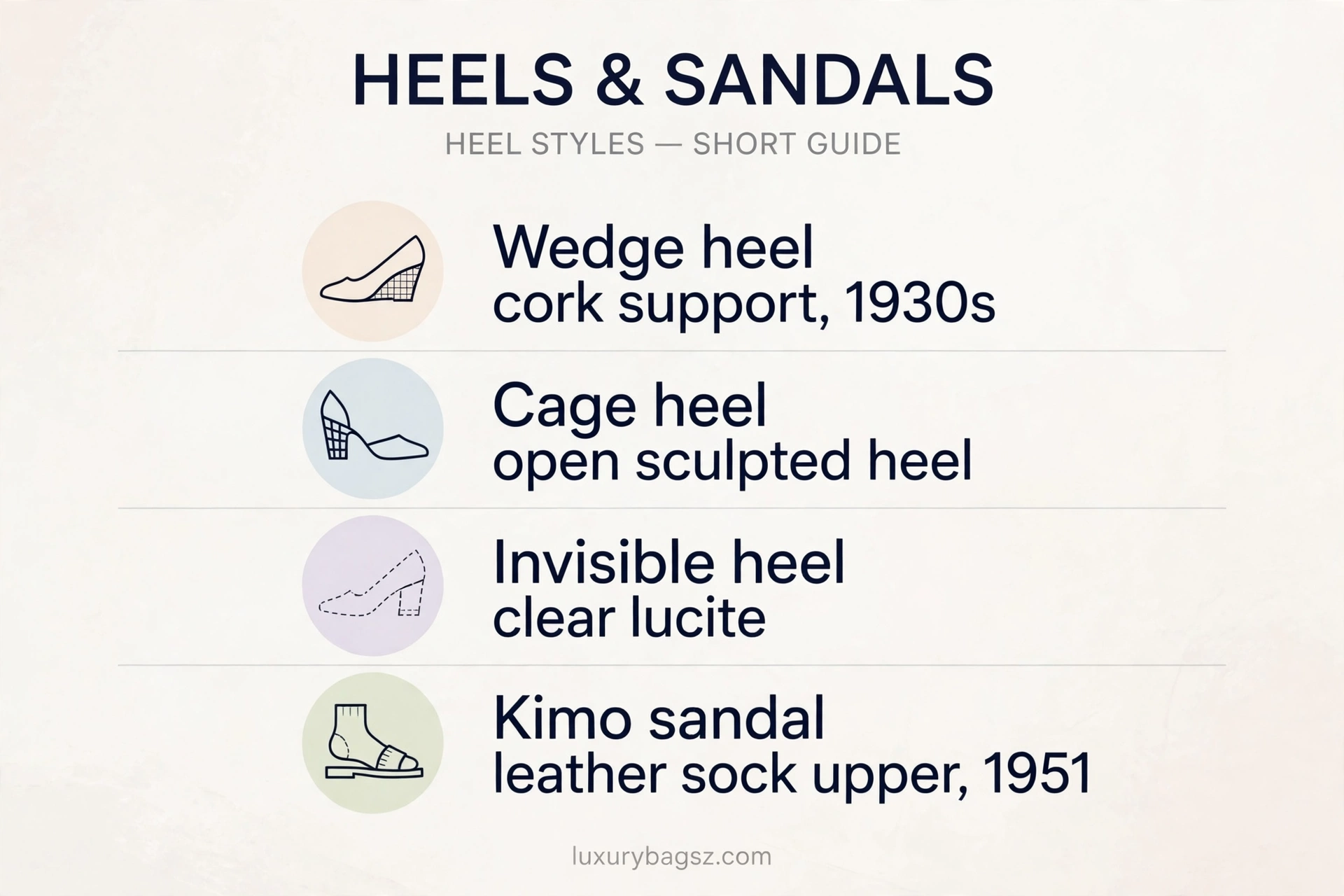
Ferragamo's anatomy studies paid off in a run of inventions that still shape footwear. The wedge heel, developed in the 1930s, spread weight across the whole foot instead of concentrating it on a narrow heel, giving height without the usual punishment. Cork, a material chosen partly because steel was scarce, made the wedge light as well as supportive.
The cage heel followed, an open, sculpted heel that exposed the foot while supporting it, and the invisible heel used clear lucite to give height with nothing visible beneath the shoe. Each invention balanced the same two goals: a striking silhouette and a foot that could actually walk in it. Later, the Kimo sandal of 1951 added a coloured leather sock upper, turning a shoe into something closer to clothing.
These were not gimmicks. They were patented, copied and studied, and they explain why Ferragamo's reputation survived fashion cycles. When you try on a Ferragamo shoe today, you are testing ideas that were worked out on an anatomy chart nearly a century ago.
The Rainbow Sandal and Post-War Triumph
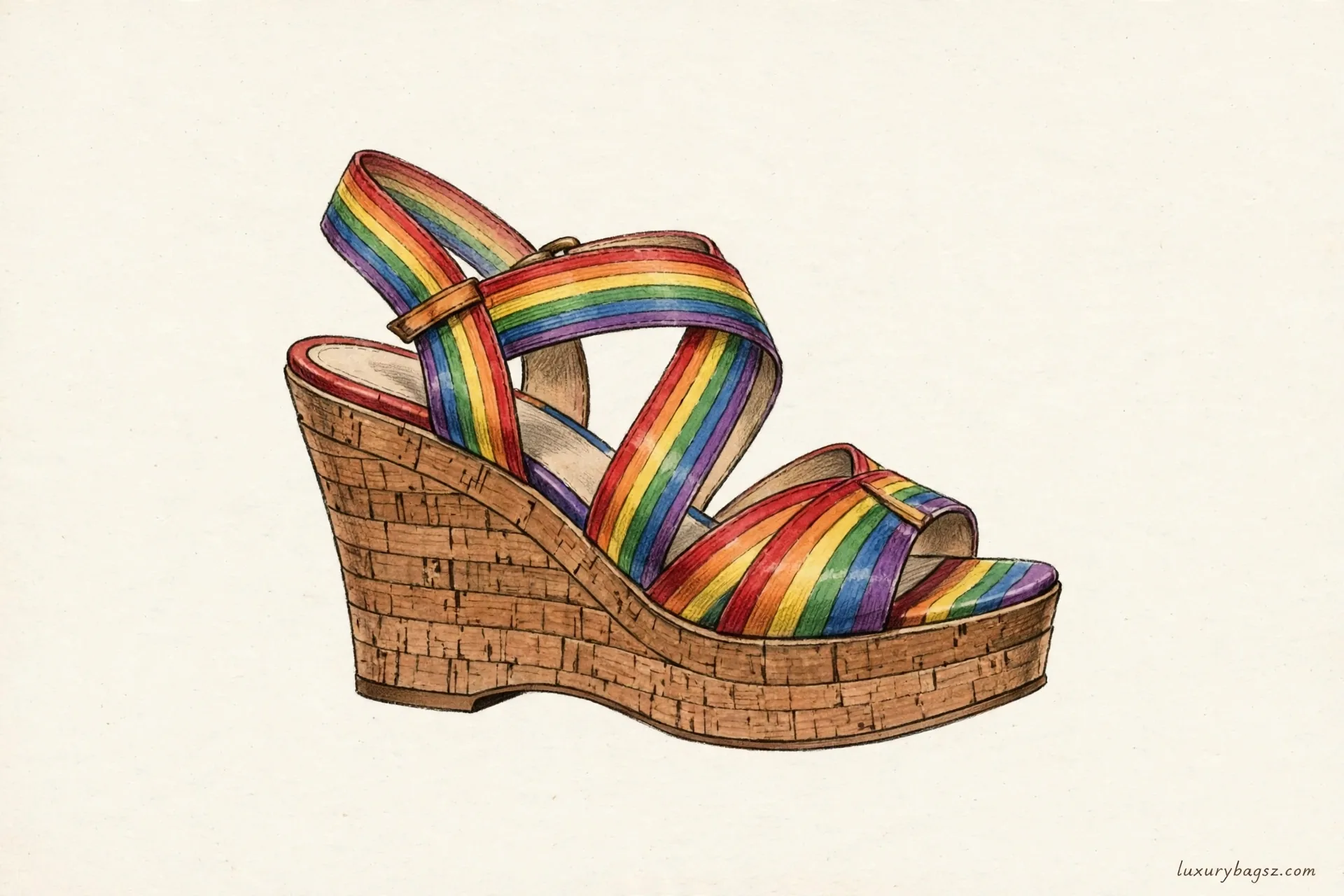
The years after the Second World War were Ferragamo's greatest period. In 1938 he had already created the Rainbow sandal, a platform sandal with multicoloured suede straps and a cork wedge, made for Judy Garland. It became an icon of joyful, inventive design, and it remains one of the most reproduced Ferragamo models in exhibitions and retrospectives.
In 1947, Ferragamo won the Neiman Marcus Award for distinguished service in the field of fashion, the first of many honours that recognised him as a designer rather than merely a tradesman. His post-war clients included Audrey Hepburn, Marilyn Monroe, Sophia Loren and Ingrid Bergman, and his ballet flats for Hepburn became a defining image of 1950s elegance. Her own wardrobe is decoded in our Marilyn Monroe style file.
The lesson of this period is worth noting for collectors. Ferragamo's most famous shoes were not red-carpet novelties; they were working shoes for working performers, designed to be worn, danced in and filmed. That is why vintage pairs, when well kept, still look modern: they were built around the foot, not around a season.
Wanda and the Family House After 1960
Salvatore Ferragamo died in 1960, aged 62. His wife Wanda, whom he had married in 1940, took over the company and led it for nearly six decades, until her death in 2018. Under her, the house grew from a shoe business into a full luxury house with handbags, ready-to-wear, accessories and fragrances, while remaining majority family-owned.
The children joined the business across its divisions, and the house went public on the Italian stock exchange in 2011 while the family kept a majority stake. That balance, public capital with family control, is unusual in luxury and it kept Ferragamo's identity stable through changing creative directors and fashion cycles.
Wanda's achievement deserves emphasis because it is often underplayed. She did not merely preserve her husband's legacy; she expanded it into a global brand without losing the Florentine craft base. The museum she helped establish in 1995, now the Museo Ferragamo, preserves the archive that makes the house's history visible to the public.
Ferragamo Today: Bags, Ready-to-Wear and the Museum
Today Ferragamo, which now trades simply as Ferragamo, is a full luxury house headquartered in Florence, with footwear and leather goods still at its core. Recent creative direction under Maximilian Davis has leaned back into the house's film roots, with short films and collections that revisit the Hollywood story for a new generation.
The handbag line has grown in importance alongside shoes, and the house's Vara bow pump, Gancini hardware and studio bags give buyers entry points beyond footwear. The Vara pump, with its grosgrain bow, remains the house's most recognisable shoe after the Rainbow sandal, and it illustrates Ferragamo's balancing act: a design from 1978 that still looks current because its proportions are restrained rather than fashionable. Gancini, the double-hook hardware drawn from the Palazzo Spini Feroni's ironwork, plays a similar role across bags and accessories, giving the house a quiet signature that does not shout.
For shoppers weighing Italian houses against each other, our Prada guide and Gucci guide offer useful comparisons, and our vintage vs new bags guide helps decide whether to buy a current or pre-owned piece.
A visit to the Museo Ferragamo in the Palazzo Spini Feroni is the best single introduction to the house. The archive holds thousands of models, including shoes made for stars, and rotating exhibitions connect the founder's inventions to contemporary design. If you cannot visit, the house's foundation site tells the founder's story in his own archive's words.
Buying Ferragamo: Fit and Pre-Owned Checks
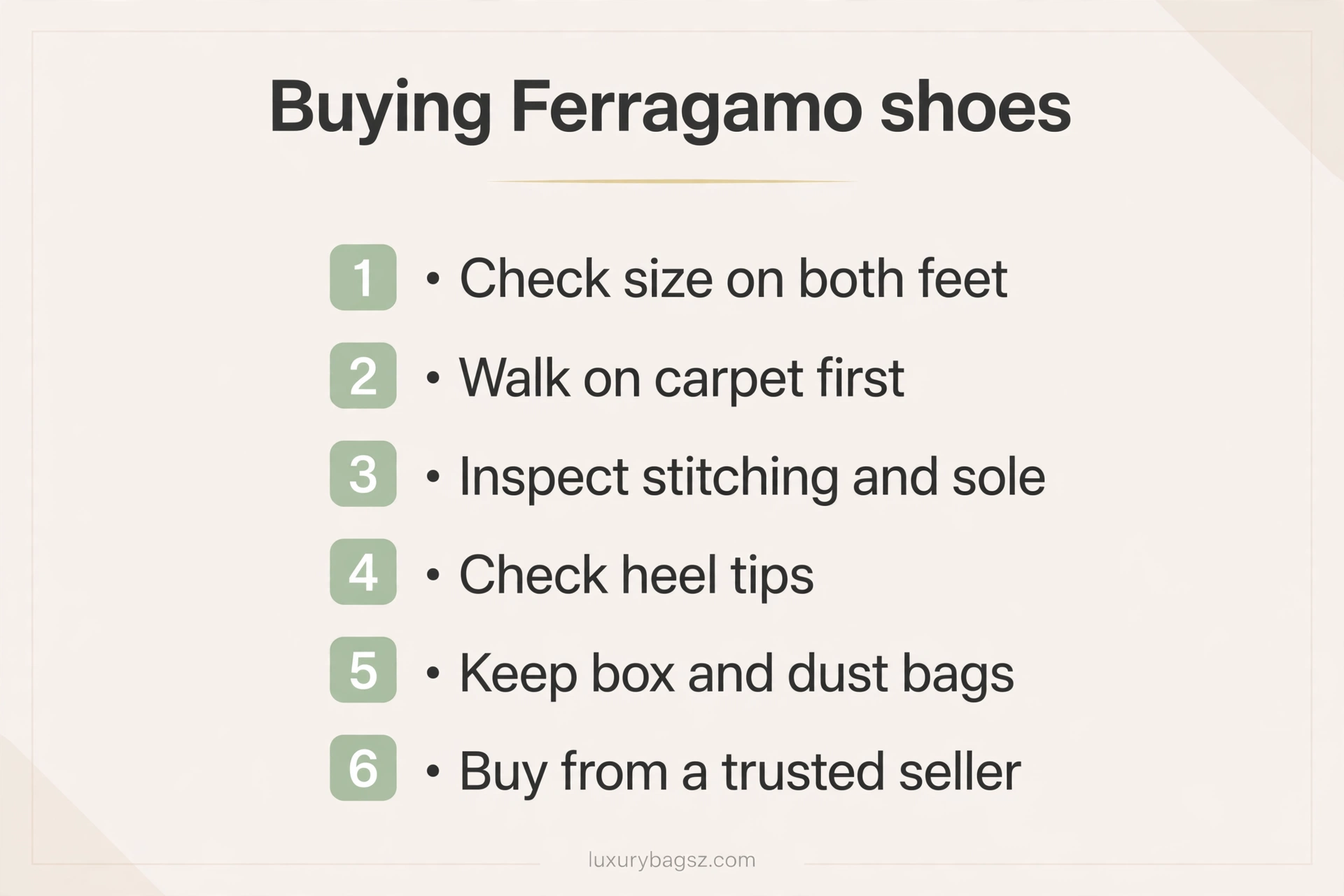
Fit comes first with Ferragamo, as the founder would have wanted. Try both feet, walk on carpet before committing, and remember that Italian sizing can run narrow, particularly in pumps and ballet flats. A shoe that pinches in the shop will not improve with wear, however beautiful it looks.
For pre-owned shoes, inspect stitching, soles and heel tips, and check for replaced insoles or repairs that change the fit. Keep the box and dust bags, since completeness supports resale value. For leather care, our leather bags and shoes care guide covers cleaning and conditioning, our shoe care kit guide lists what you actually need, and our new shoes care guide explains how to protect a pair before its first wear.
If this is your first designer shoe purchase, our first designer shoes guide walks through budgeting and fit, and our Jimmy Choo sizing guide shows how sizing logic differs between houses. With Ferragamo, the right question is never just whether a shoe looks good; it is whether your foot agrees.
Three mistakes deserve special attention. First, buying your usual size without trying the style: Ferragamo lasts vary, and a size that fits a loafer may pinch in a pump. Second, judging a shoe unworn: leather shoes reveal their fit only after a few minutes of walking, so take time in store rather than deciding at a glance. Third, neglecting heel tips: worn heel tips change your gait and damage the shoe, yet they cost little to replace if caught early. Check them before every season and replace them before they wear to the heel itself.
Ferragamo vs Its Italian Rivals: Where the House Wins
Italian luxury offers several answers to the same question, and Ferragamo's answer is the quietest. Against Gucci, the contrast is volume: Gucci sells maximalist glamour, logomania and runway theatre, while Ferragamo sells restraint, craft and shoes engineered around the foot. A buyer who wants to be noticed across a room may choose Gucci; a buyer who wants to walk across that room in comfort may choose Ferragamo.
Against Prada, the contrast is intellectual. Prada's genius lies in subverting good taste, pairing ugly-chic materials with brilliant ideas. Ferragamo rarely subverts anything; it refines. Its innovations serve the foot rather than the argument, and its designs age more slowly because they were never trying to shock. That makes Ferragamo the safer long-term wardrobe investment, though rarely the most exciting headline.
Against Tod's and other Italian shoemakers, Ferragamo wins on invention and archive. Few houses can point to patented heels, a Hollywood origin and a museum of thousands of models. Tod's driving shoe is a masterpiece of casual luxury, but it does not carry Ferragamo's story of anatomy, film and Florentine craft in a single pair.
Ferragamo also differs from its rivals in how it treats its founder. Gucci and Prada are defined by creative directors who reinvent the house each decade; Ferragamo is defined by a shoemaker whose ideas still shape its lasts and heels. That continuity is a strength for buyers who value consistency, and a weakness when fashion wants novelty, which is why recent creative direction has leaned so hard on the film archive.
So what should you buy first? For shoes, a Vara pump or a pair of loafers gives the house's comfort engineering in its most wearable form. For bags, a Gancini studio bag offers the signature hardware without the price of a top-tier tote. For collectors, vintage Rainbow-inspired sandals and well-kept 1950s-style pumps are the pieces that tell the story. Whatever you choose, fit it properly, keep the box, and remember the founder's rule: a beautiful shoe that hurts is an unfinished design.
Breaking in deserves a final word, because even well-fitted leather shoes need patience. Wear new pairs indoors for short periods first, letting the leather mould to your foot before committing to a full day. Use shoe trees between wears to hold the shape and absorb moisture, and rotate pairs so no single pair carries two days in a row. Heel tips and soles wear faster on hard pavements, so a cobbler's check once a season prevents small wear from becoming structural damage. Many Ferragamo styles can be resoled, which extends their life far beyond fashion shoes built to be discarded. That repairability is part of what you pay for, and it is worth using rather than leaving a good pair to wear out.
Prices, Sizes and What to Expect to Pay
Ferragamo pricing sits in the upper-mid luxury bracket, below the most expensive French houses but firmly above high-street designer labels. Shoes are the core purchase: ballet flats, loafers and Vara pumps form the accessible tier, while hand-finished styles, exotic materials and limited editions move higher. Handbags follow a similar ladder, with small leather goods and studio bags below larger totes and top-handle styles.
Sizing is the detail that most often trips up first-time buyers. Italian shoes frequently run narrow, and Ferragamo's lasts vary between styles, so a size that fits in a loafer may pinch in a pump. Where possible, try the exact style rather than trusting a previous Ferragamo size, and remember that leather stretches slightly with wear but never enough to fix a genuinely tight fit.
Pre-owned Ferragamo offers strong value, particularly for classic pumps and loafers in neutral colours, which resell steadily when well kept. Fashion colours and extreme heel heights resell more slowly, so buy those for love rather than investment. As with all pre-owned shoes, inspect soles, heel tips and insoles closely, and budget for a cobbler's attention if the pair needs new heel tips or edge dressing.
Frequently Asked Questions
When was Salvatore Ferragamo founded?
Salvatore Ferragamo returned to Florence and founded his house in 1927, although some company sources give 1928 as the foundation date.
Who was Salvatore Ferragamo?
Salvatore Ferragamo (1898–1960) was an Italian shoemaker who dressed Hollywood stars in the 1920s and founded the Florence luxury house that bears his name.
What is Ferragamo famous for?
Ferragamo is famous for the wedge heel, the cage heel, the invisible lucite heel, the Rainbow sandal and the Kimo sandal, plus shoes made for stars such as Audrey Hepburn and Marilyn Monroe.
What is the Hollywood Boot Shop?
The Hollywood Boot Shop was Ferragamo's shop opened in Hollywood in 1923, where he made custom shoes for film stars and earned the nickname shoemaker to the stars.
What is the Rainbow sandal?
The Rainbow sandal, created in 1938 for Judy Garland, is a platform sandal with multicoloured suede straps and a cork wedge heel, now a Ferragamo icon.
Who led Ferragamo after Salvatore's death?
His wife Wanda Ferragamo led the company from 1960 until her death in 2018, expanding it from shoes into a full luxury house.
Where is Ferragamo headquartered?
Ferragamo is headquartered in Florence, Italy, with its flagship store and museum in the Palazzo Spini Feroni.
Do Ferragamo shoes run true to size?
Ferragamo sizing can run narrow, especially in pumps and flats. Always try both feet and check the house's current size guidance before ordering online.
Is Ferragamo still family-owned?
The Ferragamo family remains the majority shareholder, even after the company went public on the Italian stock exchange in 2011.
What is the Museo Ferragamo?
The Museo Ferragamo, opened in Florence in 1995, preserves the founder's archive and shoe models and hosts exhibitions on the house's history and design.
Summary: Craft, Comfort and Stardust
Salvatore Ferragamo's story runs from a borrowed pair of tools in Bonito to the feet of Hollywood royalty and back to a palace in Florence. He proved that a beautiful shoe could also be a comfortable one, and his family proved that a founder's workshop could grow into a global house without losing its craft. Buy for fit first, keep the box, and you will understand why his shoes still walk out of the museum and into daily life. Whether you start with a Vara pump, a loafer or a Gancini bag, choose the piece your foot and your wardrobe both agree on, and care for it properly. That is the closest a buyer can come to the founder's own standard, and it is a standard worth keeping.