Everyday Diamond Jewelry: The Designs That Made Diamonds Wearable
Diamonds You Can Actually Wear Every Day
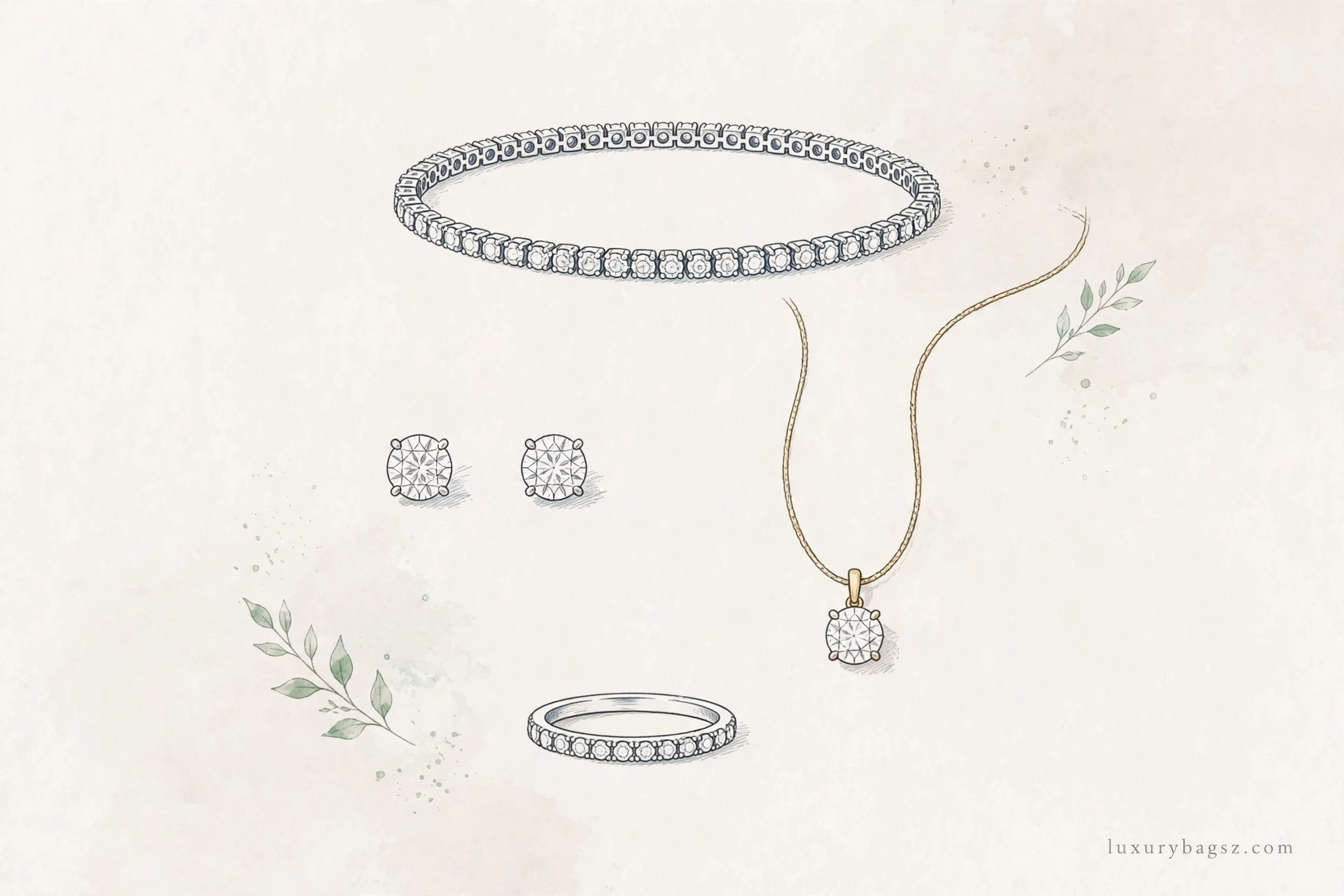
The best everyday diamond jewelry disappears into your day and only announces itself when it catches the light. That is the whole trick behind the designs in this guide: tennis bracelets that flex with the wrist, studs that frame the face, and bands that carry diamonds all the way around the finger. None of them need an occasion.
Diamonds were once occasion jewelry, kept in a box for evenings and weddings. Designers changed that by simplifying settings, slimming profiles and letting single stones or clean lines do the work. The result is a small set of proven designs that suit work, weekends and evenings alike.
Buy for your real life, not a fantasy one. A bracelet that snags on a keyboard, a ring you cannot type in, or a necklace that flips constantly will live in the box no matter how beautiful it is. Comfort, secure settings and sensible carat weights matter more than total sparkle.
Key Takeaways

- Tennis bracelets, riviere necklaces, studs, eternity bands and hoops are the core everyday diamond designs.
- Flexible, articulated settings are what make diamond bracelets comfortable for daily wear.
- Stud pairs must match in color, size and face-up appearance, not just carat weight.
- Full eternity bands are hard to resize, so sizing must be right before you buy.
- Bezel and low-profile prong settings survive daily life best; high claws snag and loosen.
- Signed designs add history, but an unsigned piece can be just as well made.
The Tennis Bracelet: Diamonds in Motion
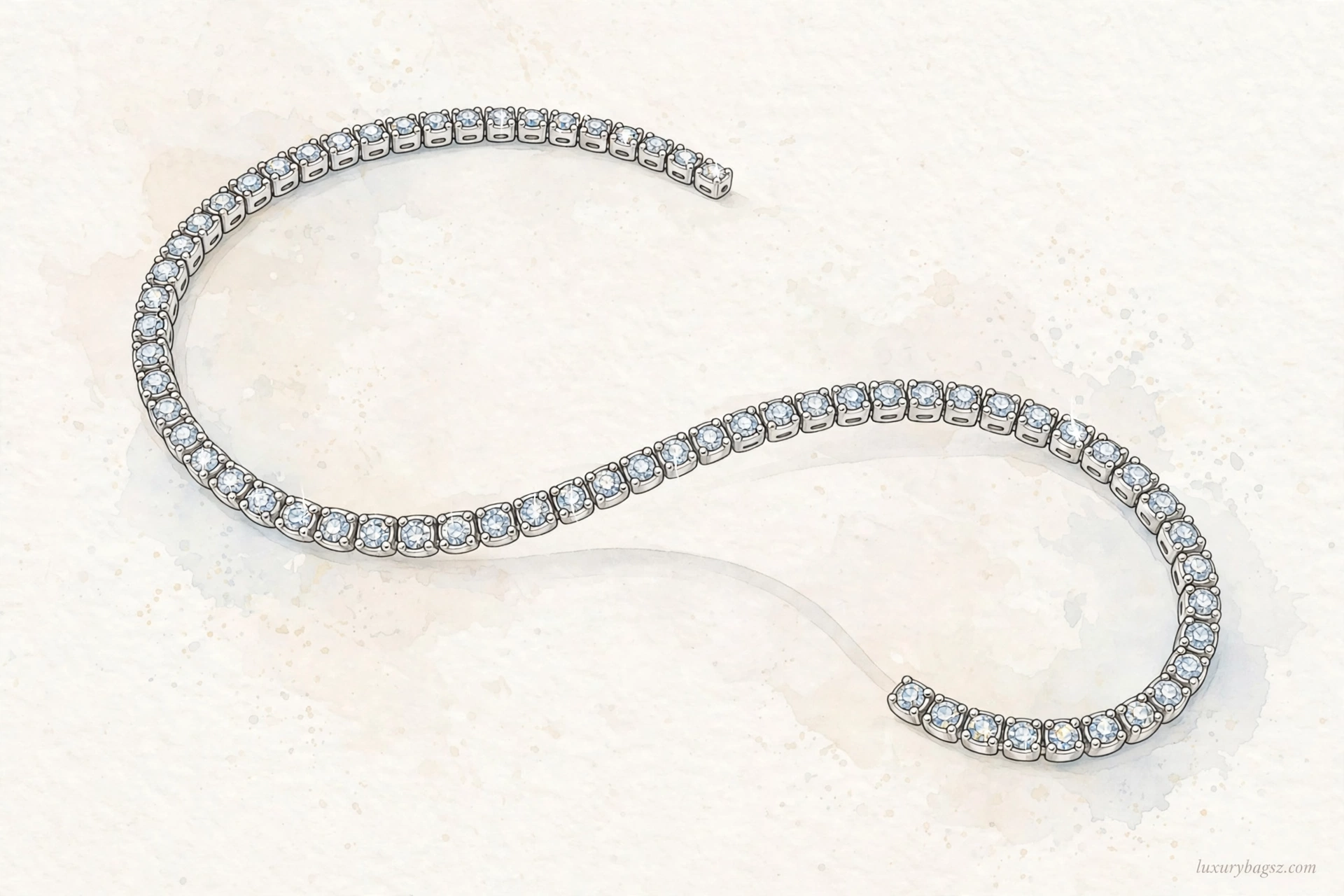
Long before the name tennis bracelet existed, diamond line bracelets were prized for their continuous row of stones. Unlike a rigid bangle, the articulated links follow the wrist, so substantial diamonds feel easy rather than stiff. The modern name came later, through tennis champion Chris Evert, whose diamond bracelet famously came loose during a match at the 1987 US Open.
Construction decides quality here. Look for closely matched stones, links that move smoothly without twisting, and a clasp with a safety catch. A well-known example, a Cartier platinum tennis bracelet set with 38 round brilliant-cut diamonds totaling about 10 to 11 carats, shows the standard: matched stones and flexible platinum work creating one unbroken line of brilliance.
For daily wear, slimmer is smarter. A total weight of 1 to 2 carats suits most everyday contexts, while 3 to 5 carats reads as a clear statement piece. Aim for color consistency across the stones, ideally D to H, since variance shows quickly in a continuous line.
SI1 to SI2 clarity is the usual value sweet spot, with VS2 and above for premium pieces. Also check the bracelet's flexibility on your own wrist before buying: it should drape in a smooth curve, not kink or hold a stiff shape when lifted.
From the Riviere to the Tennis Necklace
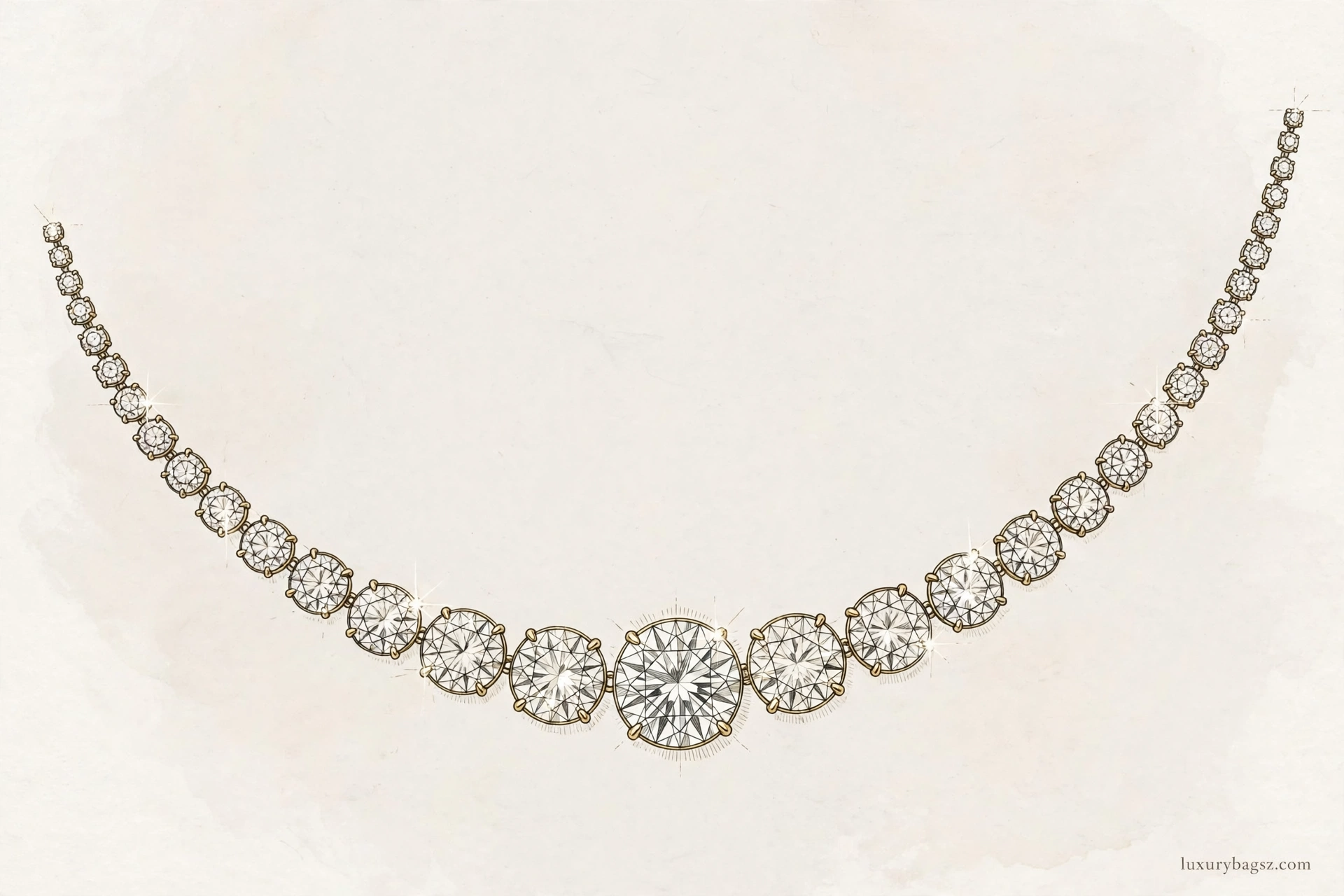
The diamond riviere has been a fixture of fine jewelry since the 18th century: a continuous line of diamonds, often graduated in size toward the center, with settings designed to hide the metal. The modern tennis necklace follows the same principle, with more consistent cutting and more flexible links.
Graduation changes the character completely. A graduated riviere, like a Tiffany Victoria example at 16 inches with marquise-cut diamonds accenting the clasp, sits close to the neck and draws the eye inward. A uniform necklace of consistent stones, such as a 20-inch piece with 35.55 carats averaging 0.25 carat each, reads as a steady, even line of light.
Length is a practical decision. Sixteen to 18 inches suits most necklines and layers well under a collar, while 20 inches sits lower and suits open necklines. Check the clasp as carefully as the stones: a necklace is only as safe as its weakest link, and a worn clasp is the most common reason a necklace is lost.
Clasp styles vary, and each has a trade-off. A hidden box clasp with a safety catch is the most secure everyday choice, while a simple spring ring is easier to fasten alone but wears faster. Try fastening the necklace yourself before buying, since a clasp you struggle with will discourage wearing.
Diamond Studs: The Importance of the Pair
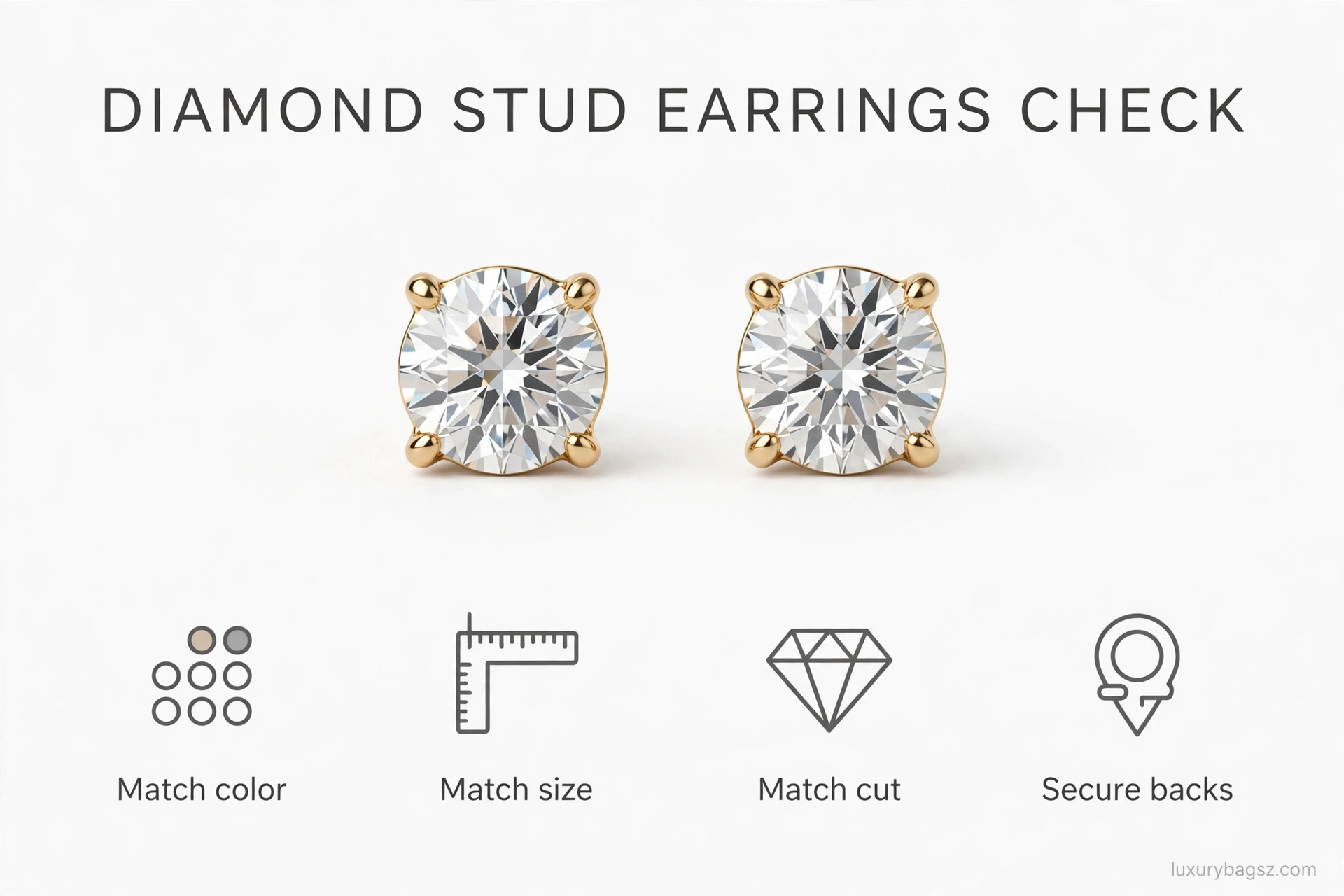
Studs look simple, which is exactly why they are hard to make well. Two stones must appear identical on the ears, and any difference in color, size or cut shows at once. Matching carat weight alone is not enough; the stones need compatible face-up dimensions, color and proportions.
A real-world pair makes the point: platinum cushion-cut studs weighing 2.18 and 2.02 carats, both graded G color by GIA, work as a pair despite different clarity grades of VS1 and VVS1. The shared color and shape matter more than identical paperwork. Always view a pair side by side, face-up, in daylight before buying.
Size guidance is straightforward. About 0.25 to 0.50 carat per ear suits most everyday contexts, while 0.75 to 1.0 carat makes a clear statement without becoming occasion-only. Screw backs are the safest daily choice, and round brilliant cuts remain the most popular for maximum light return, though oval and pear studs are gaining ground.
Backs deserve as much thought as stones. Screw backs stay put during sleep and exercise, while push backs with a secure notch are quicker to remove. If you have metal sensitivities, confirm the post metal matches the setting, since mixed-metal posts cause most earring irritation.
Eternity Bands: Diamonds All the Way Around
The eternity band takes the diamond line and carries it around the entire finger. Once tied to weddings and anniversaries, it now stands as a ring in its own right, worn alone or stacked. Earlier examples used small round or baguette diamonds set closely together, while modern versions use larger stones and bolder profiles.
Shape drives the look. Round brilliants give a uniform, classic rhythm; baguettes give a sleek, architectural line; oval stones, such as a band of 13 ovals at about 1.01 carats each, create an elongated, more dramatic effect. The trade-off is profile: larger stones sit higher and catch on things more easily.
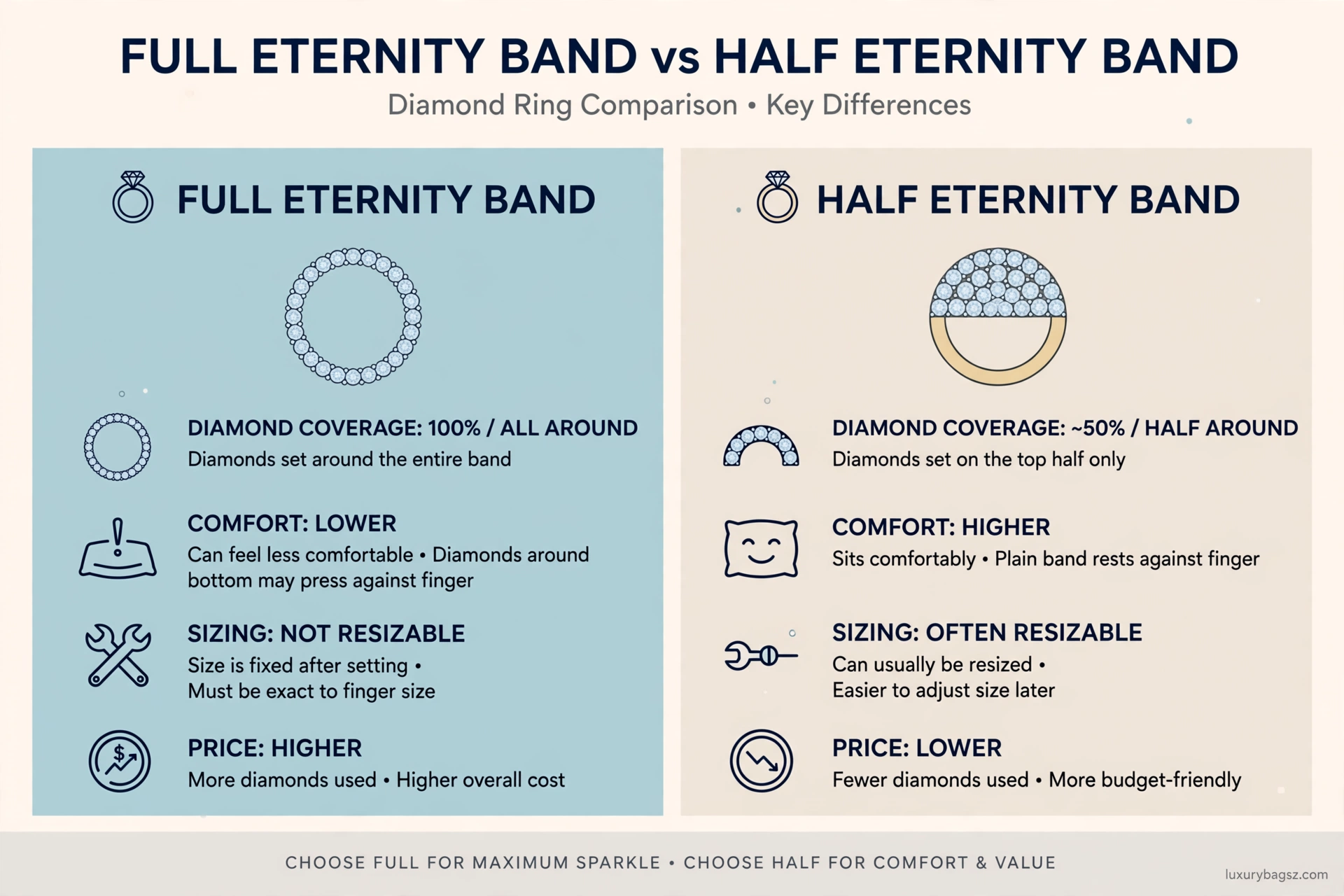
Sizing is the critical warning. Full eternity bands are difficult to resize without disrupting the continuous setting, so get sized properly, ideally at the time of day when your fingers are warmest. If your finger size fluctuates, consider a half-eternity band, which carries diamonds across the top only and can be resized more easily.
Stacking an eternity band with a wedding band works best when the metals match and the profiles are similar. A high-profile eternity ring next to a flat wedding band rocks and wears both rings faster, so try the pair together before committing to either.
Diamonds by the Yard, Hoops and Buying Pre-Owned
In 1976, Elsa Peretti changed diamond jewelry with Diamonds by the Yard for Tiffany & Co. Instead of a continuous line, she placed bezel-set brilliant-cut diamonds spaced along fine chains, leaving air between the stones. The design made diamonds feel intimate and casual, and it still influences station necklaces today.
Diamond hoops took a different route to everyday wear. Rather than concentrating on one stone, hoops spread diamonds along a curve so they catch light as you move. Inside-out settings place stones on the front and back of the hoop, keeping them visible from several angles. Mini hoops suit daily wear; larger hoops belong to evenings.
Pre-owned pieces deserve a serious look, since everyday designs change slowly and a well-kept bracelet or necklace loses little by being secondhand. Check clasps, prongs and links under magnification, and ask for any available reports.
Read our guide on how to resell luxury jewellery so you understand what holds value if you ever sell. Signed Peretti pieces carry a premium for their design history, but unsigned quality should never be dismissed.
Settings, Metals and Daily Care
Settings decide whether a piece survives everyday life. Bezel settings, which wrap metal around the stone's edge, protect best and snag least, making them ideal for active days. Low-profile prong settings show more stone while staying practical; tall, exposed claws catch on fabric and loosen faster.
Metal choice is mostly about lifestyle and skin tone. Platinum is heavy, durable and naturally white, while 18k white gold is lighter and usually less expensive but may need replating over time. Yellow gold warms a diamond's appearance, which suits lower color grades, while mixed metals are now fully accepted, so nothing needs to match perfectly.
Travel changes the routine slightly. Carry diamond jewelry in a small roll with separate compartments, never loose in a bag where pieces grind together. Keep the roll in hand luggage, and leave anything you would be devastated to lose at home rather than in a hotel safe.
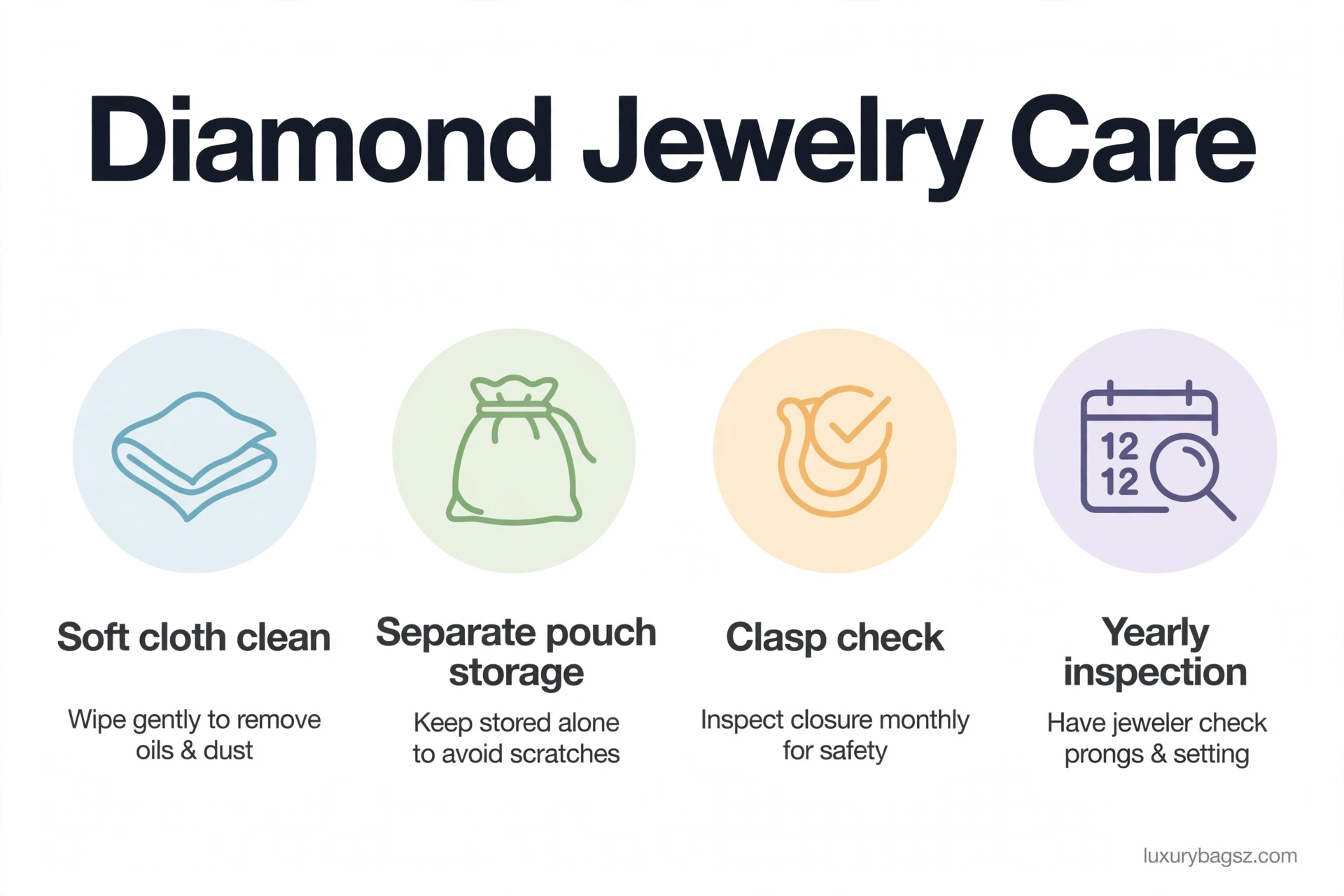
Care is simple and regular. Clean with warm water, mild soap and a soft brush, then dry with a lint-free cloth. Store each piece in its own pouch so diamonds cannot scratch each other or softer stones.
Check clasps monthly and have prongs inspected yearly. Our guide to cleaning diamond rings covers the routine, and our gemstone jewelry care advice applies to any colored-stone pieces worn alongside diamonds.
Building Your Everyday Collection in Order
Start with studs, then add a bracelet, then a necklace, then a ring. That order follows how often each piece gets worn and how much styling effort it demands. Studs need no decisions, a tennis bracelet needs only a wrist, a necklace needs a neckline plan, and a ring needs the most thought about comfort and hand use.
Stacking works when one piece leads and the rest support. Pair a tennis bracelet with a plain gold bangle, not with another diamond line that competes for attention. Layer a station necklace over a solitaire pendant at a different length, keeping at least two inches between chains so they do not tangle. On the hands, wear an eternity band alone or with a plain wedding band, and save full diamond stacks for evenings.
Budget in tiers rather than buying everything at once. A sensible first tier is studs plus a slim bracelet in white gold or platinum. A second tier adds a station necklace and a half-eternity band. A third tier, for collectors, adds a graduated riviere or a signed Peretti piece. Each tier should feel complete on its own, so the collection never looks half-finished.
Workplaces and lifestyles should shape the order too. If you type all day, postpone high-profile rings and put the budget into bracelets and necklaces. If you work with your hands, bezel-set studs and a low-profile band will outlast anything with tall claws. The best collection is the one that survives your calendar, not the one that photographs best.
Revisit the collection once a year and retire what you no longer wear. Pieces that sit unworn for a year are candidates for resetting, restyling or selling, and the budget they free can fund the next tier. A collection that evolves with your life stays loved, while a static one slowly becomes a box of obligations.
Resetting is often the smartest use of an unworn piece. A diamond from a dated ring can become a modern pendant, and stones from a broken bracelet can become studs. Work with a jeweler who returns your original stones and documents the new setting, so the piece keeps its history.
Gift-giving follows the same order as collecting. Studs suit almost any recipient, a bracelet suits a milestone, and a rivière suits a major occasion. When in doubt, choose the simpler piece: it will be worn more often, and wearing is what makes diamond jewelry worthwhile.
Above all, wear what you buy. Diamond jewelry earns its keep on the wrist, the ear and the neck, not in a box, and the pieces you reach for daily are the ones worth investing in first.
Frequently Asked Questions
What is the most versatile everyday diamond piece?
Diamond studs, for most people. They suit work, weekends and evenings, pair with everything, and need no styling decisions. A tennis bracelet is the next most versatile choice.
How much should a first tennis bracelet weigh in total?
A total of 1 to 2 carats covers everyday entry-level wear well. Mid-range pieces run 3 to 5 carats, and 6 carats and above moves into heirloom territory.
Why is my tennis bracelet twisting on my wrist?
Twisting usually means the links are worn, unevenly sized or poorly articulated. A well-made bracelet should drape smoothly and return to position without constant adjustment.
Do stud earrings need identical clarity grades?
No. Matching color, size and face-up appearance matters far more. A VS1 and a VVS1 stone can look identical as a pair, as the cushion-cut example in this guide shows.
Can a full eternity band be resized?
Rarely, and never easily. Resizing disrupts the continuous setting, so accurate sizing before purchase is essential. A half-eternity band is the safer choice if your size changes.
Are bezel settings better than prong settings for daily wear?
For protection, yes. Bezels guard the stone's edge and snag less, while prongs show more of the stone. Low-profile prongs are a good middle ground for most wearers.
What length tennis necklace should I choose?
Sixteen to 18 inches suits most necklines and layers neatly. Twenty inches sits lower and works better with open necklines or as a standalone piece.
Is a signed everyday diamond piece worth the premium?
Only when the signature represents a real design, like Peretti's Diamonds by the Yard. Craftsmanship and diamond quality matter more than a name on an ordinary line bracelet.
Can I wear diamond jewelry to the gym?
Better not to. Sweat, impact and equipment all risk stones and settings, and a lost stone is rarely covered. Save diamonds for the rest of the day. If you must wear a ring while exercising, choose a low-profile bezel-set band and remove bracelets and necklaces first.
How often should everyday diamond jewelry be inspected?
Have prongs, clasps and links checked by a jeweler once a year, and check clasps yourself monthly. Catching a loose stone early is far cheaper than replacing one.
Conclusion: Start With One Piece You Will Reach For Daily
The smartest everyday diamond collection starts with a single piece you genuinely wear: studs for most people, a slim tennis bracelet for others, a station necklace for layering lovers. Buy the best construction you can afford, keep the profile low, and let the piece earn its place by being worn. Diamonds became everyday jewelry through good design, and good design is still what separates the pieces you live in from the pieces you store.