

What Is the Hermès Kelly Bracelet vs Kelly Belt? The Padlock Look, Two Very Different Objects
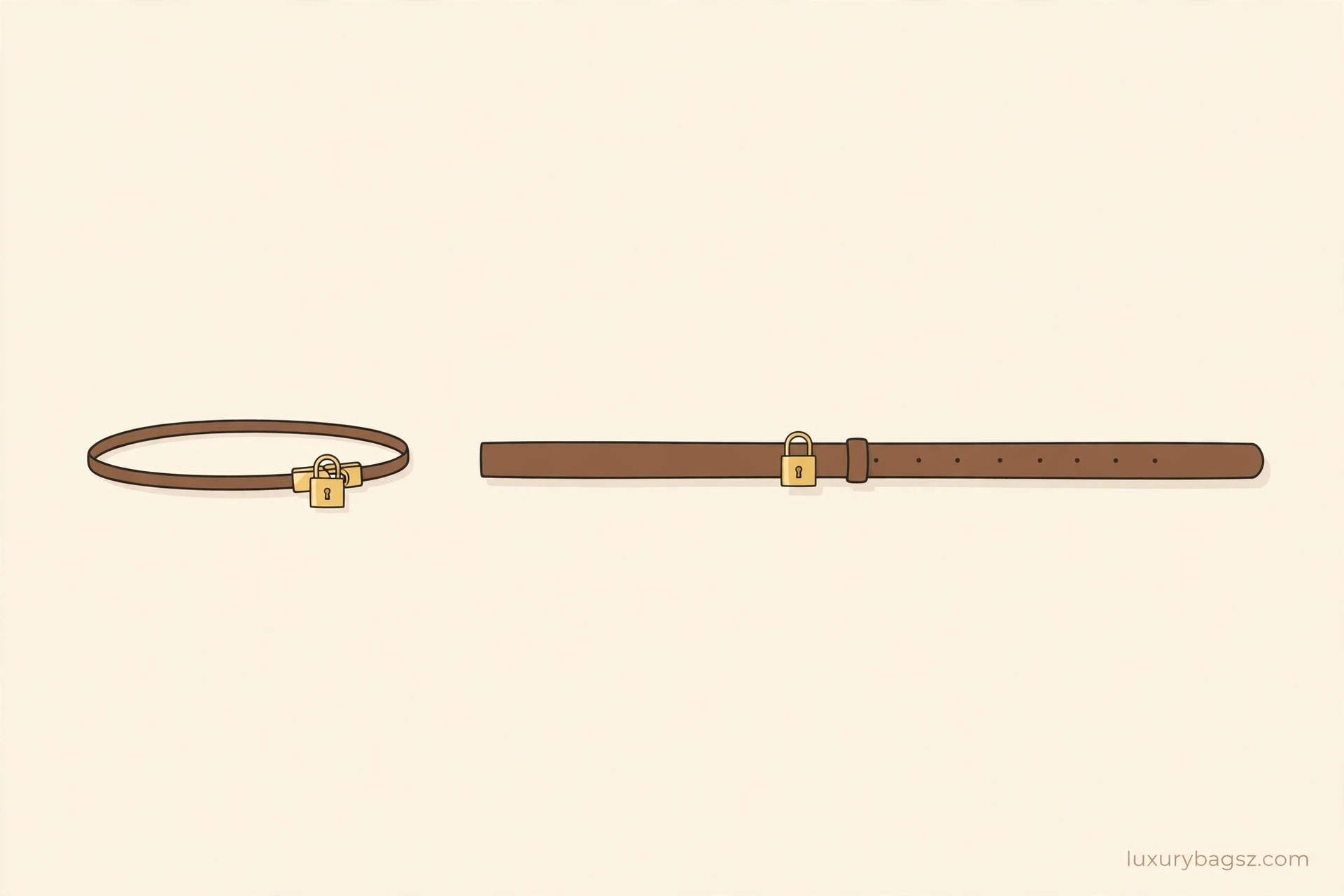
Wrist or Waist: The Kelly Difference in Plain Terms
A Kelly bracelet is purely decorative: a slim leather strap for the wrist, fastened with a padlock-style clasp. A Kelly belt does a job at the waist or hip, shaping clothing with a padlock buckle — and in Pocket form it can also carry small essentials.
That difference drives everything else, from length to how you measure. The classic Kelly 18 belt, 18 mm wide, adjusts by sliding and is single-sided. Reversible kits with interchangeable straps in widths such as 13 mm and 24 mm belong to the H buckle system, not to this belt, however a listing describes it.
Introduction
This guide draws the line cleanly, and then fills in everything that short guides leave out. It starts with the shared ancestor, the Kelly bag and its padlock, because that is where both objects get their look and their name. It then takes the bracelet apart, piece by piece: the leather strap, the padlock-style closure, the double-wrap versions, and the lookalikes that share the Kelly name but are not leather-strap bracelets at all. It does the same for the belt: the Kelly 18, the Kelly Pocket 18 with its removable pouch, and the related names that get tangled into listings.
It compares the two side by side, covers materials and hardware without blurring plated and solid metal, explains sizing for a wrist and sizing for a waist as two different jobs, shows how each one is actually worn, gives prices only as single-listing examples with their limits stated, lists what to check before buying pre-owned, and ends with care, because a leather bracelet and a leather belt do not age in the same way even when they are made from the same leather.
One warning belongs at the front, because it changes how you should read several listings you will meet. Some guides and some briefs describe the Kelly belt as a reversible strap sold as a buckle-and-strap kit in 13 mm and 24 mm widths. That description mixes two different Hermès belt systems together. The classic Kelly 18 belt, on the evidence in the Kelly belt section, is a single-sided leather belt with a sliding adjustable fit, not a reversible belt, and it is not the modular kit belt.
The reversible, mix-and-match kit system, with separate buckles and straps in widths including 13 mm, 24 mm, 32 mm and 38 mm, belongs to the H buckle belt, often called the Constance belt. The Kelly name and the H buckle name are not interchangeable, and a listing that promises you a reversible Kelly kit in 13 mm should be checked against the exact model name before you pay. This guide states that disagreement plainly rather than quietly picking one version, and the Kelly belt section sets out the evidence.
A second warning, about pictures, also belongs here. Every picture in this guide is a generic illustration, not a photograph of a real Hermès piece, and none of them should be used as a reference for genuine detail.
The featured illustration, for example, draws the belt strap with punched holes, while the Kelly 18 belt described in this guide adjusts by sliding, not by holes. The words of this guide prevail over anything simplified or wrong in an illustration. Use the pictures to understand what to look at, never as a side-by-side standard for judging a real bracelet or belt.
Key Takeaways
- The Kelly bracelet, in its classic leather form, is a slim leather strap worn on the wrist and closed with a padlock-style clasp. The Kelly belt is a slim leather strap worn at the waist or hip and closed with a Kelly padlock buckle. Same motif, different body part, different job, different sizing.
- The shared ancestor is the Kelly bag: a trapezoidal flap bag designed by Robert Dumas in the 1930s as the Sac à dépêches, renamed for Grace Kelly in 1977. Its padlock, its straps and its little key-holder, the clochette, are the design language both accessories borrow.
- The classic Kelly 18 belt is adjustable by sliding, not by punched holes, and it is single-sided, not reversible. Reversible buckle-and-strap kits in 13 mm and 24 mm widths belong to the H buckle belt system, not to the classic Kelly belt. Do not let a listing sell you one system under the other’s name.
- Bracelet sizing is a wrist job: measure snugly at the wrist bone, add a finger of ease, and allow extra length for a double-wrap. Belt sizing is a waist-or-hip job: measure where the belt will actually sit, over the clothes you will wear it with, and never use a trouser size as a substitute.
- Leather Kelly bracelets in their standard form use gold-plated or palladium-plated brass hardware, not solid gold. Plated finishes are not solid gold or sterling silver, and a “gold” bracelet or belt buckle at a suspiciously low price should be checked, not celebrated.
- Hermès issues no authenticity card as a general rule. A card supplied with a Kelly bracelet or belt is a red flag, never proof, and the same rule runs through our guide to a fake Kelly bag.
- Prices in this guide are single-listing examples only, never averages. A Kelly Pocket 18 belt at $2,125 in one magazine report, a vintage leather Kelly lock bracelet with an estimated retail of $550 in one valuation, and a diamond Kelly bracelet with an estimated retail of $57,200 in another valuation are three different objects at three different moments. Averaging them would produce a number that describes nothing you can buy.
- A bracelet lives in sweat and perfume at the wrist. A belt lives in friction at the waist, over coats and blazers. They need different care, and the care differences section keeps them apart.
The Padlock Look in Brief
What is the difference, in one sentence? A Kelly bracelet is a wrist strap with a padlock-style closure that decorates the wrist, while a Kelly belt is a waist strap with a Kelly padlock buckle that shapes an outfit and, in Pocket form, carries small essentials.
Why do they look alike? Because both borrow the Kelly bag’s hardware. The bag closes with straps, a turn-lock and a padlock, and it carries a small leather bell, the clochette, that holds the padlock’s keys. Shrink that hardware, put it on a slim strap, and you get either a bracelet or a belt depending on how long the strap is and where it is worn. The motif is the same. The object is not.
Which one should you buy first? Buy the one that solves a problem you actually have. If you want a small, quiet piece of Kelly hardware on your wrist every day, buy the bracelet. If you want to cinch a blazer, a dress or a coat, or you want a hands-free pouch without carrying a bag, buy the belt. Buying a bracelet because you liked a belt photograph, or a belt because you liked a bracelet photograph, is the mistake this guide exists to prevent, and it happens more often than sellers admit, because listings for both use almost identical words: Kelly, leather, padlock, gold hardware.
Are they the same leather and the same hardware? Often, yes in kind, no in detail. Both use Hermès calf leathers such as Epsom, Swift and Box, and both use gold-tone or palladium-tone hardware. But a bracelet strap is short, narrow and made to flex around a wrist bone all day, while a belt strap is long, made to slide through loops or sit over a coat, and made to take repeated tension at the buckle. The same leather name does not mean the same strap, and the materials section explains what each leather does well and badly in each job.
Can one be worn as the other? Not in the ordinary sense, and the creative uses in the how-to-wear section prove the rule rather than breaking it. A Kelly 18 belt is long enough to be threaded through a small bag as a strap, wrapped around a hat, or used to anchor a bag to a suitcase, and enthusiasts report all three. Those are hacks that use the belt’s length. A bracelet is far too short to belt a coat, and a belt wrapped twice around a wrist is not a bracelet, it is a belt pretending, and it will look like one.
What is the fastest way to tell them apart in a listing photograph? Look at the length and the ends. A bracelet photograph shows a short strap, often coiled or on a wrist, with a small padlock at the join. A belt photograph shows a long strap, often laid out flat or on a waist, with a padlock buckle at one end and a long tail at the other. If the photograph shows neither a wrist nor a waist and gives no length, you do not yet have enough to buy, whatever the title says.
How much should you expect to pay? There is no honest single answer, for the same reason there is no single Kelly bracelet or single Kelly belt. Leather bracelets sit in a lower price world than diamond-set gold Kelly bracelets, and a plain Kelly 18 belt sits in a different price world from a Kelly Pocket 18 belt with its pouch. The prices section gives real single-listing examples with their limits stated, rather than a made-up average.
Where the Padlock Comes From: The Kelly Bag in Short
You cannot understand either accessory without the bag, because the bag is where the padlock earned its meaning. The story, in its settled outline, runs like this. In the 1930s Robert Dumas, who had married into the Hermès family, designed a trapezoidal top-handled bag with a flap, two side straps and a turn-lock closure. It was called the Sac à dépêches, the dispatch bag, and it was a practical, structured bag for a woman who needed to carry papers and personal items with a certain formality. In the 1950s Grace Kelly, then engaged to Prince Rainier of Monaco, was photographed using one of these bags to shield her pregnancy from photographers. The photograph made the bag famous, and in 1977 Hermès renamed the model for her. That is the Kelly bag, and its hardware, the straps, the turn-lock, the padlock and the clochette that holds the padlock’s keys, became house icons in their own right.
The padlock itself deserves a plain description, because listings use the word loosely. On the bag, the padlock is a small metal lock, often covered in matching leather or left in plain metal, that slips through the turn-lock to secure the flap. It is decorative as much as it is functional: many Kelly owners wear the padlock hanging from the handle or the clochette without ever locking the bag. On the bracelet and the belt, the padlock stops being a lock for a bag and becomes a clasp or a buckle. It still looks like a padlock, with a body and a shackle, but its job has changed. It now holds a strap closed around a wrist or a waist. That change of job is the whole story of both accessories: a piece of bag hardware, removed from the bag, given a strap, and sold on its own.
Two cautions about the history, because competitors’ guides often smooth them over. First, dates for the original bag vary slightly by source: most give the 1930s, some name 1935 for the Sac à dépêches, and the renaming in 1977 is the stable date. A guide that gives you a single day or a single year for the first sketch, with no hedging, is tidier than the record. Second, the Kelly name covers a family, not one bag, and the same is true of the accessories. Kelly Pochette, Kelly Cut, Kelly Danse, Kelly Elan and Kelly To Go are all Kelly bags or clutches with different shapes and sizes, and their names leak into accessory listings. When a belt listing says “Elan Pocket”, for example, it may be borrowing the Elan name, which belongs to a bag line, for a belt with a pocket. The Kelly belt section returns to that naming tangle, because it is where buyers lose money.
The house behind both accessories is the same house whose leather sourcing is famously guarded. Our guide to where Hermès leather comes from sets out why origin and tanning matter so much for Hermès leather, and the same insistence on material runs through a bracelet strap and a belt strap, even though the straps themselves are small. You do not need to care about bags to care about a bracelet or a belt, but understanding that Hermès treats a small strap with the same seriousness it treats a bag handle explains why these accessories cost what they cost and why cheap copies feel different in the hand: the leather is wrong, the stitching is wrong, or the metal is wrong, and often all three.
If you are buying either accessory because you love the Kelly bag but cannot yet buy one, be honest with yourself about that, because it affects the choice. A bracelet is the closer echo of the bag’s hardware on your person every day, small and personal. A belt is the bolder echo, visible across a room, shaping an outfit the way a bag shapes one. Neither is a substitute for the bag, and neither should be sold to you as one. Buy the accessory for what it is, not for the bag it reminds you of, and read the guide to store a Hermes Kelly bag separately if the bag itself is also in your plans, because its storage needs are a different job from a bracelet’s or a belt’s.
The Kelly Bracelet, Part by Part
Start with the classic leather Kelly bracelet, because it is the object most buyers mean when they say “Kelly bracelet”, and because its simplicity hides the details that matter.
The strap is a slim leather band, made to sit flat against the wrist. It is not a chain, not a bangle and not a watch strap with a dial, though the Kelly watch, with its padlock-shaped case, is a close neighbour and a frequent source of confusion in listings. The strap’s width is modest, roughly half an inch on many leather examples, which is why the bracelet reads as jewellery rather than as a cuff. The leather is usually a calf leather, Epsom, Swift or Box, chosen for structure or softness as the materials section explains, and the edges are finished and stitched in the Hermès manner: even, small stitches, with no loose thread and no raw edge showing. Run a fingertip along the edge of a real strap and it feels smooth and finished. A copy often feels rough, or shows stitching that wanders, tightens and loosens, or stops short of the end.
The closure is the padlock-style clasp, and it is worth describing exactly, because photographs flatten it. On the classic leather bracelet, a small padlock, in gold-plated or palladium-plated metal, sits where the two ends of the strap meet. One end of the strap is fixed to the padlock body, the other end loops through or fastens to it, and the padlock’s shackle, the curved top, closes the loop. On some versions the padlock is a hanging charm as much as a closure: the strap fastens by another means and the padlock dangles as decoration. On others the padlock is the closure itself, and opening it opens the bracelet. Listings rarely distinguish these two, and you should ask which one you are buying, because a dangling padlock that you assume is a closure, or a closure padlock that you assume is only decoration, will both surprise you when you try to put the bracelet on.
The best-known leather variation is the Double Tour, the double-wrap bracelet. A Double Tour strap is long enough to wrap twice around the wrist before it closes, so it sits as two slim bands rather than one. The Mini Kelly Double Tour is the smaller, slimmer version of the same idea, and one resale valuation for a Mini Kelly Double Tour wrap bracelet recorded a length of 13.5 inches, a width of 0.5 inches, a weight of 11.1 grams, gold-plated brass hardware, and an estimated retail of $580. That is one bracelet, not a standard, but it shows the proportions: long, narrow, light, and plated, not solid. A Double Tour that measures only enough for one wrap is not a Double Tour, however the listing titles it, and a single-wrap bracelet sold as a Double Tour is a misdescription, not a bargain.
A second leather variation is the vintage Kelly Cadena lock bracelet, sometimes called the Kelly lock bracelet, in which the padlock, the cadena, is the clear centrepiece. One resale valuation for a vintage leather Kelly Cadena H lock bracelet recorded gold-plated brass hardware, leather, a maximum inside circumference of 7.75 inches, an ornament length of 0.5 inches and width of 0.25 inches, a total weight of 29.2 grams, and an estimated retail of $550, in good condition. Again, that is one bracelet at one moment, not a price or a size standard. What it usefully shows is that vintage leather Kelly bracelets exist in a different size language from modern ones: inside circumference, not wrist size, and a small padlock ornament measured separately from the strap. If you buy vintage, ask for inside circumference and padlock measurements, not just a size letter.
Then there are the Kelly bracelets that are not leather-strap bracelets at all, and this is where the naming mess costs buyers the most. The Mini Clic Kelly is an enamel bangle, not a leather strap: a narrow bracelet in plain enamel that opens and closes with a toggle clasp which reveals the Kelly signature, listed by Hermès with a wrist size of 16 cm and a width of 0.8 cm in rose gold plating.
It shares the Kelly name and a toggle idea, but its body is enamel and metal, not leather, its care is enamel care, and its sizing is bangle sizing. Our guide to the enamel Clic H bracelet explains that enamel world in full, and the contrast is instructive: a Clic H is a rigid bangle with an H clasp, a Mini Clic Kelly is a rigid enamel bangle with a Kelly toggle, and a leather Kelly bracelet is a flexible strap with a padlock. Three different objects, three different fits, one family name.
The precious-metal Kelly bracelets are a further world again. The Kelly Chaine bracelet, in small model, is a gold chain bracelet carrying the Kelly lock motif, and diamond versions exist with very high valuations: one resale valuation for a diamond Kelly bracelet in small model recorded rhodium-plated 18-karat white gold, 3.25 carats of diamonds across 515 stones, an inside circumference of 6.5 inches, a width of 0.25 inches, a weight of 23.0 grams, and an estimated retail of $57,200.
That figure is a single valuation for a diamond piece, not a price for a Kelly bracelet in general, and quoting it as “the Kelly bracelet price” would be nonsense. But it shows the range the Kelly bracelet name covers: from a $550 estimated retail leather bracelet to a $57,200 estimated retail diamond bracelet, with enamel and gold-chain versions in between. Any guide that gives you one Kelly bracelet price without naming the construction has not understood the name.
A metal chain bracelet is a further contrast worth naming, because it is often shelved next to leather Kelly bracelets in shops: a Chaîne d’Ancre bracelet is a flexible metal chain with a toggle, not a leather strap with a padlock, and its sizing, care and price logic are chain logic, not strap logic.
Finally, the high-jewellery Kelly world, Kellymorphose and the Kelly Clochette pieces in gold and diamonds, reimagines the bag’s turn-lock, straps and padlock as rings, necklaces and cuffs in precious metal. Those pieces are jewellery in the fine-jewellery sense, with precious-metal prices, and they should not be confused with a leather strap bracelet that happens to share the padlock look. If a listing calls a leather bracelet “Kellymorphose”, or a gold cuff “a Kelly bracelet” without naming its construction, ask for the construction in writing before you pay.

The Kelly Belt, Part by Part
The Kelly belt starts from the same padlock, but everything else about it is built for the waist.
The classic model is the Kelly 18 belt. The 18 is the width in millimetres: 1.8 cm, a slim strap that adds definition without bulk. It is made, in its standard form, from Epsom calfskin, with a Kelly buckle in gold-tone or palladium-tone metal, and it uses a sliding adjustment system rather than traditional fixed belt holes. You slide the leather through the buckle’s loops until it sits where you want it, at the waist or on the hips, and no cutting and no extra holes are required. That sliding fit is the belt’s great practical advantage: one belt can be worn high on the waist over a blazer one day and low on the hips with trousers the next, and it can be worn over different thicknesses of clothing, from a dress to a winter coat, without needing a different size. Reseller listings for the Kelly 18 describe an adjustable range of approximately 55 cm to 100 cm, while auction listings for Kelly 18 belts describe a maximum length of 105 cm. Those two figures disagree, and this guide does not resolve them silently: they may describe different years, different measuring methods, or different listings, and you should ask a seller for the actual length of the belt you are buying, measured end to end and as worn, rather than trusting either figure as a standard.
The Kelly Pocket 18 belt adds a pouch. It is, in its essentials, a Kelly 18 belt with a functional, removable pouch, or pocket, attached to it, sized for small essentials such as cards and lipstick. One magazine report, describing a Kelly Pocket 18 belt worn as a belt bag, gave its price as $2,125, in Epsom calfskin with a Kelly buckle, worn at the waist or slung low on the hips thanks to the sliding system.
That price is a single report at a single moment, not a current retail price, and it should not be quoted as one. What the Pocket adds, beyond the pouch itself, is a styling change: the belt stops being only a cinching device and becomes a small carrying device, a belt bag in Hermès form. The pouch is removable, so the belt can be worn plain, and the pouch can be positioned where it sits best, usually at the hip rather than at the centre front, where it would compete with the buckle.
Then comes the naming tangle, and it needs plain handling. Some listings and briefs mention a “Kelly Pocket 18” and an “Elan Pocket 24” as if they were a matched pair of belt models. The evidence does not support that neat pairing. Kelly Pocket 18 is well attested as a Kelly belt with a pouch. Elan, on the other hand, is best attested as a bag line: the Kelly Elan, a long, narrow Kelly clutch and bag first made in the early 2000s and revived later, and the Constance Elan, the elongated Constance bag.
A “Pocket 24” name, where it appears, more plausibly belongs to a 24 mm belt or pouch system in the wider Hermès belt range, and one belt guide’s table even lists a Kelly Pocket at 25 mm rather than 18 mm, against the Kelly Pocket 18 name. Sources, in other words, disagree about the Pocket’s width as well as about the Elan name. This guide therefore treats “Elan Pocket 24” as an unsettled listing name, not as a confirmed distinct Kelly belt model: if you meet it, ask the seller to state the exact model, the width in millimetres, whether the pouch is removable, and whether the buckle is a Kelly padlock buckle or an H buckle, and do not pay a Kelly Pocket price for a belt whose model cannot be stated.
The reversible question, flagged in the Introduction, belongs here in full. The classic Kelly 18 belt is single-sided: it is made from a single piece of leather, dyed and finished on one side, with the flesh side or a protective coating on the back, not a second colour. It is not reversible, and flipping it over will not give you a second belt. Hermès does offer reversible straps, but they belong to the modular H buckle belt system, often called the Constance belt, where a detachable H buckle pairs with a reversible strap in widths including 13 mm, 24 mm, 32 mm and 38 mm, and where several buckles and several straps combine into many outfits. That system is genuinely versatile, and it is genuinely not the Kelly system. A seller who describes a Kelly 18 as a reversible kit belt in 13 mm or 24 mm has either confused the two systems or is using “Kelly” loosely for any Hermès belt with a recognisable buckle. Either way, check the buckle shape: a Kelly padlock buckle is a padlock, an H buckle is a letter H, and the shape tells you which system you are holding even when the title does not.
One more belt distinction is worth a paragraph, because it prevents a different confusion. The H buckle belt, the Constance belt, is the belt most often photographed with jeans and the most often discussed in belt guides, and its H is the same H that closes the Constance bag. It is wider, usually 24 mm or 32 mm, it is reversible, and it is a daily-workhorse belt in a way the slim Kelly 18 is not. The Kelly 18 is a dress belt, a waist-defining accent over a blazer, a dress or a coat, not a jeans belt for holding trousers up all day. Buying a Kelly 18 to do an H belt’s job, or an H belt to do a Kelly 18’s job, will disappoint you even though both are Hermès belts, because their widths, their buckles and their characters are different.
Bracelet vs Belt Side by Side
Put the two objects next to each other and the differences organise themselves.
Worn where: the bracelet on the wrist, the belt at the waist or hip. That single fact decides sizing, care and styling, and it is the fact to return to whenever a listing confuses you.
Length: a bracelet strap is short, roughly wrist circumference plus, for a Double Tour, roughly twice wrist circumference. A belt strap is long, roughly waist or hip circumference plus a tail, in the region of 55 cm to 105 cm of adjustable range on the listings cited in the Kelly belt section, with the disagreement between those figures noted rather than hidden.
Closure: the bracelet closes with a padlock-style clasp at the wrist, sometimes a hanging padlock charm with a separate fastening. The belt closes with a Kelly padlock buckle at the waist, through which the strap slides. Both look like padlocks. Only the belt’s buckle has to hold tension all day against clothing and movement, while the bracelet’s clasp has to survive only the movement of a wrist.
Adjustment: a bracelet, in its leather form, has essentially no adjustment once made, except for choosing a different size or a different wrap. A Double Tour cannot be shortened by a notch, and a single-wrap bracelet cannot be lengthened. A Kelly 18 belt, by contrast, adjusts continuously by sliding, which is why one belt serves many outfits and many waistlines. That asymmetry is the most practical difference between the two: the bracelet demands exact sizing, the belt forgives approximate sizing.
Function: the bracelet decorates and nothing else. It holds nothing, cinches nothing and carries nothing. The plain belt cinches and shapes. The Pocket belt also carries, in a small way, and that carrying function changes how it is worn: a pouch at the hip, weight on one side, a strap that must not twist under the pouch’s weight.
Width: the bracelet strap is narrow, around half an inch on many leather examples, and the Mini Clic Kelly enamel version is 0.8 cm wide. The Kelly 18 belt is 18 mm wide, and the Pocket belt is wider in some tables, at 25 mm, against its 18 name. Width matters differently in each job: on a wrist, width decides whether the bracelet reads as jewellery or as a cuff; on a waist, width decides whether the belt reads as a slim accent or as a statement, and whether it will sit comfortably through belt loops or only over clothing.
Price world: leather bracelets and plain Kelly belts sit in a broadly comparable, lower price world than diamond Kelly bracelets or exotic-skin belts, but they are not priced by the same logic. A bracelet is priced by leather, hardware, wrap and condition. A belt is priced by leather, hardware, length, pouch or no pouch, and condition. The prices section gives examples, and its lesson is that no single price covers either object.


Materials and Hardware: Leather, Plating, the In-Between
Leather first. The standard Kelly bracelet and Kelly belt leathers are calf leathers, and three names recur: Epsom, Swift and Box. Epsom is a grained, pressed calf leather, structured, scratch-resistant and popular for belts precisely because it holds its shape and shows wear less readily. Swift is a soft, smooth calf leather with a fine grain, supple and comfortable against the wrist, but more vulnerable to scratches and to water marks. Box is a smooth, glossy calf leather, formal and beautiful, and the most vulnerable of the three to scratches and to rain. A bracelet in Swift will feel softer on the wrist than the same bracelet in Epsom, and a belt in Epsom will hold a crisp line over a blazer better than the same belt in Swift. Neither is universally better. The right leather depends on the job, and a seller who cannot name the leather has not told you enough to judge the price.
Exotic skins appear in both accessories, and they change the price and the care completely. Alligator and crocodile versions of Kelly bracelets and belts exist, and they sit in a higher price world, need specialist care, and are subject to trade rules that vary by market. If you buy exotic, buy from a seller who states the skin, the provenance paperwork and the care limits in writing, and do not clean an exotic strap or belt with a routine meant for calf leather.
Hardware second, and this is where the most money is lost. Standard leather Kelly bracelets and belts use gold-plated or palladium-plated brass hardware. Gold-plated means a thin layer of gold over a brass base. Palladium-plated means a thin layer of palladium, a silvery-white metal, over a base. Rose gold plating gives a warm pink finish. None of these is solid gold. A bracelet or belt described as “gold” without the word “plated” should prompt a question, not a celebration, and a gold-coloured bracelet or buckle at a price far below the plated range should be treated as imitation or as a fashion copy until proven otherwise. Plated finishes are not solid gold or sterling silver, and this guide repeats that because listings blur it so often.
Solid gold does exist in the Kelly world, but it lives in the precious-metal bracelets, not in the standard leather ones. A Kelly Chaine bracelet in 18-karat gold, marked 750, is solid gold in the jewellery sense, and a diamond Kelly bracelet in rhodium-plated 18-karat white gold is a precious-metal piece with plating over gold, a different construction again. The mark matters: 750 means 75 percent gold, 925 means 92.5 percent silver, and a plated brass piece will not carry a 750 or 925 fineness mark as its own metal. If a leather bracelet’s padlock is described as 18-karat gold without qualification, ask whether the padlock is solid gold or gold-plated brass, and ask to see the mark. A seller who cannot answer has not answered the price question either.
The metal colour also changes the look more than buyers expect. Gold-tone hardware warms a leather colour and reads as classic. Palladium-tone hardware cools it and reads as modern and crisp. On a black Epsom belt, gold hardware is the traditional pairing and palladium is the quieter one. On a bracelet, the same choice decides whether the padlock stands out against the leather or blends into it. There is no universally best finish, only the finish that suits the leathers you already own and the other jewellery you already wear. Mixed metals, a gold padlock bracelet stacked with silver bracelets, or a gold belt buckle worn with silver jewellery elsewhere, can work, but the padlock will mark softer neighbours over time where it rubs, and the how-to-wear section returns to that.
Stitching and edge finishing are the leather equivalent of hallmarks, and they are worth learning. Hermès leatherwork is known for even, small, hand-finished stitching, with edges that are painted or burnished smooth. On a bracelet strap, look at the stitching along both edges: it should be even in spacing and tension, with no skipped stitch and no thread end poking out. On a belt, look at the stitching along the long edges and at the buckle end, where stress concentrates. Uneven stitching, fraying edges, or a buckle end that shows glue rather than stitching are all reasons to pause, whether the piece is new or pre-owned. Stitching alone never proves authenticity, because stitching can be copied, but bad stitching is a fast filter, and good stitching is a necessary, not sufficient, sign of a genuine piece.
Sizing: A Wrist Job and a Waist Job
Bracelet sizing first, because it is the less forgiving of the two. Measure your wrist snugly with a soft tape at the wrist bone, where the bracelet will sit. Add a finger of ease: you should be able to slip a fingertip under the tape without forcing it, because a leather strap that fits exactly at your wrist measurement will feel tight once it settles, and leather does not stretch helpfully the way elastic does. For a single-wrap bracelet, that wrist measurement plus ease is your size. For a Double Tour, you need roughly twice that, plus ease for both wraps, and the two wraps should sit comfortably without one cutting into the other. One resale valuation gave a Mini Kelly Double Tour length of 13.5 inches, which is a useful sense of scale for a double-wrap, but it is one bracelet’s length, not a size chart, and a Double Tour for a larger wrist will be longer.
Size letters and numbers add confusion, and they should be treated as a starting point, not a verdict. Leather bracelets are sold in sizes that vary by model and by era, and vintage pieces use inside circumference rather than a modern size letter. The Mini Clic Kelly, for contrast, is listed with a wrist size of 16 cm, which is a bangle size, not a leather-strap size, and it should not be used to size a leather bracelet. When buying pre-owned, ask for three numbers: the strap length, the inside circumference when closed, and the padlock or ornament size, if any. If a seller can give you only a size letter, you do not yet have enough to buy with confidence, and a return policy matters more than a size chart.
Belt sizing is a different job with a different disagreement built into it. Hermès’ own size guidance for belts says, in essence, that belts are sized in centimetres, that you should measure one of your own belts from the base of the tongue to the hole you use most, or measure your waist circumference where you normally wear belts, and that a waist of 85 cm gives a belt size of 85. Other guides disagree: some say to add 5 cm to your waist measurement to get your belt size, some say to add 10 cm to 15 cm, and some describe belt size as the distance from the buckle to the middle hole, which is a different measurement again. Those guides are mostly describing holed belts with five holes, where the middle hole is the intended wearing hole, and their arithmetic does not transfer cleanly to a sliding Kelly 18 belt, which has no holes and no middle hole. This guide states the disagreement plainly: Hermès’ own method and the popular guides do not agree, and the Kelly 18’s sliding fit makes the argument less important than it is for a holed belt, because a sliding belt adjusts across a range rather than locking to a hole.
What should you actually do, then, for a Kelly belt? Measure where the belt will sit, not where you think your waist is. Waist and hip are different places, and a belt worn high on the waist over a blazer needs a different length from the same belt worn low on the hips with trousers. Measure over the clothes you will wear it with, because a belt that fits over a dress will not fit over a winter coat, and a sliding belt’s range, not its nominal size, is what saves you there. Ask the seller for the belt’s total length and its adjustable range, and compare that range against your measured waist or hip plus the thickness of your usual outer layer. If the seller gives only a size number, ask what that number measures: total length, length to the buckle, or a holed-belt size. A number without a measuring method is not a size.
A final sizing trap applies to both objects. Leather changes with wear, heat and moisture, but not in the direction buyers hope. A tight leather bracelet will not stretch into comfort the way a leather shoe breaks in, because a wrist strap is short and its closure is fixed. A belt will soften and mould slightly with wear, but it will not grow longer. Buy the size that fits on day one, with the ease described above, and do not buy a smaller size hoping it will stretch, or a larger size hoping it will shrink.

How to Wear Each
A Kelly bracelet wears as a quiet line on the wrist. On its own, with a shirt cuff or a bare forearm, it reads as a small piece of Kelly hardware, personal rather than loud. Stacked, it needs care: a leather strap bracelet stacks well with a slim metal bangle or a fine chain, and badly with a wide cuff or a watch with a heavy metal bracelet, because the padlock will rub and mark its neighbours, and the leather will pick up marks from harder metals. The rule is one hero per wrist. If the Kelly padlock is the hero, everything else on that wrist should be quiet and smooth. If you wear a watch on the same wrist, wear the bracelet on the other wrist, or accept that the padlock will mark the watch case over time. A Double Tour already occupies the wrist twice over, so it stacks least well of all: wear it alone, or with nothing more than a slim ring’s worth of company on that wrist.
A Kelly belt wears as a line across an outfit, and its styling range is wider than the bracelet’s. The classic wear is cinched at the waist over a structured blazer, a dress or a coat, where the slim 18 mm strap adds shape without bulk and the padlock buckle becomes a focal point at the centre front. Worn low on the hips with wide-leg trousers or jeans, the same belt reads as casual and relaxed, though it remains a dress belt in character, not a workhorse jeans belt. Worn over a winter coat, it adds polish to an outfit that would otherwise hide any waistline, and the sliding fit is what makes that possible: you slide it out to fit over the coat, slide it back for a dress, and no new holes are needed. Colour matters here in a way it does not for a bracelet: a black Epsom belt with gold hardware goes with almost everything, a bright colour goes with a narrower range, and a belt bought in a colour you love but rarely wear is a belt you will rarely wear, however beautiful it is in the box.
The Pocket belt wears differently again, because the pouch changes the balance. Wear the pouch at the hip, not at the centre front, where it competes with the buckle and adds bulk where you least want it. Keep the pouch light: cards, a lipstick, a key, not a phone and a wallet, because a heavy pouch will pull the slim belt out of line, twist it, and wear the strap where the pouch hangs. Wear the pouch on the side opposite your dominant hand if you reach for it often, so you are not constantly crossing your body to open it. And remember that a Pocket belt, worn with the pouch, reads as a belt bag, with all the associations that carries: practical, hands-free, and, to some eyes, casual. Worn without the pouch, it reads as a plain Kelly 18 belt again. That two-in-one character is the Pocket’s charm, and it is worth paying for only if you will use both characters.
Creative uses, reported by enthusiasts, deserve a paragraph because they show the belt’s length being used well, and because they are often sold as reasons to buy. Threading a Kelly 18 belt through a small bag, such as a Kelly Pochette, to make a crossbody strap is a genuine use, provided the bag has loops or attachment points that fit an 18 mm strap. Wrapping a Kelly 18 belt around a hat, a bun, or a bag to anchor it to a suitcase are reported hacks, and they work as occasional styling tricks, but they are not reasons to buy a belt: a belt bought for a hat trick and never worn at the waist is an expensive hat band. Judge the belt on its waist job first, and treat the hacks as bonuses. The same logic applies in reverse to the bracelet: a bracelet is not a bag charm, a hair tie or a belt, however tempting it is to use a beautiful strap for something else.
If you are choosing a crossbody length for a small bag and wondering how a Kelly 18 strap compares with a dedicated crossbody strap, our guide to how to choose a crossbody bag size sets out the body measurements that matter, and the same principle applies: measure on your body, in the clothes you will wear, not from a chart. A strap that looks right in a photograph and sits wrong on your shoulder is a strap you will not use.

Prices: Single-Listing Examples Only, Never Averages
No part of this topic is more misreported than price, so this part states its limits before its numbers. Hermès does not publish a single stable price list that this guide can quote as current for every Kelly bracelet and belt, prices vary by market, leather, hardware, size and year, and resale listings vary by condition, completeness and seller. Everything below is therefore examples with their context, not a price guide, and any guide that gives you a single average price for “a Kelly bracelet” or “a Kelly belt” without naming construction, leather, hardware and condition is inventing a number.
Start with the bracelet examples, each with its limits. A resale valuation for a Mini Kelly Double Tour wrap bracelet, in leather with gold-plated brass hardware, size T2, recorded an estimated retail of $580, in very good condition, with a generic pouch. A second valuation, for a vintage leather Kelly Cadena H lock bracelet, recorded an estimated retail of $550, in good condition. Those two figures are close, and it would be tempting to average them into a “Kelly bracelet price” of about $565. Do not. They are two different bracelets, one modern double-wrap and one vintage lock bracelet, valued at different moments, and their closeness is coincidence, not a market. A third valuation, for a diamond Kelly bracelet in small model, recorded an estimated retail of $57,200. Averaging that with the leather figures would produce a number in the tens of thousands that describes no bracelet you can buy. Marketplace aggregates make the same error at scale: one marketplace’s Kelly bracelet listings run from $395 to $80,000, with an average of $1,195, while its small-model listings average $21,488, from $3,695 to $52,525. Those averages mix leather, enamel, gold-chain and diamond pieces, and they are nearly useless for pricing a specific bracelet. This guide does not quote them as a price for anything.
The enamel bangle world has its own, narrower figures, and they should not be mixed with leather figures either. Hermès’ own listings, as found during research, show a Mini Clic Kelly bracelet at AU$1,235 in one market, and a Mini Kelly Double Tour bracelet at AU$885 in another listing set. Those are current-listing figures in those markets at those times, in Australian dollars, and they will change with price rises, currency and market. A price in euros or in another region will not match them, and a leather bracelet price will not match an enamel bangle price, even when both carry the Kelly name.
Now the belt examples, with the same limits. A magazine report on the Kelly Pocket 18 belt gave its price as $2,125, in Epsom calfskin with a Kelly buckle. That is a single report, not a current retail price, and it describes a Pocket belt, not a plain Kelly 18 belt, so it should not be used to price a plain belt. Auction estimates for plain Kelly 18 belts give a different kind of figure: one 2021 black Epsom Kelly 18 belt with a gold-plated Kelly buckle was estimated at 700 euros, and one 2023 white Epsom Kelly 18 belt with a gold-plated Kelly buckle was estimated at 8,000 Swedish kronor. Those are auction estimates, in different currencies, for different colours and years, in different conditions, and they are not retail prices. A marketplace range for Kelly belts, from $435 to $14,995 with an average of $942, mixes plain belts, Pocket belts, vintage belts and exotic belts, and its average is, again, a number that describes nothing you can buy. Use it, if at all, only as proof that the range is wide.
What, then, should you actually do with prices? First, fix the exact object: bracelet or belt, leather or enamel or gold, single-wrap or double-wrap, plain or Pocket, colour, hardware, size and condition. Second, find several recent listings or sold prices for that exact combination, not for the Kelly name in general, and look at the spread, not the average. Third, treat a price far below the spread for that combination as a warning, not a bargain, and ask why: is the metal plated when the listing implies solid, is the strap damaged, is the seller new, is the listing using generic photographs? Fourth, remember that completeness matters: an original box and pouch add value and confidence, but they do not prove authenticity on their own, and their absence does not prove a piece fake. Fifth, budget for the costs after purchase: a leather clean and condition, a hardware check, and, for a belt, a check of the sliding mechanism. A belt that is cheap because its sliding mechanism is worn is not cheap once it has been repaired properly.
One more pricing trap deserves a plain sentence. Some sellers quote a “retail price” that is not a current boutique price but a figure carried over from an old listing, a different market, or a different model. If a listing’s retail figure cannot be tied to the same construction, leather, hardware and model as the piece being sold, ignore it and price the piece on comparable sold listings for the same combination instead.
What to Check When Buying Pre-Owned
Buying a Kelly bracelet or belt pre-owned is the sensible way to find discontinued colours and vintage leather, and it is also where most costly mistakes happen. The checks below are ordered by what you can do before you pay, and they are written for a buyer, not a professional authenticator. No checklist in any guide can give you certainty on a high-grade counterfeit. What a checklist can do is filter out the large majority of bad pieces and tell you when to pay for a professional opinion.
First, ask for the facts in writing: bracelet or belt, exact model name, leather stated by name, hardware stated as gold-plated, palladium-plated or solid, strap length, width in millimetres, and, for a bracelet, inside circumference when closed, and, for a belt, total length and adjustable range. Ask for photographs of the padlock or buckle from the front and the side, the strap from both sides, the stitching along both edges, and any engraving or marks. A seller who cannot give you those basics has not given you enough to buy, however good the first photograph looks.
Second, examine the marks and the metal, and know what they can and cannot prove. Genuine pieces carry the Hermès name, with the accent on the second e, and Made in France, in crisp, even engraving. The placement, depth and lettering of these marks matter, and copies routinely get the accent, the spacing or the mark format wrong. But marks alone prove nothing, because marks are copied too. A correct-looking mark raises confidence; it never closes the case. And the metal test matters as much as the mark test: a padlock or buckle described as solid gold should carry a fineness mark and a weight consistent with solid metal, while a plated brass piece will be lighter and will show wear at the edges where plating thins. Plated finishes are not solid gold or sterling silver, and a seller who will not state the metal plainly, in the form “gold-plated brass” or “18-karat gold 750”, has not answered the price question.
Third, run the hand and eye tests. On a bracelet, the strap should feel smooth and finished along both edges, the stitching should be even, and the padlock should open and close smoothly, with no grinding, no looseness and no shackle that slips open on its own. On a belt, the strap should slide smoothly through the buckle’s loops without catching or fraying, the buckle should sit straight when closed, and the strap should show even wear, not a single deep crease where it has been forced through a too-tight loop. On a Pocket belt, the pouch should attach and detach cleanly, its own closure should work, and its stitching should match the belt’s stitching in quality. A pouch whose stitching is visibly cruder than the belt’s stitching is a warning that the pouch may not belong to the belt.
Fourth, apply the card rule without exception. Hermès issues no authenticity card as a general rule, so a card, a certificate, or a code to check online, supplied with a Kelly bracelet or belt, is a red flag, not reassurance. The same rule is central to our guide to a fake Kelly bag, and it applies here with the same force. A box and pouch are nice to have and add value, but they are also bought separately and borrowed from other purchases, so judge the strap and the metal, not the packaging. A receipt photograph proves that someone once bought something, not that this bracelet or belt is the thing they bought.
Fifth, check the story against the object. A bracelet described as a vintage Cadena lock bracelet should show the inside circumference, the padlock size and the wear consistent with that era, not the proportions of a modern Mini Double Tour. A belt described as a Kelly Pocket 18 should show a removable pouch and a Kelly padlock buckle, not an H buckle and a fixed pouch. A belt described as reversible should show two finished leather faces, not one finished face and one flesh side. A belt described as a buckle-and-strap kit in 13 mm should show an H buckle and a detachable strap, not a Kelly padlock buckle fixed to its strap. Vague stories, “from an estate”, “bought in Paris”, “guaranteed genuine”, are not evidence, and a seller who leans on a story instead of photographs and measurements is telling you where their confidence actually comes from.
Sixth, protect the payment. Buy through a platform or seller that offers returns and buyer protection, pay by a method that preserves that protection, and keep the right to return the piece if a reputable authenticator disagrees with the seller’s description. If the price is high, the seller is unknown to you, or anything still feels slightly off after the checks above, pay for professional authentication before the return window closes, not after. A seller who discourages independent authentication, or who will not accept a return on an authenticator’s disagreement, has given you an answer about the piece, whether they meant to or not.
Finally, know when to walk away without further argument. Walk away when several checks fail at once, when the seller refuses the photographs and measurements above, when the metal cannot be stated plainly, when a card is offered as proof, when the price is far below the spread for that exact combination with no credible explanation, or when you are pressed to pay quickly, off-platform, or by a method with no protection. Any one of those is a reason to pause. Two together are a reason to stop.

Care Differences: Wrist and Waist Leathers Age Differently
A bracelet and a belt may share a leather name, but they do not share a life, and their care should not be identical.
A bracelet lives at the wrist, in sweat, perfume, lotion and handwashing. Put it on last, after perfume and lotion have dried, and take it off before washing your hands, exercising, swimming or cleaning. Sweat is mildly acidic and will dull plating and darken leather over time if it is left on the surface repeatedly. Perfume sprayed directly onto a leather strap will mark it, and lotion worked into the strap will soften it unevenly. After wearing, wipe the strap gently with a soft, dry cloth, and wipe the padlock with the same cloth to remove skin oils. Do not soak a leather bracelet, do not run it under a tap, and do not use a leather cleaner meant for a bag without testing it first on a hidden part of the strap, because a bracelet strap is thin and a cleaner that is safe on a thick bag panel can darken a thin strap unevenly.
A belt lives at the waist, in friction. It rubs against belt loops, against coat linings, against bag straps and against chair backs, and that friction wears edges and stitching before it wears the middle of the strap. Keep the belt clean and dry before you store it, wipe it after wearing it over a coat that has shed lint or dye, and check the edges regularly for fraying, because edge fraying on a belt is the equivalent of a bracelet’s stitching loosening: early, it is repairable; late, it is a replacement. Do not hang a belt by its buckle for months, because the weight of the strap pulling on the buckle end will stretch and crease it. Roll it loosely, or hang it by the strap over a wide, smooth hook, with the buckle supported, not dangling.
Both pieces need the same storage principle, in miniature, as a bag: one piece, one protected space, clean and dry before it is put away, away from direct sunlight, heat and humidity. A bracelet coiled in a pouch with keys will be scratched by the keys. A belt tossed into a drawer with other belts will be marked by their buckles. Store each piece in its own soft pouch or its own compartment, with the padlock or buckle protected so it cannot scratch the leather of its neighbours. The same separate-pouch habit that helps when you store a Hermes Kelly bag applies here in miniature, and the same warning applies to exotic skins: do not store an exotic strap or belt against a calf piece that can transfer dye or moisture.
Conditioning deserves a careful paragraph, because it is where well-meaning owners do the most damage. Leather conditioner can help calf leather stay supple, but it can also darken light colours, soften structure and, on a thin bracelet strap, change the feel completely. If you condition, use a product made for the leather in question, test it on a hidden area, apply sparingly, and let it dry fully before wearing. A conditioner such as Saphir Renovateur is widely used on leather goods, and our guide to it sets out its method in full, but a belt and a bracelet are not shoes or bags, and a routine written for a thick bag panel should not be transferred to a thin strap without testing. For exotic skins, for Box leather, and for any piece whose colour is pale, get specialist advice before conditioning at all, because a darkening mistake on a pale strap is permanent in practice.
Cleaning routines for other materials do not transfer either. The routine for clean Chanel bags is built around Chanel leathers and constructions, and the routine to clean a canvas bag is built around canvas, which tolerates water in a way leather does not. Do not transfer a canvas routine onto a Kelly leather strap or belt, and do not transfer a Chanel routine onto a Hermès strap without checking that the leather and the finish match. When in doubt, the gentlest method in this guide, a soft dry cloth, followed by a barely damp cloth and immediate drying, is the right one, and a professional leather clean is cheaper than a ruined strap.
Finally, know what cannot be fixed. A leather strap that has cracked through, a padlock whose plating has worn to brass across its face, a belt whose sliding mechanism has worn its loops thin, and a pouch whose stitching has come apart along a whole edge are all problems that a repairer can improve but rarely make invisible. Prevention, putting the piece on last, taking it off first, storing it alone, wiping it after wearing, is worth far more than repair, and it is free. A bracelet or belt that is worn carefully for ten years will look better than one worn carelessly for one year and then repaired, and that is the honest economics of leather accessories.
Final Verdict
Buy the bracelet if you want Kelly hardware on your wrist, in a quiet, personal form, and you are willing to size it exactly, because a leather bracelet gives you no sliding adjustment to hide behind. Buy the belt if you want Kelly hardware at your waist, shaping an outfit, and you value the sliding fit that lets one belt work over a dress, a blazer and a coat. Buy the Pocket belt only if you will actually use the pouch, lightly and at the hip, because a pouch you never use is weight and bulk you paid for and will resent.
Do not buy either piece on the name alone. Fix the construction first: leather strap or enamel bangle or gold chain for a bracelet, plain or Pocket for a belt, plated or solid for the metal, and Kelly padlock or H buckle for the closure. Then fix the size on your own body, in your own clothes. Then check the piece against the pre-owned checklist if it is not new, and against the price spread for that exact combination, not against an average that mixes leather with diamond and plain belts with Pocket belts.
The padlock look is the same on both objects, and that is the charm and the trap. The charm is that one motif can give you two completely different accessories. The trap is believing that the same look means the same object. It does not. A wrist strap and a waist strap are different jobs, different sizes and different lives, and the buyer who keeps them apart will enjoy either one far longer than the buyer who buys one while dreaming of the other.
FAQ
Is a Kelly bracelet the same as a Kelly belt, only smaller? No. A Kelly bracelet is a short wrist strap with a padlock-style closure that decorates the wrist. A Kelly belt is a long waist strap with a Kelly padlock buckle that shapes an outfit and, in Pocket form, carries small items. They share a motif, not a size, a job or a sizing method.
Is the Kelly belt reversible? The classic Kelly 18 belt is not reversible. It is a single-sided leather belt with a sliding adjustable fit, finished on one side only. Reversible buckle-and-strap kits belong to the H buckle belt system, not to the classic Kelly belt, and a listing that promises a reversible Kelly kit should be checked against the exact model and buckle shape.
What is the Kelly 18 belt? It is the classic Kelly belt: a slim leather belt, 18 mm wide, usually in Epsom calfskin, with a Kelly padlock buckle and a sliding adjustment system, worn at the waist or hip, over a dress, blazer or coat. Its adjustable range is reported as approximately 55 cm to 100 cm in one reseller listing and as a maximum of 105 cm in auction listings, and those figures disagree, so ask a seller for the actual length of the belt you are buying.
What is the Kelly Pocket 18 belt? It is a Kelly 18 belt with a functional, removable pouch attached, sized for small essentials such as cards and lipstick. One magazine report gave its price as $2,125, which is a single report, not a current retail price. Wear the pouch at the hip, keep it light, and wear the belt plain when you do not need the pouch.
What is an Elan Pocket 24 belt? That name is unsettled in the sources this guide found. Elan is best attested as a bag line, including the Kelly Elan and the Constance Elan, while Pocket belongs to the Kelly Pocket belt, and one guide’s table lists a Kelly Pocket at 25 mm rather than 18 mm. Treat “Elan Pocket 24” as a listing name to verify, by model, width, pouch removability and buckle shape, before paying a Kelly Pocket price for it.
How do I size a Kelly bracelet? Measure your wrist snugly at the wrist bone with a soft tape, add a finger of ease, and, for a Double Tour, allow roughly twice the wrist length plus ease. Ask a pre-owned seller for strap length and inside circumference when closed, not just a size letter, because size letters vary by model and era.
How do I size a Kelly belt? Measure where the belt will sit, waist or hip, over the clothes you will wear it with, and compare that measurement against the belt’s total length and adjustable range. Hermès’ own guidance equates waist centimetres with belt size, while other guides add 5 cm or 10 cm to 15 cm, and those methods disagree, especially for a sliding belt with no holes. The sliding range matters more than any single size number.
Are Kelly bracelets and belts solid gold? Standard leather versions are not. Their hardware is gold-plated or palladium-plated brass. Solid gold lives in precious-metal Kelly bracelets, marked 750 for 18-karat gold, and plated finishes are not solid gold or sterling silver. Ask a seller to state the metal plainly, and to show the mark, before paying a solid-metal price.
Does Hermès give an authenticity card with a Kelly bracelet or belt? As a general rule, no. Hermès issues no authenticity card, so a card supplied with a Kelly bracelet or belt is a red flag, never proof. Judge the strap, the stitching, the metal and the measurements, and buy through a seller who offers returns and accepts independent authentication.
Can I wear a Kelly bracelet and a Kelly belt together? Yes, and they pair well, because they repeat the padlock motif at the wrist and the waist without competing for the same place. Keep the bracelet’s padlock away from harder neighbours on the wrist, keep the belt’s pouch light and at the hip, and do not let the belt’s buckle rub against a bag worn at the same hip for hours, because friction marks both pieces over time.
Which one holds its value better? Neither can be promised as an investment, and condition, leather, hardware and exact model matter far more than the Kelly name. Leather bracelets and plain belts in good condition with their boxes tend to resell steadily, Pocket belts and rare colours can command more when they are complete, and diamond or exotic pieces sit in a different market entirely. Price any piece on recent sold listings for that exact combination, never on an average across the whole Kelly range.






