

How to Wear a Hermès Rivage Pendant: Lengths, Layering, and the Anchor-Chain Look
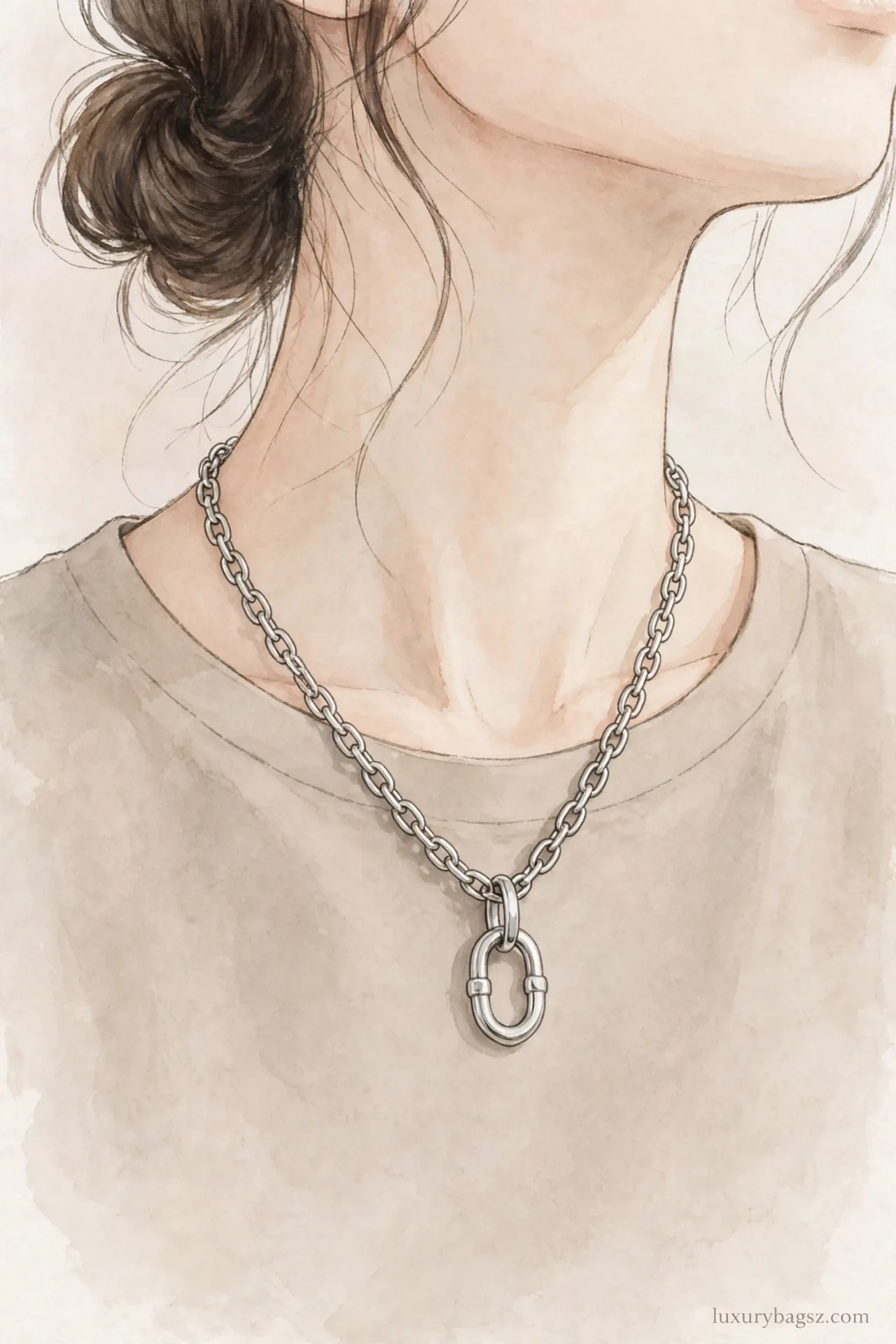
Getting the Rivage to Sit Where It Should
Choose the length by where the drop lands on you: a 16-inch chain typically places a small pendant at the collarbone, while an 18-inch chain sits just below it. Measure against your own neck and neckline, adding the pendant’s own drop, rather than trusting a chart alone.
For layering, leave about 5 centimetres between chains, let the Rivage lead, and keep any companions plainer and finer. Two chunky anchor-style chains worn at the same length will twist together and compete, while one pendant with clear spacing stays elegant.
Confirm whether your piece is silver or horn before styling or caring for it, as the name is used for both. Silver can be polished when it tarnishes; horn must stay away from prolonged water, heat and silver cleaner.
Introduction
A pendant is a small decision that changes a whole outfit. It sits in the one place every conversation partner looks first, it moves every time you move, and it either finishes a neckline or fights it. That is why a short guide that only says “wear it with everything” is no help at all.
A Rivage pendant, whatever exact version you own, needs the same practical questions answered as any pendant, and a few extra ones that come from the Hermès name itself: what is this piece actually made of, how long is its chain, where does the pendant itself fall on your chest, what can you layer it with without tangling it, and how do you look after a material that may be metal, horn, or a mix of the two?
This guide answers those questions in order, and it starts with an honesty problem that most rival guides skip entirely. The name “Rivage” is used loosely online, and the pieces sold under it do not all match one description. Some listings describe a silver anchor-chain pendant, in the spirit of the Chaîne d’Ancre motif. The one detailed, dated Rivage piece this guide could verify in public writing, a jewellery blog post from October 2026, describes something different: a necklace whose links are made of horn, priced at CAD 1,575, with the writer noting both a debt to the Chaîne d’Ancre motif and a story about beach pebbles.
Those two descriptions cannot both define the same object, and this guide does not pretend they do. The naming section sets out the disagreement plainly, and the wearing advice that follows is written so it works for either version, with the places where horn and silver demand different care clearly separated. If you take one habit from this guide, make it this: buy and wear the exact piece in front of you, with its exact material and length confirmed, not the idea of a Rivage pendant in general.
That habit matters because pendant guides usually fail in the same few places. They quote one chain length as if every neck and torso were the same. They show layering photographs in which three necklaces sit perfectly apart, and never mention that real chains slide, twist, and tangle within an hour. They treat silver care and horn care as interchangeable, when water that merely dulls silver can warp horn. They quote a single price as if it described a market, when it describes one listing. And they write about authenticity as if a card in a box settled it, when, for Hermès, the opposite is true: Hermès issues no authenticity card as a general rule, so a card offered as proof is a red flag, never reassurance.
The pictures in this guide are generic illustrations, not photographs of a real Hermès piece, and they should never be used as a side-by-side standard for judging a real pendant. Illustrations simplify link shapes, smooth over horn grain, and tidy up chain drape. The words of this draft prevail over anything simplified in an image or infographic, and the buying pre-owned section tells you what to look for on a real piece instead of in a picture.
Key Takeaways
- The name “Rivage” is not a single, standardised product in public sources. One verified October 2026 account describes horn links and a CAD 1,575 price, while many listings describe a silver anchor-chain pendant. Confirm the material, the length, and the clasp of your exact piece before you follow any styling or care advice written for the other version.
- A pendant necklace has two lengths that matter: the chain length, and where the pendant itself falls once the chain is on you. A 16-inch chain puts a small pendant at the collarbone on most wearers; an 18-inch chain puts it just below the collarbone; longer chains move it down the chest. Your neck, torso, and neckline move those landing points by centimetres, so measure on yourself, not on a chart alone.
- Layering works on spacing, not on number. Leave a clear gap of about 5 centimetres, roughly 2 inches, between necklace lengths, let one pendant lead, and keep the other layers plainer. Two anchor-style chains at the same length will tangle and compete; a fine chain and one pendant will not.
- Silver and horn need opposite instincts. Silver tarnishes and can be polished; horn is an organic material that hates prolonged water, heat, and harsh chemicals, and cannot be dipped or polished back the way silver can. Never use silver cleaner on horn, and never put a horn piece through an ultrasonic cleaner.
- Plated finishes are not solid gold or solid sterling silver. A thin plated layer wears first where links rub, at the bail that holds the pendant, and at the clasp, and a gold-coloured pendant at a silver price is a warning, not a bargain.
- Hermès issues no authenticity card as a general rule. A card supplied with a pendant is a red flag, not proof, and a box on its own proves nothing either.
- Single prices are examples only, never a market average. The CAD 1,575 Rivage figure and the USD 670 estimated retail figure for a Chaîne d’Ancre pendant necklace quoted in this guide describe different pieces at different moments, and neither one prices your piece.
- The fastest way to ruin a good pendant look is to wear it with a second strong focal point at the same height: a second chunky chain, a large brooch on the same neckline, or heavy statement earrings that pull the eye in two directions at once. One focal point per neckline is the rule that keeps this pendant elegant.
The Rivage Pendant in Brief
What is it, in one sentence? The Hermès Rivage pendant, as buyers meet it online, is a pendant necklace in the house’s nautical, anchor-chain design language, worn on a chain at or below the collarbone, with the exact material and length varying by the individual piece.
What does “Rivage” mean? It is French for “shore” or “bank”, the edge where land meets water. That meaning fits both stories told about the piece: the anchor-chain story, which belongs to the sea, and the beach-pebble story told about the horn-link Rivage necklace, which belongs to the shore itself. The name alone does not tell you the material. Do not let a poetic name do the work of a listing description.
What does it look like? Expect a focal pendant formed from interlocking, anchor-style links, or, in the horn version, a row of smooth, pebble-like horn links, on a chain that lets the focal links sit visibly against the chest. The pendant is the point of the piece: it is larger, heavier, or more textured than the chain that carries it, and it is meant to be seen rather than tucked away. If a listing shows a plain chain with no focal pendant at all, it is describing a chain necklace, not a pendant necklace, whatever the title says.
Who is it for? Anyone who wants one strong, quiet focal point at the neckline rather than a row of stones or a logo plate. The anchor-chain look reads equally well on men and women, and the horn version reads softer and more organic than polished silver, which suits wearers who find bright metal too hard against their skin tone or wardrobe. Link and pendant size decide the effect more than any gender label in a listing: a small pendant reads delicate, a large link pendant reads bold, and the same piece can look entirely different on two people.
Which length should you start with? If you own only one version, start with the length that puts the pendant just below your collarbone, which is usually an 18-inch chain, about 46 centimetres, on an average build. It clears most crew necks and scoop necks, sits above most V-necks without sinking into them, and leaves room to add a longer layer later. The chain lengths section works through every common length and neckline so you can adjust from that starting point rather than guessing.
How much should you expect to pay? There is no honest single answer, and the prices section explains why. The only Rivage-specific price this guide could verify is a single CAD 1,575 figure for a horn-link Rivage necklace in an October 2026 blog post, with no chain length or full material breakdown given. That figure is one piece at one moment, not a price for “the Rivage pendant”. Silver anchor-link pendant necklaces in the wider Chaîne d’Ancre family carry their own, different figures, and the prices section gives those separately, with their limits stated.
What is the one mistake to avoid first? Assuming you know the material. A buyer who polishes horn as if it were silver, or who soaks a silver chain as if it were costume jewellery, damages the piece in the first week. Read the naming section, confirm your piece, and only then follow the care advice that matches it.
The Rivage Pendant, and the Naming Problem No Guide Admits
Most guides to this pendant begin by describing it confidently, and that confidence is the problem. Search for “Hermès Rivage pendant” and you will find three kinds of result, often using the same words for different objects. First, listings and blog posts that describe a silver anchor-chain pendant, clearly borrowing the Chaîne d’Ancre motif: interlocking oval links, each with the character of a ship’s chain link, gathered into a pendant drop on a finer chain. Second, the one detailed Rivage account this guide found, the October 2026 IntoTemptation post, which describes a Rivage necklace whose links are made of horn, a material Hermès uses frequently across its accessories, selling for CAD 1,575, with the writer saying the house’s design vocabulary here falls back on the Chaîne d’Ancre motif while also attributing the piece to an owner’s fascination with picking up beach pebbles. Third, general Hermès pendant listings that use “Rivage” loosely, or use “pendant necklace” for any necklace with a focal ornament, including Chaîne d’Ancre pendant necklaces that are not Rivage pieces at all.
This guide does not resolve that disagreement by picking the version that makes the neatest article, because picking one would mislead every reader who owns the other. Instead, it states the disagreement and builds the advice around it. The wearing advice in parts 4 to 7 applies to both versions, because length, neckline, layering spacing, and focal-point discipline do not depend on whether the links are silver or horn.
The care advice in the metal and horn care section is split in two, because silver and horn do depend on material, and following the wrong half is how damage happens. The buying checks in the pre-owned section are likewise split: weight, marks, and articulation matter for metal, while grain, warmth, and surface matter for horn, and no single checklist covers both.
There is a second disagreement worth stating plainly, about length. Resale valuations for Chaîne d’Ancre pendant necklaces in sterling silver record a maximum length of 16 inches, about 41 centimetres, with an ornament about 1 to 1.25 inches long and 0.5 inches wide, and a total weight of 9.9 to 10.7 grams. Those are single listings, not a standard, and they describe Chaîne d’Ancre pendants, not a verified Rivage length.
No equivalent verified length could be found for the horn Rivage necklace, and general pendant guides quote every length from 14 inches to 32 inches as if all of them were standard for this piece. They are not standard for this piece. They are standard necklace lengths in general, and the chain lengths section uses them that way: as a map of where a pendant falls, not as a claim about what length your Rivage piece is. Measure the chain you own, or ask the seller for its exact length, before you plan an outfit around it.
A third point of confusion is the word “pendant” itself. In jewellery writing, a pendant is a hanging ornament on a chain, while a pendant necklace is the whole piece: chain plus ornament. In resale listings, “pendant necklace” is also used for a necklace whose focal links form the ornament, even when there is no separate drop hanging below the chain.
A Rivage necklace made of horn links sits in that grey area: the links themselves are the ornament, and there may be no single drop to point at. When you shop, ask the seller a simple question that cuts through all of this: is there a separate pendant drop, and if so, how long and wide is it, or is the link row itself the focal ornament? The answer changes how the piece sits, how it layers, and how it should be stored, and a seller who cannot answer it has not described the piece well enough to buy.
One more distinction, because it affects how you wear the piece with the rest of your jewellery. The Rivage pendant is not a bracelet, and it is not a long sautoir chain to be wrapped several ways round the neck and wrist. Long Hermès chains in the Farandole family, for example, come in lengths of 80, 120, and 160 centimetres and are designed to be doubled, wrapped as a bracelet, or worn as a belt, and rival guides sometimes import that advice wholesale into pendant guides. Do not import it.
A pendant necklace with a fixed focal ornament cannot be wrapped round a wrist or belt without dragging the pendant to the wrong place and stressing the bail, the small loop or fitting that joins the pendant to the chain. If your piece is long enough to double, the pendant will sit differently doubled than single, and the clasps and doubling section explains how to test that before you wear it out.
The house behind the piece is the same house whose leather goods dominate its reputation, and the same insistence on handwork runs through both. Our guide to Hermès leather sets out where the house’s leather comes from and why its sourcing is so closely guarded; the jewellery workshops apply the same logic to metal and to horn, with pieces finished by hand and marked accordingly. You do not need to care about bags to care about this pendant, but understanding that Hermès treats a chain link with the same seriousness it treats a bag handle explains why the pendant costs what it costs and why cheap copies feel different in the hand.
How the Rivage Differs from the Chaîne d’Ancre and Other Pendants
The Rivage pendant lives inside a family of Hermès jewellery that shares one design language and very different wearing rules, and confusing family members is the most common beginner mistake after confusing materials. Start with the closest relative. The Chaîne d’Ancre bracelet is a flexible bracelet made from a single row of interlocking oval links, each crossed by a central bar, closed with a T-bar toggle, first made in silver in 1938 after Robert Dumas saw anchor chains in a Normandy port.
A Rivage or Chaîne d’Ancre pendant necklace borrows that link, but it wears nothing like the bracelet: the bracelet articulates round a wrist and is judged by wrist fit and link count, while the pendant is judged by chain length, drop, and neckline, and its links do not need to articulate round a curve at all. Owning the bracelet tells you what the motif looks like; it does not tell you what length of pendant chain to buy.
The Farandole is the next neighbour, and the one most often confused with a pendant necklace because it is also a long silver chain. The Farandole takes the anchor-chain idea, mixes link sizes, and spaces them out to create a fluid, airy chain, offered in long lengths that invite doubling and wrapping. A Farandole is a chain first and an ornament second: its beauty is in its length and movement.
A Rivage pendant is the reverse: its beauty is in its focal ornament, and its chain is there to place that ornament correctly. If you layer a Farandole and a Rivage pendant together, the Farandole’s length is an advantage, because it can sit well below the pendant, but the two pieces must not share a length, or the Farandole’s links will tangle with the pendant’s chain and hide the focal point.
The Clic family is a different world again, and worth naming because sellers sometimes group every Hermès piece under one heading. Clic bracelets are rigid enamel bangles with an H clasp: they do not drape, they slide over the hand, and they are sized by hand size.
A Clic bangle worn on the wrist with a Rivage pendant at the neck is a perfectly coherent pairing, because the two pieces occupy different territories, wrist and neckline, and the enamel colour can echo an outfit without competing with the pendant’s metal or horn. A Clic necklace, where one exists in a given season, is a different matter: an enamel H at the same height as a Rivage pendant is a second focal point, and the layering section explains why that pairing usually fails.
Other Hermès pendants set the scale for what counts as a pendant in this house. The Pop H and Mini Pop H pendants are small lacquered enamel H shapes on fine chains: light, colourful, and deliberately easy to layer. The Kelly-inspired pendants borrow bag hardware, a padlock or clochette shape, and read as jewellery quoting a bag. The Amulettes Constance pendants frame an H in a rounded case.
Against those, a Rivage pendant is the grown-up, textural option: no bright enamel, no bag hardware quotation, just links or horn, metal or organic material, doing the work. That restraint is why it layers so well with plain chains and so badly with other statement pendants: it has a strong texture but no colour to hide behind, so a second textured piece next to it reads as clutter rather than contrast.
Finally, a word on copies. The anchor-chain motif has been so widely copied that Hermès defended it in court in France, with the Court of Appeal confirming in 2022 that the design is protected by copyright. A chain can look like an anchor chain without being a Hermès piece, and a horn-link necklace can look like a Rivage piece without being one.
The difference lives in the details covered in the buying pre-owned section: the marks, the weight, the articulation of metal links, the grain and finish of horn, and the quality of the bail and clasp. A pendant that gets the motif right and the construction wrong is a copy wearing a good idea, and no amount of careful styling will make it a genuine piece.
Chain Lengths and Where the Pendant Falls on You
Chain length is the single most practical fact about a pendant necklace, and the one most guides describe worst, because they quote lengths without saying where those lengths land on a real body. A chain length is the total length of the chain, measured end to end, not the distance from your neck to the pendant.
The pendant’s landing point depends on that length, on your neck size, on the size of the pendant itself, which adds its own drop below the chain, and on the neckline you wear it against. Two people wearing the same 18-inch chain will see the pendant land in slightly different places, and the same person will see it land differently against a crew neck, a V-neck, and a turtleneck. That is normal, and it is why this part gives you a method, not just a chart.
Start by measuring yourself. Stand in front of a mirror with a soft tape measure and a piece of string. Loop the string round your neck at the length you are considering, mark where it meets, and measure the string flat. Then hold the pendant, or an object of similar size, at that loop and see where it falls on your chest. That thirty-second test beats any chart, because it accounts for your neck and torso in a way no generic table can.
If you are buying online and cannot try the piece, ask the seller for the chain length in both inches and centimetres, the pendant’s own length and width, and whether the stated length includes the clasp. A chain measured including a large toggle reads longer than the same chain measured as chain only, and a pendant with a long bail hangs lower than a pendant that sits directly on the chain.
With that method in hand, here is the map of common lengths, using the standard necklace lengths that jewellers use generally, applied to a pendant necklace. A 14-inch chain, about 36 centimetres, is a choker: it hugs the base of the neck, and a pendant on it sits high, tight against the throat. It suits a small pendant and a bare neckline, and it suits almost nothing else: against a collared shirt it fights the collar, and on a larger neck it can feel tight. A 16-inch chain, about 41 centimetres, is the classic collar length, and it is also the length recorded in resale valuations for Chaîne d’Ancre pendant necklaces, with ornaments of about 1 to 1.25 inches.
On most wearers it puts a small to medium pendant at or just below the collarbone, which is the most flattering single position for a pendant, and it clears a crew neck worn underneath if the pendant is small enough to sit above the fabric. A 18-inch chain, about 46 centimetres, is the princess length, and the safest default for a first pendant: the pendant sits just below the collarbone, clears most necklines, and leaves room for a shorter layer above it or a longer layer below it.
Longer chains move the pendant down the chest and change its job. A 20-inch chain, about 51 centimetres, puts the pendant at the upper chest, between the collarbone and the bust line, where it works over a plain top or a shirt worn open at the neck. A 22 to 24-inch chain, about 56 to 61 centimetres, is a matinee length: the pendant sits at or just above the bust line, and it needs a plain expanse of fabric or skin to show against, because a busy print or a second necklace at the same height will swallow it.
A 28 to 32-inch chain, about 71 to 81 centimetres, is an opera or sautoir length: the pendant sits below the bust, and the piece reads as a long necklace with a focal point rather than a pendant at the neckline. Long lengths can be doubled, but only if the pendant and bail allow it without twisting, and the clasps and doubling section explains the test for that.
Necklines decide which length works on a given day, and this is where most styling mistakes happen. Against a crew neck, the pendant must sit either clearly above the neckline, on a 16-inch chain, or clearly below it, on a 20-inch chain or longer; a pendant that lands exactly on the neckline edge will flip in and out of sight as you move and will catch on the fabric. Against a V-neck, the pendant should echo the V without sinking into it: choose a length that puts the pendant a little above the point of the V, so it frames the opening rather than disappearing into it, and prefer a pendant shape that mirrors the V, an elongated link drop rather than a wide, flat one.
Against a scoop neck, almost any length from 16 to 20 inches works, because the scoop gives the pendant a clean frame of skin or plain fabric. Against a turtleneck or high collar, switch to a longer chain, 20 inches or more, and let the pendant sit over the knit: a short pendant tucked under a turtleneck is invisible, and a short pendant worn over a thick knit will sit awkwardly high and tight. Against a shirt with a collar, wear the pendant under the collar points on a shorter chain, or over an open collar on a longer chain, and never let the chain fight the collar stays or the top button.
Body scale matters as much as neckline, and rival guides rarely say so. On a petite frame, a large link pendant on a long chain can overwhelm the neckline, because the pendant’s visual weight is large relative to the chest it sits on; a smaller pendant on a 16 or 18-inch chain usually reads better.
On a taller or broader frame, that same small pendant can disappear, and a larger pendant on a 20-inch chain holds its place. On a larger neck, add roughly 2 inches to any length you read in a guide to get the same landing point, because more of the chain is used going round the neck before it starts to drop. These are adjustments, not rules, and the string test at the start of this part is how you find your own version of them.
One last length trap: the pendant’s own size adds drop. A pendant that is 1.25 inches long hangs 1.25 inches below the chain, so a 16-inch chain with a long pendant can land where an 18-inch chain with a small pendant lands.
When a seller gives you only the chain length, you do not yet know where the pendant will sit. Always ask for both numbers, chain length and pendant length, and add them together in your head before you decide.

Day, Evening, and Work: How One Pendant Changes Its Job
The same pendant can be a quiet daytime piece, a work piece, and an evening piece, and the difference is rarely the pendant itself. It is the length you choose, the neckline you pair it with, and what else you wear at the neckline and wrist. This part gives you three settings for one piece, so you do not need three pendants to cover a week.
For daytime, let the pendant do one job: finish a plain top. A white or cream shirt, a plain knit, a simple dress with a scoop or V-neck, and the pendant on a 16 or 18-inch chain is a complete look. The pendant’s texture, silver links or horn grain, is enough interest against plain fabric, and adding a second necklace, a scarf, or a brooch at the same height only muddies it.
Keep earrings small and quiet, a stud or a small hoop in the same metal family, and keep the wrist to one piece, because a daytime pendant look is about ease, not accumulation. If you wear the pendant with denim, a linen shirt, or a casual jacket, the horn version has a particular advantage: its organic, matte surface softens casual fabric in a way bright silver does not, and it reads intentional rather than dressy. Silver, by contrast, sharpens a casual outfit, which is an advantage when you want a plain outfit to look finished rather than relaxed.
For work, the rules tighten in one direction: the pendant must stay still, stay quiet, and stay out of the way. Choose the shorter length, 16 or 18 inches, so the pendant does not swing when you lean over a desk, and choose a pendant size that sits flat against the chest rather than swinging freely on a long bail. A pendant that clatters against a desk, a lanyard, or a laptop edge will distract you and wear its own links faster, and a pendant that swings into view on every video call pulls attention away from your face.
Wear it under a blazer lapel or over a plain blouse, not over a patterned shirt, and keep the rest of the neckline empty: no second chain, no silk scarf knotted at the same height, no statement earrings competing for the same visual territory. If your workplace is formal, the silver version reads more conventionally professional than horn, which can read casual in a boardroom; if your workplace is creative, the reverse is true, and horn reads as a deliberate, textural choice.
For evening, let the pendant stand alone and give it room. A longer chain, 20 inches or more, over a plain dark dress or a bare neckline lets the pendant’s texture catch light without competition, and a single pendant on a bare neckline is more elegant than a stack of necklaces fighting a neckline that is already doing the work. If the dress has a detailed neckline, beading, or a high collar, move the pendant to a length that clears the detail entirely, or leave the pendant off: an evening look fails when jewellery and dress compete at the same height.
For a black-tie or formal evening, silver has the advantage of catching light, while horn has the advantage of warmth against dark fabric; either works, but neither works with heavy chandelier earrings and a statement bracelet on the same side of the body. Evening is the one setting where a larger pendant earns its size, because the room is darker, the distances are greater, and a small pendant that was perfect at a desk can disappear across a table.
Travel and long days deserve a sentence of their own, because pendants fail most often on long days, not at fittings. A pendant worn for twelve hours will twist, will slide to one side, and will catch on scarves, bag straps, and seatbelts. Before a long day, check that the clasp closes firmly, that the pendant’s bail does not spin freely on the chain, and that the length you chose does not put the pendant exactly where a bag strap crosses your chest.
A pendant that sits under a bag strap all day will be scratched by the strap’s hardware and will wear a groove in the chain where it rubs. Move the pendant to a different length for travel days, or carry it in its pouch and put it on when you arrive. That small habit saves more pendants than any cleaning routine.

Layering: What to Stack With a Rivage Pendant, and What Never
Layering is where pendant guides promise the most and explain the least, because a photograph of layered necklaces hides the two facts that matter most in real life: chains tangle, and pendants migrate. A stack that looks spaced in a photograph will, within an hour of real movement, slide together, twist round each other, and end with the focal pendant hidden behind a plainer chain. The rules in this part are designed for real movement, not for a photograph.
The first rule is spacing. Leave a clear gap of about 5 centimetres, roughly 2 inches, between each necklace length in a stack. That means if the Rivage pendant sits on an 18-inch chain, the next layer should sit on a 16-inch chain above it or a 20 to 22-inch chain below it, not on another 18-inch chain. The gap is not a styling preference; it is the minimum distance that keeps chains from sliding into each other and tangling as you move your head and shoulders. If you cannot achieve that gap with the chains you own, do not layer them: wear the pendant alone. A single pendant worn well beats a tangled stack every time.
The second rule is hierarchy. Let one pendant lead, and keep every other layer plainer than the leader. If the Rivage pendant leads, the other layers should be fine chains with no pendant, or with a very small pendant that sits at a clearly different height. If you want to layer two pendants, the second pendant must be smaller, plainer, and at least 5 centimetres away in height, and even then it works only if the two pendants are in the same metal family or share a material logic, silver with silver, or horn with a matte, organic companion, not bright silver against bright gold in a way that reads accidental. Mixed metals can work deliberately, when the forms share a design language, but accidental mixed metals in a stack read as a mistake, not a choice, and the Rivage pendant’s strong texture makes accidental mixing more visible, not less.
The third rule is a list of things never to stack with this pendant. Never stack it with a second anchor-chain necklace at the same length: two anchor-style chains will interlock, tangle, and scratch each other, and the two focal points will compete rather than complement. Never stack it with a heavy statement necklace, a bib, or a collar necklace at the same height: the pendant will be hidden behind the larger piece or will fight it for the eye. Never stack it with a chunky beaded necklace whose beads can catch in the pendant’s links: beads and open links are a tangling machine. Never stack it with a long scarf worn knotted at the same height, because the knot will push the pendant to one side and the scarf fabric will rub the pendant’s surface all day. And never stack more than three necklaces total with a pendant of this size: beyond three, the stack stops reading as layered jewellery and starts reading as a pile, and the risk of tangling rises faster than the visual reward.
What does work, then? A fine, plain chain, 2 inches shorter than the pendant chain, worn above it, frames the pendant without competing with it. A longer, plain chain, 2 to 4 inches longer, worn below it, gives the eye a second line to follow without a second focal point. A pair of small earrings in the same metal family, and a single bracelet on the wrist, complete the look without adding a second neckline focal point. A silk scarf worn as a top or draped over the shoulders, rather than knotted at the neck, can pair beautifully with a pendant, and a scarf ring used to hold that drape away from the neckline keeps the pendant visible instead of buried in fabric. The same logic applies to bags: a twilly on a bag handle repeats a motif across an outfit without putting a second focal point at the neckline, which is exactly the kind of echo that works when a second necklace does not.
Tangles deserve practical advice, because they will happen even in a well-planned stack. When chains tangle, do not pull: pulling tightens the knot and can kink a link or snap a fine chain. Lay the stack flat on a table, work the knot loose with two pins or needles, and add a drop of mineral oil to a stubborn metal tangle only, never to horn, and wipe it off afterwards. To prevent tangles in storage, fasten each chain before you put it away, and store layered pieces separately, not in a pile in one pouch. A pendant stored loose with other chains will arrive tangled, and a horn piece stored against metal will arrive scratched.
Finally, know when to stop layering and wear the pendant alone. Wear it alone when the neckline is already detailed, when the outfit has a strong print or texture at the chest, when you will be moving a lot, travelling, or working at a desk all day, and when the pendant itself is large. A large pendant does not need layers; it needs room. The most elegant pendant wearers are not the ones with the most layers, but the ones who know which days are one-pendant days.

Clasps, Length Adjustment, and Wearing a Long Chain Doubled
A pendant necklace is only as wearable as its clasp, and clasp trouble is the most common reason a pendant ends up unworn in a drawer. Yet rival guides almost never describe clasps at all, as if every pendant closed the same way. It does not. Pendant necklaces in this family close with several different fittings, depending on the model and era: a lobster claw that springs shut, a spring ring, a toggle bar through a ring, or a slide fitting on a cord or long chain. Your first job with any Rivage piece is to identify which fitting yours has, test it, and learn its weakness, because each fitting fails differently.
Test the clasp before you rely on it. Fasten and unfasten it ten times in front of a mirror, with the pendant on. A good lobster claw snaps shut crisply and resists pulling open; a tired spring loses its snap and needs replacing, which is a small jeweller’s job, not a reason to discard the piece. A toggle bar should pass through its ring and sit sideways securely; if the bar slides back out with a gentle tug, the ring has been bent out of round and needs reshaping by a jeweller. A spring ring should close fully, with no gap where the chain can slip out; a gap means the spring is worn. If any fitting feels loose, gritty, or reluctant, have it checked before you wear the piece out: a pendant lost because a clasp failed is not a styling problem, it is a preventable loss, and the loss of a pendant is worse than the loss of a bracelet, because a necklace that comes undone falls without you noticing.
Length adjustment is the next practical question, and it has three honest answers, not one. The first is an extender chain: a short length of matching chain, usually 2 to 5 centimetres, that clips onto the existing clasp and lengthens the necklace by that amount. Extenders are cheap, reversible, and the right answer when a chain is slightly too short or when you want to wear the same pendant at two lengths on different days. Choose an extender in the same metal as the chain, and check that its links are fine enough not to scratch the pendant’s bail. The second answer is a jeweller’s adjustment: a jeweller can add or remove links, move a bail, or replace a clasp, and that is the right answer when the length is wrong by more than an extender can fix, or when the chain itself needs repair. The third answer, and the one to avoid, is a home adjustment: never cut a chain, force a link open with pliers, or glue a fitting. A forced link is a weak link, and a glued fitting will fail at the worst moment, usually away from home.
Doubling a long chain is a special case of adjustment, and it needs a test, not an assumption. A long pendant chain, 28 inches or more, can sometimes be worn doubled, so that it sits as two shorter strands with the pendant at the front. Test it in front of a mirror before you wear it out: double the chain, fasten it, and check three things. First, does the pendant sit centred and level, or does it pull to one side because the two strands are uneven? Second, does the bail spin or twist when doubled, so that the pendant faces sideways instead of forwards? Third, does the doubled chain tangle with itself when you move your head? If any answer is unsatisfactory, wear the chain single, at its full length, and accept that not every long chain is meant to be doubled. A pendant whose bail is designed for a single strand will never double well, and forcing it will wear the bail faster than any other habit.
One more clasp habit matters for longevity. Fasten the necklace before you put it away, and unfasten it before you put it on, rather than stretching it over your head. Stretching a chain over the head stresses the clasp spring and the bail, and it drags the pendant across your hair and collar, which tangles fine chains and scratches horn. Put the chain round your neck, fasten it at the back, and let the pendant fall into place. It takes five seconds longer, and it adds years to the clasp.
Metal and Horn Care: Two Materials, Two Routines, Never Mixed Up
This is the part where following the wrong advice damages a piece, so it is split in two, and the split matters more than any single tip inside it. First, identify your material with certainty, using the marks and tests in the buying pre-owned section, and then follow only the routine for that material. If you are not certain, follow the gentler routine, a soft dry cloth and nothing else, until a jeweller confirms the material.
Sterling silver, marked 925, is 92.5 percent silver and 7.5 percent other metal, usually copper. Its drawback is tarnish: silver reacts with sulphur compounds in the air and in sweat, forming a dark layer that dulls the shine over time. Tarnish is normal, it is not damage, and it is reversible, but it happens fastest in the crevices where links meet and where a pendant’s bail rubs the chain. For routine care, wipe the piece with a soft, dry cloth after wearing, and store it in a sealed pouch or a tarnish-resistant bag, because air exposure is what drives tarnish between wearings. For a deeper clean, use a silver-polishing cloth, or warm water with a tiny amount of mild soap, a soft brush for the joints between links, and thorough drying afterwards. Never use a silver dip on a piece you have not identified with certainty, because dips are harsh, they can strip a plated layer entirely, and they can damage any non-metal part of the piece. Never use toothpaste, baking soda paste, or an abrasive cloth on silver links: they scratch the surface, and scratches on a link catch light in the wrong way for the rest of the piece’s life.
Gold, marked 750 for 18-karat gold, meaning 75 percent pure gold, does not tarnish the way silver does, but it still collects skin products and dirt in its joints, and it still scratches. Clean it the same gentle way, warm soapy water, a soft brush, thorough drying, and keep it apart from harder pieces in storage, because gold is softer than steel and will be marked by a steel chain or a diamond piece stored against it. White gold deserves a note: its cool colour often comes from a coating that wears with time, especially on a pendant that rubs against clothing all day, and recoating is a jeweller’s job, not a home polish.
Plated finishes are not solid gold or solid sterling silver, and they need the gentlest routine of all. A plated piece is a base metal coated with a thin layer of gold or silver, and that layer wears first where links rub, at the bail, and at the clasp. Clean a plated piece only with a soft dry cloth, never with a polishing cloth or a dip, because polishing removes the plated layer it is meant to shine. If a plated pendant’s base metal is already showing through at the bail or the edges, no cleaning will restore it, and replating is a jeweller’s decision that changes the piece’s value and should be weighed before it is done, not after. A gold-coloured pendant offered near a silver price, or a “gold” pendant with no 750 mark and no credible provenance, should be treated as plated or imitation until proven otherwise, and should never be paid for as solid metal.
Horn is a different world, and this is the gap rival guides leave widest, because they write silver care and stop. Horn is an organic material, related to hair and nail, and it behaves like one: it is warm to the touch, it shows natural grain and colour variation from piece to piece, it can be polished to a soft shine, and it is sensitive to the things that do not trouble metal. Prolonged water is horn’s enemy: soaking a horn piece, wearing it swimming, or leaving it wet will swell, warp, or crack it over time, and the damage is not reversible by polishing. Heat is the second enemy: radiators, hair dryers, and hot cars dry horn out and can warp it.
Harsh chemicals are the third: perfume, hairspray, and cleaning products should never be sprayed directly onto horn, so put the pendant on last, after perfume has dried, and take it off before cleaning or exercising. For routine horn care, wipe it with a soft, dry cloth, and nothing else. If a horn piece looks dry, a tiny amount of a neutral oil on a cloth, applied sparingly and wiped off, is the traditional remedy, but test it on an inconspicuous link first, and never use silver cleaner, an ultrasonic cleaner, steam, or a chemical dip on horn.
Ultrasonic cleaning, which is safe for many solid metal pieces, can crack horn, and a silver dip will damage its surface permanently. If a horn piece is already cracked or warped, do not try to fix it at home: a specialist restorer, not a general jeweller, is the right person, and some damage cannot be undone, which is why prevention matters more for horn than for any metal.
Storage follows the same split. Store silver in a sealed pouch, away from air and from rubber bands, which accelerate tarnish. Store horn in a dry place at room temperature, away from radiators and windows, in its own soft pouch, never loose against metal chains that will scratch it.
Store every pendant with its clasp fastened and its chain laid out, not balled up, so it does not arrive tangled. And keep the pendant’s pouch with the piece when you travel: a pendant loose in a bag, rubbing against keys, coins, or a bag’s hardware, will arrive scratched, and a pendant loose in a canvas tote will pick up dust and grit in its links that then grind every time the piece moves.

Buying Pre-Owned: Marks, Weight, Articulation, and Horn Grain
Buying a Rivage pendant pre-owned is the sensible way to find a version that is no longer in boutiques, and it is also where most costly mistakes happen. The checks below are ordered by what you can do before you pay, and they are split by material, because a metal check and a horn check are different skills. No checklist in any guide can give you certainty on a high-grade counterfeit. What a checklist can do is filter out the large majority of bad pieces and tell you when to pay for a professional opinion.
First, ask for the facts in writing, whatever the material: the exact name or description the seller is using, the material stated plainly, the chain length in inches and centimetres, the pendant’s length and width, the clasp type, the weight in grams, and photographs of the pendant from the front and back, the bail, the clasp, and any marks. A seller who cannot give you those basics has not given you enough to buy, however good the first photograph looks.
Compare the weight against the size: resale valuations for sterling silver Chaîne d’Ancre pendant necklaces record total weights of 9.9 and 10.7 grams for 16-inch pieces with ornaments of about 1 to 1.25 inches. Those are single listings, not a standard for a Rivage piece, but they show the direction: a silver pendant necklace of that size should feel substantial, not feather-light, and a piece that looks like a medium silver pendant but weighs very little for its size is a warning, because genuine metal links are solid, while copies are often hollow or made from lighter alloys.
Second, examine the marks, for metal pieces, and know what they can and cannot prove. Genuine silver pieces carry the Hermès name, with the accent on the second e, alongside the metal fineness mark, 925 for silver or 750 for gold, and often French assay marks and a maker’s mark. The placement, depth, and lettering of these marks matter, and copies routinely get the accent, the spacing, or the mark format wrong. But marks alone prove nothing, because marks are copied too.
A correct-looking mark raises confidence; it never closes the case, and a missing or worn mark on a genuinely old piece does not automatically condemn it, because decades of wear soften engraving. For horn pieces, marks are different: look for a discreet brand mark on a metal fitting, the bail or the clasp, rather than stamped into the horn itself, and judge the horn by its grain, not by a stamp. Horn shows natural variation, subtle streaks, and a warm, slightly translucent quality that plastic imitations lack: plastic looks too uniform, too perfect, and too cold, while genuine horn varies from link to link, even within one necklace.
Third, run the hand and eye tests. For metal, check that links are uniform in size and shape, that edges are smooth with no burr or sharp spot, that the chain articulates freely without kinking, and that the bail holds the pendant securely without spinning loosely or rattling. Run a fingertip slowly along the inside of the chain: a genuine piece feels smooth throughout, with no rough spot catching your skin, because polishing the inside of every link by hand is slow and expensive, and a maker cutting corners will polish the outside that photographs well and leave the inside rough.
For horn, check that each link feels warm and smooth, that the grain runs naturally through the material rather than sitting printed on the surface, that edges are rounded and polished rather than sharp or moulded, and that the links fit together without gaps or glue visible at the joints. Glue at a horn joint, or a link that feels like moulded plastic, is a reason to stop.
Fourth, apply the card rule without exception, and the same logic to every other piece of paper. Hermès issues no authenticity card as a general rule, so a card, a certificate, or a code to check online, supplied with a Rivage pendant, is a red flag, not reassurance. The same rule is central to our guide to a fake Chaîne d’Ancre bracelet, and it applies here with the same force. A box and pouch are nice to have and add value, but they are also bought separately and borrowed from other purchases, so judge the pendant, not the packaging. A receipt photograph proves that someone once bought something, not that this pendant is the thing they bought.
Fifth, check the story against the object. A pendant described as a silver anchor-chain piece should show silver marks, silver weight, and metal articulation. A pendant described as a horn Rivage piece should show horn grain, horn warmth, and no metal marks stamped into the horn.
A pendant described as unworn should show no wear where links meet or where the bail rubs the chain. A pendant described as a rare version should be named as that version, with the features that make it rare stated plainly. Vague stories, “from an estate”, “bought in Paris”, “guaranteed genuine”, are not evidence, and a seller who leans on a story instead of photographs and measurements is telling you where their confidence actually comes from.
Sixth, protect the payment. Buy through a platform or seller that offers returns and buyer protection, pay by a method that preserves that protection, and keep the right to return the pendant if a reputable authenticator disagrees with the seller’s description. If the price is high, the seller is unknown to you, or anything still feels slightly off after the checks above, pay for professional authentication before the return window closes, not after.
A seller who discourages independent authentication, or who will not accept a return on an authenticator’s disagreement, has given you an answer about the pendant, whether they meant to or not. Walk away when several checks fail at once, when the seller refuses the photographs and measurements above, when the material cannot be stated plainly, when a card is offered as proof, when the price is far below the spread for that exact material and size with no credible explanation, or when you are pressed to pay quickly, off-platform, or by a method with no protection. Any one of those is a reason to pause. Two together are a reason to stop.

Prices: Why One Figure Never Prices a Rivage Pendant
No part of this topic is more misreported than price, so this part states its limits before its numbers. Hermès does not publish a single stable price list that this guide can quote as current, prices vary by market, material, length, and year, and resale listings vary by condition, completeness, and seller. Everything below is therefore examples with their context, not a price guide, and any guide that gives you a single average price for a Rivage pendant without naming material, length, and condition is inventing a number.
Start with the shape of the market rather than a figure. Silver is the entry point for metal pendants, gold costs several times more, because the metal itself costs more and the piece contains a substantial weight of it. Horn sits in its own world: its price reflects craftsmanship, finish, and rarity rather than metal weight, which is why a horn necklace can cost more than a small silver pendant and less than a large gold one, without any contradiction.
Larger pendants cost more than smaller ones in the same material, because they contain more material and more work. Completeness matters: an original box and pouch add value and confidence, but they do not prove authenticity on their own, and their absence does not prove a pendant fake.
Now the examples, each with its limits. The only Rivage-specific price this guide could verify is CAD 1,575, for a horn-link Rivage necklace described in an October 2026 jewellery blog post. That is one piece, described briefly, with no chain length, no pendant measurement, and no condition report given, and it cannot be used to price a silver Rivage pendant, a different horn piece, or the same piece in a different market. The second set of examples comes from a different family, and must not be merged with the first: resale valuations for sterling silver Chaîne d’Ancre pendant necklaces, 16 inches long, ornaments about 1 to 1.25 inches long and 0.5 inches wide, weights of 9.9 and 10.7 grams, record an estimated retail figure of USD 670 in each case.
Those are single valuations, not boutique prices, and they describe Chaîne d’Ancre pendants, not Rivage pieces. Quoting USD 670 as “the Rivage price” would be exactly the kind of silent merging this guide refuses to do.
What, then, should you actually do with prices? First, fix the exact piece: material, pendant size, chain length, clasp type, and condition. Second, find several recent listings for that exact combination, not for the name in general, and look at the spread, not any average. Third, treat a price far below the spread for that combination as a warning, not a bargain, and ask why: is the material plated, is the piece damaged, is the seller new, is the listing using stock photographs?
Fourth, remember that a price that looks like a bargain for silver may be a fair price for plated metal, and a price that looks high for horn may be fair for a finely finished, well-grained piece. Fifth, budget for the costs after purchase: a jeweller’s check, a professional clean for metal, or a restorer’s opinion for horn, and, for a clasp repair, workshop time. A pendant that is cheap because its clasp is worn is not cheap once it has been repaired properly.
One more pricing trap deserves a plain sentence. Some sellers quote a “retail price” that is not a current boutique price but a figure carried over from an old listing, a different market, or a different model. If a listing’s retail figure cannot be tied to the same material, pendant size, and length as the piece being sold, ignore it and price the piece on comparable sold listings for the same combination instead.
Care, Storage, and Travel: Keeping a Pendant Wearable for Years
Daily habits decide a pendant’s life more than any annual deep clean, because a pendant is worn against skin, fabric, and bag straps for hours at a time. Put the pendant on last, after perfume, lotion, and hair products have dried, and take it off first when you come home. Perfume and lotion do not ruin metal in a day, but they build up in the joints of a chain and on the surface of horn faster than on a smooth bangle, and they accelerate tarnish on silver and dullness on horn.
Remove the pendant before swimming, bathing, exercising, and cleaning: chlorine attacks gold alloys and speeds silver tarnish, salt water dulls metal and drives tarnish into chain joints, and for horn, water of any kind is the habit to break first. Remove it before sleeping too, not because it will break overnight, but because a chain caught in bedding can kink a link or twist a bail, and a kinked link is the beginning of a weak point.
Storage is simple, and it is worth doing properly every time. Keep the pendant in its own soft pouch, with the clasp fastened and the chain laid out, not balled up, and keep that pouch away from other jewellery. Metal chains stored loose against each other scratch each other, and a horn piece stored against metal arrives scratched. Keep silver in a sealed pouch to slow tarnish, and keep horn at room temperature, away from radiators, windows, and damp bathrooms.
Keep the pouch in a drawer, not on a bathroom shelf, where steam and perfume settle on everything. If you travel with the pendant, carry it in its pouch in your hand luggage, not in checked luggage, and put it on when you arrive rather than wearing it through security, seatbelts, and bag straps all day. If the tote that carried it needs attention after a trip, remember that tote care is a separate routine from pendant care: our guide to cleaning a canvas bag covers canvas, while this guide covers the pendant, and the cloths and cleaners for one should never be used on the other.
Cleaning follows the metal and horn care section, and the routine is worth restating as a habit, not a project. For silver, a soft dry cloth after wearing, and a gentle soap-and-water clean when tarnish builds, with thorough drying. For gold, the same gentle routine, with attention to the joints. For plated pieces, a dry cloth only. For horn, a dry cloth only, and nothing wet, chemical, or ultrasonic, ever. In every case, dry the piece fully before you store it, because a damp pendant stored in a sealed pouch will tarnish or, for horn, swell, faster than a pendant left out in dry air. Check the clasp and bail every few months: fasten and unfasten the clasp, check the bail for looseness or wear, and look at the chain where it meets the bail, because that is where wear concentrates. A bail that is wearing thin is a jeweller’s job, caught early, and a lost pendant, caught late.
When to seek professional help is the last habit to learn. Seek it when the clasp loses its snap, when a link kinks or a horn link cracks, when tarnish will not lift with a gentle clean, when a plated layer is wearing through, or when you are unsure of the material and want it identified before you clean it.
A reputable jeweller will identify metal and check a clasp in minutes, and a horn specialist is the right person for horn damage. Do not let a general cleaner talk you into an ultrasonic bath for a piece you have not identified, and do not let a seller talk you out of an independent check on a piece you are about to pay a large sum for. Professional help is cheap compared with a lost or ruined pendant, and it is the habit that separates a piece worn for a decade from a piece worn for a season.
Mistakes That Spoil a Good Pendant, and How to Avoid Them
Most pendant mistakes are not matters of taste. They are practical errors that rival guides never name, because naming them requires admitting that pendant wearing is a physical activity, not a photograph. Here are the errors to avoid, in the order you are most likely to make them.
Buying by title alone is the first. A listing titled “Rivage pendant” may describe a silver anchor-chain pendant, a horn-link necklace, or a Chaîne d’Ancre pendant that is not a Rivage piece at all. Buy by the listing’s facts, material, length, pendant size, clasp type, and weight, not by its title, and walk away from a listing that will not give you those facts.
Choosing length from a chart alone is the second. Charts do not know your neck, your torso, or your neckline, and a length that lands perfectly on a model can land on a neckline edge on you. Use the string test in the chain lengths section, and add the pendant’s own length to the chain length before you decide.
Layering at the same length is the third. Two necklaces at the same length will tangle and compete, however good they look in a photograph. Keep 5 centimetres between layers, let one pendant lead, and wear the pendant alone on days when you cannot achieve that spacing.
Treating horn like silver is the fourth, and the most damaging. Water, heat, ultrasonic cleaning, and silver dip are all safe enough, or at least recoverable, for many metal pieces, and all of them can ruin horn. If you are not certain of the material, use a dry cloth only, and get the material identified before you clean further.
Polishing a plated piece like a solid piece is the fifth. A polishing cloth or dip that shines solid silver will strip a plated layer, and the damage shows first at the bail and the edges, exactly where the eye falls. If a piece is plated, treat it as plated, and never pay a solid-metal price for it.
Ignoring the clasp is the sixth. A clasp that is losing its snap, a toggle ring that has bent out of round, or a bail that spins loosely will eventually lose the pendant, usually away from home. Test the clasp before you rely on it, and have it repaired at the first sign of wear, not after it fails.
Storing the pendant loose with other jewellery is the seventh. A pendant stored in a pile arrives tangled and scratched, and a horn piece stored against metal arrives marked. One pouch per piece, clasp fastened, chain laid out, is the whole routine, and it takes less time than untangling a pile.
Wearing the pendant under a bag strap all day is the eighth. A strap’s hardware scratches links and horn alike, and a pendant that sits exactly where a strap crosses will wear a groove in its chain. Move the pendant to a different length on travel days, or carry it in its pouch and put it on when you arrive.
And believing a card is the ninth, and the one that costs the most money. Hermès issues no authenticity card as a general rule, so a card is a red flag, not proof, and a box without a genuine piece inside is just a box. Judge the pendant by its marks, weight, articulation, grain, bail, and clasp, and by a professional opinion when the sum is large, not by paper.
Avoid those nine errors, and a Rivage pendant becomes what it should be: a quiet, textural focal point that finishes an outfit without demanding attention, that layers cleanly when you want layers, and that survives daily wear because you looked after the exact material in front of you, not the idea of a pendant in general.
Final Verdict
A Rivage pendant is worth buying when you know exactly what you are buying, and worth passing over when you do not. That sentence sounds cautious, and it is meant to be, because the name covers more than one kind of piece, and the market rewards buyers who check facts over buyers who trust titles.
If you have confirmed the material, silver or horn, the chain length, the pendant size, and the clasp type, and if the pendant lands where you want it against the necklines you actually wear, then this is a versatile, long-lived piece: quiet enough for work, textured enough for evening, and simple enough to wear daily without tiring of it. If any of those facts is missing, or if the seller answers questions with stories instead of measurements, wait. Another pendant will come, and it will come with its facts attached.
Wear it, when you do buy it, with the discipline this guide has argued for throughout: one focal point at the neckline, clear spacing if you layer, a length chosen by the string test rather than a chart, and care matched to the material in your hand. Silver will reward a soft cloth and a sealed pouch with years of bright wear. Horn will reward dry, gentle handling and distance from water and heat with years of warm, organic wear. Neither will reward being treated like the other, and neither will reward being stored loose, worn under a bag strap, or layered at the same length as a second strong chain.
The anchor-chain look, and the shore from which the Rivage name comes, both suggest the same thing: a working object, refined, not decorated. That is the appeal of this pendant, in either material. It does not shout, it does not glitter for its own sake, and it does not need a second statement piece to justify it. Buy the exact piece, wear it at the right length, look after its exact material, and let it do the quiet work it was designed to do.
FAQ
How long should a Rivage pendant chain be?
There is no single correct length, because the pendant’s landing point depends on your neck, torso, and neckline as well as the chain. As a starting point, 16 inches, about 41 centimetres, puts a small to medium pendant at the collarbone on most wearers, and 18 inches, about 46 centimetres, puts it just below the collarbone. Use the string test in the chain lengths section, and add the pendant’s own length to the chain length, before you decide. If you are buying online, ask the seller for the chain length in inches and centimetres, the pendant’s length and width, and whether the stated length includes the clasp.
Can I layer a Rivage pendant with other necklaces?
Yes, if you keep clear spacing and a clear hierarchy. Leave about 5 centimetres, roughly 2 inches, between each necklace length, let the Rivage pendant lead, and keep the other layers plain. Do not layer it with a second anchor-chain necklace at the same length, a heavy statement necklace at the same height, or a beaded necklace whose beads can catch in its links. On days when you cannot achieve that spacing, wear the pendant alone: a single pendant worn well beats a tangled stack.
Is the Rivage pendant silver or horn?
Public sources describe both, and that is the central naming problem in this guide. A detailed October 2026 account describes a horn-link Rivage necklace at CAD 1,575, while many listings describe a silver anchor-chain pendant. Do not assume either version for your piece. Ask the seller to state the material plainly, check the marks for metal or the grain for horn, and follow only the care routine for the material you have confirmed. Silver care and horn care are not interchangeable.
How do I clean a silver Rivage pendant?
Wipe it with a soft, dry cloth after wearing, and store it in a sealed pouch to slow tarnish. When tarnish builds, use a silver-polishing cloth, or warm water with a tiny amount of mild soap and a soft brush for the joints between links, followed by thorough drying. Never use toothpaste, baking soda paste, or an abrasive cloth, and never use a silver dip on a piece whose material you have not identified, because dips strip plated layers and damage non-metal parts.
How do I clean a horn Rivage pendant?
With a soft, dry cloth, and nothing else, as a routine. Never soak horn, never wear it swimming, never use an ultrasonic cleaner, steam, or a chemical dip on it, and never spray perfume or hairspray directly onto it. Put it on last, after perfume has dried, keep it away from radiators and hot cars, and store it in its own soft pouch at room temperature. If a horn piece looks dry, a tiny amount of neutral oil on a cloth, tested first on an inconspicuous link, is the traditional remedy, but cracked or warped horn needs a specialist restorer, not a home fix.
What is the difference between a Rivage pendant and a Chaîne d’Ancre bracelet?
The motif is related, but the wearing rules are entirely different. The Chaîne d’Ancre bracelet, first made in 1938, is a flexible bracelet of interlocking oval links with a central bar, closed with a T-bar toggle, and judged by wrist fit and link size. A Rivage pendant is a necklace judged by chain length, pendant drop, and neckline. Owning one does not tell you how to size the other, and a pendant chain cannot be wrapped round a wrist or used as a belt the way a long chain sometimes can.
Can I shorten or lengthen a Rivage pendant chain?
A small change is easy: a matching extender chain of 2 to 5 centimetres clips onto the existing clasp and lengthens the necklace reversibly. A larger change needs a jeweller, who can add or remove links, move a bail, or replace a clasp. Never cut a chain, force a link open with pliers, or glue a fitting at home: a forced link is a weak link, and a glued fitting will fail, usually away from home. Test a doubled long chain in front of a mirror before wearing it out, and wear it single if the pendant pulls to one side or the bail twists.
What should I check before buying a Rivage pendant pre-owned?
Ask for the material, chain length, pendant size, clasp type, and weight in writing, with photographs of the pendant front and back, the bail, the clasp, and any marks. For metal, check marks, weight, smooth edges, and free articulation. For horn, check natural grain, warmth, rounded polished edges, and joints without visible glue. Treat any authenticity card as a red flag, judge the piece rather than its box, buy through a platform with returns and buyer protection, and pay for professional authentication before the return window closes if the sum is large or anything feels off.
Does a Rivage pendant go with a scarf or a bag twilly?
Yes, if the scarf or twilly does not compete at the neckline. A silk scarf draped over the shoulders, held away from the neckline, pairs well with a pendant, while a scarf knotted at the same height will push the pendant aside and rub it all day. A twilly on a bag handle repeats a motif across an outfit without adding a second focal point at the neck, which is exactly the kind of echo that works when a second necklace does not.
Is a Rivage pendant a good investment?
Buy it because you want to wear it for years, not because a seller promises appreciation. No pendant is a guaranteed investment, and condition, material, exact version, and completeness matter far more than the name on the listing. Anyone who quotes you a return figure for “a Rivage pendant” without naming the material, pendant size, and condition is selling, not advising, and a price far below the spread for that exact combination is a warning, not a bargain.






