

What Is a Hermès Kelly Belt? The Padlock Buckle, the Sliding Fit, and the Reversible Trap
The Kelly Belt in Brief
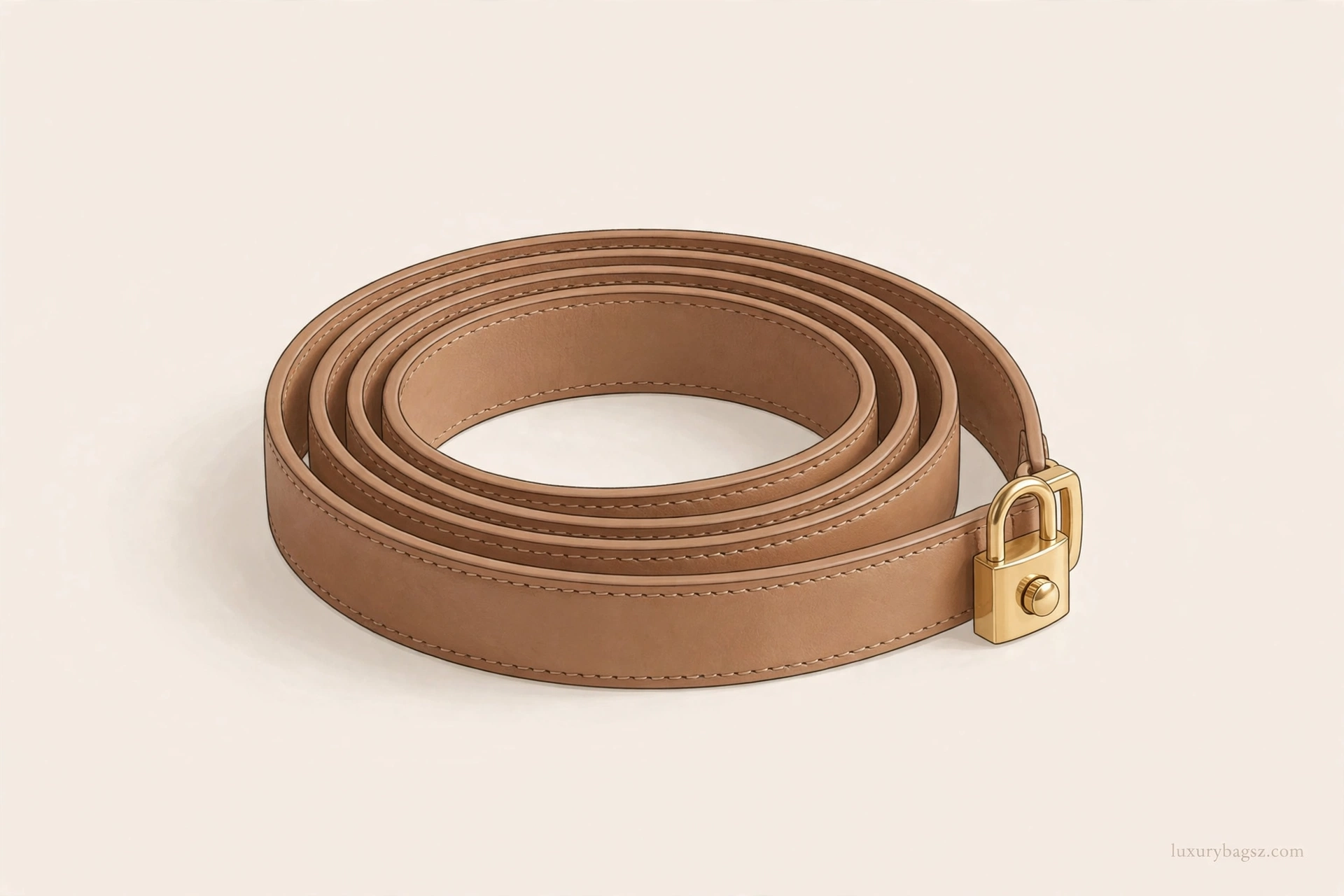
A Hermès Kelly belt is a slim leather waist belt closed by a small padlock-style turnlock buckle. That buckle borrows its shape from the Kelly bag, and it is the fastest way to recognise the belt.
The classic Kelly 18 belt is single-sided and sliding-adjustable, not reversible. It has one finished face, a plain reverse, and a fit that slides rather than fastening through punched holes.
That last point matters more than any other. Many listings call a Kelly belt reversible, and many buyers repeat the claim. The reversible buckle-and-strap kit system belongs to the H buckle and Constance family, not to the classic Kelly belt.
A Kelly belt is also not a bag strap, a bracelet, or a scaled-down Kelly bag. It is a belt in its own right, sized in centimetres, worn at the waist or on the hips, and made to cinch a coat, a dress, or a pair of trousers.
Prices in this guide are single listings only, never averages. One US listing put a Kelly 18 belt at about $1,375, and a separate listing put a Kelly Pocket 18 belt at about $2,150. Boutique and resale prices move, so confirm a current price before you buy.
Hermès issues no authenticity cards as a general rule. A card offered as proof with a Kelly belt is a red flag, not reassurance. A missing card, on its own, proves nothing either way.
This guide explains the buckle, the strap, the leathers, the sizing, the styling, and the pre-owned checks. Where sources disagree, it says so plainly instead of quietly picking one version.
Key Takeaways
- A Kelly belt is a slim leather belt with a padlock-style turnlock buckle borrowed from the Kelly bag.
- The classic Kelly 18 belt is single-sided and sliding-adjustable, not reversible.
- The reversible kit system belongs to the H buckle and Constance family, not to the Kelly belt.
- The Kelly buckle is 18 mm wide, with gold or palladium plating over metal, not solid gold.
- Belt size is a length in centimetres, not a width and not your trouser size.
- Measure where you will wear the belt, at the waist or on the hips, never tip to tip.
- Prices below are dated single listings only, never market averages or guarantees.
- Hermès issues no authenticity cards as a general rule, so a card is a red flag.
- Stamps, stitching, edge paint, and hardware must agree as a whole before you pay.
- Draft text prevails over any simplification in an illustration or infographic.
Part 1: What the Kelly Belt Actually Is
A Kelly belt is a narrow belt, usually 18 mm wide, with a small metal padlock buckle at one end. The buckle turns to lock, much like the turnlock on a Kelly bag, and that shared detail is where the name comes from.
It is worn as a waist belt, not as a wide fashion belt and not as a heavy work belt. Its job is to define a waistline, finish a coat, or add a small flash of hardware to a simple outfit.
Most Kelly belts are made from calfskin, with exotic skins on rarer or custom pieces. Colours range from classic black and gold to seasonal shades, and the hardware is usually gold-plated or palladium-plated metal.
The belt is sold as one fixed piece, buckle and strap together. That is a real difference from the H buckle system, where buckle and strap are bought as a kit and swapped. A Kelly belt does not offer that mix-and-match system.
Shoppers often meet the Kelly belt while looking for something else entirely. Some arrive from the Kelly bag, some from the Kelly bracelet, and some from a general search for a slim designer belt. Each route brings a different misunderstanding with it.
The bag shopper may expect a lock, a key, and a clochette. The bracelet shopper may expect a wrist clasp. The belt shopper may expect holes and a pin. None of those expectations fits the Kelly belt exactly, and this guide clears each one up in turn.
If you want the bracelet comparison first, read our Kelly bracelet versus Kelly belt guide. It sets out, side by side, what the two Kelly pieces share and where they part company.
Part 2: From Kelly Bag Padlock to Belt Buckle
The Kelly bag began life as a travel bag, and its turnlock closure became one of the most copied details in luxury design. Hermès later used that same padlock idea on smaller pieces, including the belt that now carries the Kelly name.
On the bag, the padlock sits on a flap and works with straps and a key. On the belt, the padlock is the buckle itself. It is smaller, lighter, and built to fasten a strap around a waist, not to secure a bag flap.
That borrowing is deliberate. It lets a Kelly bag owner echo the bag hardware at the waist without wearing a second bag. It also lets a buyer who cannot yet buy a Kelly bag own a small piece of the same design language.
The resemblance can mislead, though. A Kelly belt buckle is not a bag lock removed from a bag, and it does not come with a bag key or a clochette. If a seller offers those extras with a belt, ask why, because they belong to a different piece.
The buckle also explains why the Kelly belt looks dressier than most slim belts. A plain rectangular buckle disappears into an outfit. A padlock buckle draws the eye, and that is the point: the hardware is the decoration.
Collectors often describe the Kelly belt as jewellery for the waist. That phrase is useful, because it sets the right expectation. This is a light, decorative belt, not a belt built to hold up heavy trousers all day.
The same design language appears across the Kelly line, and fakes often copy the shape while missing the finish. Part 14 returns to that point, with the checks that matter most when you buy pre-owned.
Part 3: Anatomy of a Kelly Belt
A Kelly belt has four parts worth naming: the buckle, the strap, the sliding adjustment, and the tip. Learning those four names makes every later part of this guide easier to follow.
The buckle is the padlock-style turnlock at the front. It measures 18 mm on the classic Kelly 18, and that number is a width, not a length. It tells you how wide the strap is, not how long the belt is.
The strap is a single layer of leather, finished on one face. The reverse is not a second colour waiting to be shown. It is the back of the same piece of leather, and wearing it outward would look unfinished.
The sliding adjustment is the mechanism that sets the fit. Instead of a pin going through a punched hole, the strap slides through the buckle housing and holds at the length you set. That is why one belt can sit at the waist or on the hips.
The tip is the tapered end of the strap. It should be neatly cut, evenly painted at the edge, and free of fraying or rough fibres. A ragged tip is often the first sign of heavy wear or poor care.
Together, those four parts give the Kelly belt its character: slim, light, decorative, and adjustable across a range rather than fixed at one hole. Keep that picture in mind, because the sizing parts that follow depend on it.

Part 4: Single-Sided, Sliding-Adjustable — Not Reversible
The classic Kelly 18 belt has one display face. The leather is dyed, grained, and finished on that face, with neat stitching along both edges. The reverse is the flesh side or a plain backing, not a second finished colour.
That single-sided build is not a flaw or a cost saving. It is how a slim padlock belt is made. A second finished face would add bulk, stiffen the strap, and fight the sliding mechanism that gives the belt its range.
Sliding adjustment works differently from a holed belt. On a holed belt, you pick a hole and the pin locks you there. On a Kelly belt, you slide the strap to the length you need and the buckle holds it. The result is a smooth range, not a set of fixed steps.
Listings disagree about that range, and the disagreement is worth stating plainly. Some listings give roughly 55 to 100 cm, while others give roughly 60 to 100 cm. The draft rule is simple: never buy at the edge of a claimed range without trying the belt or confirming the measurement.
A sliding belt also wears differently from a holed belt. There is no single hole that stretches or tears first. Instead, the whole sliding zone can show wear, and the strap can develop a gentle curve where it passes through the buckle most often.
Care follows from that wear pattern. Store the belt flat or loosely coiled, never sharply folded at the sliding zone. A hard fold there can crease the leather and weaken the finish in exactly the place that moves most.
The single-sided point also settles a common styling question. You cannot flip a Kelly belt to get a second colour for a second outfit. If you want two colours, you need two belts, or a different belt family altogether.
Part 5: The Reversible Trap — Kelly Versus H Buckle and Constance Kits
The most common Kelly belt error is also the most expensive. A buyer reads that Hermès belts reverse, buys a Kelly belt expecting two colours, and only learns the truth when the belt arrives.
Hermès does make reversible belts, but they belong to a different family. The H buckle belt, often sold in the Constance family, is a kit: one detachable buckle plus one strap finished on both faces. Flip the strap, refit the buckle, and the second colour shows.
The Kelly belt has none of that kit logic. Its buckle is not made to be swapped between straps, and its strap is not finished on both faces. Calling a classic Kelly belt reversible is simply wrong, however often the claim appears in listings.
Some sources claim that a small number of reversible Kelly-style straps exist. Other sources say the Kelly line is single-sided by design. This guide states that conflict plainly and gives the safe buyer rule: never assume a Kelly belt reverses.
Ask the seller to photograph both faces of the actual belt, in daylight, before you pay. A genuine two-faced strap will show two finished colours and two finished edges. A single-sided strap will show one finished face and one plain reverse.
The buckle-shape test takes seconds and prevents most mistakes. A small padlock turnlock means Kelly. A large, open H letter means the H buckle and Constance kit family. If a listing hides the buckle, ask for a straight-on photograph.
That test also shapes the price conversation. A reversible kit is priced as a buckle plus a strap, and extra straps can be added later. A Kelly belt is priced as one fixed piece, so a second colour means a second full purchase.
Part 6: Buckle Finishes — Gold, Palladium, and What Plating Means
Kelly belt buckles are usually described as gold or palladium. Those words describe the plating, the thin metal coating on the buckle surface, not the metal underneath. The buckle is plated metal, not solid gold and not solid palladium.
That distinction matters for price, care, and expectations. A solid gold buckle would cost far more, weigh more, and scratch differently. A plated buckle gives the colour and shine at a lower weight and a lower price, but the coating can wear with time.
Gold plating gives a warm, yellow tone that suits warm leathers and classic black. Palladium plating gives a cooler, silvery tone that suits cooler colours and a more understated look. Neither finish is better in general; the choice is about wardrobe, not quality.
Sources sometimes shorten “gold-plated” to “gold” in listings, and that shortening misleads buyers. If a listing says solid gold without evidence, treat it as a warning sign, not a selling point. Ask the seller to quote the listing or boutique description exactly.
Plating wear shows first on edges and on the turnlock knob, where fingers touch the buckle most. Light wear is normal on a pre-owned belt. Deep wear that exposes a different metal underneath, or flaking that lifts in sheets, deserves a closer look.
Care for plated hardware is gentle by rule. Wipe with a soft, dry cloth, keep perfume and hairspray away from the buckle, and never use abrasive polish meant for solid metal. Harsh polish can strip plating faster than years of normal wear.
Matching hardware across pieces is a personal choice, not a rule. Some owners match belt buckle, bag hardware, and jewellery. Others mix gold and palladium freely. The Kelly belt works either way, because the padlock shape reads clearly in both finishes.


Part 7: Strap Leathers and Colours
Most Kelly belts are made from calfskin, and within calfskin there are several grains to learn. Epsom is grained and structured, holding its shape well. Togo is grained and supple, with a softer hand. Box calf is smooth and glossy, showing scratches more readily.
Swift is soft and matte, with a fine grain that suits quiet colours. Each leather ages differently, and that ageing should shape your choice. A structured grain forgives daily wear, while a smooth leather rewards careful handling.
Exotic skins appear on rarer Kelly belts, including crocodile and lizard on custom or limited pieces. Those belts cost far more, need specialist care, and are harder to authenticate. A first-time buyer is usually better served by calfskin.
Colour choice follows the same logic as any belt purchase, with one extra point. A Kelly belt is a small, bright accent, so its colour punches above its size. Black is the safest first buy, gold or tan the most versatile warm option, and a bright colour the most fun second buy.
Hermès leather comes from several countries, and tannage affects grain, structure, and ageing. Our guide to leather origins explains where Hermès leather is made and why that matters for a strap you will bend daily.
Seasonal colours come and go, and discontinued shades can carry a resale premium. Do not pay that premium blind. Check the colour in daylight photographs, because calfskin shades shift under shop lighting and phone filters.
Stitching colour is usually tonal, matching the leather rather than contrasting with it. Contrast stitching on a claimed Kelly belt is not proof of a fake on its own, but it is a reason to check the rest of the belt more carefully.
Part 8: Widths — Why 18 mm Matters and What Else Exists
The number 18 in Kelly 18 is a width in millimetres. It means the strap is 18 mm wide, about the width of a fingertip, and the buckle is made to match that strap. Width and buckle size must agree, or the belt will not sit or slide properly.
That slim width is the Kelly belt signature. It reads as jewellery, not as a utility belt, and it suits waists, dresses, and light coats. A wider belt would change the whole character of the piece, which is why the 18 mm size dominates listings.
Other Hermès belts use other widths, and that is where confusion creeps in. H buckle kits come in widths from 13 mm up to 42 mm, with 24 mm and 32 mm among the most common. A buyer who mixes those numbers with Kelly numbers will order the wrong piece.
Width is not size. A belt can be 18 mm wide and 75 cm long, or 18 mm wide and 90 cm long. The width tells you how the belt looks; the length tells you whether it fits. Part 9 deals with length, and the two must never be swapped.
Some listings give width in inches or as a vague “slim” or “thin” label. Convert before you buy: 18 mm is roughly 0.7 inches. If a listing gives no width at all, ask for it measured with a ruler across the strap, not estimated by eye.
A strap that is visibly wider or narrower than 18 mm on a claimed Kelly 18 is a warning sign. Small manufacturing variation exists, but a strap that measures 24 mm or 32 mm is a different belt family, or a fake, not a Kelly 18 variant.
Pocket versions add another naming wrinkle. The Kelly Pocket 18 name points to a pocket detail rather than a different width, but listings do not always explain that. Always confirm width, pocket, and buckle from photographs of the actual belt.
Part 9: Sizing — Length in Centimetres, Waist Versus Hips
Kelly belt size is a length in centimetres. It is not your dress size, not your trouser size, and not the width in millimetres. Keeping those three numbers apart is the single most useful sizing skill in this guide.
Start by deciding where you will wear the belt. A waist measurement and a hip measurement can differ by 10 cm or more on the same person, and a belt that fits one place will not fit the other. Measure the place, not the person in general.
Measure over the clothes you will usually wear with the belt. A belt measured over a thin dress will sit differently over a thick coat. If you plan to wear it over coats, measure over a coat, and leave room for the sliding adjustment to do its work.
Use a soft tape, level around the body, snug but not tight. Breathe out naturally and read the number where the tape meets. Write that number down in centimetres, then compare it with the belt length range, not with a single fixed number.
Because the Kelly belt slides, it covers a range rather than one hole. That range is its strength: one belt can serve a waist on one day and hips on another, provided both measurements fall inside the range. Sitting at the very edge of a range is risky, so leave margin.
If you sit between two belt lengths, the usual advice is to take the longer option, since a sliding belt can adjust down more gracefully than it can stretch up. A belt that is too short cannot be made longer, while a belt that is slightly long can still slide to fit.
Boutique staff can measure you, and a good resale seller can measure the belt. Ask for the belt length range in centimetres, measured as the maker intends, and compare it with your own waist or hip number. Do not accept a dress size as a substitute.
Part 10: The Tip-to-Tip Trap and Other Measuring Mistakes
The tip-to-tip trap is the most common Kelly belt sizing error. A seller lays the belt flat, measures from one end to the other, and quotes that total as the belt size. That total includes the buckle, the tip, and parts that never wrap around your body.
A belt size should reflect the wearing length, not the flat length. Tip-to-tip numbers run long, so a buyer who trusts them ends up with a belt that is too big. The error is honest in many cases, but it still costs the buyer a return or a resale loss.
A second mistake is measuring a different belt and assuming the numbers transfer. Belt lengths vary by maker, by buckle, and by how the sliding zone is counted. Your old belt number is a hint, not a guarantee, for a Kelly belt.
A third mistake is measuring the waist while wearing high-waisted trousers, then wearing the belt over a low dress. The belt has not changed, but the wearing place has, and the fit will feel wrong. Measure the wearing place for each outfit you care about.
A fourth mistake is trusting a single photograph with a ruler laid beside the belt. Ruler photographs help, but perspective can distort them. Ask for the number in writing, plus a photograph of the belt worn or held at the stated length, where possible.
A fifth mistake is confusing width and length in the listing title. A title that says “18” may mean 18 mm wide, not 18 inches or a size 18. Read the full listing, check the units, and ask the seller to confirm width in millimetres and length in centimetres separately.
The safe routine is short: measure your waist or hips in centimetres, ask for the belt wearing range in centimetres, and leave margin at both ends. If the seller cannot give a wearing range, treat that gap as a reason to pause, not as a detail to guess.

Part 11: Prices — Single Listings Only, and What Moves Them
Prices in this guide are single listings only. They are snapshots of one seller, one belt, one condition, at one time. They are never averages, never typical prices, and never promises of what you will pay.
One US listing put a Kelly 18 belt at about $1,375. A separate listing put a Kelly Pocket 18 belt at about $2,150. Those two numbers describe two different belts, in different conditions, from different sellers. Do not average them, and do not treat either as a going rate.
Boutique prices move by region, by season, and by price rises that Hermès does not announce in advance. Resale prices move with condition, colour, leather, hardware finish, and how complete the set is. A black calfskin belt in worn condition and a rare exotic belt in mint condition are not the same market.
Condition moves price more than any other single factor. A belt with a clean strap, even edge paint, and light buckle wear will command more than the same belt with a creased sliding zone, a frayed tip, or heavy plating wear. Photographs should let you judge that, not just the colour.
Completeness matters too, but it must be judged correctly. An orange box and a dust bag add presentation value, and many buyers like them. They do not prove authenticity, and their absence does not prove a fake. Price them as packaging, not as proof.
Colour and leather move price in a quieter way. Classic black and gold hold demand because they suit many wardrobes. A seasonal colour may suit fewer buyers, yet a discontinued shade may attract collectors. Both effects are real, and neither is a rule you can bank on.
Before you pay, confirm the current boutique or resale price for the exact belt you want, in the exact condition on offer. A single listing from months ago is a starting point for research, not a price you can quote to a seller.
Part 12: Styling — Waist, Hips, Coats, Dresses, Trousers
A Kelly belt earns its price in styling, because a slim padlock belt can change an outfit without changing anything else. The trick is to place it where it does the most work, and to let the buckle be the decoration.
At the waist, the belt defines a shape that a loose dress or coat hides. Place it at the natural waist, slide it to fit, and let the padlock sit centred at the front. That centred placement reads as deliberate, while a buckle sliding to one side reads as an accident.
On the hips, the same belt gives a relaxed, lower line that suits long shirts, tunics, and low-rise trousers. The sliding fit helps here, because hip placement needs a longer length than waist placement. Check that both placements fall inside the belt range before you rely on both.
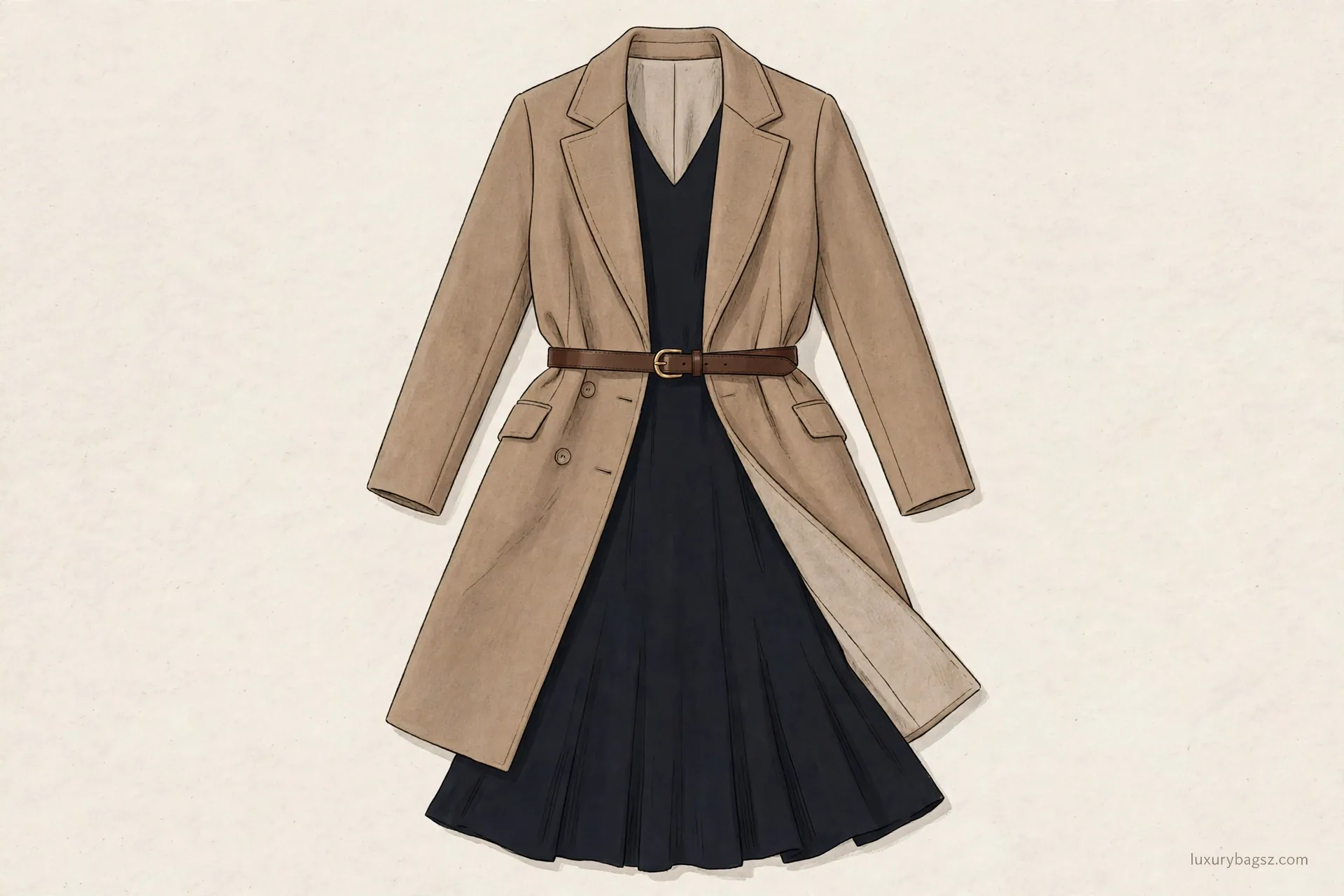
Over a coat, a Kelly belt turns outerwear into a shaped piece. A wool coat cinched at the waist looks tailored, and the gold or palladium buckle lifts a dark coat without shouting. Measure over the coat first, as Part 9 explains, or the belt will feel tight when you need it most.
Over a dress, the belt works best with simple fabrics and clean lines. A plain dress lets the padlock shine, while a heavily patterned dress can fight it. If the dress already has a busy print, a black or tonal belt usually sits more quietly than a bright one.
With trousers, the Kelly belt suits tailored styles with belt loops that fit an 18 mm strap. Wide loops made for a 32 mm belt will let a slim strap slide and twist. Check loop width before you plan a trouser outfit around the belt.
Evening styling favours palladium or gold to match your jewellery, while daytime styling favours whichever finish matches your bag hardware. There is no rule here, only a habit: match one piece, and let the rest of the outfit stay simple.
Part 13: Care and Storage
Kelly belt care is gentle, regular, and boring, which is exactly why it works. A soft, dry cloth after wear, a cool dry place for storage, and no harsh chemicals will preserve a calfskin belt longer than any miracle product.
After wearing, wipe the strap lightly to remove dust and surface moisture, and wipe the buckle with a separate soft cloth. Keep perfume, hairspray, and hand cream away from both leather and plating, because they can mark leather and dull a finish over time.
For light leather cleaning, a barely damp cloth, well wrung out, is usually enough, followed by air drying away from heat and sun. Never soak a Kelly belt, never use a hairdryer on it, and never leave it on a radiator. Heat and water together damage leather faster than either alone.
Conditioning needs care and restraint. A conditioner made for smooth calfskin can help a dry strap, but it can darken light colours and change the finish. Test on a hidden spot first, use a tiny amount, and stop if the colour shifts. Suede or exotic belts need different products entirely.
For routine leather care, our Saphir Renovateur guide explains a widely used conditioner and its limits. For suede pieces, our suede brush guide explains brushing without damaging the nap. Use each product only on the leather it suits.
Storage matters as much as cleaning. Coil the belt loosely, or hang it straight, and keep it in its dust bag away from sunlight. Never fold it sharply at the sliding zone, and never stack heavy items on top of a coiled belt.
If you own a Kelly bag too, store belt and bag separately, so buckle and bag hardware cannot scratch each other. Our guide on how to store a Hermès Kelly bag gives the same gentle logic for the bag, and it applies just as well to the belt.
Part 14: Buying Pre-Owned — Stamps, Stitching, Hardware, Card Trap
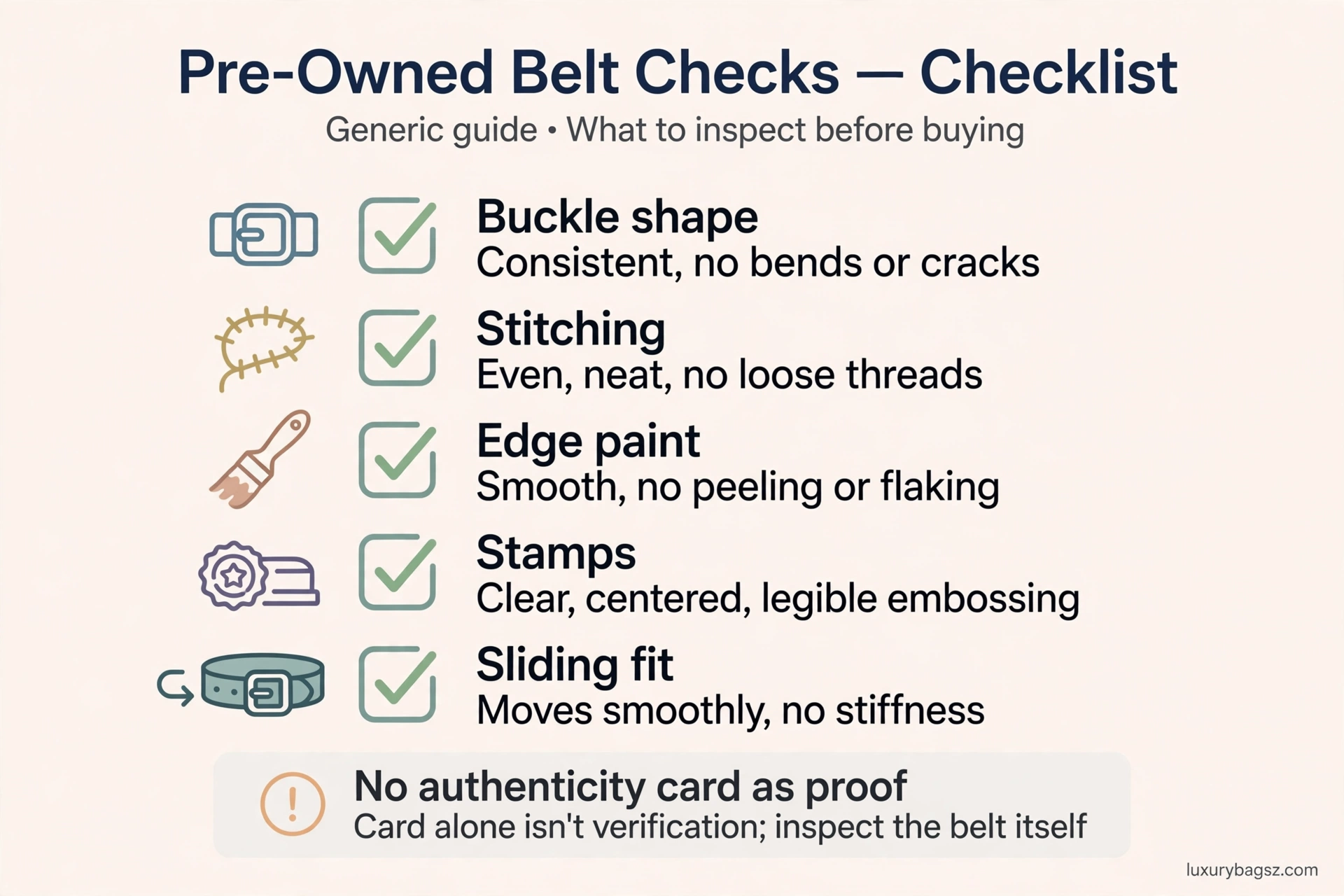
Buying a Kelly belt pre-owned can save money, but it needs a slower eye than buying new. Judge the belt as a whole: buckle, strap, stitching, stamps, and edge paint must agree. No single detail proves a belt genuine, and no single flaw proves it fake.
Start with the buckle shape. The padlock should be neat, symmetrical, and cleanly finished, with a turnlock that moves smoothly and locks with a firm click. Rough casting, uneven edges, or a loose, wobbly turnlock all deserve a closer look.
Check the plating next, with the conflict in mind that guides disagree on shine. Some guides call genuine buckles shinier, others call them less shiny. Judge consistency instead: the same plating quality across face, edges, and back, with wear that matches the claimed condition.
Stitching is the next honest tell. Genuine Kelly belt stitching is even, straight, and evenly spaced along both edges, with no wandering, bunching, or loose threads. A strap whose stitching drifts off the edge, or changes spacing halfway along, is a strong warning sign.
Edge paint should be smooth, even, and the right colour for the leather, with no cracking, peeling, or rough fibres showing through. Edge paint cracks with age and wear, so light cracking on an old belt is not fatal. Fresh, thick, uneven paint on a claimed mint belt is a different story.
Stamps need the same whole-belt thinking. A genuine stamp is cleanly pressed, with even letters that fit the claimed material and origin. A blurred, uneven, or misspelled stamp is a serious warning. A correct-looking stamp, on its own, is not proof, because stamps are easy to copy.
Bag blind-stamp year logic does not transfer neatly to belts, so do not date a belt from a stamp alone. Use stamps for sense and consistency: wording, placement, and depth should match the claimed belt, leather, and condition. Anything that breaks that pattern needs an explanation.
The card trap deserves its own warning, because it catches careful buyers. Hermès issues no authenticity cards as a general rule. A seller who offers a card as proof, or who charges extra for one, is giving you a red flag, not reassurance. A missing card proves nothing on its own.
Box and dust bag prove nothing either. Both are widely copied, and both can be borrowed from a genuine purchase. Judge the belt, not the packaging, and price packaging as presentation only.
For the wider fake-check method, our fake Kelly guide sets out the same whole-pattern approach for the bag. The belt checks above follow that logic, adapted for a slim strap and a padlock buckle.
Ask for daylight photographs before you pay: buckle front, buckle back, stitching close-up, edge paint close-up, stamps, both faces of the strap, and the belt worn. A seller who refuses those photographs, or who pressures you to pay off-platform, is giving you a reason to walk away.
If you already bought a belt and now doubt it, stop presenting it as proven genuine, keep everything that came with it, do not alter it, and get a professional opinion before you resell it. A paid authentication is cheaper than a mistaken resale.
Part 15: Kelly Belt, Kelly Bracelet, Lookalikes — Do Not Mix Them Up
Shoppers often confuse three Kelly pieces: the belt, the bracelet, and the bag. They share a padlock idea, but they are built for different places, different fits, and different prices. Mixing them up in a search can waste weeks.
The Kelly bracelet is a wrist piece with a padlock clasp and a short leather strap that wraps the wrist. It is sized for a wrist, not a waist, and it cannot be worn as a belt. A bracelet listing that appears in a belt search is a sorting error, not a bargain.
The Kelly bag is a handbag with a flap, a turnlock, handles, and a shoulder strap on some sizes. Its padlock is a closure, not a buckle, and its price sits in a different range entirely. A belt will never substitute for a bag, and a bag lock will never fasten a waist.
Lookalikes add a second layer of confusion. Many high-street belts copy the padlock shape, and some copy it well at a glance. A padlock buckle alone does not make a belt a Kelly belt, just as an H-shaped buckle alone does not make a belt an Hermès kit.
Check the whole belt when a lookalike is suspected: strap width, stitching, edge paint, stamp, and sliding action together. A lookalike may copy one detail well and miss the rest, and that pattern is usually visible in daylight photographs.
Naming adds a third layer. Sellers sometimes call any slim Hermès belt a Kelly belt, even when the buckle is an H or a plain rectangle. Others call a Kelly belt a Constance belt, because both names feel familiar. Trust the buckle shape, not the title.
A useful habit is to search by buckle first, then by name. Look for a padlock turnlock, confirm 18 mm width, and only then check whether the title says Kelly. That order filters out most mislabelled listings before you spend time on them.
Gift buyers face the same confusion in reverse. A Kelly belt is a strong gift for someone who wears slim belts at the waist, and a poor gift for someone who never wears belts at all. Size, colour, and hardware finish all need to match the recipient, not just the giver’s taste.
If you are buying as a gift, measure a belt the recipient already wears, at the place they wear it, and compare that number with the Kelly belt range. A surprise gift in the wrong length is a return, not a delight, however beautiful the buckle.
New versus pre-owned is the last choice to settle. New gives boutique packaging, a known history, and a full price. Pre-owned gives a lower price, a wider colour range, and a need for the checks in Part 14. Neither route is wrong, but they suit different buyers.
A first-time buyer who values certainty should start new or with a trusted reseller who offers authentication. A collector who values a discontinued colour may need pre-owned, and should budget for professional authentication as part of the price.
Whichever route you take, keep the record: photographs, seller messages, and any authentication report. That record protects you if you resell, and it helps the next buyer judge the belt fairly. Good records are part of good ownership.
Frequently Asked Questions
What is a Hermès Kelly belt?
A Hermès Kelly belt is a slim leather waist belt with a padlock-style turnlock buckle borrowed from the Kelly bag. The classic Kelly 18 is 18 mm wide, single-sided, and sliding-adjustable, and it is worn at the waist or on the hips.
Is a Kelly belt reversible?
No, not in its classic form. The classic Kelly 18 belt is single-sided, with one finished face and a plain reverse. The reversible buckle-and-strap kit belongs to the H buckle and Constance family, not to the Kelly belt.
What does Kelly 18 mean?
Kelly 18 means the strap and buckle are 18 mm wide. That number is a width, not a length and not a size. Belt length is a separate number, given in centimetres, and the two must never be swapped.
Is the Kelly buckle solid gold?
No. Kelly buckles described as gold or palladium are plated metal, not solid gold or solid palladium. The plating gives the colour and shine, while the metal underneath gives the strength. Listings that claim solid gold need evidence.
How do I size a Kelly belt?
Measure where you will wear it, at the waist or on the hips, over the clothes you will usually wear, in centimetres. Compare that number with the belt wearing range, leaving margin at both ends. Never use a dress size, a trouser size, or a tip-to-tip measurement.
What is the tip-to-tip trap?
Tip-to-tip measuring quotes the full flat length of the belt, including buckle and tip, as if it were the wearing length. That number runs long, so buyers who trust it end up with a belt that is too big. Always ask for the wearing range instead.
How much does a Kelly belt cost?
There is no single price to quote, because boutique and resale prices move. One US listing put a Kelly 18 belt at about $1,375, and a separate listing put a Kelly Pocket 18 belt at about $2,150. Treat both as single listings only, never as averages, and confirm a current price before you buy.
Does a Kelly belt come with an authenticity card?
No, not as a general rule. Hermès issues no authenticity cards as a general rule, so a card offered as proof is a red flag. A missing card, on its own, proves nothing either way. Judge the belt itself, not the paperwork.
How do I care for a Kelly belt?
Wipe it with a soft, dry cloth after wear, keep it away from perfume and harsh chemicals, and store it loosely coiled or hanging in a dust bag. Never soak it, never fold it sharply at the sliding zone, and test any conditioner on a hidden spot first.
Kelly belt or H buckle belt — which should I buy first?
Buy the Kelly belt first if you want a slim, decorative, padlock-accent belt for waists and dresses. Buy an H buckle kit first if you want two colours from one strap and a mix-and-match buckle system. The buckle shape tells you which family you are buying.
Final Verdict
A Hermès Kelly belt is a small piece with a clear identity: a slim, single-sided leather strap, an 18 mm padlock buckle, and a sliding fit that covers a range rather than one hole. That identity is its charm, and it is also the test that separates a real Kelly belt from a mislabelled kit.
Buy it for what it is, not for what listings sometimes claim. Do not expect a second colour, a detachable buckle system, or a card that proves authenticity. Expect a light, dressy belt that defines a waist, finishes a coat, and echoes the Kelly bag in miniature.
Measure carefully, in centimetres, at the place you will wear it, and leave margin inside the stated range. Check buckle, stitching, edge paint, and stamps as a whole, and walk away from pressure, missing photographs, or a card offered as proof.
Chosen that way, a Kelly belt is a versatile first Hermès belt and a lasting accent piece. It will not do everything a wider kit belt does, and it does not try to. Its strength is doing one slim, elegant job very well.






