How to Clean Hermès Oran Sandals: Leather, Suede, Patent, Canvas and Exotic Pairs
Cleaning an Oran Without Ruining It
There is no single way to clean an Oran — the safe method is set by the material in front of you. With smooth leather, begin by brushing away dust and grit, then go over one small patch at a time with a cloth that is barely moist and a gentle, pH-balanced leather cleaner. Lift the loosened dirt away with a clean cloth, then leave the pair to dry slowly in open air, away from radiators and windows.
Suede is the opposite case: water stays away from it altogether. Let any mud dry where it sits, brush it off once hard, and lift marks with a suede eraser. Patent leather asks for little — a wipe with a slightly damp cloth and the smallest drop of gentle soap, then a dry buff. Canvas can be brushed and dabbed at individual marks, but never saturated. Exotic skins get the lightest handling of all: a dry cloth, and nothing else.
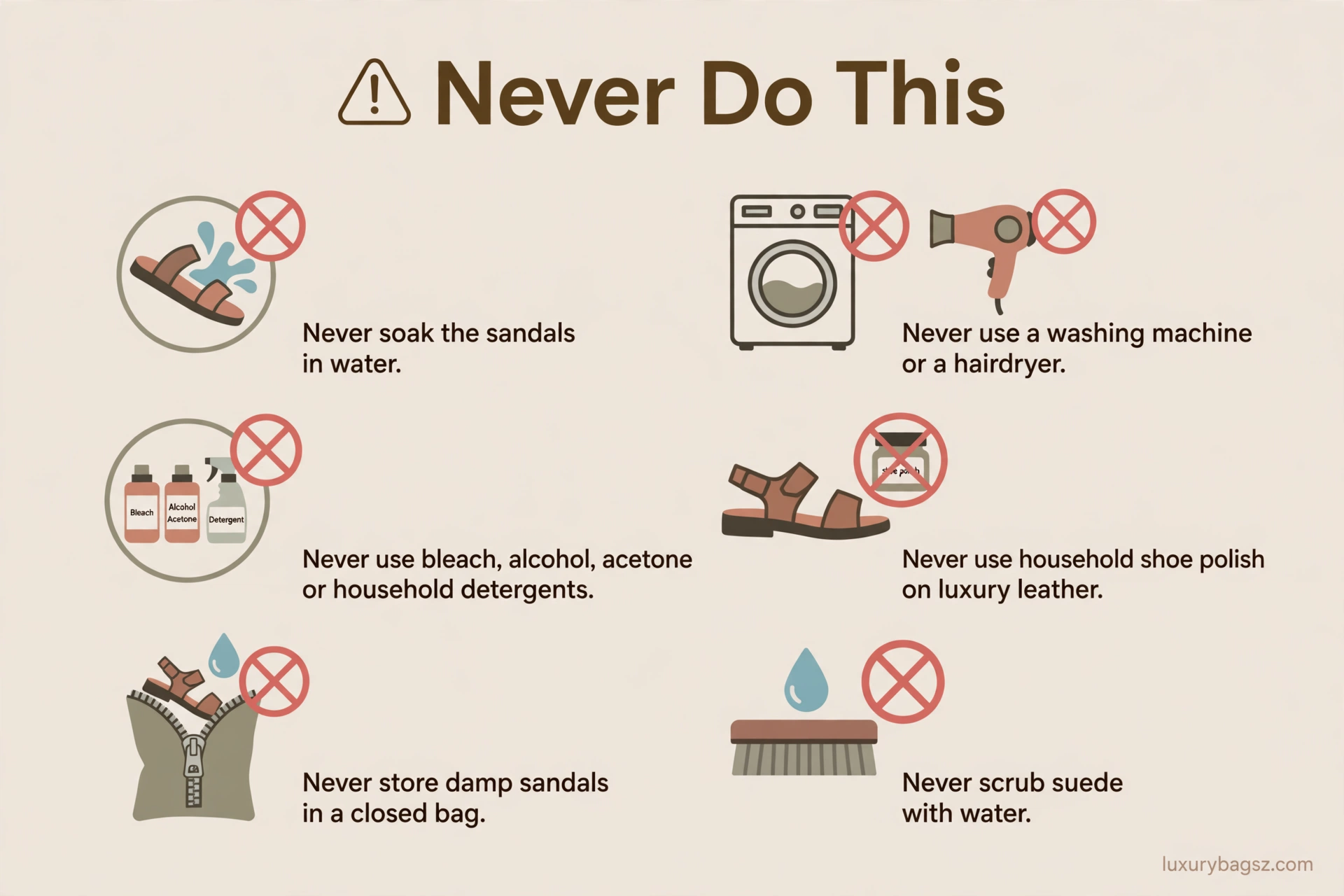
Three boundaries hold for every pair, whatever the finish. The sandals are never soaked or held under water. Bleach, alcohol, acetone and everyday household cleaners are never used on them. And they are never dried against heat or in strong sun — shade and moving air only. Nearly every ruined pair traces back to crossing one of those three lines.
Key Takeaways
- Never soak an Oran, never machine-wash it, and never dry it with heat. Water is the fastest route to warped leather, lifted dye, and stiffened suede.
- Identify the material before you touch the pair. Smooth leather, suede, patent, canvas, and exotic skins each need a different routine, and the wrong routine causes the damage.
- Wipe the pair down after every wear. Sweat, sunscreen, salt, and dust break down leather and stitching if they sit on the surface for weeks.
- For smooth leather, clean small areas with a barely damp cloth and a mild, pH-balanced leather cleaner, then wipe off the residue and air-dry slowly. Condition sparingly, only once the leather is fully dry.
- For suede, keep liquids away. Brush dry, use a rubber eraser for marks, and treat the nap gently rather than scrubbing it flat.
- For salt stains, two Hermès-focused guides agree on one method: dab with equal parts distilled water and white vinegar, then blot and air-dry. That agreement is rare in this field, and it is worth trusting.
- Protective sprays are disputed. Some guides recommend them broadly, while others warn against using them on suede or highly polished calfskin. Test first, and never spray a pair you have not tested.
- Footbeds darken and pick up odour because they sit bare against skin. Wipe them after wear, let the pair air out, and use baking soda overnight for odour rather than wetting the footbed.
- Stitching, edge paint, and the underside of the strap are the parts most guides skip. They are also the parts where dirt collects and where careless cleaning shows first.
- When stitching unravels, a strap attachment loosens, or the sole thins to discomfort, take the pair to a cobbler early. Small problems on a thin-soled sandal grow fast.
The Hermès Oran looks almost too simple to need a cleaning guide. It is a flat leather sole and one broad strap with a cut-out shape across the foot. There is nowhere for dirt to hide, or so it seems.
In practice, the Oran is one of the easiest luxury shoes to damage while cleaning. The strap is thin, the stitching is visible, the sole is leather, and the footbed sits bare against skin all summer. One harsh cleaner, one soaking, or one hot drying session can do damage that no conditioner will undo.
This guide covers every Oran material: smooth calfskin and Box calf, suede and nubuck, patent, canvas, denim, embellished pairs, and exotic skins. It gives a routine for after every wear, a step-by-step deep clean, and a stain-by-stain rescue plan.
It also says plainly where rival guides disagree. Cleaning advice for luxury sandals is full of confident contradictions, and this guide names them instead of quietly picking one side. Where a method is disputed, you will read both versions and learn which one is the safer bet for a pair you cannot easily replace.
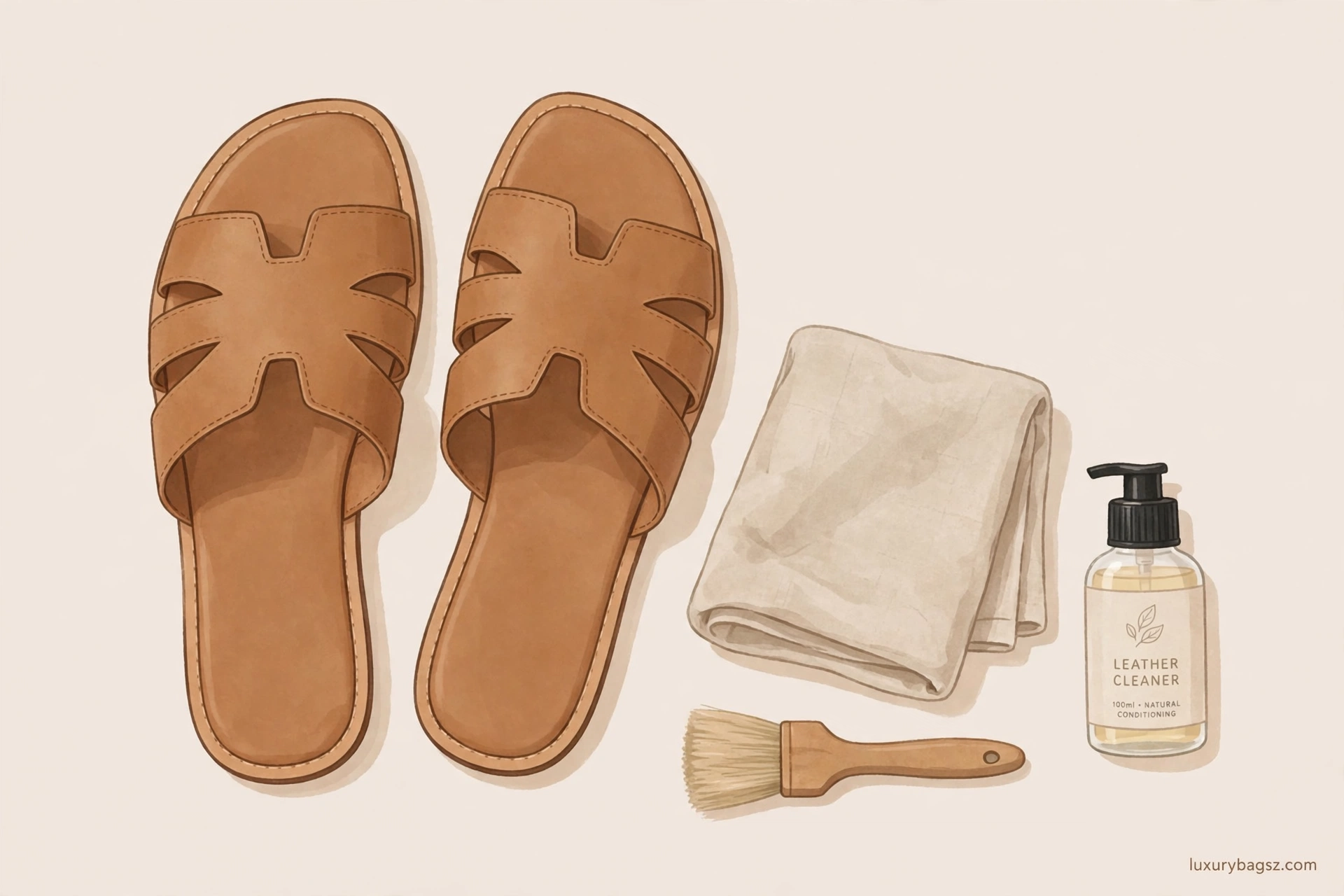
A note on the pictures first. Every picture in this guide is a generic illustration, not a photograph of a real Hermès sandal. Illustrations simplify leatherwork and flatten colours, and they are not drawn to an exact scale. Use the pictures to follow the ideas, and use the words for the method. Where a picture simplifies a detail, the words in this guide prevail.
Cleaning an Oran in Brief
Start with the material, not the stain. A smooth calfskin Oran and a suede Oran are different cleaning jobs that happen to share a shape. Check the strap, the footbed, and the sole before you pick up any product.
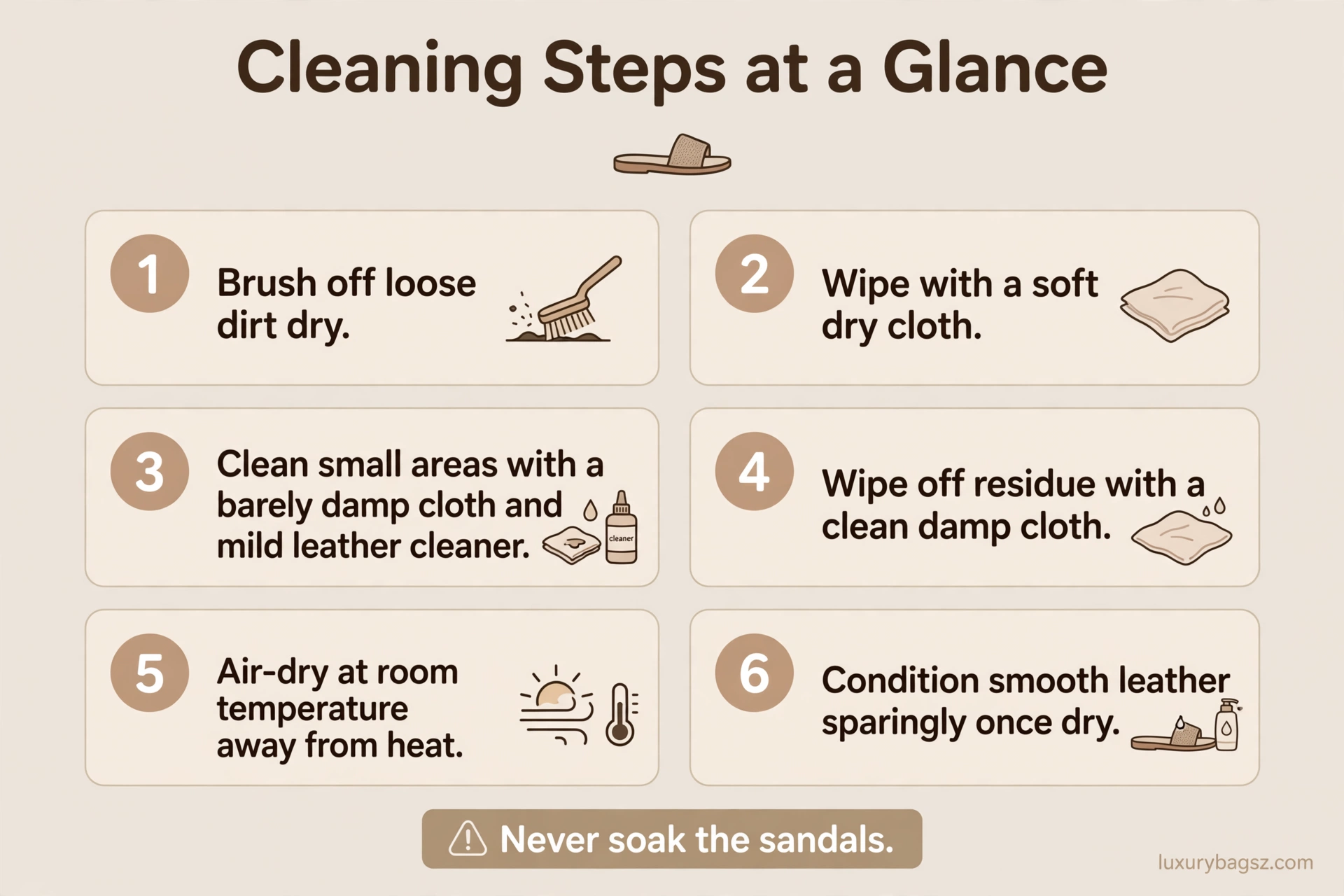
For smooth leather, the short routine is this: brush off loose dirt dry, wipe with a soft dry cloth, and clean small areas with a barely damp cloth and a mild leather cleaner. Wipe off the residue with a clean damp cloth, air-dry at room temperature away from heat, and condition sparingly once dry.
For suede, the short routine is shorter still: let mud dry, brush it off gently, and use a rubber eraser for marks. Keep water, liquid cleaners, and polishes away from the nap. A suede brush used lightly after every wear does more good than any deep clean.
For patent, wipe with a soft damp cloth and a drop of mild soap, then buff dry. For canvas, brush dry and spot-clean gently without soaking the fabric. For exotic skins, do almost nothing at home beyond a dry wipe, and hand anything worse to a professional.
Whatever the material, three rules never change. Never soak the sandals, never use bleach, alcohol, acetone, or household detergents, and never dry them beside a heater or in direct sun. Most Oran cleaning disasters break at least one of those three rules.
Know Your Material First
The Oran is made in a wide range of materials, and rival guides do not even agree on the full list. Calfskin, Box calf, suede goatskin, goatskin, canvas, and denim appear across sources, along with exotic skins such as lizard and alligator. One 2026 guide lists calfskin, suede, shearling, and exotics for Hermès sandals generally.
That variety is why material identification comes first. A cleaner that is safe for calfskin can ruin suede, and a brush that revives suede can scratch patent. If you are unsure what your pair is made of, stop and find out before cleaning.
Smooth calfskin is the most common Oran material. It has a smooth, slightly glossy surface, visible grain, and a firm feel when new that softens with wear. Box calf is a polished, firmer calfskin with a shinier finish. Both are cleaned the same way, but Box calf shows water marks and scratches more readily.
Suede goatskin is the second most common material. It feels soft and napped, like fine velvet, and it darkens slightly where fingers press it. Suede is the material most often damaged by well-meaning owners, because almost every instinct from leather cleaning — damp cloth, liquid cleaner, conditioner — is wrong for it.
Patent leather has a hard, glossy, almost plastic-like shine. It is less absorbent than calfskin, which makes it easier to wipe clean, but it is vulnerable to colour transfer, heat, and sticking to other surfaces in storage. Treat it as its own material, not as ordinary leather.
Canvas and denim Orans are fabric pairs. They do not stretch or condition like leather, and they soak up water and stains instead of resisting them. Their cleaning routine is closer to fabric care than to leather care, and the background on how to clean a Hermès canvas bag is useful reading before the first spill.
Exotic skins, above all lizard, have a scaled surface that is stiff and unforgiving. They do not absorb conditioner the way calfskin does, and a wrong product can sit in the scales or lift them. The home routine for exotic Orans is deliberately minimal, and the exotic skins section explains why.
Embellished pairs add one more layer. Some Orans carry rhinestones, embroidery, or printed designs, and retailer care notes for a suede pair with rhinestones advise wiping the stones gently with a soft dry cloth. Never brush, soak, or spray an embellished pair the way you would a plain one.
The Cleaning Kit
A good Oran cleaning kit is small, and that is the point. Every extra product in the kit is another chance to use the wrong thing on the wrong material. Keep the kit together, near where you take the sandals off, so the after-wear wipe actually happens.
You need soft, lint-free cloths, at least three: one dry for dusting, one barely damp for cleaning, and one clean damp cloth for wiping off residue. Microfibre works, but a plain soft cotton cloth works just as well. Avoid paper towels for routine wiping, since they can leave fibres and drag grit across the surface.
You need a soft-bristled brush for dry dirt and a suede brush for suede pairs. These are different tools, and the suede brush deserves its own guide: the routine for how to use a suede brush explains pressure, direction, and how often to brush. A hard brush has no place near an Oran strap.
You need a mild, pH-balanced leather cleaner for smooth leather, and a neutral, non-silicone leather conditioner for after cleaning. Buy small bottles from a leather-care brand rather than a household brand. Household cleaners are made for floors and counters, not for thin luxury leather.
You also need a few quiet helpers: distilled water, white vinegar, baking soda, talcum powder, and a rubber eraser. Distilled water matters because tap water can leave mineral marks on light leather. The eraser is for suede marks, and the baking soda is for footbed odour, not for scrubbing straps.
What stays out of the kit is just as important. No bleach, no alcohol, no acetone, and no household detergents: two Hermès-focused guides agree that these strip dyes and oils. No household shoe polish, which one repair specialist warns can seal a scuff and make later professional colour matching impossible.
No coloured cloths, either, since dye from a cloth can transfer to light leather. White or undyed cloths are the safe choice. And no hairdryer, heater, or direct sun for drying, which belongs in the drying section but is worth stating wherever drying is mentioned.
The Everyday Routine
The most useful cleaning advice in this guide is also the dullest: wipe the pair down after every wear. One Hermès-focused guide recommends wiping leather sandals after every wear and doing a light clean weekly if they are worn often. Another guide says the same in different words, and the agreement is reassuring.
Sweat, sunscreen, salt, and dust are the daily enemies. Sweat carries salts that darken footbeds and dry out stitching. Sunscreen leaves a film that attracts dirt and can stain light leather. Dust works its way into the cut-outs of the strap and into the stitching, where it grinds gently with every step.
The routine takes two minutes. Brush off loose dirt with a soft brush, working away from the stitching rather than across it. Wipe the strap, top and underside, with a soft dry cloth. Wipe the footbed with a dry cloth as well, and let the pair air out upright before putting it away.
Do not store damp sandals in a closed bag or box. Moisture trapped in seams breaks down stitching faster than almost anything else, and one guide names this explicitly. Let the pair dry fully at room temperature first, even if that means leaving it out overnight.
Rotation helps more than most owners expect. Wearing the same pair every day never lets the leather rest, dry, or recover its shape. If you own two pairs of summer sandals, alternating them does more for the Oran’s lifespan than any conditioner.
Pay attention to the footbed in this routine, because it is the part owners ignore. Leather footbeds absorb sweat and salts, which cause darkening and odour over time. A quick dry wipe after wear slows that process a lot, and it costs nothing.
The Deep Clean for Smooth Leather
A deep clean is for visible dirt, not for routine maintenance. Do it only when the pair looks dirty, not on a schedule, since every wet clean removes a little of the leather’s oils. One guide puts it well: gentle and frequent beats harsh and rare, every time.
Start dry, always. Brush off loose dirt with a soft brush, then wipe the whole pair with a soft dry cloth. Brushing first matters, because loose grit dragged across wet leather scratches it. Spend extra time on the cut-outs of the strap, where dust collects in the corners.
Next, test your cleaner. Put a tiny amount on a hidden spot — the underside of the strap, or the inner edge near the sole — and wait for it to dry. Check for darkening, colour change, or stiffness. If anything changes, stop and use a different product or hand the pair to a professional.
Here is where rival guides disagree, and the disagreement is worth stating plainly. One general sandal guide recommends saddle soap, which cleans and conditions in one step. Hermès-focused guides recommend a mild, pH-balanced leather cleaner instead, applied sparingly on a soft cloth.
This guide sides with the pH-balanced cleaner. Saddle soap is a sound product for sturdy leather, but it can darken light colours and leave a residue on thin luxury leather. If you already use saddle soap and it works for you, that is your experience, but it is not the safer recommendation for a first deep clean.
Work in small areas, one patch of strap at a time. Dampen a clean cloth — barely damp, not wet — add a small amount of cleaner, and rub gently in circles. Lift the dirt rather than grinding it in, and do not scrub the stitching hard. Stitching on an Oran is decorative and structural, and frayed stitching is hard to repair invisibly.
Wipe off the residue with a clean, barely damp cloth, then wipe again with a dry cloth. Let the pair air-dry at room temperature, away from heaters and sunlight. Drying is not a step to rush, and the drying section covers it in full.
Once the leather is fully dry, condition sparingly if the leather feels dry or dull. Use a small amount of neutral, non-silicone conditioner on a lint-free cloth, work it thinly and evenly, let it sit for 10 to 20 minutes, then buff. Over-conditioning softens glue lines, so thin beats generous.

Suede and Nubuck
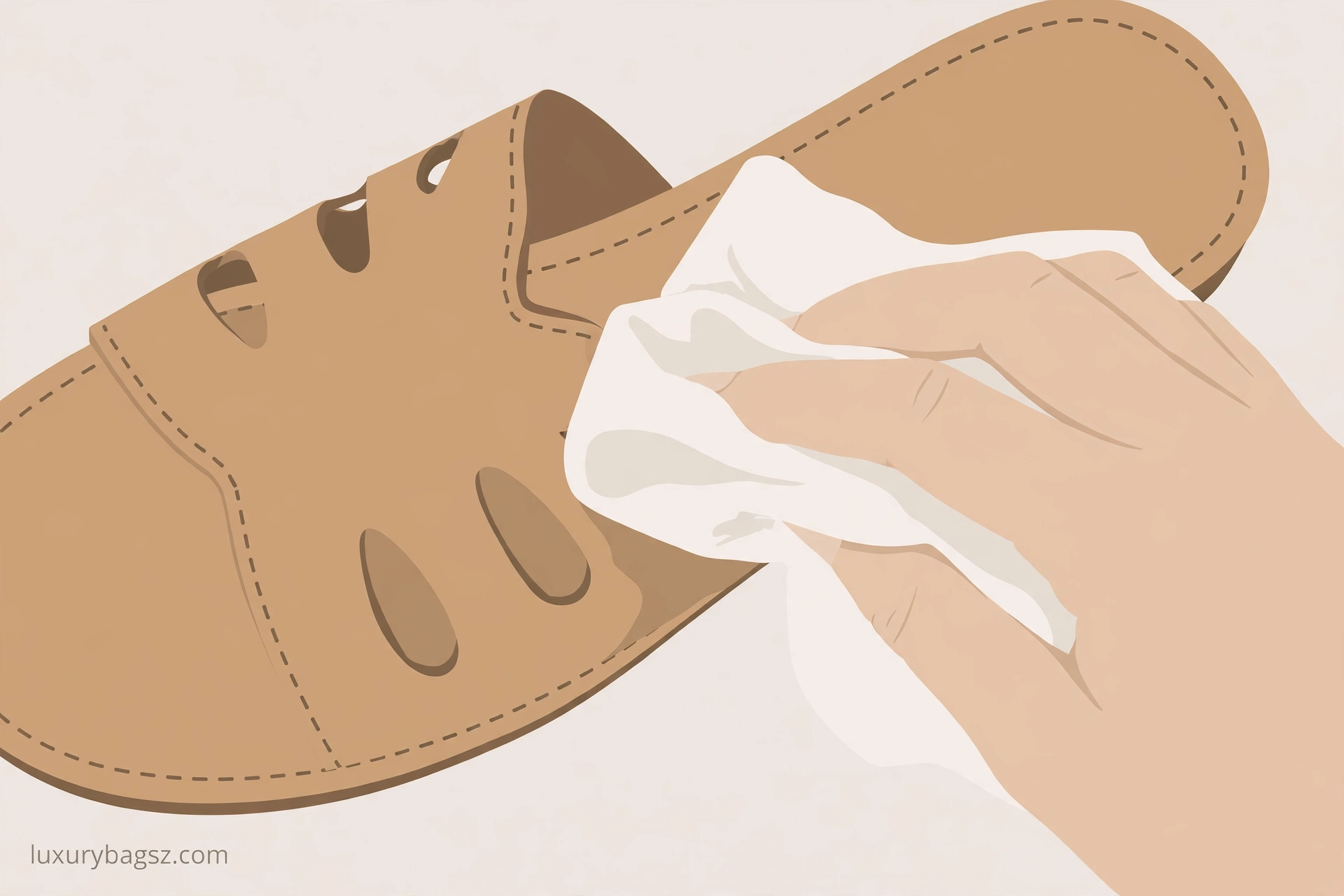
Suede Orans need a different mindset from leather ones. The rule is simple: keep liquids away, and let the brush do the work. Water stains suede, liquid cleaners darken it unevenly, and conditioner meant for smooth leather will flatten the nap.
Start dry, as with leather, but stay dry. Let any mud dry fully before touching it, then brush it off gently with a suede brush. Brushing a wet suede strap pushes mud into the nap instead of lifting it out. Brush in one direction, lightly, and do not press hard enough to shine the surface.
For surface marks, use a rubber eraser — a clean, colourless one — rubbed gently over the mark, then brush again to lift the nap. Retailer care notes for suede Orans recommend exactly this pair of tools: a soft suede brush and a rubber eraser for stains, with liquids avoided. The routine for how to use a suede brush covers the pressure and direction in detail.
Here the sources disagree sharply, and the disagreement matters. One general sandal guide suggests dabbing stains with rubbing alcohol and buffing with fine sandpaper. Hermès-focused sources say the opposite: avoid liquids on suede entirely, and never use products made for smooth leather.
This guide rejects the alcohol-and-sandpaper method for Oran suede. Rubbing alcohol can strip dye and dry the fibres, and sandpaper removes nap that cannot be put back. A suede pair damaged by sanding looks worse than a suede pair with a faint mark, and the mark can usually be improved by brushing alone.
Protect suede before the first wear, not after the first stain. Retailer care notes recommend a professional suede protector sprayed before first wear, applied lightly and evenly from a distance. One Hermès-focused guide, however, warns against using sprays on suede or highly polished calfskin, which is a direct conflict covered in the protection section.
The safest way through that conflict is to test. Spray a hidden spot — the underside of the strap — and check for darkening or stiffness once dry. If the test is clean, a light protector coat is reasonable. If it darkens, skip the spray and rely on brushing and careful wear.
Suede also shows wear differently from leather. The nap flattens where the foot presses, and the colour looks lighter where it is brushed against the grain. Regular light brushing keeps the nap even, which is why the after-wear routine matters even more for suede than for leather.
Patent, Canvas, Denim and Embellished Pairs
Patent Orans are the easiest to wipe and the easiest to ruin by storage. Wipe the strap with a soft damp cloth and a drop of mild soap, then buff dry with a clean cloth. That is usually enough, since patent does not absorb dirt the way calfskin does.
One conflict to note: a general shoe-care guide says a patent cleaner containing silicone restores gloss, while a Hermès-focused guide recommends a neutral, non-silicone conditioner for leather care generally. The two are not quite the same product for the same job, but the silicone question is unresolved across sources.
For patent, this guide favours the gentler route: damp cloth and mild soap, with no silicone product unless the pair already looks dull and you have tested the product on a hidden spot. Silicone can build up into a film, and on a glossy surface that film shows.
Canvas Orans need fabric thinking. Brush dry first, then spot-clean with a barely damp cloth and a tiny amount of mild soap, working from the outside of the mark inward. Never soak the fabric, and never machine-wash the pair. The fabric will dry stiff and misshapen if it is soaked, and the leather sole and trim will suffer at the same time.
Denim pairs behave like canvas pairs, with one extra risk: dye transfer. New denim bleeds colour onto light surfaces, and an Oran’s light footbed or light strap edge can pick up blue from jeans. Wipe denim pairs after wear, and keep light-coloured Orans away from new, unwashed denim.
Embellished pairs need the gentlest routine of all. Rhinestones should be wiped gently with a soft dry cloth, as retailer care notes advise, and never brushed or sprayed. Embroidery should be brushed only with the softest brush, in the direction of the stitching, and printed designs should never be scrubbed.
For canvas and fabric pairs generally, the companion routine for how to clean a Hermès canvas bag is worth reading. The materials differ, but the principle is the same: gentle, dry-first, and never soaked.
Exotic Skins
Exotic Orans — lizard above all, with alligator reported in some seasons — are the pairs where home cleaning should be minimal. No rival guide found in this research gives an Oran-specific exotic cleaning routine. That gap is itself a finding, and it shapes this part.
Lizard skin is made of small scales over a thin leather base. It is stiffer than calfskin, it does not stretch, and it does not absorb conditioner evenly. A product that vanishes into calfskin can sit on lizard scales, collect dust, or lift a scale edge. That is why the home routine here is deliberately short.
Wipe an exotic pair with a soft dry cloth after every wear. That is the whole routine for a pair in good condition. For light surface dust, a very soft brush used lightly is acceptable, but do not press into the scales.
Do not use water, liquid cleaners, or conditioner on exotic skins at home unless a specialist has told you to for that exact pair. Do not use suede tools, patent products, or household cleaners either. The risk is not that the product fails to clean, but that it changes the scales in a way that cannot be reversed.
Stains on exotic pairs are a professional job. A cobbler or leather specialist experienced with exotic skins can clean between scales without lifting them, and can match the finish afterwards. The cost of that visit is small next to the cost of the pair, and exotic Orans cost significantly more than calfskin ones.
That cost difference is worth grounding. One 2026 guide puts a calfskin Oran at approximately $900 in the US and around €635 in Europe, while noting that exotic options cost significantly more. Another review dated May 2026 puts the US price at $900 plus tax and the European price at €595. A third source lists roughly $750 in the US and around €620 in Europe.
Those three sources disagree with each other, so none of them is a settled market price. They are dated single-source figures, not averages, and they are quoted here only to show the scale of the investment. An exotic pair sits well above even the highest of those figures, which is why a mistake on exotic skin is the most expensive mistake in this guide.
Stains, One by One
Stains are where speed matters most. The longer a stain sits, the deeper it sets, and the more aggressive the cleaning it needs. Blot first, identify second, and clean third — in that order, every time.
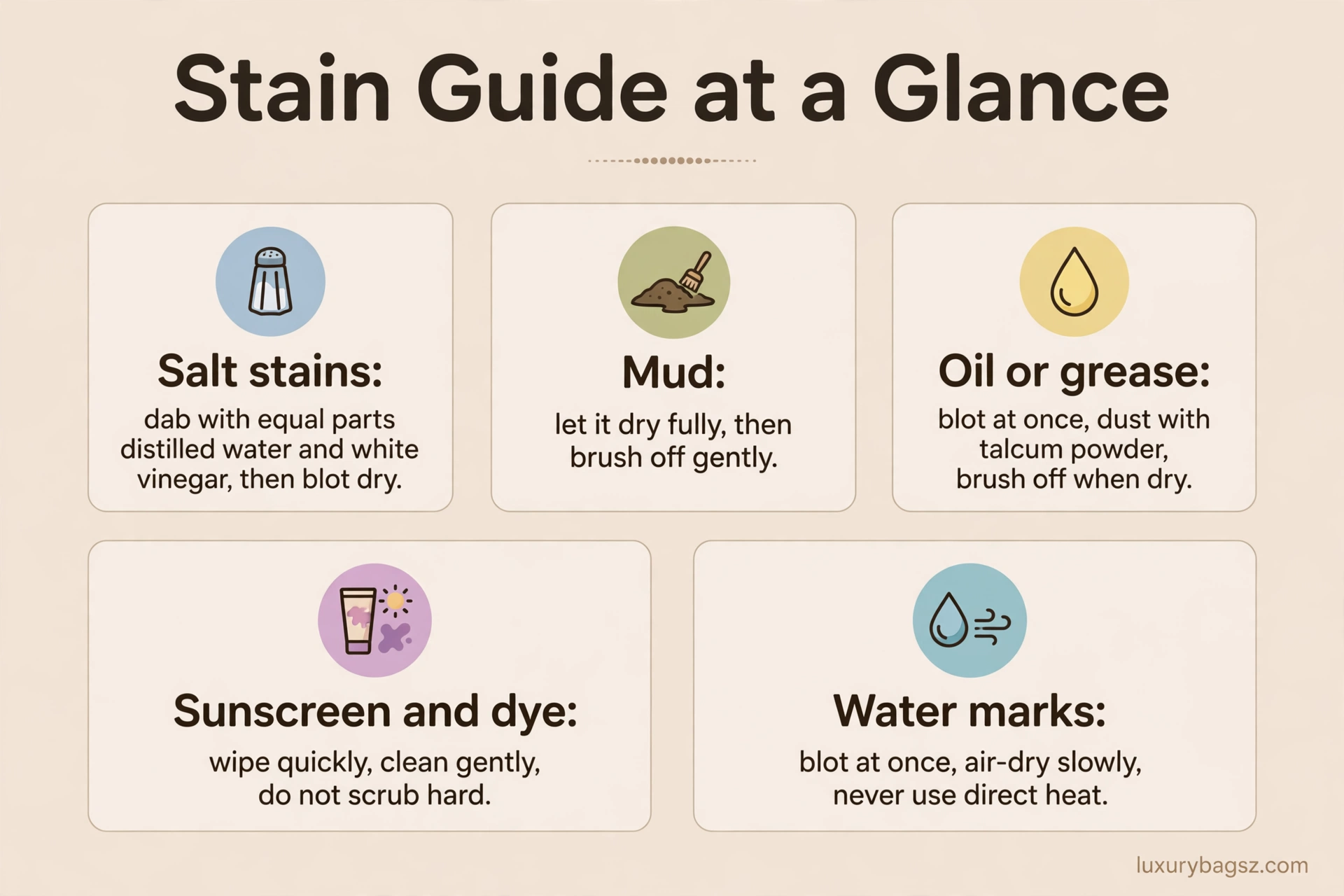
Salt and sea-water stains are the best-documented Oran stain, and the sources agree here. Two Hermès-focused guides give the same method: mix equal parts distilled water and white vinegar, dab the stain lightly, then blot and air-dry away from direct heat. The vinegar neutralises salt without bleaching dye, according to both guides.
Use that method only on smooth leather, and test it first on a hidden spot. Dab, do not rub, since rubbing spreads salt crystals across the surface. If a white ring remains after drying, repeat once, lightly, rather than scrubbing harder. Suede salt stains are a different job, covered below.
Mud is the most forgiving stain, if you wait. Let mud dry fully, then brush it off gently with a soft brush. Wiping wet mud smears it into grain and stitching, which turns a five-minute job into a deep clean. For suede, the same rule applies with more force: dry mud brushed off is harmless, while wet mud rubbed in can stain permanently.
Oil and grease need blotting at once. Press a clean dry cloth onto the mark to lift what you can, without rubbing it wider. Then dust the mark with talcum powder, leave it to draw out the oil, and brush the powder off when dry. A general shoe-care guide gives this method, and it works for smooth leather and, cautiously, for suede.
Do not use water on an oil stain first. Water spreads oil and can set it into the leather. If the talcum method leaves a faint shadow, a professional can usually improve it, but a home attempt with detergent will usually make it worse.
Sunscreen is a summer-specific stain that rival guides barely mention. Wipe sunscreen off as soon as you notice it, with a dry cloth first and then a barely damp cloth for smooth leather. Sunscreen contains oils and chemicals that stain light leather and attract dirt, and a film left overnight is harder to remove than a fresh smear.
Dye transfer is the quiet stain. Dark jeans, dark bags, and coloured straps can leave colour on light Orans, especially pale and white pairs. Wipe the pair after wear, and do not try to scrub dye out aggressively, since scrubbing removes the Oran’s own dye along with the transferred colour. A faint transfer mark is better than a scrubbed bald patch.
Water marks need patience rather than product. Blot at once with a dry cloth, then air-dry slowly at room temperature. Do not use heat to hurry the drying, and do not re-wet the whole strap to even the mark out. That last idea appears in general leather advice, but on thin Oran leather it risks a larger mark than the one you started with.
For suede stains generally, the rule stays dry: brush, eraser, and patience. A suede-specific cleaner used sparingly is acceptable if brushing and erasing fail, but test it on a hidden spot first. If a suede stain survives brushing, erasing, and a tested cleaner, it is a professional job.
Footbeds, Soles, Stitching and Edges
The strap gets all the attention, and the rest of the sandal does most of the wearing. Footbeds, soles, stitching, and edges are where an Oran shows its age first, and they are the parts rival guides cover least.
Footbeds darken because they sit bare against skin. Sweat, body oils, and sunscreen build up gradually, and the leather absorbs them. Wipe the footbed with a dry cloth after every wear, and let the pair air out upright so moisture escapes rather than sitting in the footbed.
For a deeper footbed clean on smooth leather, use a barely damp cloth with a tiny amount of mild soap, worked gently over the surface. Wipe off the residue with a clean damp cloth, then dry the pair fully before wearing it again. Do not saturate the footbed, since water that soaks into the footbed takes a long time to leave.
Never use a suede brush or a hard brush on a smooth leather footbed. The footbed is thin, and aggressive brushing wears through its finish. If the footbed is suede-lined, brush it lightly with a suede brush only, and keep it dry.
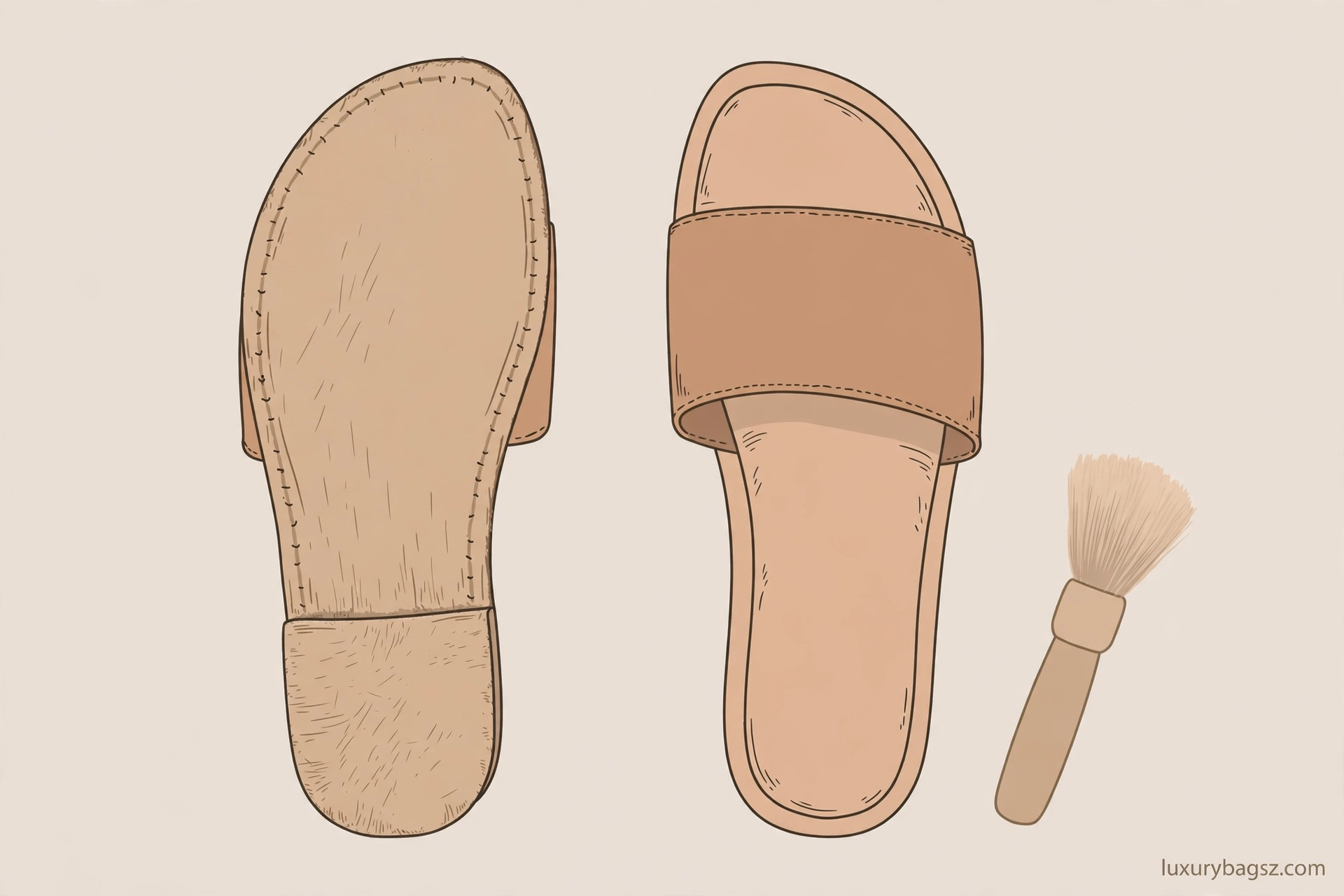
Soles need a different kind of care. The Oran’s leather sole is thin, and it wears fastest at the front edge and the heel. Brush dirt off the sole after wear, and wipe it with a dry cloth. Do not wet the sole deliberately, since water softens leather soles and shortens their life.
One guide recommends adding a thin rubber half sole from a cobbler before the first wear, to protect against hot pavement and wet surfaces. A repair specialist agrees, noting that thin rubber sole protectors add longevity and grip without changing how the sandal looks. That advice is sound for a pair you plan to wear hard.
It is not universal, though. Some owners prefer to keep the original leather sole untouched, valuing the original look and feel over extra life. Both views are reasonable, and the choice is yours. What is not reasonable is waiting until the sole is worn through before deciding, since a worn-through sole is a resoling job, not a protection job.
Stitching deserves a gentle hand. The Oran’s stitching is visible along the strap and the sole edge, and it collects dirt in every stitch hole. Brush along the stitching, not across it, and never pick at loose threads. A loose thread trimmed flush is fine; a thread pulled out unravels the line.
Edge paint is the coloured finish on the sole edge and strap edge. It chips with wear, and it is easy to damage while cleaning. Do not scrub edges, and do not apply conditioner thickly to edges, since one guide warns that over-conditioning softens glue lines. A specialist can repaint edges, and that is a routine cobbler job.
White stitching, which appears on some Oran pairs, shows dirt faster than matching stitching. Brush it gently and wipe it with a dry cloth, but do not bleach it. Bleach weakens thread and yellows leather, and white stitching cleaned with bleach looks worse within weeks.
Water, Drying and Odour
Water is the Oran’s worst enemy, and it arrives in ordinary ways: rain, puddles, beach trips, and wet grass. Avoid wearing leather-soled Orans on wet surfaces where you can, as one guide advises, and treat any soaking as an incident, not as a normal wear.
If the pair gets wet, act at once. Blot the moisture with an absorbent cloth, pressing gently rather than rubbing. Stuff the footbed lightly with plain paper to hold the shape while it dries, and keep the pair at room temperature. Change the paper if it becomes soaked.
Never use a heater, a hairdryer, or direct sunlight to dry an Oran. Heat shrinks delicate leather, stiffens it, and can crack the finish. One repair guide notes that controlled heat is used sparingly by professionals, but that too much heat shrinks delicate Hermès leathers. At home, slow air-drying is the only safe method.
Drying time is measured in days, not hours, for a soaked pair. A lightly damp pair may dry overnight, but a soaked pair can take a full day or two. Do not wear the pair until it is fully dry, since wearing damp leather stretches it unevenly and traps moisture in the seams.
For suede that gets wet, blot gently and air-dry slowly, then brush the nap once dry to restore it. Do not apply heat, and do not brush wet suede. A water mark on suede may fade with brushing, but it may also stay, and that is a risk to accept rather than chase with liquids.
Odour comes from the footbed, not from the strap. Bacteria grow in the warm, damp footbed, and the smell builds over a summer. The prevention is the after-wear wipe and the airing-out routine from the everyday routine section, which keep the footbed dry between wears.
For existing odour, use baking soda overnight. Sprinkle it lightly over the footbed, leave the pair overnight, then tap and brush it all out in the morning. General sandal guides agree on this method, and it works because baking soda absorbs odour without wetting the leather.
Do not spray perfume, scented sprays, or essential-oil mixtures into the footbed as a fix. They mask odour for a day and can stain or darken the leather. A clean, dry footbed smells of nothing, and that is the goal.
If odour survives baking soda and a gentle footbed clean, the cause may be deeper: moisture trapped in the sole layers, or a footbed that has broken down. That is a cobbler question, not a cleaning question, and the professional help section covers it.
Protection, Storage, Travel and Professional Help
Protection starts before the first wear, and it is disputed territory. Some general guides recommend a leather protection spray for new shoes, to guard against stains and water damage. One Hermès-focused guide recommends a thin protective spray for leather in unpredictable weather, but warns against using sprays on suede or highly polished calfskin.
Retailer care notes for suede Orans go the other way, recommending a professional suede protector before first wear. So the sources disagree in both directions: sprays recommended for leather, warned against for suede by one source, and recommended for suede by another.
The way through is testing and restraint. Test any spray on a hidden spot first, apply it lightly and evenly from a distance, and let it dry fully before wearing the pair. Never spray a pair heavily, and never reapply often enough to build up a film. A thin coat that passes a spot test is reasonable; a heavy coat applied blindly is not.
Conditioning frequency is also disputed. One guide recommends treating calfskin with conditioner every few months. Other guides recommend conditioning sparingly, only after cleaning or when the leather looks dry. Those are not the same schedule, and the difference matters for thin leather.
This guide sides with the sparing schedule. Condition when the leather looks or feels dry, not on a calendar, and always thinly. Over-conditioning softens glue lines and can darken light colours, while under-conditioning is fixed by one more thin coat.
A conditioner such as Saphir Renovateur is a sound choice, used the way its own guide describes: sparingly, and never as a substitute for cleaning.
Storage is simple and often skipped. Keep Orans in their dust bags, in a cool, dry place, away from direct sunlight and humidity. Sunlight fades colour and dries leather, while humidity encourages mould on stored leather. Do not stack heavy items on top of the pair, since the strap creases under weight.
Keep patent pairs apart from other shoes in storage. Patent can stick to neighbouring surfaces and lift colour from them, especially in heat. A dust bag per pair, rather than a shared box, prevents most of that damage.
Travel needs a little planning. Pack Orans in their dust bags, with tissue lightly supporting the strap shape, and never pack a damp pair. If the pair gets wet on a trip, dry it fully before packing it away, even if that means carrying it out of the bag for a night.
Cleaning a pre-owned pair needs caution. A used Oran has already been broken in to someone else’s foot, and its strap and footbed carry that history. Clean it gently, using the driest method for its material, and do not try to restore it to new in one session.
If the pair’s condition worries you, compare it against known tells the way a buyer would when learning how to spot fake Hermès Oran sandals — a seller’s cleaning claims are no substitute for evidence in the pair itself.
Hermès issues no authenticity cards as a general rule, so a card offered with a pre-owned pair is a red flag rather than reassurance. That note belongs here because pre-owned pairs are often sold as “freshly cleaned,” and a cleaned-up listing can hide wear that matters. Judge the pair, not the story.
Know when to stop doing it yourself. Take the pair to a cobbler when stitching unravels, a strap attachment loosens, the sole thins to discomfort, or a stain survives the gentle methods in this guide. A repair specialist notes that small problems compound quickly on luxury sandals, and that edge repainting, glue reinforcement, and stitch replacement are routine jobs for a skilled cobbler.
For a full restoration — recolouring, resoling, or exotic skin work — choose a cobbler experienced with thin leather soles and luxury finishes. Ask to see previous Hermès work, and ask what the repair will change about the pair’s look. A good cobbler will tell you what cannot be restored to new, and that honesty is worth more than a promise of perfection.
The companion guides on this site cover the wider care picture. The general Oran introduction in what are Hermès Oran sandals explains the materials and styles, while the Hermès Oran sandals sizing guide covers fit and break-in.
For leather care beyond sandals, the routine for how to clean Chanel bags shares the same dry-first principle. The storage advice in how to store a Hermès Kelly bag applies to keeping any luxury leather away from sun and humidity.
Leather sourcing also varies by hide, which is why which country makes leather for Hermès bags is useful background when a pair behaves differently from another pair you own.
For embellished pairs, the routine for how to clean Hermès fashion jewelry is a useful parallel, since stones and delicate finishes need the same gentle hand.
FAQ
Can I wash Hermès Oran sandals in water?
No. Never soak an Oran, and never machine-wash it. Clean smooth leather with a barely damp cloth, keep suede dry, and air-dry any pair that gets wet at room temperature away from heat.
How do I clean suede Oran sandals?
Brush them dry with a suede brush, and use a rubber eraser for marks. Keep water, liquid cleaners, and smooth-leather conditioner away from the nap, and let mud dry fully before brushing it off.
What removes salt stains from Oran sandals?
For smooth leather, dab with equal parts distilled water and white vinegar, then blot and air-dry away from heat. Two Hermès-focused guides agree on this method. Test it on a hidden spot first, and do not rub the stain wider.
Can I use a protector spray on my Orans?
Sources disagree. Some guides recommend sprays, while one Hermès-focused guide warns against them on suede or highly polished calfskin. Test any spray on a hidden spot first, apply it lightly, and never build up a heavy film.
How do I get rid of footbed odour?
Wipe the footbed after every wear and let the pair air out. For existing odour, sprinkle baking soda over the footbed overnight, then tap and brush it all out in the morning. Do not spray perfume into the footbed.
How do I clean the leather sole?
Brush dirt off the sole and wipe it with a dry cloth. Do not wet the sole deliberately. A cobbler can add a thin rubber half sole before the first wear if you want extra protection and grip.
Can a cobbler fix scuffs and worn edges?
Yes, in most cases. Surface scuffs can be buffed and recoloured, edges can be repainted, and loose stitching can be replaced. Deep gouges, missing leather, and heavy sole separation are harder, so take the pair in early.
How should I store Oran sandals?
In their dust bags, in a cool, dry place, away from direct sunlight and humidity. Never store a damp pair in a closed bag. Keep patent pairs apart from other shoes, since patent can stick and lift colour.
Are white and pale Orans harder to clean?
Yes. Light colours show dirt, sunscreen, and dye transfer faster, and they darken more visibly when a product is wrong. Use white or undyed cloths, test every product on a hidden spot, and wipe pale pairs after every wear.
When should I stop cleaning at home and see a professional?
When stitching unravels, a strap attachment loosens, the sole thins to discomfort, a stain survives the gentle methods, or the pair is exotic skin with anything beyond surface dust. A skilled cobbler can do work at home that would risk permanent damage.
Final Verdict
Cleaning an Oran is mostly about restraint. The pairs that last are the ones wiped after every wear, dried slowly, and cleaned gently only when they need it. The pairs that fail early are usually the ones soaked, scrubbed, heated, or sprayed with the wrong product in a single enthusiastic session.
Learn your material first, keep the kit small, and test every product on a hidden spot. Treat suede dry, treat exotic skins barely at all, and treat stains quickly but gently. When a problem is beyond the gentle methods, hand the pair to a cobbler early rather than escalating at home.
An Oran rewards that restraint for years. It is a simple sandal made of fine materials, and fine materials respond to gentle, regular care far better than to occasional heroic cleaning. Wipe it, dry it, store it well, and it will keep the shape and colour that made you buy it.