

What Are Hermès Jumping Boots?
The Jumping Boot in Brief
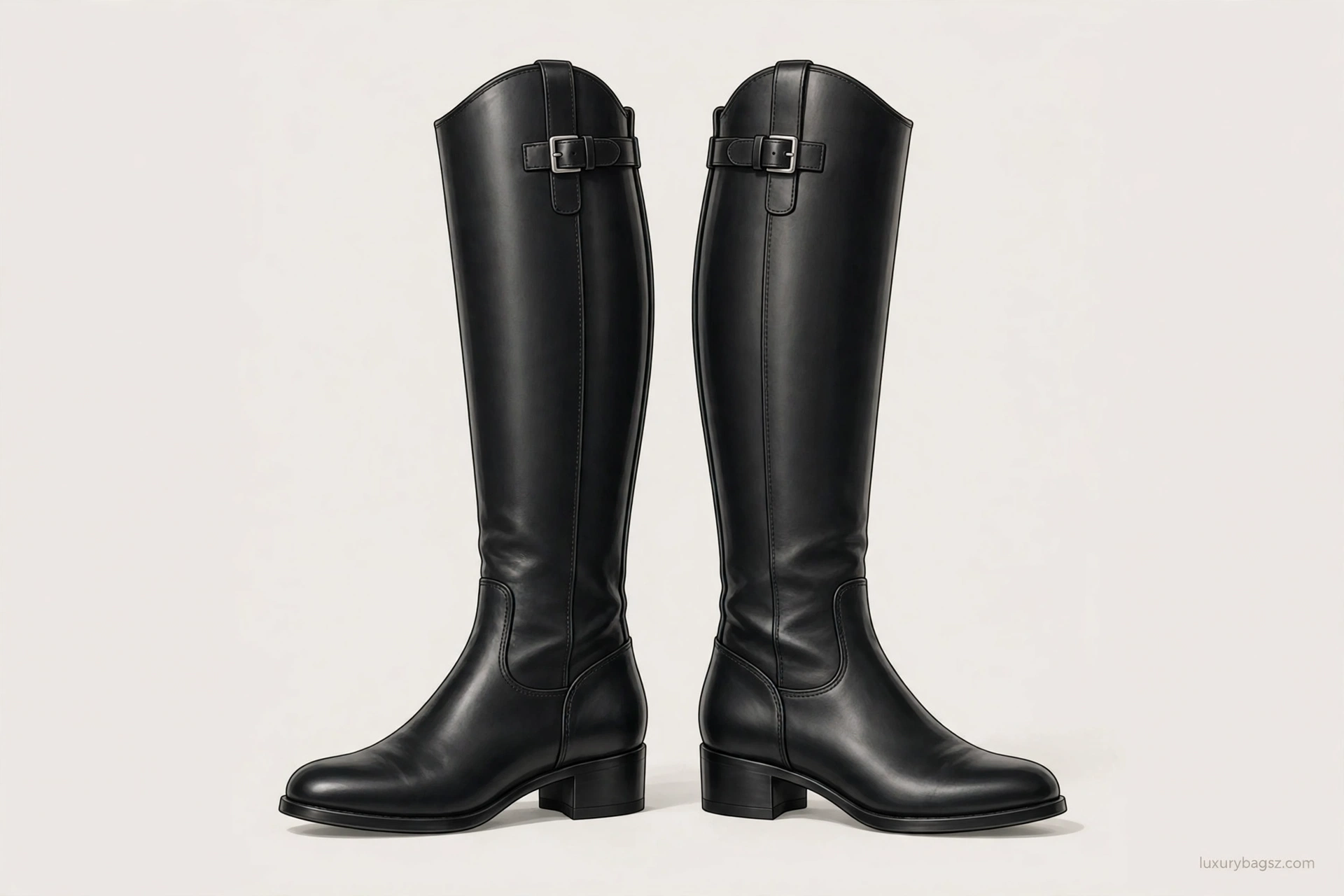
The Hermès Jumping boot is a tall, knee-high riding-style boot with a slim shaft and a small buckle strap near the top. That buckle is the Kelly buckle, borrowed from the house’s most famous bag, and it is the detail most people notice first.
Hermès describes the boot as an iconic equestrian-inspired model with a daring, chic look. It is a town boot inspired by riding, not a piece of certified riding equipment. That distinction matters, and this guide keeps it in plain view.
The boot comes in two upper heights, called Jumping and Jumping shorter. The shorter version has a lower shaft for shorter legs or for anyone who wants more freedom at the knee. Both versions share the same slim silhouette, low heel, and leather sole.
Prices vary a great deal by material and season. A plain calfskin pair was listed at $3,500 on the Hermès US store on 1 November 2026, while a calfskin-and-shearling pair was listed at $8,200 on the same store the same day. Treat every price in this guide as a dated single-listing example, never as a market average.
Hermès began in 1837 as a harness and saddle workshop in Paris. Horses were the whole business then, and the house has never really left them behind. The Jumping boot is one of the clearest survivals of that origin in the modern shoe range.
The boot takes the shape of a classic riding boot and pares it down for city life. Designer Pierre Hardy once described the house’s jumping boots as “riding boots for town.” He found the style in the Hermès archive when he joined, and kept it close to its original form.
That restraint is the point. The boot has no laces, no zips, and no loud branding. It is a pull-on boot with clean lines, a rounded or almond toe, and one small buckle strap. Everything else is leather, stitching, and proportion.
This guide covers what rival guides usually skim: the conflicting dates and measurements, the real material range, how the two shaft heights differ, what the boot costs, how to style it, how to care for each material, and what to check before buying a pre-owned pair. Where sources disagree, the disagreement is stated outright.
Key Takeaways
- The Jumping boot is a tall pull-on riding-style boot with a Kelly buckle strap at the top of the shaft.
- It is made in Italy, not France, by a specialist bootmaker — a fact Hermès itself has confirmed in press coverage.
- Two upper heights exist: Jumping and Jumping shorter. The shorter version suits shorter legs and easier knee movement.
- Calfskin is the classic material, with Box calfskin, suede goatskin, shearling, canvas-print, and exotic versions appearing across seasons.
- The heel is low, around 2 cm, and the sole is leather. The boot is built for walking city streets, not for jumping horses.
- Sizing is disputed: Hermès says the boot runs true to size, while resale listings and one owner review say it runs small or narrow.
- Hermès issues no authenticity card as a general rule. A seller offering one as proof should be treated with suspicion.
- Pre-owned prices swing widely with condition, material, and size, so a single resale figure proves nothing about value.
Part 1. Where the Jumping Boot Comes From
The Jumping boot draws directly on Hermès’s equestrian roots. The house’s first product was horse harness, and its first bag, the Haut à courroies of 1892, was designed to carry riding boots. A boot like the Jumping was therefore never a stretch for Hermès. It was a return to the beginning.
There is, however, a genuine conflict about when this particular boot was created. The Hermès US store states that “the Jumping boot, created in 2004, draws inspiration from the House’s equestrian roots.” A PurseBop gift guide, by contrast, dates the silhouette much earlier, writing that it was “first introduced in 1972.”
Both claims cannot be right in the same sense. The honest reading is that a jumping-style boot has existed in the Hermès archive for decades, while the current named model dates to 2004. Rival guides usually pick one date and present it as fact. This guide does not, because the sources do not agree.
The boot’s designer history is better documented. Pierre Hardy, Hermès’s shoe designer, has spoken about finding the style in the archive and deliberately changing it as little as possible. His stated aim was to make it slightly lighter and slightly softer, without reinterpreting it.
That conservatism explains the boot’s long life. Fashion boots usually change every season. The Jumping keeps its shape and changes its colours and materials instead. It is, in that sense, closer to a bag style than to a seasonal shoe.
The boot is also one of the few Hermès products made outside France. A Telegraph-era account of the boot’s making reported that it is produced by an artisan bootmaker in northern Italy, near Venice. Hermès’s own store pages confirm the point today: every current Jumping listing states “Made in Italy.”
That fact surprises buyers who assume everything Hermès is French. It should not. Hermès has long said it goes where the savoir-faire is, and for footwear that is Italy. The same account noted that only two other Hermès categories were outsourced at the time: lacquer work and cashmere weaving.
Part 2. Design: What the Boot Actually Looks Like
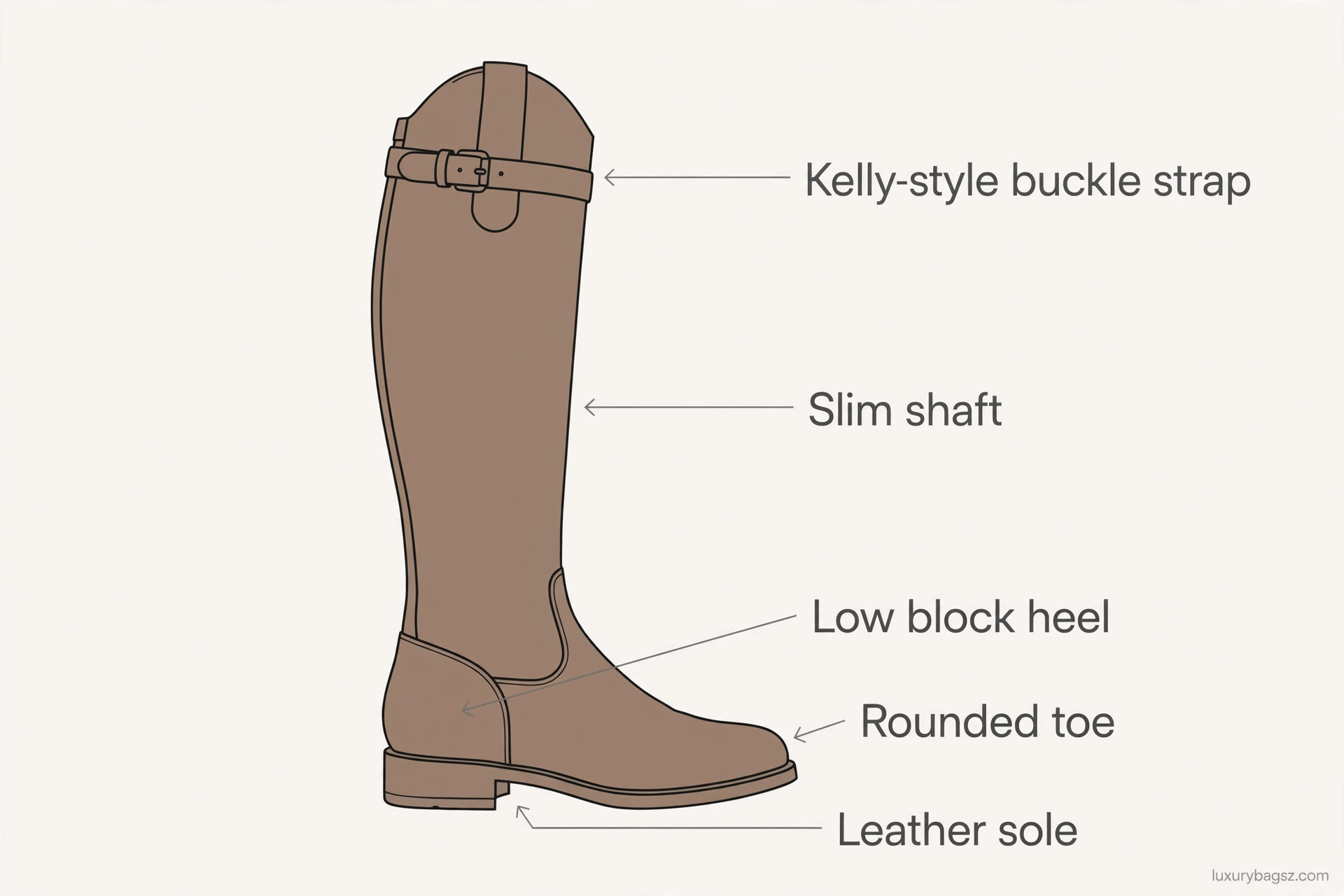
The Jumping boot is a pull-on, knee-high boot with no zip and no laces. You step into it, and the shaft grips the calf. That clean, uninterrupted line is the whole design idea. Anything that breaks the line would weaken it.
The signature detail sits near the top of the shaft. A slim strap wraps the leg and fastens with a small Kelly buckle in palladium-plated metal on most versions. The buckle is functional in the sense that it adjusts, but its real job is identification. It tells you, at a glance, that this is Hermès.
The toe is rounded to almond-shaped, never pointed and never square. The heel is a low stacked block, roughly 2 cm high, with a small platform of about 1 cm. The sole is leather, usually natural leather with a coloured edge. On the brown calfskin version the edge is Moka; on the black shearling version it is black.
Stitching is fine, even, and close to the edges. The ankle has a slight curve shaped over a wooden last, which is why the boot follows the leg rather than standing stiffly away from it. The arch is sharp, a detail resale guides single out as characteristic of the model.
There is no visible logo on the outside of the boot. The branding is the buckle shape, the proportions, and the quality of the leather. Counterfeiters therefore focus on copying the buckle, which is why pre-owned buyers should study it closely. Part 10 covers those checks in detail.
One more design point matters for everyday wear. Because the boot is pull-on, there is no way to loosen it around a fuller calf. The fit is decided by the shaft circumference, not by the foot size. That is why calf measurement, covered in Part 5, matters more here than for any lace-up or zip boot.
Part 3. Materials: Calfskin, Box, Suede, Shearling, and More
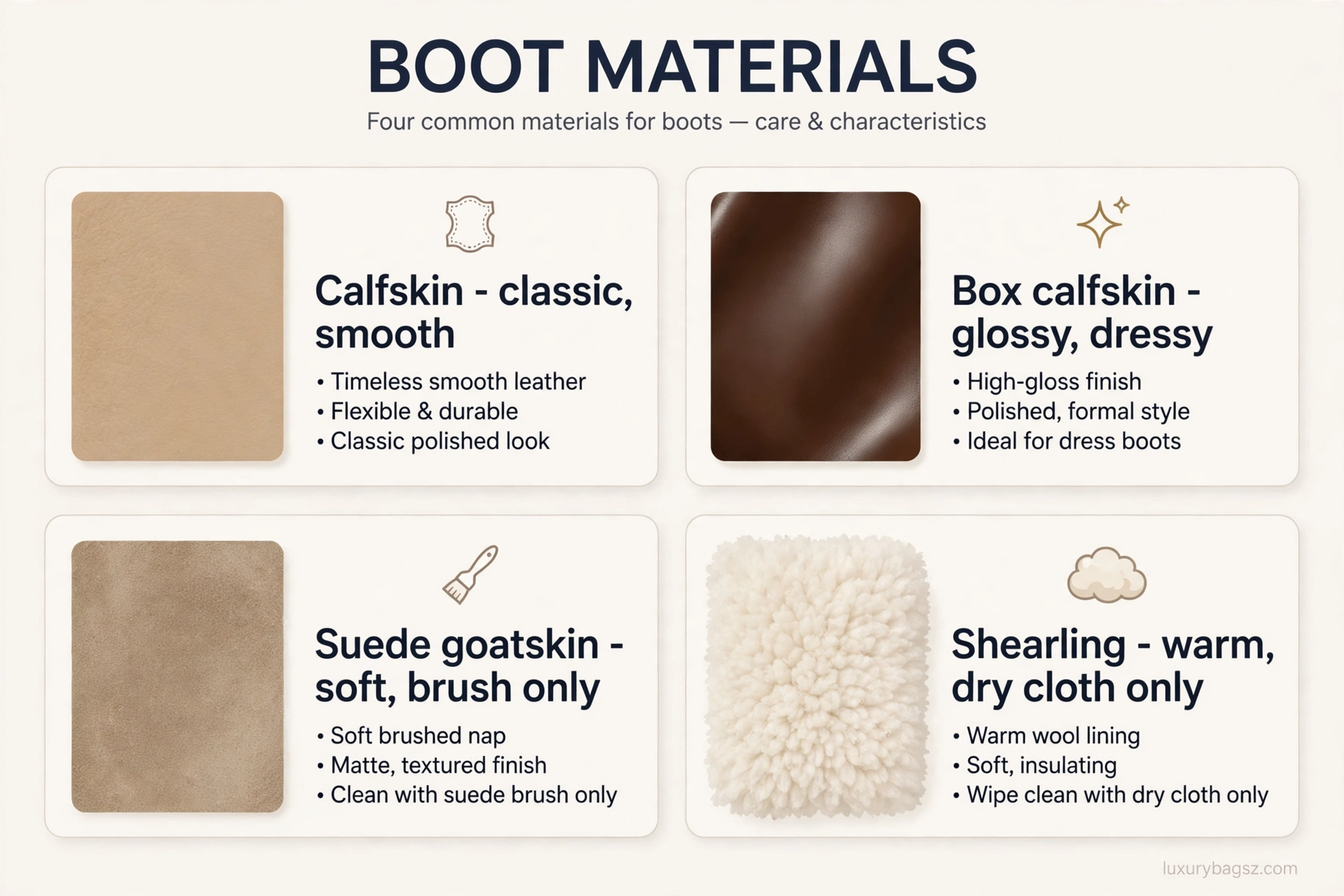
Calfskin is the default Jumping material and the one Hermès lists first. The current US store describes the brown version simply as “made in calfskin,” with a lambskin insole and lining. Calfskin is smooth, flexible, and relatively forgiving. It scuffs, but it also responds well to cream and polishing.
Box calfskin is the dressier sibling. It is a smooth, glossy, glazed calf leather with a firmer hand and a shinier finish. A review of the black Box calfskin Jumping boot calls it one of Hermès’s most iconic and heritage materials. Box shows scratches more readily than plain calfskin, so it demands more careful wear.
Suede goatskin appears in the softer, more casual versions of the boot. One pre-owned listing for an Étoupe suede goatskin pair describes it as ultra-soft and flexible, moulding naturally to the leg. Suede gives a relaxed silhouette, but it stains and marks far more easily than smooth leather. It also needs a different care routine, covered in Part 9.
Shearling is the winter version. Current Hermès listings pair calfskin with shearling, sometimes in a chevron pattern, for warmth and texture. Hermès describes shearling as elegant, comfortable, and thermally insulated, but also delicate. It sheds if rubbed against rough surfaces and has low resilience to humidity.
Seasonal versions go further. The archive and resale market show Toile canvas prints, such as the Dé Camp Déchaînée Toile version, and the Telegraph account mentions matt crocodile and silk-print versions. These are rare, expensive, and harder to authenticate. They should not be used as the baseline for what a Jumping boot “normally” costs.
Material also affects the lining. Most versions use calfskin or lambskin for the insole and lining, which feels soft against the leg. Some suede versions use lambskin lining too. A lining that feels plasticky or papery is a warning sign on a pre-owned pair, not a minor flaw.
Where does Hermès get its leather? That question has its own long answer, and it applies to bags as much as to boots. Readers curious about the origins of the house’s leather will find the full picture in the guide to which country makes leather for Hermès bags.
Part 4. The Two Upper Heights: Jumping and Jumping Shorter
Hermès sells the Jumping boot in two upper heights. The taller is called Jumping; the lower is called Jumping shorter. Hermès’s own wording is that the two sizes exist “to guarantee each of our customers maximum comfort and a perfect fit,” and that the shorter models have a lower upper.
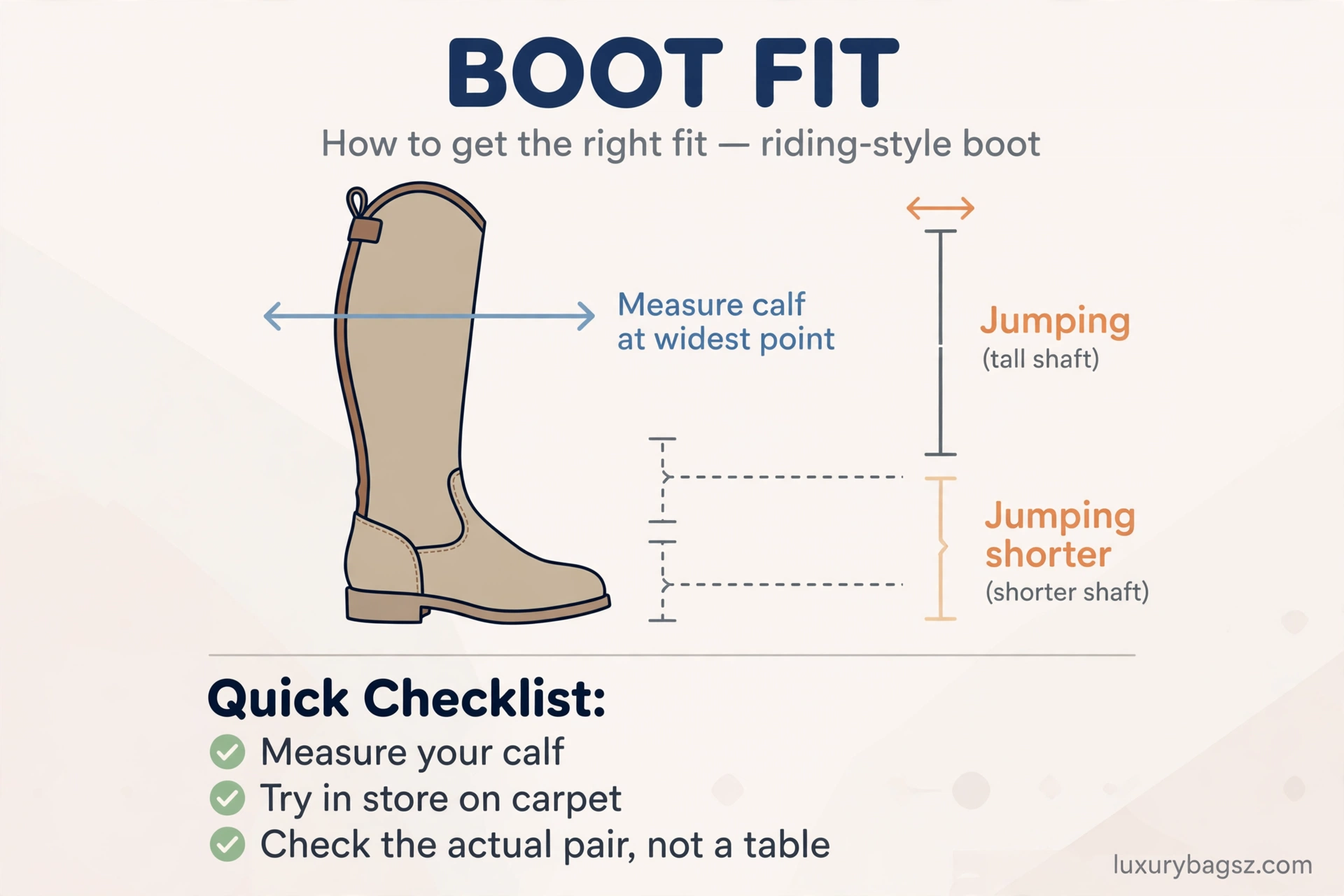
The difference is a few centimetres of shaft, but it changes how the boot wears. The taller shaft sits closer to the knee and gives the classic riding-boot line. The shorter shaft frees the knee, suits shorter legs, and works better with skirts and dresses that hit above the knee.
Here the sources disagree on exact numbers, and the disagreement is worth stating. PurseBlog gives the two heights as 14.7 inches for the Jumping and 13.5 inches for the Jumping shorter. The Hermès US store gives a single upper height of 14 inches for the brown calfskin version, without saying which of the two heights that figure belongs to.
The shearling version complicates things further. Hermès’s Finland store lists its upper height as 41.5 cm, about 16.3 inches, with a calf circumference of 36 cm. A third-party listing for a Box calfskin pair gives 36.6 cm of upper height and 31.1 cm of calf circumference. These are clearly different boots, or different ways of measuring the same boot.
The lesson is practical, not academic. Do not buy a Jumping boot on a single published measurement. Ask the seller for the shaft height and calf circumference of the actual pair, measured from the sole to the top of the shaft. Then compare those numbers with your own leg, not with a rival guide’s table.
Part 5. Sizes and Fit: The Calf Is the Deciding Factor
Hermès sizes the Jumping boot in French and Italian sizes, roughly from 35 to 42 for women. The foot sizing follows the usual European scale, and half sizes exist in some versions. Width, however, is not offered as a separate choice. The boot comes in one width, and the calf circumference is fixed for each size.
That fixed calf is the fit problem. A boot can fit the foot perfectly and still fail at the calf. Resale guides are unanimous on this point: measure the widest part of your calf, and compare it with the actual pair’s circumference. Do not guess, and do not assume your usual boot size will work.
The fit advice itself is disputed. Hermès’s US store states plainly that “this model runs true to size.” The RealReal, by contrast, labels Hermès boots as typically running half a size small across its Jumping listings. An owner review of the black Box calfskin pair says the boots run true to size but narrow, and that she sized up half a size for thicker socks and toe room.
All three claims can be partly true. A narrow foot may find the boot true to size, while a wider foot or a thicker sock may need the half size up. The safest approach is to try the boot in a store, on carpet, before buying. Hermès itself advises trying shoes on non-abrasive or carpeted surfaces, since a marked sole cannot be returned.
Calf circumference figures vary as much as shaft heights. The US brown calfskin version is listed at 13.8 inches. The shearling version is listed at 36 cm, about 14.2 inches. Individual RealReal listings range from 10.75 inches to 14.75 inches for different sizes and versions. Again, the actual pair’s measurement is the only one that counts.
For comparison, sizing a boot is a different exercise from sizing a sandal. The Hermès Oran sandals sizing guide shows how much a single Hermès style can vary between reviewers, and the same caution applies here. Trust measurements of the pair in front of you over any general rule.
One practical tip: put the boot on while seated, and pull it up with both hands rather than yanking the buckle strap. The strap is a design detail, not a pull tab. Forcing it can strain the stitching at exactly the point where wear shows first on pre-owned pairs.

Part 6. Prices: What a Pair Actually Costs
Prices for the Jumping boot are unusually spread out, because material and season change the figure so much. The honest way to present them is as dated examples from named listings. Any guide that gives a single “average price” for this boot is hiding the range.
The clearest current examples come from the Hermès US store, checked 1 November 2026. A brown calfskin Jumping boot was listed at $3,500. A black calfskin-and-shearling Jumping boot was listed at $8,200. Both were shown as in stock on the US store that day.
The same shearling boot costs differently elsewhere. Hermès Finland listed it at €5,750, though it was out of stock there. A PurseBop gift guide from December 2025 gave $7,700 for shearling chevron versions in Noir/Écru and Naturel/Écru. Currency, taxes, and season all sit behind those gaps.
Older figures are lower, and they show how much prices have moved. PurseBlog’s pre-spend guide listed a Box calfskin Jumping boot at $2,625. A Labellov listing gave an estimated retail price of €2,310 for a black leather pair. Neither figure is current, and neither should be quoted as today’s price.
Pre-owned prices are lower again, but they vary with condition and size. One RealReal listing for a black leather pair showed an estimated retail of $2,840 with a sale price of $1,196 after discount. A brand-new-in-box beige Natura pair in size 38 was listed at $2,150 by a reseller. A suede goatskin Étoupe pair was listed at $2,600.
Marketplace ranges are the least useful figures of all. 1stDibs shows Hermès “jumping” items from $195 to $3,900, but that range sweeps in vintage pieces, other product types, and different conditions. Quoting it as the price of a Jumping boot would mislead. It is included here only as a warning about lazy price reporting.
The practical conclusion is simple. Budget around $3,500 for a current plain calfskin pair from Hermès, and expect shearling or exotic versions to cost far more. On the pre-owned market, condition and size matter more than any published average. A worn pair in a rare size can cost more than a mint pair in a common one.
Part 7. Styling: How to Wear a Jumping Boot
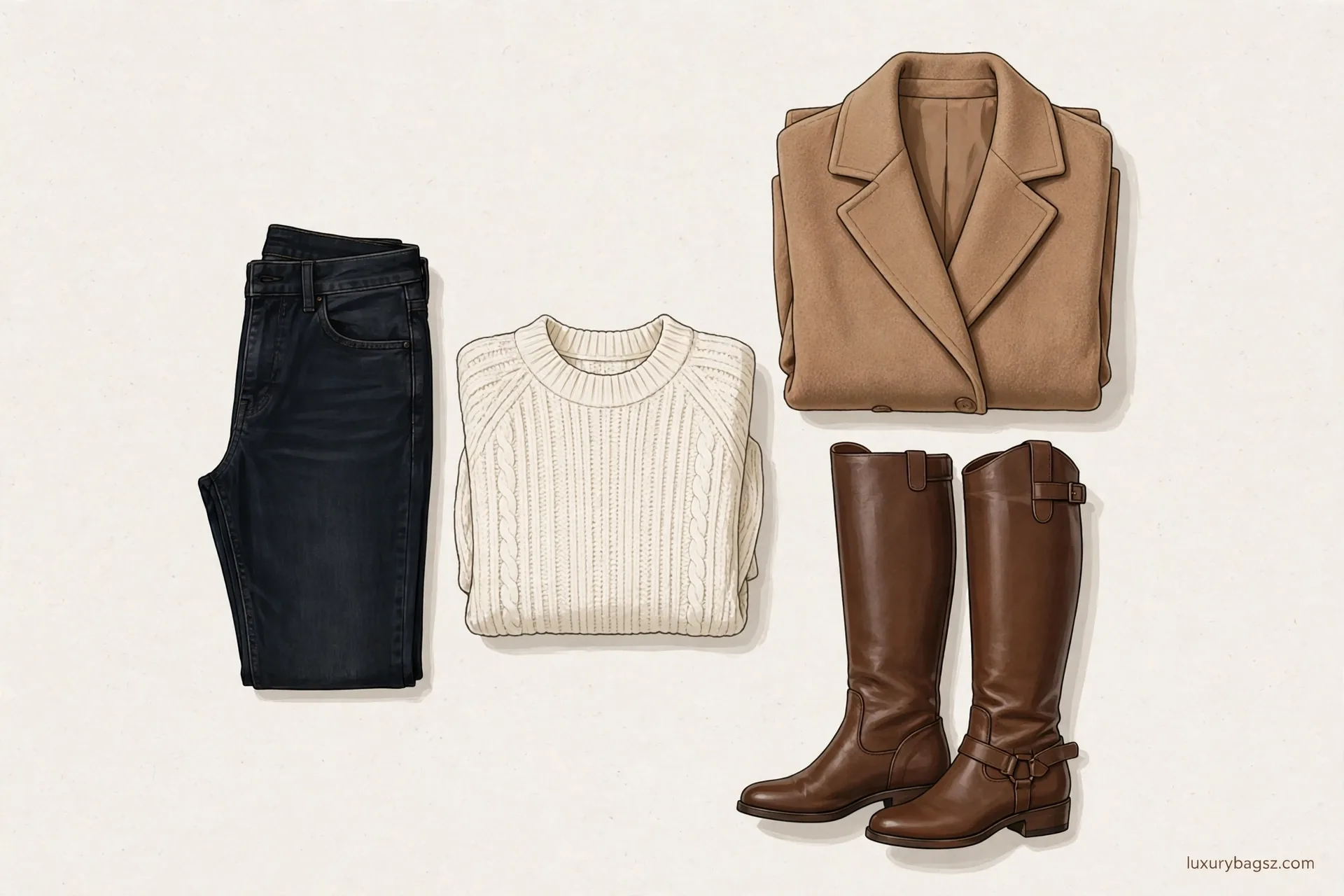
The Jumping boot works because it is restrained. It adds height and line without adding noise. The most reliable styling rule is to let the boot be the longest line in the outfit. Tuck slim trousers or skinny jeans into the shaft, and keep the top half simple.
With jeans, the classic pairing is dark straight or skinny denim, a plain knit, and a structured coat. The boot’s slim shaft sits neatly under a coat that ends at mid-thigh or below. Avoid wide-leg trousers over the shaft, which hide the boot’s shape and defeat the point of buying it.
With skirts and dresses, the shorter shaft version earns its keep. A knee-length or just-above-knee skirt leaves a clean gap or a small overlap with the shorter shaft. The taller shaft works better with midi lengths, where only the toe and lower shaft show. Either way, the boot reads as equestrian rather than costume.
Colour choice changes the outfit’s temperature. Black Box calfskin is the most formal option and pairs with everything from navy tailoring to a camel coat. Brown calfskin is softer and suits cream, olive, and denim. Étoupe suede is the most casual of the three and works best in transitional weather.
The buckle deserves a styling note of its own. It is small, but it catches light, so it pairs naturally with other palladium or silver-toned hardware. That includes the hardware on a Kelly bag, which is why the two pieces are so often worn together. The shared buckle language is deliberate, and it reads as intentional rather than matched.
One thing the boot does not do well is heavy weather. The leather sole is smooth, and the shaft is not waterproof. In rain or snow, the boot needs protection or a different pair entirely. Rival guides that call it an all-weather boot are overstating the case. It is a city boot for dry days, and it lasts longer when treated as one.
Part 8. Jumping Boots vs Other Hermès Boots
The Jumping is the signature, but it is not the only Hermès boot. Knowing the neighbours helps a buyer who is unsure whether the Jumping is really the right shape. The differences are mostly about toe, shaft, and attitude.
The Volver is the closest alternative. Resale guides describe it as a more urban boot with a pointed toe, against the Jumping’s rounded riding shape. If the Jumping feels too traditional, the Volver is usually the next boot a store will suggest. It is a city boot first, with no riding pretence at all.
Other Hermès boots go shorter or chunkier. Ankle boots and biker-style boots suit trousers better and need no calf measurement. Over-the-knee styles exist in some collections, but they are fashion pieces with a shorter life than the Jumping. The Jumping sits in the middle: tall enough to be dramatic, restrained enough to last.
There is also the question of what the Jumping is not. It is not a riding boot in the sporting sense. Real riding boots are built to safety standards, with soles and stirrup treads designed for the saddle. The Jumping’s smooth leather sole and fashion heel are not that. Wearing it to ride would damage the boot and offer no protection.
Comparing boots with sandals is useful too, because Hermès buyers often own both. The Oran sandal guide describes a flat, open shoe built for summer, while the Jumping is a closed, structured boot built for cooler months. They share the house’s leather quality, but they solve opposite problems.
The same house logic applies to bags. The Herbag pairs canvas with leather in the same practical, equestrian spirit as the Jumping’s canvas-print seasonal versions. Buyers who like one usually understand the other. Both are Hermès at its most functional, before decoration takes over.
Part 9. Care: A Different Routine for Each Material
Care for the Jumping boot depends entirely on material. A single routine for all versions will damage at least one of them. The paragraphs below separate the materials, so each pair gets the treatment it can tolerate.
Smooth calfskin is the easiest. Wipe it with a soft, dry cloth after wear to remove dust. Apply a neutral leather cream sparingly, a few times a year, and buff gently. Test any cream on a hidden spot first, such as the inside of the shaft. If the colour changes, stop.
Box calfskin needs the same routine, but with more restraint. Its glossy finish shows polish build-up quickly. Use less cream, buff more, and never use a coloured polish unless the shade matches exactly. A mismatched polish on Box is visible in daylight and hard to reverse.
Suede goatskin needs a brush, not a cream. A soft suede brush lifts the nap and removes surface dust. Work in one direction, gently, and keep the boot away from water. For the full brush routine, the guide to how to use a suede brush covers the strokes and pressure in detail. Never use leather cream on suede.
Shearling needs the gentlest handling of all. Hermès advises a dry soft cloth, no brushes, and storage away from light, dust, and humidity. Brushes can damage the wool, and damp storage encourages shedding. After wear, leave shearling boots in a cool, dry place before putting them away.
For deeper leather conditioning, a dedicated balm has its place. The guide to how to use Saphir Renovateur explains how to apply it thinly and evenly. Use it on smooth calfskin only, and never on suede or shearling. A little goes a long way, and over-conditioning softens the shaft’s shape.
Storage matters as much as cleaning. Keep the boots upright with boot trees or rolled inserts so the shaft does not fold. Store them in their dust bags, away from radiators and sunlight. The same upright, dust-bag logic applies to bags, and the guide to storing a Hermès Kelly bag makes the parallel case for structured leather goods.
Resoling is possible, and it is worth knowing about before the sole wears through. A good cobbler can replace a leather sole, but the work is costly and the result depends on the cobbler’s skill. Ask for a leather sole replacement, not a rubber overlay, if you want to keep the boot’s original feel. Rubber soles change the grip and the look.
Finally, a note on what not to do. Do not wear the boots in heavy rain, do not dry them by a radiator, and do not stuff them with newspaper, which can transfer ink. These sound like small things. On a boot at this price, they are the difference between a decade of wear and a single ruined season.
Part 10. Buying Pre-Owned: Checks Before You Pay
Pre-owned Jumping boots are common, and a careful buyer can save a great deal. The risks are also real. Counterfeits exist, and worn boots hide damage that photographs conceal. The checks below are ordered from easiest to hardest, and no single check is enough on its own.
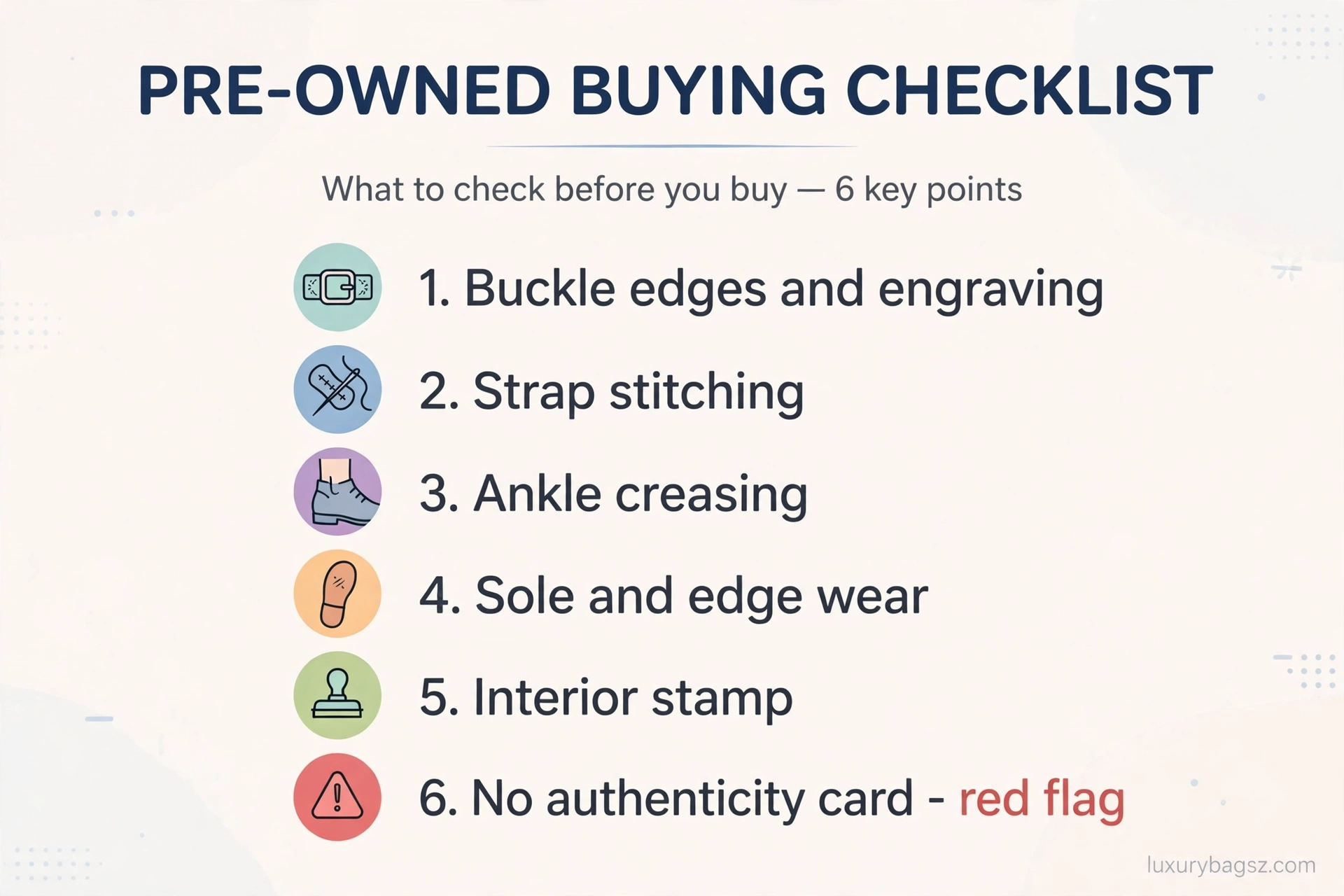
Start with the buckle. The Kelly buckle on a genuine pair has clean, curved edges and even, well-spaced engraving. Fakes often show sharper edges, thicker or uneven lettering, and a lighter, cheaper feel. Compare the buckle against a known genuine pair, not against a photograph of one.
Next, look at the stitching. Genuine Hermès stitching is even, tight, and consistent in angle and spacing. On boots, pay attention to the shaft seams and the buckle strap attachment. Crooked, thin, or uneven stitching at the strap is a strong warning sign. One flaw here outweighs a perfect-looking box.
Then check the leather itself. Genuine calfskin and Box have a consistent grain and a natural smell. Suede should feel soft and even, not patchy or plasticky. Creasing at the ankle is normal on a worn pair, but deep cracks, flaking, or a stiff, cardboard feel are not. Ask for close photographs of the ankle bend and the counter.
The sole tells the boot’s history. Check for wear at the toe and heel, and ask whether the sole has been replaced. Resoling is legitimate, but it should be disclosed, and it affects value. Also check the leather edge colour: on the brown version it should be Moka, and a repainted edge can signal heavier wear than the listing admits.
The interior stamp matters too. Genuine boots carry a discreet Hermès stamp, and the size marking should match the listed size. A stamp that is pressed too deeply, unevenly spaced, or in the wrong font is a red flag. Worn stamps on genuinely old pairs can fade, so a faint stamp alone proves nothing either way.
Packaging is the weakest evidence of all. A genuine pair usually comes with an orange box and dust bags, but boxes are easy to obtain separately. Conversely, a genuine pair without a box is common, since boxes get discarded. Treat packaging as a bonus, not as proof.
The strongest red flag is the one the task warns about explicitly. Hermès issues no authenticity card as a general rule. A seller who presents a card as proof of authenticity is either mistaken or dishonest. The same caution applies to bags, and the guide to spotting a fake Hermès Kelly bag makes the same point about cards in the bag world.
Price is the final check. A price far below comparable pairs in the same material and condition is a warning, not a bargain. The pre-owned examples in Part 6 give a sense of the real range. If a “brand new” pair is offered at a fraction of those figures, walk away.
The same counterfeit caution applies across Hermès footwear. The guide to spotting fake Hermès Oran sandals shows how fakes copy individual details while missing the whole, and boots reward the same whole-picture approach. When in doubt, use a professional authentication service before paying.
Part 11. Where Other Guides Conflict: The Date and the Measurements
Most rival guides about the Jumping boot are short, and they share the same gaps. The first gap is the date conflict. Guides state either 2004 or 1972 as fact, without mentioning the other claim. A reader who checks a second guide then finds a contradiction and no explanation.
The second gap is measurement. Guides copy one set of shaft and calf figures and present them as universal. The figures differ by centimetres between Hermès’s own regional stores, and by inches between resale listings. A guide that gives no warning about this is setting readers up for a wrong-size purchase.
The third gap is material range. Many guides describe the Jumping as a calfskin boot and stop there. They miss Box, suede goatskin, shearling, Toile prints, and exotics entirely. A buyer who only knows calfskin will misjudge both price and care for any other version.
The fourth gap is the fit dispute. Guides either repeat Hermès’s “true to size” line or repeat a reseller’s “half size small” line, but rarely both. The truth is that fit depends on foot width, sock thickness, and calf shape. A guide that gives one rule for all feet is not helping.
The fifth gap is the riding question. Several guides imply, without saying it outright, that the Jumping is a boot for riding horses. It is not. It is a riding-inspired town boot with a smooth leather sole. No responsible guide should leave a reader thinking it is suitable for the saddle.
The sixth gap is care by material. Guides that do give care advice usually give one routine, often a generic “condition the leather” line. That advice ruins suede and shearling. Material-specific care, as in Part 9, is rarer than it should be.
The seventh gap is pre-owned authentication. Most guides either skip it or reduce it to “buy from a trusted seller.” That is true but useless on its own. Specific checks — buckle edges, strap stitching, ankle creasing, sole wear, stamp quality — are what actually protect a buyer, and they are seldom listed for boots.
The eighth gap is price honesty. Guides quote a single price, often an old one, without a date or a source. Prices for this boot have moved from around $2,625 for Box in older guides to $3,500 for calfskin and $8,200 for shearling today. An undated price is worse than no price at all.
This guide has tried to close all eight gaps. Where sources disagree, the disagreement is on the page. Where a figure is dated, the date is given. Where a claim is uncertain, it says so. That is the standard a boot at this price deserves.
Part 12. Who Should Buy the Jumping Boot, and Who Should Not
The Jumping boot suits a buyer who wants one tall boot for many years. Its shape changes little, its colours are restrained, and its quality repays careful wear. If your wardrobe leans toward slim trousers, midi skirts, and structured coats, the boot will earn its place quickly.
It also suits a buyer who values quiet branding. There is no logo on the shaft, and the buckle is small. People who know Hermès will recognise it. People who do not will see a well-made riding boot. That discretion is part of the appeal, and it is rarer than it used to be.
The boot is less suited to a buyer with a fuller calf who cannot try it on first. The fixed shaft circumference is unforgiving, and returning a worn pair is difficult. If you cannot measure the actual pair or try it in store, the risk of a wrong fit is real. The shorter shaft version helps some buyers, but it does not change the calf circumference.
It is also a poor choice for anyone who wants a hard-wearing daily boot for wet weather. The leather sole, the smooth finish, and the delicate materials all argue against it. A rubber-soled, waterproof boot will serve that purpose better and cheaper. The Jumping is a fair-weather investment, not a workhorse.
Budget matters too. At $3,500 for calfskin and $8,200 for shearling, the boot competes with several pairs of excellent boots from other makers. Its case rests on design longevity and craftsmanship, not on warmth, waterproofing, or versatility in bad weather. Buyers who want one of those qualities first should look elsewhere.
Finally, the boot suits a buyer who will care for it. Boot trees, dust bags, material-specific cleaning, and resoling when needed are not optional extras. They are the maintenance contract that comes with the price. A buyer who will not keep that contract will get less from the boot than a cheaper pair would give.
Frequently Asked Questions
What are Hermès Jumping boots?
They are tall, pull-on, knee-high riding-style boots made by Hermès, with a slim shaft, a low heel, a leather sole, and a small Kelly buckle strap near the top. They are inspired by equestrian boots but designed for city wear, not for riding horses.
When were Jumping boots created?
Sources disagree. The Hermès US store states the Jumping boot was created in 2004, while a PurseBop gift guide dates the silhouette to 1972. The likeliest explanation is that a jumping-style boot existed in the Hermès archive for decades, and the current named model dates to 2004.
Are Hermès Jumping boots made in France?
No. They are made in Italy by a specialist bootmaker near Venice, a fact confirmed in press coverage of the boot’s making and on Hermès’s own store pages. Hermès has said it goes where the footwear savoir-faire is, and for boots that is Italy.
What is the difference between Jumping and Jumping shorter?
Jumping shorter is the same boot with a lower shaft. Hermès offers both heights so buyers can match the shaft to their leg length and knee movement. The shorter version suits shorter legs and outfits where the knee needs more freedom.
Do Jumping boots run true to size?
Hermès says the model runs true to size, but resale listings and at least one owner review say it runs narrow or half a size small. The safest advice is to try the boot in store, and to measure the calf circumference of the actual pair before buying.
How much do Hermès Jumping boots cost?
As dated single-listing examples from 1 November 2026, the Hermès US store listed a brown calfskin pair at $3,500 and a calfskin-and-shearling pair at $8,200. Older guides quoted around $2,625 for Box calfskin, and pre-owned pairs vary widely with condition, material, and size.
Can you ride a horse in Jumping boots?
No, not as a substitute for proper riding boots. The Jumping boot has a smooth leather sole and a fashion heel, and it is not built to riding safety standards. It is a riding-inspired town boot, and wearing it in the saddle risks both the boot and the rider.
How do you clean Hermès Jumping boots?
It depends on the material. Smooth calfskin and Box take a soft cloth and a little neutral cream. Suede needs a soft suede brush and no cream. Shearling needs only a dry soft cloth, with no brushes, and storage away from humidity. Always test any product on a hidden spot first.
Do Hermès Jumping boots come with an authenticity card?
No. Hermès issues no authenticity card as a general rule, so a card offered as proof of authenticity is a red flag, not reassurance. Judge a pre-owned pair by its buckle, stitching, leather, sole, and stamp, and use a professional authentication service when in doubt.
Are Hermès Jumping boots worth the price?
For a buyer who wants one restrained tall boot for many years, will care for it by material, and can confirm the fit, the answer is yes. For a buyer who needs wet-weather durability, a wider calf fit, or a lower price, the answer is no. The boot’s value lies in design longevity and craftsmanship, not in all-weather performance.
The Jumping Boot: Restraint That Lasts
The Hermès Jumping boot is a riding-inspired town boot of unusual restraint and longevity. Its slim shaft, low heel, and small Kelly buckle have survived decades with barely a change, while its materials and colours have kept it current. That combination is rare in footwear, and it explains the boot’s loyal following.
Its weaknesses are real and should not be minimised. The fixed calf fit excludes some buyers, the leather sole is unsuited to wet weather, and the price has risen well beyond the figures older guides still quote. The conflicting dates and measurements in published sources do not help, and buyers should verify the actual pair before paying.
For the right buyer, though, the case is strong. A plain calfskin pair in black or brown, in the correct shaft height, cared for by material, will outlast most boots at any price. It is not a boot for riding, for rain, or for every leg. It is a boot for the city, worn well, for a long time.
The Jumping boot’s little Kelly buckle is hardware I know from the bags, and it sets the standard for the whole boot: leather honest, stitching calm, buckle true. I check boots the way I check a Kelly — shaft, seams and closure before colour. A boot built with that restraint does not need to change, and mostly, it has not.






