

Hermès Oran Sandals Sizing Guide: True to Size, Half Sizes, Width, and the Conversions That Disagree
Getting the Oran Fit Right First Time
For narrow to average feet, your normal European size is usually the right Oran size. If your feet are broader, your instep sits high, or you fall between sizes, move up by half a size where available, otherwise to the next whole size.
Trust your foot length in centimetres above any conversion chart. An EU 38 is variously labelled US 7, 7.5 or 8, so converted labels can mislead by a full size. Measure both feet standing, in the evening, and remember width often decides comfort: this narrow, fixed-strap sandal cannot be loosened, and leather softens slightly but will not gain a whole size.
Introduction
The Hermès Oran sandal is one of the simplest-looking luxury shoes ever made: a flat leather sole and a single broad strap across the foot. It was designed in 1997 by Pierre Hardy, Hermès’ creative director of footwear, as part of an Africa-inspired collection, and named after the Algerian coastal city of Oran. Nearly three decades later it is still in production, released in new colours and materials every season, and it is still the sandal that causes the most sizing arguments on the internet.
That is the strange thing about the Oran. The shoe itself has almost nothing to it — no laces, no buckle, no adjustable strap, no heel, no arch support to speak of. And yet ask ten guides whether it runs true to size and you will get ten answers that sound confident and disagree with each other. One guide says it runs true to size for everyone. Another says it runs small. A third says it runs true to size for narrow feet and small for wide feet, which is a different claim wearing the same words. A fourth tells you to size up a full size. A fifth tells you that half sizes do not exist, while a reviewer elsewhere calmly reports buying a 38.5. Conversion charts cannot agree whether a European 38 is an American 7, 7.5, or 8. And because the Oran has no adjustment of any kind, every one of those disagreements lands directly on your foot: there is no strap to tighten or loosen to cover a mistake.
This guide does not pretend those disagreements do not exist. It lays them out source by source, explains why they happen, and gives you a way to choose a size that does not depend on trusting any single guide — including this one. The core of that method is simple: measure your own feet in centimetres, understand what width and material do to the fit, and treat any converted US or UK label as a rough translation rather than a fact. Where sources disagree, this guide says so plainly and tells you which answer is the safer bet when you cannot try the sandal on first.
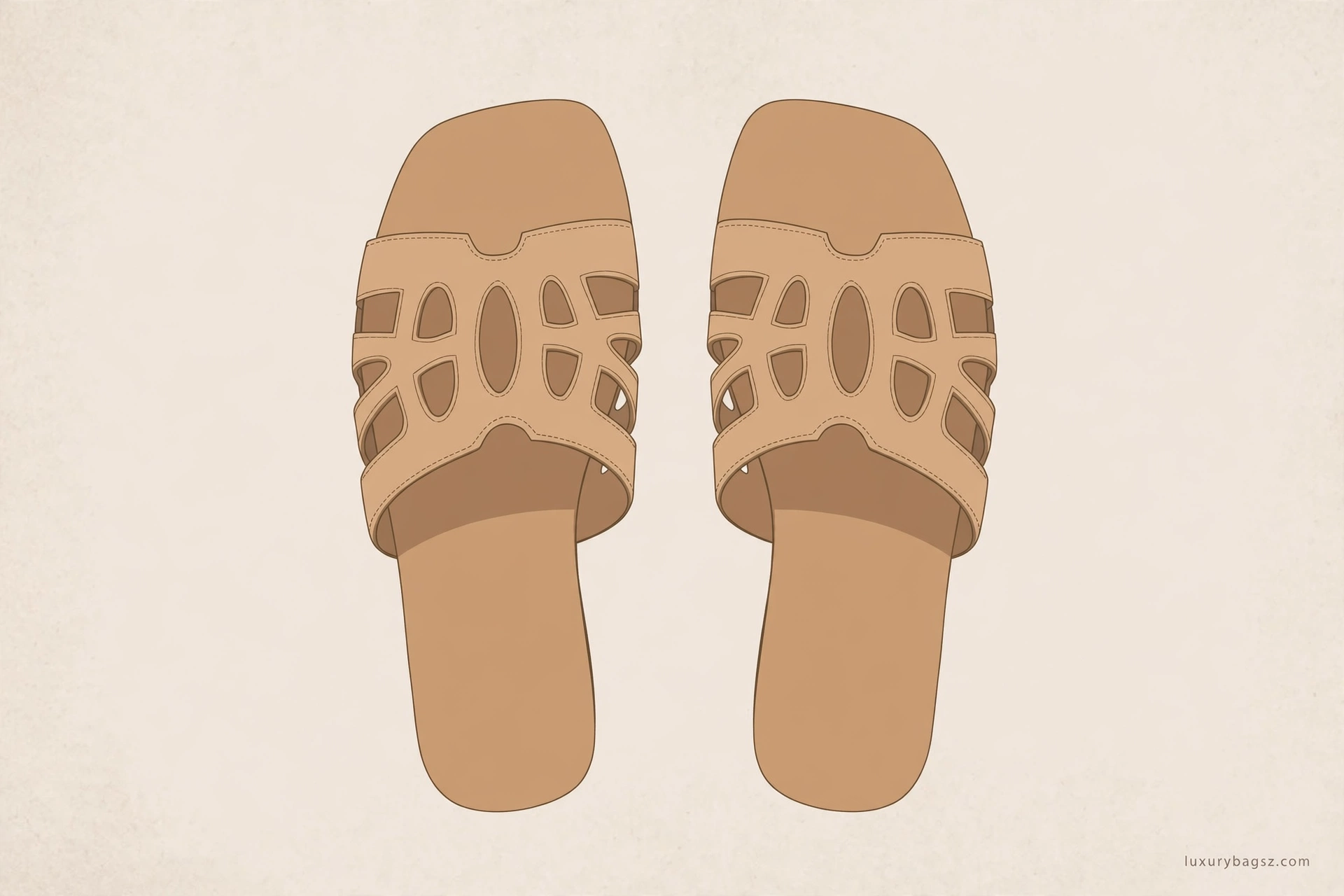
A note on the pictures first. Every picture in this guide is a generic illustration, not a photograph of a real Hermès sandal. Illustrations simplify leatherwork and flatten colours, and they are not drawn to an exact scale, so never measure a length or a width off a picture. Use the pictures to follow the ideas, and use the words — and your own tape measure — for the numbers. Where a picture simplifies a detail, the words in this guide prevail.
A note on scope, too. This guide is about sizes and fit. It is not an authentication guide, and a size label on its own never proves a pair genuine. A seller can print any size on a listing for a pair that is not that size, and a pair can be the right size and still be a copy. Size checks and genuineness checks are different jobs, and the pre-owned part of this guide keeps them separate. Hermès issues no authenticity cards as a general rule, so a card offered with a pair is a red flag rather than reassurance, whatever else the listing claims.
Key Takeaways
- For narrow or standard-width feet, the Oran usually fits true to its European size. For wide feet, a high instep, or anyone between sizes, the most repeated advice is to go up half a size — but some guides and wearers go further and say the sandal runs small in general, so “true to size” is a majority view, not a settled fact.
- Half sizes are a genuine source of confusion: one guide states flatly that Orans do not come in half sizes, while a reviewer reports buying a 38.5 and other guides say half sizes are often offered. Availability appears to vary by market and season, so never assume your half size is or is not made — check the actual listing or boutique stock.
- European 38 is listed as US 7 on some charts, US 7.5 on others, and US 8 by some wearers. European 39 is listed as US 8 on some charts and US 8.5 by some wearers. Conversion labels disagree by up to a full size, which is why your foot length in centimetres is the only number worth trusting.
- Width matters more than length for many buyers. The Oran is a narrow-cut sandal with a fixed strap, so a foot that is long enough but too wide will feel tight across the strap even in the “right” length. Going up in length is the only tool available for a width problem, and it is an imperfect one.
- Leather relaxes slightly with wear but will not stretch a full size. Suede feels tighter at first and gives a little more than calfskin; stiff exotic skins give the least. Never buy a too-small pair hoping it will stretch into comfort.
- Break-in takes roughly a week of normal wear for most people, and up to 5 to 10 wears before the leather moulds to the foot, according to the guides that give a number at all. The first wears can be stiff, and the little toes are the usual complaint.
- Measure both feet, in the evening, standing up, with a tracing on paper. Feet swell through the day, most people have one foot larger than the other, and the Oran has no adjustment to hide either fact.
- When buying pre-owned, ask for the insole length in centimetres, photos of both soles and both straps, and the return policy. A stretched strap or uneven wear pattern tells you more about how a used pair will fit than the printed size does.
Oran Sizing at a Glance
If you want the short version before the evidence, here it is. The Oran is sized in European (also called French) sizes, and the women’s range most commonly reported runs from EU 35 to EU 42. Start from your usual European size. If your feet are narrow or standard in width and you are not between sizes, your usual size is the most likely fit, and that is the single most repeated finding across guides and wearer reports. If your feet are wide, if you have a high instep, or if you sit between sizes, go up half a size where a half size is available, or up to the next whole size where it is not. If you are buying without trying on, measure your feet in centimetres and compare that number to a chart rather than converting from a US or UK size, because the conversion charts disagree with each other by as much as a full size.
Two warnings belong in the short version as well. First, do not buy a size down hoping the leather will stretch to meet your foot. It will relax, but the guides that quantify this at all describe a slight relaxation, not a full size of give, and a pair that pinches on day one is a pair you will dread wearing. Second, do not treat any single guide’s conversion table as gospel. The disagreements documented in the conversions section are not rounding errors; they are different charts giving different answers for the same foot, and the only way to be safe is to anchor on centimetres.


True to Size or Not: What the Sources Actually Disagree About
“True to size” is the most used and least precise phrase in Oran sizing. Nearly every guide uses it, and nearly every guide means something slightly different by it, which is why two guides can both say “true to size” and still send you to different sizes.
The majority position, repeated by Fashionphile’s academy guide, Konesseur’s 2026 sandals guide, DecentFoot, FootonBoot, and The Glam and Glitter, is that the Oran runs true to its European size for people with standard or narrow feet. Fashionphile puts it plainly: the sandals follow French sizing and generally fit true to size, though wider feet should go up half a size. Konesseur says the same with a small addition that matters: the leather will relax slightly with wear but will not stretch a full size. DecentFoot’s fit guide says the sandals typically fit true to size, and adds that the heel should not extend beyond the back of the sandal for proper foot support — a fit check this guide returns to in the try-on checklist section.
The minority position is not a fringe one. DecentFoot’s own “do they run small” guide reports that many people say Oran sandals run small, and that professionals in shoe fitting frequently recommend buying at least half a size larger than standard sizing. One of FootonBoot’s guides reports that on average most customers find they wear half a size up in the Oran because of its narrow design. A wearer review on Covering Bases reports the opposite experience in the same breath as the majority view: the reviewer wears a US 8 in everyday shoes, owns a 38, and says going up a size would probably still be fine while going down would not. That is a useful way to read the whole disagreement: for this reviewer, the Oran is true to size and also forgiving upward, but not forgiving downward.
So what is actually going on? Three things, and separating them clears up most of the argument.
First, “true to size” is usually measured against European sizing, not against the buyer’s home sizing. A buyer who wears a US 8 and reads that the Oran is “true to size” still has to convert, and the conversion is where the error creeps in (see the conversions section). A sandal that is true to its EU size can still arrive feeling a size off if the buyer converted wrongly.
Second, width is doing quiet work inside the length claim. The Oran is a narrow-cut sandal. A guide that tested it on narrow feet will call it true to size; a guide whose readers mostly have wider feet will call it small. Both can be honest. The disagreement is not about the sandal’s length so much as about whose feet were doing the judging.
Third, material changes the first impression. A stiff new calfskin pair feels tighter on day one than the same pair feels after ten wears. Guides written from a first try-on and guides written after months of ownership are describing different moments in the same shoe’s life, and the breaking-in section covers that timeline.
The practical conclusion is not “trust the majority” but “trust the majority only if you match the majority’s feet.” Narrow or standard width, usual EU size known, no high instep: the majority view probably fits you. Wide feet, high instep, between sizes, or buying from a US or UK size without a centimetre measurement: the minority view — go up half a size — is the safer bet, because a slightly roomy flat sandal is wearable while a pinching one is not.
The Half-Size Problem
Here is a disagreement that should not exist but does, and it catches real buyers. One guide states that Oran sandals do not come in half sizes and do not come in a 6.5, advising anyone between sizes to go up. Another guide says half sizes are often offered, which can help with precise fitting. And a reviewer writing about her own pair says she took a 38.5, that it fit like a glove, and that going down to a 38 would have left her big toe hanging over too much while going up to a 39 would also have worked. All three cannot be describing the same stock.
The likeliest explanation is that half-size availability varies by market, season, and colour, and that guides generalise from whatever stock they saw. A boutique in one country may carry half sizes while another carries whole sizes only; a seasonal colour may be produced in a narrower size run than a core colour. The honest statement is therefore this: half sizes such as 38.5 do exist and have been bought and worn, but they are not guaranteed to be available in the colour and market you are shopping in, and some guides’ claim that they do not exist at all is contradicted by the reviewer evidence.
What this means for you depends on where you sit:
- If you are a whole size in European sizing, this problem does not touch you. Buy your size, subject to the width advice in the width section.
- If you are a half size in European sizing and your half size is in stock, buy it. The reviewer evidence says a true half-size fit is the best outcome, better than sizing up or down.
- If you are a half size and only whole sizes are available, go up, not down. This is one of the few points on which the disagreeing sources agree: the guide that denies half sizes exist and the reviewer who bought a 38.5 both point upward when a half size is not on offer, because a sandal that is slightly long is wearable while a sandal that is too short leaves toes over the edge and the heel looking wrong at the back.
- If you are a half size in US sizing converting to European sizing, do not assume the conversion gives you a half European size at all. Convert to centimetres first (see the measuring section), then find the European size whose foot-length range contains your measurement, and round up if you fall on a boundary.
One more trap inside this part: some sellers list sizes in a way that hides the half-size question. A listing that says “38” may be a true 38 or a rounded 38.5, and a listing that says “US 8” may have been converted from either. When the half size is the whole decision, ask the seller to confirm the size printed on the sandal itself, not just the size in the listing title.
EU, UK and US Conversions That Do Not Match
This is the part of Oran sizing where the sources most plainly contradict each other, and it is the part most buyers get wrong, because conversion feels like arithmetic and arithmetic feels safe. It is not safe here. Different charts use different conversion tables, brands do not share one table, and US sizing itself is not perfectly standardised across brands. The result is that the same European size maps to different US sizes depending on which chart you open.
Take EU 38, the most commonly cited example. One size-chart site lists EU 38 as US 7, with a foot length of 24.10 cm. Another guide lists EU 38 as US 7.5, and that is the figure given by a reviewer who wears a UK 5 and a US 7.5 in the Oran in size 38. A different reviewer, who wears a US 8 in everyday shoes, owns the Oran in 38. So for one European size, published sources give US 7, US 7.5, and US 8 — a full size of spread. EU 39 shows the same pattern: one chart lists it as US 8 with a foot length of 24.70 cm, while another guide says a US 8 wearer may need a European 39, which translates to approximately 8.5. The UK side is no cleaner: the reviewer above pairs EU 38 with UK 5, while other charts pair EU 38 with UK 5.5, and the same spread appears at every size.
Why do the charts disagree? Three reasons. First, there is no single official EU-to-US table; each retailer and guide builds its own, and some round to the nearest half size while others round down. Second, US sizing differs between brands, so a chart built from one brand’s lasts will not match a chart built from another’s. Third, some charts convert from the shoe’s internal length while others convert from the foot length the shoe is meant to fit, and those two lengths differ by the wiggle room built into the shoe. None of this is a mistake by any one chart; it is what happens when a conversion pretends to be exact and is not.
The way out is to stop converting and start measuring. Your foot length in centimetres is a physical fact that no chart can disagree about, and European sizing is built on foot length in a way that US sizing is not. One chart puts EU 35 at a foot length of about 22.5 cm and EU 42 at about 26.5 cm, and the same chart’s figures for EU 38 (24.10 cm) and EU 39 (24.70 cm) sit neatly on a roughly 6 mm step per size. That step is the useful number: each European size is roughly 6 to 7 mm longer than the last, so being 3 mm over a boundary is genuinely ambiguous, while being a full size out is not a rounding issue at all.
Practical rules for conversion:
- If you know your European size from other European shoes, use it directly and ignore US and UK conversions entirely.
- If you only know a US or UK size, measure your feet (see the measuring section) and convert from centimetres, not from the US or UK label.
- If a seller lists only a US size, ask for the European size printed on the sandal and for the insole length in centimetres. A seller who cannot give either is a seller whose size claim you cannot check.
- If your centimetre measurement falls exactly on a boundary between two European sizes, round up, for the same reason given in the half-size section: a slightly long flat sandal is wearable, a short one is not.
- Never buy two sizes at once from two different conversion tables and assume one will fit. The tables disagree by design, and you will end up returning one pair for a reason that was never about your foot.

Width: The Fit Factor Most Guides Skim
Length gets all the attention in Oran sizing guides, and width gets a sentence. That ratio is backwards for a large share of buyers, because the Oran’s width problem is structural: the sandal is cut narrow, the strap is fixed, and there is no width option, no wide fitting, and no adjustment to let the strap out. A foot that is the right length but too wide for the cut will feel tight no matter which length you pick, and the only remedy available is to go up in length, which adds length you may not need in order to gain a small amount of width.
The consensus across guides is consistent on the direction, even where it differs on the size question: wide feet should go up half a size. Fashionphile, Konesseur, DecentFoot, FootonBoot, and The Glam and Glitter all say it, and DecentFoot’s wide-feet guide goes further, saying plainly that Oran sandals do not fit wide feet well and are designed for narrow to medium widths. That is a bracing sentence for a buyer with wide feet, and it is worth taking seriously rather than shopping around for a guide that says otherwise. If your feet are genuinely wide — if you regularly buy wide fittings in other brands, or if straps on other sandals cut into the sides of your feet — the Oran may never be your most comfortable sandal, and sizing up half a size improves it without transforming it.
Narrow feet have the mirror-image question. Some guides say narrow feet should stick to their usual size, and others say narrow feet may need half a size down for a snug fit. The difference matters less than it sounds, because a slightly roomy flat sandal on a narrow foot is usually still wearable, while a too-tight sandal on a wide foot is not. If your feet are narrow and your usual size feels loose, try the half size down before assuming the sandal is wrong for you — but only where the half size exists, and only if the smaller size does not push your heel over the back edge or your toes over the front.
High instep deserves its own mention because it is not the same as width, though it feels similar. A high instep — a high arch that makes the top of the midfoot sit taller — pushes up against the fixed strap, and the strap cannot rise to meet it. Konesseur’s guide names a high instep alongside wide feet as a reason to size up half a size. If the strap presses on the top of your foot while the length is right, you have an instep problem, not a length problem, and going up in length is again the only available remedy. It helps a little, because a longer sandal has a slightly longer strap span, but it does not help as much as an adjustable strap would, which is why one rival sandal with a hook-and-loop strap is sometimes recommended for this foot shape instead.
Width is also the reason to measure width, not just length, when you do the home measuring routine in the measuring section. Most guides tell you to measure length only, and then wonder why a buyer with the right length still has a tight sandal. Measure the widest point of each foot, across the ball, and write it down next to the length. You cannot convert a width measurement into a European size — there is no width table for the Oran — but you can use it as a tiebreaker: a wide measurement next to a boundary length measurement is a reason to round up, and a wide measurement next to a comfortably mid-range length is a reason to expect a snug first fit that may or may not relax enough.
Foot Shape: Arches, Instep, Toes, One Foot Larger
Beyond width, four foot-shape facts change Oran sizing, and rival guides mostly mention one or none of them.
Flat feet first. A flat foot spreads more under weight than an arched foot does, so a flat foot that measures a given length while seated may measure effectively wider and longer while standing. DecentFoot’s fit guide notes that flat feet may experience discomfort from insufficient support and may need a size up plus arch supports. The Oran has a flat leather sole with no built-in arch support, so a flat-footed buyer is not only choosing a size but choosing a shoe with no support to offer. If you wear orthotics or arch supports in other shoes, try the Oran with them in mind — a thin support changes the effective length of the foot inside the sandal — and be aware that a sandal with no back or ankle hold will not keep an insert in place the way a closed shoe does.
High arches are the opposite problem with a similar outcome. A high-arched foot is shorter on the ground than its outline suggests, because the arch lifts the midfoot away from the sole, and the top of the foot sits higher against the strap. The result can be a sandal that fits in length but presses on the top of the foot. This is the instep problem from the width section, and it is worth naming separately because a buyer with high arches and narrow feet can read “narrow feet: buy your usual size” and still end up with a pressing strap.
Toe shape matters more in a sandal than in a closed shoe because there is nothing hiding the toes. A long second toe, a bunion that pushes the big toe outward, or toes that splay widely will all show at the front edge of the sole. The fit check in the try-on checklist covers this, but the sizing implication belongs here: if your longest toe is not your big toe, measure to the longest toe, not to the big toe, or your length measurement will be short. And if you have a bunion, the strap’s position matters as much as its tightness — a strap that sits across the bunion will rub every step, and no size change moves the strap off the bunion by much, because the strap position scales with the sandal’s length only slightly.
Finally, the fact almost every guide skips: most people have one foot larger than the other, usually by a small amount, and the Oran cannot accommodate the difference. A closed shoe with laces can be tightened differently on each foot; a sandal with a fixed strap cannot. The rule is simple and non-negotiable: always size for the larger foot. A sandal that fits the larger foot will be slightly roomy on the smaller one, which is fine on a flat slide. A sandal that fits the smaller foot will pinch the larger one, which is not. This is also why the measuring routine in the measuring section insists on both feet, and why a buyer who has only ever measured one foot may have been buying the wrong size for years.
Swelling through the day is the last shape factor, and it is a timing factor too. Feet swell as the day goes on, in heat, and after walking. One guide advises trying sandals on in the afternoon when feet may be slightly swollen, and that advice is sound: a sandal fitted to a morning foot can feel tight by evening. If you try on in a boutique, go in the afternoon if you can. If you measure at home, measure in the evening, and if you are choosing between two sizes after an evening measurement, the larger one is the safer choice for all-day wear.
Materials and How Each One Changes the Fit
The Oran is made in a range of materials — calfskin, suede, goatskin, canvas, and exotic skins such as lizard are all reported — and the material changes the fit in ways that most sizing guides mention only in passing. The reason is straightforward: the strap is the whole upper of the shoe, so the strap’s material is the shoe’s fit. A calfskin strap, a suede strap, and a lizard strap are three different fits that happen to share a sole shape.
Calfskin is the standard and the baseline for most sizing advice. It feels firm and slightly stiff when new, then softens and moulds to the foot over the first wears. Most “true to size” claims are really claims about calfskin, because it is the version most guides and reviewers have worn. If you are reading a guide that does not name its material, assume it means calfskin, and adjust from there for other materials.
Suede behaves differently in two ways. It feels tighter at first, because suede has a nap that grips the skin slightly and a softer structure that sits closer to the foot, and it gives a little more than calfskin over time, because the softer leather stretches more readily. Forum and guide reports describe suede options as feeling tighter initially but offering more flexibility after several wears. The sizing implication is a judgement call: if you buy suede in your usual size, expect a snug first week; if you size up for suede, expect a roomier sandal once it has given. For most buyers the usual size is still right, because the give is real, but a wide-footed buyer in suede has two reasons to go up rather than one.
Goatskin is reported as the material of some Oran pairs, and it is generally a softer, more supple leather than calfskin. A goatskin strap should feel less stiff on day one and mould faster, though no guide quantifies the difference for the Oran specifically, and this guide will not invent a number for it. Treat goatskin as a slightly more forgiving version of calfskin for sizing purposes: your usual size, with the same width cautions.
Canvas is the outlier. Canvas does not stretch the way leather does, and it does not mould to the foot in the same way. A canvas Oran that feels tight on day one is more likely to stay tight than a leather one, so the “it will stretch” hope is weakest here. Canvas pairs also raise a care question that leather pairs do not: cleaning a fabric upper is a different job from conditioning leather, and the approach for a fabric Hermès piece is closer to the routine for a canvas bag than to the routine for a leather one, so a buyer choosing canvas should read up on how to clean a Hermès canvas bag before the first spill rather than after it.
Exotic skins, above all lizard, are the stiffest and least forgiving. A lizard strap will not give the way calfskin does, and it is also the material where a sizing mistake is most expensive, because exotic pairs cost more and are harder to replace in the right size. For exotic skins, the conservative choice is the rule: if you are between sizes, go up, and if you cannot try on, do not buy exotic in a size you have not already confirmed in calfskin.
Two care notes belong in this part because care and fit are linked. A suede strap that gets wet or dirty and is then brushed back into shape will feel different from a neglected one, and the right tool matters: a suede brush used gently is the standard way to keep the nap even, while a harsh cleaner can stiffen suede and make a snug fit worse. For smooth leather, a conditioner such as Saphir Renovateur keeps the strap supple, and a supple strap moulds better than a dried-out one — but conditioner is maintenance, not a stretching treatment, and it will not rescue a pair that is a size too small. Leather sourcing also varies, and the background on which country makes leather for Hermès bags is a reminder that “Hermès leather” is not one uniform material with one uniform behaviour; different hides and finishes behave differently, which is one more reason material-specific sizing advice is always approximate.
Breaking In: What Changes and What Never Will
Every Oran sizing guide mentions breaking in, and almost none says what it actually is. Breaking in is two separate changes, and confusing them is how buyers end up keeping a pair that will never fit.
The first change is the leather softening. A new calfskin strap is stiff; after repeated wear it becomes supple and begins to follow the shape of the foot under it. Konesseur’s guide puts this at 5 to 10 wears for leather versions without a lining, and DecentFoot’s fit guide describes a break-in period of about a week of normal wear. A long-term reviewer reports the same arc from the other side: stiff at first, a little discomfort in the little toes after a long walking day early on, and after a year of ownership, sandals that feel like second nature and have formed to the feet. That timeline is the honest version: days to a week for the stiffness to go, longer for the sandal to feel truly moulded.
The second change is the sole settling. A new leather sole is flat and hard; with wear it takes a slight impression of the foot and becomes more flexible. This change is smaller than the strap change and it does not alter the sandal’s length or width. It makes the sandal feel more comfortable without making it bigger, which is an important distinction: comfort improving is not the same as size increasing.
What never changes is the sandal’s length, the sole’s outline, and the strap’s position. Leather relaxes slightly; it does not grow. Konesseur states this directly: the leather will relax slightly with wear but will not stretch a full size. A pair that leaves your toes hanging over the front edge on day one will still leave them hanging over the front edge on day fifty, because the sole does not get longer. A pair whose strap cuts into the side of a wide foot may ease a little as the leather softens, but it will not become a wide fitting.
The practical rules follow from that split:
- Judge a new pair on length, not on softness. If the length is right and only the stiffness bothers you, keep the pair and wear it in gradually. If the length is wrong, no amount of wearing will fix it.
- Break a pair in gradually: short wears at home first, then short outings, then full days. The reviewer’s experience — a full day of heavy walking on the very first wear ending with sore little toes — is the cautionary tale. A sandal that only hurts after hours of walking on day one is probably fine; a sandal that hurts within minutes is probably the wrong size.
- Blisters in the first wears are common with stiff leather and are not, on their own, proof of the wrong size. But blisters in the same spot after two weeks of regular wear are a fit signal, not a break-in signal, and they point to a strap position or width problem rather than stiffness.
- Do not try to force a break-in. Stretching sprays, shoe stretchers, and wearing thick socks in a sandal are all reported by buyers, and none of them is a substitute for the right size. A stretcher can distort a strap’s shape, and a distorted strap on a luxury sandal is damage, not a solution. If a pair needs forcing, it is the wrong pair.
- Heat and water change leather, but not helpfully. Wet leather stretches more easily and then dries stiffer and sometimes misshapen, which is why one guide’s advice to avoid wearing leather-soled sandals on wet surfaces matters for fit as well as for sole life. Keep new pairs dry while they are breaking in.
One more break-in fact that guides rarely state: the two sandals in a pair do not break in identically, because your two feet are not identical. The sandal on the larger foot will soften and mould slightly more, and after months the pair may look faintly asymmetric. That is normal wear, not a defect, and it is another reason to size for the larger foot from the start.
How to Measure Your Feet at Home
Most sizing guides tell you to measure your feet and then stop, as if measuring were one obvious act. It is not. A sloppy measurement is worse than no measurement, because it produces a confident wrong number. Here is the routine that makes the number trustworthy.
You need a sheet of paper larger than your foot, a pencil, a ruler or tape measure marked in centimetres, and a hard floor. Do it in the evening, when your feet are at their largest, and do it standing up, because a foot under body weight is longer and wider than a foot dangling off a chair.
- Put the paper on the hard floor against a wall. Stand on it with your heel lightly touching the wall and your weight evenly on that foot. Stand normally; do not stretch your toes out or curl them.
- Have someone else trace around your foot if you can. If you are alone, trace carefully while standing, keeping the pencil vertical against the foot rather than angled outward, which adds millimetres that are not really there.
- Mark the longest point — the tip of the longest toe, whether that is the big toe or the second toe — and the back of the heel. Measure the distance between those two marks in centimetres. That is your foot length.
- Mark the widest points on each side, across the ball of the foot, and measure that distance too. That is your foot width. Write both numbers down, for each foot.
- Repeat for the other foot. Use the larger foot’s numbers for sizing.
- Repeat the whole routine a second time on a different day, and if the two measurements differ by more than a couple of millimetres, take the larger one. Feet vary day to day, and the larger measurement is the safer anchor.
Then compare your length to a European size chart that lists foot lengths in centimetres. One chart puts EU 38 at 24.10 cm and EU 39 at 24.70 cm, with roughly 6 mm per size step, and another puts EU 35 at about 22.5 cm and EU 42 at about 26.5 cm. Use a chart that lists centimetres, not one that lists only US conversions, and if your measurement falls on a boundary, round up. A foot of 24.4 cm sits between the 38 and 39 figures on the first chart, and rounding up to 39 is the safer choice for the reasons given in parts 3 and 4.
Three common measurement errors are worth naming because they produce exactly the kind of wrong size that buyers then blame on the sandal. Measuring while seated shortens the foot. Measuring in socks adds thickness that the sandal will not have, since Orans are worn barefoot. Measuring only one foot ignores the larger foot, which is the one that will complain. And measuring in the morning ignores the swelling that will arrive by evening. Get all four right and your number is worth more than any conversion table.

The Try-On Checklist
If you can try the Oran on before buying — in a boutique, or with a return policy that lets you try at home — use the fitting, not the size label, as the verdict. A size label tells you what the sandal is supposed to be; your foot tells you what it is. Work through these checks in order, standing up, with your weight on both feet.
Heel first. Your heel should sit inside the back edge of the sole, not on it and not over it. Multiple guides agree on this: the heel should not extend beyond the back of the sandal. A heel that hangs over the back means the sandal is too short, whatever the label says, and it also looks wrong, as one reviewer noted when a too-small pair made the back of her ankle look strange.
Toes second. Your toes should rest inside the front edge, with a small margin — not pressed against the edge and not hanging over it. The reviewer’s near-miss is instructive: in the half size down, her big toe hung over too much, which settled the decision for the larger size. If any toe touches or crosses the front edge while standing, the sandal is too short.
Strap third. The broad strap should sit comfortably across the midfoot without pressing hard on the top of the foot or cutting into the sides. Slide a finger under the strap: it should go in with slight resistance, not freely and not only with force. If the strap presses on a bunion or on the top of a high instep, note it — that pressure may ease slightly as the leather softens, but it will not disappear, and it is a reason to consider the next size up.
Sides fourth. Look down at the sandal from above. The sides of your feet should sit inside the sole’s outline, not spill over it. Spilling over the sides is a width problem, and as the width section explains, going up in length is the only remedy, so a foot that spills over the sides in its length-correct size needs the next size up, not a different length debate.
Walk fifth. Walk around the room, not just stand. A flat slide should stay with your foot without you having to grip with your toes to keep it on. If you are curling your toes to hold the sandal, it is too loose or too long. If the sandal slaps loudly or slides forward so your toes hit the front edge, it is too loose. If it feels like it might slip off at the heel on a normal step, it is too loose. Some movement is normal in a slide; constant gripping is not.
Time sixth. If you are trying on at home under a return policy, wear the pair indoors for an hour before deciding, and walk on a hard floor, not carpet, which hides fit problems. An hour is long enough for early pressure points to declare themselves and short enough that the pair stays returnable. Do not wear a pair outside until you have decided to keep it, because a worn-outside pair is usually a kept pair whether it fits or not.
If you are choosing between two sizes in the fitting room and both pass the heel and toe checks, choose by the strap and the walk, not by the label. The size that lets you walk without gripping and without pressure is the size, even if it is not the size you expected to buy.

Buying Pre-Owned: Sizing Checks Before You Pay
Pre-owned Orans are a large share of the market, and they add sizing risks that a new pair does not have. A used pair has already been broken in — to someone else’s foot. Its strap has already relaxed, its sole has already taken an impression, and its size label may no longer describe how it fits. The checks below are the ones that matter, in the order to ask them.
Ask for the insole length in centimetres first. This is the single most useful number a seller can give, because it bypasses every conversion disagreement in the conversions section and every rounding question in the half-size section. A seller who measures the insole from heel to toe inside the sandal and reports the number has given you a checkable fact. Compare it to your own foot length from the measuring section: the insole should be a little longer than your foot, by roughly the small margin that lets your toes sit inside the front edge. If the insole is shorter than your foot, the pair cannot fit you, whatever the label says.
Ask for photos of both soles and both straps. Soles tell you about wear pattern: even wear across the sole is normal, heavy wear on one side suggests the previous owner’s gait, and a sole worn thin at the front edge suggests a foot that was pushing forward, which can mean the pair was small for its previous owner too. Straps tell you about stretching: a strap that has relaxed will look slightly looser and may show creasing where it bent over the foot. Compare the two straps with each other; if one is visibly more stretched than the other, the pair has moulded asymmetrically, and it will fit your two feet asymmetrically too.
Ask whether the pair has been stretched, treated, or repaired. Stretching sprays, stretcher use, and cobbler work all change the fit in ways a label cannot show. A cobbler-added rubber half sole, which one guide recommends for leather soles before the first wear, is a sensible protective addition on a new pair, but on a used pair it adds a thin layer that slightly changes the foot’s height inside the strap. None of this is a reason to refuse a pair, but all of it is information that should change what you expect from the fit.
Check the size marking itself. Ask for a photo of the size printed or stamped on the sandal, not just the size in the listing title, because listing titles are where half sizes get rounded and conversions get smuggled in. If the stamped size and the listing size disagree, believe the stamp and ask the seller to explain the difference. If the seller cannot show the stamp, treat the size as unverified.
Confirm the return policy before paying, in writing, for fit reasons specifically. Some resale platforms and sellers accept returns for authenticity problems but not for fit, and a pair bought for fit reasons with no fit return is a pair you own whether it fits or not. The return policy is part of the size decision, not an afterthought to it.
Finally, keep the size question and the genuineness question apart, and do both. A pair can be the right size and still be a copy, and a copy can carry a convincing size stamp. Hermès issues no authenticity cards as a general rule, so a card in the listing photos is a red flag, not reassurance. For the genuineness side of a pre-owned purchase, the same discipline that applies to other Hermès pieces applies here: compare the listing against known tells rather than trusting a label, in the way a buyer would when learning how to spot a fake Hermès Kelly bag or how to spot a fake Hermès Geta bag — look for evidence in the object itself, not in the claims around it. If the size story does not add up, pause whether or not anything else worries you, because a seller who is careless or misleading about size is a seller whose other claims deserve the same scepticism.

Oran Sizing Against Other Hermès Sandals
The Oran does not exist in isolation, and buyers often cross-shop it against other Hermès sandals. The sizing does not transfer directly between them, and the differences are worth stating because they are a common source of wrong-size purchases.
The Izmir is the men’s counterpart with the same strap design, cut wider and longer for men’s feet and available in sizes EU 39 to 47, according to Konesseur’s guide. A man who wears the Oran at the top of its women’s range should not assume the same number in the Izmir, because the Izmir’s cut is different, and Hermès’ own advice for the Izmir is more aggressive: size up one full size, compared with the Oran’s half size. The two sandals share a look, not a fit.
The Oasis is a different trap. A long-term reviewer who wears 38 in the Oran and the Legend wears 39 in the Oasis, describing the Oasis as running a size small. A buyer who knows their Oran size and orders the same size in the Oasis on that basis is likely to end up a size short. The lesson generalises: within Hermès footwear, each style has its own last and its own fit, and a size that is gospel in one style is only a starting guess in another.
The Chypre, with its hook-and-loop strap, is the useful contrast for buyers whose feet the Oran does not suit. Its adjustable strap accommodates a foot that is slightly larger on one side, a high instep, or a foot that swells through the day — all the cases where the Oran’s fixed strap is unforgiving. Konesseur’s guide notes that current Chypre production runs true to size for standard or narrow feet with a half size up for wide feet or a high instep, which sounds like the Oran advice, but the adjustable strap means the penalty for getting it slightly wrong is much smaller. If you have already failed with the Oran’s fixed strap, the Chypre is worth trying before concluding that Hermès sandals do not fit you.
The wider point is that Hermès sizing is a family of separate answers, not one answer. The same is true across the maison’s other pieces: a sizing guide for one piece does not settle another, which is why the house has separate guides for Hermès Geta bag price and sizes, Hermès Lindy bag sizes explained, Hermès Clic Clac H bracelet sizes explained, and how to choose a Hermès crossbody bag size. A buyer who treats any one of those as a template for the Oran will be misled, because bags and bracelets are sized by different measurements entirely. The Oran is sized by your foot, in centimetres, and nothing else in the Hermès catalogue is a shortcut to that number.
Final Verdict
The Oran is not a hard sandal to size once you stop asking it to be a simple one. Its European sizing is consistent, its length step is roughly 6 mm a size, and for narrow or standard feet the usual size is the most likely fit. The difficulty comes from everything around that core fact: conversion charts that disagree by a full size, half sizes that exist in some stock and not in others, a narrow fixed-strap cut that turns width problems into length problems, and materials that change the first-week fit without changing the size. None of those difficulties is a reason to avoid the sandal. All of them are reasons to measure your feet in centimetres, size for the larger foot, round up on a boundary, and never buy a too-small pair on the hope that leather will stretch.
If you remember one sentence from this guide, make it this one: trust your centimetre measurement over any converted label, and trust the fit on your own foot over any guide’s verdict, including this one.
FAQ
Are Hermès Oran sandals true to size?
For most people with narrow or standard-width feet, yes — the Oran generally fits true to its European size. For wide feet, a high instep, or anyone between sizes, the most repeated advice is to go up half a size, and some guides and fitters go further and say the sandal runs small in general. So “true to size” is the majority view, not a unanimous one, and it depends on your foot width.
Should I size up or down in Oran sandals?
Up, if you need to move at all. The sources agree more on this than on anything else: a slightly long flat sandal is wearable, while a too-short one leaves toes over the front edge and the heel over the back. Never size down hoping the leather will stretch to meet your foot.
Do Oran sandals come in half sizes?
This is genuinely disputed. One guide states that they do not come in half sizes, while a reviewer reports buying a 38.5 and other guides say half sizes are often offered. The likeliest explanation is that half-size availability varies by market, season, and colour. Check the actual stock rather than trusting any guide’s blanket claim, and if your half size is not available, go up to the next whole size.
What is a European 38 in US sizing?
It depends on which chart you ask. One chart lists EU 38 as US 7 with a foot length of 24.10 cm, another guide pairs EU 38 with US 7.5, and a reviewer who wears US 8 owns the Oran in 38. That is a full size of spread for one European size, which is why this guide recommends converting from your foot length in centimetres rather than from a US label.
Do Oran sandals fit wide feet?
Not well, according to the guides that address the question directly: the Oran is cut narrow to medium in width, with a fixed strap and no wide fitting. Wide-footed buyers should go up half a size and expect an improvement rather than a transformation. If the strap still cuts in after sizing up, the Oran may simply not be the right sandal shape for your foot.
How much do Oran sandals stretch?
Slightly, not a full size. Leather straps relax and mould to the foot over roughly 5 to 10 wears, and most guides describe the change as slight. The sole does not get longer and the strap does not move, so a pair that is too short on day one will still be too short later. Suede gives a little more than calfskin; stiff exotic skins give the least; canvas gives the least of all.
How long does it take to break in Oran sandals?
Roughly a week of normal wear for the stiffness to go, and longer for the sandal to feel truly moulded to your foot. Break them in gradually with short wears at home first. A full day of heavy walking on the very first wear is the classic way to end up with sore little toes.
How do I measure my feet for Oran sandals?
Stand on paper on a hard floor in the evening, trace both feet with the pencil held vertically, and measure from heel to longest toe in centimetres, plus the width across the ball of each foot. Use the larger foot’s numbers, and if your length falls on a boundary between two European sizes, round up.
What size Oran should men buy?
The Oran’s women’s range is most commonly reported up to EU 42. Men looking for the same strap design are generally pointed to the Izmir, which is cut wider and longer for men’s feet in EU 39 to 47, with advice to size up a full size rather than the Oran’s half size. Do not carry an Oran size number straight across to the Izmir.
What should I check when buying pre-owned Orans?
Ask for the insole length in centimetres, photos of both soles and both straps, and the size stamped on the sandal itself, and confirm the return policy for fit reasons before paying. Check for stretched straps and uneven wear, which show how the pair has already moulded to someone else’s foot. And remember that Hermès issues no authenticity cards as a general rule, so a card in a listing is a red flag, not reassurance, and a size label alone never proves a pair genuine.






