What Are Hermès Oran Sandals? The Iconic H Slide, Explained
The Oran in Short
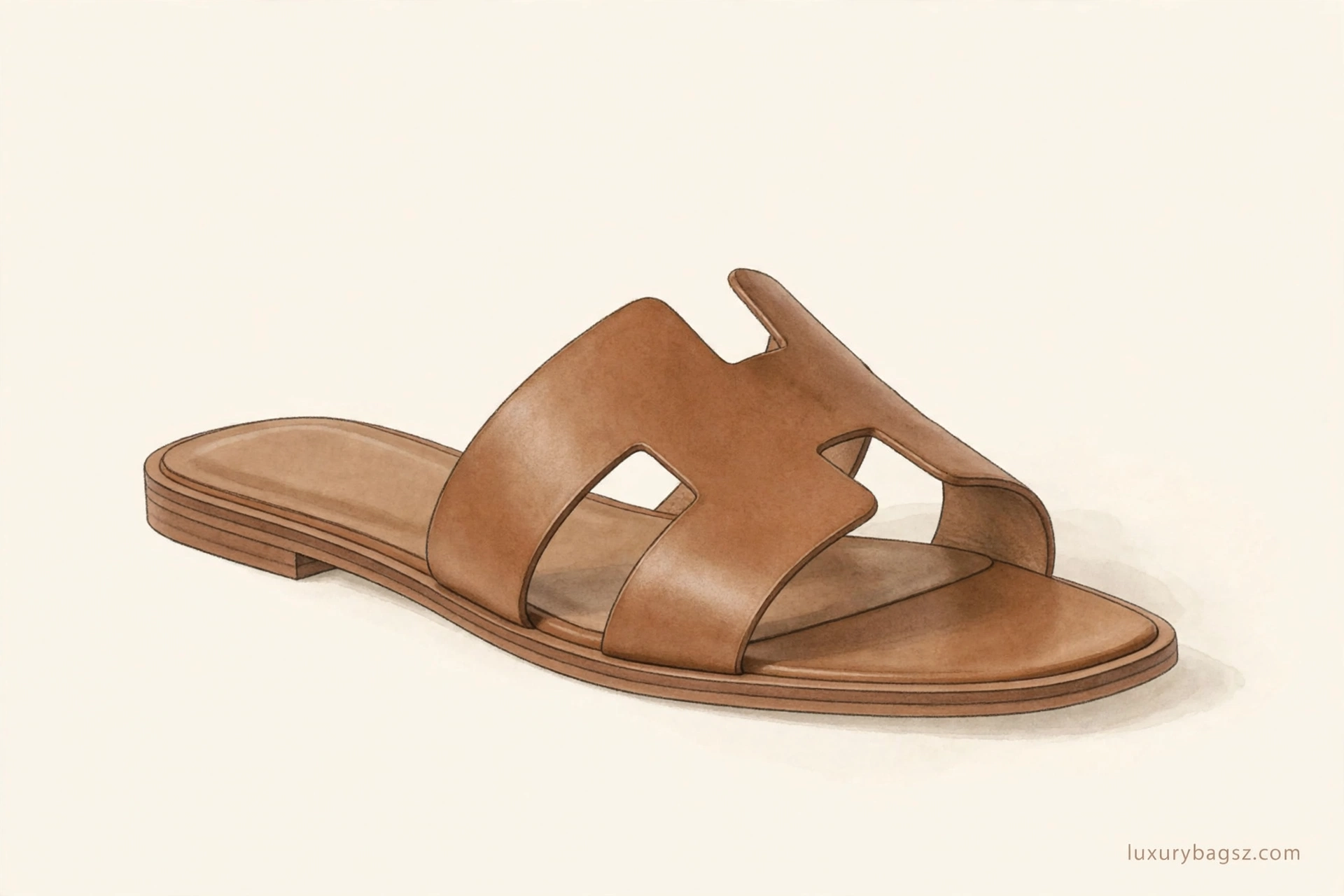
The Hermès Oran is a flat leather slide sandal built around a single strap cut into the shape of the letter H. Designed in 1997 by Pierre Hardy for Hermès’ Year of Africa collection, and named after the Algerian coastal city of Oran, it has been in continuous production for nearly three decades and is still the house’s best-known sandal.
The classic version is made in Italy from box calfskin leather, with a padded leather insole, a leather sole, and a barely-there wooden heel piece. It comes in European sizing with half sizes, is generally described as true to size, and needs a short break-in period before the leather softens to your foot.
Prices have climbed steadily since launch, and rival guides disagree on the current retail figure, so this guide gives dated, single-listing examples rather than one smooth average. If you only remember one thing, remember this: the Oran is deliberately plain, and that plainness is exactly why it has lasted.
Introduction
Walk through any resort town, airport lounge, or smart summer lunch in July and you will see them: a flat leather slide with a single H-shaped strap across the foot, worn with everything from linen trousers to a silk dress. That sandal is the Hermès Oran, and it is one of the rare luxury items that became more famous after its first decade than during it.
Most rival guides treat the Oran as a shopping list: a photo, a price, and a sizing tip. They skip the questions a careful buyer actually asks. Why is a sandal with one strap and no visible branding beyond a letter shape so expensive? Why do some people swear it runs true to size while others insist it runs small?
What changed between the 1997 original and the dozens of materials on sale today? And how does the Oran relate to the rest of the Hermès sandal family, including the chunkier Chypre, the heeled Oasis, and the men’s Izmir?
This guide answers all of that, and it does so honestly where sources disagree. Hermès does not publish a single official history page for the Oran, so much of what circulates comes from the house’s own interviews, retailer guides, and long-term owners. Where those sources conflict — on price, on fit, on the exact story behind the H — this guide says so plainly instead of quietly picking one version.
One more thing before we start: every image in this guide is a generic illustration, not a photograph of a real Hermès product. No trademark logo has been reproduced. The illustrations show the general shape and idea of an H-cutout slide sandal so you can follow the design discussion; they are not evidence of what any particular pair looks like.
Key Takeaways
- The Oran was designed in 1997 by Pierre Hardy for Hermès’ Year of Africa collection and named after the Algerian city of Oran.
- It is a flat slide sandal: one H-cutout strap, a padded leather insole, a leather sole, and a small wooden heel piece. There is no buckle, no back strap, and no arch support.
- The original material is box calfskin leather, made in Italy. Today the Oran also appears in Epsom leather, suede, patent, velvet, denim, canvas, woolskin, shearling, and exotic skins.
- Sizing is European (French) sizing with half sizes. Most guides call it true to size; people with wide feet or a high instep usually size up half a size.
- Expect a break-in of roughly 3 to 10 wears. The leather sole is slippery when new, and many owners add a thin rubber half sole at a cobbler before the first wear.
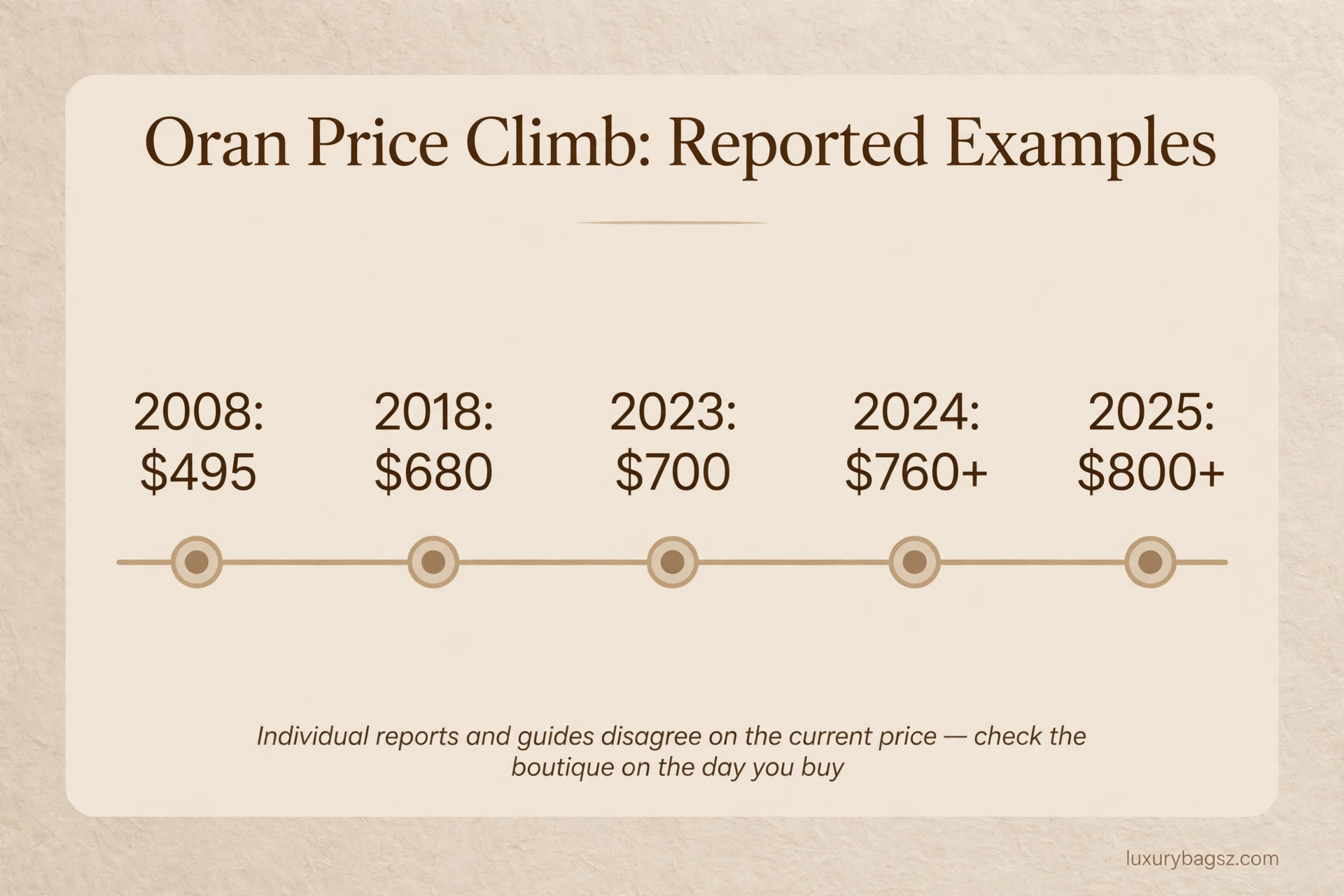
- Retail prices have risen from about $495 in 2008 to roughly $800 or more by 2025 in the United States, but published figures for the current price disagree, so check the boutique price on the day you buy.
- The Oran is sold as a women’s sandal up to EU 42. Men who want the same H strap are generally directed to the Izmir, which is cut wider and longer.
- Hermès issues no authenticity cards as a general rule, so a card bundled with a pre-loved pair is a red flag, not reassurance.
Table of Contents
Part 1: The 1997 Origin — Africa, Ndebele Painting, a City Name
The Oran begins with a theme. In 1997, Jean-Louis Dumas, then at the head of Hermès, declared the house’s annual theme to be Africa. Pierre Hardy, the house’s footwear creative director at the time, was asked to design within that theme, and the sandal he produced took its name from Oran, a port city on Algeria’s Mediterranean coast.
Hardy himself has described the design goal in strikingly modest terms. He did not set out to make a status shoe. He wanted a simple, almost invisible flat — in his own much-quoted phrase, “like a bare foot with something painted on it” — a sandal that just about any woman could wear. That ambition explains the restraint of the finished design: one strap, one letter, nothing else competing for attention.
The inspiration behind the H is where sources start to vary slightly, and the difference is worth noting rather than smoothing over. Several guides say the H cutout was inspired by the painted house decorations of southern Africa’s Ndebele people, whose bold geometric patterns and bright colours carry a visual language of their own. Other accounts describe the H more narrowly as echoing the shape of a Ndebele house itself.
Both versions agree on the essentials — an African visual source, translated into a single graphic letter — but they do not agree on whether the reference is to Ndebele decoration in general or to a house shape in particular. This guide reports both, because the distinction matters to anyone repeating the story: the broader claim (Ndebele painted decoration) is the one most often repeated, while the house-shape version appears in a smaller number of accounts.
What is not in dispute is the commercial result. Once the Oran reached stores, it became the footwear department’s bestseller, and it has stayed one ever since. Harper’s Bazaar Arabia, writing about the sandal’s staying power, notes that it became the métier’s bestseller on arrival and remains a “red hot ticket” more than 25 years later.
Hardy, by his own account, did not expect the sandal to become a classic at all — which makes the Oran a rare case of a designer underestimating his own most famous design.
There is also a useful bit of context that rival guides often skip: Hardy was not a newcomer when he designed the Oran. He had worked at Hermès since 1990, responsible for men’s and women’s shoes, and he had trained as a dancer before turning to design — a background he credits with his attention to how a shoe actually feels on a moving foot.
The Oran’s comfort-first brief makes more sense once you know its designer thought about feet from a dancer’s point of view.
Part 2: Anatomy of the Sandal — The H Cutout, the Sole, and the Heel
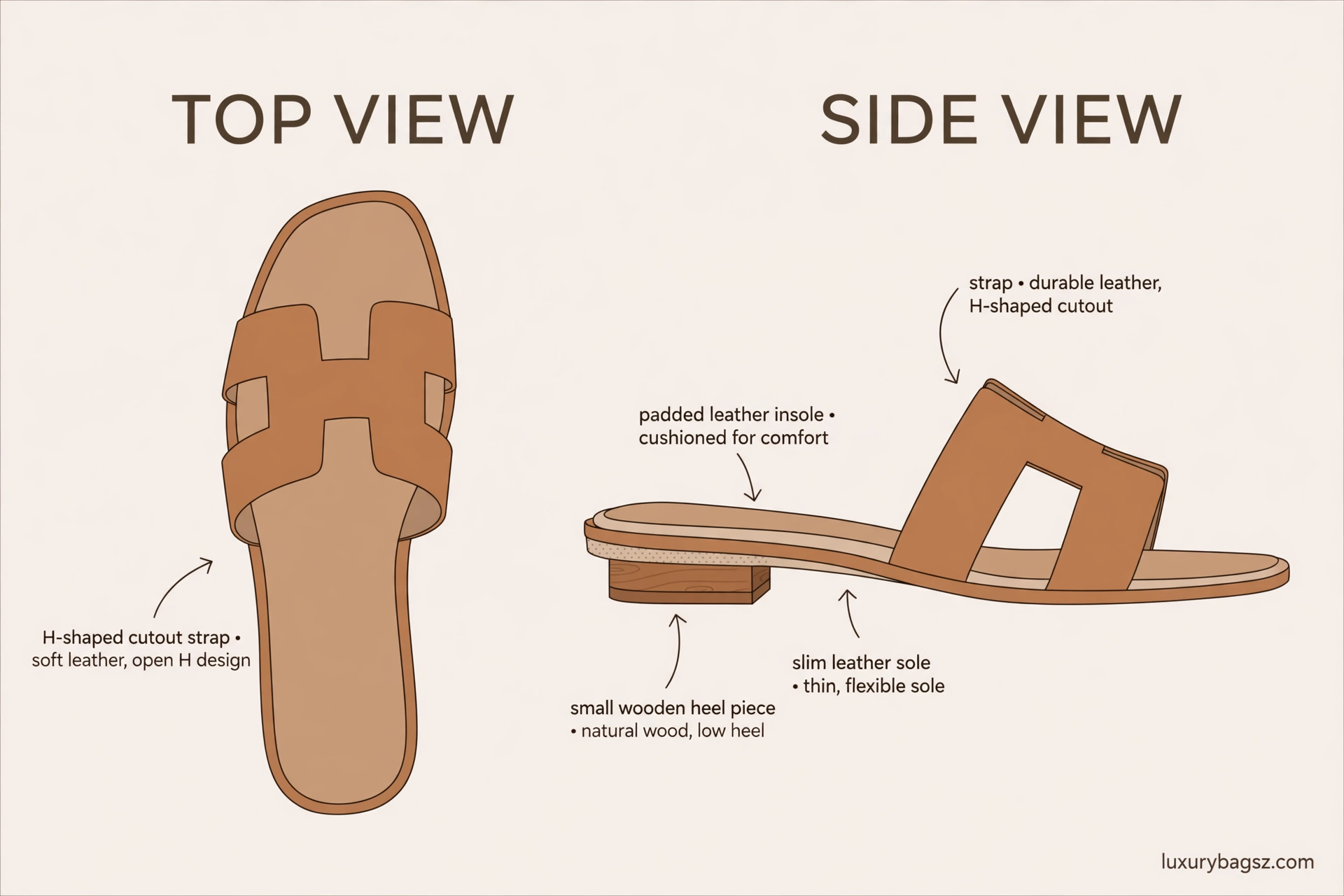
Strip the Oran down to its parts and there are very few of them, which is precisely the point. Understanding each one helps you judge quality, fit, and fakes alike.
The H strap. A single wide strap crosses the top of the foot, cut so that the negative space forms the letter H. The strap is the whole upper: there is no toe post, no ankle strap, and no buckle. On many pairs the H strap is lined, which Hermès’ own product descriptions note adds stability to the cutout shape. Because the letter is formed by cutting away leather rather than by adding hardware, the strap’s edges and stitching are fully exposed — which is why uneven stitching or ragged cut edges stand out immediately on a poor copy.
The insole. The footbed is a padded leather insole, gold-embossed with the Hermès name on many pairs. One long-term owner guide describes the insole as padded leather sitting over a barely-there wooden heel piece. The padding is modest, not plush: the Oran cushions rather than cradles, and it offers no moulded arch support. That flatness is a genuine dividing line between buyers. People who want a contoured footbed usually prefer the Chypre, covered in Part 9.
The sole and heel. The outsole is leather, and the heel is a small wooden piece — one resale listing for a new black calfskin pair measures the heel at half an inch. A leather sole is elegant and quiet on some floors, but it is slippery when new, especially on marble, wet stone, and cobbles.
More than one owner reports an undignified slip in the first week. The standard fix, repeated across owner guides, is a thin rubber half sole fitted by a cobbler before the first wear. It changes the look barely at all and extends the sole’s life considerably.
The weight. One 2026 sandal guide puts the Oran at 380 grams per pair, which is remarkably light for a leather sandal. Treat that figure as a single guide’s measurement rather than an official specification — Hermès does not publish an official weight — but it matches the general owner impression of a sandal that feels like very little on the foot.
The box and extras. A new pair arrives in the familiar orange Hermès box with dust bags, sometimes called sleepers, for each shoe. Keep both. The dust bags are your storage solution for the off-season, and a complete set — box, ribbon, dust bags — matters if you ever resell.
Part 3: Materials and Leathers — From Box Calf to Shearling
The original Oran is a box calfskin sandal, and box calfskin deserves a proper introduction because rival guides often name it without explaining it. Box calf is a smooth, fine-grained calfskin leather, historically the first leather Hermès used for its handbags. It is firm, smooth, and develops a patina with wear, and owners generally find it more scratch-resistant than softer leathers such as lambskin. That combination — structure plus a clean surface — is why it suits a design whose entire visual interest is one cut letter: any flaw in the leather would show.
But the Oran of today is not only a box calf sandal. Over nearly three decades, Hermès has used the same H shape as a canvas for almost every material in its library. Rival guides tend to list three or four; the fuller picture includes:
- Box calfskin — the original, smooth and structured, and still the default for classic colours.
- Epsom leather — grained and pressed, lighter in feel, and popular in the étoupe and neutral colourways seen on resale sites.
- Suede (velours) — soft and matte, lovely in pastel and bright colours, but the most care-hungry version. Suede Orans need a brush, not a cloth, and this is where knowing how to use a suede brush properly makes a real difference to how long the nap stays clean.
- Patent leather — glossy and slightly tighter across the bridge of the foot at first, according to one owner who tried both patent and regular leather in the same size.
- Velvet, denim, and canvas — seasonal textile versions that change the sandal’s character entirely. Canvas Orans need gentler cleaning than leather ones, and the same caution that applies when you clean a Hermès canvas bag applies here: test any cleaner on a hidden spot first and keep water to a minimum.
- Woolskin and shearling — fuzzy, cold-weather versions, including the Rose du Désert shearling pair that one 2021 price report listed well above the classic leather price. These turn a summer slide into a house-and-travel shoe.
- Exotic skins — crocodile and lizard versions appear in limited runs at significantly higher prices, and discontinued shades in these materials are among the most sought-after on resale.
A note on leather sourcing, since readers often ask where Hermès leather comes from: the house draws on tanneries in several countries, and the full picture is more varied than any single “made in” label suggests. If that topic interests you, our guide on which country makes leather for Hermès bags walks through it in detail. The Oran itself, though, is made in Italy — a fact that surprises people who assume everything Hermès makes is made in France. Hermès footwear has long been produced in Italy, while the famous bags are made in France, and both facts can be true at once.
One practical consequence of the material range: do not assume one Oran feels like another. A suede pair, a patent pair, and a shearling pair in the same size will fit and behave differently, and the material matters more to comfort than most buyers expect.
Part 4: Colours — Permanent Neutrals vs Seasonal Colour
Hermès treats the Oran as a colour story told twice a year. There is a permanent core of neutrals that returns season after season, and then there is everything else: a rotating cast of brights, pastels, and prints that appears, sells out, and sometimes never returns.
The permanent core, named consistently across guides, is black (Noir), white (Blanc), and gold (Gold) — with gold being the name that confuses newcomers most, because Hermès gold is not metallic at all but a warm natural tan-brown. Étoupe, a greyish taupe, functions as a fourth neutral in practice and appears constantly in resale listings. If you are buying your first pair, almost every long-term owner guide gives the same advice: start with a neutral. Black dresses up and down, white is the fresh spring and summer choice (and the hardest to keep clean), and gold goes with practically everything.
The seasonal colours are where collecting begins. Guides name lemon yellow (Jaune Impérial), mint green (Vert Pomme), ballerina pink (Rose Pâle), fuchsia, emerald, bright orange, and a range of blues and pastels.
One resale analysis found the most popular Oran colours on its platform over a twelve-month period were greens, browns, pinks, blues, and classic black, in that order — a useful reminder that the headline-grabbing brights are not always the colours people actually buy.
There are also bi-colour and patterned versions, where the H strap carries two tones or a print, and the occasional embellished pair — rhinestone detailing is one example owners mention with longing. These are the pairs most likely to trade at a premium on resale once discontinued, precisely because they cannot be reordered.
Two colour warnings belong here. First, Hermès colours look different on different leathers: the same colour name applied to box calf, Epsom, and suede can read as three noticeably different shades, so judge the pair in front of you, not the colour name. Second, pale colours and suede are a high-maintenance combination. A white suede Oran is beautiful and unforgiving in equal measure; buy it knowing that, not discovering it later.
Part 5: Sizes and Fit — EU Sizing, Half Sizes, and the Break-In
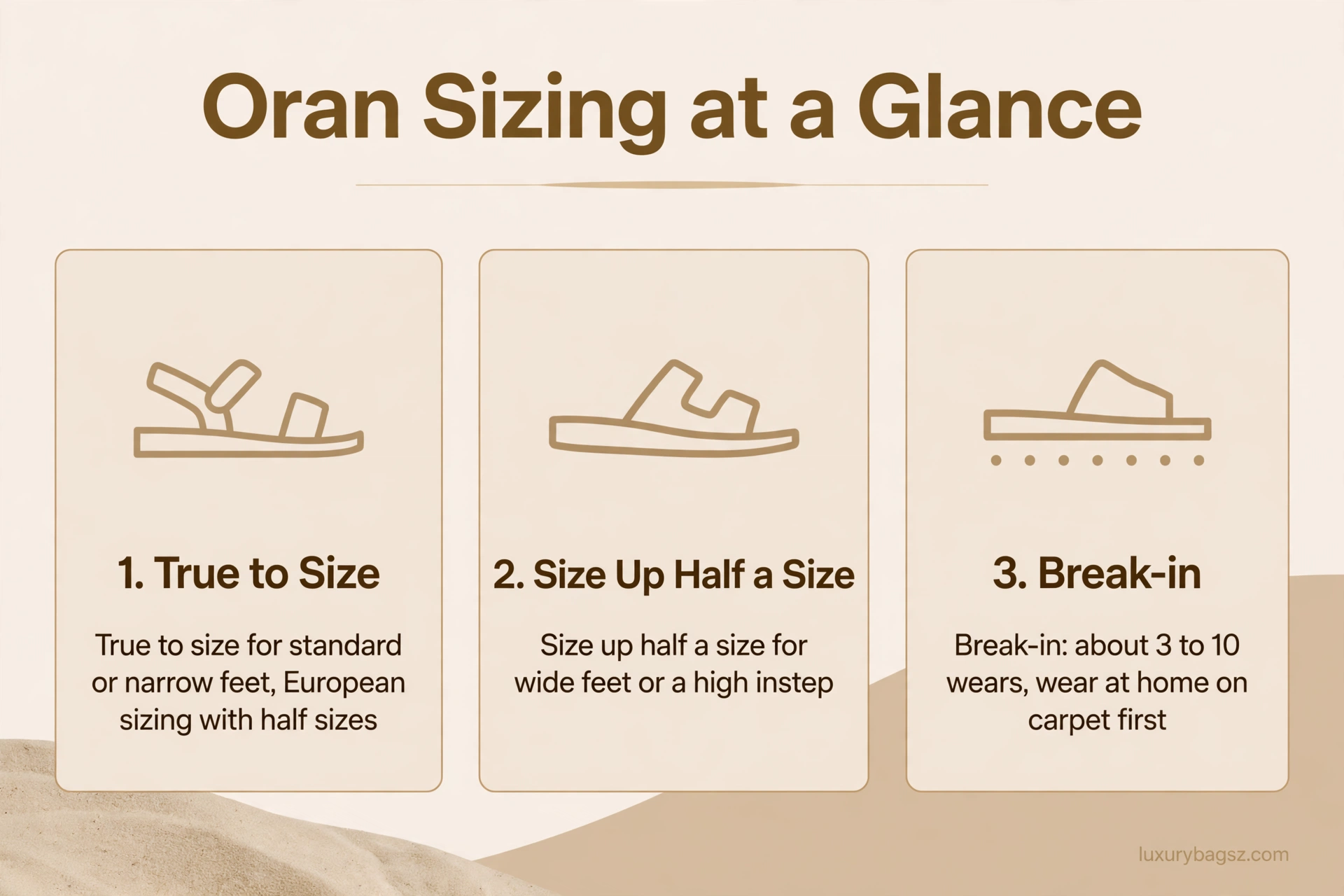
Oran sizing is European (French) sizing, and the sandal is sold in half sizes — a genuine advantage if you sit between whole sizes. The size range most often cited for the women’s Oran runs up to EU 42. Within that range, the honest summary of owner experience is: usually true to size, with exceptions worth knowing before you order.
The majority view. Most guides and many owners report that the Oran runs true to your usual European size. One owner who wears a US 8 in everyday shoes takes a FR 39 in the Oran and reports the heel landing exactly at the end of the sole — her test for a correct fit. Another owner takes her usual 38 in both gold and white pairs. If your feet are standard or narrow in width, your usual EU size is the right starting point.
The exceptions. Three groups of buyers regularly size up half a size. The first is people with wide feet: the H strap does not stretch much, and a wide foot can feel pinched across the bridge. The second is people with a high instep, for the same reason — the strap sits over the highest point of the foot and there is no adjustment. The third is people between sizes, where the half-size range usually solves the problem but, if in doubt, the extra half size is the safer choice because the leather relaxes slightly with wear but will not stretch a full size.
Where sources disagree. Some wearers report the Oran runs small, and one guide aimed at first-time buyers says so flatly. Others say it is true to size and that the “runs small” reports come from buyers with wider feet or from patent leather, which one owner found a touch tighter than regular leather in the same size. Both observations can be true: the sandal’s fit depends on foot shape and material as much as on the number stamped inside. The practical rule is to try before you buy when you can, and when you cannot, order your usual EU size if your feet are narrow or standard, and go up half a size if they are wide, high-instepped, or between sizes.
The fit test. However you buy, check two things when the pair arrives. First, your heel should not extend beyond the back of the sole, and your toes should not hang over the front edge — a slide with no back strap gives your foot nowhere to go if the sole is too short. Second, the H strap should sit flat across the foot without the edges digging into the skin beside your big toe or little toe. One reviewer measured the footbed of her FR 39 pair at 25.2 cm (9.9 inches) from toe box to heel end — a useful single-pair measurement, though not an official size chart, and footbed length will differ by size.
The break-in. This is the part rival guides most often underplay. Expect roughly 3 to 10 wears before the Oran feels fully comfortable, with some guides narrowing that to 5 to 10 wears. The leather strap is stiff at first, and blisters on the sides of the big toe and little toe are common in the early wears, particularly in stiffer leathers. The gentlest way through it, repeated by owner after owner, is to wear the sandals at home on carpet for short periods before taking them outside — you soften the strap without scuffing the leather sole.
Applying leather conditioner before the first wear can also help soften the material, though you should test any conditioner on a hidden spot first. Once broken in, the leather moulds to your foot, and that moulding is a large part of why owners keep pairs for years: the sandal becomes shaped to its owner in a way a moulded synthetic footbed never quite does.
What the Oran does not do. It offers no arch support, and it is not a walking shoe. Owners consistently describe it as comfortable for strolls, errands, beach trips, and dinners, and consistently warn against long-distance walking or rough terrain. If you need support for a full day on your feet, the Chypre’s moulded footbed (Part 9) is the better Hermès choice.

Part 6: Price Evolution — What the Oran Has Cost Over the Years
Prices are where rival guides fail most often, because they quote one figure as if it were settled. It is not settled. Published figures for the Oran’s current retail price disagree by a wide margin, and older figures come from individual buyers rather than official price lists. This part therefore gives dated, single-listing examples and labels them as such, so you can see the trend without being misled by any one number.
The timeline, as reported by individual buyers and guides:
- 2008: $495 USD, reported by one long-term owner tracking her own purchases.
- 2018: $680 USD plus tax for a patent leather pair bought in California, a total of $741.30 with the state’s 9% tax. Patent cost more than standard leather even then.
- 2021: $660 USD for a classic pair listed on the official Hermès website, and $1,025 for a shearling Rose du Désert version, as reported by a fashion magazine’s price check of the time.
- 2023: $700 USD, per the same long-term owner’s tracking.
- 2024: $760 USD and up, per the same owner, and $760 as the starting figure in another independent review from the same period.
- 2025: $800 USD and up, per the owner’s updated tracking.
- 2026 guides: one 2026 sandal guide puts the Oran around $900 USD for standard calfskin, while a separate market report puts European pricing around €620 for standard leather versions and the US figure around $750. These two 2026-era figures disagree with each other by a wide margin, and both disagree with the $800-plus figure from 2025 tracking.
What can you safely conclude from that spread? First, the direction is unambiguous: the Oran’s price has roughly doubled since 2008, rising about 53% between 2008 and 2024 by one owner’s calculation. Second, the exact current price is not something any guide can responsibly state as a single number without a same-day boutique check — the published figures conflict, and Hermès adjusts prices by market and by material. Third, material moves the price more than colour does: shearling, exotic skins, and embellished versions sit well above the classic leather figure, and a 1stDibs snapshot of size 38 listings once showed a low end of $799 and a high end above $10,000 for exotic versions, which tells you how wide the range gets once rare materials enter the picture.
The value question. Resale is part of the price story. One market analysis cited by a white-Oran guide found used Orans selling at roughly 70–80% of retail, which is strong for footwear, and resellers describe the Oran as one of their fastest-selling shoes year-round. That does not make the sandal an investment — shoes wear out, and resale depends on condition, colour, and size — but it does mean a well-kept classic colour in a common size is easier to resell than most designer shoes. The cost-per-wear argument owners make is straightforward: a neutral pair worn several times a week for several summers costs less per outing than a cheaper pair replaced every season.
A buying note on channels. The Oran is sold through Hermès boutiques and the official online store, and unlike the house’s famous bags, it does not require an appointment or a purchase history to buy. One reseller’s summary puts it neatly: in a couple of clicks online, the Oran can be yours, while a bag appointment remains coveted. That accessibility is part of the sandal’s appeal — it is the most reachable way into the house — and it also means there is little reason to pay a premium to a middleman for a standard colour in a standard size.
Part 7: How to Wear and Style the Oran
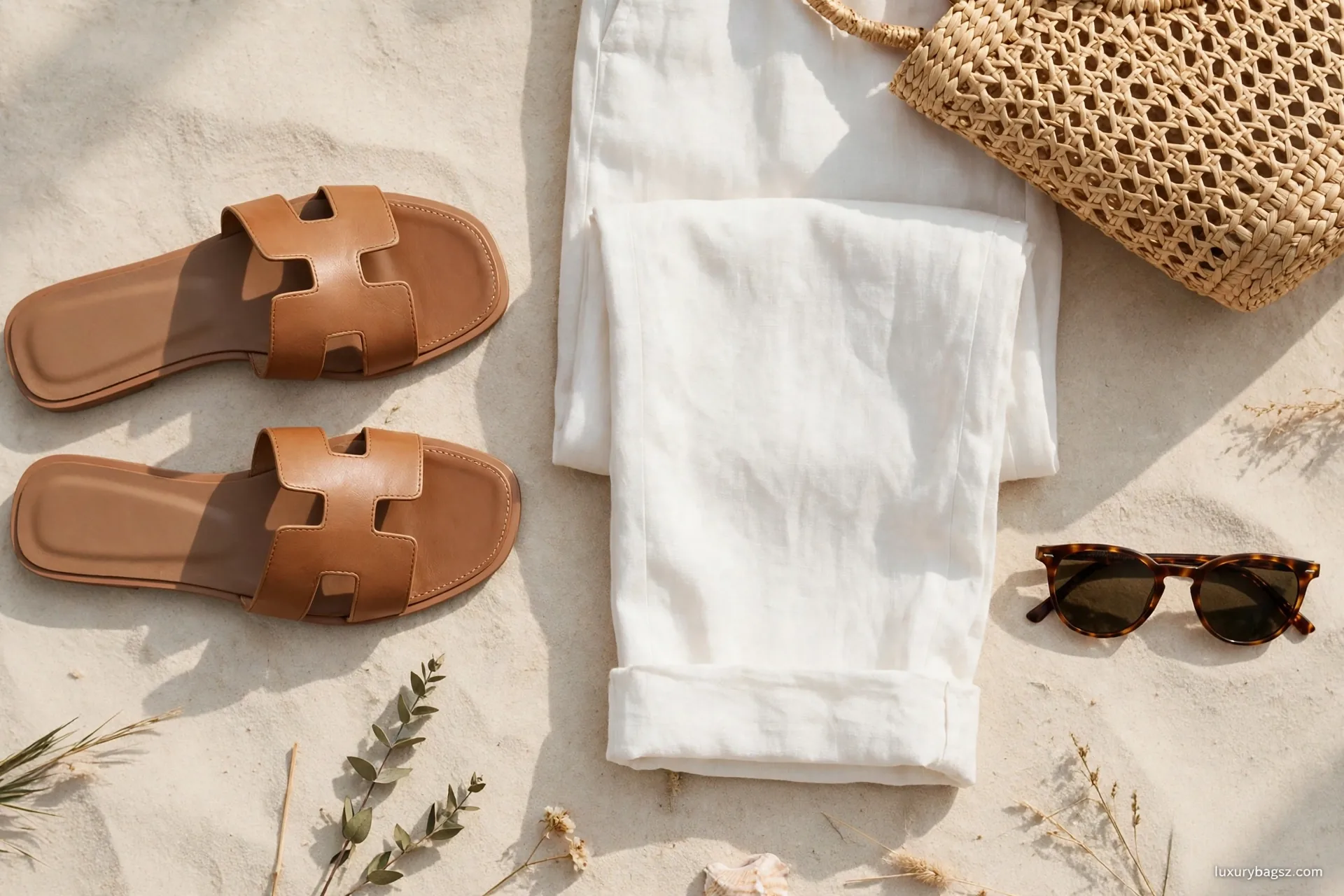
The Oran’s styling secret is that it refuses to belong to one dress code. The same pair that works for a beach lunch works for a dinner reservation, and that range is why owners describe it as the most versatile sandal Hermès makes. Here is how that versatility plays out in practice.
Casual days. With denim, shorts, and relaxed summer looks, the Oran is at its most natural. White or gold pairs lighten a jeans outfit without making it feel dressed up, and the flat sole keeps the whole look grounded. This is the Oran’s home territory, and it is where the sandal earns its “house shoe that left the house” reputation — several owners admit to breaking pairs in at home and then simply never taking them off.
Smarter looks. With a midi dress, a linen suit, or tailored trousers, the Oran acts as a deliberate alternative to heels: polished, but comfortable enough to walk in. Black pairs are the easiest route here, and gold pairs work beautifully with warm neutrals and earth tones. The H strap reads as jewellery-adjacent rather than sporty, which is why the sandal crosses into smarter settings where a chunkier slide would not.
Evening and travel. For dinners and resort evenings, the Oran pairs with silk and satin without clashing, and it packs flat for travel — a real advantage in a suitcase. Owners who travel with them note the weight (around 380 grams a pair by one guide’s measurement) and the fact that one pair covers beach, lunch, and dinner, which is exactly the kind of multi-duty packing that makes a holiday wardrobe work.
Pairing with bags and accessories. The Oran’s quietness makes it a good partner for a statement bag rather than a competitor with one. A neutral Oran lets a colourful bag lead, and a bright Oran can be the colour accent when the bag is neutral. For the bag itself, a small crossbody worn hands-free suits the sandal’s easy mood, and choosing the right length matters — our guide on how to choose a Hermès crossbody bag size covers the sizing logic. A silk scarf adds another layer: a scarf tied at the neck or wrist lifts a simple Oran-and-linen outfit into something intentional, and the classic pairing of an Evelyne bag with Orans is a familiar sight in resort towns for good reason — both are relaxed, both are recognisably Hermès, and neither shouts.
Colour strategy. First pair: neutral. Second pair: the colour you actually reach for, not the colour that photographs best. Bright orange pairs beautifully with a Picotin-style tote in summer, but only if orange is a colour you wear. Pastels — lemon, mint, ballerina pink — are lovely and seasonal, and they are the pairs most likely to feel dated if your wardrobe moves on. The owners who build collections of Orans tend to add one seasonal colour a year rather than buying several at once, which keeps each pair feeling chosen rather than accumulated.
What not to pair. The Oran’s flat sole and open design do not suit formal evening dress that demands a heel, rough terrain, or days that involve serious walking. It also looks wrong with heavy winter clothing — the shearling versions aside, this is a warm-weather shoe, and forcing it into cold-weather outfits undercuts the ease that makes it work.
Part 8: Care, Cleaning, and Making Them Last
A leather slide with a leather sole asks for a little routine, and the owners whose pairs still look good after years all follow roughly the same one. None of it is complicated; all of it is easy to skip, which is why it is worth writing down.
After every wear. Brush off dust and wipe the leather with a soft, dry cloth. For light marks, a barely damp cloth followed by air drying is enough. Do not soak the leather, and do not use wet wipes as a daily habit — one owner does use them for dirt and sweat and lets the pair air dry, but wipes are a convenience, not a care system, and repeated use can dry the surface.
Conditioning. Treat smooth calfskin with a leather conditioner every few months to keep it supple, and always test on a hidden spot first. If you use a balm-type conditioner, our guide on how to use Saphir Renovateur walks through the application in detail — the same patient, thin-coat approach applies to a sandal strap as to a bag. For suede versions, skip conditioner entirely and use a brush: knowing how to use a suede brush correctly, with light strokes in one direction, is what keeps the nap from going patchy.
The sole. This is the highest-value care step and the one most buyers miss. Before the first wear, take the pair to a cobbler and ask for a thin rubber half sole. It protects the leather sole from pavement, wet stone, and heat, it fixes the new-leather slipperiness, and it is far cheaper than a resole. Avoid wearing leather-soled sandals on wet surfaces whenever you can, and let the pair air out fully between wears rather than wearing the same pair daily — rotation extends the life of any shoe, and the Oran is no exception.
Water, sun, and stains. Keep the sandals out of prolonged direct sunlight, which fades colour and dries leather, and away from radiators and heaters. For white leather, a white-specific conditioner avoids tinting the surface, and a stain and water repellent mist applied before the first wear, then topped up at intervals, gives pale pairs a fighting chance. For suede, a protector spray before the first wear is nearly mandatory — suede stains fast and forgives slowly.
Storage. Store the pair in its dust bags in a cool, dry place, ideally with a shoe tree or stuffing that holds the strap’s shape. The same principles that apply when you store a Hermès Kelly bag — dust bag, cool and dry, out of sunlight, no stacking heavy items on top — apply here, just at sandal scale. Keep the orange box if you have room; a complete set helps at resale time.
Repairs. Hermès offers repair services for its products, and a good cobbler can handle sole work, but the H strap itself is the part to protect: once the cutout edges fray or the stitching goes, the sandal’s whole visual identity suffers. Catch loose stitching early, and do not try to dye or recolour a damaged strap at home — a bad dye job is worse than honest wear.
Realistic lifespan. Owners report pairs in excellent condition after three years of regular wear, with only minor creasing on the H strap — creasing that happens naturally as the leather flexes and is not a flaw. With sole protection, rotation, and basic conditioning, a classic leather pair should last many summers. Without them, the leather sole is usually the first thing to go.
Part 9: Oran vs the Rest of the Hermès Sandal Family
The Oran does not live alone in the Hermès shoe department, and choosing between siblings is the decision most buyers actually face. Here is how the family lines up.
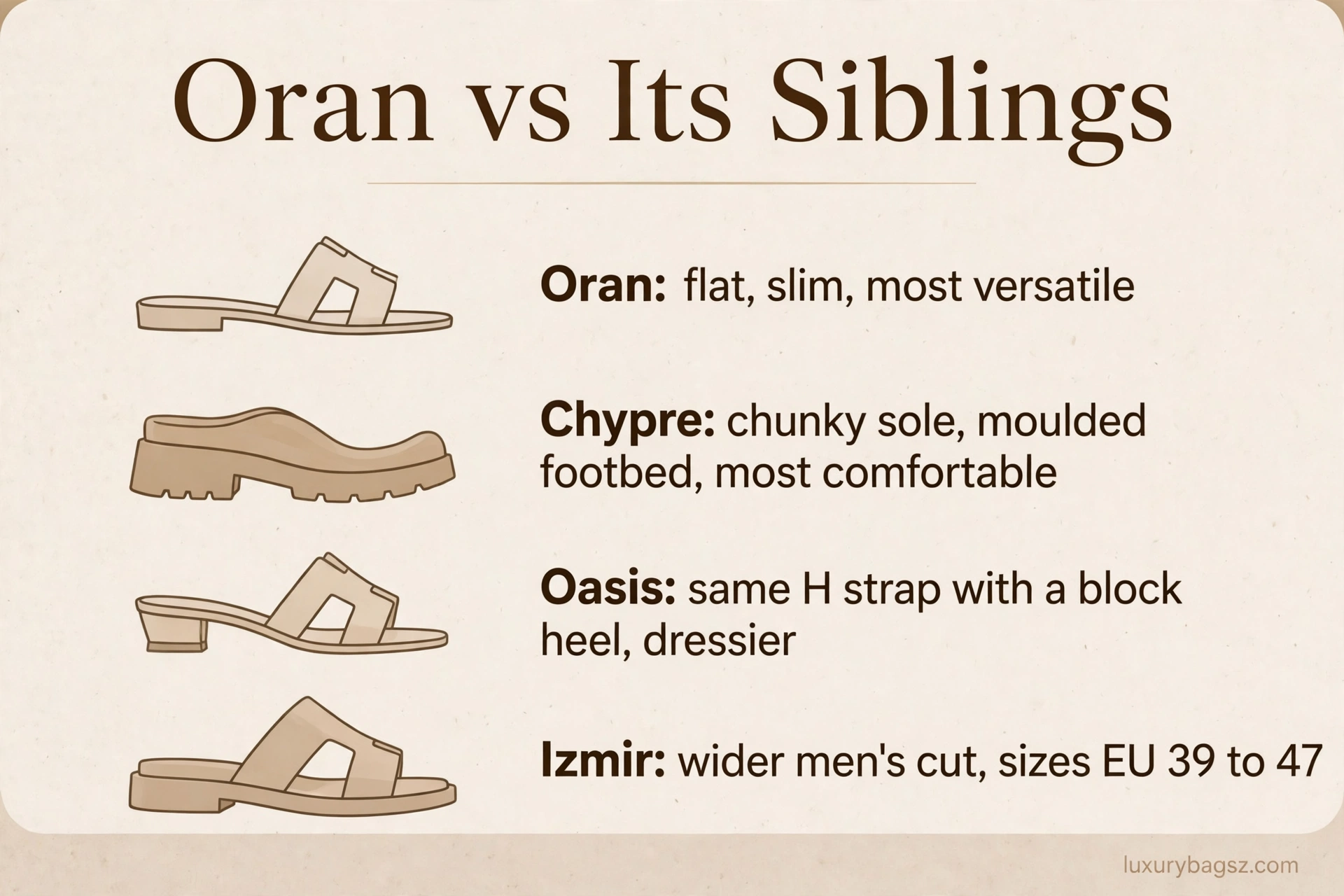
Oran vs Chypre. The Chypre, released in 2021, is the Oran’s great rival and the comparison rival guides return to most. It shares the H cutout strap but adds a chunky sole, a moulded footbed shaped to the foot, and a thick adjustable velcro strap across the middle of the foot. The Chypre is more comfortable for long wear and more forgiving of foot shape, thanks to that adjustable strap, and its rubber sole needs no cobbler visit. But it is chunkier, more casual, and more trend-driven in feel, while the Oran is slimmer, more elegant, and easier to dress up. One guide’s summary is hard to beat: the Chypre is the casual sandal, the Oran is the versatile one. If you want one pair to cover beach and dinner, take the Oran. If you want comfort above all and mostly wear casual clothes, take the Chypre.
Oran vs Oasis. The Oasis is, in one owner’s words, “the exact same as the Oran except there is a roughly two-inch block heel on the end.” The H strap is the same, the flat ease is not — the heel adds height and a dressier line, at the cost of the Oran’s walk-all-day comfort and with a tendency for the H edges to rub after a full day. Oasis sizing also differs: the same owner wears a 39 in the Oasis against a 38 in the Oran, and describes the Oasis as running a size small. Choose the Oasis when you want the Oran look with leg-lengthening height; choose the Oran when comfort leads.
Oran vs Izmir. The Izmir is the men’s slide and the answer to the most common men’s question about the Oran. It carries the H strap on a last cut wider and longer for men’s feet, in sizes from EU 39 to 47, at a similar price point to the Oran. The Oran itself is sold as a women’s sandal up to EU 42, and Hermès directs men to the Izmir. Confusingly, some resale listings do show men’s Oran pairs, which suggests either older or regional production or simply loose listing language — one more disagreement this guide flags rather than resolves. If you are a man buying new from a boutique, expect to be shown the Izmir, not the Oran.
Oran vs Geta. The Geta is Hermès’ other famous sandal, but it is a different animal: a wooden-soled sandal with a thong-style design rooted in Japanese geta footwear, rather than a flat leather slide. It deserves its own guide — and has one, our full Hermès Geta bag guide covers the design in depth, with pricing detail in the companion Geta price and sizes guide. The short version for comparison purposes: the Geta is more sculptural and more of a statement, while the Oran is the quieter everyday choice.
Oran vs Empire and Island. The Empire carries the Kelly bag’s buckle on its vamp, giving it a dressier, hardware-led character, while the Island is a slim flip-flop for buyers who want the least shoe possible. Neither has the Oran’s balance of recognition and restraint, which is why neither has matched its longevity. They are worth knowing about, but they are not substitutes for the Oran — they are answers to different questions.
Part 10: Buying Smart — Boutique, Online, and Pre-Loved
Buying new. The simplest route is the Hermès boutique or the official online store, where standard colours and sizes are usually available without an appointment. Try before you buy when you can, especially if you are between sizes or have wide feet. If you are ordering online, remember the exchange policy difference one owner flags: in-store purchases at Hermès are typically exchange-only or account credit, while online orders may allow returns — check the policy that applies to your order before you commit, because it affects how safely you can test a size at home.
Buying pre-loved. The Oran is one of the most resold Hermès items, and pre-loved is where the best colour finds live — discontinued shades, exotic materials, and past-season brights that boutiques no longer carry. It is also where fakes concentrate, because the Oran’s simple design is easy to copy badly and profitable to copy at all. A few ground rules:
- No authenticity card means nothing, and a card means trouble. Hermès issues no authenticity cards as a general rule. A seller who waves a card as proof of authenticity is either mistaken or misleading you; treat the card as a red flag, not reassurance. This is a point on which this guide is absolute, because the opposite claim circulates widely and it is wrong.
- Check the details, not the vibe. One owner guide notes that authentic Orans commonly carry a serial number on the inner part of the H strap, on the side nearest the little toe, though it is unclear whether older pairs have them. Stitching should be even, cut edges clean, the insole embossing crisp, and the leather smell and hand-feel consistent with calfskin rather than coated or plastic-feeling material. No single detail proves authenticity on its own.
- Compare against known fakes with care. The caution that applies when you learn how to spot a fake Hermès Kelly bag applies here in spirit: study the genuine article’s construction first, then judge the suspect pair against it, rather than hunting for one magic tell. A dedicated fake-Oran guide is a separate project; this guide’s job is to stop you from being fooled by the most common traps, starting with the card myth above.
- Condition is the price. On resale, price tracks condition, colour rarity, and size availability. A classic black pair in excellent condition in a common size will command a strong price; a pale suede pair with stained straps will not, however rare the colour. Inspect sole wear, strap creasing, insole wear, and odour before paying, and prefer sellers who photograph the soles and the inside of the strap.
- Complete sets matter. Box, ribbon, and dust bags add value and also add confidence, since a full set is harder to assemble convincingly than a bare pair.
What to pay. For a standard leather pair in good condition, expect pre-loved prices to sit below current retail but not far below it — the 70–80% of retail figure cited in Part 6 is a reasonable anchor, not a rule. Rare colours and exotic materials can exceed retail. If a listing is dramatically below retail for a current colour in a common size, treat that as a warning, not a bargain.
Part 11: The Oran for Men, Wide Feet, and Other Fit Questions
A guide that only describes the average foot fails the buyers who need it most, so this part collects the edge cases.
Men. As covered in Part 9, the Oran is sold as a women’s sandal, and the men’s equivalent is the Izmir. Some men with smaller feet do wear the Oran in its larger sizes, and resale listings occasionally show men’s Orans, but the boutique answer is the Izmir: wider, longer, and sized from EU 39 to 47. If you are a man drawn to the Oran’s slimness rather than the Izmir’s broader cut, try both before deciding — the difference is in the last, not just the label.
Wide feet. Size up half a size, and consider Epsom or suede over box calf or patent, since softer and grained materials give slightly more than firm smooth leather. The H cutout itself helps here: the open letter shape gives the foot a little more room than a solid strap would, which is one reason owners with wider feet still choose the Oran over a closed slide.
High insteps. The same advice applies: half a size up, because the strap crosses the instep and cannot be loosened. If the strap digs in during a boutique try-on, it will not reliably soften enough to fix the problem — leather relaxes, but it does not gain a full size of give.
Narrow feet. Stick with your usual size. The Oran’s slim silhouette suits narrow feet well, and sizing down risks your heel slipping past the back edge of a sole that has no back strap to catch it.
Between sizes. The half-size range usually resolves this, which is a genuine advantage over brands that only offer whole sizes. If you are exactly between half sizes, go up rather than down — a slightly long sole is manageable, a short one is not.
Foot conditions. The Oran’s flatness and lack of arch support make it a poor choice for anyone who needs orthotic support or suffers from plantar discomfort on hard surfaces. It is also not ideal for bunions during the break-in, since the strap edges can press on the sides of the foot — though some owners with wider feet or bunions report the leather moulding to them over time and becoming comfortable. Treat those reports as individual experience, not a promise, and try the pair in person if foot comfort is a medical concern rather than a preference.
Children. The Oran is an adult design, and Hermès does not position it as a children’s shoe. The question comes up because the sandal looks simple enough for a child, but sizing, construction, and price all point the other way.
Part 12: Who the Oran Suits Best — and Who Should Skip It
After nearly three decades of owners, a clear picture emerges of who loves the Oran and who regrets it.
It suits you if: you want one sandal that covers casual and smart summer occasions; you like quiet branding and would rather have a cut letter than a visible logo; your feet are standard or narrow, or you are willing to size up half a size for width; you are happy to break a pair in over a week or so and to add a rubber half sole; and you will wear a neutral colour often enough to justify the price per outing.
It may disappoint you if: you need arch support or walk long distances daily; you have very wide feet or a very high instep and cannot try before buying; you want a shoe you can wear in rain without thinking; you expect a plush, cushioned footbed; or you are buying purely for resale, since shoes are wear items and the Oran’s resale strength depends on keeping a pair in excellent condition.
The honest summary. The Oran is not the most comfortable sandal Hermès makes — the Chypre takes that title — and it is not the most practical, since a leather sole needs protection and dry weather. What it is, is the most versatile and the most enduring: a design that has survived nearly thirty years of fashion cycles without a redesign, that works with more outfits than any other Hermès sandal, and that still looks current next to shoes designed last season. That endurance is the real value proposition, and it is why the sandal keeps selling while trendier slides come and go.
Final Verdict
The Hermès Oran is a flat leather slide sandal that has earned its reputation the slow way: one strap, one letter, no redesign, and nearly three decades of continuous production. It is not the cheapest way to get a summer slide, nor the most cushioned, nor the most practical in wet weather. It is, however, the most versatile sandal Hermès makes, the easiest entry point into the house, and a design whose simplicity has outlasted countless louder trends. Buy your usual European size if your feet are standard or narrow, go up half a size if they are wide or high-instepped, protect the leather sole before the first wear, and start with a neutral colour you will actually reach for. Do that, and the Oran will do what it has done for owners since 1997: disappear onto your foot and quietly elevate everything you wear with it.
Frequently Asked Questions
What are Hermès Oran sandals?
The Oran is a flat leather slide sandal from Hermès, defined by a single strap cut into the shape of the letter H. It was designed in 1997 by Pierre Hardy for the house’s Year of Africa collection and named after the Algerian city of Oran. It has a padded leather insole, a leather sole, and a small wooden heel piece, with no buckle, back strap, or arch support.
Are Hermès Oran sandals true to size, and are they comfortable?
Most guides and owners say yes, in European sizing with half sizes available. People with wide feet or a high instep usually size up half a size, and some wearers report the sandal runs small, particularly in patent leather. The safest rule is your usual EU size for standard or narrow feet, and half a size up for wide feet, high insteps, or if you are between sizes.
After a break-in of roughly 3 to 10 wears, most owners find them comfortable for everyday summer wear, strolls, errands, and dinners. They are not comfortable out of the box for everyone — early blistering on the sides of the toes is common — and they offer no arch support, so they are not suited to long-distance walking.