How to Spot a Fake Hermès Lindy Bag: 12 Checks, Blind Stamps, and the Traps That Prove Nothing
The Empty-Bag Fold That Gives a Lindy Away
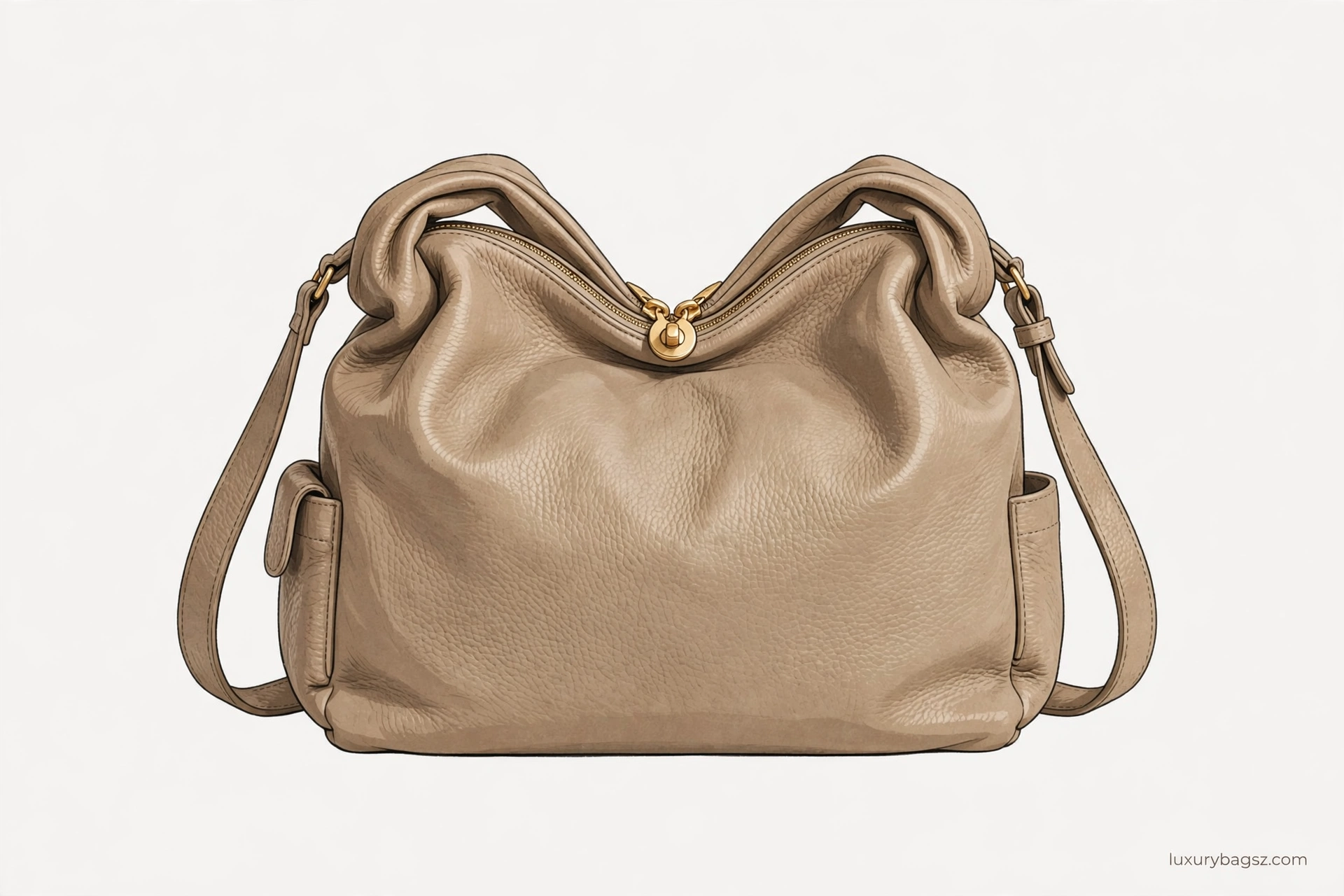
Look first at the bag empty and unstuffed: a genuine Lindy slouches, folds inward at the middle, its side handles drop towards each other, and its zip opening sits narrower than its base. A rigid, boxy shape that holds sharp corners fails that first test.
Next, match the leather grain to the material named — Clemence, for example, should show large, bold pebbling with a semi-matte finish — then check the saddle stitching, the zips meeting at the centre, and the turn-lock action.
The blind stamp letter and any surrounding shape must fit the claimed year: a circle for 1971 to 1996, a square for 1997 to 2014, and a single letter alone from 2015 onward. Any authenticity card is a red flag.
A fake Hermès Lindy is not usually caught by one dramatic giveaway. It is caught — or missed — by a pile of small details, checked in the right order, on the actual bag in front of you. That is why so many buyers get it wrong.
The Lindy makes this harder than most bags, and easier in one way. Harder, because it is soft. A rigid Kelly or Birkin either holds its shape or it does not, and a wrong shape is visible from across a room.
This guide is written for a buyer, not for a professional authenticator, and it is honest about its limits. No guide, and no set of photographs, can give you a certain verdict on a high-grade counterfeit. What this guide can do is teach you to spot the large majority of fakes, to ask for the photographs and measurements that make a fake much harder to hide, to recognise the traps that prove nothing at all, and to know when to stop and pay for professional authentication before you pay for the bag.
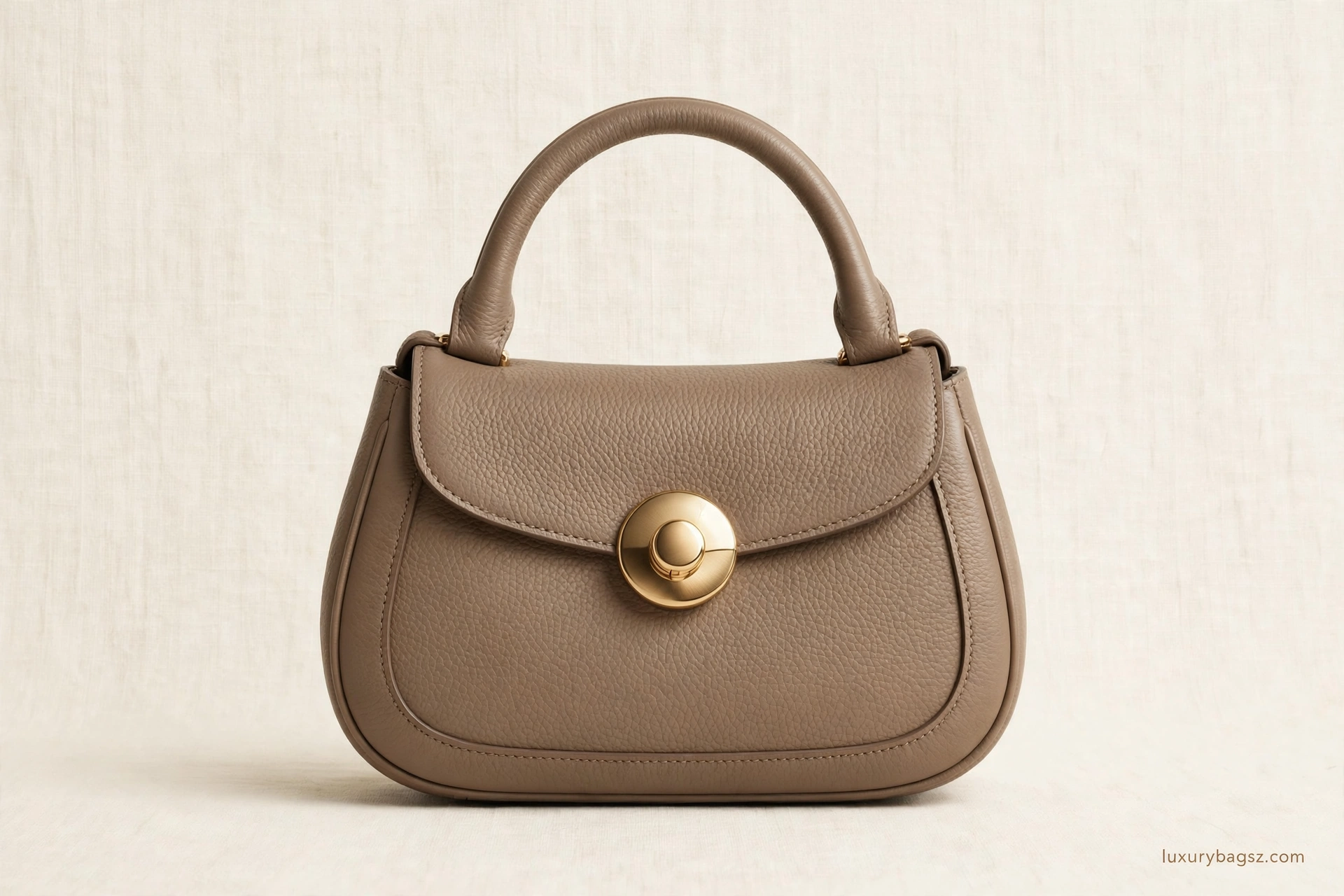
A note on the pictures in this guide, because it matters for an authentication article more than for any other kind. Every picture here is a generic illustration, not a photograph of a real Hermès bag, and none of them should be used as a reference for what a genuine Lindy looks like in detail. Illustrations simplify stitching, flatten grain, and tidy up hardware.
Key Takeaways
- Judge a Lindy as a whole. No single check — stamp, price, photograph, card, or receipt — proves a bag genuine, and no single flaw, on its own, always proves it fake. It is the pattern across all twelve checks that matters.
- Hermès issues no authenticity cards and no traditional serial numbers for its bags. A card, a number to “check online”, or a plastic orange card is a red flag, not reassurance. A copied blind stamp proves nothing either, because counterfeiters copy stamps.
- The Lindy’s shape is its first check and its most misunderstood one. A genuine Lindy folds softly in the middle when empty, its side handles fall inward, and its zippered centre opening is narrower than its base. A bag that is stiff, boxy when empty, or opens as wide as its base deserves a much closer look.
- Know which Mini you are looking at. The original Mini Lindy 20, from 2019, and the current Mini Lindy II are different bags: the II is about 2 cm narrower across the bottom and has a shorter strap drop, about 48 cm against about 53 cm for the original. A listing that just says “Mini Lindy” has not told you which one it is selling.
- The blind stamp must match its era: no shape before 1971, a circle from 1971 to 1996, a square from 1997 to 2014, and a single letter with no shape from 2015 onward, in a sequence that is deliberately not alphabetical. A stamp that breaks that pattern, or a claimed year that contradicts the stamp, is a serious warning.
- Ask for ten photographs before you pay, including the bag empty, the stamp, the zippers meeting at the centre, stitching close-ups, and the bag worn. A seller who cannot or will not supply them has not given you enough to buy safely, however good the first photograph looks.
- If you have already bought a bag and now doubt it, stop using it as a proven genuine bag, keep everything that came with it, do not alter it, and get a professional opinion before you try to resell it or confront the seller. The already-bought section sets out the order to follow.
My first Lindy test needs no tools at all: I set the bag down empty and watch what it does. A genuine Lindy slouches — the middle folds inward, the side handles drop towards each other, and the zip opening settles narrower than the base. A copy usually holds a boxy, stuffed shape that no real Clemence or Swift leather would keep. Only once the silhouette behaves do I check the blind stamp’s shape against the claimed year and run the bag through Entrupy. Ten years of handling Hermès has taught me that posture catches more Lindy fakes than any stamp.
Spotting a Fake Lindy in Brief
Can you tell a fake Lindy from one photograph? Almost never, and you should distrust any seller or guide that says you can. One photograph can rule a bag out — a plainly wrong shape, a misspelled stamp, or stitching that is visibly machine-straight can be enough to walk away — but it cannot rule a bag in. Good counterfeits are photographed to pass the one angle you are shown.
What is the fastest honest check? Look at the bag empty, from the front, with nothing stuffed inside it. A genuine Lindy is soft. It folds inward at the centre, its side handles fall inward toward each other, and it looks smaller and slouchier than its stuffed boutique photograph.
What about the stamp? Check it, but do not stop there. A genuine blind stamp is a small, cleanly pressed letter, sometimes with a shape around it and a craftsman mark beside it, in a place that matches the model and the era. For a Lindy of 26 cm and above, guides place it on the leather strap; for the newer Mini, on the inside of the bag at the side.
What is the one trap to avoid above all? Treating anything that came in the box as proof. Hermès does not issue authenticity cards, and it does not give its bags serial numbers that a buyer can check in a database. A card, a certificate, a “serial number check”, or a receipt photograph can all be faked, borrowed from another bag, or printed at home.
When should you walk away without further argument? When several checks fail at once, when the seller refuses the ten photographs in the seller-photo checklist section, when the claimed year contradicts the blind stamp, when the price is far below any plausible market range for that size, leather, and condition with no credible explanation, or when the seller pressures you to pay quickly, off-platform, or by a method with no buyer protection. Any one of those is a reason to pause. Two or more together are a reason to stop.
When should you pay for professional authentication? Whenever the bag passes your own checks but the price is high, the seller is unknown to you, the bag is a Mini in a desirable colour, or anything in the listing still feels slightly off after you have run all twelve checks. Professional authentication is not an admission that you cannot tell; it is the normal, sensible step for a purchase at this price, and reputable resellers expect it. A seller who discourages it, or who will not allow a return if a reputable authenticator disagrees, is telling you something important.
What a Real Lindy Is Supposed to Look Like
The Lindy was designed in 2006 and released in the Spring/Summer 2007 collection, under Jean-Paul Gaultier’s creative direction at the time, from an observation by designer Frédéric Vidal: a traditional top-handle bag forces you to hold your arm out so the bag stays parallel to your body, which strains the shoulder and forearm.
The Lindy’s answer was to move the handles to the gussets — the narrow sides of the bag — so the bag sits more naturally against the body, and to add a strap that connects handle to handle. That one decision explains almost everything about how a genuine Lindy looks, and therefore almost everything a fake gets subtly wrong.
A genuine Lindy, seen from the front, is a soft, rounded, slightly slouchy bag. Its body is wider at the base than at the top when it is empty, because the top folds inward. Its two handles sit on the sides, not on the broad front and back faces, and when the bag is set down or held empty, those handles fall inward, toward each other, rather than standing apart.
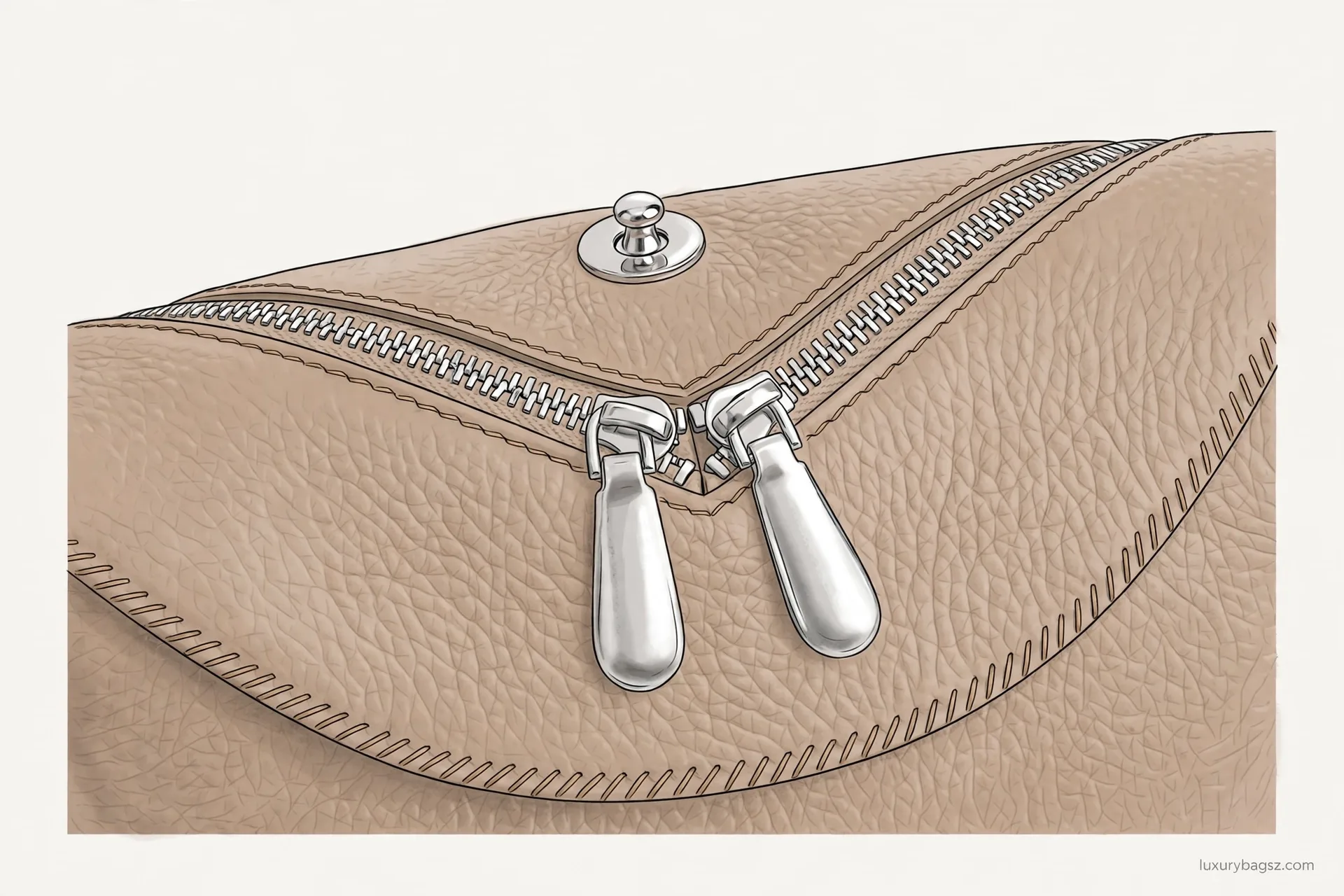
The opening is the Lindy’s most distinctive feature, and the one most fakes handle badly. Two zippers run in from opposite ends and meet in the centre, under a turn-lock, sometimes called a clous de selle or twist lock. The opening they create is a zippered centre opening, and it is narrower than the base.
Around the body, a genuine Lindy has two exterior slip pockets, one under each handle, and interior pockets inside. The base has five feet. Those feet should match the rest of the hardware in metal and colour, and guides that have handled many examples describe genuine feet as hammered in, while counterfeiters often screw feet in because it is faster.
The interior matters more than most guides admit, because it is where a counterfeiter’s cost-cutting often shows. A genuine Lindy interior is lined in leather that matches the quality of the exterior, with pockets that are neatly stitched and evenly placed. A fake interior is often where the leather turns thin, the stitching turns rushed, and the pockets sit unevenly or pull at their corners.
Finally, the Lindy’s overall finish should be quiet. Hermès does not shout. The brand stamp is pressed into the leather, not printed in large letters across the bag, and there is no large external logo.
Generations and Sizes: Why a Size Name Alone Proves Nothing
Most fake-Lindy guides give a size table and stop. That is a mistake, because size is one of the easiest things for a seller to get wrong — accidentally or deliberately — and one of the hardest things for a buyer to verify from a single photograph. A size name proves nothing on its own, for three reasons: the Lindy family has changed over time, its measurements vary by source and by example, and its soft body makes a nominal size an unreliable guide to the actual bag in front of you.
The family, as sources support it, is Mini 20, 26, 30, 34, and the discontinued 45 travel size. The original sizes were 26, 30, and 34, the 45 was added as a travel version, and the Mini did not appear until Fall/Winter 2019. The commonly listed dimensions are Mini 19.5 x 12.5 x 9.5 cm, 26 at 26 x 18 x 13 cm, 30 at 30 x 21 x 15 cm, 34 at 34 x 22 x 17.5 cm, and 45 at 45 x 26 x 26 cm — but other guides give different heights and depths for the same nominal sizes, and for the 45 the depth is given as both 23 cm and 26 cm in different guides.
Inside the Mini family, the split matters more than any other size detail, and it is the detail most competitor guides miss entirely. There are two Mini generations. The original Mini Lindy 20, from 2019, is about 19 to 20 cm wide, about 12 to 12.5 cm high, and about 9 to 10 cm deep, with a strap drop of about 53 cm.
For authentication, the Mini split is a trap in both directions. A seller who lists a Mini Lindy II at original Mini dimensions, or an original Mini at II dimensions, may simply be copying a table without measuring the bag — or may be selling one generation under the other’s name, at the other’s price. A Mini whose blind stamp year predates the II’s introduction, but which is sold as a II, is a contradiction, not a curiosity.
For the larger sizes, the authentication point is simpler but still missed by many guides: a genuine Lindy is soft, so its measurements move with fill and leather. A Clemence 30 will measure and drape differently from a Swift 30, and both will measure differently empty and stuffed. A seller who gives only a nominal size — “Lindy 30” — and no measurements of the actual bag has given you a model name, not a measurement.
One more size trap deserves a plain statement. The discontinued 45 is not a current boutique size. Any 45 you find will be pre-owned or vintage, and it should be priced and judged as such.
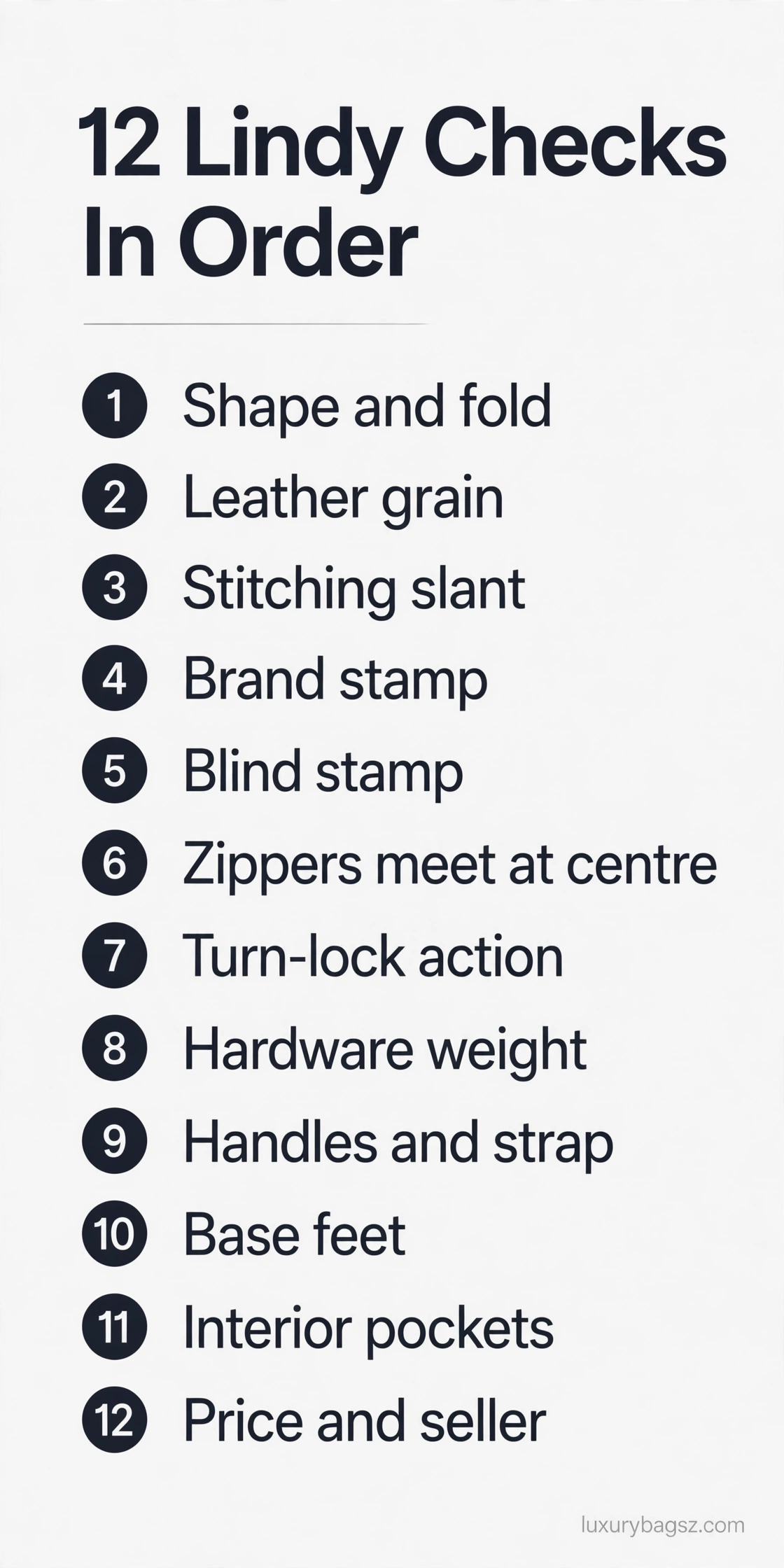
The 12 Checks in Order
Work through these checks in order, on clear photographs of the actual bag, and do not skip ahead to the stamp. The order matters: the early checks are the ones a fake most often fails, and they are also the ones that tell you whether the later, finer checks are even worth running. If a bag fails badly on shape, leather, or stitching, you do not need a stamp reading to walk away.
Check 1 — Shape and fold. Set the bag down empty, or ask for a photograph of it empty. It should fold softly in the middle, with side handles falling inward. It should not stand rigidly boxy, hold sharp corners, or keep its handles splayed outward.
Check 2 — Leather feel and grain. This is covered in detail in the leather grain section, but the short version belongs here: the grain must match the claimed leather, it must be even across the bag, and it must feel soft and supple, not stiff, plasticky, thick, or dull. Run your eye — and, if you have the bag in hand, your hand — across the front, the back, and the gussets. A genuine Lindy’s grain is consistent in character even though handmade leather varies slightly from panel to panel.
Check 3 — Saddle stitching. Hermès hand-stitches its bags with a saddle stitch, using waxed linen thread, and that stitch has a natural, visible slant. It is even and straight in its line, but each stitch is slightly slanted, not perfectly vertical like a machine stitch. Look at the stitching where the handles join the bag, which guides describe as double-stitched, and along the edges and pockets.
Check 4 — Brand stamp. The stamp reads “HERMÈS PARIS MADE IN FRANCE”, pressed into the leather, with clear, evenly spaced lettering. On a genuine bag the lettering is thick, flat, and full, with clean edges, and its colour should match the hardware tone. On a fake the lettering is often too tall, too thin, too thick, blurred at the edges, unevenly spaced, or crooked.
Check 5 — Blind stamp and era. Covered in full in the blind stamp section. In short: find the stamp, read its letter and shape, and check both against the claimed year and the claimed generation. A stamp in the wrong place, in the wrong shape for its year, or contradicting the seller’s story is a serious warning, and it is one of the few checks that can, on its own, justify walking away.
Check 6 — Zippers meeting at the centre. Open and close both zippers and watch where they meet. They should run smoothly from opposite ends and meet neatly at the centre, under the turn-lock, with no gap, no overlap, and no bunching of leather at the meeting point. The zipper teeth should be even, finely made, and consistent, and the pulls should be solid metal, matching the rest of the hardware in tone and finish.
Check 7 — Turn-lock action. The centre turn-lock should turn smoothly, with a clean, firm action, and sit centrally over the zipper meeting point. It should feel solid, not hollow or rattly, and its finish should match the other hardware exactly. Fakes often get this wrong in a way you can feel before you can see: a gritty, loose, stiff, or wobbly turn, or a lock that does not sit flush.
Check 8 — Hardware weight, finish, and engraving. Genuine Hermès hardware is solid, heavy, hand-polished metal — gold-plated, palladium, or permabrass — with crisp, fine engraving. The engraving on a turn-lock or a zipper pull should read “HERMÈS-PARIS”, fine and delicate, with clear spacing, and guides that have studied genuine examples note details such as the shape of the R, whose right leg sits away from the left leg with a slight curve, where fakes often make it straight and slanted. The finish should be even, with no bubbling, peeling, or brassy undertone showing through, and every piece on the bag — turn-lock, zipper pulls, feet, strap rings — should be the same metal in the same colour.
Check 9 — Handles, strap, and their joins. The Lindy’s handles sit on the gussets, and the strap connects handle to handle. Check the handle joins first: the stitching there should be double, straight, and even, with no pulling, fraying, or loose threads, and the leather at the join should be cleanly finished, not rough or frayed at the edge. Then check the strap: its length and drop must match the claimed size and generation (see the generations and sizes section), its stitching must match the bag’s stitching in slant and spacing, and its joins to the handles must be secure and evenly finished.
Check 10 — Base, feet, and edges. Turn the bag over. The base should be evenly shaped, with five feet that match the hardware, sit evenly, and show no sign of being loose, replaced, or mismatched. The edge finishing — the painted or burnished edges of the leather — should be smooth, even, and the same colour throughout, with no rough, flaking, or unevenly painted edges.
Check 11 — Interior and pockets. Open the bag and look inside with the same care you gave the outside. The lining should be leather of matching quality, the interior pockets should be neatly stitched and evenly placed, and the interior should be cleanly finished, with no rough edges, loose threads, or glue showing. On a Lindy, there are interior pockets to check as well as the two exterior pockets, and their stitching should match the exterior stitching in slant and spacing.
Check 12 — Price, seller, and story. Finally, check the story around the bag, not just the bag. Does the price make sense for this size, leather, generation, colour, and condition, on the day, in this market? Does the seller’s account of where the bag came from, when it was bought, and why it is being sold fit the blind stamp, the generation, and the condition?

Leather Grain Must Match the Claimed Material
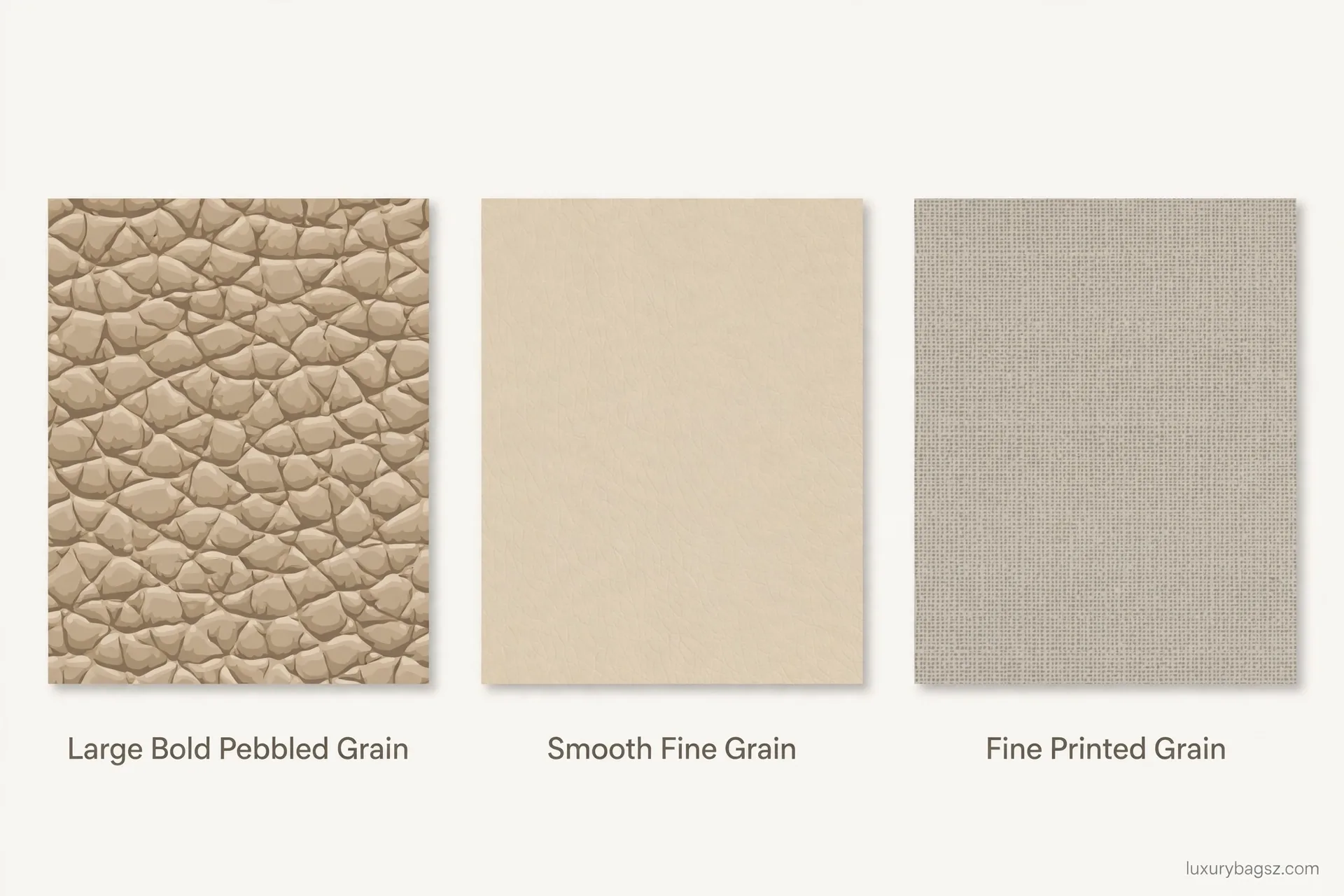
If there is one check that separates a careful buyer from a casual one, it is this: do not just ask whether the leather looks good. Ask whether it looks like the leather the seller claims it is.
Clemence is the classic Lindy leather, and the one most buyers will meet first. It is a bull-calf leather with a large, bold, prominent pebbled grain and a semi-matte finish, introduced for luggage in 1992. For a wider look at where Hermès leathers come from and how they are made, see our guide to Hermès leather.
Swift is a smooth calfskin with a fine natural grain and a matte finish. It shows colour more vividly than Clemence, which is why bright Mini Lindys in Swift photograph so well, but it is smoother, softer in structure, and more easily scratched and marked.
Evercolor sits between the grained and smooth families: a fine printed grain with a satin finish and a slight sheen. It is more structured than Swift and less slouchy than Clemence, and it is often described as a versatile middle ground.
Togo and Epsom appear in Lindy listings less often, and each changes the check in the same way. Togo is pebbled, matte, and lighter and thinner than Clemence, with a more held shape.
Exotic leathers — crocodile, alligator, ostrich, lizard, and others — are produced in small numbers, command much higher prices, and should be judged on their own listings, not on Clemence dimensions or Clemence grain. An exotic Lindy comes with its own paperwork in some cases — for example, a CITES certificate for exotic skins — but that paperwork is about the skin’s legal trade, not a guarantee that this particular bag is genuine, and it should never be treated as authentication on its own.
One practical rule belongs with this part: compare grain across the bag, not in one photograph.
Blind Stamp Format Versus Era
The blind stamp is the most over-trusted check in fake-Lindy guides, and the most useful one when it is used correctly. Used correctly, it means this: the stamp’s letter and shape must fit the era the seller claims, the stamp must sit where that model and era put it, and the stamp must agree with the bag’s generation, leather, and condition. Used incorrectly, it means staring at a single letter and declaring a bag genuine because the letter looks right.
A blind stamp is a small mark pressed into the leather with a hot iron, not printed and not attached as a tag. It carries a year letter, usually with a craftsman mark beside it, and sometimes a mark showing an exotic skin. It is deliberately discreet, which is why guides call it “blind”: it is hidden, hard to find, and easy to miss if you do not know where to look.
The era pattern, as the better guides agree, runs like this. From 1945 to 1970, the year letter stands alone, with no shape around it. From 1971 to 1996, the letter sits inside a circle. From 1997 to 2014, the letter sits inside a square. From 2015 onward, the letter stands alone again, with no shape, but in a sequence that is deliberately not alphabetical — a change Hermès made precisely so that the year cannot be guessed from the alphabet. The known recent sequence includes T for 2015, X for 2016, A for 2017, C for 2018, D for 2019, Y for 2020, Z for 2021, U for 2022, B for 2023, and W for 2024. Two well-known anchor points help you test any claimed year in the square era: square Q is 2013 and square R is 2014.
That pattern gives you three concrete tests. First, shape against year: a bag claimed as 2010 with a letter in no shape, or a bag claimed as 2020 with a letter in a square, breaks the pattern. Second, letter against year: a bag claimed as 2023 with a letter that the sequence assigns to another year breaks the pattern.
Sources disagree about the most recent stamps, and that disagreement should be stated plainly rather than smoothed away. Some guides report that Hermès moved, for bags from 2025 onward, to a longer format of letters and digits, while other guides continue to describe the post-2015 system as a single letter with a craftsman mark. This guide does not resolve that disagreement by picking one version, because the sources do not yet agree and because a guide that invents certainty about the newest stamps would mislead exactly the buyers who need care most.
The stamp’s quality matters as much as its letter. On a genuine bag, the stamp is cleanly pressed, with flat, even edges to its lettering, and it sits straight on the leather. Guides that have compared many examples describe genuine Lindy stamp lettering as clearly engraved with flat edges, where imitation engraving is often concave, deformed, or uneven at the edges.
Two final cautions belong here, because they are where buyers most often go wrong. First, a blind stamp is not a serial number, and there is no database in which a buyer can “check” a blind stamp and receive a verdict. Any seller or website that offers to verify a Lindy from its stamp alone, for a fee, is selling reassurance, not authentication.
Hardware in the Hand: What Photographs Cannot Show
Hardware is where a Lindy fake often looks convincing in a photograph and fails in the hand, so this part is short on purpose: the detailed hardware, zipper, and turn-lock checks are already in the twelve-checks section, as checks 6, 7, and 8, and they apply here unchanged. What this part adds is the difference between judging hardware from photographs and judging it in your hands.
From photographs, compare the tone of every metal piece in the same light, ask for a close-up in focus of the turn-lock engraving and of a zipper pull, and check that the turn-lock sits centrally and flush. In your hands, add weight and feel: genuine hardware is solid and heavy, engraving cut into the metal has crisp recessed edges you can feel with a fingernail, zippers glide smoothly with a weighted motion, and the turn-lock turns cleanly without grit, looseness, or wobble. Light, hollow, rough, or mismatched hardware across the whole bag is the signature of a bag made to a price, not to a standard, and it is a reason to seek a professional opinion even if the photographs looked good.
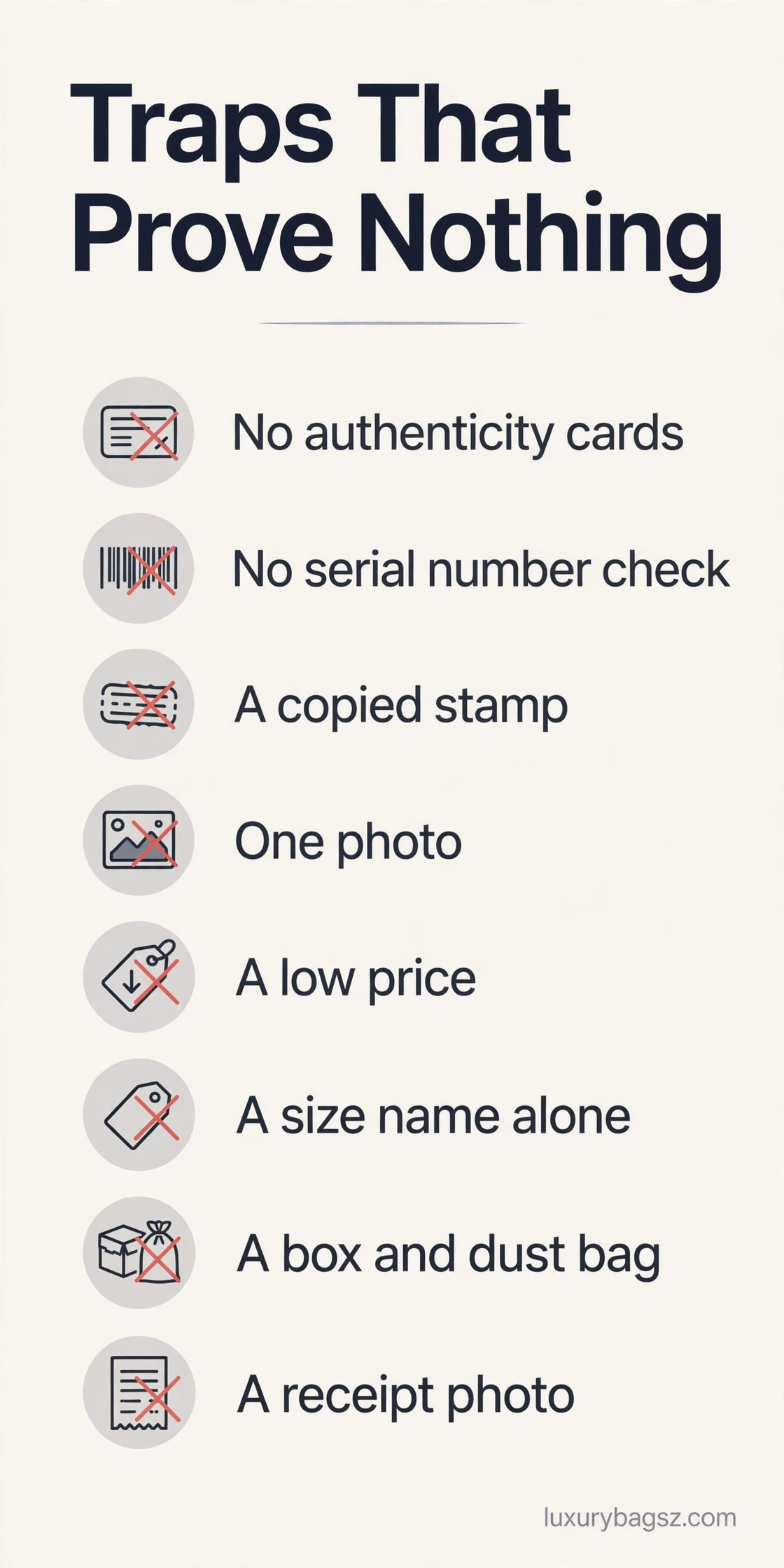
The Traps That Prove Nothing
This is the part most competitor guides get shortest, and it is the part that saves buyers the most money. A trap, in this guide’s sense, is something that feels like proof, is offered as proof, and proves nothing — or proves the opposite of what the seller claims.
Trap 1 — The authenticity card. Hermès issues no authenticity cards for its bags. None.
Trap 2 — The serial number check. Hermès bags have no traditional serial numbers, and there is no official database in which a buyer can enter a number and receive a verdict. A seller who gives you a “serial number” to check, or who points you to a website that will “verify” the bag from a number, is offering you a performance, not a check.
Trap 3 — The box, the dust bag, and the ribbon. A genuine Hermès bag comes in the signature orange box, with a dust bag and ribbon, and fakes come in boxes too. Boxes, dust bags, ribbons, and tissue are packaging, and packaging is among the easiest things to copy, buy separately, or borrow from another bag.
Trap 4 — The receipt photograph. A receipt photograph proves that someone once had a receipt, not that this bag is the bag on that receipt. Receipts can be borrowed, photographed from another purchase, faked, or reused across many sales.
Trap 5 — A single photograph, or a single good angle. A bag photographed from one flattering angle, heavily stuffed, in soft light, can hide almost every flaw in this guide. That is why the seller-photo checklist section asks for ten photographs, including the bag empty, the base, the stamp, and the stitching close-ups.
Trap 6 — A low price presented as a bargain, or a high price presented as proof. Price is a check, not a verdict, and it cuts both ways. A price far below the plausible range for a size, leather, generation, and condition is a warning, because no seller gives away a genuine Lindy for a fraction of its value without a reason — and the reason is usually that it is not genuine, or not as described. The same pattern shows in other Hermès fakes: our guide to a fake Geta shows a plausible price and a good first photograph hiding flaws that only the full set of checks reveals.
Trap 7 — The size name alone. “It is a Lindy 30” is a model name, not a measurement, and not a guarantee of anything. As the generations and sizes section explains, a size name does not tell you which Mini generation you are buying, what the strap drop is on the actual bag, or what the opening width is.
Trap 8 — A seller’s reputation borrowed from elsewhere. A seller with good feedback for selling other goods, or a seller who shows you feedback for other bags, has not proved anything about this bag. Feedback can be bought, borrowed, or earned on low-value goods and then used to sell a high-value fake.
Trap 9 — “Super fake”, “mirror quality”, and other seller language. Sellers of counterfeits have their own vocabulary, and it is designed to disarm you: “super fake”, “1:1”, “mirror copy”, “original leather”, “same factory”. Treat any of that language as an admission, not as a quality grade.
Trap 10 — A professional-looking listing. A polished website, a professional logo, a smart photograph, and a confident tone are all cheap to produce and prove nothing about the bag. Some of the most convincing fake listings are the most professional-looking ones, because the seller has invested in presentation rather than in genuine stock.
The 10-Photo Seller Checklist, Plus Price and Seller Sense
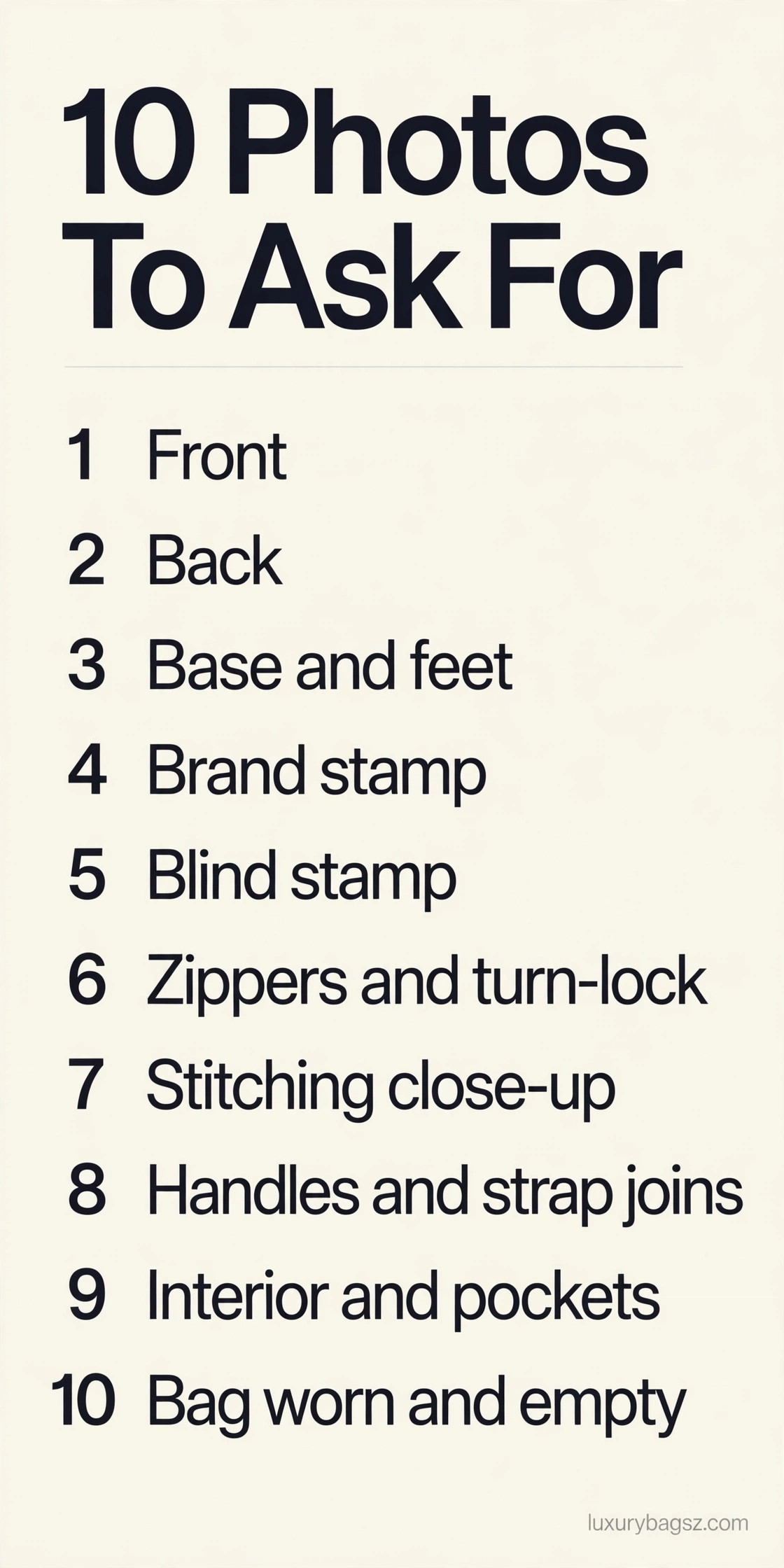
Do not pay for a Lindy until you have these ten photographs of the actual bag being sold — not stock photographs, not photographs of a similar bag, and not photographs taken from another listing. The same ten-photo discipline applies to other Hermès fakes, including our guide to a fake Evelyne. If a seller cannot supply them, or supplies photographs that are blurred, cropped, or taken in light that hides detail, treat that as a failed check, not as a minor inconvenience.
- Front, empty and unstuffed. The whole bag, from the front, with nothing inside it, in daylight. This shows the fold, the handle fall, and the true shape.
Alongside the photographs, ask for four measurements on the actual bag: base width, opening width, strap drop (and strap length, if the seller gives it, so you can tell which is which), and handle drop. Ask for the claimed leather, colour, year, and generation in writing, and ask whether the strap is original, whether any part has been repaired or replaced, and what is included with the bag.
Price sense belongs here too, and it needs the same plain warning as every other price discussion in this guide: Hermès does not publish a price list, sources are dated differently, and single listings are never market averages.
As a rough orientation only, recent guides put a Mini Lindy at around $9,050 in US boutiques after the annual increase, with secondary-market leather Lindys reported in a wide range from roughly $4,000 to $15,000 depending on size, condition, and desirability, and desirable Minis in popular colours listed well above retail on the secondary market.
Seller sense, finally, is about the transaction, not the bag. Buy through a platform or a seller that gives you buyer protection, a written return policy, and a realistic time to have the bag authenticated after it arrives.
Already Bought? What to Do Next, in Order
If you have already bought a Lindy and now doubt it — because a check in this guide failed, because a friend questioned it, or because something about the listing now feels wrong — do not panic, and do not act in a way that makes your position worse. Follow these steps in order, and do not skip ahead to a confrontation or a resale.
Step 1 — Stop presenting it as genuine. Do not wear it as a proven genuine bag, do not lend it as one, and above all do not resell it as genuine while you doubt it. Selling a bag you believe may be fake, as if it were genuine, puts the next buyer in the position you are in now, and it puts you in a far worse position if that buyer has it authenticated. Keep the bag, and keep your doubt private, until you have an independent opinion. Every check in this guide follows the Luxury Bagsz authentication process.
Step 2 — Keep everything, and change nothing. Keep the box, the dust bag, the ribbon, any cards or papers that came with it, the listing photographs, the seller’s messages, and the payment record. Do not clean it aggressively, do not repair it, do not replace a strap or a zipper, and do not try to “fix” a stamp or a piece of hardware. Any change you make can destroy evidence, reduce the bag’s value if it is genuine, and make it harder for an authenticator to judge.
For day-to-day keeping while you decide, the same careful storage that suits other soft Hermès bags applies — supported, not hung by its handles, and not squashed — as set out in our guide to store Hermes Kelly. If the bag needs cleaning after authentication, a gentle, leather-appropriate approach is covered in our guide to Saphir Renovateur, but do not clean it before authentication, because cleaning can alter the very details an authenticator needs to see.
Step 3 — Run the twelve checks again, calmly, on the bag in your hands. Work through the twelve checks in order, with the bag in front of you, in daylight, and write down what passes and what fails. Photograph each check yourself, in focus, so you have your own record. This does two things: it gives you a clear picture of how strong your doubt is, and it gives a professional authenticator a useful starting point.
Step 4 — Get an independent professional opinion. Use a reputable authentication service with a track record on Hermès, ideally one that examines the physical bag or, at minimum, a full set of high-quality photographs covering every check in this guide, and that gives you a written opinion naming the bag and its photographs. A vague verbal assurance, or an opinion from a seller with an interest in the outcome, is not independent. A written opinion from a reputable service is evidence you can use with a seller, a platform, or a payment provider.
Step 5 — Go back to the seller and the platform, with evidence, not anger. Contact the seller in writing, through the platform if you bought through one, and set out the facts: what you bought, what was claimed, which checks failed, and what the independent opinion says. Ask for a return and a refund, within the platform’s time limits and the seller’s stated policy. Keep every message, and keep your tone factual.
Step 6 — If the bag is confirmed fake, do not resell it as genuine, and do not destroy evidence. A confirmed fake should not be passed on to another buyer as genuine, however tempting it is to recover your money that way. Follow the platform’s or the payment provider’s instructions for a confirmed counterfeit, which may include returning it to the seller, and keep a copy of the authentication opinion and all correspondence. If you are unsure about your legal position — for example, if the seller is in another country, or the payment was made off-platform — seek advice promptly, rather than acting on a guess.
A final word on this part. Doubting a bag you own is unpleasant, and it is easy to put off dealing with it. But a doubt dealt with promptly, with evidence and a professional opinion, is a problem you can solve. A doubt ignored, or dealt with by reselling the bag quickly to someone else, is a problem you pass on — and one that may come back to you.
FAQ
How can I tell if my Hermès Lindy is real?
By judging the whole bag against all twelve checks in full, on clear photographs or, better, in your hands — shape and fold, leather grain against the claimed material, saddle stitching, brand stamp, blind stamp against its era, zippers meeting at the centre, turn-lock action, hardware weight and engraving, handles and strap, base and feet, interior and pockets, and price, seller, and story. No single check proves a bag genuine.
Does Hermès issue authenticity cards?
No. Hermès issues no authenticity cards for its bags, and no traditional serial numbers that a buyer can check in a database.
What is the Hermès blind stamp, and where is it on a Lindy?
It is a small mark pressed into the leather with a hot iron, carrying a year letter, usually with a craftsman mark beside it. On a Lindy, guides place it on the leather strap for sizes of 26 cm and above, and on the inside of the bag at the side for the newer Mini. Its letter and shape must fit its era: no shape before 1971, a circle from 1971 to 1996, a square from 1997 to 2014, and a single letter with no shape from 2015 onward, in a deliberately non-alphabetical sequence. A stamp that breaks that pattern, or that contradicts the claimed year or generation, is a serious warning.
What is the difference between a Mini Lindy and a Mini Lindy II?
The II is the current, slightly smaller generation, introduced around 2022. The original Mini Lindy 20, from 2019, is about 19 to 20 cm wide with a strap drop of about 53 cm.
Why does my Lindy fold in the middle? Is that a flaw?
No.
Is a Lindy with a square blind stamp automatically old?
A square stamp places a bag in the 1997 to 2014 era, which means a bag with a square stamp cannot be a recent purchase, a Mini Lindy II, or a bag claimed as made after 2014. That does not make it fake — many genuine Lindys carry square stamps — but it does mean any listing that pairs a square stamp with a recent year, a Mini II generation, or a “new” description is contradicting itself. Check the letter inside the square against the claimed year as well: square Q is 2013 and square R is 2014, for example.
Can a fake Lindy have a correct blind stamp?
Yes. Counterfeiters copy stamps, including the letter and the shape, and a stamp that reads correctly proves nothing on its own.
What should I do if a seller refuses to send close-up photographs?
Do not buy the bag. A seller who cannot or will not supply the ten photographs listed in the seller-photo checklist section, in focus and in daylight, has not given you enough to judge a high-value bag, and a refusal is itself information.
Is professional authentication worth it for a Lindy?
Yes, for any Lindy at a high price, from a seller unknown to you, in a desirable Mini colour, or where anything still feels off after your own checks. Professional authentication is the normal step for a purchase at this price, and reputable sellers expect it.
What is the most common mistake buyers make with a fake Lindy?
Stopping after one check. Usually the stamp, or the price, or the first photograph.
The Lindy Verdict I Trust: The Pattern, Not the Detail
A fake Lindy is rarely caught by a single brilliant observation. It is caught by patience, by order, and by refusing to accept any one piece of evidence as a verdict. Run all twelve checks, in order, on the actual bag. Check the shape empty, not just stuffed. Check the grain against the claimed leather, not just against beauty.
Check the stitching for its slant, the stamp for its era, the zippers for their meeting point, and the turn-lock for its action. Check the hardware for weight and matching tone, the handles and strap for their joins and their drop, the base for its five feet, and the interior for the same care as the exterior. Then check the story around the bag — its price, its seller, and its measurements — with the same scepticism you applied to the leather.
If the bag passes all of that, and the seller supplies the ten photographs listed in the seller-photo checklist section, answers your questions directly, and accepts a return if a reputable authenticator disagrees, you have done what a careful buyer can do — and for a high-value bag, a professional opinion is still the sensible final step. If the bag fails several checks, if the seller refuses photographs or a return, if the claimed year contradicts the stamp, or if the price or the story does not make sense, walk away. There will be another Lindy, and the money you do not spend on a fake is money you keep for a genuine one.
The Lindy rewards a buyer who understands it as a soft, folding, handmade bag, not as a rigid box with a stamp on it. Buy it that way — empty and stuffed, measured on the actual bag, judged as a whole, and checked by someone independent when the price demands it — and you give a fake very little room to hide. That is the whole of this guide, in one sentence: judge the bag, not the photograph, not the paper, and not the price, and judge all of it, not just the part that looks right first.
That patience is the habit more than ten years of checking bags has left me with. I have examined over 500 bags by hand, and the Lindy is the model that most often punishes a rushed verdict — its fold, its stamp era and its zippers only make sense together, so I let them.