

How to Spot a Fake Hermès Chaîne d’Ancre Bracelet: 12 Checks, Link Articulation, Toggle Fit, Era Hallmarks, and the Traps That Prove Nothing
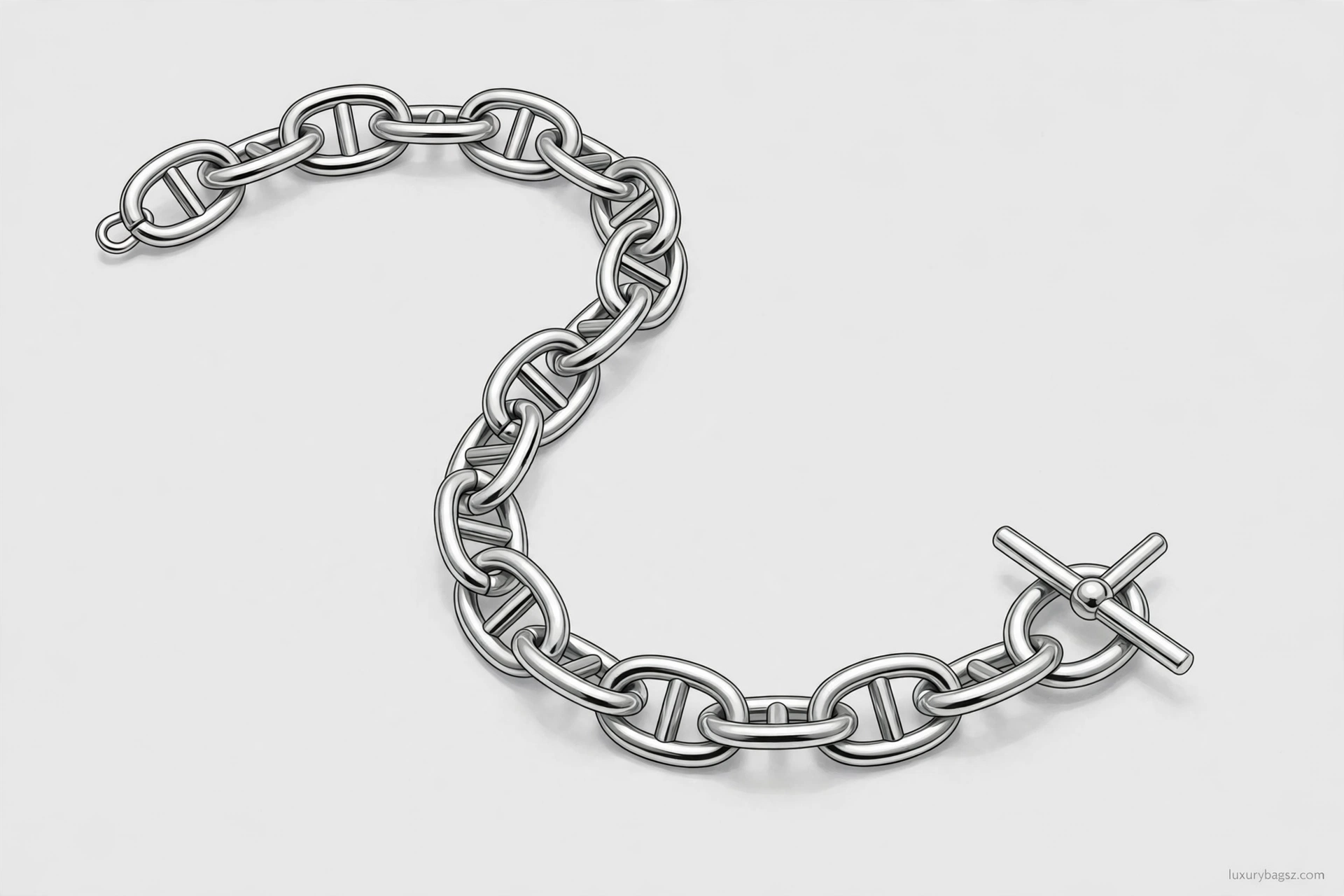
How a Real Chaîne d’Ancre Moves and Hangs
Test how the chain behaves before trusting any marking. A genuine bracelet falls in a soft, even curve, bends freely both ways and shows no stiff links, kinks or catching. Its anchor links should also repeat faithfully — same proportions, with each central bar sitting in the same place.
Check the toggle next: the T-bar ought to be straight, firmly fixed and to seat cleanly through its ring without wobble. Weight helps only when comparing an identical model, link size, metal and length. A copied hallmark, box or card proves nothing on its own; the overall pattern has to agree.
Introduction
A fake Hermès Chaîne d’Ancre bracelet is rarely caught by one dramatic giveaway. It is usually caught — or missed — by a pile of small details, checked in the right order, on the actual bracelet in front of you. That is why so many buyers get it wrong, and why so many guides get it wrong too: they give you five quick tells, you tick them off, and you feel safe, while the bracelet that fooled you passed all five easily. The Chaîne d’Ancre makes this harder than most Hermès pieces, and easier in one way. Harder, because it is a chain, and chains are among the most copied forms in all of jewellery. A counterfeiter does not have to copy leather grain, stitching, or a complex bag shape. The counterfeiter only has to get a row of metal links and a T-shaped bar roughly right, and at arm’s length, in a single resale photograph, most copies look roughly right. Easier, because a chain bracelet is a moving object, not a picture. It drapes, it articulates, it swings, and its toggle either seats cleanly or it does not. How it moves, how it weighs in the hand, and how its links sit against each other tell you things a photograph of a bag never could — if you know what to feel for and what to ask a seller to show you. This guide is written for a buyer, not for a professional authenticator, and it is honest about its limits. No guide, and no set of photographs, can give you a certain verdict on a high-grade counterfeit. What this guide can do is teach you to spot the large majority of fakes, to ask for the photographs and measurements that make a fake much harder to hide, to recognise the traps that prove nothing at all, and to know when to stop and pay for professional authentication before you pay for the bracelet. A note on the pictures in this guide, because it matters for an authentication article more than for any other kind. Every picture here is a generic illustration, not a photograph of a real Hermès bracelet, and none of them should be used as a reference for what a genuine Chaîne d’Ancre looks like in detail. Illustrations simplify metalwork, flatten chain links, and tidy up toggles. Use them to follow the checks, not to compare a bracelet against them line for line. Where an illustration simplifies a detail, the words in this guide prevail. That warning applies with extra force to the infographics: their chain drawings omit the central bars of the anchor links, so they must never be used as a link-shape reference.Key Takeaways
- Judge a Chaîne d’Ancre as a whole. No single check — hallmark, price, photograph, card, or receipt — proves a bracelet genuine, and no single flaw, on its own, always proves it fake. It is the pattern across all twelve checks that matters.
- Hermès issues no authenticity cards as a general rule. A card, a certificate, a number to “check online”, or a plastic card supplied with a Chaîne d’Ancre is a red flag, not reassurance. A copied hallmark proves nothing either, because counterfeiters copy hallmarks.
- Articulation is the most underrated check in the whole subject. A genuine chain drapes smoothly, bends evenly in every direction, and falls in a soft curve with no stiff links, no kinks, and no links that catch on each other. A chain that is stiff in places, that kinks, or that holds a bent shape deserves a much closer look, even if its hallmarks look perfect.
- Link symmetry is the second most underrated check. On a genuine bracelet, the anchor links repeat with the same shape, the same proportions, and the same central bar position, link after link. Links that drift in size, that lean, or whose bars sit off-centre suggest casting or poor finishing, not hand-finished fine jewellery.
- Weight is a comparison, never a pass or fail number on its own. A genuine Chaîne d’Ancre feels solid for its size, but link size, model, metal, and length all change the weight, and no single published gram figure can settle a bracelet. Compare like with like — same model, same link size, same metal, same length — or do not use weight at all.
- A box, a pouch, and a ribbon prove nothing on their own. All three are widely copied, and all three can be borrowed from a genuine purchase. Judge the bracelet, not its packaging.
- Ask for ten photographs before you pay, including the toggle closed and open, a hallmark close-up, a link close-up, and the bracelet worn. A seller who cannot or will not supply them has not given you enough to buy safely, however good the first photograph looks.
- Tarnish alone proves nothing. Sterling silver tarnishes, and a genuine silver bracelet that has been stored unworn can look dull or darkened in its crevices. What matters is the pattern of wear and tarnish, and whether it fits the seller’s story, not whether tarnish is present at all.
- If you have already bought a bracelet and now doubt it, stop wearing it as a proven genuine piece, keep everything that came with it, do not polish, repair, or alter it, and get a professional opinion before you try to resell it or confront the seller. The already-bought section sets out the order to follow.
Spotting a Fake Chaîne d’Ancre in Brief
Can you tell a fake Chaîne d’Ancre from one photograph? Almost never, and you should distrust any seller or guide that says you can. One photograph can rule a bracelet out — plainly uneven links, a misspelled hallmark, or a toggle that plainly does not fit its ring can be enough to walk away — but it cannot rule a bracelet in. Good counterfeits are photographed to pass the one angle you are shown. What is the fastest honest check? Look at the bracelet as a moving chain, not as a picture. Ask for a short video, or at least photographs, of the bracelet draped over a hand, bent gently in both directions, and fastened and unfastened with its toggle. A genuine chain moves evenly and the toggle seats without force. Many fakes look fine laid flat and give themselves away the moment they move. What about the hallmark? Check it, but do not stop there. A genuine hallmark is a small, cleanly struck mark in a place that matches the model and the era, and the metal fineness and maker marks must fit the claimed age and origin of the bracelet. A hallmark that breaks that pattern, or a claimed year that contradicts the hallmark, is a serious warning — but a correct-looking hallmark is not proof, because hallmarks are among the easiest details to copy. What is the one trap to avoid above all? Treating anything that came in the box as proof. Hermès does not issue authenticity cards as a general rule, and it does not give a Chaîne d’Ancre a serial number that a buyer can check in a database. A card, a certificate, a “serial number check”, or a receipt photograph can all be faked, borrowed from another purchase, or printed at home. When should you walk away without further argument? When several checks fail at once, when the seller refuses the ten photographs listed in the seller-photo checklist section, when the claimed metal contradicts the hallmark, when the price is far below any plausible range for that metal and link size with no credible explanation, or when the seller pressures you to pay quickly, off-platform, or by a method with no buyer protection. Any one of those is a reason to pause. Two or more together are a reason to stop. When should you pay for professional authentication? Whenever the bracelet passes your own checks but the price is high, the seller is unknown to you, the bracelet is claimed to be solid gold, or anything in the listing still feels slightly off after you have run all twelve checks. Professional authentication is not an admission that you cannot tell; it is the normal, sensible step for a purchase at this price, and reputable resellers expect it. A seller who discourages it, or who will not allow a return if a reputable authenticator disagrees, is telling you something important. That pattern-first discipline is the same discipline behind a fake Kelly check: no one detail carries the verdict, and the whole pattern has to agree.What a Real Chaîne d’Ancre Is Supposed to Look Like
The Chaîne d’Ancre dates to 1938. Robert Dumas, inspired by the anchor chains of ships in a Normandy port, turned a working ship’s chain into a bracelet: a row of interlocking links, each one an elongated oval with a central bar, fastened by a T-shaped bar that passes through a ring. That description is the whole design, and it is also the reason the bracelet is so often misdescribed. Guides that call it a bangle are wrong. Guides that show a photograph of a different chain — a curb chain, a cable chain, or a printed enamel bracelet — and label it a Chaîne d’Ancre are wrong in a way that poisons every check that follows. Start with the link. The signature link is an oval, elongated rather than round, with a bar across its middle. Sources describe that link in slightly different words — one calls the links round, another calls them rounded rectangles, another calls them oval links with central bars — and those descriptions are not fully consistent with each other, because they are describing the same shape from different angles and at different link sizes. This guide does not resolve that disagreement silently. What matters for authentication is consistency within one bracelet: every anchor link on the same bracelet should have the same outline, the same proportions, and the same bar position. A bracelet whose links drift from oval to round, or whose bars wander off-centre from link to link, has a consistency problem, whatever word a guide uses for the ideal shape. Next, the clasp. The classic Chaîne d’Ancre fastens with a toggle: a straight T-shaped bar, fixed to one end of the chain, that passes through a ring at the other end and then turns to sit across the ring so it cannot slip back through. There is no spring, no hinge, and no snap to test, which is a genuine difference from bracelets that close with a mechanism. The test here is fit, not feel: the bar must be long enough to stay seated, short enough to pass through the ring without force, and straight, with ends that match each other. A bar that is bent, uneven at its ends, or too short to sit securely across the ring is a warning, however good the chain looks. Then the metals, which is where most listings go vague or go wrong. The classic Chaîne d’Ancre bracelet is made in sterling silver, marked 925, and in gold versions, including 18-karat yellow, rose, and white gold, marked 750. Sources agree on those two fineness numbers, and they agree that the silver version is the most widely traded. What sources do not agree on, and what a buyer must therefore check rather than assume, is everything around those numbers: which maker made a given bracelet, where it was made, and what a given era’s marks look like. The hallmarks section deals with that in full. One rule, however, is settled and must be stated plainly: a plated finish is not solid gold, and a plated finish is not sterling silver either. A bracelet described as “gold-plated” or “silver-plated” is a coated base-metal bracelet, whatever its links look like, and it must never be bought, priced, or described as a solid-metal Hermès bracelet. Sellers who blur that line — “gold Chaîne d’Ancre” for a plated copy, or “925” stamped on a plated bracelet — are giving you the single clearest warning in this whole guide. Sizes add a second layer of vagueness. Hermès uses size names including TPM, PM, GM, and TGM for its chain pieces, and some guides describe five link sizes to choose from, while others describe the bracelet family simply as small, medium, and large. Resale listings add further labels, such as a designer size number or a two-letter size code, which do not map neatly onto the TPM-to-TGM names. Sources therefore disagree on how many sizes exist and what each name measures, and this guide does not publish a single size table as if it were exact. What you should do instead is pin the listing down: ask the seller for the total length in centimetres, the number of links, the length and width of a single anchor link, and the named size as it appears on the bracelet’s own marks, if any. A seller who will only say “standard size” has not told you anything, and a bracelet whose link count has plainly been changed — links added or removed to make it fit — is a different bracelet from the one its size name describes, even if every link on it is genuine. Finally, know the family, because confusing one Chaîne d’Ancre model with another is a common buyer error. The classic chain bracelet, the smaller-link Enchaînée version, and the many rings, necklaces, earrings, and cufflinks that carry the same motif are not interchangeable references for each other. An Enchaînée bracelet is lighter, smaller-linked, and shorter in its links than a classic bracelet of the same named size, and its weight, drape, and hallmark placement must be judged against Enchaînée examples, not against classic examples. A seller who photographs an Enchaînée bracelet and describes it as a classic bracelet, or the other way round, is either careless or misleading, and either way you should not buy until the model is pinned down.The Standard Points, and Why They No Longer Settle It
Most competitor guides for Hermès bracelets cover the same five or six points, and they cover them in the same order: hallmark, weight, shape, clasp, and box. Those points are real, and this guide covers them too, but on their own they are not enough, for three reasons. First, they are the points counterfeiters already know. A guide that has been public for years teaches a counterfeiter exactly what to fix next. The hallmark on a good copy is now often copied letter for letter. The weight is often matched by using a denser base metal. A guide that stops at those points is testing a fake against last year’s standard, not this year’s copy. Second, most guides treat each point as a pass or fail test on its own. “If the hallmark is wrong, it is fake” or “if the weight is light, it is fake” sounds decisive, and it is misleading. Genuine bracelets vary by era, by maker, by model, and by wear. A genuine bracelet from one era can carry different marks from a genuine bracelet from another era. A single failed point is a reason to look harder, not always a reason to declare a fake — and a single passed point is never a reason to declare a bracelet genuine. Third, and most importantly, most guides miss the checks that actually separate a good copy from a genuine bracelet in practice. They rarely describe link articulation in any usable detail. They rarely explain toggle fit — not just whether a toggle exists, but whether its bar is the right length for its ring. They rarely explain hallmark placement by era with the honest caveat that placement and origin marks vary by maker and by example, so buyers either over-trust a hallmark or dismiss a genuine bracelet because its marks sit where a blog said they should not. They rarely explain solder joints, which are where cheap chain manufacture shows first. They rarely give a seller-photo checklist that a buyer can actually send to a seller. They rarely explain tarnish, so buyers mistake a genuine silver bracelet that has tarnished in storage for a fake, or mistake a fake that has been polished to hide poor plating for a genuine bracelet in good condition. And they almost never explain what to do after you have bought a bracelet you now doubt, which is when most buyers actually need help. This guide is built to fill those gaps. The twelve checks below are ordered the way a buyer should run them: start with what you can see in a photograph, move to what you can feel and test in person, and finish with the traps that should never decide a purchase. Where sources disagree — on link descriptions, on sizes, on origin marks, on prices — this guide says so plainly, instead of picking one version and presenting it as settled. Note: the video above unboxes a Chaîne d’Ancre Enchaînée bracelet — the same anchor-link design this guide teaches you to check.

Check 1: Link Shape and Symmetry
Link shape is the first check for a reason: it is the largest visible feature on the bracelet, it is the hardest feature to fake well across every link, and it is the feature most buyers look at least carefully, because they are looking at the bracelet as a whole instead of at one link at a time. On a genuine Chaîne d’Ancre, every anchor link on the same bracelet repeats the same shape. Lay the bracelet flat and compare the links one by one. Each anchor link should be an elongated oval with a central bar, and each bar should sit in the same place within its link, at the same angle, with the same proportions. The outline of each link should be smooth and even, with no flat spots, no pinched corners, and no bulges. The bar should join its link cleanly at both ends, with no visible gap, no blob of excess metal, and no step where the bar meets the outline. The links that join the anchor links to each other should also repeat evenly, with the same size and the same shape throughout the bracelet. On a fake, link shape goes wrong in several distinct ways, and each one tells you something different. Links that vary in length or width from one end of the bracelet to the other suggest casting from a mould that was not finished, or links sourced from more than one batch. Bars that sit off-centre, at a slant, or at different positions from link to link suggest a bar that was added after the link was formed, rather than formed as part of it. Links with flat spots, sharp corners, or a pinched outline suggest a link that was pressed or bent rather than properly formed. Links whose bars are visibly thicker on one side than the other, or whose bars end in a blob rather than a clean join, suggest poor finishing at the exact point where a buyer is least likely to look closely. None of these on its own is a certain verdict, but two or more together, on a bracelet sold as genuine and in good condition, are a strong warning. Photographs hide link faults better than any other fault, because a seller can photograph a bracelet in soft light, at a distance, and at an angle that flattens differences between links. That is why the link close-up is one of the ten photographs in the seller-photo checklist section, and why you should ask for it in bright, natural light, straight on, with no filter, showing at least five consecutive links. A seller who will only send soft, distant photographs of the whole bracelet has not shown you the links at all. One caution belongs here, because it is where buyers most often go wrong. Links on a genuine bracelet that has been worn for decades, repaired, or resized may not all match perfectly, because a repairer may have replaced one link, or added links from a slightly different batch. A single mismatched link on an otherwise well-made bracelet that is sold as vintage or repaired is not proof of a fake. What matters is the pattern: one replaced link, openly described by the seller, is plausible repair; links that drift in size across the whole bracelet, with no repair story, are a manufacturing pattern, and they point the other way. Ask the seller to photograph every link that looks different, and to describe any repair or resizing, before you decide what a difference means.
Check 2: Articulation, Drape, and How It Moves
If link shape is the first check, articulation is the check most guides rush past, and it is the check this guide spends the most time on, because it is the hardest thing for a counterfeiter to fake and the easiest thing for a buyer to test. A genuine Chaîne d’Ancre drapes. Hold it by one end and let it hang, and it should fall in a soft, even curve, with every link moving freely against its neighbours. Bend it gently in one direction, then in the other, and it should bend evenly along its whole length, with no stiff spot, no kink, and no place where the chain resists and then suddenly gives. Lay it on a flat surface and it should lie flat without springing up at one end. Pick it up again and it should fall back into a curve without holding the shape you bent it into. That even, fluid movement comes from links that were formed and finished to move against each other, and it is very hard to copy with links that were cast roughly or joined too tightly. On a fake, articulation gives itself away in ways that are hard to photograph but easy to feel. A chain that is stiff in places, so that one part of the bracelet bends and another part stays rigid, suggests links that were joined too tightly or finished roughly at their contact points. A chain that kinks — that folds sharply at one link instead of curving smoothly — suggests a link that is bent, damaged, or formed with the wrong proportions. A chain that holds a bent shape when you let go of it suggests metal that is too soft, or links that are catching on each other instead of sliding. A chain whose links catch, click, or grind as they move suggests rough contact surfaces, casting marks, or excess metal at the joints. A chain that twists along its length, so that some links sit flat and others sit on edge when the bracelet is laid out, suggests links that were not formed to a consistent shape. Ask a seller for a short video of the bracelet moving, not just photographs. A video of the bracelet draped over a hand, bent gently in both directions, and laid flat, filmed in natural light with no music and no cuts, is worth more than ten still photographs of a bracelet laid flat. A seller who refuses a video, or who sends only a video of a bracelet being waved at the camera, has not shown you how it moves. If you are buying in person, drape the bracelet over your hand, bend it slowly in both directions, and feel for the same freedom of movement along its whole length. A chain that moves differently at one end from the other is telling you something about its build quality, and you should listen to it. Be careful with one common misreading. A genuine bracelet that is very short, or that has very small links, will naturally feel less fluid than a long, large-link bracelet, because there is less chain to drape. Compare articulation against a bracelet of the same model and link size, not against a different model, and do not mistake a short bracelet’s natural firmness for stiffness caused by poor manufacture.Check 3: The Toggle and T-Bar Clasp
The toggle is the only fastening on a classic Chaîne d’Ancre, which makes it a small check with a large amount of information in it. There is no hinge to test and no snap to listen for. There is only a bar, a ring, and the fit between them, and that fit either works cleanly or it does not. On a genuine bracelet, the T-bar is straight, with ends that match each other in shape and finish, and a smooth, even surface along its whole length. The bar is fixed firmly to its end link, with no wobble, no play, and no visible gap at the fixing point. The ring at the other end is a clean, even oval or round loop, with a smooth inner edge and no rough spot where the bar passes through. To fasten the bracelet, the bar passes through the ring without force, turns, and then sits across the ring so that it cannot slip back through on its own. When fastened and worn, the bar should sit flat and stable, not tilted at an angle, not sliding toward one side of the ring, and not working its way loose as the wrist moves. On a fake, the toggle goes wrong in ways that are easy to miss in a single photograph of a fastened bracelet. A bar that is bent, even slightly, suggests metal that is too soft or a bar that was bent during manufacture. A bar whose ends do not match — one rounded, one flat, or one longer than the other — suggests a bar that was cut and finished by hand without a proper template. A bar that is too short for its ring will sit insecurely and can slip back through, while a bar that is too long for its ring looks out of proportion and can catch on clothing. A ring whose inner edge is rough, pinched, or uneven will catch the bar as it passes through, so fastening feels gritty rather than smooth. A bar that wobbles at its fixing point suggests a fixing that was soldered weakly or that has already started to fail. Any one of these is a reason to look harder, and a toggle that does not fasten securely is a reason to stop, whatever the hallmarks say, because a bracelet that cannot be worn safely has failed as a bracelet before it has even been judged as a genuine article. Ask the seller for two toggle photographs and, ideally, a short video: the toggle closed, showing the bar seated across the ring, and the toggle open, showing the bar and the ring separately, plus a video of the bracelet being fastened and unfastened. A seller who will only show the bracelet fastened has shown you the toggle at its most flattering angle and hidden the fit that matters. If you are buying in person, fasten and unfasten the bracelet several times, slowly, and feel for the same smooth passage each time. A toggle that fastens smoothly once and catches the next time is telling you something about its ring or its bar, and you should not buy it until that something is explained.
Check 4: Hallmarks and Stamps by Era
The hallmark is the check buyers trust most, and it is the check they should trust least on its own. Counterfeiters copy hallmarks. They copy them well. A correct-looking hallmark is necessary for a genuine bracelet, but it is never sufficient proof, and an unusual hallmark is not always proof of a fake, because hallmark placement, origin marks, and maker marks vary by era, by maker, and by example. Start with what should be present, in general terms. A genuine Chaîne d’Ancre in sterling silver should carry a fineness mark for silver, commonly 925, and a genuine gold version should carry a fineness mark for gold, commonly 750 for 18-karat gold. Alongside the fineness mark, genuine French-made fine jewellery commonly carries a maker’s mark and, for gold and for some silver pieces, a French control mark, such as the Minerva head for silver and the eagle head for gold, although the exact control marks that appear vary by era and by the workshop that made the piece. The brand name should appear with its correct accent, as HERMÈS, in clean, evenly spaced lettering, struck or engraved crisply, with no misspelling, no doubled letters, and no letters that fade in the middle of a word. Where a mark looks painted, printed, or stuck on, rather than struck into the metal, that is a serious warning. Next, the origin problem, which is where most guides go wrong by being too certain. One widely repeated guide says that old Hermès enamel bracelets were made in Austria until 2010 and that a vintage bracelet marked as made in France must therefore be fake. That claim is about enamel bracelets, not about fine jewellery chain bracelets, and it must not be applied to a Chaîne d’Ancre as if it were a rule. Published appraisals of genuine Chaîne d’Ancre bracelets show different origin marks on different examples, including marks reading Made in France on one sterling bracelet and Made in Italy on a small-link Enchaînée bracelet, with different maker codes alongside them. Sources therefore disagree on origin as a single rule, and this guide does not publish one. What you should do instead is check for internal consistency: the origin mark, the maker code, the fineness mark, and the style of the bracelet should all point to a plausible combination for the claimed era and model. A bracelet claimed as a recent French-made classic with marks that belong to a different maker, a different model, or a different era has a story that does not add up, and the seller should be able to explain it before you buy. Year codes need the same caution. Hermès leather goods use a letter-based date system, and some guides describe letter-in-shape systems for older pieces and a single letter for newer pieces. Those systems are described for leather goods and for some accessories, and different guides publish different tables for them, so this guide does not publish a letter-to-year table for Chaîne d’Ancre bracelets as if it were settled. Do not reject a bracelet because its letter does not match a blog table, and do not accept a bracelet because a seller has matched a letter to a year on a chart. What matters is whether the marks as a whole fit the claimed age: a bracelet claimed as brand new with old-format marks, or a bracelet claimed as vintage with new-format marks, has a story that does not add up. Serial numbers deserve a plain statement, because sellers use them as if they settled the matter. Hermès does not give a Chaîne d’Ancre a serial number that a buyer can check in a public database, and a number copied from a genuine bracelet proves nothing on its own. The same principle applies to a copied number on any luxury item: a genuine number on a fake bracelet is still a fake bracelet. As with fake Rolex checks, where counterfeiters also copy genuine numbers, the number must agree with the whole bracelet — its era, its metal, its construction — or it is just a number. Never buy a Chaîne d’Ancre because a seller showed you a number that “checks out” on a chart. Finally, remember what a hallmark cannot do. A hallmark cannot prove a bracelet genuine if the links, the articulation, the toggle, and the weight all point the other way. A copied hallmark on a fake bracelet is still a copied hallmark. Judge the hallmark last among the physical checks, not first, and judge it as one voice in a chorus, not as a solo verdict. A missing or faint hallmark, on its own, is also not a verdict: hallmarks wear, especially on a bracelet worn daily for decades, and a worn hallmark on an otherwise consistent vintage bracelet is a reason to seek expert help, not a one-word rejection. The same restraint applies to other Hermès pieces: our guide to fake Evelyne makes the same point about stamps, that format, placement, and quality must be read together, not as a single letter.Check 5: Metal, Finish, and Plating
Metal is where a genuine bracelet that has been made well and a fake bracelet that has been made cheaply look most alike at a glance, and most different when you look closely. Learning to read metal finish is therefore one of the most useful skills in this whole guide. On a genuine sterling silver Chaîne d’Ancre, the metal has a cool, bright tone, with a consistent colour across every link, the toggle bar, and the ring. The surface is polished smoothly, with no rough patches, no casting bubbles, and no dull areas that do not match the rest of the bracelet. On a genuine gold version, the tone is likewise consistent across the whole bracelet: yellow gold is warm and even, rose gold is soft and even, and white gold has its own cooler tone, and none of them changes from link to link. A bracelet whose links are one tone of gold and whose toggle is another tone of gold has a metal story that does not add up, unless the seller can explain a repair that replaced one part. On a fake, metal goes wrong in different ways. A plated bracelet — a base-metal chain coated with a thin layer of silver or gold — can look convincing when new, but its coating wears first at the high points and at the contact points between links, and where it wears, a different-coloured base metal shows through in patches. A bracelet whose links are silver on the outside and yellowish or greyish at the joints, at the toggle fixing, or inside the ring has a coating story, not a solid-metal story. A bracelet whose metal feels warm and light, or whose surface is rough, pitted, or bubbled, suggests a base metal or a casting that was never finished to fine-jewellery standard. A bracelet stamped 925 or 750 that shows a different base metal underneath a worn patch is not a genuine bracelet with wear; it is a plated bracelet with a copied stamp, and that combination is a clear reason to stop. Colour tone alone, however, is weak evidence, and it must be used with care. Photographs distort metal tone in predictable ways. Warm indoor light makes silver look yellow and gold look orange. A phone filter can make a dull bracelet look bright and a bright bracelet look flat. Ask the seller for photographs in natural daylight, with no filter, and compare the tone across several photographs, not just one. If the tone looks different in every photograph, the photographs are not showing you the metal — they are showing you the lighting — and you should not buy on tone until you have seen the bracelet in person or through a trusted authenticator. One further trap belongs here. Some sellers describe a plated bracelet as “gold” without the word “plated”, or describe a silver-coloured bracelet as “silver” without saying whether it is sterling silver or silver-plated base metal. That missing word is the whole difference in value, and a listing that avoids it is avoiding the most important fact about the bracelet. Ask the seller, in writing, whether the bracelet is solid sterling silver, solid gold of a stated karat, or plated, and keep the answer with the listing. A seller who will not answer that question plainly has not given you enough to buy.Check 6: Weight as a Comparison Only
Weight is the check most guides state most confidently and least usefully. “A genuine Chaîne d’Ancre feels heavy” is true, and it is almost useless on its own, because “heavy” is relative, because link size changes weight, because model changes weight, because metal changes weight, and because a counterfeiter can add weight by using a denser base metal or by making links thicker. Use weight as a comparison, never as a pass or fail number. If you already own a genuine Chaîne d’Ancre of the same model, link size, metal, and length, compare the two in your hands, one after the other. If you do not own one, compare the bracelet you are considering with a known genuine example in a boutique, if you have access to one, or ask a trusted reseller to weigh a comparable example for you. A difference that is obvious in the hand — a bracelet that feels like a toy, or a bracelet that feels noticeably heavier than a comparable genuine example — is useful evidence. A difference of a few grams on a kitchen scale, measured by a seller you do not know, on a bracelet whose model and link size you have not confirmed, is not. Published appraisal examples show why cross-model weight comparison fails. One appraised sterling silver Chaîne d’Ancre bracelet in a medium model, with an inside circumference of about 7.5 inches, weighed about 62 grams. Another appraised sterling silver bracelet, a small-link Enchaînée model in a medium size, with a maximum inside circumference of about 6.5 inches, weighed about 19 grams. Both were appraised as genuine pieces, and their weights differ by more than three times, because they are different models with different link sizes and different lengths. Any guide that publishes a single gram figure for a Chaîne d’Ancre, without naming the model, the link size, the metal, and the length, is publishing a number that cannot settle any bracelet, and any seller who leans on such a number — “weighs 60 grams, therefore genuine” — is leaning on the weakest form of evidence. Be especially careful with weight claims in competitor guides. One guide says fake bracelets are lighter because they are made from plastic or resin, and that is true of cheap plastic copies, but it is not true of metal copies, which can be made to weigh almost exactly what a genuine bracelet weighs. Another guide says fake bracelets are often smaller than real ones, and that size difference can feel like a weight difference, when it is really a size difference. Separate the two: measure the bracelet, then weigh it, and do not let a small size explain away a large weight difference, or a large weight explain away a small size. In photographs, weight cannot be judged at all, which is why weight should never be the reason you buy a bracelet from photographs alone. If a listing leans heavily on weight — “heavy, therefore genuine” — without showing the links, the toggle, and the hallmark, it is leaning on the weakest form of evidence in the weakest form of presentation. Ask for the photographs in the seller-photo checklist section, and treat weight as a check you run in person, or not at all.Check 7: Solder Joints, Edges, and Inner Finish
Small metal details are where cost-cutting shows, because they are the details a buyer is least likely to photograph and a counterfeiter is least likely to finish well. Look at them deliberately. Start with the solder joints: the places where a link is closed, where a bar joins its link, and where the toggle bar is fixed to its end link. On a genuine bracelet, those joints are neat, tight, and clean, with no excess solder, no blob, no gap, and no rough patch. The joint should be almost invisible at a normal viewing distance, and it should feel smooth when a fingertip passes over it gently, in person. On a fake, joints are often where you find blobs of excess metal, visible gaps, rough patches, or a joint that has been filed flat in a way that thins the metal around it. A joint that is visibly weaker than the metal around it, or that shows a different colour from the rest of the link, suggests a repair, poor manufacture, or both, and a joint that is already cracking or opening is a reason to stop, whatever else the bracelet shows. Next, look at the edges of every link and of the toggle bar. On a genuine bracelet, edges are smooth and rounded, with no sharp burrs, no rough casting marks, and no edge that catches on skin or clothing. Run a fingertip — gently, in person — along the edge of a link and feel for a sharp spot or a step that should not be there. In photographs, ask for a close-up of the link edges, straight on, in natural light. A bracelet whose edges are sharp, burred, or rough has been finished for its outside photographs, not for wear, and it is also a comfort warning: a bracelet that catches on skin is not a bracelet you should wear, genuine or not, until it has been assessed. Finally, look at the inner surfaces of the links: the surfaces that sit against your wrist and against each other as the chain moves. On a genuine bracelet, those surfaces are finished cleanly, even if they are not polished to the same shine as the outside. They should not be rough, pitted, discoloured in patches, or coated in a way that flakes onto skin. A rough or flaking inner finish suggests a bracelet that was finished for photographs, not for wear, and it is also a sign that the contact points between links — the exact places where articulation is tested — were not finished at all.Check 8: Wear, Tarnish, and Finish Wear Patterns
Tarnish is where a genuine bracelet that has been worn well and a fake bracelet that has been made badly look most alike at a glance, and most different when you look closely. Learning to read wear patterns is therefore one of the most useful skills in this whole guide. On a genuine sterling silver Chaîne d’Ancre, wear and tarnish follow a predictable pattern. Sterling silver tarnishes when it is exposed to air, moisture, and sulphur compounds, and that tarnish appears first in the crevices and contact points between links, where a cloth cannot easily reach, and last on the high, polished points that are handled and wiped most often. Light, even dulling on the high points, and darker tarnish in the crevices, is a normal pattern for a silver bracelet that has been worn and stored. A bracelet that has been worn daily should show some wear somewhere — soft dulling on the toggle bar, light marks where links rub against each other, and tarnish in the least accessible places — and a bracelet sold as used with absolutely no wear at all deserves a question, not automatic trust, because it may have been polished aggressively, replated, or never worn, and each of those stories needs checking. On a fake, wear goes wrong in different ways. A plated coating wears first at the high points and at the contact points between links, and where it wears, a different-coloured base metal shows through in patches. That patchy colour change is not tarnish, and it must not be mistaken for tarnish: tarnish darkens silver evenly and can be cleaned from solid silver, while a worn plating patch shows a different metal that no cleaning will turn back into silver or gold. A bracelet whose links are bright on the outside and patchy, flaking, or discoloured at the joints has a coating story, not a tarnish story. A bracelet whose wear is concentrated in a place that never touches anything — for example, heavy wear on a link that sits protected against the wrist, with no wear on the exposed toggle — has a wear story that does not fit how the bracelet is worn. Perfume, sweat, and water are the three everyday causes of wear that buyers most often mistake for fake signs. Perfume sprayed directly onto a bracelet can dull metal over time. Sweat is mildly acidic and, with repeated wear in heat or during exercise, can tarnish silver faster than a buyer expects. Chlorine from swimming pools and harsh cleaning products can damage metal quickly and visibly. That is why the polishing-damage section separates polishing damage from fake signs in detail: wear that matches a plausible story — a bracelet worn daily, sprayed with perfume, or worn swimming — is not the same as wear that matches no story at all, such as flaking on a bracelet sold as unworn, or wear concentrated in a place that never touches anything. Ask the seller for a wear close-up, in natural light, of the toggle bar, the contact points between links, and the least accessible crevices, and ask how the bracelet was worn and stored. A seller who describes wear honestly, and whose photographs match that description, is giving you usable evidence. A seller who describes a heavily worn bracelet as “like new”, or a like-new bracelet with heavy wear in its photographs, is giving you a contradiction, and contradictions are what this guide is built to catch.
Check 9: Size, Length, and Link Count
Size is a check that sounds too simple to matter, and it matters precisely because it is simple, and because it is the check most listings leave vague. A Chaîne d’Ancre that does not fit cannot be worn, and a Chaîne d’Ancre whose size story does not add up is either mislisted or misrepresented, and either way you should not buy it until the measurements are explained. Test size in three ways. First, ask for the total length in centimetres, measured end to end with the bracelet laid flat and the toggle open, and for the inside circumference when fastened, which is the measurement that decides whether it fits your wrist. Second, ask for the number of links, counted by the seller, and for the length and width of a single anchor link, measured with a ruler or caliper. Third, measure your own wrist at the point where you will wear the bracelet, and allow for the way a chain bracelet sits: a chain needs a little slack to drape and to let the toggle sit comfortably, and a bracelet that fits exactly, with no slack at all, will feel tight and will pull at its toggle. Link count deserves a careful note, because it is where resizing hides. A genuine bracelet that has been shortened for a smaller wrist will have fewer links than the same model in its original length, and a bracelet that has been lengthened will have more. Resizing, openly described, is not proof of a fake, but it changes what the bracelet is: its weight, its length, and its fit no longer match the named size, and its value should reflect that. What matters is whether the links that were added or removed match the rest of the bracelet in shape, metal, tone, and finish. Added links that differ in size, tone, or bar position from the original links are a warning, even if every link on the bracelet is genuine metal, because the bracelet as a whole is no longer in its original form. Ask the seller, in writing, whether any links have been added or removed, and how many, before you buy. Be careful with size names from competitor guides. One guide describes five link sizes, another describes the family as small, medium, and large, and resale listings add further codes that do not map neatly onto either system. Do not reject a bracelet because its size name differs from a blog table. Reject a listing, or at least pause it, when the seller’s own measurements contradict the seller’s own description — when a bracelet described as a large-link model measures as a small-link model, or a bracelet described as fitting a 7-inch wrist measures 6 inches long — because that contradiction is about the listing, not about a table.Traps That Prove Nothing: Box, Pouch, Card, and Receipt
This part could be the shortest in the guide, and it is one of the most important, because it is about evidence that feels convincing and proves nothing. A genuine-looking orange box proves nothing. Boxes are copied, and genuine boxes are sold empty, borrowed, and reused. A box that is the wrong size for the bracelet, a box whose colour or print does not match the era of the bracelet, or a box that is in perfect condition while the bracelet is heavily worn, are all warnings about the listing, but a perfect box with a fake bracelet is common, and a missing box with a genuine bracelet is also common, because boxes get lost, damaged, and thrown away. A pouch and a ribbon prove nothing on their own, for the same reasons. Both are simple to copy and easy to borrow. A pouch in the wrong material or with the wrong print, or a pouch that is brand new while the bracelet is old, are warnings, but a correct pouch with a fake bracelet proves nothing at all. Judge the bracelet, not its wrapping. An authenticity card proves less than nothing, because it is a red flag in itself. Hermès issues no authenticity cards as a general rule, so a card supplied with a Chaîne d’Ancre, however official it looks, however many holograms or numbers it carries, is evidence against the listing, not for it. The same applies to certificates, plastic cards, and any document that claims to “certify” a Chaîne d’Ancre. A genuine bracelet does not need a card to be genuine, and a fake bracelet does not become genuine because someone printed a card for it. A receipt proves very little, and a photograph of a receipt proves even less. Receipts can be borrowed from a genuine purchase, faked, or reused for a different bracelet. A receipt that names a different metal, link size, or date from the bracelet in the listing is a contradiction, and a receipt photograph that is blurred, cropped, or taken from the internet is not evidence at all. A receipt can support a bracelet that already passes the physical checks, by showing a plausible purchase history, but it cannot rescue a bracelet that fails them. The rule for all four traps is the same: packaging and paperwork are supporting details, never deciding evidence. If a seller leans on the box, the card, or the receipt instead of showing you the links, the toggle, and the hallmark, that seller is leaning on the weakest evidence available, and you should ask why.Price, Listings, and Seller Behaviour
Price is not an authenticity check, and it is not a trap either. It is a context check: a price that makes sense for a metal, link size, model, and condition, from a seller with a plausible history, is unremarkable, while a price that makes no sense is a reason to look harder, not a reason to celebrate a bargain. Resale prices for Chaîne d’Ancre bracelets vary widely, and that variation is the first thing to understand. A sterling silver bracelet and a solid gold bracelet of the same link size are not in the same price range at all, and a small-link bracelet and a large-link bracelet in the same metal are not in the same price range either, because the amount of metal differs. Published appraisal examples illustrate the spread without settling a market price: one sterling medium bracelet was appraised with an estimated retail figure of about $1,875, while a sterling small-link Enchaînée bracelet was appraised with an estimated retail figure of about $910, and a solid 18-karat gold bracelet sold at auction for about $8,000. Those figures come from different dates, different models, and different markets, and a single resale listing is never a market average, so none of them should be treated as the price for a Chaîne d’Ancre. Check several recent, comparable, sold listings for the same model, metal, link size, and condition, from reputable resellers, before you decide what a plausible price looks like, and remember that retail prices change, that gold prices move with the metal market, and that a bracelet in excellent condition with its original pouch can command a price that looks high until you compare it with other bracelets in the same condition. Watch for listing language that should make you pause. A seller who refuses to give measurements, who will only describe a bracelet as “authentic guaranteed” without showing the hallmark or toggle, who uses stock photographs instead of photographs of the actual bracelet, who pressures you to pay off-platform, or who offers a price far below comparable listings with a story that does not explain it — a sudden sale, a gift that was never wanted, a price that is “only for today” — is giving you behavioural evidence, and behavioural evidence matters. A genuine seller with a genuine bracelet has no reason to hide measurements, refuse photographs, or rush you. A price that looks too good is a warning in a fake Geta listing just as it is here, and the same pause applies in both cases. Also watch for listings that copy language from authentication guides. A listing that recites the twelve checks, or that says “passes all authentication checks”, without showing you the photographs that would let you run those checks yourself, is using guide language as a substitute for evidence. Ask for the evidence, not for the claim. A seller who can show you the links, the toggle, and the hallmark does not need to tell you the bracelet passes; you can see it for yourself. Also watch for metal-word games in the price itself. A solid gold bracelet priced like a silver bracelet is not a bargain; it is a warning that the bracelet is plated, or that the listing is wrong, or that the seller is not who they claim to be. A silver bracelet priced like a gold bracelet is not a premium for rarity; it is a warning that the seller is pricing a story, not a bracelet. In both cases, the price is telling you to check the metal first, before anything else.The 10-Photo Seller Checklist
Send this list to the seller, word for word if you like, before you pay. A seller who supplies all ten photographs, in natural light, with no filters and no stock images, has given you enough to run the checks in this guide. A seller who supplies only some of them, or who supplies them blurred, cropped, or filtered, has not.- Full bracelet, laid flat, straight on, with the whole chain and the toggle visible.
- Toggle closed, close-up, showing the bar seated across the ring.
- Toggle open, close-up, showing the bar and the ring separately.
- Hallmark close-up, in natural light, with the marks legible and unfiltered.
- Link close-up, in natural light, showing at least five consecutive links.
- Solder joints close-up, showing where bars join links and where the toggle is fixed.
- Wear close-up, in natural light, showing the toggle bar, the contact points between links, and the crevices.
- Worn on the wrist, showing how the bracelet drapes, where the toggle sits, and whether the chain twists.
- Length and link count, shown with a ruler or tape beside the bracelet, and the link count stated in writing.
- Full bracelet on a plain background, in natural light, with no filter, showing the whole bracelet at a glance.







