

What Is a Hermès Evelyne Bag: The Honest Guide to the Perforated H Crossbody
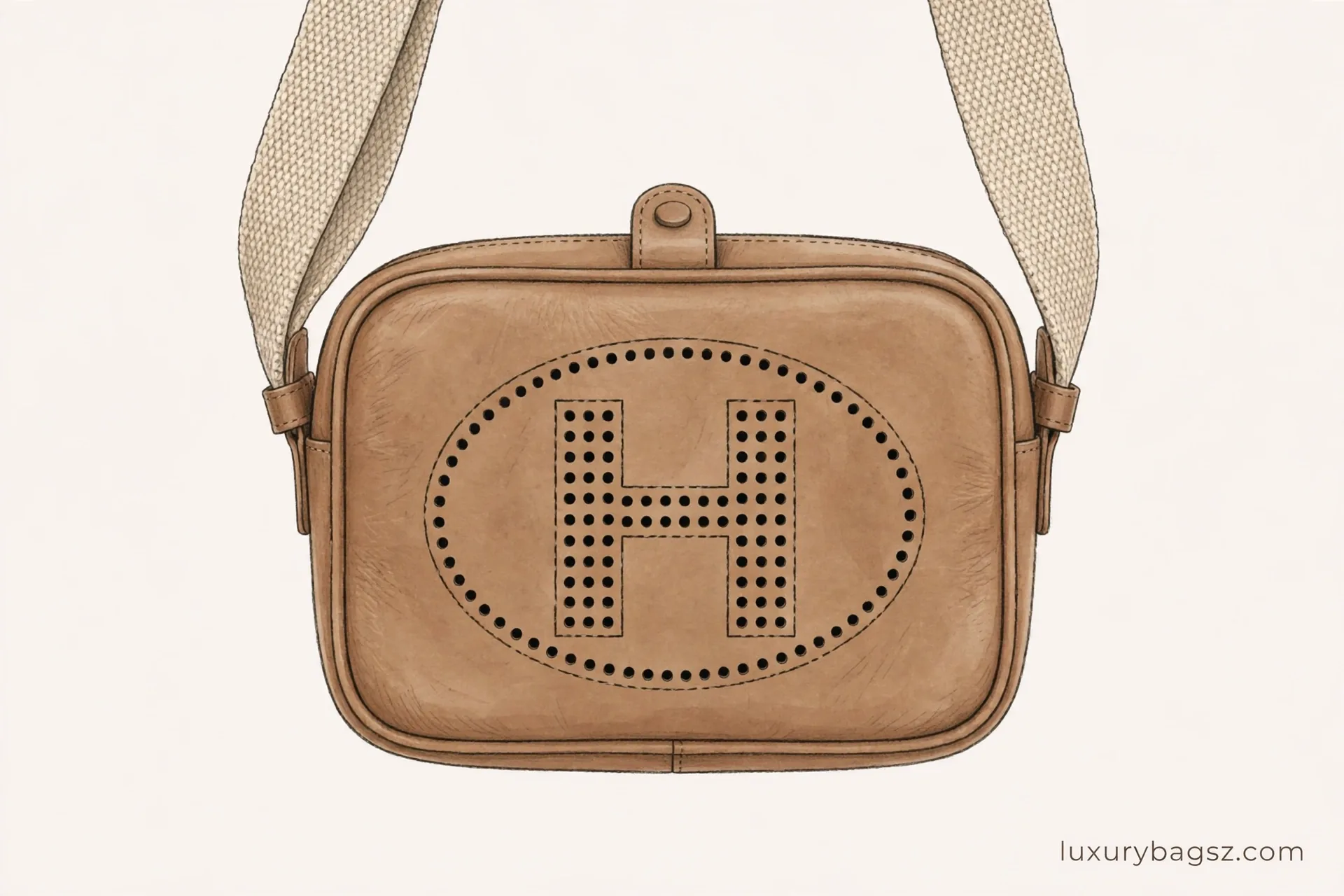
If the Birkin is Hermès’ locked, structured icon and the Kelly is its formal flap bag, the Evelyne is the bag you actually reach for on an ordinary day. It is soft, light, open at the top, and worn across the body on a wide strap. There is no lock to fumble with, no flap to lift, and no rigid frame to protect. You pull a small leather tab, and you are in.
That simplicity is also why the Evelyne is so often misunderstood. Shoppers ask whether the big H on the front is a logo, a pocket, or a flaw. Sellers call almost any size “the mini” or “the medium”. Price lists disagree by hundreds of dollars for the same size. And second-hand listings mix up generations that look alike in a thumbnail but wear very differently in real life.
This guide clears up those points in order: what the Evelyne was made for, why the H is full of holes, how the generations differ, what each size really holds, which leathers change the feel, what it costs now, and what to check before you buy one pre-owned.
Key Takeaways
- The Evelyne was designed in 1978 by Évelyne Bertrand, then head of Hermès’ riding department, as a grooming bag for horse groomers. The perforated H was ventilation, not decoration.
- The H side was originally meant to face the body. Most people now wear it facing out. Neither way makes a bag fake.
- The current standard is the Evelyne III: an exterior back pocket and an adjustable canvas strap. The earlier Evelyne I had no exterior pocket and a fixed strap; the Evelyne II added the pocket but kept a fixed strap.
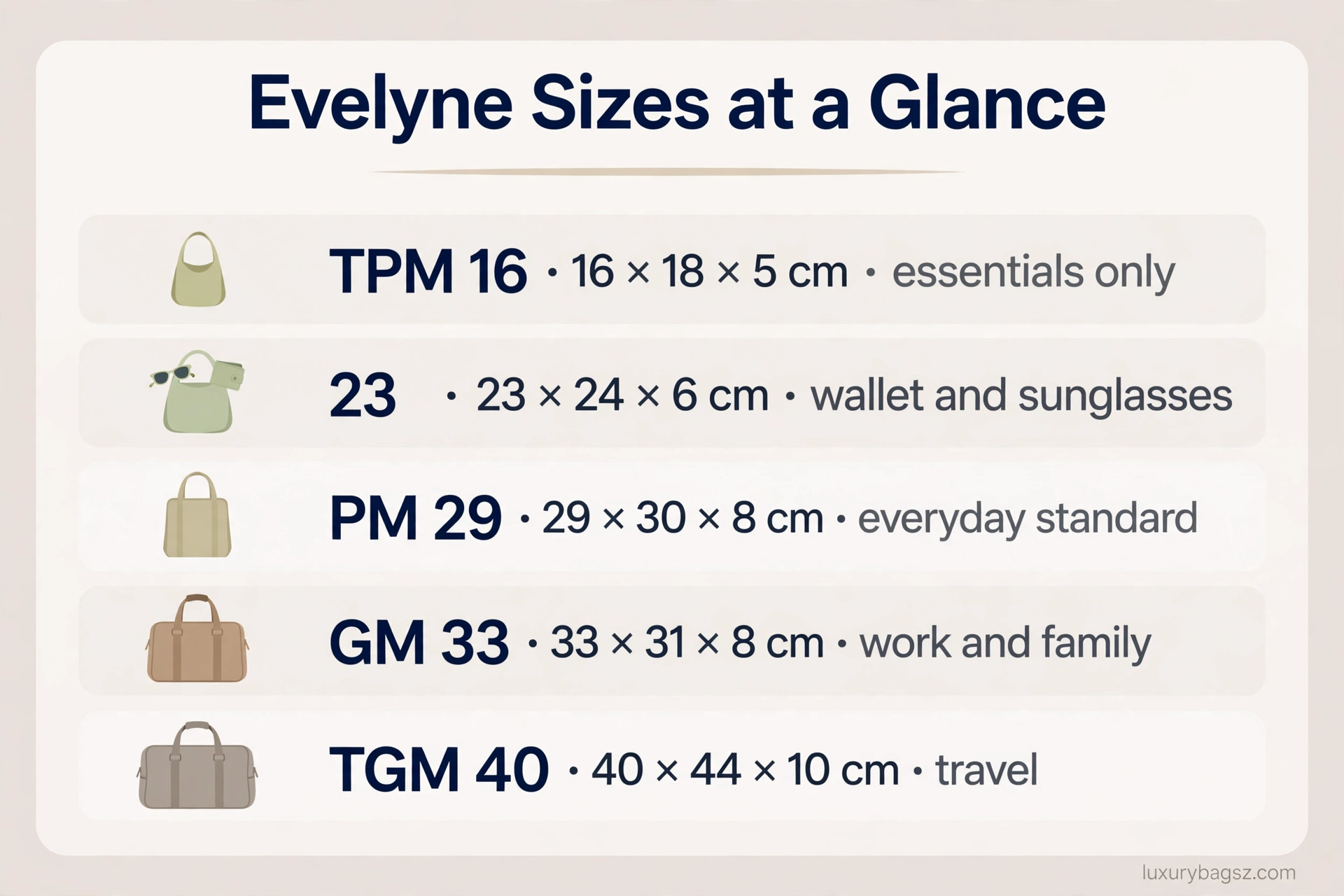
- Sizes are named by width in centimetres: TPM 16, the newer 23, PM 29, GM 33, and TGM 40. The number is the width, not a guarantee of capacity, because depth and softness change how much fits.
- The TPM’s strap is a trap for buyers: some current Amazone listings describe it as adjustable, while several guides say it is fixed and long. Check the actual bag, not the size name.
- The Evelyne is generally described as a non-quota bag and is sold online as well as in boutiques, but that does not mean every colour and size is in stock on a given day.
- Prices move every year and differ by region. The 2026 guide figures in this article are starting points to check on the day, for the same size, leather, and market — never a promise.
Generations are where Evelyne listings quietly mislead, so I identify the generation before I judge anything else. The strap, the closure tab and the details around the perforated H changed across the I, II and III, the Sellier and the Amazone, and a bag described as one generation wearing another’s features deserves a harder look. Then I read the leather — Clemence, Togo, Epsom or Maurice each behave differently in the hand. I covered spotting a fake Evelyne in its own guide; here the same habit applies in a friendlier direction: name the generation first, and every size and price that follows makes more sense.
Evelyne at a Glance
What is the Hermès Evelyne bag? A soft, unlined leather crossbody with a wide strap, a snap-tab top closure, an exterior back pocket on most current versions, and a large perforated H inside an oval on the front panel.
Who was it made for originally? Horse groomers, who needed a hands-free bag for brushes, sponges, and other stable tools. The holes let damp tools breathe and dry.
What are the sizes? TPM 16 (16 cm wide), the newer 23 (23 cm), PM 29 (29 cm), GM 33 (33 cm), and TGM 40 (40 cm). The PM 29 is the most commonly recommended everyday size; the TPM 16 is the smallest and most popular mini.
How much does it cost? As a check-on-the-day guide only, 2026 US guide figures for Clemence are about $2,525 for the TPM 16 Amazone, $4,275 for the 23, $4,425 for the PM 29, and $4,850 for the GM 33, before sales tax. Other 2026 guides give different figures for the same sizes — see the Prices section, where the conflicts are set out plainly.
Is it a good everyday bag? For a light, hands-free day — phone, wallet, keys, sunglasses — yes, especially in the 23 or PM 29. For a secure, zip-top work bag, a laptop bag, or a bag you can leave open in a crowd without thinking, no. The top is open apart from a snap tab.
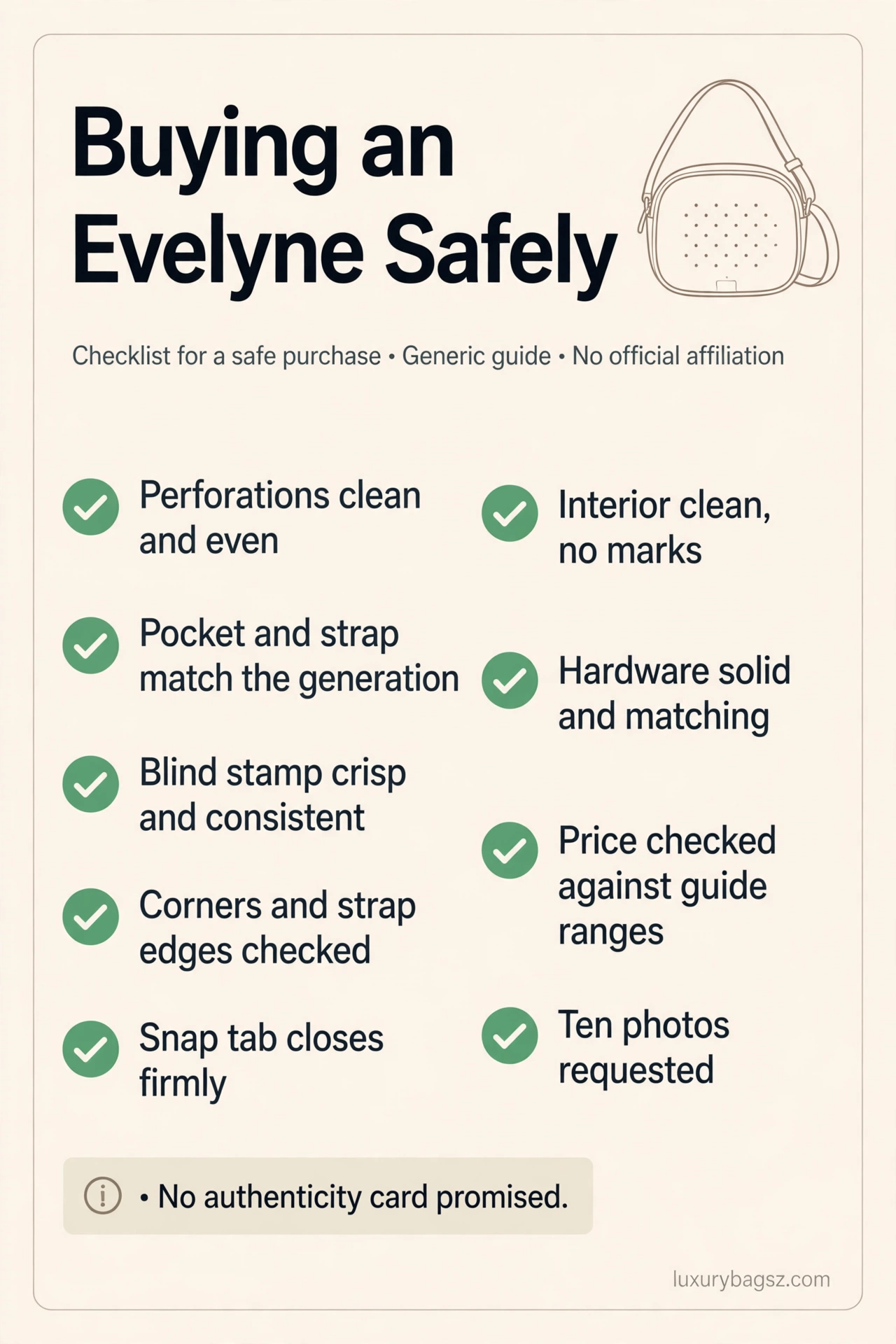
What should you check first when buying pre-owned? The perforations (clean, even, correctly shaped), the strap (adjustable or fixed, as the generation claims), the exterior pocket (present or absent, as the generation claims), the blind stamp, and the corners and strap edges. One check alone never proves a bag real.
What the Evelyne Actually Is
Strip away the Hermès name and the Evelyne is a very simple object: a soft leather pouch, slightly taller than it is wide in the smaller sizes, with a wide strap attached at both sides, a small tab that snaps over the top, and, on most current bags, a flat pocket on the back.
There is no zip. There is no internal zip pocket in the usual sense, and there is no rigid base, feet, or lock. Guides generally describe the interior as unlined — leather inside, not fabric — with one main compartment. Some reseller listings describe a suede-like interior finish, so do not assume a fabric lining or an internal zip pocket from a listing photo alone; look at the inside of the actual bag.
That simplicity is the point. A Birkin or Kelly asks you to protect its structure. An Evelyne is meant to be knocked about a little: carried on a train, worn on a walk, set down on a café chair. It is the Hermès bag most often described as casual, sporty, and understated, and that reputation is fair — as long as you do not mistake “casual” for “cheap” or “easy to fake-proof”.
The wide strap is part of the design, not an afterthought. Guides link it to a horse’s girth, the strap that helps secure a saddle. In wear, the width spreads the weight across the shoulder, which is why a soft leather bag that looks small can still feel comfortable when it is full. The trade-off is bulk: a wide canvas strap is more visible under a coat, and a light-coloured strap shows dirt sooner than the leather body does.
The Evelyne is also one of the few Hermès bags that is regularly described as unisex in listings and guides. Nothing about the shape is gendered in the design itself; the size, colour, and strap length decide how it reads on a person, not a “men’s” or “women’s” label.
The Perforated H: Why It Is There, and Which Way It Faces
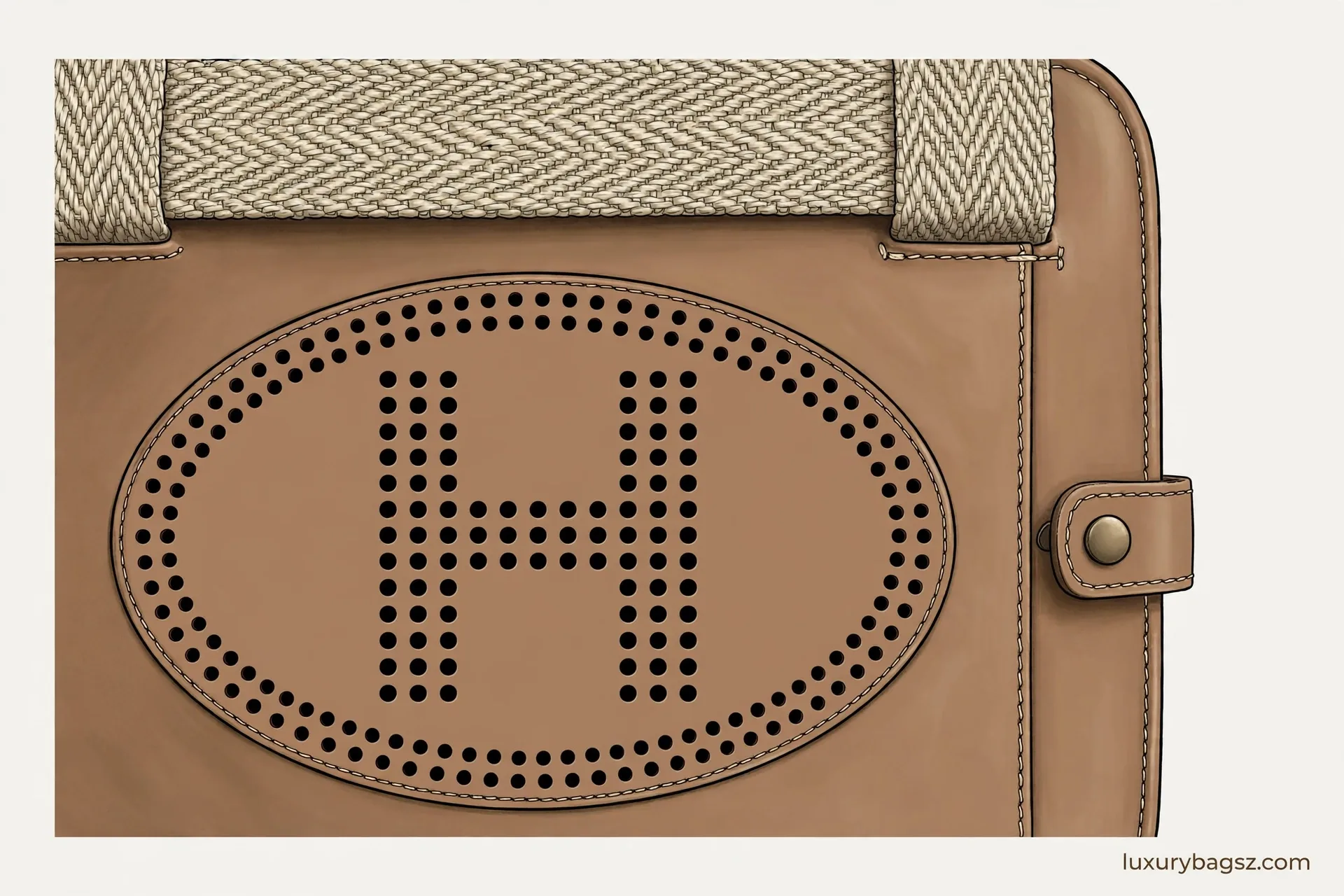
The Evelyne’s most famous detail is also its most misunderstood. The large H on the front is not printed, embossed, or stitched on. It is punched through the leather as a series of small, clean holes, set inside a perforated oval. Authentication guides commonly give the count as 63 holes in total: 40 for the oval, 9 for each arm of the H, and 5 across the middle bar. The holes are larger or smaller depending on the size of the bag, but the shape should stay proportional and even.
Those holes were functional. Grooming brushes and sponges go into a bag damp. A sealed leather pouch would trap that dampness. Perforations let air circulate so the tools could dry. That is why the H side was originally worn against the body: the ventilation was meant to face inward, towards the groomer, and the plain leather side faced out.
Today almost everyone wears the H facing out, and that is normal. A seller who tells you the H “must” face inward, or a buyer who treats an outward-facing H as a fault, is applying the original stable logic to a fashion bag. Wear it whichever way you prefer. The choice says nothing about authenticity.
What does matter is the quality of the perforations. On a genuine Evelyne the holes should be clean, round, evenly spaced, and evenly sized for that bag, with raw, unfinished edges and no tearing, fraying, or stray fibres. Misshapen, oval, blurry, or unevenly spaced holes, or an oval that looks too pointed or too circular at the sides, are red flags in authentication guides. Counting holes from a single listing photo is not reliable on its own — light, angle, and resolution can hide or merge holes — but a clearly wrong shape or ragged edge is worth asking about before you pay.
One more distinction matters here. The Evelyne Sellier, described below, does not have a perforated H at all. It has an embossed H inside a diamond shape. A Sellier described as having perforations, or a perforated Evelyne described as a Sellier, is a mixed listing. Ask which version is actually for sale.
Generations: I, II, III, Sellier, Amazone, and Neo
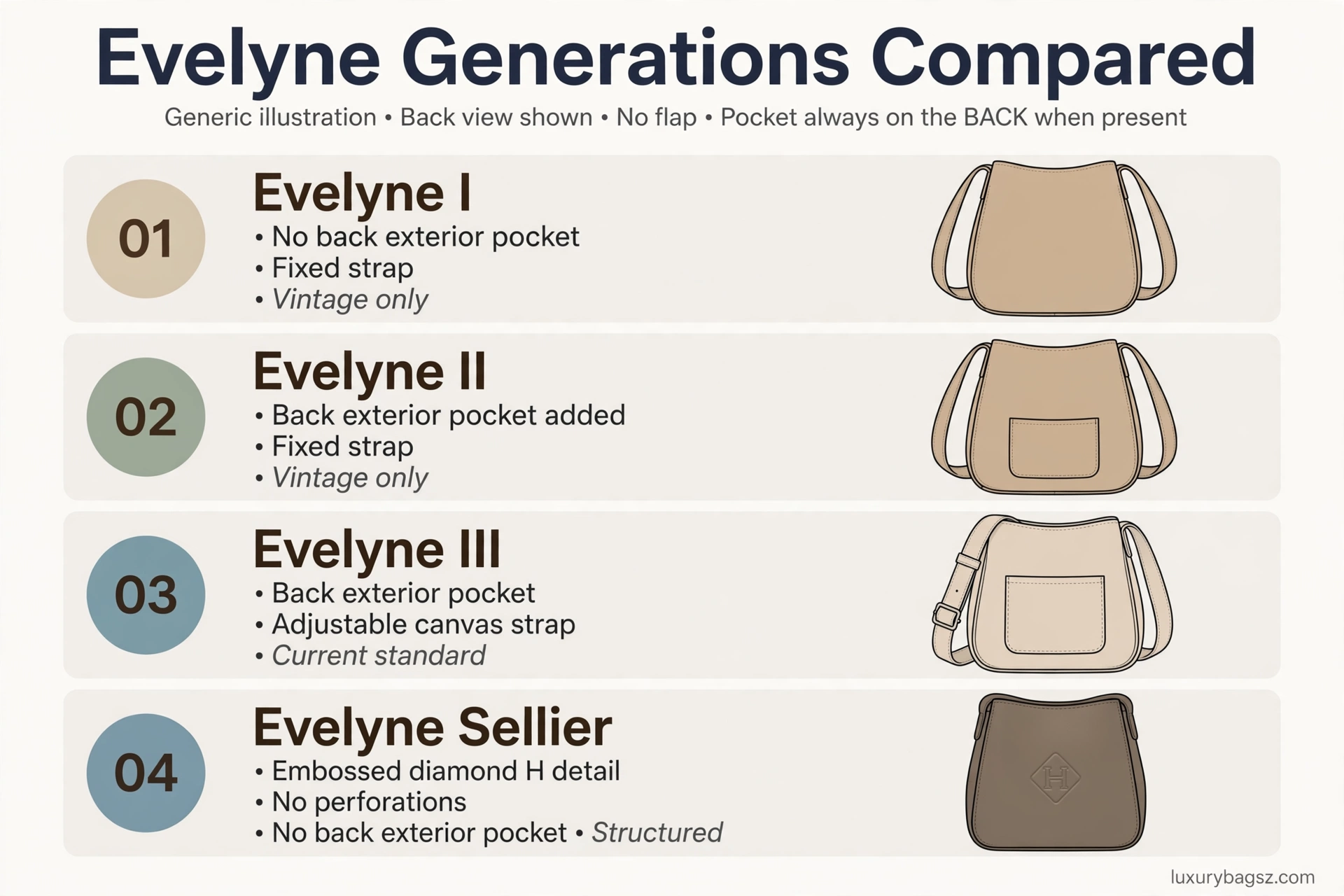
Most Evelyne confusion comes from generations. The shape looks the same in a small photo, but the pocket and the strap tell you which generation you are looking at. Get those two details right and most listings sort themselves out.
Evelyne I — the original. No exterior pocket. A fixed, non-adjustable strap. This is a vintage-only generation now. If a seller calls a bag with an exterior pocket and an adjustable strap an “Evelyne I”, the generation label is wrong, even if the bag itself is genuine.
Evelyne II — the pocket arrives. An exterior back pocket is added, but the strap is still fixed. Also vintage-only in practice. The difference between I and II is the pocket; the difference between II and III is the strap.
Evelyne III — the current standard. Both an exterior back pocket and an adjustable canvas strap. This is the generation most new and recent pre-owned Evelynes belong to, in sizes from 29 to 40 cm in the standard range, plus the newer 23 and the Amazone 16. If you are buying a current Evelyne and the listing does not name a generation, assume you need to confirm it is a III from the pocket and the strap, not from the title.
Evelyne Sellier — the structured exception. Introduced in 2016 under creative director Nadège Vanhee-Cybulski, the Sellier is a different construction, not just a different leather. It has outward-turned Sellier edges, a more structured, geometric shape, an embossed diamond H instead of perforations, and no exterior pocket. Early Sellier versions were in 29 and 33 cm. Sources disagree on the leather: some guides name embossed Epsom, others name Hunter leather. Treat the leather as a listing detail to verify, not as a settled fact. A newer Sellier 16 in Epsom is also reported in recent guides, with a non-adjustable, detachable all-leather strap and a 2026 guide price of $3,975 in the US. Again, the missing pocket and the embossed H are the reliable identifiers, not the leather name alone.
Evelyne Amazone — the mini, by another name. The Amazone name is used for the 16 cm size. Guides describe it as the same practical silhouette in downsized form, with the perforated H, an exterior pocket, and an adjustable strap — but see the strap warning below. Some guides still call the smallest size simply the TPM 16, and some listings call it the Mini Evelyne. All three names usually mean the same 16 cm bag, but the strap and pocket details still need checking, because the TPM has the most contradictory strap descriptions of any size.
Evelyne Neo — the canvas variant. Introduced in the Spring–Summer 2023 collection in guides, the Neo is a canvas-and-leather take on the shape: Officier canvas with Swift leather trim, the perforated H, and textured embroidery detail in some descriptions. It is a variant, not a replacement for the leather Evelyne III. If a listing calls a plain leather Evelyne a “Neo”, or a canvas Neo a standard III, ask for the material description.
The TPM strap warning, stated plainly. This is the single most contradictory detail in Evelyne guides. Several guides say the TPM 16 strap is fixed and long — indeed, one guide calls it the longest strap in the range, which is counter-intuitive for the smallest bag. Other guides and current Amazone listings describe the TPM strap as adjustable, with a drop of roughly 45–55 cm in one listing. Both cannot be the rule for every TPM. The safe position is: never buy a TPM on the assumption that its strap adjusts, and never reject a TPM only because its strap does not adjust. Photograph and measure the strap on the actual bag, and compare it with the generation the seller claims.
Sizes Explained: TPM 16, 23, PM 29, GM 33, and TGM 40
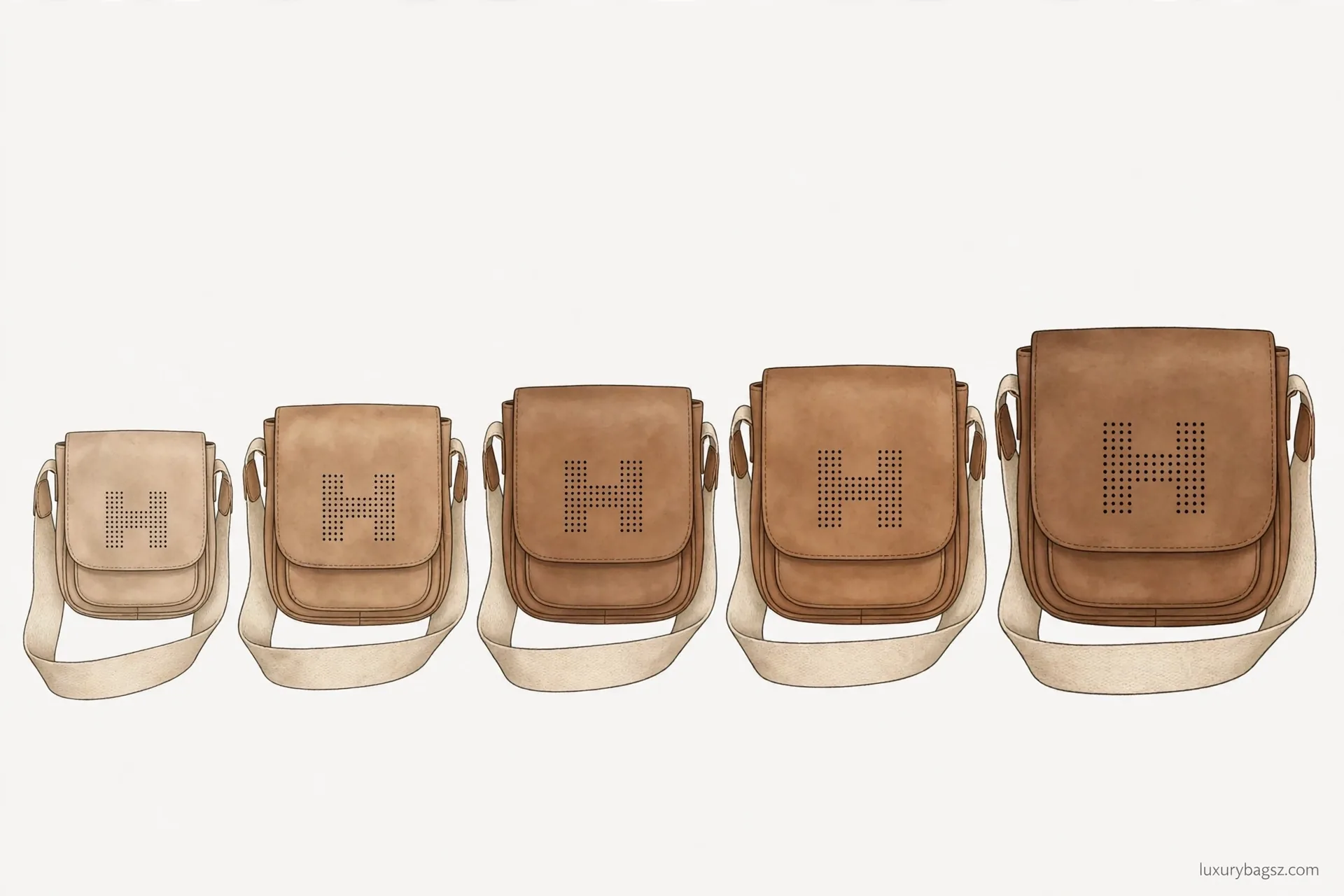
The number in an Evelyne size is its width in centimetres. That is the one consistent rule across guides. Everything else — height, depth, and what fits — varies by source, by generation, and by leather, because a soft bag does not hold a single rigid shape.
| Size | Common names | Dimensions most guides give | Depth conflicts to watch |
|---|---|---|---|
| TPM 16 | Mini, Amazone, Très Petit Modèle | 16 x 18 x 5 cm | One guide gives 16 x 20 x 5.5 cm for the Amazone; one reseller listing gives 17 x 19 x 5 cm |
| 23 | Evelyne 23, new mid-size | 23 x 24 x 6 cm | One guide gives 23 x 24 x 7 cm |
| PM 29 | Petit Modèle, medium | 29 x 30 x 8 cm | PurseBop gives 29 x 30 x 7 cm; Sellier 29 is listed at 29 x 30 x 10 cm |
| GM 33 | Grand Modèle, large | 33 x 31 x 8 cm | Most guides agree on 8 cm depth |
| TGM 40 | Très Grand Modèle, extra large | 40 x 44 x 10 cm | Most guides agree; some listings round height to 42 cm in inches conversions |
The older four-size picture — TPM, PM, GM, TGM only — is now out of date. The 23 is the fifth size, introduced in 2025 guides (first rumoured early in 2025, seen at the Fall–Winter 2025 re-see, and in boutiques towards the end of 2025). A guide that lists only four sizes is not necessarily wrong about the older sizes, but it is missing the current range. Conversely, a guide that calls the TPM “discontinued” should not be treated as current: 2026 price guides list a current TPM 16 Amazone retail price, which contradicts a blanket discontinued claim. Availability of a particular colour may be scarce without the size itself being discontinued.
TPM 16 — essentials only. Phone, card case or small wallet, keys, lipstick, and a small pouch at most. Owners in guides describe it as a “one mint too many” bag: it looks roomy until you try to add a full wallet, sunglasses, and a charger. It is the best choice for errands, travel documents, and evenings when you want almost nothing, and the worst choice if you regularly carry a full wallet and sunglasses case. Because the strap question is unresolved (see above), try the TPM on with the strap as it actually is, not as a guide promises.
Evelyne 23 — the new middle. Full wallet or medium wallet, phone, keys, sunglasses, a small cosmetic pouch, and a portable charger, according to 23 guides. It keeps the PM’s adjustable strap and rear pocket, which is the practical point: moving down from the PM to the 23 mainly changes capacity and how much hip the bag covers, not the feature set. If the TPM feels too small and the PM feels too wide, the 23 is the size to try first.
PM 29 — the everyday standard. The most recommended everyday size in guides. A wallet, phone, keys, sunglasses, a small cosmetic pouch, and, depending on the guide, a small tablet or a slim water bottle. Do not promise yourself both a tablet and a bottle in the same PM: guides disagree on whether a bottle fits comfortably, and a soft 8 cm-deep bag bulges quickly once it is overfilled. The PM is the size to choose if you want one Evelyne to do most days.
GM 33 — the work and family size. Everything in the PM, plus a book or e-reader, a larger pouch, a water bottle, and room for the extras that accumulate on a long day — gloves, a scarf, snacks, or baby essentials in guides. It is still a crossbody, not a tote: the weight sits on one shoulder, and a full GM is noticeably heavier than a full PM. If you carry a laptop, measure it against the actual interior; guides describe a vertical laptop fit in the GM, but laptop sizes and case thickness vary too much to take that as a guarantee.
TGM 40 — the travel size. Overnight essentials, gym kit, documents, and a large amount of daily carry. It is the least common size in everyday guides and the easiest to overbuy: a 40 cm crossbody covers a lot of hip and swings more when it is light. Choose it for travel or for a genuinely large daily load, not because it looks like better value per centimetre. Value per centimetre is a poor way to choose a bag you will wear every day.
Materials: Clemence, Togo, Epsom, Maurice, and the Rest
Most Evelynes you will see are in grained, durable leathers. Exotic Evelynes are not common in guides, and a listing that presents an exotic Evelyne as a standard option should be checked carefully. The four leathers to know are Clemence, Togo, Epsom, and Maurice. They change the weight, the slouch, and the care, even when the size and colour are the same.
Clemence — the classic Evelyne leather. Made from baby bull hide (Taurillon Clemence), with a wide, natural grain, a semi-matte finish, and a soft, heavy feel. It is the leather most guides name first for the Evelyne, and it is the reason many Evelynes look relaxed rather than rigid. Clemence slouches with age and softens further. It is scratch-resistant in guides, but it is also the leather most often warned about around water: water marks and blisters on Clemence are described as hard to remove. If you live in a wet climate or carry the bag in rain without a cover, Clemence asks for more care than its casual look suggests. For where Hermès leather comes from and how it is made, the background in our guide to Hermès leather is a useful companion to this section, because no single country makes “the” Evelyne leather.
Togo — the lighter, firmer cousin. Baby calfskin with a fine, pebbled grain. Guides describe Togo as lighter than Clemence, better at holding its shape, and still soft. That combination makes it a good middle choice if you like the grained look but do not want a bag that slouches as much as Clemence. Togo is named less often than Clemence for the Evelyne in the guides seen, so a Togo Evelyne listing should still be checked against the grain in the photos — fine pebble, not the wider Clemence grain — rather than taken on the leather name alone.
Epsom — the structured, lightweight option. An embossed calfskin with a fine, regular, slightly cross-hatched grain. The grain is pressed in, not natural, which is why Epsom looks so even and holds colour so well. It is lightweight, scratch-resistant in guides, and the easiest of the four to wipe clean. It is also the leather of the Sellier Evelyne in most guides, where its structure suits the geometric shape. The trade-off is feel: Epsom is firmer and less soft than Clemence or Togo, and a large Epsom Evelyne can look more formal than the casual shape intends. Bright colours show particularly well in Epsom.
Maurice — the newer middle ground. A baby bull leather introduced in guides around 2017, similar in appearance to Clemence but with a smaller, better-defined grain and a little more structure and subtle sheen. If a listing calls a bag Maurice and the grain looks like wide, relaxed Clemence, ask again. Maurice is meant to sit between Clemence softness and Epsom structure, not to be a synonym for Clemence.
Other materials you may meet. Swift appears as trim on the Evelyne Neo and in some variant descriptions; it is soft and smooth, and guides warn that smooth leathers scratch more easily. Hunter leather is named for the Sellier in some guides, in conflict with Epsom — see the Generations section. The Evelyne III strap is usually canvas with leather accents, not all leather, while some Sellier and vintage versions have leather straps. A canvas strap is not a fault, and an all-leather strap is not automatically proof of a Sellier. Check the strap material against the generation and version claimed.
Colour note: guides and listings show the Evelyne in neutrals (Noir, Etoupe, Gold, Caban, Ébène) and in brighter seasonal colours (Rose Sakura, Tangerine, Purple, and others for the 23). Colour alone never proves a version or a year. The same colour can appear in different leathers, generations, and sizes, at different prices.
Strap, Carrying, and What Fits
The Evelyne is worn crossbody first, shoulder second, and hand-carried almost never. That order matters when you choose a size. A crossbody bag that sits too low swings; one that sits too high digs into the neck. The adjustable strap on the Evelyne III and the 23 is the feature that lets you fix that, and it is the main practical reason to prefer a III over a II for everyday use.
Strap lengths in guides and listings vary, because they are measured differently (drop versus total length) and because the TPM question is unresolved. For the 23, guides give an adjustable drop of roughly 16.5 to 23 inches, and another guide gives about 18 to 22 inches. For a GM 33, one reseller listing gives a total strap length of about 140 cm. Do not compare a “drop” figure from one listing with a “total length” figure from another and conclude that one bag is longer. Measure the bag you are buying, with the coat you will wear it over: a length that sits at the hip over a T-shirt can sit too high over a winter coat, and a strap adjusted for a coat can swing too low in summer.
Three wear points that guides often miss:
- The open top. The snap tab holds the top closed, but it is not a zip. A phone in the back pocket is quicker to reach and easier to lose than a phone inside the main compartment. In a crowd, wear the bag in front of your hip, not behind it, and keep valuables inside, not in the exterior pocket.
- The wide strap and light colours. A wide canvas strap spreads weight, but it also picks up dirt, denim transfer, and rain marks faster than the leather body. A light strap on a dark coat, or a dark strap on a light coat, will show transfer sooner. Check strap edges and the underside in pre-owned photos, not just the front panel.
- Softness and swing. A soft Clemence Evelyne changes shape as it fills. An overfilled PM or GM bulges at the sides and pulls the strap forward. Pack heavy items low and central, not at the top or in a corner, and leave a little slack. The Evelyne is not a bag that rewards overpacking.
If you want a more structured Hermès crossbody shape for comparison, the Geta bag is a useful contrast: smaller, box-like, and closed by a leather-sheathed H, where the Evelyne is soft, open, and closed by a tab. The comparison helps because it shows what the Evelyne gives up for its lightness — structure and security — and what it gains — comfort and ease.
Prices: Retail and Pre-Owned, With Conflicts Stated
No Evelyne price in this section is a promise. Hermès raises prices most years, sometimes twice in a year in guides, and prices differ by country, currency, tax, size, leather, and version. Check the boutique or Hermès website on the day, for the exact size and leather you want.
2026 US retail guide figures (Clemence, before sales tax, from 2026 price guides):
| Size | Guide figure most often given | Other 2026 guide figures |
|---|---|---|
| TPM 16 Amazone, Clemence | $2,525 | $2,520 in one guide (a $5 rounding difference, not a separate price) |
| TPM 16 Sellier, Epsom | $3,975 | — |
| Evelyne 23, Clemence | $4,275 | $4,100 as a debut figure in one guide, and about $4,100 in another guide’s summary |
| PM 29, Clemence | $4,425 | About $4,025 in one guide’s summary — a large gap; do not average these, check the current list |
| GM 33, Clemence | $4,850 | $4,725 in one guide |
| TGM 40, Clemence | Not given in the 2026 guides seen | Do not price a TGM from a GM figure |
European guide figures for the same period are lower in euros before tax: TPM 16 Clemence €1,750 (up from €1,690), PM 29 Clemence €3,050 (up from €2,950), 23 Clemence €2,950, and GM 33 Clemence €3,500 in one guide. A European price is not a US price converted at the day’s exchange rate, and a price that includes tax in one country cannot be compared directly with a before-tax US price.
Pre-owned: single listings are not averages. This is where Evelyne guides mislead most often. A single pristine TPM listing at $4,250 does not make “the TPM resale price” $4,250. The ranges below are guide ranges, not market averages, and they move with colour, condition, year, and whether the set (box, dust bag, strap) is complete:
- TPM 16: guide resale ranges around $3,000–$4,250, with pristine or rare-colour examples listed higher, up to about $5,000 in one guide. Individual reseller listings seen for new TPMs run from about $3,950 to $5,450 depending on colour and hardware — again, single listings, not a market price.
- PM 29: guide resale ranges around $2,500–$3,900 in one guide, but about $4,800–$5,000 for pristine examples in another guide. That gap is a warning, not a typo to average away: condition and colour change the PM market more than the size name suggests.
- GM 33: guide resale ranges around $2,000–$2,900 in one guide, well below retail, which fits the pattern that larger, less scarce Evelynes do not hold the same premium as the TPM.
- Evelyne 23: guide resale ranges around $3,500–$6,350 in one guide, a very wide range that reflects a new size with few comparable sales. Do not treat the top of that range as the expected price.
The pattern to take away is simple: the TPM is the size most likely to sell above retail pre-owned, because it is small, popular, and often scarce in a wanted colour. The larger sizes are more likely to sell at or below retail pre-owned, because they are less scarce and heavier to wear. A seller who prices a used GM 33 above its current retail price needs a specific reason — rare colour, pristine condition, complete set — not just the Hermès name.
Is the Evelyne a quota bag? Guides describe the Evelyne, including the 23, as non-quota and sold online without a boutique offer, with availability and regional purchase limits still applying. That is a useful distinction from Birkin and Kelly buying, but it is not a guarantee of stock. “Non-quota” means you are not, in guides’ terms, spending a quota slot. It does not mean the boutique will have your colour in your size today.
Real vs Fake Pointers (Brief)
A full fake Evelyne guide is a separate article in this batch, so this section is a pointer list, not a complete authentication guide. No single check below proves a bag real or fake. Use them together, and get a professional opinion before you pay a large sum for a bag you doubt.
- Perforations first. Clean, round, evenly spaced holes in a correctly shaped oval H, with raw edges and no tearing or fibres. Wrong count, misshapen holes, or a too-pointed or too-circular oval are red flags. Remember that hole size scales with bag size.
- Stitching second. Hermès saddle stitching is hand-done, with a natural slant, in linen thread. It should be clean and precise, but handmade stitching is not machine-perfect. Perfectly straight, machine-even stitching, loose threads, or stitching that does not match the leather in tone where it should, are warning signs. The same saddle-stitch principle is set out in our guide to spotting a fake Kelly, and it applies here too, even though the bag is different.
- Blind stamp third. A small stamp giving the year letter and artisan/workshop codes, reported in guides as under the pull-through tab or on the strap for the Evelyne. The stamp should be crisp, correctly formed, and consistent with the bag’s claimed year and generation. Hermès issues no authenticity cards, so a “certificate card” in a listing is itself a red flag, not proof.
- Leather and hardware fourth. Grain should match the leather claimed (wide Clemence grain, fine Togo pebble, even Epsom embossing), and hardware should feel solid, with clean engraving and a finish that matches the stamp colour where applicable. Light, hollow, or plastic-feeling hardware is a warning sign.
- Generation consistency fifth. Pocket present or absent, strap adjustable or fixed, perforated or embossed H, and Sellier structure or soft III shape must all point to the same generation and version. A bag that mixes them — for example, a Sellier shape with a perforated H and an exterior pocket — is not a “rare variant” until a reliable source proves it is.
- Price and seller sixth. A price far below the guide ranges above, a seller who refuses clear photos of the H, the strap back, the blind stamp, and the corners, or a listing that uses only stock photos, are all reasons to stop, whatever the bag looks like in the main photo.
Condition Checklist for Pre-Owned
Use this list on the actual bag, not on a listing description. A bag described as “excellent” can still have a dirty strap, worn corners, or a stretched tab that the photos hide.
- Front panel and perforations: Are the holes clean and complete, with no stretched, torn, or darkened holes? Is the panel scuffed or faded around the oval?
- Corners and base: Soft Evelynes wear at the corners first. Look for scuffing, darkening, colour loss, and any collapse or misshaping at the base.
- Strap: Check the full length, both sides, and the edges. Look for dirt, denim transfer, fraying, cracking at the attachment points, and a slider or adjustment that slips. On a TPM, confirm whether the strap adjusts at all.
- Snap tab: Does the snap close firmly and stay closed? A loose tab is a security problem on an already open bag, not just a cosmetic flaw.
- Exterior pocket: Is the pocket flat and clean, with no stretching, staining, or torn stitching at its edges? A stretched pocket is a sign of heavy use.
- Interior: Is the leather interior clean, with no pen marks, stains, odour, or sticky residue? An unlined interior shows every mark, which is both a drawback and a useful condition tell.
- Hardware: Are the rings and snap clean, with no plating loss, scratching, or mismatched finishes? Hardware colour should be consistent across the bag.
- Shape: Does the bag hold its intended shape when empty, or does it collapse, lean, or bulge to one side? Clemence will slouch, but a bag that leans permanently has been stored or packed badly.
- Set: Box, dust bag, and the correct strap for the generation. A missing strap is a cost, not a detail: a replacement strap changes both the price and the wear.
Care and Storage
The Evelyne is easier to live with than a structured Hermès bag, but “easier” does not mean “no care”. The two rules that matter most are: keep it dry where you can, and store it so it does not lose its shape.
Daily care. Brush off dust with a soft, dry cloth. Wipe light marks with a barely damp cloth only if the leather allows it, and let the bag air-dry away from heat and direct sun. Do not soak the bag, do not use heat, steam, or an iron to dry it, and do not use alcohol, bleach, harsh cleaners, or home remedies on the leather or the canvas strap. For Clemence in particular, water marks are hard to remove once they set, so a rain cover or a different bag on a wet day is cheaper than a repair. Epsom tolerates a damp wipe better, but that does not make it waterproof.
Strap care. Canvas straps show dirt first. Spot-clean a canvas strap gently and let it dry fully before storing the bag. Do not machine-wash a strap that is attached to a leather bag, and do not assume a replacement strap will match the original colour exactly — canvas fades and varies by batch.
Storage. Store the bag upright or lightly stuffed so it keeps its shape, in its dust bag, away from direct sun, heat, and damp. Do not hang it by its strap for long periods, do not stack heavy items on it, and do not store it damp or in a sealed plastic bag. The same upright, lightly stuffed, dust-bag principle is set out in our guide to storing a Kelly, and it applies to the Evelyne too, even though the Evelyne is softer and less structured than a Kelly.
When to get help. Deep scratches, water damage, a broken snap, a slipping strap slider, or a stretched pocket are jobs for a leather specialist, not for home products. A cheap fix that changes the grain, the stitching, or the hardware finish can cost more in resale value than the repair saves.
Buying Checklist
Ask for these ten photos before you pay for a pre-owned Evelyne, and do not accept a listing that shows only the front panel:
- Front panel, straight on, in daylight — perforated H and oval clearly visible.
- Perforation close-up — holes, spacing, and edges, not a blurred detail.
- Back of the bag — exterior pocket present or absent, as claimed.
- Strap, full length, both sides — adjustment mechanism (or its absence) visible.
- Strap attachments and edges — wear, fraying, and hardware close-up.
- Snap tab, open and closed — snap condition and tab leather.
- Interior, empty — main compartment, interior finish, and any marks or odour notes.
- Blind stamp — under the tab or on the strap, as the seller describes it, in focus.
- Corners and base — all four corners, not just the cleanest one.
- Full set — box, dust bag, and strap together, if the seller claims a complete set.
Then apply these rules: buy the generation, size, and leather you can prove from the photos, not the title. Check the price against the guide ranges in this article for the same size and condition, not against a single listing. Prefer sellers who answer specific questions (strap adjustment, pocket, stamp location) over sellers who repeat the listing title. And if anything in the photos contradicts the listing — a pocket where the generation should have none, a perforated H on a claimed Sellier, a price far below the guide range — stop and ask, rather than assuming it is a rare variant.

FAQ
Is the Evelyne a quota bag?
Guides describe it as non-quota and sold online as well as in boutiques, with availability and regional limits still applying. That does not guarantee stock in your colour and size.
What is the difference between Evelyne I, II and III, and what is the Sellier?
Evelyne I has no exterior pocket and a fixed strap. Evelyne II adds the exterior pocket but keeps a fixed strap. Evelyne III has both the exterior pocket and an adjustable strap, and is the current standard. A structured 2016 variant with outward-turned edges, an embossed diamond H instead of perforations, and no exterior pocket. It is a different construction, not just a different leather.
Which Evelyne size is best for everyday use, and does the TPM strap adjust?
For most people, the PM 29, with the newer 23 as the better choice if the PM feels too wide. The TPM 16 is for essentials only, and the GM 33 and TGM 40 are for larger loads or travel. Sources disagree. Some current Amazone listings describe it as adjustable; several guides say it is fixed and long. Check the actual bag and do not buy on the size name alone.
Why does the Evelyne have holes in it?
The perforated H was ventilation for damp grooming tools in its original equestrian use. It was meant to face the body. Today most people wear it facing out, and that is normal.
Can a man wear an Evelyne?
Yes. Guides and listings describe it as unisex. Size, colour, and strap length decide how it looks, not a gender label.
Is the Evelyne waterproof?
No. Epsom tolerates a damp wipe better than Clemence, but no Evelyne leather in this guide is described as waterproof, and Clemence water marks are hard to remove. Keep it out of heavy rain where you can.
Does the Evelyne hold its value?
The TPM is the size most likely to sell above retail pre-owned in guides, while larger sizes more often sell at or below retail. Colour, condition, year, and a complete set matter more than the size name alone.
Final Verdict
The Evelyne earns its reputation, but only if you buy it for what it actually is: a light, soft, open crossbody that trades security and structure for comfort and ease. Choose the PM 29 if you want one bag for most days, the 23 if the PM feels too wide but the TPM feels too small, and the TPM 16 only if you genuinely travel light. Choose Clemence for softness, Togo for a firmer grained feel, Epsom for structure and easy wiping, and Maurice if you want something between Clemence and Epsom — and check the grain in the photos, not just the leather name.
Before you pay, confirm the generation from the pocket and the strap, confirm the size from the width and the depth, and confirm the price against a current guide for the same size, leather, and condition. A bag that passes all three checks is a sound buy. A bag that fails any one of them is a question to answer first, not a bargain to rush into.






