What Is a Hermès Herbag: The Canvas-and-Leather Kelly Alternative, Explained
The Herbag in Brief
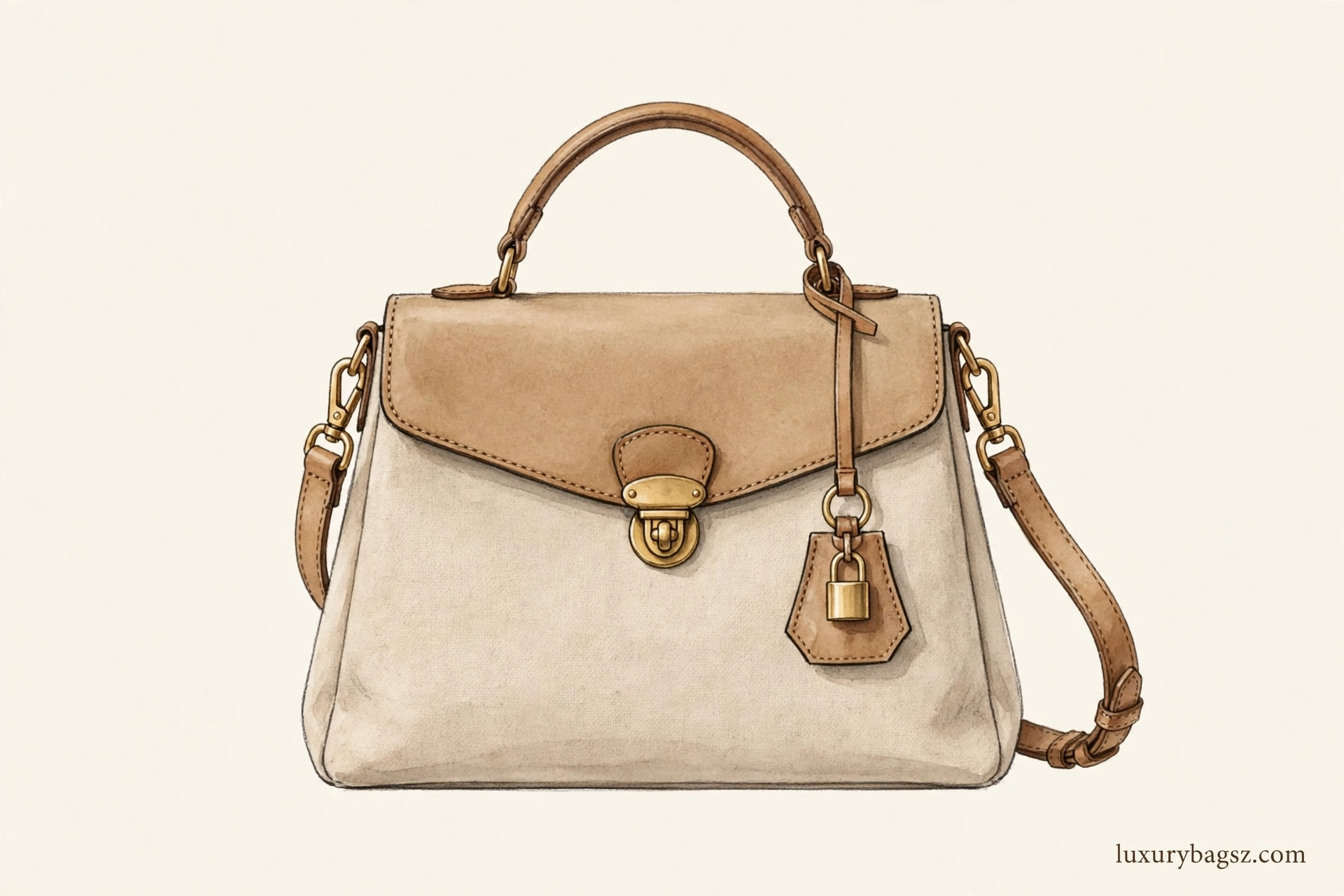
What is the Hermès Herbag? A trapezoidal bag with a woven canvas body and a leather top, handle and strap, closed by a leather flap and a saddle-style turnlock called the Clou de Selle. It looks like a Kelly at a glance, but it is lighter, softer in feel, and far more casual, because most of the bag is canvas, not leather.
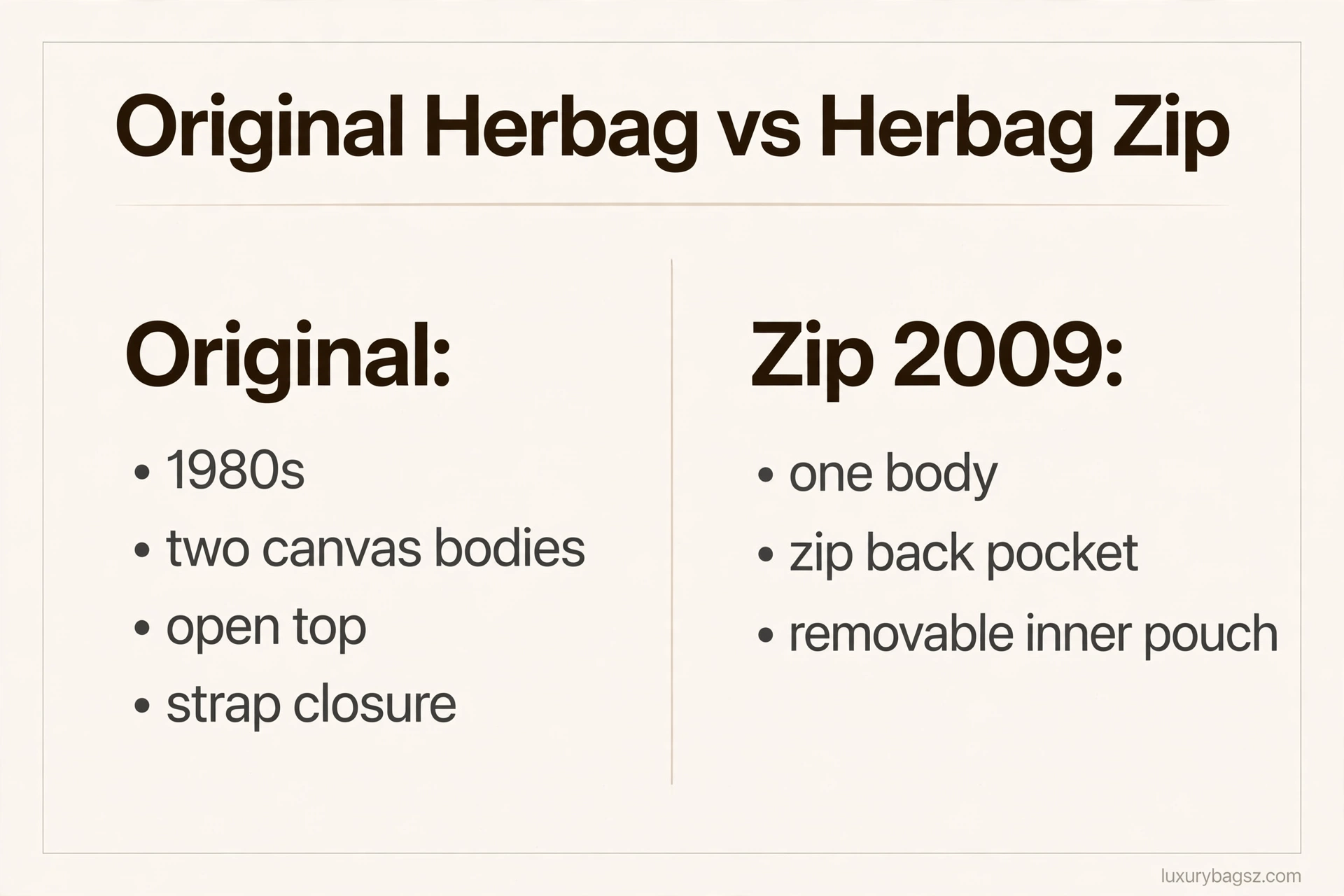
Why does it have two names, Herbag and Herbag Zip? The original Herbag appeared in the 1980s and was later discontinued. Hermès brought the shape back in 2009 as the Herbag Zip, with a zippered pocket on the back and a removable pouch inside. When a seller writes “Herbag” today, they usually mean the Zip version, but the two are not identical, and the naming section of this guide sets out the differences.
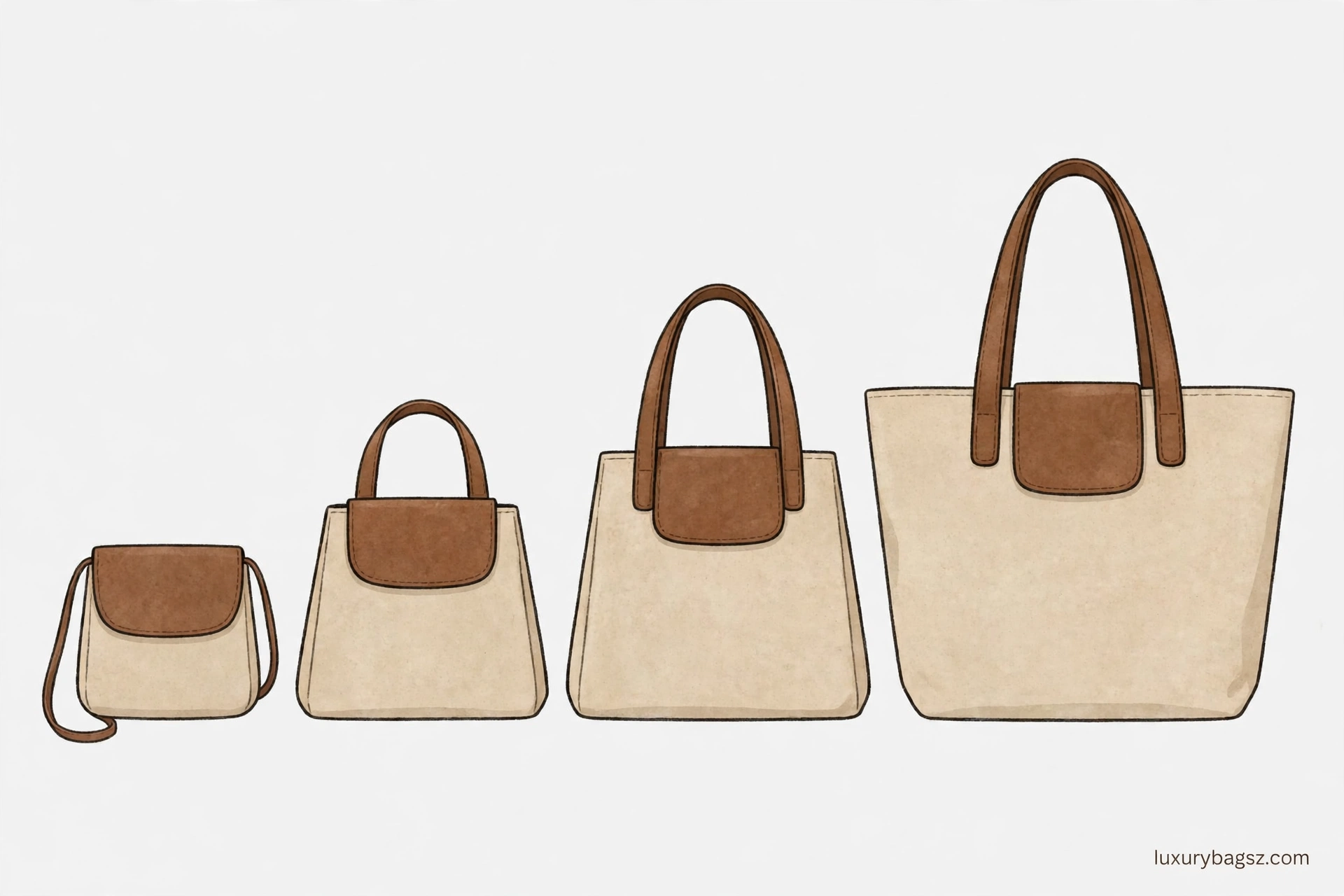
What sizes are there? The current everyday range is the Zip 20, the Zip 31 and the Zip 39, plus a horizontal Messenger 39 and larger Cabine and Weekender travel bags. Older bags use the names PM, MM and GM instead of centimetre numbers, and those old numbers do not match the Zip numbers exactly.
How much does it cost? As a check-on-the-day guide only, United States retail listings seen in September and October 2026 put the standard Zip 31 at $3,525 and the Zip 20 at $3,200, before sales tax. Printed and pocket versions cost more, and other guides give different figures for the same sizes. The prices section sets out those conflicts plainly instead of averaging them away.
Is it a quota bag? Guides describe the Herbag as a non-quota bag that can be bought in a boutique or online when it is in stock. That does not mean your colour and size will be in stock on a given day.
Who should buy one? Anyone who likes the Kelly shape but wants a lighter, everyday canvas bag for commuting, travel, and days when full leather would feel too formal or too heavy. Anyone who wants a fully leather bag, a rigid formal bag, or many built-in pockets should look elsewhere.
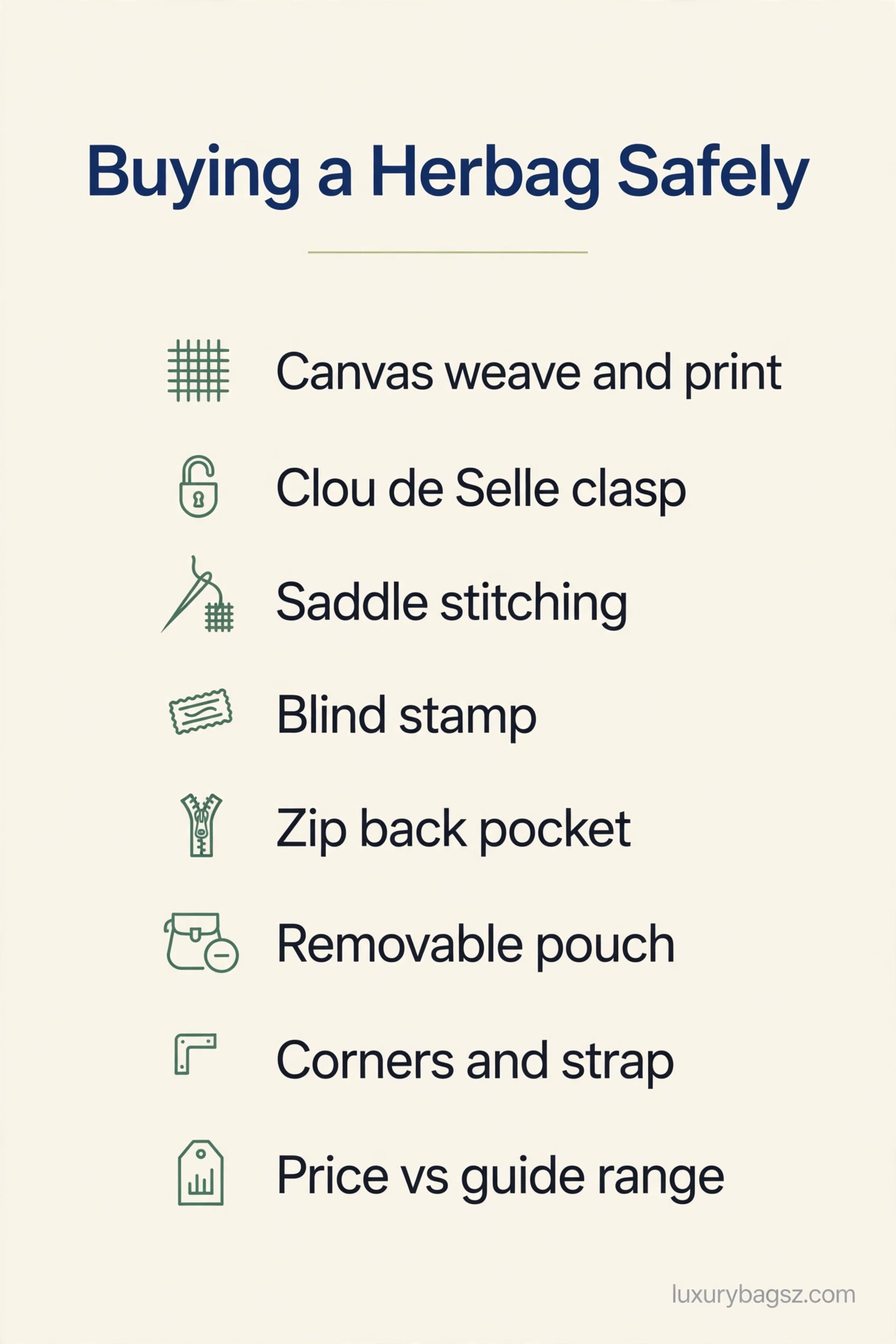
What should you check first when buying pre-owned? The canvas weave and print, the Clou de Selle clasp, the saddle stitching, the blind stamp, the zippered back pocket, the removable pouch, and whether size, construction and price all point to the same version. One check alone never proves a bag real.
The Herbag’s party trick — interchangeable canvas bodies under one leather top — is also my favourite check. I unclip the body and examine both: the woven canvas should feel substantial with a clean weave, the leather top’s Clou de Selle turnlock should work smoothly, and the fittings where body meets top should align without force. Copies often get one body passable and the spare sloppy. I own pre-owned canvas-and-leather bags myself, and the Herbag rewards the same habit as all of them: judge the canvas as carefully as the leather, because on this bag the canvas is most of what you carry.
What the Herbag Actually Is
Strip away the Hermès name and the Herbag is a very practical object: a trapezoid that is wider at the bottom than at the top, made mostly from woven cotton canvas, with a leather flap across the top, a leather handle, and a leather shoulder strap. A small leather clochette, sometimes with a padlock and keys, hangs from the side, echoing the Kelly. Inside, the current Zip version has one main compartment, a removable zipped pouch, and no forest of built-in pockets.
That mix is the whole point of the bag. A Kelly is made entirely from leather, which makes it heavy, structured and formal. A Herbag keeps the Kelly silhouette but swaps most of the leather for canvas, which makes it lighter, less formal, and easier to carry for a long day. Guides call it a “Kelly Country” or a “two-in-one bag” in older writing, and both nicknames capture something true: it is a country-casual take on a town-formal shape, and the original version really was two things in one, as the naming section explains.
It is also important to say what the Herbag is not. It is not a tote, even though the larger Cabine versions are sometimes sold as totes. It is not an open crossbody like the Evelyne, even though the small Zip 20 can be worn across the body. And it is not a cheap Kelly. At more than $3,500 for a standard Zip 31 at retail in late 2026, it is a serious purchase in its own right.
The question of origin deserves a plain answer, because listings romanticise it. Guides agree that the Herbag appeared in the 1980s as a practical, everyday version of the Kelly shape, built for regular use rather than for formal occasions. They do not agree on a single founding story, a single designer, or a single original purpose such as gardening, and this guide does not invent one. What the evidence supports is a utility-minded idea: take the most recognisable Hermès silhouette, make it in hard-wearing canvas with leather where it matters most — the flap, the handle, the strap and the closure — and sell a bag that can be used daily without the weight and worry of a full-leather Kelly.
Original Herbag vs Herbag Zip: The Naming Problem
Most Herbag confusion comes from one word: Zip. Sellers use “Herbag”, “Herbag Zip” and “Herbag Zip Retourne” loosely, and buyers assume they are the same bag. They are related, but they are not the same, and the differences matter when you buy pre-owned.
The original Herbag, 1980s to the mid-2000s. Guides place its first appearance in the 1980s and its discontinuation in the early to mid-2000s; sources disagree on the exact end year, so treat any precise “discontinued in 2003” style claim in a listing as a guide date, not a settled fact.
The original came, in the usual telling, as a set of two canvas bodies with one leather top: you could swap the canvas body for another colour while keeping the same flap, handle and strap. That is the “two-in-one” idea. It had an open-style top closed by a strap and the saddle clasp, and it did not have the zippered back pocket or the removable inner pouch that define the Zip.
The Herbag Zip, from 2009. Hermès reintroduced the shape in 2009 under the new name, with the same trapezoid silhouette but with practical changes. The Zip is normally sold with one body, not two, although the body can still be detached and replaced by another body of the same size.
It adds a zippered pocket on the back for a phone, keys or passport, and a removable zipped pouch inside. It does not, in the usual description, have other built-in inside pockets. The word “Zip” refers to that back pocket and to the pouch, not to a zip closing the main compartment, which is still closed by the flap and the Clou de Selle.
The swap-body myth, stated plainly. It is true that the leather top detaches and that collectors swap bodies between bags of the same size. It is not true, in the guides seen, that Hermès sells spare canvas bodies separately at retail as a routine option. Collectors who want two bodies usually own two bags. A second body with a pre-owned bag is an extra, not the standard package.
Retourne and Sellier: a second naming trap. Retourne means edges turned inward, for a softer outline. Sellier means edges turned outward and stitched visibly, for a crisper, more structured outline. A Zip 31 Retourne and a Zip 31 Sellier do not sit, wear or age the same way, so a listing that gives only “Zip 31” is missing a detail to ask about. Some listings shorten “Retourne” to “RT”, and some write “Retroune”, a spelling error, not a separate version.
Old PM, MM and GM vs new centimetre numbers. Older Herbags use PM (small), MM (medium) and GM (large). Current Zip bags are usually named by a number: 20, 31, 39, 50 or 52, widths in centimetres across the base in the usual telling. The systems do not line up neatly: one vintage guide gives the original PM as about 30 x 26 x 11 cm, the MM as about 37 x 33 x 14 cm, and the GM as about 52 x 34 x 23 cm, while the Zip equivalents are 31, 39 and 52 with different heights and depths. Never assume a “PM” and a “31”, or a “GM” and a “Cabine”, are the same bag without measuring the actual bag.
Anatomy: Every Part That Matters
A Herbag rewards a buyer who knows its parts, because most fakes and misleading listings fail on a part, not on the overall shape.
Canvas body. The main body is woven cotton canvas, described in guides as Toile H. It is durable and lighter than leather, somewhat weather-resistant, and not waterproof. Heavy rain can soak it and leave marks, and light canvas shows dirt and denim transfer sooner than dark canvas. The weave should look heavy, even and tight, not flimsy.
Leather top, flap, handle and strap. The flap, top structure, handle and shoulder strap are leather, usually Vache Hunter cowhide: grained, sturdy, supple yet firm, developing a patina with use. Guides warn it is rather prone to scratches, so light scratches on a used Hunter flap are normal, not proof of a fake.
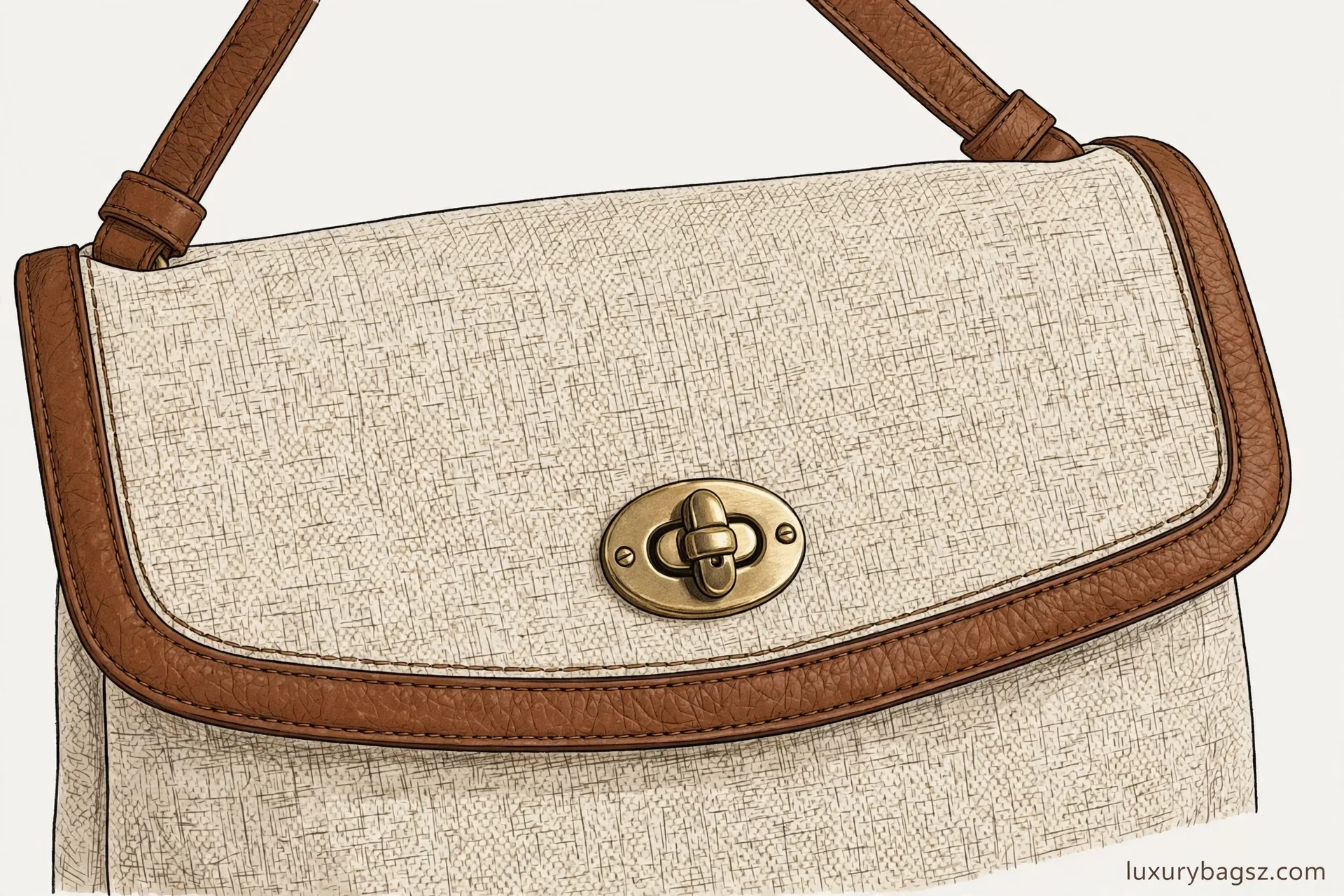
Clou de Selle closure. The flap closes with a saddle-style turnlock, the Clou de Selle, from the same family as the Kelly’s closure. It should turn smoothly, sit centrally, and carry a crisp “Hermès Paris” stamp. A loose, gritty or off-centre clasp, or blurry stamp letters, is a reason to ask questions.
Hidden metal rod. A concealed rod under the canvas helps the bag hold its trapezoid shape and lets the handle or strap be removed or flipped. That rod is why a Herbag keeps its shape when empty better than a soft canvas tote, and why a bag that collapses or leans permanently may have a bent rod or a replaced body. Do not try to straighten a rod yourself.
Back zip pocket. On the Zip version, the back has an exterior pocket closed by a zip, large enough for a phone, keys or a passport. The original pre-Zip Herbag has no such pocket, so a “vintage original” with one is a mixed description. Check that the zip runs smoothly and the pull matches the hardware finish.
Removable inner pouch. Inside the Zip, a small zipped pouch hangs from a leather strap. It is the bag’s only real organisation, and the part most often missing from a pre-owned bag. A missing pouch is a cost, not proof of fakery, but a seller who claims a “complete set” without it is overstating the set. Exception: guides say the mini Zip 20 does not include the pouch.
Clochette, padlock and keys. Many Herbags come with a small leather clochette holding a padlock and two keys, as the Kelly does. The lock is decorative-style, not a security device. Check that it turns, that the keys fit, and that the clochette leather matches the flap.
Interior and hardware. The interior is usually unlined or canvas-lined, with the same canvas as the body in many listings. Do not expect many pockets, a suede lining as standard, or an internal zip pocket beyond the removable pouch. Hardware is usually palladium (silver-tone) or gold-plated, and it should feel heavy and smooth, with a consistent finish across clasp, rings, studs and zip pull. Light, hollow or plastic-feeling hardware, or mixed finishes, are warning signs.
Sizes and How They Are Named
The Herbag family is wider than most guides admit. A guide that lists only “31 and 39” is missing the compact end, the horizontal version, and the travel end.
| Size | Dimensions most guides give | Carry | Best for |
|---|---|---|---|
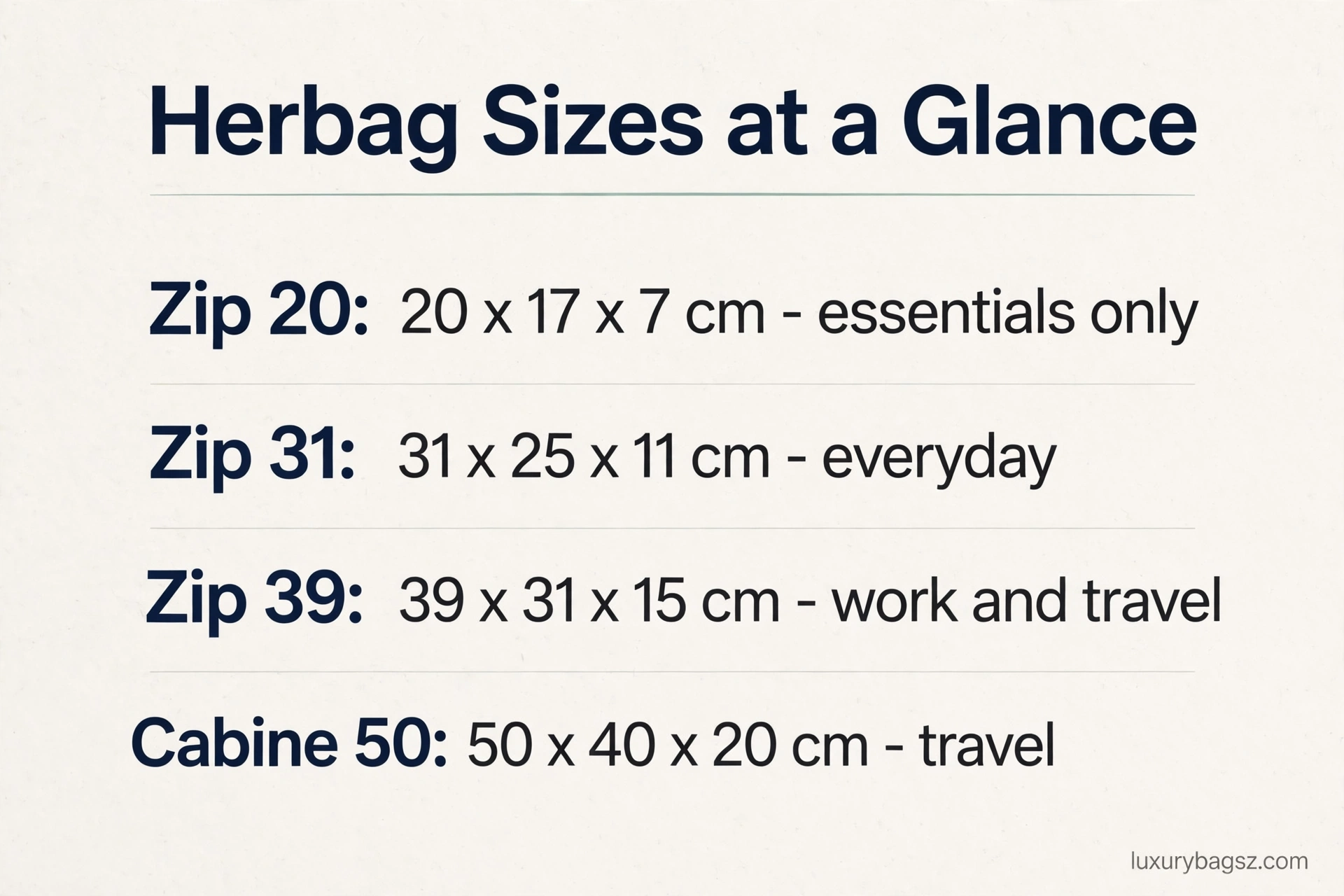
| Zip 20 (Mini) | 20 x 17 x 7 cm (one guide gives 20.6 x 16.5 x 7.1 cm) | Shoulder or crossbody, collapsible handle, strap about 104 cm | Phone, card holder, keys, lipstick |
| Zip 31 (PM in newer usage) | 31 x 25 x 11 cm (some guides give 31 x 25 x 10 cm) | Top handle plus shoulder strap | Everyday carry |
| Zip 39 (MM in newer usage) | 39 x 31 x 15 cm (some listings give 39 x 30 x 15 cm, or 38 x 30 x 14 cm) | Top handle plus shoulder strap | Work, travel, larger daily load |
| Messenger 39 | 39 family, horizontal shape; exact dimensions differ by listing | Hand, shoulder or crossbody | Crossbody wear in a larger size |
| Cabine 50 | About 50 x 40 x 20 cm | Top handle plus strap, hand or shoulder | Travel, large daily load |
| Weekender / Zip 52 (GM family) | About 52 x 36 x 20 cm for the Zip GM; Retourne travel versions differ | Top handle plus strap, hand or shoulder | Weekend and overnight trips |
Three conflicts in that table need stating plainly, because they are where buyers get caught.
First, the Zip 31 depth. Most current listings give 11 cm, but several older guides give 10 cm. That one centimetre decides whether a chunky sunglasses case sits flat, so measure the actual bag at its widest point, not at the flap.
Second, the Zip 39 dimensions. Guides agree on a 39 cm width and a height around 30 to 31 cm, but depths wander between 14 and 15 cm. A listing that gives 39 x 31 x 10 cm has mixed the 31 depth into the 39, and one that gives 39 x 25 cm has mixed the 31 height into the 39. Check width, height and depth together.
Third, Cabine and Weekender naming overlaps. “Cabine”, “Cabine 50”, “Zip 52”, “Weekender” and “GM” cover overlapping travel sizes, and a Retourne Cabine does not measure exactly like a Sellier travel bag: one guide’s Retourne Cabine is about 50 x 34 x 23 cm in inch conversion, while another guide’s Cabine is about 50 x 40 x 20 cm. Do not buy a travel Herbag by name alone; ask for all three measurements of the actual bag.
Older sizes add a fourth trap. Vintage Herbags also appear as a backpack (Sac à Dos) in PM size, about 36 x 29 x 11 cm in one listing, and as a TPM crossbody in older resale listings, about 20 x 15 x 7 cm. Those are real vintage variants, but a current Zip 20 is not the same as a vintage TPM, even though both are about 20 cm.
Zip 20 — essentials only. Phone, slim wallet or card holder, keys, lipstick or compact, and earphones. A full wallet plus a sunglasses case will fight for space. Its advantage is carry, not capacity, which the carry section covers.
Zip 31 — the everyday standard. Full wallet, phone, sunglasses case, small cosmetics pouch, keys, and a small tablet or notebook. It is the size most buyers should try first, because the Kelly shape still reads as a handbag here rather than a tote.
Zip 39 — work and travel. Everything in the 31, plus a larger tablet or e-reader, a water bottle, a light sweater, a notebook, and, in one guide’s words, A4 documents “nearly” fitting. Take that “nearly” seriously: measure an A4 sheet against the actual interior before you rely on it.
Messenger 39 — the crossbody 39. This is the version most guides miss. The standard Zip 39 is a hand or shoulder bag; the Messenger 39 is a horizontal version made to be worn across the body. If you want a 39 with crossbody wear, ask for the Messenger by name.
Cabine 50 and Weekender 52 — travel, not daily bags. Clothing for a short trip, books and documents fit, but a 50 or 52 cm canvas bag is heavy when full and awkward in a crowded train. Buy it for travel, not because it looks like better value per centimetre.

How It Carries: Hand, Shoulder and Crossbody
The Herbag does not carry the same way in every size, and that is the part of the buying decision that a dimensions table cannot make for you.
Zip 20: shoulder or crossbody. The mini has a collapsible handle and a long strap, about 104 cm (40.9 inches) in guides, letting it sit on the shoulder or across the body. It is the only current Zip truly designed for crossbody wear as standard, and that carry is its strongest argument for travel days. See our guide to choosing a crossbody bag size for a check on strap length and body position before you commit to a mini.
Zip 31 and Zip 39: hand and shoulder. Both have a top handle and a detachable shoulder strap. They are not, in standard form, crossbody bags, and a seller who calls a standard Zip 39 a “crossbody” is either describing the Messenger without naming it, or stretching the strap description. Try both carries with the bag loaded as you will actually load it, because an empty Herbag feels very different from one holding a tablet, a bottle and a pouch.
Messenger 39: the crossbody exception. The horizontal Messenger adds true crossbody wear to the 39 family. If you walk a lot or commute with a larger bag, seek it out by name rather than assuming a standard 39 will do the same job.
Cabine and Weekender: hand and shoulder, travel first. These carry by a top handle and a strap, mainly by hand or on the shoulder. They swing more when light and pull more when full, so pack heavy items low and central, and do not overfill: canvas gives a little, and a bulging trapezoid loses the clean shape that is the point of the bag.
Weight and sag, stated honestly. Guides agree the Herbag is lighter than a comparable all-leather bag, but they give no consistent empty weight per size, and this guide does not invent one. If weight decides your choice, weigh the actual bag loaded before you buy. The rod helps the shape, but an overfilled bag will still slump at the sides, and a heavy Cabine load will pull the flap out of line. Pack heavy items low, do not overfill, and see our guide to carrying a tote without sagging for the packing habits that help a canvas bag most.
Materials: Canvas Types, Leather Trim and Hardware
Most Herbag guides name only “canvas and leather” and stop there. That is not enough, because the canvas name decides the look, the care and the price.
Toile H canvas. The standard body canvas, a durable woven cotton, described as weather-resistant but not waterproof, in plain colours and seasonal prints. The weave should be tight and even. A loose, thin or shiny canvas is a warning sign, and a blurry or misaligned print is a stronger one.
Toile Militaire, also called Officier or military canvas. A sturdier, military-style canvas used for many standard Zip bags, including the standard Zip 31 in late 2026 retail listings. It is the workhorse canvas of the family, and the version most often recommended for hard daily use. If a listing says “Militaire” and the canvas looks thin and dressy, ask again.
Toile Berline. A coated or treated canvas named in older and some current guides as the standard Toile H variant. Guides use “Berline” and “Toile H” in overlapping ways, so do not treat a Berline label as proof of a different bag. Ask for the weave and finish in photos, not just the canvas name.
Printed canvases: H Plume, Circuit 24, Quadrille and others. Seasonal Herbags use printed canvas, including H Plume prints, the Circuit 24 motif, Maillons and Co prints, and Quadrille checks. Printed versions cost more at retail — see the prices section — and fade and mark differently from plain canvas. A print is harder to fake well, but only if you compare it against a known example of the same motif: a Circuit 24 print in the wrong colours or at the wrong scale is a question, not a “variant”.
Vache Hunter leather. The standard trim leather: grained cowhide, supple yet sturdy, used for the flap, handle, strap and top structure. It develops a patina, scratches fairly easily, and darkens with handling, especially on handles. Classic trim colours include Noir, Gold, Etoupe and Bleu Indigo. For background on where Hermès leather comes from, see our guide to Hermès leather: no single country makes “the” Herbag leather, so judge trim by grain and finish, not by a country label in a listing.
Swift and other trim leathers. Swift, a smooth, fine-grained leather, appears in some premium editions as trim. It feels softer than Hunter and scratches more easily. A listing that calls ordinary grained trim “Swift” without showing a smooth grain is worth questioning.
Hardware: palladium and gold. Palladium is the silver-tone option and the more modern look; gold-plated hardware is the classic look. Both should feel heavy, turn smoothly, and match across the bag. A bag with palladium on the clasp and gold on the zip pull has mixed hardware, and that is a fault or a repair, not a factory option to accept without asking.
Colours and the reversible claim. Guides list neutrals (Noir, Etoupe, Gold, Fauve, Beton) and brighter seasonal colours (Orange Mécano, Bleu Bill, Rouge H, Lime and others). One specialist guide also calls the Herbag “often reversible”. Treat that as a version-specific claim to verify on the actual bag, not a standard feature: a seller who claims reversibility should show both faces.
What short guides miss on materials. Canvas and leather age at different speeds: canvas fades and stains, leather patinates and scratches, so a ten-year-old Herbag will not age evenly, and that uneven ageing is normal. Printed canvas also wears at folds and corners first, and a strap in a clearly different leather from the flap is a replacement, which changes both price and wear.
Prices: Retail and Pre-Owned, With Conflicts Stated
No Herbag price in this part is a promise. Prices differ by country, currency, tax, size, canvas and version, and a printed version is not priced like a plain one. Check the boutique or the Hermès website on the day, for the exact size and canvas you want.
United States retail guide figures, September to October 2026, before sales tax, from dated listings:
| Version | Guide figure | Note |
|---|---|---|
| Zip 20, H Viking canvas, Hunter trim | $3,200 | Listing seen 29 September 2026 |
| Zip 31, Militaire canvas, Hunter trim | $3,525 | Listing seen 6 October 2026 |
| Zip 31 laque, Militaire canvas, Hunter trim | $3,900 | Listing seen 1 September 2026 |
| Zip 31 pocket, Militaire canvas, Hunter trim | $4,425 | Listing seen 26 May 2026 |
| Zip 31, Maillons and Co printed H Plume canvas | $4,475 | Listing seen 21 May 2026 |
| Zip 39, Militaire canvas, Hunter trim | $3,775 | Listing seen 29 September 2026 |
| Messenger 39, H Viking canvas, Hunter trim | $4,550 | Listing seen 5 October 2026 |
| Zip Cabine, Militaire canvas, Hunter trim | $5,200 | Listing seen 6 October 2026 |
| Zip Cabine, Circuit 24 printed H Plume canvas | $6,650 | Listing seen 6 October 2026; printed version, not the standard Cabine price |
The Zip 39 conflict, stated plainly. Another reputable guide gives about $4,550 for the Zip 39, while the dated listing above gives $3,775 for the Zip 39 in Militaire canvas. Those two figures cannot both be the standard Zip 39 retail price on the same day, and this guide does not average them into a false $4,160. The gap may reflect different dates, different canvas versions, or a guide figure that belongs to the Messenger 39, which the dated listings price at $4,550. Check the current list for the exact version you want, and do not let a seller use the higher figure to justify a pre-owned price for a standard Militaire Zip 39.
Older figures, for context only. A 2024 guide gives the Zip PM at $4,150 in military canvas and Hunter, $5,400 in printed canvas in the United States, and €2,420 to €2,950 in Europe. Those figures are higher for the standard PM than the late 2026 dated listing, which is another reason not to average guides across years.
Pre-owned: single listings are not averages. This is where Herbag guides mislead most often. A single pristine Zip 20 listed at $5,995 does not make “the Zip 20 resale price” $5,995. The figures below are asking-price samples from one guide’s September to October 2026 survey of live United States listings, not completed sale prices, and they include used and new bags, plain and printed versions mixed together:
- Zip 20: asking range $3,235 to $5,995, median ask $5,520, across 45 listings. That median sits above the $3,200 retail figure because the mix includes new, printed and scarce-colour minis at the top; it is not the price of a standard used Zip 20.
- Zip 31: asking range $1,345 to $6,250, median ask $3,075, across 124 listings. That median sits below the $3,525 standard retail price, which fits the usual pattern: most used Zip 31s sell below retail, while rare prints and pristine sets sit far above it.
- Zip 39: asking range $1,480 to $2,820, median ask about $2,500, across only 6 listings. Six listings are a thin sample, so treat that median as a hint, not a market price.
- Zip 50: asking range $2,125 to $3,130, median ask $2,860, across only 3 listings. Again, a thin sample, for a travel size with fewer buyers.
The pattern is simple. The Zip 20 is most likely to ask above retail pre-owned, because it is small, popular and often scarce in a wanted colour. Standard Zip 31 and Zip 39 bags more often ask at or below retail, because they are everyday sizes with more supply. A seller who prices a used standard Zip 31 well above retail needs a specific reason — rare print, pristine condition, complete set — not just the Hermès name.
Is the Herbag a quota bag? Guides describe it as non-quota and sold online as well as in boutiques, without a prior-purchase requirement, when in stock. That does not guarantee stock in your colour and size, and regional purchase limits can still apply.
Value warning. A Herbag is not, in the guides seen, a reliable investment purchase. Buy one because you want to carry it, not because you expect to recover the full retail price.
Herbag vs Kelly, Evelyne and Other Canvas Bags
Comparisons help only if they are honest about what each bag gives up. The Herbag is often sold as “a Kelly for less”, and that slogan hides as much as it reveals.
Herbag vs Kelly. The Kelly is fully leather, rigid, formal, closed by a turnlock and a double flap clasp, and bought by boutique offer, not online. The Herbag is canvas with leather trim, lighter, closed by a flap and a single Clou de Selle, and sold online when in stock. It gives you the trapezoid silhouette at a lower price and weight, and gives up the leather luxury, rigidity and formality of the Kelly. For the fake-checking principles shared by both bags, see our guide to spotting a fake Kelly.
Herbag vs Evelyne. The Evelyne is a soft, full-leather, open-top crossbody with a perforated H, made for hands-free days. The Herbag is flap-closed, with a handle and a shoulder strap, made for days when you want a closed, structured shape. The Evelyne is easier to get into; the Herbag is more secure. See our guide to the Evelyne bag for that open-top trade-off in full.
Herbag vs Geta and Neo Garden. The Geta is a smaller, box-like shape with a leather-sheathed H closure, and the Neo Garden is a more open canvas tote. The Herbag sits between them: more closed than a tote, larger and more practical than a small box bag. See our guide to the Geta bag and our guide to the Neo Garden bag for both ends of that canvas range.
Real vs Fake Pointers (Brief)
A full Herbag authentication guide is a separate job, so this part is a pointer list, not a complete authentication guide. No single check below proves a bag real or fake. Use them together, and get a professional opinion before you pay a large sum for a bag you doubt. For a worked example on a different Hermès shape, our guide to spotting a fake Evelyne shows how the same kind of pointer checks play out on a soft leather bag.
- Canvas first. Heavy, even, tight weave, with a print that is sharp, correctly coloured and aligned at the seams. Flimsy, shiny, blurry or misaligned canvas is a red flag. Light canvas that looks too white or too grey for its claimed colour is worth asking about.
- Stitching second. Hermès saddle stitching is hand-done, with a natural slant, in linen thread. It should be clean and precise, but handmade stitching is not machine-perfect. Perfectly straight, machine-even stitching, loose threads, visible glue, or stitching that does not match the leather in tone where it should, are warning signs.
- Clou de Selle third. Crisp, well-proportioned “Hermès Paris” lettering on the clasp, a smooth turn, and a finish that matches the rest of the hardware. Blurry, uneven or misspelt lettering, a gritty turn, or mixed finishes are warning signs.
- Blind stamp fourth. A small stamp giving the year letter and artisan or workshop codes, reported in guides as on the leather strap for the Herbag. It should be crisp, correctly formed, and consistent with the bag’s claimed year and version. Hermès issues no authenticity cards, so a “certificate card” in a listing is itself a red flag, not proof.
- Version consistency fifth. Back zip pocket present or absent, removable pouch present or absent, Retourne or Sellier construction, and original or Zip naming must all point to the same version. A bag that mixes them — for example, a claimed original with a zip back pocket and a pouch, or a claimed Zip 20 with a pouch that guides say the mini does not include — is not a “rare variant” until a reliable source proves it is.
- Leather and hardware sixth. Hunter grain should match the trim claimed, hardware should feel heavy and smooth, and the clochette leather should match the flap. Light, hollow or plastic-feeling hardware, or a clochette in a different leather, are warning signs.
- Price and seller seventh. A price far below the guide ranges in the prices section, a seller who refuses clear photos of the canvas weave, the clasp, the stitching, the blind stamp, the back pocket and the corners, or a listing that uses only stock photos, are all reasons to stop, whatever the bag looks like in the main photo.
Condition Checklist for Pre-Owned
Use this list on the actual bag, not on a listing description. A bag described as “excellent” can still hide a stained canvas base, a scratched Hunter flap, or a missing pouch.
- Canvas body: Fading, stains, water marks, denim transfer, fraying at corners and seams, and print wear at folds on printed versions.
- Flap and leather trim: Scratches, patina, darkening on the handle, colour loss at edges, and cracking at fold points.
- Clou de Selle: Smooth turn, central sit, crisp stamp, and no plating loss. A clasp that sticks or wobbles is a repair cost, not a cosmetic detail.
- Back zip pocket: Smooth zip, matching pull, clean pocket, and no torn stitching at the pocket edges. A pocket that sticks or gaps is a daily annoyance on the bag’s quick-access part.
- Removable pouch: Present or absent, zip working, strap intact, and canvas matching the body. A missing pouch on a Zip 31 or Zip 39 should reduce the price.
- Handle and strap: Full length, both sides, edges, attachment points, and any fraying, cracking or darkening. A replaced strap in a different leather changes the price and the wear.
- Corners and base: Canvas wear, fraying, staining and any collapse or lean. The rod helps the shape, but a bag that leans permanently has been stored or packed badly.
- Interior: Marks, stains, odour and pen marks. A canvas interior shows every mark, which is a useful condition tell.
- Rod and shape: Does the bag hold its trapezoid shape when empty, or does it collapse, lean or bulge to one side? A bent rod is a specialist job, not a home fix.
- Set: Box, dust bag, clochette, padlock and keys, and the removable pouch, where a complete set is claimed.
Care and Storage
The Herbag is easier to live with than a full-leather bag, but “easier” does not mean “no care”. The two rules that matter most are: keep the canvas dry where you can, and store the bag so it keeps its trapezoid shape.
Daily care for canvas. Brush off dry dirt gently with a soft brush or a dry cloth. Do not soak the canvas, use heat or steam to dry it, or scrub a stain hard, because scrubbing can spread a stain and damage the weave. Guides conflict on wet cleaning: one says to avoid wet wipes and soap because they can spread stains, while another says a soft damp cloth with a drop of mild soap is acceptable. This guide’s position is: dry brush first, blot a fresh spill at once with a dry cloth, and leave anything beyond a light mark to a professional cleaner.
Daily care for leather trim. Wipe Hunter trim with a soft, dry cloth. Protect it from water and oils, condition sparingly if at all, and accept that patina and light scratches are part of Hunter’s life. Do not use alcohol, bleach or harsh cleaners on the trim. Our guide to clean Chanel bags shows how leather-first care differs from canvas-first care, and why one routine does not fit both.
Water and storage. The canvas is somewhat weather-resistant, not waterproof. If the bag gets wet, blot at once and air-dry away from heat and direct sun, lightly stuffed so it keeps its shape. Store it upright or lightly stuffed, in its dust bag, away from direct sun, heat and damp. Do not hang it by its strap for long periods, stack heavy items on it, or store it in a sealed plastic bag, which traps moisture. The same upright, lightly stuffed, dust-bag principle is set out in our guide to storing a Kelly, and it applies here too: shape, sun and damp are the enemies in both cases.
When to get help. Deep canvas stains, water damage, a bent rod, a broken clasp, a sticking back-pocket zip, or a torn seam are jobs for a specialist, not for home products. A cheap fix that changes the weave, stitching or hardware finish can cost more in resale value than the repair saves.
Buying Checklist
Ask for these ten photos before you pay, and do not accept a listing that shows only the front panel:
- Front panel, straight on, in daylight — flap, Clou de Selle and canvas weave clearly visible.
- Canvas close-up — weave and print, not a blurred detail.
- Clasp close-up — “Hermès Paris” lettering and finish.
- Stitching close-up — flap edges and handle attachments.
- Back of the bag — zippered back pocket present or absent, as claimed, with the zip pull visible.
- Interior, empty — main compartment, removable pouch (or its absence), and any marks.
- Blind stamp — on the strap, as the seller describes it, in focus.
- Handle and strap, full length, both sides — wear, darkening and attachment points.
- Corners and base — all four corners, not just the cleanest one.
- Full set — box, dust bag, clochette, lock and keys, and pouch together, if the seller claims a complete set.
Then apply these rules: buy the version, size and construction you can prove from the photos, not the title. Check the price against the guide ranges in the prices section for the same size, canvas and condition, not against a single listing. Prefer sellers who answer specific questions (Retourne or Sellier, pouch present or absent, back pocket zip working) over sellers who repeat the listing title. If anything in the photos contradicts the listing, stop and ask, rather than assuming it is a rare variant.
FAQ
Is the Herbag the same as a Kelly?
No. It shares the trapezoid silhouette and a saddle-style closure, but it is canvas with leather trim, lighter and more casual, while the Kelly is fully leather, rigid and formal.
What is the difference between a Herbag and a Herbag Zip?
The original, from the 1980s to the mid-2000s, came with two canvas bodies and no zip back pocket or inner pouch. The Zip, from 2009, is normally sold with one body, adds both, and is the current standard.
Can I buy a spare canvas body separately, and does the Zip 20 include a pouch?
Guides say Hermès does not sell spare bodies separately at retail as a routine option. A second body with a pre-owned bag is an extra, not the standard package.
Guides say the mini Zip 20 does not include the pouch.
Which size is best for everyday use, and can the Zip 39 be worn across the body?
For most people, the Zip 31. The Zip 20 is for essentials only, the Zip 39 is for work and travel, and Cabine and Weekender sizes are for travel.
Not as standard. It is a hand and shoulder bag. The Messenger 39 is the horizontal, crossbody version of the 39 family.
Is the Herbag waterproof?
No. The canvas is somewhat weather-resistant, but heavy rain can soak it and leave marks.
Is the Herbag a quota bag, and does it hold its value?
Guides describe it as non-quota and sold online as well as in boutiques when in stock. That does not guarantee stock in your colour and size.
Standard Zip 31 and Zip 39 bags more often ask at or below retail pre-owned in the samples seen, while the Zip 20 more often asks above retail.
What is Retourne and what is Sellier?
Retourne means edges turned inward, for a softer outline. Sellier means edges turned outward and stitched visibly, for a crisper outline.
Final Verdict
The Herbag earns its reputation, but only if you buy it for what it actually is: a light, practical, canvas-and-leather take on the Kelly shape, made for everyday use rather than formal occasions. Choose the Zip 31 for most days, the Zip 20 if you genuinely travel light and want crossbody wear, and the Zip 39 or Messenger 39 for work or travel capacity, with the Messenger as the crossbody choice. Choose plain Militaire canvas for hard daily use, printed canvas only if you accept the higher price and faster wear at folds, and Hunter trim with your eyes open about scratches and patina.
Before you pay, confirm the version from the back pocket and pouch, the construction from the edges, the size from all three measurements of the actual bag, and the price against a current guide for the same size, canvas and condition. A bag that passes all four checks is a sound buy. A bag that fails any one of them is a question to answer first, not a bargain to rush into.