

How to Spot a Fake Hermès Belt: 12 Checks That Actually Work
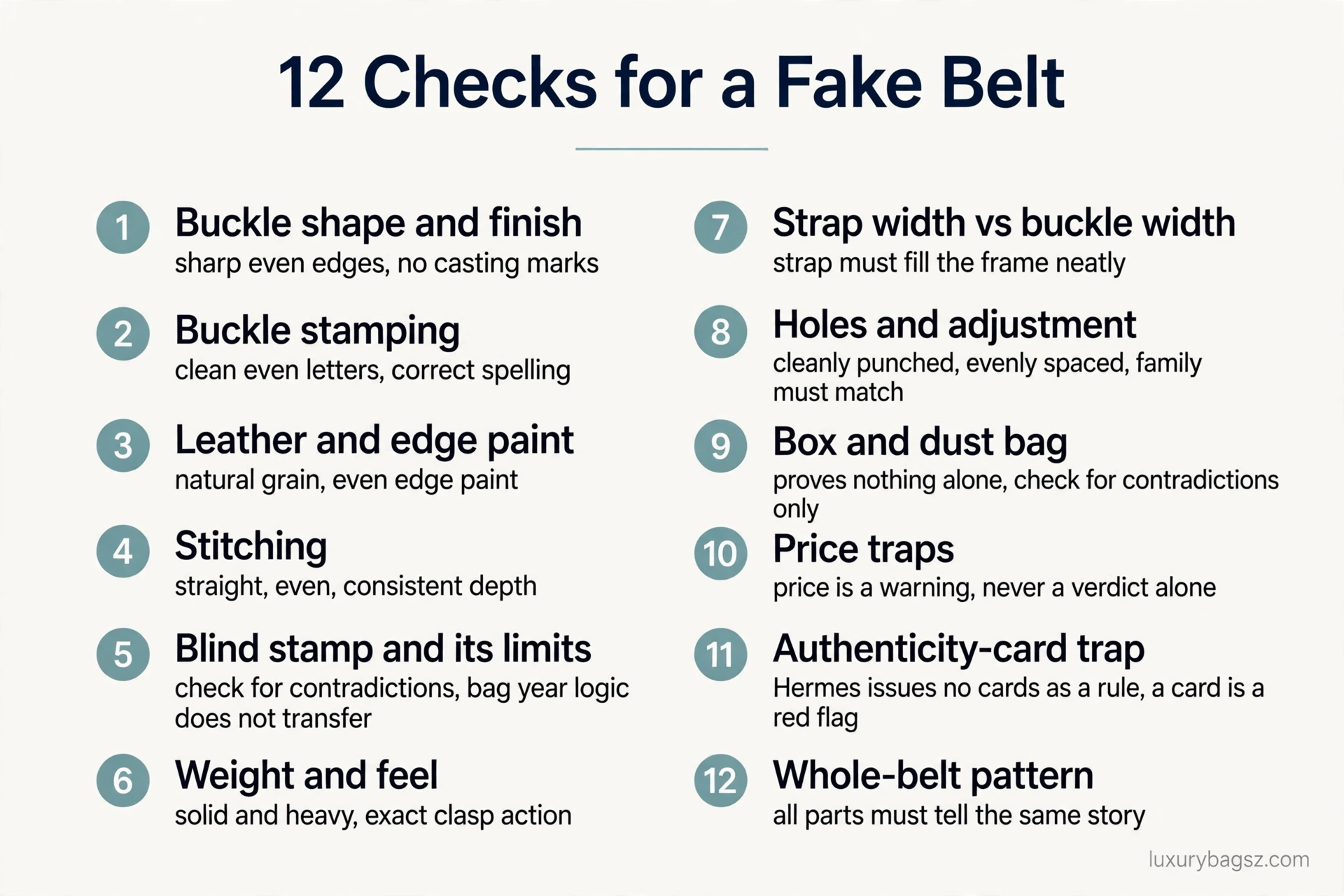
Spotting a Fake Belt in Brief
Can you tell a fake Hermès belt from one photograph? Almost never. One photograph can rule a belt out. A lopsided H, a misspelled stamp, or stitching that wanders off the edge can be enough to walk away. But no single photograph can rule a belt in, since good counterfeits are photographed to pass the one angle you are shown.
What is the fastest honest check? Start with the buckle, then the strap, then the stamps. Ask for a close-up of the buckle face, a close-up of the buckle back, a close-up of the stitching along one edge, and a close-up of the strap stamps. Use bright, natural light, with no filter. A genuine belt should pass all four without strain.
What about the stamps? Check them, but do not stop there. A genuine stamp is cleanly pressed, and its wording must fit the claimed material and origin. A stamp that breaks that pattern is a serious warning. But a correct-looking stamp is not proof, because stamps are among the easiest details to copy.
What is the one trap to avoid above all? Treating anything that came in the box as proof. Hermès issues no authenticity cards as a general rule. A card, a certificate, or a number to check online is a red flag, not reassurance. The same caution applies to a receipt photograph, a dust bag, and an orange box.
When should you walk away? When several checks fail at once, when the seller refuses the seller photographs listed in the seller photographs section, when the strap width does not fit the buckle, or when the seller pressures you to pay quickly, off-platform, or by a method with no buyer protection. Any one of those is a reason to pause. Two or more together are a reason to stop.
A fake Hermès belt is rarely caught by one dramatic giveaway. It is usually caught, or missed, by a pile of small details, checked in the right order, on the actual belt in front of you. That is why so many buyers get it wrong, and why so many guides get it wrong too. They give you five quick tells, you tick them off, and you feel safe, while the belt that fooled you passed all five easily.
This guide is written for a buyer, not for a professional authenticator, and it is honest about its limits. No guide, and no set of photographs, can give you a certain verdict on a high-grade counterfeit. What this guide can do is teach you to spot the large majority of fakes, to ask for the photographs that make a fake much harder to hide, and to know when to pay for professional authentication before you pay for the belt.
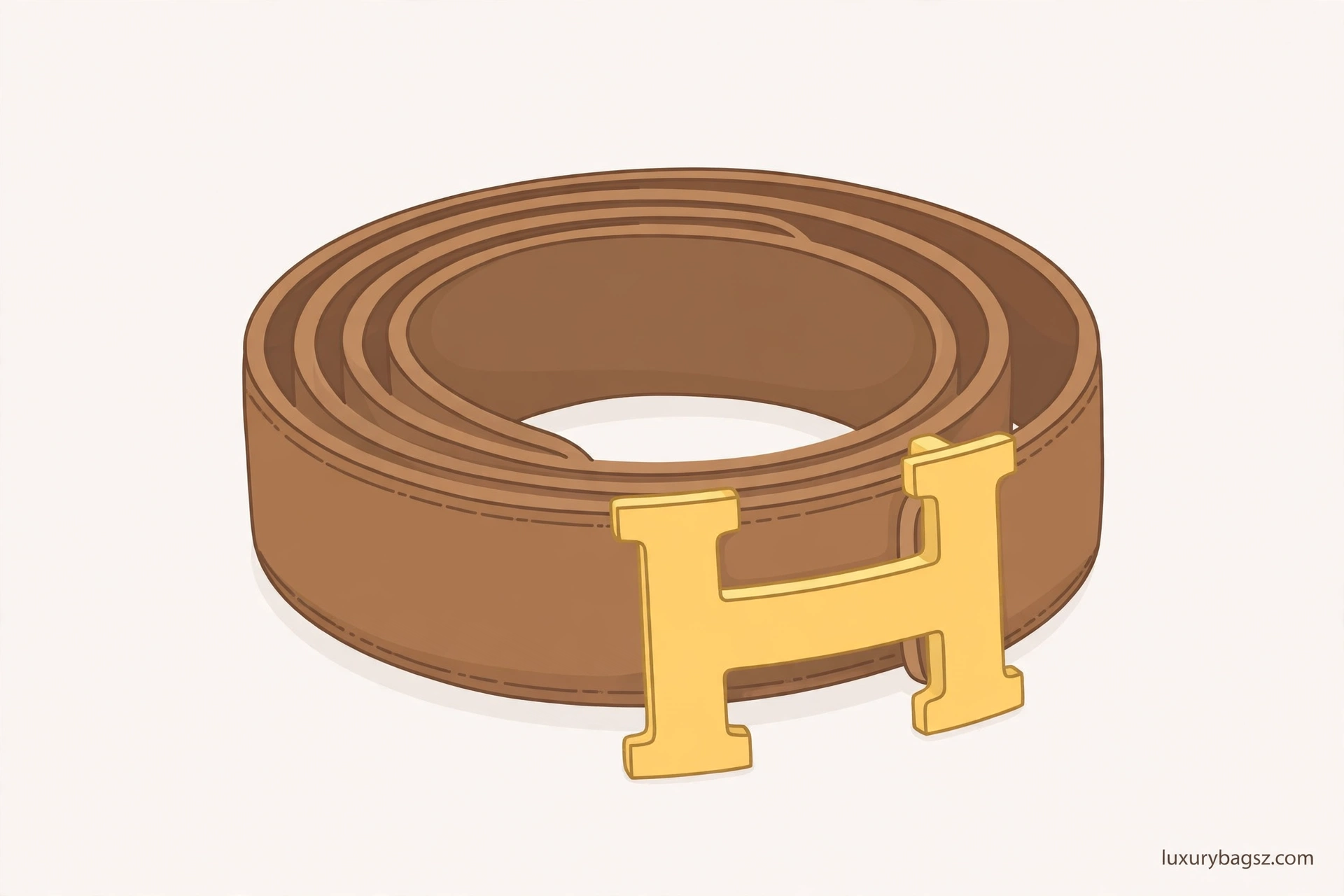
A note on the pictures in this guide, because it matters for an authentication article more than for any other kind. Every picture here is a generic illustration, not a photograph of a real Hermès belt. None of them should be used as a reference for what a genuine belt looks like in detail.
Illustrations simplify leather, flatten stitching, and tidy up edges. Where an illustration simplifies a detail, the words in this guide prevail. No illustration here is a genuine-versus-fake comparison photograph, and none should be presented as one.
A third note, just as important, and the one most guides get wrong: there is no single thing called “a Hermès belt” for authentication purposes. There are belt families, and they behave differently.
The classic Kelly 18 belt is single-sided and sliding-adjustable, not reversible. The reversible modular buckle-and-strap kit belongs to the H buckle and Constance family. A seller claiming a Kelly belt reverses is giving you a warning sign, not a feature.
Key Takeaways
- Judge a belt as a whole. No single check, stamp, price, photograph, card, or receipt proves a belt genuine. It is the pattern across all twelve checks that matters.
- Know the family first. The Kelly 18 belt is single-sided and sliding-adjustable, not reversible. The reversible kit belongs to the H buckle and Constance family.
- Hermès issues no authenticity cards as a general rule. A card supplied with a belt is a red flag, not reassurance. A missing card proves nothing on its own either.
- The buckle is the most underrated check. A genuine buckle is precise and cleanly finished, with sharp, even edges and no casting marks, bubbles, or chips.
- Stamping depth matters as much as stamping wording. Clean, evenly sized, consistent letters are the standard. Blurred, uneven, or overly deep letters are a common tell.
- Bag blind-stamp year logic does not transfer mechanically to belts. A belt stamp can be checked for sense and consistency, but it cannot date a belt the way a bag stamp is often said to date a bag.
- Strap width must fit the buckle. A strap that swims in, or is pinched by, its buckle is a strong fake tell, and one that a single buckle photograph can hide.
- A box, a ribbon, and a dust bag prove nothing on their own. All three are widely copied, and all three can be borrowed from a genuine purchase.
- Price is a warning, never a verdict on its own. A price far below any plausible range with no credible explanation is a reason to stop. A high price proves nothing either.
- Ask for twelve photographs before you pay, including the buckle face, the buckle back, the stitching close-up, the strap stamps, the holes, and the belt worn.
- If you already bought a belt and now doubt it, stop wearing it as proven genuine, keep everything that came with it, do not alter it, and get a professional opinion first. The already-bought section sets out the order.
With a Hermès belt, the buckle goes into my palm before I look at a single stamp. I weigh it, turn it over and study the H for balance: a genuine buckle has a clean shape, an even finish and honest heft, while copies arrive lopsided, thin or roughly cast. Then I check the buckle’s engraving against the strap’s blind stamp and date-code logic, and run the strap’s stitching along one edge. Having examined more than 500 bags and accessories by hand, I start with weight because it is the one quality a listing photograph cannot lend a fake.

Two Belt Families First — Do Not Mix Them Up
Before you check anything, work out which belt family the listing claims to sell. Most authentication mistakes start here, not at the buckle. Guides that treat every Hermès belt as one thing will tell you a genuine Kelly belt is fake because it does not reverse, or a fake H kit is genuine because it does reverse. Both errors come from the same confusion.
The H buckle and Constance family is a modular kit. You buy a buckle and a strap, and the strap is double-sided, with a different leather or colour on each side, so the belt reverses. The buckle is removable, and one buckle can be worn with different straps of the same width. Listings for this family usually give two colours, two leathers, a width in millimetres, and a length in centimetres.
The Kelly 18 belt is a different object. Its buckle mirrors the padlock turnlock of the Kelly bag, in gold or palladium, and the belt is usually made from calfskin, with exotic materials on custom pieces.
It is single-sided, and it adjusts by sliding, not by flipping the strap over. A seller who describes a Kelly belt as reversible, or shows it flipped to a second colour, is either selling a different family under the wrong name or selling a fake.
This family-first discipline is the same discipline behind a fake Kelly bag check. No one detail carries the verdict, and the whole pattern has to agree. Where a check below says “for an H kit” or “for a Kelly belt”, it means exactly that family, and it should not be applied to the other one.
If you are unsure whether you are looking at a Kelly belt or a piece from the wider Kelly line, the Kelly bracelet versus Kelly belt comparison is worth a read first. Belt buckles, bracelet clasps, and bag locks share a design language, and sellers mix them up often. Getting the family right costs you two minutes. Getting it wrong can cost you the whole purchase.
Check 1: Buckle Shape and Finish
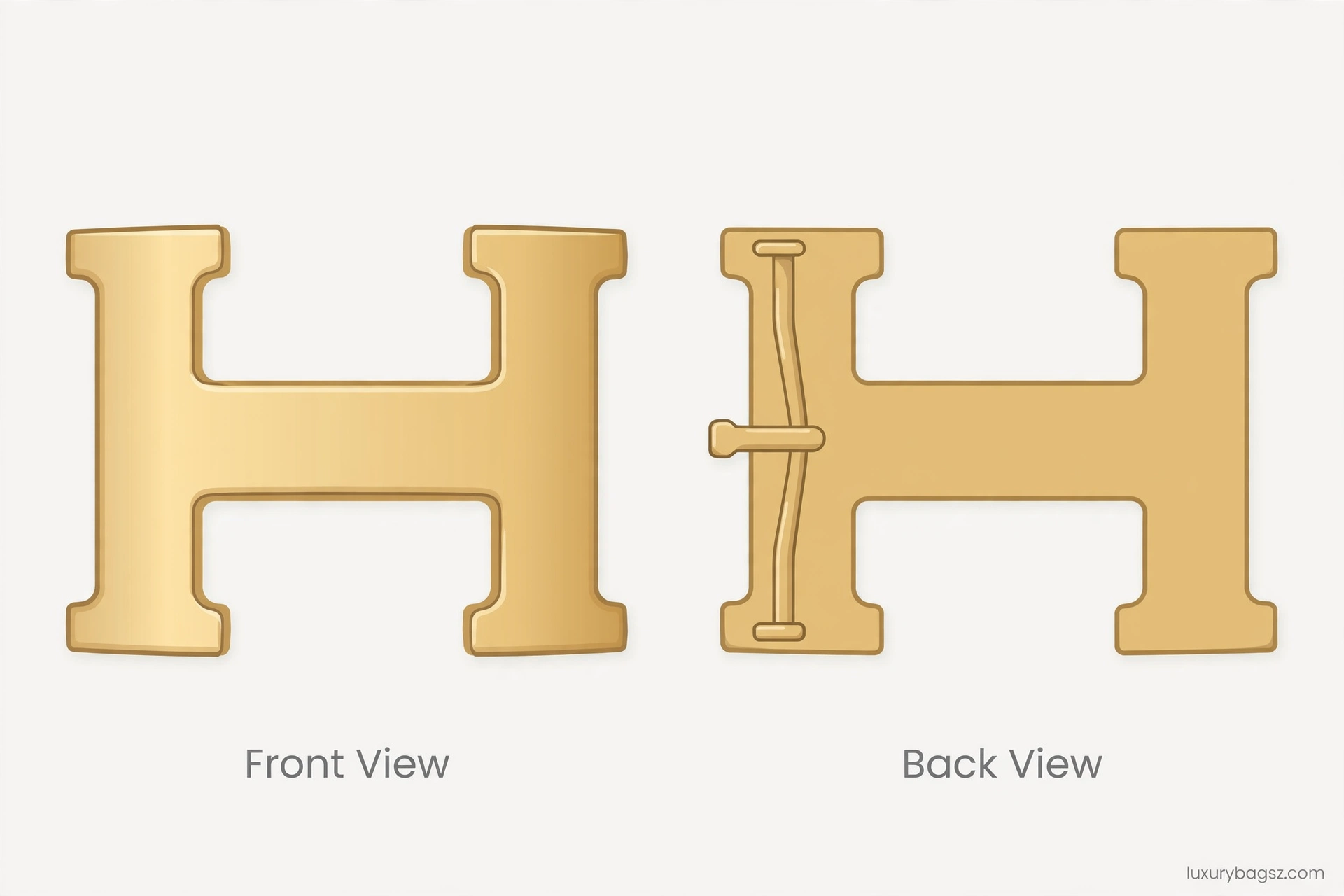
Start with the buckle in your hand, or in the largest, sharpest photograph you can get. A genuine Hermès buckle is a precise piece of metalwork. Its edges are defined, its corners are clean, and its faces are smooth, with no bubbles, chips, casting marks, or rough patches.
One long-running guide puts the difference well: the original edges are more defined, while fake buckles are more rounded around the corners. That softness is a casting tell, and it survives even on copies that get the colour right.
Look at the H itself first, on an H buckle. The two uprights should be straight, parallel, and the same width. The crossbar should sit level and centred. The letter should read as one clean shape, not as uprights that lean, differ in thickness, or meet the crossbar unevenly.
Finish comes next, and here you must handle a genuine conflict between sources, stated plainly rather than smoothed over. One guide says the genuine buckle is significantly shinier than a replica. Another guide says the opposite: the authentic buckle is less shiny, and the fake is shinier. A third guide says the back of the buckle is always matte, and that a shiny back means a replica. These three claims cannot all be true as general rules.
The honest way to use finish, given that conflict, is to compare finish within the belt, not against a single shininess rule. A genuine buckle should be consistent: the same plating quality across the face, the edges, and the back, with wear that matches the claimed condition. A buckle that is mirror-bright on the face but dull and rough on the back deserves suspicion.
Check 2: Buckle Stamping and Engraving
Turn the buckle over. The stamping on a genuine buckle is one of the most informative checks, and one of the most misdescribed. Guides disagree about exactly where the stamp sits, and that disagreement matters, so it is stated here rather than hidden.
One guide says the Hermès logo is always on the back of the buckle, and that a belt is false if it is not visible there. Another guide says the stamp is on the bottom of the buckle, and that it will never be on the back. Both cannot be right as a universal rule.
What the guides do agree on is more useful than where they differ. The stamp should be perfectly placed, clear, and correctly spelled, in a font that matches the brand’s own lettering. The accent over the second “e” in Hermès is a frequent fake tell, and several guides treat a missing accent as a warning.
But here too there is variation to respect. One detailed Constance guide notes that authentic buckles may carry the word with a downward slash, without a slash, and that many newer buckles carry dashes on either side of the word. A missing accent alone, on an otherwise perfect buckle, is a question to investigate, not an automatic verdict.
Read the stamp letter by letter. Counterfeit stamps are often too thick, too thin, unevenly sized, or pressed too deeply in places and too shallowly in others. One guide contrasts authentic letters, consistently sized with thinner stamping, against fake letters, inconsistently sized and stamped too deeply.
Another guide says the opposite about thickness, claiming fake lettering is thinner and smaller. The wording conflict itself is the lesson: do not judge a stamp by one thickness rule. Judge it by consistency within itself, by clean edges on every letter, and by correct spelling and spacing.
Check 3: Strap Leather and Edge Paint
The strap is where most buyers spend the least time and where many fakes give themselves away. Hermès uses high-quality leathers, and the well-known names recur across guides: Box calf, Epsom, Togo, and other calfskins, with exotic skins on custom pieces.
What matters is not the name on the listing, but whether the leather in front of you behaves like the leather claimed, and whether it is consistent across the whole strap and, for a reversible kit, across both sides.
Feel comes first when the belt is in your hand. Genuine Hermès leather is supple, with a natural grain and a soft, rich feel, and it should not smell of chemicals, glue, or plastic. A strong synthetic or adhesive smell is a warning, though it is not proof on its own, since a belt stored badly or cleaned wrongly can pick up an odd smell.
Look at the strap as a single piece of leather, not as a surface. One Kelly belt guide makes a point worth repeating: genuine Kelly belts use a single, dense piece of leather, while imitations often sandwich filler material, such as foam, between thinner layers. A strap that feels puffy or hollow, or that shows a foam core at a cut edge, has failed this check.
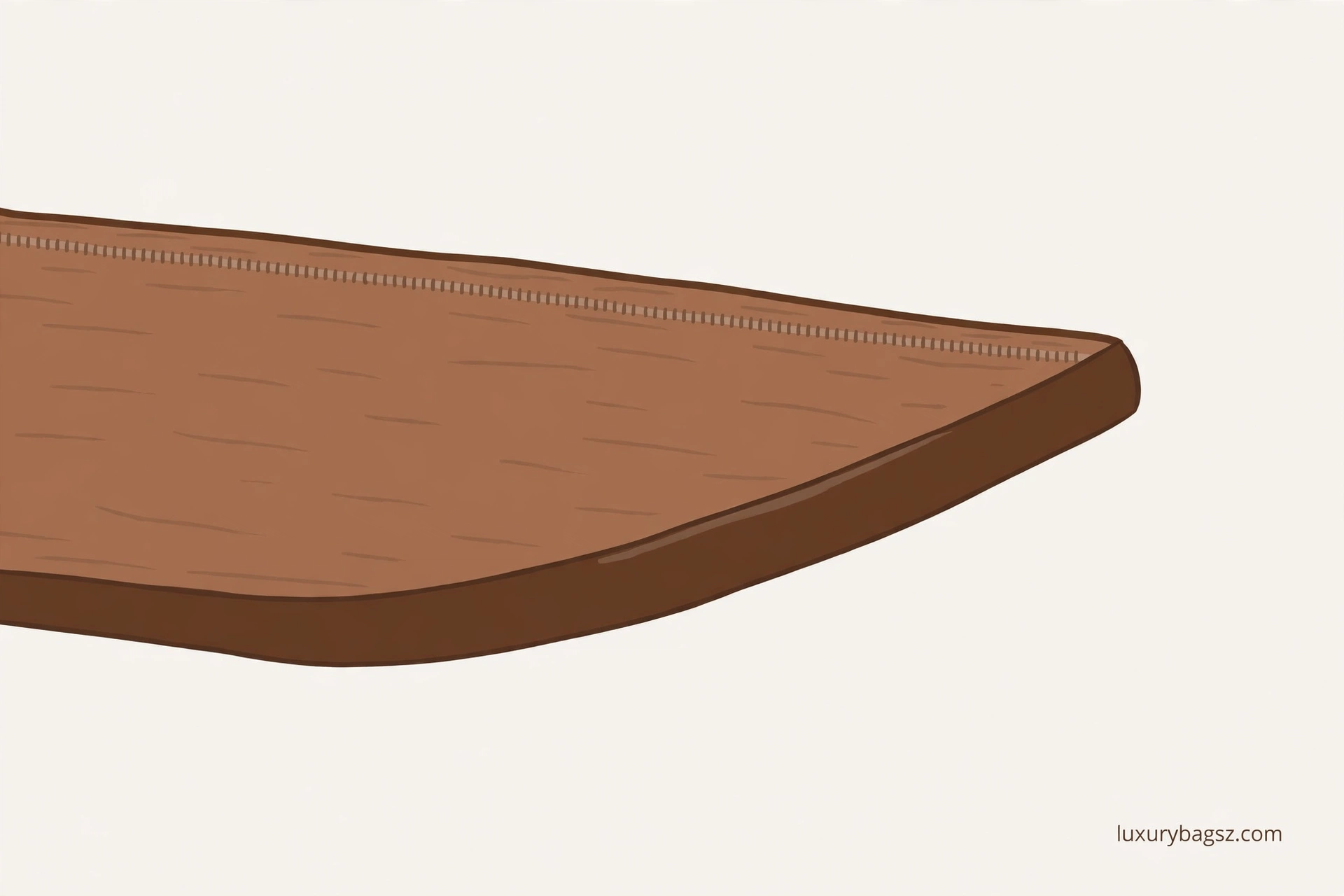
Edge paint is the detail most buyers skip, and it repays attention. The edges of a genuine strap are finished cleanly, with paint that is even, smooth, and the right colour for the leather, with no drips, bubbles, or overlaps onto the face of the strap.
Counterfeit edge paint is often too thick, too glossy, uneven, or slightly the wrong shade. It also cracks and peels sooner. On a used belt, light edge wear is normal. What is not normal is edge paint that lifts in sheets, or that stops and starts along the same edge.
For a reversible H kit, check both sides as separate leathers. Each side should be a full, proper leather in its own right, with its own grain, colour, and finish, not a thin veneer over a single core. Several guides stress that the two sides need not be different colours, despite claims elsewhere that they must be.
Same-colour reversible kits exist, so do not treat matching colours as a fake tell. What you should treat as a tell is a second side that looks and feels like an afterthought: thinner, rougher, or finished differently from the first side.
Care mistakes can mimic fakery here, so keep the two apart. A strap dried out by heat, or damaged by the wrong cleaner, can look rough and feel stiff without being fake. If you own a belt and are unsure about its leather, a Saphir Renovateur routine is the safe, standard approach for smooth leather.
For suede straps, a suede brush is the right tool instead. Neither product can turn a fake into a genuine belt, and neither should be used to judge a belt you have not yet bought.
Check 4: Stitching
Stitching is the check that most guides name first, and for good reason. When a Hermès belt is new, its stitching is straight, symmetrical, and free of nicks or blemishes. Every thread is in place, the stitches are even, and none of them are split.
Look along the whole edge, not at one neat stretch. Counterfeit stitching often looks acceptable in the middle of a run and fails near the buckle, near the tip, or where the strap curves. Check for stitches that bunch up, taper unevenly, or wander away from the edge.
Thread matters as much as spacing. Genuine thread is matte, strong, and consistent in thickness and colour. Glossy thread, thread that breaks when pulled lightly, or thread whose colour does not match the leather are all warnings.
Stitch counts deserve a warning of their own, because one guide publishes precise numbers: 9 to 10 stitches per inch for 32 mm belts, 8 to 9 for 36 mm belts, and 7 to 8 for 41 mm belts. Those numbers may describe the examples that guide examined, but they are not a universal pass-or-fail table.
Check 5: Blind Stamp and Date-Code Logic — and Its Limits
This is the check most buyers over-trust, and the one where this guide most plainly disagrees with the simpler guides. A genuine Hermès belt strap carries stamps, and the best-known set is the brand stamp, the size in centimetres, and a letter mark that relates to the year of manufacture.
One detailed Constance guide lists exactly three stamps on one side of the strap: the Hermès Paris made-in stamp, the size number, and a letter inside a circle or square for the year. That guide adds a useful refinement: earlier year marks in circles, and square marks with A or B, tend to pair with a gold or silver brand stamp.
Square marks with C or later tend to pair with a clear imprint stamp instead. Those details are worth checking. A belt missing a stamp it should carry, with no sign of severe rubbing to explain the loss, deserves suspicion. A size given in inches rather than centimetres is a warning, since Hermès gives belt sizes in centimetres.
A year letter in a shape that does not fit the claimed era, or a brand stamp in a finish that contradicts the year mark, is a reason to stop and investigate. Ask for a close-up of every stamp, not just the brand stamp, and check that the three marks agree with each other and with the listing.
A table built for Birkin or Kelly bags cannot be laid over a belt strap and treated as a verdict. A letter that dates a bag to one year does not automatically date a belt to the same year. A belt with no visible year mark is not automatically fake, since stamps wear, placement varies, and some belts carry marks in places one photograph misses.
Second, stamps are among the easiest details to copy. Counterfeiters copy the brand stamp, the size number, and the year letter together, and they copy them well enough to pass a casual look. A correct-looking stamp therefore proves very little on its own.
What stamps can do, reliably, is contradict a listing. A stamp that contradicts the claimed size, family, or era is a genuine warning. A stamp that agrees with the listing is merely consistent, not conclusive.
Check 6: Hardware Weight and Feel
Pick the buckle up. A genuine Hermès buckle is solid, never hollow, and it feels heavy in the hand. That weight is one of the first things buyers notice, and one of the hardest things for cheap copies to reproduce, because solid metal costs money and hollow copies save it.
A small 24 mm buckle will naturally weigh less than a large 42 mm buckle, and a brushed finish can feel different from a polished one without being fake. The test is comparative, not absolute: does this buckle feel right for its claimed family and size, and does it feel solid through its whole shape, with no thin, flexing, or rattling part?
Feel extends beyond weight. The clasp or turnlock action on a Kelly buckle should be tight and exact, not loose and imprecise. The prong on an H kit buckle should move smoothly and sit firmly. The buckle should not rattle when shaken gently, and its moving parts should not wobble.
Counterfeit mechanisms are often loose because their tolerances are wider, and that looseness shows up in the hand long before it shows up in a photograph. If you are buying online, ask the seller to describe the clasp action in words, and to film it closing and opening, since a still photograph cannot show it at all.
A strap that twists sharply may simply have been stored badly, so treat this as a supporting clue, not a verdict. But a strap that cannot hold a straight line at all, combined with light hardware, is a pattern worth taking seriously.
Check 7: Strap Width Against Buckle Width
This is a short check, and it catches a surprising number of fakes. Hermès belt kits are made in matched widths: a buckle made for a 32 mm strap goes with a 32 mm strap, and a buckle made for a 38 mm strap goes with a 38 mm strap. The strap should fill the buckle frame neatly, with no visible gap at the sides and no pinching or bunching where strap meets buckle.
A mismatch is a strong tell, because it usually means the seller, or the counterfeiter, has paired parts that were never meant to go together. A strap that is too narrow will sit loosely, slide sideways, and show daylight at the edges. A strap that is too wide will bunch, crease, or show stress marks where it has been forced into the frame.
The listing should state the strap width in millimetres and the belt length in centimetres. Ask for a photograph of the strap measured with a ruler or tape, taken from directly above, with the ruler flat against the leather. A seller who gives the width in inches only, or who refuses to measure, has not given you enough to run this check.
But a width mismatch between the two parts of the same belt is not a variation. It is a fault, and it should weigh heavily in your verdict.
Check 8: Holes, Prong, and How the Belt Adjusts
How a belt adjusts tells you which family you are holding, and whether the belt is honest about it. A Kelly 18 belt adjusts by sliding. It has no row of punched holes in the way a conventional belt does, and its adjustment is part of its design, not an afterthought.
An H kit strap, by contrast, carries a row of holes for the prong, and the spacing, shape, and finish of those holes are worth a close look. Start with the holes themselves, on any belt that has them. One guide notes that genuine holes are smaller and narrower, while fake holes are bigger and wider.
That check applies best to unworn or gently worn belts, since heavy use can stretch holes. That caution matters. A stretched hole on a heavily worn belt is wear, not fakery. But on a belt claimed as new or barely worn, holes that are oversized, ragged, torn, or unevenly spaced are a warning.
Each hole should be cleanly punched, with smooth edges and no fraying, cracking, or flaking of the leather around it. Check the hole spacing and count against the claimed length. A belt of a given length should carry a sensible number of holes at even intervals, with the first and last holes placed where the claimed size says they should be.
A belt whose holes crowd together at one end, or whose spacing changes halfway along, has either been altered or was never made to the claimed pattern. Added holes are a particular warning: a hole punched later will usually differ in size, shape, or edge finish from the factory holes, and it will often sit slightly off the centre line.
Check the prong and its seating. The prong should be the right length for the strap thickness, should sit centrally in the hole, and should not wobble, bend, or show casting roughness. On a Kelly sliding belt, check the sliding mechanism instead: it should move smoothly, hold its position under light tension, and show no grinding, catching, or looseness.
A sliding belt that slips under its own weight, or that needs force to move at all, has a mechanism fault, and a mechanism fault on a claimed genuine belt deserves professional attention before purchase. Finally, test the adjustment story against the family story.
Check 9: Box and Dust Bag
The box and the dust bag are the most photographed and least informative parts of any belt listing. A genuine Hermès belt arrives in an orange box, tied with a ribbon, with a dust bag for the strap and often a separate small dust bag for the buckle. Counterfeiters know this, and they copy all of it.
That is why this check is about catching contradictions, not granting verdicts. Look at the box with a sceptical eye. Guides describe the genuine box as orange, with consistent lettering thickness on the logo, the brand name, and the place name, and with nothing stamped or printed inside the box.
A box with a round stamp inside, with misaligned or crooked borders, with thin or uneven lettering, or with a ribbon that carries the wrong logo, is a fake box. But a fake box does not automatically prove a fake belt, and a genuine-looking box does not prove a genuine belt, because boxes are borrowed, bought separately, and reused.
The dust bag deserves the same treatment. Guides compare the thickness of the letter and the circle in the dust bag logo, with genuine examples showing a thicker, bolder mark and copies showing a thinner one. That comparison can catch a poor copy, but it cannot authenticate a belt, because dust bags are among the most widely copied and most easily borrowed items in the resale market.
A dust bag in the wrong colour, with a burgundy stamp where no genuine bag carries one, or with a logo that does not match the claimed era, is a question to ask. A perfect dust bag is not an answer. The strongest packaging warning is not about the box or the bag at all. It is about what else the seller includes.
Judge the belt, not its packaging. If the belt passes its checks and the box looks slightly off, the belt may still be genuine with a replaced or borrowed box, and professional authentication can settle it. If the belt fails its checks and the box looks perfect, the box has told you nothing, and the belt has told you everything.
Check 10: Price Traps
Price is a warning, never a verdict on its own, but it is a warning that catches more buyers than any other single check. A price far below any plausible range for that kit and condition, with no credible explanation, is a reason to stop. A price that looks normal proves nothing, since expensive fakes are common.
A genuine belt can also be listed cheaply by a seller who needs a quick sale or has misidentified what they own. Use price to decide how careful to be, not to decide the verdict. This guide gives no market average, because averages mislead.
Belt prices vary by family, by width, by buckle finish, by leather, by colour, by length, and by condition, and any single average hides all of that variation. Instead, here are dated single-listing examples, each tied to one real listing seen during research, so you can see the spread rather than a smoothed-over number.
A Madison Avenue Couture listing seen during research priced a pristine, never-worn 32 mm reversible black and orange Constance H kit, 80 cm, with a brushed gold buckle, at $1,100, and it was out of stock at that price. A second dated example points the other way.
A Queen Station listing seen during research offered a 100 cm reversible H kit in orange and brown leather, in excellent used condition, at €420, while stating a retail price of €660 for that combination. A third Queen Station listing offered a 90 cm reversible kit in etoupe and black leather at €370, while stating a retail price of €755.
The gap between the two stated retail prices, €660 and €755, for similar 32 mm kits, shows why no single price can be treated as the price. Retail varies by combination, by market, and by year, and resale varies by condition and by seller. What should worry you is not a low price on its own, but a low price with a story that does not hold together.
Check 11: The Authenticity-Card Trap
No trap in belt authentication is as confident, as common, or as wrong as the authenticity card. A seller shows an orange card, a certificate, a plastic card, or a printed document, and presents it as proof. Sometimes the card carries a number, and the seller invites you to check that number online.
The detailed Constance guide states it directly: authentic Hermès belts do not come with an orange authenticity card, and the card is something that replicas come with. The same guide adds that an authentic belt box should not carry a stamp inside it, which is another mark that appears on counterfeit packaging.
A belt sold with a card, a certificate, or a check-online number has therefore arrived with a story that contradicts how Hermès actually sells belts. A missing card proves nothing on its own, and that half of the rule matters just as much. A genuine belt sold without a card is normal, because no card was ever issued with it.
The same logic applies to receipts, and to serial-number checks. A receipt photograph can be borrowed from another purchase, printed at home, or bought with a fake. A receipt that matches the belt in every detail is consistent, not conclusive. A receipt that contradicts the belt, in date, in model, in price, or in store, is a genuine warning.
There is no public database in which a buyer can type a belt code and receive a genuine-or-fake verdict. Any seller who offers such a check, or who links you to a website that claims to offer one, is either mistaken or trying to mislead you. If a listing leads with the card, treat the listing with extra care from the start.
Check 12: The Whole Belt, Judged as One Pattern
The twelfth check is not a new place to look. It is a discipline for looking at everything you have already seen, together. A belt is genuine when its buckle, its strap, its stitching, its stamps, its width, its holes, its packaging, and its price all tell the same story, about the same family, the same era, and the same condition.
A belt is suspect when those stories disagree, even if each part looks acceptable on its own. Run the pattern test in three passes. First, the family pass: does everything belong to the claimed family? A Kelly buckle on a reversible strap, or an H buckle on a single-sided strap with a sliding adjuster, fails this pass.
Second, the era pass: do the stamps, the stamp finishes, the buckle markings, and the packaging agree on a plausible era? A year mark that contradicts the stamp finish, or a dust bag logo that belongs to a different decade from the buckle, fails this pass.
Third, the condition pass: does the wear match the claimed condition? A belt claimed as new should not show stretched holes, flaking edge paint, and a pitted buckle. A belt claimed as heavily worn should not show perfect stitching and a flawless buckle.
A fake Evelyne check, a fake Geta check, a fake Lindy check, and a fake Oran check all reach the same conclusion by different routes.
No one detail carries the verdict. The whole pattern has to agree.
Write your verdict down before you pay. List each check, mark it as pass, fail, or unknown, and count the unknowns honestly. A belt with three unknowns and no fails is not a proven genuine belt. It is an unproven belt, and the unknowns are the reason to ask for more photographs, or to pay for professional authentication.
Traps That Prove Nothing
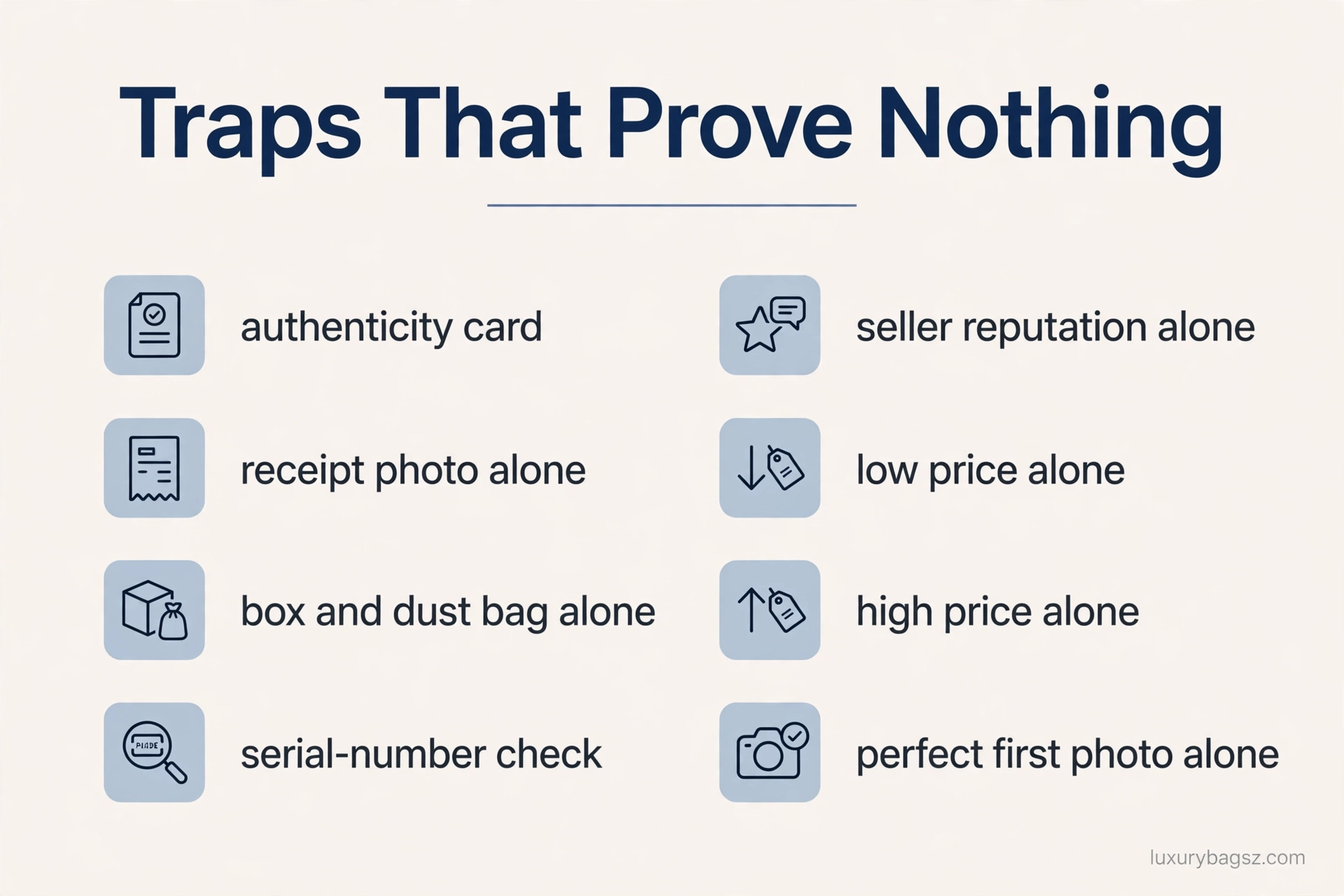
Some evidence feels reassuring and proves nothing at all. This part collects the traps in one place, so you can recognise them when a listing leans on them. The rule for every trap is the same: it can support a verdict reached through the twelve checks, but it can never replace those checks.
An authenticity card proves nothing, and a missing card proves nothing either, for the reasons given in the authenticity-card trap section. A receipt photograph proves nothing on its own, because receipts are borrowed and printed. A box and a dust bag prove nothing on their own, because both are copied and borrowed, as the box and dust bag check explains.
A serial-number or code check proves nothing, because there is no public Hermès database that gives a buyer a genuine-or-fake verdict for a belt. Seller reputation alone proves nothing either. A seller with many positive reviews can still list a fake, sometimes unknowingly, after buying it themselves.
A new seller with no reviews can still list a genuine belt. Reputation is a reason to trust the seller’s willingness to answer questions and accept returns, not a reason to skip the checks. The same applies to platform badges and to professional-looking photographs.
Seller Photos to Demand Before You Pay
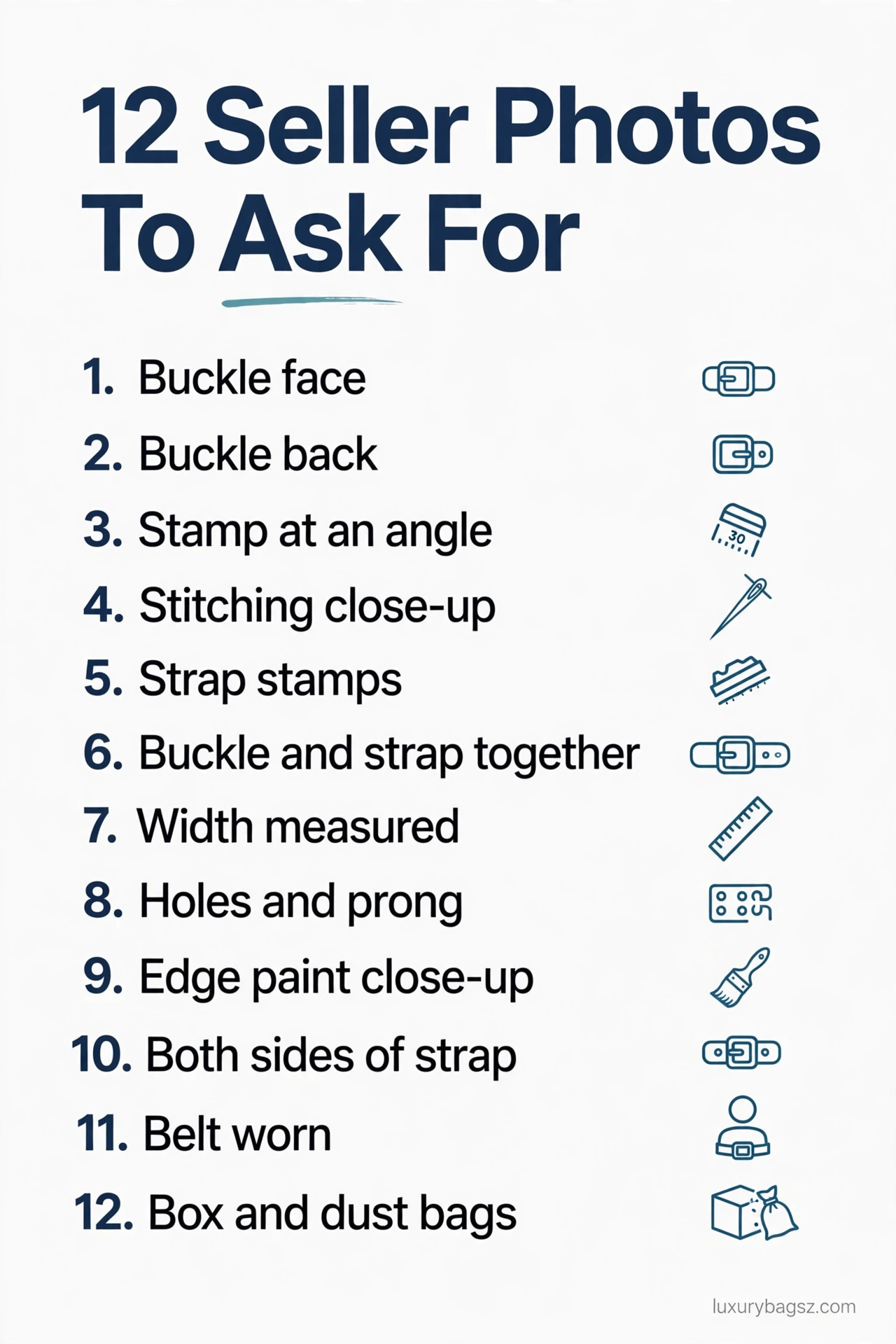
Do not pay for a belt you have only seen from one angle. Ask for twelve photographs, in bright, natural light, with no filter, and with the belt out of its box and dust bag. A seller who can supply them easily is usually a seller with nothing to hide.
Ask for these twelve, in this order. First, the buckle face, straight on, filling the frame. Second, the back of the buckle, straight on, with the stamp in focus. Third, the same stamp at a slight angle, so its depth shows.
Fourth, a close-up of the stitching along one full edge, from buckle to tip. Fifth, a close-up of the strap stamps, including the brand stamp, the size, and the year mark, all in one frame if possible. Sixth, a straight-on photograph of the buckle and strap together, showing how the strap sits in the buckle frame.
Seventh, a photograph of the strap measured with a ruler, showing the width in millimetres, plus the belt length in centimetres if the seller will supply both. Eighth, a close-up of the holes and the prong, or of the sliding mechanism on a Kelly belt.
Ninth, a close-up of one edge of the strap, showing the edge paint and the leather layers. Tenth, a photograph of both sides of the strap, for a reversible kit, or of the full single side for a Kelly belt, so the family claim can be checked.
Eleventh, a photograph of the belt worn, or draped naturally, so its drape, proportions, and buckle size can be judged in use. Twelfth, a photograph of the box, the dust bags, and anything else included, not as proof, but so you can check for the contradictions described in parts 11 and 13.
Judge the photographs as a set, not one by one. A set that is sharp, consistent in lighting and background, and complete across all twelve requests is consistent with a genuine seller. A set that mixes stock photographs with real ones, or that stays soft exactly where a stamp or a stitch should be sharp, deserves questions.
If you later need professional authentication, or a return, the original photographs and the original description are your evidence. Screenshots with dates are better than memory. If the listing changes after you buy, or the seller deletes photographs, your saved copies are the record of what was actually offered.
If You Already Bought One
If you have already bought a belt and now doubt it, do not panic, and do not make the situation worse. Follow this order, and do not skip steps because you feel embarrassed or angry. Many buyers in this position bought in good faith, and many belts that raise doubts turn out to be genuine.
First, stop wearing it as a proven genuine belt. Put it aside, in a safe place, and do not lend it, photograph it for resale, or describe it to anyone as genuine until you have an opinion you can rely on. Second, keep everything that came with it: the box, the dust bags, the ribbon, any card, any receipt, and the packaging it arrived in.
Third, keep the listing, the seller’s messages, the payment record, and the photographs you were sent. These are your evidence, and they matter more than any later argument about what was said. Fourth, do not alter the belt. Do not polish it, dye it, repair it, or add holes until you have a professional opinion.
Alteration can destroy the very details an authenticator needs to see, and it can weaken a return claim, since a seller can argue that you changed the item after purchase. If the belt is dirty, leave it dirty for now. A careful clean Chanel bags routine is a different subject, for a different brand and material, and it should not be borrowed as a belt-cleaning method here.
Fifth, run the twelve checks again, calmly, against the belt in your hand, and write down your verdict for each check, including the unknowns. That written record is useful for an authenticator, and it stops a single worrying detail from growing into a certainty in your mind.
If the belt is genuine, you can wear it with confidence. If it is fake, contact the seller first, in writing, with the authenticator’s opinion attached, and ask for a return under the platform’s rules and deadlines. If the seller refuses, escalate through the platform, and then through your payment provider, within their time limits.
Storage matters while you wait. Keep the belt flat, cool, and dry, away from heat and sunlight, with the buckle protected so it cannot scratch the leather. The same flat, cool storage that suits a belt also suits a bag, and the advice for how to store a Hermes Kelly bag covers the same principles of keeping leather unstressed and protected.
When to Pay for Professional Authentication
Professional authentication is not a last resort. It is a normal part of buying a belt at this price, and this part sets out when it is worth paying for, what to expect, and what it cannot do. When the stakes are high and the evidence is mixed, pay for an opinion before you pay for the belt.
Pay for authentication whenever the belt passes your checks but the price is high, the seller is unknown to you, or the colour combination is desirable or rare. Pay for it whenever the belt has two or more unknowns you cannot resolve from photographs, whenever the stamps contradict each other, and whenever the seller’s story and the belt’s details disagree.
Be wary of any service that promises an instant verdict from one photograph, that charges far less than every other service, or that offers to authenticate from a card number or a code alone. A serious opinion takes time, examines the whole pattern, and states its limits honestly, including when a belt cannot be judged from photographs alone.
Understand what an opinion can and cannot do. A reputable authenticator can give you a well-grounded judgement, with reasons, based on the belt or the photograph set supplied. No authenticator can give you absolute certainty on a high-grade counterfeit from photographs alone, and no opinion replaces your own checks.
Use the opinion as the final check in your pattern, not as a substitute for the other eleven. If an authenticator’s opinion contradicts your own pattern, ask why, and weigh the reasons, rather than simply accepting the answer you hoped for. Finally, treat authentication as protection for the seller as well as for you.
A seller who welcomes pre-purchase authentication, who supplies the twelve photographs, and who accepts a return if a reputable authenticator disagrees, is a seller whose confidence rests on the belt itself. A seller who discourages authentication, or who insists that a card settles the matter, is telling you something important. Listen to it, and walk away if you need to.
Frequently Asked Questions
Can a fake Hermès belt pass all twelve checks?
A high-grade counterfeit can pass many checks, and in rare cases it can pass all twelve as judged from photographs alone. That is why this guide is honest about its limits, and why professional authentication matters at this price. The twelve checks catch the large majority of fakes, but they are not a guarantee.
Is a Kelly belt reversible?
No. The classic Kelly 18 belt is single-sided and sliding-adjustable, not reversible. The reversible modular buckle-and-strap kit belongs to the H buckle and Constance family. A seller claiming a Kelly belt reverses, or showing it flipped to a second colour, is giving you a warning sign. Either the belt belongs to a different family and is misnamed, or it is a fake.
Does Hermès issue authenticity cards with belts?
No, as a general rule Hermès issues no authenticity cards with belts. A card, a certificate, or a check-online number supplied with a belt is a red flag, not proof. A missing card proves nothing on its own either, since no card was ever issued. Judge the belt through the twelve checks, not through paperwork that Hermès does not issue.
Can I date a belt from its blind stamp the way bag guides date bags?
Not mechanically, no. Belt stamps can be checked for sense and consistency, and a stamp that contradicts the claimed size, family, or era is a genuine warning. But bag blind-stamp year logic does not transfer directly to belts, whose stamps, placement, and conventions have their own history. A stamp that agrees with the listing is consistent, not conclusive, and a belt with no visible year mark is not automatically fake.
What is the single strongest fake tell on a belt?
There is no single strongest tell that works for every belt, and any guide that names one should be treated with suspicion. In practice, the most productive places to look are the buckle shape and finish, the stitching along a full edge, and the strap width against the buckle width, because those three are hard to fake cheaply and hard to hide in photographs.
Should I buy a belt buckle and strap separately?
You can, but you must authenticate the pair, not just the better-looking part. A genuine buckle can arrive with a fake strap, and a fake buckle can arrive with a genuine strap. Check the width fit, the stamp consistency, and the condition match between the two parts. A buckle and strap that disagree on width, era, or condition are not a genuine kit, whatever each part looks like on its own.
Does a low price always mean a belt is fake?
No. A low price is a warning, never a verdict on its own. A genuine belt can be listed cheaply by a seller who needs a quick sale, who has misidentified what they own, or who is selling an unpopular length or colour. What matters is the price together with the story: a very low price, from a new seller, with no returns, and with pressure to pay off-platform, is a pattern.
Can I trust a receipt or a box that comes with the belt?
Not on their own, no. Receipts can be borrowed or printed, boxes can be borrowed or copied, and dust bags are among the most widely copied items in the resale market. A receipt or box that contradicts the belt, in date, model, price, or store, is a genuine warning. A receipt or box that agrees with the belt is merely consistent.
What photographs should I ask a seller for?
Ask for twelve photographs, listed in full in the seller photographs section, including the buckle face, the buckle back, the stamp at an angle, the stitching along a full edge, the strap stamps, the buckle and strap together, the width measured with a ruler, the holes and prong, the edge paint, both sides of a reversible strap, the belt worn, and the box and dust bags.
A seller who cannot or will not supply them has not given you enough to buy safely, however good the first photograph looks.
What should I do if I already bought a belt and now think it is fake?
Stop wearing it as a proven genuine belt, keep everything that came with it, do not alter, polish, dye, or repair it, and keep the listing, the messages, and the payment record. Run the twelve checks again in writing, then get a professional opinion from a reputable Hermès authenticator.
If the opinion says the belt is fake, contact the seller in writing with the opinion attached, and escalate through the platform and your payment provider within their time limits if the seller refuses a return.
My Belt Rule: Weight in the Palm Before Any Stamp
Spotting a fake Hermès belt is not about memorising one trick. It is about knowing which family you are holding, checking the buckle, the leather, the stitching, and the stamps in order, and refusing to let any single detail, or any piece of packaging, outvote the rest of the evidence.
The buyers who get caught are rarely careless. They are usually buyers who checked one thing well, trusted a card or a box, or fell in love with a first photograph and stopped looking.
The discipline in this guide is deliberately slow, and deliberately boring. Know the family first, so a Kelly belt is never judged as if it should reverse. Look at the buckle as a shape, not as a logo, since shape is harder to copy than lettering. Read the stamps for contradictions, not for verdicts, since stamps are easy to copy and bag year logic does not transfer mechanically to belts.
Measure the width, count the pattern rather than the price, and ask for twelve photographs before you pay. Write your verdict down, check by check, including the unknowns, and let the pattern decide. Where sources disagree, as they do on buckle shininess, on stamp placement, and on stitch counts, this guide has said so plainly rather than picking the version that sounds tidiest.
That honesty is part of the method. A guide that hides its disagreements will mislead you on the next belt, even if it happens to be right on this one. If you remember one sentence from this guide, make it this one. Judge the belt, not its box, not its card, and not its first photograph, and when the pattern is mixed or the price is high, pay for a professional opinion before you pay for the belt.
There will always be another belt, in another listing, from another seller. There is no reason to buy this one under pressure, on incomplete evidence, or on the strength of a document that Hermès never issued. Walk away when you need to, and buy with confidence when the whole pattern agrees.
A belt gives you the whole Hermès argument in miniature: buckle weight, engraving depth, stitching and leather in a single strip. I run those checks in that order — the same order I have used across more than ten years of checking bags — because on a piece this size, one wrong detail has nowhere to hide.






