

How to Wash a Hermès Silk Scarf Safely: The Careful Hand-Wash Method, the Care-Label Decision, and When to Use a Professional
The Careful Hand Wash, and When to Skip It
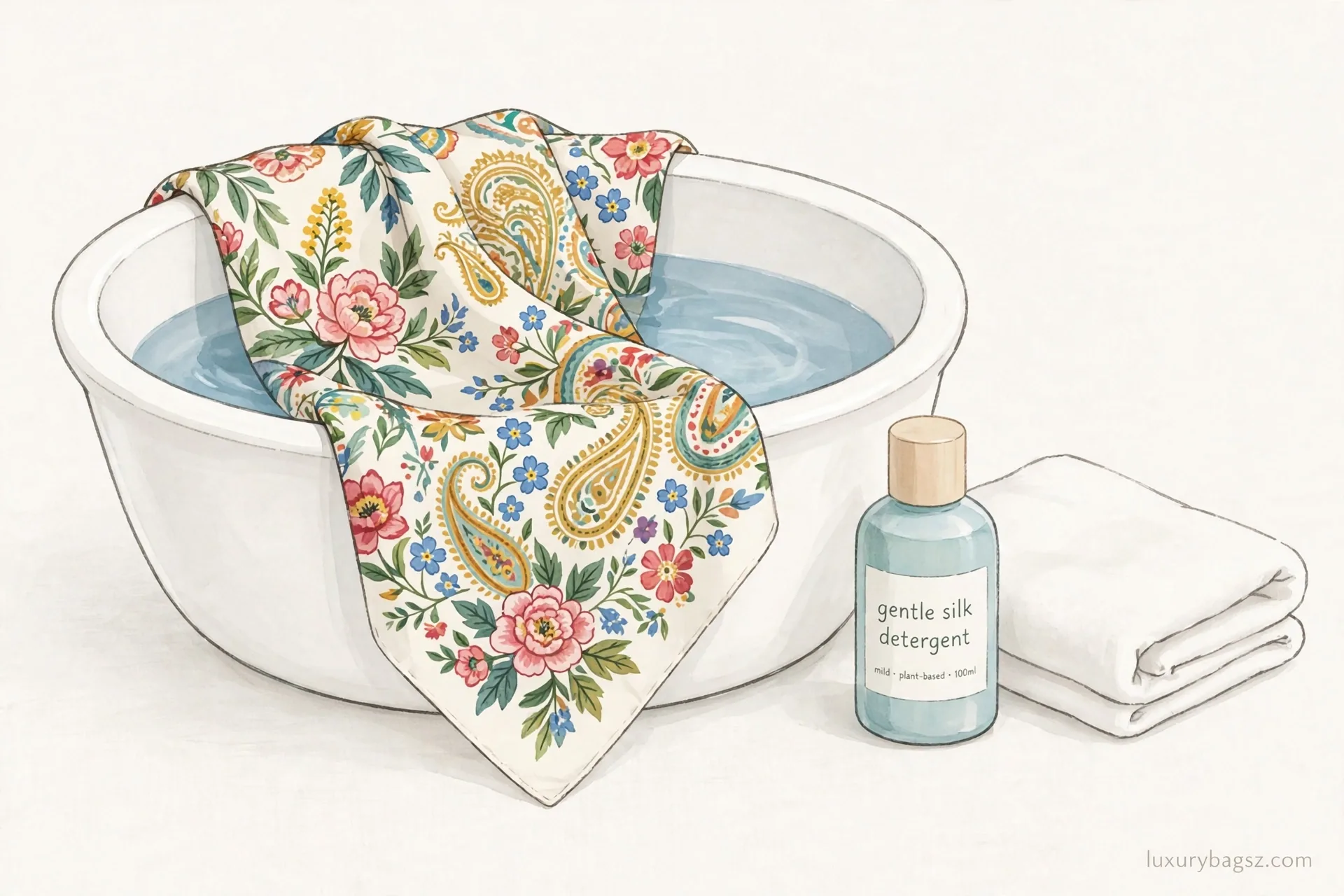
Hermès recommends professional dry cleaning, so check the care label first and hand wash only after a patch test shows no dye movement. If you proceed, fill a basin with cool water spiked with just a drop or two of gentle detergent made for silk, and move the scarf slowly through it for a few minutes, avoiding any scrubbing, twisting or squeezing.
Then rinse repeatedly in clean, cool water until the water runs clear and suds-free, lift water out by pressing the scarf between clean white towels, then dry it flat in shade away from heat. If pressing is needed, use a low silk setting on the reverse, with a cloth in between, and keep the iron off the hand-rolled hem.
A Hermès silk scarf is one of the few luxury objects that is meant to be touched, folded, knotted, and worn close to the face, and that closeness is exactly why washing it feels so frightening. A bag can sit on a shelf between outings.
A scarf picks up foundation at the jawline, perfume at the neck, a splash of coffee at lunch, and a rain shower on the walk home. Sooner or later, every well-loved scarf needs cleaning, and the owner faces a question that most short online guides answer far too breezily: do you trust it to water at home, or do you hand it to a dry cleaner and hope for the best?
This guide does not pretend that question has one risk-free answer. Hermès itself advises owners to avoid washing scarves and ties and to entrust them to a dry cleaner who will pay careful attention to the hand-rolled edges, and it warns that printing on silk may be damaged by rain.
That is the official position, and it is the safest starting point in this guide: follow the care label first. At the same time, a large community of experienced collectors hand washes silk scarves at home and reports good results, often arguing that repeated dry cleaning dulls silk, yellows pale grounds, and flattens the very rolled hems that make a carré special.
Both camps have a point, and both camps have failures they rarely mention. Dry cleaning chemicals can strip lustre over time, and careless pressing can flatten a hem beyond repair. Home washing can move dye, leave water marks, or shrink and stiffen silk if the water is too hot, the detergent too harsh, or the soak too long.
So this guide takes a deliberately cautious middle path. It treats hand washing as a careful method for certain scarves in certain conditions, never as a risk-free routine, and it gives you the tests, the limits, and the professional threshold that let you decide for your own scarf rather than copying a five-step routine from a stranger on the internet.
Where sources disagree — and they disagree a great deal, on water temperature, on soak time, on detergent, and on vinegar — this guide says so plainly and keeps the cautious version as the rule. Where a home method cannot fix a mark, this guide says that too, instead of selling you a stronger chemical.
The guide is written for the silk twill carré first, because that is the scarf most owners mean when they say “Hermès scarf”, but it also covers the smaller silk twilly, the larger silk shawl, cashmere-and-silk blends, and vintage pieces, because each of those behaves differently in water. A twilly is small and dries fast, but its narrow width makes it easy to twist and stretch.
A cashmere blend is thicker, holds far more water, and takes far longer to dry, which changes every timing in the method. A vintage scarf may carry dyes that were never fully colourfast, and what is safe for a new issue may not be safe for a forty-year-old one. One routine cannot cover all of them, and any guide that pretends otherwise is not being honest with you.
Read the whole guide before you fill a basin. The patch test in the patch-test section takes only a few minutes, and it is the single most useful habit in this guide. If the patch test shows dye movement, stop.
If your scarf is a fragile vintage piece, a family heirloom, or a scarf you could not replace, the right answer may be a specialist cleaner, not a basin at home. There is no shame in that decision. The most expensive wash is the one that ruins a scarf you loved.
Washing Silk Safely in Brief
Should you wash a Hermès silk scarf at home? Only after you have read the care label, done a patch test, and accepted that hand washing carries risk. Hermès advises professional dry cleaning. Home hand washing is a careful method some owners use successfully, not a risk-free alternative, and it is never the right choice for every scarf.
What is the careful method in one paragraph? Clean a basin, fill it with cool water, dissolve a tiny amount of mild silk detergent, and swish one scarf gently for a few minutes without rubbing, twisting, or wringing. Rinse in fresh cool water until no soap remains, press water out between clean white towels, and dry flat in shade, away from heat and direct sun. Press only if needed, on the reverse side, on a low silk setting, with a pressing cloth, and never over the hand-rolled hem.
What should you never do? Never machine wash, never tumble dry, never use bleach, harsh detergent, or a strong stain remover, never use hot water, never wring or twist, never hang a wet scarf by its corners or on a wire hanger, and never iron the rolled hem flat. Never wash two scarves together, because dye from one can mark the other.
How often should you wash a silk scarf? As rarely as you can. Silk does not need washing after every wear. Air it after wearing, keep perfume and makeup off it, and wash only when it is actually soiled, smells stale after airing, or carries a mark that blotting cannot lift. Every wash, however gentle, is wear on fibre and dye, and frequent washing dulls silk faster than careful wearing does.
When should you go to a professional instead? When the care label says so and you are not willing to accept the risk, when the patch test shows dye movement, when the scarf is vintage, fragile, or irreplaceable, when the mark is ink, dye transfer, or a set-in stain, or when a previous wash has already left water marks or stiffness. The ‘When Not to Wash at Home’ section gives the full list.
What do most guides get wrong? They give one temperature, one soak time, and one detergent as if those were settled facts. They are not. Sources in this guide disagree on all three, and the guide-disagreements section sets out those disagreements so you can see why the cautious version wins.
Table of Contents
The First Decision: Care Label or Hand Wash
Start with the label, not with the basin. Find the care label on your scarf, read every symbol, and photograph it before you do anything else. If the label says dry clean only, understand what that means and what it does not mean.
It means the maker will stand behind professional cleaning, not home washing, and it means the maker has judged that water, heat, or agitation could change the scarf. It does not mean the scarf will certainly dissolve in water, and it does not mean every dry cleaner will treat it well. Both of those misunderstandings cause damage.
Hermès states its position plainly in its care guidance: avoid washing scarves and ties, entrust them to a dry cleaner, and pay careful attention to the hand-rolled edges, while remembering that printing on silk may be damaged by rain. That advice deserves respect, especially for a new, valuable, or irreplaceable scarf.
A professional cleaner who genuinely knows luxury silk can clean without flattening hems, and can often treat a mark you should not touch at home. The problem is that not every cleaner on a high street has that knowledge. Collectors report, again and again, the same three cleaner failures: hems pressed flat by machine pressing, pin holes where a ticket was pinned through the silk, and a dulled, slightly stiff finish after repeated chemical cleaning.
Those failures are not arguments for washing at home without care. They are arguments for briefing a cleaner properly, which the dry-cleaner section covers, or for choosing home washing only when you understand the risks and have tested your scarf first.
The hand-washing case, made by collectors who wash dozens of scarves, runs like this. Silk is a natural protein fibre, closer in nature to hair than to cotton, and it is happier in cool water with a gentle cleanser than in repeated baths of dry-cleaning solvent.
Dry-cleaning fluids, even newer varieties, can yellow white and pale grounds over time, diminish lustre, and weaken fibre. Home washing, done gently, can restore softness and let the owner control scent, pressing, and hem care.
Some collectors wash every scarf they own, including new issues, and report no mishaps. Others wash only everyday scarves and send special ones to a cleaner. Both approaches are defensible.
What is not defensible is presenting home washing as safe for every scarf, or presenting dry cleaning as safe in every cleaner’s hands. The honest position is that each route has its own risks, and your scarf, its age, its colours, and its value should decide which risk you accept.
A useful way to make the decision is to ask four questions. First, what does the label say, and are you willing to go against it? Second, what would you lose if this wash went wrong: a replaceable everyday scarf, or a scarf you could not buy again? Third, what does the patch test show, because a scarf that bleeds dye in a patch test should not go into a basin at all?
Fourth, is there a cleaner near you who can show real experience with printed silk and hand-rolled hems, or would you be handing the scarf to a stranger and hoping? If the answers point toward caution, choose the cleaner. If they point toward a sturdy, modern, replaceable scarf with a clean patch test, the careful hand-wash method in the step-by-step hand-wash section is a reasonable choice, made with open eyes.
One more decision belongs here: the decision not to wash at all yet. Many scarves that look dirty only need airing, gentle brushing of surface dust, or blotting of a fresh mark. A scarf worn for an evening, folded away clean, and aired the next day will often smell fresh again without any water. Washing should be the last step, not the first reflex, and the after-washing section explains how to keep a freshly washed scarf clean for longer so the next wash is further away.

Know Your Scarf Before Water Touches It
Not all Hermès silk pieces are the same cloth, and the differences matter in a basin. The classic carré is a silk twill square, most famously the 90 cm carré, a substantial piece of printed twill with a hand-rolled, hand-stitched hem. Twill has a diagonal weave that gives it body and a soft sheen, and it holds a knot well, but it also shows water marks clearly on pale grounds and dark, saturated prints.
The hem is the most vulnerable part of the whole scarf. It is rolled by hand and stitched by hand, it is thicker than the body of the scarf, it dries more slowly than the body, and once it is pressed flat, that hand-rolled character is gone. Every step in this guide protects the hem first, because a perfect body with a flattened hem is still a damaged scarf.
Smaller formats behave differently. A twilly is a long, narrow silk band, often worn on a wrist or a bag handle, and its small size tempts owners to wash it quickly in a sink with less care than a carré deserves. Resist that temptation.
A twilly twists easily when wet, and a twisted twilly dries with a permanent corkscrew curl. Wash it flat, unknotted, and fully spread, and dry it flat, never hanging. If you wear a twilly on a bag handle, check the handle side for dye transfer and grime before you decide whether the whole twilly needs washing or only a gentle blot will do.
Larger silk shawls and stoles carry more cloth, more dye, and more water. They need a bigger basin, more rinse water, and a longer drying time, and they are harder to lift when wet without stretching. Never lift a large wet shawl by one corner. Gather it gently, support its full weight in both hands or in a towel, and lay it out without pulling.
If your basin is too small for the shawl to lie without folding tightly on itself, do not wash it at home. A folded wet shawl is a dye-transfer accident waiting to happen, because wet printed areas pressed against each other can exchange colour.
Colour matters as much as size. Deep reds, emerald greens, navy blues, and black grounds are the colours collectors name most often when dye movement is reported, and older issues are more likely to bleed than modern ones. Pale grounds, whites, ivories, and pastels show every water mark and every trace of transferred dye, even when the dye movement itself was small.
A scarf that mixes a deep saturated colour with a pale ground is the highest-risk combination of all, because one colour can mark the other in the same basin. That is why this guide insists on washing one scarf at a time, alone, in clean water, and why a colour-catcher sheet, discussed in the supplies section, is an aid, not a guarantee.
Construction details beyond the hem also deserve a look before washing. Check for loose stitches along the hem, tiny pulls or snags, thin spots, old repairs, and any area where the print looks cracked or powdery.
A weakened area that survives gentle wearing may not survive even gentle washing, because wet silk is weaker than dry silk and a snag can run further when the fibre is swollen with water. If you find damage, photograph it, and take professional advice before washing. Washing a damaged scarf at home can turn a small repair into a large one.
Finally, know how your scarf is used, because use decides how dirty it really is. A scarf worn as a neck scarf picks up makeup, foundation, and perfume. A scarf worn as a head covering picks up hair products and sunscreen.
A scarf carried on a bag picks up hand grime and dye from the bag or from clothing. Each of those soils needs a different approach in the stain-by-stain section, and a scarf that only needs its neck edge freshened may not need a full wash at all. Spot care, done early and gently, often saves a scarf from a full basin.
Where Washing Advice Disagrees — and the Cautious Version
Most online guides to washing a silk scarf are short, confident, and incomplete in the same ways. They give a tidy list of steps, a single temperature, and a reassurance that hand washing is easy, and they leave out everything that actually decides whether your scarf survives. This part names those gaps, because they are the reason this guide is longer than the guides it hopes to beat.
First, most guides ignore the care-label conflict altogether. They either tell you to ignore a dry-clean-only label without explaining the risk, or they tell you never to wash without explaining why experienced collectors disagree.
Neither version helps you decide. This guide states the official advice, states the collectors’ case, and leaves the decision with you, with tests to inform it.
Second, most guides skip the patch test, or mention it in one line without saying how to do it, where to test, or what result should stop you. A patch test done on a bold central print tells you little, and a patch test done without a white cloth to catch transferred dye tells you nothing. The patch-test section gives a test you can actually use.
Third, most guides give one soak time as if it were law. In reality, sources disagree sharply. Some guides say two to five minutes, some say three to five minutes of gentle swishing, some say four minutes, some say up to an hour, and some say do not let silk soak at all because soaking is unkind to the fibres.
Those are not small differences. A scarf soaked for an hour in a dye-rich bath is in a different situation from a scarf swished for three minutes. This guide keeps the soak short and explains why.
Fourth, most guides give one water temperature as if it were settled. Sources say cold, cool, lukewarm, below 30 degrees Celsius, below 40 degrees Celsius, and never warmer than 100 degrees Fahrenheit.
Cold and lukewarm are not the same thing, and a basin that feels comfortably warm to your hands may already be too warm for silk. This guide defines cool in a way you can feel and check, and keeps the rinse at the same temperature, because a sudden change from warm to cold can shock fibres.
Fifth, most guides recommend a detergent without discussing what makes it safe or unsafe for silk. One source even recommends a gentle soap that is alkaline, while other sources explain that silk prefers a mildly acidic environment, around pH 4.5 to 5.5, and that alkaline detergents around pH 9 strip finish and dull the surface.
Baby shampoo is recommended by some guides and dismissed by others in favour of a product made for silk. Powder detergents, enzyme detergents, optical brighteners, and fabric softeners are rarely discussed at all, yet each can harm silk in its own way. The supplies section sorts this out.
Sixth, most guides either praise vinegar as a miracle rinse or never mention it. Recommended amounts range from a teaspoon in a basin, to a quarter of a cup per gallon, to half a cup in a rinse, and one guide suggests lemon juice as an alternative. Those amounts are very different, and vinegar used wrongly, or on the wrong scarf, can itself cause trouble. The rinsing section gives the disagreement in full and the cautious version to use.
Seventh, most guides say “dry flat” or “hang to dry” without discussing the trade-offs. Hanging a wet silk scarf stretches it and can leave hanger marks. Drying flat takes space and time, and a scarf folded over a rack edge dries with a crease and a damp line.
Rapid drying in front of a fan is praised by one source and never mentioned by others, and the slow-drying rolled hem is almost never mentioned at all. The drying section covers all of it.
Eighth, most guides say “iron on low” and stop there, without explaining the steam disagreement, the pressing-cloth question, or the hem rule. Some sources say never use steam.
Others say a low steam setting is acceptable if the iron allows it. Some press face down, some press through a cloth, some press while slightly damp, and some wait until fully dry. The pressing section gives the cautious combination.
Ninth, most guides give no dry-cleaner briefing. They say “take it to a professional” as if every professional knew silk. The three instructions that matter most — do not staple, do not pin any tag through the silk, and do not iron the hand-rolled hems flat — are rarely written down anywhere a reader can hand them to a cleaner. The dry-cleaner section writes them down.
Tenth, most guides treat every silk scarf as identical. They do not separate twill from cashmere blends, new issues from vintage, pale grounds from saturated prints, or a scarf from a twilly. Parts 14 and 15 do that work, because a blend or a vintage piece washed like a new twill carré is a common route to regret.
Eleventh, most guides ignore hard water, rain, perfume, sunscreen, and storage after washing, all of which decide whether a wash stays successful. Hard water leaves mineral film that stiffens silk and dulls shine.
Rain is not clean water: it can mark printed silk and should never be left to dry folded. Perfume and sunscreen applied after the scarf is on will mark it again within days. A freshly washed scarf folded damp into a closed drawer will mildew. This guide covers each of those aftercare points.
If you remember only one idea from this part, remember this: a short guide is not a safe guide when the subject is a valuable printed silk. The length of this guide is not padding. It is the patch test, the disagreements, the limits, and the professional threshold that short guides leave out.
The Patch Test and the Colour-Bleed Test
Never skip the patch test. It takes a few minutes, costs nothing, and is the best predictor of whether your scarf can survive a basin. Do it in good daylight, on a clean white surface, with a clean white cloth or white paper towel ready to catch any transferred colour.
Choose your test spot with care. The best spot is a hidden area that still carries print, such as the inside of a rolled hem edge, a corner on the reverse side, or a small area near the hem where a faint mark would matter least.
Testing a plain, unprinted border tells you about the ground colour only, and testing the boldest central motif risks a visible mark on the most important part of the scarf. If the scarf has several strong colours, test the darkest or most saturated colour as well as the palest ground, because those two are the pair most likely to interact.
Dampen a clean white cloth with cool water, press it gently against the test spot for about thirty seconds, and lift it away. Look at the cloth, not just the scarf. Any colour on the cloth means dye is moving, and dye that moves under a damp cloth will move far more in a basin full of water.
Next, dampen the test spot itself lightly, wait a minute, and blot again with a fresh white cloth. If the second cloth is clean and the spot looks unchanged once dry, that is a reassuring result, but it is not a guarantee.
It means the dye is reasonably stable in cool water under light pressure. It does not mean the scarf can survive hot water, a long soak, a harsh detergent, or washing with another scarf.
Do a detergent patch test as well, because water alone and water with detergent are different tests. Mix your chosen detergent at the dilution you plan to use, dab a tiny amount onto the same hidden spot with a cotton swab, wait two minutes, rinse the spot gently with cool water, and blot dry.
Check for colour change, stiffness, or a change in sheen once the spot is fully dry. Some damage only shows when the fibre is dry again, so do not judge the result while the spot is still damp.
Know what result should stop you. Stop and seek professional advice if any of these happen: colour transfers to the white cloth, the test spot looks lighter or changed after drying, the fabric feels stiff or rough in the test area, or the scarf is vintage with already unstable-looking print.
A failed patch test is not a challenge to wash more carefully. It is information. The scarf is telling you that its dyes are not secure in water, and no gentle technique changes that fact.
Repeat the patch test if anything about the scarf has changed since you last washed it: a new stain, a previous wash, a long period in storage, or a scarf bought secondhand whose history you do not know.
Dye stability is not a permanent property. It changes with age, with previous cleaning, and with exposure to light and heat. A scarf that passed a patch test two years ago may not pass today, and a secondhand scarf has a history you cannot see.
What You Need, and What to Leave in the Cupboard
Gather everything before the scarf touches water. A wash interrupted halfway, while you search for a towel or a detergent, is a wash where a wet scarf sits folded, dripping, or pressed against a coloured surface, and each of those is a risk. Set out a clean basin or sink, a second basin or large pitcher for rinse water, clean white towels, a clean white cloth, a mild silk detergent, and, if you use them, a colour-catcher sheet.
Remove rings, bracelets, and watches, and check your nails for rough edges. Silk snags on jewellery and on rough skin, and a snag made when the scarf is wet is worse than one made when it is dry. Some experienced washers wear thin rubber gloves, which protect both the hands from detergent and the scarf from nails and jewellery. Gloves are optional, but bare hands with a ring on are not.
Clean the basin first, and clean it properly. A sink that held bleach, a harsh cleaner, or a coloured laundry load earlier in the day can still carry residue that harms silk. Wash the basin with plain warm water, rinse it thoroughly, and wipe it dry before you start. If you use a sink, clean the whole sink, not just the bowl, because a scarf draped over the edge will touch the rim.
A dedicated plastic basin, kept only for delicates, is the simplest way to avoid this problem, and it is worth buying if you plan to wash silk more than once.
Choose your detergent as if it mattered, because it does. Use a liquid product made for silk or delicates, used in a tiny amount, fully dissolved in water before the scarf goes in. Never pour undiluted detergent onto silk, never use powder detergent that may not dissolve fully and may leave gritty residue on the print, and never use a regular laundry detergent, dish soap, or a heavy-duty stain remover.
Enzyme detergents deserve special caution: enzymes are designed to break down protein stains, and silk itself is a protein fibre, so an enzyme product can attack the scarf as well as the stain. Optical brighteners and fabric softeners have no place in a silk wash either. Brighteners coat the fibre and change its colour, and softeners leave a film that dulls sheen and attracts dirt.
Two products need a plain warning because owners reach for them out of habit. Bleach, including chlorine bleach and strong oxygen bleach used at full strength, must never be used on a printed silk scarf. It can strip dye, weaken fibre, and yellow pale grounds, and the damage is often permanent.
Leather care products must also stay away from silk. A leather balm has no cleaning role on a scarf, and the same instinct that leads owners to care for leather should not be carried over to silk. If you care for leather goods as well, you may already know a product such as Saphir Renovateur for leather, but that product belongs on leather, never on a silk scarf, and keeping the two routines apart is part of good care.
Colour-catcher sheets are a useful aid, not a safety net. A sheet in the wash water can catch loose dye before it settles on a pale area, and many collectors use one for exactly that reason. But a sheet cannot catch all dye, cannot rescue a scarf whose dyes are unstable, and cannot protect two scarves washed together.
Use one if you wish, as an extra precaution alongside a patch test, never as a substitute for one. If the sheet comes out deeply coloured, that is information about your scarf’s dyes, and you should note it for next time, rinse thoroughly, and check the pale areas carefully once dry.
Use clean white towels and white cloths only. Coloured towels can transfer dye to wet silk, and a towel with a rough texture can catch the weave. White cotton towels, freshly laundered without fabric softener, are the right tool for pressing out water.
Keep at least two large towels ready, because one towel will become damp quickly with a large carré, and a second dry towel finishes the job. A clean white sheet on the drying surface protects the scarf from dust and from any colour in the surface below it.
Leave the following in the cupboard: bleach, harsh stain removers, alcohol-based cleaners, hairspray, perfume, and any spray-on fabric protector. Fabric protectors are sometimes suggested for scarves, but spraying a coating over a finished, printed silk changes its hand, can yellow with age, and can interfere with future cleaning. A scarf is not outdoor furniture. It is better protected by careful wearing and prompt blotting than by a chemical coat.
The Careful Hand-Wash Method, Step by Step
Work slowly, in good light, with the scarf fully spread and never rushed. The whole wash should take well under half an hour of active handling, plus drying time. If you find yourself hurrying, stop, because hurried hands rub, twist, and pull, and those are the three motions that damage wet silk.
Step one: prepare the scarf. Unknot it fully, unfold it, and lay it flat on a clean white surface. Inspect it once more for loose threads, snags, and stains, and note where the stains are so you can check them at the end.
Shake it gently outdoors or over a clean surface to remove surface dust. Do not brush it hard, and do not use a lint roller with strong adhesive on printed silk, because adhesive can lift print and catch loose fibres.
Step two: prepare the water. Fill a clean basin with cool water, enough for the scarf to move freely without folding tightly on itself. This guide defines cool as water that feels cool to the inside of your wrist, not cold enough to sting and not warm enough to feel comfortable as a bath. Sources disagree on a number: some say below 30 degrees Celsius, some say below 40 degrees Celsius, some say never warmer than 100 degrees Fahrenheit, and some simply say cold or lukewarm.
The cautious reading is to stay at the cool end of that range, around or below 30 degrees Celsius, and to keep the water the same temperature throughout, including the rinse. If your tap runs warm, add cool water until it feels cool, and test it with your wrist, not your fingertips, which are less sensitive.
Step three: dissolve the detergent. Add a tiny amount of mild silk detergent to the water and swirl it with your hand until it is fully dissolved and lightly sudsy. A little goes a long way, and more soap does not mean a cleaner scarf. Extra soap means extra rinsing, and extra rinsing means extra handling of wet silk. If the water looks cloudy with suds, you have used too much. Drain it and start again with less. Add a colour-catcher sheet now, if you use one.
Step four: submerge the scarf, alone. Lower the scarf into the water in one smooth motion, spread out, not bunched into a ball. Press it gently below the surface with flat hands so the whole scarf is wet evenly. Uneven wetting is one route to water marks, so take a moment to make sure no area stays dry while another soaks.
Wash one scarf only. Never wash two scarves together, even if they look similar in colour, because dye from one can settle on the other and neither scarf can be rinsed clean of the other’s dye.
Step five: wash by swishing, not scrubbing. Move the scarf gently through the water for a few minutes, lifting and lowering it, squeezing the soapy water through the cloth with flat hands, and letting the water and detergent do the work. Do not rub one part of the scarf against another, do not scrub a stain with your fingers or a brush, and do not twist any part of the scarf.
For a light mark, you may press the marked area very gently between your palms in the soapy water, but if the mark does not lift with that light pressure, leave it for the stain-by-stain section rather than scrubbing harder. Keep the total soak short: a few minutes of gentle swishing, roughly three to five minutes, is the cautious version. Some guides allow up to an hour, and some say not to soak at all.
A long soak gives dye more time to move, gives the fibre more time to swell, and gives a rolled hem more time to hold dirty water. Short and gentle is the rule in this guide.
Step six: lift, do not wring. Gather the scarf gently, support its weight, and lift it from the basin without twisting, wringing, or pulling it over the basin edge. Let water drip briefly, then lay it flat on a clean white towel.
Do not hang it dripping wet, and do not leave it bunched in the basin while you prepare rinse water, because a bunched wet scarf presses printed areas together and invites dye transfer and creasing.
Step seven: rinse until the water runs clear of soap. Drain the basin, refill with fresh cool water at the same temperature, and swish the scarf gently again. Repeat with fresh water until the rinse water feels clean and no soap remains on the cloth.
Most scarves need two or three rinses. Soap left in silk stiffens it, dulls its sheen, and attracts dirt later, so rinsing is not a step to rush. The rinsing section explains the final rinse in more detail, including the vinegar question.
Step eight: press out water with towels. Lay the scarf flat on a clean white towel, place a second clean white towel over it, and press gently with flat hands, or roll the towel and scarf together loosely and press along the roll. Unroll, check the scarf, and repeat with a dry towel if it is still very wet.
Never wring, never twist, and never use a spin cycle. Some general silk guides allow a gentle spin, but for a printed Hermès scarf with a hand-rolled hem, this guide does not recommend it. A spin cycle presses the scarf against the drum, creases the hem, and risks snagging.
Step nine: dry flat, as the drying section describes, and do not wear, fold, or press the scarf until it is fully dry. A scarf that feels dry on the body may still be damp in the rolled hem, and folding a damp hem into storage invites mildew and a permanent crease. Wait until the hem, not just the body, is dry to the touch.


Rinsing Well, and the Vinegar Question
Rinsing matters more than most owners expect, because detergent residue is one of the commonest causes of a scarf that feels stiff, looks dull, or attracts dirt quickly after washing. Silk that is not rinsed clean does not simply stay slightly soapy. The residue dries into the fibre, changes its hand, and leaves a film that catches dust and dulls the printed colours.
Rinse until the water is clear and the cloth feels clean between your fingers, not slippery. If you are unsure whether you have rinsed enough, rinse once more in fresh cool water. One extra gentle rinse costs little, while residue costs shine.
Keep the rinse water at the same cool temperature as the wash water. A sudden change from warm to cold, or from cold to warm, can shock fibres and affect the finish. If your tap water temperature shifts while you work, adjust the basin gradually rather than plunging the scarf from one temperature to another.
This is a small point, and it is easy to overlook when you are focused on soap, but it is one of the reasons this guide insists on testing the water with your wrist at the start and keeping it steady.
Now the vinegar question, where sources disagree enough that you should hear the full range before you decide. Many silk guides recommend a final rinse with white vinegar, on the grounds that silk prefers a mildly acidic environment and vinegar neutralises alkaline detergent residue, restoring shine and helping colours stay bright.
The recommended amounts, however, vary widely: one guide suggests a teaspoon in a basin of rinse water, another suggests a quarter of a cup per gallon of lukewarm water, and another suggests half a cup in a final rinse. Those are not equivalent doses, and a guide that gives one amount without explaining the range is not giving you the full picture.
This guide takes the cautious position. A vinegar rinse is optional, not required, and if you use one, use the smallest amount: about a teaspoon of distilled white vinegar in a basin of cool rinse water, only after a patch test, and only followed by a final plain-water rinse.
Do not use vinegar on a scarf that failed a patch test, do not use it on a vintage scarf with unstable dyes, and do not use malt vinegar, coloured vinegar, or any vinegar with added colouring, because those can stain pale silk.
Lemon juice is sometimes suggested as an alternative rinse, but this guide does not recommend it for printed Hermès silk, because its acidity and its effect on dyes are less predictable than a tiny amount of distilled white vinegar, and a printed scarf is not the place to experiment with kitchen acids.
Hard water deserves a note here, because it changes rinsing. If your tap water is hard, minerals can leave silk feeling stiff and looking chalky after drying, even when you rinsed well.
A tiny vinegar rinse, as described above, can help soften that mineral film, and filtered or distilled water for the final rinse is another option if hard water is a known problem in your home. If your scarf feels stiff after drying despite careful rinsing, hard water or detergent residue is the likeliest cause, and the drying section explains how to judge whether the stiffness is temporary or a sign of damage.
One more rinsing warning: never rinse a silk scarf under a strong running tap. A direct stream of water can mark or deform the cloth, push dye across a print, and stretch a wet area. Always rinse in a basin of still water, lifting and lowering the scarf gently. The tap is for filling the basin, not for washing the scarf.
Drying Without Watermarks, Stretch, or Flattened Hems
Drying is where many careful washes are undone, because the scarf is most vulnerable when it is wet, and the mistakes made while drying are the hardest to reverse. The rule is simple to state and needs care to follow: dry flat, in shade, in clean air, without heat, without hanging, and without folding the scarf on itself while it is damp.
Lay the scarf flat on a clean white towel or a clean white sheet, spread to its full shape, with the edges smoothed out gently and the hem lying naturally, not pulled straight. If you use a drying rack, cover the rack with a towel first, so the scarf never touches bare metal or wood, and make sure no part of the scarf folds over a rack bar, because a fold over a bar dries into a crease and a damp line.
A large carré needs a large flat surface. If you do not have one, use a clean bed covered with a white sheet, or a clean table covered with towels. Do not dry a scarf on a coloured blanket, a printed towel, or a newspaper, because wet silk picks up colour and print from whatever it touches.
Keep the scarf out of direct sunlight and away from radiators, heaters, hair dryers, and any direct source of heat. Sunlight fades printed colours, and heat stiffens silk and can set a crease or a mark permanently. A bright room with indirect light and gentle air movement is ideal. Some guides recommend rapid drying in front of a fan to prevent water marks and preserve gloss, and a gentle fan at a distance, not blowing directly onto the scarf at full force, is acceptable.
What is not acceptable is a hot fan, a heater, or a scarf draped over a radiator just for an hour. Heat damage to silk is often invisible until the scarf feels different, and by then it cannot be undone.
Water marks deserve their own explanation, because they confuse owners who did everything else right. A water mark is usually a ring left where a drop or a damp patch dried unevenly, leaving minerals or moved dye at the edge of the damp area. The way to avoid water marks is to wet the scarf evenly, rinse evenly, and dry evenly, without letting one area stay wet while another dries.
Never fold a damp scarf on itself, because the fold traps moisture and creates a sharp damp line. Never leave a damp scarf in a pile, a bag, or a closed drawer. If a water mark appears after drying, do not try to spot-wet it away with a damp cloth, because spot-wetting often creates a second, larger mark. A light, even re-wetting followed by careful flat drying sometimes helps, but a set water mark is often a professional job, and repeated home attempts usually make it worse.
The rolled hem needs extra drying time, and this is the detail most guides miss. Because the hem is rolled and stitched, it holds water longer than the body of the scarf, and it can feel dry on the outside while still damp inside. Let the scarf dry overnight, laid flat, before you judge it dry, fold it, or store it. Turn it once during drying, if you can do so without pulling it, so both sides dry evenly. Do not be tempted to speed the hem with an iron or a hair dryer. Patience here protects the most valuable detail on the scarf.
Do not hang a wet silk scarf. Hanging stretches wet silk under its own weight, distorts the square, and can leave marks where a clip or hanger gripped the cloth. A scarf that is hung wet may dry longer on one side, pull out of shape, and never sit quite square again.
Flat drying is slower and takes more space, but it is the only drying method this guide recommends for a Hermès silk scarf. If space is truly limited, dry the scarf flat in two stages: flat until it is just damp, then flat again on a fresh towel, rather than hanging it just to finish.

Pressing: Low Heat, Reverse Side, Never the Rolled Hem
Many scarves need no pressing at all after flat drying, because silk relaxes as it dries and light creases fall out on their own. If your scarf looks smooth after drying, leave the iron in the cupboard. Pressing is an optional finishing step, not a required part of washing, and every pass of an iron is a chance to damage print, sheen, or hem. When pressing is needed, the cautious combination in this part is the one to use.
Set the iron to its lowest silk setting, and test it first on a pressing cloth, not on the scarf. Work on the reverse side of the scarf, never directly on the printed face, and place a clean, dry cotton pressing cloth between the iron and the silk. Press gently and quickly, gliding with light pressure, never holding the iron in one spot, and never pressing the same area twice.
Work from the centre outward, smoothing the cloth as you go, and stop as soon as the crease relaxes. A scarf that is slightly damp presses more easily than a fully dry one, but if you press while damp, use the same low setting and the same pressing cloth, and let the scarf cool flat before folding it.
Steam is a point of disagreement, and you should know both sides. Some experienced owners say never use steam on a Hermès scarf, because steam is water and heat together, and it can mark printed silk or affect the finish. Others say a low steam setting is acceptable if the iron allows it and the owner is confident.
This guide sides with caution: use a dry silk setting, no steam, especially on a first wash, a vintage scarf, or a scarf with a pale ground. If you have used low steam successfully on your own scarves before, that experience is yours to weigh, but it is not a recommendation this guide makes for a first-time wash.
The hem rule is absolute: never iron over the hand-rolled hem, and never press the hem flat. The rolled hem is a hand-finished detail, and pressing it flat changes the scarf’s character and value in a way that cannot be reversed by re-rolling. Iron up to the hem, not over it, and let the hem keep its soft roll.
The same rule applies at a dry cleaner, which is why the dry-cleaner section tells you to say it out loud before you hand the scarf over. If a hem has become slightly flattened by a previous pressing, do not try to re-roll it with an iron. Leave it, and ask a specialist whether anything can be done, because home attempts at hem repair usually make the problem more visible.
Never iron a scarf that still has a stain, a makeup mark, or a damp patch of unknown origin. Heat sets stains into silk, and a mark that a cleaner could have lifted becomes a permanent mark once it has been ironed.
Check the scarf in good light after drying, before pressing, and if you find a mark you missed, deal with it through the stain-by-stain section or a professional, not through the iron. The same rule applies to perfume and hairspray: never press over an area where perfume was sprayed onto the silk, because heat can fix the perfume’s colour and scent into the fibre.
Stain by Stain: What Home Washing Can and Cannot Fix
Stains are where good intentions do the most damage, because the urge to scrub a visible mark is strong and the harm from scrubbing is immediate. The first rule for every stain in this part is the same: blot, do not rub, act promptly, and stop if the mark is not lifting.
Blot with a clean white cloth, pressing gently and lifting, never rubbing in circles. Rubbing spreads the stain, pushes it deeper into the weave, and damages the surface of the silk, leaving a dull patch even if the colour comes out.
Makeup and foundation are the commonest neck-scarf marks. Blot any excess gently without spreading it, then wash as in the step-by-step hand-wash section if the scarf is otherwise due for a wash, or take it to a professional if the mark is heavy, coloured, or set. Do not use makeup remover, micellar water, or a cleansing wipe on printed silk.
Those products are made for skin, not for dye, and they can move print or leave their own residue. A light foundation mark on a sturdy modern scarf often lifts with a careful hand wash. A heavy, coloured, or long-set makeup mark is a professional job, and ironing over it before cleaning will set it permanently.
Perfume, hairspray, and skincare products are chemical marks as much as colour marks. They can dull print, leave a sticky film, or change the colour of pale silk. Blot gently if the product is still wet, and do not spray more product onto the scarf to cover the mark.
Prevention matters more than cure here: apply perfume, hairspray, and skincare first, let them dry fully, and only then put the scarf on. If a perfume mark remains after a careful wash, do not repeat the wash again and again. Repeated washing will not lift a set chemical mark, and it will wear the scarf. Take professional advice.
Oil, grease, and food marks need blotting first, with a clean white cloth, without heat and without water at first, because water on an oil mark can spread it. A light, fresh oil mark on a sturdy scarf sometimes lifts with a careful hand wash using a tiny amount of mild silk detergent, as in the step-by-step hand-wash section. A heavy, old, or strongly coloured food mark, such as curry, tomato, or red wine, is a professional job.
Do not use dish soap on silk, even though dish soap cuts grease in a kitchen. Dish soap is too harsh for printed silk, it strips finish, and it can move dye. Do not use talc, chalk, or powder to absorb oil on a printed scarf either, because powder worked into silk is hard to rinse out fully and can leave a pale film on dark print.
Drink marks, including coffee, tea, and wine, should be blotted at once, without rubbing, and kept damp only until they can be dealt with properly. Do not let a drink mark dry and then try to scrub it out days later. A fresh drink mark on a sturdy scarf may lift with a prompt careful wash.
A dried, set drink mark, especially red wine or coffee on a pale ground, is a professional job, and home attempts with vinegar, salt, or baking soda pastes risk moving dye and leaving their own marks.
Salt and baking soda are sometimes suggested for fresh stains on general silk, but this guide does not recommend packing a printed silk scarf with either, because both can abrade the surface and leave residue in the weave.
Water marks, from rain or from a splash, are covered in the drying section, but they belong here too because owners often try to fix them by spot-wetting. Do not spot-wet a water mark. A water mark is itself the result of uneven wetting, and adding more water to one spot usually makes a larger mark.
If a water mark is light and the scarf is due for a wash, an even, careful full wash and even flat drying sometimes improves it. If the mark is set, dark-edged, or on a pale ground, take professional advice rather than repeating washes.
Sweat and body oils build up slowly at the neck edge, and they are one of the few marks where timely washing genuinely helps, because perspiration left in silk can weaken fibre over time.
A neck edge that smells stale after airing, or shows a faint yellowed line, should be washed promptly by the careful method, or professionally cleaned if the scarf is vintage or fragile. Do not use deodorant sprays on a scarf to mask the smell. They add their own chemical film and make professional cleaning harder.
Ink, dye transfer, and colour from clothing are professional-only marks in this guide. Ink from a pen, dye from dark jeans, a new belt, or a coloured bag, and colour transferred from another scarf in a shared wash, cannot be safely lifted at home on printed silk.
Home solvents, alcohol, and strong stain removers will move the print as surely as they move the stain, and scrubbing will damage the weave. Do not try. Photograph the mark, keep the scarf dry and unfolded, and take it to a cleaner with experience in printed silk, telling them exactly what caused the mark, because the cause decides the treatment.
Finally, know when to stop. If a mark has not lifted after one careful wash, do not wash again immediately, do not use a stronger product, and do not scrub. Repeated washing is not a stronger version of careful washing. It is a different, riskier act, and it wears fibre and dye with every round. One careful wash, then professional advice, is the limit in this guide.

If You Choose a Dry Cleaner: The Brief to Give Them
Choosing a dry cleaner is not a matter of finding the nearest shop. It is a matter of finding a cleaner who has actually handled printed silk and hand-rolled hems, and then briefing that cleaner in words they cannot misunderstand.
Ask before you hand over the scarf: have you cleaned Hermès silk scarves before, do you know what a hand-rolled hem is, and will you press the scarf by hand rather than by machine?
If the answers are vague, or if the shop seems surprised by the questions, walk away with your scarf. A cleaner who has never seen a hand-rolled hem is not the cleaner to learn on your scarf.
Give the brief in person, and put it in writing on the ticket if the shop allows it. Say these three things, plainly: do not staple anything to the silk, do not pin any tag, ticket, or receipt through the silk anywhere, and do not iron the hand-rolled hems flat. Pins and staples leave holes in silk that cannot be repaired invisibly, and machine pressing flattens hems.
Ask the cleaner to attach any ticket to the care label or to the bag the scarf travels in, never through the cloth. Ask how the scarf will be pressed, and ask for hand pressing on the reverse side, away from the hem, if pressing is needed at all.
Tell the cleaner what the mark is, where it is, and what caused it, and tell them what you have already tried, including any home washing, blotting, or product you used. A cleaner who knows a mark is red wine, perfume, or dye transfer can choose a treatment.
A cleaner who is told only there is a stain may choose the wrong one. Point out pale grounds, saturated colours, and any fragile area, loose stitch, or old repair, and ask the cleaner to note those on the ticket. Photograph the scarf before you leave it, in good light, including the hem and the marked area, so you have a record if anything changes.
Ask about turnaround and about risk. A cleaner who promises a perfect result on a set stain, a vintage scarf, or a dye-transfer mark is promising more than any honest cleaner can promise. A good cleaner will tell you what is likely, what is uncertain, and what could go wrong, and will ask your permission before attempting a risky treatment.
If the cleaner will not discuss risk, that is information too. Collect the scarf promptly when it is ready, inspect it in the shop in good light, and check the hem, the print, and the marked area before you leave. Problems found in the shop are far easier to discuss than problems found at home days later.
For owners who cannot find a local cleaner with silk experience, a boutique recommendation is worth seeking. Hermès boutiques and high-end hotels are often asked for cleaner recommendations, and a recommendation from a source that handles luxury silk regularly carries more weight than a search result.
Distance is not a barrier worth fearing here: posting a scarf to a known specialist, packed flat in tissue in a clean bag, is often safer than handing it to an unknown local shop. The cost of specialist cleaning is small beside the value of the scarf it protects.
When Not to Wash at Home
Some scarves should never go into a basin at home, however careful the method, and recognising those scarves is a skill, not a failure. Do not wash at home if the care label says dry clean only and you are not willing to accept the risk of going against it. Do not wash at home if the patch test shows any dye movement, stiffness, or colour change.
Do not wash at home if the scarf is a family heirloom, a gift with deep personal value, or a piece you could not replace at any price, because the cost of a mistake is not measured in cleaning bills.
Do not wash at home if the scarf is already damaged: loose hem stitching, thin spots, pulls, snags, cracked print, or a previous repair. Wet silk is weaker than dry silk, and washing can turn a small weakness into a tear. Do not wash at home if the scarf carries ink, dye transfer, or a set stain of unknown origin, because those marks need professional treatment and home washing can set them further.
Do not wash at home if you cannot give the scarf a full flat drying surface, clean white towels, and overnight drying time. A wash done without proper drying is worse than no wash at all.
Do not wash a scarf that has just been caught in heavy rain by plunging it straight into a basin. A rain-soaked scarf should first be laid flat on a clean white towel, blotted gently, and allowed to dry flat, so you can see what the rain actually did. Rain is not clean water, and printed silk can be damaged by rain itself, so a rain mark assessed after drying may need a professional, not a home wash.
Do not wash a scarf that smells of mildew or has been stored damp, because mildew in silk is a professional matter and home washing can spread it and weaken already affected fibre.
It helps to remember that silk is not the only luxury material with a gentle cleaning routine, and the habits do not transfer blindly from one material to another. A woven canvas bag tolerates a barely damp cloth in a way printed silk does not, and a leather good tolerates conditioning in a way silk never will.
Each material has its own limits, and a method that is gentle for canvas or leather can still be harsh for printed silk. When in doubt, the professional route is not the expensive option. It is the option that keeps the scarf wearable.
Cashmere-and-Silk Blends and Other Mixed Fabrics
A cashmere-and-silk blend, such as the well-known 70 percent cashmere and 30 percent silk shawl, is not a silk scarf with a little extra warmth. It is a different cloth, with different behaviour in water, and washing it like a silk twill carré is a common mistake. Cashmere is a fine, soft wool fibre, and wool behaves differently from silk when wet: it holds far more water, it felts if agitated in warm water, and it takes far longer to dry.
A blend shawl therefore needs cooler water, even gentler handling, no agitation at all beyond the lightest swish, and a much longer flat drying time. If you are unsure of the exact blend, read the label and treat the scarf for its most delicate fibre, not its most common one.
Size compounds the difference. Blend shawls are often large, sometimes close to two metres long, and a large wet shawl is heavy, hard to lift without stretching, and hard to rinse thoroughly. Rinsing a large shawl needs more water and more changes of water than a carré, and detergent trapped in a thick blend will stiffen it and dull it just as surely as in silk.
If your basin cannot hold the shawl spread out, or if you cannot lift it supported in a towel, do not wash it at home. A professional cleaner with experience in cashmere blends is the right choice for a large or valuable shawl.
Drying a blend takes patience. The thick cloth and any fringed or finished edge hold water long after the surface feels dry, and a blend shawl folded while still damp in the middle will mildew and crease.
Dry it flat, on fresh towels, turned once, and allow a full day or longer, in a well-aired room out of direct sun. Never hang a wet blend shawl, never use heat to hurry it, and never press it while damp with a hot iron. If the shawl has fringes, lay them straight while drying, without pulling them, because wet fringes tangle and knot easily.
Other mixed fabrics deserve the same caution. A silk scarf with a metallic thread, a beaded edge, a leather trim, or any applied decoration should not be washed at home on the strength of a silk guide alone, because the decoration may react to water even when the silk does not.
Metallic threads can tarnish, beads can loosen, and leather trim can stain silk when wet. If your scarf carries any decoration beyond print and a rolled hem, take professional advice before water touches it, and tell the cleaner about the decoration when you hand it over.
Vintage Scarves: Extra Caution
Vintage scarves carry history in their fibres, and that history changes how they behave in water. Dyes used decades ago may not have been fully colourfast even when new, and age, light, previous cleaning, and storage can all weaken dye bonds further.
Collectors report that very old designs, especially in bright greens, deep reds, and saturated blues, are the most likely to bleed, and that a vintage scarf can bleed in one colour while the rest of the print stays stable. That is why a vintage scarf needs a patch test on every strong colour, not just one test spot, and why a single clean test does not clear the whole scarf.
Old silk itself is more fragile than new silk. Years of light exposure, folding along the same lines, and repeated handling thin the fibre, especially along fold lines and at the hem. A vintage scarf that looks perfect folded in a drawer may show weakness as soon as it is wet and handled, because wet fibre reveals damage that dry fibre hides.
Check a vintage scarf in strong daylight, unfolded, before you consider washing: look for thin areas, small holes, faded fold lines, yellowing, and any stiffness that suggests old chemical residue from decades of cleaning. Stiffness and a yellowish film on a vintage scarf often come from old cleaning products built up over years, and removing that buildup is a gradual professional process, not a single home wash.
If you do wash a vintage scarf, after professional advice and a full patch test, use the shortest, coolest, gentlest version of the method in the step-by-step hand-wash section, with no vinegar rinse, no colour-catcher relied upon as protection, and no pressing beyond the lightest touch on the reverse side.
Better still, consider whether the vintage scarf needs washing at all. Many vintage scarves are collected, displayed, or worn rarely, and a scarf that is clean, aired, and stored well may not need a basin. Surface dust can be removed by gentle shaking and airing, and a light mark can be assessed by a specialist without a full wash. The goal with a vintage scarf is preservation, not freshness, and preservation often means less intervention, not more.
Provenance matters for vintage scarves in a practical way too. A scarf bought secondhand may have been washed before, dry cleaned before, stored in sunlight, or exposed to perfume and smoke, and none of that history is visible on the label.
If you do not know the scarf’s history, treat it as more fragile than a new scarf, test it more thoroughly, and lean toward professional care. A seller’s assurance that a scarf is freshly cleaned is not a substitute for your own inspection and patch test, because a scarf can be freshly cleaned and still carry residue, stiffness, or weakened dye.
After Washing: Folding, Rolling, and Wearing Again
A successful wash is only half the job. How you dry, fold, store, and wear the scarf next decides how long it stays clean and whether the wash needs repeating soon. Wait until the scarf is fully dry, including the hem, before you fold it. Folding a scarf that is even slightly damp traps moisture, creates creases, and invites mildew in storage.
When it is fully dry, fold it loosely along its existing fold lines if it has them, or roll it loosely, without pressing hard creases into the cloth. A scarf that is rolled loosely and stored in a clean, dry, dark place will keep its shape better than a scarf folded tightly into a small square and pressed under weight.
Storage after washing deserves the same care as washing itself. Keep the scarf in a clean, dry, dark place, away from direct sunlight, heat, and humidity, and away from perfume bottles, leather goods that might transfer dye, and coloured papers or boxes that might mark it. A clean cotton bag or a sheet of acid-free tissue is a good home for a scarf.
Never store a silk scarf in a plastic bag that seals damp air inside, and never store it in a drawer with mothballs or strong scented products, because silk absorbs scent and chemical residue readily. Check stored scarves from time to time, refold them along different lines if they will sit for months, and air them briefly in a clean room before wearing.
Wearing the scarf well after washing is the best way to delay the next wash. Apply perfume, makeup, hairspray, and sunscreen first, let them dry fully, and only then put the scarf on. Keep the scarf away from rain where you can, and if you are caught in rain, lay it flat to dry as soon as you are indoors, rather than folding it wet into a bag. At the end of wearing, air the scarf flat for a few hours before putting it away, so body warmth and light moisture leave the cloth rather than sitting in a fold. These small habits, repeated, matter more than any single wash, because they decide whether a scarf needs washing twice a year or twice a month.
Once your scarf is clean, dry, and pressed, it is ready to wear again, and the way you wear it can be part of its care. Learning how to tie a silk scarf in a knot that does not pull or twist the cloth protects the weave, and a knot tied loosely and untied gently each time will keep a scarf looking new far longer than a tight knot left in place for days. A scarf ring can hold a drape without a knot at all, which suits a freshly washed scarf whose fibres you want to rest.
And if you own scarves in several formats, knowing the different scarf sizes helps you choose the right piece for the day, rather than forcing a large shawl into a small knot or a small twilly into a job it was not made for. The same gentle habit that helps when cleaning Chanel bags — blot, never scrub, and stop before you cause a new problem — serves a silk scarf just as well, because luxury materials of every kind reward patience more than force.
Mistakes That Ruin Silk Scarves
Most ruined scarves are not ruined by one dramatic accident. They are ruined by a small, ordinary mistake, repeated or combined with another small mistake, until the damage is visible. This part gathers those mistakes in one place, so you can check yourself against them before you start.
Machine washing, even on a delicate cycle, even in a mesh bag, is the first mistake. A machine agitates, twists, and presses silk against a drum and against other garments, and no delicate setting removes that risk for a printed Hermès scarf. Tumble drying is the second, because heat and tumbling together stiffen silk, dull print, and distort shape.
Bleach is the third, because it strips dye and weakens fibre permanently, and no rinse fully reverses it. Hot water is the fourth, because it shrinks, dulls, and stiffens silk, and because a basin that feels pleasantly warm to your hands may already be too hot.
Wringing and twisting are the fifth, because wet silk is weak silk, and a twist that would do nothing to a dry cotton towel can break silk fibres and set a permanent curl. Rubbing a stain is the sixth, because rubbing spreads the stain and damages the surface, leaving a dull patch even when the colour lifts.
Washing two scarves together is the seventh, because dye transfer between scarves is one of the saddest and most avoidable accidents in silk care. Using a coloured towel, a dirty basin, or a sink that held bleach is the eighth, because wet silk picks up colour and chemical residue from everything it touches.
Hanging a wet scarf is the ninth, because wet silk stretches under its own weight and dries out of shape. Drying in direct sun or near a heater is the tenth, because light fades print and heat stiffens fibre.
Ironing the rolled hem flat is the eleventh, and it is the mistake collectors regret most, because the hem is the signature of the scarf and it cannot be restored by home means. Ironing over a stain is the twelfth, because heat sets the stain permanently. Spraying perfume or hairspray onto a scarf already being worn is the thirteenth, because those products mark silk and the marks are hard to lift.
Folding a damp scarf into storage is the fourteenth, because damp storage breeds mildew and permanent creases. Repeating a wash that did not work, with a stronger product, is the fifteenth, because repeated washing wears fibre and dye, and a mark that survived one careful wash is telling you it needs a professional, not a second basin.
Check yourself against this list before every wash, not just the first. Experience does not remove these risks. It only makes them easier to forget, because a wash that went well last time can breed confidence that the next wash does not deserve. The scarf in front of you, its age, its colours, and its patch test, matter more than your last success.

Frequently Asked Questions
Can I wash a Hermès silk scarf in a washing machine on a delicate cycle?
No. Machine washing agitates, twists, and presses silk against the drum and other garments, and that handling damages printed silk and hand-rolled hems even on a delicate setting. Hand washing, done carefully, or professional cleaning, are the only methods this guide recommends.
Does dry clean only really mean I must never wash it at home?
It means the maker recommends professional cleaning and will not stand behind home washing. Many owners do hand wash successfully, but they accept the risk themselves, and this guide treats home washing as a careful method with patch-test and risk notes, never as a risk-free alternative. Follow the care label first, and decide with the patch test and the value of your scarf in mind.
What water temperature should I use?
Cool water, around or below 30 degrees Celsius, that feels cool to the inside of your wrist, kept at the same temperature for washing and rinsing. Sources disagree, naming cold, cool, lukewarm, below 30 degrees, below 40 degrees, and below 100 degrees Fahrenheit, so this guide keeps to the cool end of that range, where the risk of shrinkage, dullness, and dye movement is lowest.
How long should a silk scarf soak?
A few minutes of gentle swishing, roughly three to five minutes, is the cautious version in this guide. Sources disagree widely, from no soaking at all to an hour, and a long soak gives dye more time to move and fibre more time to swell. Short and gentle is the rule, and the scarf should not sit bunched in dirty water while you prepare a rinse.
Can I use baby shampoo instead of a silk detergent?
Some guides recommend baby shampoo as a gentle option, and others prefer a product made for silk. Baby shampoo is gentler than regular detergent, but a liquid detergent made for silk or delicates, used in a tiny amount and fully dissolved, is the more predictable choice in this guide. Never use regular laundry detergent, dish soap, powder detergent, enzyme detergent, bleach, or fabric softener on printed silk.
Should I add vinegar to the rinse?
Vinegar is optional, not required. If you use it, use about a teaspoon of distilled white vinegar in a basin of cool rinse water, only after a patch test, and follow it with a plain-water rinse. Recommended amounts in other sources range up to half a cup, which this guide considers too strong for a first wash of a printed scarf. Never use coloured vinegar, and never use vinegar as a substitute for a patch test.
Can I use a colour-catcher sheet to make washing safe?
A colour-catcher sheet can catch some loose dye, and many collectors use one, but it cannot make an unsafe wash safe. It cannot rescue a scarf whose dyes are unstable, and it cannot protect two scarves washed together. Use it as an extra precaution alongside a patch test, never instead of one.
How do I dry a silk scarf after washing?
Dry it flat, on clean white towels, in shade, in a well-aired room, away from direct sun and heat, with the hem lying naturally and no part folded over an edge. Allow overnight drying so the rolled hem dries fully, and do not hang the scarf wet, use a tumble dryer, or hurry drying with a heater or hair dryer.
Can I iron a silk scarf after washing?
Only if needed, on the lowest silk setting, on the reverse side, through a clean cotton pressing cloth, with light, quick glides, and never over the hand-rolled hem. Use a dry setting, not steam, for a first wash, and never iron over a stain, because heat sets stains permanently.
What should I do if my scarf gets caught in the rain?
Lay it flat on a clean white towel as soon as you are indoors, blot gently without rubbing, and let it dry flat in shade. Never fold a wet scarf on itself, because that is the quickest route to colour transfer, and never use heat to dry it. Once dry, inspect it in good light, and take professional advice if you see water marks, colour movement, or texture changes.
Can I wash a cashmere-and-silk shawl the same way?
No. A cashmere blend holds more water, felts if agitated in warm water, and takes far longer to dry than silk twill. Use cooler water, even gentler handling, more rinse water, and a longer flat drying time, or choose a professional cleaner with blend experience, especially for a large or valuable shawl.
My scarf feels stiff after washing. What went wrong?
The likeliest causes are detergent residue from incomplete rinsing, hard water mineral film, water that was too warm, or drying with heat. Rinse thoroughly in future washes, consider a tiny vinegar rinse followed by plain water, or filtered water for the final rinse, and always dry flat in shade. If stiffness remains after the scarf is fully dry, or if the surface looks dull or rough, take professional advice before washing again, because repeated washing will not fix fibre damage.
Final Verdict
A Hermès silk scarf can be washed at home, carefully, by an owner who reads the label, tests the dye, uses cool water and a tiny amount of mild silk detergent, rinses thoroughly, and dries flat in shade without ever touching the rolled hem with an iron. That sentence is true, and it is also incomplete without its second half: the same scarf can be ruined at home by hot water, a long soak, a harsh product, a scrubbed stain, a wrung twist, a sunny windowsill, or an iron passed once over the hem. The difference between those two outcomes is rarely luck. It is preparation, patience, and knowing when to stop.
If your scarf is modern, sturdy, and replaceable, if its patch test is clean, and if you follow the careful method in this guide without shortcuts, home washing is a reasonable choice, made with open eyes. If your scarf is vintage, fragile, irreplaceable, or marked with ink, dye transfer, or a set stain, or if its patch test shows any dye movement at all, the professional route is the right one, and briefing that professional properly matters as much as choosing them. There is no bargain that is worth washing a scarf you love into a scarf you cannot wear.
Wash rarely, wash gently, wash one scarf at a time, and let the scarf tell you, through its label and its patch test, whether it is ready for water. Look after the hem as if it were the whole scarf, because in many ways it is. And when the wash is done, wear the scarf, enjoy it, and keep perfume, rain, and haste away from it, so the next wash stays a long way off.






