

How to Size a Hermès Belt: Measure Right the First Time
Your Belt Size in Brief
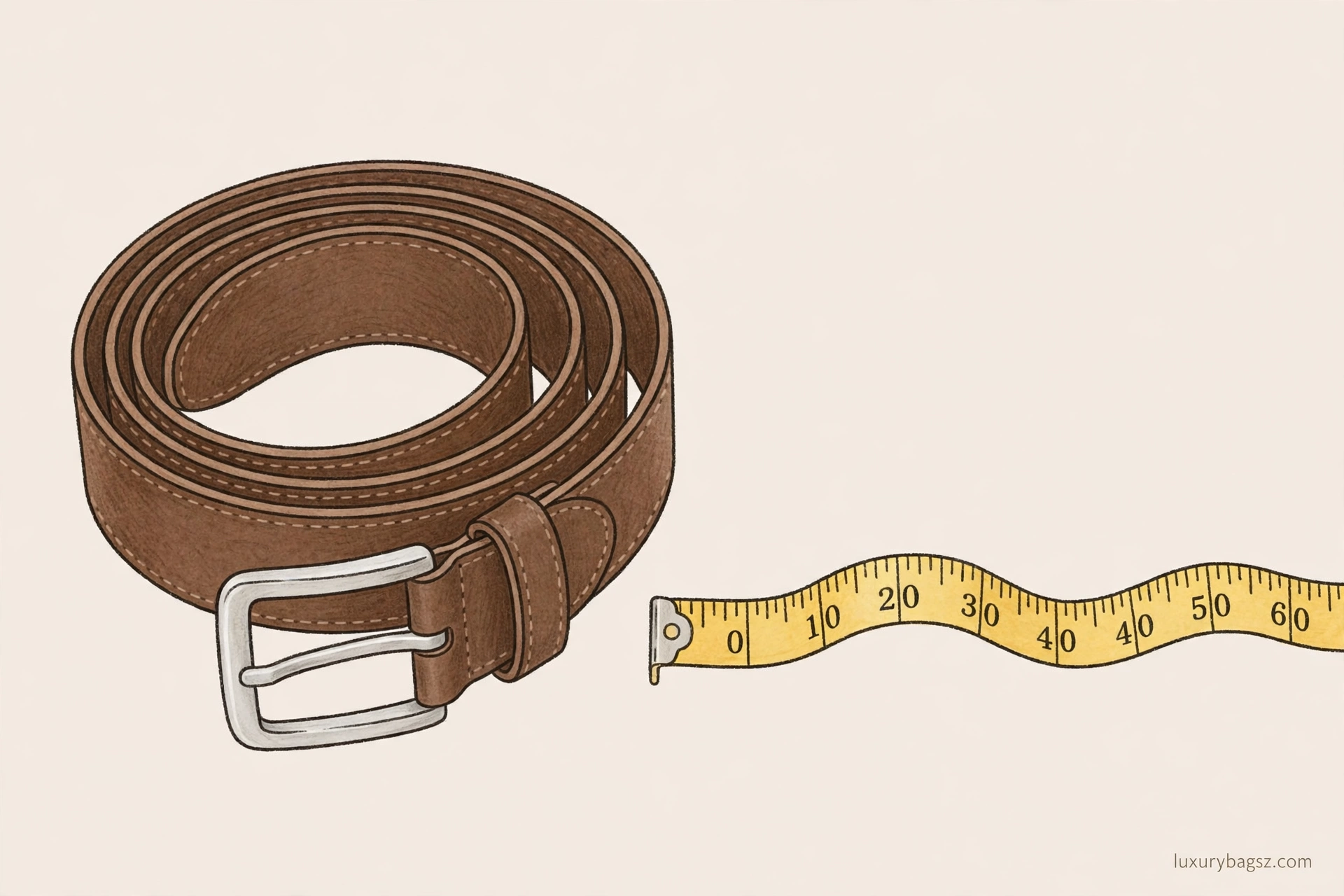
A Hermès belt size is the distance in centimetres from the buckle end of the strap to the hole you use most. Measure a belt you already wear well, from its buckle end to the hole you fasten every day, and round that number to the nearest 5 cm. That rounded number is your Hermès belt size. Do not buy by your trouser size, your waist number alone, or the total tip-to-tip length of a strap.
Hermès belt sizes usually run from 70 cm to 120 cm in 5 cm steps. A size 75 strap can measure around 90 cm from tip to tip, so total length will mislead you by a full size or more. If you remember only one rule from this guide, make it this one: buckle end to most-used hole, then round to the nearest 5 cm.
The rest of this guide walks through that method in detail, then covers the traps. You will learn why sources disagree about waist measurements, how holes and widths work, what to do between sizes, and how to check a pre-owned belt before you pay.
Key Takeaways
- Your Hermès belt size is the buckle-end to most-used-hole distance, rounded to the nearest 5 cm.
- The worn-belt method beats every waist formula, because it already includes how and where you wear a belt.
- Belt length in centimetres and strap width in millimetres are two different numbers; never mix them up.
- A size 75 strap can measure about 90 cm tip to tip, so total length is not a size.
- Hermès straps usually carry three wearing holes, with the middle hole as the intended everyday hole.
- Between sizes, size up if you tuck shirts in or wear layers, and size down if you wear the belt on bare-waist outfits only.
- For a pre-owned belt, always ask for the buckle-end to most-used-hole measurement and photos of the strap.
Part 1: What the Number on a Hermès Belt Actually Means
A Hermès belt size is a length in centimetres, stamped on the strap alongside a letter. That number answers one question: how far is it from the buckle end to the hole the belt is meant to fasten on? It is not your waist size, not your trouser size, and not the length of the whole strap.
Hermès itself describes the size this way in its own size guide. It recommends measuring a favourite belt from the buckle to the hole you use most, and notes that the resulting number is measured to the middle hole of the Hermès strap, not to the total length of the strap. A size 85, on that definition, means 85 cm from buckle to middle hole.
That definition matters because the strap keeps going past the last hole. There is a tapered tip beyond the final hole, plus the folded leather at the buckle end and the buckle itself. All of that extra material is why a belt stamped 85 can measure close to 97 or 99 cm end to end.
Other guides define the number differently, and that is where confusion starts. Some describe Hermès sizing as the total length from tip to middle hole, and some treat the size as a waist measurement with a fixed amount added. This guide follows the Hermès definition, because it is the one the stamp on the strap actually matches.
The practical result is simple. When a listing says size 90, it should mean 90 cm from buckle end to middle hole. When a seller gives you any other number, ask which two points they measured between before you trust it.
Part 2: The One Reliable Method — Measure a Belt You Already Wear Well
Start with a belt that already fits you the way you like. It does not need to be a luxury belt, and it does not need to be the same width as the Hermès strap you want. It only needs to fasten comfortably at your usual belt line, on the kind of outfit you will wear the new belt with.
Lay the belt flat on a table, fully stretched out, with the buckle attached. Find the hole you actually use most days, not the hole you wish you used or the one you used once. That hole is your anchor, because it records your real fit rather than a guess about your body.
Measure from the buckle end of the belt to that hole. Hermès phrases this as measuring from the base of the tongue, and other guides phrase it as measuring from the inside edge of the buckle or from the buckle hole on a detachable strap. These starting points sit within a centimetre or two of each other on most belts, so pick the buckle end and stay consistent.
Write the number down in centimetres. If your tape shows inches, convert before you do anything else: one inch is 2.54 cm, so a 35.4 inch measurement is 90 cm. Do not round at this stage, and do not add anything yet; the raw number is the input for the next part.
Repeat the measurement once, with the belt worn if you can. Put the belt on, fasten it on your most-used hole, and mark where the buckle sits against your body. This second check catches the most common error, which is measuring a belt that has stretched or that you fasten differently than you remember.
If you do not own a belt that fits well, skip to Part 6 for the waist method and its warnings. The worn-belt method is the most reliable, but a careful waist measurement is far better than guessing from a trouser label.

Part 3: Rounding to the Nearest 5 cm
Hermès belt sizes move in 5 cm steps: 70, 75, 80, 85, 90, 95, 100, and so on up to 120 cm. Your raw measurement will almost never land exactly on one of those steps, so the last move is rounding to the nearest one. A measurement of 88 cm rounds to 90, and a measurement of 92 cm also rounds to 90.
The rounding rule is the nearest step, not always up and not always down. A measurement of 87 cm sits 2 cm from 85 and 3 cm from 90, so it rounds to 85. A measurement of 88 cm sits 3 cm from 85 and 2 cm from 90, so it rounds to 90. The holes on the new strap will cover the small gap either way, which is exactly what they are for.
Exactly halfway cases need a judgement call, and Part 10 covers that choice in full. As a short preview: a measurement of 87.5 cm sits exactly between 85 and 90, and the right answer depends on layers, tucking, and whether your weight tends to move up or down. Do not let a seller round for you without asking how they chose.
One more check before you commit: compare your rounded size against the hole range of the new belt. A size 90 strap with three holes spaced about 2.5 cm apart covers roughly 87.5 to 92.5 cm of fastening range. If your raw measurement sits inside that range, the size will work even if it is not dead on the middle hole.
Keep the raw number, not just the rounded size, when you shop pre-owned. A seller who can tell you the strap measures 91 cm from buckle end to middle hole is giving you far more useful information than a seller who only repeats the stamped size.
Part 4: The Size Range and a Simple Conversion Chart
Hermès belt sizes usually run from 70 cm to 120 cm, in 5 cm steps. That range covers most adults, from a small waist worn high to a larger waist worn at the hips. If your measurement falls below 70 cm or above 120 cm, a standard strap may not exist in your size, and a boutique order or an extra hole may be the answer.
Sources disagree about the edges of the range, and the disagreement is worth stating plainly. Some guides list 65 cm to 120 cm, some list 70 cm to 120 cm, and some list only 80 cm to 120 cm for the classic straps. The middle of the range is consistent everywhere; only the smallest sizes vary, because small sizes appear and disappear with collections.
The chart below converts each size to inches, rounded to one decimal place. These inch figures match the conversions published in long-running owner forums, where a size 70 is listed as 27.5 inches and a size 120 as 47.2 inches. Use centimetres whenever you can, since Hermès sizes, stamps, and listings all use centimetres.
- Size 70 cm — 27.5 inches
- Size 75 cm — 29.5 inches
- Size 80 cm — 31.5 inches
- Size 85 cm — 33.5 inches
- Size 90 cm — 35.4 inches
- Size 95 cm — 37.4 inches
- Size 100 cm — 39.4 inches
- Size 105 cm — 41.3 inches
- Size 110 cm — 43.3 inches
- Size 115 cm — 45.3 inches
- Size 120 cm — 47.2 inches
Notice that the inch gap between sizes is about 2 inches, while the centimetre gap is exactly 5 cm. That is why rounding in centimetres is cleaner: an inch-based measurement can easily land you a full step off. Measure in centimetres from the start if your tape allows it.
Sizes at the ends of the range can be harder to find second-hand, because fewer were made. If you wear a 70 or a 120, start your search early, and be ready to ask a boutique about availability rather than assuming a listing will appear.
Part 5: Belt Size in Centimetres Is Not Strap Width in Millimetres
Two numbers describe a Hermès belt, and mixing them up is one of the most common buying mistakes. The size, in centimetres, is the length from buckle end to middle hole. The width, in millimetres, is how wide the strap is and which buckle it fits. A size 90 belt can be 24 mm wide or 32 mm wide, and both are still size 90.
Strap widths for the modular buckle kits run from 13 mm up to 42 mm, with 24 mm and 32 mm among the most familiar. The width decides which buckle fits the strap, because the buckle’s back loop must match the strap width. A 32 mm buckle will not sit properly on a 24 mm strap, and the reverse is just as wrong.
This matters for sizing because a listing may lead with the width number. A title that reads “32 mm belt” is telling you the strap width, not the length, and you still need the centimetre size before you can judge fit. Always ask for both numbers: the centimetre size for length, and the millimetre width for buckle fit.
Width also changes how a belt looks and feels at a given size, even though it does not change the size itself. A wider strap reads more casual and shows more leather at the waist, while a narrower strap reads dressier and sits lighter under a jacket. Neither effect makes a size 90 fit like a size 95, but width can decide whether you reach for the belt daily.
If you already own a Hermès buckle, measure its back loop or check its marked width before ordering a strap. Buckle kits are sold as a buckle plus a strap, but straps are also bought on their own, and a strap in the wrong width is a return even when the length is perfect.
Part 6: Waist Measurement Versus Belt Size — the Disagreement
If you have no well-fitting belt to measure, the fallback is measuring your waist where you wear the belt. Wrap a soft tape around your body at that line, keep it level and snug but not tight, and read the number in centimetres. The problem is what to do with that number next, because sources flatly disagree.
Hermès itself gives the simplest version: if your waist measures 85 cm, your Hermès belt size is 85. On that version, the waist number and the belt size are the same number, with no addition at all. This is the guidance on the brand’s own size guide pages.
Other guides add 5 cm. On that version, an 85 cm waist means a size 90 belt, because the extra 5 cm covers the buckle overlap and the distance from the buckle to the fastening hole. One widely repeated guide puts it as a general rule: add 2 inches, which is 5 cm, to your waist measurement.
Still other guides add 10 to 15 cm. On that version, an 82 cm waist plus 13 cm gives a size 95, and a 78 cm waist plus 12 cm gives a size 90. The reasoning is similar — overlap and prong insertion — but the amount added is far larger, so the same waist can produce sizes two steps apart depending on which guide you follow.
These versions cannot all be right for the same body, and this guide will not pretend otherwise. The gap comes from different starting points: a tape around a bare waist, a tape over trousers, a tape at the hips rather than the waist, and different ideas of how much overlap a buckle needs. Clothing thickness alone can move a waist reading by several centimetres.
The worn-belt method in Part 2 avoids this whole argument, because a belt you already wear has already absorbed the overlap, the clothing, and the belt line. If you must use the waist method, measure over the clothes you will actually wear with the belt, try the Hermès version first, and treat any guide that adds 10 to 15 cm with caution. A belt bought two sizes too large cannot be fixed by its three holes.

Part 7: Where You Wear the Belt Changes the Size
A belt worn at the natural waist and the same belt worn at the hips are effectively two different sizes. The waist is usually narrower than the hips, so a belt that fastens at the waist will be too short at the hips, and a belt bought for the hips will be too long at the waist. Decide the belt line before you measure anything.
High-waisted trousers and dresses sit at or above the natural waist, which is the narrowest point of the torso for most people. Low-rise trousers sit on the hip bones, where the circumference can be 5 to 10 cm larger. That gap alone can move you a full size or two, which is why a single “belt size” can feel wrong when the outfit changes.
Some owners solve this with extra holes punched by a boutique, so one strap covers both a waist position and a hip position. Owner forums report exactly this: a size 75 with extra holes added to make it slightly larger for dresses worn on the hips and slightly smaller for the waist. It is a real option, but it changes the strap permanently, so it belongs in Part 14 rather than as a first resort.
If you plan to wear the belt in two places, measure both lines and compare. When the two measurements sit within one size step of each other, one belt with its normal hole range will usually cover both. When they sit two steps apart, you are choosing between two belts, a boutique-punched strap, or accepting a compromise fit at one position.
The same logic applies to seasonal change. A belt measured over a summer shirt will fasten differently over a winter knit, and a belt worn over a coat needs more length again. Measure at the bulkiest outfit you realistically plan to wear with it, or size up by one step if layers are a regular part of the plan.

Part 8: The Tip-to-Tip Length Trap
The single most expensive mistake in belt sizing is buying by total length. A seller lists a strap as 105 cm long, a buyer who needs a size 105 orders it, and the belt arrives two sizes too large — because 105 cm tip to tip is the total length of a size 90 strap, not a size 105 strap.
Real owner measurements show the gap clearly. One owner measured a size 85 belt at 99 cm end to end, and another measured a size 90 belt at 105 cm end to end. A third owner, holding a belt stamped 85, measured 97 cm on a tape and could not see how 85 came from that number. The answer in each case is the same: the stamp counts buckle end to middle hole, and the rest is tip, fold, and buckle.
The task’s own example makes the same point at the small end: a size 75 strap can measure around 90 cm tip to tip. That is a 15 cm difference between the size number and the total length, which is three full size steps. Any listing that gives only a total length is giving you a number that cannot be converted to a size without more information.
Protect yourself with one question, asked before you pay: “What is the measurement from the buckle end to the middle hole?” If the seller cannot answer, ask for a photo of a tape laid along the strap from the buckle end to the middle hole. A genuine seller with the belt in hand can produce that photo in a minute.
Never accept a total length as a substitute, even when the seller is confident. Confidence is not a measurement, and the return postage on a wrong-size belt is the cheapest lesson this guide can save you. The draft text here prevails over any diagram that simplifies the two lengths into one number.

Part 9: Holes — Count, Spacing, and the Middle Hole
A classic Hermès strap usually carries three wearing holes at the tapered end, spaced about 2.5 cm apart. The middle hole is the intended everyday hole, the hole nearest the buckle end is for a slightly tighter fit, and the hole nearest the tip is for a slightly looser fit. That gives a size 90 strap a practical fastening range of roughly 87.5 to 92.5 cm.
Sources disagree about hole count, and the disagreement has a simple cause. Many ordinary belts carry five holes, and some guides describe five-hole belts as the standard, with two holes on either side of a centre hole. Hermès straps are different: owner guides and the brand’s own description point to three holes as the house standard, with one hole at the buckle end for the buckle and three at the wearing end.
That distinction matters when you inspect a listing. A strap with five evenly spaced wearing holes is not automatically wrong — some belts and some eras differ — but it is not the classic three-hole layout, and it deserves a question. Ask the seller whether the holes are original or added, and compare the spacing against the 2.5 cm standard.
Extra holes punched by a boutique are a separate case, and they are common. A boutique can punch an additional hole to extend the range of a strap, and owners report doing exactly this to cover both waist and hip wear. An extra hole is not a defect, but it should be disclosed, and it should sit in line with the original holes at the same spacing.
When you fasten a new belt for the first time, aim for the middle hole. If you land on the middle hole with a comfortable fit, the size is right. If you are already on the last hole on day one, you have no room left for a heavier outfit or a small change in weight, and one size up would have been the better buy.

Part 10: Between Sizes — Round Up or Round Down
A measurement that lands exactly between two sizes is the hardest call in belt buying, because both answers can be defended. A raw measurement of 87.5 cm sits exactly between 85 and 90, and the three holes on either strap will partly cover the gap. The tie-breakers below decide it, in order of importance.
First, think about layers and tucking. If you tuck shirts in, wear knitwear, or put the belt over a jacket, size up: the extra 5 cm gives you the room those layers take, and the tighter holes stay available for lighter outfits. If you wear the belt only on bare-waist summer outfits, size down, because there is nothing between the strap and your body to absorb.
Second, think about which direction your body tends to move. If your weight fluctuates, or you are between sizes after a change in shape, the safer choice is the size whose middle hole matches your larger measurement. A belt that is slightly loose can be fastened one hole tighter; a belt that is already on its loosest hole on day one has nowhere to go.
Third, think about the belt line you use most. A between-size measurement taken at the waist will behave differently at the hips, and the hip number is almost always larger. If you split your wear between waist and hips, size up, because the larger position is the one that will punish a too-short strap.
Fourth, remember the boutique option. If you buy the larger size and find it slightly long, a boutique can punch an extra hole to tighten the range. The reverse is also true: a slightly short strap can gain a hole at the loose end. Extra holes cost little, but they are permanent, so use them to fine-tune a good size rather than rescue a bad one.
When all four tie-breakers are neutral, size up. A belt that fastens on its tightest hole still looks and feels fine, while a belt that cannot close at all is unwearable. The cost of one size too large is a slightly long tip; the cost of one size too small is a belt you cannot wear.
Part 11: Buckle Families — the Kelly 18 Is Not Reversible
Belt sizing also depends on which buckle family you are buying into, because the families are built differently. The classic Kelly 18 belt is single-sided and sliding-adjustable, not reversible. Its strap is made to be worn one way, and its adjustment comes from sliding the buckle along the strap rather than flipping the strap over.
The reversible modular buckle-and-strap kit belongs to a different family: the H buckle and Constance family. In that kit, the buckle detaches and the strap flips to show a second colour, so one strap serves two looks. That reversibility is a property of the kit design, not a property of every Hermès belt, and it does not apply to the Kelly 18.
Why does this matter for sizing? Because a reversible strap is measured and worn the same way — buckle end to most-used hole — but its two faces may be different leathers with slightly different stiffness. A stiff face can feel tighter at the same hole than a soft face, so try both faces when you first fasten a reversible strap, and judge the size on the face you will wear most.
The Kelly family has its own story beyond belts, and the distinction between a Kelly bracelet and a Kelly belt is worth knowing before you shop. If you are comparing the two, our guide to the Kelly bracelet vs Kelly belt explains how the same Kelly name covers two very different pieces.
For sizing, though, the rule stays the same: measure the strap you will wear, not the name on the buckle.
Width ties the families together. The H buckle and Constance kits come in widths such as 13 mm, 24 mm, and 32 mm, and the strap width must match the buckle loop. A Kelly 18 belt has its own sliding buckle design, so its width logic is separate. In both cases, confirm width and length as two separate numbers before you order.
Part 12: Buying a Belt for Someone Else
Buying a belt as a gift removes your best tool, because you cannot measure the recipient’s favourite belt without spoiling the surprise. The next best tool is a belt they already own and wear well, measured in secret. Borrow it for a minute, lay it flat, and measure from the buckle end to the hole that shows the most wear. That worn hole tells you more than any guess about their waist.
If you cannot borrow a belt, use their clothing as a proxy, but be honest about its limits. A pair of well-fitting trousers gives you a waistband measurement, but the waistband sits where the trousers sit, not necessarily where the belt will sit. Add nothing to that number until you have read Part 6, and remember that the guides disagree by up to 15 cm on what to add.
Ask a close friend or family member for help when you can. Someone who shares a closet or does the laundry often knows which hole a person uses, or can measure a belt without raising suspicion. A single honest measurement from a third party beats a confident guess from a size chart.
Choose a flexible option when the size is uncertain. A boutique-bought belt can usually be exchanged if the size is wrong, and a modular buckle kit lets the recipient swap the strap later while keeping the buckle. A pre-owned belt with no return option is the riskiest gift, because a wrong size becomes a resale project rather than an exchange.
When in doubt between two sizes for a gift, size up. A slightly long belt can be worn on a looser hole or adjusted with an extra hole, while a belt that will not close is a disappointment on the day it is opened. Include the receipt and the return terms with the gift, so the recipient can fix the size without awkwardness.
Part 13: Pre-Owned Sizing Checks Before You Pay
Pre-owned listings are where sizing errors concentrate, because the seller may not know the Hermès definition of size. Treat every pre-owned listing as unverified until you have the right measurement, even when the stamped size is clearly photographed. A stamp tells you what the belt was made as, not how it measures today after years of wear.
Ask the seller for four things, in this order. First, the measurement from the buckle end to the most-used hole, taken with a tape and stated in centimetres. Second, photos of the full strap laid flat, so you can see the holes, the tip, and the buckle end yourself. Third, a photo of the stamped size number, so you can compare the stamp against the measurement. Fourth, a note on any extra holes and whether they were punched by a boutique.
Compare the stamp and the measurement before you judge. A belt stamped 90 should measure about 90 cm from buckle end to middle hole, and its total tip-to-tip length will be roughly 105 cm. If the seller’s “size 90” measures 90 cm tip to tip, you are looking at a belt closer to size 75, and the listing is wrong however honest the seller believes it to be.
Check the holes in the photos as carefully as the numbers. Count them, look at their spacing, and look for holes that sit off-line or show rougher edges than the rest. Extra holes are not a deal-breaker on their own, but undisclosed extra holes are a sign the seller has not inspected the strap closely, and that should lower your trust in their measurement too.
One brief authenticity note belongs here, because pre-owned buyers often ask about it. Hermès issues no authenticity cards as a general rule, so a card offered with a belt is a red flag rather than proof of anything.
This guide is about sizing, not authentication, and if you need a full authentication check, our guide on how to spot a fake Hermès Kelly bag shows the kind of detail that matters. For sizing purposes, trust the tape, the stamp, and the photos, in that order.

Part 14: When the Belt Is the Wrong Size
A wrong-size belt is not always a lost cause, and the fix depends on how wrong it is and which direction. A belt that is one hole too loose or one hole too tight can often be saved. A belt that is a full size or more off usually cannot, and the honest move is exchange or resale rather than surgery on the strap.
Extra holes are the simplest fix for a belt that is slightly too large. A boutique can punch an additional hole at the correct spacing, extending the tight end of the range by 2.5 cm per hole. This works best when the strap is otherwise in good shape and the new hole sits in line with the originals. It is permanent, so have it done by a boutique or a skilled leather worker, not by a home punch.
A belt that is slightly too small has a mirror option: a hole punched toward the tip extends the loose end of the range. This is less tidy, because the tip beyond the last hole gets shorter, and a very short tip can look odd and slip out of the first belt loop. One extra hole is usually fine; two starts to change how the belt wears.
Exchange is the cleanest fix for a boutique purchase, and it is the reason to keep receipts and packaging until the fit is confirmed. Try the belt on every outfit you plan to wear it with before deciding, because a belt that fits a summer dress may not fit winter tailoring. Most sizing regret shows up in the second week, not the first fitting.
Resale is the last resort, and it rewards honest listings. When you resell a wrong-size belt, give the buckle-end to most-used-hole measurement, the stamped size, and clear photos of the holes and tip. The next buyer deserves the information you wish your seller had given you, and a well-measured listing sells faster than a stamped-size-only listing.
Care for the strap you keep is part of getting the size right over time. Leather stretches slightly with wear, especially at the hole you use most, so a belt that starts on the middle hole may drift toward the tighter holes over years.
A light conditioner such as Saphir Renovateur keeps the leather supple, and a suede brush is the right tool if your strap is suede rather than smooth leather. Conditioned leather holds its shape better, which keeps your size honest for longer.
Part 15: Mistakes That Cause a Wrong Size
Most wrong-size belts trace back to a small list of mistakes, and each one is avoidable. The first is ordering by trouser size. Trouser labels vary by brand, country, and cut, and none of them measure your body at your belt line. A 34-inch trouser label does not make you a size 90, whatever a conversion chart claims.
The second mistake is measuring over the wrong clothes. A tape over a heavy coat gives a bigger number than a tape over a shirt, and a belt ordered on the coat number will hang loose on every normal outfit. Measure over the clothes you will actually wear with the belt, and treat bulky outerwear as a separate case.
The third mistake is trusting a total length. This guide has repeated the point because listings repeat the error: a tip-to-tip number is not a size, and a seller who gives only a total length has not given you a size at all. Ask for the buckle-end to middle-hole number every time, without exception.
The fourth mistake is ignoring where the belt will sit. A belt bought for the waist will not fit the hips, and a belt bought for low-rise trousers will not fit high-waisted ones. One belt rarely covers both positions unless the measurements are within a size step, so decide the position first and measure second.
The fifth mistake is forgetting that Hermès sizing is its own system. Other brands size belts differently, and a size that works in one brand’s system will not transfer. Footwear shows the same pattern: an Oran sandal size is a shoe size, and the Oran sandals sizing guide exists because that system needs its own explanation.
Belts are no different, and neither are Jumping boots, which follow footwear sizing rather than belt sizing. Never carry a number across product types.
The sixth mistake is skipping the second measurement. One tape reading, taken in a hurry on a belt you have not worn in months, is a guess with a number attached. Measure twice, once flat and once worn, and keep the raw figure. The five minutes this takes are far cheaper than a return.
Leather provenance is a separate question from size, but buyers often ask about it alongside sizing. If you are curious about where the leather in Hermès pieces comes from, our guide on which country makes leather for Hermès bags covers that history. It will not change your belt size, but it explains why the material behaves the way it does.
Frequently Asked Questions
What is my Hermès belt size if my waist measures 85 cm?
On Hermès’s own guidance, your size is 85, because the brand equates the waist measurement with the belt size. Other guides would add 5 cm and give you 90, or add 10 to 15 cm and give you 95 or 100. The guides disagree, so the worn-belt method is the safer tie-breaker: measure a belt you already wear well from buckle end to most-used hole, and round to the nearest 5 cm.
How do I measure a belt I already own for Hermès sizing?
Lay the belt flat and find the hole you use most days. Measure from the buckle end to that hole in centimetres, then round to the nearest 5 cm step. A reading of 88 cm rounds to 90, and a reading of 92 cm also rounds to 90. Keep the raw reading as well as the rounded size, because the raw number is what a pre-owned seller needs from you.
Why does my size 85 belt measure 97 cm long?
Because the size counts only the distance from buckle end to middle hole, while your tape measured the whole strap tip to tip. The tapered tip beyond the last hole, the fold at the buckle end, and the buckle itself add roughly 12 to 15 cm. A size 85 at about 97 cm tip to tip and a size 90 at about 105 cm tip to tip are both normal.
How many holes does a Hermès belt have?
A classic Hermès strap usually carries three wearing holes, spaced about 2.5 cm apart, with the middle hole as the intended everyday hole. Some guides describe five holes as standard, but that is the standard for ordinary belts, not the Hermès layout. Extra boutique-punched holes can raise the count, and they should always be disclosed in a listing.
Should I size up or down if I am between sizes?
Size up if you tuck shirts in, wear layers, or split wear between waist and hips. Size down only if you wear the belt on light outfits at one belt line and your weight is stable. When every tie-breaker is neutral, size up: a belt that fastens on its tightest hole is wearable, while a belt that will not close is not.
Is belt size in centimetres the same as strap width in millimetres?
No, and confusing the two is a common error. The size in centimetres is the length from buckle end to middle hole. The width in millimetres, such as 24 mm or 32 mm, is how wide the strap is and which buckle it fits. A listing that says only “32 mm” has told you the width, not the length, and you still need the centimetre size.
Can a boutique punch extra holes in my belt?
Yes, boutiques can punch additional holes at the standard spacing to extend the fastening range. Owners commonly do this to cover both waist and hip wear on one strap. The change is permanent, so use it to fine-tune a good size rather than rescue a badly wrong one, and keep the new holes in line with the originals.
What should I ask a pre-owned seller about sizing?
Ask for the buckle-end to most-used-hole measurement in centimetres, photos of the full strap laid flat, a photo of the stamped size, and a note on any extra holes. Compare the stamp against the measurement: a belt stamped 90 should measure about 90 cm to the middle hole, not 90 cm tip to tip. Walk away if the seller can only give you a total length.
Is the Kelly 18 belt reversible?
No. The classic Kelly 18 belt is single-sided and sliding-adjustable, not reversible. The reversible modular buckle-and-strap kit belongs to the H buckle and Constance family, where the buckle detaches and the strap flips to a second colour. Do not buy a Kelly 18 expecting two looks from one strap.
What do I do if my belt arrives in the wrong size?
First, check whether one extra hole fixes it: a boutique can punch a hole to extend the range by 2.5 cm in either direction. If the error is a full size or more, exchange it where you bought it, keeping the receipt and packaging until the fit is confirmed. For a final-resort resale, list the buckle-end to most-used-hole measurement and clear hole photos so the next buyer can judge fit.
Summary
Sizing a Hermès belt comes down to one measurement done properly. Take a belt you already wear well, measure from its buckle end to the hole you use most, and round to the nearest 5 cm. That number is your size, and it will serve you better than any waist formula, trouser label, or size chart.
The traps in this guide all share one shape: a number that looks like a size but is not one. A total tip-to-tip length is not a size. A strap width in millimetres is not a size. A waist measurement is only a size on one version of the guidance, and other versions add 5 cm or even 10 to 15 cm. Knowing which number you are looking at is half the skill.
Buy with the same discipline you measured with. Confirm the centimetre size and the millimetre width as separate numbers, decide your belt line before you order, and size up when you are between sizes or buying for someone else. For a pre-owned belt, accept nothing less than the buckle-end to most-used-hole measurement and clear photos of the strap.
Get that one measurement right, and the rest of the purchase gets easy. The buckle, the leather, and the colour are choices to enjoy; the size is a number to verify, once, before you pay.






