

How to Spot Fake Hermès Sneakers: 12 Checks That Actually Work
Fake Hermès Sneakers in Brief
No single detail proves a pair of Hermès sneakers is real. The safest verdict comes from the whole pair: shape, stitching, sole, stamps, packaging, price, and seller behaviour, all pointing the same way.
Start with the model name and colourway, then compare the pair in front of you with verified photos of that exact model. If several checks fail at once, walk away, however good the price looks.
Hermès issues no authenticity cards as a general rule. A plastic or paper card presented as proof of genuineness is a red flag, not reassurance, and it should lower your trust in the listing, not raise it.
This guide covers the Day, Bouncing, and similar low-top styles in general terms. Details vary by model and year, so a detail that is right on one model can be wrong on another.
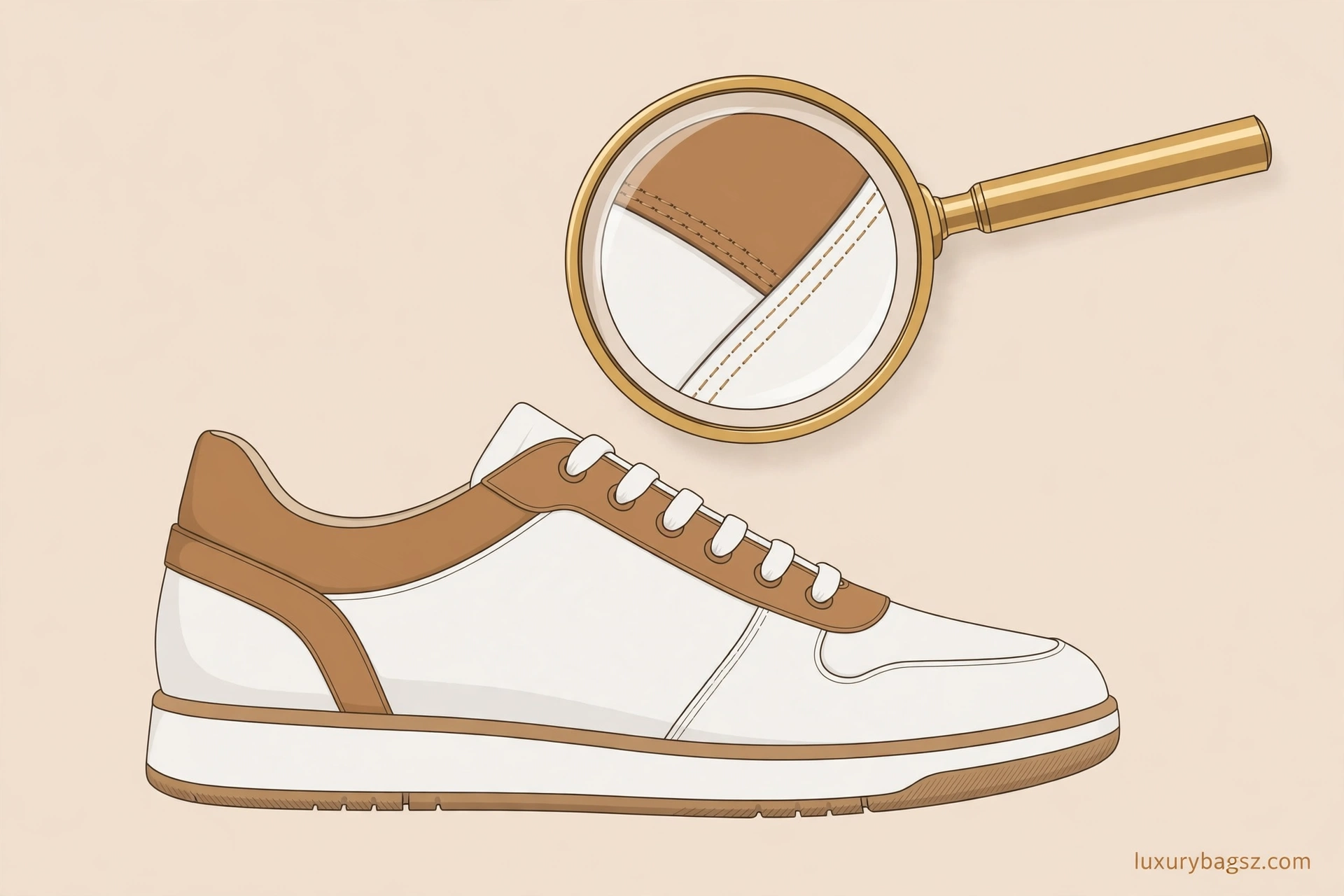
The pictures in this guide are generic illustrations of checks and details. They are not photos of real or fake pairs, and they must never be treated as comparison evidence.
If you are unsure after working through the checks, get a professional opinion before you pay. A second opinion costs far less than a fake pair.
Key Takeaways
- Judge the whole pair, never one logo, stamp, or card on its own.
- Compare only with verified photos of the same model, colourway, and era.
- Hermès issues no authenticity cards as a general rule; a card is a red flag.
- Stitching, sole pattern, heel shape, and hardware finish must all agree.
- A price far below the going range for that model is a warning, not a bargain.
- Blurry, stock, or borrowed seller photos are a reason to pause, not to buy.
- Wear, repairs, and replaced laces can blur genuine details, so weigh them fairly.
- When in doubt, pause the purchase and seek a professional check.
Table of Contents
A pair of Hermès sneakers should look calm and deliberate. Nothing should shout, nothing should look rushed, and nothing should feel like an afterthought.
That calm finish is the thread running through every check below. Fakes often get the big picture right and fail on the small, repeated details.
Keep that idea in mind as you work through the parts. One odd detail can have an innocent explanation, but a cluster of odd details rarely does.
Sneakers are also harder to judge than bags in one respect. They are worn hard, they crease, and soles pick up marks, so condition alone never settles authenticity.
What you are really looking for is quality of making, consistency across the pair, and agreement with the known details of that model.
Part 1: Start With the Pair, Not One Detail
Name the model first. Day, Bouncing, Trail, Quicker, and Happy sneakers do not share one sole, one stamp, or one hardware style.
Ask the seller for the model name, colourway, size, and year of purchase if they know it. A seller who cannot name the model but insists the pair is genuine has already given you useful information.
Search for verified photos of that exact model before you judge anything. Official boutique photos and trusted resale listings of authenticated pairs are your reference, not random marketplace pictures.
Compare the left and right shoes with each other. Genuine pairs are made as a pair, so the two shoes should match in shape, colour, stitching, and hardware tone.
A mismatch between the two shoes is a strong warning. One shoe darker than the other, or one heel shaped differently, deserves a clear explanation before you proceed.
Check the overall silhouette from the side, from above, and from behind. The toe should rise smoothly, the heel should sit upright, and the collar should curve evenly.
Fakes often look slightly puffy, flat, or lopsided when viewed from behind. The shape may look fine in a single front photo and wrong from every other angle.
That is why a single flattering photo proves nothing. Ask for side, top, back, heel, sole, and interior views before forming any view at all.
Note the materials from the listing and from your own eyes. Calfskin, suede goatskin, ripstop fabric, knit, and even crocodile appear across Hermès sneaker lines.
Do not assume every Hermès sneaker is plain calfskin. A Bouncing sneaker in ripstop and calfskin is a different construction from a perforated calfskin Day sneaker.
Material claims must match the model. If a listing calls a mesh-style pair solid calfskin, or calls suede panels smooth leather, treat the description as unreliable.
Weight can help, but only loosely. Genuine sneakers feel substantial for their size, with balanced weight between the two shoes.
A pair that feels feather-light, hollow, or oddly heavy on one side is worth questioning. Weight alone, though, never proves or disproves authenticity.
Smell is another soft clue, not a verdict. Genuine leather smells like leather, while many fakes carry a sharp chemical or plastic smell.
That smell fades with wear and airing, though, and some genuine pairs pick up storage smells. Use it as background, never as your deciding check.
The same caution applies across the brand. Readers checking a fake Kelly will recognise the pattern: judge the whole item, not one feature.


Part 2: Shape, Toe, and Heel Counter
Stand the shoes on a flat surface and look at them from the side. The toe box should hold a smooth, rounded shape, not collapse inward or point sharply upward.
Press the toe gently if you hold the pair in hand. Genuine leather uppers spring back with a soft resistance, while thin fakes often dent and stay dented.
Look at the toe cap join. Panels should meet cleanly, with no puckering, gaps, or glue squeezing out along the edge.
Glue lines are a recurring fake tell on Day-style sneakers. Genuine pairs show clean joins, while fakes often show visible glue, rough edges, or uneven panel overlaps.
Check the heel counter from behind. It should stand straight, with a symmetrical curve on both shoes, and the back seam should run true down the centre.
A heel that leans, twists, or flares outward suggests poor lasting, which is the shaping stage where the upper is pulled over the foot form.
Look at the collar padding around the ankle. It should be even in thickness, smoothly stitched, and the same height on both shoes.
Uneven collar height is easy to miss in a front photo and obvious in a back photo. Ask for that back photo if the listing does not include one.
Check the tongue position. It should sit centred, with a clean outline and no waviness along its edges, and it should not twist to one side.
On Day sneakers, published guides note that fake tongues often have a poor, soft outline compared with the sharp, sleek tongue of the genuine shoe.
That detail matters because the tongue is in almost every listing photo. If the outline looks blurred, bloated, or misshapen, look harder at everything else.
Finally, look at how the shoe sits when unworn. A genuine sneaker holds its shape empty, while a fake often slumps, folds at the ankle, or leans to one side.
Shape loss alone does not condemn a well-worn pair. A heavily worn genuine pair can slump too, so weigh shape together with stitching, sole, and stamps.
Part 3: Leather and Other Materials
Run your eyes, and if possible your fingers, over the leather. Genuine Hermès calfskin feels smooth, dense, and even, with a fine, natural grain that varies slightly.
Fake leather often looks too perfect, too plasticky, or too uniform. It may shine oddly under light, or feel thin and papery between your fingers.
Perforated calfskin, used on Day sneakers, should show clean, evenly spaced holes with no torn edges or ragged punching. Ragged perforations suggest rushed cutting.
Suede panels should feel soft and nap evenly in one direction. Brush a suede panel lightly and watch whether the nap shifts smoothly or looks patchy and thin.
One useful habit comes from suede care generally. A suede brush shows how real suede responds to gentle brushing, while fake suede often looks flat and lifeless.
Ripstop and technical fabric panels, seen on Bouncing styles, should feel tight and structured, not flimsy or shiny like cheap nylon. The weave should be fine and regular.
Knit panels, where a model uses them, should stretch evenly and spring back. Knit that bags, ladders, or pulls unevenly points to lower-grade yarn and construction.
Exotic trims raise the stakes and the price. A crocodile-trimmed Bouncing sneaker is a very different item from a plain calfskin pair, and its price should reflect that.
If an exotic trim looks printed rather than textured, or feels like embossed plastic, treat it as a serious warning. Genuine exotic skin has depth you can see and feel.
Colour is another check, but a subtle one. Genuine Hermès colours are rich and consistent, with the same tone on both shoes and across panels.
Fakes often miss the tone slightly, especially in white, black, and étoupe-style neutrals. One shoe warmer or greyer than the other is a warning sign.
Dye should not rub off easily onto a light cloth, and edges should be dyed or finished evenly. Raw, pale, or blotchy edges suggest rushed finishing.
Remember that sunlight, wear, and cleaning change colour over time. A used pair will not look factory-fresh, so compare tone between the two shoes first.
Part 4: Stitching, the Most Honest Check
Stitching is where fakes most often betray themselves, because even stitching across a whole pair is hard to copy cheaply at scale.
Look at stitch length first. Genuine stitches are even in length, evenly spaced, and follow the panel edge at a steady distance.
Fake stitching often varies in length, wanders away from the edge, or crowds together in one stretch and spreads out in another.
Look for loose threads, skipped stitches, and doubled-back stitches. A genuine pair may show one minor flaw, but a trail of them across the shoe is a pattern.
Check the stitching around the heel, where published Day guides highlight tight, symmetrical stitching on genuine pairs. Loose or crooked heel stitching deserves attention.
Check the stitching where the sole meets the upper. It should be firm, regular, and deeply set, not sitting loosely on the surface.
Midsole stitching is a related tell. Guides on Day sneakers note loose midsole stitching on fakes, where the midsole is not securely attached.
Compare the stitching on both shoes, panel by panel. The same panel on the left and right shoe should show the same stitch count, spacing, and angle.
Slanted stitching is normal on hand-finished Hermès goods, but the slant should be consistent. Random angles, with some stitches vertical and some diagonal, suggest machine rushing.
Thread colour matters too. It should match the leather or contrast deliberately, as designed, and it should be the same colour on both shoes.
Faded thread on a used pair is normal wear. Thread that is a different colour on one shoe, or that frays into fuzz, is not normal wear.
Edge finishing ties in here. Genuine edges are painted or burnished smoothly, while fake edges often look rough, cracked, or thickly painted to hide cuts.
Take close-up photos of the stitching if you are buying remotely. Ask the seller for macro shots of the heel, the toe join, and the sole join, not just full-shoe views.
The same stitching discipline applies to bags. Readers who know the fake Evelyne checks will find the same logic here: even, deep, consistent stitching, or questions.

Part 5: The H Detail, Buckle, and Hardware
Many Hermès sneakers carry an H motif, a Kelly-style buckle, or metal trim. Hardware is heavy, precise, and finished to a high standard on genuine pairs.
Pick the hardware up in your mind and judge its weight. Genuine palladium or permabrass pieces feel solid, while fake hardware often feels light, hollow, or tinny.
Look at the plating. It should be even, smooth, and consistent in tone across every metal part on both shoes.
Published Day guides warn that fake palladium locks often look too yellow or golden, as if the maker overdid the finish. A brassy tint on supposed palladium is a warning.
Check engraving on buckles and metal parts. Letters should be crisp, evenly deep, and correctly spelled, with the accent on the è in Hermès where the marking includes it.
Engraving that looks dotted, chiselled, scratched, or shallow suggests casting or laser work of lower quality. Genuine engraving reads cleanly at a glance.
Check the Kelly buckle function on Day-style sneakers. The buckle should move smoothly, close firmly, and sit flat, not wobble or catch.
A buckle that is purely decorative on a model where it should function, or that flops loosely, points to a copy that copied the look and skipped the mechanism.
Look at the shape of the H itself. Edges should be clean and symmetrical, with no blobs, burrs, or rounded corners where the design calls for sharp ones.
Compare the H on both shoes. Size, position, and angle should match exactly, since hardware is made to tight tolerances.
Check screws, rivets, and eyelets for the same finish. One dull eyelet among shiny ones, or one rough rivet, breaks the consistency genuine pairs show.
Metal should not flake, peel, or show a different base metal beneath a thin coat. Peeling plating on a nearly new pair is a strong warning.
On used pairs, some wear on high points is normal. Wear should look like honest rubbing, though, not like a coating lifting away in sheets.
Hardware tone should also match the listing description. If the seller says palladium and the buckle looks gold, ask why before you accept any explanation.
Part 6: Tongue, Laces, and Eyelets
The tongue carries branding on many models, and it is one of the easiest parts to compare with verified photos.
Read every letter on the tongue label or stamp. Spelling, spacing, and the accent in Hermès must be exactly right, since a misspelling ends the discussion.
Look at the font weight. Letters should be neither too thin and wispy nor too thick and blobby for that model, and spacing between letters should look deliberate.
Compare the tongue label with verified photos of the same model. Font styles change across models and years, so only a same-model comparison counts.
Check the tongue shape itself. Genuine tongues have a clean, sharp outline, while fake tongues often look soft, wavy, or poorly cut at the edges.
Look at how the tongue is stitched in. Stitches should be even and symmetrical, with no puckering where the tongue meets the upper.
Eyelets deserve their own look. Genuine eyelets are perfectly round, evenly set, and finished smoothly, with symmetrical stitching around them where stitched.
Published Day guides note that fake eyelets are often darker than they should be, with a dark outline that makes them stand out cheaply.
Check that every eyelet matches. One oval eyelet, one darker eyelet, or one eyelet set at a different angle breaks the pattern.
Laces should match the model: flat or round, waxed or plain, and in the right colour and length. Wrong lace type alone does not prove a fake, since laces get replaced.
A spare pair of laces in the box is common for some models, including Day sneakers, which are reported with a second set of laces. Their presence is nice, not proof.
What matters is whether the laces look and feel right for a luxury shoe: even weave, clean ends, and no fraying on a new pair.
Check lace holes for stretching or tearing. Evenly worn holes suggest honest use, while torn or punched-looking holes suggest poor reinforcement.
If the seller shows the shoes unlaced or with odd lacing, ask for a normally laced photo. Hiding the tongue and eyelets is sometimes accidental and sometimes not.
Part 7: Heel, Heel Tab, and Back Details
The heel is a small area that carries several checks at once: stitching, shape, ventilation dots, and lettering.
Look at the heel from directly behind. Both heels should mirror each other in height, width, and curve, with no lean to either side.
Published Day guides highlight a dot pattern for ventilation on the genuine heel. A fake pair in that guide lacked the airflow dots entirely.
Do not turn that into a universal rule. Ventilation dots belong to specific models, so check whether your model should have them before judging.
Read any lettering on the heel or heel tab. Font weight, depth, and spacing should match verified photos of the same model.
Guides on Day sneakers report thicker, more deeply carved font on genuine heels, with thinner, shallower lettering on fakes. Depth and weight must be judged together.
Check the heel tab stitching. It should be tight and symmetrical, following the tab edge evenly on both shoes.
Look at the heel sole edge, where the upper meets the outsole at the back. The join should be clean, with no glue overflow or stepped, uneven layers.
Press the heel counter gently. It should feel firm and spring back, holding the ankle shape, rather than collapsing flat under light pressure.
On worn pairs, heel drag and scuffing are normal. What is not normal is a heel that has lost its shape entirely while the rest of the shoe looks new.
Compare heel wear between the two shoes. A genuine worn pair usually wears fairly evenly, allowing for the wearer’s gait, while odd one-sided collapse suggests poor structure.
Photograph the heels straight-on if you are selling or buying remotely. Angled heel photos hide lean, asymmetry, and missing dots, which is exactly what you need to see.
Part 8: Insole, Interior, and Size Markings
Take the insole view seriously, even though it is the least glamorous photo in a listing. Many fakes fail here.
Read the insole branding. Letters should be crisp, evenly pressed or printed, and correctly spelled, with the accent in Hermès present where the design includes it.
Look at the depth of the insole stamp. Genuine markings are usually clean and well-defined, neither faint and blurry nor brutally deep and distorted.
Font thickness is a guide, not a law. On Oran sandals, one published guide finds fake insole text too thin, while fake sole text can run too thick elsewhere.
That conflict is the point: thickness direction varies by part and by fake batch. Compare with the same model, not with a general rule about thick or thin.
Check the size marking. It should sit where the model places it, in the expected format, and it should agree with the size on the box and in the listing.
A size that disagrees across shoe, box, and listing is a warning. Genuine pairs can have box swaps, but the seller should explain the mismatch openly.
Check the interior lining. It should be smooth, well-fitted, and cleanly stitched, with no bunching, loose flaps, or rough glued seams inside the shoe.
Look for a made-in marking and read it exactly. Many Hermès sneakers are reported as made in Italy, including Day, Bouncing, and Trail styles.
Do not assume every pair says the same thing. Check the marking against the official description for that model, and treat an unexpected origin claim as a question, not an answer.
Beware of applying bag stamp logic to shoes. The year-letter blind stamp system used for bags does not decode sneaker markings, and a bag chart will mislead you here.
Sneaker markings vary by model and year, and some pairs carry little more than brand, size, and origin. Absence of a bag-style date code is not itself a fake tell.
Smell the interior if you hold the pair. Genuine leather lining smells like leather, while a strong glue or plastic smell inside a supposedly new pair is a warning.
Finally, check the insole fit. It should lie flat, fill the shoe evenly, and not curl, bubble, or slide, all of which suggest poor cutting or replacement.
Part 9: Sole, Midsole, and Outsole Pattern
Turn the shoes over. The sole is where many guides start, because sole pattern, logo, and construction are hard to copy exactly.
Look at the overall sole shape. It should follow the upper neatly, with no overhang, no pinched waist, and no wavy edge where the sole meets the leather.
Check the midsole layer. On Day sneakers, guides report the genuine midsole pattern as engraved, with rounder elements, while fakes show embossed, boxier shapes.
Look at the pattern elements one by one. Genuine elements are usually clean, rounded, and evenly spaced, while fake elements can look sharper, boxier, or unevenly sized.
Check the sole colour and finish. It should be even, with the expected tone for that model, and the same tone on both shoes.
Published Oran guides note fake soles in too light a brown against a darker genuine brown. Colour shade can therefore help, but only against the same model.
Read the outsole logo and text. Letters should be well-formed, evenly spaced, and pressed to a consistent depth across the whole marking.
On Day sneakers, one guide reports a deeply engraved red HERMES logo on genuine soles, with a shallower, thicker-lettered logo on fakes.
Treat that as a model-specific observation, not a universal law. Other models and other fake batches show the opposite thickness error, so compare like with like.
Check the size or model text on the sole where present. It should match the interior size and the box, and it should use the expected font for that model.
Look at sole stitching or bonding. Stitched soles should show even stitching, while bonded soles should show a clean, gap-free join with no glue lines.
Press the sole gently. Genuine rubber soles feel dense and resilient, while cheap fakes can feel hard and slippery, or soft and crumbly at the edges.
Check wear patterns on used pairs. Honest wear concentrates on the heel strike and forefoot, while a sole that is pristine except for odd gouges may have been altered.
Finally, compare both soles side by side. Pattern, logo depth, colour, and wear should agree, since the two soles leave the same mould and factory line.

Part 10: Box, Dust Bags, and Extras
Packaging supports a story, but it never proves authenticity on its own. Judge it after the shoes, not instead of them.
A genuine Hermès shoe box is sturdy, well-printed, and correctly sized for the pair. Print should be sharp, with no blur, misspelling, or washed-out colour.
Check the box label. Model, colour, and size should match the shoes inside, and the label style should match the era of the pair.
A box that names a different model or size is not fatal on a preloved pair, since boxes get swapped. It does mean the box adds no support to the claim.
Dust bags should feel like quality cotton or flannel, with clean stitching and a correctly printed or embroidered logo. Thin, shiny, or rough bags are a warning.
Published Oran guides note fake dust bags with a logo in very light brown, almost red, against a black logo on genuine bags. Logo colour can help on that model.
Check the dust bag logo size and shape. A logo that is too thick, too large, or poorly formed suggests a copy, even if the bag fabric feels plausible.
Spare laces, care booklets, and tissue add context when they match the model and era. Mismatched extras, or extras for a different model, add nothing.
Receipts can support provenance, but they can also be borrowed, edited, or faked. A receipt helps when it matches the model, size, date, and seller story.
Never accept paperwork as a substitute for shoe checks. The shoes are the item, and a perfect box around a fake pair is still a fake pair.
Keep the same discipline for other Hermès pieces. The fake Oran sandals guide makes the same point: packaging is context, never proof.
Part 11: The Authenticity Card Trap
This part deserves emphasis, because the card trap catches even careful buyers. Hermès issues no authenticity cards as a general rule.
Multiple published authentication guides state this plainly: Hermès has never issued authenticity cards for its bags, and the same rule is applied to its leather goods generally.
A shiny plastic card, an orange credit-style card, or a paper certificate claiming to certify the sneakers should therefore raise alarm, not confidence.
Sellers sometimes include such cards to imitate other luxury brands, which do use cards. Hermès does not follow that practice, so the imitation itself is the tell.
Third-party certificates are a different thing. A resale platform or authenticator may issue its own certificate, but that is their document, not a Hermès card.
Read any third-party certificate carefully. It should name the authenticator, the item, and the date, and it should be verifiable with that authenticator.
A vague certificate with no issuer, no item details, and no way to verify it is worth little. Do not let a fancy certificate override failing shoe checks.
Some listings advertise bundles such as box, card, dust bag, and carry bag as a selling point. When the card is presented as Hermès proof, treat the listing with extra caution.
The same caution applies to exotic-skin paperwork. CITES documents for exotic skins are a separate legal document, not a general authenticity card for sneakers.
If a seller insists the card proves genuineness, ask them to explain which Hermès card system they mean. A genuine seller will usually correct the claim or drop it.
A missing card, by contrast, is not a problem. Most genuine Hermès purchases simply never included one, so absence of a card proves nothing either way.
Judge the shoes, judge the seller, and judge the story together. A card that should not exist is a reason to look harder, and often a reason to walk away.

Part 12: Price Traps and Model Confusion
Price is a filter, not a verdict, but extreme prices deserve a hard look. Start by finding the going range for that exact model and condition.
Retail prices vary widely by model, material, and region, and preloved prices vary further by condition, size, and seller. Never use one listing as a market average.
Dated single listings show the spread. A preloved pair of black Day sneakers, size 35, was listed at $457, reduced from $581, by one consignment seller.
A preloved pair of Quicker Jungle Love sneakers, size FR 39, was listed at $288 CAD against an estimated retail of $983 by one Canadian consignment seller.
A men’s Bouncing sneaker in ripstop and calfskin was listed at AED 6,490 across sizes by one UAE personal-shopping seller, with the same price at every size.
A preloved pair of Happy sneakers, size 36, was listed at ₱45,000 against an estimated retail of ₱55,000 by one Philippines preloved seller.
These are single dated listings, not averages and not current retail. They show why a single price quoted online should never anchor your judgement.
Material changes the range sharply. A crocodile-trimmed Bouncing sneaker was listed at $7,695 by one seller, far above plain calfskin versions of the same line.
Currency, region, taxes, and seller fees also move prices. A price that looks low in one currency may be ordinary once conversion and fees are counted.
Be wary of new, full-size-range listings at a fraction of retail. A seller offering every size of a popular model at a deep discount is a classic fake pattern.
Be wary of urgency tricks too: flash sales, countdown timers, and claims of a closing warehouse. Genuine sellers rarely need to rush you.
Check whether the price fits the condition. A like-new pair priced like a heavily worn pair, or a worn pair priced like new, both deserve questions.
Compare prices across trusted resale platforms for the same model, size range, and condition. A price far below every trusted listing is a warning.
Finally, remember that a plausible price proves nothing on its own. Good fakes are often priced plausibly, precisely to pass the price filter.
Part 13: Seller Photos, and What to Ask For
Most fakes are bought from photos, so the photo set is part of the authentication. A thin or evasive photo set is itself a signal.
Ask for both shoes together, then each shoe alone, from the side, top, back, and sole. A seller who provides only one angle is asking you to trust blind.
Ask for close-ups of the tongue, the heel, the insole, the sole logo, the stitching at the heel and toe, and any hardware. Blurry close-ups are not close-ups.
Ask for a photo of the box label and dust bag, if included, plus any receipt with personal details covered. Refusal to show packaging is a soft warning.
Check whether the photos look like one pair in one place. Mixed lighting, mixed backgrounds, and mixed flooring across photos can mean borrowed pictures.
Reverse-image check the main photo when you can. A photo that appears on many listings, or on a brand site, is likely stock or stolen.
Watch for photos that hide flaws: shoes always photographed from the same flattering angle, heels never shown, soles never shown, or interiors never shown.
Ask the seller to add a dated note or a specific angle you request, such as the left sole next to a coin for scale. A genuine seller with the pair in hand can usually comply.
Be cautious with sellers who claim the pair is in a warehouse, with a friend, or otherwise unavailable for new photos. That story is sometimes true and often convenient.
Check the seller’s history, reviews, and return policy. A strong return policy and a clear authentication promise lower risk, though neither guarantees genuineness.
Read the listing text for contradictions. Model, size, material, and colour should agree across title, description, and photos, with no copy-paste leftovers.
A listing that names two different models, or that describes suede in the title and calfskin in the text, has not been written from the pair in hand.
Keep copies of the listing and photos before you pay. If the pair arrives different from the photos, that record is your evidence for a return or claim.

Part 14: Traps That Prove Nothing
Some popular checks sound convincing and prove very little. Knowing them saves you from false confidence in both directions.
A dust bag proves nothing on its own. Dust bags are easy to copy, easy to swap, and easy to buy separately, so a nice bag adds only context.
A box proves nothing on its own, for the same reason. Boxes are swapped between pairs, and fake boxes can look convincing in a single photo.
A receipt proves little on its own. Receipts can be borrowed from a genuine purchase, edited, or faked, and a receipt for a different item proves nothing about this pair.
A third-party certificate proves only what its issuer checked, if anything. An unverifiable certificate, or one from an unknown issuer, should carry no weight.
A seller’s claim of boutique purchase proves nothing without supporting detail. Ask which boutique, when, and whether any record matches the pair.
A large social media following proves nothing about authenticity. Followers can be bought, and a polished feed can sit above a fake operation.
A low price proves nothing by itself, and a high price proves nothing either. Fakes are sold cheaply to move volume and dearly to look genuine.
A good smell, a heavy feel, or a nice box can all be faked or mimicked. Soft clues support a verdict, but they never replace stitching, sole, and stamp checks.
Wear proves nothing either way. Genuine sneakers wear out, and fakes can be artificially aged, so a worn look is not evidence of genuineness.
Rarity claims prove nothing. A seller calling a common colourway rare, limited, or sold out should be asked for the basis of that claim.
Even a professional-looking listing proves nothing. Good photography, neat formatting, and confident wording are cheap, while good craftsmanship is not.
The only reliable approach is the cluster approach: many independent checks, all pointing the same way, for the same model.
Part 15: If You Already Bought a Pair
If the pair is already on its way, or already in your home, work through the checks calmly and keep your options open.
Photograph the parcel, the box, and the shoes before you wear them. Unboxing photos protect you if you later need a return or a claim.
Work through Parts 1 to 10 in order, with the shoes in hand, and note each check as pass, fail, or unclear. Do not decide on the first fail alone.
Do not wear the pair outdoors until you have decided. Worn shoes are harder to return, and a seller may refuse a return once soles show outdoor wear.
Try the shoes indoors on a clean surface if you need a fit check. Indoor trying preserves the soles while letting you judge size and comfort.
Sizing needs care here. One preloved listing notes that Hermès shoes typically run 1 to 1.5 sizes smaller, with sizing dependent on style.
Other buyers report different fits by model, so treat sizing as a fit question, not an authenticity verdict. A tight pair is not automatically fake.
Check the return window and the platform’s claim deadlines on the day the pair arrives. Deadlines pass quietly, and a late claim is a weak claim.
Contact the seller promptly, politely, and specifically if checks fail. Name the checks, attach photos, and ask for a return or a professional authentication.
Keep the original packaging, dust bags, laces, and extras together. Returning a pair without its packaging weakens your position, even when you are right.
If the seller refuses, escalate through the platform with your dated photos and your check notes. A clear, specific claim fares better than a general complaint.
Consider a professional authentication service for a disputed pair. A written opinion helps with the seller, the platform, and any payment claim.
If the verdict is fake, do not resell the pair as genuine, and do not pass the problem to another buyer. Report the seller where the platform allows it.
If the verdict is genuine but the fit is wrong, that is a different outcome. A genuine pair in the wrong size is a sizing lesson, not a fraud, and it can be resold honestly.
Part 16: Care, Storage, and Keeping a Genuine Pair Genuine
Care does not authenticate a pair, but good care keeps a genuine pair looking genuine, which matters if you later resell it.
Clean leather panels with a soft, dry cloth first, and test any product on a hidden spot. Harsh cleaners and water can stain calfskin and suede.
Suede panels need a gentle touch and the right tool. The same suede brush guidance used for bags applies to suede sneaker panels.
Leather conditioner can help smooth calfskin, but it should be used sparingly and matched to the leather type. Over-conditioning darkens and softens the leather.
Readers who condition bag leather will know the parallel. Guidance on Saphir Renovateur shows the test-first habit that also suits sneakers.
Store sneakers in their dust bags, in their box, away from sunlight and damp. Sunlight fades colour, and damp encourages mould and glue failure.
Use shoe trees or tissue to hold the shape, especially for soft leather uppers. A collapsed toe or ankle makes any pair harder to judge later.
Keep laces, spare laces, box, and dust bags together. A complete set with matching extras supports a future sale, even though extras never prove authenticity alone.
Rotate wear where you can. Daily wear in the same pair wears soles and heels faster, and uneven wear can confuse later checks.
Photograph a genuine pair when it is new to you, including sole, insole, heel, and hardware. Those photos become your own reference if you later question the pair.
Keep purchase records with the pair: receipt, seller details, platform order number, and any authentication opinion. Records support provenance, not proof, but they help.
Finally, remember the leather story behind the brand. Knowing which country makes leather for Hermès bags gives context, but sneaker leather and making should still be judged on the pair itself.
Part 17: When to Walk Away, and When to Get Help
Walk away when several checks fail together, even if each single fail could be explained. A cluster of fails is the pattern fakes show.
Walk away when the seller cannot provide the photos you asked for, or when the photos keep arriving blurry, cropped, or borrowed.
Walk away when a card is presented as the main proof. That claim contradicts how Hermès works, and it tells you about the seller’s standards.
Walk away when the price, the model, and the condition do not line up. A like-new exotic-trim pair at a worn calfskin price is not a lucky find.
Walk away when the listing contradicts itself on model, size, or material. A seller who has not looked closely at the pair cannot vouch for it.
Walk away when pressure is applied: a countdown, a competing buyer story, or a demand for off-platform payment. Genuine deals survive a pause.
Get a professional opinion when the pair passes most checks but one or two remain unclear. Borderline pairs are exactly where experts earn their fee.
Get help early, before payment, where the platform allows a pre-purchase check. A pre-purchase opinion is cheaper and cleaner than a post-purchase dispute.
Choose an authenticator with a clear Hermès footwear record, and ask what they check and how they report. A one-word verdict with no reasoning helps no one.
Understand what boutiques will and will not do. Hermès boutiques do not generally authenticate pre-owned items on request, so do not rely on a boutique visit.
If you already own a pair you now doubt, get an opinion before wearing it further or reselling it. An honest verdict protects you and any future buyer.
The same discipline runs through the brand’s other fakes guides. A fake Lindy check, a fake Geta check, and a fake Clic H check all end in the same place: evidence first, purchase second.
That order is the whole guide in one line. Evidence first, purchase second, and no single card, box, or bargain ever reverses it.
Frequently Asked Questions
What is the fastest way to spot a fake Hermès sneaker?
Start with shape, stitching, sole pattern, and hardware together, then compare with verified photos of the same model. No one detail is fast and reliable alone.
Do Hermès sneakers come with an authenticity card?
No, as a general rule Hermès issues no authenticity cards. A card presented as Hermès proof is a red flag, and a missing card is not a problem.
Does a box and dust bag prove sneakers are genuine?
No. Boxes and dust bags can be copied or swapped, so they add context only. Judge the shoes first, and treat packaging as supporting detail.
Are Hermès sneakers made in Italy?
Many reported models, including Day, Bouncing, and Trail styles, are made in Italy. Always check the marking against the official description for that exact model.
How much do genuine Hermès sneakers cost?
Prices vary widely by model, material, region, and condition, so there is no single genuine price. Compare trusted listings for the same model and condition, and treat extreme discounts as warnings.
Do Hermès sneakers run small?
One preloved listing notes that Hermès shoes typically run 1 to 1.5 sizes smaller, with sizing dependent on style. Other buyers report different fits by model, so fit alone never proves authenticity.
Can I trust a seller’s receipt?
A receipt can support provenance, but it can also be borrowed, edited, or faked. It helps most when model, size, date, and seller story all agree with the pair.
What photos should I ask a seller for?
Ask for both shoes together, each shoe alone, side, top, back, heel, sole, insole, tongue, stitching close-ups, and hardware. Refusal or repeated blur is a reason to pause.
What should I do if I already bought a fake pair?
Photograph everything, do not wear the pair outdoors, contact the seller promptly with specific checks and photos, and escalate through the platform if needed. Get a professional opinion for a disputed pair.
Can a Hermès boutique authenticate my sneakers?
Hermès boutiques do not generally authenticate pre-owned items on request. Use the checks in this guide, or a reputable independent authenticator, instead.
Conclusion
Spotting a fake Hermès sneaker is a habit, not a trick. Name the model, compare with verified photos of that model, and work through shape, stitching, sole, hardware, stamps, packaging, price, and seller behaviour together.
No card, box, receipt, or bargain replaces that work. Hermès issues no authenticity cards as a general rule, and any seller who leans on a card has told you something important about their listing.
Most fakes fail as a cluster, not as a single flaw. Trust the cluster, pause when it points against the pair, and get a professional opinion before money changes hands on a borderline pair.
Buy slowly, keep your photos and records, and let evidence lead. That patience is what turns a risky resale purchase into a pair you can wear with confidence.






