Hermès Belt Buckle and Strap Sizes Explained: 13 mm vs 24 mm
13 mm or 24 mm? The Short Answer
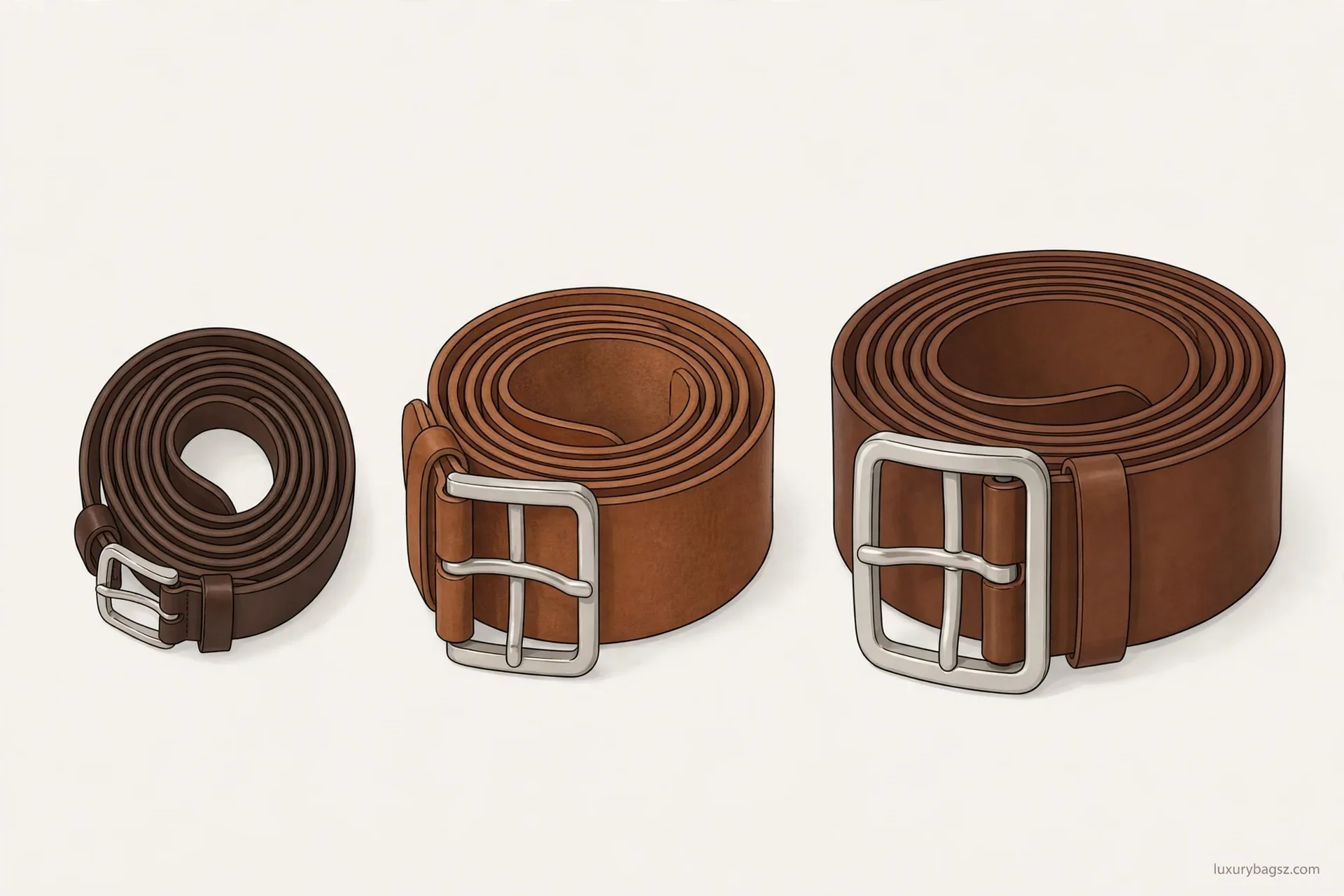
A Hermès belt number in millimetres is its width, not its length. A 13 mm belt is a slim, delicate strap, about half an inch wide. A 24 mm belt is a neat medium strap, just under an inch wide.
The number on the buckle must match the number on the strap exactly. A 13 mm buckle fits a 13 mm strap only, and a 24 mm buckle fits a 24 mm strap only. There is no close-enough fit here.
Length is a separate number, given in centimetres. Your belt size in centimetres is measured from the buckle hole to the hole you use most. Width and length answer different questions, and mixing them up is the most common buying error.
If you want a dressy, jewellery-like belt, start with 13 mm. If you want one belt for everyday wear, start with 24 mm. The rest of this guide shows how to measure, compare, and buy without a width mistake.
A Hermès belt is bought as a kit, not as a single fixed belt. The kit pairs one metal buckle with one leather strap, and the strap is usually finished in two colours, one on each face.
After your first kit, you can buy extra straps on their own. Those straps must still match your buckle width exactly. A new colour does not help if the strap cannot pass through the buckle loop.
One warning belongs at the top, before any shopping. The classic Kelly 18 belt is single-sided and sliding-adjustable, not reversible. The reversible buckle-and-strap kit belongs to the H buckle and Constance family.
Hermès also issues no authenticity cards as a general rule. A seller who offers a card as proof is raising a red flag, not settling the question. Judge a belt by its leather, stitching, stamp, and hardware instead.
Prices in this guide are dated, single-listing examples only. They are never market averages, and they are never a promise of what you will pay. Boutique and resale prices move with region, season, colour, and condition.
Where sources disagree, this guide says so plainly. Width ranges, hole counts, size conversions, and prices all carry conflicts, and each one is flagged where it appears.
Table of Contents
Key Takeaways
- Width in millimetres is the strap width, and the buckle loop width must match it exactly.
- 13 mm is slim and dressy, about half an inch; 24 mm is a neat medium strap, just under an inch.
- Length in centimetres is separate from width in millimetres; measure from the buckle hole to the hole you use most.
- Hermès belt kits pair one buckle with one strap; buy extra straps at your exact buckle width only.
- The classic Kelly 18 belt is single-sided and sliding-adjustable, not reversible.
- The reversible kit belongs to the H buckle and Constance family.
- A 13 mm strap cannot take a 24 mm buckle, and a 24 mm strap cannot take a 13 mm buckle.
- Measure the buckle loop inside, edge to edge, and the strap edge to edge, both in millimetres.
- Hermès issues no authenticity cards as a general rule; judge by leather, stitching, stamp, and hardware.
- Model name alone never proves width; measure the buckle loop and the strap.
Part 1: The Kelly Correction Every Buyer Needs First
The classic Kelly 18 belt is single-sided and sliding-adjustable, not reversible. That single fact clears up the most common mix-up in Hermès belt shopping. If you want the full Kelly story, read our Kelly belt guide for how the bracelet and the belt differ.
A reversible belt kit is a different product line. It pairs a buckle that accepts the strap from either face with a strap finished in two colours, one on each face. That kit belongs to the H buckle and Constance family, not to the Kelly line.
Why does this matter for sizes? A reversible kit must match width on two faces, and buyers often assume the Kelly belt works the same way. It does not. Buy the Kelly 18 for the sliding, single-sided fit, and buy an H or Constance kit when you want the reversible function.
Part 2: How the Hermès Belt Kit System Works
A Hermès belt kit pairs one metal buckle with one leather strap. The strap is usually finished in two colours, one on each face, so one kit gives two looks through one buckle.
The first purchase is the full kit. After that, straps are sold on their own, and buckles are sold on their own. An extra strap is only useful if its width matches your buckle loop exactly.
Hermès works with many tanneries and leather types, and leather choice changes feel, grain, and care. Our guide to leather origins explains where Hermès leather is made and why it matters for a belt you will wear daily.
Think of the kit as two independent decisions. First, choose your buckle width: 13 mm, 24 mm, 32 mm, or wider. Then, choose your strap in the same width, in the colours and leather you prefer. Width is the gatekeeper; everything else follows.
Part 3: What 13 mm and 24 mm Actually Measure
A millimetre width is measured straight across the strap, edge to edge, at its widest finished point. A 13 mm strap measures 13 mm across; a 24 mm strap measures 24 mm across. The buckle loop is measured the same way, inside edge to inside edge, where the strap passes through.
Here is the conversion buyers ask about most. 13 mm is about half an inch, and 24 mm is just under an inch. Neither is a length; both describe how wide the strap sits on your waist or hips.
Length is the separate number in centimetres. Your belt size in centimetres runs from the buckle hole to the hole you use most. A belt marked 85 cm and 24 mm is 85 cm long and 24 mm wide: two numbers, two jobs.
Part 4: The 13 mm Belt in Depth
The 13 mm belt is the slimmest standard width in the Hermès belt range. At about half an inch, it reads as a dressy, jewellery-like accent rather than a workhorse belt.
A 13 mm buckle is proportionally small. The Focus buckle in 13 mm, for example, is a neat, compact frame that suits the slim strap. A wider buckle would overhang the strap edges and look wrong.
Wear the 13 mm width when the belt is an accessory first. It suits dresses, high-waisted skirts, and tailored trousers where a slim line matters. It is less suited to heavy denim or wide belt loops.
The trade-off is presence. A 13 mm belt will not carry visual weight the way a 32 mm belt does. Choose it for delicacy, not for statement.
Part 5: The 24 mm Belt in Depth
The 24 mm belt is the neat medium of the range, just under an inch wide. It is the most versatile width for everyday wear.
A 24 mm buckle is a comfortable middle size. The Mini Constance buckle in 24 mm, for example, is compact but still reads clearly as a design feature. It balances with the strap without dominating it.
Wear the 24 mm width as a daily default. It works with jeans, chinos, and casual tailoring, and it still looks tidy with smarter outfits. If you buy one belt first, this width is the usual recommendation.
The trade-off is subtlety. A 24 mm belt will not disappear the way a 13 mm belt does. Choose it for versatility, not for invisibility.
Part 6: The Other Widths That Exist
13 mm and 24 mm are not the only widths. Hermès belt straps and buckles also come in 32 mm, 38 mm, and 42 mm, among others. Sources conflict on the full range, and this guide flags that conflict rather than pretending the list is closed.
The rule does not change with width. Whatever number is on the buckle, the strap must carry the same number. A 32 mm buckle needs a 32 mm strap; a 38 mm buckle needs a 38 mm strap.
Wider widths suit different styling. A 32 mm belt reads as a classic casual belt. 38 mm and 42 mm are bolder, more statement widths, and they need belt loops wide enough to take them.
Do not assume a wider strap is a longer strap. Width and length remain separate numbers at every size. A 42 mm belt in 80 cm and a 42 mm belt in 95 cm are the same width and different lengths.

Part 7: 13 mm vs 24 mm at a Glance
The table below sums up the head-to-head choice. Use it to shortlist a width, then measure before you buy, since no table replaces a ruler.
| Question | 13 mm | 24 mm |
|---|---|---|
| Width | About half an inch | Just under one inch |
| Look | Slim, delicate, jewellery-like | Neat, balanced, clearly a belt |
| Formality | Dressiest, best for evenings | Versatile, office to weekend |
| Best with | Dresses, slim trousers, skirts | Jeans, tailored trousers, dresses |
| Buckle style | Slim and jewel buckles | Mini H, jewel, and mid-size buckles |
| Daily wear | Light use, more delicate | Regular use, more forgiving |
| Strap range | Narrower colour range | Broad colour range |
| First kit? | Best as a second, dressy belt | Best as a first, everyday belt |
Formality is the sharpest difference. A 13 mm belt whispers, while a 24 mm belt speaks at normal volume. Neither is better in itself; the right choice depends on the outfits you wear most.
Body shape also plays a part, though taste beats any rule. A slim belt can vanish on a larger frame, and a medium belt can ground a smaller frame. Try both widths against your usual outfits if you can.
Belt loops decide more than most buyers expect. A 13 mm strap fits almost any loop, including very slim dress loops. A 24 mm strap fits most standard loops, but check a special garment first.
Buckle choice follows width, not the other way round. Fall in love with a buckle, then check its width, then buy straps in that width. Falling in love with a strap in the wrong width helps no one.
Cost per wear favours 24 mm for most first buyers. A 24 mm kit gets worn more often, and extra 24 mm straps are easier to find. A 13 mm kit earns its place as a dressy second belt.
If you can only buy one kit this year, buy 24 mm. If you already own a 24 mm or 32 mm kit and want something dressier, 13 mm is the natural next step.


Part 8: How to Measure a Buckle in Millimetres
Measuring a buckle takes a ruler, good light, and one minute. Do not trust the listing title alone, and do not judge width by the buckle face.
Step one: remove the strap if you can, or lay the buckle flat with the loop open. You need a clear view of the loop, which is the opening the strap threads through.
Step two: place a millimetre ruler across the inside of the loop, edge to edge. Measure the clear opening, not the outside of the metal frame. The clear opening is the number that must match the strap.
Step three: read the number in millimetres, not inches. If your ruler shows only inches, convert with care: 13 mm is about half an inch, and 24 mm is about 15/16 of an inch.
Step four: compare the reading with the standard widths. A reading near 13 mm means a 13 mm buckle, and a reading near 24 mm means a 24 mm buckle. A reading near 37 or 38 mm belongs to that wider family.
Step five: repeat the measurement at the narrowest point of the loop. Some loops taper, and the narrowest point is the true limit for the strap. A strap that fits the wide end but not the narrow end still does not fit.
Common buckle mistakes are easy to avoid. Measuring the face instead of the loop is the first one, and it always gives a number far too large.
Measuring the outside of the frame is the second one. The frame adds metal on both sides, so the outside reading runs several millimetres larger than the loop opening.
Using a soft tape measure around a curved buckle is the third one. A rigid ruler or calliper gives a cleaner reading, and a calliper is best for jewel buckles with uneven loops.
For a pre-owned purchase, ask the seller to photograph the ruler inside the loop. A straight-on photo with the millimetre marks visible settles width disputes before money changes hands.
If the seller refuses a ruler photo, walk away. A genuine seller with the right width has nothing to lose by proving it, and a vague answer is itself useful information.

Part 9: How to Measure a Strap in Millimetres
Measuring a strap is simpler than measuring a buckle, but it still needs care. Lay the strap flat on a table, with no twist and no curl at the edges.
Place a millimetre ruler straight across the strap, at right angles to its length. Read edge to edge, leather only, ignoring stitching that sticks out beyond the edge.
Measure in at least two places: near the buckle end and near the middle. A genuine strap keeps the same width along its length, apart from a tapered tip at the very end.
Do not measure across the tapered tip. The tip narrows by design, so a tip reading always comes out smaller than the true width. Measure the main body of the strap instead.
Also check both faces if the strap is reversible. A two-faced strap should measure the same on each face, since both faces are bonded into one strap. A difference suggests damage or a non-original strap.
For a 13 mm strap, expect a reading of 13 mm across the main body. For a 24 mm strap, expect 24 mm. A reading of 12 mm or 25 mm is not close enough, even though it looks near.
Leather can vary by a fraction of a millimetre with wear and humidity. A reading within half a millimetre of a standard width is normal, but a full millimetre out deserves a second check.
If you have no millimetre ruler, use a calliper or a printable millimetre scale. Phone apps that estimate width from a photo are not reliable enough for a purchase decision.
For a pre-owned purchase, ask for a ruler photo across the strap body, not across the tip. Ask for the same photo on the buckle loop, so you can compare the two numbers side by side.
One last check: thread the strap through the loop if you can test in person. It should pass smoothly, with no forcing and no sideways wobble. Smooth and snug is the right feel.
Part 10: Length in Centimetres Is a Separate Number
Width answers “how wide is the strap?” Length answers “how long is the belt?” The two numbers use different units, and confusing them is the fastest route to a wrong order.
Belt length is given in centimetres, not millimetres. A belt listed as 85 means 85 cm from the buckle hole to the hole you use most, not 85 mm and not 85 inches.
To find your size, take a belt you already wear well. Remove the buckle if you can, then measure from the buckle hole, where the pin sits, to the hole you use most.
That hole is usually the middle hole on a three-hole Hermès strap. On a five-hole strap from another brand, it is usually the third hole. Do not assume the middle hole is always your hole.
Round your reading to the nearest 5 cm, since Hermès sizes step in 5 cm increments. A reading of 83 cm rounds to 85 cm, and a reading of 87 cm also rounds to 85 cm in most guides.
Check the rounding rule with the seller if you sit near a boundary. A reading of 87.5 cm could round either way, and a seller who knows the strap can confirm which size the strap was sold as.
Hole spacing is another conflict to note plainly. One replacement-strap maker gives hole spacing as about 2.5 cm, or one inch, for Hermès-style straps, while other guides imply slightly different spacing.
Hole count is a related conflict. Hermès kit straps usually carry three holes, while standard belts from other brands usually carry five. A five-hole strap is not automatically wrong, but it is not the usual Hermès kit pattern.
Tail length also differs by hole count. One maker states that a belt should measure 10 cm from the last hole to the tip for five-hole belts, and 12.5 cm for three-hole Hermès-style belts.
That tail rule explains the tip-to-tip trap. Tip-to-tip length includes the buckle width, the tail past the last hole, and the full strap. It always reads longer than your belt size.
For example, a belt sized 85 cm may measure about 100 cm or more tip to tip, depending on buckle and tail. Ordering by tip-to-tip length therefore buys a belt that is far too long.
Trouser size is the other trap. Your belt size is not your trouser size, and guides disagree on the conversion. One rule says go two inches up from trouser size, while others say measure a belt you already own.
Measuring a belt you own beats any conversion rule. Trouser labels vary by brand and cut, while a buckle-hole-to-worn-hole measurement reflects how you actually wear a belt.
If you wear a belt at the waist for one outfit and on the hips for another, you need two sizes or a sliding belt. A pin-and-hole belt cannot cover both positions well, since the gap is usually more than one hole.

Part 11: Buying New — Kit First, Straps Later
Your first Hermès belt purchase is normally a full kit: one buckle plus one strap. Hermès does not sell buckles alone through official channels, so the kit is the only official entry point.
Choose the buckle first, because it sets the width for every later strap. A buckle you love in 24 mm gives you years of strap choices, while a buckle you merely like in 13 mm limits you to slim straps.
Next, choose a strap colour pairing you will wear often. Black with gold is the safest first pairing, since it works with dark and light outfits alike. Save a bold pairing for your second strap.
Check the width on the product page before you add anything to your basket. Hermès pages state the width plainly, such as 13 mm or 24 mm, for each kit. Screenshot the page if you buy online.
Confirm the length too, using your buckle-hole-to-worn-hole measurement. If you sit between sizes, ask the boutique whether the strap can be cut shorter or given an extra hole.
One resale guide states that Hermès can cut a strap shorter in store and punch extra holes free of charge. Treat that as a single-guide claim, not a guaranteed service, and confirm it with the boutique first.
After your first kit, extra straps are bought on their own. This is where the kit system pays off, since a new strap costs less than a new kit and doubles your outfit options.
Keep a note of your buckle width with your order records. A simple note such as “24 mm buckle, 85 cm” prevents a future mistake when you order a strap in a hurry.
Also note your strap length in the same place. Width and length together are the full order, and either number alone is incomplete. A strap in the right width but the wrong length still fails.
Price claims need the same care as size claims. One resale guide, accessed for this guide, put a complete kit at $700 to $1,035 in 2026, with a 32 mm replacement strap at about $610.
That same guide put a Constance buckle kit with a 38 mm strap at about $1,190 on hermes.com. Treat both figures as single-guide examples from 2026, not as current boutique prices.
Another guide put standalone buckles on the secondary market at $180 to $895. That wide range reflects buckle design, metal, and condition, and it is not a price list for any single buckle.
Boutique prices move by region and season, and resale prices move with condition and colour. Always confirm a current price before you buy, and never budget from a single old listing.
Part 12: Buying Pre-Owned — Width Checks That Matter
Pre-owned buying rewards patience and punishes haste. Width checks come first, because a width mistake cannot be fixed by cleaning, conditioning, or goodwill.
Start with the listing title, then ignore it. Titles often say “24 mm” because the seller copied a similar listing, not because the strap was measured. Ask for measurements instead.
Ask for four photos: the buckle loop with a ruler inside it, the strap body with a ruler across it, the stamp, and both faces of the strap. A seller who provides all four is already a good sign.
Check the stamp with care. It should read clearly, with even lettering, on the inner face or underside of the strap. Blurred, uneven, or misspelled lettering is a warning sign.
Check the stitching next. Hermès stitching is even, straight, and consistent along the strap edges. Loose threads, skipped stitches, or wavy lines suggest repair or a fake.
Check the holes as well. Genuine holes are clean, evenly spaced, and free of tearing. Stretched or torn holes suggest heavy wear, or holes punched after sale by someone without the right tools.
Check the buckle fit in person when you can. The strap should thread smoothly through the loop, with no forcing and no sideways wobble. The pin should align cleanly with the holes.
Check the buckle metal too. Plating should be even, with wear only where you expect it, such as on high points. Flaking, bubbling, or a brassy base metal showing through are warning signs.
Now the card question. Hermès issues no authenticity cards as a general rule, so a card offered as proof is a red flag, not reassurance. Our fake Kelly guide makes the same point for bags, and it applies to belts too.
A missing card is normal, and a present card proves nothing on its own. Judge the belt by leather, stitching, stamp, and hardware, and seek expert authentication for any high-value purchase.
Check the strap faces for reversibility claims. If the listing says reversible, both faces must be fully finished. A plain flesh side on the reverse means a single-sided strap, whatever the title says.
Check the tip shape as well. One maker notes that 32 mm straps often carry a square tip, while other widths taper. A tip that looks cut or re-shaped after sale deserves a question.
Finally, check the seller’s return policy before you pay. A seller who refuses returns on a belt whose width was never measured is asking you to carry all the risk. Buy elsewhere.

Part 13: Common Mistakes and How to Avoid Them
Mistake one is buying a strap that does not fit the buckle loop. The fix is simple: measure loop and strap in millimetres, and buy only when the two numbers match exactly.
Mistake two is trusting the model name alone. Cavaliere comes in both 13 mm and 24 mm, so a model name without a width is an incomplete order. Always pair model with millimetres.
Mistake three is the tip-to-tip length trap. Tip-to-tip length always reads longer than belt size, so ordering by it buys a belt that is far too long. Measure buckle hole to worn hole instead.
Mistake four is using trouser size as belt size. Trouser labels vary by brand and cut, and conversion rules disagree. Measure a belt you already wear well, and round to the nearest 5 cm.
Mistake five is assuming every Hermès belt reverses. The classic Kelly 18 belt is single-sided, and exotic-skin straps are usually single-sided too, even when calfskin straps in the same width reverse.
Mistake six is judging width by the buckle face. A bold H face can span far more than its loop width, so a large face never proves a wide strap. Judge by the loop opening alone.
Mistake seven is measuring the tapered tip. The tip narrows by design, so a tip reading always understates the true width. Measure the main body of the strap, away from the tip.
Mistake eight is trusting a card as proof. Hermès issues no authenticity cards as a general rule, so a card is a red flag. Judge leather, stitching, stamp, and hardware instead.
Mistake nine is buying a lone buckle without checking its history. Boutiques do not sell buckles alone, so a lone buckle comes from resale or a split kit. Check width, stamp, and fit with extra care.
Mistake ten is skipping the belt-loop test. A strap that fits your waist but not your garment loops is useless for that outfit. Check loop width with a tape measure before you commit.
Mistake eleven is ordering a second strap in a hurry without noting width and length. Keep a note of both numbers with your order records, and check it every time you order.
Mistake twelve is assuming 37 mm and 38 mm are safely interchangeable. Some makers list them together, but a one-millimetre gap can still cause slipping. Measure both pieces before you pay.
Part 14: Leathers, Care, and Storage by Width
Leather choice affects how a belt wears at each width. A slim 13 mm strap shows scratches faster, since there is less leather to spread the wear. A wider strap hides small marks better.
Togo is a good daily choice in 24 mm and wider, since its grain is supple yet resilient. Epsom holds its shape well and resists scratches, which suits a structured look in any width.
Box calf is smooth and glossy, but it marks more easily than grained leathers. Save Box for occasions, and keep a soft cloth handy for light marks after wear.
Swift is soft and matte, with a fine grain that suits slim buckles. It needs gentler handling than Epsom, and it benefits from keeping away from sharp edges and rough surfaces.
Suede and printed editions need extra care. A suede brush lifts dust from a suede face without flattening the nap, while a damp cloth can stain the same face.
For smooth calfskin, a tiny amount of conditioner on a soft cloth helps now and then. Our Saphir Renovateur guide shows how to use it sparingly, since over-conditioning darkens light colours.
Never use the same routine for every material. Canvas needs a different routine from leather, as our clean canvas bag guide shows for bags, and the same caution applies to mixed-material straps.
Store a kit belt coiled loosely, with the buckle in its pouch and the strap in its own pouch. Tight coiling creases the leather, and a buckle left against a strap can scratch the face.
Hang a belt only if you have a wide, padded hook. A narrow hook creases a slim strap at one point, and the crease shows more on 13 mm than on wider straps.
Keep belts away from direct sun and damp rooms. Sun fades colour unevenly, and damp encourages mould on leather and tarnish on plated metal. A cool, dry drawer suits most collections.
Rotate straps if you own several in one width. Rotation spreads wear across the collection, keeps each strap’s holes from stretching, and lets you spot damage early.
Finally, check width again after any repair. A repaired strap can lose a millimetre at the edge, or gain bulk from added layers. Re-measure loop and strap before you trust a repaired belt.
Frequently Asked Questions
Can a 13 mm strap fit a 24 mm buckle?
No, and the reverse also fails. A 13 mm strap in a 24 mm loop slips sideways, sits crooked, and wears unevenly at the pin. A 24 mm strap will not thread through a 13 mm loop at all.
Is 24 mm the same as one inch?
Not exactly. Twenty-four millimetres is about 15/16 of an inch, just under a full inch. Some guides round it to one inch, but for buying, use millimetres. A rounded inch can hide a one-millimetre error.
What does the millimetre number actually measure?
It measures strap width, edge to edge, and the matching buckle loop width. It does not measure buckle face size, strap length, or hole spacing. Judge width by the loop opening, never by the face.
How do I find my belt size in centimetres?
Measure a belt you wear well, from the buckle hole to the hole you use most. Round the reading to the nearest 5 cm. That number is your belt size, and it is separate from width in millimetres.
Are Hermès belts sold as a kit or separately?
Your first purchase is normally a full kit: one buckle plus one strap. After that, you can buy extra straps on their own. Buckles are not sold alone through official channels, so lone buckles come from resale.
Is the Kelly 18 belt reversible?
No, not in its classic form. The classic Kelly 18 belt is single-sided and sliding-adjustable, with a padlock-style clasp. The reversible kit system belongs to the H buckle and Constance family instead.
Do Hermès belts come with an authenticity card?
No, as a general rule Hermès issues no authenticity cards. A card offered as proof is a red flag, not reassurance. Judge a belt by its leather, stitching, stamp, and hardware, and seek expert help for costly buys.
What widths exist besides 13 mm and 24 mm?
The wider kit widths most often cited are 32 mm, 38 mm, and 42 mm. Some makers list 37 mm instead of 38 mm, and some ranges stop at 38 mm. Always measure, since lists and ranges disagree.
Why does tip-to-tip length mislead buyers?
Tip-to-tip length adds the buckle width and the tail past the last hole to the true size. It always reads longer than belt size, sometimes by 15 cm or more. Ordering by it buys a belt that is far too long.
Should I buy 13 mm or 24 mm first?
Buy 24 mm first if you want one everyday belt. It suits jeans, office wear, and dresses, and its strap range is broad. Buy 13 mm first only if you mainly want a dressy, jewellery-like belt for evenings.
Final Verdict
Width first, length second, model name last. That order prevents almost every Hermès belt mistake, from a strap that will not thread to a belt that arrives far too long.
A 13 mm belt is a dressy, delicate choice, best for evenings and refined outfits. A 24 mm belt is a neat, versatile choice, best as a first kit for everyday wear. Both are right, for different wardrobes.
Measure the buckle loop and the strap body in millimetres, and buy only when the two numbers match exactly. Measure belt length from the buckle hole to the hole you use most, and round to the nearest 5 cm.
Remember the Kelly rule and the card rule. The classic Kelly 18 belt is single-sided, not reversible, and Hermès issues no authenticity cards as a general rule. A card is a warning, not proof.
Buy the kit first, then add straps in your buckle width. Keep a note of width and length with your orders, store belts coiled loosely, and rotate straps to spread wear. A little measuring at the start saves a costly return later.