How to Clean a Hermès Leather Belt: The Leather-First Guide to Smooth, Suede, Patent, and Exotic Straps
Clean It Right, in Brief
Yes, you can clean a Hermès leather belt at home, and for most everyday dirt you should. Brush off dust, wipe smooth leather with a soft, barely damp cloth, let it dry slowly at room temperature, and condition only when the leather starts to feel dry.
That short routine covers the great majority of belt care. A belt is not a bag that hangs on your arm and mostly stays dry. It sits against your waist, bends at the buckle holes, meets sweat, rain, denim dye, and belt-loop friction every time you wear it.
The one rule that matters more than any product is this: identify the leather before you touch it with anything. Smooth calfskin, grained leather, suede, patent, and exotic skins each need a different toolkit, and the wrong product can do damage that no later cleaning will undo.
Cream, oil, and wax belong on smooth leather only. Suede and nubuck need a brush, an eraser, and a suede-only protector, and nothing creamy at all. Patent needs a gentle wipe and nothing abrasive. Exotic skins should mostly be left to a professional.
Hermès itself is more cautious than most care guides. Its own leather guidance says to wipe with a soft cloth, keep leather away from water, heat, and strong sun, rest the item in its cover, and entrust serious work to Hermès artisans, warning that unsuitable products can cause damage.
This guide respects that caution and still gives you the practical steps rival guides cover: the kit, the everyday routine, the smooth-leather deep clean, suede care, patent and exotic skins, stain-by-stain rescue, buckle care, edge paint, conditioning, drying, and storage.
Where sources disagree on method, product, or frequency, this guide says so plainly instead of quietly picking one version. Draft text here prevails over any simplification in an image or infographic.
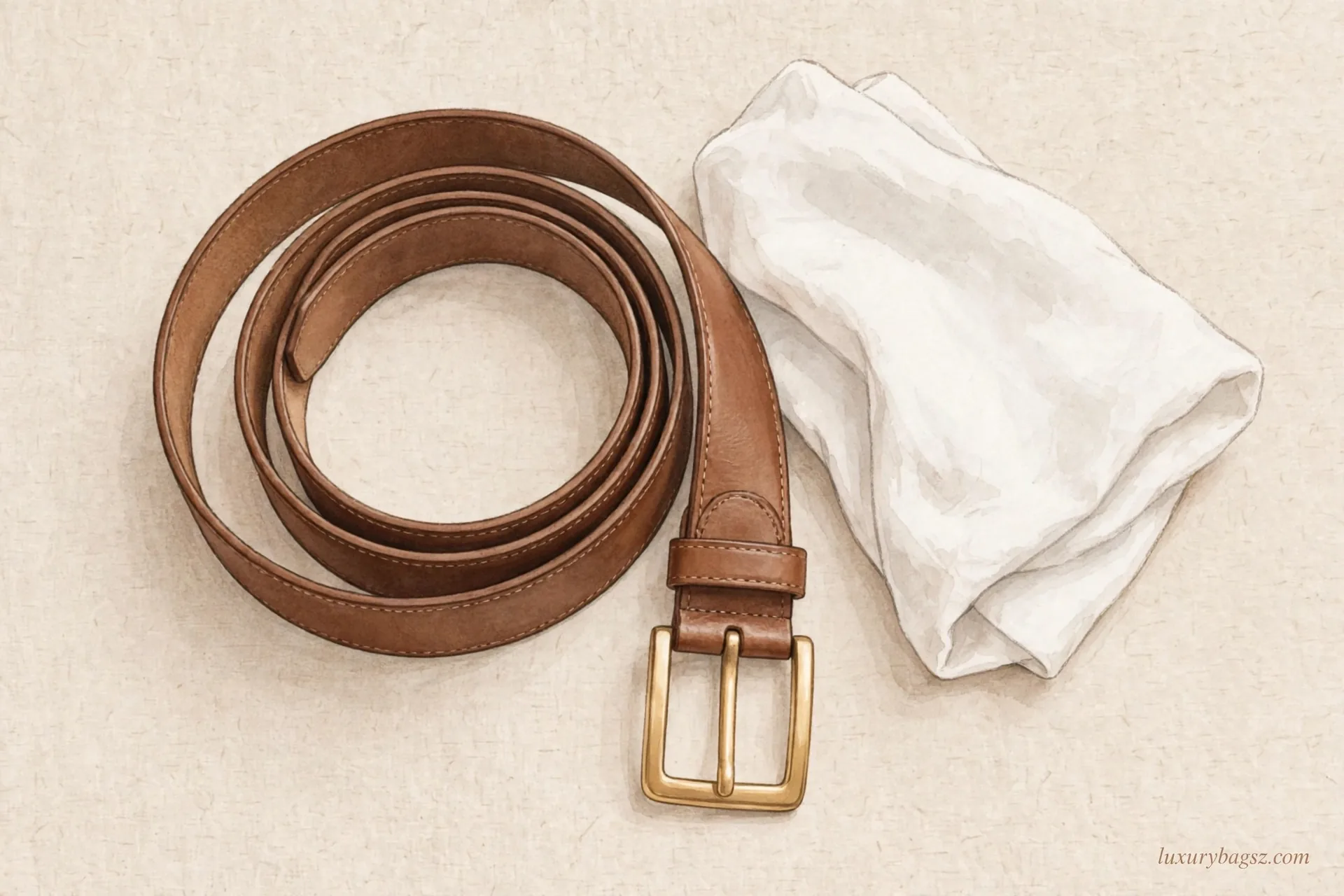
Every image in this guide is a generic illustration, not a photograph of a real Hermès product. No trademark logo has been reproduced. The illustrations show the general shape and idea of a leather belt so you can follow the care steps.
One framing point before we start, because belt guides often get it wrong. The classic Kelly 18 belt is single-sided and sliding-adjustable, not reversible. The reversible belt kit system belongs to the H buckle and Constance family, where two straps and a buckle are made to be swapped and flipped.
That matters for cleaning because a single-sided belt has one face to protect, while a reversible kit has two faces, two edges, and a buckle mechanism that must be kept clean and dry. Do not treat one system as if it were the other.
A second framing point concerns paperwork. Hermès issues no authenticity cards as a general rule. A card offered with a pre-owned belt is a red flag, while a missing card proves nothing on its own. Paperwork never tells you how to clean the leather in front of you.
Key Takeaways
- Identify the leather first. Smooth calfskin, suede, patent, and exotic skins need different tools, and the wrong product can cause permanent damage.
- For everyday care, brush off dust and wipe smooth leather with a soft, barely damp cloth. Never soak a belt, and never dry it with heat.
- Condition smooth leather by feel, not by calendar. If it feels supple and looks even, leave it alone. If it feels dry or papery, it is time.
- Never put cream, oil, or wax on suede. Brush suede, use an eraser for marks, and protect it with a suede-only spray before it meets rain.
- Buckles are plated, not solid gold. Clean them gently with a soft dry cloth and never polish aggressively, or the plating will wear through.
- Test every cleaner on a hidden spot first, such as the underside near the buckle end. If colour lifts or the finish changes, stop at once.
- Exotic skins, deep stains, dye transfer that will not lift, and cracked edge paint belong with a professional cobbler or Hermès after-sales, not with a home experiment.
Identify Your Leather First
Start by looking, then by touching. Smooth calfskin feels even and slightly cool, with a fine, regular grain or almost no visible grain at all. Grained calfskin, such as Togo-style grain, shows a clear pebble pattern that you can feel under your fingertips.
Suede and nubuck feel soft and velvety, with a nap that changes shade when you brush it one way and then the other. Patent leather is glossy, hard, and reflective, almost like a mirror finish. Exotic skins, such as crocodile or lizard, show a scale pattern that is unmistakable once you have seen it.
If you are unsure, check the underside of the strap and the area near the buckle holes. These spots show the leather’s true character without the wear and shine of the outer face. A belt that has been worn for years may look darker and smoother than it did when new, especially where it bends.
Leather type also decides which cleaner is safe. A pH-balanced leather cleaner made for smooth leather is the usual safe choice for calfskin. The same cleaner can flatten suede, cloud patent, or strip the finish from an exotic skin, so never assume one bottle covers every belt you own.
Where your leather comes from matters less for cleaning than what it is, but it explains why Hermès leathers behave differently from cheaper belts. If you want the background, read about which country makes leather for Hermès bags to see how the house sources and finishes its hides.
A mixed-material belt needs extra care. Some belts pair a leather face with a canvas or textile reverse, and that reverse is not leather at all. Clean the canvas part the way you would cleaning a canvas bag, and keep leather creams away from it.
If you cannot identify the leather with confidence, treat the belt as delicate. Use only a dry soft cloth and a suede brush on the nap, and take it to a professional before you apply any liquid. Guessing is how most belt damage happens.
Your Cleaning Kit
A good belt kit is small, and that is a virtue. You need a soft, lint-free cloth, a second clean cloth for buffing, a soft horsehair brush, a pH-balanced leather cleaner for smooth leather, and a neutral leather conditioner. Add a suede brush and a suede eraser if you own any suede belt.
Keep a pencil eraser style suede eraser, not a pink school eraser, which can leave crumbs and colour behind. A suede-only protector spray belongs in the kit too, but only for suede and nubuck. Never use a waterproofing wax meant for boots on a fine belt strap.
For hardware, you need nothing more than a soft dry cloth and, for stubborn grime, a cotton bud barely dampened with water. Metal polish, silver polish, and abrasive pastes have no place near a plated buckle. They remove plating faster than they remove tarnish.
Store your kit away from direct sun and heat, and keep cloths clean. A cloth that still holds last month’s conditioner will transfer it to the next belt you wipe, including a suede belt that must never meet cream. Wash cloths separately and let them dry fully.
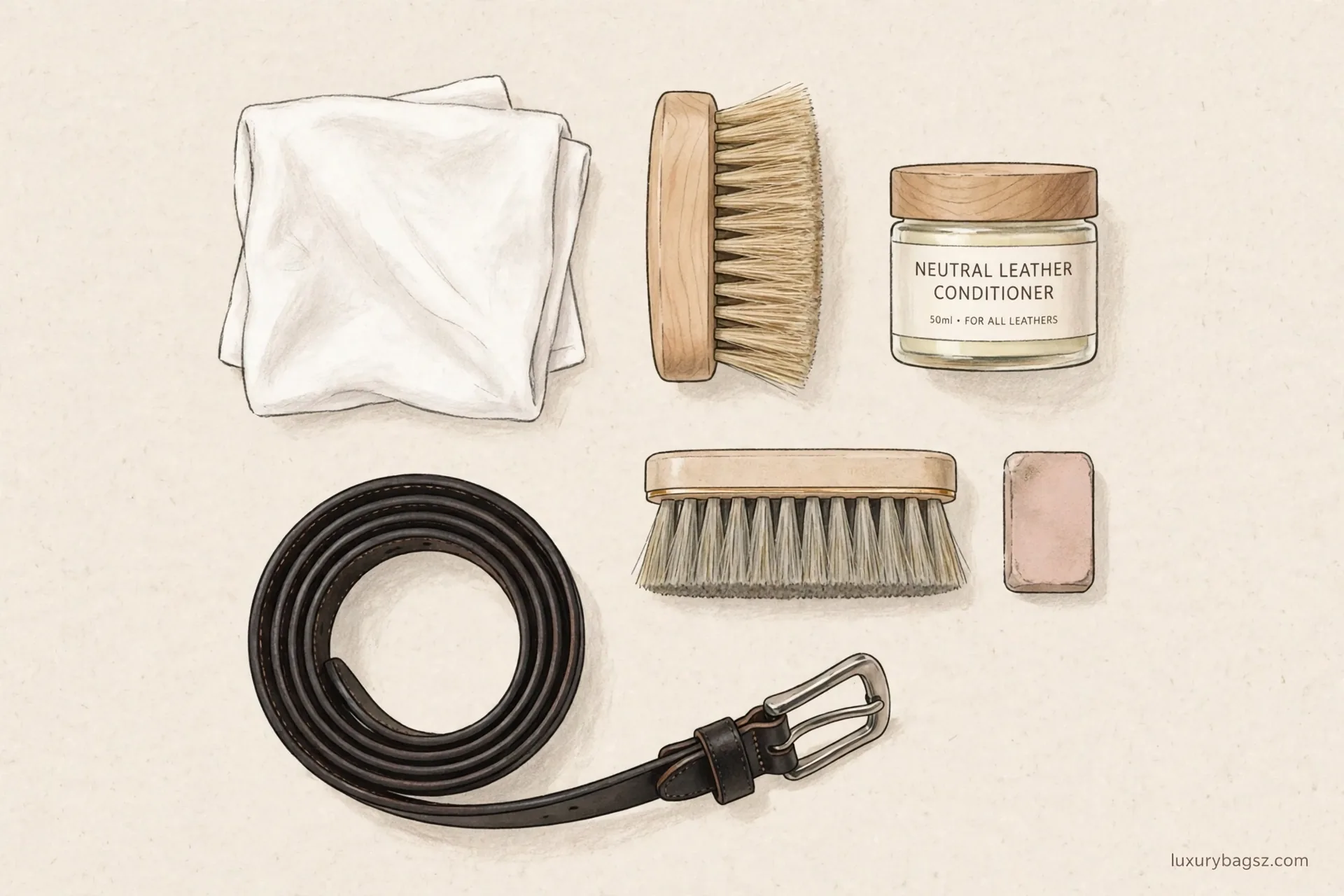
One honest note on cost: you do not need a luxury-branded kit. A plain horsehair brush and a well-reviewed neutral conditioner do the same work as a kit that costs five times as much. Spend your money on the right product for your leather, not on a logo on the bottle.
The Everyday Routine
The everyday routine takes about two minutes and prevents most deep cleaning. After you take the belt off, hold it by the buckle end and brush the strap lightly from buckle to tip. This lifts dust, lint, and grit before it works into the grain.
Next, wipe smooth leather with a soft dry cloth. If the belt has picked up light surface dirt, use a cloth barely dampened with clean water, then follow at once with a dry cloth. Do not leave the strap damp, and do not hang it up wet.
Hang the belt or coil it loosely, buckle outside the coil so the metal cannot press a mark into the leather. Never fold a belt sharply or crease it in half for a drawer, because a hard fold can crack the finish and the edge paint over time.
The same wipe-down habit that keeps a clean Chanel bag looking fresh applies here, even though the materials and shapes differ. Regular light care always beats rare heavy rescue, on bags and on belts alike.
Check the buckle holes each time you wear the belt. Grit caught in a hole wears the edge of the hole wider, and a stretched hole is one of the first signs of a tired belt. A quick brush around each hole costs seconds and saves the strap.
If the belt got rained on, skip the rest of the routine and go straight to slow drying, covered in the drying section. Wet leather that is brushed hard or conditioned while damp is far more likely to spot, stiffen, or darken unevenly.
The Smooth-Leather Deep Clean
A deep clean is for a belt that looks dull, feels grimy, or has picked up a season of wear. Do it at most a few times a year, and only on smooth or grained calfskin. Suede, patent, and exotic skins follow different rules in Parts 5 to 7.
Start by brushing the whole strap, both faces, and around the buckle. Work in one direction, buckle to tip, so you are not pushing grit back into the grain you have just cleared. Remove the buckle if it unfastens easily, and clean the strap and buckle separately.
Dampen a soft cloth with clean water and wring it until it is barely damp, not wet. Wipe the strap in short, gentle passes along its length, not in hard circles. Hard scrubbing on fine calfskin can burnish one patch shinier than the rest, and that patch will catch the eye forever.
Now the test-first rule, which is non-negotiable. Put a tiny amount of your pH-balanced cleaner on a hidden spot, such as the underside near the buckle end, and wait for it to dry fully. If the colour, texture, or sheen changes, do not use that cleaner on the visible face.
If the test passes, apply a small amount of cleaner to a cloth, never directly onto the belt. Work in small areas, wiping gently along the strap, and turn the cloth often so you are not smearing dirt back on. Follow with a clean, barely damp cloth to lift residue, then a dry cloth.
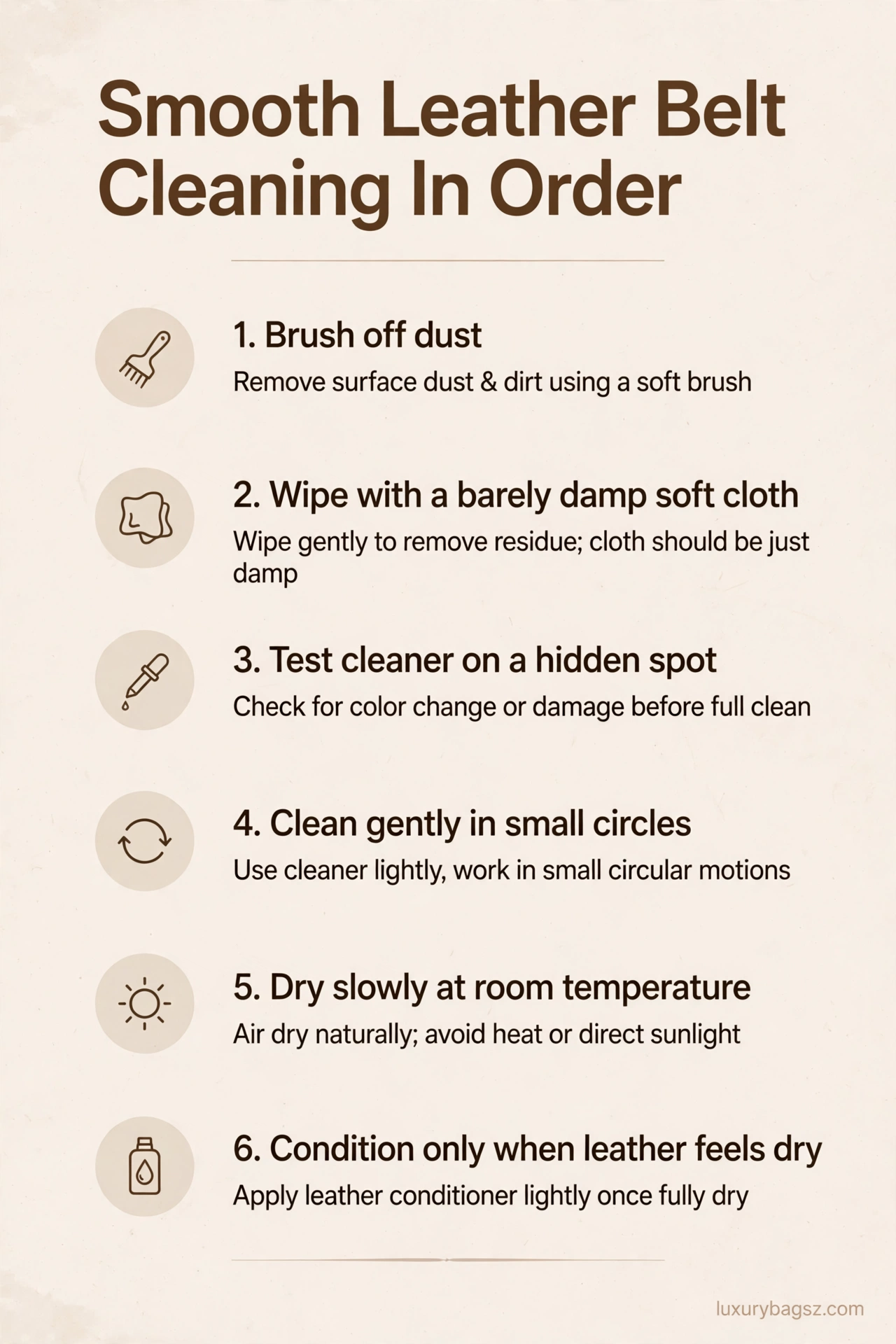
Let the belt dry slowly at room temperature, away from sun, radiators, and hair dryers. Once it is fully dry and feels even, you can decide whether it needs conditioning, covered in the conditioning section. Conditioning a belt that is still damp traps moisture and can leave dark patches.
Here is the first plain disagreement between sources. Some guides recommend saddle soap for this deep clean, praising its traditional cleaning power. Others warn that saddle soap is alkaline, can dry fine calfskin over time, and can leave a residue that dulls the finish.
This guide sides with the cautious camp for Hermès calfskin: use a pH-balanced leather cleaner made for fine leather, and keep saddle soap for sturdier work boots, if you use it at all. If you already use saddle soap and your belt looks fine, you are not in danger from one past use, but switching is the safer long-term choice.
A second disagreement concerns how often to deep clean. Some blogs suggest monthly deep cleans, while leather-care professionals more often suggest two to four times a year for a regularly worn belt. Monthly deep cleaning strips natural oils and finish faster than it helps, so this guide recommends the slower rhythm, with the two-minute routine doing the daily work.

Suede and Nubuck Care
Suede and nubuck belts must never meet water, cream, oil, or wax. Those products mat the nap, darken the colour, and leave a patch that no amount of brushing will fully lift. If you own a suede belt, its kit is a brush, an eraser, and a protector spray, and nothing else.
Start dry, always. Brush the strap with a suede brush in one direction to lift the nap and remove surface dust. Then brush lightly in the other direction to check for flat or shiny patches, which show where the nap has been pressed down by wear.
For a scuff or a light mark, rub the suede eraser gently over the mark, using short strokes along the strap. Brush again afterwards to restore the nap. Work patiently and lightly; hard erasing can thin the nap and leave a pale, worn-looking patch that stands out more than the mark did.
Water spots on suede are a common panic, and the usual advice is to let the spot dry completely, then brush the whole strap evenly. Brushing only the spot can leave a visible ring, while brushing the whole strap blends the nap back to an even look. Do not be tempted to wet the whole belt to even it out.
Protect suede before it meets rain, not after. Spray a suede-only protector in a light, even mist from a short distance, outdoors or in a ventilated room, and let the belt dry fully before wearing it. Reapply after a few wears in wet weather, following the spray maker’s instructions.
Here sources disagree on waterproofing in general, and the disagreement matters. Some guides promise that a good spray makes suede effectively rainproof. Others warn that no spray makes suede waterproof, and that it only buys you time to get out of the rain.
This guide takes the middle position, stated plainly: a suede protector reduces absorption and makes water bead briefly, but it does not make a suede belt safe in a downpour. Treat a protected suede belt as shower-resistant at best, and choose a smooth leather belt on a truly wet day.
Patent Leather Care
Patent leather looks tough because it is glossy and hard, but its finish is easy to cloud, scratch, and mark. Clean it with a soft, dry cloth first, and only add a barely damp cloth for light dirt. Never use a brush with stiff bristles, an abrasive cloth, or a cream meant for porous leather.
Patent’s special enemy is colour transfer and sticking. Patent can pick up dye from dark denim, from other belts, and from printed packaging, and it can stick to other patent or plastic surfaces in a warm drawer. Store patent belts separately, never pressed flat against another patent item.
For a dull patch, a tiny amount of patent-specific cleaner or a drop of neutral, non-abrasive care product on a soft cloth can restore shine, but test it on a hidden spot first. If the test spot clouds or goes matte, stop. Patent that has clouded across a wide area rarely recovers fully at home.
Heat is patent’s other enemy. Never leave a patent belt on a radiator, in a hot car, or in direct sun for hours. Heat softens the coating, makes it sticky, and can leave a permanent impression from anything pressed against it. Room temperature storage is not a nicety for patent; it is the rule.
Do not condition patent the way you condition calfskin. Patent’s coating seals the surface, so conditioner cannot soak in and will only sit on top as a smeary film. A clean, dry wipe is usually all a patent belt needs, and that simplicity is one of its few care advantages.
Exotic Skins: Mostly Hands Off
Exotic skins, such as crocodile, alligator, and lizard, need the lightest home touch of all. Dust them with a soft, dry cloth, keep them away from water and sun, and stop there. Their scales, finishes, and dyes react unpredictably to cleaners that are perfectly safe on calfskin.
Never apply conditioner, oil, or wax to an exotic belt unless a professional who has seen the belt tells you to. Oils can darken scales unevenly, lift scale edges, and change the colour in patches. A single well-meaning application can cost more to repair than years of professional care would have cost.
Water is especially risky for exotic skins. A splash that would be a minor event on calfskin can lift a scale edge or leave a watermark on crocodile. If an exotic belt gets wet, blot it at once with a soft dry cloth, let it dry slowly at room temperature, and have it checked by a professional if any scale looks raised or dull.
Sun and heat dry exotic skins faster than calfskin, and they can also fade dyes unevenly. Store exotic belts in a cool, dark place in their dust bag, away from windows and radiators. Never hang an exotic belt where afternoon sun falls on it day after day.
The honest summary is short: if you own an exotic belt, your home job is dusting and careful storage. Cleaning, conditioning, and repair belong with a cobbler experienced in exotic skins or with Hermès after-sales. That restraint is not a gap in this guide; it is the advice.
Stain by Stain
Stains behave differently by type, and the wrong first move often sets them. The universal rules are: act quickly, blot rather than rub, work from the outside of the stain inward, and test any product on a hidden spot. Rubbing spreads a stain and pushes it deeper into the grain.
Water spots on smooth leather usually look worse than they are. Let the belt dry slowly and completely at room temperature, then wipe the whole strap lightly with a barely damp cloth and let it dry again. Conditioning once fully dry, covered in the conditioning section, often evens out the last faint mark.
If a water spot stays visible after drying and conditioning, do not keep wetting it. Repeated wetting makes the ring worse, not better. At that point a professional has tools, such as even, controlled cleaning of the whole strap, that home wiping cannot match.
Oil and grease need blotting first, with a clean dry cloth, pressing gently without rubbing. A light dusting of absorbent powder, such as plain talc or cornstarch, left for several hours can draw out surface oil on smooth leather. Brush the powder off gently and reassess before trying anything stronger.
Dark oil that has soaked in is a different problem, and home cleaners rarely remove it fully. If the dark patch remains after blotting and powder, take the belt to a professional rather than scrubbing harder. Scrubbing an oil stain usually spreads it and wears the finish around it.
Dye transfer, most often from dark denim onto a pale belt, is the stain belt owners fear most. Try a gentle pH-balanced cleaner on a cloth, working lightly, and stop the moment colour starts to lift from the belt itself rather than from the transferred dye. If the dye will not lift with gentle cleaning, it has bonded with the finish.
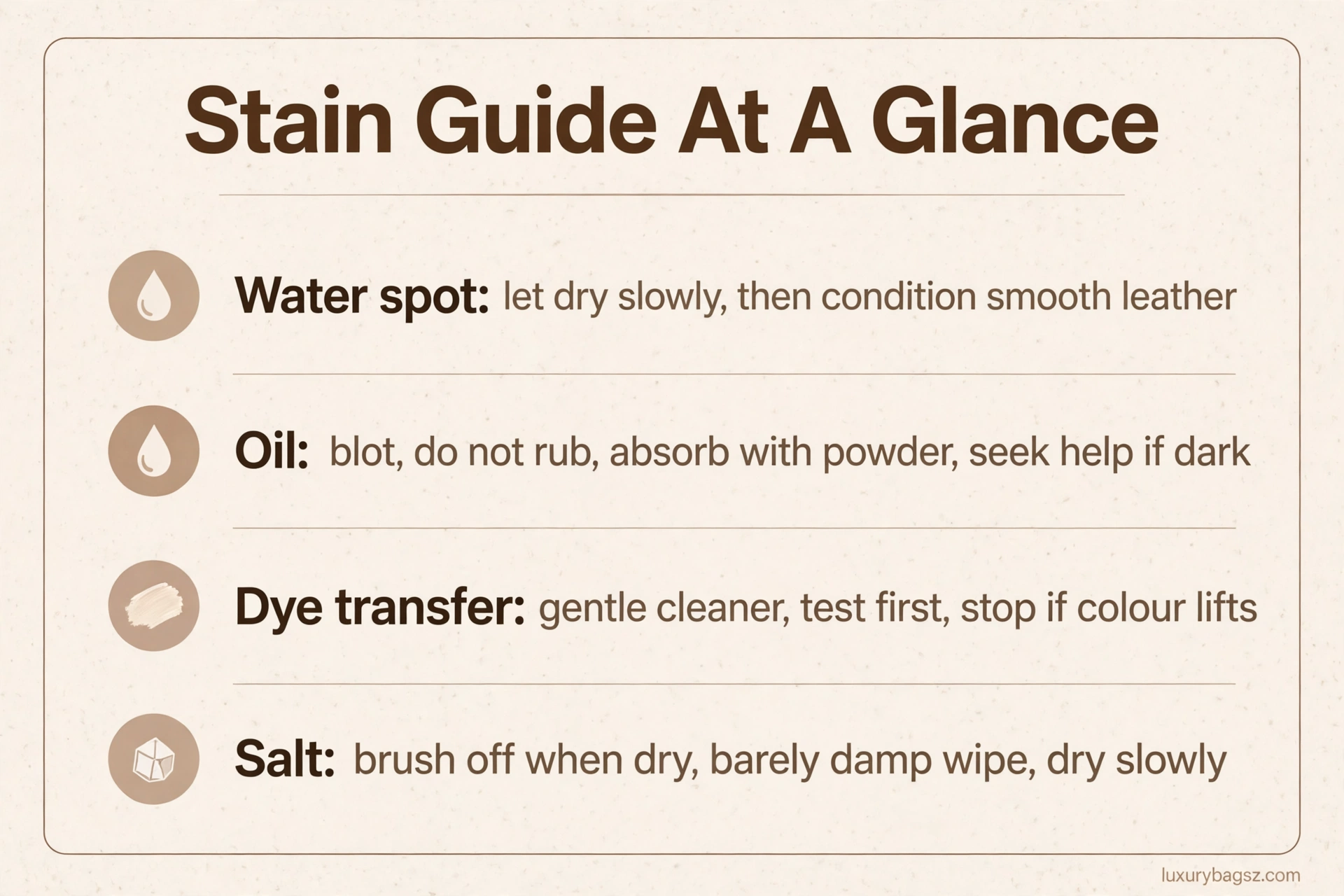
Salt marks, familiar to anyone who wears leather in winter, need patience. Let the belt dry fully, brush off loose salt, then wipe smooth leather with a barely damp cloth. Some guides recommend a weak vinegar-and-water mix for stubborn salt lines, while others warn that vinegar can dry or discolour fine leather.
This guide states that disagreement plainly: vinegar can help on sturdy leather, but on fine Hermès calfskin the risk is not worth it as a first step. Try the damp-cloth method first, and leave vinegar to a professional. Leather boots face the same salt problem, and our guide to caring for leather boots follows the same gentle-first order.
Ink is the hardest home stain of all. A fresh ballpoint mark may lift slightly with gentle cleaner, but most ink that has set into leather will not come out at home without damaging the finish around it. Do not try alcohol, acetone, or hairspray on a belt; all three can strip colour and finish in seconds.
Buckle and Hardware Cleaning
Hermès belt buckles are plated, not solid gold, and that single fact decides how you clean them. Plating is a thin layer over a base metal, and aggressive polishing wears through it, leaving a dull or differently coloured patch that cannot be polished back.
For everyday care, wipe the buckle with a soft, dry cloth after wear. That removes fingerprints, sweat, and dust before they dull the finish. If grime has built up around the buckle mechanism, use a cotton bud barely dampened with water, then dry the buckle at once with a soft cloth.
Never use metal polish, silver polish, toothpaste, or abrasive pastes on a buckle. Never use a rough cloth, a scouring pad, or an ultrasonic cleaner unless a professional has approved it for that specific buckle. The shine you gain in a minute can cost you the plating for good.
Check the buckle mechanism on reversible kits and sliding-adjustable belts. Lint and grit in the sliding channel make the buckle stiff and can scratch the strap as it moves. Brush the channel gently with a soft, dry brush, and never oil the mechanism. Oil attracts more grit and can stain the strap.
If the plating is already worn, flaking, or showing base metal, home cleaning will not restore it. A professional can advise on replating or replacement, and Hermès after-sales can advise on a genuine replacement buckle for current models. Do not paint over worn plating with gold paint; it looks worse and flakes onto clothing.
A note on authenticity belongs here, because buckles attract fakes. A buckle that feels too light, has rough casting, uneven engraving, or a finish that wears oddly fast deserves a closer look. The same paperwork tricks seen in fake Kelly listings, such as a suspicious card or receipt, appear with belts too, and Hermès issues no authenticity cards as a general rule.
Edge Paint and Stitching Care
Edge paint is the coloured coating along the cut edges of the strap, and it takes more abuse than any other part of the belt. It bends at the buckle holes, rubs against belt loops, and flexes every time you sit. Small cracks at the edges are normal wear, not a sign that you have cleaned the belt wrong.
Clean edges with a soft dry cloth only. Never scrub edge paint with cleaner, and never apply conditioner to the edges in the hope of restoring them. Conditioner on edge paint can soften it, make it tacky, and attract lint that then sticks permanently.
Check stitching the same way you check the edges. Look for loose threads, lifted stitches near the buckle holes, and any thread that has gone pale or frayed. A single loose thread is not an emergency, but a run of loose stitches near a hole means the belt needs professional attention before the hole tears.
Do not trim loose threads flush with scissors at home unless you know what you are doing. Cutting a thread that is still anchored can unravel the next stitch, while leaving a long thread to catch on clothing can pull the stitch out anyway. A cobbler can secure a loose thread in minutes.
If edge paint is flaking, peeling, or missing in patches, home products will not fix it. Edge paint is reapplied by a professional with matched paint and a steady hand, and a good job is invisible. A home touch-up with the wrong paint colour or finish is usually more visible than the original wear.
Conditioning: By Feel, Not by Calendar
Conditioning replaces oils that leather loses through wear, sun, and cleaning. On smooth calfskin it keeps the strap supple, prevents surface cracking, and restores an even look after cleaning. On suede, patent, and exotic skins it is either forbidden or a professional-only job, as Parts 5 to 7 explain.
The central disagreement about conditioning is frequency, and sources give wildly different answers. Some guides say condition every three months, some say twice a year, some say once a year, and some say once a week for frequently worn items. Treating any one of those as a rule would mislead most readers.
This guide recommends conditioning by feel, not by calendar. Bend the strap gently: if it feels supple, looks even, and shows no dry or papery patches, leave it alone. If it feels stiff, looks dull in patches, or shows fine surface dryness, it is time to condition.
When the time comes, use a neutral, high-quality leather conditioner of the Saphir Renovateur type, and test it first. Apply a thin layer to a hidden spot, such as the underside near the buckle end, and wait a full day. Some conditioners darken leather slightly, and pale belts show that change most.
If the test passes, apply a thin, even layer to the strap with a soft cloth, working along its length. Less is more: a thick layer sits on the surface, attracts dust, and can darken the belt unevenly. Let it absorb fully, then buff lightly with a clean dry cloth.
Read the dedicated guide to using Saphir Renovateur before your first conditioning, especially if your belt is pale, grained, or new. It covers the test-first method in detail and the mistakes that darken or over-soften fine leather.
Never condition a belt that is still damp from cleaning or rain. Never condition over dirt, because conditioner seals grime into the grain. And never condition to fix a stain: conditioner over a stain can set it and darken the area around it, making professional removal harder.
A word on oils, stated plainly because blogs disagree here too. Mink oil, neatsfoot oil, and olive oil are all recommended somewhere online for leather care. On fine Hermès calfskin they are too heavy, can darken the leather permanently, and can over-soften a strap that needs to hold its shape. Keep them for work boots, not for a fine belt.
Drying Done Right
How a belt dries matters as much as how it is cleaned. Leather that dries too fast stiffens, cracks, and spots. Leather that dries in sun fades unevenly. Leather left damp in a closed drawer can smell musty and grow mould in warm weather.
If a belt gets wet, blot it at once with a soft dry cloth, pressing gently without rubbing. Then lay it flat or hang it loosely at room temperature, away from radiators, hair dryers, direct sun, and dehumidifiers blowing hot air. Let it dry slowly, even if that takes a full day.
Never wring a wet belt, never twist it, and never hang it by the buckle from a hook while it is soaked, because the wet strap stretches under the buckle’s weight. Support the whole strap evenly, and check it after a few hours to make sure no part is still sitting in a puddle of its own drips.
Once the belt is fully dry, brush smooth leather lightly and wipe it with a dry cloth. Only then decide whether it needs conditioning, following the conditioning section. Conditioning a belt that feels dry on the surface but is still damp inside is one of the most common home-care mistakes.
If a belt smells musty after drying, air it in a ventilated room, away from sun, for a day or two. Do not spray it with perfume, fabric freshener, or disinfectant, all of which can stain leather or react with its finish. A persistent musty smell after full drying deserves a professional’s opinion.
Storage That Prevents the Next Clean
Good storage prevents more damage than any cleaner repairs. Store belts in a cool, dry place away from direct sun, radiators, and damp walls. Sun fades leather unevenly, heat dries it, and damp encourages mould and musty smells.
Hang belts on rounded hooks or coil them loosely, buckle outside the coil, so the metal cannot press into the leather. Never fold a belt sharply, never hang it from a thin wire hook that creases one point, and never stack heavy items on top of coiled belts in a drawer.
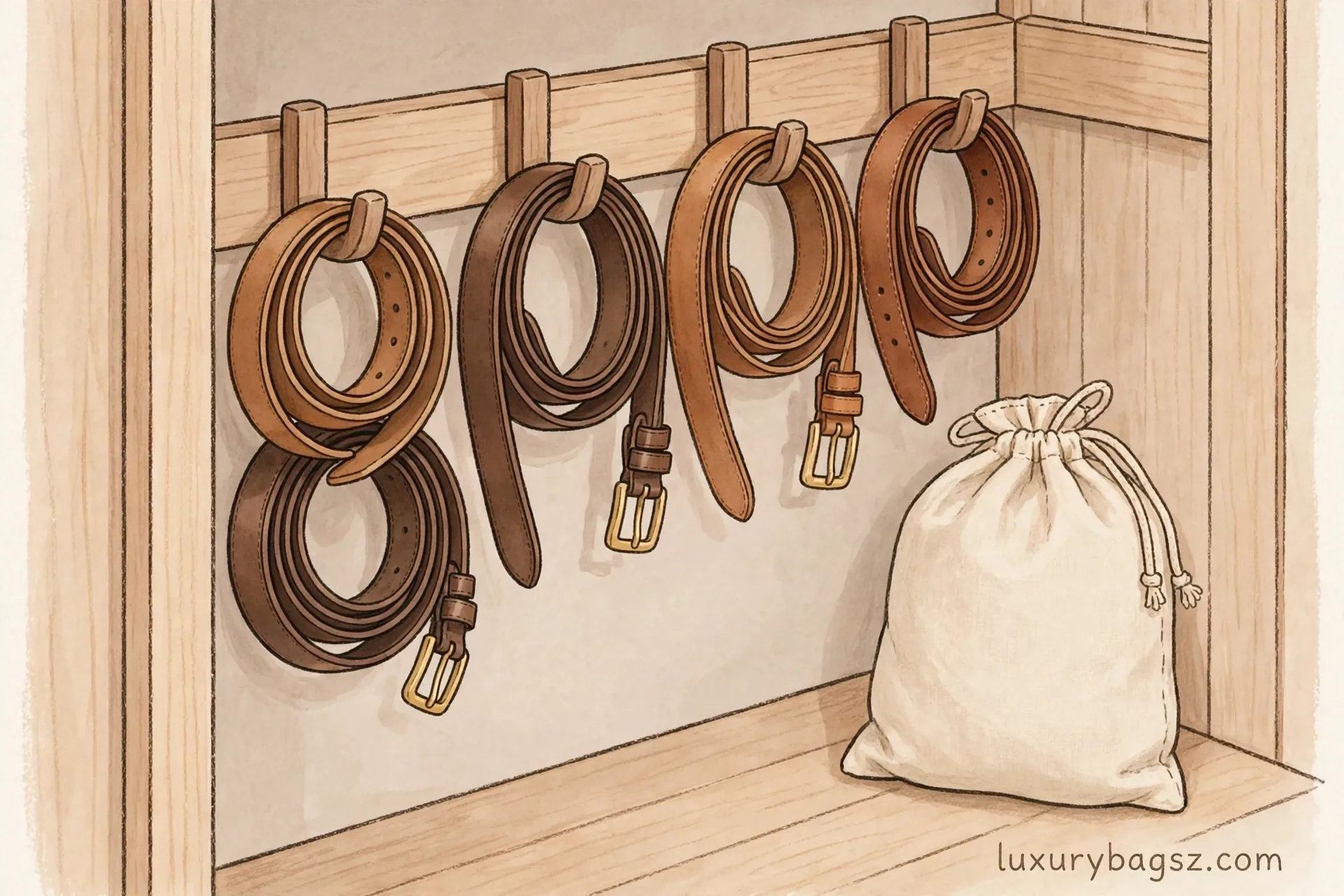
Keep each belt in its own dust bag or a clean cotton bag, especially patent and light-coloured belts. Patent must never be stored pressed against another patent item or a plastic surface, or the finishes can stick together and peel. Light belts must never be stored against dark denim or a dark belt that can transfer dye.
The same cool, dry, dust-bag habit used when storing a Kelly works for belts, even though the shape is different. The principle is identical: protect the leather from light, heat, moisture, and contact with things that can mark it.
Rotate your belts if you own several. Wearing the same belt every day wears its buckle holes and edges far faster than sharing the wear across two or three belts. A rest day lets leather recover its shape and dry fully between wears.
Before long-term storage, clean the belt, let it dry fully, and check the buckle holes and edges. A belt put away dirty will come out with set stains, and a belt put away damp will come out smelling musty. Clean, dry, and bagged is the whole long-term formula.
What Never to Use
Some products appear in belt-care advice so often that they deserve a single clear list. Never soak a belt or put it in a washing machine. Never use bleach, acetone, nail polish remover, or any harsh solvent on leather. Never use baby wipes or alcohol wipes, which contain chemicals that strip finish.
Never use household cleaners, dish soap, or all-purpose sprays. Dish soap is designed to cut grease on plates, and it cuts the natural oils and finish on fine leather just as effectively. A pH-balanced leather cleaner is not an expensive luxury; it is the only cleaner made for the job.
Never use cream, oil, or wax on suede, as the suede and nubuck section explains, and never use a suede protector on smooth leather, where it can leave a hazy film. Never use mink oil, neatsfoot oil, or olive oil on fine calfskin. Never use shoe polish on a belt unless a professional has matched it, because polish colours rarely match and can transfer to clothing.
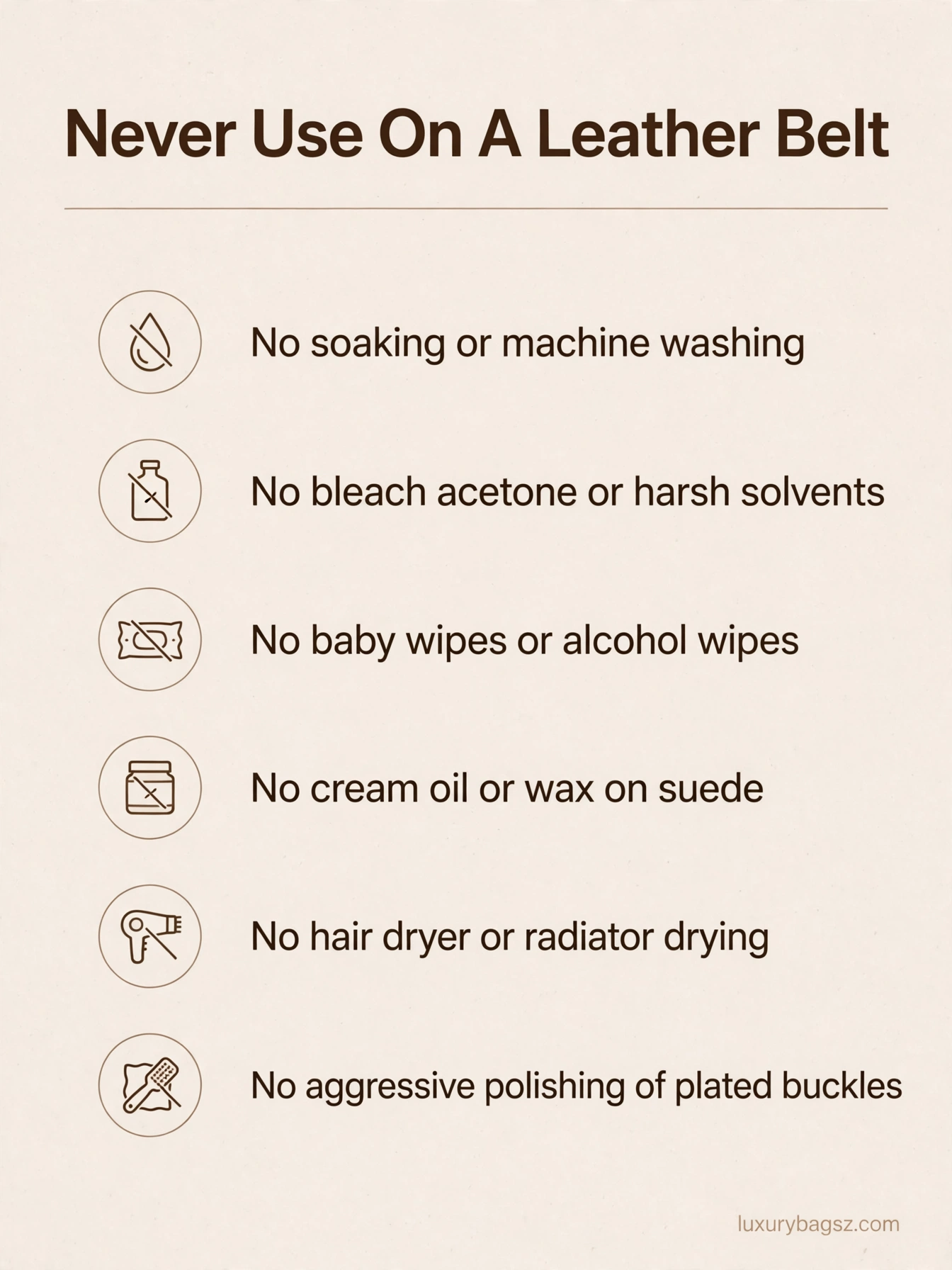
Never dry a belt with a hair dryer, a radiator, or direct sun. Never iron a belt, never steam it, and never use a magic eraser, which is abrasive and removes finish along with dirt. Never scrub with a stiff brush, a scouring pad, or sandpaper, however lightly you think you are scrubbing.
If a product is not made for fine leather, do not test it on your belt to find out. The test-first rule in the smooth-leather deep clean section exists for products made for leather. It is not a licence to try household chemicals on a hidden spot and hope for the best.
When to See a Cobbler or Hermès After-Sales
Home care has a clear boundary, and knowing it saves belts. See a professional for exotic skins, deep or set stains, dye transfer that will not lift gently, ink, cracked or flaking edge paint, loose stitching near a buckle hole, a stretched or torn hole, worn plating, and any belt that smells musty after full drying.
A good cobbler experienced in luxury leather can clean a whole strap evenly, reapply edge paint, secure stitching, and advise on conditioning. Hermès after-sales can advise on repairs, replacement buckles for current models, and spa services for items within their repair scope. Ask about cost and turnaround before leaving a belt, and get the advice in writing for a valuable piece.
For pre-owned belts, professional cleaning before first wear is often money well spent. A previous owner’s products, sweat, and storage marks are already in the leather, and a professional can assess what is wear, what is damage, and what is reversible. That assessment also helps you judge whether the belt was honestly described.
One caution about third-party repair: anyone who offers to “restore” a belt by dyeing the whole strap a new colour is changing the belt, not cleaning it. Full re-dyeing can look good at first and wear badly at stress points, and it may affect resale honesty. Discuss it as a change, not a clean, and think twice before agreeing.
The Two Gaps That Damage Belts: Leather Identification and Plated Buckles
Most rival belt guides fail in the same few places, and this guide was written to close those gaps. The first gap is leather identification: many guides give one cleaning method for every belt, as if suede, patent, and calfskin were interchangeable. They are not, and a single-method guide will damage at least one of them.
The second gap is the buckle. Rival guides often recommend metal polish for buckles without saying that Hermès buckles are plated, not solid gold. That advice wears through plating and leaves a patch no polish can restore. This guide treats the buckle as plated from the start, because that is what it is.
The third gap is the reversible confusion. Guides routinely call the Kelly 18 reversible, or describe every Hermès belt as if it flipped. The Kelly 18 is single-sided and sliding-adjustable, while the reversible kit belongs to the H buckle and Constance family. Cleaning advice built on the wrong system cleans the wrong faces.
The fourth gap is frequency. Many guides give one conditioning schedule as if it were settled, when published advice ranges from weekly to yearly. This guide replaces the schedule with a feel test, and states the disagreement openly so readers can judge for themselves.
The fifth gap is stain honesty. Rival guides often promise that home methods remove oil, ink, and set dye transfer. They usually do not, and scrubbing harder only spreads the stain and wears the finish. This guide says plainly where home care ends and professional help begins.
The final gap is exotic skins. Some guides barely mention them, or worse, recommend conditioner for every belt including crocodile. This guide gives exotic belts the lightest home touch of all: dusting and careful storage, with everything else left to a professional.
Frequently Asked Questions
Can I clean a Hermès leather belt with water?
Yes, in small amounts on smooth leather. Use a soft cloth barely dampened with clean water, wipe gently, and follow at once with a dry cloth. Never soak a belt, never hold it under a tap, and never use water at all on suede, where it causes spots and matting.
How often should I clean my Hermès belt?
Brush and wipe it after every few wears, which takes about two minutes. Deep clean smooth leather only two to four times a year for a regularly worn belt. More frequent deep cleaning strips oils and finish faster than it helps.
How often should I condition a Hermès leather belt?
By feel, not by calendar. Condition when the leather feels dry, stiff, or papery, and leave it alone when it feels supple and looks even. Published advice ranges from once a week to once a year, which is why this guide rejects a fixed schedule in favour of the feel test.
Can I use saddle soap on a Hermès belt?
You can, but this guide recommends against it for fine calfskin. Saddle soap is alkaline and can dry fine leather and dull its finish over time. A pH-balanced leather cleaner made for fine leather is the safer choice for a Hermès strap.
What is the best conditioner for a Hermès leather belt?
A neutral, high-quality leather conditioner of the Saphir Renovateur type, tested first on a hidden spot. Apply it thinly, let it absorb fully, and buff lightly. Avoid heavy oils such as mink oil and neatsfoot oil, which can darken and over-soften fine calfskin.
How do I clean a suede Hermès belt?
Dry only: brush with a suede brush, use a suede eraser for marks, and protect with a suede-only spray before rain. Never use water, cream, oil, or wax on suede. If a stain will not lift with dry methods, take the belt to a professional.
How do I remove denim dye transfer from a pale belt?
Try a gentle pH-balanced cleaner on a cloth, working lightly, and stop if the belt’s own colour starts to lift. Dye that will not lift gently has bonded with the finish and needs a professional. Never use alcohol, acetone, or a magic eraser on dye transfer.
Can I clean the buckle with metal polish?
No. Hermès buckles are plated, not solid gold, and metal polish wears through plating. Wipe the buckle with a soft dry cloth, and use a barely damp cotton bud only for grime around the mechanism, drying at once afterwards.
Is the Kelly 18 belt reversible?
No. The classic Kelly 18 belt is single-sided and sliding-adjustable, not reversible. The reversible belt kit system belongs to the H buckle and Constance family. Clean a Kelly 18 as a single-faced belt, and clean each face of a reversible kit separately.
When should I stop cleaning at home and see a professional?
Stop and seek help for exotic skins, deep or set stains, ink, dye transfer that will not lift, cracked edge paint, loose stitching, a torn buckle hole, worn plating, or a musty smell after full drying. A cobbler or Hermès after-sales has tools and matched materials that home care cannot replace.
Conclusion
A clean Hermès leather belt is not the result of one heroic deep clean. It is the result of a short routine done often, the right product for the right leather, and the restraint to stop when home care reaches its limit.
Identify the leather first, every time. Brush and wipe after wear. Deep clean smooth leather gently and rarely. Keep cream far away from suede, keep polish far away from plated buckles, and keep heat, soaking, and harsh solvents far away from every belt you own.
Condition by feel, not by calendar. Dry slowly at room temperature. Store belts coiled or hung, bagged, and away from sun and damp. And when a stain, a scale, or an edge is beyond gentle methods, let a professional take over before a small problem becomes a permanent one.
A belt that is cared for this way does what a good belt is meant to do. It bends without cracking, holds its colour, keeps its buckle bright, and looks better with age rather than merely older. That is the whole payoff, and it costs about two minutes after each wear.