Hermès Leathers and Materials Guide: Togo, Clemence, Epsom, Swift and Exotics
Hermès Leathers in Brief: Togo, Epsom and Clemence Compared
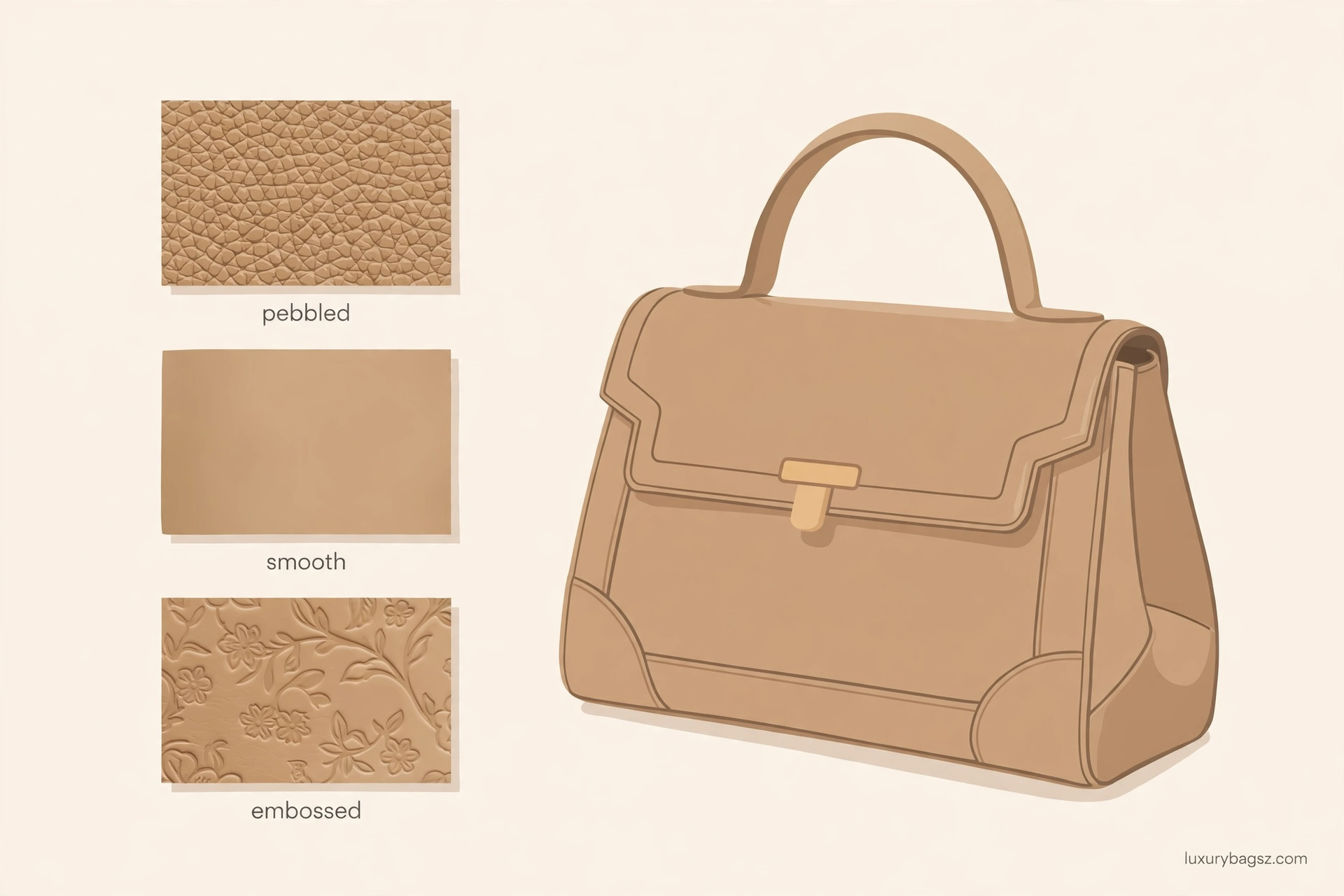
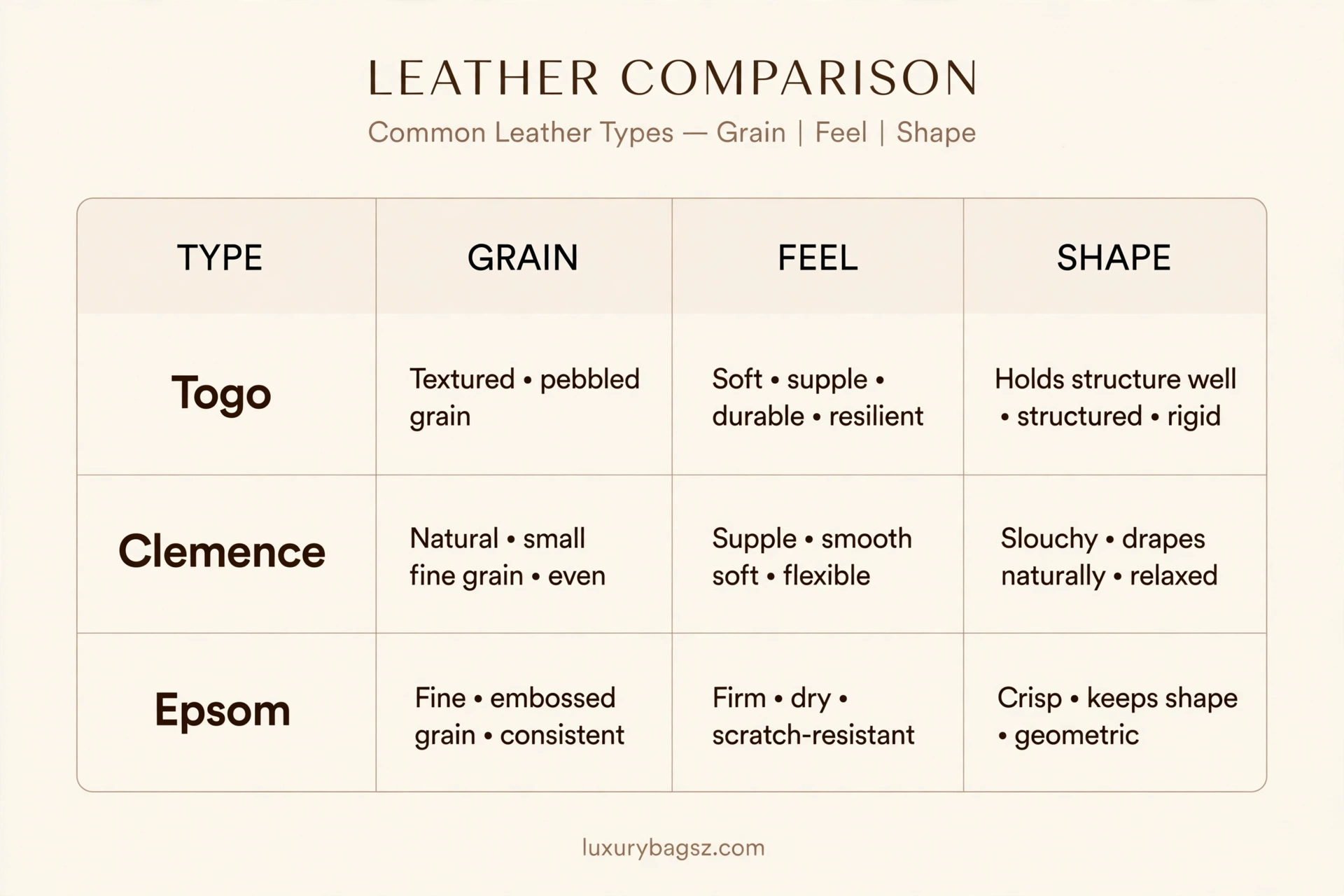
If you remember only three Hermès leathers, make them Togo, Clemence and Epsom. Togo is the balanced everyday choice: pebbled, scratch-resistant, and able to hold its shape while softening gracefully. Clemence is softer, heavier and slouchier, with a larger, flatter grain that gives bags a relaxed, lived-in look.
Epsom is the structured one: a lightweight, embossed calfskin that holds crisp lines and vivid colour, and that shrugs off scratches better than almost any other Hermès leather.
Beyond that trio sit the smooth leathers — Swift and Box Calf — the goat leather Chevre, and the exotics: crocodile, alligator, ostrich and lizard. One heritage leather sits outside that list entirely: our Barenia leather guide covers the original saddle leather and its famous patina. Each changes how a bag looks, feels, weighs and ages, and each suits a different life. A leather that is perfect for a weekend Lindy can be wrong for a daily Birkin, and a leather that glows on a small Kelly can look heavy on a large tote.
This guide works through them one by one, honestly, including what wears badly as well as what wears well.
A note on language first. Hermès uses French terms that confuse newcomers: Veau means calfskin, Vache means cowhide, and Taurillon Clemence is the full name for Clemence. Sellers often shorten these, so a listing that says only "TC" means Clemence, and "Box" means Box Calf. Learning those few terms makes listings far easier to read, and far harder to be misled by.
Key Takeaways
- Togo is the most popular everyday Hermès leather: pebbled calfskin, scratch-resistant, and balanced between structure and softness.
- Clemence is softer, heavier and slouchier than Togo, with a larger, flatter grain; it suits relaxed bags like the Lindy and Evelyne.
- Epsom is embossed, not naturally grained, which makes it lightweight, structured and excellent at holding bright colour.
- Swift is smooth, fine-grained and buttery, showing colour vividly but marking more easily than grained leathers.
- Box Calf is the heritage smooth leather: glossy, elegant, scratch-prone, and prized by vintage collectors for its patina.
- Exotic leathers carry their own stamps and rules, cost far more, and need specialist care and legal paperwork on resale.
Why Leather Choice Changes Everything About a Bag
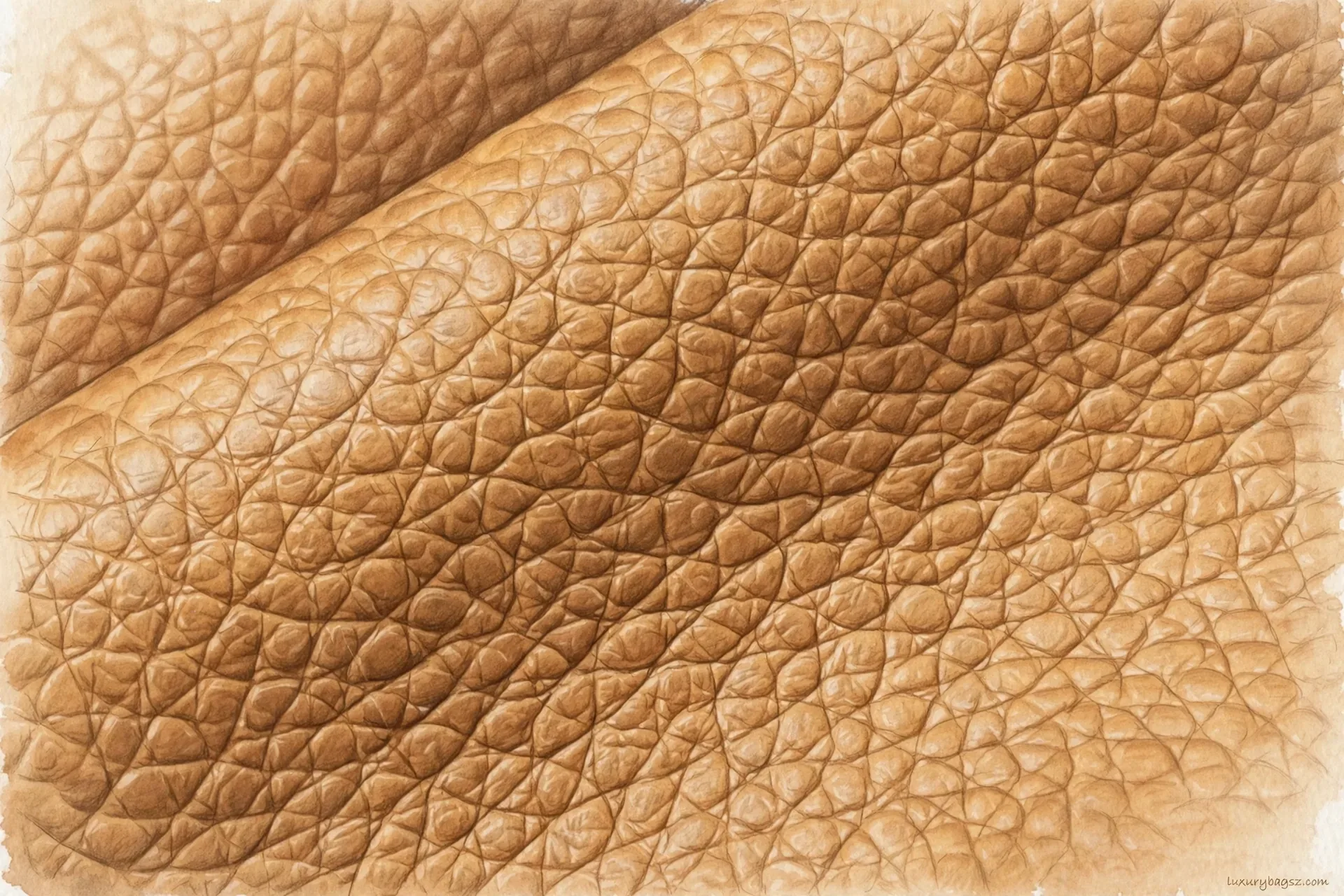
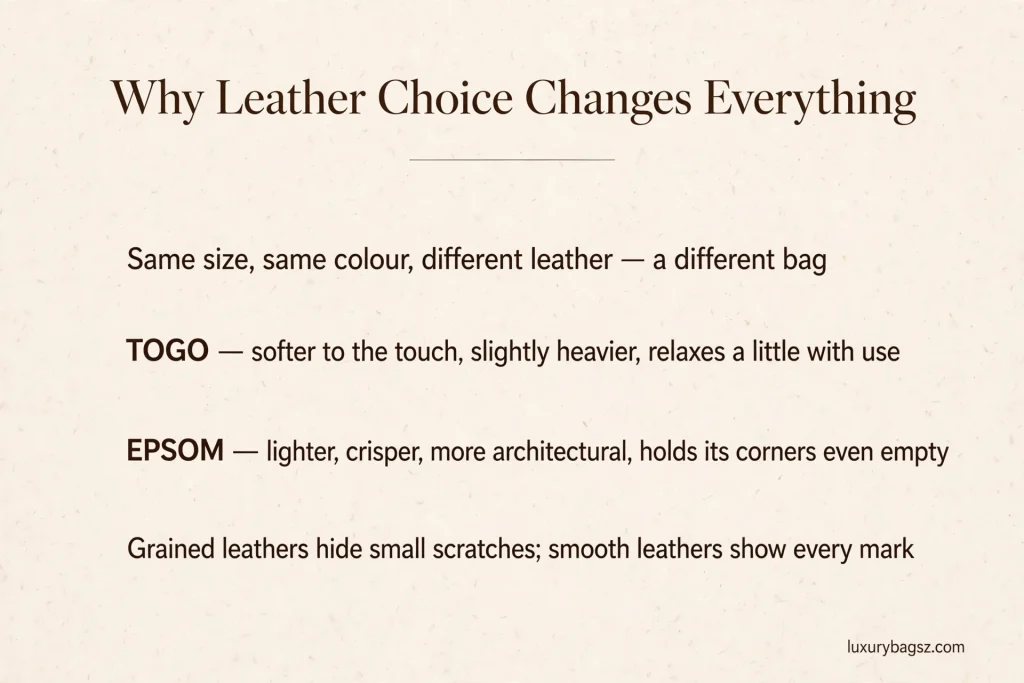
Two Birkins in the same size and colour can feel like different bags if one is Togo and the other is Epsom. The Togo version will be softer to the touch, slightly heavier in the hand, and will relax a little with use. The Epsom version will feel lighter, crisper, and more architectural, holding its corners even when empty. Neither is better in the abstract; the question is which behaviour you want from a bag you will carry for years.
Leather also decides how a bag ages. Grained leathers like Togo and Clemence hide small scratches in their pebble, so daily wear barely shows. Smooth leathers like Swift and Box Calf show every mark, which means they either develop a characterful patina that collectors love, or they look tired quickly if neglected.
Embossed Epsom sits in between: its pressed grain resists scratches well, but it does not soften and develop character in the same way as a natural grain.
Weight is the factor buyers most often forget. Clemence is noticeably heavier than Togo or Epsom, and on a large bag that weight adds up over a long day. If you carry a lot, or you have shoulder or back concerns, a lighter leather in a smaller size is worth more than a beautiful leather you dread picking up.
Our Hermès history guide shows how the house's leather craft grew from saddlery, where weight, strength and endurance were not luxuries but necessities.
Finally, leather affects colour, price and resale. Swift and Epsom hold vivid colour best, so bright shades are often at their most striking in those leathers. Structured leathers tend to photograph well, which helps resale listings, while slouchy leathers can look less crisp in photographs even when the bag itself is in excellent condition.
Keep all of this in mind as you read the leather-by-leather part that follows: the right leather is the one that fits your hands, your shoulder, and your daily routine.
Togo: The Everyday Classic
Togo is the leather most Hermès lovers meet first, and for good reason. Introduced in 1997, it is a grained calfskin with a fine, pebbled texture, a matte finish, and a soft, supple feel. It is widely described as the most popular Hermès leather, and it is the default choice for Birkins and Kellys for buyers who want one leather that does almost everything well.
It resists scratches, holds its shape while softening gracefully over time, and is relatively lightweight for a grained calfskin.
In practice, Togo suits the Retourne Kelly, with its softer, inward-stitched seams, and the Birkin, where it gives structure without stiffness. It is forgiving of daily use: keys, a phone, and a commute will not ruin it, and small marks tend to disappear into the grain. It does become slightly shinier with age, which most owners consider an improvement rather than a flaw.
Our Birkin sizes guide is worth reading alongside this part, because Togo's behaviour changes with size: a Togo Birkin 25 feels neat and structured, while a Togo Birkin 35 in the same leather will relax more under its own weight.
Togo's weaknesses are modest but real. It is not waterproof, and heavy rain can mark it, so a sudden downpour is worth avoiding or covering for. It can also slouch over many years if a bag is stored unstuffed or overloaded, though far less dramatically than Clemence.
For a first Hermès bag, and for a daily bag in general, Togo remains the recommendation most collectors would give their own friends — and the leather against which all others are measured.

Clemence and Epsom: The Two Great Alternatives
Clemence, full name Veau Taurillon Clemence, is Togo's softer, heavier cousin. Introduced in 1992, it is made from bull calfskin with a larger, more irregular grain than Togo, and a famously relaxed drape. Bags in Clemence slouch: they soften, settle, and develop a casual, lived-in silhouette that suits the Lindy and the Evelyne perfectly.
Many owners love exactly that quality, describing Clemence as the leather that looks like it has always been yours.
That softness has costs. Clemence is heavier than Togo, so a large Clemence bag can feel substantial on the shoulder. It also needs stuffing in storage to keep its shape, and it can be more vulnerable to rain marking than Togo, according to several collector guides. If you love structure, Clemence will frustrate you. If you love a bag that moulds to your body and looks better slightly broken in, Clemence is hard to beat.
Our Lindy sizes guide shows why this leather and that slouchy shape are such a natural pairing.
Epsom is the opposite temperament. Introduced in 2004 to succeed the discontinued Courchevel, it is a calfskin whose fine, cross-hatched grain is pressed, or embossed, rather than natural. That process makes Epsom lightweight, rigid, and highly scratch-resistant, and it holds its shape for years, even in a structured Sellier Kelly or a Constance.
It is also the leather that shows colour most vividly, which is why bright and pastel shades are so often at their best in Epsom.
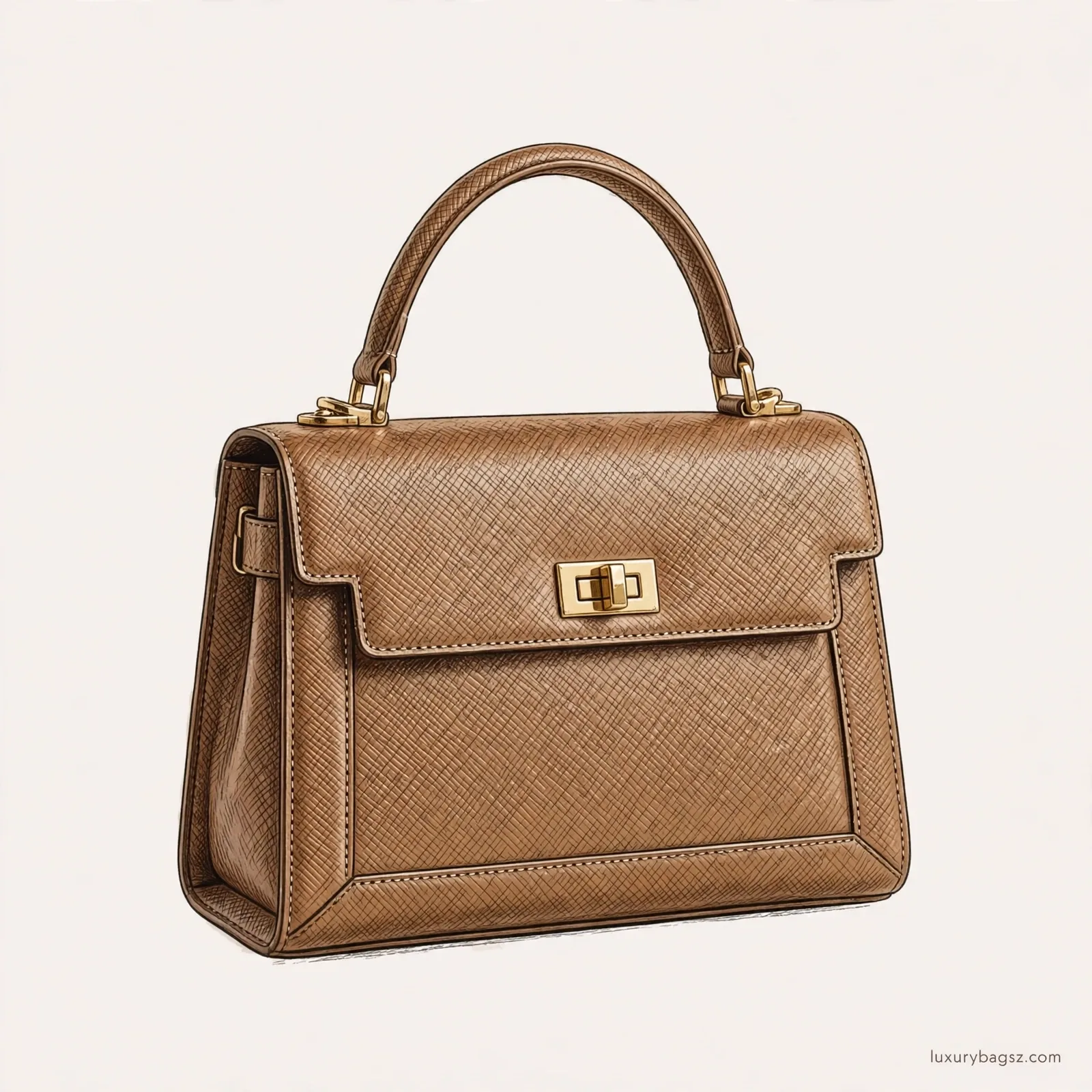
Epsom's trade-off is feel. It is firmer and less buttery than Togo or Clemence, and it does not soften in the same way with wear. Some owners find it almost too perfect, lacking the lived-in warmth of a natural grain. It is also the leather most often used for smaller bags and travel pieces, where its lightness and shape retention matter most.
Choose Epsom when you want crisp lines, bright colour, and low maintenance; choose Clemence when you want softness, drape, and character.
Swift, Box Calf and Chevre: The Smooth and the Supple
Swift is the smooth leather most buyers encounter after the grained trio. Formerly known as Gulliver, which was discontinued in 1999, it returned in 2005 under the Swift name. It is a fine-grained, buttery calfskin with a soft, pillowy feel and exceptional colour depth, which makes it a favourite for smaller bags and for vivid shades.
A Swift bag in a bright colour is one of the most beautiful objects Hermès makes — and one of the most demanding to keep beautiful.
That demand is the point to understand. Swift marks, scratches and absorbs more readily than Togo or Epsom, so it suits owners who rotate bags, handle them gently, and accept that a well-loved Swift bag will show its life. It is less forgiving as a daily workhorse, but superb as a special-occasion or second bag.
If you love the feel of Swift, buy it in a darker or mid-tone colour, where marks show less, and keep it for days when you can give it a little care.
Box Calf is the heritage smooth leather, and the oldest of the house's leathers, dating to the 1890s and named after the English shoemaker Joseph Box. It is smooth, glossy, and supremely elegant, holding its shape well and developing a rich patina with age. Vintage collectors prize Box Calf precisely for that patina, and a well-kept vintage Box Kelly in Rouge H is a collector's prize.
New Box Calf, however, scratches easily and needs careful handling, so it is a connoisseur's leather rather than a beginner's one.
Chevre, or goat leather, deserves a mention because it appears on many smaller pieces and some Kellys. Fine-grained, lightweight and slightly textured, Chevre Mysore in particular is prized for small bags where a lighter, tougher skin makes sense. It is less common on large Birkins, but if you are shopping for a Kelly 25 or a small leather good, Chevre is a leather worth seeking out and handling in person before you decide.
Exotic Materials: Crocodile, Alligator, Ostrich, Lizard, Canvas
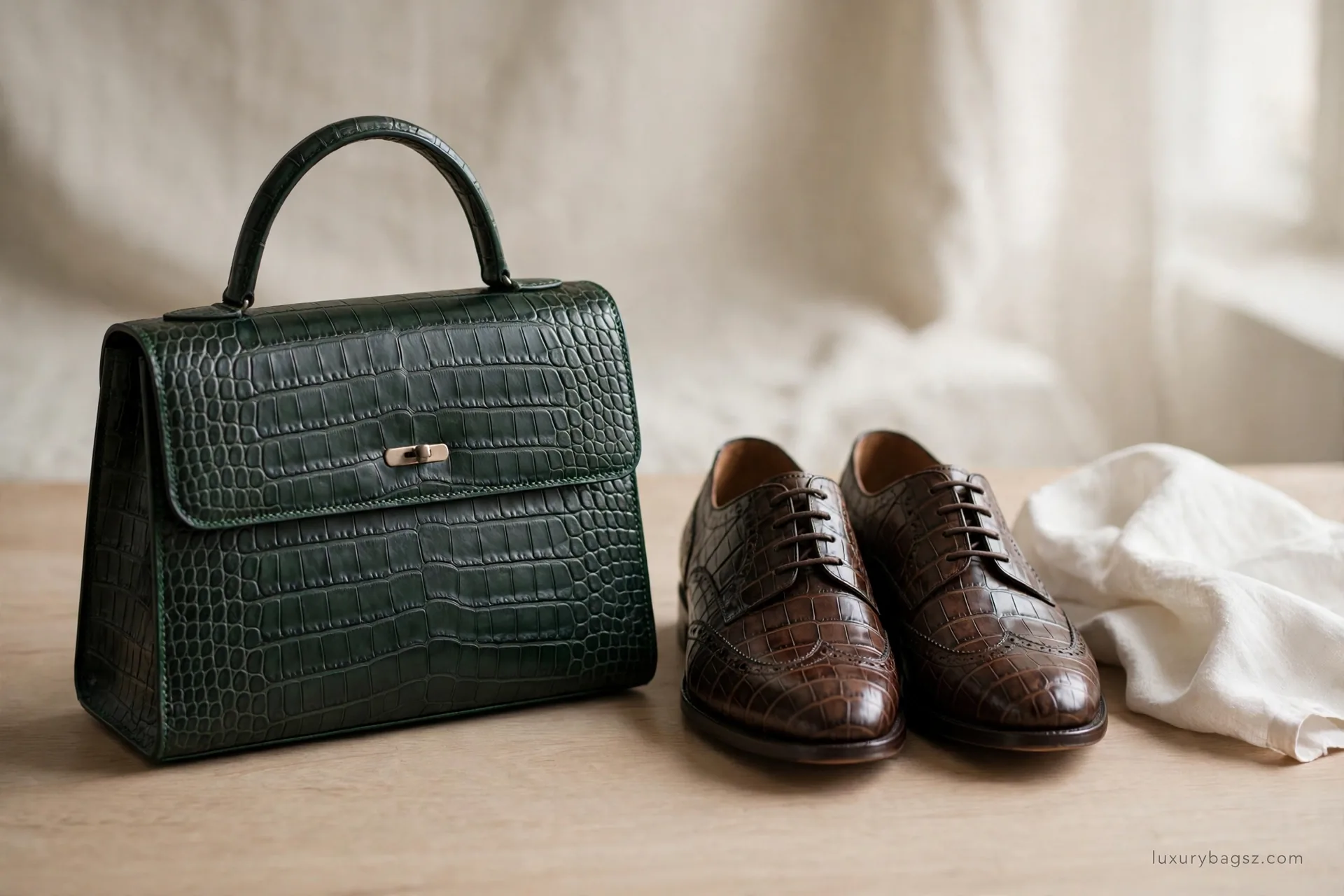
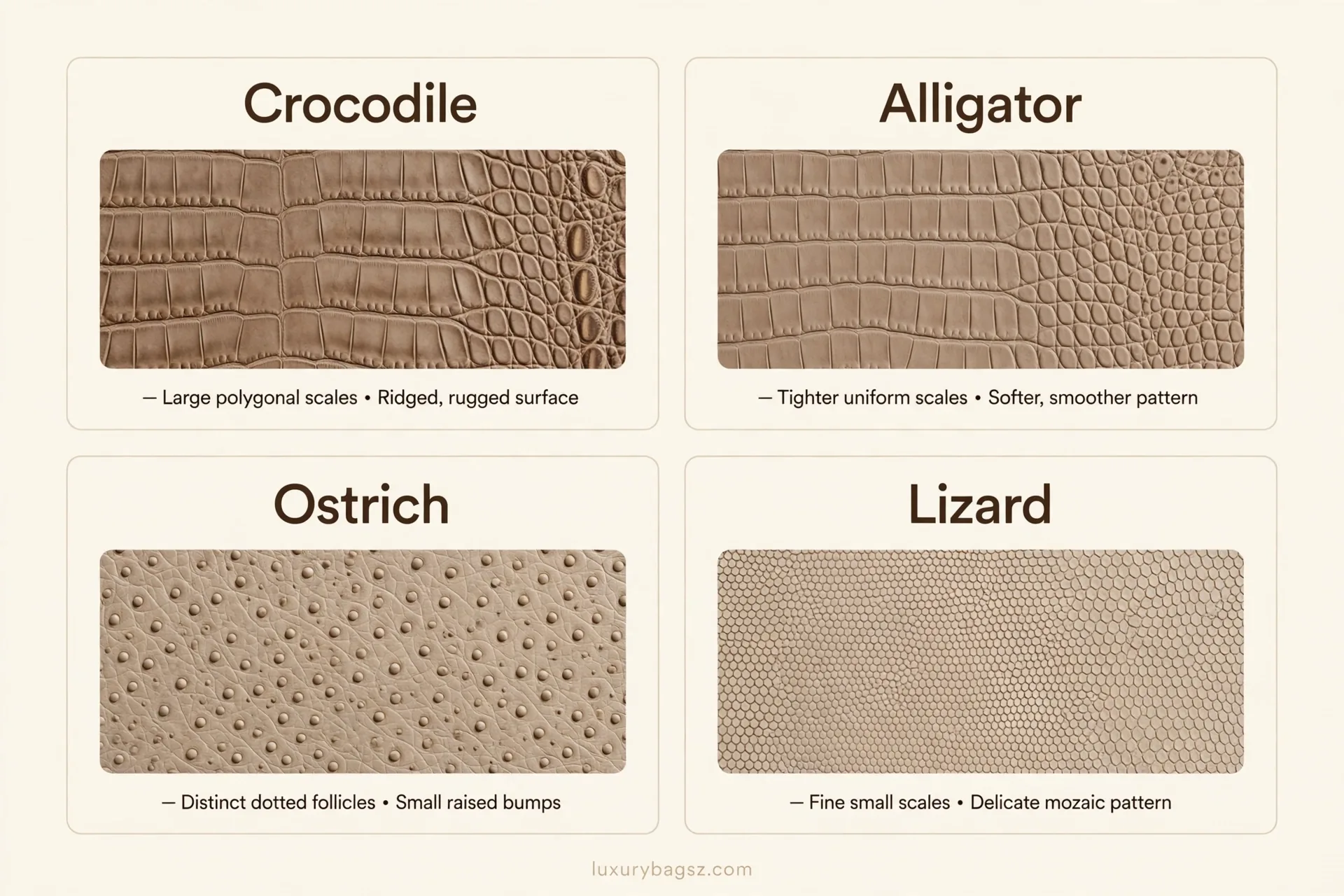
Exotic leathers are a different world, with different prices, rules and care needs. Crocodile, in both Niloticus and Porosus varieties, and alligator are the most famous, used for the highest-priced Birkins and Kellys, including the Himalaya bags whose gradient colouring makes them collector legends.
Alligator scales are generally smaller and more regular than crocodile, and the two are distinguished by scale pattern and pore details, but telling them apart reliably takes expertise — one more reason to buy exotics only from trusted sources.
Ostrich is softer and more flexible than the scaled exotics, with a distinctive quill pattern where feathers once grew. It is lighter than crocodile, more wearable daily, and develops a soft sheen with use. Lizard is smaller in scale, delicate, and mostly used for small leather goods and smaller bags, where its fine pattern can be appreciated up close. Our dedicated guide to Hermès lizard and ostrich bags covers both exotic skins in depth.
Both are beautiful, both need specialist care, and both should be checked for the correct exotic stamps and, on resale, for the paperwork that proves legal trade.
Beyond leather, Hermès makes bags in canvas, notably Toile H and Toile Officier, often combined with leather trim on bags like the Herbag and the Garden Party. Canvas bags are lighter, more casual, and more forgiving of rain and daily knocks than most leathers, which makes them excellent first Hermès pieces or travel bags.
They do not carry the same resale prestige as a leather Birkin or Kelly, but they are honest, hardworking bags, and for many owners they become the most-carried piece in the collection.
A final materials note: only exotic leathers carry their own special leather stamps alongside the date stamp, while standard leathers are identified by feel, grain and listing description. That makes exotic authentication a specialist job, and it makes standard-leather authentication a matter of handling many genuine bags until the grains become familiar. Never buy an exotic bag on the strength of a stamp photograph alone.
Caring for Each Leather Without Ruining It
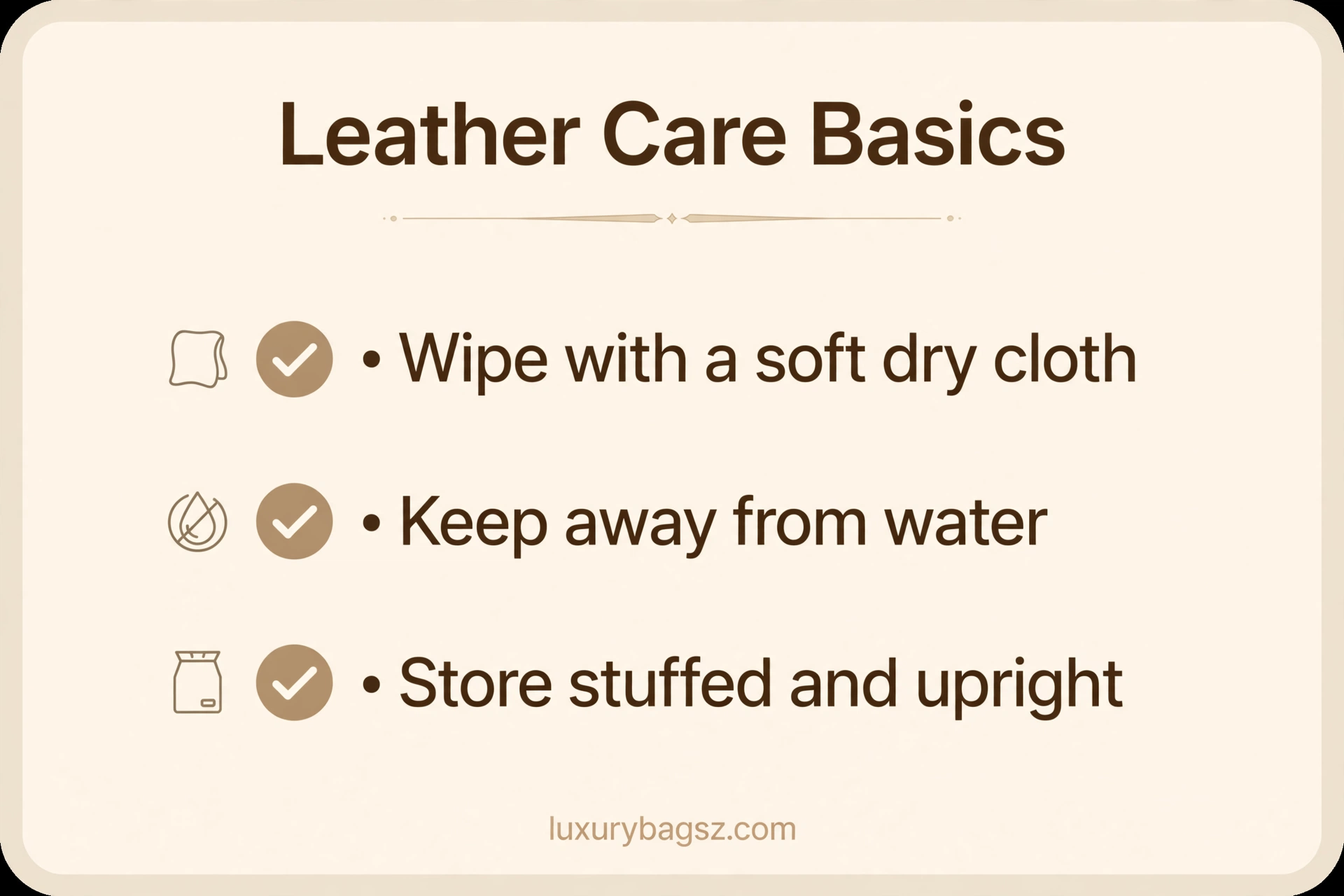
Care starts with the same rule for every leather: wipe with a soft, dry cloth, keep the bag out of prolonged direct sunlight, and store it stuffed and upright in its dust bag. Beyond that, leathers diverge. Grained leathers tolerate a gentle wipe and occasional leather-specific conditioning, but they should not be soaked, scrubbed, or treated with products made for other brands' leathers without advice.
Swift and Box Calf need a lighter touch still: no water, no harsh cleaners, and prompt attention to marks before they set.
Rain is the enemy most owners underestimate. Togo and Clemence can mark in heavy rain, Epsom resists moisture better thanks to its embossed finish, and smooth leathers can spot badly. If you are caught out, let the bag dry naturally at room temperature, away from radiators and hairdryers, and do not rub wet leather.
For serious marks, water damage, or exotic leathers, professional Hermès spa services or a trusted leather specialist are worth the cost: a botched home repair can reduce value far more than the original mark did. Our guide to cleaning a Hermès Birkin bag gives leather-by-leather instructions that apply to most Hermès bags, not only the Birkin.
Storage matters as much as cleaning. Never hang a heavy leather bag by its handles for months, never store it flat under other bags, and never leave it unstuffed if it is Clemence or another soft leather. Keep bags out of plastic bags, which trap moisture, and keep them away from dark clothing or coloured dust bags that can transfer dye. A few minutes of storage care after each wear will do more for a bag's long life than any expensive product.
Choosing, Fakes and Resale: Putting Leather Knowledge to Work
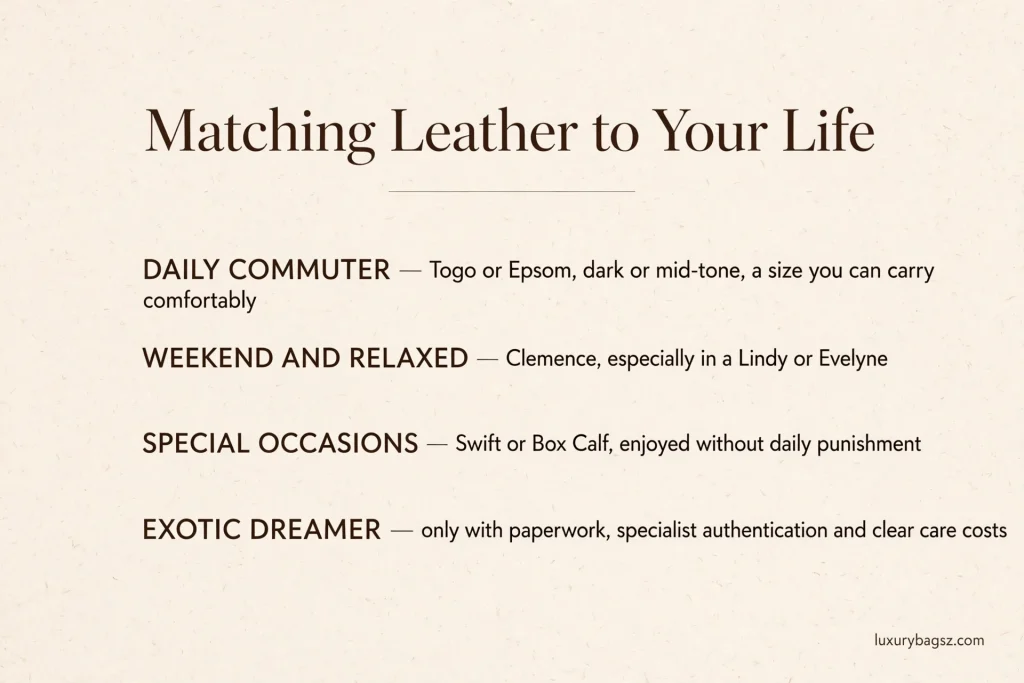
When you are choosing, start from your life, not from a ranking. Daily commuter? Togo or Epsom, in a dark or mid-tone colour, in a size you can carry comfortably. Weekend and relaxed dressing? Clemence, especially in a Lindy or Evelyne. Special occasions and a rotating collection? Swift or Box Calf, where their beauty can be enjoyed without daily punishment. Small bag lover? Chevre and Epsom deserve a close look. Exotic dreamer?
Buy only with paperwork, specialist authentication, and a clear understanding of the care and cost involved.
Leather knowledge also protects you from fakes, though it never proves authenticity alone. Counterfeits often get the grain wrong: Togo that looks too uniform, Epsom that feels too plasticky, Clemence that is too light or too stiff. Handling genuine bags, in boutiques or from trusted dealers, trains your hands faster than any photograph can train your eyes.
Our fake Hermès Birkin checks cover twelve tests, and leather feel is only one of them — stitching, hardware, stamps and overall construction must all agree before you trust a bag.
On resale, structured and popular leathers tend to do well, with Togo and Epsom dominating many resale listings for Birkins and Kellys. Smooth leathers are more condition-sensitive: a pristine Box Calf vintage piece can command a premium, while a scratched one can struggle. Exotics sit at the top of the market but are also the most volatile and the most paperwork-dependent.
Whatever leather you choose, condition is king: a well-kept Togo bag will outsell a neglected exotic, and a complete set — box, dust bag, lock, keys and receipt where available — helps every leather sell better. Remember too that Hermès issues no authenticity cards, so any seller offering a card as proof should be treated with caution, not reassurance.
Frequently Asked Questions
What is the best Hermès leather for everyday use?
Togo, for most people. It is pebbled, scratch-resistant, relatively lightweight, and holds its shape while softening gracefully. Epsom is the other strong everyday choice if you prefer a crisper, more structured bag and brighter colour, while Clemence suits a more relaxed daily bag if you do not mind extra weight and slouch.
What is the difference between Togo and Clemence?
Togo has a finer, more regular pebble grain, is lighter, and holds its shape better. Clemence has a larger, flatter, more irregular grain, is softer and heavier, and slouches more with wear. Togo suits structured and everyday bags, Clemence suits relaxed bags like the Lindy and Evelyne. Both are calfskin, and both are popular, but they behave quite differently over time.
Is Epsom leather real grained leather?
Epsom's grain is embossed, meaning it is pressed into the calfskin rather than occurring naturally. That is not a flaw: it makes Epsom lightweight, rigid, scratch-resistant and excellent at holding colour. It does mean Epsom feels firmer and less buttery than Togo or Clemence, and it does not soften in quite the same way with age.
What is Swift leather?
Swift is a smooth, fine-grained calfskin, formerly known as Gulliver, reintroduced in 2005. It is buttery to the touch and shows colour vividly, which makes it lovely for smaller bags and bright shades. It marks more easily than grained leathers, so it suits rotating collections and careful handling better than hard daily use.
Is Box Calf leather worth it?
For collectors and careful owners, yes. Box Calf is glossy, elegant, historic, and develops a beautiful patina. For a first or daily bag, it is risky, because it scratches easily and shows wear quickly. Buy Box Calf when you love its look enough to handle it gently and accept patina as part of its character.
What is Chevre leather?
Chevre is goat leather, fine-grained and lightweight, used on many smaller Hermès pieces and some Kellys. Chevre Mysore is a well-known variety prized for small bags. It is tougher than it looks, but it is less common on large Birkins, so most buyers meet it on Kellys, Constances and small leather goods.
How can you tell crocodile from alligator?
By scale pattern and pores, but reliably telling them apart takes expertise and handling of genuine examples. Alligator scales are generally smaller and more regular, while crocodile shows more variation. For any exotic purchase, rely on specialist authentication and paperwork, not on a scale photograph alone.
Which Hermès leather holds colour best?
Epsom and Swift are usually cited as the best at holding vivid colour, with Epsom's embossed surface giving bright shades particular punch. Togo and Clemence show colour more softly, which suits neutrals and muted shades beautifully. Always judge a colour in the leather you intend to buy, not in a different leather.
Which Hermès leather is heaviest?
Clemence is noticeably heavier than Togo or Epsom, and that weight matters on a large bag carried all day. If weight is a concern, favour Togo or Epsom, or choose a smaller size. Always try a bag on your shoulder, loaded as you would actually carry it, before committing.
How should I care for Hermès leather?
Wipe with a soft, dry cloth, keep the bag out of direct sunlight and heavy rain, and store it stuffed and upright in its dust bag. Avoid water and harsh cleaners, especially on Swift, Box Calf and exotics. For serious marks or exotic leathers, use a professional service rather than attempting a home repair that could reduce value.
Final Verdict: Match the Leather to Your Life, Not to a Ranking
There is no single best Hermès leather, only a best leather for a particular bag and a particular owner. Togo wins for most daily bags, Epsom wins for structure and bright colour, Clemence wins for relaxed slouch, Swift and Box Calf win for beauty and occasion, and exotics win for rarity and occasion at a far higher price and level of care.
The mistake is to buy a leather because it tops a list, then discover that its weight, its marks, or its stiffness do not suit the way you actually live.
Handle as many genuine leathers as you can before you buy, carry the bag loaded, and look at it in daylight. A leather you love to touch, that suits your shoulder, and that forgives your daily routine will be carried for decades. A leather chosen for prestige alone will spend its life in a dust bag, and no Hermès leather, however beautiful, is worth owning if you are afraid to use it.