Hermès Lizard and Ostrich Bags: Skins, Stamps, Prices and Care
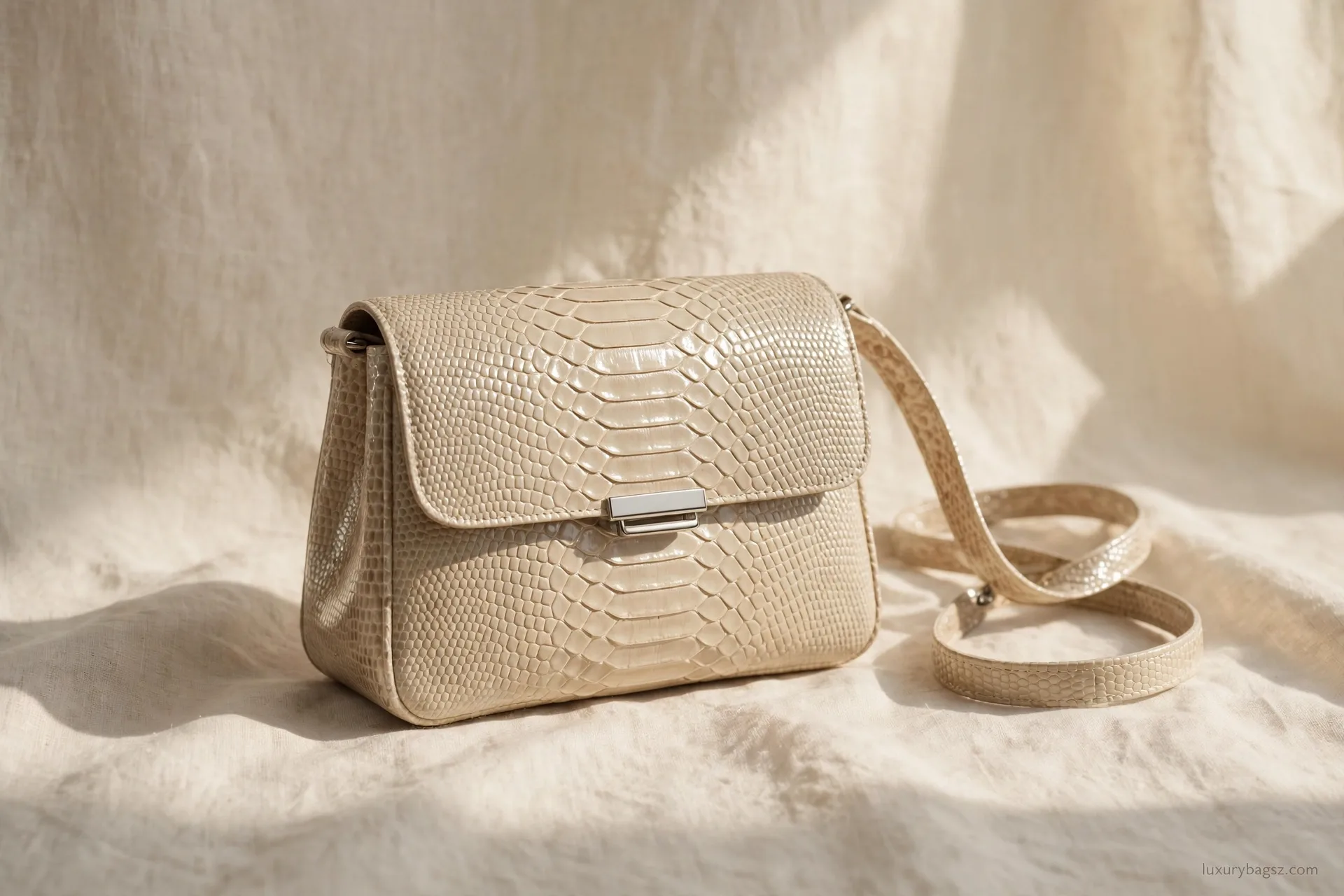
Hermès Lizard and Ostrich Bags: Skins, Stamps, Prices and Care
Lizard Is for Small Bags, Ostrich Is the Easier Exotic to Live With
If you want a Hermès lizard bag, think small: Constance, Mini Kelly, Kelly Pochette and Birkin 25 or smaller. The skin is too small for large panels. Ostrich has no such limit, and comes in Birkin and Kelly 25, 30 and 35.
The skins behave oppositely. Lizard is glossy and fragile when dry. Ostrich is softer and tougher day to day, but handles darken from hand oils and pale colours fade in light. Neither is a carefree first exotic.
Against crocodile, both sit lower on price and prestige, and are easier to find. That gap is the opportunity: a genuine exotic at a lower entry price, if you buy the right model, colour and paperwork.
Key Takeaways
- Lizard stamps: Niloticus lizard is marked “–”, Salvator lizard is marked “=”. Ostrich has no special stamp at all.
- Lizard is limited by skin size to small bags. Ostrich is made in small, medium and larger Birkin and Kelly sizes.
- Ombré lizard is undyed, naturally shaded skin, light in the centre and darker at the edges. It cannot be colour-matched easily.
- On resale, lizard and ostrich usually sit below comparable crocodile. Small lizard quota bags hold value best.
- Lizard hates dryness and cracks. Ostrich hates hand oils on handles and strong light on pale colours.
- Always check the stamp, the skin pattern, the paperwork and the seller photographs before you pay. Stamps alone prove nothing.
Hermès Lizard: Two Species, Two Stamps
Niloticus Lizard and the Dash Stamp
Hermès uses two lizard species. Niloticus lizard has fine, even scales and a polished finish. On the blind stamp it is marked with a dash, “–”, near the year and craftsman marks.
Niloticus is the lizard most buyers meet in recent Constance, Mini Kelly and small Kelly bags. Its scales sit flat, take dye evenly and give the glassy shine people expect. Shine, though, is a finish, not strength.
Salvator Lizard and the Equals Stamp
Salvator lizard, from the Asian water monitor, is marked “=”. Its scales are slightly larger and less uniform, with more visible grain. It appears less often now, so do not reject a genuine bag for the different symbol.
Learn both symbols before you shop. A dash or equals sign in the right place and depth supports the skin claim. A missing symbol on a bag sold as lizard is a reason to walk away.
Our Hermès leathers and materials guide places lizard and ostrich beside calfskin, goatskin and crocodile, so you can compare hand feel and structure first.
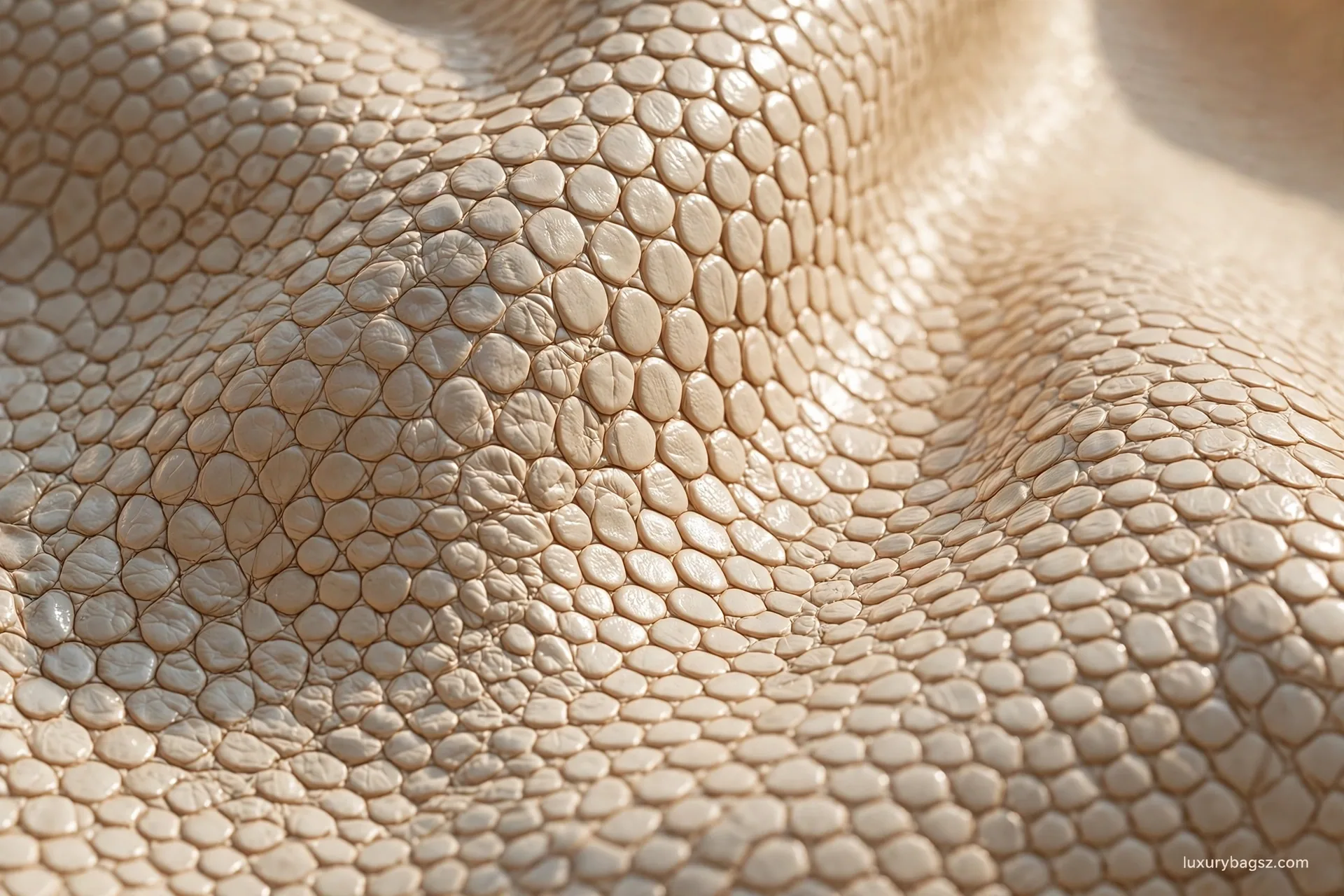
Why Lizard Stays Small: Skin Size and Panel Logic
A lizard skin is narrow and short. A large bag front needs one wide, unblemished panel, which lizard cannot provide without joins or mismatched scales. Hermès will not piece a front from scraps, so the model list stays small.
So lizard appears on the Constance 18 and 24, Mini Kelly, Kelly Pochette, Kelly 20 and 25, and Birkin 25. There is no regular-production lizard Birkin 35. Any large bag offered as lizard deserves extreme suspicion.
Touch pieces are the exception. A Kelly or Birkin in Swift or Togo may use lizard for a flap, handles or trim, where small pieces fit. The video below shows lizard as an accent, not a full skin.

Small size helps value. Small quota bags are the most wanted Hermès bags in any skin, and a lizard Constance or Mini Kelly combines two scarcities. Good examples rarely sit unsold for long.
Ombré Lizard and Other Lizard Colours
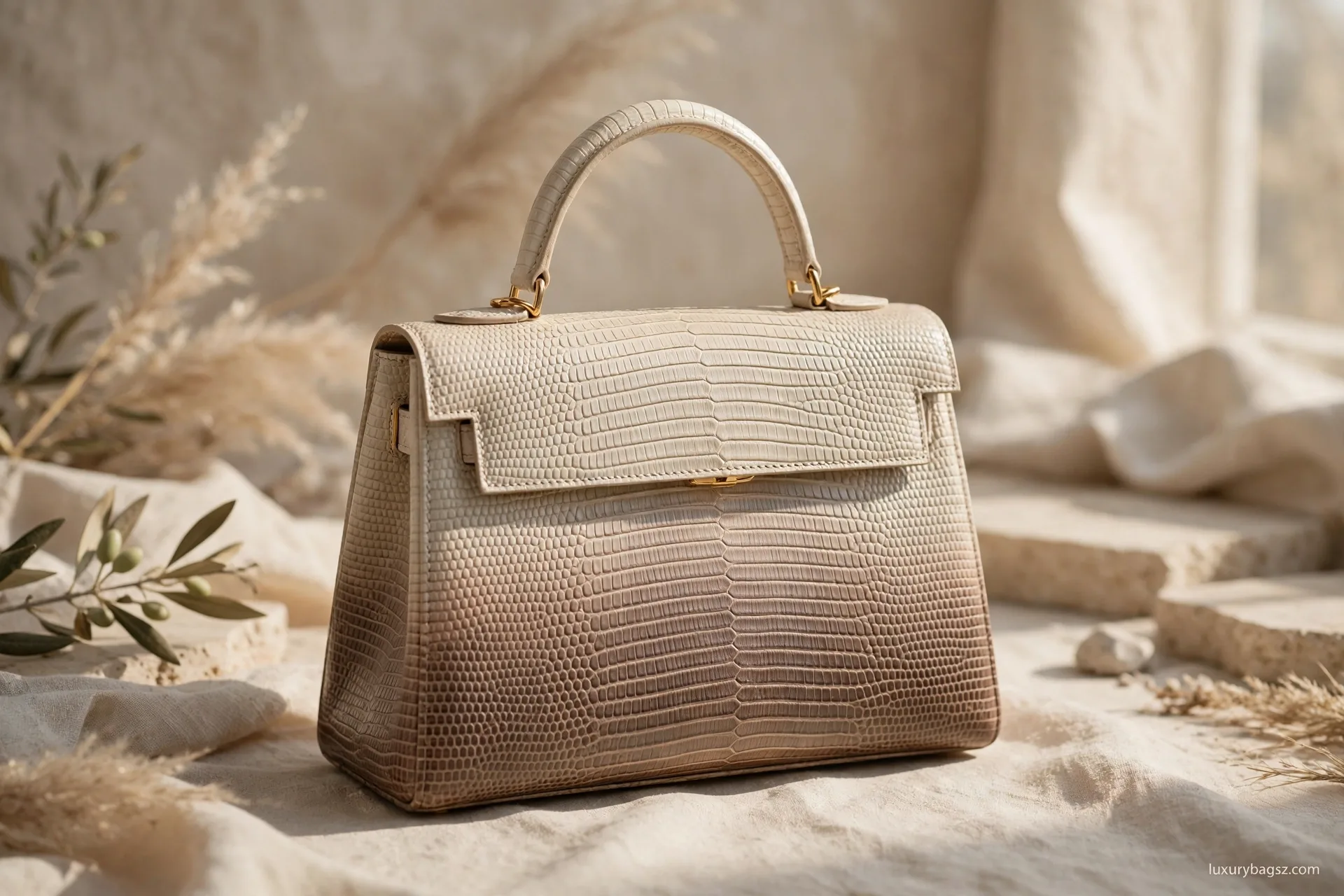
Ombré lizard is the most misunderstood exotic. It is not printed or dyed to order. The skin is left largely undyed, so its own shading shows: pale, almost ivory in the centre, deepening to grey-brown at the edges.
No two Ombré bags match. The gradient follows one animal, so panels vary slightly across a bag. That is correct. A perfectly uniform “Ombré”, identical on every panel, is a warning sign, not a quality sign.
Dyed lizard differs. Black, Rouge H, gold and jewel colours take dye well, and the gloss lifts the colour. Dark shades hide wear best. Pale dyed lizard shows edge darkening and cannot be recoloured evenly.
Buy Ombré only if you love variation. It cannot be touched up to match, spare skin in the same gradient is effectively unavailable, and a scuff on the pale centre shows at once. Collectors pay for that honesty.
Hermès Ostrich: Quills, Colour and No Special Stamp
How to Recognise Real Ostrich
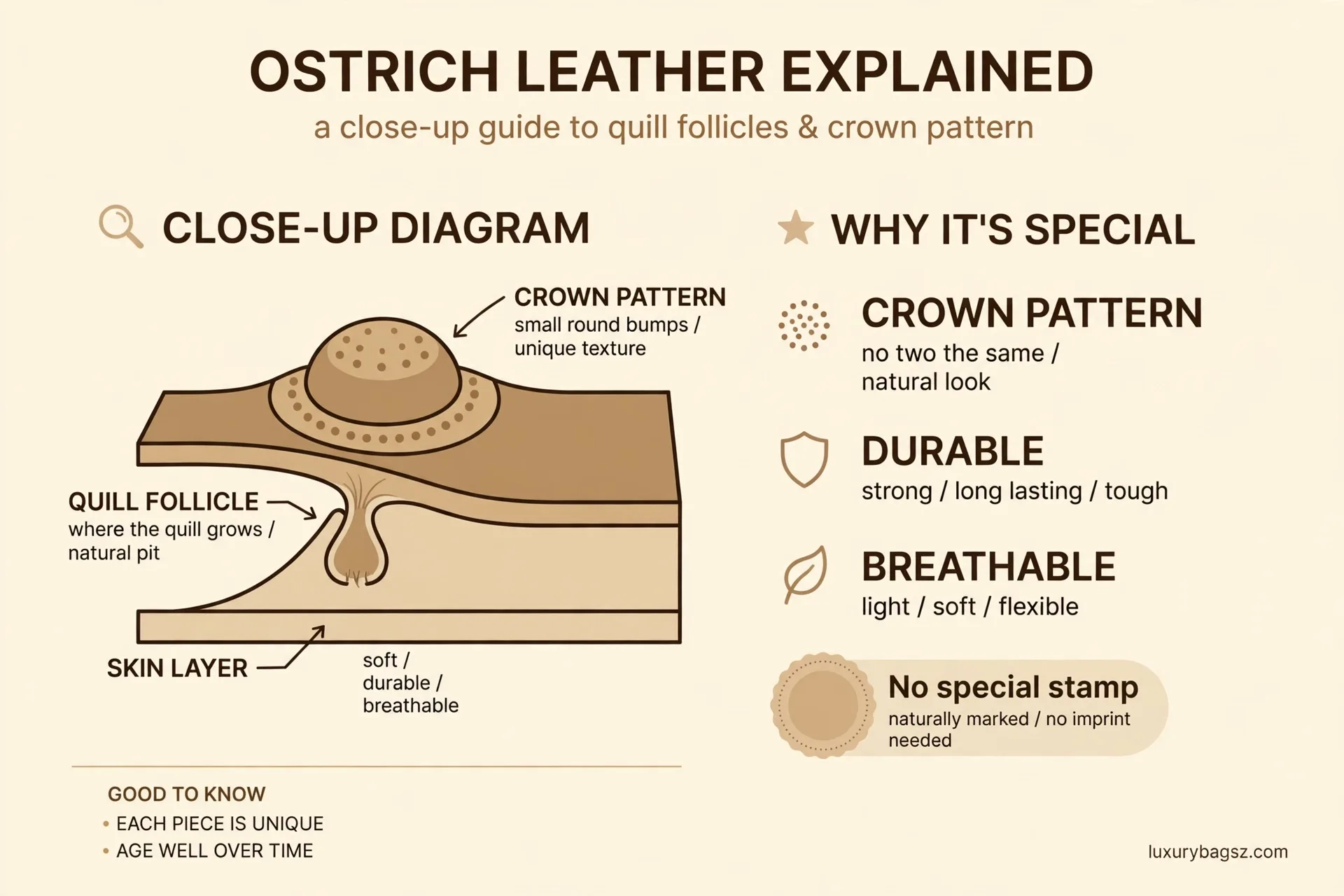
Ostrich is recognised by its quill follicles: raised bumps where feathers sat, in a crown pattern on the best part of the hide. On a genuine bag they are irregular and three-dimensional, not printed evenly everywhere.
Run a fingertip over them. Real follicles rise and fall unevenly; the skin between them is soft and slightly pebbled. Embossed fakes feel regular and identical. If every bump matches in size and spacing, it is not ostrich.
Ostrich has no special stamp — no dash, dot or symbol, unlike lizard and crocodile. Authentication rests on follicles, construction and paperwork. Compare crocodile symbols in our guide to telling crocodile from alligator leather.
Which Sizes Ostrich Is Actually Made In
Ostrich hide is large, so the model list is wide: Birkin 25, 30 and 35, Kelly 25, 28 and 32, plus Constance and Lindy in some years. Panel size is not the limit; demand and price are.
Placement matters. Hermès puts the follicle crown where it will be seen, usually on the front. A bag with follicles only in hidden areas may be genuine but less desirable, and should be priced to reflect that.
Prices and Resale: Lizard and Ostrich vs Crocodile
At retail, both skins sit above calfskin and below crocodile. Boutique prices move by year, size and market. Treat the figures below as market-observation ranges from recent listings and sales, not fixed prices.
| Bag | Typical resale range | Position vs crocodile |
|---|---|---|
| Lizard Constance 18 / 24 | Roughly $18,000–$35,000 | Well below crocodile Constance |
| Lizard Mini Kelly / Pochette | Roughly $25,000–$50,000 | Below crocodile; small size lifts it |
| Ostrich Birkin / Kelly 25–30 | Roughly $25,000–$45,000 | Often half or less of crocodile |
| Crocodile Birkin / Kelly 25–30 | Roughly $45,000–$90,000+ | The exotic benchmark |
Resale follows the same order. Crocodile leads, as interest in a Niloticus crocodile Lindy 26 shows even outside quota models. Ostrich trades at a clear discount; lizard sits between, lifted by small quota models.
Colour and condition decide the real price. Black and gold ostrich, and black or Ombré lizard in a Mini Kelly, attract the widest bidding. Bright ostrich, cracked pale lizard and missing papers narrow the pool sharply.
Do not buy either skin expecting crocodile returns. Buy lizard for scarcity in a small event bag, and ostrich for a usable exotic below crocodile money. If the price nears crocodile, most buyers should choose crocodile.
Care: Two Skins, Two Different Enemies
Lizard Care: Dryness, Cracking and the Membrane
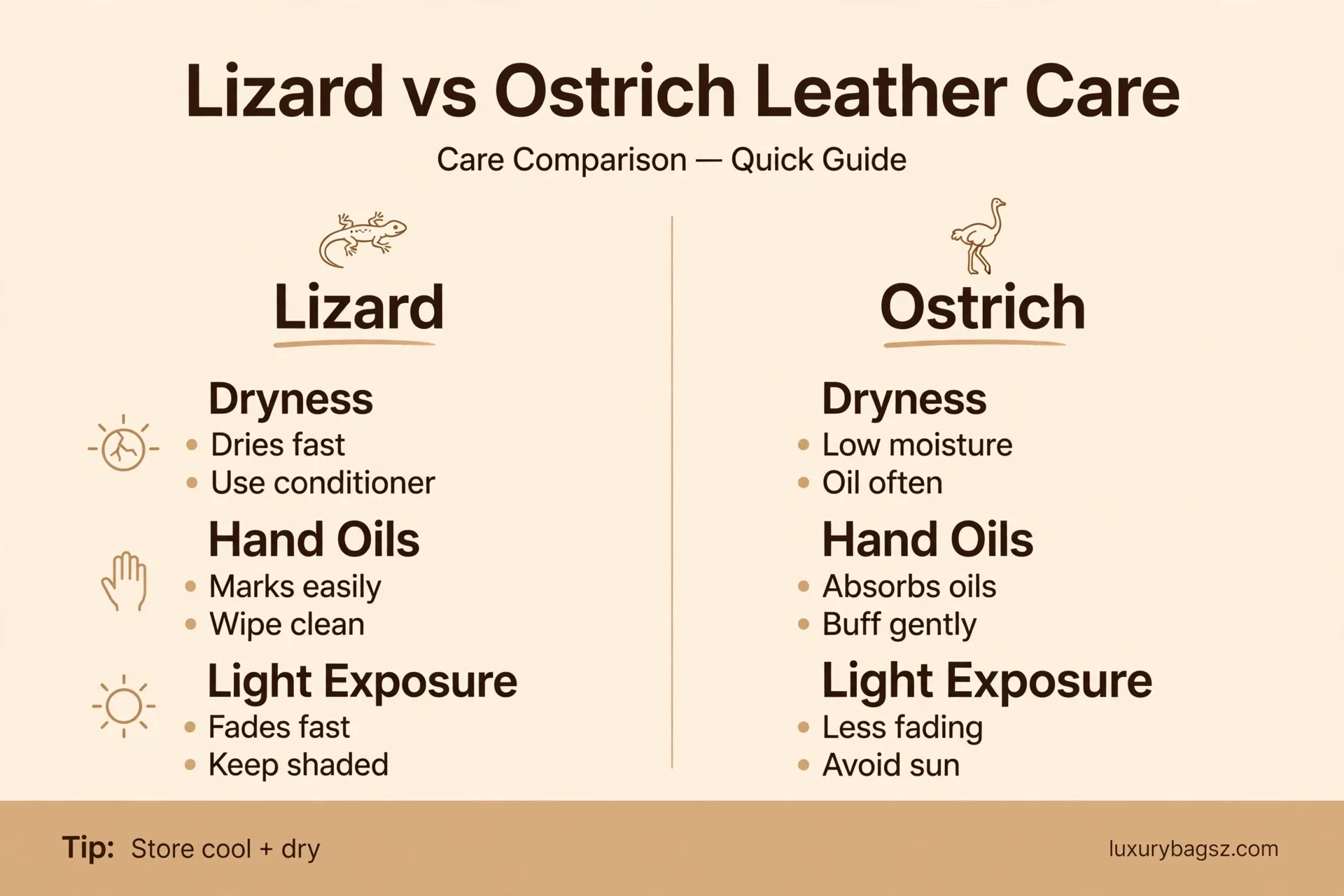
Lizard dries out. Each scale sits on a thin membrane; when it loses moisture, scales lift, curl and crack. Heat, sun and dry storage speed this up. Once a scale cracks, it cannot be uncracked.
Keep lizard in its dust bag, lightly padded, away from radiators and windows. Use only a specialist exotic conditioner, sparingly; never soak it or use calfskin creams. Our guide to caring for reptile leather covers storage and humidity.
Ostrich Care: Hand Oils, Light and Follicles
Ostrich fails the opposite way. Hand oils darken handles and corners, often permanently, because the skin absorbs oil readily. Use clean, dry hands, consider handle wraps, and never apply hand cream just before carrying it.
Light is the second enemy. Pale and bright ostrich fades in sun, unevenly where a flap shades part of a panel. Store it in its dust bag, rotate use, and keep it out of window and car-seat sun.
Clean follicles gently. Dust settles around the quills, so lift it away with a soft, dry brush. Avoid wet wipes and household cleaners, which darken the skin and leave tide marks around the follicles.
Buying and Authentication: Stamps, Paperwork and Red Flags
What to Photograph and Ask a Seller
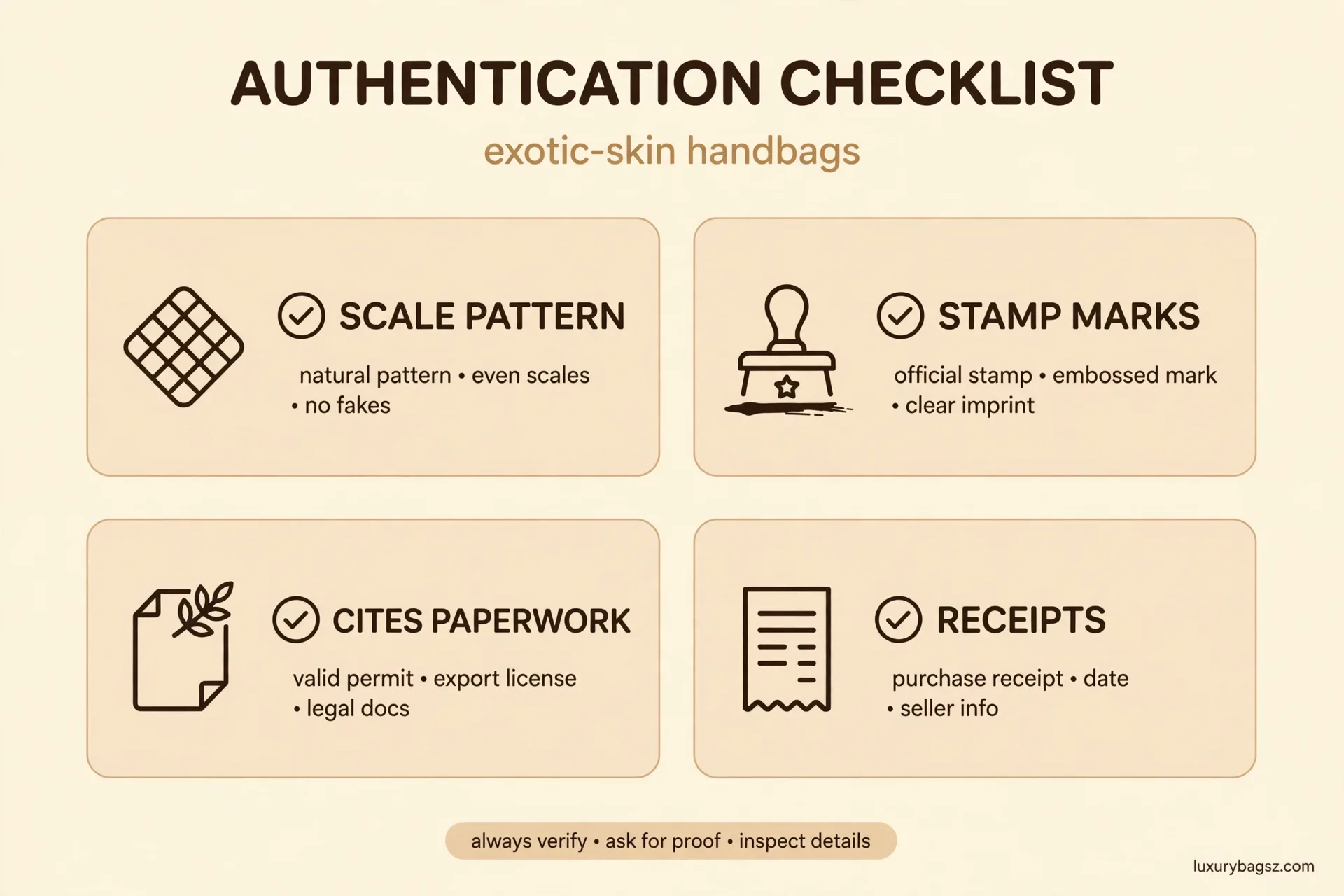
- Ask for the full blind stamp in sharp focus, plus the skin symbol: dash for Niloticus lizard, equals for Salvator, none for ostrich.
- Ask for close photographs of the scales or follicles, all corners, handles, hardware, stitching, interior and zip, in daylight.
- Ask for the receipt or invoice copy, any CITES or export papers, the year, the exact colour name and a full list of flaws.
- Ask whether the skin has been recoloured, polished or repaired, and whether any scale lifting or handle darkening is present.
CITES and Paperwork Checks
Lizard is traded under CITES controls; crocodile is stricter still. An exotic sold across borders should be traceable to correct export and import paperwork. Missing papers do not always mean fake, but they limit resale and travel.
Check that papers match the bag: species, skin, colour and dates should make sense together. Papers for a different skin, altered photocopies, or a seller who shows none are serious concerns. Keep every document with the bag.
Fake Red Flags Beyond the Stamps
Stamps can be copied, so look wider. Red flags include perfectly repeating scales or follicles, plastic shine, chemical smell, uneven stitching, lightweight hardware with poor engraving, and a thin, synthetic-feeling lining.
Price is a flag too. A lizard Birkin 35, an ostrich bag with a crocodile stamp, or any exotic far below the ranges above needs an explanation sellers rarely have. Pay for independent authentication before completion.
Frequently Asked Questions
Does Hermès ostrich have a special stamp?
No. Ostrich has no special symbol on the blind stamp. That absence is correct. Authentication depends on the raised, irregular quill follicles, the construction quality and the paperwork, not on a skin symbol.
Why is there no lizard Birkin 35?
The skin is too small to cut a large, clean front panel without joins or flaws. Hermès limits full lizard to small bags such as the Constance, Mini Kelly and Birkin 25. Larger bags use lizard only as a touch accent.
Does ostrich darken over time?
Yes, mainly where hands touch it. Oils darken handles and corners, and the change is usually permanent. Clean hands, handle wraps and rotation slow it down, but no cleaning reliably reverses deep oil darkening.
Is Ombré lizard dyed?
Not in the usual sense. Ombré uses the natural shading of the undyed skin, pale in the centre and darker at the edges. Because the gradient belongs to one animal, panels vary and touch-ups cannot be matched evenly.
Do lizard and ostrich bags need CITES paperwork?
Lizard is covered by CITES trade controls, so cross-border sales should have matching export and import documents. Keep all papers with the bag. Missing paperwork limits resale, shipping and travel options.
Which holds value better, lizard or ostrich?
Small lizard quota bags usually hold value better, because the model and the skin are both scarce. Ostrich in classic colours holds value steadily but at a lower level. Crocodile in the same models still leads both.
Final Verdict
Choose lizard if you want a small, jewel-like event bag, love gloss and Ombré shading, and will store and carry it carefully. In a Constance or Mini Kelly, it is the most distinctive exotic below crocodile.
Choose ostrich if you want a daylight exotic, in a Birkin or Kelly 25 or 30, at well below crocodile money. Accept handle darkening, protect pale colours from light, and pick a deep shade for the easiest life.
Skip both if you need a daily bag that tolerates rain, neglect or heavy loads, or if you cannot verify stamps, skin and paperwork first. Buy calfskin now, or save towards crocodile with full papers and authentication.