

History of Hermès: From Horse Harnesses to the Birkin
Hermès in Brief: From Harness Maker to Luxury’s Most Exclusive Name
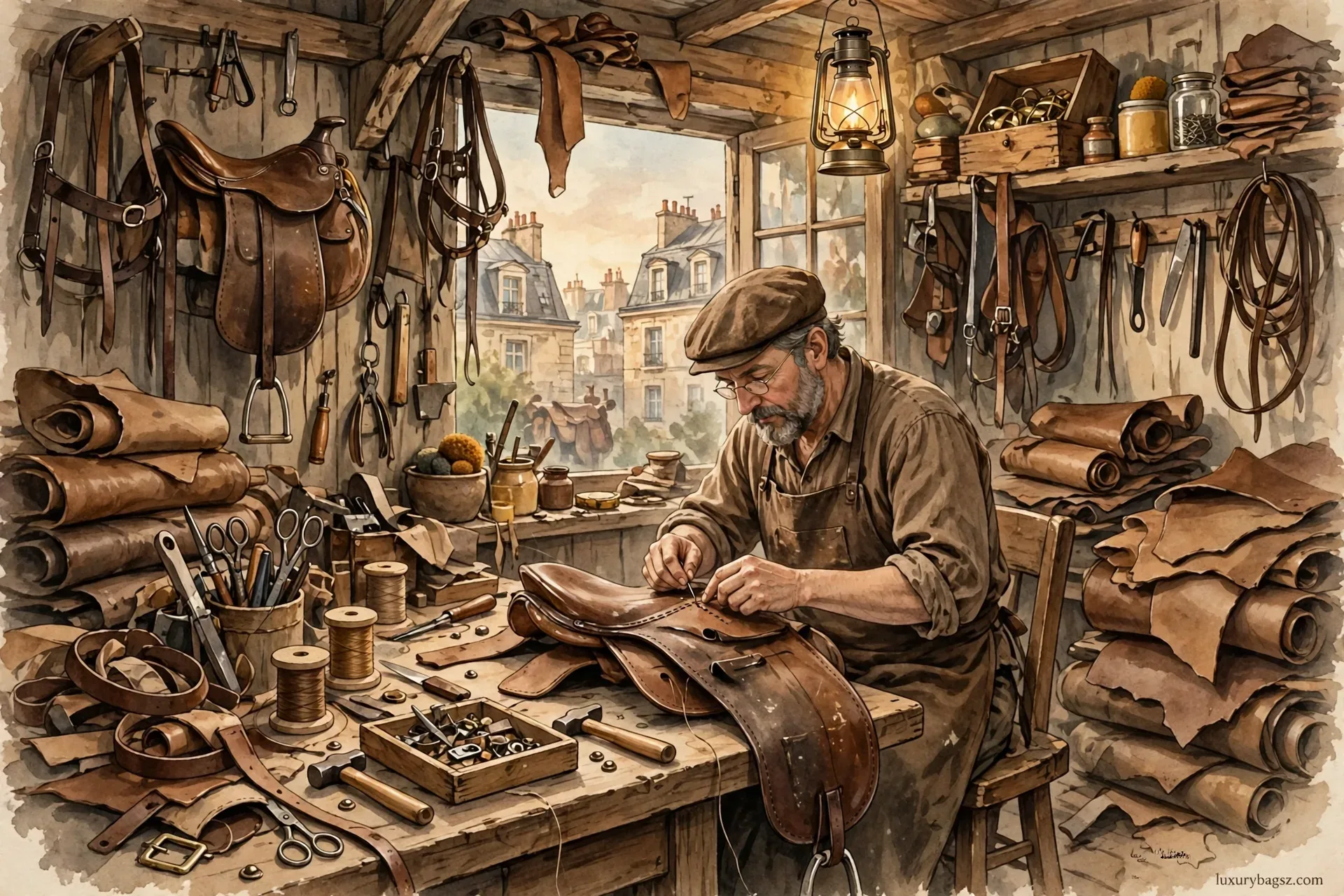
Hermès began in Paris in 1837, when Thierry Hermès opened a harness workshop in the Grands Boulevards quarter. He made bridles, saddles, and harnesses for horse-drawn carriages, winning a first-class medal at the 1867 Universal Exhibition for work that combined discreet finesse with endurance. Nearly two centuries later, the same house makes the Birkin and Kelly bags, silk carrés, and a full range of leather goods, still largely by hand.
What sets Hermès apart is continuity. Six generations of the family have run the house, which went public in 1993 while remaining under family control. When LVMH quietly built a large stake around 2010, the family locked a majority of shares into a holding company to keep control — a defensive move that became a famous case study in luxury independence. Hermès still makes its most coveted bags in limited numbers, by a single artisan, using the saddle stitch developed for harnesses. The story continues in our full Hermès guide collection, which follows the house from these beginnings to the bags, scarves and jewellery it makes today.
For buyers, that history explains both the magic and the frustration of Hermès today: the craftsmanship is real, the waiting lists are real, and the pre-owned market is where most people actually buy. Understanding how the house evolved helps you choose wisely, care for what you own, and avoid the many fakes that trade on the name.
Key Takeaways
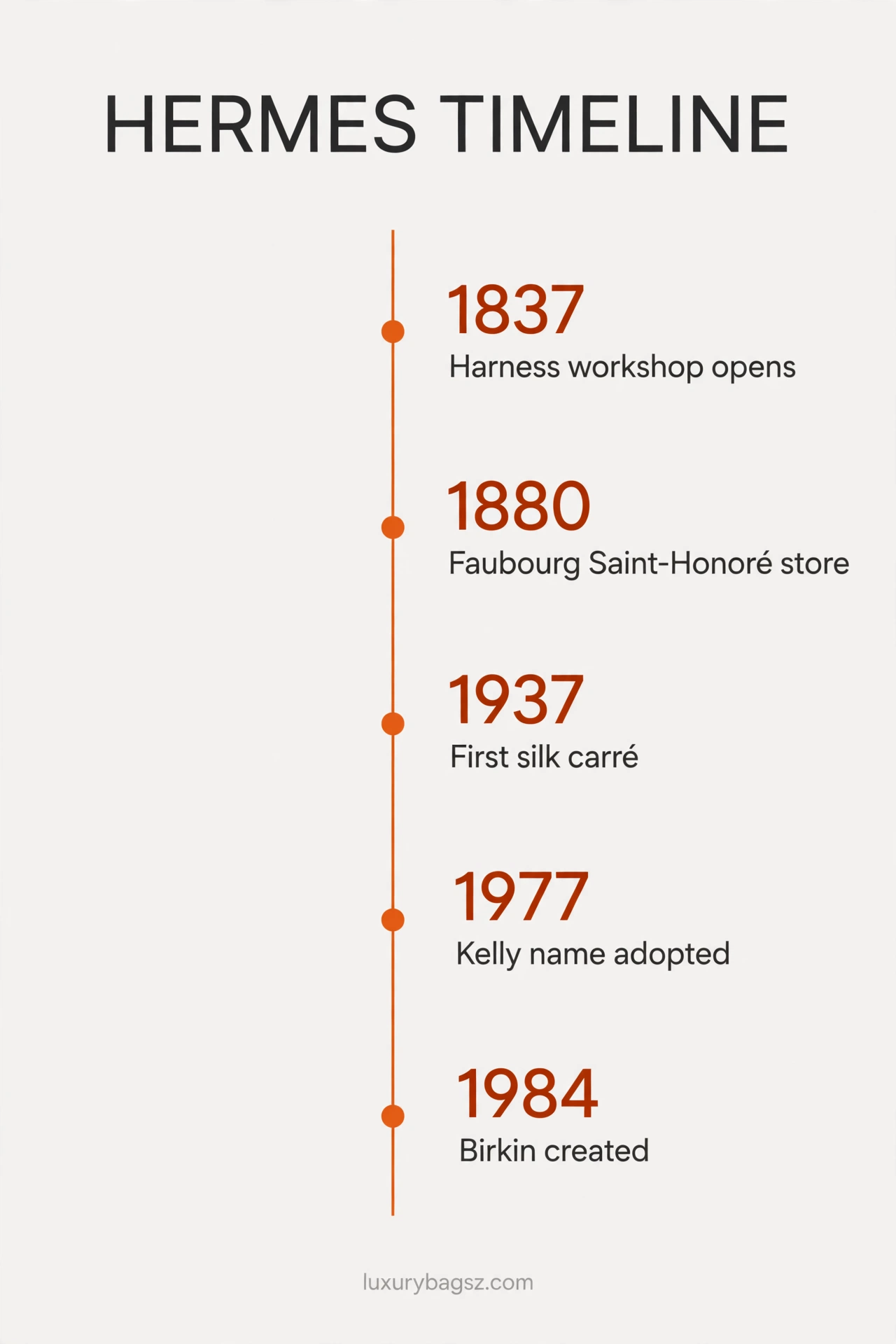
- Hermès was founded in Paris in 1837 by harness maker Thierry Hermès.
- His son Charles-Émile moved the workshops to 24 Rue du Faubourg Saint-Honoré in 1880, still the flagship address today.
- Émile-Maurice Hermès led the move into leather goods and luggage as cars replaced carriages, and introduced the zip to France.
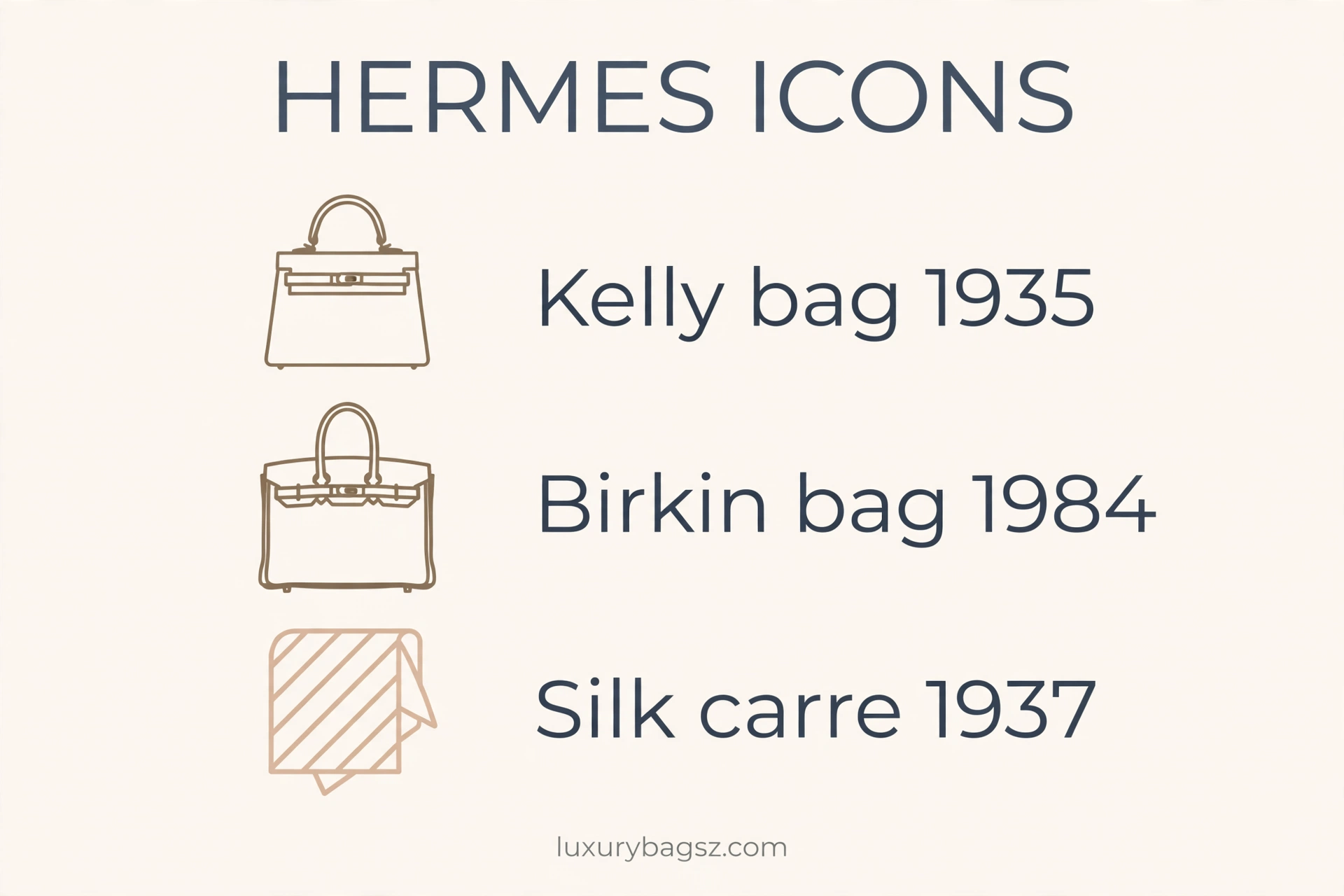
- The Sac à dépêches (1935) became the Kelly, renamed in 1977 after Grace Kelly; the Birkin followed in 1984 after Jane Birkin's flight encounter with Jean-Louis Dumas.
- The first silk carré appeared in 1937, and Hermès went public in 1993 while the family kept control.
Thierry Hermès and the Harness Workshop
Thierry Hermès was born in 1801 in Krefeld, then in Prussia and now in Germany, and was orphaned young. He trained as a saddler and harness maker in Normandy before moving to Paris in 1837, where he opened a workshop in Rue Basse-du-Rempart, near the Madeleine. His customers were coachmen, cavalry officers, and the stable masters of European aristocracy — people who needed equipment that would not fail on the road.
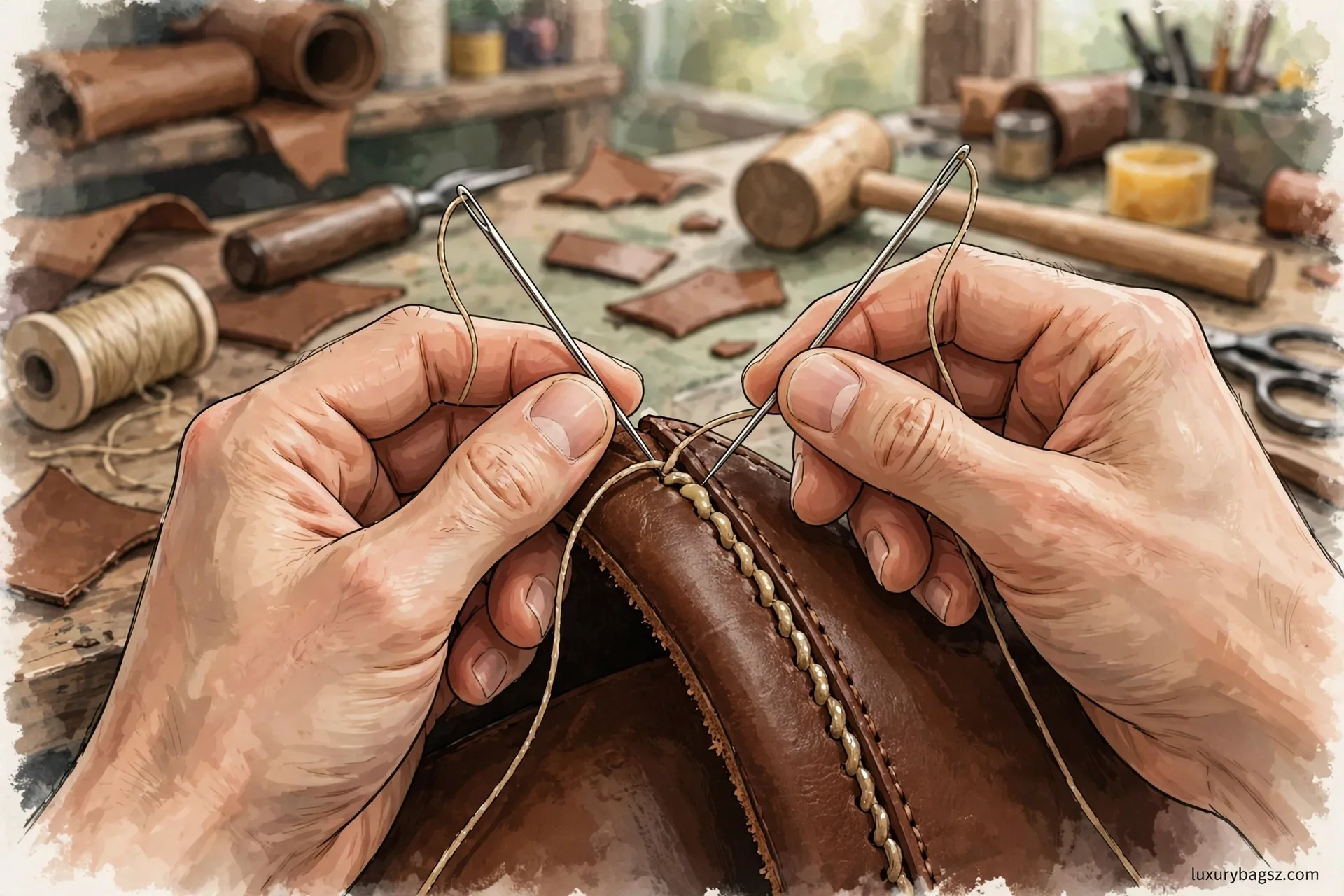
His harnesses embodied a particular philosophy: discreet finesse plus endurance in all conditions. Stitching had to be strong, leather had to be chosen carefully, and hardware had to work smoothly under stress. That philosophy, developed for horses, later transferred directly to handbags: a Birkin's saddle stitch, made with two needles and waxed linen thread, is the same technique used on a 19th-century harness, and it is famously hard to unravel even if one stitch breaks.
Thierry's work earned recognition at the 1867 Exposition Universelle, where he won a first-class medal, opening doors to clients including European nobility. He died in 1878, leaving the business to his son Charles-Émile. The workshop was small, but its reputation for uncompromising craft was already established, and that reputation would prove more durable than any single product.
The Move to Faubourg Saint-Honoré
In 1880, Charles-Émile Hermès moved the workshops to 24 Rue du Faubourg Saint-Honoré and opened a store there. That address remains Hermès's flagship today, a rare continuity in a luxury world where brands move constantly. The move also signalled ambition: Hermès was no longer a workshop tucked away in a side street, but a Paris house with a shopfront worthy of its clientele.
Under Charles-Émile, the house expanded its saddlery and began making a wider range of equestrian goods, including saddles and riding equipment for a growing international clientele. The business passed to the next generation at a moment of profound change: the horse was about to lose its place at the centre of transport, and a harness maker that could not adapt would fade with it. Hermès adapted by turning its leather skills towards the people who had once ridden horses — and towards the luggage they now carried in cars and on trains.
This period also established the house's visual identity. The horse-drawn carriage logo, based on a drawing by Alfred de Dreux, recalls the harness origins and remains in use today. It is a reminder, on every bag and box, that Hermès began by serving movement itself — first by horse, then by car, train, and aeroplane.
Émile-Maurice and the Pivot to Leather Goods
The decisive pivot came under Émile-Maurice Hermès, Thierry's grandson, who led the house in the early 20th century. Recognising that automobiles were replacing carriages, he expanded into leather goods, luggage, and accessories for motorists and travellers. In 1900 the house introduced the Haut à Courroies, a large bag designed to carry a saddle and riding boots, which is regarded as an ancestor of the modern Hermès handbag.
Émile-Maurice also travelled to America and Canada, where he observed new manufacturing methods and brought back ideas, including the zip fastener, which Hermès introduced to France and secured rights to use on leather goods. The first leather handbag proper followed in 1922, reportedly after his wife complained she could not find a bag she liked — a story that echoes Kate Spade's founding frustration decades later. Practical problems, solved elegantly, have always driven Hermès design.
The house diversified steadily through the 1920s: ready-to-wear began with a men's golf jacket in 1925, and new métiers followed over the decades. By the 1930s Hermès was no longer a saddler that also made bags, but a luxury house whose equestrian roots informed everything from its hardware to its colour palette. That transition, managed without abandoning craft, is the central achievement of Émile-Maurice's leadership.
The Kelly: From Sac à Dépêches to Princess
In 1935, under Émile-Maurice's son-in-law Robert Dumas, Hermès introduced the Sac à dépêches, a structured top-handle bag with a trapezoid shape, single handle, and lock closure. It was elegant, practical, and quietly luxurious — and it might have remained a connoisseur's bag had it not met Grace Kelly. In 1956, the actress-turned-Princess of Monaco was photographed using her Sac à dépêches to shield her pregnancy from paparazzi, and the bag became famous overnight.
Hermès renamed the bag the Kelly in 1977, formalising the association. The Kelly's design rewards patience: it is made by a single artisan, takes many hours to complete, and comes in sizes from the petite Mini Kelly to the larger 32 and 35, in leathers from Togo and Epsom to exotics. Its single-handle, structured silhouette suits formal occasions and careful carrying, and it remains one of the two great Hermès icons.
Our guide to what a Hermès Kelly bag is explains sizes, leathers, and prices in detail. If you are choosing between the two icons, remember the practical difference: the Kelly is more structured and formal, with a shoulder strap for occasional use, while the Birkin is a more open, everyday tote. Neither is objectively better; the right one is the one that fits your life.
Silk, Colour, and the Carré
Hermès's second great icon is not a bag at all. The first silk carré — a square scarf, typically 90 cm by 90 cm — appeared in 1937, printed with intricate, hand-drawn artwork. Each design begins as an artist's drawing, is engraved onto screens, and is printed by hand in dozens of colours, then hand-rolled and hemmed. A single carré can involve many screens and weeks of work, which explains both its price and its collectability.
The carré became a canvas for Hermès's imagination: equestrian scenes, natural history, travel, mythology, and abstract patterns, all rendered in the house's vivid colour sense. Under Robert Dumas, colour itself became a house signature, including the famous Hermès orange used on boxes and packaging. Where other houses treated scarves as accessories, Hermès treated them as art objects — and collectors followed, trading rare colourways and retired designs at strong prices.
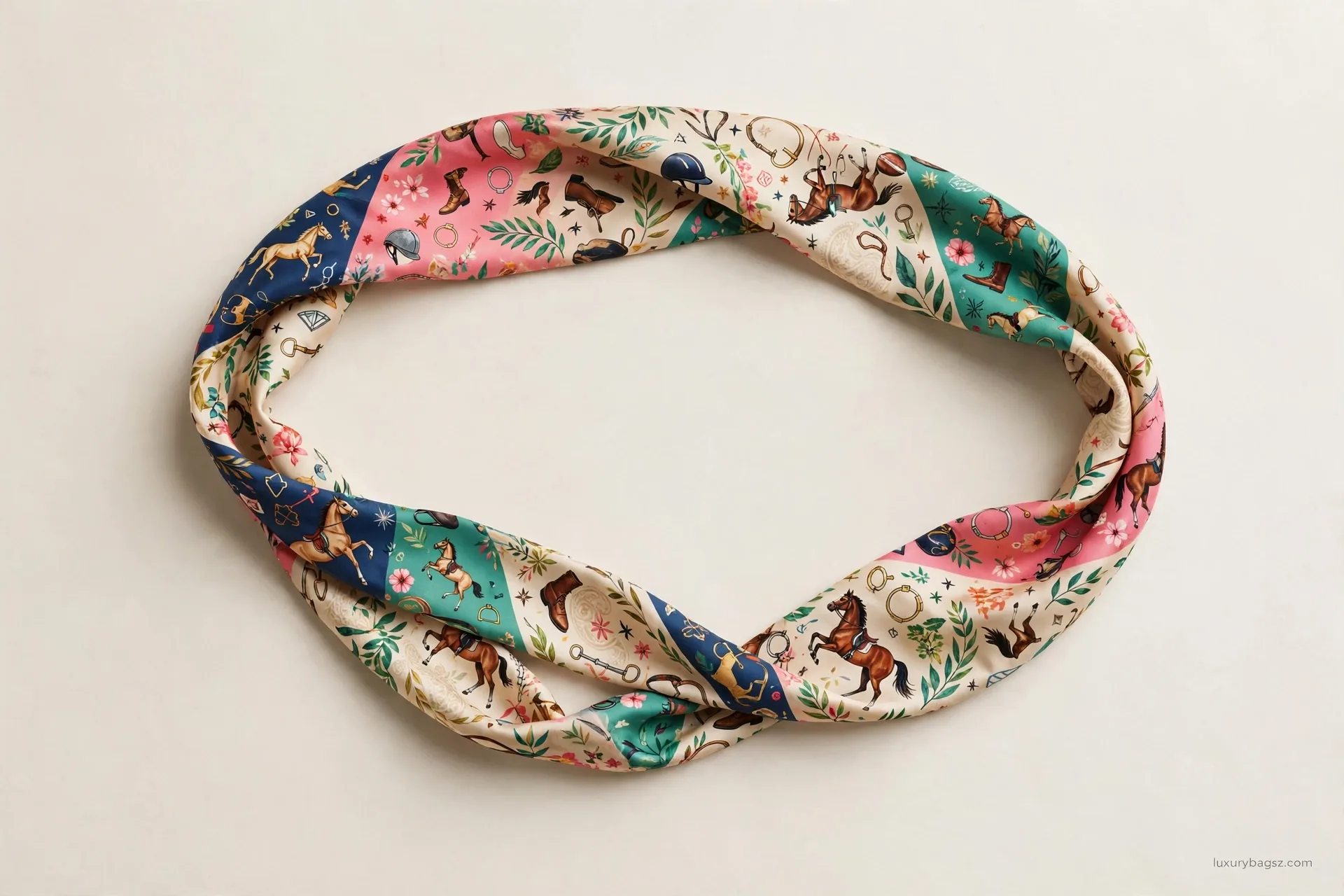
The silk story also shows Hermès's approach to craft at scale. The house now produces carrés in large numbers, yet each still passes through hand finishing. That combination — industrial organisation with artisanal finishing — is how Hermès manages to be both exclusive and global. It is also why a genuine Hermès scarf feels different in the hand: the silk is heavy, the print is crisp on both sides, and the hand-rolled hem is slightly uneven in the way only handwork is.

The Birkin and the Modern Empire
The Birkin's origin story is now legend. In 1984, Jean-Louis Dumas, the fifth-generation chief executive who had taken over in 1978, sat next to actress and singer Jane Birkin on a flight from Paris to London. Her belongings kept falling from her straw basket, and Dumas offered to design a bag that would hold everything. The result was a structured, spacious tote with a lock, flap, and two handles, made to be carried by hand or on the forearm.
The Birkin became the ultimate status bag, not only because of its design but because of its scarcity. Hermès limits production, distributes bags through its boutiques rather than wholesale, and does not sell its most coveted models online. Would-be buyers typically need a purchase history and a relationship with a sales associate, a system that frustrates newcomers but sustains the bag's aura. Our guide to how to get a Hermès bag appointment explains how the boutique process actually works.
Under Jean-Louis Dumas and his successor Axel Dumas, Hermès expanded worldwide, opening hundreds of stores while keeping production largely in France. The house went public in 1993, with the family retaining control, and in 2010–2011 it faced the LVMH stake-building episode, when Bernard Arnault's group quietly accumulated nearly a quarter of the company through equity swaps. The family responded by locking 50.2 per cent of shares into the H51 holding company, preserving independence.
That independence shapes the shopping experience in a way newcomers often underestimate. Hermès does not chase quarterly fashion cycles with heavy discounting or mass distribution, and it does not flood the market with its most wanted bags to meet demand. Instead it grows production slowly, trains new artisans over years, and accepts waiting lists as the price of keeping craft central. For a buyer, this means patience is part of the purchase: a relationship with a boutique, built over ordinary purchases, is often the route to a Birkin or Kelly, while the pre-owned market serves those who want a specific bag now and are willing to pay a premium for immediacy.
If you are weighing the two icons, our Kelly vs Birkin comparison and Birkin sizes guide will help you compare them side by side.
Buying Pre-Owned Hermès Safely
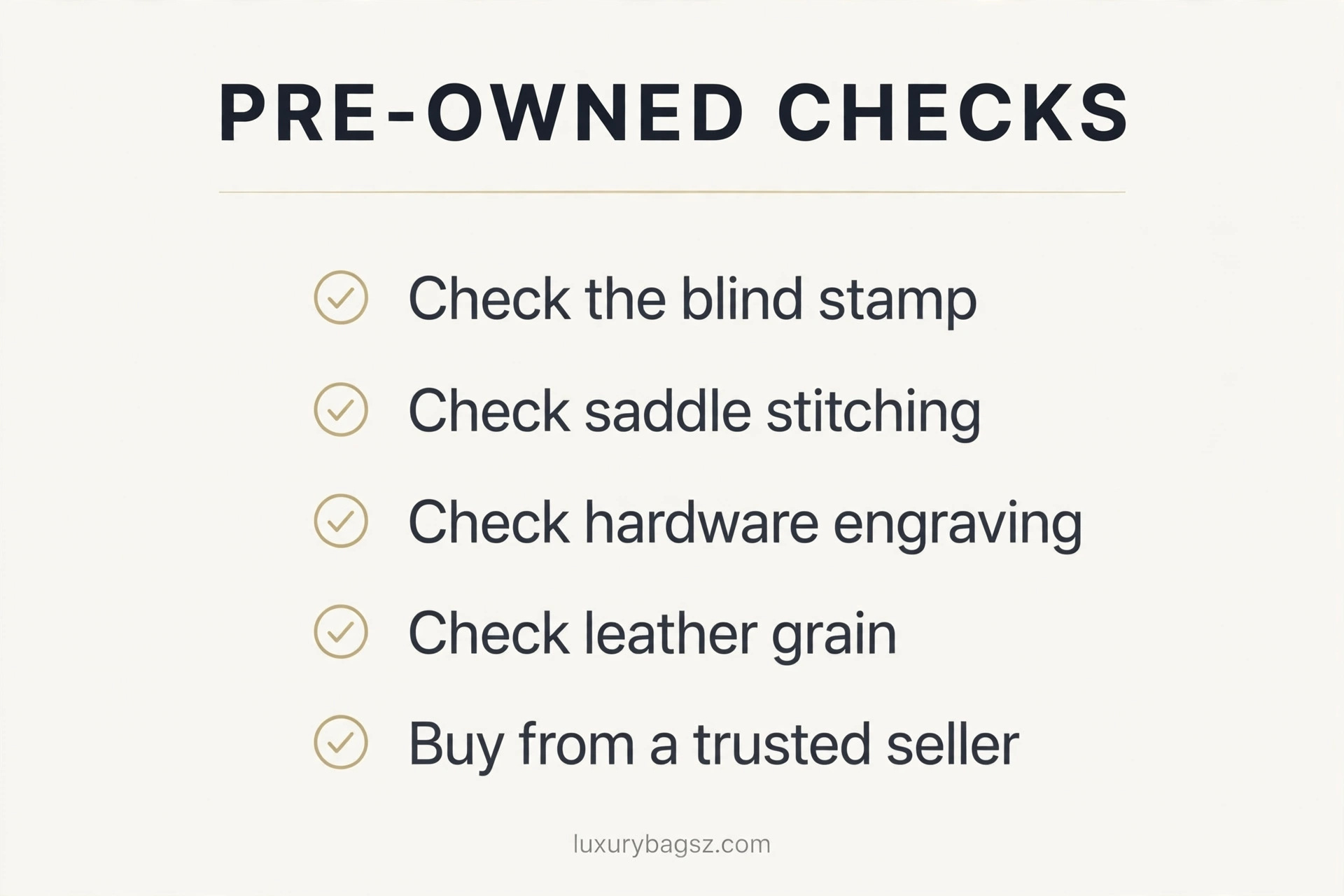
Most buyers meet Hermès through the pre-owned market, where Birkins and Kellys trade at prices that often exceed boutique prices for popular sizes and colours. That premium makes authentication essential. Start with the blind stamp: genuine Hermès bags carry a small, discreet stamp indicating the year and artisan, placed in a consistent location for the era. Fakes often stamp too deeply, unevenly, or in the wrong place, and a stamp that looks freshly pressed on a supposedly vintage bag deserves scepticism.
Next, examine stitching, hardware, and leather. Genuine Hermès stitching is slightly slanted, even, and done with waxed linen thread; the saddle stitch means each stitch is locked by two threads, so a single broken stitch does not unravel a seam. Hardware should feel weighty and be engraved crisply, with no flaking or rough edges. Leather should smell of leather, not chemicals, and the grain should be consistent with the stated type — Togo is pebbled, Epsom is pressed and structured, Clemence is soft and slouchy.
Papers, receipts, and boxes help, but they are frequently faked or mismatched, so never treat them as proof alone. Buy from a dealer with a clear authentication process and a returns policy, and consider an independent authentication service for high-value pieces. Our fake Hermès Birkin checks cover twelve tests in detail. Price is also a signal: a Birkin far below market price is either misdescribed, damaged, or fake, and a seller who cannot explain the price should not get your money.
Caring for Hermès and Living With It
Owning Hermès is a long-term commitment, and care routines repay the effort. Store bags stuffed, upright, and in their dust bags, away from direct sunlight and humidity, and never hang a Birkin or Kelly by its handles for long periods, which strains the stitching. Keep leather away from water, perfume, and hand cream, and wipe gently with a soft, dry cloth after use. For suede or exotic leathers, professional care is safer than home experiments.
Silk carrés need gentler handling still: fold rather than hang, avoid perfume sprayed directly onto silk, and have stains treated by a specialist cleaner experienced with hand-rolled hems. With sensible care, both bags and scarves last for decades — which is precisely the point of Hermès craft. A well-kept Birkin can be carried daily for years and still look superb, while a neglected one loses value quickly, however rare its colour.
The broader lesson of Hermès's history is that slowness can be a strategy. In an industry built on speed, Hermès still trains artisans for years, still makes bags one at a time, and still refuses to discount or mass-produce its icons. That discipline frustrates shoppers in a hurry, but it is why a 1984 design still feels modern. If you own a Birkin, our guide to cleaning a Hermès Birkin bag gives leather-by-leather advice. Buy slowly, care carefully, and choose the piece you will love in ten years, not just this season.
New buyers often ask whether the boutique system is worth the effort, or whether pre-owned is simply the smarter route. The honest answer depends on what you value most. A boutique purchase brings the full experience — the orange box, the relationship with a sales associate, and the certainty of provenance — but it demands patience and prior spending. A pre-owned purchase brings immediacy and choice of colour and size, at a premium for the most wanted combinations, and it demands careful authentication. Neither route is wrong; the mistake is rushing either one. Decide which experience you want, set a budget that includes care and insurance, and let the bag's history — harness workshop to handbag icon — remind you that the best Hermès purchases are measured in decades, not seasons.
Frequently Asked Questions
When was Hermès founded?
Hermès was founded in Paris in 1837 by harness maker Thierry Hermès, who opened a workshop making bridles, saddles, and harnesses for carriages.
Who founded Hermès?
Thierry Hermès (1801–1878) founded the house. Six generations of his family have run it since, including his son Charles-Émile and grandson Émile-Maurice.
What was the first Hermès product?
Harnesses, bridles, and saddles for horse-drawn carriages. The house later moved into luggage, leather goods, silk scarves, and ready-to-wear as transport changed.
When was the Kelly bag created?
The Sac à dépêches was introduced in 1935 and renamed the Kelly in 1977, after Grace Kelly famously carried it in 1956.
When was the Birkin bag created?
The Birkin was created in 1984, after Jean-Louis Dumas met Jane Birkin on a flight and offered to design a spacious, practical tote for her.
When was the first Hermès silk scarf made?
The first silk carré appeared in 1937. It is typically a 90 cm square, printed by hand from the artist's original drawing and finished with a hand-rolled hem.
Is Hermès still family owned?
Hermès went public in 1993, but the family retains control, including through the H51 holding company created after LVMH built a large stake around 2010.
Why are Birkin bags so hard to buy?
Hermès limits production, sells coveted bags through its own boutiques, and typically requires a purchase history and a relationship with a sales associate.
How can I tell if a Hermès bag is real?
Check the blind stamp, saddle stitching, hardware engraving, leather grain, and overall finishing against verified examples, and buy from a reputable dealer.
How should I store a Hermès bag?
Store it stuffed, upright, and in its dust bag, away from sunlight and humidity, and do not hang it by its handles for long periods.
Summary: Craft, Patience, and a Carriage Logo
Hermès began with harnesses and became a byword for luxury by refusing to hurry: one artisan, one bag, one saddle stitch at a time. The Kelly, the Birkin, and the silk carré all grew from practical needs — a bag for a princess, a tote for a singer, a scarf as a canvas — and all endure because the craft behind them is genuine. That is the history worth remembering when you buy: choose well, check carefully, and care for what you own, and a Hermès piece will repay you for decades.






