How to Spot a Fake Hermes Birkin Bag
Real Birkin or Fake: The Short Answer
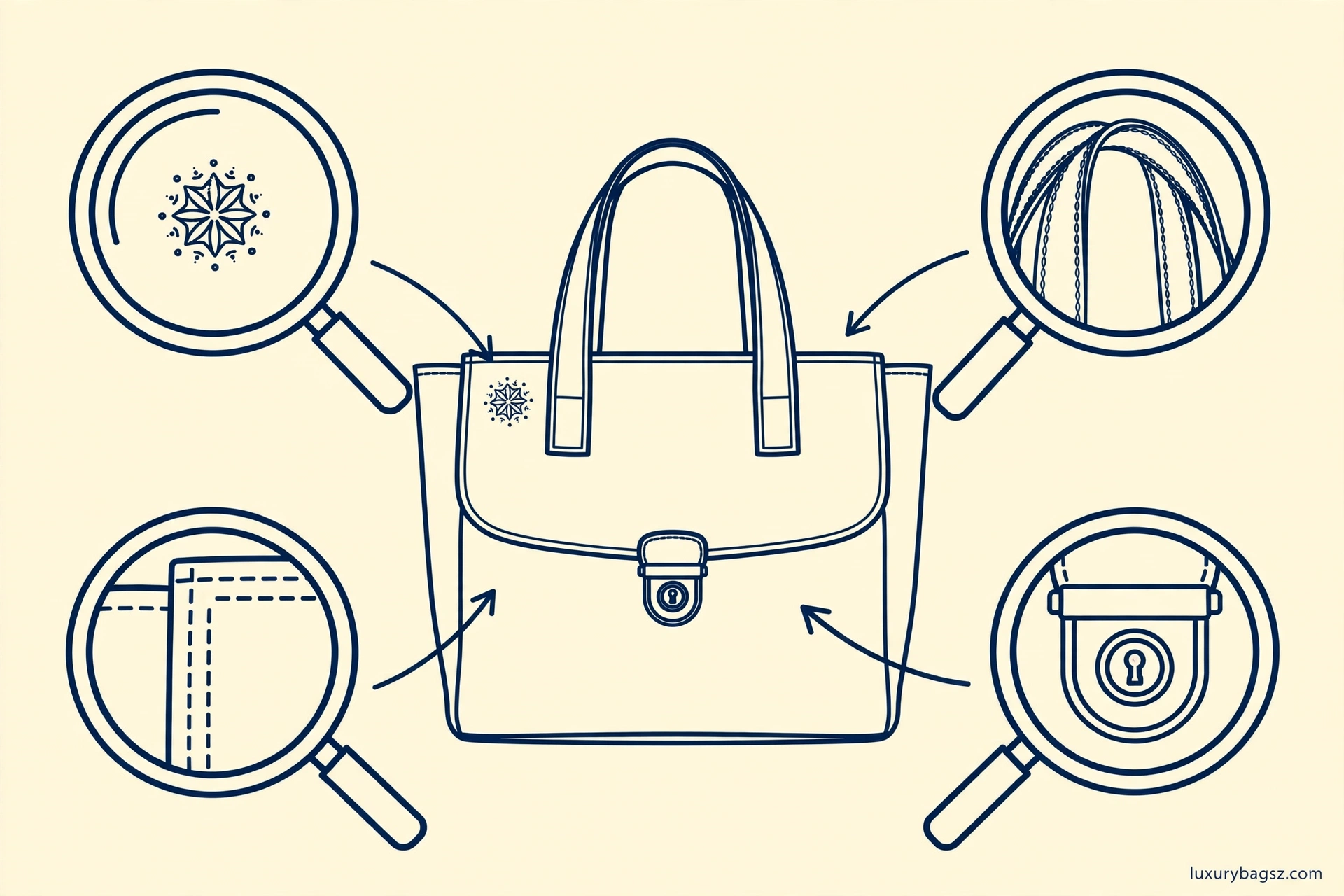
Watch what the seller offers as proof. A card, a receipt or one flattering photograph of the heat stamp is how fake Birkins are sold, because a genuine Birkin needs none of them: it passes shape, leather, stitching, stamps, hardware, lock and keys, interior and packaging together, while a fake typically gets several of those right and quietly fails the rest.
Hermès issues no authenticity card, so a card in the box is a red flag rather than reassurance. The stamps deserve their own checks below for the same reason — they are the detail counterfeiters copy most carefully and buyers trust most quickly, and in over 500 bags examined by hand they are where borrowed confidence usually starts.
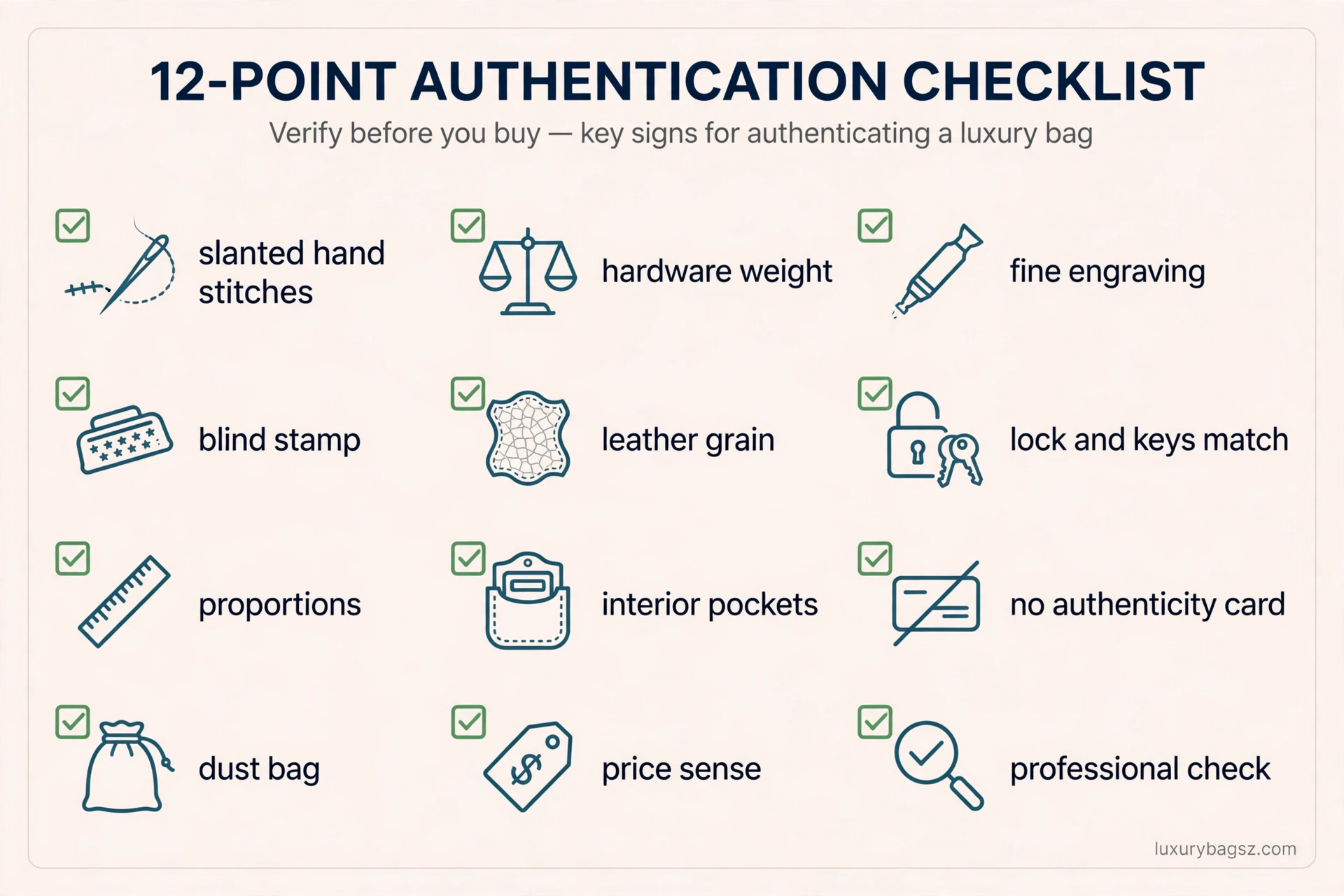
Work through the 12 checks in order, in good light, with clear photos if you are buying online. If anything fails, or the price and the story do not add up, pause and get a professional authentication before you pay.
When a Birkin comes to me, I start with the stitching before I look at anything else. Hermès saddle stitch is sewn by hand with two needles and one thread, and after examining more than 500 bags I can feel the slight irregularity that handwork leaves and that machine copies smooth away. I then turn to the blind stamp under the front strap, because its format tells me the year before I check a single other detail. Only once those two agree do I open the Entrupy app and work through the hardware, engravings and leather in order.
Start With the Whole Bag, Not One Detail
Good copies exist now. Some copy leather grain, hardware weight and even stamp fonts closely enough to fool a quick look. That is why authenticators judge the whole bag rather than one close-up.
Begin by asking whether the bag looks coherent. Do the leather, stitching, hardware colour and proportions all belong to the same bag, from the same era? A bag that mixes a crisp new stamp with tired, mismatched hardware deserves a closer look.
Photos matter as much as the bag itself. Ask for clear shots of the front stamp, the blind stamp, both strap plaques, the padlock base, the keys, the handle stitching and the interior pockets. A seller who refuses, or who sends only soft, distant photos, has already told you something.
Shape and Proportions
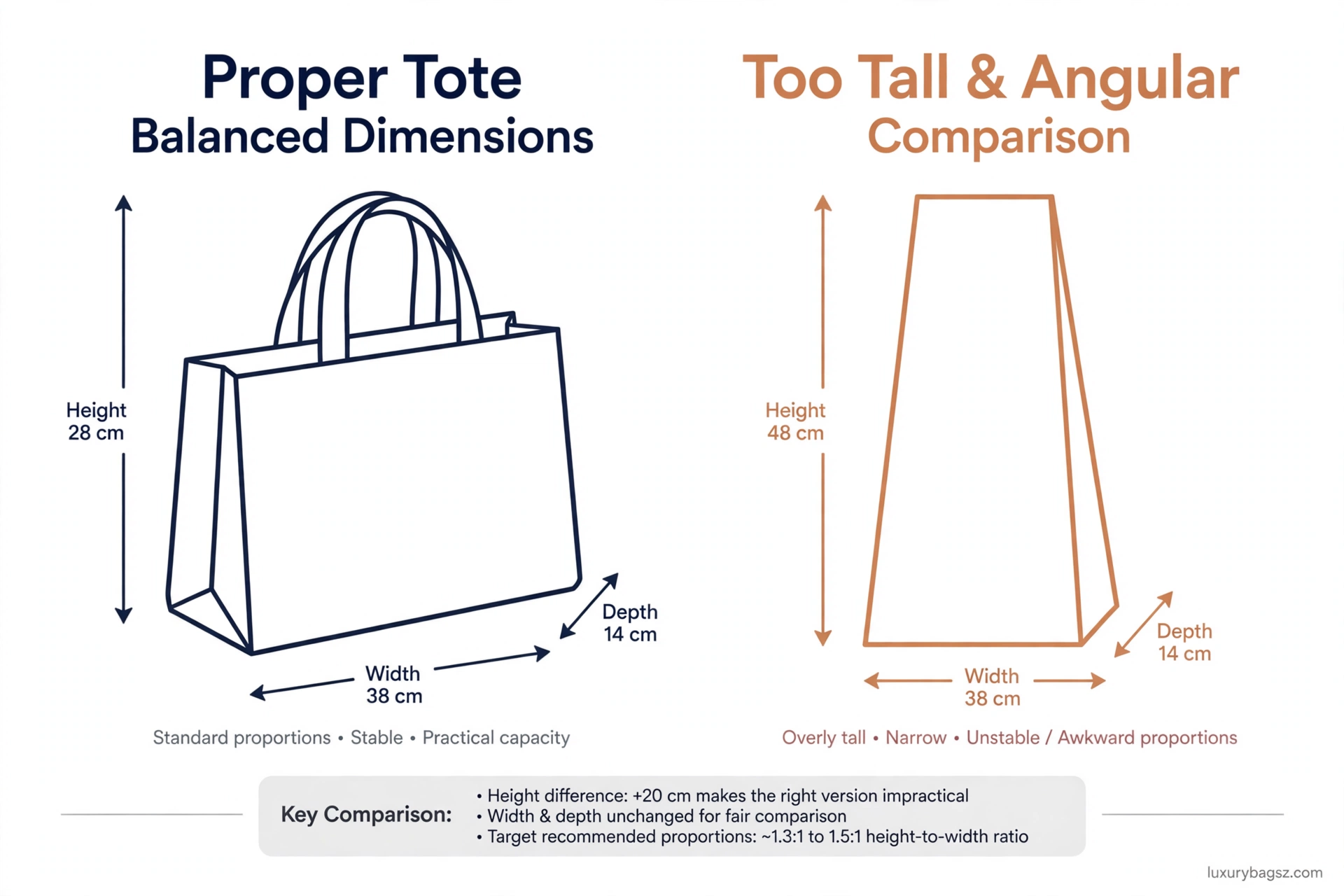
A genuine Birkin has a balanced, slightly soft shape. In comparisons, the real bag looks more delicate and curved, while the counterfeit often looks larger and more angular. A bag that looks stretched, boxy or lopsided is worth measuring.
Measure the bag and compare it with the size it claims to be. A Birkin 30 should measure about 30 cm wide, 22 cm tall and 16 cm deep. Fakes often come out too shallow, too tall or uneven from one side to the other.
Check the flap too. On a genuine bag the flap sits neatly and matches the body. In comparisons, fake flaps have run larger, with looser stitching along the edge.

Leather and Grain
Leather is the first thing your hands should question. Genuine Hermes leather feels rich and natural, with a grain that suits the leather type. Togo, a grained calfskin, varies naturally from bag to bag, so a Togo surface that looks perfectly regular all over is a warning sign.
Epsom breaks that rule. Epsom is embossed, so a genuine Epsom bag does have a uniform grain. Judging every leather by the Togo rule would wrongly condemn a real Epsom bag.
Smell helps, but only weakly. Real leather smells earthy, while plastic, rubber or heavy glue smells point to a fake. Smell is easy to fake with conditioners, so use it as a hint, never as a verdict.
Stitching: The Saddle Stitch Tell
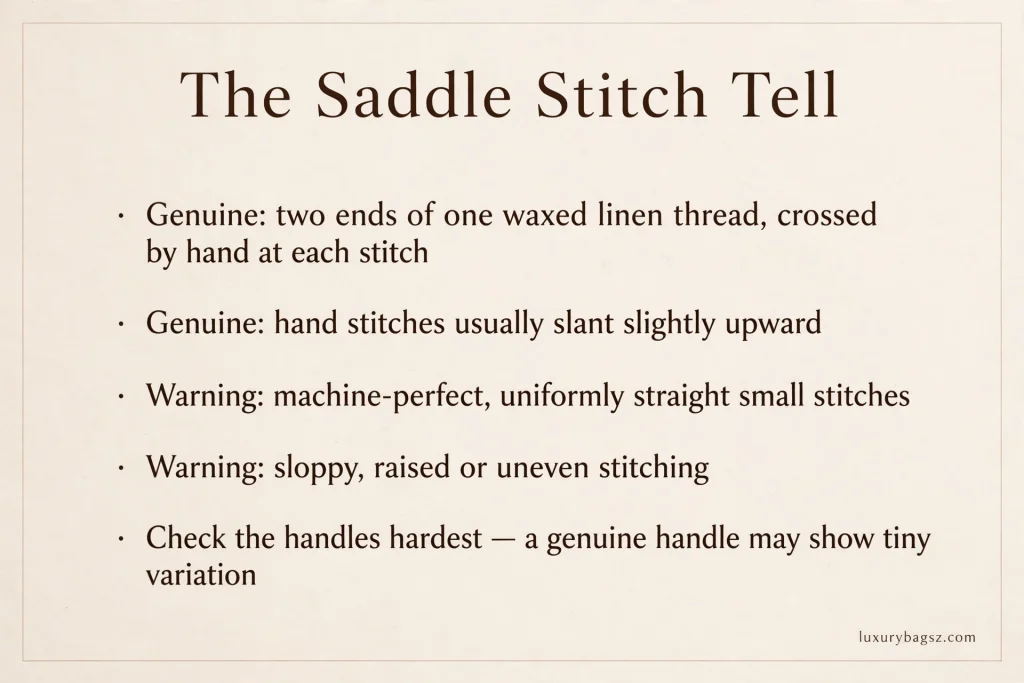
Hermes joins its leather with the saddle stitch. Two ends of one beeswax-coated linen thread cross at each stitch, worked by hand. On a Birkin, those hand stitches usually have a slight upward slant.
That slant is the tell. Stitching that looks machine perfect, with small stitches that are uniformly straight, is a common sign of a fake. At the other extreme, stitching that is sloppy, raised or uneven also points away from a genuine bag.
Look hardest at the handles and side tabs. Handle stitching is difficult, so a genuine bag may show tiny variation there, including a doubled stitch. A handle that looks impossibly perfect is more suspicious than one with a small, honest irregularity.
The Front Stamp: Hermes Paris Made in France
Under the flap, on the front of the bag, a Birkin carries the stamp HERMES, PARIS, MADE IN FRANCE on three lines. The lines step down in size from top to bottom, the letters are evenly spaced, and the line spacing is regular. It is heat-stamped, never screen printed.
Sources disagree about how perfect this stamp should look, and the disagreement matters. One guide describes the genuine stamp as crisp and even, while another stresses that hand stamping leaves depth and small variation. This guide sides with the second view.
A heat-stamped foil version may show a slight bleed at the edges of the letters, and that is normal. What should worry you is a stamp with the wrong font, visibly slanted words, missing accents on the E in HERMES, or letters that are much smaller than they should be.
The Blind Stamp and Year Letter
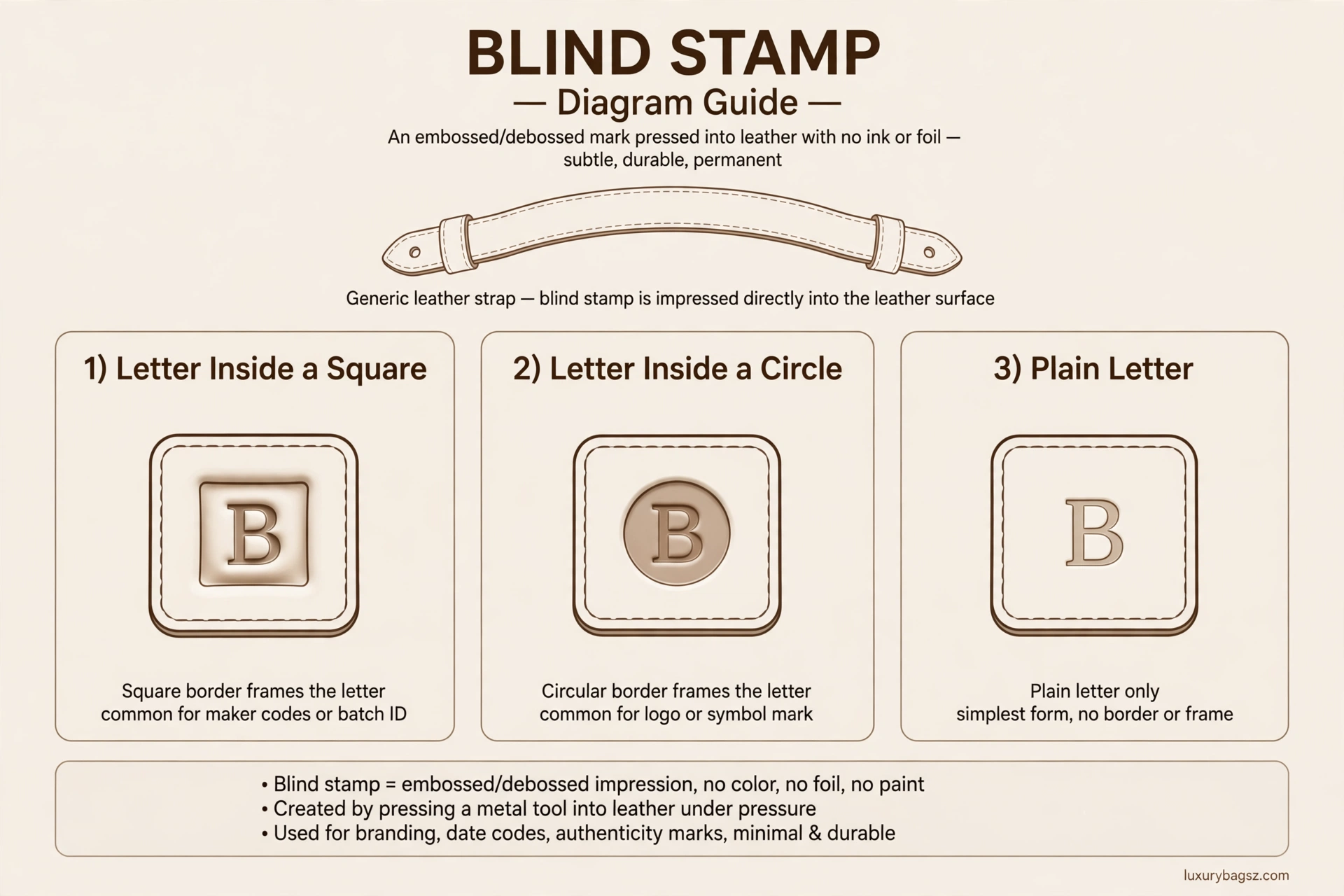
The blind stamp, also called the date stamp, is pressed into the leather without ink. It holds a year letter, and the shape around that letter tells you which run of the alphabet it belongs to. This is the detail most buyers over-trust.
The broad pattern, as reported by authentication guides, runs like this. A plain letter with no frame covers 1945 to 1970. A letter in a circle covers 1971 to 1996. A letter in a square covers 1997 to 2014. From around 2015 the plain letter returns, but the letters no longer run in alphabetical order.
Reported letters for recent years include T for 2015, X for 2016, A for 2017, C for 2018 and D for 2019, with U reported for 2022. Letters reported for 2023 onward, B, W, K and G, are flagged here as unverified reports, not confirmed facts. Hermes publishes no public register, so do not treat any online year chart as official.
Where the stamp sits also depends on age. On a Birkin made before about 2015, it sits on the underside of the strap that carries the lock. After that it moved inside the bag, to the top edge of the interior side wall, usually on the left near the back flap. The move came in gradually, so a 2015 or 2016 bag can carry it in either place.
Beside the year letter you will see other letters and numbers. They are a craftsman or workshop reference, and no public key exists for them, so they cannot be decoded. Anyone who claims to decode them is guessing. A correct year letter only tells you the marking fits a period.
Hardware Engraving and Finish
Birkin hardware is plated or finished in a precious metal, usually gold or palladium, and it should feel weighty and solid. The plaques on the straps are engraved HERMES-PARIS. On gold-plated hardware, a small box follows the word PARIS, with writing inside it too small to read without a loupe. That box is not present on palladium hardware.
On recent bags the engraving is a fine, slightly irregular line that looks worked by hand. Counterfeits often use laser engraving, leaving smooth strokes and a pale groove. A plaque with no engraving at all is a strong warning sign.
Finish alone will mislead you, because guides disagree here too. One guide calls for a clean matte zipper finish, while others describe palladium as shiny. Finish varies by hardware type, so judge the engraving quality, the weight and the consistency of finish across the bag, not shine alone.
Rivets deserve a look too. Genuine rivets are hammered by hand, so their heads often show small hammer marks and may darken, even on a new bag. Many fakes use two-part rivets with no hammer marks, in bright, lightweight metal.
The Lock, Keys and Clochette
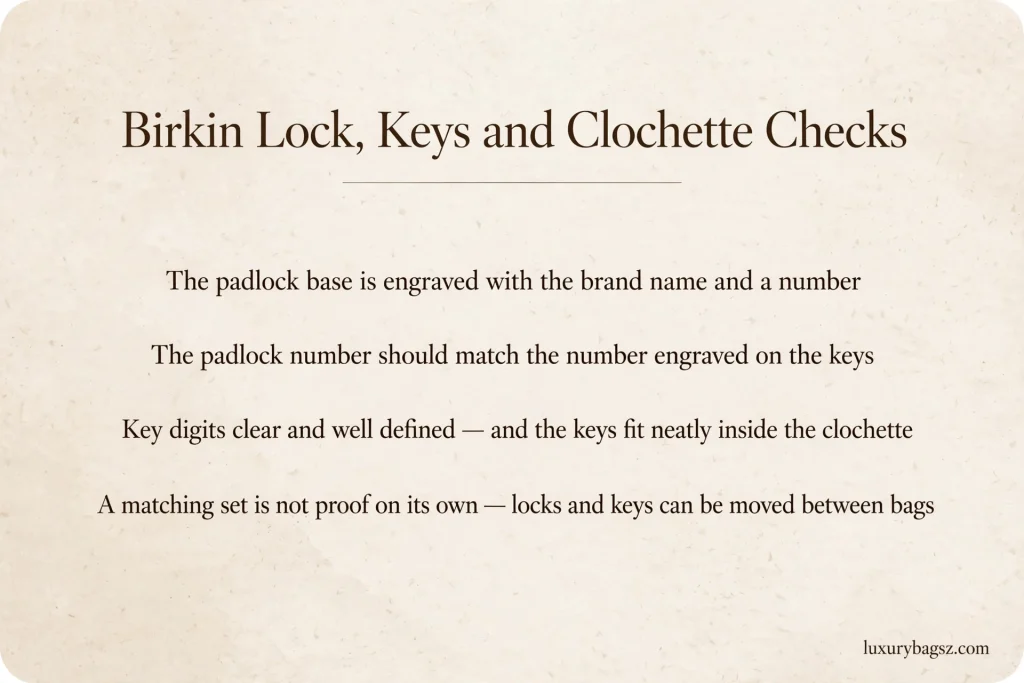
A Birkin comes with a padlock and a set of keys, kept in the clochette, the small leather key case. The padlock is engraved HERMES on its base, together with a number. Turn it over and compare the engraving, which should be neat and even on a genuine lock, with clean, finished edges around the keyhole.
The number on the padlock should match the number engraved on the keys. On a genuine set the key digits are clear and well defined, and the keys should fit neatly inside the clochette. On many fakes they do not fit entirely.
Two cautions belong here. A matching pair is not proof on its own, because a genuine lock and keys can be moved to another bag. Older guides also warn that fakes often carry craftsman stamp 28S or lock set 121, although 121 was used as an authentic lock set long ago. Treat those numbers as a reason to look closer, not as an automatic verdict. For the method behind the checks, see how we check bags.
Interior and Pockets
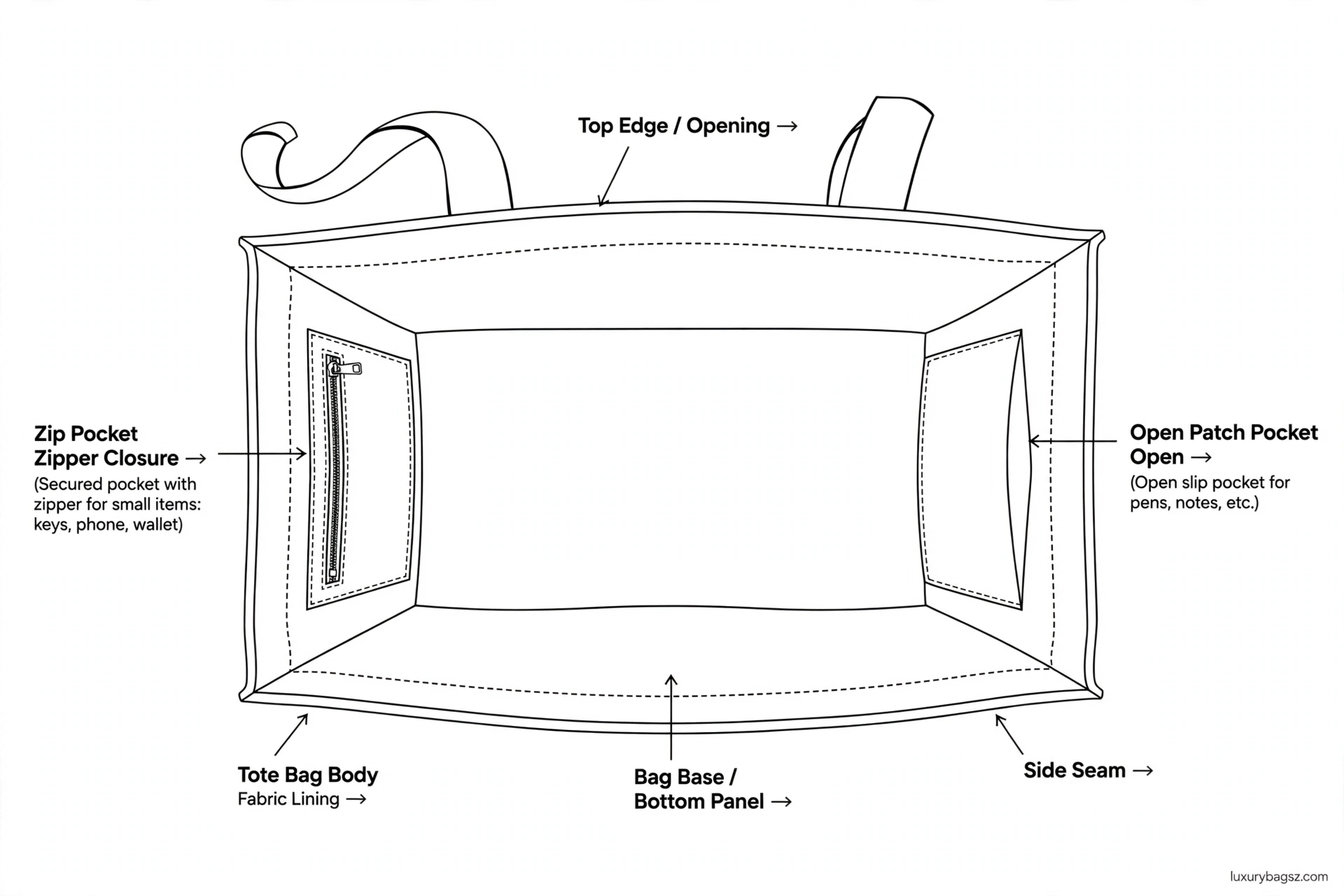
Open the bag and count the pockets. A genuine Birkin has two: one open patch pocket at the front and one zip pocket at the back. Many fakes get this wrong, leaving a pocket out or putting the zipper in the wrong place.
Check the zipper itself. On a genuine bag the interior zipper is engraved with Hermes, not with another maker's name such as YKK, and it should run horizontally along the closure rather than hanging down vertically. Panel alignment should stay symmetrical, with matching grain flow across the front and back.
The lining should match the bag's claimed leather and era, and the interior stamp should be heat-debossed rather than printed. Watch for ink marks, staining and transferred dye, and ask whether the bag has had spa work, edge repainting or reshaping.
Handles, Feet and Piping
A genuine Birkin has two structured, rolled leather handles that stand upright on top of the bag. They are made from the same leather as the body, rolled to give a smooth finish. Handles that look mismatched, roughly made or in a different colour from the body are a warning sign.
Underneath, the bag stands on four feet, called clou, which match the hardware of the rest of the bag. Genuine feet taper slightly, with the ends narrower than the top. Fake feet are often the same width all the way around and may not match the other hardware.
Piping, the leather trim along the base edges, should be finished precisely and follow the edge evenly. Rough edges, visible glue or frays anywhere point away from Hermes handwork.
Dust Bag, Box and Packaging Traps
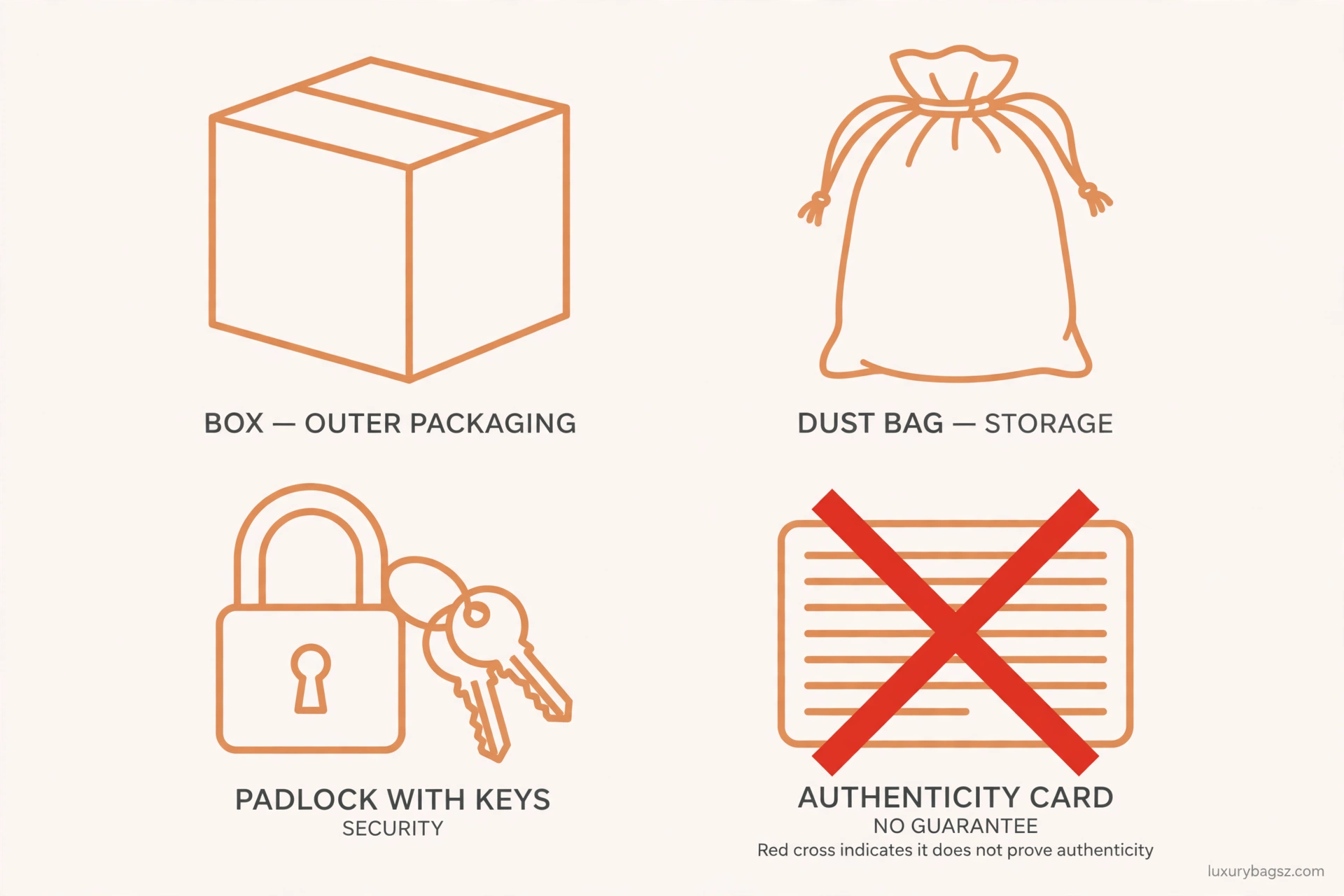
Hermes packaging proves far less than sellers claim. A genuine dust bag is high-quality cotton flannel, with the brand name in a subtle brown colour. A thin, shiny or badly stitched dust bag warns you, but a good dust bag alone proves nothing, because dust bags are easy to copy.
The biggest packaging trap is the authenticity card. Hermes bags do not come with authenticity cards. This is confirmed across authentication guides, and it is the single most useful packaging rule in this guide. If a listing waves a card, a certificate or a hang tag as proof, that proof is itself evidence against the bag.
Receipts and boxes are weaker still. A receipt can belong to another bag, a box can be bought on its own, and a full set can be assembled around a fake. Judge the bag first. Treat a complete set as a small bonus, never as the reason you believe the bag.
Price, Seller and the Professional Check
Price is a useful sense check, but a trap if used alone. PurseBlog's long-standing advice is that no one gives away a bag that can be resold for $12,000 for a lot less just because they claim it was a gift. In 2026 price trackers, a standard leather Birkin 25 sits near $13,500, a Birkin 30 near $14,900 and a Birkin 35 near $16,300 at US retail, so a clean bag offered far below those levels needs a very good explanation.
The trap runs the other way too. Seasoned sellers of fakes often price a bag in the right range, because a believable price helps sell the illusion. A fair price never authenticates a bag. It only removes one reason for suspicion.
Know your seller before you pay. Ask for the full set of photos, ask about returns, and read the seller's written policy on what happens if a bag is judged fake. Pay by a method that gives you protection. A wire transfer is advantageous to the seller and leaves the buyer with no protection at all if something goes wrong.
Do not believe a seller who insists a boutique will authenticate the bag. Hermes boutiques generally will not authenticate bags for buyers, and a meeting at a store proves nothing about the bag in your hands.
The same caution applies across models. The checks in our fake Kelly guide follow the same order, and our fake Lindy checks use the same habit of judging the whole bag.
If you are paying Birkin prices, a professional authentication is the safer step. One resale guide reports typical fees between $25 and $150 for a photo-based review, though that range is reported, not verified here. Send clear photos of the stamps, hardware, padlock, keys and stitching.
Frequently Asked Questions
Does Hermes issue an authenticity card with a Birkin?
No. Hermes issues no authenticity card. A card, certificate or hang tag presented as proof is a red flag, and a common fake's prop.
Does a correct blind stamp prove a Birkin is real?
No. A correct letter only shows the marking fits a period. Counterfeiters copy stamps, so the stamp must also agree with the leather, stitching, hardware and proportions.
Where is the blind stamp on a Birkin?
On a Birkin made before about 2015, it is on the underside of the strap that carries the lock. On newer bags it is inside, on the top edge of the interior side wall, usually on the left near the back flap. A 2015 or 2016 bag can carry it in either place.
Do the lock and key numbers on a Birkin match?
Yes, the padlock number should match its keys. A matching pair is still not proof alone, because a genuine lock and keys can be moved to another bag.
Is a Birkin stitched by hand?
Yes. Hermes uses the saddle stitch, crossing two ends of one beeswax-coated linen thread at each stitch. Hand stitches usually slant slightly, while machine-perfect straight stitching is a common fake sign.
Can a Hermes boutique authenticate my Birkin?
Generally no. Hermes boutiques do not offer an authentication service for buyers, so a seller who promises a boutique check should not be believed.
What if a Birkin smells like chemicals or plastic?
That points to a fake, but only as a hint. Real leather smells earthy, while plastic or heavy glue smells suggest imitation. Smell can be masked, so never let it decide alone.
Can a fake Birkin pass some of these checks?
Yes, and the best copies pass several. That is why all 12 checks matter together. A bag that passes the stamp but fails stitching, hardware or proportions is still suspect.
What should I do if I already bought a bag I now doubt?
Gather your photos, receipt and seller messages, and get an independent professional authentication in writing. Then follow the seller's return policy, or your payment provider's dispute route, with that verdict.
Are super fakes impossible to spot without help?
For most buyers, yes. When a copy gets leather, stamps and hardware close, only detailed comparison and experience separate it from the real thing. That is the honest limit of any home guide.
Summary
A fake Birkin is rarely caught by one dramatic flaw. It is caught by the accumulation of small ones: stitching that is too perfect, a stamp that is too even, hardware that is too light, a lock that does not match its keys, or a card that Hermes never issued.
Use the 12 checks in order, judge the whole bag, and distrust any single proof. Check the price against 2026 retail levels, the seller's photos and return policy, and pay by a protected method. When doubt remains, get a professional check first.
That caution protects both your money and the pleasure of owning a real Birkin.