

Etro Brand Guide: Paisley, Milanese Craft and Bohemian Luxury Since 1968
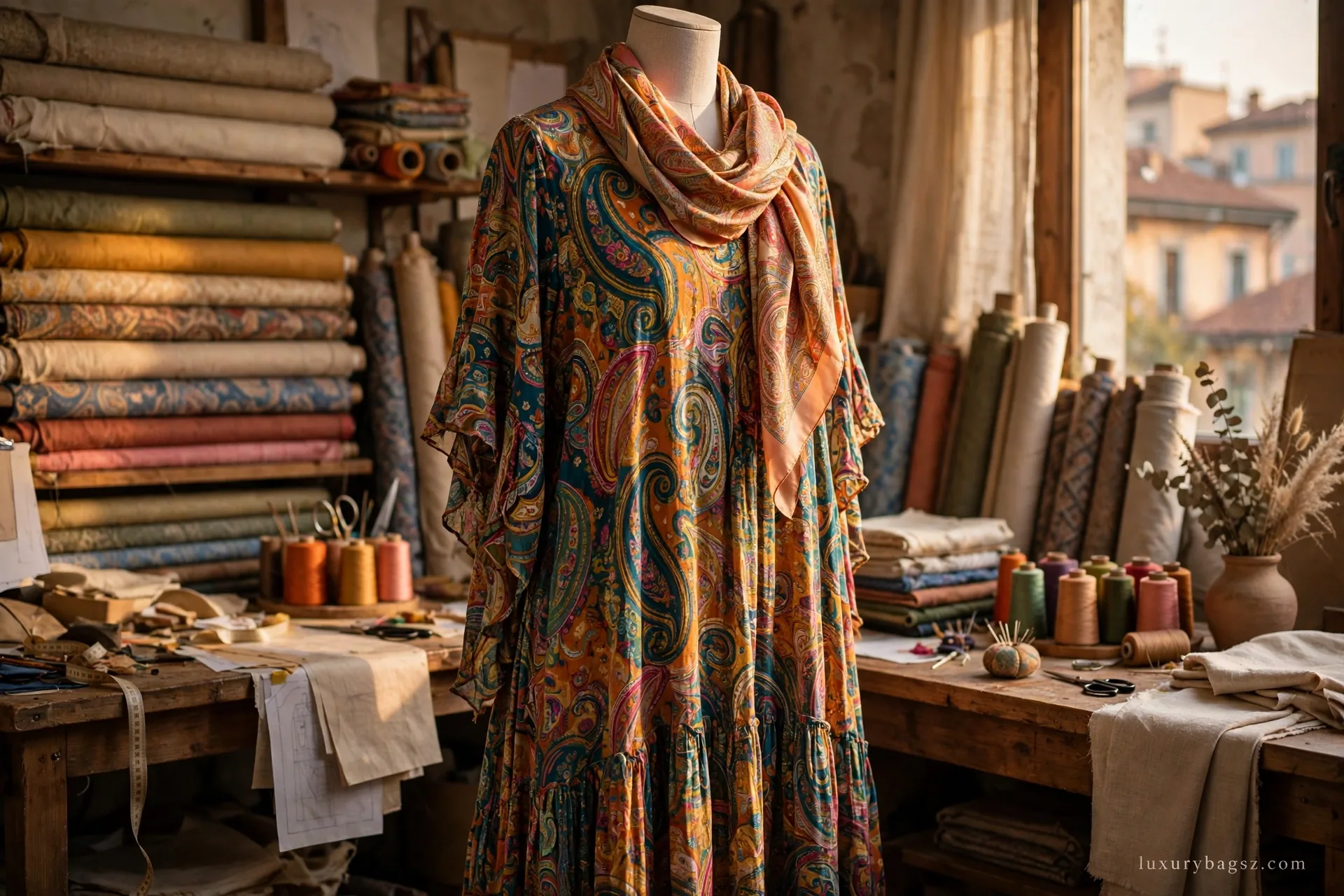
Etro in Brief: The House That Turned Paisley Into a Philosophy
Etro is Italy's great bohemian luxury house. Founded in Milan in 1968 by Gerolamo "Gimmo" Etro as a textile company, it built its name on fabrics before it ever sold a dress, and its signature paisley print became one of fashion's most recognisable motifs. Gimmo once said paisley was not just a pattern but a philosophy, a way of life, and the house has lived by that idea for more than fifty years.
Etro's world is colour, travel and craft: jacquard weaves, silk scarves, paisley coats and a Milanese atelier that still treats fabric as the starting point of design. If you remember one thing, remember this: at Etro, the print comes first, the garment second, and the result is luxury that feels cultured rather than corporate.
Key Takeaways
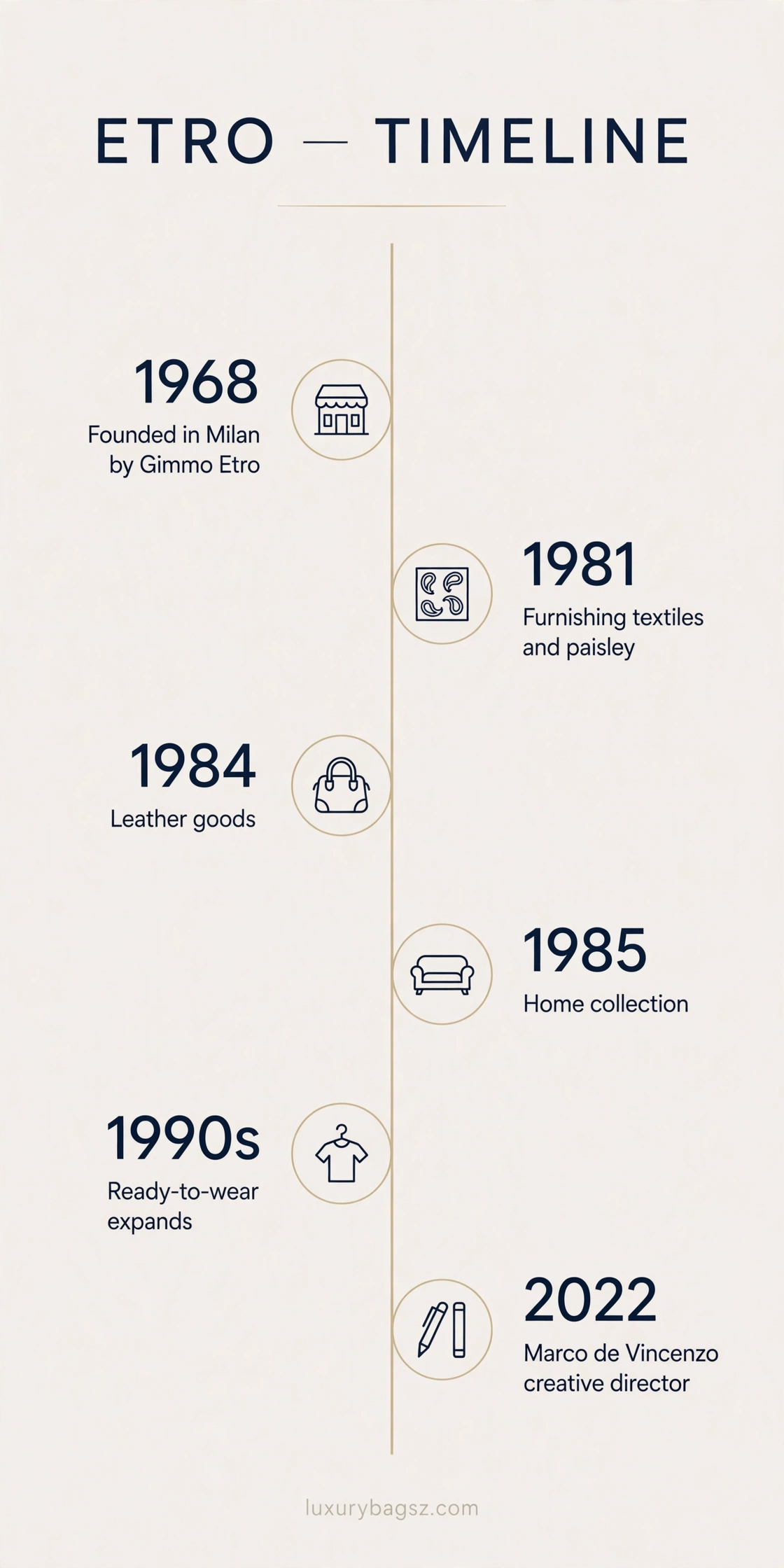
- Founded in Milan in 1968 by Gimmo Etro as a luxury textile company.
- Gimmo and his wife Roberta collected around 300 antique shawls, forming a famous archive.
- The paisley motif became Etro's signature after the furnishing textiles launch of 1981.
- Leather goods followed in 1984, the home collection in 1985, ready-to-wear in the 1990s.
- Gimmo's four children each ran a division: womenswear, menswear, textiles and the business.
- Marco de Vincenzo became creative director in 2022, modernising the house.
- Buyers should check print alignment, jacquard weave quality and fabric care labels.
A Textile House in Milan: 1968
Etro began not with a fashion show but with a loom. In 1968, Gimmo Etro founded a textile design company in Milan, supplying fine fabrics to the growing Italian ready-to-wear industry. The city was the right place: Milan's mills, workshops and fashion houses formed an ecosystem where a brilliant fabric could find a garment within weeks.
The timing mattered too. 1968 was a year of cultural revolution, and Etro's bohemian spirit, curiosity about the world and love of colour fitted the moment. While other houses chased minimalism or sharp tailoring, Etro offered richness: silk, wool and cashmere in patterns drawn from travel, art and history.
The headquarters on Via Spartaco in Milan, renovated in 1977, became the house's heart, holding the textile archive and library that still inspire collections today. For Etro, the archive was never a museum piece; it was a working tool, consulted before every new print was drawn.
The Shawl Collection and the Archive
Gimmo Etro and his wife Roberta, an antiques dealer, had assembled a collection of around 300 antique shawls by the time the company was founded. It remains one of the largest private collections of its kind, and it shaped everything the house made. Paisley shawls from Persia and southern Asia, with their teardrop motifs and rich dyes, taught Etro what a pattern could carry: history, travel and emotion in a single repeat.
The archive grew into a broader library of textiles, prints and inspirations, gathered on travels and through decades of collecting. Designers at Etro still begin with fabric and motif rather than silhouette, which is why the house's clothes often feel like textiles that happen to be garments.
For buyers, the archive explains Etro's quality signals. Real Etro prints have depth: layered colour, careful repeats and a hand-drawn feel, even when produced at scale. Flat, blurry or misaligned prints are the first sign that a piece may not be genuine or may be from a lesser line.
Paisley: The Signature Motif
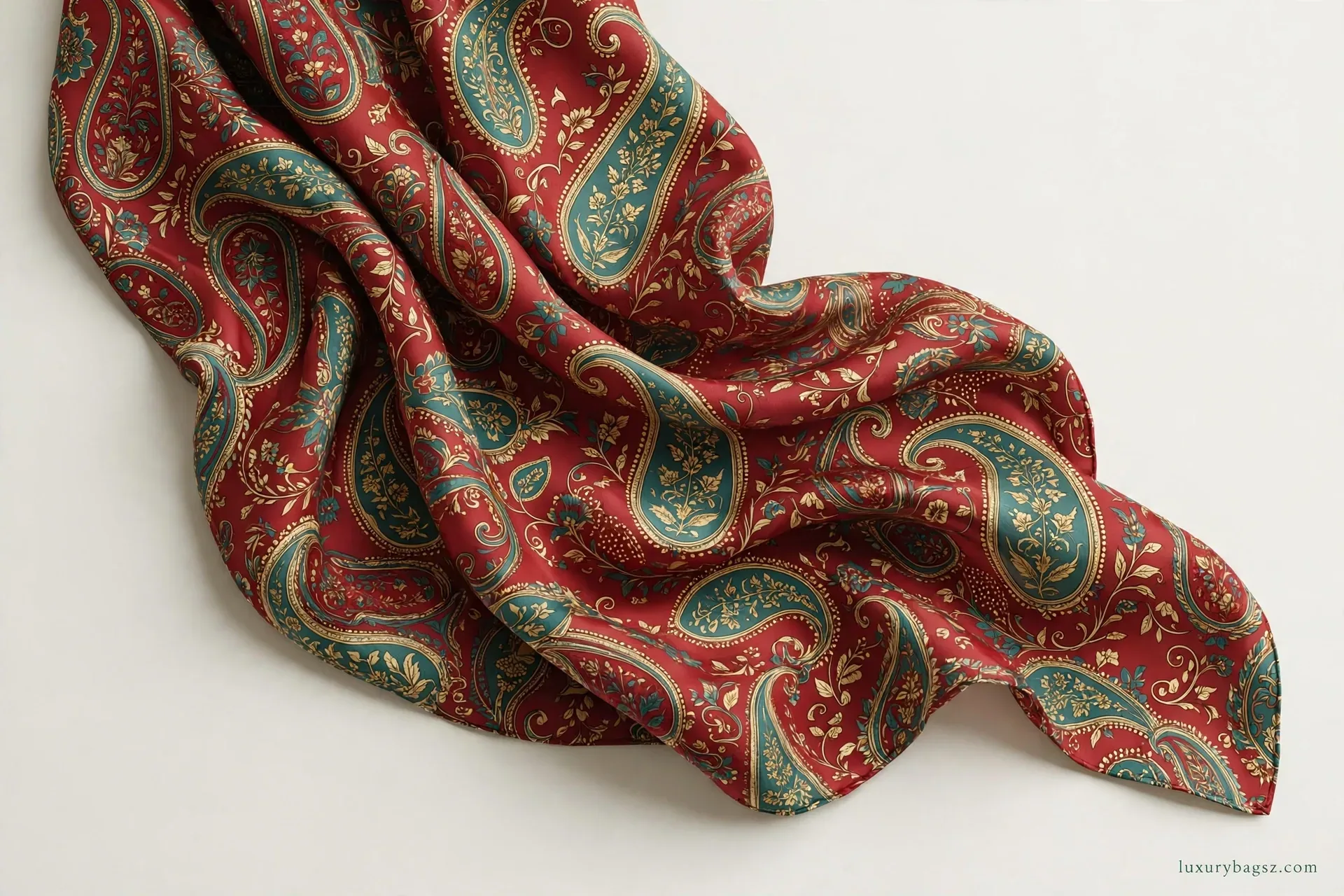
Paisley is a teardrop-shaped motif with roots in Persia and India, where it represented the date palm blossom, a symbol of nourishment, prosperity and fertility. It travelled to Europe through trade and became famous in Scotland, where the town of Paisley gave it its name. By the 1960s, counterculture had adopted it as a symbol of Eastern spirituality and freedom.
Etro made paisley its own after a trip to India by company executives led to the furnishing textiles line of 1981. The motif appeared on fabrics with a richness and colour that no one else matched, and Elle magazine later called it synonymous with the label. From furnishing fabrics, paisley spread to scarves, ties, shirts, dresses and bags, becoming the house's visual signature.
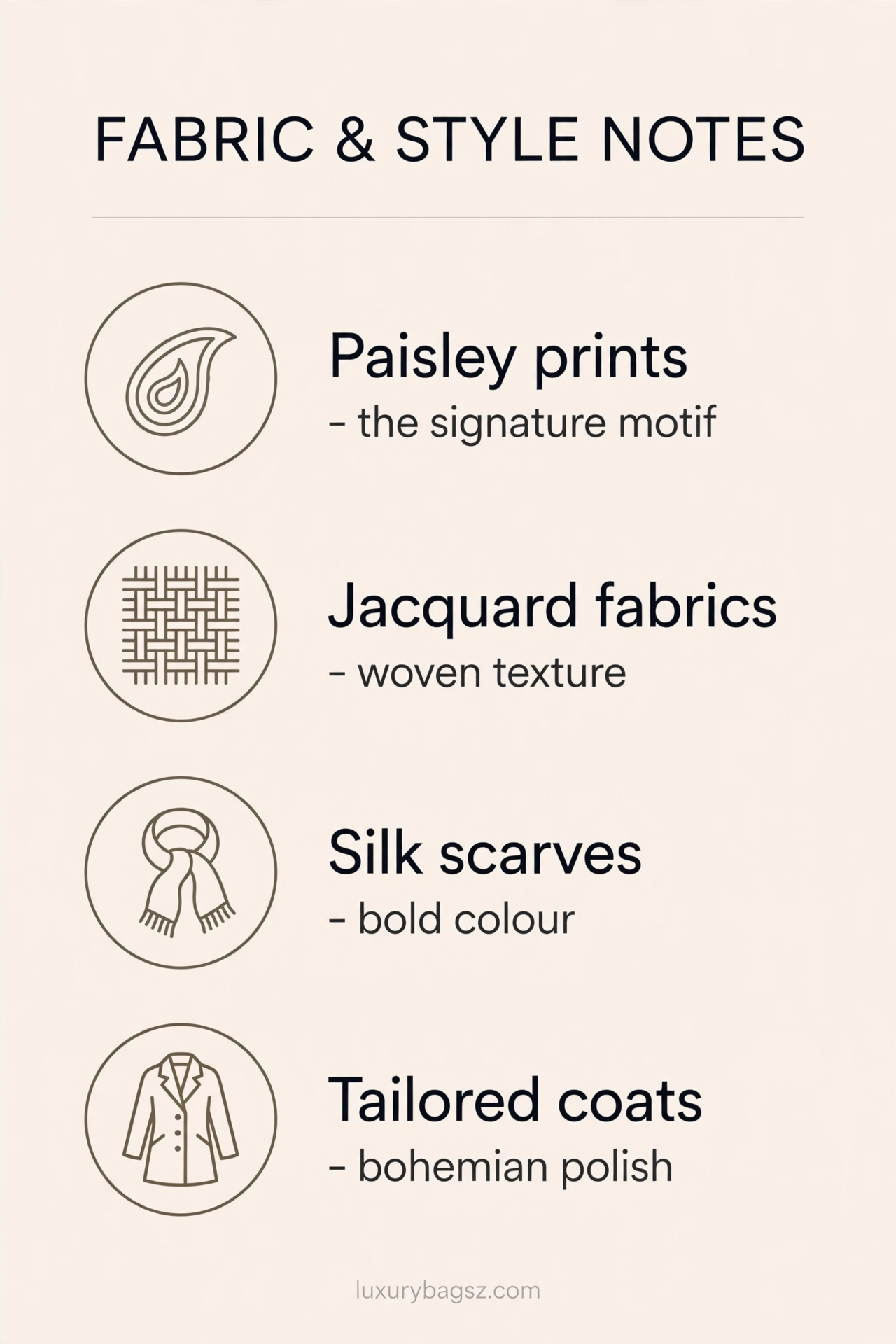
Etro's paisley is not one print but a language. The house reworks it in countless scales, colours and combinations, from bold Arnica jacquards woven with five threads of contrasting hues to delicate scarf borders. Learning to recognise the quality of the weave and the clarity of the repeat is the most useful skill an Etro buyer can develop.

From Fabric to Fashion: Leather, Home and Ready-to-Wear
Etro's expansion followed a logical path from its textile base. Leather goods arrived in 1984, using paisley jacquard fabrics that gave bags a textile identity no leather house could copy. The home collection followed in 1985, with cushions, plaids, ceramics and later wallpaper, turning the Etro look into a way of living.
Ready-to-wear came in the 1990s: menswear first, then womenswear, evolving from ties and haberdashery into a full wardrobe. Fragrance joined the range in 1989, with the first boutique on Via Verri in Milan. Each step kept fabric at the centre; even the leather goods carried woven paisley, and even the perfumes were presented as part of a colourful, cultured lifestyle.
The house's Pegasus logo, symbolising imagination and travel, captured that spirit. Etro was never just selling clothes; it was selling a worldview in which a well-read, well-travelled person dressed in prints that told stories. That positioning still sets it apart from quieter luxury houses today.
The Family at Work: Four Children, Four Passions
For most of its history, Etro was run by Gimmo's four children, each following a personal passion within the house. Veronica Etro led womenswear, Kean Etro led menswear, Jacopo Etro led textiles and home, and Ippolito Etro led the business as chief executive. Saturday mornings in the atelier, where the children played and drew as their father worked, became family legend.
That division of labour gave Etro unusual coherence. Womenswear and menswear shared a textile language but kept distinct voices, and the home line extended the same prints into interiors without dilution. The family ethos also kept the house independent for decades, resisting the conglomerate model that absorbed many Italian rivals.
Family ownership changed in stages. In 2021, the private equity fund L Catterton took a majority stake, and later reports say the founding family sold its remaining stake in December 2025, ending family ownership. The transition marks a real turning point, and collectors may find that pre-2021 family-era pieces carry extra interest as the house's character evolves under new ownership.
The Etro Look: How to Wear It
Etro's look is bohemian polish: rich prints, soft tailoring and colour worn with confidence. The easiest entry point is a silk scarf or a paisley shirt, worn with plain tailoring so the print does the talking. A paisley coat over dark trousers, or a jacquard jacket with simple knitwear, gives the Etro effect without fancy-dress risk.
The common mistake is print overload. Two Etro prints can work together if they share a colour, but three competing patterns usually fight. Let one piece lead, keep the rest quiet, and the outfit reads as cultured rather than chaotic. Etro's own styling often pairs a bold print with denim, camel or black, a formula any wardrobe can copy.
Fabric choice matters as much as print. Etro's jacquards carry weight and structure, suiting coats and jackets, while its silk twills drape softly for scarves and blouses. A jacquard coat will hold its shape for years but needs careful cleaning, while a silk scarf rewards gentle handling with decades of wear. Match the fabric to the job, and the print will take care of itself.
For buyers drawn to quieter luxury, Etro is a useful counterpoint. Our quiet luxury guide explains the minimal aesthetic Etro deliberately avoids, and understanding that contrast helps you decide whether Etro's maximalism suits your wardrobe or simply your holiday suitcase.
Etro Today: Marco de Vincenzo and a New Chapter
In June 2022, Sicilian designer Marco de Vincenzo became Etro's creative director, bringing experience from Fendi's leather goods and accessories. His collections have modernised the house while honouring its heritage, blending traditional paisley and textile craft with bolder colours, experimental fabrics and a younger, more contemporary silhouette.
His Fall/Winter 2023 womenswear collection, titled Radical, revisited the house's roots directly, reconstructing classic paisley, floral appliqué and tartan motifs into 58 looks that treated history as raw material rather than costume. The message was clear: Etro's archive is a living resource, not a museum.
Today Etro sits at a crossroads between family heritage and corporate ownership, between bohemian tradition and modern fashion. For shoppers comparing Italian houses, our Prada guide and Gucci guide show how differently Milan's great names answer the same questions of identity and change.
Buying and Caring for Etro
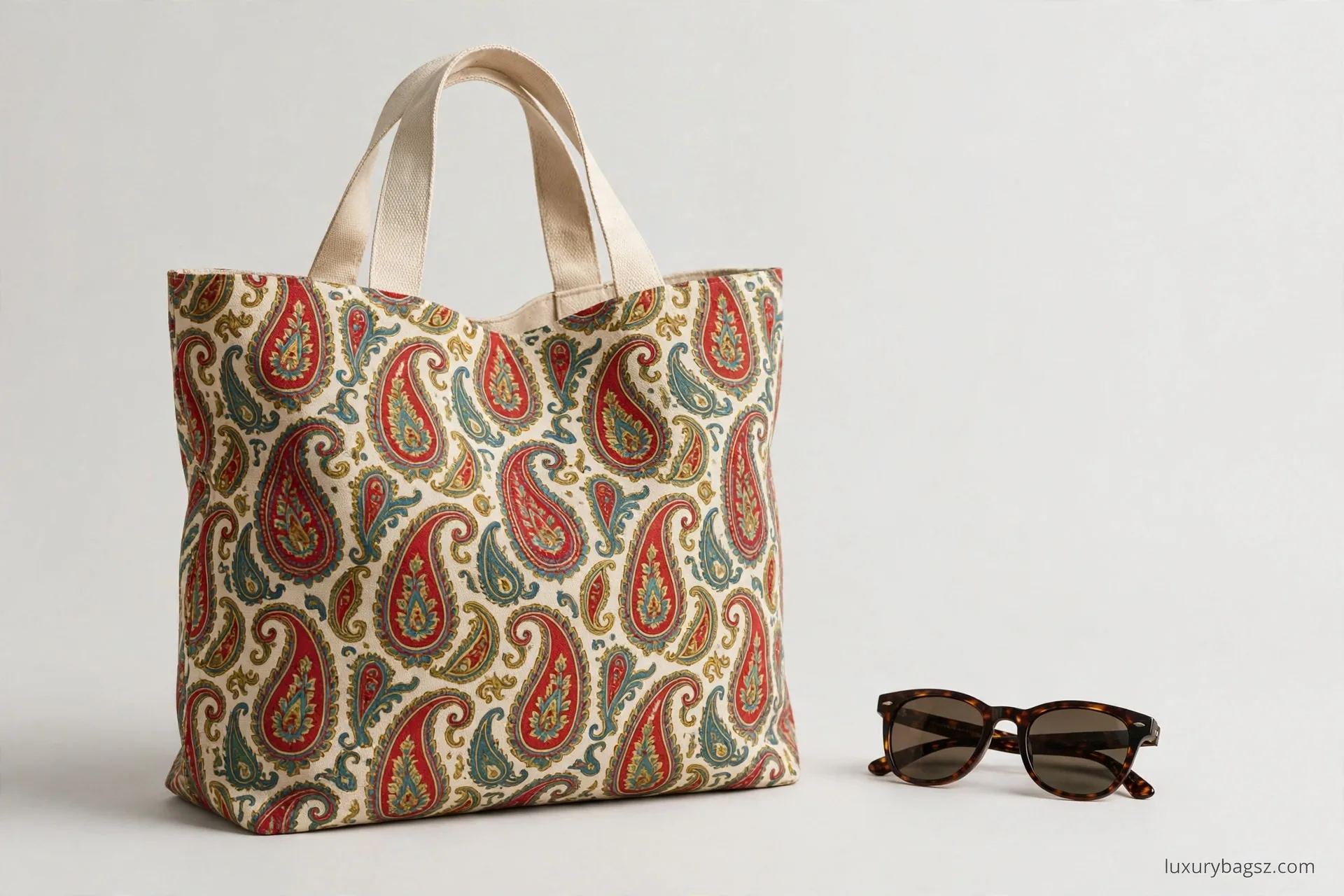
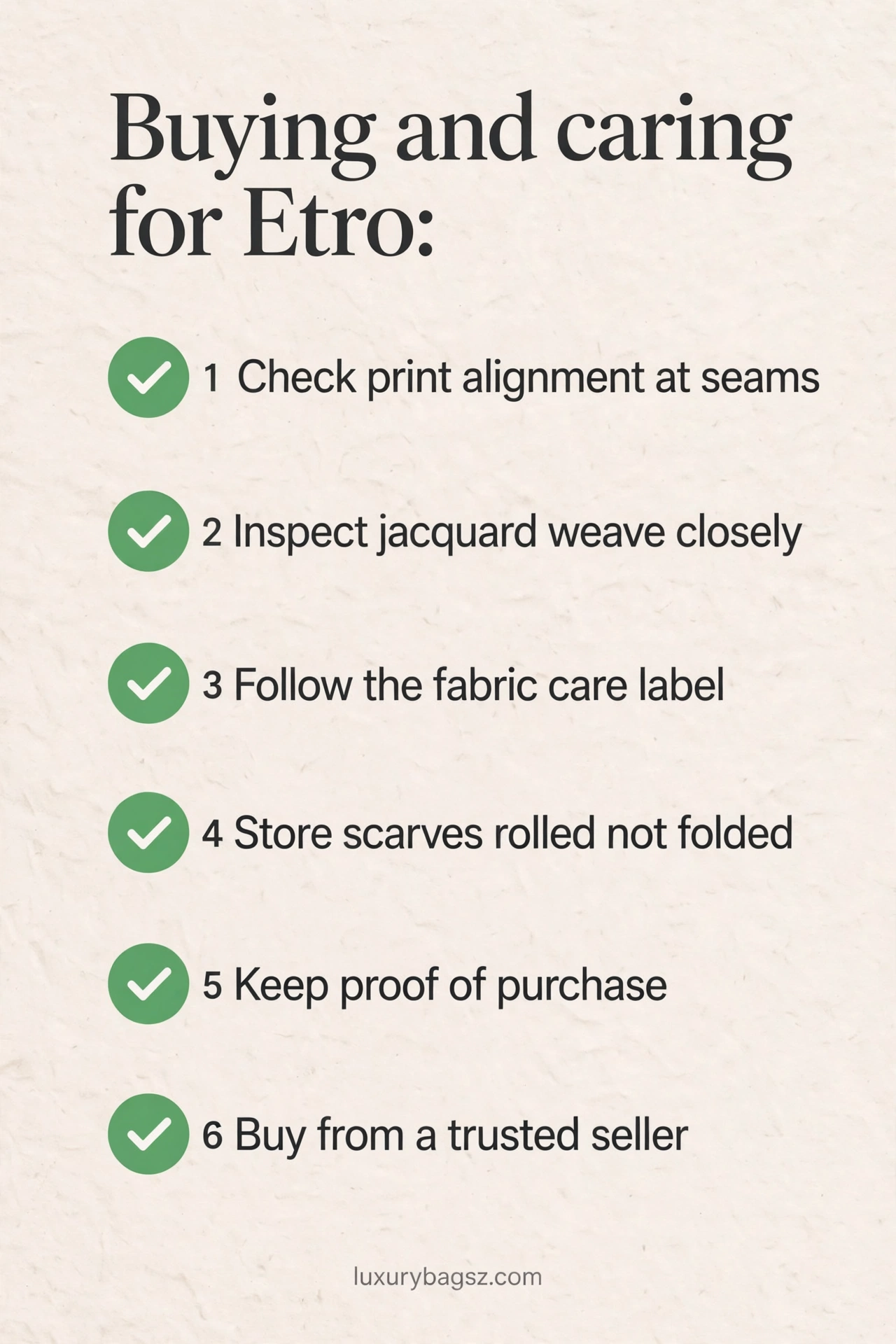
Buy Etro for fabric first. Check print alignment at seams, since a well-made Etro piece matches its pattern carefully across joins. Inspect jacquard weaves closely for even texture and clear motifs, and feel silk scarves for weight and a clean hand-rolled or finished edge. On bags, check that paisley jacquard is taut and evenly woven, not puckered or faded.
Care follows the label, and Etro's varied fabrics demand attention. Our cotton, linen and silk cleaning guide covers washing and stain care for natural fabrics, and our designer clothing care guide explains storage, rotation and professional cleaning. For silk scarves specifically, our silk scarf washing guide gives a careful hand-wash method that works for fine scarves generally.
When judging quality, our craftsmanship spotting guide explains seams, fabric and finishing to check, and for Etro's leather-trimmed bags, our leather bags and shoes care guide covers conditioning and storage. Store scarves rolled rather than folded to avoid creases, keep proof of purchase, and buy from trusted sellers. Etro's prints are widely copied, so a price far below market is a warning, not a bargain.
Three mistakes deserve special attention. First, judging a print from a thumbnail: Etro's quality lies in weave depth and colour layering, which only close inspection reveals, so ask for detailed photographs. Second, ignoring the care label: a jacquard coat or silk scarf cleaned the wrong way can be ruined in one wash, and that loss dwarfs any saving on price. Third, buying a runway print for daily wear: the boldest seasonal prints date fastest, while classic paisley in balanced colours stays wearable for years.
Etro vs Its Rivals: The Case for Colour
Etro's rivals clarify its appeal. Against Missoni, its closest Italian print rival, Etro offers narrative where Missoni offers rhythm. Missoni's zigzags are abstract and instantly recognisable; Etro's paisleys carry stories of travel, history and craft. A Missoni knit is a pattern you wear, while an Etro print is a place you visit. Buyers who love colour without storytelling may prefer Missoni; buyers who love a print with a past will prefer Etro.
Against Gucci and Prada, Etro is smaller, quieter and more textile-led. Gucci's maximalism is louder and more logo-driven, while Prada's intellectual edge can feel cold beside Etro's warmth. Etro rarely dominates a room, but it rewards close looking: the weave, the colour layering and the hand of the fabric all repay attention that a logo never will.
Against the quiet luxury houses, Etro is the deliberate opposite. Where brands such as Loro Piana and The Row whisper in cashmere and camel, Etro speaks in paisley and jewel tones. That makes Etro a poor choice for a stealth-wealth wardrobe and an excellent choice for anyone who finds minimalism boring. Fashion needs both languages, and Etro keeps the colourful one fluent.
Etro's challenge today is staying distinctive under corporate ownership. The archive, the Milan atelier and the textile-first method are its defences, and Marco de Vincenzo's collections suggest they still work. For buyers, the practical advice is to favour pieces where the fabric leads: jacquard coats, silk scarves and paisley shirts that could only come from this house.
So what should you buy first? A silk paisley scarf is the classic entry, wearable with everything and easy to judge for quality. A jacquard coat is the investment piece, bold but timeless in the Etro world. A paisley shirt or tote offers everyday colour without full commitment. In every case, check the weave, match the print at the seams, and wear it with confidence: Etro's philosophy was never about blending in.
Mixing prints deserves a final word, because Etro buyers often ask how far they can go. The safest rule is one hero print per outfit, supported by plain colours drawn from within that print. A second print works when it shares a colour family and differs in scale, such as a large paisley coat with a small paisley scarf in a matching tone. What fails is two large, unrelated prints competing for attention, which reads as noise rather than confidence. Start with the hero-print rule, learn which colours recur in your Etro pieces, and build from there. Over time, you will develop an eye for combinations that look intentional rather than accidental, which is exactly the skill Etro's own stylists practise.
Prices, Sizes and What to Expect to Pay
Etro pricing follows its fabric hierarchy. Silk scarves and small accessories form the entry point, offering the signature paisley at the most accessible level. Shirts, knitwear and trousers sit in the middle, while jacquard coats, tailored outerwear and leather-trimmed bags occupy the top tier. Home pieces, from cushions to plaids, span a similar range depending on size and material.
Sizing runs broadly true to Italian norms, which means it can feel slim to buyers used to looser cuts. Coats and jackets reward trying on, since Etro's tailored shoulders and longer lines fit differently from boxy contemporary shapes. Scarves, by contrast, are forgiving: the classic large silk square suits most wearers, and smaller formats offer a lighter option for those who find big scarves overwhelming.
Pre-owned Etro offers good value for bold prints, since the house's colours and motifs age well when the fabric is sound. Check for fading, especially in reds and deep tones, and inspect jacquard weaves for pulls or thinning. Classic paisley scarves in good condition resell steadily, while highly seasonal runway prints appeal to narrower audiences. As always, a trusted seller and proof of purchase matter more than a bargain price.
Frequently Asked Questions
When was Etro founded?
Etro was founded in Milan in 1968 by Gerolamo "Gimmo" Etro as a luxury textile design company.
What is Etro famous for?
Etro is famous for its paisley prints, rich jacquard fabrics, silk scarves and bohemian Italian luxury, built on a textile heritage rather than a single bag or shoe.
What does paisley mean?
Paisley is a teardrop motif rooted in Persia and India, where it represented the date palm blossom, symbolising nourishment, prosperity and fertility.
When did Etro start using paisley?
Etro's paisley became its signature after the furnishing textiles launch of 1981, following a company trip to India, and it has defined the house ever since.
Who is Etro's creative director?
Marco de Vincenzo became Etro's creative director in June 2022, modernising the house while honouring its paisley and textile heritage.
Is Etro still family-owned?
Etro was family-managed for decades, but L Catterton took a majority stake in 2021, and later reports say the founding family sold its remaining stake in December 2025.
What is the Etro Pegasus logo?
The Pegasus logo symbolises imagination and travel, reflecting the house's cultured, wandering spirit and its love of stories from around the world.
How should I care for Etro silk scarves?
Follow the care label, hand-wash gently where allowed, roll rather than fold for storage, and keep scarves away from direct sunlight and perfume.
How do I spot a fake Etro piece?
Check print alignment at seams, jacquard weave quality, fabric weight, label accuracy and seller reputation. Blurry prints and uneven weaves are warning signs.
What is Etro's most iconic product?
Etro's most iconic products are its paisley silk scarves and jacquard fabrics, which carry the house's signature motif in its purest form.
Conclusion: A Philosophy You Can Wear
Etro began with a collector's love of old shawls and turned it into a living fashion language. Paisley gave the house its signature, the archive gave it depth, and the family gave it soul. Under new ownership and a new creative director, the question is whether that philosophy survives its own success. For buyers, the answer is in the fabric: check the weave, trust the print, and choose pieces whose colour and craft you will still love when the trend cycle moves on. Start with a silk scarf, graduate to a jacquard coat, and wear both with the confidence Gimmo Etro intended. Colour, after all, was never just decoration at Etro; it was the philosophy itself.






