

What Is a Hermès Carré Scarf 90: The Honest Guide to the Classic Silk Square
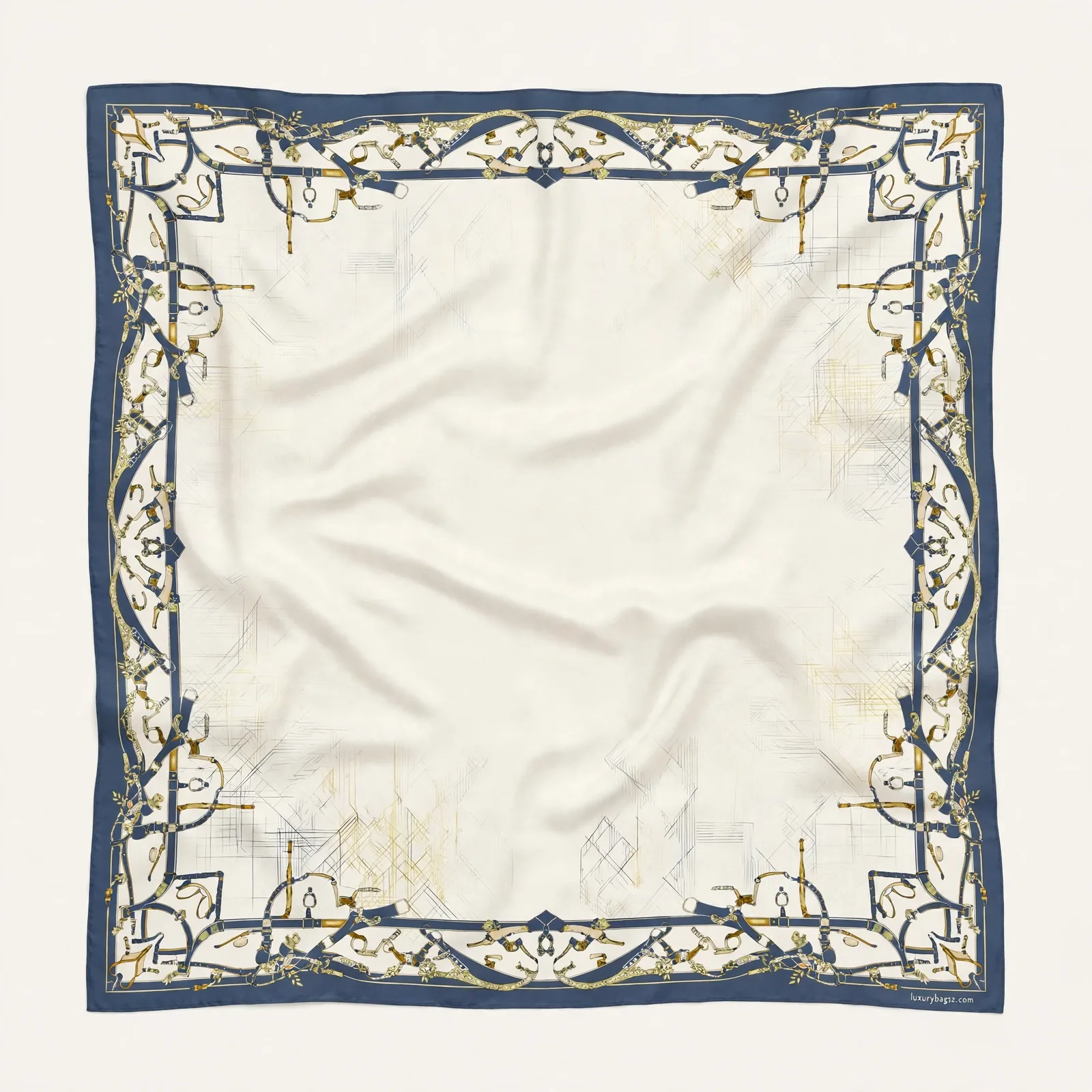
If you have ever held a Hermès silk scarf and wondered why one square of silk costs as much as a good leather bag from another brand, you were almost certainly holding a carré 90 — or looking at a copy of one. The carré 90 is the format that made Hermès a silk house, not just a leather house. It is a 90 cm square of silk twill, printed with a full artwork, finished with a hand-rolled hem, and worn in more ways than almost any other single accessory in luxury fashion.
It is also one of the most misunderstood Hermès products. Shoppers ask whether 90 cm is too big, whether the scarf is really worth the price when smaller squares exist, whether it can be washed at home, and how to tell a genuine one from a convincing copy. Sellers, meanwhile, use the word “carré” loosely, call almost any square scarf a “90”, and quote prices that disagree by hundreds of dollars for what sounds like the same item.
This guide answers those questions in order: what the word carré means, why 90 cm became the classic size, how the scarf is actually made, how it differs from every other Hermès scarf format, what kinds of designs it carries, how to wear it without fighting the silk, what quality markers to check, how to look after it, what it costs, and what to check before buying one pre-owned.
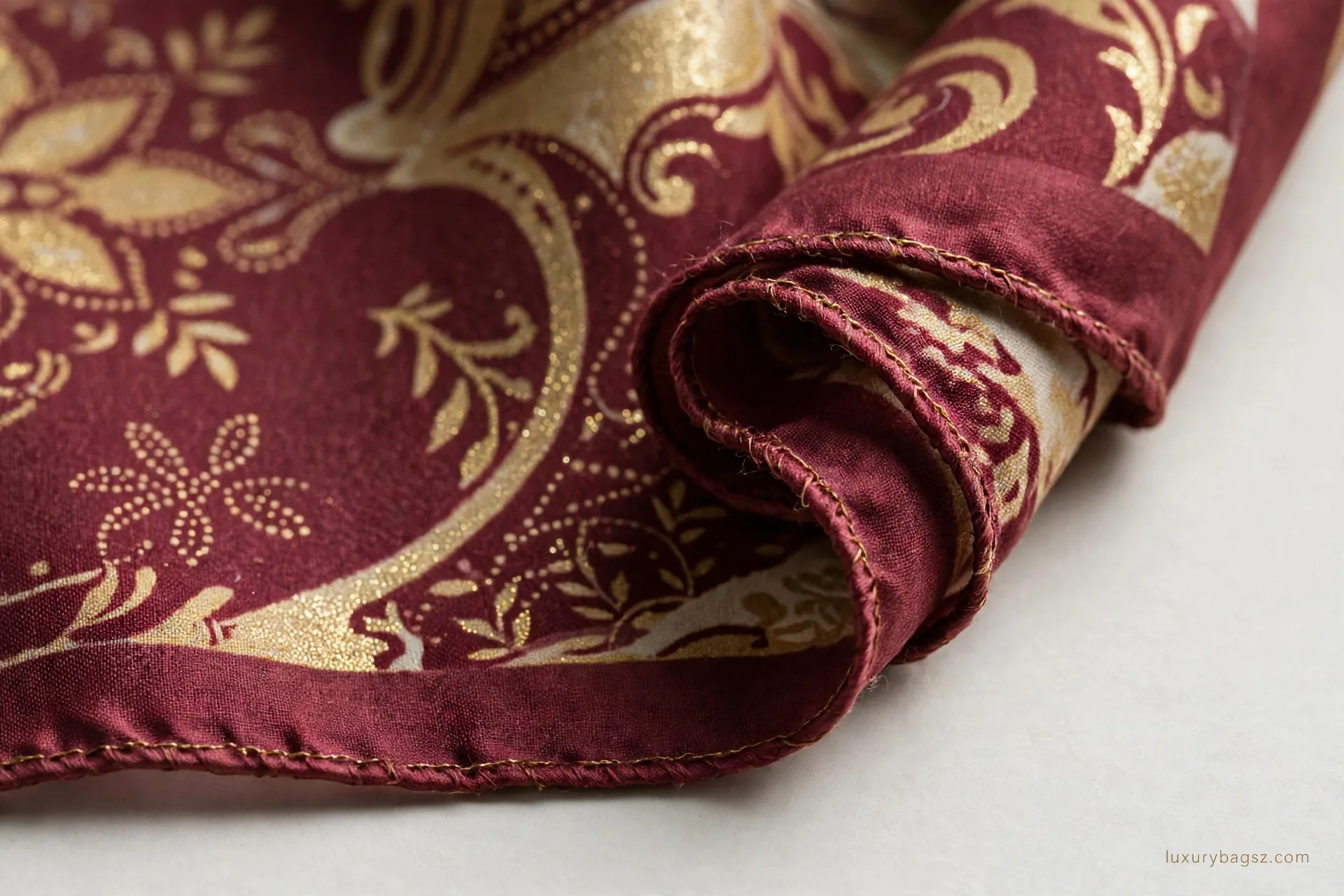
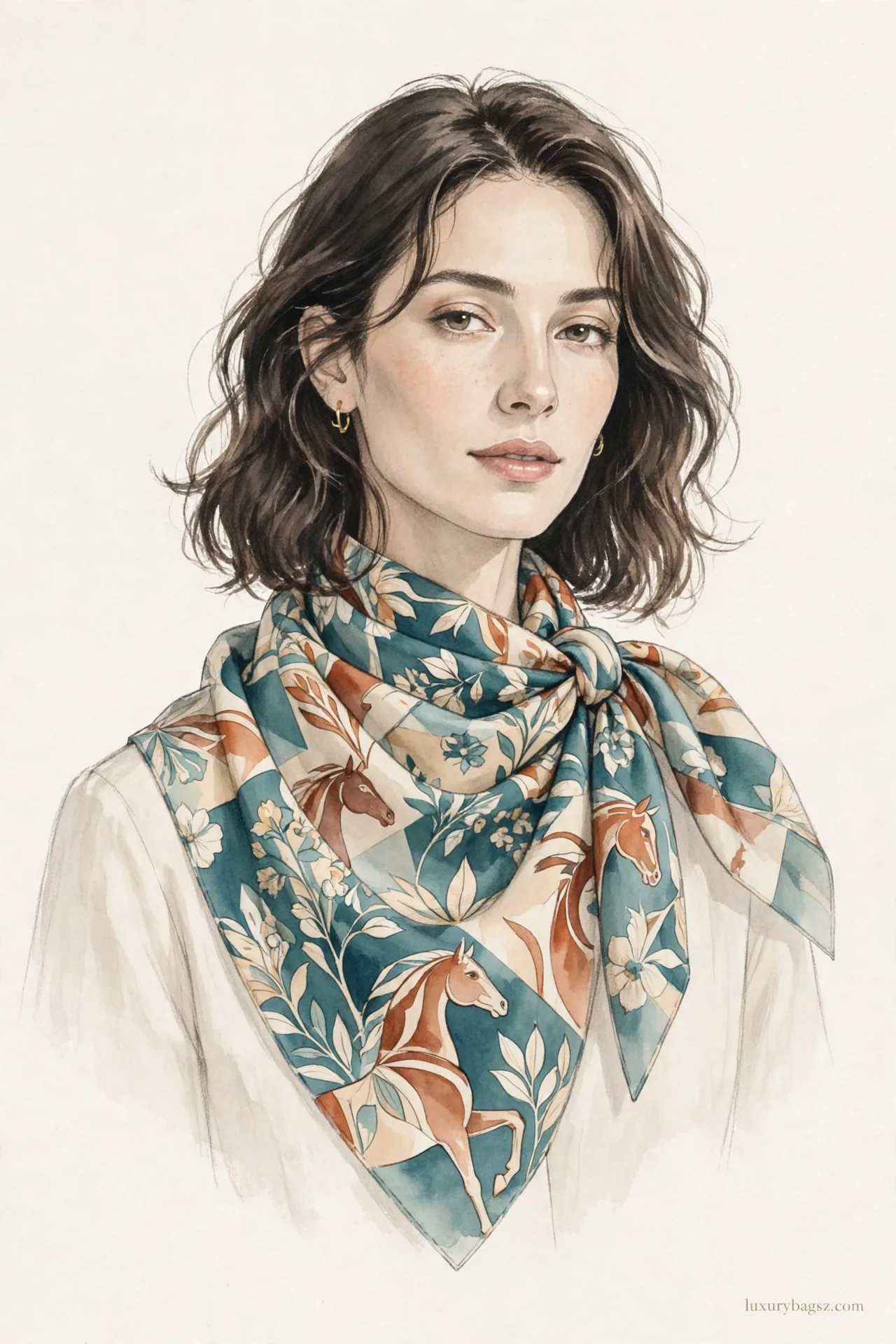
One important note before you start. The pictures in this article are generic illustrations, not photographs of real Hermès scarves or real Hermès designs. They show the shape, the scale, and the styling ideas. They do not reproduce any trademarked artwork, and no illustration in this article should be used to judge the print, colours, or signature of a real scarf. The written guide prevails wherever an illustration simplifies a detail.
Table of Contents
The Carré 90 in Brief
What is a Hermès carré scarf 90? A square silk scarf, 90 cm by 90 cm, made of silk twill, printed with a full artwork, and finished with hand-rolled hems. It is Hermès’ classic scarf format, first established in 1937.
Why is it called a carré? Because carré means “square” in French. The number is the size: 90 cm on each side. A “carré 70” is the same idea at 70 cm, and a “carré 90” is the same idea at 90 cm.
What is it made of? 100% silk twill for the standard carré 90. Twill is a diagonal weave that gives the silk weight, drape, and a slight resistance when you knot it, so a knot holds instead of slipping open.
How big is it, really? 90 cm is about 35.4 inches per side. Unfolded, it covers the shoulders of most adults as a light drape. Folded into a band, it is long enough to wrap around the neck twice or tie in a generous knot. A measurement a centimetre or two short of 90 cm is usually put down to hand finishing, measuring method, or age, but a scarf that measures far from 90 cm on both sides is not a standard carré 90, whatever the listing title says.
Who is it for? Anyone who wants one silk scarf that can do many jobs: a polished neck scarf for work, a headscarf for travel, a colour accent on a bag, a belt over a dress, or a light shoulder cover in the evening. It is not a warmth scarf. For real warmth, a larger cashmere-blend shawl is the better tool, and the formats section explains why.
How much does it cost? As a starting point only, recent US guide figures put a standard 90 cm silk carré at $660 before sales tax, with a double-face version at $800 and exceptional or embroidered pieces far higher. Other guides and older listings quote different figures — see the prices section, where the disagreements are set out in full.
Can it be washed at home? The care tag generally says dry clean only. Do not machine wash a carré 90, and do not assume that a hand-wash tip from a general silk guide applies to a hand-finished, screen-printed artwork.
What “Carré” Means and Where the 90 Comes From
Hermès began in 1837 as a harness workshop in Paris, making saddles, bridles, and other leather goods for horses. That equestrian beginning still runs through the house’s imagery: harnesses, bridles, horses, carriages, and stable life appear again and again in its scarf designs, nearly two centuries later.
Silk came much later. In 1937, under Robert Dumas, Hermès introduced its first silk scarf. The first design is widely recorded as “Jeu des Omnibus et Dames Blanches” — a playful scene of omnibuses and ladies in white. It was a square, and it set the pattern that still defines the carré: a complete picture, printed edge to edge, with a border that frames the scene like a painting.
The word carré itself is doing more work than it first appears to do. In French it simply means square, but at Hermès it has become a product name, a size family, and a shorthand for a whole way of making scarves. When a seller writes “Hermès carré”, they usually mean a square silk scarf in the classic tradition. When they write “carré 90”, they are naming the size as well: 90 cm on each side.
Why 90 cm Became the Classic Size
Ninety centimetres sounds like an arbitrary number until you wear the alternatives. At 45 cm, a square is a neckerchief: neat, light, and easy to knot, but too small to drape over the shoulders, cover the head properly, or tie as a top. At 70 cm, a square is a comfortable neck scarf and a good hair accessory, but it is still tight as a headscarf and short as a shoulder drape.
Folded diagonally, a 90 cm square gives a triangle with a long edge of about 127 cm — long enough to wrap around the neck and tie at the front with ends to spare. Folded into a band, it gives a ribbon long enough to wrap twice around the neck or tie once with a loose, soft knot. Opened fully, it covers the head with fabric to spare for tying at the nape, and it drapes over both shoulders without pulling tight.
That versatility is why guides consistently call the 90 cm carré the classic, the iconic, and the quintessential Hermès size, and why it is the format used for many of the house’s most famous designs. If you buy only one Hermès silk scarf, most guides point you to the 90 first, because it is the size that does the most jobs.
A 90 is not the best warmth layer, not the neatest small neck knot under a tight collar, and not the easiest scarf to tie to a slim bag handle without bulk. The formats section sets out which format suits which job, so you can buy the 90 for what it does well rather than expecting it to do everything.
Finally, the 90 has a practical advantage that smaller scarves lack: the artwork is fully visible. A carré design is a picture, often with a border, a central scene, and small details at the corners. On a 45 cm square, much of that picture disappears into a fold as soon as you knot it. On a 90, you can fold it so that a chosen part of the picture — a horse, a border, a corner motif — sits exactly where you want it. That is why styling advice for the carré 90 so often talks about “choosing what to show”: the size gives you something worth choosing.
How a Carré 90 Is Made: Twill, Printing, Hand-Rolled Hem
A carré 90 starts as silk, but not just any silk. The standard carré 90 is woven from silk twill, a weave in which the threads cross in a diagonal pattern rather than a plain over-under grid. You can see that diagonal rib if you look closely at the fabric, and you can feel it: twill has a little more body and a little more grip than a flat silk satin, which is why a twill scarf knots firmly and holds its shape instead of sliding apart.
Competitor guides often stop at “silk twill” and move on. The details that matter for a buyer are what happens next. The silk for Hermès scarves is woven in the Lyon region of France — one detailed reseller guide names Pierre-Bénite, near Lyon — and the design itself begins as an artist’s painting, usually in gouache, which is then broken down into separate colours for printing.
Each colour needs its own screen, and the screens are printed one colour at a time onto the silk. That is why a carré can carry so many colours, and why the printing process takes so long: one guide puts the engraving and colour-separation stage at six months to two years for a single design.
How many colours? Sources disagree, and the disagreement is worth stating rather than smoothing over. One reseller guide says flat screen-printing can use up to 36 colours; a listing for a single equestrian design claims up to 46 hues; other guides give lower figures.
The honest summary is that a carré 90 is a many-colour screen print — often dozens of colours — and that the exact count varies by design. Do not treat any single number as a test of authenticity. A scarf is not fake because a seller quotes 27 colours and a guide quotes 36.
The same caution applies to weight. One reseller guide puts a carré 90 at around 75 grams in total. Other online guides quote grams per square metre in figures that do not line up with that total. Weight is therefore a poor authentication test on its own: scales, measuring methods, and whether the scarf is weighed with its box all change the number. Feel and drape — substantial, fluid, not stiff and not flimsy — are more useful than a number from a listing.
The most famous part of the making process is the hem, and it deserves its reputation. Each edge of a carré 90 is rolled by hand — the roulotté hem — and stitched by hand with silk thread matched to the colour of the scarf. Guides describe the roll as soft, plump, and slightly irregular: the stitches are not perfectly uniform, because a human hand made them. That irregularity is a feature, not a flaw. Machine-rolled hems, by contrast, tend to look too even, feel stiffer, and show a regular running stitch or a glued edge. Those figures measure different things — one scarf’s hem versus one design’s full journey — so they do not contradict each other, but neither should be quoted as a simple fact about “how long a scarf takes”.
Every carré also carries the marks of its design: the artist’s signature, printed into the design itself, the design title, and the Hermès mark. On a genuine scarf these are printed cleanly, not embroidered, and they sit where the design intends them to sit — often near a corner or along an edge. A blurred signature, a misspelled title, or a mark that looks stamped on as an afterthought is a warning sign, but the quality markers section explains why it is never the whole story.
How the Carré 90 Differs From Other Hermès Scarf Formats
Hermès makes silk in many shapes, and the carré 90 is only one of them. Knowing the family makes it easier to buy the right format and harder to be sold the wrong one under a vague name.
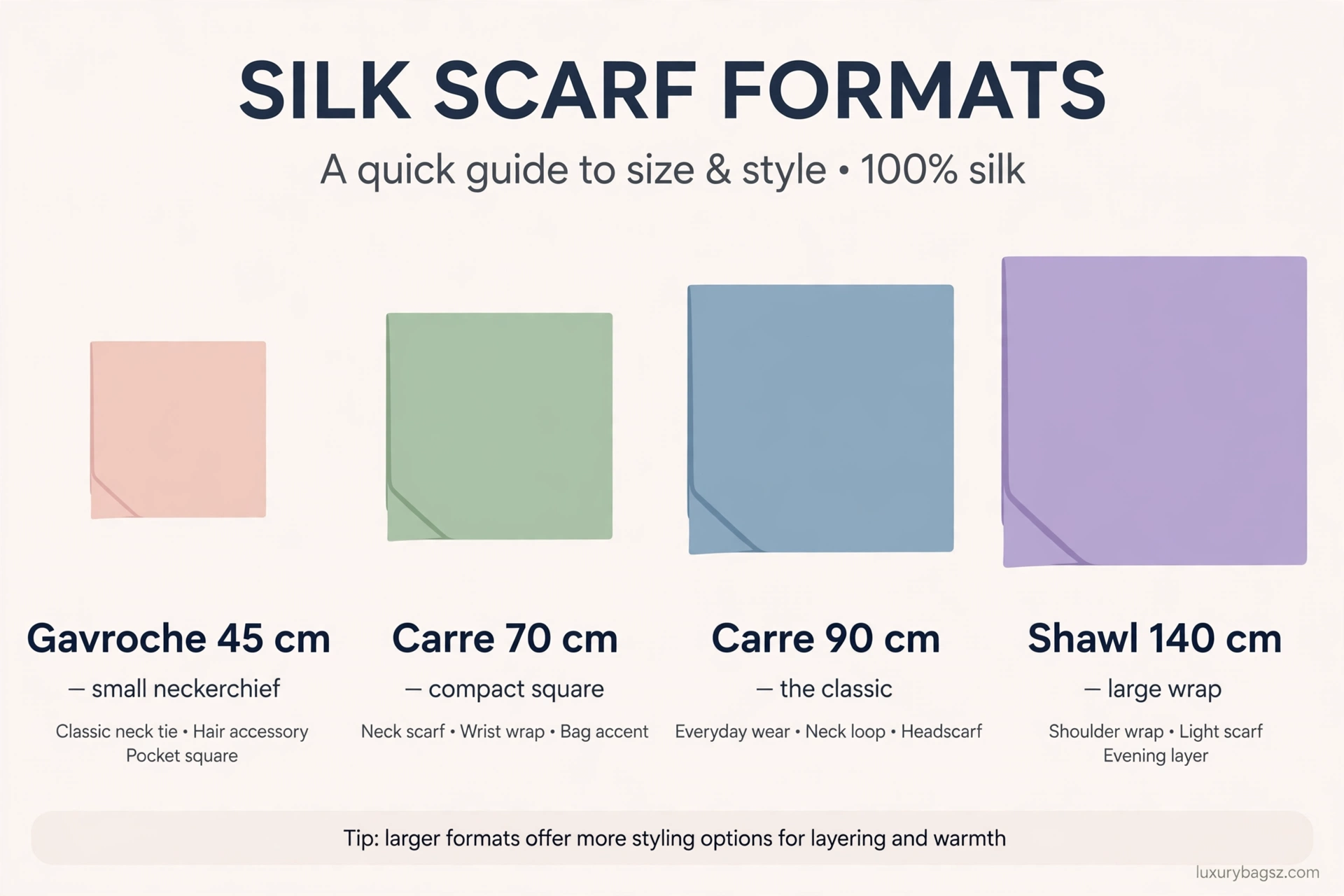
The gavroche, at about 45 cm square, is the small square: a neckerchief, a pocket square, a wrist tie, or a small bag accent. It is charming and easy to knot, but it cannot drape over shoulders or cover the head the way a 90 can.
The carré 70, at 70 cm square, is the compact square. It is lighter and less bulky at the neck than the 90, and many wearers prefer it for a neat, everyday neck knot or a ponytail wrap. It is a genuine alternative to the 90, not a lesser version of it — but it is a different scarf, with less fabric for headscarves, shoulder drapes, and tops.
The carré 90, at 90 cm square, is the classic. It is the format this guide is about: the full artwork, the full range of styling options, and the deepest catalogue of designs.
Beyond the squares, the family widens. The twilly is a narrow silk ribbon, commonly about 5 cm by 86 cm, worn at the neck, in the hair, at the wrist, or wrapped around a bag handle. It is the format most people picture when they think of a scarf tied to a handbag, and it does that job far more neatly than a folded 90.
The grand carré and larger squares, around 100 cm, offer a little more drape than the 90. The giant shawls, at about 140 cm, are usually silk-and-cashmere blends rather than pure silk twill, and they are warmth and evening layers first, knotting scarves second. Fringed and special editions vary further, so always check the measurements and composition of the actual piece rather than trusting a format name alone.
Classic Designs and Themes
A carré 90 is a picture before it is an accessory, and the pictures fall into families that collectors learn to recognise. The oldest family is equestrian: harnesses, bridles, saddles, horses, carriages, and stable scenes, drawn from the house’s origins as a harness maker. The most famous example is “Brides de Gala” by Hugo Grygkar, first issued in 1957 and still the historic best-seller in reseller guides. Its parade-harness imagery, worked from the border inward with an open centre, is the design many people picture when they hear the words “Hermès scarf”, even if they do not know its name.
Other families followed as the house’s artists widened their subjects. There are maritime and travel designs — ships, ports, maps, and journeys. There are botanical and animal designs — flowers, gardens, big cats, birds, and horses in motion. There are architectural and historical designs — palaces, cities, and scenes from history. There are astronomical and mythological designs — stars, constellations, and classical figures. And there are playful, modern designs that treat the square as a poster, a comic strip, or a puzzle, with the picture meant to be “read” from one corner to another.
Two habits of the house shape how these designs behave on the market. First, designs are reissued. A design from the 1950s or 1980s can return in new colourways, which means “old design” does not always mean “old scarf”, and a new-looking scarf can carry a decades-old picture. Second, colourways matter as much as designs. The same picture in a navy-and-gold colourway, a pastel colourway, and a bright colourway can look like three different scarves, appeal to three different buyers, and sell at three different prices pre-owned. When a guide or a listing talks about a design without naming its colourway, it has only told you half the story.
For a first-time buyer, the practical advice is simple. Choose the picture you actually want to wear, not the picture a guide calls most collectible. A famous design in a colourway you never reach for is a worse purchase than a quieter design in colours you wear every week. And if you are buying for value rather than wear, remember that fame alone does not set the price: condition, colourway, rarity, and whether the design is currently in production all move the number, as the prices section and the pre-owned checklist section explain.
How to Wear and Style a Carré 90
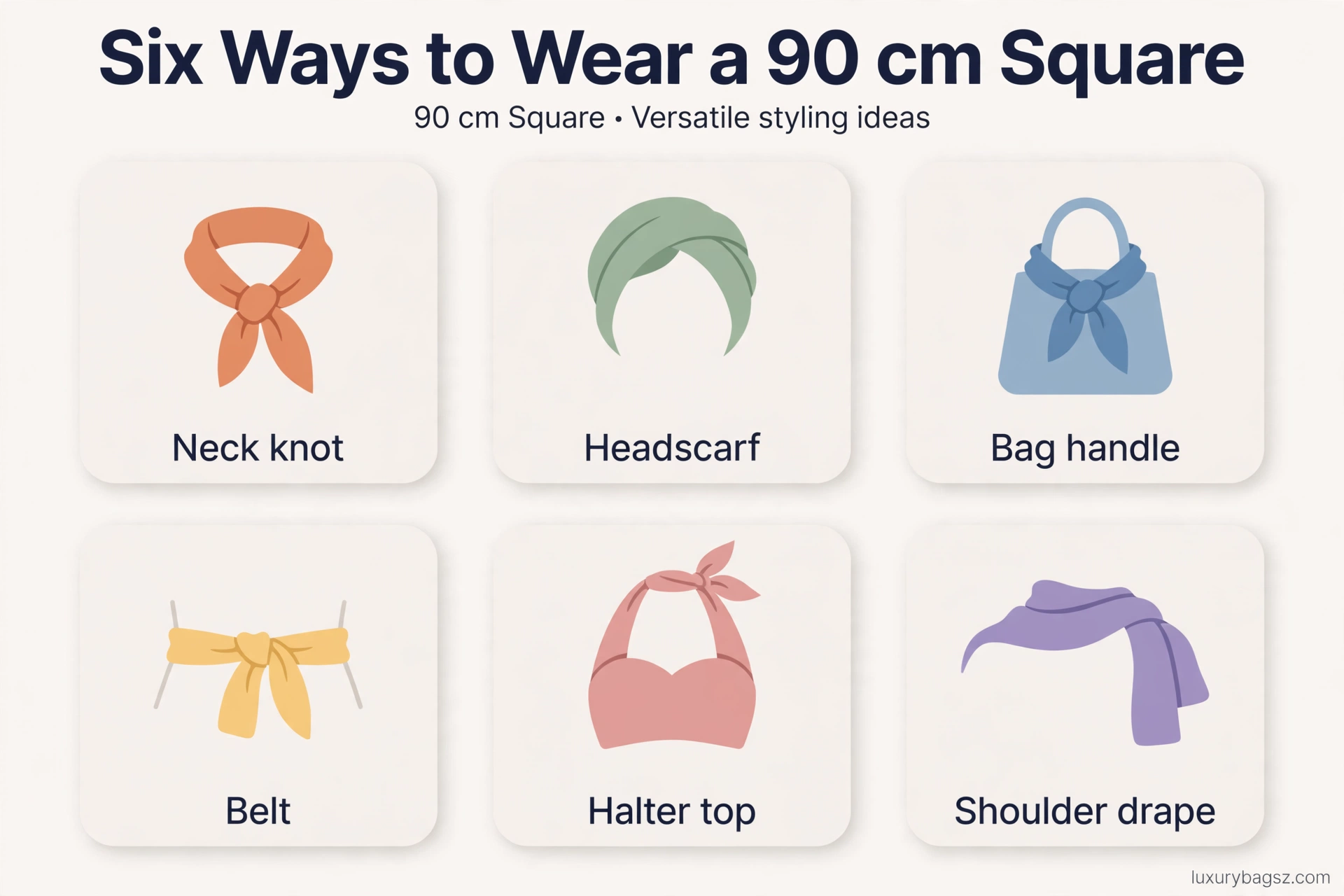
The carré 90’s size is what makes its styling range possible, but size alone does not style a scarf. The fold does. Almost every way of wearing a 90 starts from one of two folds, and learning those two folds first will save you from most of the frustration that makes people leave a beautiful scarf in a drawer.
The first fold is the band, sometimes called the bias fold. Lay the square flat, fold two opposite corners toward the centre, and keep folding inward until you have a long, narrow strip. The band is the starting point for neck knots, headbands, belts, and bag ties. Its width is your choice: a wide band shows more of the picture, a narrow band knots more neatly and adds less bulk.
The second fold is the triangle. Fold the square diagonally, corner to corner, so you have a triangle with a long folded edge and a point. The triangle is the starting point for bandana-style neck wear, headscarves, and halter tops. The point can fall at the front, at the back, or to one side, and each position changes the look completely.
From those two folds, the main uses follow.
At the neck, the classic options are the simple knot, the loop, and the ascot. For a simple knot, fold into a band, drape it around the neck, and tie a loose knot at the front or slightly to one side. For a loop, wrap the band around the neck and pull one end through the loop at the front. For an ascot, fold into a triangle, place the long edge at the back of the neck, and let the point fall at the front over a shirt or jacket. Keep the knot loose enough to move and breathe: a silk knot pulled drum-tight looks strained, creases the twill, and is harder to untie without pulling threads.
On the head, fold into a triangle, place the long edge across the forehead or hairline, and tie the ends at the nape or beneath the chin. A 90 gives enough fabric for full coverage without the tight, skimpy feeling of a smaller square, and the ends are long enough to tie securely without pulling. If you wear glasses, sunglasses, or earrings with sharp edges, check that nothing catches the silk as you adjust the scarf — a single snag can pull a thread across a whole corner.
On a bag, a carré 90 needs more care than a twilly. Fold it into a narrow band and wrap it around a handle, or tie it in a loose bow at the base of a handle, and let the ends hang unevenly rather than in a stiff, symmetrical bow. For everyday bag wear, a twilly is the neater tool; the 90 is the choice when you want the bag to carry a visible splash of the full design. A structured bag such as the Constance bag takes a silk accent well, because the bag’s shape stays crisp while the silk moves — and the same idea works on a soft crossbody, where a folded 90 tied to the strap adds colour without fighting the bag’s shape. If you carry a soft leather crossbody such as the Evelyne bag, keep the silk clear of the strap hardware and the snap tab, which are the two places most likely to snag it.
At the waist, fold into a band and thread it through belt loops with smooth edges, or tie it over a dress at the waist with the knot at the side. Check the length first: a 90 folded into a band is long enough for most waists, but a wide band eats length quickly, and rough belt loops or sharp buckles can catch the weave. A carré belt is a decorative accent, not a working belt — do not rely on it to hold up heavy trousers.
As a top, fold into a triangle and knot the ends behind the neck and at the back, halter-style, over a camisole or a swimsuit top. This is the use where size matters most: a 70 is usually too small for most adults as a halter top, while a 90 gives enough coverage to wear with confidence.
Over the shoulders, simply open the square and drape it, or fold it into a wide triangle and let the point fall down the back. A 90 is a light evening layer, not a wrap for cold weather — it will take the edge off air conditioning and add colour to a plain dress, but it will not replace a shawl for warmth.
A few things not to do. Do not wear a 90 as a wrist wrap: there is far too much fabric, and the bulk looks accidental rather than styled. Do not force a knot that fights the fabric: if a knot keeps slipping, widen the band or choose a different knot rather than pulling harder, which strains the silk at a single point. And do not wear silk against rough jewellery, sharp watch clasps, or coarse knitwear without checking for snags first — silk twill is durable for its weight, but it is still silk.

Quality Markers: What to Look At Before You Trust a Scarf
No guide can authenticate a scarf from a description, and this part does not try to. What it does is teach you what to look at, in what order, so that you can spot the obvious problems, ask better questions, and know when to walk away or seek a professional opinion.
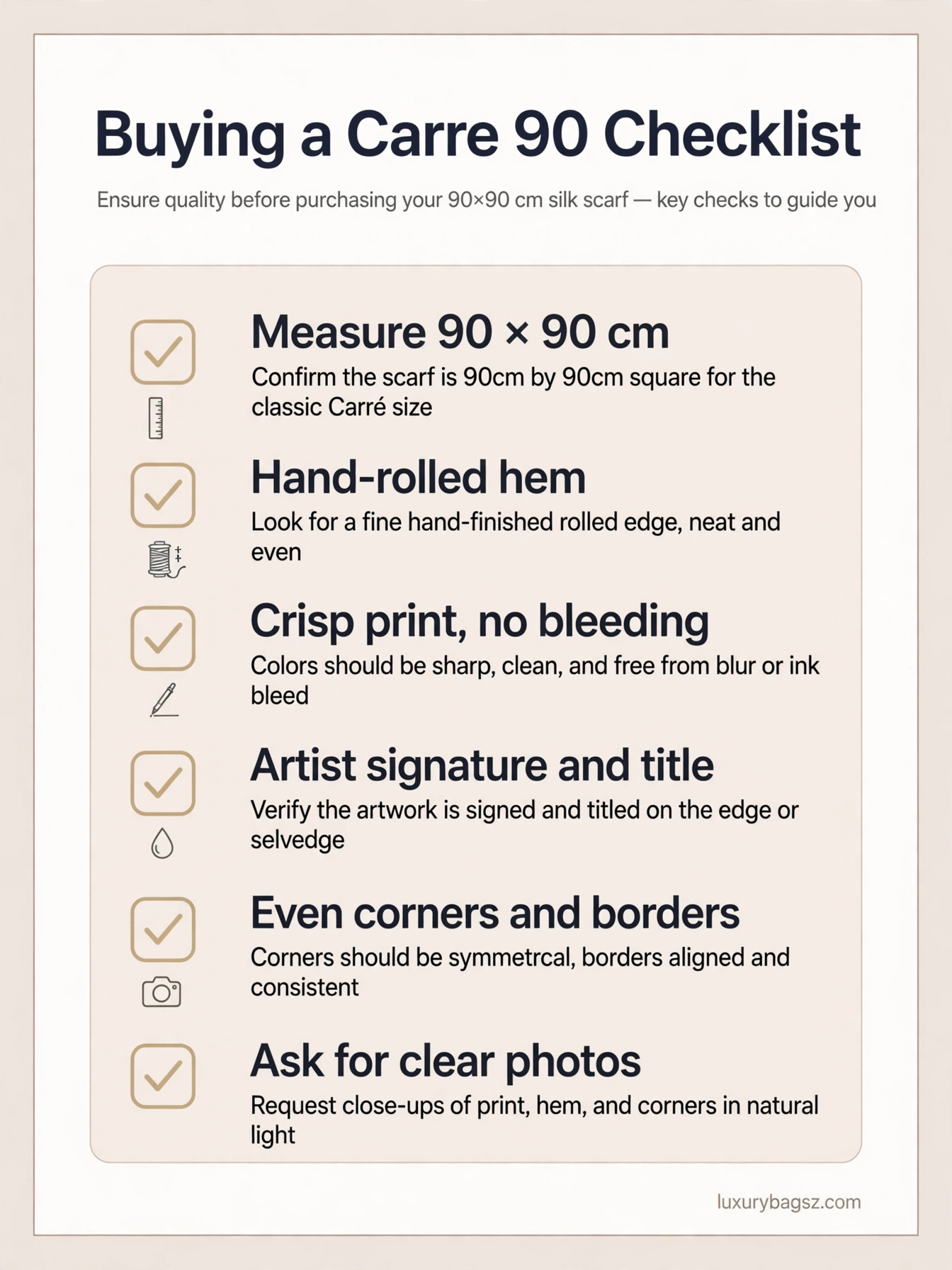
Start with the hem. Roll an edge between your fingers. On a genuine carré 90, the hem is a soft, hand-rolled tube, stitched by hand with thread matched to the scarf’s colour, and the stitches show the small irregularities of handwork. It should feel even along its length without feeling machined. A stiff, flat, glued, or perfectly uniform machine-stitched edge is a serious warning sign. Some guides add a finer detail: the roll should turn toward the printed face of the scarf. That detail is useful, but treat it as one clue among several, not as a pass-or-fail test on its own.
Next, look at the print. Hold the scarf up in good, natural light and look at the lines. On a genuine carré, the screen printing is crisp: fine lines stay fine, colours sit inside their boundaries, and there is no bleeding or blurring at the edges of motifs. Check the corners and borders with particular care: on a well-made carré, the border pattern meets the corners cleanly and the design stays symmetrical. Misaligned borders, cut-off motifs at the corners, or a pattern that does not mirror when you fold the scarf diagonally are all warning signs.
Then look for the signature and the title. A genuine carré carries the artist’s signature and the design title printed into the artwork, along with the Hermès mark. The lettering should be clean and correctly spelled, with the accent in place. Blurred lettering, missing accents, wrong spacing, or a signature that looks added after printing are warning signs. But remember the caution from the making section: signatures and marks can be copied, so a clean signature proves little on its own, and a worn signature on a decades-old scarf proves nothing against it either.
Then check the size and the feel. Measure the scarf flat, corner to corner, on both sides. A standard carré 90 should measure close to 90 cm by 90 cm; listings that measure 88 cm or 89 cm are common and usually unremarkable, but a scarf measuring 80 cm or 100 cm is a different format, whatever the title claims. Feel the drape: genuine silk twill is fluid but substantial, with a soft sheen that shifts as the fabric moves. A scarf that feels slippery, waxy, papery, or stiff, or that holds sharp creases when crumpled and released, deserves a closer look — though age, washing, and storage can all change how an old scarf feels, so feel alone never settles the question.
Then check the care tag, where one survives. On a genuine carré, the attached tag generally reads “Made in France”, “Soie 100% Silk”, and “Dry Clean Only”. A tag with spelling errors, the wrong fibre content, or a country that does not match the scarf’s claimed origin is a warning sign. But tags can be removed, replaced, or faked, and vintage scarves may have lost their tags entirely, so a missing tag is not proof of fakery — it is a reason to lean harder on the hem, the print, and the provenance.
Finally, look at the whole package: the box, the tissue, and the ribbon for a new scarf, and the seller’s history, photos, and returns policy for a pre-owned one. Packaging adds confidence when it is right, but it proves nothing on its own, because boxes and ribbons are among the easiest things to copy. The same one-detail-at-a-time habit that helps when spotting a fake Kelly helps here too: no single check authenticates a scarf, and a scarf that passes one check can still fail three others.
Two warnings that competitor guides often bury. First, Hermès does not run an authentication service for items bought outside its own stores, according to reseller guides, so a seller who claims a scarf is “Hermès authenticated” should be asked exactly who authenticated it, and when. That is why clear, close-up photos in natural light matter more than a long list of claims in a listing, and why a price far below the going range for a design should make you more careful, not more eager.
Care and Storage Basics
Silk twill is tougher than it looks, but it is still silk, and the care rules for a carré 90 are mostly rules about what not to do.
Do not machine wash it. Do not tumble dry it. Do not bleach it, do not soak it for hours, and do not wring it out like a towel. The care tag’s “Dry Clean Only” instruction is the safest rule to follow, and it is the rule this guide recommends: take the scarf to a cleaner experienced with silk and with printed textiles, and tell them it is a hand-finished, screen-printed silk scarf, not a plain silk blouse.
Why does this need saying when so many general silk guides suggest hand washing? Because those guides are usually talking about plain silk garments, not about a multi-colour screen print with a hand-rolled hem. Water, heat, and agitation can shift dyes, dull a print, and distort a hand-rolled edge, and the damage may not show until the scarf dries. If a seller tells you a carré is “machine washable”, treat that as a warning sign about the seller, not as a feature of the scarf. The cleaning routine for a leather bag is a different job entirely, and the contrast is instructive: where a guide to clean Chanel bags deals with leather, conditioners, and surface dirt, silk care deals with dye, weave, and water — borrowing the leather routine for silk, or the silk routine for leather, damages both.
For day-to-day wear, a few small habits protect the scarf more than any product. Put the scarf on after perfume, hairspray, and makeup, not before, so those products do not land directly on the silk. Keep it away from sharp jewellery, rough bag hardware, and coarse knitwear while you wear it. If it gets lightly creased, hang it in a steamy bathroom for a few minutes rather than pressing it flat with a hot iron; if you must iron, use the lowest silk setting, a pressing cloth, and no steam directly on the print, and never press the hand-rolled hem flat.
For storage, the rules are cool, dark, dry, and loose. Store the scarf clean, because stains and body oils set over time and attract moths. Fold it loosely in acid-free tissue, or roll it loosely rather than folding it along the same lines every time, which creates permanent crease lines. Keep it out of direct sunlight, which fades dyes, and out of damp places, which encourage mildew. Do not store it in a sealed plastic bag, which traps moisture; a breathable cotton bag or a box with tissue is better. The same dark, cool, dry discipline that helps when storing a Kelly helps here too, even though the materials are entirely different: light, heat, damp, and pressure are the enemies of both.
If a scarf arrives with a stain, a pull, or a damaged hem, do not try to fix it at home with water, stain remover, or a needle. A pulled thread can run, a stain remover can lift dye, and a home repair to a hand-rolled hem is visible forever. A textile conservator or a cleaner experienced with printed silk is the right call for anything beyond light surface dust, which a soft, dry cloth can lift gently.
Prices: What a Carré 90 Costs and Why Figures Disagree
Prices for the carré 90 are the part of this subject where sources disagree most, and the disagreements are not small. This part sets them out plainly, separates retail figures from single listings, and explains why a single number is never the whole answer.
Start with recent US retail guide figures. One price guide updated in October 2026, drawing on the official US Hermès collection, puts a standard new 90 cm silk carré at $660 before sales tax, a 70 cm silk scarf at $500, a standard silk twilly at $260, and a 90 cm double-face silk scarf at $800. The same guide’s broader context is useful: Hermès US silk scarves were listed mostly in the $500 to $1,100 range across the 55, 65, 70, 80, 90, 100, and 140 formats, with the double-face 90 at $800 and one embroidered exceptional piece at $5,650. That figure is lower than $660, and the gap matters. Hermès raises prices regularly, and a guide written a year earlier can be out of date by the time you read it. The honest reading is that a new standard carré 90 in the US recently cost roughly in the $550 to $660 range before tax, with special editions higher — and that you should check the current boutique price for the exact design and edition on the day you buy, rather than trusting any guide figure, including this one.
European figures tell a similar story of disagreement. Reseller listings for pre-owned carré 90 scarves variously cite a retail price of €460 or €495 for the same format, again reflecting different dates, markets, and editions. Neither figure should be treated as “the” European price. A single pre-owned listing is even less useful as a price guide: the listings found during research included a pre-owned carré 90 at €295, another at €335, another at €369, another at €385, another at €389, a UK listing at £346, and a US reseller listing at $700.70 for a particular equestrian design. Those are seven individual asking prices for seven individual scarves in different designs, colourways, and conditions. They are not an average, they are not a range for a standard carré, and they must never be quoted as one.
What actually moves the price? At retail, the edition matters most: a standard silk twill carré costs less than a double-face version, which costs less than an embroidered or otherwise exceptional piece. At resale, four things matter most: the design, the colourway, the condition, and the rarity. A discontinued design, a sought-after colourway, or a design in mint condition with its box can trade above retail. A damaged, faded, stained, or heavily worn scarf trades far below, whatever its design. Three practical rules follow. First, compare prices only for the same design, format, colourway, and condition, in the same market and currency. Second, treat any guide price as a starting point to verify, not as a promise — prices change, and regional differences are real. A bargain can be genuine, especially for a damaged or unfashionable colourway, but a mint, famous design at a fraction of its usual price is more often a warning than a gift.
Buying Pre-Owned: A Practical Checklist
Buying a carré 90 pre-owned is where most buyers actually meet the scarf, because the pre-owned market holds the discontinued designs, the retired colourways, and the vintage pieces that boutiques no longer carry. It is also where most mistakes happen. This checklist is the competitor-beating core of the guide, because most rival guides list two or three checks and stop. Use all of it.
First, confirm the format. Ask the seller for flat measurements of both sides, and for a photo of the scarf laid flat with a ruler or a known object for scale. Confirm it is close to 90 cm by 90 cm, not 70 cm or 100 cm, and confirm the composition: 100% silk twill for a standard carré 90, not a blend, unless the listing explicitly names a special edition.
Second, ask for close-up photos in natural light: the hem on at least two edges, a corner where the border meets, the artist signature and title, the care tag if one survives, and any area the seller describes as worn, stained, or repaired. If the seller cannot or will not provide these, walk away. A genuine seller with a genuine scarf has nothing to lose from clear photos.
Third, work through the quality markers set out earlier, one at a time: hem, print, signature, size, feel, tag. Write down what you see for each one rather than forming a general impression.
Fourth, check the design and colourway together. Identify the design by name, confirm the artist where the design is documented, and confirm the colourway from the photos rather than from the listing title. A listing that names a famous design but shows a different picture, a different border, or a different colourway from the one you expected is a listing to question, not to excuse.
Fifth, assess condition honestly. Ask about stains, fading, pulls, snags, hem damage, odour, and previous cleaning or repairs. Ask whether the scarf comes with its box, tissue, ribbon, or receipt, and treat those items as supporting evidence, not as proof. Ask how the scarf was stored, and be wary of scarves stored folded tightly for years in sunlight or damp.
Sixth, check the seller, not just the scarf. A seller with a history of luxury textile sales, clear photos, a returns policy, and a willingness to answer questions is a different proposition from a seller with stock photos, vague descriptions, and no returns. If the price is far below the range for a comparable scarf, ask why, and be ready for the answer to be unsatisfying.
Seventh, consider a professional opinion for any expensive purchase. An independent authentication service or a reputable reseller with its own authentication process is worth its fee when the scarf costs several hundred dollars or more. Keep in mind the warning from the quality markers section: a claim of “Hermès authenticated” needs a named authenticator, because Hermès itself does not authenticate items bought outside its stores.
Finally, buy the scarf you will wear. A famous design in a colourway that suits no outfit you own is a display piece, not a wardrobe piece, and a display piece still needs the same care, storage, and insurance as a worn one. The best pre-owned purchase is usually a design you love, in colours you wear, in condition you can live with, from a seller you trust, at a price you verified against comparable scarves — not the cheapest listing you found in a hurry.
Final Verdict
The Hermès carré 90 earns its reputation, but it earns it for specific reasons, not for magic. It is a 90 cm square of silk twill, printed with a complete artwork in many colours, finished by hand, and sized so that it can be a neck scarf, a headscarf, a shoulder drape, a belt, a bag accent, and a halter top.
No smaller square does all of that, and no larger shawl knots as neatly at the neck. That versatility, plus a catalogue of designs going back to 1937, is why the 90 is the classic format and why it remains the best first Hermès scarf for most buyers.
Buy it if you want one silk scarf that works hard across outfits and seasons, if you love the idea of wearing a picture rather than a pattern, and if you are willing to look after silk properly — dry cleaning, careful storage, and a little attention to snags and sunlight.
Choose your design and colourway by what you will actually wear, check the hem, the print, the signature, and the measurements before you pay, and verify the price against comparable scarves in the same market rather than trusting a single listing or an old guide figure.
Do not buy it if you need warmth first, if you want a wash-and-go accessory, or if you need the neatest possible small neck knot under a tight collar — those jobs belong to a shawl, a different fabric, and a smaller square respectively.
And do not buy the cheapest listing you find without working through the checks in the quality markers section and the pre-owned checklist. A carré 90 bought carefully is a piece you can wear for decades; a carré 90 bought carelessly is an expensive lesson in why the checks exist.
Frequently Asked Questions
Is a Hermès carré 90 too big for a petite wearer?
Not usually. The size is in the fabric, not in the finished look: folded into a band, a 90 ties as neatly as a smaller scarf, and the extra length gives you more knot options, not more bulk. If you prefer a very small, tight neck knot under a collar, a 70 may suit you better, but most petite wearers find the 90 perfectly wearable once they learn the band fold.
Is a carré 90 a good investment?
Some discontinued designs and sought-after colourways rise in price pre-owned, and many standard designs hold a reasonable share of their retail price in good condition. But prices vary by design, colourway, condition, and market, and no guide can promise that a particular scarf will appreciate. Buy it because you will wear it and enjoy it; any resale value is a bonus, not a guarantee.
Can I wash a carré 90 at home?
The care tag says dry clean only, and this guide follows the tag. Hand-washing tips in general silk guides do not account for multi-colour screen printing and a hand-rolled hem, and water, heat, and agitation can damage both. Take it to a cleaner experienced with printed silk.
How do I store a carré 90 between wears?
Clean, cool, dark, dry, and loose: folded loosely in acid-free tissue or rolled rather than folded along the same lines, out of sunlight and damp, in a breathable bag or box rather than sealed plastic, away from heavy items and strongly treated leather goods. Full guidance is in the care and storage section.
What is the difference between a carré 90 and a double-face 90?
A standard carré 90 is printed on one face, with a softer echo of the design on the reverse. A double-face 90 is a particular edition printed to be worn on either side, and it costs more — recent US guide figures put it at $800 against $660 for a standard carré. “Double-face” is an edition, not a property of every carré 90.
How can I tell if a carré 90 is real?
No single check settles it. Work through the hem, the print quality, the border alignment, the artist signature and title, the measurements, the feel of the twill, and the care tag, and ask for clear close-up photos in natural light. If the price is far below the range for a comparable scarf, or the seller will not provide those photos, walk away or seek a professional opinion. The quality markers section sets out each check in detail.






