What Is a Hermès Calvi Card Holder?
The Calvi in Brief
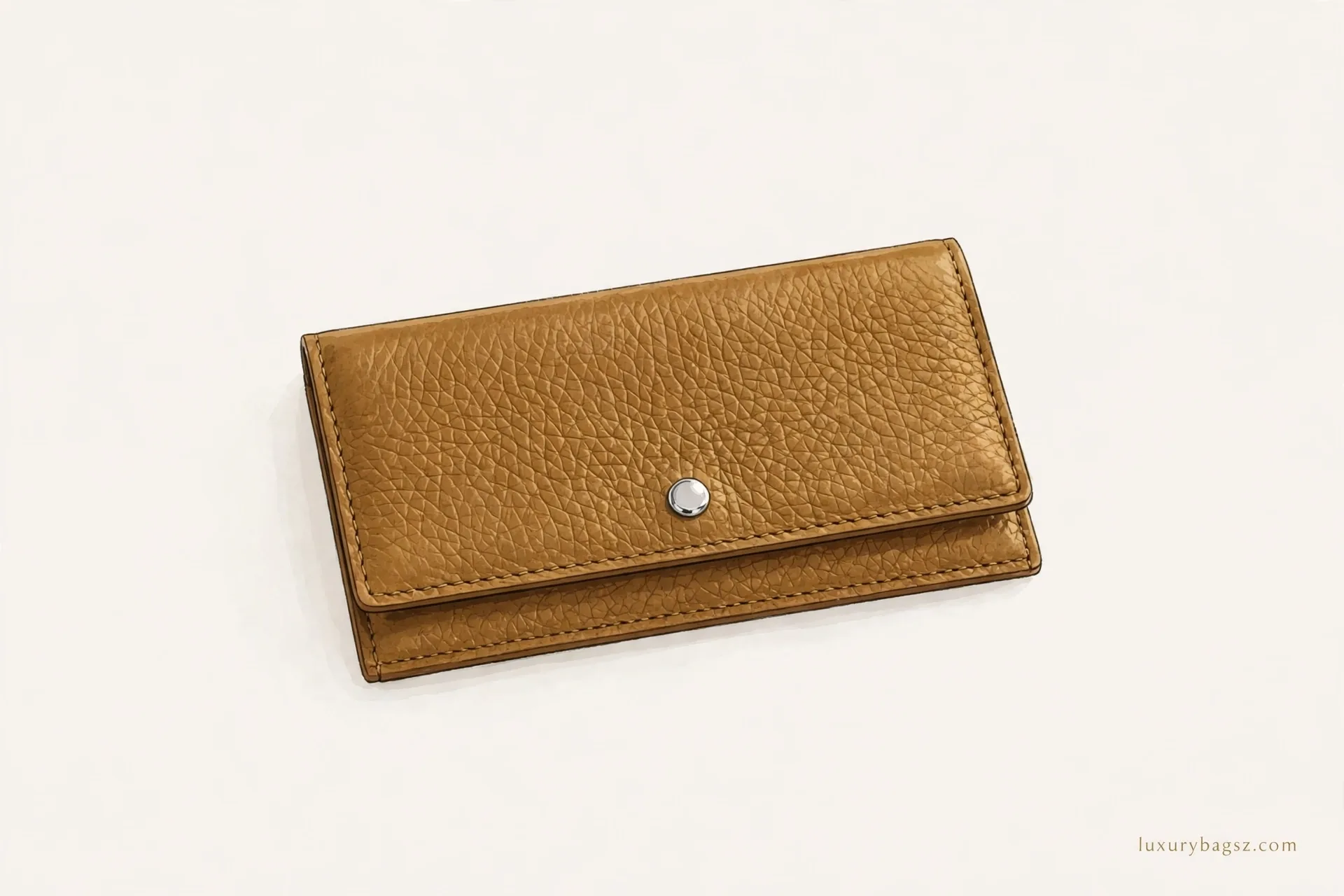
The Hermès Calvi is a slim leather card holder with a snap closure and two card pockets. It is made to carry cards and folded notes, not coins, not a phone, and not a full wallet load.
It is not a bifold wallet, and it is not a coin purse. It opens to reveal two pockets, one on each side, and it closes with a single palladium snap. That is the whole design, and its simplicity is the point.
Hermès lists the Calvi at 7 cm wide by 10.5 cm tall, or 2.8 by 4.1 inches. The brand warns that handmade dimensions may vary slightly, so a millimetre or two of difference is normal, not a flaw.
In practice, the Calvi suits someone who carries a handful of cards and a few folded notes. If you still carry coins, receipts, keys, and a dozen loyalty cards, it will feel too small, and you should know that before you buy.
Key Takeaways
- The Calvi is a slim snap-closure card holder with two card pockets, not a bifold wallet.
- Hermès lists it at 7 x 10.5 cm, with a palladium snap and a leather lining.
- Epsom is the most commonly listed leather, with Box, Swift, Evercolor, and exotic versions also reported.
- The official listing describes two card slots, not a fixed card count, and reviewers disagree on how many cards fit in practice.
- Hermès issues no authenticity cards as a general rule, so a card with a Calvi is a red flag, while a missing card proves nothing.
- A Calvi is a good first Hermès leather piece, but a poor choice for anyone who needs coins, cash bulk, or a phone pocket.
Part 1: What the Calvi Card Holder Is
The Calvi is one of Hermès’s smallest leather goods, and one of its most copied ideas. It is a flat, rectangular card case that folds in a clever way, so two pockets sit back to back inside a single snap-closure cover.
When closed, it looks like a small leather envelope with one snap. When open, it shows two pockets that face opposite directions, which keeps your most-used cards apart from the rest. That layout is simple, but it works well in daily use.
Hermès describes the Calvi as an everyday essential, built around an interplay of leather folds. That wording matters, because the Calvi has no zip, no coin pocket, and no extra flap. What you see is what you get, and there is nowhere to hide clutter.
The Calvi is often bought as a first Hermès piece, or as a companion to a small bag. It fits inside a mini bag, a jacket pocket, or a coat pocket without adding bulk. It also works as a slim pocket carry on days when you leave a bag at home.
It is worth saying plainly what the Calvi is not. It is not a wallet replacement for everyone, and sellers who call it one are overselling it. It is a card holder, and it does its one job very well.
Part 2: Design and Build
The Calvi is built from folded leather, stitched at the edges, with a single snap on the front flap. The snap is palladium-plated on current listings, which gives a cool silver tone that suits most leather colours.
Inside, the lining is usually Swift calfskin on Box versions, and a matching or contrasting leather on other versions. The lining is smooth, so cards slide in and out without catching, which matters when you are paying at a till.
Stitching on a genuine Calvi is neat, even, and slightly angled, in a thread colour that matches or complements the leather. Uneven stitching, loose threads, or glue showing at the edges are all warning signs on the pre-owned market.
There is no hardware on the Calvi apart from the snap. There is no lock, no clasp, no chain, and no zip pull to check, which makes the leather, the stitching, and the stamp the main things to judge.
The Calvi has no visible logo on the outside. The Hermès name is stamped discreetly inside, in small blind lettering, rather than printed in large letters. If you want a loud logo, this is the wrong piece, and that quiet look is part of its appeal.
Over time, the leather softens slightly and the pockets ease, which is normal for a well-made card holder. A Calvi that stays stiff forever has probably never been used, while one that is stretched out of shape has probably been overfilled.
Part 3: Dimensions and Size in Real Life
Hermès lists the Calvi at 7 cm wide and 10.5 cm tall, which converts to about 2.8 by 4.1 inches. That size is just larger than a standard credit card, which is why cards fit with a small margin all round.
Some resellers list slightly different numbers, and some list the Calvi Duo at 10.5 by 7.3 by 1.5 cm instead. Those are different models, not errors, but careless listings do mix them up, so always check which model a measurement belongs to.
Handmade variation also plays a part, and Hermès says so itself on its own product pages. A Calvi that measures 7.1 cm instead of 7 cm is not fake on that evidence alone, and a perfect measurement is not proof of authenticity either.
In a pocket, the Calvi feels flat when it holds four to six cards, and noticeably thicker once you pass eight or ten. That thickness is the real size limit, not the printed dimensions, because a bulging Calvi stops looking slim.
In a small bag, the Calvi is easy to find and easy to grab, which is a real advantage over a long wallet. In a large tote, it can sink to the bottom, so pairing it with a small pouch or an inner pocket helps.
If you wear slim trousers, the Calvi works in a back pocket or a jacket pocket, but a fully loaded one will print through thin fabric. Half-loaded is the sweet spot for pocket carry, and it keeps the leather in better shape too.

Part 4: Leathers Used for the Calvi
Epsom calfskin is the leather most often listed for the Calvi, and it is the safest default choice. It has a small, regular, machine-printed grain, a dry hand, and a firm shape that holds the Calvi’s flat profile well.
Epsom is also forgiving in daily use, because its printed grain hides light marks better than smooth leather. It does not develop a deep shine with wear, which some buyers love and others find a little flat, so taste matters here.
Box calfskin is the glossy, smooth alternative, with a deep colour and a firm, round hand. Box looks dressier than Epsom, but it shows scratches and scuffs more readily, so it suits careful owners and special occasions.
Swift calfskin appears as a lining on some versions, and as the main leather on others. Swift is soft, smooth, and slightly supple, which feels lovely in the hand, but it can mark more easily than Epsom in a pocket full of keys.
Evercolor calfskin is another version reported for the Calvi, with a fine grain and a soft, flexible feel. Evercolor sits between Epsom and Swift in character, offering a little more give without losing structure entirely.
Mysore goatskin is reported in older Calvi listings, and it is worth naming because buyers still search for it. Mysore is a grained goat leather, and its availability varies by season, so do not assume a current boutique will stock it on demand.
Exotic versions, including alligator and other skins, appear in rare listings at far higher prices. Those pieces are not the standard Calvi, and their care, legality, and resale rules differ, so treat any exotic claim with extra checks.
Sources disagree on which leathers are currently in production, because Hermès rotates small leather goods by season and region. The draft rule here is simple: trust the listing in front of you, not a claim that every leather is always available.
For a first Calvi, Epsom is the practical pick, while Box is the dressy pick and Swift is the soft pick. There is no wrong leather, only a wrong match between leather and lifestyle, and that match is worth thinking about before paying.
Part 5: Colours and Finishes
The Calvi comes in a wide range of Hermès colours, from neutrals like black, gold, and etoupe to brights like orange, pink, and blue. Neutral colours are easier to resell, while bright colours are easier to spot inside a dark bag.
Gold, the warm tan-brown shade, is one of the most commonly listed Calvi colours on the pre-owned market. It pairs with most bags, hides wear well, and suits both Epsom and Box versions without looking fussy.
Black is the safest colour for work and travel, but black Epsom can look plain in photos, and black Box can show dust and fingerprints. If you buy black, check the leather in daylight, not just under shop lights.
Two-tone and Verso versions, with one colour outside and another inside, appear from time to time. These are fun, and they make the pockets easy to tell apart, but they can be harder to match to a future buyer if you resell.
Special editions, including printed and patterned versions, also exist, but they are not the core Calvi range. A patterned Calvi is a style choice, not a better card holder, and patterns can date faster than a plain colour.
Colour names matter on the pre-owned market, because a wrong colour name can hide a wrong price. Ask the seller to name the colour from the listing or receipt, and compare it with photos, rather than trusting a vague word like tan or brown.
Contrast stitching appears on some versions, usually in a pale thread against a darker leather. That stitching is a design detail, not a flaw, but it does make any uneven stitching easier to see, which helps when you are checking a used piece.
Part 6: Prices, Dated Single Listings Only
Hermès prices for the Calvi vary by region, leather, and season, and no single number tells the whole story. The figures below are single listings found on 1 November 2026, not averages, and they will change.
On the Hermès United States site, an Epsom Calvi was listed at $460 on the search date. That is a boutique list price for one leather in one region, not a global price, and it excludes any tax or shipping differences.
On the Hermès United Kingdom site, a Box calfskin Calvi was listed at £480 on the same date. Box costs more than Epsom in that listing, which matches the usual pattern, but the gap varies, so do not treat it as fixed.
On the Hermès Australia site, an Epsom Calvi was listed at A$740 on the same date. Australian luxury prices often look higher in local currency, and currency conversion alone does not make one region a bargain once duties and travel are counted.
On the pre-owned market, a dark brown Epsom Calvi from 2019 was listed at IDR 6,695,000 on Hunt Street, and marked as not available. That is one sold-style listing in one currency, not a market rate, and it shows how much resale prices depend on condition.
An older PurseBlog review quoted $340 for an Epsom Calvi and $465 for an Epsom Calvi Duo. Those are older prices from that review, not current prices, and they are useful only to show how much small leather goods prices have risen since then.
A 1stDibs listing for a Calvi Duo in Swift was priced at $875, which is a Duo price, not a Calvi price. Mixing Duo and Calvi prices is one of the most common pricing errors in articles about this piece, so keep the models apart.
Exotic Calvi versions, when they appear, are priced far above standard leather versions. If an exotic Calvi is priced like a standard Epsom one, that is a warning sign, not a bargain, and it deserves a professional check.
The honest pricing rule is this: check the current boutique price in your own region, then check recent sold listings for the same leather and colour. Anything else is guesswork dressed up as research.
Part 7: What Fits, and What Does Not
Hermès lists the Calvi with two credit card slots, and that is the official description. It does not state a fixed number of cards, and any article that gives one number as a fact is going beyond the official listing.
Reviewers disagree openly on capacity, and that disagreement is worth stating plainly. One review claims up to eight cards per side, or sixteen in total, while another guide says four to five cards per side is the comfortable limit.
A third claim, from a review round-up, puts the Calvi at an eighteen-card capacity. Those three claims cannot all describe comfortable daily use, and the gap comes from different ideas of what counts as fitting: squeezed in, or carried well.
In practice, most owners find six to ten cards comfortable, with folded notes tucked behind the cards on one side. Thin cards fit more easily than embossed cards, and business cards are thinner still, so your own card mix changes the answer.
What fits well: bank cards, credit cards, a driving licence, a transit pass, business cards, and a few folded notes. A transit pass on the outer side is handy, because you can tap it without opening the holder fully.
What fits poorly: coins, which have no pocket and will stretch the leather or fall out, and keys, which scratch the lining. A phone does not fit at all, and trying to force one in will damage the snap and the stitching.
Receipts are a grey area, because one folded receipt is fine, but a wad of receipts turns the Calvi into a lump. If you keep receipts, clear them out daily, or carry a separate pouch for paper.
The capacity rule that protects the leather is simple: if the snap closes without force, the load is fine, and if you have to press hard, it is too full. A Calvi that is always overfilled will stretch, and stretched leather does not spring back.


Part 8: Calvi, Calvi Duo, Bastia, and Other Small Leather Goods
The Calvi Duo is the closest relative of the Calvi, and the easiest to confuse with it. The Duo adds a snap pocket inside, so it holds roughly what a Calvi plus a Bastia would hold, plus cash or a few more cards.
PurseBlog’s Calvi Duo review makes that comparison directly, and it notes a trade-off: the snap flap takes up a little space on one side, so a fully loaded Duo holds slightly less on that side than a fully loaded Calvi. The Duo is also slightly larger and bulkier when closed.
The Bastia is a different idea altogether, even though it looks similar from the outside. It is a single-piece, origami-style coin purse with one snap, made for coins and tiny items, not for cards.
If you carry coins, a Bastia plus a Calvi is a classic pairing, and it keeps coins away from your cards. If you never carry coins, a Bastia adds nothing, and a Duo may be the tidier single-piece answer.
The Calvi Duo Compact is a smaller Duo variant reported in resale listings, at about 10 by 7 cm. It is not the same as the standard Duo, and its capacity is lower, so check measurements before assuming a Compact will hold what a Duo holds.
Other Hermès small leather goods, like the Bearn and Constance wallets, are full wallets with many card slots and note pockets. They suit buyers who want one piece for everything, while the Calvi suits buyers who want the smallest piece that still works.
Choosing between a Calvi and a larger wallet is really a choice about how much you carry. If your daily load is cards and notes only, the Calvi wins on size, and if your load includes coins and receipts, a larger wallet wins on function.
A guide to choosing a Hermès crossbody bag size is useful here, because a Calvi is often bought to fit a small crossbody. Check the bag’s inner pocket before you buy, not just the bag’s headline size.
Part 9: How to Use and Carry the Calvi
Use one pocket for everyday cards and the other for rarely used cards, and you will stop fumbling at the till. Put your payment card and transit pass on the side you open first, and keep ID and backup cards on the other side.
Folded notes sit best behind the cards, not in front of them, because notes in front make the snap harder to close. Fold notes in thirds, not in half, so they sit flat and do not push the leather out of shape.
When you pay, open the Calvi fully rather than yanking a card from a half-open pocket. Yanking bends cards and strains the stitching at the pocket mouth, while a full open keeps the leather flat and the cards safe.
In a bag, keep the Calvi in an inner pocket or a small pouch, so it does not rub against keys, coins, or a zip. Leather-on-metal rubbing is the fastest way to scuff a Calvi, and it happens inside bags more than in pockets.
In a pocket, keep the Calvi away from keys and loose change, for the same reason. A jacket pocket is kinder than a trouser pocket, because it is roomier and puts less pressure on the snap when you sit down.
For travel, the Calvi works as a slim document holder for a hotel key card, a transit card, and a backup bank card. It is not a passport holder, and it will not protect a boarding pass, so do not ask it to do those jobs.
If you switch bags often, the Calvi is easy to move, which is one of its quiet strengths. A larger wallet needs a bag check every time, while a Calvi moves in seconds, and that small saving adds up over a busy week.
At a restaurant, a Calvi is discreet on the table, because it lies flat and opens without a zip or a flap in the way. That discretion suits people who dislike drawing attention when they pay, and it suits small tables too.
At an airport, keep your Calvi in a jacket pocket rather than a tray-bound bag, so your ID and bank card stay with you through security. Just remember to take it out of the pocket before a body scan if the staff ask you to empty your pockets.
For evenings out, a Calvi plus a phone is often the whole carry, which is freeing after years of larger bags. A small clutch or a coat pocket holds both, and you stop worrying about a bag for the rest of the night.

Part 10: Care for Leather, Colour, and the Snap
Care for a Calvi starts with clean, dry hands and a habit of wiping it with a soft, dry cloth. That simple step removes dust and skin oils before they dull the leather, and it takes less than a minute.
Water is the main enemy, especially for Box and Swift, which mark more readily than Epsom. If a Calvi gets wet, blot it gently with a dry cloth and let it dry naturally, away from heat, and never use a hairdryer on it.
For routine leather care, a gentle conditioner made for fine calfskin can help, but test it on a hidden spot first. A guide to Saphir Renovateur explains how that well-known conditioner is used, and the same caution applies here: little and often beats a heavy coat.
Suede versions, if you own one, need a different routine, and a guide to using a suede brush covers the brushing habit that keeps suede nap even. Do not use a leather conditioner on suede, because it will flatten the nap and darken the colour.
The snap needs care too, because a gritty snap wears faster than a clean one. Wipe the snap area with a dry cloth, and close the snap straight, not at an angle, so the two halves meet evenly every time.
Sunlight fades colour over weeks and months, not in a single afternoon, so do not leave a Calvi on a car dashboard or a sunny windowsill. Heat dries leather as well, so radiators and car boots in summer are both bad storage spots.
Scratches on Epsom are usually light and can be softened with a gentle rub, while scratches on Box are more visible. Deep scratches on any leather are hard to fix at home, and a professional leather restorer is a better bet than a DIY dye.
Part 11: Storage at Home and on the Move
Store a Calvi flat, empty or lightly loaded, in its dust bag or a soft pouch. Storing it stuffed full will stretch the pockets, and storing it folded or bent will crease the leather in the wrong place.
Keep it away from other leather goods that could transfer colour, especially dark or brightly dyed pieces. Colour transfer is slow, but it happens when two leathers sit pressed together in a warm bag for weeks.
A cool, dry drawer is better than a bathroom cabinet, because humidity and temperature swings age leather faster. If your home is humid, a small silica pouch nearby helps, but keep it outside the Calvi itself.
When travelling, pack the Calvi in a handbag inner pocket, not loose in a suitcase, where it can be crushed. A crushed Calvi usually recovers if emptied and rested flat, but repeated crushing will weaken the snap area.
The same storage logic that protects larger leather goods applies here, and a guide to storing a Hermès Kelly bag sets out the dust bag, stuffing, and humidity habits in full. Scale those habits down, and they work for a Calvi too.
Rotate your Calvi with another holder if you own two, because daily use wears any one piece faster. Rotation also lets the leather rest flat between uses, which keeps the shape truer over years.
If you stop using a Calvi for a season, empty it, wipe it, and store it flat in its dust bag. Check it every few months, because leather stored and forgotten can dry out, and a quick wipe and airing prevents that.
Part 12: Buying New, and Buying Pre-Owned
Buying new from a Hermès boutique gives you the full choice of current colours and leathers, plus a proper receipt and a dust bag. Stock varies by store and season, so a colour you want may need a wait or a different store.
Boutique staff can show you the leather options in person, which matters more for a Calvi than for a bag, because the leather feel is the whole product. Ask to handle Epsom and Box side by side before you decide, if both are in stock.
Pre-owned buying opens up discontinued colours and older leathers, often at a lower price than boutique. It also opens up fakes, so the checks in the next part matter, and a seller’s good photos are not a substitute for them.
Wherever you buy pre-owned, ask for clear photos of the stamp, the stitching, the snap, and both pockets. A seller who refuses those photos, or who only shows one styled shot, is not a seller to trust with a luxury purchase.
Price traps are common, and the biggest one is a price far below boutique for a supposedly perfect piece. A genuine Calvi in good condition holds value well, so a bargain price usually means a flaw, a fake, or a different model.
Another trap is a listing that calls a Calvi Duo a Calvi, or a Compact a standard Duo, at a Calvi price. Check the measurements and the inner snap pocket, because those two details separate the models at a glance.
Keep your receipt and any boutique packaging, even if you buy pre-owned, because provenance helps at resale. A Calvi with a clear buying history is easier to sell than one with no history at all, even when both pieces look identical.
If you buy from a resale platform, read its buyer protection rules before you pay, not after a problem appears. Return windows, authentication options, and fee rules differ widely, and the cheapest platform is not always the safest one.
When a pre-owned Calvi arrives, inspect it in daylight within the return window, and compare it with the listing photos at once. Delays help no one, because a late complaint is harder to prove than a prompt one with dated photos.
A Calvi bought as a gift deserves the same checks as one bought for yourself, plus a gift receipt if the seller offers one. The recipient may spot a flaw you missed, and a clean return path protects both of you from an awkward conversation.
Part 13: Pre-Owned Checks, Stitching, Stamps, and the Card Trap
Start with the stitching, because it is hard to fake well and easy to see in a good photo. Genuine stitching is even, slightly slanted, and consistent in length, with no loose ends or doubled stitches at the corners.
Next, check the blind stamp inside, which shows a craftsman mark and a year letter. The stamp should be crisp but not deep, and the year letter should match the seller’s claimed age, so ask what year the seller claims and compare.
The snap is the third check, because a genuine palladium snap sits flush and closes with a clean click. A loose snap, a brassy tone under worn plating, or a snap that catches at an angle all deserve a closer look.
Leather grain is the fourth check, because Epsom has a regular printed grain, Box is smooth and glossy, and Swift is soft and fine. A grain that looks printed on a piece claimed as Box, or smooth on a piece claimed as Epsom, is a mismatch worth questioning.
The card trap is the most important warning in this guide, so read it twice. Hermès issues no authenticity cards as a general rule, so a card offered with a Calvi is a red flag, not a bonus, and a missing card proves nothing on its own.
Sellers who lean on a card, a certificate, or a fancy box as proof are selling paper, not leather. Judge the Calvi itself, through stitching, stamp, snap, grain, and overall feel, and get a professional opinion if any check feels off.
A guide to spotting a fake Hermès Evelyne bag covers the same habits in bag form, and the mindset transfers directly: no single check proves authenticity, and several small doubts add up to a no.

Part 14: Who Should Buy a Calvi, Who Should Not, and Common Mistakes
The Calvi suits minimal carriers, small-bag owners, and anyone who wants a first Hermès leather piece without a wallet price. It also suits travellers who want a slim holder for hotel, transit, and bank cards in one flat piece.
It suits gift buyers too, because it is unisex, one-size, and easy to choose in a neutral colour. A Calvi in black or gold Epsom is a safe gift, while a bright exotic version is a gamble unless you know the recipient’s taste well.
The Calvi does not suit coin carriers, receipt hoarders, or anyone who needs a phone pocket, a key pocket, and a note pocket in one piece. If that is you, a larger wallet or a Calvi plus a Bastia will serve you better than a stretched Calvi.
It also does not suit buyers who want a visible logo, because the Calvi has none on the outside. If brand display matters to you, say so honestly, and choose a piece that shows it, rather than resenting a quiet design.
Common mistakes include overfilling from day one, which stretches the pockets before the leather has settled. Start with four to six cards, add more slowly over weeks, and let the leather ease rather than forcing it.
Another mistake is buying the cheapest listing without checking the model, leather, or stamp. A Duo priced as a Calvi, a worn Box piece priced as mint Epsom, and a fake with a card are all listings that punish haste.
The final mistake is treating the Calvi as an investment first and a tool second. It holds value reasonably well in good condition, but it is not a guaranteed profit piece, and buying it to use and enjoy is the sounder reason.

Part 15: Calvi Myths: The Wallet Label and the Card Count
Many guides call the Calvi a wallet, and that single word misleads buyers. A wallet implies coin storage, note pockets, and room for bulk, while the Calvi offers none of those, and buyers who expect them end up disappointed.
Other guides give a single card number as if Hermès had published it, and that number then gets copied across the web. Hermès publishes two slots, not a count, so any fixed number is a reviewer’s experience, not a brand fact.
A third gap is pricing, where guides quote one price without a region, leather, or date. A United States Epsom price, a United Kingdom Box price, and an Australian price are three different facts, and blending them into one average helps nobody.
Colour gaps are common too, because guides list colours without saying which are current and which are discontinued. A colour that was easy to find in 2019 may be rare now, and rarity changes both price and waiting time.
Leather gaps follow the same pattern, with guides claiming every leather is always available. In reality, Hermès rotates small leather goods by season, so Mysore or a special finish may simply not be in stores when you ask.
Another myth is that a Calvi needs breaking in like a pair of shoes. It softens slightly with use, but it should feel usable from day one, and a Calvi that will not close is overfilled, not waiting to break in.
Some sellers claim a Calvi is unisex in a way that implies one size fits every pocket. The Calvi is unisex in style, but pocket fit still depends on your clothes, your bag, and how many cards you carry, so try it in your own pocket first.
A related myth is that a more expensive leather is always tougher, which is not true for the Calvi. Box looks more luxurious than Epsom, but it marks more easily, while Epsom looks plainer and survives pocket life better.
Guides also underplay the snap, treating it as a detail rather than a wear point. A snap that is forced shut over a bulging load wears faster than any leather, and snap repair is a specialist job, not a home fix.
Pre-owned guides sometimes treat a dust bag as proof of authenticity, which it is not. Dust bags are easy to copy and easy to buy separately, so a dust bag adds presentation value only, and never replaces a stamp and stitching check.
The card myth deserves repeating, because it is the costliest mistake in this market. A printed card, a certificate, and a glossy box are all easy to fake, while good leather, neat stitching, and a correct stamp are much harder to copy well.
What this guide adds over thinner rivals is plain disagreement, stated rather than smoothed over. Capacity, leather availability, and prices all conflict across sources, and a buyer who knows that shops more carefully than one who does not.
If you read another Calvi guide after this one, test it against three questions. Does it name a region and date for its prices, does it separate the Calvi from the Duo, and does it warn you about the card trap?
A guide that passes all three is a guide you can trust for the basics. A guide that fails any of them may still have nice photos, but its facts need checking elsewhere before you spend money.
Frequently Asked Questions
What is a Hermès Calvi card holder?
The Calvi is a slim leather card holder with a snap closure and two card pockets. It carries cards and folded notes, and it is not a bifold wallet, a coin purse, or a phone case.
How big is the Calvi?
Hermès lists the Calvi at 7 cm wide by 10.5 cm tall, or 2.8 by 4.1 inches. Handmade variation of a millimetre or two is normal, and the brand says so on its own product pages.
How many cards does a Calvi hold?
Hermès lists two card slots, not a fixed card count, and reviewers disagree on the practical total. Most owners find six to ten cards comfortable, with more possible if the cards are thin and the holder is not forced shut.
Is the Calvi a wallet replacement?
For minimal carriers, yes, because cards and a few folded notes are all they need. For coin carriers and receipt keepers, no, because the Calvi has no coin pocket and no room for paper bulk.
What leathers does the Calvi come in?
Epsom is the most commonly listed leather, with Box, Swift, Evercolor, Mysore in older listings, and rare exotic versions also reported. Availability varies by season and region, so check the listing in front of you.
How much does a Calvi cost?
Prices vary by region and leather, and single listings found on 1 November 2026 include $460 for Epsom in the United States, £480 for Box in the United Kingdom, and A$740 for Epsom in Australia. Those are single listings, not averages, and they change.
Should a Calvi come with an authenticity card?
No, and this matters. Hermès issues no authenticity cards as a general rule, so a card with a Calvi is a red flag, while a missing card proves nothing. Judge the leather, stitching, stamp, and snap instead.
What is the difference between the Calvi and the Calvi Duo?
The Duo adds an inner snap pocket, so it holds roughly what a Calvi plus a Bastia would hold, plus cash. It is slightly larger and bulkier when closed, and its snap flap takes a little space on one side.
Can the Calvi fit in a mini bag?
Yes, in most cases, because it is flat and only just larger than a credit card. Check the bag’s inner pocket rather than its headline size, and keep the Calvi away from keys and coins inside the bag.
Is the Calvi worth buying?
It is worth buying if you carry cards and notes only, value quiet design, and will keep it lightly loaded. It is not worth buying if you need coins, bulk cash, or a full wallet, because no card holder can do those jobs well.
Summary
The Hermès Calvi is a slim, snap-closure card holder with two pockets, listed at 7 by 10.5 cm, and made for cards and folded notes. It is not a bifold wallet, it is not a coin purse, and it is at its best when it is lightly loaded and well cared for.
Choose Epsom for everyday toughness, Box for dressy shine, or Swift for softness, and choose a neutral colour if resale matters to you. Check single-listing prices in your own region, and do not trust a global average that hides leather, colour, and condition differences.
Buy pre-owned with care, checking stitching, stamp, snap, and grain, and remember the card trap: Hermès issues no authenticity cards as a general rule. A card is a red flag, a missing card proves nothing, and the leather itself is the evidence that counts.
If your daily load is cards and notes only, the Calvi is one of the simplest and most satisfying Hermès pieces you can own. If your load is bigger, buy a bigger wallet, and let the Calvi be the right tool for the right job.