

How to Store a Hermès Silk Scarf Without Creases
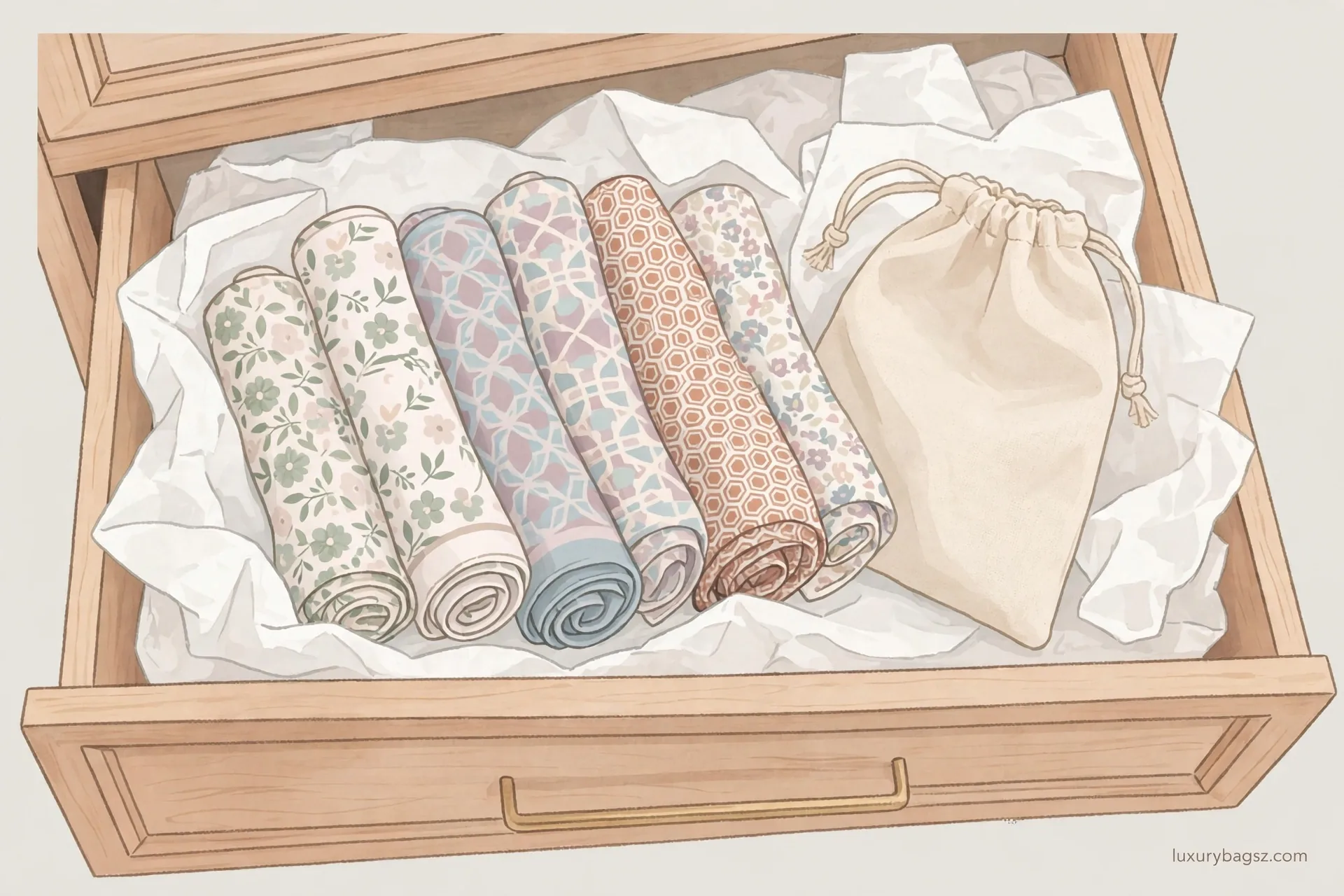
Storing a Silk Scarf Without Creases in Brief
A silk scarf creases for one simple reason: it is left folded, pressed, knotted or squeezed in the same shape for too long. The fix is equally simple, and it starts before the scarf ever reaches a drawer. Untie it fully, let it air for a short while, smooth it flat with your hands, and then roll it loosely around a core of plain, acid-free tissue paper.
Store the roll in a cool, dark, dry drawer or breathable box, never in a sealed plastic bag, never in a vacuum bag, and never under a pile of heavier clothes. For short periods, hanging a scarf over a wide, padded bar is fine and can even relax light creases. For months at a time, hanging is the riskier choice, because gravity slowly stretches the weave.
Fold only loosely if you must fold, change the fold lines every few months, and keep scented products, mothballs, sunlight and damp away from the silk. Light creases usually relax with hanging and gentle steam. Hard, set creases may need a low-heat press through a cotton cloth, and heat-shiny or scorched silk should go to a specialist rather than to a hotter iron.
Most guides to storing a silk scarf give the same three tips — fold it, use tissue paper, keep it out of sunlight — and then stop. That advice is not wrong, but it leaves out almost everything that decides whether a scarf comes out of storage looking fresh or tired. It does not say what to do with the knot you wore all day, whether rolling really beats folding, or how a 90 cm silk twill carré, a soft cashmere-blend shawl and a narrow twilly differ in storage.
And it rarely says what to do when the damage is already done: a scarf folded in the same lines for two years, a shawl stretched on a hook, a carré ironed directly and left shiny.
This guide fills those gaps, from the minute you take a scarf off to the day you pack it for a trip, and it says plainly where guides disagree. The focus is the classic Hermès silk formats, but every method here works for any good silk scarf. One warning up front: no storage method rescues a scarf put away dirty, damp or still knotted. Those three conditions cause more lasting damage than any drawer or hanger ever will.
Table of Contents
Why Silk Creases, and Why Some Creases Stay
Silk is a natural protein fibre. Unlike a synthetic fabric, which springs back when pressure is removed, silk holds the shape it is left in. Press it into a sharp fold and leave it there, and the fibres along that line compress and remember the fold.
Leave the same fold for months and the line can become permanent; in the worst cases the fibres weaken and the fabric thins there, which is why very old scarves sometimes split along old fold lines.
Time matters as much as pressure: a scarf folded sharply for an evening usually relaxes overnight, while the same scarf folded sharply for a year may not. Varying fold lines spreads the stress so no single line takes the full load, season after season.
Three other forces work alongside pressure. Heat bakes a fold into silk. Moisture makes a scarf dry into whatever shape it was stored in, and damp silk invites mildew. Friction wears silk whenever it rubs a rough drawer edge, a zip or a buckle. Good storage removes pressure, heat, moisture and friction at the same time.
Sort creases into three kinds, because they need different fixes, covered in the getting-creases-out section. Soft creases, from a day’s wear or a loose fold, usually relax with hanging and a little steam.
Set creases, from months in one fold, need careful steam and sometimes a gentle press through a cloth. Damage — shiny patches from a hot iron, thinned lines from years of folding, a weave distorted by hanging — does not steam out, and more heat usually makes it worse.
Before You Put It Away: Untie, Air, Check
The storage routine starts the moment you take the scarf off. Three short steps, taking about two minutes, prevent most creases later blamed on storage.
Untie it fully. If you have spent the day tying a silk scarf into a neck knot, a bow or a head wrap, undo every knot gently, working the silk free rather than pulling the ends apart. A knot left in overnight starts to set a crease exactly where the silk gripped itself, and a knot left in for weeks — in a drawer, on a hook, or still wrapped around a bag handle — sets a hard line that is difficult to relax.
The same applies to a twilly: take it off the bag handle rather than leaving it wrapped tight for months, when the spiral itself becomes a crease pattern.
Let it air. Lay the scarf flat for an hour or so, or drape it loosely over a clean chair back, before putting it away. Silk picks up body heat, moisture and the day’s smells, and storing it immediately traps all three. Airing also lets light creases from the day’s knots relax on their own. Use a shaded, room-temperature spot, never direct sunlight, a radiator or a damp towel.
Check it before it disappears. Look over the scarf in good light for stains, snags, loose threads and moth signs such as tiny holes or fine webbing. A stain stored for a season becomes much harder to remove, and moths in a closed drawer spread to neighbouring scarves.
Do not scrub a stain out at home on a printed silk carré; its dyes and hand-rolled edges damage easily. Take it to a cleaner who handles silk, and store it only once clean and fully dry. Leave a loose thread alone rather than pulling it, which can run a line across the fabric.
Only when the scarf is untied, aired, checked, clean and dry should it go into storage. Everything after this part assumes that starting point.
Roll or Fold? The Decision That Matters Most
Ask ten guides whether to roll or fold and you will get ten confident answers, most incomplete. Both methods work, for different scarves and lengths of time, and rolling wins for printed silk kept for months, large formats, and scarves you want crease-free.
Rolling avoids sharp folds altogether: a loosely rolled scarf has no single line under pressure, so no fold line sets. Rolls stored upright can be lifted out one at a time without disturbing the rest, unlike a stack of folded scarves. Rolling suits the 90 cm carré, large shawls and heavily printed scarves, where fold lines cut across the pattern most visibly.
Its weakness is space: a roll is bulkier than a flat fold, and a roll made too tightly creates spiral tension that can leave soft ridges. Roll firmly enough to hold its shape, loosely enough to slide a finger under the outer layer.
Folding suits short-term storage and small formats. A twilly folds or rolls equally well, and a 70 cm square folded loosely once or twice fits a shallow drawer that a roll might not. It also suits a scarf worn weekly, because a fold undone every few days never gets time to set.
Its weakness is the obvious one: every fold is a line under pressure, and the same fold repeated for months becomes a set crease. Fold loosely, cushion with tissue, and change the fold lines regularly — the folding section gives the method.
Hanging divides guides more than any other method. Covered in full in the hanging section, the short version is: hanging is excellent for a day or two, when gravity helps light creases drop out, and risky for months, when the same gravity slowly stretches the weave, especially in heavier shawls. Treat hanging as a resting place and a crease remedy, not as long-term storage.
The practical answer: roll the carrés and shawls you keep for months, fold loosely the pieces you wear every week, and hang a scarf for a day or two when it needs to relax.
How to Roll a Scarf Without Creases
Rolling sounds simple, but the details decide whether the roll protects the scarf or just moves the creases elsewhere.
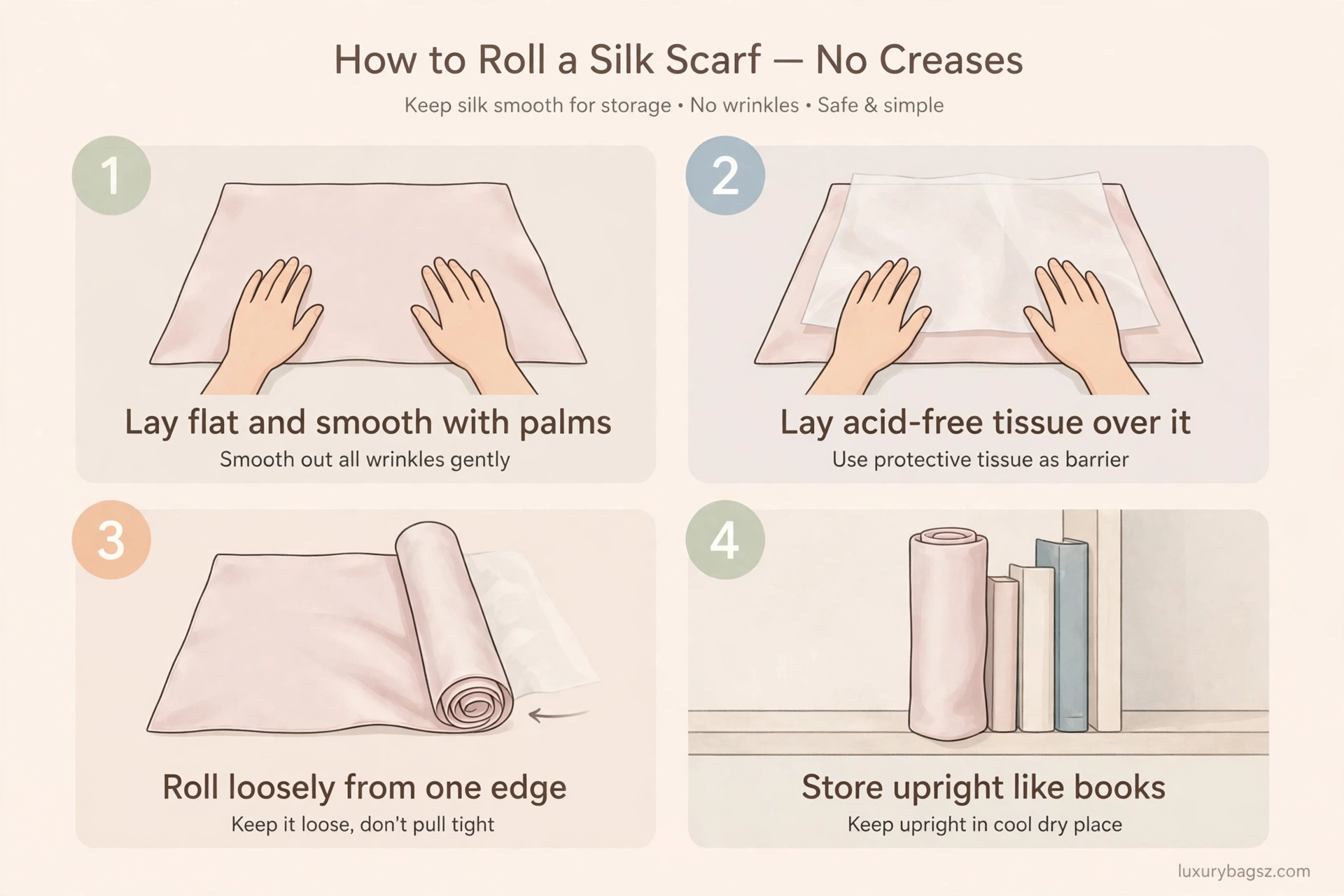
- Lay the scarf flat, face up, and smooth it gently with your palms, working from the centre outwards. Do not pull the corners to stretch it flat; silk under tension creases worse, not better.
- Lay one sheet of plain, white, acid-free tissue paper over the scarf, or place a tissue core at one edge if rolling around a tube. The tissue paper section explains why acid-free and uncoloured matter.
- Start at one edge — not a corner, which makes a slipping cone shape — and roll towards the opposite edge in a slow, even roll, keeping the edges aligned so the roll stays a neat cylinder.
- Keep the roll loose: when you finish, you should be able to press it gently and feel it give, not feel a hard, dense sausage. If it feels hard, unroll and start again with a lighter hand.
- If using a tube core, use a smooth cardboard tube wrapped in tissue or muslin, never a bare plastic tube or one with a rough or printed surface. The core stops the roll collapsing flat, which would recreate a fold line. A roll without a core is still far better than a fold, so do not let the lack of a tube stop you rolling.
- Slip the roll into a breathable cotton or muslin sleeve, or lay it in a tissue-lined drawer. Do not secure it with an elastic band, which leaves a pressure line and can perish and stick to silk, or a tight ribbon. Mark it, if you must, with a loose cotton tie or a paper tag outside the sleeve.
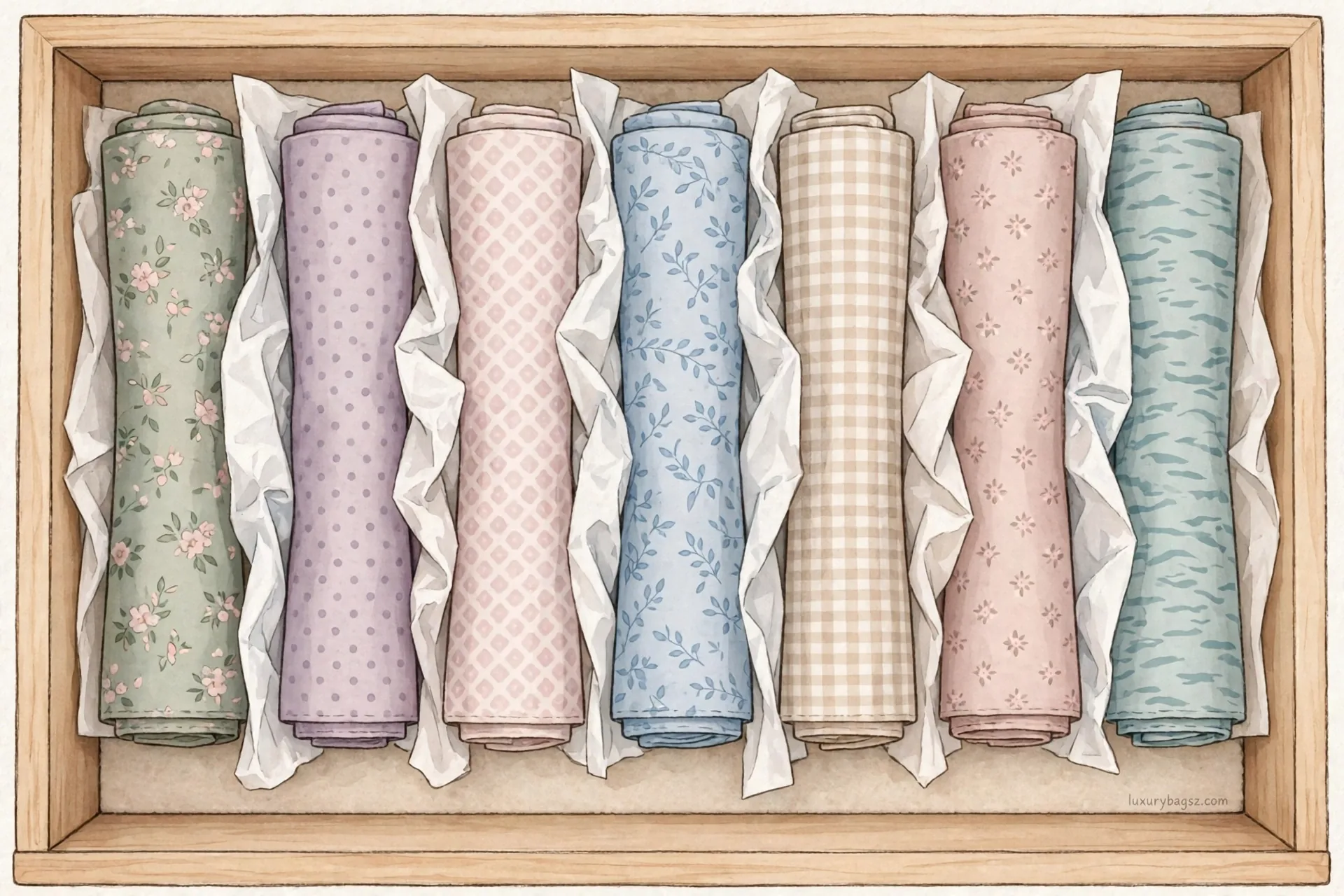
- Store rolls upright, side by side, like books, not stacked in a pile. Upright rolls take no weight from above, and you can remove one without crushing the rest. If the drawer is too shallow, lay them in a single layer with space between them, never in a compressed second layer.
A rolled carré takes more drawer space than a folded one. If space is tight, roll the scarves you care about most and fold the rest loosely, rather than squeezing every roll until the benefit is lost.

Note: this is a general silk-scarf storage guide, not a Hermès-specific video — it demonstrates folding a silk scarf to the shape of its box to keep it creaseless.
How to Fold a Scarf Without Hard Lines
If you prefer folding, or a drawer forces it, fold for softness, not neatness. A razor-sharp fold is the enemy; a soft, rounded fold is the goal.
- Lay the scarf flat and smooth it with your palms, as in the rolling section. Place a sheet of acid-free tissue over the scarf before the first fold, and another sheet between each major fold. The tissue rounds the fold slightly and stops silk pressing directly on silk, which reduces both creasing and the risk of dye transfer between layers.
- Fold in broad thirds rather than tight quarters, and keep each fold loose, like turning a page rather than creasing paper. Do not press down along the fold with your hand, a book, or any weight. The fold should be a soft bend, not a sharp edge.
- Fold along the scarf’s existing lines where you can — the lines it already had when it came in its box — rather than inventing new ones across the middle of a printed motif. Existing lines are already the least visible places to fold, and reusing them avoids adding fresh crease lines to the pattern.
- Store folded scarves in a single layer where possible, or in a shallow stack with the lightest scarves on top. Never put a folded scarf at the bottom of a heavy stack of clothes, where the weight of everything above presses its folds deeper every day.
- Change the fold lines every two to three months. Unfold the scarf, let it rest flat or hang for a day, and refold it along different lines. Some guides say every three to four months; the exact interval matters less than doing it at all, and more often is safer than less often for scarves you rarely wear. This one habit, on its own, prevents most of the permanent fold lines that collectors complain about.
- Never fold a scarf while it is damp, freshly steamed, or still warm from an iron or steamer. Let it cool and dry completely first, or the fold will set as the silk cools into its new shape.
Folding well takes a little more care than folding quickly, but the difference shows the next time you wear the scarf. A loosely folded scarf with tissue between the folds comes out with soft bends that relax in minutes. A tightly folded scarf without tissue comes out with sharp lines that need steaming.
Tissue Paper: What It Does, and What It Does Not Do
Tissue paper is genuinely useful, but for three specific reasons, not magic. It cushions folds and rolls, spreading pressure over a curve instead of a line. It separates layers of silk, so printed surfaces do not press together and transfer dye. And it absorbs a small amount of residual moisture. It does not, on its own, protect against damp, moths or light, and the wrong tissue can cause the damage it is meant to prevent.
Use plain, white, acid-free tissue sold for textile storage, not gift wrap. Coloured tissue can transfer dye, newspaper is worse — its ink transfers and its acids yellow silk — and ordinary white tissue can also yellow silk over long storage, because it contains acids and lignin. For a season, ordinary plain tissue is unlikely to cause visible harm; for years, acid-free is the safe choice, and costs very little more.
Use tissue loosely, not as a tight wrapping; a scarf swaddled tightly in tissue is under pressure again. One sheet between folds, one inside or around a roll, and one lining the drawer is plenty. Replace tissue when damp, dusty or crushed. Muslin or unbleached cotton does the same job and lasts longer. Whatever you use, keep it clean, dry and unprinted, between the silk and anything that could rub, stain or press it.
Drawer Storage That Works
A drawer is the best home for most silk scarves, provided it is the right kind of drawer, used the right way. The ideal drawer is on an inside wall, away from windows, radiators and exterior walls that run cold and damp. It is clean, dry, lined with tissue or muslin, and shallow enough that scarves sit in one layer or in upright rolls, not in a deep, compressed pile.
Empty the drawer and wipe it clean, checking for rough edges, splinters, protruding screws and sticky liner residue, all of which snag silk. Line it with tissue or muslin, then place scarves in, one per sleeve or roll, with air space between them. Do not fill every gap: a packed drawer presses creases into everything it holds and makes it hard to remove one scarf without dragging the rest across each other.
Keep the drawer for scarves and other soft, light items only — never under jeans, knitwear, belts or bags, and never sharing space with buckles, zips, keys or jewellery. One metal edge can snag a silk thread, and a snag rarely stays small.
Dividers can work if smooth and fabric-lined, but dividers that wedge a scarf into a narrow slot recreate the pressure problem; open, upright rolls in an undivided drawer are simpler and usually safer. Keep the drawer closed: an open drawer collects dust, light and spills, while a closed drawer in a cool, dark room is close to an archival box, without any special equipment.
Hanging: When It Helps, and When It Stretches
Hanging is where guides disagree most sharply, and both sides have a point, because they are usually talking about different lengths of time.
Short-term hanging — a day or two, up to a week — is genuinely helpful. Gravity pulls light creases out, which is why a scarf hung after wearing often looks better the next day, and a steamy bathroom (see the getting-creases-out section) relaxes it faster still. For tomorrow’s outfit or a rest between wears, a wide, padded bar is excellent.
Long-term hanging — months, or a whole off-season — is where the risk appears. Gravity keeps pulling once creases are out, slowly stretching the weave, most noticeably in heavier cashmere-blend shawls, and most visibly where the scarf bends over the bar, where a permanent bend or thinned line can form.
Hanging by one corner or on a hook is worse: all the weight hangs from one point. Some guides recommend hanging as the main method, because it looks tidy; others, including specialist closet advice, say to store silk folded, not hanging, to avoid stretching. This guide sides with the second group for long-term storage and the first for short rests — the disagreement is really about timescale.
If you do hang, use a wide, smooth, padded bar, never a wire hanger, sharp clip or narrow hook. Drape the scarf fully open, or folded once loosely, so weight spreads across a broad bend rather than a sharp edge. Keep hung scarves out of sunlight and away from heating vents, do not crowd them, and take a scarf down for rolled storage if it will not be worn for more than a few weeks.
Scarf Hangers, Rings and Rods: What to Buy, and What to Skip
The market for scarf storage is full of clever-looking products, most unnecessary, a few actively harmful. This part sorts them out.
Worth having. A multi-loop scarf hanger with smooth, wide, padded loops can be useful for a small collection you wear often, because it keeps scarves visible and separate without folding them. Check that every loop is smooth, with no rough seams, sharp joins or exposed metal, and that the loops are wide enough that the scarf bends over a curve, not an edge.
A wall-mounted rod or a towel bar, smooth and clean, does the same job for a few favourite scarves and costs almost nothing. A set of smooth cardboard tubes, wrapped in tissue, is the cheapest genuinely useful purchase for rolling.
Use with care. Scarf rings are for wearing, not storage: a ring left clamped on a stored scarf presses a ring-shaped line into the silk. Take rings off before storage. Clip hangers concentrate pressure on a small area, and tiered hangers press scarves against each other and make removal a friction risk.
Skip. Wire hangers, hooks for long-term storage, vacuum bags, sealed plastic boxes, and any organiser with rough wood, unfinished edges, exposed screws or sticky surfaces.
No product keeps silk wrinkle-free on its own: the method matters more, and a clean drawer with tissue beats an expensive organiser used badly. One good solution, used consistently — a drawer of upright rolls, or a short rod for favourites plus a drawer for the rest — covers almost every collection.
Storage by Format: Carré, 70 cm, Twilly and Shawl
One method does not fit every format, because formats differ in size, weight and weave.
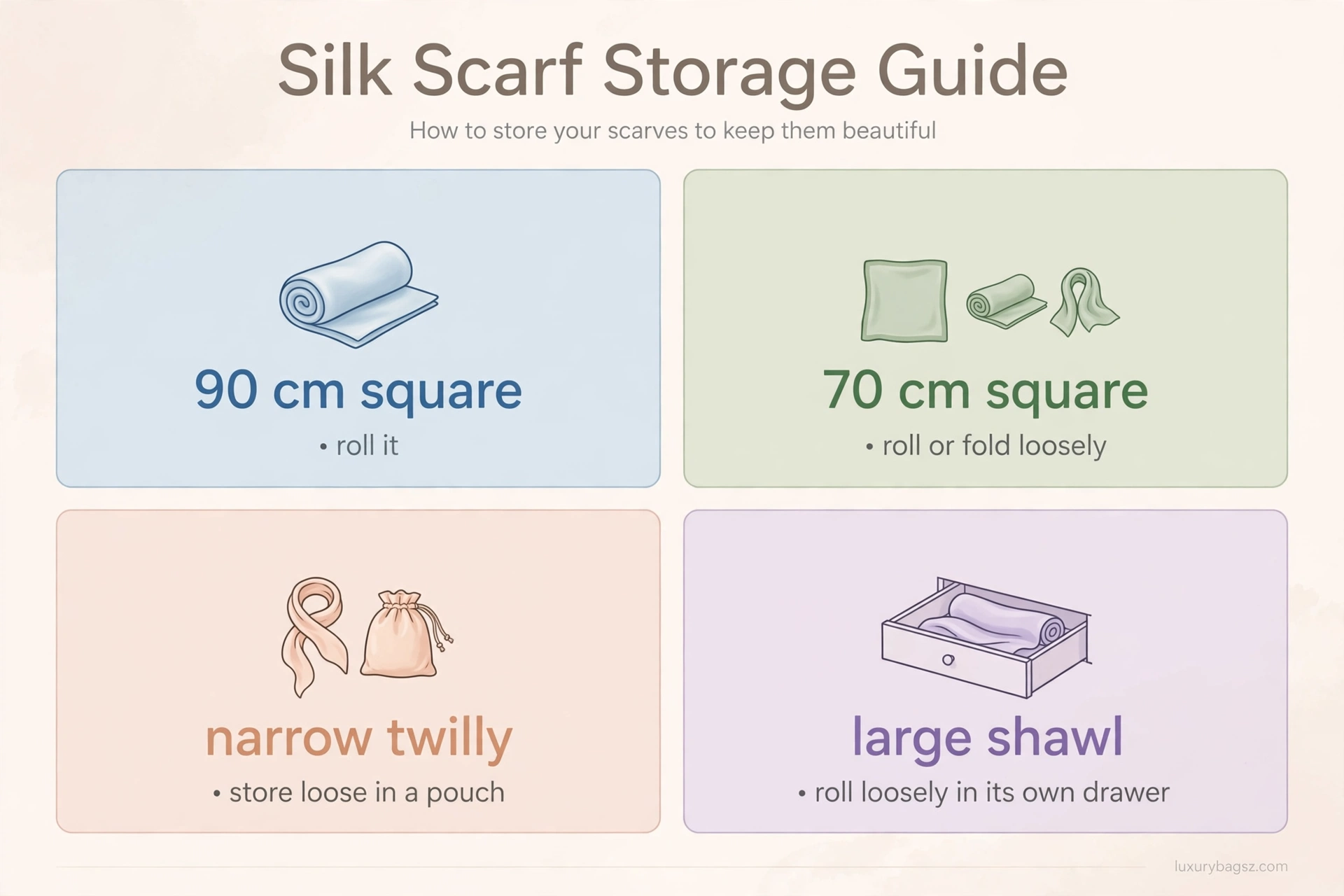
The 90 cm carré. Rolling is its best method: a carré is large enough that folding creates long, visible lines across the print, and rolling avoids both that and the slow stretch of hanging. Roll it around a tissue core and store it upright. If you fold one, fold in broad thirds with tissue between folds, and refold along different lines every few months.
The 70 cm square. Folding is reasonable here because the folds are shorter and the scarf lighter. Roll it if you have drawer depth; fold it loosely if you do not. Either way, keep it out from under heavier scarves: a small square at the bottom of a stack is easily crushed flat, and its fold lines show proportionally more when worn as a neat neck knot.
The twilly. A twilly needs the least fuss and the most discipline about one mistake: leaving it on a bag. Stored loose, rolled or folded gently in a small pouch, it keeps its shape indefinitely. Left wrapped around a bag handle for months, it takes on the spiral shape of the wrap, and the silk where it gripped the handle can shine or crease.
Unwrap it when the bag goes back into storage, and keep twillies away from bag hardware, zips and keys, which snag narrow silk faster than a broad carré.
The 140 cm shawl. Weight changes everything. A large shawl, especially a silk and cashmere blend, is heavy enough that hanging stretches it noticeably, and bulky enough that tight folding creates deep lines. Roll it loosely in a drawer or box of its own, or fold it in very broad, soft folds with generous tissue, in a single layer, with nothing on top.
Never hang it by a corner or a narrow hook, never store it under other clothes, and never use it as drawer padding: a shawl stored as padding comes out creased in the shape of whatever it was protecting.
Knowing your format also helps you choose which scarf to reach for: a guide to scarf sizes sets out the full range, and the 90 cm carré in particular rewards the rolling method described here, because its large printed field shows every fold line.
Storage by Fabric: Twill, Cashmere Blend, Muslin, Wash Silk
Fabric matters as much as format: different silks crease, stretch and react to moisture differently.
Silk twill is the classic carré fabric: smooth, slightly crisp, with a diagonal weave that gives it body. Its crispness makes fold lines sharp and visible, but the weave has spring, so it recovers well from steam and hanging. Roll twill, steam it gently when needed, and never press its hand-rolled edges flat.
Silk and cashmere blend is softer, heavier and drapier than pure twill. It creases less sharply but stretches more under its own weight, so hanging is riskier, and it pills if it rubs rough surfaces. Store blends flat or rolled in a single layer, with nothing rubbing them, and air them well before storage, since blends hold smells more than twill. Scented sachets should never touch the fabric directly.
Fine silk muslin and silk chiffon are feather-light and slip easily. They crease in fine, soft lines and recover quickly with hanging or steam, but they snag and pull more easily than twill, and a pull in muslin is hard to hide. Store them individually in sleeves, never loose where they can catch, and roll them very loosely, because a tight roll crushes their airy texture.
Wash silk is a treated silk that tolerates gentle hand washing better than traditional printed silk twill. That does not change its storage needs much: it still creases if folded sharply for months, still fades in sunlight, and still suffers in a sealed plastic bag.
The practical difference is that a soiled wash silk scarf can be freshened at home, while a printed Hermès carré should go to a professional cleaner. Do not assume a scarf is wash silk because it feels soft; check its care label, and when in doubt treat it as traditional silk.
Across all four fabrics, one rule never changes: store the scarf clean, dry, untied and loose, in the dark, and the fabric will take care of the rest.
The Storage Environment: Light, Heat, Moisture and Air
A perfect roll in a bad environment still comes out damaged. Four environmental factors decide most long-term outcomes.
Light. Direct sunlight is silk’s fastest enemy. Ultraviolet light breaks down silk protein, fades dyes and, over time, makes the fabric brittle and yellowed. A scarf left on a chair in a sunny room for a season can fade unevenly, and that fading does not reverse. Store scarves in a closed drawer or box, never display one permanently in a sunny window, and prefer a dark drawer to an open shelf even in a room without direct sun.
Heat. Keep scarves away from radiators, heating vents, hot attics and warm cars. Heat dries silk out, makes it brittle, and sets any crease the scarf is in. A stable, room-temperature spot — roughly 15 to 21 degrees Celsius, the range most careful guides agree on — is ideal. Avoid attics and basements, where temperature swings widely between seasons.
Moisture. Silk absorbs moisture from the air, which is why a damp drawer is dangerous: humidity brings mildew, musty smells and dye migration, while very dry air makes silk brittle. Most guides put the safe humidity range around 45 to 55 percent, with some saying below 50 percent and others below 60 percent; the principle matters more than the exact number — dry, but not bone dry, and stable, not swinging.
A bedroom drawer on an inside wall usually sits in the safe range. A bathroom cabinet, a basement box and a damp exterior-wall drawer do not. In a humid home, a breathable box beats a sealed plastic container, which traps whatever moisture is already inside. A silica gel packet in its own pouch, never touching silk, can help.
Air. Silk needs to breathe only in the limited sense that trapped, stagnant air lets moisture and smells build up — hence breathable cotton sleeves, muslin-lined boxes and drawers, not sealed plastic. It does not mean leaving scarves out in the open, where dust and light get at them. A closed drawer opened regularly, in a room with normal air circulation, gives silk all the air it needs.
Moths, Smells and Stains in Storage
Three quiet problems can ruin a stored scarf without leaving a crease, and all three are easier to prevent than to fix.
Moths. Clothes moths attack natural fibres, silk included, especially if a scarf was stored with body oils, food marks or perfume on it. Prevention is mostly cleanliness: store only clean, dry scarves, and clean the drawer itself first. Lavender sachets and cedar are widely recommended as repellents, but keep them out of direct contact with silk, since concentrated scent and wood oils can mark it, and replace them when their scent fades.
Guides disagree here: some recommend cedar freely, while at least one careful source warns that cedar emits acids harmful to silk and recommends lavender alone. The safe path is lavender sachets near, not on, the scarves, and no cedar in direct contact.
Avoid mothballs entirely: their fumes can yellow silk and leave a lasting smell. If you find tiny holes, webbing or larvae, isolate the scarf at once in a sealed bag away from the collection and take it to a specialist cleaner.
Smells. Silk holds smells from perfume, body odour, smoke and storage materials. Perfume is the most common culprit: spraying it directly onto a scarf, or storing a scarf that still smells strongly of it, can leave invisible marks that appear later, sometimes after heat or cleaning.
Spray perfume before putting a scarf on, and let it dry first. If a stored scarf smells musty, air it in a shaded, ventilated room; mustiness with damp tissue points to a moisture problem in the drawer, which must be fixed before the scarf goes back.
Stains in storage. A stain invisible when the scarf went away — a clear splash, a trace of foundation, a hastily wiped food mark — can set, yellow or attract moths during storage, which is why the before-storing section insists on checking in good light, and why storing a scarf clean is a rule, not a preference.
If you find a stain coming out of storage, do not scrub it, apply a home stain remover to printed silk, or iron over it, which can set it permanently. Blot gently if fresh; otherwise take it to a cleaner who handles printed silk, and tell them what the stain might be and how long it has been there.
Travel Storage: Packing Without Creases
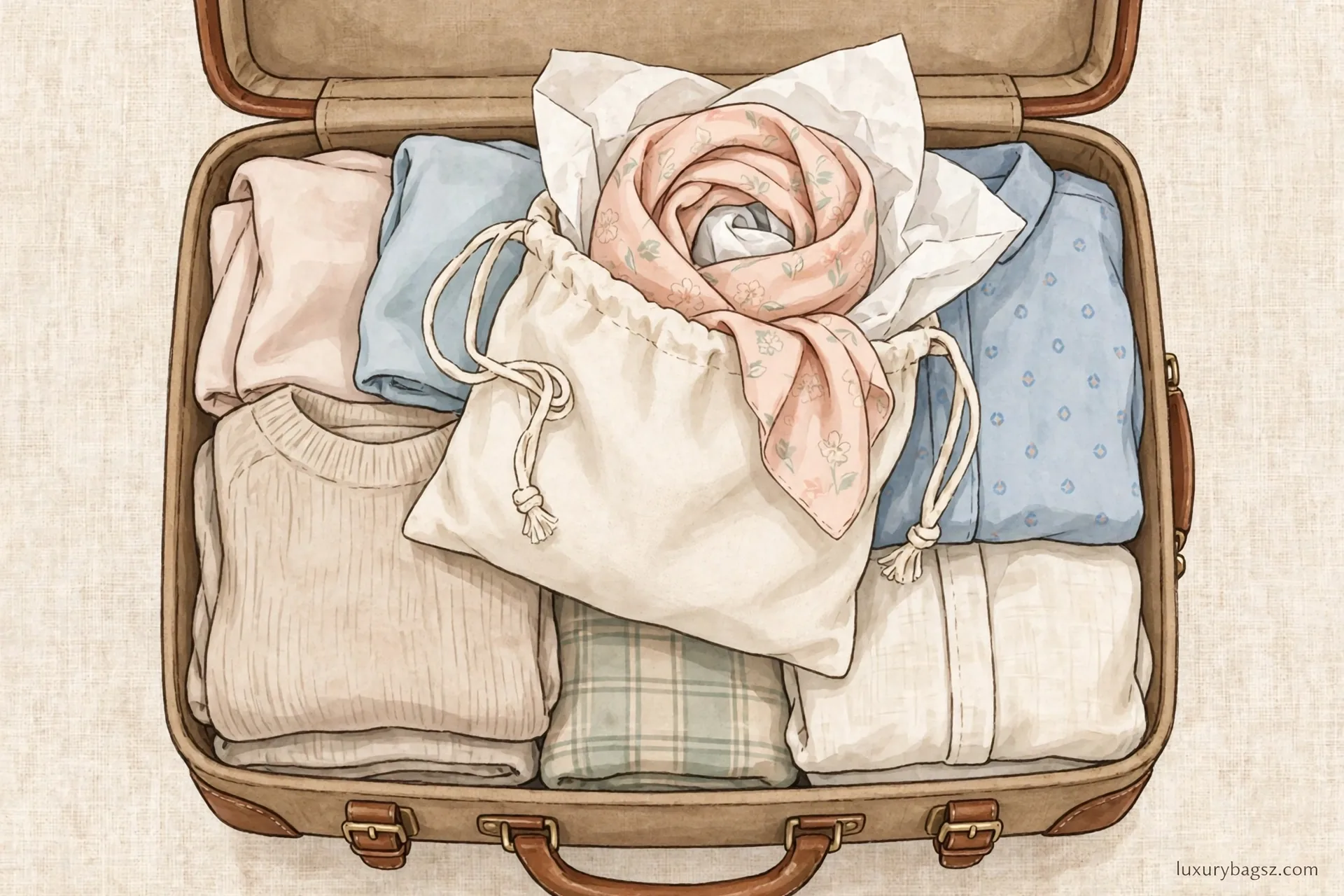
Travel tests good storage habits hardest, because a suitcase is a small, crowded, moving drawer. Roll, do not fold, for travel: a loosely rolled scarf with tissue inside survives far better than a folded square, because the suitcase presses folds deeper with every movement while a roll has no fold to press.
Pack the roll in a breathable cotton pouch, on top of soft clothes, never under shoes, books or a toiletry bag, and never in a squeezed outside pocket.
If you must fold for space, fold loosely with tissue between folds, and unpack and hang the scarf as soon as you arrive. The first hour in a hotel room is the best time to rescue a travel crease: hang it over a wide hanger or towel bar, and use the steamy-bathroom method in the getting-creases-out section for anything that does not drop out on its own.
Do not leave a scarf folded in a suitcase for the whole trip and then fold it again for the journey home; each leg adds fresh lines.
On the journey itself, wear the scarf untied in transit, then retie on arrival, rather than knotted tightly for hours in a warm cabin. On return, untie, air and check it before it goes back into home storage; a scarf moved straight from suitcase to drawer, still folded in its travel shape, carries its travel creases into its next season.
Never use a vacuum compression bag, even for a short trip: the compression creates deep creases and traps moisture, and a scarf from a vacuum bag often needs professional help, not just hanging.
Getting Creases Out: Hanging, Steam, Pressing and Specialists
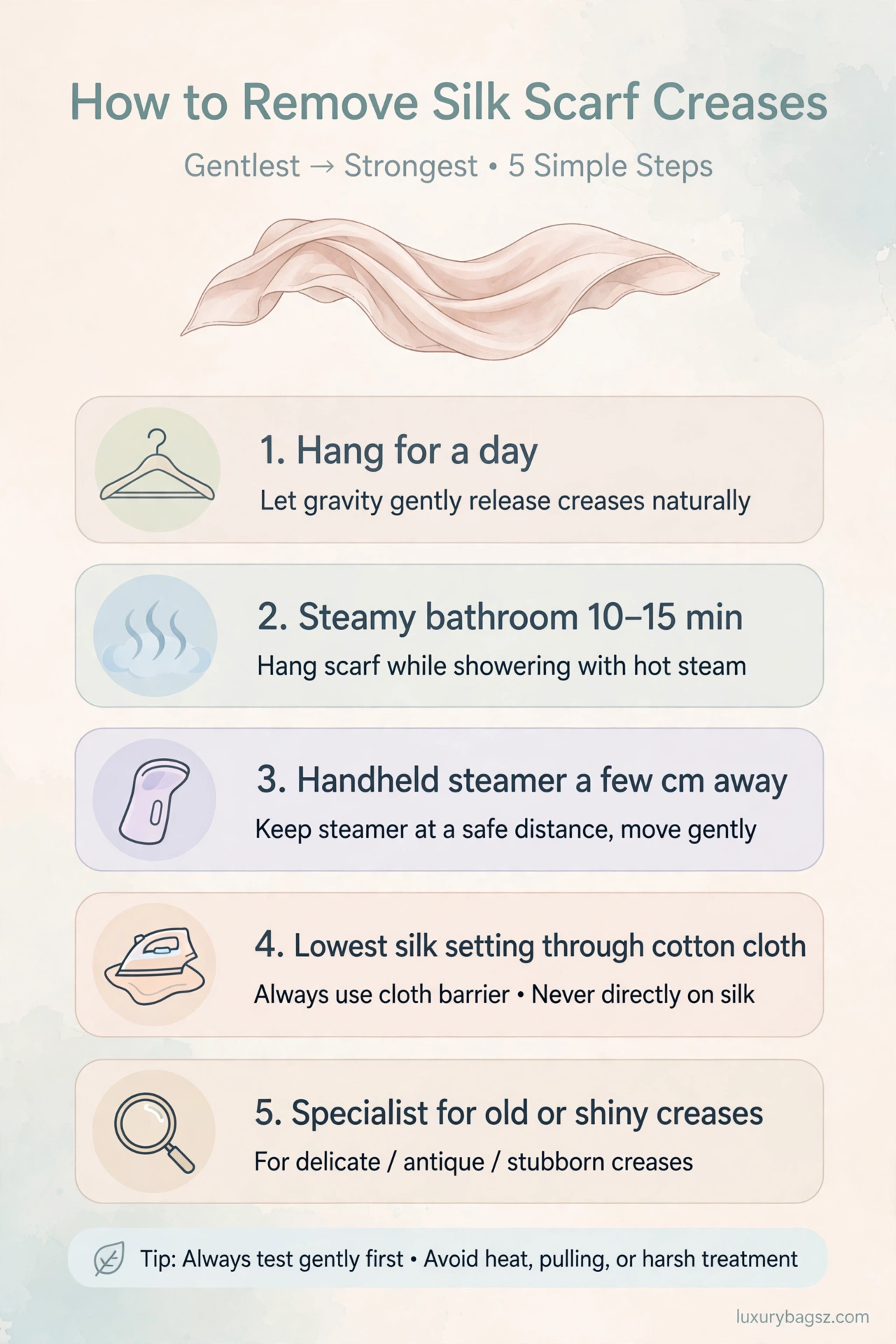
Sooner or later, every silk scarf needs a crease removed. Work through these methods from gentlest to strongest, stopping as soon as the crease relaxes; using the strongest method first is how good scarves get damaged.
Hanging and time. For soft creases, hang the scarf fully open over a wide, padded bar in a shaded room for a day or overnight. Gravity and the silk’s own weight do much of the work. Smooth creased areas gently with your hands, along the crease rather than across it, without pulling the fabric taut. Many day-to-day creases disappear with this alone.
Steam from a bathroom. Hang the scarf in a bathroom after a hot shower, door closed, for ten to fifteen minutes, clear of wet surfaces and direct water. The gentle humidity relaxes silk fibres without direct heat or contact. Smooth creases lightly afterwards, then let the scarf dry fully in a shaded spot before storing or wearing it. This suits light and medium creases and is the safest heat-free option for a valuable printed carré.
A handheld steamer. Hold a clean steamer about 2.5 to 5 centimetres from the fabric, working in slow, downward strokes, never letting it sit in one place or spit water onto the silk. Use distilled water if your tap water is hard, to avoid mineral spots, and test on a hidden corner first.
Let the scarf cool and dry completely before folding or storing it, or creases can snap back as fibres cool. Steaming is the method most silk specialists recommend first, because it relaxes fibres with moist heat and no direct contact.
Ironing, only if you must. Some guides say a medium iron on the reverse is fine; others insist on the lowest silk setting with a pressing cloth; still others say never iron printed silk at home. The risk is real: direct heat can scorch silk, leave a permanent shiny mark, or flatten hand-rolled edges.
If steam has not removed a set crease and you decide to iron, use the lowest silk setting, work on the reverse, place a clean cotton pressing cloth between iron and silk, keep the iron moving, and never press the rolled hems flat. Stop at once if you see shine or smell scorching. For a deep, old crease across a motif you care about, skip home ironing and use a specialist.
A specialist. Take the scarf to a professional cleaner who handles printed silk if the crease is old and set, if the silk is shiny or thinned along the crease, if there is also a stain, or if the scarf is valuable enough that a mistake would be costly.
Tell them how the crease happened and what you have already tried. Professional pressing uses controlled steam and pressure a home iron cannot match, and a specialist will tell you honestly when a crease is permanent.
Never use a wrinkle-release spray on a printed silk carré without testing a hidden area first, and never soak a printed carré to remove creases unless a specialist advises it. Water alone can spot some silk dyes, and a badly dried soaked scarf gains a new set of problems.
What NOT to Do
Some storage mistakes are so common they deserve their own list: each one undoes the good work of the rest of this guide.
Do not iron directly onto silk. No pressing cloth, no low setting, no quick pass is a safe substitute for the cloth-and-low-heat method in the getting-creases-out section, and a hot iron directly on silk is the fastest way to a permanent shiny mark.
Do not store silk in a sealed plastic bag, a plastic box with a tight lid, or a vacuum bag. Plastic traps moisture, stops air circulation, and can encourage mildew and dye migration. Vacuum sealing adds crushing pressure on top of that.
One older guide lists plastic storage boxes among its materials, but the overwhelming advice from textile-care sources is against sealed plastic for silk, and this guide follows that majority: breathable cotton, muslin or an archival box instead.
Do not use elastic bands, tight ribbons, clips or pins to hold a stored scarf. Each one leaves a pressure line, and elastic perishes and can stick to silk. Use a loose cotton tie or nothing at all.
Do not hang a scarf by one corner, on a hook, or on a wire hanger for any length of time. The weight concentrates at one point and distorts the weave.
Do not fold along the same lines for years without changing them. A fold line that is never varied becomes a permanent line, and eventually a weak line.
Do not store a scarf dirty, damp, perfumed or still knotted. These four conditions cause stains, mildew, smells and set creases respectively, and they are all preventable in two minutes at the end of the day.
Do not put heavy items on top of stored scarves, and do not cram a drawer full. Pressure is pressure, whether it comes from a fold, a stack of jeans or a drawer that will not quite close.
Do not use coloured tissue, newspaper or printed paper in contact with silk. Dye and ink transfer, and acids in ordinary paper yellow silk over time. Plain, white, acid-free tissue is the safe choice.
Do not use mothballs, and do not press a scented sachet directly against silk. Mothball fumes can yellow silk; concentrated scent and wood oils can mark it.
Do not store scarves in attics, basements, sunny windows or damp exterior-wall drawers. Temperature swings, light and moisture do slow damage that only shows up seasons later.
Avoiding this list is worth more than any single clever storage product. Most damaged scarves in storage got there through one of these ten mistakes, not through a lack of equipment.
A Collection System: Labelling, Rotation and the Seasonal Check
A single scarf is easy to store well. A collection needs a system, or the scarves at the back of the drawer quietly suffer while favourites get all the attention.
Label rolls and sleeves on the outside, not on the silk. A small paper tag tied loosely to a sleeve, or a label on the outside of a box, lets you find a scarf without unrolling half the drawer. Photographing each scarf next to its tag makes a simple catalogue, useful for insurance or resale. Never pin, stick or write on the scarf itself, and never use adhesive that could transfer to silk.
Rotate the collection. Give stored scarves an outing at least once a season: take each one out, unroll it, let it air and hang for a day, check it for stains, moth signs and new creases, and reroll it along different lines before it goes back.
This catches problems — a damp drawer, a fading top scarf, a moth in one corner — while they are still small. Guides differ on timing, some saying every two to three months and others every three to four; once a season is a rhythm most collectors can actually keep.
Store scarves you wear often where you can reach them, and scarves you keep for special occasions or for the long term in the coolest, darkest drawer. The everyday scarves will be refolded naturally by use, so they need less formal rotation. The stored scarves need the seasonal check most, because nobody is looking at them in between.
Finally, keep bags and scarves in the same system but not the same space. A scarf inside a bag, or a bag on top of a scarf, transfers pressure, dye and hardware marks both ways. The patience that goes into storing a Kelly bag — clean, dry, supported, out of sunlight — is the same patience that keeps a silk scarf crease-free, but each piece deserves its own drawer, sleeve or box.
What Guides Disagree On
Hang or fold for the long term? Some guides recommend hanging as the main method, praising its crease-free drape. Others, including specialist closet advice, say to store silk folded, not hanging, to avoid stretching. Timescale decides it: hanging wins for days, folding or rolling wins for months, and this guide follows that split.
Roll or fold? Some guides present rolling as plainly superior; others present folding along original lines as equally good. Rolling avoids fold lines entirely, which matters most for large printed pieces kept for months, while loose folding with tissue is perfectly good for small pieces worn weekly. Guides that present one method as universal are oversimplifying.
Cedar or not? Most guides recommend cedar or lavender for moths. At least one careful source warns that cedar emits acids harmful to silk and recommends lavender alone. This guide takes the cautious path: lavender near, not on, the scarves, and no cedar in direct contact.
Wash at home or professional cleaning only? General silk guides describe gentle hand washing at home. Advice specific to Hermès printed scarves leans strongly towards professional cleaning, because of the printed dyes and hand-rolled edges. For a printed carré, follow the Hermès-specific advice unless a specialist who has seen your scarf says otherwise.
Iron or steam only? Older guides describe ironing silk on a medium setting on the reverse. Most modern silk guides prefer steaming, allowing ironing only on the lowest silk setting with a pressing cloth. This guide follows the modern majority, because a scorching mistake on a printed carré costs far more than a slightly crisper finish is worth.
Plastic boxes, and humidity figures. One older guide lists plastic boxes among its materials, but overwhelming modern textile advice is against sealed plastic for silk, because it traps moisture, and this guide follows the majority. Humidity figures likewise range from below 50 percent to below 60 percent, with 45 to 55 percent most commonly quoted; a bedroom drawer on an inside wall normally falls in or near that band.
Pick the cautious option where the stakes are high — a valuable printed carré, a long storage period, a deep crease — and the convenient option where the stakes are low — a scarf worn weekly, a short rest on a hanger, a loose fold with tissue.
Final Verdict
Storing a silk scarf without creases is not about buying the right hanger or finding a secret fold. It is a short routine, done consistently: untie the scarf, let it air, check it, roll it loosely with tissue, and put it in a cool, dark, dry drawer where nothing heavy sits on it and nothing sharp touches it.
Change fold lines if you fold, take the scarf down if you hang it for more than a few weeks, and work from hanging to steam to a careful press, in that order, when a crease needs removing. Keep sunlight, damp, sealed plastic, mothballs and hot irons away from silk, and give the collection a seasonal check.
Do that, and a silk scarf will come out of storage looking very much as it went in — soft, flat, and ready to wear. Roll it loose, store it dark and dry, and let it rest between wears. That is the whole secret, and it is enough.
Frequently Asked Questions
Should I roll or fold a silk scarf to avoid creases?
Roll loosely for long-term storage, especially a 90 cm carré or large shawl, because rolling has no sharp fold line to set. Fold loosely with tissue between folds for short-term storage or small formats worn weekly, changing the fold lines every few months.
Is it better to hang a silk scarf or store it in a drawer?
Hang it for a day or two to relax light creases, and store it in a drawer for months. Long-term hanging can slowly stretch the weave, especially in heavier shawls.
Can I store a silk scarf in a plastic bag?
No. Sealed plastic traps moisture and stops air circulation, encouraging mildew and dye migration. Use a breathable cotton or muslin sleeve, or a tissue-lined drawer, instead.
How do I remove creases from a silk scarf safely?
Start with hanging over a wide, padded bar for a day. Next, try a steamy bathroom for ten to fifteen minutes, or a handheld steamer a few centimetres from the fabric. Only if a set crease remains, press on the lowest silk setting, on the reverse, through a cotton pressing cloth, never pressing the rolled hems flat. For old, deep or valuable pieces, use a specialist.
Can I iron a silk scarf directly?
No. Direct heat can scorch silk and leave a permanent shiny mark. Always use a pressing cloth, the lowest silk setting, and the reverse of the scarf, and keep the iron moving. When in doubt, steam instead of ironing.
What is acid-free tissue paper, and do I really need it?
Acid-free tissue is plain, white tissue without the acids and lignin in ordinary paper, which can yellow silk over time. For a season, plain tissue is usually fine; for years, acid-free is the safe, inexpensive choice. Never use coloured tissue or newspaper against silk.
How do I protect a stored silk scarf from moths?
Store only clean, dry scarves, keep the drawer clean, and use lavender sachets near, not on, the scarves. Avoid mothballs, whose fumes can yellow silk, and keep cedar out of direct contact. Check once a season for tiny holes or webbing, and isolate any affected scarf at once.
How should I pack a silk scarf for travel?
Roll it loosely with tissue inside, put it in a breathable cotton pouch, and pack it on top of soft clothes, never under heavy items. Unpack and hang it on arrival, and do not use a vacuum compression bag.
Why does my scarf still crease even though I fold it carefully?
Usually because the same fold lines were used for months, the scarf was put away damp or still knotted, or weight from above pressed the folds deeper. Untie and air it first, fold loosely with tissue, change the lines regularly, and store it where nothing sits on top.
Should I store a twilly differently from a carré?
Mostly the same, with one extra rule: do not leave a twilly wrapped around a bag handle in storage. Store it loose in its own pouch, away from bag hardware, so it does not take on the spiral shape of the wrap.
When should I take a creased scarf to a specialist instead of fixing it at home?
When the crease is old and set, the silk looks shiny or thinned along it, there is also a stain, or the scarf is valuable enough that a home mistake would be costly.






