

What Is a Hermès Avalon Blanket?
The Avalon in Brief
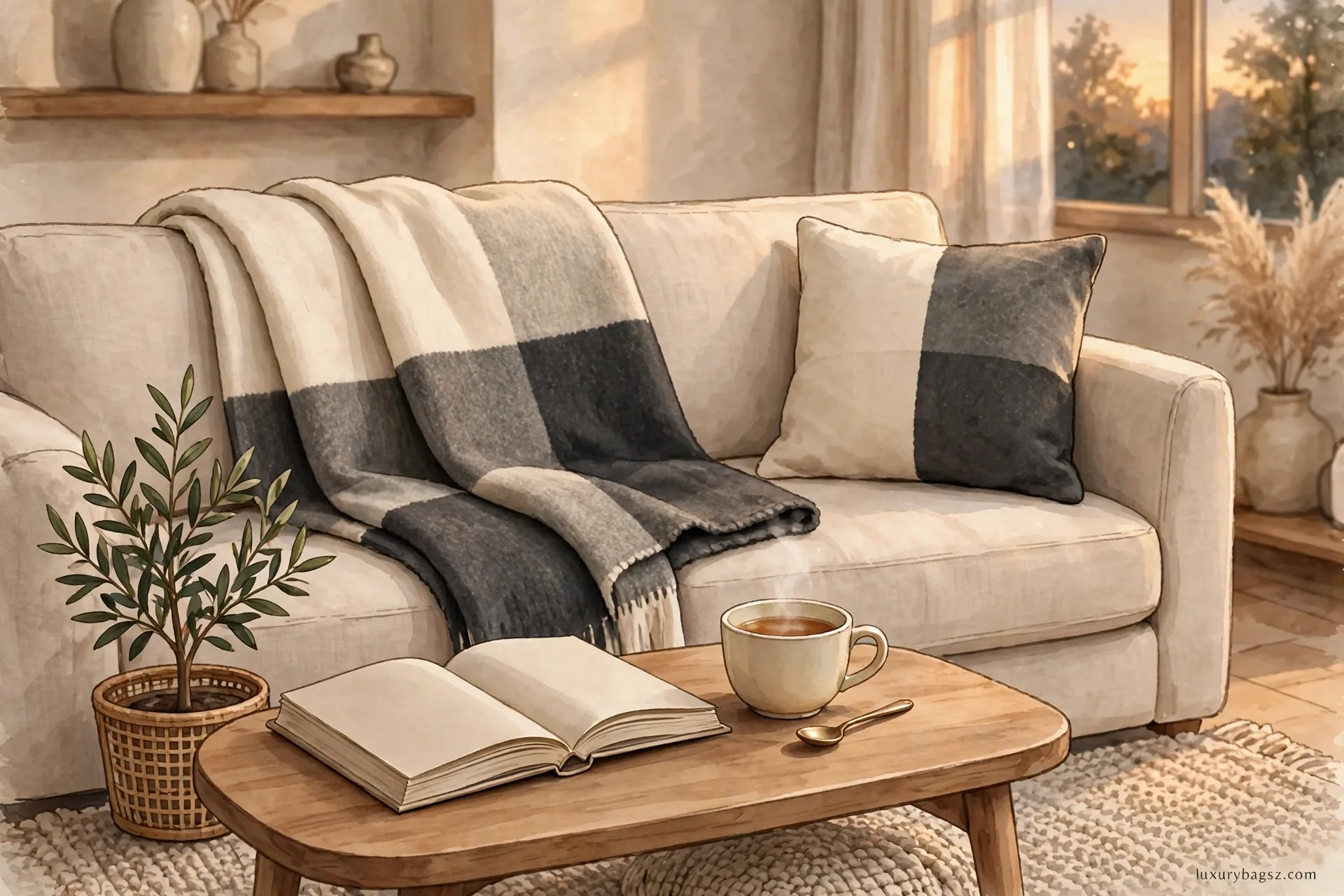
The Hermès Avalon is a woven wool and cashmere throw blanket with an oversized letter motif, made for sofas, beds, and armchairs. It is the house’s most famous home textile, and it has been in production since 1988.
The standard throw measures 135 cm by 170 cm, or about 53 by 67 inches. That is generous for one person, cosy for two, and large enough to fold across the foot of a bed as a decorative layer.
Most current listings describe the blend as 90 percent Merino wool and 10 percent cashmere. Older listings give a different ratio, 85 percent wool and 15 percent cashmere, and that disagreement is stated plainly later in this guide.
The design comes from the coats of arms once printed on horse blankets, which ties the throw to Hermès’s equestrian roots. Folded, it forms a checkerboard of four squares with the letter motif in opposing corners.
If you want one sentence, here it is: the Avalon is a large, warm, graphic wool throw that works as both a blanket and a piece of interior design. Everything else in this guide is detail around that fact.
Key Takeaways
- The Avalon is a woven wool and cashmere throw blanket, introduced by Hermès in 1988.
- The standard throw measures 135 x 170 cm; a smaller baby size is also reported at about 100 x 140 cm.
- Current listings give 90% Merino wool and 10% cashmere, but older listings give 85% wool and 15% cashmere.
- The Avalon III is the current standard version; Hermès publishes no clear changelog for earlier versions.
- The design appears in negative on the reverse, with the colours swapped front to back.
- Prices vary widely by region, version, and condition, so only dated single listings are quoted in this guide.
- For deep cleaning, use a professional cleaner; a full washing guide is a separate topic and is not given here.
Part 1: What the Avalon Blanket Is
The Avalon is a throw, not a bedspread and not a duvet. It is a single woven layer, made to drape over a sofa back, fold across a chair, or warm one or two people on a cold evening.
It belongs to Hermès’s home collection, not its leather goods range. That matters, because it is bought, stored, and cleaned like a fine textile, not like a bag, and its value rests on weave, fibre, and condition.
The throw is woven, not printed, which is why the pattern looks the same from a distance on both sides. A printed throw fades and flattens with washing, while a woven throw keeps its pattern in the yarn itself.
Hermès says the Avalon blankets and pillows were created in 1988, and that the design draws on horse blanket heraldry. The name evokes Avalon, the island of Arthurian legend, which adds a mythic note to a very practical object.
Admirers have called the Avalon the Birkin of the home, and the comparison is about status, not function. Like the Birkin, it is instantly recognisable, widely copied, and bought as much for what it signals as for what it does.
The Avalon is also a gateway piece for many Hermès buyers. It costs far less than a quota bag, it needs no purchase history, and it is often available without a waiting list, which makes it a first Hermès buy for new clients.
That accessibility cuts both ways, because it also makes the Avalon one of the most copied Hermès items. Good fakes exist, so the pre-owned checks later in this guide matter more than they would for a rare piece.
Part 2: Materials, Wool, Cashmere, and the Blend Disagreement
The standard Avalon throw is a blend of Merino wool and cashmere, woven in Great Britain. Merino gives warmth, weight, and structure, while cashmere adds softness and a smoother hand against the skin.
Current resale and retail listings most often state 90 percent Merino wool and 10 percent cashmere. That is the figure on the widely circulated Avalon III listings, and it is the figure to expect on a recent throw’s label.
Older sources disagree, and the disagreement should not be smoothed over. A 2025 Doyle auction listing describes an older Avalon as 85 percent wool and 15 percent cashmere, and a current Hermès Thailand listing for the related Avoine blanket also gives 85 percent wool and 15 percent cashmere.
Those two ratios may reflect different production years, different blanket lines, or both. The honest rule is to trust the woven label on the throw in front of you, not a ratio quoted in an article, including this one.
Merino wool is a fine, soft sheep’s wool, and it is warmer for its weight than coarser wool. That is why a single-layer Avalon feels warmer than its thickness suggests, and why it drapes rather than standing stiff.
Cashmere, even at 10 percent, changes the feel noticeably. It softens the wool’s surface, reduces itch, and gives the throw a smoother finish, which is why the Avalon feels kinder on bare skin than a pure wool blanket.
A guide comparing a Hermès cashmere shawl with a silk scarf explains how cashmere behaves as a fibre, and that behaviour carries over here. Cashmere is soft and warm, but it is also delicate, and it pills more readily than wool.
Pilling is normal on a wool and cashmere blend, especially where the throw rubs against a sofa or a seatbelt. A fabric comb or a gentle de-pilling pass keeps it tidy, and pilling alone is not a sign of a fake or a flaw.
Weight is another clue to quality, because a real Avalon has a reassuring heft. It is not a featherlight travel wrap, and a throw that feels thin and papery is unlikely to be the same weave, whatever its label claims.
Part 3: Sizes and Dimensions, and Why Sources Differ
The standard Avalon throw is listed at 135 cm by 170 cm in most current listings. That converts to about 53 inches wide by 67 inches long, which is the figure many guides quote in inches.
That size covers one person generously from shoulders to feet, and it covers two people sitting close. It also works folded in half across a double bed, or folded in quarters as a sofa accent.
Some listings give 136 cm by 170 cm instead of 135 cm, a one-centimetre difference. That gap is almost certainly measuring or rounding variation, not a different model, and it is too small to matter in use.
Older and vintage throws show larger gaps, and those are worth noting. A Bukowskis auction listing gives 130 cm by 170 cm for a vintage wool and cashmere Avalon, five centimetres narrower than the current standard.
An even older Avalon in a 2025 Doyle listing measured 58 inches by 38 inches, far smaller than the current throw. That piece may be an earlier or smaller version, and it shows why a single size figure cannot cover every Avalon ever made.
The baby Avalon is a separate size, reported on owner forums at about 39.5 inches by 55 inches, or roughly 100 cm by 140 cm. That figure is a forum report, not an official Hermès measurement, so treat it as approximate.
A baby throw fits a crib mattress, but it will not cover a twin bed, which is 39 inches wide but 78 inches long. It works later as a stroller wrap or folded at the foot of a twin bed, but not as a full bed cover.
When you buy, measure the throw yourself if you can, or ask the seller for a tape-measure photo. Listings copy dimensions from each other, and a copied error can travel across dozens of pages before anyone checks it.

Part 4: The Design, the Letter Motif, and the Reverse
The Avalon design is a large letter motif set in a block pattern, drawn from the heraldic marks on horse blankets. From across a room, the motif reads as a bold graphic, which is why the throw photographs so well in interiors.
Folded in a particular way, the throw forms a checkerboard of four squares, with the letter motif appearing in two opposing corners. That folded look is the image most people recognise, even if they have never seen the throw open.
Opened fully, the throw shows the motif at all four corners, with contrasting colours setting the letters against the ground. The corners are the point, and the middle of the throw is deliberately quieter, so the eye goes to the edges.
The reverse is just as important as the front, because the design appears in negative on the back. Where the front shows a dark motif on a light ground, the back shows a light motif on a dark ground, and the colours swap.
That negative reverse is a useful authenticity clue, because cheap copies often print one side and leave the back blank or faded. A genuine woven Avalon has a real pattern on both sides, even though the colours are inverted.
The edges are finished with a whipstitch, also called an overlock stitch, in a contrasting or matching thread. On the Avalon III cushion, for example, the stitching is described as grey overlock stitching, and even stitching is a mark of careful making.
Fringe is not an Avalon feature, so a throw with a long fringe is a different design, not an Avalon. If a listing calls a fringed throw an Avalon, the name is being used loosely, and the piece deserves a closer look.
The motif itself is sometimes described as a signature letter, and it is the most copied element of the design. Copies get the letter roughly right but miss the weave, the weight, and the reverse, which is why handling a throw beats judging it from one photo.
Part 5: The Avalon III and Other Versions
The Avalon III is the version most often listed today, and it is the current standard throw at 135 cm by 170 cm. When a seller writes Avalon III, they usually mean the standard wool and cashmere throw in its current form.
Hermès does not publish a clear changelog explaining what changed between the first Avalon, the second, and the third. Articles that claim a detailed version history are filling gaps with guesswork, and this guide will not do that.
What can be said is that earlier Avalons differ in size and blend from current ones, as the auction records show. An older throw may be smaller, or carry the 85/15 blend, without being fake, because production has changed over nearly four decades.
The pure cashmere Avalon is a distinct and more expensive version, introduced around 2017 according to one guide. It is made from 100 percent Mongolian cashmere, handwoven in Nepal, with a whipstitched edge in the house’s equestrian style.
That pure cashmere version is softer and lighter than the wool blend, but it is also more delicate and far dearer. It suits a careful owner and a low-traffic room, while the wool blend suits everyday sofa use.
The baby Avalon is another distinct version, smaller and made for nurseries and strollers. Its label carries a baby designation, which matters at resale, because a baby throw is harder to sell as a home decor piece than a standard throw.
The Avalon cushion, or Coussin Avalon III, is a matching pillow cover in the same merino and cashmere blend, about 50 cm by 50 cm. It is a companion piece, not a smaller blanket, and it is often sold separately from the throw.
Other Hermès blankets sit outside the Avalon family but get confused with it. The Avoine blanket shares the letter pattern and the 85/15 blend, while the Avalon Tangram uses a geometric, dip-dyed pattern, and the Parcours de Sangles blanket uses a strap motif.

Part 6: Colours and Patterns
Avalon throws come in two-tone pairings, with one colour for the ground and a contrasting colour for the motif. The classic pairings use écru, the warm off-white, against a darker or brighter second colour.
Écru and camel is the quietest and most versatile pairing, and it suits neutral rooms without drawing attention. Écru and rouge H, the house’s signature red, is bolder, and it reads as unmistakably Hermès from across a room.
Black and écru is the sharpest pairing, and it suits modern rooms with dark furniture. Grey and écru is softer than black, and it is a good choice if black feels too hard against pale upholstery.
Orange and écru is a bright, warm option, and it echoes the house’s famous orange packaging without matching it exactly. Absinthe and sisal, a green and natural pairing seen in auction listings, is rarer and more seasonal.
Colour names matter on the pre-owned market, because a vague word like tan or brown can hide the wrong pairing. Ask the seller to name both colours from the listing, and compare them with daylight photos before paying.
Seasonal colours appear and disappear, so a colour that was easy to find five years ago may be rare now. Rarity changes price, but it does not change warmth or quality, so buy the colour you like living with, not the colour you think will impress a buyer.
The same bold graphic language appears across Hermès textiles, and the Carré 90 scarf shows how the house uses large, flat motifs on silk. The Avalon does on wool what the Carré does on silk, at a much larger scale.
Fading is the main colour risk, and it comes from sunlight, not from age alone. A throw left in a sunny window will fade on the exposed side, while the folded layers stay bright, which leaves a visible stripe when the throw is opened.
Part 7: How to Tell the Avalon Apart from Similar Throws
The Avalon is often confused with other luxury throws, and the confusion is understandable, because the market is full of block-pattern and letter-motif blankets. The differences are in weave, weight, and finish, not in the first glance.
A generic block-pattern throw may look similar in a photo, but it is usually printed rather than woven. Turn it over, and the back will be faded or blank, while a genuine Avalon shows a crisp negative pattern on the reverse.
Weight is the second separator, because the Avalon has a dense, substantial weave. A light, thin throw with a similar pattern is almost certainly a different product, even if the colours match closely.
The whipstitch edge is the third separator, because it is even, tight, and consistent all round. A copy may have a rolled hem, a fringe, or uneven stitching, and any of those is a reason to question the listing.
Other Hermès blankets are the fourth source of confusion, and they are genuine Hermès pieces with different names. The Avoine, the Tangram, and the Parcours de Sangles are all real, but they are not Avalons, and their prices differ accordingly.
Size is the fifth separator, because the standard Avalon is 135 cm by 170 cm, and a throw far from that size needs an explanation. It may be a baby throw, an older version, or a different blanket altogether, and the seller should say which.
Labels are the sixth separator, and a genuine throw carries a woven label with fibre content and care details. A missing label proves nothing on its own, because labels can be cut out, but a wrong label, with the wrong blend or a misspelt name, is a warning.
If you cannot handle the throw before buying, ask for photos of the front, the reverse, the edge stitching, and the label. A seller who shows only one styled shot is not giving you enough to judge, and a careful seller will not mind the extra photos.

Part 8: Styling and Use at Home
On a sofa, the Avalon works best folded in quarters and draped over one arm or across the back. That folded look shows the checkerboard pattern, and it keeps the throw within reach without covering the whole sofa.
Across a bed, fold the throw in half lengthways and lay it across the foot, with the motif corners visible. That placement adds colour without hiding the bedding, and it lets you pull the throw up on a cold night without remaking the bed.
In an armchair, drape the throw over the back and let the ends fall evenly on both sides. That arrangement warms the chair, protects the upholstery, and looks intentional rather than thrown on in a hurry.
For two people on a sofa, open the throw fully and share it, with one motif corner on each lap. At 135 cm wide, it covers two seated adults to the waist, which is the practical limit for shared warmth.
The Avalon also works as a picnic or outdoor layer, but wool and cashmere are not outdoor fabrics. Damp grass, rough stone, and food stains all age a fine throw faster than sofa use, so save the Avalon for indoors and use a cheaper blanket outside.
In a nursery, the baby Avalon works draped over a crib rail or folded on a nursing chair. Babies should not sleep under loose blankets in their first year, so the baby throw is for supervised use, strollers, and decoration, not for unsupervised crib sleeping.
Colour choice changes the room more than any other decision, so test the pairing before committing. A bold rouge H throw will dominate a pale room, while an écru and camel throw will blend in, and both effects are valid if they are what you want.
Rotate the throw occasionally, so the same fold lines and the same sun exposure do not wear one part faster than the rest. Refolding along different lines also prevents permanent creases in the weave, which show on a two-tone pattern.

Part 9: Warmth, Weight, and Everyday Practicality
The Avalon is warm, but it is not a duvet, and buyers who expect duvet warmth will be disappointed. It is a single woven layer, and its warmth comes from wool’s insulating fibres, not from loft or filling.
Merino wool traps warm air in its fibres, which is why the throw feels warm quickly after you pick it up. It also breathes, so it is less clammy than a synthetic fleece on a mild evening, and it suits rooms that are cool rather than cold.
The throw’s weight is part of its comfort, because a heavier throw stays in place and feels grounding. A light throw slides off at the slightest movement, while the Avalon settles and stays where you put it.
That weight is also a drawback for travel, because a 135 cm by 170 cm wool throw is bulky in a bag. It is a home blanket, not a travel wrap, and buyers who want a travel piece should look at a lighter cashmere shawl instead.
Static is rarely a problem with wool, which is a small but real advantage over synthetic throws. Wool also resists odours better than synthetics, so the Avalon needs airing rather than frequent washing, which suits its delicate fibre mix.
Pet owners should know that wool and cashmere attract pet hair, and that claws can snag a woven throw. A throw on a pet’s favourite chair will show wear faster, so keep the Avalon for human seating or accept the extra maintenance.
Allergies are another practical point, because wool can irritate sensitive skin, even with cashmere in the blend. If wool itches you in a sweater, it will likely itch you in a throw, and a cotton or silk alternative is the kinder choice.
Layering is where the Avalon earns its keep in a cold house, because it works over a duvet, under a heavier blanket, or on its own. A throw that layers well gets used in every season, while a throw that only works alone spends half the year folded away.
Part 10: Care Basics, and When to Call a Professional
Daily care for an Avalon is simple, and it starts with airing rather than washing. Shake the throw out, hang it over a chair for an hour, and let fresh air remove everyday odours before they settle into the fibres.
Brush off lint and surface dust with a soft clothes brush, working in one direction. That habit keeps the weave looking crisp, and it removes the surface debris that turns into matting if left alone.
Small marks should be blotted, not rubbed, with a clean dry cloth, and a stain should never be attacked with a harsh household cleaner. Rubbing pushes a mark deeper into woven wool, and a wrong cleaner can bleach a two-tone pattern.
For deep cleaning, entrust the throw to a professional cleaner with experience in fine wool and cashmere. Hermès’s own general advice for its fine textiles is to avoid home washing and to use a professional cleaner, and that advice fits the Avalon well.
Tell the cleaner the exact fibre content from the label, and mention the two-tone pattern, so they can check for dye transfer. A cleaner who knows wool and cashmere will also know to avoid heat and agitation, which shrink and felt wool.
Do not machine wash, tumble dry, or iron the throw at home, even if a generic wool setting looks safe. The weave, the whipstitch edge, and the two-tone dyes all react badly to heat and agitation, and the damage is often irreversible.
A full washing guide for this blanket is a separate topic, and it is not given in this guide. The next article in this batch covers washing in detail, and this guide deliberately stops at professional cleaning to avoid contradicting it.

Part 11: Prices, Dated Single Listings Only
Avalon prices vary by region, version, colour, and condition, and no single number tells the whole story. The figures below are single listings and dated claims found on 1 November 2026, not averages, and they will change.
On Luxury Promise, an Avalon III throw in rouge H and écru was listed at £1,100 on the search date. That listing was located in Hong Kong, was sold without a box, and excluded international shipping and insurance, so it is not a delivered price.
On the same site, a black and écru Avalon blanket was listed at £1,870 on the same date. That is a different colour and a different listing, and the £770 gap between the two shows how much individual listings can differ.
Also on Luxury Promise, an orange Avalon blanket was listed at £1,000 on the same date. Three listings from one seller, on one day, already span £1,000 to £1,870, which is why an average would mislead.
Secondary guides disagree on United States retail, and that disagreement is stated here rather than resolved. One buying guide quotes $1,625 for the Avalon III throw, while a 2026 home decor guide quotes $2,050 for the same throw in the United States.
Those two figures cannot both be the current boutique price, and neither was verified at a Hermès boutique for this guide. Check the price in your own region before buying, and treat any article’s retail figure as a claim to verify, not a fact.
Older guides quote lower prices, and those are useful only as history. One older guide says the blanket started at $1,300, while a 2021 Chiswick auction estimate for an Avalon III throw was £300 to £500 plus fees, which shows how much auction and retail prices differ.
The pure cashmere version sits far above the wool blend, with one older guide putting it from about $3,000 to over $4,700. That range is old and unverified here, but the direction is right: pure cashmere costs multiples of the standard throw.
For cleaning costs, a guide to cleaning a Hermès canvas bag shows how different the advice is for a washable canvas weave. A wool and cashmere throw needs professional care, and that care cost belongs in your buying budget too.
Part 12: Storage at Home and Between Seasons
Store the Avalon folded, clean, and dry, in a breathable cotton bag or a clean drawer. Plastic bags trap moisture, and moisture invites mildew and moths, which are the two worst enemies of stored wool.
Moths deserve special attention, because wool and cashmere are moth food. Cedar blocks, lavender sachets, or moth traps near the storage spot help, but keep any scented product from touching the throw directly, or the scent will transfer.
Keep the throw away from direct sunlight in storage as well as in use, because sun fades one side faster than the other. A dark, cool cupboard is better than a sunny shelf, and a drawer is better than either if you have the space.
Do not store the throw pressed against dark or brightly dyed textiles for long periods, because colour transfer happens slowly in warm storage. A cotton layer between the throw and other items prevents that quiet damage.
The same storage logic that protects larger Hermès pieces applies here, and a guide to storing a Hermès Kelly bag sets out the dust bag, stuffing, and humidity habits in full. Scale those habits down, and they work for a throw too.
Folding without creases matters for a patterned throw, because a hard crease shows across a two-tone design. A guide to storing a silk scarf without creases covers the rolling and padding habits that keep folds soft, and rolling works for a throw as well.
Between seasons, take the throw out, shake it, air it, and refold it along different lines. That single habit prevents permanent creases, lets you check for moth damage early, and keeps the throw ready for the next cold snap.
Part 13: Pre-Owned Buying Checks
Start with the woven label, because it should state the fibre content, the maker, and the care details. A label that gives the wrong blend, a misspelt name, or no care information at all is a reason to pause, not to proceed.
Next, check the whipstitch edges, which should be even, tight, and consistent all round. Loose threads, fraying, or a re-stitched edge suggest heavy wear or repair, and repair on a two-tone throw is hard to hide.
Then check the reverse, which should show the design in negative, with the colours swapped front to back. A back that is blank, faded, or identical to the front, rather than inverted, does not match the woven Avalon construction.
Check closely for moth holes and stains, especially along fold lines, where damage hides. Hold the throw up to a light, and look through the weave, because small holes show as bright points against the light.
Ask for daylight photos, because indoor lighting flatters colours and hides fading. A seller who photographs the throw in natural light, front and back, is giving you the information you need, while a seller who refuses is not.
The same authentication mindset applies across Hermès textiles, and a guide to spotting a fake Hermès silk scarf covers the label, weave, and photo habits in scarf form. The habits transfer directly, even though the products differ.
Price is a check in itself, because a genuine Avalon in good condition holds value well. A price far below the dated listings in this guide usually means a flaw, a fake, or a different blanket, and it deserves a professional opinion before you pay.
Keep the box, the receipt, and any boutique packaging if the seller offers them, because provenance helps at resale. A throw with a clear buying history is easier to sell than one with no history, even when both look identical.

Part 14: Who Should Buy an Avalon, Who Should Not, and Common Mistakes
The Avalon suits buyers who want one beautiful, warm throw for a sofa or a bed, and who will use it indoors. It suits design lovers, first-time Hermès buyers, and anyone who wants a piece that works every winter.
It suits gift buyers too, because it is one-size, unisex, and easy to choose in a neutral pairing. Écru and camel is the safe gift choice, while rouge H is the bold one, and the recipient’s room should decide between them.
The Avalon does not suit buyers who want a machine-washable, pet-proof, outdoor blanket. Wool and cashmere need gentle handling, and a household with muddy dogs, small children, and outdoor picnics will wear an Avalon out fast.
It also does not suit buyers who are sensitive to wool, because the cashmere content softens the feel but does not remove wool entirely. If wool irritates your skin, a silk or cotton throw is the kinder and cheaper answer.
Common mistakes include buying the cheapest listing without checking the size, the blend, or the reverse. A baby throw priced as a standard throw, a fringed copy priced as an Avalon, and a faded throw photographed in dim light are all listings that punish haste.
Another mistake is treating the Avalon as a bedspread for a large bed, because 135 cm by 170 cm will not cover a double bed. It is a throw, and it works as a layer across the foot of a bed, not as the main bed cover.
The final mistake is buying for investment first and use second, because the Avalon holds value reasonably well but is not a guaranteed profit piece. Buy it to use and enjoy, and treat any resale value as a bonus, not a promise.
Part 15: What Rivals Miss, and What to Check Before You Spend
Many rival guides quote a single price without a region, a version, or a date, which makes their figure useless. A United States retail claim, a Hong Kong resale listing, and a 2021 auction estimate are three different facts, and blending them helps nobody.
Other guides give a single blend ratio as if every Avalon ever made shared it, which the auction record disproves. The 90/10 and 85/15 figures both appear in credible listings, and a guide that hides that conflict is hiding useful information.
A third gap is size, where guides quote 135 cm by 170 cm and stop, ignoring older, smaller, and baby versions. A buyer who meets a 130 cm vintage throw or a 100 cm baby throw needs to know those exist, or they will wrongly call a real piece fake.
Colour gaps are common too, because guides list colours without saying which are current and which are seasonal. A colour that was easy to find in 2020 may be rare now, and rarity changes both price and waiting time.
Care gaps follow the same pattern, with guides either telling readers to machine wash a fine wool throw or telling them nothing at all. Professional cleaning is the safe middle ground, and it is stated plainly in this guide for that reason.
Some sellers claim the Avalon is handmade in the sense of handwoven throughout, which overstates the case. The throw is woven in Great Britain, and the pure cashmere version is handwoven in Nepal, but the standard throw’s production is a mill process, not a single artisan’s handwork.
Guides also underplay the reverse, treating it as a detail rather than a check. The negative reverse is one of the fastest ways to separate a woven Avalon from a printed copy, and it deserves the attention this guide gives it.
What this guide adds over thinner rivals is plain disagreement, stated rather than smoothed over. Blend ratios, dimensions, and prices all conflict across sources, and a buyer who knows that shops more carefully than one who does not.
If you read another Avalon guide after this one, test it against three questions. Does it date its prices, does it name both blend ratios, and does it tell you to check the reverse?
A guide that passes all three is a guide you can trust for the basics. A guide that fails any of them may still have nice photos, but its facts need checking elsewhere before you spend money.
Frequently Asked Questions
What is a Hermès Avalon blanket?
The Avalon is a woven wool and cashmere throw blanket with a large letter motif, introduced by Hermès in 1988. It is made for sofas, beds, and armchairs, and it is the house’s most famous home textile.
How big is the standard Avalon throw?
Most current listings give 135 cm by 170 cm, or about 53 by 67 inches. Older and vintage throws differ, with 130 cm by 170 cm and smaller sizes also recorded, so check the listing in front of you.
What is the Avalon made of?
Current listings most often state 90 percent Merino wool and 10 percent cashmere. Older listings give 85 percent wool and 15 percent cashmere, so trust the woven label on the throw itself.
What is the Avalon III?
The Avalon III is the current standard version of the throw, at 135 cm by 170 cm in the wool and cashmere blend. Hermès publishes no detailed changelog for earlier versions, so exact differences between generations are not officially documented.
How much does an Avalon blanket cost?
Prices vary by region, version, and condition. Single listings found on 1 November 2026 include £1,100 for an Avalon III in rouge H and écru, £1,870 for a black and écru Avalon, and £1,000 for an orange Avalon, all from one resale seller.
Can you wash an Avalon blanket at home?
This guide does not give a home washing method, because deep cleaning should go to a professional cleaner experienced with fine wool and cashmere. A full washing guide is a separate article, and machine washing or tumble drying at home risks shrinking and felting the weave.
What colours does the Avalon come in?
Two-tone pairings are the norm, with écru against camel, rouge H, black, grey, orange, and rarer seasonal colours such as absinthe and sisal. Colour availability changes by season, so check current listings rather than assuming every colour is always available.
Is the Avalon a good gift?
Yes, for the right recipient, because it is one-size, unisex, and easy to choose in a neutral pairing such as écru and camel. It is a poor gift for someone sensitive to wool, or for a household that needs a machine-washable blanket.
How do you spot a fake Avalon?
Check the woven label, the even whipstitch edges, and the reverse, which should show the design in negative with colours swapped. Ask for daylight photos front and back, and check for moth holes along fold lines before paying.
Is the Avalon worth buying?
It is worth buying if you want a warm, graphic, well-made throw for indoor use and you will care for it properly. It is not worth buying if you need a washable, pet-proof, or outdoor blanket, because wool and cashmere are not built for that life.
Conclusion
The Hermès Avalon is a woven wool and cashmere throw, introduced in 1988, sized at 135 cm by 170 cm in its current standard form, and patterned with a bold letter motif drawn from horse blanket heraldry. It is warm, graphic, and instantly recognisable, and it earns its place on a sofa or at the foot of a bed.
Buy with the disagreements in mind, not in spite of them. Check the label for the blend, measure the throw rather than trusting a copied dimension, and look at the reverse, where the negative design tells you more than any styled photo.
Choose a colour you like living with, budget for professional cleaning, and store the throw clean, dry, and away from moths and sunlight. Those habits cost little, and they protect a piece that should last for years.
If your life suits a fine indoor throw, the Avalon is one of the most satisfying Hermès pieces you can own. If your life needs a washable workhorse, buy that instead, and let the Avalon be the right blanket for the right home.






